 Skip to content
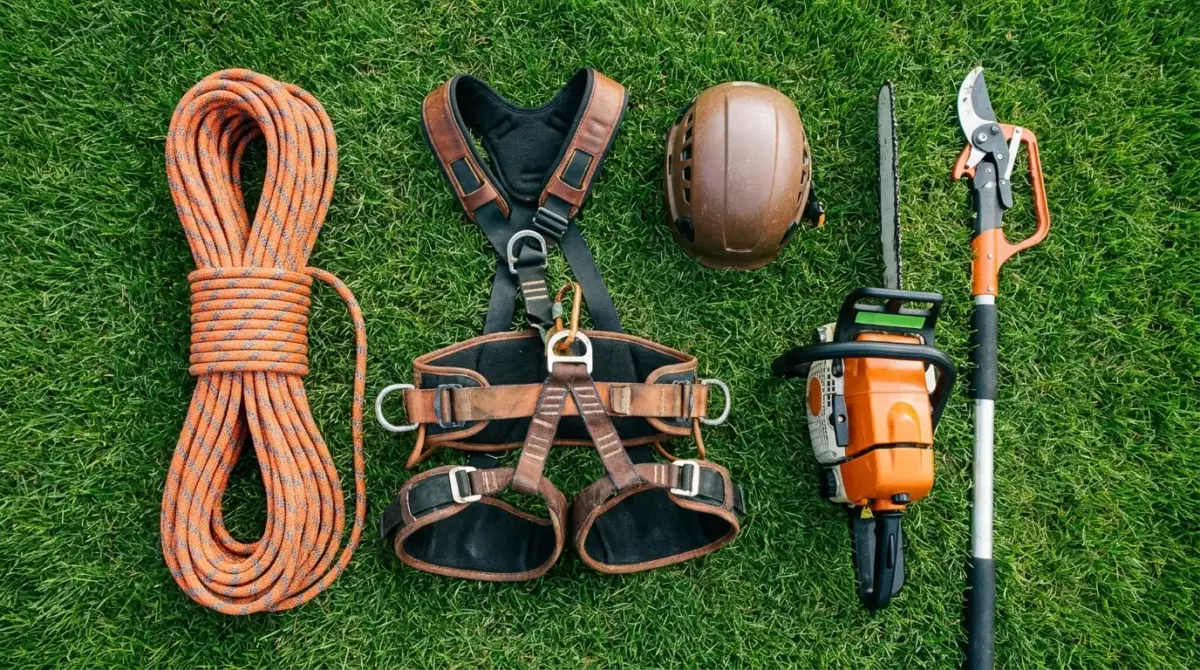
There is real work a homeowner can do with a pole saw on a Saturday, and there is work where the difference between a good day and an ambulance is rope technique. This guide draws the line: what is reasonable to handle yourself, what needs climbing gear and insurance behind it, and how to tell which side of that line your tree sits on.
Some tree work is genuinely DIY-friendly. You don’t need to call a pro every time a branch droops. But the line between “weekend project” and “emergency room visit” is closer than most homeowners realize, and crossing it is one of the most common ways people get hurt on their own property.
Here’s how to decide when to grab a saw versus when to call a certified arborist.
What You Can Safely Do Yourself
Realistic DIY tree work includes:
- Pruning small branches (under 2 inches diameter) on small trees (under 15 feet) you can reach from the ground
- Removing dead branches you can grab from a stable ladder no higher than 6 feet
- Trimming shrubs and ornamental small trees
- Clearing brush and dead growth around the base of trees
- Cutting up already-fallen branches that are clearly stable on the ground
- Watering, mulching, and basic soil care
- Identifying problems and calling a pro
This list has limits for a reason — every item on it keeps you on the ground or near it, with controllable forces and clear escape paths.
When to Hand It Off to a Pro
Any of these means it’s professional time:
The Work Requires Going Above 10 Feet
According to the CDC’s NIOSH tree care safety data, falls from height are the #1 cause of tree work fatalities. Above 10 feet, the consequence of any mistake — slipping, branch giving way, equipment failure — becomes life-altering or fatal.
Professionals use climbing systems, secondary tie-ins, and aerial bucket trucks specifically because ladders at height kill people every year.
Anything Involving a Chainsaw Above Shoulder Height
Chainsaws are dangerous on the ground. They’re catastrophic above your head. Kickback alone kills experienced loggers every year. Operating one above shoulder height while standing on a ladder or in a tree is the highest-risk thing a homeowner can do in their yard.
The job is not worth the risk. Period.
Trees Near Power Lines
Energized power lines kill quietly. You don’t have to touch them — a wet branch contacting the line can complete the circuit through your saw. In Massachusetts, work within 10 feet of power lines must be done by qualified line-clearance arborists, not homeowners and not general tree services either.
Tree Removal of Any Real Size
Felling a tree that’s taller than your house requires controlling several thousand pounds of falling wood with rope, wedges, and proper notch cuts. Get it wrong and the tree falls on what you didn’t want it to fall on. The math is unforgiving — a 60-foot oak weighs more than 2 cars.
Storm-Damaged Trees with Tension or Compression
A tree that bent under wind, snapped partially, or got tangled with another tree has stored energy you can’t see. The wrong cut releases that energy unpredictably. The “barber chair” — where a partially-cut trunk splits vertically and snaps backward — is one of the most common fatal accidents in storm cleanup.
Hazard Assessment
Knowing whether a tree is dangerous, why it’s dangerous, and what level of risk it presents requires training. Certified arborists earn their credentials through years of study and hundreds of hours of fieldwork. A homeowner looking at a tree can’t reliably evaluate root structural integrity, internal decay, lean potential, or species-specific failure modes.
How to Verify You’re Actually Hiring an Arborist
“Tree guy” and “arborist” aren’t the same job. A certified arborist holds credentials from the International Society of Arboriculture, has passed exams on tree biology, pruning standards, safety, and soil science, and is required to do continuing education to maintain certification.
When booking, ask:
- Is the company ISA-certified, and which staff members hold the cert?
- Can they show proof of general liability insurance AND workers’ compensation?
- Are they licensed in Massachusetts (sole proprietors and LLCs both need this)?
- Do they pull tree warden permits as part of the job?
- How do they price — flat rate or hourly, with what included?
Anyone hesitating on those questions isn’t the company you want on your property.
What the Cost Buys You
Professional tree work in Massachusetts costs more than in many states. The reasons:
- Workers’ comp rates for arborists are among the highest in any trade
- Equipment — bucket trucks, chippers, grinders — is expensive and depreciates fast
- ISA-certified arborists command higher wages because the certification is genuinely hard to earn
You’re not just paying for the cut. You’re paying for the training, the insurance, the equipment, and the years of experience that make the work go safely.
The DIY Mistakes That Cost the Most
If you do tackle the safe DIY work, avoid these common mistakes:
- Topping — cutting back to stubs. This wrecks the tree’s structure permanently and creates weak regrowth that fails in storms
- Flush cuts — cutting branches flush with the trunk. Prevents proper healing. Always leave the branch collar intact
- Lion-tailing — stripping all the interior foliage and leaving tufts at the ends. Makes branches more storm-prone, not less
- Pruning during the wrong season — sap-bleeders in spring, oaks during oak wilt window
- Using climbing spikes on a live tree — leaves permanent wounds that invite disease
Bottom Line
The line between DIY and pro is height, weight, and proximity to anything you can’t afford to break. Ground-level small pruning is fine. Going up a ladder with a chainsaw is when you should be on the phone instead. Every Massachusetts tree service can tell you stories about homeowners they had to rescue mid-job — or wished they’d been called first. Don’t be the cautionary tale.
Trusted Local Network
Property-management decisions involving trees often coincide with HVAC and insurance trades. For homeowners outside MA, HVAC services for property-system coordination handle that scope. And for the claim advocacy that runs alongside major property issues, public insurance adjuster services represent policyholder interests.
Your Massachusetts Tree Trimming Specialists
If your tree work is past the safe DIY line, Norfolk Tree Service serves Norfolk County, Middlesex County, and Bristol County — including Waltham, Lexington, Watertown, Milton, and 40+ surrounding towns. Our ISA-certified arborists handle tree trimming safely with full insurance and permits. Contact us today for a free consultation.