 Skip to content
Expert Tree and Shrub Planting by Norfolk Tree Service
"*" indicates required fields
How It Works
Call or Request a Quote
Tell us what you need over the phone or online.
Free On-Site Estimate
A certified pro assesses the job and gives you a clear written quote.
We Handle It & Clean Up
Safe work, plus full cleanup and haul-away when we leave.
Tree and Shrub Planting in Massachusetts
Massachusetts is renowned across the country for its breathtaking natural beauty, defined by lush, sprawling landscapes, deeply wooded suburban enclaves, and impressive seasonal transformations. From the lively, fiery hues of the famous New England autumn foliage to the delicate, fragrant blossoms of early spring, trees and shrubs are the absolute foundation of our local environment. They define our neighborhoods, provide shelter for our local wildlife, and offer a profound sense of rooted history. For residential and commercial property owners in Waltham, Lexington, Wellesley, Newton, and the surrounding communities, adding new trees and shrubs is one of the most rewarding, value-adding, and environmentally responsible investments you can make in your real estate.
However, successfully establishing a new tree or shrub in the complex, highly variable New England climate is not nearly as simple as just digging a hole in the ground and dropping a plant into it. In fact, improper planting techniques—often performed by well-meaning homeowners or inexperienced, general landscapers—are the leading cause of premature tree death, stunted growth, and structural failure in suburban landscapes. A tree that is planted too deeply, placed in the wrong type of soil, or positioned in an area with inadequate sunlight will struggle to survive from the very first day. It will suffer from chronic transplant shock and eventually become a costly, hazardous liability rather than a beautiful, thriving asset.
At Norfolk Tree Service, we approach tree and shrub planting with the exact same level of scientific rigor, deep horticultural expertise, and careful, detail-oriented care that we apply to our complex emergency tree removals and structural pruning operations. We understand that a newly planted tree represents a long-term legacy—a living, breathing structure that will ideally thrive for generations. A properly planted tree will grow to provide essential cooling shade, improve local urban air quality, mitigate stormwater runoff, and dramatically enhance the architectural beauty and market value of your property. As the leading tree care experts serving the greater Massachusetts area, our crew of certified arborists and landscape professionals is committed to ensuring your new plantings not only survive their critical first year but flourish vigorously for decades to come.
By partnering with Norfolk Tree Service for your complete planting needs, you are guaranteed a full-service, stress-free experience. We guide you expertly through every single step of the horticultural process: from carefully evaluating your property’s unique soil composition and microclimate, to selecting the absolute perfect species for your specific aesthetic goals, to sourcing the highest-quality, disease-free nursery stock available in New England, and finally executing the installation with flawless, industry-standard precision.
Our Complete Tree and Shrub Planting Services
Every property is entirely unique, featuring its own specific soil chemistry, sunlight exposure levels, drainage patterns, and aesthetic potential. Therefore, successful planting requires a highly customized, thoroughly planned approach. Whether you are looking to install a single, impressive ornamental centerpiece in your front yard or completely redesign the perimeter of your commercial property with a dense privacy screen, Norfolk Tree Service has the expertise, the resources, and the vision to bring your landscape goals to life.
Planting a tree that will outlive the next homeowner is a different conversation than planting one to fill a gap this season. Sun, soil, root space, salt exposure near the coast, watering plan the property can actually keep — every piece matters. We walk options for the spot before any tree goes in: heritage species like sugar maple and white oak for the long game, faster-growing red maple or river birch for the ten-year horizon, smaller flowering trees (serviceberry, redbud, kousa dogwood) where space is tight. Root flare visible, hole sized to the rootball, mulch ring kept off the trunk. (781) 386-0512 for a walk-through.
The Most Recommended Tree Service

Residential Shade Tree Planting and Landscape Enhancement
The large shade trees on your residential property are the anchoring, foundational elements of your entire landscape design. They provide essential scale, vertical structure, and dramatic seasonal interest that lifts the curb appeal of your home to the next level. Our residential shade tree planting services are designed to carefully help homeowners select and install the perfect large-canopy trees to match their specific lifestyle and architectural style.
Whether you desire a massive, fast-growing shade tree—like a Red Maple or a Northern Red Oak—to naturally cool your home during the humid, sweltering Massachusetts summers, or a majestic American Elm to frame your driveway, our arborists will make sure the right tree is planted in the exact right location. We take into careful account critical biological factors such as mature canopy spread and future underground root system expansion. This careful planning makes sure your new tree never interferes with your home’s foundation, underground plumbing and septic systems, or overhead high-voltage utility lines as it grows to its full, magnificent size.

Custom Shrub, Bush, and Hedge Installation
Shrubs and bushes are the versatile, hardworking workhorses of any well-designed, multi-layered landscape. They provide essential mid-level structure, define property borders, create beautiful, softening foundation plantings that hide exposed concrete and soften the harsh architectural lines of a house, and offer vital, protective habitats for local New England songbirds and pollinating insects.
Our specialized team excels in the careful selection and precise installation of a vast variety of shrub species. Whether you are looking for classic, formal evergreens like Boxwoods, Yews, or Japanese Hollies to line a formal brick walkway, or lively, flowering deciduous shrubs like Hydrangeas, Lilacs, Viburnums, and Forsythia to inject massive, eye-catching bursts of seasonal color into your yard, we carefully plant each shrub. We make sure best spacing for future growth, correct soil amendments for explosive root development, and pristine long-term health.

Evergreen Privacy Screens and Natural Windbreaks
In densely populated, busy Massachusetts suburbs, privacy is often a precious and highly sought-after commodity. If your property is unfortunately exposed to a busy, noisy roadway, if you have a clear, unwanted sightline directly into your neighbor’s living room, or if your backyard patio is constantly battered by harsh, freezing winter winds, planting a natural evergreen privacy screen is the ultimate, elegant solution.
Unlike a static wooden or vinyl fence that will eventually rot, fade, and require expensive maintenance, a “living fence” grows more beautiful, more solid, taller, and more effective with each passing year, while also actively absorbing significant noise pollution and dust from the street. Norfolk Tree Service specializes in designing and planting dense, fast-growing evergreen screens using premium, disease-resistant species such as Green Giant Arborvitae, Leyland Cypress, and Eastern White Pine. We expertly calculate the exact triangular spacing required so that the trees quickly grow together into an impenetrable, lush green wall without aggressively competing with one another for vital soil nutrients and water.
Ornamental and Fruit Tree Installation
Sometimes, a landscape needs a dramatic focal point—a “specimen tree” that draws the eye and anchors a specific garden zone. Ornamental trees, such as the delicate Japanese Maple, the stunning Eastern Redbud, the classic flowering Dogwood, or the prolific Kwanzan Cherry, provide unmatched spring blossoms, unique summer foliage, and striking winter silhouettes.
And, many Massachusetts homeowners are turning their backyards into sustainable, productive micro-orchards. We offer expert installation of fruit-bearing trees, including apple, pear, peach, and cherry trees that are specifically grafted and bred to thrive in the New England climate. Planting fruit and ornamental trees requires a delicate touch, highly specific soil pH adjustments, and strategic placement to make sure they receive the exact amount of chill hours in the winter and direct sunlight in the summer to produce a bountiful, beautiful yield.
Post-Removal Replacement Planting and Canopy Restoration
When a large, historic, or deeply loved mature tree must unfortunately be removed from your property due to advanced disease, catastrophic storm damage, or severe structural failure, it often leaves behind a massive, glaring visual void in your landscape that can be emotionally and aesthetically jarring. Our holistic, full-circle approach to complete tree care means we don’t just remove the problem; we help you restore and lift the beauty of your yard.
After our crews have safely dismantled a hazardous tree and thoroughly ground the remaining stump deep below the soil grade, our arborists can seamlessly transition into a customized replacement planting phase. We can recommend highly disease-resistant species to replace a tree that succumbed to a local, sweeping pathogen, ensuring that your new investment is fully protected from the same fate. Replacement planting is the absolute best way to heal a disrupted landscape, prevent aggressive weeds from taking over the empty space, and begin actively growing the next generation of your property’s valuable canopy.

Choosing the Right Trees for the Massachusetts Climate
One of the most critical, foundational steps in the entire planting process occurs long before a shovel ever touches the dirt: species selection. In professional arboriculture, the phrase “Right Tree, Right Place” is the absolute golden rule. Massachusetts experiences a highly dynamic, often unforgiving climate, typically falling within the specific USDA Plant Hardiness Zones 5 through 7, depending on whether you live closer to the coast or further inland. This geographic reality means your newly selected trees and shrubs must be biologically capable of surviving deep, freezing winter temperatures, heavy, branch-breaking ice accumulations, and hot, humid, occasionally drought-stricken summer stretches.
Selecting a tree based solely on its attractive appearance at a local retail nursery is a recipe for long-term disaster. Our certified arborists take a deeply scientific, analytical approach to species selection. We comprehensively evaluate your property’s specific soil pH (whether it is highly acidic or alkaline), the rate of soil drainage (whether you have heavy, water-retaining clay that drowns roots or fast-draining, sandy loam that requires constant irrigation), and the exact hours of direct, unfiltered sunlight the planting site receives on a daily basis.
Also, we strongly advocate for the integration and prioritization of native Massachusetts tree species whenever possible. Native trees—such as the iconic Sugar Maple (Acer saccharum), the sturdy White Oak (Quercus alba), the beautiful River Birch (Betula nigra), and the Eastern Red Cedar (Juniperus virginiana)—have spent thousands of years perfectly adapting to our highly specific local climate, historical rainfall patterns, and native soil conditions. Because they are naturally, evolutionarily suited to the New England environment, native species require significantly less supplemental watering, require fewer chemical fertilizers, and boast higher natural immunities to local pest infestations than exotic ornamental species. They also provide indispensable, life-saving food and shelter for local New England wildlife, including vital migratory birds and pollinator insects.
The Environmental and Economic Benefits of New Plantings
Planting new trees and shrubs is far more than just a simple cosmetic upgrade for your front yard; it is a profound, highly measurable investment in the long-term ecological health of your community and the hard financial value of your real estate portfolio. The multifaceted benefits provided by a healthy, actively growing canopy are extensively documented by scientists and economists, and the positive impacts are incredibly far-reaching.
Economically, strategic tree planting yields a massive, undeniable return on investment (ROI). According to extensive, nationwide real estate studies, a well-landscaped property featuring mature, healthy, properly placed trees can see a total property value increase of anywhere from 7% to 15% compared to similar properties with barren, treeless yards. Buyers are naturally drawn to the aesthetic appeal and established feel of a wooded lot. Also, trees are nature’s ultimate, zero-emission energy-efficiency tool. Planting large, broad-leafed deciduous shade trees on the southern and western exposures of your home can dramatically reduce the amount of direct, blistering solar radiation hitting your roof and windows during the peak of summer. This incredible natural cooling effect can lower your air conditioning costs by up to 30%. Conversely, in the dead of winter, dense evergreen windbreaks planted strategically on the northern side of your property can block freezing, biting winds, significantly reducing your heating bills by providing a buffer of dead air space.
Environmentally, the impact is even more profound and urgent. Trees are quite literally the lungs of our urban and suburban environments. A single, mature shade tree can absorb up to 48 pounds of carbon dioxide per year, actively fighting global climate change while simultaneously releasing clean, pure oxygen back into the atmosphere for us to breathe. Their massive, complex underground root systems act as incredible natural water filters and sponges, slowing down torrential stormwater runoff, preventing severe topsoil erosion, and actively filtering out harmful chemical pollutants from lawn fertilizers before they can reach local Massachusetts waterways, streams, and critical drinking water aquifers. Organizations like the Arbor Day Foundation extensively document how restoring and expanding our urban canopies is one of the most effective, accessible, and beautiful ways to improve public health and environmental resilience on a local level.
The Norfolk Tree Service Planting Process: Science and Precision
What truly sets Norfolk Tree Service apart from standard landscaping companies and weekend gardening crews is our unwavering, uncompromising commitment to the science of proper arboricultural installation. A poorly planted tree will suffer from a condition known as “transplant shock” for years, circling its roots in a desperate search for oxygen and eventually suffocating itself to death. Our highly detailed installation process is carefully designed to eliminate transplant stress, protect the delicate root hairs, and encourage explosive, healthy root growth from the very first day it goes into the ground.
1. Complete Site Evaluation and Dig Safe Compliance Before any physical planting begins, our arborists conduct a thorough, on-site assessment of the chosen location. This includes analyzing the soil compaction, testing drainage rates, and identifying microclimates. Crucially, before we dig any hole on your property, we strictly adhere to Massachusetts state law by contacting Dig Safe (811) to make sure the planting site is completely clear of all dangerous underground utilities, including explosive gas lines, lethal electrical wires, and vital telecommunication cables. Safety for our crew and your home is always our absolute first priority.
2. Sourcing Premium, Disease-Free Nursery Stock We refuse to purchase our trees from big-box home improvement stores, where plants are often severely root-bound in small plastic pots, chronically underwatered by untrained staff, and poorly maintained. We partner exclusively with top-tier, highly reputable wholesale agricultural nurseries across New England to source the healthiest, most solid, deeply lively, and structurally sound saplings and mature balled-and-burlapped (B&B) trees available on the professional market.
3. Excavating the Perfect, Scientifically Sized Planting Hole The most common and ultimately fatal mistake amateurs make is digging a hole that is shaped like a deep, narrow teacup. The vast majority of a tree’s actively growing, water-absorbing roots remain in the top 12 to 18 inches of the soil profile, where life-giving oxygen is plentiful. If a tree is planted too deeply in a narrow hole, the roots will literally suffocate. Our arborists dig a wide, shallow, saucer-shaped hole that is two to three times the width of the root ball, but exactly the same depth as the root mass. This wide area of freshly loosened soil allows the new, tender roots to easily push horizontally outwards into the surrounding earth without facing compacted resistance.
4. Locating and Protecting the Vital Root Flare The “root flare” (or root collar) is the highly critical, highly sensitive anatomical area where the main trunk of the tree dramatically widens as it transitions into the root system. It is absolutely vital that this specific flare remains visible completely above the final soil line after planting. Burying the root flare under soil or heavy mulch traps stagnant moisture against the sensitive trunk bark, inevitably leading to devastating fungal crown rot and encouraging the growth of fatal, secondary “girdling roots” that will eventually wrap around the trunk and choke the tree to death. Our experts carefully expose the trunk and position the root flare perfectly at grade level.
5. Mitigating Circling Roots and Careful Backfilling Trees grown in smooth plastic nursery pots frequently develop dense, circling roots that wrap tightly around themselves in a spiral. If planted exactly this way, the tree will eventually strangle itself as those roots grow thicker and woodier over the years. We carefully tease apart, cleanly prune, and straighten the outer root system before gently placing the tree in the ground. We then backfill the hole using the native soil, breaking up any large clay clumps and gently tamping the dirt down with water to eliminate massive, root-drying air pockets without severely compacting the dirt. We generally avoid backfilling with heavy, unmixed compost, as this encourages the roots to stay entirely within the planting hole rather than exploring the native soil.
6. Proper Mulching, Hydration, and Staking Finally, we apply a 2-to-3-inch layer of high-quality, organic, double-shredded mulch in a wide ring around the base of the tree to replicate the natural forest floor. This mulch acts as an incredible insulator, regulating wild soil temperature swings, retaining critical moisture during summer droughts, and actively suppressing competing weeds. Crucially, we pull the mulch completely back from the actual trunk of the tree to prevent “volcano mulching,” a highly damaging, amateur practice that causes bark decay and invites insect borers. We finish the entire process with a deep, thorough, slow-drip saturation watering to settle the soil matrix and deeply hydrate the root ball. If the tree is planted in a high-wind area or has a top-heavy canopy, we will install temporary, flexible staking to hold the root ball steady while allowing the trunk to sway and build natural taper strength.
Tree and Shrub Planting FAQs
Why do you loosen circling roots before planting?
Trees grown in smooth plastic nursery pots often develop roots that spiral around themselves. Left that way, those roots thicken over the years and can strangle the tree, so we tease apart, prune and straighten the outer roots before the tree goes in the ground.
What do you backfill the planting hole with?
Native soil. We break up large clay clumps and water the soil in to remove root-drying air pockets without compacting it. We avoid heavy, unmixed compost because it keeps roots inside the planting hole instead of spreading into the surrounding soil.
How much mulch should go around a new tree?
A 2-to-3-inch layer of organic, double-shredded mulch in a wide ring, pulled completely back from the trunk. Piling mulch against the bark, often called volcano mulching, invites bark decay and insect borers.
Do newly planted trees need staking?
Only when the tree sits in a high-wind spot or carries a top-heavy canopy. In those cases we install temporary, flexible staking that steadies the root ball while still letting the trunk sway and build strength.
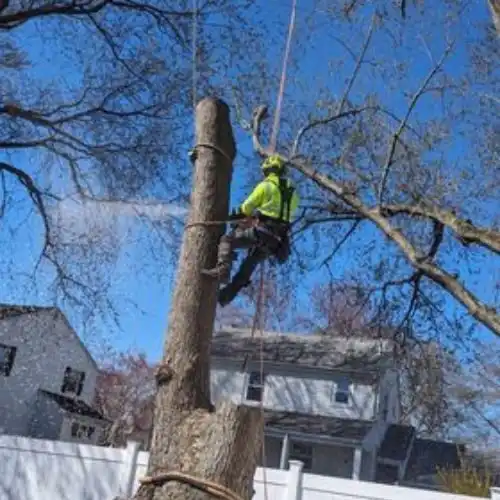
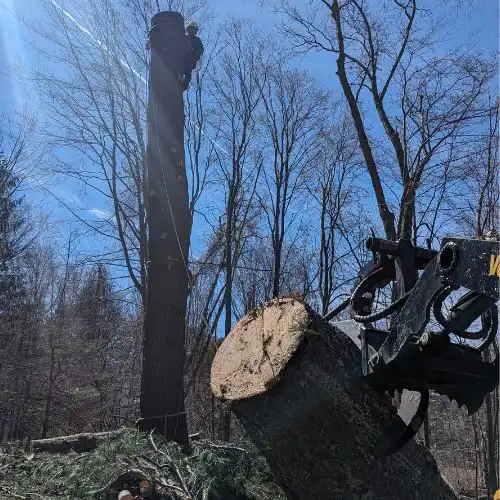
Amazing Client Gallery
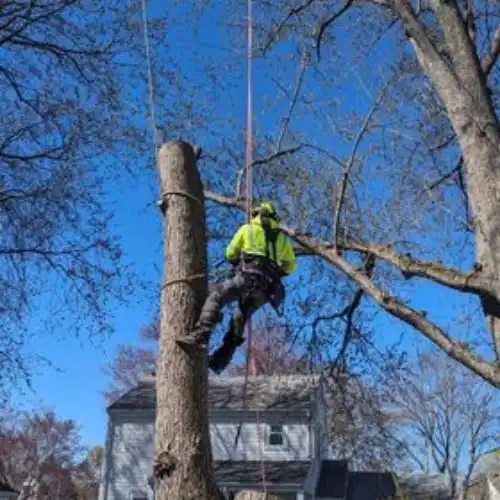
Our Recent Projects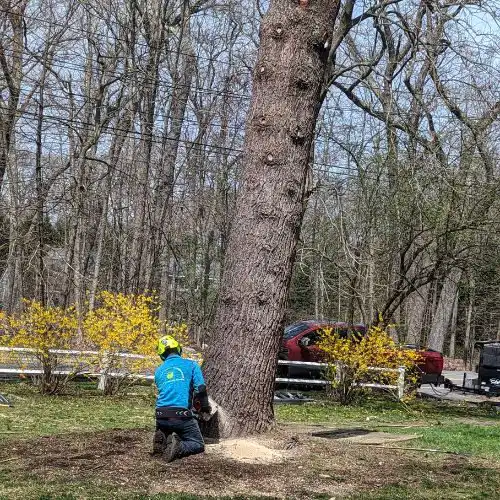
Words from Our Customers
Contact Norfolk Tree Service Today for Expert Planting
Adding lively new trees and lush shrubs to your property is an incredibly exciting, highly transformative process that will pay incredible dividends in unmatched beauty, vital shade, and skyrocketing property value for decades to come. However, protecting that significant investment requires the profound horticultural knowledge, precise installation techniques, and heavy-duty resources of true, dedicated tree care professionals.
Whether you are looking to carefully design a stunning new residential landscape from the ground up, install an impenetrable, towering evergreen privacy barrier to block out the neighborhood noise, or completely revitalize the exterior of your commercial property to impress your clients, the certified experts at Norfolk Tree Service are ready to help you grow your vision into a reality. We proudly serve Waltham, Lexington, Wellesley, Newton, and all surrounding Massachusetts communities with uncompromising quality, deep scientific expertise, and dedicated, friendly customer service.
Do not leave the long-term future of your valuable landscape to chance or outdated, amateur planting methods. Let our specialized team of certified arborists guide you seamlessly through a flawless, completely stress-free planting experience—from the very first initial soil consultation and species selection to the final, deep watering of your new, beautiful tree.
Call us directly at (781) 386-0512 for immediate assistance, to ask our arborists any questions you might have about local native tree species, or to schedule your complete, on-site property planting consultation.
Click here to Contact Us and schedule your professional tree and shrub planting service today!
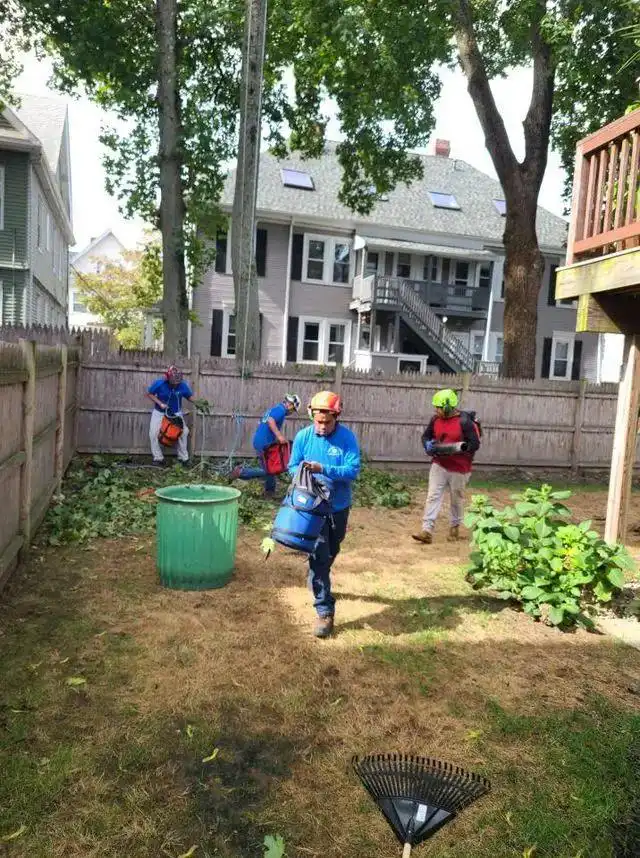
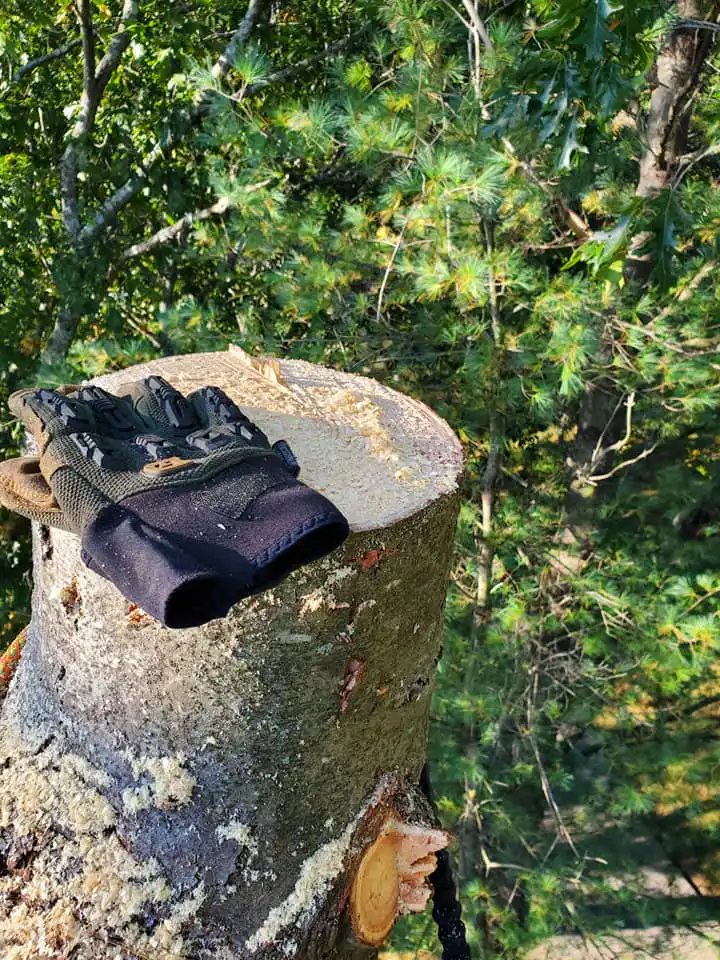 | A photo from Norfolk Tree Service job files. Every photo on this page comes from our own crews, not a stock library. |
Frequently Asked Questions (FAQs)
1. When is the absolute best time of year to plant new trees and shrubs in Massachusetts? The absolute best windows for planting new trees and shrubs in the Massachusetts climate are during the mild, transitional seasons: early-to-mid spring (after the ground has fully thawed from winter but before the harsh summer heat arrives) and early-to-mid fall (September through October). Planting during these dormant or semi-dormant, cooler periods allows the plant to focus 100% of its biological energy on establishing a solid, expansive underground root system in the warm soil without facing the extreme, dehydrating stress of trying to keep a full canopy of leaves hydrated during a blazing July heatwave.
2. Do I need to apply chemical fertilizer to my newly planted tree right away? No, you should actively avoid fertilizing a newly planted tree during its very first year in the ground. This is a very common misconception. High-nitrogen chemical fertilizers aggressively push the tree to rapidly grow new leaves and upper branches at the exact moment when it desperately needs to be focusing all of its energy downward on growing stabilizing roots. Applying harsh fertilizer too early can easily burn the delicate, newly forming root tips, increase the tree’s demand for water, and induce severe, sometimes fatal, transplant shock. Focus entirely on providing proper, consistent watering during the first full growing season.
3. Exactly how much and how often should I water my new tree or shrub? Consistent, deep moisture is the single most critical factor in the survival and success of a new planting. For the first two to three weeks, a newly planted tree should be watered deeply almost every single day, depending on rainfall. After that initial period, you should transition to watering deeply two to three times a week for the remainder of the first growing season, extending into the fall until the ground freezes. “Deeply” means applying the water slowly (using a trickling hose or a specialized slow-release tree watering bag) directly at the base of the tree so it thoroughly saturates the entire depth of the root ball, rather than just lightly spraying the surface with a sprinkler. Be careful not to drown the tree; the soil should feel like a wrung-out sponge—moist, but never a swampy, standing puddle.
4. Do you use stakes and rigid guy-wires on all the new trees you plant? We do not automatically stake every single tree we plant. In fact, modern arboriculture science dictates that a tree builds critical trunk strength, natural taper, and root stability by naturally swaying slightly in the wind. However, staking is absolutely necessary for trees planted in exposed, high-wind areas, trees with exceptionally heavy, dense, top-heavy canopies (like large evergreens), or trees planted on steep, uneven slopes. If staking is required to keep the root ball completely stable in the soil while new roots anchor, we use wide, flexible, tree-safe arbor-tie webbing and explicitly instruct you to remove the stakes and lines after exactly one year. Leaving stakes on too long will cause the wires to eventually grow into and fatally girdle the expanding trunk.
5. How close to my house, driveway, or foundation can I safely plant a tree? This calculation depends entirely on the specific species of the tree, its projected mature canopy width, and the aggressive nature of its root system. A small, ornamental Japanese Dogwood can be safely planted relatively close to a house or patio. However, a massive Weeping Willow or a Silver Maple—which aggressively seek out underground moisture and have vast, incredibly invasive, foundation-cracking root systems—must be planted extremely far away from foundations, septic tanks, and underground plumbing lines. As a general, safe rule of thumb for large shade trees, they should be planted at a distance equal to at least half of their expected mature canopy width away from any permanent structure. Our arborists will precisely calculate this mathematical spacing during your initial property consultation.
6. Do you guarantee the survival of the trees and shrubs you plant? Yes. Because we strictly adhere to the absolute highest standards of professional arboriculture, source only premium, thoroughly inspected, disease-free nursery stock, and perform incredibly careful, scientifically backed installations, we are deeply confident in the long-term success of our plantings. Norfolk Tree Service offers complete establishment warranties on the trees and shrubs we supply and install, provided that the property owner carefully adheres to our specific, detailed post-planting watering and care instructions. A tree is a living organism, and its survival depends on proper aftercare. We will clearly discuss all warranty details and provide you with written care guidelines prior to the final installation.
7. Can I just buy a tree online and have you plant it for me? While we strongly prefer to supply the trees ourselves to make sure they meet our rigorous quality and health standards, we do occasionally offer installation-only services for client-purchased trees. However, if you purchase a tree from an unverified online retailer or a big-box store, we cannot provide our standard warranty on the plant’s survival, as we cannot verify how it was grown, how it was stored, or whether its root system was already permanently damaged prior to our arrival. We highly recommend utilizing our complete sourcing and installation package for the best possible, guaranteed results.
Other services we run
- Tree Trimming & Pruning across Norfolk County, MA.
- Stump Grinding across Norfolk County, MA.
- Tree Removal across Norfolk County, MA.
- Lot & Land Clearing across Norfolk County, MA.
- 24/7 Emergency Tree Service across Norfolk County, MA.
Areas We Serve
Norfolk Tree Service handles tree & shrub planting for homeowners and property managers across Eastern Massachusetts:
| Service | Expert Tree and Shrub Planting by Norfolk Tree Service |
|---|---|
| Service area | Towns across Norfolk County and Greater Boston, MA. See our service areas. |
| Services | Tree Trimming & Pruning across Norfolk County, MA., Stump Grinding across Norfolk County, MA., Tree Removal across Norfolk County, MA., Lot & Land Clearing across Norfolk County, MA., 24/7 Emergency Tree Service across Norfolk County, MA. |
| Phone | (781) 386-0512 |
| Inquiry | Send an inquiry through the quote form on this page, or call the number listed here. |
- Tree & Shrub Planting in Waltham, MA
- Tree & Shrub Planting in Brookline, MA
- Tree & Shrub Planting in Needham, MA
- Tree & Shrub Planting in Wellesley, MA
- Tree & Shrub Planting in Natick, MA
- Tree & Shrub Planting in Framingham, MA
- Tree & Shrub Planting in Quincy, MA
- Tree & Shrub Planting in Dedham, MA
- Tree & Shrub Planting in Norwood, MA
- Tree & Shrub Planting in Lexington, MA
- Tree & Shrub Planting in Concord, MA
Visit Our Waltham, MA Service Area
Tree & Shrub Planting Services
| Service | What It Covers | When You Need It |
|---|---|---|
| Species Selection | The right tree for your soil & space | New landscaping or replacements |
| Planting & Installation | Proper planting, staking & mulching | Adding new trees or shrubs |
| Transplanting | Moving established trees & shrubs | Relocating healthy plants |
| Establishment Care | Watering & early-care guidance | Ensuring new plantings thrive |
Trusted by Massachusetts Homeowners
Read All ReviewsOur Other Tree Services
Contact Norfolk Tree Service
Free Tree Service Quote — Call Today
Tree removal, trimming, stump grinding, and 24/7 storm response across Eastern Massachusetts. Licensed and insured — free written estimates.
Call (781) 386-0512Get a QuoteLicensed & Insured
Our Service Area