 Skip to content
Every Tree Service We Offer, in One Place
"*" indicates required fields
Our Tree Services
Norfolk Tree Service is a full service tree company working out of 40 Fairmont Ave in Waltham, MA, covering Norfolk County, Middlesex County, and Greater Boston. This page lists everything we do, what each service actually involves, and the situations that usually prompt the call. If you already know what you need, ring 781-386-0512 and we will arrange an estimate.
If you are not sure, that is completely normal and it is worth a conversation rather than a guess. A great many of the calls we take describing a removal turn out to be pruning jobs, and a fair number described as pruning turn out to be trees that should have come out two years ago. Looking at the tree is how that gets settled, and estimates for work we would carry out are free.
Compare tree services by the outcome you need
A clear request helps you select the right service before discussing a date or a price. Describe what you want to change, the tree or part of the property involved and any access limits you already know about. You might be seeking an explanation of a tree’s condition, clearance around a building or preparation of an area for a future project. These are different goals. The service descriptions below help you organize the conversation without deciding the diagnosis from a photograph.
Tree removal: agree on the complete scope
Removal focuses on taking down a particular tree. Identify the tree clearly and explain the concern behind the request, such as storm damage, declining condition or a conflict with a planned use of the property. Ask what assessment is needed before the recommendation is made. Removing a tree is a significant decision; a quote for cutting does not explain by itself whether another option is suitable.
The written scope should describe the material to be removed and what will happen to it. Discuss whether brush is chipped, logs are taken away or suitable wood is left in an agreed location. Confirm the cleanup and access arrangements. Ask separately about the stump, because cutting a trunk and grinding below ground are different operations. If property boundaries, town rules or access over neighbouring land could affect the work, resolve those questions before scheduling.
Pruning: specify the reason for the work
Pruning may address dead or damaged branches, clearance or the structure of a growing tree. Explain the outcome you are seeking rather than requesting that a fixed amount of the crown be removed without assessment. A tree can need different work at different stages of its life. Ask which branches or areas are included, why those cuts are proposed and whether the work should be timed around a particular condition.
Discuss what can realistically be achieved in one visit and whether any later review is recommended. Pruning cannot guarantee that a tree will never lose a limb. The estimate should also identify brush handling, access and cleanup. If your main concern is uncertainty about the health or stability of the tree, ask whether a condition assessment should come before a pruning plan.
Stump grinding: match preparation to the next use
An old stump can remain after removal by another contractor or a previous owner. You can ask about grinding it on its own without commissioning another tree removal. Describe the stump’s location, nearby features and your plans for the space. Access for a grinder, hidden utilities and the amount of visible root material can affect the assessment and proposed work.
Confirm the requested depth and the treatment of chips before authorizing the job. Ask whether removal of chips, backfilling with soil, leveling and reseeding are included or separately quoted. A ground stump is not the same as a site prepared for a building foundation or a new hard surface. Share any specification from the next contractor so that the difference is clear at the estimate stage.
Health care and consultations: different deliverables
Tree health care begins with the concern you have noticed, such as changing foliage, canopy decline or damage around the roots. Describe the timing, whether nearby trees are affected and any recent construction or landscaping. Ask what can be assessed visually, whether further investigation is suggested and what information would support a treatment recommendation. Do not assume that discoloration alone identifies a particular pest or disease.
A consultation is useful when you need a documented assessment, a professional opinion or guidance for planning. A written report may have requirements set by its intended recipient. Explain whether it is for your own decision, a town application or another purpose. Confirm the author, relevant credentials, scope, price and delivery timing. A free estimate for carrying out work should not be treated as the same deliverable as a commissioned report.
Planting: include the establishment period
Plant selection should account for the available space and the mature plant, not just the size on delivery day. Discuss sunlight, drainage, nearby structures and how the area is used. Ask which sourcing, delivery, planting and preparation tasks are included. If an earlier tree or stump needs to be addressed first, identify that as a separate part of the proposed project.
Clarify who will water and care for the planting after installation. Ask what instructions will be provided and when follow-up might be appropriate. If a plant warranty applies, obtain its actual terms, including care obligations and exclusions. Establishment depends on site conditions and ongoing care; a page describing planting services should not be read as an unconditional survival promise.
Clearing and storm work: define the boundary and priorities
For lot clearing, identify the exact area, the retained trees and the intended next use. Clearing vegetation does not automatically include grading, excavation or approval for construction. Share plans and restrictions before equipment is scheduled. Confirm where material may be staged, whether stumps are included and what condition should remain at handover.
For storm damage, the first conversation should distinguish an immediate concern from later recovery work. Call about urgent conditions and describe what is affected from a safe location. Do not approach damaged trees or fallen lines to obtain better photographs. Ask which initial work is proposed and what later cleanup would require a separate scope. Confirm availability directly; an online inquiry is not a dispatch confirmation.
Before you accept an estimate
Compare the same scope across proposals: the identified trees, access method, protection measures, material handling, exclusions and final cleanup. Ask for current insurance documentation when required and make sure the person approving the work understands the plan. Keep the written estimate and records of agreed changes. If something is unclear, a question before the visit is easier to resolve than an assumption after work has started.
Norfolk Tree Service is based in Waltham and lists service coverage across surrounding Massachusetts communities. Provide the property address when confirming availability. Use the existing inquiry form for routine requests and describe your goal, preferred contact method and any access concerns. For urgent damage, use the phone number on the page and confirm the next step with the team.
What We Do
Tree Removal
Full takedowns and sectional dismantling, including dead, leaning, and storm damaged trees in tight spaces where nothing can be felled.
Tree Trimming and Pruning
Crown thinning, deadwooding, reduction, and roofline clearance. Structural pruning that improves the tree rather than just shortening it.
Stump Grinding
Below grade grinding with surface root chasing, so the ground can be re-lawned, replanted, or built on afterwards.
24/7 Emergency Tree Service
We make the site safe first and clear it second.
Storm Damage Tree Removal
Clearing failures after nor easters and high wind, with the damage documented before removal for insurance purposes.
Tree and Shrub Planting
Species selection, siting, and planting, including replacement planting where a town requires it after a removal.
Lot and Land Clearing
Clearing building envelopes and overgrown parcels, with protection planned for the trees that are staying.
Tree Health Care
Diagnosis and treatment of pests, disease, and decline, including winter moth, hemlock woolly adelgid, and emerald ash borer.
Certified Arborist Consultation
Condition and risk assessments, and written reports for permit applications, insurance claims, and construction projects.
Choosing the Right Service
The table below is the quickest way to match a situation to a service. Where two apply, and they often do, we will say so at the estimate rather than quoting the more expensive one by default.
| Service | What It Covers | When You Need It |
|---|---|---|
| Tree Removal | Full takedowns, sectional dismantling, hazardous and dead trees, complete cleanup | A tree is dead, unstable, or standing too close to the house |
| Trimming and Pruning | Crown thinning, deadwooding, reduction, roofline and driveway clearance | Overgrowth, low limbs, or to keep a mature tree structurally sound |
| Stump Grinding | Below grade grinding, surface root chasing, chip removal | After a removal, to clear a trip hazard, or to replant the space |
| Emergency and Storm Work | Making sites safe, clearing debris | Something has already come down, or is clearly about to |
| Planting | Species selection, siting, replacement and screen planting | Replacing what came out, or rebuilding privacy and streetscape |
| Health Care and Consultation | Diagnosis, treatment, risk assessment, written reports | A tree is declining, or a town or insurer needs documentation |
Where We Work
We cover a wide area of eastern Massachusetts from our Waltham yard. Town by town detail, including local permit rules and what the tree work is typically like, is on our service areas pages. Frequently requested towns include Waltham, Newton, Wellesley, Belmont, Needham, Brookline, and Charlestown.
Local rules vary more than people expect. Some municipalities regulate tree removal on private property and require a permit and an arborist evaluation, while in others only the public shade trees along the street are controlled. Public shade trees are managed by a town Tree Warden throughout Massachusetts, and forest health statewide is overseen by the Massachusetts Department of Conservation and Recreation. We check what applies to your address as part of the estimate.

How It Works
Call 781-386-0512 or request a quote online. We come out and look at the tree, because pricing tree work from photographs is guesswork. You get a written estimate covering the work itself, the debris, and the cleanup, along with a straight answer on whether a permit is involved. Once you approve it we schedule the work, complete it, and clear the site. For background on pricing, tree service costs in Massachusetts explains what drives the number.
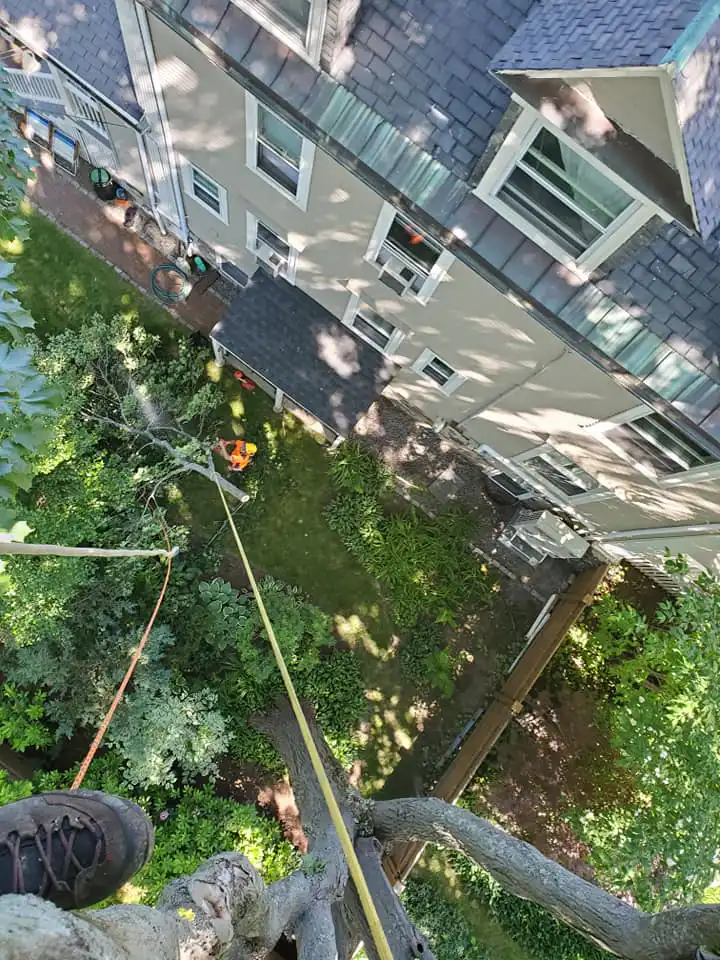
 | A photo from Norfolk Tree Service job files. Every photo on this page comes from our own crews, not a stock library. |
| Service | Our Tree Services |
|---|---|
| Service area | Towns across Norfolk County and Greater Boston, MA. See our service areas. |
| Phone | 781-386-0512 |
| Inquiry | Send an inquiry through the quote form on this page, or call the number listed here. |
Frequently Asked Questions
I am not sure which service I need. What should I do?
Call and describe what you are seeing. Most situations can be narrowed down over the phone, and where they cannot we will come and look. We would rather establish that a tree needs pruning than sell you a removal, and we say so when a tree is fine as it is.
Do you charge for estimates?
Estimates for tree work we would carry out are free and are given in writing after somebody has seen the tree. A formal arborist consultation with a written report is a separate professional service and is quoted on its own, because it produces documentation for a permit, insurer, or dispute.
What areas do you cover?
Norfolk County, Middlesex County, and Greater Boston generally, working out of Waltham. Our service areas section lists the towns individually with local detail. If your town is not listed, call anyway, because the boundary is about drive time rather than a fixed line.
Do you handle emergencies outside business hours?
Yes, on the same number. After major storms there is a queue and we prioritise genuinely hazardous situations, such as trees on buildings or limbs hanging over occupied space, so call early rather than waiting to see whether it settles.
For any of the services on this page, call Norfolk Tree Service at 781-386-0512.
Planning a tree removal? Learn whether your Massachusetts town requires a permit to remove a tree before work begins.
Contact Norfolk Tree Service
Our Tree Services — Call or Send an Inquiry
Tell us what the trees on your Norfolk County and Greater Boston, MA property need. We walk the site, explain the options and give you a written quote before any work starts.
Call (781) 386-0512Send an InquiryOur Service Area