 Skip to content
Tree Care From Belmont Hill to Waverley Square
"*" indicates required fields
Tree Services in Belmont, MA
★★★★★ Rated 4.9 from 214 reviews on Google and Yelp. Read our reviews.
“Abner and his team did a great job. They removed two trees, ground the stumps, and trimmed some huge branches off of trees that I was afraid would fall in my yard during a bad storm. Professional, nice, and good price. Will definitely use them again!”
Emily, October 2026
“Abner and his team did a phenomenal job at our property. They were prompt and very efficient. They took great care and showed expert precision. We could not be more pleased and would highly recommend them to anyone looking for tree removal!”
Patrick, September 2026
Belmont packs a lot of different tree work into six square miles. The wooded slopes of Belmont Hill hold some of the largest private oaks and white pines in the inner suburbs. Down in Waverley Square and Cushing Square the lots shrink, the driveways narrow, and the same size tree becomes a rigging problem instead of a felling job. Norfolk Tree Service covers all of it from our yard at 40 Fairmont Ave in Waltham, which sits close enough to the Belmont line that we are usually on site quickly.
Most calls we take from Belmont fall into one of two categories. Either something has already failed and needs clearing, or a homeowner has finally decided that the leaning maple over the garage has been ignored long enough. Both are worth a phone call. Dial 781-386-0512 and describe what you are looking at, and we will tell you whether it needs a crew, a consultation, or nothing at all.
Removals on Belmont Hill and the Wooded Lots
The upper part of town is genuinely wooded, and that changes the character of a removal. Trees there have grown tall and narrow competing for light, which makes them more prone to failure once a neighbouring tree comes out and exposes them to wind they never had to handle. We see this pattern constantly: one tree comes down in a storm, and within two years the ones that were sheltered behind it start dropping limbs. When we quote a removal on the Hill we look at what the removal does to everything around it, not just the tree in front of us. Our tree removal service page covers how we scope and price that work.
Pruning and Crown Work Around Belmont Center, Cushing, and Waverley
Closer to the squares, the work is finer. Older homes sit near their lot lines, garages are detached and often original, and the trees have been pruned inconsistently for decades. A lot of what we do here is corrective: removing deadwood, reducing end weight on limbs extending over roofs, and cleaning up damage from earlier topping cuts made by someone who should have known better. Good pruning on a mature tree should be almost invisible when it is finished. See tree trimming and pruning for the specifics.
Emergency and Storm Response in Belmont
Belmont Hill catches wind that the lower parts of town do not, and the exposure shows after every significant nor easter. Limb failures over driveways and cars are the most common emergency call, followed by whole trees uprooting in saturated soil during spring storms. We answer at 781-386-0512. On arrival we make the situation safe first, then deal with the debris, and we photograph the failure before we clear it so you have something to give an insurer. More on emergency tree service and storm damage tree removal.
Stump Grinding and Getting the Yard Back
Belmont lawns tend to be well kept, and a ground stump with a crater of chips left in the middle of one is not a finished job. We grind below grade, chase the surface roots that would otherwise heave later, and leave the area ready for loam and seed. On the tighter lots near the squares, access is the constraint that determines the machine, so we check gate widths before the day of the work rather than on it. Details on stump grinding and removal.
Planting, Screening, and Replacing What Comes Out
When a large tree leaves a Belmont yard it usually takes the privacy with it. Replacement planting is worth planning at the same time as the removal rather than a season later, partly because the site work is already happening and partly because species choice depends on what the removal changed. A screen that has to tolerate full afternoon sun is a different plant list from one filling a shaded gap. See tree and shrub planting.
Public Shade Trees, the Tree Warden, and What the Town Controls
The single most common misunderstanding we run into in Belmont concerns who owns the tree. Trees standing within the public way, typically the strip between the sidewalk and the street, are public shade trees. In Massachusetts those are under the care of the town Tree Warden, and removing one is a town decision that can require a posted public hearing rather than a homeowner decision. That holds even when the tree is directly in front of your house and its roots are lifting your walkway.
Belmont also maintains a Shade Tree Committee, which reviews tree and vegetation management practices on public land and advises on future plantings. If your question concerns a street tree, a tree in a park, or planting in the public way, that is the town side of the house and the Tree Warden office is where it goes. If the tree is inside your property line, it is generally your call, and we can quote it directly.
| Where the Tree Stands | Who Has Authority | What That Means for You |
|---|---|---|
| Entirely inside your property line | You do, within state and local rules | We can survey, quote, and carry out the work directly |
| In the strip between sidewalk and street | The town, as a public shade tree | The Tree Warden decides, and a public hearing may be required first |
| Trunk on your land, limbs over a neighbour | Generally follows where the trunk stands | We confirm the trunk position and advise before any cutting |
| On a boundary with conservation or trust land | The town or the organisation holding the parcel | We check the line before quoting and will not cut across it |
| Close to overhead utility conductors | The utility controls clearance work near its lines | We coordinate rather than work inside the danger zone |
| Storm damaged and actively unsafe | Safety first, paperwork afterwards | We stabilise, document the failure, then clear it |
A Neighborhood by Neighborhood Look at Belmont
Belmont Hill is the large lot end of town, with mature oak and pine, long driveways, and the McLean campus anchoring the ridge. Work up there is usually about scale and wind exposure. Belmont Center is a mix of substantial older homes and tighter streets where crane and rigging access has to be planned. Cushing Square and Waverley Square are denser again, with more two family housing, more on street parking to work around, and shorter setbacks. Winn Brook, down toward the Cambridge line, has smaller yards and a street canopy that takes a beating from salt and compaction.
The conservation land matters too. Rock Meadow, Lone Tree Hill, Beaver Brook Reservation, and the Habitat sanctuary all create property boundaries where the trees on the far side are not yours to cut, no matter how much shade they throw. We check those lines before quoting. Neighbouring towns are on the same routes: see Waltham, Watertown, Lexington, and Newton, or browse the full range of tree services.
What Grows in Belmont and What Threatens It
Northern red oak and sugar maple dominate the older private canopy, with Norway maple filling in on street frontages and white pine common on the Hill. Eastern hemlock appears along the shaded north facing slopes and at the edges of the conservation parcels, and it remains under pressure from hemlock woolly adelgid. Ash is present in smaller numbers and is worth assessing honestly given emerald ash borer activity in Middlesex County.
The failures we are called to are rarely sudden. Thinning crowns, late leaf out, fungal brackets at the base, and repeated small limb drops are all signals that show up seasons before a tree actually comes apart. If you are seeing any of those, an arborist consultation costs far less than an emergency call, and tree health care can often extend a tree well beyond the point where people assume it has to go.
Why Belmont Homeowners Call Us
We are licensed and fully insured, our crews are ISA-certified arborists trained in modern climbing, rigging, and chainsaw safety practices, and we have been working across Greater Boston since 2014. We give written estimates before the work, we protect lawns and beds while we are on site, and we do not push removals on trees that can be kept. On a street where the canopy is part of the property value, that last point matters.
How It Works
Call 781-386-0512 or send a quote request. We come out and look, tell you what the tree actually needs, and put a written price in front of you. If the tree turns out to be the town responsibility we will say so rather than quoting work we cannot legally do. Once you approve, we schedule, complete the job, and clear the site. If you want to understand pricing first, tree service costs in Massachusetts walks through the variables.
Timing Tree Work Through the Belmont Year
Season affects both the price and the wisdom of a Belmont tree job more than most homeowners realise. Winter is the best window for large removals on the Hill: the ground is firm enough to carry equipment without rutting lawns, the crowns are bare so rigging is simpler and faster, and there is no foliage hiding structural defects from the climber. Dormant season pruning on oaks is also the safer choice, because cutting oaks during the active growing months raises the risk of spreading disease between wounded trees.
Spring brings the opposite problem. Saturated soil on the slopes above Belmont Center is when we see whole trees tip rather than snap, roots and all, because the anchorage simply lets go. Late spring is also when defoliation from winter moth caterpillars becomes visible, and a tree stripped two or three years running is a tree worth assessing rather than ignoring. Summer is the season for targeted work: deadwooding, clearance over driveways, and dealing with limbs that have grown into rooflines since last year. Autumn is planting season and the right time to get ahead of storm exposure before the first serious nor easter.
What a Belmont Estimate Actually Covers
Our estimates are written, itemised, and given after somebody has physically looked at the tree. We do not price large removals from photographs, because the things that drive the number, such as what sits underneath the drop zone, how far the crew has to carry brush, and whether a crane can reach, are not visible in a picture. The quote states the work, the debris handling, and what happens to the wood.
Two Belmont specifics come up often enough to mention. First, if the tree turns out to be a public shade tree rather than yours, we will tell you at the estimate stage and there is no charge for finding that out. Second, on the narrow streets around Cushing and Waverley the job sometimes needs parking cleared or a short traffic plan, and that gets discussed before the day rather than sprung on your neighbours that morning. If cost is the main question, what tree work costs in Massachusetts explains what moves the figure.
Protecting the Rest of the Property While We Work
Belmont yards are generally tended, and a crew that fixes the tree problem while wrecking the lawn has not done the job. We plan the route in before the saw comes out: where the chipper parks, where brush gets dragged, which beds need boards over them, and where the chip truck can sit without blocking a one way street. On the steeper Hill properties we pay particular attention to turf damage, because equipment on a wet slope leaves marks that take a full season to recover.
The same care applies to what is above and below. Irrigation heads, septic components, low stone walls, and the shallow root plates of the trees that are staying all sit in the way of a careless removal. If something on your property needs protecting, point it out at the estimate and it goes in the plan. Questions about any of this are welcome on 781-386-0512.
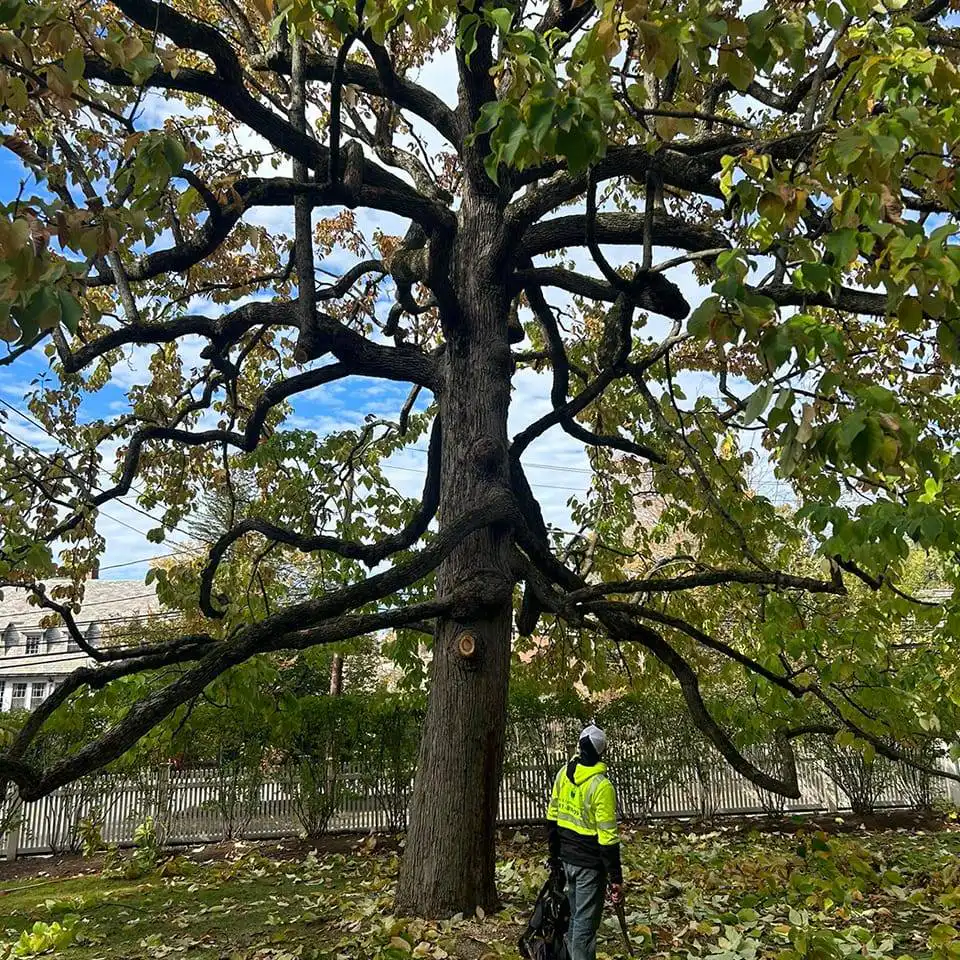 | A photo from Norfolk Tree Service job files. Every photo on this page comes from our own crews, not a stock library. |
| Service | Tree Services in Belmont, MA |
|---|---|
| Service area | Towns across Norfolk County and Greater Boston, MA. See our service areas. |
| Phone | 781-386-0512 |
| Inquiry | Send an inquiry through the quote form on this page, or call the number listed here. |
Frequently Asked Questions
Can I remove a tree in my own Belmont yard without asking the town?
If the tree stands entirely within your property line, it is generally your decision. The situation changes for public shade trees in the town way, which are handled by the Tree Warden and can require a public hearing before removal. We confirm which side of that line your tree falls on as part of the estimate, so nobody is surprised.
There is a street tree in front of my house causing problems. Who do I call?
That is a town matter. Public shade trees along the street are managed by the Tree Warden rather than the abutting homeowner, and Belmont also has a Shade Tree Committee that advises on public tree and planting policy. We can identify the tree and explain the process, but we do not remove or prune public shade trees without town authorisation.
Do you work on the larger wooded properties on Belmont Hill?
Yes, and a good share of our Belmont work is up there. Large oaks and white pines on sloped, wooded lots need proper rigging and a plan for what the removal exposes to wind afterwards. We assess the surrounding trees at the same time rather than looking at the target tree in isolation.
How fast can you respond to storm damage in Belmont?
We take emergency calls and Belmont is close to our Waltham yard, which keeps response times short. After major regional storms there is a queue and genuinely hazardous situations get priority. Call as early as you can rather than waiting to see whether it settles.
What about trees on the edge of Rock Meadow or Lone Tree Hill?
Those boundaries need checking before anything is cut. Trees on conservation or land trust parcels are not the abutting owner property to remove, even when they shade a yard heavily. We survey the line first and will tell you plainly if the tree you want gone is not yours.
Do you handle everything including the cleanup?
Yes. Our quotes cover the takedown or pruning, debris removal, and site cleanup, and we specify what happens to the wood and chips. If you want logs left for firewood or chips kept for beds, say so up front and we will price it accordingly.
To get tree work scheduled anywhere in Belmont, MA, call Norfolk Tree Service at 781-386-0512.
Contact Norfolk Tree Service
Tree Services in Belmont, MA — Call or Send an Inquiry
Tell us what the trees on your Belmont, MA property need. We walk the site, explain the options and give you a written quote before any work starts.
Call (781) 386-0512Send an InquiryOur Service Area