 Skip to content
Diagnosis First, Then Treatment
"*" indicates required fields
Tree Health Care in Norfolk, MA and Greater Boston
If you are looking for tree health care in Norfolk, this is the page for it. Norfolk Tree Service diagnoses and treats sick, stressed, and declining trees across Norfolk, MA and the surrounding towns, and the work covers pest and disease identification, soil and root treatment, structural pruning for tree health rather than appearance, and honest advice about when a tree can be saved and when it cannot. We are based at 40 Fairmont Ave in Waltham and we have been doing this across Greater Boston since 2014. Call 781-386-0512 and describe the symptoms, and we can usually tell you over the phone whether it warrants a visit.
Most people call us about removals. A meaningful share of those calls turn out to be trees that did not need to come out, or would not have needed to come out if somebody had looked at them two or three seasons earlier. Tree health care is the part of this trade that costs the least and gets thought about last.
What Tree Health Care Actually Involves
Tree health care is diagnosis before treatment. A tree that is thinning at the top might be dealing with a root problem, a soil compaction problem, a boring insect, a fungal pathogen, drought stress from three summers ago, or simple old age, and the visible symptom is very often the same in every case. Spraying something at it without establishing which of those applies is how people spend money and lose the tree anyway.
A proper assessment looks at the whole system: crown density and dieback pattern, leaf size and colour through the season, bark condition, the presence of fungal fruiting bodies, the root collar where it meets the soil, and the soil itself. It also considers history, because what happened to a site five years ago, such as a driveway being widened, a trench being dug, or grade being changed over the root zone, explains a great deal of what shows up in the crown later. If you want that assessment written up formally, an arborist consultation is the right service.
How to Tell If a Tree Is Dying
This is the question we are asked more than any other, and there is no single answer, but there are reliable signals. A healthy tree leafs out on time, holds a full crown through summer, and puts on visible new growth at the branch tips each year. Departures from that pattern are worth taking seriously, particularly when several appear together.
The single most useful thing a homeowner can do is compare the tree against itself in previous years and against neighbouring trees of the same species. A red oak that leafs out two weeks after every other red oak on the street is telling you something. Photographs taken in June each year are more diagnostic than most people expect.
| What You Are Seeing | What It Often Means | How Urgent |
|---|---|---|
| Deadwood concentrated in the upper crown | Root or vascular problem; the tree cannot supply its extremities | Assess this season |
| Leaves smaller, paler, or fewer than previous years | Chronic stress, often root zone or soil related | Assess this season |
| Leafing out noticeably later than similar nearby trees | Reduced vigour, possible root or trunk damage | Assess this season |
| Mushrooms or shelf fungi at the base or on the trunk | Possible internal decay in structural wood | Urgent, decay affects stability |
| Bark splitting, oozing, or falling away in patches | Canker, borer activity, or dead cambium beneath | Assess promptly |
| Sudden lean, lifted soil, or cracks in ground near the base | Root plate movement; the anchorage may be failing | Immediate, treat as hazardous |
| Repeated small limb drops in ordinary weather | Progressive structural failure in the crown | Urgent, especially over targets |
If you are seeing the last two on that list, this is not a tree health care question any more. Call 781-386-0512 and treat it as a safety issue, or see emergency tree service.
Pests and Diseases We Deal With in Eastern Massachusetts
New England has a specific and fairly well documented set of tree pests, and knowing which ones are actually present here matters, because a lot of general advice online refers to problems that do not occur in this state.
Winter Moth
Winter moth has been one of the defining pests of eastern Massachusetts for the past two decades. The adults fly in late autumn, often swarming around outdoor lights in November and December, and the caterpillars feed inside expanding buds in early spring, which is why the damage appears as ragged, shot-holed leaves rather than obviously chewed edges. Oak, maple, apple, crabapple, and blueberry take the worst of it. Populations have declined substantially in many areas following the introduction of a parasitic fly as a biological control, but pockets remain, and a tree defoliated several years running loses the reserves it needs to fight everything else.
Spongy Moth
Spongy moth, the insect formerly known as gypsy moth, runs in periodic outbreak cycles rather than steady pressure. In outbreak years the caterpillars can strip oaks completely by early summer. Healthy hardwoods generally refoliate and survive a single defoliation, but consecutive years, or defoliation combined with drought, is what kills trees. Buff coloured egg masses on trunks and walls in winter are the early warning, and are worth counting before spring rather than discovering in June.
Hemlock Woolly Adelgid
If you have eastern hemlock, this is the one to know. The insect appears as small white woolly masses at the base of the needles on the undersides of twigs, most visible in late winter and spring. Infested hemlocks thin from the inside out, lose needles, and decline over a period of years. Hemlock is a common screening and hedge tree in this area, so an infestation frequently arrives as a privacy problem before it registers as a tree health problem. Treatment is effective when started early and much less so once the crown is already sparse.
Emerald Ash Borer
Emerald ash borer has been present in Massachusetts since 2012 and has spread widely. The larvae feed beneath the bark and sever the tissue that moves water and sugars, so infested ash trees decline from the top down, often with vigorous sprouting from the lower trunk, D shaped exit holes, and heavy woodpecker activity stripping bark in search of larvae. Ash can be protected with treatment, but the decision needs making before the tree is far gone, and dead ash becomes brittle and dangerous to climb faster than most species.
Dutch Elm Disease
Dutch elm disease is a fungal infection spread by elm bark beetles and through root grafts between neighbouring elms. It is the reason the mature American elms that once lined New England streets are largely gone. The surviving large elms in this area are survivors for a reason, and they are worth protecting. Early symptoms are wilting and yellowing of foliage on one limb or one side of the crown, spreading through the tree over one or two seasons.
Oak Decline, and a Note on Oak Wilt
Oak wilt is a serious disease of oaks, but it is worth being accurate: it is established in parts of the Midwest and has been found in New York State, and it is not currently considered established in Massachusetts. What we actually see on stressed oaks here is oak decline, a slower collapse driven by a combination of repeated defoliation, drought, root damage, and opportunistic secondary attackers such as two lined chestnut borer and armillaria root rot. The practical distinction matters, because oak decline is often reversible in its earlier stages by relieving the underlying stress rather than by treating a pathogen.
Deep Root Fertilization and Soil Work
Deep root fertilization means injecting nutrients and, where appropriate, soil conditioners under pressure into the root zone rather than spreading granules on the surface. It is genuinely useful in the right circumstances and oversold in general, so here is the honest version: it helps when a soil test shows the tree is actually short of something, or when the root zone is compacted and needs opening up. It does not help a tree whose problem is decay, borers, or severed roots, and it will not compensate for a tree planted in the wrong place.
Far more urban and suburban trees suffer from compacted, oxygen poor soil than from nutrient deficiency. Lawn traffic, construction, and years of raking away every leaf produce a growing medium nothing evolved for. Mulching correctly over the root zone, keeping mulch off the trunk itself, and relieving compaction usually does more good than fertiliser. We will tell you which of these applies to your tree rather than defaulting to the treatment with the higher margin.
Preventive Care Through the Year
Winter is for structural pruning while the crown is bare and defects are visible, and for scouting egg masses and adelgid. Early spring is the window for bud stage pest issues and for looking at which trees leafed out late. Summer is when drought stress shows and when supplemental watering of young and recently transplanted trees actually matters, particularly through a dry August. Autumn is for planting, for soil work, and for reducing storm exposure before the winter weather arrives.
Structural pruning on young trees is the highest return work in this entire trade and almost nobody asks for it. Correcting a codominant stem on a fifteen year old tree takes twenty minutes. Dealing with the same defect when the tree is fifty and splitting over a roof is a very different invoice. See tree trimming and pruning and tree and shrub planting.
When Treatment Is Not the Answer
Sometimes the honest recommendation is removal. A tree with significant decay in its structural roots or lower trunk, a tree that has lost most of its crown, or a tree whose failure would land on a house is not a candidate for treatment regardless of what is technically possible. We would rather tell you that than sell a programme of treatments to a tree that is going to come out in three years anyway. When removal is the right call, our removal service handles it and replanting is worth building into the same conversation.
Where We Provide Tree Health Care
We cover Norfolk and the surrounding towns from our Waltham base, including Waltham, Wellesley, Newton, Belmont, and Needham. The full list of our tree services shows everything else we do. For independent, research based guidance on tree pests and diseases in this state, the UMass Extension Landscape, Nursery and Urban Forestry Program is the best public resource available, and the Massachusetts Department of Conservation and Recreation oversees forest health statewide.
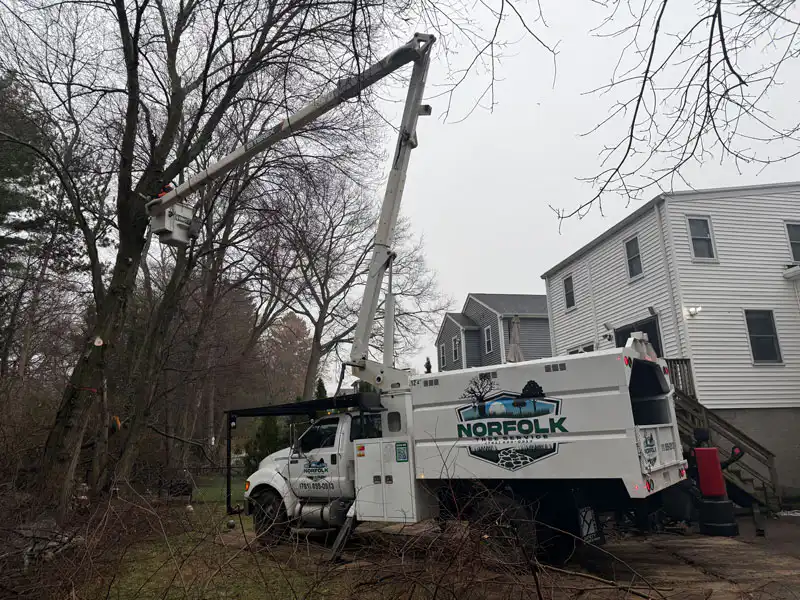 | A photo from Norfolk Tree Service job files. Every photo on this page comes from our own crews, not a stock library. |
| Service | Tree Health Care in Norfolk, MA and Greater Boston |
|---|---|
| Service area | Towns across Norfolk County and Greater Boston, MA. See our service areas. |
| Phone | 781-386-0512 |
| Inquiry | Send an inquiry through the quote form on this page, or call the number listed here. |
Frequently Asked Questions
How do I know whether my tree needs treatment or removal?
That is exactly what an assessment is for. The deciding factors are usually whether the structural roots and lower trunk are sound, how much live crown remains, and what the tree would hit if it failed. A tree with a healthy base and a treatable pest problem is usually worth keeping. A tree with decay in its anchorage is not, whatever its crown looks like.
Is deep root fertilization worth the money?
Sometimes. It genuinely helps where the soil is deficient or compacted, and it does nothing for decay, borers, or root damage. We would rather test and find out than sell it as a default. In a lot of suburban yards, correct mulching and relieving compaction delivers more benefit than any fertiliser programme.
My hemlocks are thinning. Can they be saved?
Often yes, if it is hemlock woolly adelgid and it is caught before the crown gets sparse. Look for small white woolly masses at the base of the needles. Treatment is far more effective early, so if you are seeing thinning on a hemlock hedge or screen it is worth a look this season rather than next.
Should I treat my ash tree for emerald ash borer?
It depends on the tree and how far along it is. A structurally sound ash with most of its crown intact can be protected with an ongoing treatment programme. An ash that is already thinning badly, sprouting from the trunk, and showing woodpecker damage is usually past the point where treatment is worthwhile, and dead ash gets dangerous to work on quickly.
Is oak wilt a problem in Massachusetts?
Not currently. Oak wilt is established in the Midwest and has been detected in New York, but it is not considered established in Massachusetts. Declining oaks here are usually suffering from oak decline, which is a stress driven combination of defoliation, drought, root disturbance, and secondary pests. The treatment approach is quite different, which is why correct diagnosis matters.
What does tree health care cost?
It starts with an assessment, and what follows depends entirely on the diagnosis. Soil work, treatment programmes, and structural pruning are priced separately and we will tell you what each is likely to achieve before you commit. Our cost guide covers how tree work is priced generally.
To get a tree looked at properly, call Norfolk Tree Service at 781-386-0512.
Contact Norfolk Tree Service
Tree Health Care in Norfolk, MA and Greater Boston — Call or Send an Inquiry
Tell us what the trees on your Norfolk County and Greater Boston, MA property need. We walk the site, explain the options and give you a written quote before any work starts.
Call (781) 386-0512Send an InquiryOur Service Area