 Skip to content
Answers About Your Trees, in Writing When You Need It
"*" indicates required fields
Certified Arborist Consultation
An arborist consultation is what you book when you need to know something about a tree rather than have something done to it. Norfolk Tree Service provides arborist consultations across Norfolk, Waltham, and the wider Greater Boston area, covering tree condition assessments, risk and hazard evaluations, written reports for permit applications and insurance claims, and tree protection planning for construction projects. Our crews are ISA-certified arborists trained in modern climbing, rigging, and chainsaw safety practices, and we have worked in this area since 2014. Call 781-386-0512 to arrange one.
The distinction that matters most: a free estimate answers the question of what a job would cost. A consultation answers the question of what is actually wrong, how likely the tree is to fail, what your options are, and, where you need it, produces a document that somebody else, a building department, an insurer, or a neighbour, will accept as evidence.
What an Arborist Consultation Covers
A consultation begins with the tree and its site, not with a quote. We look at the crown, the trunk, the root collar, and the ground around it, and we take the history of the property into account, because a great many tree problems in established neighbourhoods trace back to something that happened at ground level years earlier. Trenching for a utility line, regrading over the root zone, a new driveway, or a patio laid across half the roots will all show up in the crown eventually.
From that we can usually establish what is happening, whether it is reversible, what would need to be done, and what the tree is likely to do over the next few years if nothing changes. Where the problem is a pest or a pathogen we identify it specifically rather than generically, because the treatment and the prognosis differ enormously between, for example, hemlock woolly adelgid and a root decay fungus. Our tree health care service handles the treatment side once the diagnosis is settled.
Tree Risk and Hazard Assessment
Risk assessment is a specific discipline and it is worth understanding what it does and does not claim. Assessing a tree means evaluating three things together: how likely the tree or a part of it is to fail, how likely it is that something or someone would be beneath it when that happened, and how severe the consequences would be. A large dead limb over a woodland path and the same limb over a child bedroom are very different risks even though the limb is identical.
What an assessment cannot do is guarantee a tree will not fail. Anyone offering that guarantee is selling something. Trees are biological structures under variable loading and a sound tree can still come apart in an extreme event. What a proper assessment does is identify the defects that are visible and reasonably detectable, put them in context, and give you a defensible basis for a decision. That defensible basis is exactly what insurers and municipalities are looking for.
| Type of Assessment | What You Receive | Usually Requested By |
|---|---|---|
| Tree condition assessment | Findings on condition and vigour with clear recommendations | Owners deciding whether to keep, treat, or remove a tree |
| Tree risk assessment | Evaluation of likely failure modes, what is beneath the tree, and mitigation options | Owners with trees near buildings, property managers, insurers |
| Pre-purchase or pre-construction survey | An inventory of the trees on site with condition and protection recommendations | Buyers, architects, builders, and project managers |
| Permit support evaluation | Species, trunk diameter, condition, and justification in the format the town requires | Anyone applying to remove a regulated or protected tree |
| Post-storm damage documentation | Photographs, a description of the failure and its cause, and a remediation plan | Owners preparing an insurance claim |
| Health diagnosis and treatment plan | Specific diagnosis, treatment options, and a realistic schedule | Owners of declining trees that may still be salvageable |
Written Reports and What They Are Used For
A verbal opinion is fine when you simply want to know whether the maple is worth keeping. It is not enough when somebody else has to be persuaded. Written reports come into play whenever a third party is involved: a building department reviewing a removal application, an insurance adjuster deciding whether a claim is storm damage or long term neglect, a condominium board authorising work on shared land, or a neighbour disputing responsibility for a boundary tree.
A useful report records what was observed, when, and by whom, in language that does not require an arborist to interpret. It states the condition of the tree, the basis for the conclusions, and the recommended course of action. Photographs are part of it. Reports are particularly worth having before work happens rather than after, because once a tree is on the ground the evidence of why it came down has largely gone with it.
When a Town or Permit Process Requires an Arborist
This is increasingly common in this part of Massachusetts and it catches people out. Several municipalities now regulate tree removal on private property, not just public shade trees, and their application processes frequently require an evaluation by a certified arborist as a supporting document. Newton is the clearest local example: its tree preservation rules apply to private property across the city, protected trees generally require a permit before removal, and most applications call for a certified arborist evaluation along with notification of abutters. The details are published on the city page for the Newton Tree Preservation Ordinance.
Elsewhere the trigger is different. Public shade trees along the street are managed by a town Tree Warden throughout Massachusetts and removal is a municipal decision that can require a public hearing. Conservation commissions get involved where work falls within wetland buffer zones. Historic districts add their own layer. The practical point is that finding out which of these applies to your property before you plan the work is considerably cheaper than finding out afterwards. See our Newton and Belmont pages for how this plays out locally.
When an Insurer or Attorney Asks for One
Insurance claims involving trees turn on causation. If a healthy tree is blown over in a storm that is one category of claim. If a tree that had been visibly dead for two years finally came down in a light breeze, that is a different conversation, and the insurer may argue the loss was foreseeable and preventable. Documentation produced close to the event, describing the failure and what caused it, is far more persuasive than a recollection offered months later.
The same applies to disputes between neighbours over boundary trees, roots damaging structures, or work carried out on somebody else tree. We provide factual assessments and written documentation of what we observed. We do not tell clients what they want to hear, which is precisely what makes the documentation worth having.
Construction, Development, and Tree Protection Plans
Most trees lost to construction are not cut down. They are killed slowly by what happens around them: soil compaction from repeated machine traffic over the root zone, grade changes that bury or expose roots, and trenching that severs a substantial share of the root system on one side. The tree usually looks fine at the end of the project and dies three to five years later, well after everyone has moved on.
A tree protection plan sets out which trees are being retained, where the protection fencing goes, what the exclusion zone is, and what activities are prohibited within it. It is inexpensive relative to a project budget and it is the single most effective thing that can be done to keep mature trees alive through construction. Where clearing is genuinely required, lot and land clearing handles that side of the work.
What Happens During the Visit
We walk the site with you, look at the trees in question, and ask about the history of the property. Where a closer look is needed we inspect the root collar, sound the trunk for hollowing, and examine the crown from a position where it can actually be seen rather than from directly underneath. Straightforward consultations are typically completed in a single visit, and you will normally have a clear verbal answer before we leave. Written reports follow afterwards.
If the outcome is that the tree needs work, we can quote that work, and you are under no obligation to have us do it. If the outcome is that the tree is fine and needs nothing, we will tell you that too, which is a result we deliver more often than people expect.
What a Consultation Will Not Do
It will not guarantee a tree against failure. It will not detect internal decay that leaves no external evidence without specialist decay detection equipment, which is a separate exercise. It will not override a municipal decision about a public shade tree. And it will not turn a structurally compromised tree into a safe one, though it will tell you clearly which category yours falls into. Where the honest answer is removal, our removal service takes it from there.
Where We Provide Arborist Consultations
We cover Norfolk and Greater Boston from Waltham, including Waltham, Wellesley, Newton, Belmont, and Charlestown. See the full range of tree services for everything else we handle.
Situations That Typically Bring People to Us
The most common is a large tree close to a house that the owner has become uneasy about. Often nothing is visibly wrong, but a neighbour lost a tree recently, or a limb came down in the last storm, and the question has moved from background worry to something worth resolving. That is a straightforward assessment and the answer is frequently reassuring.
The second is a purchase. Somebody is buying a property with substantial trees close to the building and wants to know what they are taking on before the sale completes, rather than discovering afterwards that three mature ash trees need removing. An inventory with condition notes at that stage is inexpensive relative to the transaction and occasionally changes the negotiation.
The third is a project. An architect or builder needs to know which trees can realistically be retained, where the protection fencing has to go, and which removals will require a permit. Getting an arborist involved at design stage rather than after the plans are fixed usually saves both trees and money, because the layout can be adjusted while it is still cheap to adjust.
The fourth is a dispute or a claim, where a tree has already failed or a neighbour disagrees about responsibility, and what is needed is a factual, documented account of the condition of the tree and the cause of the failure. In that situation the sooner somebody looks at it the better, because the evidence degrades quickly once clearing begins. Call 781-386-0512 and say what the report is for.
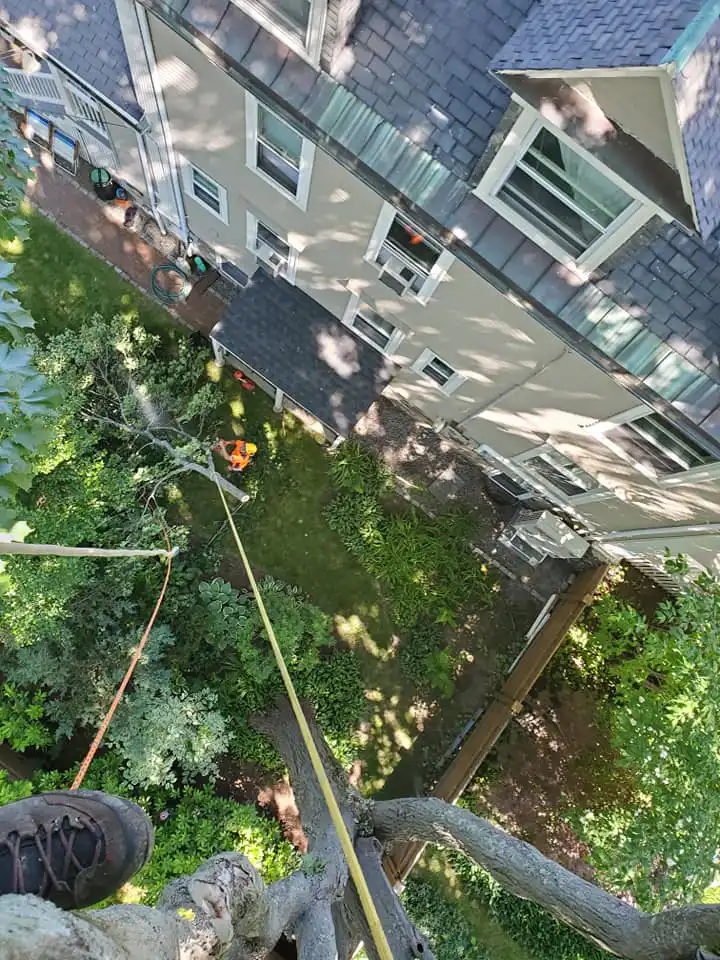
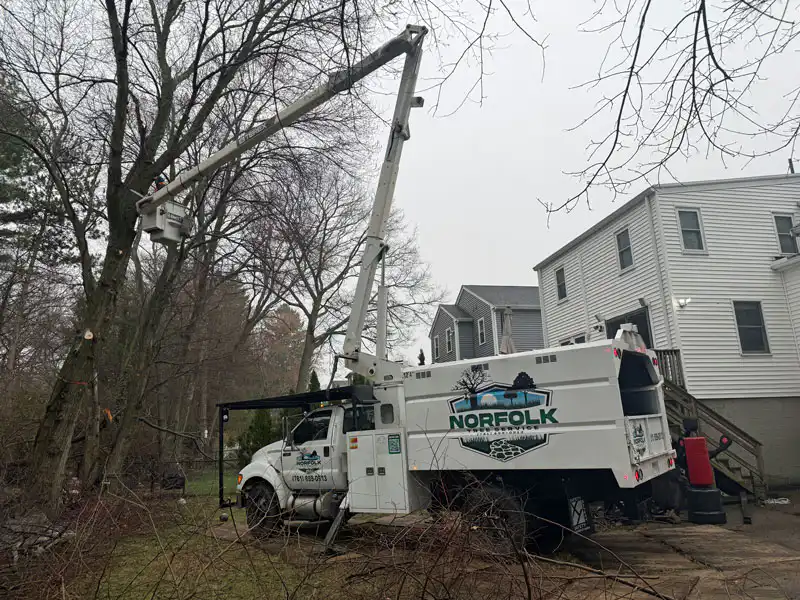 | A photo from Norfolk Tree Service job files. Every photo on this page comes from our own crews, not a stock library. |
| Service | Certified Arborist Consultation |
|---|---|
| Service area | Towns across Norfolk County and Greater Boston, MA. See our service areas. |
| Phone | 781-386-0512 |
| Inquiry | Send an inquiry through the quote form on this page, or call the number listed here. |
Frequently Asked Questions
What is the difference between a consultation and a free estimate?
An estimate prices a job you already know you want done. A consultation establishes what is actually wrong with a tree, how risky it is, and what your realistic options are, and it can produce written documentation for a permit application, an insurer, or a dispute. If you simply want a price for removing a tree, ask for an estimate.
Do I need an arborist report to remove a tree?
It depends where you are. Some municipalities in this area regulate removal of trees on private property and require a certified arborist evaluation as part of the permit application. Newton is the clearest local example. Elsewhere it may not be needed at all. We can tell you which applies before you commit to anything.
Can you provide documentation for an insurance claim?
Yes. After a failure we can document the tree, the nature and probable cause of the failure, and what remediation is required, with photographs. This is far more useful when it is done promptly, because the physical evidence disappears once the debris is cleared.
How long does a consultation take?
A single tree on a straightforward site is usually resolved in one visit, and you will normally get a verbal answer on the spot. A whole property inventory or a construction related survey takes longer, and any written report is produced afterwards rather than on site.
Are your arborists certified?
Yes. Our crews are ISA-certified arborists trained in modern climbing, rigging, and chainsaw safety practices, and we are licensed and fully insured. Insurance matters here as much as certification, particularly for work near buildings.
Is there a charge for a consultation?
Estimates for tree work we would carry out are free. A formal consultation with a written report is professional work and is quoted separately, based on the number of trees and the type of documentation you need. Tell us what the report is for when you call and we can be specific.
To arrange an arborist consultation, call Norfolk Tree Service at 781-386-0512.
Contact Norfolk Tree Service
Certified Arborist Consultation — Call or Send an Inquiry
Tell us what the trees on your Norfolk County and Greater Boston, MA property need. We walk the site, explain the options and give you a written quote before any work starts.
Call (781) 386-0512Send an InquiryOur Service Area