 Skip to content
Local Tree Crews Serving Massachusetts
"*" indicates required fields
Storm Damage Tree Removal
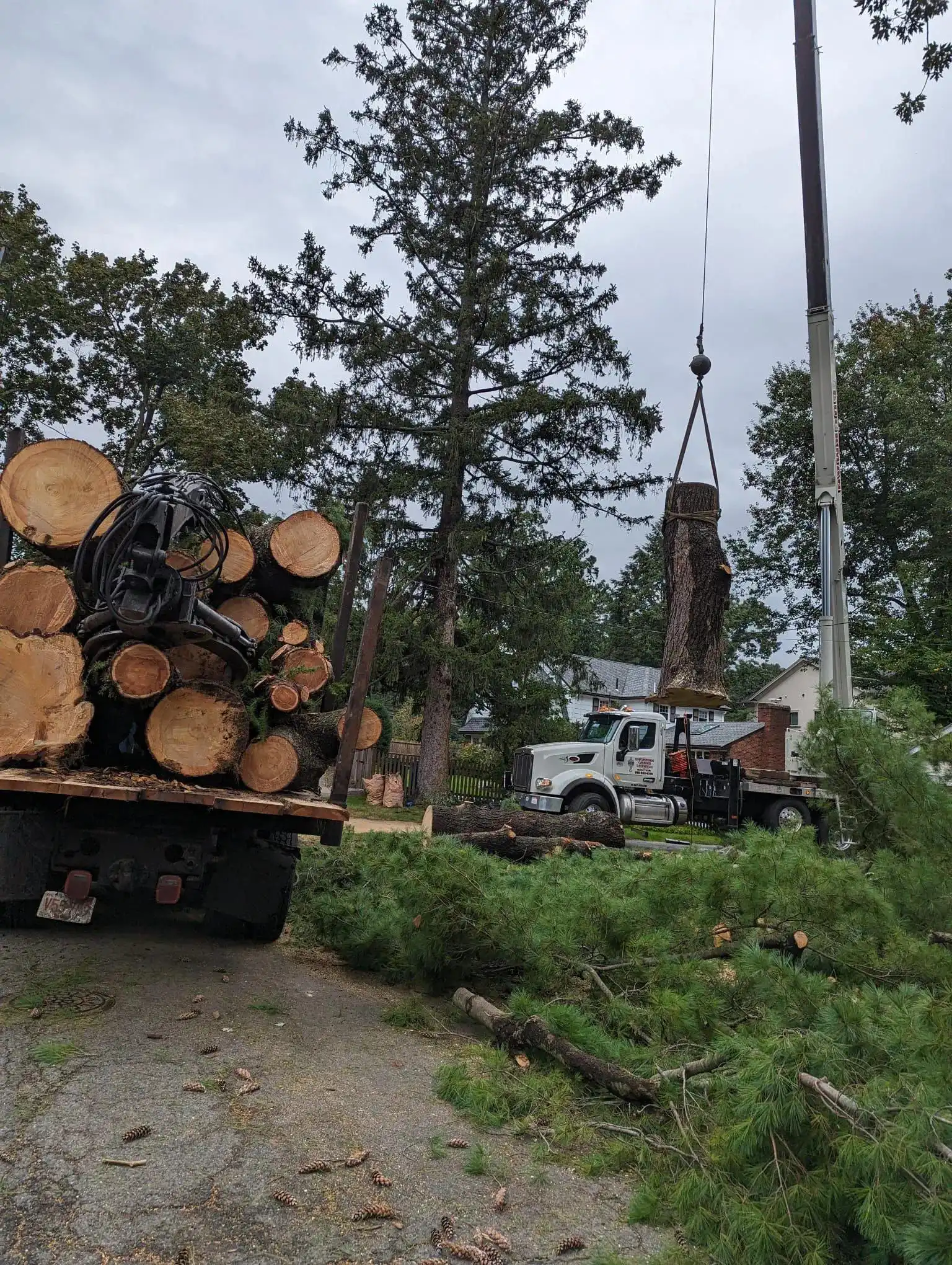
Storm damage work is a different job from scheduled tree work. The tree is already broken, the ground is already soft, and something underneath it usually matters — a roof, a car, a fence, a service drop. Norfolk Tree Service takes that work across its Massachusetts service area: limbs hung up in the canopy, split leaders, trunks leaning into a house, whole trees down across a driveway. This page sets out what a crew does on a storm call, how a damaged tree gets assessed before anybody climbs it, and what the clean-up afterwards actually covers. (781) 386-0512. Real person on dispatch.
What a Storm Call Looks Like
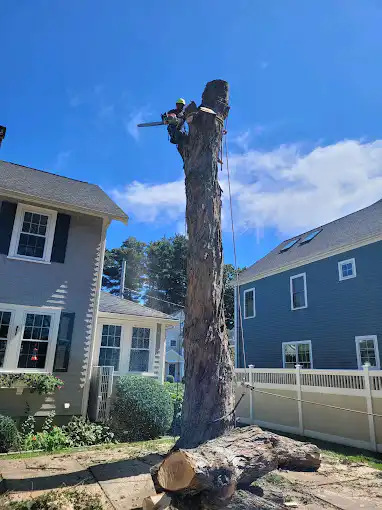
The first thing that happens is an assessment from the ground. Where is the load sitting, what is holding it, and what is underneath it. A limb hung up in a neighboring crown, a split leader still attached by a strip of bark, a trunk resting on a roofline — each of those is under tension and each releases differently. Nothing gets cut until the crew knows where the weight will go when it lets go. Once that is settled the work is rigged down in controlled pieces rather than dropped.
Hazard Trees Still Standing
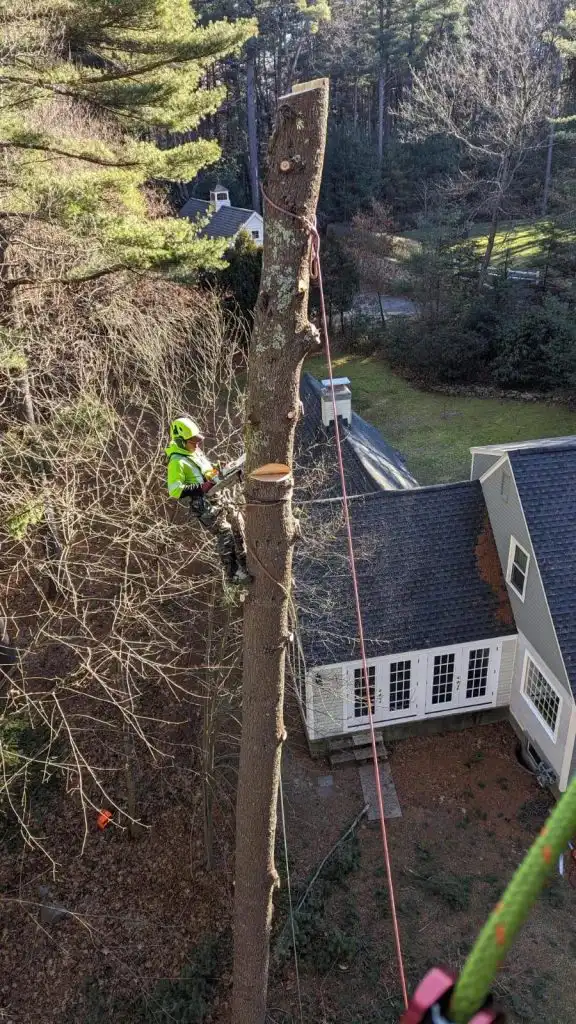
Plenty of storm damage is on trees that never came down. A root plate that has lifted on one side, a crack running down a main stem, a crown that has lost a third of its structure — those trees are the ones that fail in the next blow rather than this one. The assessment is the same either way: what is holding the tree up, what has changed, and whether the remaining structure can be pruned back to something sound or has to come out.
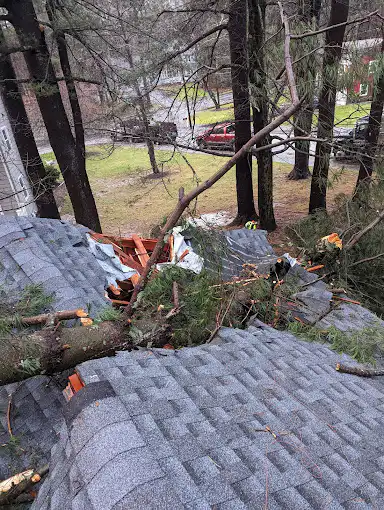
Emergency Response
Eastern Massachusetts gets the full range of it. Wet snow in late winter loads brittle limbs until they split. Summer thunderstorms produce short, violent downbursts that take out single mature specimens with no warning. The remnants of tropical systems arrive in late summer and early autumn behind days of rain, and saturated ground is what puts otherwise healthy trees over at the root plate. Storm calls are dispatched from the same yard as the rest of the work, and the line is answered rather than queued.
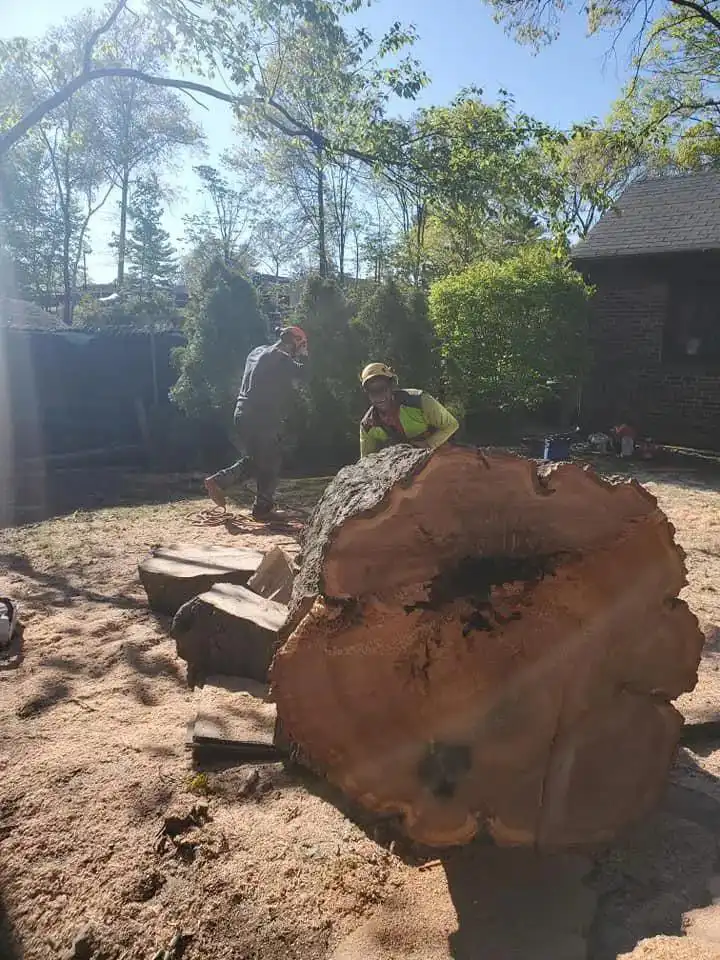
Clearing Drives, Roofs and Access
A tree across the driveway is usually the first call, because nothing else can happen until the car can move. Work on a roof is slower: the load has to come off in pieces small enough that nothing punches through what is left of the sheathing, and the crew works with the insurance adjuster’s photographs in mind rather than against them. Wood is cut down to a size that can be handled, stacked or hauled depending on what you want done with it.
Need Tree Trimming? We Can Help!
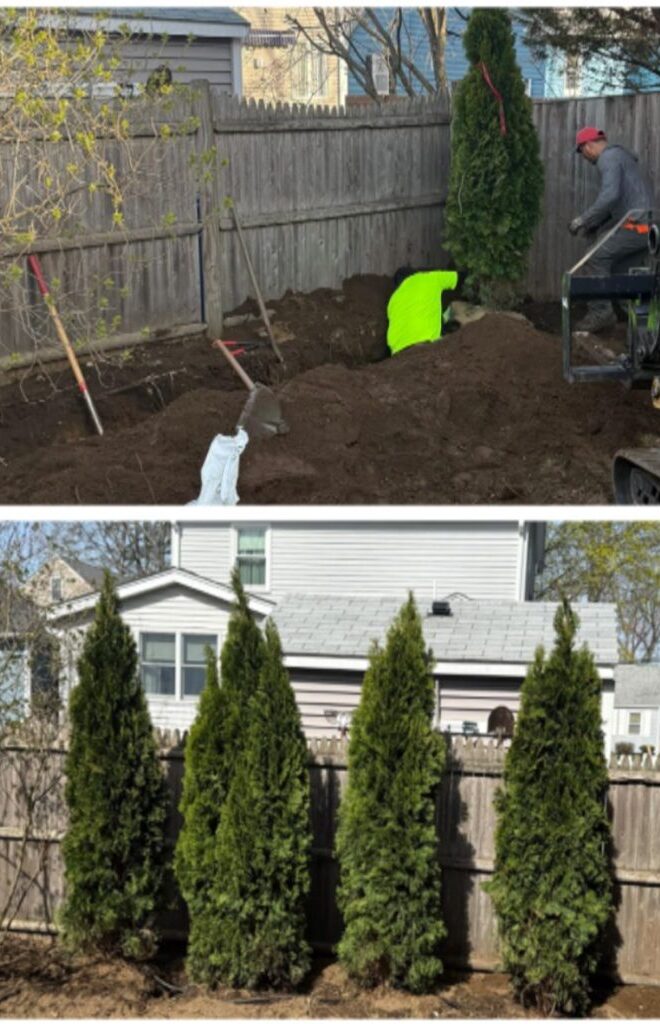
Damaged Wood and What Happens to It
Once the hazard is gone there is a pile of wood and brush that was not there yesterday. Brush is chipped, logs are cut to a length that can be moved and either stacked on site or hauled off, and the ground is raked back over. If a tree has to come out entirely, the stump can be ground at the same visit or left for a later one — storm work and stump work do not have to happen on the same day.
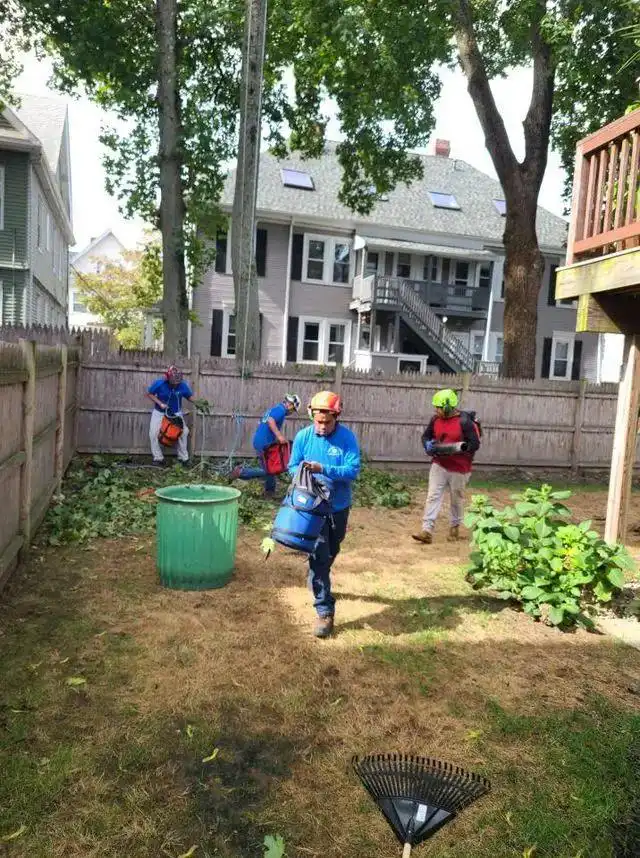
When the Whole Lot Is Affected
A bad storm rarely takes one tree. Where a whole treeline has gone over — along a boundary, behind a garage, across a back field — the work gets planned as a clearing job instead of a series of single removals: an order of operations that keeps the machine on solid ground, one debris route out, and the far end cleared before the near end so nothing gets double-handled.
Why Owners Call Us After a Storm
Five Reasons That Hold Up- Insurance That Is Real and Current
General liability and workers’ compensation with a national underwriter. Certificates emailed before the appointment as standard practice. - Familiarity With Damaged Wood Storm work is tension work — rigging down rather than free-fall, plywood under bucket pads, tarps in the drop zone, and nothing cut before the load path is understood. We have done plenty of it.
- Quotes Held to the Number
The walk-through happens on site, the price gets written down, and it does not move on the day of the work. - Cleanup Is Not an Afterthought
Chips raked, branches off the perennials, lawn ruts smoothed, magnetic sweep over the driveway. The yard goes back together the way it was.
Trees do not run on a business calendar.
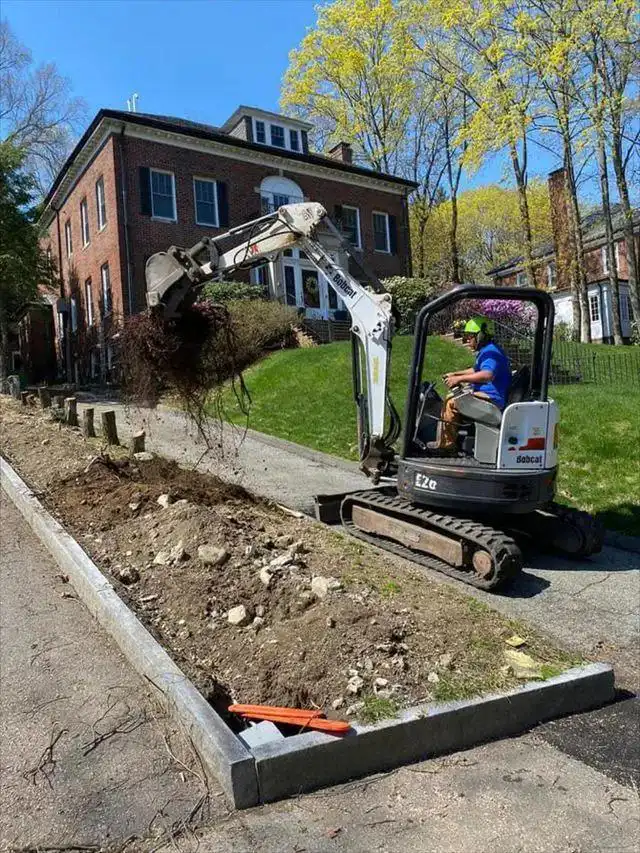
Storm Work Across Eastern Massachusetts
Working MassachusettsStorm response runs across the same towns as the scheduled work: the Charles River suburbs around the Waltham yard, the Norfolk County towns south and west of Boston, the MetroWest ring, and the towns down on the Bristol County line. Every one of them has its own service-area page. What changes from town to town after a storm is not the work but the queue — where the wires are down, which roads the town has closed, and which jobs have to wait on the utility before anybody can start.
Wet ground is the common factor in the worst of it. Trees standing near ponds, rivers and low wet corners go over at the root plate rather than snapping, because saturated soil gives up its grip before the wood gives up its strength. Red maple, swamp white oak and river birch grow in exactly those spots. A tree that has lifted its root plate even slightly is not going back down; it is waiting for the next wind.
The damage pattern is fairly predictable by species. White pine sheds whole limbs and snaps leaders. Norway maple, planted everywhere in the older suburbs, holds included bark in its unions and splits down the middle. Silver maple drops big wood in summer storms. Ash and hemlock, already under pest pressure across this part of the state, break where the decay has been working. A quick walk of the property after a blow is worth more than any general rule about which trees are safe.
Permits for storm work run the same way as any other job. Anything in the road layout or on a public shade tree goes through that town’s tree warden, and work inside a wetland buffer goes through the conservation commission. Emergency clearance of a blocked way is treated differently by most towns, and the crew will tell you which of those you are in before the saw starts rather than afterwards.
What Comes Down In A Storm
The four things that arrive on a storm call, in rough order of how often: a limb broken out of a crown and still hanging in it; a whole limb down on the ground, often across a drive or a fence; a trunk failure part way up, leaving a spike and a crown on the ground; and a complete uprooting, root plate and all, which is the one that moves a fence line and lifts a section of lawn with it. Each one is a different rigging problem and each one is priced after it has been looked at, not before.
Storm Work We Take On
- Hung-up and broken limbs
- Split leaders and cracked stems
- Trees down on structures
- Uprooted trees and lifted root plates
- Blocked drives and access routes
Nearby
- Waltham, MA
- Newton, MA
- Wellesley, MA
- Needham, MA
- Dedham, MA
- Norwood, MA
- Sharon, MA
- Sharon, MA
How It Works
Call or Request a Quote
Tell us what you need over the phone or online.
Free On-Site Estimate
A certified pro assesses the trees and gives you a clear written quote.
We Handle It & Clean Up
Safe removal or trimming, plus full cleanup and haul-away when we leave.
Species That Tend To Fail First
The canopy that storm crews work in across these towns: sugar maple, red maple, Norway maple, white oak, northern red oak, eastern white pine, eastern hemlock, American beech, and shagbark hickory. White pine and silver maple shed the most wood in a summer blow. Norway maple splits at included unions. Hemlock and ash are already weakened by pest pressure in this part of the state and break where the decay has been working. Wet-ground species — red maple, swamp white oak, river birch — are the ones that go over at the root plate once the soil is saturated.
Where Storm Crews Cover
The same towns as the scheduled work, run out of the Waltham yard: east through Watertown and Belmont, west along Route 20 and Route 117 to Weston, Lincoln and Concord, and south over Route 128 and Route 1 through Wellesley, Needham, Dedham, Canton, Sharon, Walpole, Foxborough and Mansfield to the Attleboro line. Every town on the service-area list is covered for storm work, not a shorter subset of it.
| A photo from Norfolk Tree Service job files. Every photo on this page comes from our own crews, not a stock library. |
| Service area | the Massachusetts towns listed on our service-area pages |
|---|---|
| Licensed & insured | Massachusetts general liability + workers’ comp |
| Phone | (781) 386-0512 |
| Services | Tree Removal Services in Massachusetts, Tree Trimming in Massachusetts, 24/7 Emergency Tree Services in Massachusetts, Tree & Shrub Planting in Massachusetts, Stump Grinding in Massachusetts, Lot & Land Clearing in Massachusetts |
| Inquiry | Send an inquiry through the quote form on this page, or call the number listed here. |
Frequently Asked Questions
What should I do before the crew arrives?
Keep people and cars away from underneath it, and do not pull on anything. A hung-up limb or a split leader is under tension, and moving one end of it moves the other. Photograph what you can see safely from the ground — those photographs are useful to an insurer later — and leave the rest alone.
Is a tree leaning against the house an emergency?
Treat it as one until it has been looked at. A trunk resting on a roofline is being held by whatever it landed on, and that support can shift. The assessment is about where the weight goes when the load is released, which is not something to work out from a photograph.
Do you handle trees down on wires?
No, and nobody else should either. Anything in contact with a service drop or a primary line is the utility’s job first — the line has to be made safe before a saw goes anywhere near the tree. Once the utility has released it, the removal is ordinary storm work.
Will my insurer want anything specific?
Usually photographs of the damage before anything is moved, and a written description of what was removed and why. That gets provided as a matter of course. What an individual policy covers is between you and the insurer — that is not a call this crew makes on your behalf.
Can a damaged tree be saved instead of removed?
Sometimes. A crown that has lost a limb or two can often be pruned back to sound structure and left standing. A split main stem or a lifted root plate generally cannot — the tree may leaf out again and still be a failure waiting on the next storm. The assessment is made on site rather than from the kerb.
What happens to the wood and the brush?
Brush is chipped, logs are cut to a length that can be moved, and the choice of stacking on site or hauling away is yours. The ground gets raked back over before the crew leaves. Stump grinding can happen on the same visit or a later one.
A Few Things to Look For When Hiring
Tree work consistently ranks among the most dangerous occupations in the country, and the bad outcomes almost always trace back to crews stretching past their training. Look for the signals: rope-and-saddle climbing instead of spurs into living wood, controlled cuts at the branch collar, rigging used on anything that cannot safely free-fall, hardhats and chainsaw chaps on every member of the crew, sharp saws, well-maintained chippers.
Insurance is non-negotiable. General liability covers your property; workers’ compensation covers the climber. If both certificates cannot be produced before the appointment, the conversation should end there. We send them in advance.
Cleanup is what owners notice the next morning. The crews worth keeping put the property back together — chips raked or hauled per your preference, logs cut to firewood length on request, lawn ruts rolled flat, magnetic sweep over the driveway.
We are Here For You
No menus, no callback queue, no offshore call center. The dispatch line goes to a real person who can talk specifics about the project and put eyes on it this week.
Estimates, scheduling, after-hours storm dispatch — (781) 386-0512.
Quotes happen on-site. We walk the property, take a real look at every tree on the list, and put the number in writing before any equipment moves.
Single specimen or a full lot reset, residential or commercial — give us a call.
Norfolk Tree Service · 40 Fairmont Ave, Waltham, MA 02453 · (781) 386-0512 · Always Live for Emergencies · Serving Massachusetts and the surrounding South Shore region
Our Services in Massachusetts
From every neighborhood in Massachusetts, Norfolk Tree Service handles the full catalog of tree work — removals, trimming, stump grinding, planting, land clearing, and 24/7 emergency response. Browse the services below:
- Tree Removal Services in Massachusetts
- Tree Trimming in Massachusetts
- 24/7 Emergency Tree Services in Massachusetts
- Tree & Shrub Planting in Massachusetts
- Stump Grinding in Massachusetts
- Lot & Land Clearing in Massachusetts
Tree Services We Offer
| Service | What It Covers | When You Need It |
|---|---|---|
| Tree Removal | Full takedowns, hazardous & dead trees, complete cleanup & haul-away | Dead, leaning, or storm-damaged trees near homes or lines |
| Tree Trimming & Pruning | Crown thinning, deadwooding, shaping, roofline & utility clearance | Overgrowth, low limbs, or to protect tree health |
| Stump Grinding & Removal | Below-grade grinding, root chasing, full chip cleanup | After a removal, trip hazards, or to replant |
| 24/7 Emergency Storm Response | Rapid response, road/roof clearing, hanging-limb removal | Fallen or hanging limbs, blocked driveways, storm damage |
| Lot & Land Clearing | Multi-tree clearing, brush & undergrowth, site prep | New builds, additions, or overgrown parcels |
| Tree & Shrub Planting | Species selection, planting, establishment care | Replacing removed trees or upgrading curb appeal |
Trusted by Local Homeowners
Read All ReviewsNearby Towns We Serve
Norfolk Tree Service provides tree removal, trimming, stump grinding, and 24/7 storm response across the towns we serve and the surrounding communities:
Contact Norfolk Tree Service
Free Storm Damage Tree Quote — Call Today
Removals, trimming, stump grinding, and 24/7 storm response across the towns we serve and the surrounding area. Licensed and insured — free written estimates.
Call (781) 386-0512Get a QuoteLicensed & Insured
Our Service Area
Storm Season 2026: Getting Ahead Of August Through October
Late summer into mid autumn is the hardest stretch of the year on Massachusetts trees. From August through October, the remnants of tropical systems track up the coast and the first true nor’easters arrive, and they land on trees still carrying a full canopy. A tree in full leaf behaves like a sail, and saturated ground loosens the root plate, which is why so many local failures are whole trees tipping rather than branches snapping. The work that prevents most of that damage has to happen before the wind, not after it.
Preventive Pruning Is The Cheapest Storm Insurance
Thinning a dense crown lets wind pass through instead of pushing against it, and removing deadwood takes away the limbs most likely to come down on a roof, a car, or a service line. Crossing and rubbing branches get cleared, weak V-shaped unions get evaluated, and any limb overhanging a structure gets a hard look. Pruning done now, while the tree is still healthy and accessible, costs a fraction of an emergency removal and the cleanup that follows one.
Hazard Limb Warning Signs To Walk Your Property For
- Cracked, split, or partially detached limbs, especially where two leaders meet
- Hanging or broken branches still caught in the canopy after an earlier storm
- Mushrooms, conks, or shelf fungus at the base or on the trunk, a sign of internal decay
- Cavities, hollow spots, or bark falling away in sheets
- A new lean, or soil heaving and cracking on one side of the root plate
- Bare, brittle branches in the upper crown while the rest of the tree leafs out
Any one of these is worth an inspection. Two or more on the same tree, particularly within reach of a house or driveway, should be looked at before the next storm is in the forecast.
Document Everything For Your Insurance Claim
Insurers pay faster when the paperwork is already in order. Photograph your trees and the structures near them now, while they are still standing, so you have dated proof of their condition before any damage. Keep invoices for pruning and inspections, since documented maintenance helps counter a claim denial based on neglect. If a tree does come down, photograph the damage from several angles before anything is moved, note the date and time, and hold onto the debris until your adjuster has seen it or released you to clear it.
Storms do not keep business hours, so neither do we. See our 24/7 emergency tree services for what that response covers. To get preventive pruning on the calendar before the next system moves through, contact us for a free estimate.