 Skip to content
Trees decline slowly and then fail suddenly, and the gap between those two is where an owner can still do something. The signals are there long before the trunk gives way, in the crown, at the base and under the bark. This guide runs through what to look for, roughly in the order it tends to appear.
A healthy mature tree is one of the most valuable features on a Massachusetts property. A dying mature tree is one of the most dangerous. The trick is knowing which one you’ve got, because the warning signs are subtle until they aren’t.
Every tree that’s ever crushed a roof in New England gave its owner warning signs first. Most of the time those signs were missed because the homeowner didn’t know what they were looking at. Here are the seven to watch for — ranked from “early warning” to “call someone today.”
1. Dead Branches in the Upper Canopy
Stand back from the tree on a summer day and look at the very top. Are some branches bare while the rest of the canopy is full of leaves? Those bare branches are dead, and dead branches in the upper canopy are one of the first signs of a tree in decline.
A handful of small dead twigs is normal — trees self-prune. Multiple dead branches more than 2 inches thick at the top is a red flag. The tree is failing from the top down because the upper canopy is the last part to get nutrients from the root system. When the roots are stressed, the top dies first.
2. Fungal Conks at the Base
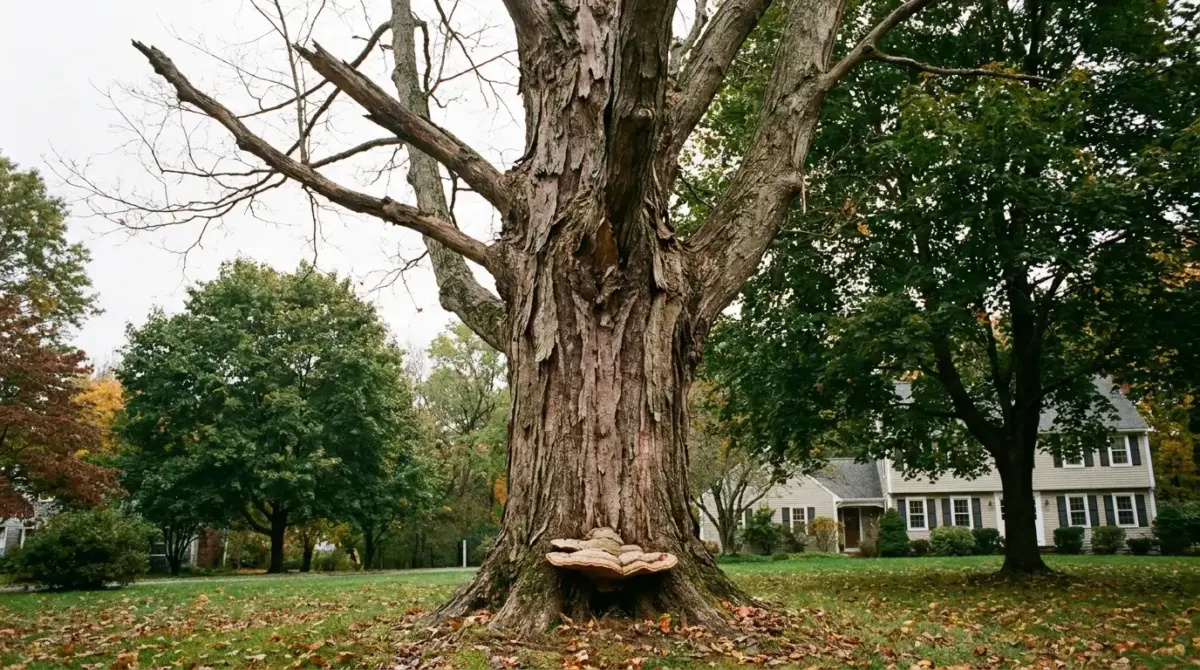
“Conks” are the shelf-like or bracket-shaped fungal growths you sometimes see attached to tree trunks, especially near the base. They look like flat mushrooms growing sideways out of the bark. Pretty? Sometimes. A serious warning sign? Always.
Conks are the fruiting bodies of a fungus that’s living inside the tree, eating the heartwood. By the time you can see the conk on the outside, the inside of the trunk is rotting. The International Society of Arboriculture (ISA) hazard tree resources rank visible conks as one of the highest-priority indicators that a tree needs professional evaluation.
3. Bark Falling Off in Sheets
Bark naturally exfoliates on some species — sycamore, birch, river birch — that’s normal. What’s not normal is large sections of bark sloughing off any tree to expose smooth bare wood underneath, or bark coming off in a vertical strip that runs much of the trunk’s height.
This usually means the tree has been struck by lightning, hit by frost crack damage, or invaded by a destructive pest like emerald ash borer. The cambium layer (the living tissue just under the bark) is dying. Without it, the tree can’t move water or nutrients.
4. A Lean That Wasn’t There Last Year
Plenty of mature trees grow at a slight lean. That’s been that way for decades, anchored by a strong root system that compensates. The concern is a tree that has developed a new lean recently — especially if you can see exposed roots on the opposite side of the lean or cracked soil at the base.
That tree is failing structurally. The roots aren’t holding it anymore. Wind, ice, or saturated spring soil could bring it down. New lean equals immediate professional assessment.
5. Deep Vertical Cracks in the Trunk
Healthy trees have textured bark with shallow furrows. Concerning trees have deep vertical cracks that go past the bark and into the wood underneath — sometimes wide enough that you can fit a finger inside. These are called frost cracks or splits and they happen when the trunk expands and contracts faster than the bark can stretch.
A single shallow frost crack on a healthy tree might heal over time. Multiple deep cracks, especially with bark separating from the wood around them, mean structural integrity is compromised.
6. Hollow or Punky Wood
Knock on the trunk with the back of your hand. A solid tree makes a dull thud. A hollow or partially hollow tree sounds noticeably more drum-like. If you can knock on different sides of the trunk and hear different sounds, the wood is rotting unevenly inside.
Don’t panic over slight hollowness — many oaks and maples live for decades with some internal decay. The danger zone is when more than a third of the trunk’s diameter is hollow. At that point a strong gust of wind can snap it like a pencil.
7. Roots That Are Lifting, Cracking, or Exposed
Walk around the base of the tree. Look at the ground out to about 5 feet from the trunk. Are there cracks in the soil forming a ring? Are roots being pushed up out of the ground on one side? Is mulch or topsoil mounding up where it didn’t used to?
The root system is failing. The tree is starting to lift out of the ground. In Massachusetts soils that get saturated with spring snowmelt and heavy fall rain, root failure is responsible for more fallen trees than any other cause besides outright disease. The Massachusetts Department of Conservation and Recreation tracks tree-related storm damage every year, and root failure is consistently at the top of the list.
Quick Self-Check You Can Do This Weekend
Walk every mature tree on your property with this checklist:
- Stand 30 feet away and look at the canopy. Dead branches at the top?
- Walk to the trunk. Knock on it at three different heights. Hollow sound anywhere?
- Look at the base. Mushrooms or shelf fungi?
- Check the bark. Strips falling off? Vertical cracks?
- Look at the lean compared to a photo from 2-3 years ago. Worse now?
- Check the ground out 5 feet. Cracks? Lifted roots?
Three or more warning signs on the same tree, especially near a structure or driveway, means it’s time for a certified arborist to look at it before nature decides for you.
What Insurance Actually Covers
Here’s a hard truth most homeowners learn the wrong way. If a healthy tree falls on your house during a storm, your homeowner’s policy generally covers the damage. If a dead, visibly diseased, or clearly hazardous tree falls on your house, the insurance company can deny the claim — arguing you should have removed it.
That’s why proactive removal of a dying tree costs less than rolling the dice on storm season.
When NOT to Remove a Tree
Not every concerning sign means death sentence. Some trees can be saved with:
- Cabling and bracing for trees with structural weakness but otherwise healthy wood
- Targeted pruning to reduce wind sail and weight on weak branches
- Soil aeration and proper fertilization for stressed root systems
- Pest treatment if the problem is an invasive species like emerald ash borer or hemlock woolly adelgid
A good arborist will look for ways to preserve a tree before recommending removal. A bad one quotes removal on every visit.
Bottom Line
Trees don’t fall without warning. They drop hints for years. Walking your property twice a year with this list takes 15 minutes and could save your roof, your car, or — in the worst case — a family member. If you see two or more warning signs on the same tree, get a professional assessment. Sooner is always cheaper.
Trusted Local Network
Tree decisions often surface broader yard and property questions. For property owners outside MA needing plumbing coordination around landscape work, regional plumbing services for landscape-adjacent work handle that scope. And for general yard and handyman work, general home-services contractors cover the surrounding scope.
Your Massachusetts Tree Removal Specialists
If you’ve spotted warning signs on a tree near your home across Norfolk County, Middlesex County, and Bristol County — including Waltham, Lexington, Watertown, Milton, and surrounding towns, Norfolk Tree Service offers fully licensed and insured tree removal with on-site hazard assessments included. Our ISA-trained crews will tell you straight whether a tree can be saved or needs to come down. Contact us today for a free consultation.