 Skip to content
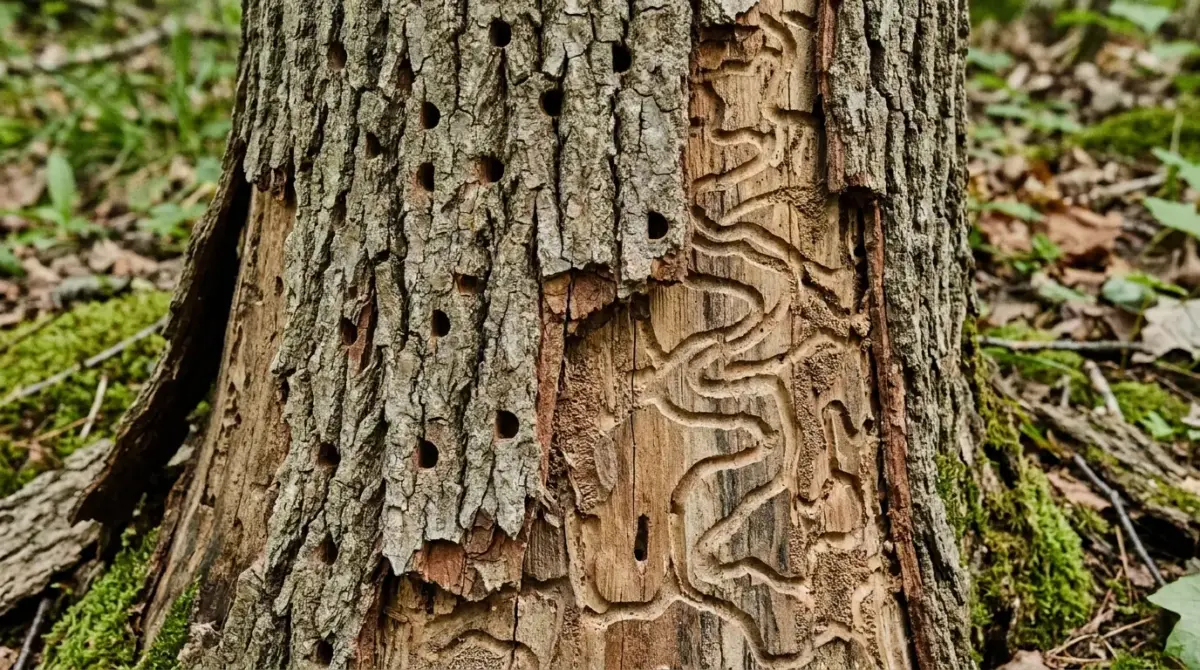
Ash trees go downhill fast once the borer is in them, and the early signs are easy to walk straight past: thinning high in the crown, woodpeckers working the upper trunk, bark splitting in fine vertical lines. This guide covers how to check an ash on your own property and what the realistic options are once the insect is confirmed nearby.
If you have an ash tree on your Massachusetts property, you need to be reading this. Emerald ash borer — a small metallic-green beetle that arrived in the US around 2002 — has killed tens of millions of ash trees across North America. Massachusetts confirmed its presence in 2012, and the beetle has been working its way through our ash population ever since.
An infested ash tree dies within 2 to 4 years of the first attack. By the time most homeowners notice something is wrong, the tree is past saving. This guide tells you how to spot it early, when to treat, and when removal is the only option.
First: Do You Even Have an Ash Tree?
Many Massachusetts homeowners assume the big tree in their yard is an oak or maple when it’s actually a white ash or green ash. Quick identification:
- Compound leaves — each leaf has 5 to 11 leaflets arranged opposite each other along a central stem
- Branches grow in opposite pairs (not alternating like oak)
- Bark on mature trees has distinctive diamond-pattern furrows
- Seeds are flat, paddle-shaped “samaras” hanging in dense clusters in fall
The Massachusetts Department of Agricultural Resources EAB page has a complete ID guide with photos.
The 5 Warning Signs of EAB Infestation
1. Canopy Thinning From the Top Down
Look at the top third of the tree. Are some branches bare while the lower canopy is full? EAB attacks the upper canopy first because that’s where their larvae cut off the flow of water and nutrients. Dieback at the top is sign #1.
2. D-Shaped Exit Holes in the Bark
The adult beetles emerge from the bark in late spring through summer, leaving a tiny but distinctive D-shaped hole (the flat side of the D is up). About 1/8 inch wide. Look on the trunk and the underside of larger branches.
Most other tree pests leave round exit holes. The D-shape is a diagnostic for EAB.
3. Serpentine Galleries Under the Bark
If you pull off a piece of loose bark from a suspected ash tree, look at what’s underneath. EAB larvae carve S-shaped or serpentine tunnels packed with fine sawdust. The galleries can be several inches long and are the actual mechanism that kills the tree — they cut off the cambium layer.
4. New Branches Sprouting From the Trunk
A stressed tree pushes out new shoots from the base or directly from the trunk — these are called “epicormic sprouts.” It’s the tree’s emergency response to losing canopy. Lots of these sprouts on an ash tree is a sign of distress.
5. Increased Woodpecker Activity
Woodpeckers are EAB’s natural predator. If you suddenly see lots of woodpeckers focused on your ash tree, drilling holes in the bark to dig out larvae, the beetles are inside. “Flecking” — sections of bark pulled off by woodpeckers exposing pale wood underneath — is a strong sign of EAB.
When You Can Save an Infested Tree
Treatment is possible — but only if you catch the infestation early. The general rule: if more than 30% of the canopy is dead, treatment isn’t economical. The tree is too far gone.
Treatment options for early-stage infestation or preventive use on nearby healthy ash:
- Trunk injections with emamectin benzoate — applied by certified arborists, effective for 2-3 years per application
- Soil drench with imidacloprid — DIY-friendly for small trees, less effective for trunks larger than 15 inches diameter
- Bark sprays — periodic professional applications during the adult flight period
Treatment is an ongoing commitment. Once you start, you have to keep it up for the life of the tree. Stopping = death.
When Removal Is the Only Option
If canopy dieback is over 30%, multiple D-shaped holes are visible, and you’re seeing all the other signs, the tree is dying. Removal protects:
- Other ash trees on your property and your neighbors’ properties
- Your house and family from falling dead branches
- Your insurance claim (insurers can deny claims on dead trees the homeowner knew about)
Dead ash gets dangerous fast. The wood becomes brittle within 1-2 years of death. Branches break unpredictably. Climbing arborists can refuse to work on severely deteriorated ash because the structure is unsafe. That makes removal more expensive the longer you wait.
Don’t Move Firewood
EAB primarily spreads via infested firewood. Massachusetts has firewood movement regulations to slow the spread. The Don’t Move Firewood campaign tracks the rules: keep firewood within 50 miles of where it was cut, and never bring out-of-state firewood into Massachusetts.
If you remove an infested ash, the wood should be disposed of through approved channels — chipped on-site or hauled by a licensed service that handles EAB material correctly. Don’t sell it as firewood. Don’t give it away to neighbors. Don’t truck it to a cabin in New Hampshire.
What to Plant in Place of Ash
If you take an ash down and want to replant, don’t plant another ash. Even if you treat it, you’re betting your investment against a beetle that’s everywhere now.
Good replacement trees for Massachusetts that aren’t currently under attack by any major pest: red maple, sugar maple, sweetgum, tulip poplar, oak (most species), American hornbeam, eastern redbud, kousa dogwood. Mix species for diversity — single-species monocultures are the reason EAB has been so devastating in the first place.
Bottom Line
If you have ash trees, inspect them every spring. Look for the canopy dieback, the D-shaped holes, the woodpecker activity. Catching EAB early gives you treatment options. Catching it late means removal becomes urgent and expensive. The beetle isn’t going away — it’s been confirmed in every Massachusetts county now — so vigilance is the only defense.
Trusted Local Network
Tree-related property issues that intersect with security and access often need locksmith coordination. For property owners outside MA, on-call locksmith services for storm damage handle that scope. And for general property maintenance, general home-services contractors cover related work.
Your Massachusetts Tree Removal Specialists
If you suspect emerald ash borer on a tree at your property, Norfolk Tree Service serves Norfolk County, Middlesex County, and Bristol County — including Waltham, Lexington, Watertown, Milton, and 40+ surrounding towns. Our ISA-trained arborists can assess your ash trees and provide tree removal services that follow Massachusetts EAB disposal regulations. Contact us today for an inspection.