 Skip to content
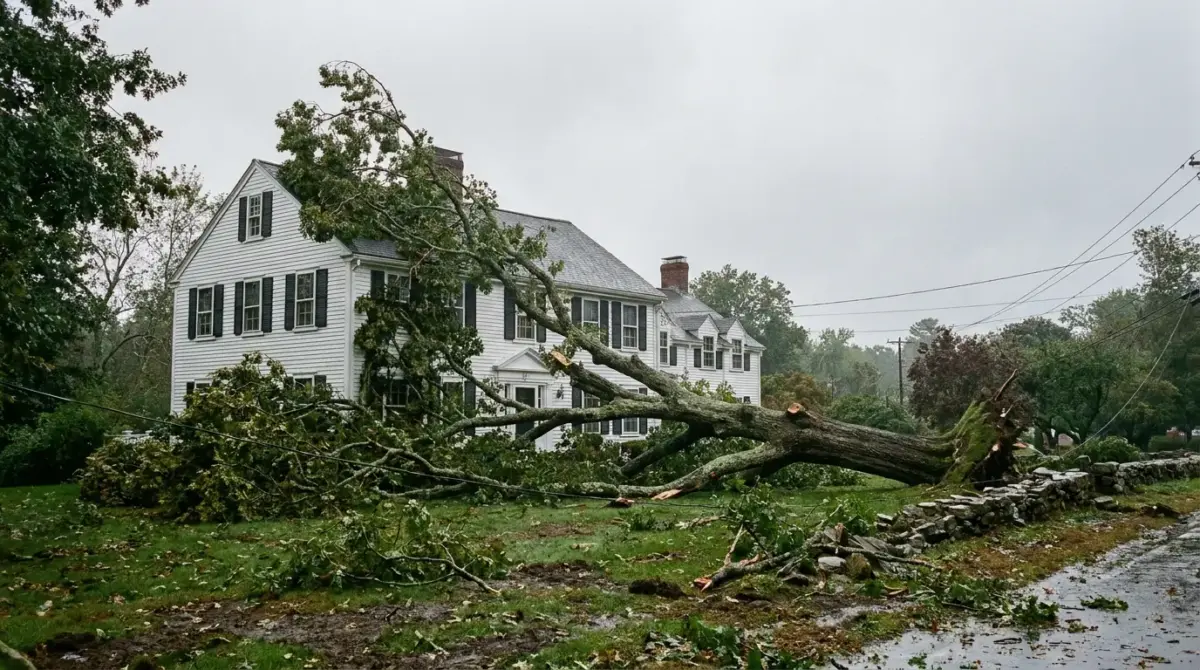
A tree down across the drive is an ordering problem before it is a cutting problem. What is underneath it, what is still holding it up, and whether anything electrical is involved decide everything that follows. This guide covers what to check first, what not to touch at all, and how to describe the scene when you call for help.
The wind dies down. You step outside. There’s an oak across your driveway. Or worse — half a maple on your roof. Or worse than that — a tangle of branches sitting on top of a downed power line in your front yard.
The right moves keep your family safe, protect your insurance claim, and get the tree off your property faster. The wrong moves can hurt someone or void your coverage.
Here’s the priority order, learned the hard way from every nor’easter that’s hit Massachusetts in the last 20 years.
Step 1: Safety First — Look Up Before You Go Out
Before you take one step outside, look from the windows. Are there downed power lines? Tree branches still hanging from above ready to fall? Any tree leaning more than it did before the storm?
The most dangerous moment after a storm isn’t the storm itself — it’s the next 24 hours. Branches that didn’t break in the wind drop when the wind dies. “Widow makers” they’re called for a reason. The Massachusetts Emergency Management Agency storm safety guide lists tree limb collapse as a leading post-storm injury cause.
Step 2: Downed Power Lines — Stay Back, Call the Utility
If a tree took down a power line, assume the line is live. Stay at least 30 feet away. Don’t touch the tree. Don’t touch any metal fence, gate, or vehicle that might be in contact with the line. If a line is down across your driveway, do not drive over it.
Call your utility immediately. National Grid: 1-800-465-1212. Eversource: 1-800-592-2000. They send a crew to de-energize the line before any tree work can begin.
No tree service — not even the best one — should work on a tree touching a live wire. Anyone who agrees to is risking their life and yours.
Step 3: Document Everything for Insurance
Before anything gets moved or cut, take photos. Lots of photos. From multiple angles. Wide shots that show the full scene. Close-ups of damage to the house, car, fence, or anything else. Photos of the tree’s root ball if it pulled out of the ground.
Get a clear picture of where the tree came from and where it ended up. Insurance adjusters work from photos — having a thorough set of your own ensures nothing gets disputed later.
Also: don’t move anything yet (unless safety requires it). Adjusters need to see the scene as close to “as fallen” as possible.
Step 4: Call Your Insurance Company
File a claim before you hire anyone for cleanup. The adjuster will tell you:
- What’s covered (tree removal cost, structure repair, contents)
- What’s your deductible
- Whether you need their pre-approval before hiring a tree service
- Whether they have preferred vendors (you usually don’t have to use them)
The Insurance Information Institute’s fallen tree coverage guide walks through typical policy structures, but every policy is different. Read yours and talk to your specific adjuster.
Step 5: Who Pays When a Neighbor’s Tree Falls?
Big Massachusetts question. Your neighbor’s oak fell across the property line and crushed your fence and your shed. Whose insurance pays?
Generally: yours. The standard rule under Massachusetts law is that a tree falling due to natural causes (storm, age, disease that wasn’t known about) is an “act of God.” Your policy pays to fix your property. Their policy pays to fix theirs.
The exception: if you can prove the neighbor knew the tree was hazardous and didn’t act (because you warned them in writing, for example, or because the dead state was obvious for years), their negligence might shift liability. This requires documentation and is hard to prove. Don’t count on it.
Step 6: Emergency vs. Non-Emergency Tree Removal
Not every fallen tree needs a 24/7 emergency response. Be honest about which category yours is in:
True emergency (call right away, premium rates apply):
- Tree on the house (especially through a roof)
- Tree blocking the only access to the property
- Tree against a power line or telecom line
- Tree leaning over an occupied structure and still falling
- Tree blocking emergency vehicle access
Not a true emergency (can wait 1-3 days for normal-rate service):
- Tree in the yard not touching any structure
- Tree across the driveway if you can park on the street
- Large branches down but the rest of the tree is stable
- Fence damage that doesn’t compromise pet or child safety
Calling for emergency service when it’s not an emergency means paying 50-100% more than weekday rates for work that could have waited.
Step 7: What NOT to Do
Common mistakes that make a bad situation worse:
- Don’t grab a chainsaw and start cutting. Storm-fallen trees have tension and compression forces you can’t see. A wrong cut releases stored energy and sends a section of tree right at you. Tree work injuries spike after every major storm because well-meaning homeowners think it looks straightforward.
- Don’t hire the first crew that knocks on your door. Out-of-state storm chasers descend on Massachusetts after every big storm with sketchy paperwork and disappearing acts after deposits clear.
- Don’t sign anything without reading it. Some crews use scope-creep contracts that authorize “additional work as needed” at unspecified rates.
- Don’t move debris that’s tangled with anything structural until a professional has assessed what’s holding what.
Step 8: Pick a Reputable Service
Once safety is handled and insurance is notified, hire someone who can do the work safely. Look for:
- Massachusetts business with verifiable address (not just a phone number)
- Proof of general liability insurance AND workers’ comp
- Written quote before work begins
- Willingness to coordinate with your insurance adjuster
- Reviews from local customers, not just Google star ratings
Bottom Line
After a tree falls, slow down. The damage is already done. Take the time to do this right and you’ll come out the other side with your insurance claim intact, your property restored, and nobody hurt. Rush it and you risk all three.
Trusted Local Network
For property owners outside MA dealing with similar tree-and-property coordination, tree-care services for similar regional issues handle that scope. And for the insurance claim side that often runs alongside tree-related property issues, public insurance claim representation handles the carrier coordination.
Your Massachusetts Emergency Tree Service Specialists
If a tree just came down on your property across Norfolk County, Middlesex County, and Bristol County — including Waltham, Lexington, Watertown, Milton, and 40+ surrounding towns, Norfolk Tree ServiceWe offer rapid-response 24/7 emergency tree services with insurance documentation assistance and transparent pricing — no storm-chaser surprises. Contact us today or call (781) 386-0512.