- Carefully pull mulch back from the trunk down to the original soil grade
- Identify the root flare (the natural widening at the base of the trunk) — it should be visible
- Check for girdling roots wrapping around the trunk. A certified arborist may need to cut these out if they’ve already grown
- Spread the existing mulch out into a flat donut shape at the proper depth
- Keep the trunk-to-mulch gap from now on
Don’t try to fix a volcano that’s been in place for 10+ years without professional help. Severe girdling roots can require careful root pruning that homeowners shouldn’t attempt.
A Quick Note on Watering
Mulch reduces evaporation but doesn’t eliminate the need to water during drought. For young trees (first 3 years) and any tree during a Massachusetts summer dry spell:
- Water deeply (slow drip for 30+ minutes) once a week instead of light daily sprinkling
- Water at the drip line, not against the trunk
- Skip watering after natural rain over 1 inch
The Arbor Day Foundation watering guide has detailed schedules for newly planted versus established trees.
Bottom Line
Proper mulching is one of the cheapest things you can do for tree health. Improper mulching is one of the most damaging — and it’s everywhere. The rule is simple: 2-4 inches deep, flat donut shape, pulled back from the trunk to expose the root flare. Do that and your trees will outlive you. Pile it up against the trunk and you’ll wonder why your maple keeps thinning out year after year.
Your Massachusetts Tree Care Specialists
If you’ve inherited a yard full of mulch volcanoes or need expert advice on tree health, Norfolk Tree Service serves Norfolk County, Middlesex County, and Bristol County — including Waltham, Lexington, Watertown, Milton, and 40+ surrounding towns. Our ISA-certified arborists can assess your trees and recommend the right tree and shrub planting care for your specific species. Contact us today.
- Late spring (May) — after the ground warms but before summer drought stress
- Late fall (mid-October) — insulates roots before freezing temperatures
Mulch doesn’t need to be replaced every year. The bottom layer decomposes and feeds the soil — that’s the goal. Refresh the top inch or so when it gets thin, but don’t strip out the old layer and pile fresh on top every spring. That’s how depths get out of control.
Fixing an Existing Mulch Volcano
If you have a tree that’s been volcano-mulched for years, don’t despair. Repair steps:
- Carefully pull mulch back from the trunk down to the original soil grade
- Identify the root flare (the natural widening at the base of the trunk) — it should be visible
- Check for girdling roots wrapping around the trunk. A certified arborist may need to cut these out if they’ve already grown
- Spread the existing mulch out into a flat donut shape at the proper depth
- Keep the trunk-to-mulch gap from now on
Don’t try to fix a volcano that’s been in place for 10+ years without professional help. Severe girdling roots can require careful root pruning that homeowners shouldn’t attempt.
A Quick Note on Watering
Mulch reduces evaporation but doesn’t eliminate the need to water during drought. For young trees (first 3 years) and any tree during a Massachusetts summer dry spell:
- Water deeply (slow drip for 30+ minutes) once a week instead of light daily sprinkling
- Water at the drip line, not against the trunk
- Skip watering after natural rain over 1 inch
The Arbor Day Foundation watering guide has detailed schedules for newly planted versus established trees.
Bottom Line
Proper mulching is one of the cheapest things you can do for tree health. Improper mulching is one of the most damaging — and it’s everywhere. The rule is simple: 2-4 inches deep, flat donut shape, pulled back from the trunk to expose the root flare. Do that and your trees will outlive you. Pile it up against the trunk and you’ll wonder why your maple keeps thinning out year after year.
Your Massachusetts Tree Care Specialists
If you’ve inherited a yard full of mulch volcanoes or need expert advice on tree health, Norfolk Tree Service serves Norfolk County, Middlesex County, and Bristol County — including Waltham, Lexington, Watertown, Milton, and 40+ surrounding towns. Our ISA-certified arborists can assess your trees and recommend the right tree and shrub planting care for your specific species. Contact us today.
- Best: Aged bark mulch (pine or hardwood), shredded leaves, wood chips from arborist work
- OK: Compost (use in thin layers, mixed with bark mulch)
- Avoid: Dyed mulches with synthetic colors, rubber mulch, fresh uncomposted wood chips (they tie up nitrogen as they decompose)
- Never: Stone or gravel around trunks — heats up, dries soil, traps no water
When to Mulch
Two ideal windows in Massachusetts:
- Late spring (May) — after the ground warms but before summer drought stress
- Late fall (mid-October) — insulates roots before freezing temperatures
Mulch doesn’t need to be replaced every year. The bottom layer decomposes and feeds the soil — that’s the goal. Refresh the top inch or so when it gets thin, but don’t strip out the old layer and pile fresh on top every spring. That’s how depths get out of control.
Fixing an Existing Mulch Volcano
If you have a tree that’s been volcano-mulched for years, don’t despair. Repair steps:
- Carefully pull mulch back from the trunk down to the original soil grade
- Identify the root flare (the natural widening at the base of the trunk) — it should be visible
- Check for girdling roots wrapping around the trunk. A certified arborist may need to cut these out if they’ve already grown
- Spread the existing mulch out into a flat donut shape at the proper depth
- Keep the trunk-to-mulch gap from now on
Don’t try to fix a volcano that’s been in place for 10+ years without professional help. Severe girdling roots can require careful root pruning that homeowners shouldn’t attempt.
A Quick Note on Watering
Mulch reduces evaporation but doesn’t eliminate the need to water during drought. For young trees (first 3 years) and any tree during a Massachusetts summer dry spell:
- Water deeply (slow drip for 30+ minutes) once a week instead of light daily sprinkling
- Water at the drip line, not against the trunk
- Skip watering after natural rain over 1 inch
The Arbor Day Foundation watering guide has detailed schedules for newly planted versus established trees.
Bottom Line
Proper mulching is one of the cheapest things you can do for tree health. Improper mulching is one of the most damaging — and it’s everywhere. The rule is simple: 2-4 inches deep, flat donut shape, pulled back from the trunk to expose the root flare. Do that and your trees will outlive you. Pile it up against the trunk and you’ll wonder why your maple keeps thinning out year after year.
Your Massachusetts Tree Care Specialists
If you’ve inherited a yard full of mulch volcanoes or need expert advice on tree health, Norfolk Tree Service serves Norfolk County, Middlesex County, and Bristol County — including Waltham, Lexington, Watertown, Milton, and 40+ surrounding towns. Our ISA-certified arborists can assess your trees and recommend the right tree and shrub planting care for your specific species. Contact us today.
- Retaining soil moisture, especially during August dry spells
- Moderating soil temperature in summer heat and winter freeze-thaw cycles
- Suppressing weeds and turf competition around the root zone
- Slowly adding organic matter as it decomposes
- Protecting roots from mower and trimmer damage
- Reducing soil compaction from foot traffic
All of those benefits assume the mulch is applied correctly. The wrong application creates the opposite — moisture trapped against the trunk, fungal rot, rodent habitat, and root suffocation.
The “Donut” Rule
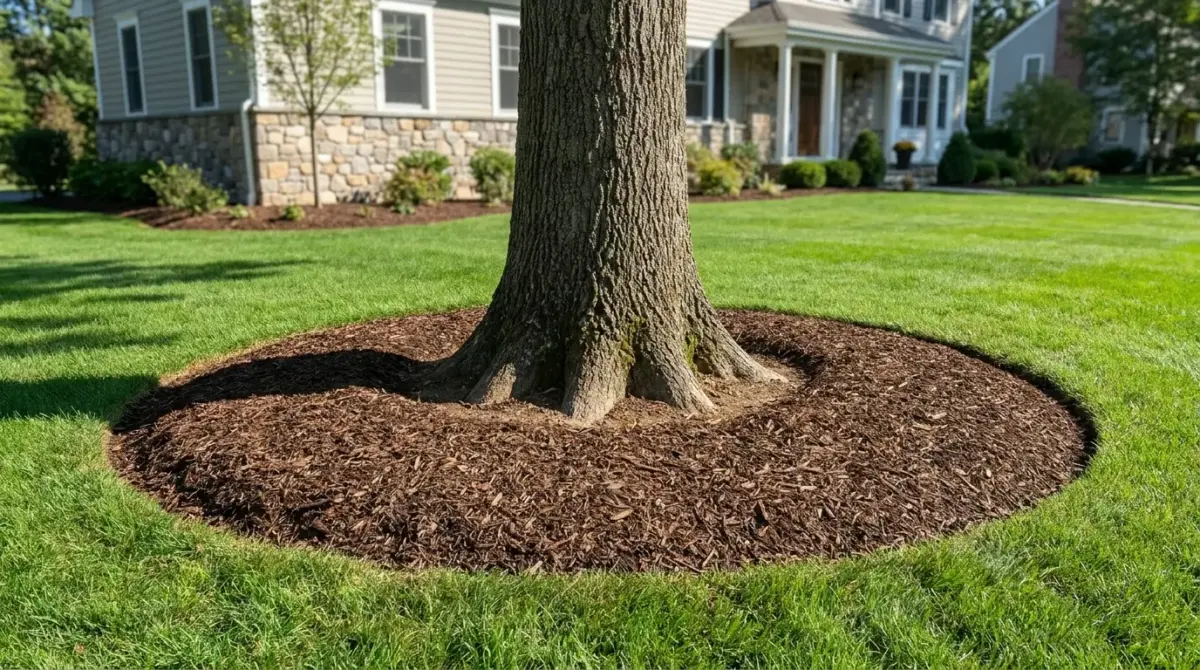
The correct shape for mulch around a tree is a flat ring or donut. Not a cone. Not a volcano. Flat.
Specifically:
- Depth: 2 to 4 inches of mulch. Anything more and you’re suffocating roots
- Width: extend out to the drip line if possible, or at least 3 feet from the trunk for established trees
- Around the trunk: keep mulch 3-6 inches AWAY from the trunk. The root flare (the point where the trunk widens at the base) must remain exposed and visible
Picture a donut. The hole in the middle of the donut is where the trunk sits.
What the Mulch Volcano Actually Does
You’ve seen it everywhere — the cone-shaped pile of mulch heaped against the trunk, sometimes a foot or more tall. It looks tidy. It looks landscaped. It’s slowly killing the tree.
Three things go wrong:
1. The Bark Rots
Tree bark evolved to be exposed to air. Pack moist mulch against it 24/7 and the bark stays wet. Fungi colonize the soft wet bark. Over a few years, the cambium layer underneath dies. The tree can’t transport water up from its roots. The canopy starts thinning.
2. Roots Grow Up Into the Mulch
Roots grow where the conditions are good. If you stack a foot of moist organic material against the trunk, the tree’s surface roots literally turn upward and grow into the mulch instead of going deep into soil. Those “girdling roots” eventually wrap around the trunk and choke off the tree’s vascular system from the inside.
3. Rodents Move In
Voles and mice love the warm, hidden chamber a mulch volcano creates. They spend the winter chewing on the bark you’ve conveniently hidden from view. By spring you find a tree girdled all the way around at the base — sentenced to death even though everything still looks green.
The UMass Landscape Message regularly publishes warnings about the cumulative damage from improper mulching across New England.
Best Mulch Types for Massachusetts
Not all mulches are created equal. For Massachusetts trees:
- Best: Aged bark mulch (pine or hardwood), shredded leaves, wood chips from arborist work
- OK: Compost (use in thin layers, mixed with bark mulch)
- Avoid: Dyed mulches with synthetic colors, rubber mulch, fresh uncomposted wood chips (they tie up nitrogen as they decompose)
- Never: Stone or gravel around trunks — heats up, dries soil, traps no water
When to Mulch
Two ideal windows in Massachusetts:
- Late spring (May) — after the ground warms but before summer drought stress
- Late fall (mid-October) — insulates roots before freezing temperatures
Mulch doesn’t need to be replaced every year. The bottom layer decomposes and feeds the soil — that’s the goal. Refresh the top inch or so when it gets thin, but don’t strip out the old layer and pile fresh on top every spring. That’s how depths get out of control.
Fixing an Existing Mulch Volcano
If you have a tree that’s been volcano-mulched for years, don’t despair. Repair steps:
- Carefully pull mulch back from the trunk down to the original soil grade
- Identify the root flare (the natural widening at the base of the trunk) — it should be visible
- Check for girdling roots wrapping around the trunk. A certified arborist may need to cut these out if they’ve already grown
- Spread the existing mulch out into a flat donut shape at the proper depth
- Keep the trunk-to-mulch gap from now on
Don’t try to fix a volcano that’s been in place for 10+ years without professional help. Severe girdling roots can require careful root pruning that homeowners shouldn’t attempt.
A Quick Note on Watering
Mulch reduces evaporation but doesn’t eliminate the need to water during drought. For young trees (first 3 years) and any tree during a Massachusetts summer dry spell:
- Water deeply (slow drip for 30+ minutes) once a week instead of light daily sprinkling
- Water at the drip line, not against the trunk
- Skip watering after natural rain over 1 inch
The Arbor Day Foundation watering guide has detailed schedules for newly planted versus established trees.
Bottom Line
Proper mulching is one of the cheapest things you can do for tree health. Improper mulching is one of the most damaging — and it’s everywhere. The rule is simple: 2-4 inches deep, flat donut shape, pulled back from the trunk to expose the root flare. Do that and your trees will outlive you. Pile it up against the trunk and you’ll wonder why your maple keeps thinning out year after year.
Your Massachusetts Tree Care Specialists
If you’ve inherited a yard full of mulch volcanoes or need expert advice on tree health, Norfolk Tree Service serves Norfolk County, Middlesex County, and Bristol County — including Waltham, Lexington, Watertown, Milton, and 40+ surrounding towns. Our ISA-certified arborists can assess your trees and recommend the right tree and shrub planting care for your specific species. Contact us today.
Mulch is supposed to help trees. In Massachusetts yards, it kills more trees than most pests do. Not because mulch itself is bad — because nearly every homeowner and most landscapers apply it in a way that slowly suffocates the trunk.
This guide covers how to mulch correctly, what the dreaded “mulch volcano” actually does, and why your trees will quietly thank you for getting it right.
What Mulching Is Supposed to Do
When done right, mulch helps trees by:
- Retaining soil moisture, especially during August dry spells
- Moderating soil temperature in summer heat and winter freeze-thaw cycles
- Suppressing weeds and turf competition around the root zone
- Slowly adding organic matter as it decomposes
- Protecting roots from mower and trimmer damage
- Reducing soil compaction from foot traffic
All of those benefits assume the mulch is applied correctly. The wrong application creates the opposite — moisture trapped against the trunk, fungal rot, rodent habitat, and root suffocation.
The “Donut” Rule
The correct shape for mulch around a tree is a flat ring or donut. Not a cone. Not a volcano. Flat.
Specifically:
- Depth: 2 to 4 inches of mulch. Anything more and you’re suffocating roots
- Width: extend out to the drip line if possible, or at least 3 feet from the trunk for established trees
- Around the trunk: keep mulch 3-6 inches AWAY from the trunk. The root flare (the point where the trunk widens at the base) must remain exposed and visible
Picture a donut. The hole in the middle of the donut is where the trunk sits.
What the Mulch Volcano Actually Does
You’ve seen it everywhere — the cone-shaped pile of mulch heaped against the trunk, sometimes a foot or more tall. It looks tidy. It looks landscaped. It’s slowly killing the tree.
Three things go wrong:
1. The Bark Rots
Tree bark evolved to be exposed to air. Pack moist mulch against it 24/7 and the bark stays wet. Fungi colonize the soft wet bark. Over a few years, the cambium layer underneath dies. The tree can’t transport water up from its roots. The canopy starts thinning.
2. Roots Grow Up Into the Mulch
Roots grow where the conditions are good. If you stack a foot of moist organic material against the trunk, the tree’s surface roots literally turn upward and grow into the mulch instead of going deep into soil. Those “girdling roots” eventually wrap around the trunk and choke off the tree’s vascular system from the inside.
3. Rodents Move In
Voles and mice love the warm, hidden chamber a mulch volcano creates. They spend the winter chewing on the bark you’ve conveniently hidden from view. By spring you find a tree girdled all the way around at the base — sentenced to death even though everything still looks green.
The UMass Landscape Message regularly publishes warnings about the cumulative damage from improper mulching across New England.
Best Mulch Types for Massachusetts
Not all mulches are created equal. For Massachusetts trees:
- Best: Aged bark mulch (pine or hardwood), shredded leaves, wood chips from arborist work
- OK: Compost (use in thin layers, mixed with bark mulch)
- Avoid: Dyed mulches with synthetic colors, rubber mulch, fresh uncomposted wood chips (they tie up nitrogen as they decompose)
- Never: Stone or gravel around trunks — heats up, dries soil, traps no water
When to Mulch
Two ideal windows in Massachusetts:
- Late spring (May) — after the ground warms but before summer drought stress
- Late fall (mid-October) — insulates roots before freezing temperatures
Mulch doesn’t need to be replaced every year. The bottom layer decomposes and feeds the soil — that’s the goal. Refresh the top inch or so when it gets thin, but don’t strip out the old layer and pile fresh on top every spring. That’s how depths get out of control.
Fixing an Existing Mulch Volcano
If you have a tree that’s been volcano-mulched for years, don’t despair. Repair steps:
- Carefully pull mulch back from the trunk down to the original soil grade
- Identify the root flare (the natural widening at the base of the trunk) — it should be visible
- Check for girdling roots wrapping around the trunk. A certified arborist may need to cut these out if they’ve already grown
- Spread the existing mulch out into a flat donut shape at the proper depth
- Keep the trunk-to-mulch gap from now on
Don’t try to fix a volcano that’s been in place for 10+ years without professional help. Severe girdling roots can require careful root pruning that homeowners shouldn’t attempt.
A Quick Note on Watering
Mulch reduces evaporation but doesn’t eliminate the need to water during drought. For young trees (first 3 years) and any tree during a Massachusetts summer dry spell:
- Water deeply (slow drip for 30+ minutes) once a week instead of light daily sprinkling
- Water at the drip line, not against the trunk
- Skip watering after natural rain over 1 inch
The Arbor Day Foundation watering guide has detailed schedules for newly planted versus established trees.
Bottom Line
Proper mulching is one of the cheapest things you can do for tree health. Improper mulching is one of the most damaging — and it’s everywhere. The rule is simple: 2-4 inches deep, flat donut shape, pulled back from the trunk to expose the root flare. Do that and your trees will outlive you. Pile it up against the trunk and you’ll wonder why your maple keeps thinning out year after year.
Your Massachusetts Tree Care Specialists
If you’ve inherited a yard full of mulch volcanoes or need expert advice on tree health, Norfolk Tree Service serves Norfolk County, Middlesex County, and Bristol County — including Waltham, Lexington, Watertown, Milton, and 40+ surrounding towns. Our ISA-certified arborists can assess your trees and recommend the right tree and shrub planting care for your specific species. Contact us today.
- Late spring (May) — after the ground warms but before summer drought stress
- Late fall (mid-October) — insulates roots before freezing temperatures
Mulch doesn’t need to be replaced every year. The bottom layer decomposes and feeds the soil — that’s the goal. Refresh the top inch or so when it gets thin, but don’t strip out the old layer and pile fresh on top every spring. That’s how depths get out of control.
Fixing an Existing Mulch Volcano
If you have a tree that’s been volcano-mulched for years, don’t despair. Repair steps:
- Carefully pull mulch back from the trunk down to the original soil grade
- Identify the root flare (the natural widening at the base of the trunk) — it should be visible
- Check for girdling roots wrapping around the trunk. A certified arborist may need to cut these out if they’ve already grown
- Spread the existing mulch out into a flat donut shape at the proper depth
- Keep the trunk-to-mulch gap from now on
Don’t try to fix a volcano that’s been in place for 10+ years without professional help. Severe girdling roots can require careful root pruning that homeowners shouldn’t attempt.
A Quick Note on Watering
Mulch reduces evaporation but doesn’t eliminate the need to water during drought. For young trees (first 3 years) and any tree during a Massachusetts summer dry spell:
- Water deeply (slow drip for 30+ minutes) once a week instead of light daily sprinkling
- Water at the drip line, not against the trunk
- Skip watering after natural rain over 1 inch
The Arbor Day Foundation watering guide has detailed schedules for newly planted versus established trees.
Bottom Line
Proper mulching is one of the cheapest things you can do for tree health. Improper mulching is one of the most damaging — and it’s everywhere. The rule is simple: 2-4 inches deep, flat donut shape, pulled back from the trunk to expose the root flare. Do that and your trees will outlive you. Pile it up against the trunk and you’ll wonder why your maple keeps thinning out year after year.
Your Massachusetts Tree Care Specialists
If you’ve inherited a yard full of mulch volcanoes or need expert advice on tree health, Norfolk Tree Service serves Norfolk County, Middlesex County, and Bristol County — including Waltham, Lexington, Watertown, Milton, and 40+ surrounding towns. Our ISA-certified arborists can assess your trees and recommend the right tree and shrub planting care for your specific species. Contact us today.
Mulch is supposed to help trees. In Massachusetts yards, it kills more trees than most pests do. Not because mulch itself is bad — because nearly every homeowner and most landscapers apply it in a way that slowly suffocates the trunk.
This guide covers how to mulch correctly, what the dreaded “mulch volcano” actually does, and why your trees will quietly thank you for getting it right.
What Mulching Is Supposed to Do
When done right, mulch helps trees by:
- Retaining soil moisture, especially during August dry spells
- Moderating soil temperature in summer heat and winter freeze-thaw cycles
- Suppressing weeds and turf competition around the root zone
- Slowly adding organic matter as it decomposes
- Protecting roots from mower and trimmer damage
- Reducing soil compaction from foot traffic
All of those benefits assume the mulch is applied correctly. The wrong application creates the opposite — moisture trapped against the trunk, fungal rot, rodent habitat, and root suffocation.
The “Donut” Rule
The correct shape for mulch around a tree is a flat ring or donut. Not a cone. Not a volcano. Flat.
Specifically:
- Depth: 2 to 4 inches of mulch. Anything more and you’re suffocating roots
- Width: extend out to the drip line if possible, or at least 3 feet from the trunk for established trees
- Around the trunk: keep mulch 3-6 inches AWAY from the trunk. The root flare (the point where the trunk widens at the base) must remain exposed and visible
Picture a donut. The hole in the middle of the donut is where the trunk sits.
What the Mulch Volcano Actually Does
You’ve seen it everywhere — the cone-shaped pile of mulch heaped against the trunk, sometimes a foot or more tall. It looks tidy. It looks landscaped. It’s slowly killing the tree.
Three things go wrong:
1. The Bark Rots
Tree bark evolved to be exposed to air. Pack moist mulch against it 24/7 and the bark stays wet. Fungi colonize the soft wet bark. Over a few years, the cambium layer underneath dies. The tree can’t transport water up from its roots. The canopy starts thinning.
2. Roots Grow Up Into the Mulch
Roots grow where the conditions are good. If you stack a foot of moist organic material against the trunk, the tree’s surface roots literally turn upward and grow into the mulch instead of going deep into soil. Those “girdling roots” eventually wrap around the trunk and choke off the tree’s vascular system from the inside.
3. Rodents Move In
Voles and mice love the warm, hidden chamber a mulch volcano creates. They spend the winter chewing on the bark you’ve conveniently hidden from view. By spring you find a tree girdled all the way around at the base — sentenced to death even though everything still looks green.
The UMass Landscape Message regularly publishes warnings about the cumulative damage from improper mulching across New England.
Best Mulch Types for Massachusetts
Not all mulches are created equal. For Massachusetts trees:
- Best: Aged bark mulch (pine or hardwood), shredded leaves, wood chips from arborist work
- OK: Compost (use in thin layers, mixed with bark mulch)
- Avoid: Dyed mulches with synthetic colors, rubber mulch, fresh uncomposted wood chips (they tie up nitrogen as they decompose)
- Never: Stone or gravel around trunks — heats up, dries soil, traps no water
When to Mulch
Two ideal windows in Massachusetts:
- Late spring (May) — after the ground warms but before summer drought stress
- Late fall (mid-October) — insulates roots before freezing temperatures
Mulch doesn’t need to be replaced every year. The bottom layer decomposes and feeds the soil — that’s the goal. Refresh the top inch or so when it gets thin, but don’t strip out the old layer and pile fresh on top every spring. That’s how depths get out of control.
Fixing an Existing Mulch Volcano
If you have a tree that’s been volcano-mulched for years, don’t despair. Repair steps:
- Carefully pull mulch back from the trunk down to the original soil grade
- Identify the root flare (the natural widening at the base of the trunk) — it should be visible
- Check for girdling roots wrapping around the trunk. A certified arborist may need to cut these out if they’ve already grown
- Spread the existing mulch out into a flat donut shape at the proper depth
- Keep the trunk-to-mulch gap from now on
Don’t try to fix a volcano that’s been in place for 10+ years without professional help. Severe girdling roots can require careful root pruning that homeowners shouldn’t attempt.
A Quick Note on Watering
Mulch reduces evaporation but doesn’t eliminate the need to water during drought. For young trees (first 3 years) and any tree during a Massachusetts summer dry spell:
- Water deeply (slow drip for 30+ minutes) once a week instead of light daily sprinkling
- Water at the drip line, not against the trunk
- Skip watering after natural rain over 1 inch
The Arbor Day Foundation watering guide has detailed schedules for newly planted versus established trees.
Bottom Line
Proper mulching is one of the cheapest things you can do for tree health. Improper mulching is one of the most damaging — and it’s everywhere. The rule is simple: 2-4 inches deep, flat donut shape, pulled back from the trunk to expose the root flare. Do that and your trees will outlive you. Pile it up against the trunk and you’ll wonder why your maple keeps thinning out year after year.
Your Massachusetts Tree Care Specialists
If you’ve inherited a yard full of mulch volcanoes or need expert advice on tree health, Norfolk Tree Service serves Norfolk County, Middlesex County, and Bristol County — including Waltham, Lexington, Watertown, Milton, and 40+ surrounding towns. Our ISA-certified arborists can assess your trees and recommend the right tree and shrub planting care for your specific species. Contact us today.
- Best: Aged bark mulch (pine or hardwood), shredded leaves, wood chips from arborist work
- OK: Compost (use in thin layers, mixed with bark mulch)
- Avoid: Dyed mulches with synthetic colors, rubber mulch, fresh uncomposted wood chips (they tie up nitrogen as they decompose)
- Never: Stone or gravel around trunks — heats up, dries soil, traps no water
When to Mulch
Two ideal windows in Massachusetts:
- Late spring (May) — after the ground warms but before summer drought stress
- Late fall (mid-October) — insulates roots before freezing temperatures
Mulch doesn’t need to be replaced every year. The bottom layer decomposes and feeds the soil — that’s the goal. Refresh the top inch or so when it gets thin, but don’t strip out the old layer and pile fresh on top every spring. That’s how depths get out of control.
Fixing an Existing Mulch Volcano
If you have a tree that’s been volcano-mulched for years, don’t despair. Repair steps:
- Carefully pull mulch back from the trunk down to the original soil grade
- Identify the root flare (the natural widening at the base of the trunk) — it should be visible
- Check for girdling roots wrapping around the trunk. A certified arborist may need to cut these out if they’ve already grown
- Spread the existing mulch out into a flat donut shape at the proper depth
- Keep the trunk-to-mulch gap from now on
Don’t try to fix a volcano that’s been in place for 10+ years without professional help. Severe girdling roots can require careful root pruning that homeowners shouldn’t attempt.
A Quick Note on Watering
Mulch reduces evaporation but doesn’t eliminate the need to water during drought. For young trees (first 3 years) and any tree during a Massachusetts summer dry spell:
- Water deeply (slow drip for 30+ minutes) once a week instead of light daily sprinkling
- Water at the drip line, not against the trunk
- Skip watering after natural rain over 1 inch
The Arbor Day Foundation watering guide has detailed schedules for newly planted versus established trees.
Bottom Line
Proper mulching is one of the cheapest things you can do for tree health. Improper mulching is one of the most damaging — and it’s everywhere. The rule is simple: 2-4 inches deep, flat donut shape, pulled back from the trunk to expose the root flare. Do that and your trees will outlive you. Pile it up against the trunk and you’ll wonder why your maple keeps thinning out year after year.
Your Massachusetts Tree Care Specialists
If you’ve inherited a yard full of mulch volcanoes or need expert advice on tree health, Norfolk Tree Service serves Norfolk County, Middlesex County, and Bristol County — including Waltham, Lexington, Watertown, Milton, and 40+ surrounding towns. Our ISA-certified arborists can assess your trees and recommend the right tree and shrub planting care for your specific species. Contact us today.
Mulch is supposed to help trees. In Massachusetts yards, it kills more trees than most pests do. Not because mulch itself is bad — because nearly every homeowner and most landscapers apply it in a way that slowly suffocates the trunk.
This guide covers how to mulch correctly, what the dreaded “mulch volcano” actually does, and why your trees will quietly thank you for getting it right.
What Mulching Is Supposed to Do
When done right, mulch helps trees by:
- Retaining soil moisture, especially during August dry spells
- Moderating soil temperature in summer heat and winter freeze-thaw cycles
- Suppressing weeds and turf competition around the root zone
- Slowly adding organic matter as it decomposes
- Protecting roots from mower and trimmer damage
- Reducing soil compaction from foot traffic
All of those benefits assume the mulch is applied correctly. The wrong application creates the opposite — moisture trapped against the trunk, fungal rot, rodent habitat, and root suffocation.
The “Donut” Rule
The correct shape for mulch around a tree is a flat ring or donut. Not a cone. Not a volcano. Flat.
Specifically:
- Depth: 2 to 4 inches of mulch. Anything more and you’re suffocating roots
- Width: extend out to the drip line if possible, or at least 3 feet from the trunk for established trees
- Around the trunk: keep mulch 3-6 inches AWAY from the trunk. The root flare (the point where the trunk widens at the base) must remain exposed and visible
Picture a donut. The hole in the middle of the donut is where the trunk sits.
What the Mulch Volcano Actually Does
You’ve seen it everywhere — the cone-shaped pile of mulch heaped against the trunk, sometimes a foot or more tall. It looks tidy. It looks landscaped. It’s slowly killing the tree.
Three things go wrong:
1. The Bark Rots
Tree bark evolved to be exposed to air. Pack moist mulch against it 24/7 and the bark stays wet. Fungi colonize the soft wet bark. Over a few years, the cambium layer underneath dies. The tree can’t transport water up from its roots. The canopy starts thinning.
2. Roots Grow Up Into the Mulch
Roots grow where the conditions are good. If you stack a foot of moist organic material against the trunk, the tree’s surface roots literally turn upward and grow into the mulch instead of going deep into soil. Those “girdling roots” eventually wrap around the trunk and choke off the tree’s vascular system from the inside.
3. Rodents Move In
Voles and mice love the warm, hidden chamber a mulch volcano creates. They spend the winter chewing on the bark you’ve conveniently hidden from view. By spring you find a tree girdled all the way around at the base — sentenced to death even though everything still looks green.
The UMass Landscape Message regularly publishes warnings about the cumulative damage from improper mulching across New England.
Best Mulch Types for Massachusetts
Not all mulches are created equal. For Massachusetts trees:
- Best: Aged bark mulch (pine or hardwood), shredded leaves, wood chips from arborist work
- OK: Compost (use in thin layers, mixed with bark mulch)
- Avoid: Dyed mulches with synthetic colors, rubber mulch, fresh uncomposted wood chips (they tie up nitrogen as they decompose)
- Never: Stone or gravel around trunks — heats up, dries soil, traps no water
When to Mulch
Two ideal windows in Massachusetts:
- Late spring (May) — after the ground warms but before summer drought stress
- Late fall (mid-October) — insulates roots before freezing temperatures
Mulch doesn’t need to be replaced every year. The bottom layer decomposes and feeds the soil — that’s the goal. Refresh the top inch or so when it gets thin, but don’t strip out the old layer and pile fresh on top every spring. That’s how depths get out of control.
Fixing an Existing Mulch Volcano
If you have a tree that’s been volcano-mulched for years, don’t despair. Repair steps:
- Carefully pull mulch back from the trunk down to the original soil grade
- Identify the root flare (the natural widening at the base of the trunk) — it should be visible
- Check for girdling roots wrapping around the trunk. A certified arborist may need to cut these out if they’ve already grown
- Spread the existing mulch out into a flat donut shape at the proper depth
- Keep the trunk-to-mulch gap from now on
Don’t try to fix a volcano that’s been in place for 10+ years without professional help. Severe girdling roots can require careful root pruning that homeowners shouldn’t attempt.
A Quick Note on Watering
Mulch reduces evaporation but doesn’t eliminate the need to water during drought. For young trees (first 3 years) and any tree during a Massachusetts summer dry spell:
- Water deeply (slow drip for 30+ minutes) once a week instead of light daily sprinkling
- Water at the drip line, not against the trunk
- Skip watering after natural rain over 1 inch
The Arbor Day Foundation watering guide has detailed schedules for newly planted versus established trees.
Bottom Line
Proper mulching is one of the cheapest things you can do for tree health. Improper mulching is one of the most damaging — and it’s everywhere. The rule is simple: 2-4 inches deep, flat donut shape, pulled back from the trunk to expose the root flare. Do that and your trees will outlive you. Pile it up against the trunk and you’ll wonder why your maple keeps thinning out year after year.
Your Massachusetts Tree Care Specialists
If you’ve inherited a yard full of mulch volcanoes or need expert advice on tree health, Norfolk Tree Service serves Norfolk County, Middlesex County, and Bristol County — including Waltham, Lexington, Watertown, Milton, and 40+ surrounding towns. Our ISA-certified arborists can assess your trees and recommend the right tree and shrub planting care for your specific species. Contact us today.
- Retaining soil moisture, especially during August dry spells
- Moderating soil temperature in summer heat and winter freeze-thaw cycles
- Suppressing weeds and turf competition around the root zone
- Slowly adding organic matter as it decomposes
- Protecting roots from mower and trimmer damage
- Reducing soil compaction from foot traffic
All of those benefits assume the mulch is applied correctly. The wrong application creates the opposite — moisture trapped against the trunk, fungal rot, rodent habitat, and root suffocation.
The “Donut” Rule
The correct shape for mulch around a tree is a flat ring or donut. Not a cone. Not a volcano. Flat.
Specifically:
- Depth: 2 to 4 inches of mulch. Anything more and you’re suffocating roots
- Width: extend out to the drip line if possible, or at least 3 feet from the trunk for established trees
- Around the trunk: keep mulch 3-6 inches AWAY from the trunk. The root flare (the point where the trunk widens at the base) must remain exposed and visible
Picture a donut. The hole in the middle of the donut is where the trunk sits.
What the Mulch Volcano Actually Does
You’ve seen it everywhere — the cone-shaped pile of mulch heaped against the trunk, sometimes a foot or more tall. It looks tidy. It looks landscaped. It’s slowly killing the tree.
Three things go wrong:
1. The Bark Rots
Tree bark evolved to be exposed to air. Pack moist mulch against it 24/7 and the bark stays wet. Fungi colonize the soft wet bark. Over a few years, the cambium layer underneath dies. The tree can’t transport water up from its roots. The canopy starts thinning.
2. Roots Grow Up Into the Mulch
Roots grow where the conditions are good. If you stack a foot of moist organic material against the trunk, the tree’s surface roots literally turn upward and grow into the mulch instead of going deep into soil. Those “girdling roots” eventually wrap around the trunk and choke off the tree’s vascular system from the inside.
3. Rodents Move In
Voles and mice love the warm, hidden chamber a mulch volcano creates. They spend the winter chewing on the bark you’ve conveniently hidden from view. By spring you find a tree girdled all the way around at the base — sentenced to death even though everything still looks green.
The UMass Landscape Message regularly publishes warnings about the cumulative damage from improper mulching across New England.
Best Mulch Types for Massachusetts
Not all mulches are created equal. For Massachusetts trees:
- Best: Aged bark mulch (pine or hardwood), shredded leaves, wood chips from arborist work
- OK: Compost (use in thin layers, mixed with bark mulch)
- Avoid: Dyed mulches with synthetic colors, rubber mulch, fresh uncomposted wood chips (they tie up nitrogen as they decompose)
- Never: Stone or gravel around trunks — heats up, dries soil, traps no water
When to Mulch
Two ideal windows in Massachusetts:
- Late spring (May) — after the ground warms but before summer drought stress
- Late fall (mid-October) — insulates roots before freezing temperatures
Mulch doesn’t need to be replaced every year. The bottom layer decomposes and feeds the soil — that’s the goal. Refresh the top inch or so when it gets thin, but don’t strip out the old layer and pile fresh on top every spring. That’s how depths get out of control.
Fixing an Existing Mulch Volcano
If you have a tree that’s been volcano-mulched for years, don’t despair. Repair steps:
- Carefully pull mulch back from the trunk down to the original soil grade
- Identify the root flare (the natural widening at the base of the trunk) — it should be visible
- Check for girdling roots wrapping around the trunk. A certified arborist may need to cut these out if they’ve already grown
- Spread the existing mulch out into a flat donut shape at the proper depth
- Keep the trunk-to-mulch gap from now on
Don’t try to fix a volcano that’s been in place for 10+ years without professional help. Severe girdling roots can require careful root pruning that homeowners shouldn’t attempt.
A Quick Note on Watering
Mulch reduces evaporation but doesn’t eliminate the need to water during drought. For young trees (first 3 years) and any tree during a Massachusetts summer dry spell:
- Water deeply (slow drip for 30+ minutes) once a week instead of light daily sprinkling
- Water at the drip line, not against the trunk
- Skip watering after natural rain over 1 inch
The Arbor Day Foundation watering guide has detailed schedules for newly planted versus established trees.
Bottom Line
Proper mulching is one of the cheapest things you can do for tree health. Improper mulching is one of the most damaging — and it’s everywhere. The rule is simple: 2-4 inches deep, flat donut shape, pulled back from the trunk to expose the root flare. Do that and your trees will outlive you. Pile it up against the trunk and you’ll wonder why your maple keeps thinning out year after year.
Your Massachusetts Tree Care Specialists
If you’ve inherited a yard full of mulch volcanoes or need expert advice on tree health, Norfolk Tree Service serves Norfolk County, Middlesex County, and Bristol County — including Waltham, Lexington, Watertown, Milton, and 40+ surrounding towns. Our ISA-certified arborists can assess your trees and recommend the right tree and shrub planting care for your specific species. Contact us today.
Mulch is supposed to help trees. In Massachusetts yards, it kills more trees than most pests do. Not because mulch itself is bad — because nearly every homeowner and most landscapers apply it in a way that slowly suffocates the trunk.
This guide covers how to mulch correctly, what the dreaded “mulch volcano” actually does, and why your trees will quietly thank you for getting it right.
What Mulching Is Supposed to Do
When done right, mulch helps trees by:
- Retaining soil moisture, especially during August dry spells
- Moderating soil temperature in summer heat and winter freeze-thaw cycles
- Suppressing weeds and turf competition around the root zone
- Slowly adding organic matter as it decomposes
- Protecting roots from mower and trimmer damage
- Reducing soil compaction from foot traffic
All of those benefits assume the mulch is applied correctly. The wrong application creates the opposite — moisture trapped against the trunk, fungal rot, rodent habitat, and root suffocation.
The “Donut” Rule
The correct shape for mulch around a tree is a flat ring or donut. Not a cone. Not a volcano. Flat.
Specifically:
- Depth: 2 to 4 inches of mulch. Anything more and you’re suffocating roots
- Width: extend out to the drip line if possible, or at least 3 feet from the trunk for established trees
- Around the trunk: keep mulch 3-6 inches AWAY from the trunk. The root flare (the point where the trunk widens at the base) must remain exposed and visible
Picture a donut. The hole in the middle of the donut is where the trunk sits.
What the Mulch Volcano Actually Does
You’ve seen it everywhere — the cone-shaped pile of mulch heaped against the trunk, sometimes a foot or more tall. It looks tidy. It looks landscaped. It’s slowly killing the tree.
Three things go wrong:
1. The Bark Rots
Tree bark evolved to be exposed to air. Pack moist mulch against it 24/7 and the bark stays wet. Fungi colonize the soft wet bark. Over a few years, the cambium layer underneath dies. The tree can’t transport water up from its roots. The canopy starts thinning.
2. Roots Grow Up Into the Mulch
Roots grow where the conditions are good. If you stack a foot of moist organic material against the trunk, the tree’s surface roots literally turn upward and grow into the mulch instead of going deep into soil. Those “girdling roots” eventually wrap around the trunk and choke off the tree’s vascular system from the inside.
3. Rodents Move In
Voles and mice love the warm, hidden chamber a mulch volcano creates. They spend the winter chewing on the bark you’ve conveniently hidden from view. By spring you find a tree girdled all the way around at the base — sentenced to death even though everything still looks green.
The UMass Landscape Message regularly publishes warnings about the cumulative damage from improper mulching across New England.
Best Mulch Types for Massachusetts
Not all mulches are created equal. For Massachusetts trees:
- Best: Aged bark mulch (pine or hardwood), shredded leaves, wood chips from arborist work
- OK: Compost (use in thin layers, mixed with bark mulch)
- Avoid: Dyed mulches with synthetic colors, rubber mulch, fresh uncomposted wood chips (they tie up nitrogen as they decompose)
- Never: Stone or gravel around trunks — heats up, dries soil, traps no water
When to Mulch
Two ideal windows in Massachusetts:
- Late spring (May) — after the ground warms but before summer drought stress
- Late fall (mid-October) — insulates roots before freezing temperatures
Mulch doesn’t need to be replaced every year. The bottom layer decomposes and feeds the soil — that’s the goal. Refresh the top inch or so when it gets thin, but don’t strip out the old layer and pile fresh on top every spring. That’s how depths get out of control.
Fixing an Existing Mulch Volcano
If you have a tree that’s been volcano-mulched for years, don’t despair. Repair steps:
- Carefully pull mulch back from the trunk down to the original soil grade
- Identify the root flare (the natural widening at the base of the trunk) — it should be visible
- Check for girdling roots wrapping around the trunk. A certified arborist may need to cut these out if they’ve already grown
- Spread the existing mulch out into a flat donut shape at the proper depth
- Keep the trunk-to-mulch gap from now on
Don’t try to fix a volcano that’s been in place for 10+ years without professional help. Severe girdling roots can require careful root pruning that homeowners shouldn’t attempt.
A Quick Note on Watering
Mulch reduces evaporation but doesn’t eliminate the need to water during drought. For young trees (first 3 years) and any tree during a Massachusetts summer dry spell:
- Water deeply (slow drip for 30+ minutes) once a week instead of light daily sprinkling
- Water at the drip line, not against the trunk
- Skip watering after natural rain over 1 inch
The Arbor Day Foundation watering guide has detailed schedules for newly planted versus established trees.
Bottom Line
Proper mulching is one of the cheapest things you can do for tree health. Improper mulching is one of the most damaging — and it’s everywhere. The rule is simple: 2-4 inches deep, flat donut shape, pulled back from the trunk to expose the root flare. Do that and your trees will outlive you. Pile it up against the trunk and you’ll wonder why your maple keeps thinning out year after year.
Your Massachusetts Tree Care Specialists
If you’ve inherited a yard full of mulch volcanoes or need expert advice on tree health, Norfolk Tree Service serves Norfolk County, Middlesex County, and Bristol County — including Waltham, Lexington, Watertown, Milton, and 40+ surrounding towns. Our ISA-certified arborists can assess your trees and recommend the right tree and shrub planting care for your specific species. Contact us today.
- Late spring (May) — after the ground warms but before summer drought stress
- Late fall (mid-October) — insulates roots before freezing temperatures
Mulch doesn’t need to be replaced every year. The bottom layer decomposes and feeds the soil — that’s the goal. Refresh the top inch or so when it gets thin, but don’t strip out the old layer and pile fresh on top every spring. That’s how depths get out of control.
Fixing an Existing Mulch Volcano
If you have a tree that’s been volcano-mulched for years, don’t despair. Repair steps:
- Carefully pull mulch back from the trunk down to the original soil grade
- Identify the root flare (the natural widening at the base of the trunk) — it should be visible
- Check for girdling roots wrapping around the trunk. A certified arborist may need to cut these out if they’ve already grown
- Spread the existing mulch out into a flat donut shape at the proper depth
- Keep the trunk-to-mulch gap from now on
Don’t try to fix a volcano that’s been in place for 10+ years without professional help. Severe girdling roots can require careful root pruning that homeowners shouldn’t attempt.
A Quick Note on Watering
Mulch reduces evaporation but doesn’t eliminate the need to water during drought. For young trees (first 3 years) and any tree during a Massachusetts summer dry spell:
- Water deeply (slow drip for 30+ minutes) once a week instead of light daily sprinkling
- Water at the drip line, not against the trunk
- Skip watering after natural rain over 1 inch
The Arbor Day Foundation watering guide has detailed schedules for newly planted versus established trees.
Bottom Line
Proper mulching is one of the cheapest things you can do for tree health. Improper mulching is one of the most damaging — and it’s everywhere. The rule is simple: 2-4 inches deep, flat donut shape, pulled back from the trunk to expose the root flare. Do that and your trees will outlive you. Pile it up against the trunk and you’ll wonder why your maple keeps thinning out year after year.
Your Massachusetts Tree Care Specialists
If you’ve inherited a yard full of mulch volcanoes or need expert advice on tree health, Norfolk Tree Service serves Norfolk County, Middlesex County, and Bristol County — including Waltham, Lexington, Watertown, Milton, and 40+ surrounding towns. Our ISA-certified arborists can assess your trees and recommend the right tree and shrub planting care for your specific species. Contact us today.
- Retaining soil moisture, especially during August dry spells
- Moderating soil temperature in summer heat and winter freeze-thaw cycles
- Suppressing weeds and turf competition around the root zone
- Slowly adding organic matter as it decomposes
- Protecting roots from mower and trimmer damage
- Reducing soil compaction from foot traffic
All of those benefits assume the mulch is applied correctly. The wrong application creates the opposite — moisture trapped against the trunk, fungal rot, rodent habitat, and root suffocation.
The “Donut” Rule
The correct shape for mulch around a tree is a flat ring or donut. Not a cone. Not a volcano. Flat.
Specifically:
- Depth: 2 to 4 inches of mulch. Anything more and you’re suffocating roots
- Width: extend out to the drip line if possible, or at least 3 feet from the trunk for established trees
- Around the trunk: keep mulch 3-6 inches AWAY from the trunk. The root flare (the point where the trunk widens at the base) must remain exposed and visible
Picture a donut. The hole in the middle of the donut is where the trunk sits.
What the Mulch Volcano Actually Does
You’ve seen it everywhere — the cone-shaped pile of mulch heaped against the trunk, sometimes a foot or more tall. It looks tidy. It looks landscaped. It’s slowly killing the tree.
Three things go wrong:
1. The Bark Rots
Tree bark evolved to be exposed to air. Pack moist mulch against it 24/7 and the bark stays wet. Fungi colonize the soft wet bark. Over a few years, the cambium layer underneath dies. The tree can’t transport water up from its roots. The canopy starts thinning.
2. Roots Grow Up Into the Mulch
Roots grow where the conditions are good. If you stack a foot of moist organic material against the trunk, the tree’s surface roots literally turn upward and grow into the mulch instead of going deep into soil. Those “girdling roots” eventually wrap around the trunk and choke off the tree’s vascular system from the inside.
3. Rodents Move In
Voles and mice love the warm, hidden chamber a mulch volcano creates. They spend the winter chewing on the bark you’ve conveniently hidden from view. By spring you find a tree girdled all the way around at the base — sentenced to death even though everything still looks green.
The UMass Landscape Message regularly publishes warnings about the cumulative damage from improper mulching across New England.
Best Mulch Types for Massachusetts
Not all mulches are created equal. For Massachusetts trees:
- Best: Aged bark mulch (pine or hardwood), shredded leaves, wood chips from arborist work
- OK: Compost (use in thin layers, mixed with bark mulch)
- Avoid: Dyed mulches with synthetic colors, rubber mulch, fresh uncomposted wood chips (they tie up nitrogen as they decompose)
- Never: Stone or gravel around trunks — heats up, dries soil, traps no water
When to Mulch
Two ideal windows in Massachusetts:
- Late spring (May) — after the ground warms but before summer drought stress
- Late fall (mid-October) — insulates roots before freezing temperatures
Mulch doesn’t need to be replaced every year. The bottom layer decomposes and feeds the soil — that’s the goal. Refresh the top inch or so when it gets thin, but don’t strip out the old layer and pile fresh on top every spring. That’s how depths get out of control.
Fixing an Existing Mulch Volcano
If you have a tree that’s been volcano-mulched for years, don’t despair. Repair steps:
- Carefully pull mulch back from the trunk down to the original soil grade
- Identify the root flare (the natural widening at the base of the trunk) — it should be visible
- Check for girdling roots wrapping around the trunk. A certified arborist may need to cut these out if they’ve already grown
- Spread the existing mulch out into a flat donut shape at the proper depth
- Keep the trunk-to-mulch gap from now on
Don’t try to fix a volcano that’s been in place for 10+ years without professional help. Severe girdling roots can require careful root pruning that homeowners shouldn’t attempt.
A Quick Note on Watering
Mulch reduces evaporation but doesn’t eliminate the need to water during drought. For young trees (first 3 years) and any tree during a Massachusetts summer dry spell:
- Water deeply (slow drip for 30+ minutes) once a week instead of light daily sprinkling
- Water at the drip line, not against the trunk
- Skip watering after natural rain over 1 inch
The Arbor Day Foundation watering guide has detailed schedules for newly planted versus established trees.
Bottom Line
Proper mulching is one of the cheapest things you can do for tree health. Improper mulching is one of the most damaging — and it’s everywhere. The rule is simple: 2-4 inches deep, flat donut shape, pulled back from the trunk to expose the root flare. Do that and your trees will outlive you. Pile it up against the trunk and you’ll wonder why your maple keeps thinning out year after year.
Your Massachusetts Tree Care Specialists
If you’ve inherited a yard full of mulch volcanoes or need expert advice on tree health, Norfolk Tree Service serves Norfolk County, Middlesex County, and Bristol County — including Waltham, Lexington, Watertown, Milton, and 40+ surrounding towns. Our ISA-certified arborists can assess your trees and recommend the right tree and shrub planting care for your specific species. Contact us today.
Mulch is supposed to help trees. In Massachusetts yards, it kills more trees than most pests do. Not because mulch itself is bad — because nearly every homeowner and most landscapers apply it in a way that slowly suffocates the trunk.
This guide covers how to mulch correctly, what the dreaded “mulch volcano” actually does, and why your trees will quietly thank you for getting it right.
What Mulching Is Supposed to Do
When done right, mulch helps trees by:
- Retaining soil moisture, especially during August dry spells
- Moderating soil temperature in summer heat and winter freeze-thaw cycles
- Suppressing weeds and turf competition around the root zone
- Slowly adding organic matter as it decomposes
- Protecting roots from mower and trimmer damage
- Reducing soil compaction from foot traffic
All of those benefits assume the mulch is applied correctly. The wrong application creates the opposite — moisture trapped against the trunk, fungal rot, rodent habitat, and root suffocation.
The “Donut” Rule
The correct shape for mulch around a tree is a flat ring or donut. Not a cone. Not a volcano. Flat.
Specifically:
- Depth: 2 to 4 inches of mulch. Anything more and you’re suffocating roots
- Width: extend out to the drip line if possible, or at least 3 feet from the trunk for established trees
- Around the trunk: keep mulch 3-6 inches AWAY from the trunk. The root flare (the point where the trunk widens at the base) must remain exposed and visible
Picture a donut. The hole in the middle of the donut is where the trunk sits.
What the Mulch Volcano Actually Does
You’ve seen it everywhere — the cone-shaped pile of mulch heaped against the trunk, sometimes a foot or more tall. It looks tidy. It looks landscaped. It’s slowly killing the tree.
Three things go wrong:
1. The Bark Rots
Tree bark evolved to be exposed to air. Pack moist mulch against it 24/7 and the bark stays wet. Fungi colonize the soft wet bark. Over a few years, the cambium layer underneath dies. The tree can’t transport water up from its roots. The canopy starts thinning.
2. Roots Grow Up Into the Mulch
Roots grow where the conditions are good. If you stack a foot of moist organic material against the trunk, the tree’s surface roots literally turn upward and grow into the mulch instead of going deep into soil. Those “girdling roots” eventually wrap around the trunk and choke off the tree’s vascular system from the inside.
3. Rodents Move In
Voles and mice love the warm, hidden chamber a mulch volcano creates. They spend the winter chewing on the bark you’ve conveniently hidden from view. By spring you find a tree girdled all the way around at the base — sentenced to death even though everything still looks green.
The UMass Landscape Message regularly publishes warnings about the cumulative damage from improper mulching across New England.
Best Mulch Types for Massachusetts
Not all mulches are created equal. For Massachusetts trees:
- Best: Aged bark mulch (pine or hardwood), shredded leaves, wood chips from arborist work
- OK: Compost (use in thin layers, mixed with bark mulch)
- Avoid: Dyed mulches with synthetic colors, rubber mulch, fresh uncomposted wood chips (they tie up nitrogen as they decompose)
- Never: Stone or gravel around trunks — heats up, dries soil, traps no water
When to Mulch
Two ideal windows in Massachusetts:
- Late spring (May) — after the ground warms but before summer drought stress
- Late fall (mid-October) — insulates roots before freezing temperatures
Mulch doesn’t need to be replaced every year. The bottom layer decomposes and feeds the soil — that’s the goal. Refresh the top inch or so when it gets thin, but don’t strip out the old layer and pile fresh on top every spring. That’s how depths get out of control.
Fixing an Existing Mulch Volcano
If you have a tree that’s been volcano-mulched for years, don’t despair. Repair steps:
- Carefully pull mulch back from the trunk down to the original soil grade
- Identify the root flare (the natural widening at the base of the trunk) — it should be visible
- Check for girdling roots wrapping around the trunk. A certified arborist may need to cut these out if they’ve already grown
- Spread the existing mulch out into a flat donut shape at the proper depth
- Keep the trunk-to-mulch gap from now on
Don’t try to fix a volcano that’s been in place for 10+ years without professional help. Severe girdling roots can require careful root pruning that homeowners shouldn’t attempt.
A Quick Note on Watering
Mulch reduces evaporation but doesn’t eliminate the need to water during drought. For young trees (first 3 years) and any tree during a Massachusetts summer dry spell:
- Water deeply (slow drip for 30+ minutes) once a week instead of light daily sprinkling
- Water at the drip line, not against the trunk
- Skip watering after natural rain over 1 inch
The Arbor Day Foundation watering guide has detailed schedules for newly planted versus established trees.
Bottom Line
Proper mulching is one of the cheapest things you can do for tree health. Improper mulching is one of the most damaging — and it’s everywhere. The rule is simple: 2-4 inches deep, flat donut shape, pulled back from the trunk to expose the root flare. Do that and your trees will outlive you. Pile it up against the trunk and you’ll wonder why your maple keeps thinning out year after year.
Your Massachusetts Tree Care Specialists
If you’ve inherited a yard full of mulch volcanoes or need expert advice on tree health, Norfolk Tree Service serves Norfolk County, Middlesex County, and Bristol County — including Waltham, Lexington, Watertown, Milton, and 40+ surrounding towns. Our ISA-certified arborists can assess your trees and recommend the right tree and shrub planting care for your specific species. Contact us today.
- Best: Aged bark mulch (pine or hardwood), shredded leaves, wood chips from arborist work
- OK: Compost (use in thin layers, mixed with bark mulch)
- Avoid: Dyed mulches with synthetic colors, rubber mulch, fresh uncomposted wood chips (they tie up nitrogen as they decompose)
- Never: Stone or gravel around trunks — heats up, dries soil, traps no water
When to Mulch
Two ideal windows in Massachusetts:
- Late spring (May) — after the ground warms but before summer drought stress
- Late fall (mid-October) — insulates roots before freezing temperatures
Mulch doesn’t need to be replaced every year. The bottom layer decomposes and feeds the soil — that’s the goal. Refresh the top inch or so when it gets thin, but don’t strip out the old layer and pile fresh on top every spring. That’s how depths get out of control.
Fixing an Existing Mulch Volcano
If you have a tree that’s been volcano-mulched for years, don’t despair. Repair steps:
- Carefully pull mulch back from the trunk down to the original soil grade
- Identify the root flare (the natural widening at the base of the trunk) — it should be visible
- Check for girdling roots wrapping around the trunk. A certified arborist may need to cut these out if they’ve already grown
- Spread the existing mulch out into a flat donut shape at the proper depth
- Keep the trunk-to-mulch gap from now on
Don’t try to fix a volcano that’s been in place for 10+ years without professional help. Severe girdling roots can require careful root pruning that homeowners shouldn’t attempt.
A Quick Note on Watering
Mulch reduces evaporation but doesn’t eliminate the need to water during drought. For young trees (first 3 years) and any tree during a Massachusetts summer dry spell:
- Water deeply (slow drip for 30+ minutes) once a week instead of light daily sprinkling
- Water at the drip line, not against the trunk
- Skip watering after natural rain over 1 inch
The Arbor Day Foundation watering guide has detailed schedules for newly planted versus established trees.
Bottom Line
Proper mulching is one of the cheapest things you can do for tree health. Improper mulching is one of the most damaging — and it’s everywhere. The rule is simple: 2-4 inches deep, flat donut shape, pulled back from the trunk to expose the root flare. Do that and your trees will outlive you. Pile it up against the trunk and you’ll wonder why your maple keeps thinning out year after year.
Your Massachusetts Tree Care Specialists
If you’ve inherited a yard full of mulch volcanoes or need expert advice on tree health, Norfolk Tree Service serves Norfolk County, Middlesex County, and Bristol County — including Waltham, Lexington, Watertown, Milton, and 40+ surrounding towns. Our ISA-certified arborists can assess your trees and recommend the right tree and shrub planting care for your specific species. Contact us today.
- Retaining soil moisture, especially during August dry spells
- Moderating soil temperature in summer heat and winter freeze-thaw cycles
- Suppressing weeds and turf competition around the root zone
- Slowly adding organic matter as it decomposes
- Protecting roots from mower and trimmer damage
- Reducing soil compaction from foot traffic
All of those benefits assume the mulch is applied correctly. The wrong application creates the opposite — moisture trapped against the trunk, fungal rot, rodent habitat, and root suffocation.
The “Donut” Rule
The correct shape for mulch around a tree is a flat ring or donut. Not a cone. Not a volcano. Flat.
Specifically:
- Depth: 2 to 4 inches of mulch. Anything more and you’re suffocating roots
- Width: extend out to the drip line if possible, or at least 3 feet from the trunk for established trees
- Around the trunk: keep mulch 3-6 inches AWAY from the trunk. The root flare (the point where the trunk widens at the base) must remain exposed and visible
Picture a donut. The hole in the middle of the donut is where the trunk sits.
What the Mulch Volcano Actually Does
You’ve seen it everywhere — the cone-shaped pile of mulch heaped against the trunk, sometimes a foot or more tall. It looks tidy. It looks landscaped. It’s slowly killing the tree.
Three things go wrong:
1. The Bark Rots
Tree bark evolved to be exposed to air. Pack moist mulch against it 24/7 and the bark stays wet. Fungi colonize the soft wet bark. Over a few years, the cambium layer underneath dies. The tree can’t transport water up from its roots. The canopy starts thinning.
2. Roots Grow Up Into the Mulch
Roots grow where the conditions are good. If you stack a foot of moist organic material against the trunk, the tree’s surface roots literally turn upward and grow into the mulch instead of going deep into soil. Those “girdling roots” eventually wrap around the trunk and choke off the tree’s vascular system from the inside.
3. Rodents Move In
Voles and mice love the warm, hidden chamber a mulch volcano creates. They spend the winter chewing on the bark you’ve conveniently hidden from view. By spring you find a tree girdled all the way around at the base — sentenced to death even though everything still looks green.
The UMass Landscape Message regularly publishes warnings about the cumulative damage from improper mulching across New England.
Best Mulch Types for Massachusetts
Not all mulches are created equal. For Massachusetts trees:
- Best: Aged bark mulch (pine or hardwood), shredded leaves, wood chips from arborist work
- OK: Compost (use in thin layers, mixed with bark mulch)
- Avoid: Dyed mulches with synthetic colors, rubber mulch, fresh uncomposted wood chips (they tie up nitrogen as they decompose)
- Never: Stone or gravel around trunks — heats up, dries soil, traps no water
When to Mulch
Two ideal windows in Massachusetts:
- Late spring (May) — after the ground warms but before summer drought stress
- Late fall (mid-October) — insulates roots before freezing temperatures
Mulch doesn’t need to be replaced every year. The bottom layer decomposes and feeds the soil — that’s the goal. Refresh the top inch or so when it gets thin, but don’t strip out the old layer and pile fresh on top every spring. That’s how depths get out of control.
Fixing an Existing Mulch Volcano
If you have a tree that’s been volcano-mulched for years, don’t despair. Repair steps:
- Carefully pull mulch back from the trunk down to the original soil grade
- Identify the root flare (the natural widening at the base of the trunk) — it should be visible
- Check for girdling roots wrapping around the trunk. A certified arborist may need to cut these out if they’ve already grown
- Spread the existing mulch out into a flat donut shape at the proper depth
- Keep the trunk-to-mulch gap from now on
Don’t try to fix a volcano that’s been in place for 10+ years without professional help. Severe girdling roots can require careful root pruning that homeowners shouldn’t attempt.
A Quick Note on Watering
Mulch reduces evaporation but doesn’t eliminate the need to water during drought. For young trees (first 3 years) and any tree during a Massachusetts summer dry spell:
- Water deeply (slow drip for 30+ minutes) once a week instead of light daily sprinkling
- Water at the drip line, not against the trunk
- Skip watering after natural rain over 1 inch
The Arbor Day Foundation watering guide has detailed schedules for newly planted versus established trees.
Bottom Line
Proper mulching is one of the cheapest things you can do for tree health. Improper mulching is one of the most damaging — and it’s everywhere. The rule is simple: 2-4 inches deep, flat donut shape, pulled back from the trunk to expose the root flare. Do that and your trees will outlive you. Pile it up against the trunk and you’ll wonder why your maple keeps thinning out year after year.
Your Massachusetts Tree Care Specialists
If you’ve inherited a yard full of mulch volcanoes or need expert advice on tree health, Norfolk Tree Service serves Norfolk County, Middlesex County, and Bristol County — including Waltham, Lexington, Watertown, Milton, and 40+ surrounding towns. Our ISA-certified arborists can assess your trees and recommend the right tree and shrub planting care for your specific species. Contact us today.
Mulch is supposed to help trees. In Massachusetts yards, it kills more trees than most pests do. Not because mulch itself is bad — because nearly every homeowner and most landscapers apply it in a way that slowly suffocates the trunk.
This guide covers how to mulch correctly, what the dreaded “mulch volcano” actually does, and why your trees will quietly thank you for getting it right.
What Mulching Is Supposed to Do
When done right, mulch helps trees by:
- Retaining soil moisture, especially during August dry spells
- Moderating soil temperature in summer heat and winter freeze-thaw cycles
- Suppressing weeds and turf competition around the root zone
- Slowly adding organic matter as it decomposes
- Protecting roots from mower and trimmer damage
- Reducing soil compaction from foot traffic
All of those benefits assume the mulch is applied correctly. The wrong application creates the opposite — moisture trapped against the trunk, fungal rot, rodent habitat, and root suffocation.
The “Donut” Rule
The correct shape for mulch around a tree is a flat ring or donut. Not a cone. Not a volcano. Flat.
Specifically:
- Depth: 2 to 4 inches of mulch. Anything more and you’re suffocating roots
- Width: extend out to the drip line if possible, or at least 3 feet from the trunk for established trees
- Around the trunk: keep mulch 3-6 inches AWAY from the trunk. The root flare (the point where the trunk widens at the base) must remain exposed and visible
Picture a donut. The hole in the middle of the donut is where the trunk sits.
What the Mulch Volcano Actually Does
You’ve seen it everywhere — the cone-shaped pile of mulch heaped against the trunk, sometimes a foot or more tall. It looks tidy. It looks landscaped. It’s slowly killing the tree.
Three things go wrong:
1. The Bark Rots
Tree bark evolved to be exposed to air. Pack moist mulch against it 24/7 and the bark stays wet. Fungi colonize the soft wet bark. Over a few years, the cambium layer underneath dies. The tree can’t transport water up from its roots. The canopy starts thinning.
2. Roots Grow Up Into the Mulch
Roots grow where the conditions are good. If you stack a foot of moist organic material against the trunk, the tree’s surface roots literally turn upward and grow into the mulch instead of going deep into soil. Those “girdling roots” eventually wrap around the trunk and choke off the tree’s vascular system from the inside.
3. Rodents Move In
Voles and mice love the warm, hidden chamber a mulch volcano creates. They spend the winter chewing on the bark you’ve conveniently hidden from view. By spring you find a tree girdled all the way around at the base — sentenced to death even though everything still looks green.
The UMass Landscape Message regularly publishes warnings about the cumulative damage from improper mulching across New England.
Best Mulch Types for Massachusetts
Not all mulches are created equal. For Massachusetts trees:
- Best: Aged bark mulch (pine or hardwood), shredded leaves, wood chips from arborist work
- OK: Compost (use in thin layers, mixed with bark mulch)
- Avoid: Dyed mulches with synthetic colors, rubber mulch, fresh uncomposted wood chips (they tie up nitrogen as they decompose)
- Never: Stone or gravel around trunks — heats up, dries soil, traps no water
When to Mulch
Two ideal windows in Massachusetts:
- Late spring (May) — after the ground warms but before summer drought stress
- Late fall (mid-October) — insulates roots before freezing temperatures
Mulch doesn’t need to be replaced every year. The bottom layer decomposes and feeds the soil — that’s the goal. Refresh the top inch or so when it gets thin, but don’t strip out the old layer and pile fresh on top every spring. That’s how depths get out of control.
Fixing an Existing Mulch Volcano
If you have a tree that’s been volcano-mulched for years, don’t despair. Repair steps:
- Carefully pull mulch back from the trunk down to the original soil grade
- Identify the root flare (the natural widening at the base of the trunk) — it should be visible
- Check for girdling roots wrapping around the trunk. A certified arborist may need to cut these out if they’ve already grown
- Spread the existing mulch out into a flat donut shape at the proper depth
- Keep the trunk-to-mulch gap from now on
Don’t try to fix a volcano that’s been in place for 10+ years without professional help. Severe girdling roots can require careful root pruning that homeowners shouldn’t attempt.
A Quick Note on Watering
Mulch reduces evaporation but doesn’t eliminate the need to water during drought. For young trees (first 3 years) and any tree during a Massachusetts summer dry spell:
- Water deeply (slow drip for 30+ minutes) once a week instead of light daily sprinkling
- Water at the drip line, not against the trunk
- Skip watering after natural rain over 1 inch
The Arbor Day Foundation watering guide has detailed schedules for newly planted versus established trees.
Bottom Line
Proper mulching is one of the cheapest things you can do for tree health. Improper mulching is one of the most damaging — and it’s everywhere. The rule is simple: 2-4 inches deep, flat donut shape, pulled back from the trunk to expose the root flare. Do that and your trees will outlive you. Pile it up against the trunk and you’ll wonder why your maple keeps thinning out year after year.
Your Massachusetts Tree Care Specialists
If you’ve inherited a yard full of mulch volcanoes or need expert advice on tree health, Norfolk Tree Service serves Norfolk County, Middlesex County, and Bristol County — including Waltham, Lexington, Watertown, Milton, and 40+ surrounding towns. Our ISA-certified arborists can assess your trees and recommend the right tree and shrub planting care for your specific species. Contact us today.
- Late spring (May) — after the ground warms but before summer drought stress
- Late fall (mid-October) — insulates roots before freezing temperatures
Mulch doesn’t need to be replaced every year. The bottom layer decomposes and feeds the soil — that’s the goal. Refresh the top inch or so when it gets thin, but don’t strip out the old layer and pile fresh on top every spring. That’s how depths get out of control.
Fixing an Existing Mulch Volcano
If you have a tree that’s been volcano-mulched for years, don’t despair. Repair steps:
- Carefully pull mulch back from the trunk down to the original soil grade
- Identify the root flare (the natural widening at the base of the trunk) — it should be visible
- Check for girdling roots wrapping around the trunk. A certified arborist may need to cut these out if they’ve already grown
- Spread the existing mulch out into a flat donut shape at the proper depth
- Keep the trunk-to-mulch gap from now on
Don’t try to fix a volcano that’s been in place for 10+ years without professional help. Severe girdling roots can require careful root pruning that homeowners shouldn’t attempt.
A Quick Note on Watering
Mulch reduces evaporation but doesn’t eliminate the need to water during drought. For young trees (first 3 years) and any tree during a Massachusetts summer dry spell:
- Water deeply (slow drip for 30+ minutes) once a week instead of light daily sprinkling
- Water at the drip line, not against the trunk
- Skip watering after natural rain over 1 inch
The Arbor Day Foundation watering guide has detailed schedules for newly planted versus established trees.
Bottom Line
Proper mulching is one of the cheapest things you can do for tree health. Improper mulching is one of the most damaging — and it’s everywhere. The rule is simple: 2-4 inches deep, flat donut shape, pulled back from the trunk to expose the root flare. Do that and your trees will outlive you. Pile it up against the trunk and you’ll wonder why your maple keeps thinning out year after year.
Your Massachusetts Tree Care Specialists
If you’ve inherited a yard full of mulch volcanoes or need expert advice on tree health, Norfolk Tree Service serves Norfolk County, Middlesex County, and Bristol County — including Waltham, Lexington, Watertown, Milton, and 40+ surrounding towns. Our ISA-certified arborists can assess your trees and recommend the right tree and shrub planting care for your specific species. Contact us today.
- Best: Aged bark mulch (pine or hardwood), shredded leaves, wood chips from arborist work
- OK: Compost (use in thin layers, mixed with bark mulch)
- Avoid: Dyed mulches with synthetic colors, rubber mulch, fresh uncomposted wood chips (they tie up nitrogen as they decompose)
- Never: Stone or gravel around trunks — heats up, dries soil, traps no water
When to Mulch
Two ideal windows in Massachusetts:
- Late spring (May) — after the ground warms but before summer drought stress
- Late fall (mid-October) — insulates roots before freezing temperatures
Mulch doesn’t need to be replaced every year. The bottom layer decomposes and feeds the soil — that’s the goal. Refresh the top inch or so when it gets thin, but don’t strip out the old layer and pile fresh on top every spring. That’s how depths get out of control.
Fixing an Existing Mulch Volcano
If you have a tree that’s been volcano-mulched for years, don’t despair. Repair steps:
- Carefully pull mulch back from the trunk down to the original soil grade
- Identify the root flare (the natural widening at the base of the trunk) — it should be visible
- Check for girdling roots wrapping around the trunk. A certified arborist may need to cut these out if they’ve already grown
- Spread the existing mulch out into a flat donut shape at the proper depth
- Keep the trunk-to-mulch gap from now on
Don’t try to fix a volcano that’s been in place for 10+ years without professional help. Severe girdling roots can require careful root pruning that homeowners shouldn’t attempt.
A Quick Note on Watering
Mulch reduces evaporation but doesn’t eliminate the need to water during drought. For young trees (first 3 years) and any tree during a Massachusetts summer dry spell:
- Water deeply (slow drip for 30+ minutes) once a week instead of light daily sprinkling
- Water at the drip line, not against the trunk
- Skip watering after natural rain over 1 inch
The Arbor Day Foundation watering guide has detailed schedules for newly planted versus established trees.
Bottom Line
Proper mulching is one of the cheapest things you can do for tree health. Improper mulching is one of the most damaging — and it’s everywhere. The rule is simple: 2-4 inches deep, flat donut shape, pulled back from the trunk to expose the root flare. Do that and your trees will outlive you. Pile it up against the trunk and you’ll wonder why your maple keeps thinning out year after year.
Your Massachusetts Tree Care Specialists
If you’ve inherited a yard full of mulch volcanoes or need expert advice on tree health, Norfolk Tree Service serves Norfolk County, Middlesex County, and Bristol County — including Waltham, Lexington, Watertown, Milton, and 40+ surrounding towns. Our ISA-certified arborists can assess your trees and recommend the right tree and shrub planting care for your specific species. Contact us today.
- Retaining soil moisture, especially during August dry spells
- Moderating soil temperature in summer heat and winter freeze-thaw cycles
- Suppressing weeds and turf competition around the root zone
- Slowly adding organic matter as it decomposes
- Protecting roots from mower and trimmer damage
- Reducing soil compaction from foot traffic
All of those benefits assume the mulch is applied correctly. The wrong application creates the opposite — moisture trapped against the trunk, fungal rot, rodent habitat, and root suffocation.
The “Donut” Rule
The correct shape for mulch around a tree is a flat ring or donut. Not a cone. Not a volcano. Flat.
Specifically:
- Depth: 2 to 4 inches of mulch. Anything more and you’re suffocating roots
- Width: extend out to the drip line if possible, or at least 3 feet from the trunk for established trees
- Around the trunk: keep mulch 3-6 inches AWAY from the trunk. The root flare (the point where the trunk widens at the base) must remain exposed and visible
Picture a donut. The hole in the middle of the donut is where the trunk sits.
What the Mulch Volcano Actually Does
You’ve seen it everywhere — the cone-shaped pile of mulch heaped against the trunk, sometimes a foot or more tall. It looks tidy. It looks landscaped. It’s slowly killing the tree.
Three things go wrong:
1. The Bark Rots
Tree bark evolved to be exposed to air. Pack moist mulch against it 24/7 and the bark stays wet. Fungi colonize the soft wet bark. Over a few years, the cambium layer underneath dies. The tree can’t transport water up from its roots. The canopy starts thinning.
2. Roots Grow Up Into the Mulch
Roots grow where the conditions are good. If you stack a foot of moist organic material against the trunk, the tree’s surface roots literally turn upward and grow into the mulch instead of going deep into soil. Those “girdling roots” eventually wrap around the trunk and choke off the tree’s vascular system from the inside.
3. Rodents Move In
Voles and mice love the warm, hidden chamber a mulch volcano creates. They spend the winter chewing on the bark you’ve conveniently hidden from view. By spring you find a tree girdled all the way around at the base — sentenced to death even though everything still looks green.
The UMass Landscape Message regularly publishes warnings about the cumulative damage from improper mulching across New England.
Best Mulch Types for Massachusetts
Not all mulches are created equal. For Massachusetts trees:
- Best: Aged bark mulch (pine or hardwood), shredded leaves, wood chips from arborist work
- OK: Compost (use in thin layers, mixed with bark mulch)
- Avoid: Dyed mulches with synthetic colors, rubber mulch, fresh uncomposted wood chips (they tie up nitrogen as they decompose)
- Never: Stone or gravel around trunks — heats up, dries soil, traps no water
When to Mulch
Two ideal windows in Massachusetts:
- Late spring (May) — after the ground warms but before summer drought stress
- Late fall (mid-October) — insulates roots before freezing temperatures
Mulch doesn’t need to be replaced every year. The bottom layer decomposes and feeds the soil — that’s the goal. Refresh the top inch or so when it gets thin, but don’t strip out the old layer and pile fresh on top every spring. That’s how depths get out of control.
Fixing an Existing Mulch Volcano
If you have a tree that’s been volcano-mulched for years, don’t despair. Repair steps:
- Carefully pull mulch back from the trunk down to the original soil grade
- Identify the root flare (the natural widening at the base of the trunk) — it should be visible
- Check for girdling roots wrapping around the trunk. A certified arborist may need to cut these out if they’ve already grown
- Spread the existing mulch out into a flat donut shape at the proper depth
- Keep the trunk-to-mulch gap from now on
Don’t try to fix a volcano that’s been in place for 10+ years without professional help. Severe girdling roots can require careful root pruning that homeowners shouldn’t attempt.
A Quick Note on Watering
Mulch reduces evaporation but doesn’t eliminate the need to water during drought. For young trees (first 3 years) and any tree during a Massachusetts summer dry spell:
- Water deeply (slow drip for 30+ minutes) once a week instead of light daily sprinkling
- Water at the drip line, not against the trunk
- Skip watering after natural rain over 1 inch
The Arbor Day Foundation watering guide has detailed schedules for newly planted versus established trees.
Bottom Line
Proper mulching is one of the cheapest things you can do for tree health. Improper mulching is one of the most damaging — and it’s everywhere. The rule is simple: 2-4 inches deep, flat donut shape, pulled back from the trunk to expose the root flare. Do that and your trees will outlive you. Pile it up against the trunk and you’ll wonder why your maple keeps thinning out year after year.
Your Massachusetts Tree Care Specialists
If you’ve inherited a yard full of mulch volcanoes or need expert advice on tree health, Norfolk Tree Service serves Norfolk County, Middlesex County, and Bristol County — including Waltham, Lexington, Watertown, Milton, and 40+ surrounding towns. Our ISA-certified arborists can assess your trees and recommend the right tree and shrub planting care for your specific species. Contact us today.
Mulch is supposed to help trees. In Massachusetts yards, it kills more trees than most pests do. Not because mulch itself is bad — because nearly every homeowner and most landscapers apply it in a way that slowly suffocates the trunk.
This guide covers how to mulch correctly, what the dreaded “mulch volcano” actually does, and why your trees will quietly thank you for getting it right.
What Mulching Is Supposed to Do
When done right, mulch helps trees by:
- Retaining soil moisture, especially during August dry spells
- Moderating soil temperature in summer heat and winter freeze-thaw cycles
- Suppressing weeds and turf competition around the root zone
- Slowly adding organic matter as it decomposes
- Protecting roots from mower and trimmer damage
- Reducing soil compaction from foot traffic
All of those benefits assume the mulch is applied correctly. The wrong application creates the opposite — moisture trapped against the trunk, fungal rot, rodent habitat, and root suffocation.
The “Donut” Rule
The correct shape for mulch around a tree is a flat ring or donut. Not a cone. Not a volcano. Flat.
Specifically:
- Depth: 2 to 4 inches of mulch. Anything more and you’re suffocating roots
- Width: extend out to the drip line if possible, or at least 3 feet from the trunk for established trees
- Around the trunk: keep mulch 3-6 inches AWAY from the trunk. The root flare (the point where the trunk widens at the base) must remain exposed and visible
Picture a donut. The hole in the middle of the donut is where the trunk sits.
What the Mulch Volcano Actually Does
You’ve seen it everywhere — the cone-shaped pile of mulch heaped against the trunk, sometimes a foot or more tall. It looks tidy. It looks landscaped. It’s slowly killing the tree.
Three things go wrong:
1. The Bark Rots
Tree bark evolved to be exposed to air. Pack moist mulch against it 24/7 and the bark stays wet. Fungi colonize the soft wet bark. Over a few years, the cambium layer underneath dies. The tree can’t transport water up from its roots. The canopy starts thinning.
2. Roots Grow Up Into the Mulch
Roots grow where the conditions are good. If you stack a foot of moist organic material against the trunk, the tree’s surface roots literally turn upward and grow into the mulch instead of going deep into soil. Those “girdling roots” eventually wrap around the trunk and choke off the tree’s vascular system from the inside.
3. Rodents Move In
Voles and mice love the warm, hidden chamber a mulch volcano creates. They spend the winter chewing on the bark you’ve conveniently hidden from view. By spring you find a tree girdled all the way around at the base — sentenced to death even though everything still looks green.
The UMass Landscape Message regularly publishes warnings about the cumulative damage from improper mulching across New England.
Best Mulch Types for Massachusetts
Not all mulches are created equal. For Massachusetts trees:
- Best: Aged bark mulch (pine or hardwood), shredded leaves, wood chips from arborist work
- OK: Compost (use in thin layers, mixed with bark mulch)
- Avoid: Dyed mulches with synthetic colors, rubber mulch, fresh uncomposted wood chips (they tie up nitrogen as they decompose)
- Never: Stone or gravel around trunks — heats up, dries soil, traps no water
When to Mulch
Two ideal windows in Massachusetts:
- Late spring (May) — after the ground warms but before summer drought stress
- Late fall (mid-October) — insulates roots before freezing temperatures
Mulch doesn’t need to be replaced every year. The bottom layer decomposes and feeds the soil — that’s the goal. Refresh the top inch or so when it gets thin, but don’t strip out the old layer and pile fresh on top every spring. That’s how depths get out of control.
Fixing an Existing Mulch Volcano
If you have a tree that’s been volcano-mulched for years, don’t despair. Repair steps:
- Carefully pull mulch back from the trunk down to the original soil grade
- Identify the root flare (the natural widening at the base of the trunk) — it should be visible
- Check for girdling roots wrapping around the trunk. A certified arborist may need to cut these out if they’ve already grown
- Spread the existing mulch out into a flat donut shape at the proper depth
- Keep the trunk-to-mulch gap from now on
Don’t try to fix a volcano that’s been in place for 10+ years without professional help. Severe girdling roots can require careful root pruning that homeowners shouldn’t attempt.
A Quick Note on Watering
Mulch reduces evaporation but doesn’t eliminate the need to water during drought. For young trees (first 3 years) and any tree during a Massachusetts summer dry spell:
- Water deeply (slow drip for 30+ minutes) once a week instead of light daily sprinkling
- Water at the drip line, not against the trunk
- Skip watering after natural rain over 1 inch
The Arbor Day Foundation watering guide has detailed schedules for newly planted versus established trees.
Bottom Line
Proper mulching is one of the cheapest things you can do for tree health. Improper mulching is one of the most damaging — and it’s everywhere. The rule is simple: 2-4 inches deep, flat donut shape, pulled back from the trunk to expose the root flare. Do that and your trees will outlive you. Pile it up against the trunk and you’ll wonder why your maple keeps thinning out year after year.
Your Massachusetts Tree Care Specialists
If you’ve inherited a yard full of mulch volcanoes or need expert advice on tree health, Norfolk Tree Service serves Norfolk County, Middlesex County, and Bristol County — including Waltham, Lexington, Watertown, Milton, and 40+ surrounding towns. Our ISA-certified arborists can assess your trees and recommend the right tree and shrub planting care for your specific species. Contact us today.
- Best: Aged bark mulch (pine or hardwood), shredded leaves, wood chips from arborist work
- OK: Compost (use in thin layers, mixed with bark mulch)
- Avoid: Dyed mulches with synthetic colors, rubber mulch, fresh uncomposted wood chips (they tie up nitrogen as they decompose)
- Never: Stone or gravel around trunks — heats up, dries soil, traps no water
When to Mulch
Two ideal windows in Massachusetts:
- Late spring (May) — after the ground warms but before summer drought stress
- Late fall (mid-October) — insulates roots before freezing temperatures
Mulch doesn’t need to be replaced every year. The bottom layer decomposes and feeds the soil — that’s the goal. Refresh the top inch or so when it gets thin, but don’t strip out the old layer and pile fresh on top every spring. That’s how depths get out of control.
Fixing an Existing Mulch Volcano
If you have a tree that’s been volcano-mulched for years, don’t despair. Repair steps:
- Carefully pull mulch back from the trunk down to the original soil grade
- Identify the root flare (the natural widening at the base of the trunk) — it should be visible
- Check for girdling roots wrapping around the trunk. A certified arborist may need to cut these out if they’ve already grown
- Spread the existing mulch out into a flat donut shape at the proper depth
- Keep the trunk-to-mulch gap from now on
Don’t try to fix a volcano that’s been in place for 10+ years without professional help. Severe girdling roots can require careful root pruning that homeowners shouldn’t attempt.
A Quick Note on Watering
Mulch reduces evaporation but doesn’t eliminate the need to water during drought. For young trees (first 3 years) and any tree during a Massachusetts summer dry spell:
- Water deeply (slow drip for 30+ minutes) once a week instead of light daily sprinkling
- Water at the drip line, not against the trunk
- Skip watering after natural rain over 1 inch
The Arbor Day Foundation watering guide has detailed schedules for newly planted versus established trees.
Bottom Line
Proper mulching is one of the cheapest things you can do for tree health. Improper mulching is one of the most damaging — and it’s everywhere. The rule is simple: 2-4 inches deep, flat donut shape, pulled back from the trunk to expose the root flare. Do that and your trees will outlive you. Pile it up against the trunk and you’ll wonder why your maple keeps thinning out year after year.
Your Massachusetts Tree Care Specialists
If you’ve inherited a yard full of mulch volcanoes or need expert advice on tree health, Norfolk Tree Service serves Norfolk County, Middlesex County, and Bristol County — including Waltham, Lexington, Watertown, Milton, and 40+ surrounding towns. Our ISA-certified arborists can assess your trees and recommend the right tree and shrub planting care for your specific species. Contact us today.
- Late spring (May) — after the ground warms but before summer drought stress
- Late fall (mid-October) — insulates roots before freezing temperatures
Mulch doesn’t need to be replaced every year. The bottom layer decomposes and feeds the soil — that’s the goal. Refresh the top inch or so when it gets thin, but don’t strip out the old layer and pile fresh on top every spring. That’s how depths get out of control.
Fixing an Existing Mulch Volcano
If you have a tree that’s been volcano-mulched for years, don’t despair. Repair steps:
- Carefully pull mulch back from the trunk down to the original soil grade
- Identify the root flare (the natural widening at the base of the trunk) — it should be visible
- Check for girdling roots wrapping around the trunk. A certified arborist may need to cut these out if they’ve already grown
- Spread the existing mulch out into a flat donut shape at the proper depth
- Keep the trunk-to-mulch gap from now on
Don’t try to fix a volcano that’s been in place for 10+ years without professional help. Severe girdling roots can require careful root pruning that homeowners shouldn’t attempt.
A Quick Note on Watering
Mulch reduces evaporation but doesn’t eliminate the need to water during drought. For young trees (first 3 years) and any tree during a Massachusetts summer dry spell:
- Water deeply (slow drip for 30+ minutes) once a week instead of light daily sprinkling
- Water at the drip line, not against the trunk
- Skip watering after natural rain over 1 inch
The Arbor Day Foundation watering guide has detailed schedules for newly planted versus established trees.
Bottom Line
Proper mulching is one of the cheapest things you can do for tree health. Improper mulching is one of the most damaging — and it’s everywhere. The rule is simple: 2-4 inches deep, flat donut shape, pulled back from the trunk to expose the root flare. Do that and your trees will outlive you. Pile it up against the trunk and you’ll wonder why your maple keeps thinning out year after year.
Your Massachusetts Tree Care Specialists
If you’ve inherited a yard full of mulch volcanoes or need expert advice on tree health, Norfolk Tree Service serves Norfolk County, Middlesex County, and Bristol County — including Waltham, Lexington, Watertown, Milton, and 40+ surrounding towns. Our ISA-certified arborists can assess your trees and recommend the right tree and shrub planting care for your specific species. Contact us today.
- Best: Aged bark mulch (pine or hardwood), shredded leaves, wood chips from arborist work
- OK: Compost (use in thin layers, mixed with bark mulch)
- Avoid: Dyed mulches with synthetic colors, rubber mulch, fresh uncomposted wood chips (they tie up nitrogen as they decompose)
- Never: Stone or gravel around trunks — heats up, dries soil, traps no water
When to Mulch
Two ideal windows in Massachusetts:
- Late spring (May) — after the ground warms but before summer drought stress
- Late fall (mid-October) — insulates roots before freezing temperatures
Mulch doesn’t need to be replaced every year. The bottom layer decomposes and feeds the soil — that’s the goal. Refresh the top inch or so when it gets thin, but don’t strip out the old layer and pile fresh on top every spring. That’s how depths get out of control.
Fixing an Existing Mulch Volcano
If you have a tree that’s been volcano-mulched for years, don’t despair. Repair steps:
- Carefully pull mulch back from the trunk down to the original soil grade
- Identify the root flare (the natural widening at the base of the trunk) — it should be visible
- Check for girdling roots wrapping around the trunk. A certified arborist may need to cut these out if they’ve already grown
- Spread the existing mulch out into a flat donut shape at the proper depth
- Keep the trunk-to-mulch gap from now on
Don’t try to fix a volcano that’s been in place for 10+ years without professional help. Severe girdling roots can require careful root pruning that homeowners shouldn’t attempt.
A Quick Note on Watering
Mulch reduces evaporation but doesn’t eliminate the need to water during drought. For young trees (first 3 years) and any tree during a Massachusetts summer dry spell:
- Water deeply (slow drip for 30+ minutes) once a week instead of light daily sprinkling
- Water at the drip line, not against the trunk
- Skip watering after natural rain over 1 inch
The Arbor Day Foundation watering guide has detailed schedules for newly planted versus established trees.
Bottom Line
Proper mulching is one of the cheapest things you can do for tree health. Improper mulching is one of the most damaging — and it’s everywhere. The rule is simple: 2-4 inches deep, flat donut shape, pulled back from the trunk to expose the root flare. Do that and your trees will outlive you. Pile it up against the trunk and you’ll wonder why your maple keeps thinning out year after year.
Your Massachusetts Tree Care Specialists
If you’ve inherited a yard full of mulch volcanoes or need expert advice on tree health, Norfolk Tree Service serves Norfolk County, Middlesex County, and Bristol County — including Waltham, Lexington, Watertown, Milton, and 40+ surrounding towns. Our ISA-certified arborists can assess your trees and recommend the right tree and shrub planting care for your specific species. Contact us today.
- Retaining soil moisture, especially during August dry spells
- Moderating soil temperature in summer heat and winter freeze-thaw cycles
- Suppressing weeds and turf competition around the root zone
- Slowly adding organic matter as it decomposes
- Protecting roots from mower and trimmer damage
- Reducing soil compaction from foot traffic
All of those benefits assume the mulch is applied correctly. The wrong application creates the opposite — moisture trapped against the trunk, fungal rot, rodent habitat, and root suffocation.
The “Donut” Rule
The correct shape for mulch around a tree is a flat ring or donut. Not a cone. Not a volcano. Flat.
Specifically:
- Depth: 2 to 4 inches of mulch. Anything more and you’re suffocating roots
- Width: extend out to the drip line if possible, or at least 3 feet from the trunk for established trees
- Around the trunk: keep mulch 3-6 inches AWAY from the trunk. The root flare (the point where the trunk widens at the base) must remain exposed and visible
Picture a donut. The hole in the middle of the donut is where the trunk sits.
What the Mulch Volcano Actually Does
You’ve seen it everywhere — the cone-shaped pile of mulch heaped against the trunk, sometimes a foot or more tall. It looks tidy. It looks landscaped. It’s slowly killing the tree.
Three things go wrong:
1. The Bark Rots
Tree bark evolved to be exposed to air. Pack moist mulch against it 24/7 and the bark stays wet. Fungi colonize the soft wet bark. Over a few years, the cambium layer underneath dies. The tree can’t transport water up from its roots. The canopy starts thinning.
2. Roots Grow Up Into the Mulch
Roots grow where the conditions are good. If you stack a foot of moist organic material against the trunk, the tree’s surface roots literally turn upward and grow into the mulch instead of going deep into soil. Those “girdling roots” eventually wrap around the trunk and choke off the tree’s vascular system from the inside.
3. Rodents Move In
Voles and mice love the warm, hidden chamber a mulch volcano creates. They spend the winter chewing on the bark you’ve conveniently hidden from view. By spring you find a tree girdled all the way around at the base — sentenced to death even though everything still looks green.
The UMass Landscape Message regularly publishes warnings about the cumulative damage from improper mulching across New England.
Best Mulch Types for Massachusetts
Not all mulches are created equal. For Massachusetts trees:
- Best: Aged bark mulch (pine or hardwood), shredded leaves, wood chips from arborist work
- OK: Compost (use in thin layers, mixed with bark mulch)
- Avoid: Dyed mulches with synthetic colors, rubber mulch, fresh uncomposted wood chips (they tie up nitrogen as they decompose)
- Never: Stone or gravel around trunks — heats up, dries soil, traps no water
When to Mulch
Two ideal windows in Massachusetts:
- Late spring (May) — after the ground warms but before summer drought stress
- Late fall (mid-October) — insulates roots before freezing temperatures
Mulch doesn’t need to be replaced every year. The bottom layer decomposes and feeds the soil — that’s the goal. Refresh the top inch or so when it gets thin, but don’t strip out the old layer and pile fresh on top every spring. That’s how depths get out of control.
Fixing an Existing Mulch Volcano
If you have a tree that’s been volcano-mulched for years, don’t despair. Repair steps:
- Carefully pull mulch back from the trunk down to the original soil grade
- Identify the root flare (the natural widening at the base of the trunk) — it should be visible
- Check for girdling roots wrapping around the trunk. A certified arborist may need to cut these out if they’ve already grown
- Spread the existing mulch out into a flat donut shape at the proper depth
- Keep the trunk-to-mulch gap from now on
Don’t try to fix a volcano that’s been in place for 10+ years without professional help. Severe girdling roots can require careful root pruning that homeowners shouldn’t attempt.
A Quick Note on Watering
Mulch reduces evaporation but doesn’t eliminate the need to water during drought. For young trees (first 3 years) and any tree during a Massachusetts summer dry spell:
- Water deeply (slow drip for 30+ minutes) once a week instead of light daily sprinkling
- Water at the drip line, not against the trunk
- Skip watering after natural rain over 1 inch
The Arbor Day Foundation watering guide has detailed schedules for newly planted versus established trees.
Bottom Line
Proper mulching is one of the cheapest things you can do for tree health. Improper mulching is one of the most damaging — and it’s everywhere. The rule is simple: 2-4 inches deep, flat donut shape, pulled back from the trunk to expose the root flare. Do that and your trees will outlive you. Pile it up against the trunk and you’ll wonder why your maple keeps thinning out year after year.
Your Massachusetts Tree Care Specialists
If you’ve inherited a yard full of mulch volcanoes or need expert advice on tree health, Norfolk Tree Service serves Norfolk County, Middlesex County, and Bristol County — including Waltham, Lexington, Watertown, Milton, and 40+ surrounding towns. Our ISA-certified arborists can assess your trees and recommend the right tree and shrub planting care for your specific species. Contact us today.
Mulch is supposed to help trees. In Massachusetts yards, it kills more trees than most pests do. Not because mulch itself is bad — because nearly every homeowner and most landscapers apply it in a way that slowly suffocates the trunk.
This guide covers how to mulch correctly, what the dreaded “mulch volcano” actually does, and why your trees will quietly thank you for getting it right.
What Mulching Is Supposed to Do
When done right, mulch helps trees by:
- Retaining soil moisture, especially during August dry spells
- Moderating soil temperature in summer heat and winter freeze-thaw cycles
- Suppressing weeds and turf competition around the root zone
- Slowly adding organic matter as it decomposes
- Protecting roots from mower and trimmer damage
- Reducing soil compaction from foot traffic
All of those benefits assume the mulch is applied correctly. The wrong application creates the opposite — moisture trapped against the trunk, fungal rot, rodent habitat, and root suffocation.
The “Donut” Rule
The correct shape for mulch around a tree is a flat ring or donut. Not a cone. Not a volcano. Flat.
Specifically:
- Depth: 2 to 4 inches of mulch. Anything more and you’re suffocating roots
- Width: extend out to the drip line if possible, or at least 3 feet from the trunk for established trees
- Around the trunk: keep mulch 3-6 inches AWAY from the trunk. The root flare (the point where the trunk widens at the base) must remain exposed and visible
Picture a donut. The hole in the middle of the donut is where the trunk sits.
What the Mulch Volcano Actually Does
You’ve seen it everywhere — the cone-shaped pile of mulch heaped against the trunk, sometimes a foot or more tall. It looks tidy. It looks landscaped. It’s slowly killing the tree.
Three things go wrong:
1. The Bark Rots
Tree bark evolved to be exposed to air. Pack moist mulch against it 24/7 and the bark stays wet. Fungi colonize the soft wet bark. Over a few years, the cambium layer underneath dies. The tree can’t transport water up from its roots. The canopy starts thinning.
2. Roots Grow Up Into the Mulch
Roots grow where the conditions are good. If you stack a foot of moist organic material against the trunk, the tree’s surface roots literally turn upward and grow into the mulch instead of going deep into soil. Those “girdling roots” eventually wrap around the trunk and choke off the tree’s vascular system from the inside.
3. Rodents Move In
Voles and mice love the warm, hidden chamber a mulch volcano creates. They spend the winter chewing on the bark you’ve conveniently hidden from view. By spring you find a tree girdled all the way around at the base — sentenced to death even though everything still looks green.
The UMass Landscape Message regularly publishes warnings about the cumulative damage from improper mulching across New England.
Best Mulch Types for Massachusetts
Not all mulches are created equal. For Massachusetts trees:
- Best: Aged bark mulch (pine or hardwood), shredded leaves, wood chips from arborist work
- OK: Compost (use in thin layers, mixed with bark mulch)
- Avoid: Dyed mulches with synthetic colors, rubber mulch, fresh uncomposted wood chips (they tie up nitrogen as they decompose)
- Never: Stone or gravel around trunks — heats up, dries soil, traps no water
When to Mulch
Two ideal windows in Massachusetts:
- Late spring (May) — after the ground warms but before summer drought stress
- Late fall (mid-October) — insulates roots before freezing temperatures
Mulch doesn’t need to be replaced every year. The bottom layer decomposes and feeds the soil — that’s the goal. Refresh the top inch or so when it gets thin, but don’t strip out the old layer and pile fresh on top every spring. That’s how depths get out of control.
Fixing an Existing Mulch Volcano
If you have a tree that’s been volcano-mulched for years, don’t despair. Repair steps:
- Carefully pull mulch back from the trunk down to the original soil grade
- Identify the root flare (the natural widening at the base of the trunk) — it should be visible
- Check for girdling roots wrapping around the trunk. A certified arborist may need to cut these out if they’ve already grown
- Spread the existing mulch out into a flat donut shape at the proper depth
- Keep the trunk-to-mulch gap from now on
Don’t try to fix a volcano that’s been in place for 10+ years without professional help. Severe girdling roots can require careful root pruning that homeowners shouldn’t attempt.
A Quick Note on Watering
Mulch reduces evaporation but doesn’t eliminate the need to water during drought. For young trees (first 3 years) and any tree during a Massachusetts summer dry spell:
- Water deeply (slow drip for 30+ minutes) once a week instead of light daily sprinkling
- Water at the drip line, not against the trunk
- Skip watering after natural rain over 1 inch
The Arbor Day Foundation watering guide has detailed schedules for newly planted versus established trees.
Bottom Line
Proper mulching is one of the cheapest things you can do for tree health. Improper mulching is one of the most damaging — and it’s everywhere. The rule is simple: 2-4 inches deep, flat donut shape, pulled back from the trunk to expose the root flare. Do that and your trees will outlive you. Pile it up against the trunk and you’ll wonder why your maple keeps thinning out year after year.
Your Massachusetts Tree Care Specialists
If you’ve inherited a yard full of mulch volcanoes or need expert advice on tree health, Norfolk Tree Service serves Norfolk County, Middlesex County, and Bristol County — including Waltham, Lexington, Watertown, Milton, and 40+ surrounding towns. Our ISA-certified arborists can assess your trees and recommend the right tree and shrub planting care for your specific species. Contact us today.
- Retaining soil moisture, especially during August dry spells
- Moderating soil temperature in summer heat and winter freeze-thaw cycles
- Suppressing weeds and turf competition around the root zone
- Slowly adding organic matter as it decomposes
- Protecting roots from mower and trimmer damage
- Reducing soil compaction from foot traffic
All of those benefits assume the mulch is applied correctly. The wrong application creates the opposite — moisture trapped against the trunk, fungal rot, rodent habitat, and root suffocation.
The “Donut” Rule
The correct shape for mulch around a tree is a flat ring or donut. Not a cone. Not a volcano. Flat.
Specifically:
- Depth: 2 to 4 inches of mulch. Anything more and you’re suffocating roots
- Width: extend out to the drip line if possible, or at least 3 feet from the trunk for established trees
- Around the trunk: keep mulch 3-6 inches AWAY from the trunk. The root flare (the point where the trunk widens at the base) must remain exposed and visible
Picture a donut. The hole in the middle of the donut is where the trunk sits.
What the Mulch Volcano Actually Does
You’ve seen it everywhere — the cone-shaped pile of mulch heaped against the trunk, sometimes a foot or more tall. It looks tidy. It looks landscaped. It’s slowly killing the tree.
Three things go wrong:
1. The Bark Rots
Tree bark evolved to be exposed to air. Pack moist mulch against it 24/7 and the bark stays wet. Fungi colonize the soft wet bark. Over a few years, the cambium layer underneath dies. The tree can’t transport water up from its roots. The canopy starts thinning.
2. Roots Grow Up Into the Mulch
Roots grow where the conditions are good. If you stack a foot of moist organic material against the trunk, the tree’s surface roots literally turn upward and grow into the mulch instead of going deep into soil. Those “girdling roots” eventually wrap around the trunk and choke off the tree’s vascular system from the inside.
3. Rodents Move In
Voles and mice love the warm, hidden chamber a mulch volcano creates. They spend the winter chewing on the bark you’ve conveniently hidden from view. By spring you find a tree girdled all the way around at the base — sentenced to death even though everything still looks green.
The UMass Landscape Message regularly publishes warnings about the cumulative damage from improper mulching across New England.
Best Mulch Types for Massachusetts
Not all mulches are created equal. For Massachusetts trees:
- Best: Aged bark mulch (pine or hardwood), shredded leaves, wood chips from arborist work
- OK: Compost (use in thin layers, mixed with bark mulch)
- Avoid: Dyed mulches with synthetic colors, rubber mulch, fresh uncomposted wood chips (they tie up nitrogen as they decompose)
- Never: Stone or gravel around trunks — heats up, dries soil, traps no water
When to Mulch
Two ideal windows in Massachusetts:
- Late spring (May) — after the ground warms but before summer drought stress
- Late fall (mid-October) — insulates roots before freezing temperatures
Mulch doesn’t need to be replaced every year. The bottom layer decomposes and feeds the soil — that’s the goal. Refresh the top inch or so when it gets thin, but don’t strip out the old layer and pile fresh on top every spring. That’s how depths get out of control.
Fixing an Existing Mulch Volcano
If you have a tree that’s been volcano-mulched for years, don’t despair. Repair steps:
- Carefully pull mulch back from the trunk down to the original soil grade
- Identify the root flare (the natural widening at the base of the trunk) — it should be visible
- Check for girdling roots wrapping around the trunk. A certified arborist may need to cut these out if they’ve already grown
- Spread the existing mulch out into a flat donut shape at the proper depth
- Keep the trunk-to-mulch gap from now on
Don’t try to fix a volcano that’s been in place for 10+ years without professional help. Severe girdling roots can require careful root pruning that homeowners shouldn’t attempt.
A Quick Note on Watering
Mulch reduces evaporation but doesn’t eliminate the need to water during drought. For young trees (first 3 years) and any tree during a Massachusetts summer dry spell:
- Water deeply (slow drip for 30+ minutes) once a week instead of light daily sprinkling
- Water at the drip line, not against the trunk
- Skip watering after natural rain over 1 inch
The Arbor Day Foundation watering guide has detailed schedules for newly planted versus established trees.
Bottom Line
Proper mulching is one of the cheapest things you can do for tree health. Improper mulching is one of the most damaging — and it’s everywhere. The rule is simple: 2-4 inches deep, flat donut shape, pulled back from the trunk to expose the root flare. Do that and your trees will outlive you. Pile it up against the trunk and you’ll wonder why your maple keeps thinning out year after year.
Your Massachusetts Tree Care Specialists
If you’ve inherited a yard full of mulch volcanoes or need expert advice on tree health, Norfolk Tree Service serves Norfolk County, Middlesex County, and Bristol County — including Waltham, Lexington, Watertown, Milton, and 40+ surrounding towns. Our ISA-certified arborists can assess your trees and recommend the right tree and shrub planting care for your specific species. Contact us today.
- Late spring (May) — after the ground warms but before summer drought stress
- Late fall (mid-October) — insulates roots before freezing temperatures
Mulch doesn’t need to be replaced every year. The bottom layer decomposes and feeds the soil — that’s the goal. Refresh the top inch or so when it gets thin, but don’t strip out the old layer and pile fresh on top every spring. That’s how depths get out of control.
Fixing an Existing Mulch Volcano
If you have a tree that’s been volcano-mulched for years, don’t despair. Repair steps:
- Carefully pull mulch back from the trunk down to the original soil grade
- Identify the root flare (the natural widening at the base of the trunk) — it should be visible
- Check for girdling roots wrapping around the trunk. A certified arborist may need to cut these out if they’ve already grown
- Spread the existing mulch out into a flat donut shape at the proper depth
- Keep the trunk-to-mulch gap from now on
Don’t try to fix a volcano that’s been in place for 10+ years without professional help. Severe girdling roots can require careful root pruning that homeowners shouldn’t attempt.
A Quick Note on Watering
Mulch reduces evaporation but doesn’t eliminate the need to water during drought. For young trees (first 3 years) and any tree during a Massachusetts summer dry spell:
- Water deeply (slow drip for 30+ minutes) once a week instead of light daily sprinkling
- Water at the drip line, not against the trunk
- Skip watering after natural rain over 1 inch
The Arbor Day Foundation watering guide has detailed schedules for newly planted versus established trees.
Bottom Line
Proper mulching is one of the cheapest things you can do for tree health. Improper mulching is one of the most damaging — and it’s everywhere. The rule is simple: 2-4 inches deep, flat donut shape, pulled back from the trunk to expose the root flare. Do that and your trees will outlive you. Pile it up against the trunk and you’ll wonder why your maple keeps thinning out year after year.
Your Massachusetts Tree Care Specialists
If you’ve inherited a yard full of mulch volcanoes or need expert advice on tree health, Norfolk Tree Service serves Norfolk County, Middlesex County, and Bristol County — including Waltham, Lexington, Watertown, Milton, and 40+ surrounding towns. Our ISA-certified arborists can assess your trees and recommend the right tree and shrub planting care for your specific species. Contact us today.
- Best: Aged bark mulch (pine or hardwood), shredded leaves, wood chips from arborist work
- OK: Compost (use in thin layers, mixed with bark mulch)
- Avoid: Dyed mulches with synthetic colors, rubber mulch, fresh uncomposted wood chips (they tie up nitrogen as they decompose)
- Never: Stone or gravel around trunks — heats up, dries soil, traps no water
When to Mulch
Two ideal windows in Massachusetts:
- Late spring (May) — after the ground warms but before summer drought stress
- Late fall (mid-October) — insulates roots before freezing temperatures
Mulch doesn’t need to be replaced every year. The bottom layer decomposes and feeds the soil — that’s the goal. Refresh the top inch or so when it gets thin, but don’t strip out the old layer and pile fresh on top every spring. That’s how depths get out of control.
Fixing an Existing Mulch Volcano
If you have a tree that’s been volcano-mulched for years, don’t despair. Repair steps:
- Carefully pull mulch back from the trunk down to the original soil grade
- Identify the root flare (the natural widening at the base of the trunk) — it should be visible
- Check for girdling roots wrapping around the trunk. A certified arborist may need to cut these out if they’ve already grown
- Spread the existing mulch out into a flat donut shape at the proper depth
- Keep the trunk-to-mulch gap from now on
Don’t try to fix a volcano that’s been in place for 10+ years without professional help. Severe girdling roots can require careful root pruning that homeowners shouldn’t attempt.
A Quick Note on Watering
Mulch reduces evaporation but doesn’t eliminate the need to water during drought. For young trees (first 3 years) and any tree during a Massachusetts summer dry spell:
- Water deeply (slow drip for 30+ minutes) once a week instead of light daily sprinkling
- Water at the drip line, not against the trunk
- Skip watering after natural rain over 1 inch
The Arbor Day Foundation watering guide has detailed schedules for newly planted versus established trees.
Bottom Line
Proper mulching is one of the cheapest things you can do for tree health. Improper mulching is one of the most damaging — and it’s everywhere. The rule is simple: 2-4 inches deep, flat donut shape, pulled back from the trunk to expose the root flare. Do that and your trees will outlive you. Pile it up against the trunk and you’ll wonder why your maple keeps thinning out year after year.
Your Massachusetts Tree Care Specialists
If you’ve inherited a yard full of mulch volcanoes or need expert advice on tree health, Norfolk Tree Service serves Norfolk County, Middlesex County, and Bristol County — including Waltham, Lexington, Watertown, Milton, and 40+ surrounding towns. Our ISA-certified arborists can assess your trees and recommend the right tree and shrub planting care for your specific species. Contact us today.
- Retaining soil moisture, especially during August dry spells
- Moderating soil temperature in summer heat and winter freeze-thaw cycles
- Suppressing weeds and turf competition around the root zone
- Slowly adding organic matter as it decomposes
- Protecting roots from mower and trimmer damage
- Reducing soil compaction from foot traffic
All of those benefits assume the mulch is applied correctly. The wrong application creates the opposite — moisture trapped against the trunk, fungal rot, rodent habitat, and root suffocation.
The “Donut” Rule
The correct shape for mulch around a tree is a flat ring or donut. Not a cone. Not a volcano. Flat.
Specifically:
- Depth: 2 to 4 inches of mulch. Anything more and you’re suffocating roots
- Width: extend out to the drip line if possible, or at least 3 feet from the trunk for established trees
- Around the trunk: keep mulch 3-6 inches AWAY from the trunk. The root flare (the point where the trunk widens at the base) must remain exposed and visible
Picture a donut. The hole in the middle of the donut is where the trunk sits.
What the Mulch Volcano Actually Does
You’ve seen it everywhere — the cone-shaped pile of mulch heaped against the trunk, sometimes a foot or more tall. It looks tidy. It looks landscaped. It’s slowly killing the tree.
Three things go wrong:
1. The Bark Rots
Tree bark evolved to be exposed to air. Pack moist mulch against it 24/7 and the bark stays wet. Fungi colonize the soft wet bark. Over a few years, the cambium layer underneath dies. The tree can’t transport water up from its roots. The canopy starts thinning.
2. Roots Grow Up Into the Mulch
Roots grow where the conditions are good. If you stack a foot of moist organic material against the trunk, the tree’s surface roots literally turn upward and grow into the mulch instead of going deep into soil. Those “girdling roots” eventually wrap around the trunk and choke off the tree’s vascular system from the inside.
3. Rodents Move In
Voles and mice love the warm, hidden chamber a mulch volcano creates. They spend the winter chewing on the bark you’ve conveniently hidden from view. By spring you find a tree girdled all the way around at the base — sentenced to death even though everything still looks green.
The UMass Landscape Message regularly publishes warnings about the cumulative damage from improper mulching across New England.
Best Mulch Types for Massachusetts
Not all mulches are created equal. For Massachusetts trees:
- Best: Aged bark mulch (pine or hardwood), shredded leaves, wood chips from arborist work
- OK: Compost (use in thin layers, mixed with bark mulch)
- Avoid: Dyed mulches with synthetic colors, rubber mulch, fresh uncomposted wood chips (they tie up nitrogen as they decompose)
- Never: Stone or gravel around trunks — heats up, dries soil, traps no water
When to Mulch
Two ideal windows in Massachusetts:
- Late spring (May) — after the ground warms but before summer drought stress
- Late fall (mid-October) — insulates roots before freezing temperatures
Mulch doesn’t need to be replaced every year. The bottom layer decomposes and feeds the soil — that’s the goal. Refresh the top inch or so when it gets thin, but don’t strip out the old layer and pile fresh on top every spring. That’s how depths get out of control.
Fixing an Existing Mulch Volcano
If you have a tree that’s been volcano-mulched for years, don’t despair. Repair steps:
- Carefully pull mulch back from the trunk down to the original soil grade
- Identify the root flare (the natural widening at the base of the trunk) — it should be visible
- Check for girdling roots wrapping around the trunk. A certified arborist may need to cut these out if they’ve already grown
- Spread the existing mulch out into a flat donut shape at the proper depth
- Keep the trunk-to-mulch gap from now on
Don’t try to fix a volcano that’s been in place for 10+ years without professional help. Severe girdling roots can require careful root pruning that homeowners shouldn’t attempt.
A Quick Note on Watering
Mulch reduces evaporation but doesn’t eliminate the need to water during drought. For young trees (first 3 years) and any tree during a Massachusetts summer dry spell:
- Water deeply (slow drip for 30+ minutes) once a week instead of light daily sprinkling
- Water at the drip line, not against the trunk
- Skip watering after natural rain over 1 inch
The Arbor Day Foundation watering guide has detailed schedules for newly planted versus established trees.
Bottom Line
Proper mulching is one of the cheapest things you can do for tree health. Improper mulching is one of the most damaging — and it’s everywhere. The rule is simple: 2-4 inches deep, flat donut shape, pulled back from the trunk to expose the root flare. Do that and your trees will outlive you. Pile it up against the trunk and you’ll wonder why your maple keeps thinning out year after year.
Your Massachusetts Tree Care Specialists
If you’ve inherited a yard full of mulch volcanoes or need expert advice on tree health, Norfolk Tree Service serves Norfolk County, Middlesex County, and Bristol County — including Waltham, Lexington, Watertown, Milton, and 40+ surrounding towns. Our ISA-certified arborists can assess your trees and recommend the right tree and shrub planting care for your specific species. Contact us today.
Mulch is supposed to help trees. In Massachusetts yards, it kills more trees than most pests do. Not because mulch itself is bad — because nearly every homeowner and most landscapers apply it in a way that slowly suffocates the trunk.
This guide covers how to mulch correctly, what the dreaded “mulch volcano” actually does, and why your trees will quietly thank you for getting it right.
What Mulching Is Supposed to Do
When done right, mulch helps trees by:
- Retaining soil moisture, especially during August dry spells
- Moderating soil temperature in summer heat and winter freeze-thaw cycles
- Suppressing weeds and turf competition around the root zone
- Slowly adding organic matter as it decomposes
- Protecting roots from mower and trimmer damage
- Reducing soil compaction from foot traffic
All of those benefits assume the mulch is applied correctly. The wrong application creates the opposite — moisture trapped against the trunk, fungal rot, rodent habitat, and root suffocation.
The “Donut” Rule
The correct shape for mulch around a tree is a flat ring or donut. Not a cone. Not a volcano. Flat.
Specifically:
- Depth: 2 to 4 inches of mulch. Anything more and you’re suffocating roots
- Width: extend out to the drip line if possible, or at least 3 feet from the trunk for established trees
- Around the trunk: keep mulch 3-6 inches AWAY from the trunk. The root flare (the point where the trunk widens at the base) must remain exposed and visible
Picture a donut. The hole in the middle of the donut is where the trunk sits.
What the Mulch Volcano Actually Does
You’ve seen it everywhere — the cone-shaped pile of mulch heaped against the trunk, sometimes a foot or more tall. It looks tidy. It looks landscaped. It’s slowly killing the tree.
Three things go wrong:
1. The Bark Rots
Tree bark evolved to be exposed to air. Pack moist mulch against it 24/7 and the bark stays wet. Fungi colonize the soft wet bark. Over a few years, the cambium layer underneath dies. The tree can’t transport water up from its roots. The canopy starts thinning.
2. Roots Grow Up Into the Mulch
Roots grow where the conditions are good. If you stack a foot of moist organic material against the trunk, the tree’s surface roots literally turn upward and grow into the mulch instead of going deep into soil. Those “girdling roots” eventually wrap around the trunk and choke off the tree’s vascular system from the inside.
3. Rodents Move In
Voles and mice love the warm, hidden chamber a mulch volcano creates. They spend the winter chewing on the bark you’ve conveniently hidden from view. By spring you find a tree girdled all the way around at the base — sentenced to death even though everything still looks green.
The UMass Landscape Message regularly publishes warnings about the cumulative damage from improper mulching across New England.
Best Mulch Types for Massachusetts
Not all mulches are created equal. For Massachusetts trees:
- Best: Aged bark mulch (pine or hardwood), shredded leaves, wood chips from arborist work
- OK: Compost (use in thin layers, mixed with bark mulch)
- Avoid: Dyed mulches with synthetic colors, rubber mulch, fresh uncomposted wood chips (they tie up nitrogen as they decompose)
- Never: Stone or gravel around trunks — heats up, dries soil, traps no water
When to Mulch
Two ideal windows in Massachusetts:
- Late spring (May) — after the ground warms but before summer drought stress
- Late fall (mid-October) — insulates roots before freezing temperatures
Mulch doesn’t need to be replaced every year. The bottom layer decomposes and feeds the soil — that’s the goal. Refresh the top inch or so when it gets thin, but don’t strip out the old layer and pile fresh on top every spring. That’s how depths get out of control.
Fixing an Existing Mulch Volcano
If you have a tree that’s been volcano-mulched for years, don’t despair. Repair steps:
- Carefully pull mulch back from the trunk down to the original soil grade
- Identify the root flare (the natural widening at the base of the trunk) — it should be visible
- Check for girdling roots wrapping around the trunk. A certified arborist may need to cut these out if they’ve already grown
- Spread the existing mulch out into a flat donut shape at the proper depth
- Keep the trunk-to-mulch gap from now on
Don’t try to fix a volcano that’s been in place for 10+ years without professional help. Severe girdling roots can require careful root pruning that homeowners shouldn’t attempt.
A Quick Note on Watering
Mulch reduces evaporation but doesn’t eliminate the need to water during drought. For young trees (first 3 years) and any tree during a Massachusetts summer dry spell:
- Water deeply (slow drip for 30+ minutes) once a week instead of light daily sprinkling
- Water at the drip line, not against the trunk
- Skip watering after natural rain over 1 inch
The Arbor Day Foundation watering guide has detailed schedules for newly planted versus established trees.
Bottom Line
Proper mulching is one of the cheapest things you can do for tree health. Improper mulching is one of the most damaging — and it’s everywhere. The rule is simple: 2-4 inches deep, flat donut shape, pulled back from the trunk to expose the root flare. Do that and your trees will outlive you. Pile it up against the trunk and you’ll wonder why your maple keeps thinning out year after year.
Your Massachusetts Tree Care Specialists
If you’ve inherited a yard full of mulch volcanoes or need expert advice on tree health, Norfolk Tree Service serves Norfolk County, Middlesex County, and Bristol County — including Waltham, Lexington, Watertown, Milton, and 40+ surrounding towns. Our ISA-certified arborists can assess your trees and recommend the right tree and shrub planting care for your specific species. Contact us today.
Mulch is supposed to help trees. In Massachusetts yards, it kills more trees than most pests do. Not because mulch itself is bad — because nearly every homeowner and most landscapers apply it in a way that slowly suffocates the trunk.
This guide covers how to mulch correctly, what the dreaded “mulch volcano” actually does, and why your trees will quietly thank you for getting it right.
What Mulching Is Supposed to Do
When done right, mulch helps trees by:
- Retaining soil moisture, especially during August dry spells
- Moderating soil temperature in summer heat and winter freeze-thaw cycles
- Suppressing weeds and turf competition around the root zone
- Slowly adding organic matter as it decomposes
- Protecting roots from mower and trimmer damage
- Reducing soil compaction from foot traffic
All of those benefits assume the mulch is applied correctly. The wrong application creates the opposite — moisture trapped against the trunk, fungal rot, rodent habitat, and root suffocation.
The “Donut” Rule
The correct shape for mulch around a tree is a flat ring or donut. Not a cone. Not a volcano. Flat.
Specifically:
- Depth: 2 to 4 inches of mulch. Anything more and you’re suffocating roots
- Width: extend out to the drip line if possible, or at least 3 feet from the trunk for established trees
- Around the trunk: keep mulch 3-6 inches AWAY from the trunk. The root flare (the point where the trunk widens at the base) must remain exposed and visible
Picture a donut. The hole in the middle of the donut is where the trunk sits.
What the Mulch Volcano Actually Does
You’ve seen it everywhere — the cone-shaped pile of mulch heaped against the trunk, sometimes a foot or more tall. It looks tidy. It looks landscaped. It’s slowly killing the tree.
Three things go wrong:
1. The Bark Rots
Tree bark evolved to be exposed to air. Pack moist mulch against it 24/7 and the bark stays wet. Fungi colonize the soft wet bark. Over a few years, the cambium layer underneath dies. The tree can’t transport water up from its roots. The canopy starts thinning.
2. Roots Grow Up Into the Mulch
Roots grow where the conditions are good. If you stack a foot of moist organic material against the trunk, the tree’s surface roots literally turn upward and grow into the mulch instead of going deep into soil. Those “girdling roots” eventually wrap around the trunk and choke off the tree’s vascular system from the inside.
3. Rodents Move In
Voles and mice love the warm, hidden chamber a mulch volcano creates. They spend the winter chewing on the bark you’ve conveniently hidden from view. By spring you find a tree girdled all the way around at the base — sentenced to death even though everything still looks green.
The UMass Landscape Message regularly publishes warnings about the cumulative damage from improper mulching across New England.
Best Mulch Types for Massachusetts
Not all mulches are created equal. For Massachusetts trees:
- Best: Aged bark mulch (pine or hardwood), shredded leaves, wood chips from arborist work
- OK: Compost (use in thin layers, mixed with bark mulch)
- Avoid: Dyed mulches with synthetic colors, rubber mulch, fresh uncomposted wood chips (they tie up nitrogen as they decompose)
- Never: Stone or gravel around trunks — heats up, dries soil, traps no water
When to Mulch
Two ideal windows in Massachusetts:
- Late spring (May) — after the ground warms but before summer drought stress
- Late fall (mid-October) — insulates roots before freezing temperatures
Mulch doesn’t need to be replaced every year. The bottom layer decomposes and feeds the soil — that’s the goal. Refresh the top inch or so when it gets thin, but don’t strip out the old layer and pile fresh on top every spring. That’s how depths get out of control.
Fixing an Existing Mulch Volcano
If you have a tree that’s been volcano-mulched for years, don’t despair. Repair steps:
- Carefully pull mulch back from the trunk down to the original soil grade
- Identify the root flare (the natural widening at the base of the trunk) — it should be visible
- Check for girdling roots wrapping around the trunk. A certified arborist may need to cut these out if they’ve already grown
- Spread the existing mulch out into a flat donut shape at the proper depth
- Keep the trunk-to-mulch gap from now on
Don’t try to fix a volcano that’s been in place for 10+ years without professional help. Severe girdling roots can require careful root pruning that homeowners shouldn’t attempt.
A Quick Note on Watering
Mulch reduces evaporation but doesn’t eliminate the need to water during drought. For young trees (first 3 years) and any tree during a Massachusetts summer dry spell:
- Water deeply (slow drip for 30+ minutes) once a week instead of light daily sprinkling
- Water at the drip line, not against the trunk
- Skip watering after natural rain over 1 inch
The Arbor Day Foundation watering guide has detailed schedules for newly planted versus established trees.
Bottom Line
Proper mulching is one of the cheapest things you can do for tree health. Improper mulching is one of the most damaging — and it’s everywhere. The rule is simple: 2-4 inches deep, flat donut shape, pulled back from the trunk to expose the root flare. Do that and your trees will outlive you. Pile it up against the trunk and you’ll wonder why your maple keeps thinning out year after year.
Your Massachusetts Tree Care Specialists
If you’ve inherited a yard full of mulch volcanoes or need expert advice on tree health, Norfolk Tree Service serves Norfolk County, Middlesex County, and Bristol County — including Waltham, Lexington, Watertown, Milton, and 40+ surrounding towns. Our ISA-certified arborists can assess your trees and recommend the right tree and shrub planting care for your specific species. Contact us today.
- Late spring (May) — after the ground warms but before summer drought stress
- Late fall (mid-October) — insulates roots before freezing temperatures
Mulch doesn’t need to be replaced every year. The bottom layer decomposes and feeds the soil — that’s the goal. Refresh the top inch or so when it gets thin, but don’t strip out the old layer and pile fresh on top every spring. That’s how depths get out of control.
Fixing an Existing Mulch Volcano
If you have a tree that’s been volcano-mulched for years, don’t despair. Repair steps:
- Carefully pull mulch back from the trunk down to the original soil grade
- Identify the root flare (the natural widening at the base of the trunk) — it should be visible
- Check for girdling roots wrapping around the trunk. A certified arborist may need to cut these out if they’ve already grown
- Spread the existing mulch out into a flat donut shape at the proper depth
- Keep the trunk-to-mulch gap from now on
Don’t try to fix a volcano that’s been in place for 10+ years without professional help. Severe girdling roots can require careful root pruning that homeowners shouldn’t attempt.
A Quick Note on Watering
Mulch reduces evaporation but doesn’t eliminate the need to water during drought. For young trees (first 3 years) and any tree during a Massachusetts summer dry spell:
- Water deeply (slow drip for 30+ minutes) once a week instead of light daily sprinkling
- Water at the drip line, not against the trunk
- Skip watering after natural rain over 1 inch
The Arbor Day Foundation watering guide has detailed schedules for newly planted versus established trees.
Bottom Line
Proper mulching is one of the cheapest things you can do for tree health. Improper mulching is one of the most damaging — and it’s everywhere. The rule is simple: 2-4 inches deep, flat donut shape, pulled back from the trunk to expose the root flare. Do that and your trees will outlive you. Pile it up against the trunk and you’ll wonder why your maple keeps thinning out year after year.
Your Massachusetts Tree Care Specialists
If you’ve inherited a yard full of mulch volcanoes or need expert advice on tree health, Norfolk Tree Service serves Norfolk County, Middlesex County, and Bristol County — including Waltham, Lexington, Watertown, Milton, and 40+ surrounding towns. Our ISA-certified arborists can assess your trees and recommend the right tree and shrub planting care for your specific species. Contact us today.
- Best: Aged bark mulch (pine or hardwood), shredded leaves, wood chips from arborist work
- OK: Compost (use in thin layers, mixed with bark mulch)
- Avoid: Dyed mulches with synthetic colors, rubber mulch, fresh uncomposted wood chips (they tie up nitrogen as they decompose)
- Never: Stone or gravel around trunks — heats up, dries soil, traps no water
When to Mulch
Two ideal windows in Massachusetts:
- Late spring (May) — after the ground warms but before summer drought stress
- Late fall (mid-October) — insulates roots before freezing temperatures
Mulch doesn’t need to be replaced every year. The bottom layer decomposes and feeds the soil — that’s the goal. Refresh the top inch or so when it gets thin, but don’t strip out the old layer and pile fresh on top every spring. That’s how depths get out of control.
Fixing an Existing Mulch Volcano
If you have a tree that’s been volcano-mulched for years, don’t despair. Repair steps:
- Carefully pull mulch back from the trunk down to the original soil grade
- Identify the root flare (the natural widening at the base of the trunk) — it should be visible
- Check for girdling roots wrapping around the trunk. A certified arborist may need to cut these out if they’ve already grown
- Spread the existing mulch out into a flat donut shape at the proper depth
- Keep the trunk-to-mulch gap from now on
Don’t try to fix a volcano that’s been in place for 10+ years without professional help. Severe girdling roots can require careful root pruning that homeowners shouldn’t attempt.
A Quick Note on Watering
Mulch reduces evaporation but doesn’t eliminate the need to water during drought. For young trees (first 3 years) and any tree during a Massachusetts summer dry spell:
- Water deeply (slow drip for 30+ minutes) once a week instead of light daily sprinkling
- Water at the drip line, not against the trunk
- Skip watering after natural rain over 1 inch
The Arbor Day Foundation watering guide has detailed schedules for newly planted versus established trees.
Bottom Line
Proper mulching is one of the cheapest things you can do for tree health. Improper mulching is one of the most damaging — and it’s everywhere. The rule is simple: 2-4 inches deep, flat donut shape, pulled back from the trunk to expose the root flare. Do that and your trees will outlive you. Pile it up against the trunk and you’ll wonder why your maple keeps thinning out year after year.
Your Massachusetts Tree Care Specialists
If you’ve inherited a yard full of mulch volcanoes or need expert advice on tree health, Norfolk Tree Service serves Norfolk County, Middlesex County, and Bristol County — including Waltham, Lexington, Watertown, Milton, and 40+ surrounding towns. Our ISA-certified arborists can assess your trees and recommend the right tree and shrub planting care for your specific species. Contact us today.
- Retaining soil moisture, especially during August dry spells
- Moderating soil temperature in summer heat and winter freeze-thaw cycles
- Suppressing weeds and turf competition around the root zone
- Slowly adding organic matter as it decomposes
- Protecting roots from mower and trimmer damage
- Reducing soil compaction from foot traffic
All of those benefits assume the mulch is applied correctly. The wrong application creates the opposite — moisture trapped against the trunk, fungal rot, rodent habitat, and root suffocation.
The “Donut” Rule
The correct shape for mulch around a tree is a flat ring or donut. Not a cone. Not a volcano. Flat.
Specifically:
- Depth: 2 to 4 inches of mulch. Anything more and you’re suffocating roots
- Width: extend out to the drip line if possible, or at least 3 feet from the trunk for established trees
- Around the trunk: keep mulch 3-6 inches AWAY from the trunk. The root flare (the point where the trunk widens at the base) must remain exposed and visible
Picture a donut. The hole in the middle of the donut is where the trunk sits.
What the Mulch Volcano Actually Does
You’ve seen it everywhere — the cone-shaped pile of mulch heaped against the trunk, sometimes a foot or more tall. It looks tidy. It looks landscaped. It’s slowly killing the tree.
Three things go wrong:
1. The Bark Rots
Tree bark evolved to be exposed to air. Pack moist mulch against it 24/7 and the bark stays wet. Fungi colonize the soft wet bark. Over a few years, the cambium layer underneath dies. The tree can’t transport water up from its roots. The canopy starts thinning.
2. Roots Grow Up Into the Mulch
Roots grow where the conditions are good. If you stack a foot of moist organic material against the trunk, the tree’s surface roots literally turn upward and grow into the mulch instead of going deep into soil. Those “girdling roots” eventually wrap around the trunk and choke off the tree’s vascular system from the inside.
3. Rodents Move In
Voles and mice love the warm, hidden chamber a mulch volcano creates. They spend the winter chewing on the bark you’ve conveniently hidden from view. By spring you find a tree girdled all the way around at the base — sentenced to death even though everything still looks green.
The UMass Landscape Message regularly publishes warnings about the cumulative damage from improper mulching across New England.
Best Mulch Types for Massachusetts
Not all mulches are created equal. For Massachusetts trees:
- Best: Aged bark mulch (pine or hardwood), shredded leaves, wood chips from arborist work
- OK: Compost (use in thin layers, mixed with bark mulch)
- Avoid: Dyed mulches with synthetic colors, rubber mulch, fresh uncomposted wood chips (they tie up nitrogen as they decompose)
- Never: Stone or gravel around trunks — heats up, dries soil, traps no water
When to Mulch
Two ideal windows in Massachusetts:
- Late spring (May) — after the ground warms but before summer drought stress
- Late fall (mid-October) — insulates roots before freezing temperatures
Mulch doesn’t need to be replaced every year. The bottom layer decomposes and feeds the soil — that’s the goal. Refresh the top inch or so when it gets thin, but don’t strip out the old layer and pile fresh on top every spring. That’s how depths get out of control.
Fixing an Existing Mulch Volcano
If you have a tree that’s been volcano-mulched for years, don’t despair. Repair steps:
- Carefully pull mulch back from the trunk down to the original soil grade
- Identify the root flare (the natural widening at the base of the trunk) — it should be visible
- Check for girdling roots wrapping around the trunk. A certified arborist may need to cut these out if they’ve already grown
- Spread the existing mulch out into a flat donut shape at the proper depth
- Keep the trunk-to-mulch gap from now on
Don’t try to fix a volcano that’s been in place for 10+ years without professional help. Severe girdling roots can require careful root pruning that homeowners shouldn’t attempt.
A Quick Note on Watering
Mulch reduces evaporation but doesn’t eliminate the need to water during drought. For young trees (first 3 years) and any tree during a Massachusetts summer dry spell:
- Water deeply (slow drip for 30+ minutes) once a week instead of light daily sprinkling
- Water at the drip line, not against the trunk
- Skip watering after natural rain over 1 inch
The Arbor Day Foundation watering guide has detailed schedules for newly planted versus established trees.
Bottom Line
Proper mulching is one of the cheapest things you can do for tree health. Improper mulching is one of the most damaging — and it’s everywhere. The rule is simple: 2-4 inches deep, flat donut shape, pulled back from the trunk to expose the root flare. Do that and your trees will outlive you. Pile it up against the trunk and you’ll wonder why your maple keeps thinning out year after year.
Your Massachusetts Tree Care Specialists
If you’ve inherited a yard full of mulch volcanoes or need expert advice on tree health, Norfolk Tree Service serves Norfolk County, Middlesex County, and Bristol County — including Waltham, Lexington, Watertown, Milton, and 40+ surrounding towns. Our ISA-certified arborists can assess your trees and recommend the right tree and shrub planting care for your specific species. Contact us today.
Mulch is supposed to help trees. In Massachusetts yards, it kills more trees than most pests do. Not because mulch itself is bad — because nearly every homeowner and most landscapers apply it in a way that slowly suffocates the trunk.
This guide covers how to mulch correctly, what the dreaded “mulch volcano” actually does, and why your trees will quietly thank you for getting it right.
What Mulching Is Supposed to Do
When done right, mulch helps trees by:
- Retaining soil moisture, especially during August dry spells
- Moderating soil temperature in summer heat and winter freeze-thaw cycles
- Suppressing weeds and turf competition around the root zone
- Slowly adding organic matter as it decomposes
- Protecting roots from mower and trimmer damage
- Reducing soil compaction from foot traffic
All of those benefits assume the mulch is applied correctly. The wrong application creates the opposite — moisture trapped against the trunk, fungal rot, rodent habitat, and root suffocation.
The “Donut” Rule
The correct shape for mulch around a tree is a flat ring or donut. Not a cone. Not a volcano. Flat.
Specifically:
- Depth: 2 to 4 inches of mulch. Anything more and you’re suffocating roots
- Width: extend out to the drip line if possible, or at least 3 feet from the trunk for established trees
- Around the trunk: keep mulch 3-6 inches AWAY from the trunk. The root flare (the point where the trunk widens at the base) must remain exposed and visible
Picture a donut. The hole in the middle of the donut is where the trunk sits.
What the Mulch Volcano Actually Does
You’ve seen it everywhere — the cone-shaped pile of mulch heaped against the trunk, sometimes a foot or more tall. It looks tidy. It looks landscaped. It’s slowly killing the tree.
Three things go wrong:
1. The Bark Rots
Tree bark evolved to be exposed to air. Pack moist mulch against it 24/7 and the bark stays wet. Fungi colonize the soft wet bark. Over a few years, the cambium layer underneath dies. The tree can’t transport water up from its roots. The canopy starts thinning.
2. Roots Grow Up Into the Mulch
Roots grow where the conditions are good. If you stack a foot of moist organic material against the trunk, the tree’s surface roots literally turn upward and grow into the mulch instead of going deep into soil. Those “girdling roots” eventually wrap around the trunk and choke off the tree’s vascular system from the inside.
3. Rodents Move In
Voles and mice love the warm, hidden chamber a mulch volcano creates. They spend the winter chewing on the bark you’ve conveniently hidden from view. By spring you find a tree girdled all the way around at the base — sentenced to death even though everything still looks green.
The UMass Landscape Message regularly publishes warnings about the cumulative damage from improper mulching across New England.
Best Mulch Types for Massachusetts
Not all mulches are created equal. For Massachusetts trees:
- Best: Aged bark mulch (pine or hardwood), shredded leaves, wood chips from arborist work
- OK: Compost (use in thin layers, mixed with bark mulch)
- Avoid: Dyed mulches with synthetic colors, rubber mulch, fresh uncomposted wood chips (they tie up nitrogen as they decompose)
- Never: Stone or gravel around trunks — heats up, dries soil, traps no water
When to Mulch
Two ideal windows in Massachusetts:
- Late spring (May) — after the ground warms but before summer drought stress
- Late fall (mid-October) — insulates roots before freezing temperatures
Mulch doesn’t need to be replaced every year. The bottom layer decomposes and feeds the soil — that’s the goal. Refresh the top inch or so when it gets thin, but don’t strip out the old layer and pile fresh on top every spring. That’s how depths get out of control.
Fixing an Existing Mulch Volcano
If you have a tree that’s been volcano-mulched for years, don’t despair. Repair steps:
- Carefully pull mulch back from the trunk down to the original soil grade
- Identify the root flare (the natural widening at the base of the trunk) — it should be visible
- Check for girdling roots wrapping around the trunk. A certified arborist may need to cut these out if they’ve already grown
- Spread the existing mulch out into a flat donut shape at the proper depth
- Keep the trunk-to-mulch gap from now on
Don’t try to fix a volcano that’s been in place for 10+ years without professional help. Severe girdling roots can require careful root pruning that homeowners shouldn’t attempt.
A Quick Note on Watering
Mulch reduces evaporation but doesn’t eliminate the need to water during drought. For young trees (first 3 years) and any tree during a Massachusetts summer dry spell:
- Water deeply (slow drip for 30+ minutes) once a week instead of light daily sprinkling
- Water at the drip line, not against the trunk
- Skip watering after natural rain over 1 inch
The Arbor Day Foundation watering guide has detailed schedules for newly planted versus established trees.
Bottom Line
Proper mulching is one of the cheapest things you can do for tree health. Improper mulching is one of the most damaging — and it’s everywhere. The rule is simple: 2-4 inches deep, flat donut shape, pulled back from the trunk to expose the root flare. Do that and your trees will outlive you. Pile it up against the trunk and you’ll wonder why your maple keeps thinning out year after year.
Your Massachusetts Tree Care Specialists
If you’ve inherited a yard full of mulch volcanoes or need expert advice on tree health, Norfolk Tree Service serves Norfolk County, Middlesex County, and Bristol County — including Waltham, Lexington, Watertown, Milton, and 40+ surrounding towns. Our ISA-certified arborists can assess your trees and recommend the right tree and shrub planting care for your specific species. Contact us today.
- Late spring (May) — after the ground warms but before summer drought stress
- Late fall (mid-October) — insulates roots before freezing temperatures
Mulch doesn’t need to be replaced every year. The bottom layer decomposes and feeds the soil — that’s the goal. Refresh the top inch or so when it gets thin, but don’t strip out the old layer and pile fresh on top every spring. That’s how depths get out of control.
Fixing an Existing Mulch Volcano
If you have a tree that’s been volcano-mulched for years, don’t despair. Repair steps:
- Carefully pull mulch back from the trunk down to the original soil grade
- Identify the root flare (the natural widening at the base of the trunk) — it should be visible
- Check for girdling roots wrapping around the trunk. A certified arborist may need to cut these out if they’ve already grown
- Spread the existing mulch out into a flat donut shape at the proper depth
- Keep the trunk-to-mulch gap from now on
Don’t try to fix a volcano that’s been in place for 10+ years without professional help. Severe girdling roots can require careful root pruning that homeowners shouldn’t attempt.
A Quick Note on Watering
Mulch reduces evaporation but doesn’t eliminate the need to water during drought. For young trees (first 3 years) and any tree during a Massachusetts summer dry spell:
- Water deeply (slow drip for 30+ minutes) once a week instead of light daily sprinkling
- Water at the drip line, not against the trunk
- Skip watering after natural rain over 1 inch
The Arbor Day Foundation watering guide has detailed schedules for newly planted versus established trees.
Bottom Line
Proper mulching is one of the cheapest things you can do for tree health. Improper mulching is one of the most damaging — and it’s everywhere. The rule is simple: 2-4 inches deep, flat donut shape, pulled back from the trunk to expose the root flare. Do that and your trees will outlive you. Pile it up against the trunk and you’ll wonder why your maple keeps thinning out year after year.
Your Massachusetts Tree Care Specialists
If you’ve inherited a yard full of mulch volcanoes or need expert advice on tree health, Norfolk Tree Service serves Norfolk County, Middlesex County, and Bristol County — including Waltham, Lexington, Watertown, Milton, and 40+ surrounding towns. Our ISA-certified arborists can assess your trees and recommend the right tree and shrub planting care for your specific species. Contact us today.
Mulch is supposed to help trees. In Massachusetts yards, it kills more trees than most pests do. Not because mulch itself is bad — because nearly every homeowner and most landscapers apply it in a way that slowly suffocates the trunk.
This guide covers how to mulch correctly, what the dreaded “mulch volcano” actually does, and why your trees will quietly thank you for getting it right.
What Mulching Is Supposed to Do
When done right, mulch helps trees by:
- Retaining soil moisture, especially during August dry spells
- Moderating soil temperature in summer heat and winter freeze-thaw cycles
- Suppressing weeds and turf competition around the root zone
- Slowly adding organic matter as it decomposes
- Protecting roots from mower and trimmer damage
- Reducing soil compaction from foot traffic
All of those benefits assume the mulch is applied correctly. The wrong application creates the opposite — moisture trapped against the trunk, fungal rot, rodent habitat, and root suffocation.
The “Donut” Rule
The correct shape for mulch around a tree is a flat ring or donut. Not a cone. Not a volcano. Flat.
Specifically:
- Depth: 2 to 4 inches of mulch. Anything more and you’re suffocating roots
- Width: extend out to the drip line if possible, or at least 3 feet from the trunk for established trees
- Around the trunk: keep mulch 3-6 inches AWAY from the trunk. The root flare (the point where the trunk widens at the base) must remain exposed and visible
Picture a donut. The hole in the middle of the donut is where the trunk sits.
What the Mulch Volcano Actually Does
You’ve seen it everywhere — the cone-shaped pile of mulch heaped against the trunk, sometimes a foot or more tall. It looks tidy. It looks landscaped. It’s slowly killing the tree.
Three things go wrong:
1. The Bark Rots
Tree bark evolved to be exposed to air. Pack moist mulch against it 24/7 and the bark stays wet. Fungi colonize the soft wet bark. Over a few years, the cambium layer underneath dies. The tree can’t transport water up from its roots. The canopy starts thinning.
2. Roots Grow Up Into the Mulch
Roots grow where the conditions are good. If you stack a foot of moist organic material against the trunk, the tree’s surface roots literally turn upward and grow into the mulch instead of going deep into soil. Those “girdling roots” eventually wrap around the trunk and choke off the tree’s vascular system from the inside.
3. Rodents Move In
Voles and mice love the warm, hidden chamber a mulch volcano creates. They spend the winter chewing on the bark you’ve conveniently hidden from view. By spring you find a tree girdled all the way around at the base — sentenced to death even though everything still looks green.
The UMass Landscape Message regularly publishes warnings about the cumulative damage from improper mulching across New England.
Best Mulch Types for Massachusetts
Not all mulches are created equal. For Massachusetts trees:
- Best: Aged bark mulch (pine or hardwood), shredded leaves, wood chips from arborist work
- OK: Compost (use in thin layers, mixed with bark mulch)
- Avoid: Dyed mulches with synthetic colors, rubber mulch, fresh uncomposted wood chips (they tie up nitrogen as they decompose)
- Never: Stone or gravel around trunks — heats up, dries soil, traps no water
When to Mulch
Two ideal windows in Massachusetts:
- Late spring (May) — after the ground warms but before summer drought stress
- Late fall (mid-October) — insulates roots before freezing temperatures
Mulch doesn’t need to be replaced every year. The bottom layer decomposes and feeds the soil — that’s the goal. Refresh the top inch or so when it gets thin, but don’t strip out the old layer and pile fresh on top every spring. That’s how depths get out of control.
Fixing an Existing Mulch Volcano
If you have a tree that’s been volcano-mulched for years, don’t despair. Repair steps:
- Carefully pull mulch back from the trunk down to the original soil grade
- Identify the root flare (the natural widening at the base of the trunk) — it should be visible
- Check for girdling roots wrapping around the trunk. A certified arborist may need to cut these out if they’ve already grown
- Spread the existing mulch out into a flat donut shape at the proper depth
- Keep the trunk-to-mulch gap from now on
Don’t try to fix a volcano that’s been in place for 10+ years without professional help. Severe girdling roots can require careful root pruning that homeowners shouldn’t attempt.
A Quick Note on Watering
Mulch reduces evaporation but doesn’t eliminate the need to water during drought. For young trees (first 3 years) and any tree during a Massachusetts summer dry spell:
- Water deeply (slow drip for 30+ minutes) once a week instead of light daily sprinkling
- Water at the drip line, not against the trunk
- Skip watering after natural rain over 1 inch
The Arbor Day Foundation watering guide has detailed schedules for newly planted versus established trees.
Bottom Line
Proper mulching is one of the cheapest things you can do for tree health. Improper mulching is one of the most damaging — and it’s everywhere. The rule is simple: 2-4 inches deep, flat donut shape, pulled back from the trunk to expose the root flare. Do that and your trees will outlive you. Pile it up against the trunk and you’ll wonder why your maple keeps thinning out year after year.
Your Massachusetts Tree Care Specialists
If you’ve inherited a yard full of mulch volcanoes or need expert advice on tree health, Norfolk Tree Service serves Norfolk County, Middlesex County, and Bristol County — including Waltham, Lexington, Watertown, Milton, and 40+ surrounding towns. Our ISA-certified arborists can assess your trees and recommend the right tree and shrub planting care for your specific species. Contact us today.
- Late spring (May) — after the ground warms but before summer drought stress
- Late fall (mid-October) — insulates roots before freezing temperatures
Mulch doesn’t need to be replaced every year. The bottom layer decomposes and feeds the soil — that’s the goal. Refresh the top inch or so when it gets thin, but don’t strip out the old layer and pile fresh on top every spring. That’s how depths get out of control.
Fixing an Existing Mulch Volcano
If you have a tree that’s been volcano-mulched for years, don’t despair. Repair steps:
- Carefully pull mulch back from the trunk down to the original soil grade
- Identify the root flare (the natural widening at the base of the trunk) — it should be visible
- Check for girdling roots wrapping around the trunk. A certified arborist may need to cut these out if they’ve already grown
- Spread the existing mulch out into a flat donut shape at the proper depth
- Keep the trunk-to-mulch gap from now on
Don’t try to fix a volcano that’s been in place for 10+ years without professional help. Severe girdling roots can require careful root pruning that homeowners shouldn’t attempt.
A Quick Note on Watering
Mulch reduces evaporation but doesn’t eliminate the need to water during drought. For young trees (first 3 years) and any tree during a Massachusetts summer dry spell:
- Water deeply (slow drip for 30+ minutes) once a week instead of light daily sprinkling
- Water at the drip line, not against the trunk
- Skip watering after natural rain over 1 inch
The Arbor Day Foundation watering guide has detailed schedules for newly planted versus established trees.
Bottom Line
Proper mulching is one of the cheapest things you can do for tree health. Improper mulching is one of the most damaging — and it’s everywhere. The rule is simple: 2-4 inches deep, flat donut shape, pulled back from the trunk to expose the root flare. Do that and your trees will outlive you. Pile it up against the trunk and you’ll wonder why your maple keeps thinning out year after year.
Your Massachusetts Tree Care Specialists
If you’ve inherited a yard full of mulch volcanoes or need expert advice on tree health, Norfolk Tree Service serves Norfolk County, Middlesex County, and Bristol County — including Waltham, Lexington, Watertown, Milton, and 40+ surrounding towns. Our ISA-certified arborists can assess your trees and recommend the right tree and shrub planting care for your specific species. Contact us today.
- Best: Aged bark mulch (pine or hardwood), shredded leaves, wood chips from arborist work
- OK: Compost (use in thin layers, mixed with bark mulch)
- Avoid: Dyed mulches with synthetic colors, rubber mulch, fresh uncomposted wood chips (they tie up nitrogen as they decompose)
- Never: Stone or gravel around trunks — heats up, dries soil, traps no water
When to Mulch
Two ideal windows in Massachusetts:
- Late spring (May) — after the ground warms but before summer drought stress
- Late fall (mid-October) — insulates roots before freezing temperatures
Mulch doesn’t need to be replaced every year. The bottom layer decomposes and feeds the soil — that’s the goal. Refresh the top inch or so when it gets thin, but don’t strip out the old layer and pile fresh on top every spring. That’s how depths get out of control.
Fixing an Existing Mulch Volcano
If you have a tree that’s been volcano-mulched for years, don’t despair. Repair steps:
- Carefully pull mulch back from the trunk down to the original soil grade
- Identify the root flare (the natural widening at the base of the trunk) — it should be visible
- Check for girdling roots wrapping around the trunk. A certified arborist may need to cut these out if they’ve already grown
- Spread the existing mulch out into a flat donut shape at the proper depth
- Keep the trunk-to-mulch gap from now on
Don’t try to fix a volcano that’s been in place for 10+ years without professional help. Severe girdling roots can require careful root pruning that homeowners shouldn’t attempt.
A Quick Note on Watering
Mulch reduces evaporation but doesn’t eliminate the need to water during drought. For young trees (first 3 years) and any tree during a Massachusetts summer dry spell:
- Water deeply (slow drip for 30+ minutes) once a week instead of light daily sprinkling
- Water at the drip line, not against the trunk
- Skip watering after natural rain over 1 inch
The Arbor Day Foundation watering guide has detailed schedules for newly planted versus established trees.
Bottom Line
Proper mulching is one of the cheapest things you can do for tree health. Improper mulching is one of the most damaging — and it’s everywhere. The rule is simple: 2-4 inches deep, flat donut shape, pulled back from the trunk to expose the root flare. Do that and your trees will outlive you. Pile it up against the trunk and you’ll wonder why your maple keeps thinning out year after year.
Your Massachusetts Tree Care Specialists
If you’ve inherited a yard full of mulch volcanoes or need expert advice on tree health, Norfolk Tree Service serves Norfolk County, Middlesex County, and Bristol County — including Waltham, Lexington, Watertown, Milton, and 40+ surrounding towns. Our ISA-certified arborists can assess your trees and recommend the right tree and shrub planting care for your specific species. Contact us today.
- Retaining soil moisture, especially during August dry spells
- Moderating soil temperature in summer heat and winter freeze-thaw cycles
- Suppressing weeds and turf competition around the root zone
- Slowly adding organic matter as it decomposes
- Protecting roots from mower and trimmer damage
- Reducing soil compaction from foot traffic
All of those benefits assume the mulch is applied correctly. The wrong application creates the opposite — moisture trapped against the trunk, fungal rot, rodent habitat, and root suffocation.
The “Donut” Rule
The correct shape for mulch around a tree is a flat ring or donut. Not a cone. Not a volcano. Flat.
Specifically:
- Depth: 2 to 4 inches of mulch. Anything more and you’re suffocating roots
- Width: extend out to the drip line if possible, or at least 3 feet from the trunk for established trees
- Around the trunk: keep mulch 3-6 inches AWAY from the trunk. The root flare (the point where the trunk widens at the base) must remain exposed and visible
Picture a donut. The hole in the middle of the donut is where the trunk sits.
What the Mulch Volcano Actually Does
You’ve seen it everywhere — the cone-shaped pile of mulch heaped against the trunk, sometimes a foot or more tall. It looks tidy. It looks landscaped. It’s slowly killing the tree.
Three things go wrong:
1. The Bark Rots
Tree bark evolved to be exposed to air. Pack moist mulch against it 24/7 and the bark stays wet. Fungi colonize the soft wet bark. Over a few years, the cambium layer underneath dies. The tree can’t transport water up from its roots. The canopy starts thinning.
2. Roots Grow Up Into the Mulch
Roots grow where the conditions are good. If you stack a foot of moist organic material against the trunk, the tree’s surface roots literally turn upward and grow into the mulch instead of going deep into soil. Those “girdling roots” eventually wrap around the trunk and choke off the tree’s vascular system from the inside.
3. Rodents Move In
Voles and mice love the warm, hidden chamber a mulch volcano creates. They spend the winter chewing on the bark you’ve conveniently hidden from view. By spring you find a tree girdled all the way around at the base — sentenced to death even though everything still looks green.
The UMass Landscape Message regularly publishes warnings about the cumulative damage from improper mulching across New England.
Best Mulch Types for Massachusetts
Not all mulches are created equal. For Massachusetts trees:
- Best: Aged bark mulch (pine or hardwood), shredded leaves, wood chips from arborist work
- OK: Compost (use in thin layers, mixed with bark mulch)
- Avoid: Dyed mulches with synthetic colors, rubber mulch, fresh uncomposted wood chips (they tie up nitrogen as they decompose)
- Never: Stone or gravel around trunks — heats up, dries soil, traps no water
When to Mulch
Two ideal windows in Massachusetts:
- Late spring (May) — after the ground warms but before summer drought stress
- Late fall (mid-October) — insulates roots before freezing temperatures
Mulch doesn’t need to be replaced every year. The bottom layer decomposes and feeds the soil — that’s the goal. Refresh the top inch or so when it gets thin, but don’t strip out the old layer and pile fresh on top every spring. That’s how depths get out of control.
Fixing an Existing Mulch Volcano
If you have a tree that’s been volcano-mulched for years, don’t despair. Repair steps:
- Carefully pull mulch back from the trunk down to the original soil grade
- Identify the root flare (the natural widening at the base of the trunk) — it should be visible
- Check for girdling roots wrapping around the trunk. A certified arborist may need to cut these out if they’ve already grown
- Spread the existing mulch out into a flat donut shape at the proper depth
- Keep the trunk-to-mulch gap from now on
Don’t try to fix a volcano that’s been in place for 10+ years without professional help. Severe girdling roots can require careful root pruning that homeowners shouldn’t attempt.
A Quick Note on Watering
Mulch reduces evaporation but doesn’t eliminate the need to water during drought. For young trees (first 3 years) and any tree during a Massachusetts summer dry spell:
- Water deeply (slow drip for 30+ minutes) once a week instead of light daily sprinkling
- Water at the drip line, not against the trunk
- Skip watering after natural rain over 1 inch
The Arbor Day Foundation watering guide has detailed schedules for newly planted versus established trees.
Bottom Line
Proper mulching is one of the cheapest things you can do for tree health. Improper mulching is one of the most damaging — and it’s everywhere. The rule is simple: 2-4 inches deep, flat donut shape, pulled back from the trunk to expose the root flare. Do that and your trees will outlive you. Pile it up against the trunk and you’ll wonder why your maple keeps thinning out year after year.
Your Massachusetts Tree Care Specialists
If you’ve inherited a yard full of mulch volcanoes or need expert advice on tree health, Norfolk Tree Service serves Norfolk County, Middlesex County, and Bristol County — including Waltham, Lexington, Watertown, Milton, and 40+ surrounding towns. Our ISA-certified arborists can assess your trees and recommend the right tree and shrub planting care for your specific species. Contact us today.
Mulch is supposed to help trees. In Massachusetts yards, it kills more trees than most pests do. Not because mulch itself is bad — because nearly every homeowner and most landscapers apply it in a way that slowly suffocates the trunk.
This guide covers how to mulch correctly, what the dreaded “mulch volcano” actually does, and why your trees will quietly thank you for getting it right.
What Mulching Is Supposed to Do
When done right, mulch helps trees by:
- Retaining soil moisture, especially during August dry spells
- Moderating soil temperature in summer heat and winter freeze-thaw cycles
- Suppressing weeds and turf competition around the root zone
- Slowly adding organic matter as it decomposes
- Protecting roots from mower and trimmer damage
- Reducing soil compaction from foot traffic
All of those benefits assume the mulch is applied correctly. The wrong application creates the opposite — moisture trapped against the trunk, fungal rot, rodent habitat, and root suffocation.
The “Donut” Rule
The correct shape for mulch around a tree is a flat ring or donut. Not a cone. Not a volcano. Flat.
Specifically:
- Depth: 2 to 4 inches of mulch. Anything more and you’re suffocating roots
- Width: extend out to the drip line if possible, or at least 3 feet from the trunk for established trees
- Around the trunk: keep mulch 3-6 inches AWAY from the trunk. The root flare (the point where the trunk widens at the base) must remain exposed and visible
Picture a donut. The hole in the middle of the donut is where the trunk sits.
What the Mulch Volcano Actually Does
You’ve seen it everywhere — the cone-shaped pile of mulch heaped against the trunk, sometimes a foot or more tall. It looks tidy. It looks landscaped. It’s slowly killing the tree.
Three things go wrong:
1. The Bark Rots
Tree bark evolved to be exposed to air. Pack moist mulch against it 24/7 and the bark stays wet. Fungi colonize the soft wet bark. Over a few years, the cambium layer underneath dies. The tree can’t transport water up from its roots. The canopy starts thinning.
2. Roots Grow Up Into the Mulch
Roots grow where the conditions are good. If you stack a foot of moist organic material against the trunk, the tree’s surface roots literally turn upward and grow into the mulch instead of going deep into soil. Those “girdling roots” eventually wrap around the trunk and choke off the tree’s vascular system from the inside.
3. Rodents Move In
Voles and mice love the warm, hidden chamber a mulch volcano creates. They spend the winter chewing on the bark you’ve conveniently hidden from view. By spring you find a tree girdled all the way around at the base — sentenced to death even though everything still looks green.
The UMass Landscape Message regularly publishes warnings about the cumulative damage from improper mulching across New England.
Best Mulch Types for Massachusetts
Not all mulches are created equal. For Massachusetts trees:
- Best: Aged bark mulch (pine or hardwood), shredded leaves, wood chips from arborist work
- OK: Compost (use in thin layers, mixed with bark mulch)
- Avoid: Dyed mulches with synthetic colors, rubber mulch, fresh uncomposted wood chips (they tie up nitrogen as they decompose)
- Never: Stone or gravel around trunks — heats up, dries soil, traps no water
When to Mulch
Two ideal windows in Massachusetts:
- Late spring (May) — after the ground warms but before summer drought stress
- Late fall (mid-October) — insulates roots before freezing temperatures
Mulch doesn’t need to be replaced every year. The bottom layer decomposes and feeds the soil — that’s the goal. Refresh the top inch or so when it gets thin, but don’t strip out the old layer and pile fresh on top every spring. That’s how depths get out of control.
Fixing an Existing Mulch Volcano
If you have a tree that’s been volcano-mulched for years, don’t despair. Repair steps:
- Carefully pull mulch back from the trunk down to the original soil grade
- Identify the root flare (the natural widening at the base of the trunk) — it should be visible
- Check for girdling roots wrapping around the trunk. A certified arborist may need to cut these out if they’ve already grown
- Spread the existing mulch out into a flat donut shape at the proper depth
- Keep the trunk-to-mulch gap from now on
Don’t try to fix a volcano that’s been in place for 10+ years without professional help. Severe girdling roots can require careful root pruning that homeowners shouldn’t attempt.
A Quick Note on Watering
Mulch reduces evaporation but doesn’t eliminate the need to water during drought. For young trees (first 3 years) and any tree during a Massachusetts summer dry spell:
- Water deeply (slow drip for 30+ minutes) once a week instead of light daily sprinkling
- Water at the drip line, not against the trunk
- Skip watering after natural rain over 1 inch
The Arbor Day Foundation watering guide has detailed schedules for newly planted versus established trees.
Bottom Line
Proper mulching is one of the cheapest things you can do for tree health. Improper mulching is one of the most damaging — and it’s everywhere. The rule is simple: 2-4 inches deep, flat donut shape, pulled back from the trunk to expose the root flare. Do that and your trees will outlive you. Pile it up against the trunk and you’ll wonder why your maple keeps thinning out year after year.
Your Massachusetts Tree Care Specialists
If you’ve inherited a yard full of mulch volcanoes or need expert advice on tree health, Norfolk Tree Service serves Norfolk County, Middlesex County, and Bristol County — including Waltham, Lexington, Watertown, Milton, and 40+ surrounding towns. Our ISA-certified arborists can assess your trees and recommend the right tree and shrub planting care for your specific species. Contact us today.
- Best: Aged bark mulch (pine or hardwood), shredded leaves, wood chips from arborist work
- OK: Compost (use in thin layers, mixed with bark mulch)
- Avoid: Dyed mulches with synthetic colors, rubber mulch, fresh uncomposted wood chips (they tie up nitrogen as they decompose)
- Never: Stone or gravel around trunks — heats up, dries soil, traps no water
When to Mulch
Two ideal windows in Massachusetts:
- Late spring (May) — after the ground warms but before summer drought stress
- Late fall (mid-October) — insulates roots before freezing temperatures
Mulch doesn’t need to be replaced every year. The bottom layer decomposes and feeds the soil — that’s the goal. Refresh the top inch or so when it gets thin, but don’t strip out the old layer and pile fresh on top every spring. That’s how depths get out of control.
Fixing an Existing Mulch Volcano
If you have a tree that’s been volcano-mulched for years, don’t despair. Repair steps:
- Carefully pull mulch back from the trunk down to the original soil grade
- Identify the root flare (the natural widening at the base of the trunk) — it should be visible
- Check for girdling roots wrapping around the trunk. A certified arborist may need to cut these out if they’ve already grown
- Spread the existing mulch out into a flat donut shape at the proper depth
- Keep the trunk-to-mulch gap from now on
Don’t try to fix a volcano that’s been in place for 10+ years without professional help. Severe girdling roots can require careful root pruning that homeowners shouldn’t attempt.
A Quick Note on Watering
Mulch reduces evaporation but doesn’t eliminate the need to water during drought. For young trees (first 3 years) and any tree during a Massachusetts summer dry spell:
- Water deeply (slow drip for 30+ minutes) once a week instead of light daily sprinkling
- Water at the drip line, not against the trunk
- Skip watering after natural rain over 1 inch
The Arbor Day Foundation watering guide has detailed schedules for newly planted versus established trees.
Bottom Line
Proper mulching is one of the cheapest things you can do for tree health. Improper mulching is one of the most damaging — and it’s everywhere. The rule is simple: 2-4 inches deep, flat donut shape, pulled back from the trunk to expose the root flare. Do that and your trees will outlive you. Pile it up against the trunk and you’ll wonder why your maple keeps thinning out year after year.
Your Massachusetts Tree Care Specialists
If you’ve inherited a yard full of mulch volcanoes or need expert advice on tree health, Norfolk Tree Service serves Norfolk County, Middlesex County, and Bristol County — including Waltham, Lexington, Watertown, Milton, and 40+ surrounding towns. Our ISA-certified arborists can assess your trees and recommend the right tree and shrub planting care for your specific species. Contact us today.
Mulch is supposed to help trees. In Massachusetts yards, it kills more trees than most pests do. Not because mulch itself is bad — because nearly every homeowner and most landscapers apply it in a way that slowly suffocates the trunk.
This guide covers how to mulch correctly, what the dreaded “mulch volcano” actually does, and why your trees will quietly thank you for getting it right.
What Mulching Is Supposed to Do
When done right, mulch helps trees by:
- Retaining soil moisture, especially during August dry spells
- Moderating soil temperature in summer heat and winter freeze-thaw cycles
- Suppressing weeds and turf competition around the root zone
- Slowly adding organic matter as it decomposes
- Protecting roots from mower and trimmer damage
- Reducing soil compaction from foot traffic
All of those benefits assume the mulch is applied correctly. The wrong application creates the opposite — moisture trapped against the trunk, fungal rot, rodent habitat, and root suffocation.
The “Donut” Rule
The correct shape for mulch around a tree is a flat ring or donut. Not a cone. Not a volcano. Flat.
Specifically:
- Depth: 2 to 4 inches of mulch. Anything more and you’re suffocating roots
- Width: extend out to the drip line if possible, or at least 3 feet from the trunk for established trees
- Around the trunk: keep mulch 3-6 inches AWAY from the trunk. The root flare (the point where the trunk widens at the base) must remain exposed and visible
Picture a donut. The hole in the middle of the donut is where the trunk sits.
What the Mulch Volcano Actually Does
You’ve seen it everywhere — the cone-shaped pile of mulch heaped against the trunk, sometimes a foot or more tall. It looks tidy. It looks landscaped. It’s slowly killing the tree.
Three things go wrong:
1. The Bark Rots
Tree bark evolved to be exposed to air. Pack moist mulch against it 24/7 and the bark stays wet. Fungi colonize the soft wet bark. Over a few years, the cambium layer underneath dies. The tree can’t transport water up from its roots. The canopy starts thinning.
2. Roots Grow Up Into the Mulch
Roots grow where the conditions are good. If you stack a foot of moist organic material against the trunk, the tree’s surface roots literally turn upward and grow into the mulch instead of going deep into soil. Those “girdling roots” eventually wrap around the trunk and choke off the tree’s vascular system from the inside.
3. Rodents Move In
Voles and mice love the warm, hidden chamber a mulch volcano creates. They spend the winter chewing on the bark you’ve conveniently hidden from view. By spring you find a tree girdled all the way around at the base — sentenced to death even though everything still looks green.
The UMass Landscape Message regularly publishes warnings about the cumulative damage from improper mulching across New England.
Best Mulch Types for Massachusetts
Not all mulches are created equal. For Massachusetts trees:
- Best: Aged bark mulch (pine or hardwood), shredded leaves, wood chips from arborist work
- OK: Compost (use in thin layers, mixed with bark mulch)
- Avoid: Dyed mulches with synthetic colors, rubber mulch, fresh uncomposted wood chips (they tie up nitrogen as they decompose)
- Never: Stone or gravel around trunks — heats up, dries soil, traps no water
When to Mulch
Two ideal windows in Massachusetts:
- Late spring (May) — after the ground warms but before summer drought stress
- Late fall (mid-October) — insulates roots before freezing temperatures
Mulch doesn’t need to be replaced every year. The bottom layer decomposes and feeds the soil — that’s the goal. Refresh the top inch or so when it gets thin, but don’t strip out the old layer and pile fresh on top every spring. That’s how depths get out of control.
Fixing an Existing Mulch Volcano
If you have a tree that’s been volcano-mulched for years, don’t despair. Repair steps:
- Carefully pull mulch back from the trunk down to the original soil grade
- Identify the root flare (the natural widening at the base of the trunk) — it should be visible
- Check for girdling roots wrapping around the trunk. A certified arborist may need to cut these out if they’ve already grown
- Spread the existing mulch out into a flat donut shape at the proper depth
- Keep the trunk-to-mulch gap from now on
Don’t try to fix a volcano that’s been in place for 10+ years without professional help. Severe girdling roots can require careful root pruning that homeowners shouldn’t attempt.
A Quick Note on Watering
Mulch reduces evaporation but doesn’t eliminate the need to water during drought. For young trees (first 3 years) and any tree during a Massachusetts summer dry spell:
- Water deeply (slow drip for 30+ minutes) once a week instead of light daily sprinkling
- Water at the drip line, not against the trunk
- Skip watering after natural rain over 1 inch
The Arbor Day Foundation watering guide has detailed schedules for newly planted versus established trees.
Bottom Line
Proper mulching is one of the cheapest things you can do for tree health. Improper mulching is one of the most damaging — and it’s everywhere. The rule is simple: 2-4 inches deep, flat donut shape, pulled back from the trunk to expose the root flare. Do that and your trees will outlive you. Pile it up against the trunk and you’ll wonder why your maple keeps thinning out year after year.
Your Massachusetts Tree Care Specialists
If you’ve inherited a yard full of mulch volcanoes or need expert advice on tree health, Norfolk Tree Service serves Norfolk County, Middlesex County, and Bristol County — including Waltham, Lexington, Watertown, Milton, and 40+ surrounding towns. Our ISA-certified arborists can assess your trees and recommend the right tree and shrub planting care for your specific species. Contact us today.
- Late spring (May) — after the ground warms but before summer drought stress
- Late fall (mid-October) — insulates roots before freezing temperatures
Mulch doesn’t need to be replaced every year. The bottom layer decomposes and feeds the soil — that’s the goal. Refresh the top inch or so when it gets thin, but don’t strip out the old layer and pile fresh on top every spring. That’s how depths get out of control.
Fixing an Existing Mulch Volcano
If you have a tree that’s been volcano-mulched for years, don’t despair. Repair steps:
- Carefully pull mulch back from the trunk down to the original soil grade
- Identify the root flare (the natural widening at the base of the trunk) — it should be visible
- Check for girdling roots wrapping around the trunk. A certified arborist may need to cut these out if they’ve already grown
- Spread the existing mulch out into a flat donut shape at the proper depth
- Keep the trunk-to-mulch gap from now on
Don’t try to fix a volcano that’s been in place for 10+ years without professional help. Severe girdling roots can require careful root pruning that homeowners shouldn’t attempt.
A Quick Note on Watering
Mulch reduces evaporation but doesn’t eliminate the need to water during drought. For young trees (first 3 years) and any tree during a Massachusetts summer dry spell:
- Water deeply (slow drip for 30+ minutes) once a week instead of light daily sprinkling
- Water at the drip line, not against the trunk
- Skip watering after natural rain over 1 inch
The Arbor Day Foundation watering guide has detailed schedules for newly planted versus established trees.
Bottom Line
Proper mulching is one of the cheapest things you can do for tree health. Improper mulching is one of the most damaging — and it’s everywhere. The rule is simple: 2-4 inches deep, flat donut shape, pulled back from the trunk to expose the root flare. Do that and your trees will outlive you. Pile it up against the trunk and you’ll wonder why your maple keeps thinning out year after year.
Your Massachusetts Tree Care Specialists
If you’ve inherited a yard full of mulch volcanoes or need expert advice on tree health, Norfolk Tree Service serves Norfolk County, Middlesex County, and Bristol County — including Waltham, Lexington, Watertown, Milton, and 40+ surrounding towns. Our ISA-certified arborists can assess your trees and recommend the right tree and shrub planting care for your specific species. Contact us today.
- Best: Aged bark mulch (pine or hardwood), shredded leaves, wood chips from arborist work
- OK: Compost (use in thin layers, mixed with bark mulch)
- Avoid: Dyed mulches with synthetic colors, rubber mulch, fresh uncomposted wood chips (they tie up nitrogen as they decompose)
- Never: Stone or gravel around trunks — heats up, dries soil, traps no water
When to Mulch
Two ideal windows in Massachusetts:
- Late spring (May) — after the ground warms but before summer drought stress
- Late fall (mid-October) — insulates roots before freezing temperatures
Mulch doesn’t need to be replaced every year. The bottom layer decomposes and feeds the soil — that’s the goal. Refresh the top inch or so when it gets thin, but don’t strip out the old layer and pile fresh on top every spring. That’s how depths get out of control.
Fixing an Existing Mulch Volcano
If you have a tree that’s been volcano-mulched for years, don’t despair. Repair steps:
- Carefully pull mulch back from the trunk down to the original soil grade
- Identify the root flare (the natural widening at the base of the trunk) — it should be visible
- Check for girdling roots wrapping around the trunk. A certified arborist may need to cut these out if they’ve already grown
- Spread the existing mulch out into a flat donut shape at the proper depth
- Keep the trunk-to-mulch gap from now on
Don’t try to fix a volcano that’s been in place for 10+ years without professional help. Severe girdling roots can require careful root pruning that homeowners shouldn’t attempt.
A Quick Note on Watering
Mulch reduces evaporation but doesn’t eliminate the need to water during drought. For young trees (first 3 years) and any tree during a Massachusetts summer dry spell:
- Water deeply (slow drip for 30+ minutes) once a week instead of light daily sprinkling
- Water at the drip line, not against the trunk
- Skip watering after natural rain over 1 inch
The Arbor Day Foundation watering guide has detailed schedules for newly planted versus established trees.
Bottom Line
Proper mulching is one of the cheapest things you can do for tree health. Improper mulching is one of the most damaging — and it’s everywhere. The rule is simple: 2-4 inches deep, flat donut shape, pulled back from the trunk to expose the root flare. Do that and your trees will outlive you. Pile it up against the trunk and you’ll wonder why your maple keeps thinning out year after year.
Your Massachusetts Tree Care Specialists
If you’ve inherited a yard full of mulch volcanoes or need expert advice on tree health, Norfolk Tree Service serves Norfolk County, Middlesex County, and Bristol County — including Waltham, Lexington, Watertown, Milton, and 40+ surrounding towns. Our ISA-certified arborists can assess your trees and recommend the right tree and shrub planting care for your specific species. Contact us today.
- Retaining soil moisture, especially during August dry spells
- Moderating soil temperature in summer heat and winter freeze-thaw cycles
- Suppressing weeds and turf competition around the root zone
- Slowly adding organic matter as it decomposes
- Protecting roots from mower and trimmer damage
- Reducing soil compaction from foot traffic
All of those benefits assume the mulch is applied correctly. The wrong application creates the opposite — moisture trapped against the trunk, fungal rot, rodent habitat, and root suffocation.
The “Donut” Rule
The correct shape for mulch around a tree is a flat ring or donut. Not a cone. Not a volcano. Flat.
Specifically:
- Depth: 2 to 4 inches of mulch. Anything more and you’re suffocating roots
- Width: extend out to the drip line if possible, or at least 3 feet from the trunk for established trees
- Around the trunk: keep mulch 3-6 inches AWAY from the trunk. The root flare (the point where the trunk widens at the base) must remain exposed and visible
Picture a donut. The hole in the middle of the donut is where the trunk sits.
What the Mulch Volcano Actually Does
You’ve seen it everywhere — the cone-shaped pile of mulch heaped against the trunk, sometimes a foot or more tall. It looks tidy. It looks landscaped. It’s slowly killing the tree.
Three things go wrong:
1. The Bark Rots
Tree bark evolved to be exposed to air. Pack moist mulch against it 24/7 and the bark stays wet. Fungi colonize the soft wet bark. Over a few years, the cambium layer underneath dies. The tree can’t transport water up from its roots. The canopy starts thinning.
2. Roots Grow Up Into the Mulch
Roots grow where the conditions are good. If you stack a foot of moist organic material against the trunk, the tree’s surface roots literally turn upward and grow into the mulch instead of going deep into soil. Those “girdling roots” eventually wrap around the trunk and choke off the tree’s vascular system from the inside.
3. Rodents Move In
Voles and mice love the warm, hidden chamber a mulch volcano creates. They spend the winter chewing on the bark you’ve conveniently hidden from view. By spring you find a tree girdled all the way around at the base — sentenced to death even though everything still looks green.
The UMass Landscape Message regularly publishes warnings about the cumulative damage from improper mulching across New England.
Best Mulch Types for Massachusetts
Not all mulches are created equal. For Massachusetts trees:
- Best: Aged bark mulch (pine or hardwood), shredded leaves, wood chips from arborist work
- OK: Compost (use in thin layers, mixed with bark mulch)
- Avoid: Dyed mulches with synthetic colors, rubber mulch, fresh uncomposted wood chips (they tie up nitrogen as they decompose)
- Never: Stone or gravel around trunks — heats up, dries soil, traps no water
When to Mulch
Two ideal windows in Massachusetts:
- Late spring (May) — after the ground warms but before summer drought stress
- Late fall (mid-October) — insulates roots before freezing temperatures
Mulch doesn’t need to be replaced every year. The bottom layer decomposes and feeds the soil — that’s the goal. Refresh the top inch or so when it gets thin, but don’t strip out the old layer and pile fresh on top every spring. That’s how depths get out of control.
Fixing an Existing Mulch Volcano
If you have a tree that’s been volcano-mulched for years, don’t despair. Repair steps:
- Carefully pull mulch back from the trunk down to the original soil grade
- Identify the root flare (the natural widening at the base of the trunk) — it should be visible
- Check for girdling roots wrapping around the trunk. A certified arborist may need to cut these out if they’ve already grown
- Spread the existing mulch out into a flat donut shape at the proper depth
- Keep the trunk-to-mulch gap from now on
Don’t try to fix a volcano that’s been in place for 10+ years without professional help. Severe girdling roots can require careful root pruning that homeowners shouldn’t attempt.
A Quick Note on Watering
Mulch reduces evaporation but doesn’t eliminate the need to water during drought. For young trees (first 3 years) and any tree during a Massachusetts summer dry spell:
- Water deeply (slow drip for 30+ minutes) once a week instead of light daily sprinkling
- Water at the drip line, not against the trunk
- Skip watering after natural rain over 1 inch
The Arbor Day Foundation watering guide has detailed schedules for newly planted versus established trees.
Bottom Line
Proper mulching is one of the cheapest things you can do for tree health. Improper mulching is one of the most damaging — and it’s everywhere. The rule is simple: 2-4 inches deep, flat donut shape, pulled back from the trunk to expose the root flare. Do that and your trees will outlive you. Pile it up against the trunk and you’ll wonder why your maple keeps thinning out year after year.
Your Massachusetts Tree Care Specialists
If you’ve inherited a yard full of mulch volcanoes or need expert advice on tree health, Norfolk Tree Service serves Norfolk County, Middlesex County, and Bristol County — including Waltham, Lexington, Watertown, Milton, and 40+ surrounding towns. Our ISA-certified arborists can assess your trees and recommend the right tree and shrub planting care for your specific species. Contact us today.
Mulch is supposed to help trees. In Massachusetts yards, it kills more trees than most pests do. Not because mulch itself is bad — because nearly every homeowner and most landscapers apply it in a way that slowly suffocates the trunk.
This guide covers how to mulch correctly, what the dreaded “mulch volcano” actually does, and why your trees will quietly thank you for getting it right.
What Mulching Is Supposed to Do
When done right, mulch helps trees by:
- Retaining soil moisture, especially during August dry spells
- Moderating soil temperature in summer heat and winter freeze-thaw cycles
- Suppressing weeds and turf competition around the root zone
- Slowly adding organic matter as it decomposes
- Protecting roots from mower and trimmer damage
- Reducing soil compaction from foot traffic
All of those benefits assume the mulch is applied correctly. The wrong application creates the opposite — moisture trapped against the trunk, fungal rot, rodent habitat, and root suffocation.
The “Donut” Rule
The correct shape for mulch around a tree is a flat ring or donut. Not a cone. Not a volcano. Flat.
Specifically:
- Depth: 2 to 4 inches of mulch. Anything more and you’re suffocating roots
- Width: extend out to the drip line if possible, or at least 3 feet from the trunk for established trees
- Around the trunk: keep mulch 3-6 inches AWAY from the trunk. The root flare (the point where the trunk widens at the base) must remain exposed and visible
Picture a donut. The hole in the middle of the donut is where the trunk sits.
What the Mulch Volcano Actually Does
You’ve seen it everywhere — the cone-shaped pile of mulch heaped against the trunk, sometimes a foot or more tall. It looks tidy. It looks landscaped. It’s slowly killing the tree.
Three things go wrong:
1. The Bark Rots
Tree bark evolved to be exposed to air. Pack moist mulch against it 24/7 and the bark stays wet. Fungi colonize the soft wet bark. Over a few years, the cambium layer underneath dies. The tree can’t transport water up from its roots. The canopy starts thinning.
2. Roots Grow Up Into the Mulch
Roots grow where the conditions are good. If you stack a foot of moist organic material against the trunk, the tree’s surface roots literally turn upward and grow into the mulch instead of going deep into soil. Those “girdling roots” eventually wrap around the trunk and choke off the tree’s vascular system from the inside.
3. Rodents Move In
Voles and mice love the warm, hidden chamber a mulch volcano creates. They spend the winter chewing on the bark you’ve conveniently hidden from view. By spring you find a tree girdled all the way around at the base — sentenced to death even though everything still looks green.
The UMass Landscape Message regularly publishes warnings about the cumulative damage from improper mulching across New England.
Best Mulch Types for Massachusetts
Not all mulches are created equal. For Massachusetts trees:
- Best: Aged bark mulch (pine or hardwood), shredded leaves, wood chips from arborist work
- OK: Compost (use in thin layers, mixed with bark mulch)
- Avoid: Dyed mulches with synthetic colors, rubber mulch, fresh uncomposted wood chips (they tie up nitrogen as they decompose)
- Never: Stone or gravel around trunks — heats up, dries soil, traps no water
When to Mulch
Two ideal windows in Massachusetts:
- Late spring (May) — after the ground warms but before summer drought stress
- Late fall (mid-October) — insulates roots before freezing temperatures
Mulch doesn’t need to be replaced every year. The bottom layer decomposes and feeds the soil — that’s the goal. Refresh the top inch or so when it gets thin, but don’t strip out the old layer and pile fresh on top every spring. That’s how depths get out of control.
Fixing an Existing Mulch Volcano
If you have a tree that’s been volcano-mulched for years, don’t despair. Repair steps:
- Carefully pull mulch back from the trunk down to the original soil grade
- Identify the root flare (the natural widening at the base of the trunk) — it should be visible
- Check for girdling roots wrapping around the trunk. A certified arborist may need to cut these out if they’ve already grown
- Spread the existing mulch out into a flat donut shape at the proper depth
- Keep the trunk-to-mulch gap from now on
Don’t try to fix a volcano that’s been in place for 10+ years without professional help. Severe girdling roots can require careful root pruning that homeowners shouldn’t attempt.
A Quick Note on Watering
Mulch reduces evaporation but doesn’t eliminate the need to water during drought. For young trees (first 3 years) and any tree during a Massachusetts summer dry spell:
- Water deeply (slow drip for 30+ minutes) once a week instead of light daily sprinkling
- Water at the drip line, not against the trunk
- Skip watering after natural rain over 1 inch
The Arbor Day Foundation watering guide has detailed schedules for newly planted versus established trees.
Bottom Line
Proper mulching is one of the cheapest things you can do for tree health. Improper mulching is one of the most damaging — and it’s everywhere. The rule is simple: 2-4 inches deep, flat donut shape, pulled back from the trunk to expose the root flare. Do that and your trees will outlive you. Pile it up against the trunk and you’ll wonder why your maple keeps thinning out year after year.
Your Massachusetts Tree Care Specialists
If you’ve inherited a yard full of mulch volcanoes or need expert advice on tree health, Norfolk Tree Service serves Norfolk County, Middlesex County, and Bristol County — including Waltham, Lexington, Watertown, Milton, and 40+ surrounding towns. Our ISA-certified arborists can assess your trees and recommend the right tree and shrub planting care for your specific species. Contact us today.
- Retaining soil moisture, especially during August dry spells
- Moderating soil temperature in summer heat and winter freeze-thaw cycles
- Suppressing weeds and turf competition around the root zone
- Slowly adding organic matter as it decomposes
- Protecting roots from mower and trimmer damage
- Reducing soil compaction from foot traffic
All of those benefits assume the mulch is applied correctly. The wrong application creates the opposite — moisture trapped against the trunk, fungal rot, rodent habitat, and root suffocation.
The “Donut” Rule
The correct shape for mulch around a tree is a flat ring or donut. Not a cone. Not a volcano. Flat.
Specifically:
- Depth: 2 to 4 inches of mulch. Anything more and you’re suffocating roots
- Width: extend out to the drip line if possible, or at least 3 feet from the trunk for established trees
- Around the trunk: keep mulch 3-6 inches AWAY from the trunk. The root flare (the point where the trunk widens at the base) must remain exposed and visible
Picture a donut. The hole in the middle of the donut is where the trunk sits.
What the Mulch Volcano Actually Does
You’ve seen it everywhere — the cone-shaped pile of mulch heaped against the trunk, sometimes a foot or more tall. It looks tidy. It looks landscaped. It’s slowly killing the tree.
Three things go wrong:
1. The Bark Rots
Tree bark evolved to be exposed to air. Pack moist mulch against it 24/7 and the bark stays wet. Fungi colonize the soft wet bark. Over a few years, the cambium layer underneath dies. The tree can’t transport water up from its roots. The canopy starts thinning.
2. Roots Grow Up Into the Mulch
Roots grow where the conditions are good. If you stack a foot of moist organic material against the trunk, the tree’s surface roots literally turn upward and grow into the mulch instead of going deep into soil. Those “girdling roots” eventually wrap around the trunk and choke off the tree’s vascular system from the inside.
3. Rodents Move In
Voles and mice love the warm, hidden chamber a mulch volcano creates. They spend the winter chewing on the bark you’ve conveniently hidden from view. By spring you find a tree girdled all the way around at the base — sentenced to death even though everything still looks green.
The UMass Landscape Message regularly publishes warnings about the cumulative damage from improper mulching across New England.
Best Mulch Types for Massachusetts
Not all mulches are created equal. For Massachusetts trees:
- Best: Aged bark mulch (pine or hardwood), shredded leaves, wood chips from arborist work
- OK: Compost (use in thin layers, mixed with bark mulch)
- Avoid: Dyed mulches with synthetic colors, rubber mulch, fresh uncomposted wood chips (they tie up nitrogen as they decompose)
- Never: Stone or gravel around trunks — heats up, dries soil, traps no water
When to Mulch
Two ideal windows in Massachusetts:
- Late spring (May) — after the ground warms but before summer drought stress
- Late fall (mid-October) — insulates roots before freezing temperatures
Mulch doesn’t need to be replaced every year. The bottom layer decomposes and feeds the soil — that’s the goal. Refresh the top inch or so when it gets thin, but don’t strip out the old layer and pile fresh on top every spring. That’s how depths get out of control.
Fixing an Existing Mulch Volcano
If you have a tree that’s been volcano-mulched for years, don’t despair. Repair steps:
- Carefully pull mulch back from the trunk down to the original soil grade
- Identify the root flare (the natural widening at the base of the trunk) — it should be visible
- Check for girdling roots wrapping around the trunk. A certified arborist may need to cut these out if they’ve already grown
- Spread the existing mulch out into a flat donut shape at the proper depth
- Keep the trunk-to-mulch gap from now on
Don’t try to fix a volcano that’s been in place for 10+ years without professional help. Severe girdling roots can require careful root pruning that homeowners shouldn’t attempt.
A Quick Note on Watering
Mulch reduces evaporation but doesn’t eliminate the need to water during drought. For young trees (first 3 years) and any tree during a Massachusetts summer dry spell:
- Water deeply (slow drip for 30+ minutes) once a week instead of light daily sprinkling
- Water at the drip line, not against the trunk
- Skip watering after natural rain over 1 inch
The Arbor Day Foundation watering guide has detailed schedules for newly planted versus established trees.
Bottom Line
Proper mulching is one of the cheapest things you can do for tree health. Improper mulching is one of the most damaging — and it’s everywhere. The rule is simple: 2-4 inches deep, flat donut shape, pulled back from the trunk to expose the root flare. Do that and your trees will outlive you. Pile it up against the trunk and you’ll wonder why your maple keeps thinning out year after year.
Your Massachusetts Tree Care Specialists
If you’ve inherited a yard full of mulch volcanoes or need expert advice on tree health, Norfolk Tree Service serves Norfolk County, Middlesex County, and Bristol County — including Waltham, Lexington, Watertown, Milton, and 40+ surrounding towns. Our ISA-certified arborists can assess your trees and recommend the right tree and shrub planting care for your specific species. Contact us today.
Mulch is supposed to help trees. In Massachusetts yards, it kills more trees than most pests do. Not because mulch itself is bad — because nearly every homeowner and most landscapers apply it in a way that slowly suffocates the trunk.
This guide covers how to mulch correctly, what the dreaded “mulch volcano” actually does, and why your trees will quietly thank you for getting it right.
What Mulching Is Supposed to Do
When done right, mulch helps trees by:
- Retaining soil moisture, especially during August dry spells
- Moderating soil temperature in summer heat and winter freeze-thaw cycles
- Suppressing weeds and turf competition around the root zone
- Slowly adding organic matter as it decomposes
- Protecting roots from mower and trimmer damage
- Reducing soil compaction from foot traffic
All of those benefits assume the mulch is applied correctly. The wrong application creates the opposite — moisture trapped against the trunk, fungal rot, rodent habitat, and root suffocation.
The “Donut” Rule
The correct shape for mulch around a tree is a flat ring or donut. Not a cone. Not a volcano. Flat.
Specifically:
- Depth: 2 to 4 inches of mulch. Anything more and you’re suffocating roots
- Width: extend out to the drip line if possible, or at least 3 feet from the trunk for established trees
- Around the trunk: keep mulch 3-6 inches AWAY from the trunk. The root flare (the point where the trunk widens at the base) must remain exposed and visible
Picture a donut. The hole in the middle of the donut is where the trunk sits.
What the Mulch Volcano Actually Does
You’ve seen it everywhere — the cone-shaped pile of mulch heaped against the trunk, sometimes a foot or more tall. It looks tidy. It looks landscaped. It’s slowly killing the tree.
Three things go wrong:
1. The Bark Rots
Tree bark evolved to be exposed to air. Pack moist mulch against it 24/7 and the bark stays wet. Fungi colonize the soft wet bark. Over a few years, the cambium layer underneath dies. The tree can’t transport water up from its roots. The canopy starts thinning.
2. Roots Grow Up Into the Mulch
Roots grow where the conditions are good. If you stack a foot of moist organic material against the trunk, the tree’s surface roots literally turn upward and grow into the mulch instead of going deep into soil. Those “girdling roots” eventually wrap around the trunk and choke off the tree’s vascular system from the inside.
3. Rodents Move In
Voles and mice love the warm, hidden chamber a mulch volcano creates. They spend the winter chewing on the bark you’ve conveniently hidden from view. By spring you find a tree girdled all the way around at the base — sentenced to death even though everything still looks green.
The UMass Landscape Message regularly publishes warnings about the cumulative damage from improper mulching across New England.
Best Mulch Types for Massachusetts
Not all mulches are created equal. For Massachusetts trees:
- Best: Aged bark mulch (pine or hardwood), shredded leaves, wood chips from arborist work
- OK: Compost (use in thin layers, mixed with bark mulch)
- Avoid: Dyed mulches with synthetic colors, rubber mulch, fresh uncomposted wood chips (they tie up nitrogen as they decompose)
- Never: Stone or gravel around trunks — heats up, dries soil, traps no water
When to Mulch
Two ideal windows in Massachusetts:
- Late spring (May) — after the ground warms but before summer drought stress
- Late fall (mid-October) — insulates roots before freezing temperatures
Mulch doesn’t need to be replaced every year. The bottom layer decomposes and feeds the soil — that’s the goal. Refresh the top inch or so when it gets thin, but don’t strip out the old layer and pile fresh on top every spring. That’s how depths get out of control.
Fixing an Existing Mulch Volcano
If you have a tree that’s been volcano-mulched for years, don’t despair. Repair steps:
- Carefully pull mulch back from the trunk down to the original soil grade
- Identify the root flare (the natural widening at the base of the trunk) — it should be visible
- Check for girdling roots wrapping around the trunk. A certified arborist may need to cut these out if they’ve already grown
- Spread the existing mulch out into a flat donut shape at the proper depth
- Keep the trunk-to-mulch gap from now on
Don’t try to fix a volcano that’s been in place for 10+ years without professional help. Severe girdling roots can require careful root pruning that homeowners shouldn’t attempt.
A Quick Note on Watering
Mulch reduces evaporation but doesn’t eliminate the need to water during drought. For young trees (first 3 years) and any tree during a Massachusetts summer dry spell:
- Water deeply (slow drip for 30+ minutes) once a week instead of light daily sprinkling
- Water at the drip line, not against the trunk
- Skip watering after natural rain over 1 inch
The Arbor Day Foundation watering guide has detailed schedules for newly planted versus established trees.
Bottom Line
Proper mulching is one of the cheapest things you can do for tree health. Improper mulching is one of the most damaging — and it’s everywhere. The rule is simple: 2-4 inches deep, flat donut shape, pulled back from the trunk to expose the root flare. Do that and your trees will outlive you. Pile it up against the trunk and you’ll wonder why your maple keeps thinning out year after year.
Your Massachusetts Tree Care Specialists
If you’ve inherited a yard full of mulch volcanoes or need expert advice on tree health, Norfolk Tree Service serves Norfolk County, Middlesex County, and Bristol County — including Waltham, Lexington, Watertown, Milton, and 40+ surrounding towns. Our ISA-certified arborists can assess your trees and recommend the right tree and shrub planting care for your specific species. Contact us today.
- Late spring (May) — after the ground warms but before summer drought stress
- Late fall (mid-October) — insulates roots before freezing temperatures
Mulch doesn’t need to be replaced every year. The bottom layer decomposes and feeds the soil — that’s the goal. Refresh the top inch or so when it gets thin, but don’t strip out the old layer and pile fresh on top every spring. That’s how depths get out of control.
Fixing an Existing Mulch Volcano
If you have a tree that’s been volcano-mulched for years, don’t despair. Repair steps:
- Carefully pull mulch back from the trunk down to the original soil grade
- Identify the root flare (the natural widening at the base of the trunk) — it should be visible
- Check for girdling roots wrapping around the trunk. A certified arborist may need to cut these out if they’ve already grown
- Spread the existing mulch out into a flat donut shape at the proper depth
- Keep the trunk-to-mulch gap from now on
Don’t try to fix a volcano that’s been in place for 10+ years without professional help. Severe girdling roots can require careful root pruning that homeowners shouldn’t attempt.
A Quick Note on Watering
Mulch reduces evaporation but doesn’t eliminate the need to water during drought. For young trees (first 3 years) and any tree during a Massachusetts summer dry spell:
- Water deeply (slow drip for 30+ minutes) once a week instead of light daily sprinkling
- Water at the drip line, not against the trunk
- Skip watering after natural rain over 1 inch
The Arbor Day Foundation watering guide has detailed schedules for newly planted versus established trees.
Bottom Line
Proper mulching is one of the cheapest things you can do for tree health. Improper mulching is one of the most damaging — and it’s everywhere. The rule is simple: 2-4 inches deep, flat donut shape, pulled back from the trunk to expose the root flare. Do that and your trees will outlive you. Pile it up against the trunk and you’ll wonder why your maple keeps thinning out year after year.
Your Massachusetts Tree Care Specialists
If you’ve inherited a yard full of mulch volcanoes or need expert advice on tree health, Norfolk Tree Service serves Norfolk County, Middlesex County, and Bristol County — including Waltham, Lexington, Watertown, Milton, and 40+ surrounding towns. Our ISA-certified arborists can assess your trees and recommend the right tree and shrub planting care for your specific species. Contact us today.
- Best: Aged bark mulch (pine or hardwood), shredded leaves, wood chips from arborist work
- OK: Compost (use in thin layers, mixed with bark mulch)
- Avoid: Dyed mulches with synthetic colors, rubber mulch, fresh uncomposted wood chips (they tie up nitrogen as they decompose)
- Never: Stone or gravel around trunks — heats up, dries soil, traps no water
When to Mulch
Two ideal windows in Massachusetts:
- Late spring (May) — after the ground warms but before summer drought stress
- Late fall (mid-October) — insulates roots before freezing temperatures
Mulch doesn’t need to be replaced every year. The bottom layer decomposes and feeds the soil — that’s the goal. Refresh the top inch or so when it gets thin, but don’t strip out the old layer and pile fresh on top every spring. That’s how depths get out of control.
Fixing an Existing Mulch Volcano
If you have a tree that’s been volcano-mulched for years, don’t despair. Repair steps:
- Carefully pull mulch back from the trunk down to the original soil grade
- Identify the root flare (the natural widening at the base of the trunk) — it should be visible
- Check for girdling roots wrapping around the trunk. A certified arborist may need to cut these out if they’ve already grown
- Spread the existing mulch out into a flat donut shape at the proper depth
- Keep the trunk-to-mulch gap from now on
Don’t try to fix a volcano that’s been in place for 10+ years without professional help. Severe girdling roots can require careful root pruning that homeowners shouldn’t attempt.
A Quick Note on Watering
Mulch reduces evaporation but doesn’t eliminate the need to water during drought. For young trees (first 3 years) and any tree during a Massachusetts summer dry spell:
- Water deeply (slow drip for 30+ minutes) once a week instead of light daily sprinkling
- Water at the drip line, not against the trunk
- Skip watering after natural rain over 1 inch
The Arbor Day Foundation watering guide has detailed schedules for newly planted versus established trees.
Bottom Line
Proper mulching is one of the cheapest things you can do for tree health. Improper mulching is one of the most damaging — and it’s everywhere. The rule is simple: 2-4 inches deep, flat donut shape, pulled back from the trunk to expose the root flare. Do that and your trees will outlive you. Pile it up against the trunk and you’ll wonder why your maple keeps thinning out year after year.
Your Massachusetts Tree Care Specialists
If you’ve inherited a yard full of mulch volcanoes or need expert advice on tree health, Norfolk Tree Service serves Norfolk County, Middlesex County, and Bristol County — including Waltham, Lexington, Watertown, Milton, and 40+ surrounding towns. Our ISA-certified arborists can assess your trees and recommend the right tree and shrub planting care for your specific species. Contact us today.
- Retaining soil moisture, especially during August dry spells
- Moderating soil temperature in summer heat and winter freeze-thaw cycles
- Suppressing weeds and turf competition around the root zone
- Slowly adding organic matter as it decomposes
- Protecting roots from mower and trimmer damage
- Reducing soil compaction from foot traffic
All of those benefits assume the mulch is applied correctly. The wrong application creates the opposite — moisture trapped against the trunk, fungal rot, rodent habitat, and root suffocation.
The “Donut” Rule
The correct shape for mulch around a tree is a flat ring or donut. Not a cone. Not a volcano. Flat.
Specifically:
- Depth: 2 to 4 inches of mulch. Anything more and you’re suffocating roots
- Width: extend out to the drip line if possible, or at least 3 feet from the trunk for established trees
- Around the trunk: keep mulch 3-6 inches AWAY from the trunk. The root flare (the point where the trunk widens at the base) must remain exposed and visible
Picture a donut. The hole in the middle of the donut is where the trunk sits.
What the Mulch Volcano Actually Does
You’ve seen it everywhere — the cone-shaped pile of mulch heaped against the trunk, sometimes a foot or more tall. It looks tidy. It looks landscaped. It’s slowly killing the tree.
Three things go wrong:
1. The Bark Rots
Tree bark evolved to be exposed to air. Pack moist mulch against it 24/7 and the bark stays wet. Fungi colonize the soft wet bark. Over a few years, the cambium layer underneath dies. The tree can’t transport water up from its roots. The canopy starts thinning.
2. Roots Grow Up Into the Mulch
Roots grow where the conditions are good. If you stack a foot of moist organic material against the trunk, the tree’s surface roots literally turn upward and grow into the mulch instead of going deep into soil. Those “girdling roots” eventually wrap around the trunk and choke off the tree’s vascular system from the inside.
3. Rodents Move In
Voles and mice love the warm, hidden chamber a mulch volcano creates. They spend the winter chewing on the bark you’ve conveniently hidden from view. By spring you find a tree girdled all the way around at the base — sentenced to death even though everything still looks green.
The UMass Landscape Message regularly publishes warnings about the cumulative damage from improper mulching across New England.
Best Mulch Types for Massachusetts
Not all mulches are created equal. For Massachusetts trees:
- Best: Aged bark mulch (pine or hardwood), shredded leaves, wood chips from arborist work
- OK: Compost (use in thin layers, mixed with bark mulch)
- Avoid: Dyed mulches with synthetic colors, rubber mulch, fresh uncomposted wood chips (they tie up nitrogen as they decompose)
- Never: Stone or gravel around trunks — heats up, dries soil, traps no water
When to Mulch
Two ideal windows in Massachusetts:
- Late spring (May) — after the ground warms but before summer drought stress
- Late fall (mid-October) — insulates roots before freezing temperatures
Mulch doesn’t need to be replaced every year. The bottom layer decomposes and feeds the soil — that’s the goal. Refresh the top inch or so when it gets thin, but don’t strip out the old layer and pile fresh on top every spring. That’s how depths get out of control.
Fixing an Existing Mulch Volcano
If you have a tree that’s been volcano-mulched for years, don’t despair. Repair steps:
- Carefully pull mulch back from the trunk down to the original soil grade
- Identify the root flare (the natural widening at the base of the trunk) — it should be visible
- Check for girdling roots wrapping around the trunk. A certified arborist may need to cut these out if they’ve already grown
- Spread the existing mulch out into a flat donut shape at the proper depth
- Keep the trunk-to-mulch gap from now on
Don’t try to fix a volcano that’s been in place for 10+ years without professional help. Severe girdling roots can require careful root pruning that homeowners shouldn’t attempt.
A Quick Note on Watering
Mulch reduces evaporation but doesn’t eliminate the need to water during drought. For young trees (first 3 years) and any tree during a Massachusetts summer dry spell:
- Water deeply (slow drip for 30+ minutes) once a week instead of light daily sprinkling
- Water at the drip line, not against the trunk
- Skip watering after natural rain over 1 inch
The Arbor Day Foundation watering guide has detailed schedules for newly planted versus established trees.
Bottom Line
Proper mulching is one of the cheapest things you can do for tree health. Improper mulching is one of the most damaging — and it’s everywhere. The rule is simple: 2-4 inches deep, flat donut shape, pulled back from the trunk to expose the root flare. Do that and your trees will outlive you. Pile it up against the trunk and you’ll wonder why your maple keeps thinning out year after year.
Your Massachusetts Tree Care Specialists
If you’ve inherited a yard full of mulch volcanoes or need expert advice on tree health, Norfolk Tree Service serves Norfolk County, Middlesex County, and Bristol County — including Waltham, Lexington, Watertown, Milton, and 40+ surrounding towns. Our ISA-certified arborists can assess your trees and recommend the right tree and shrub planting care for your specific species. Contact us today.
Mulch is supposed to help trees. In Massachusetts yards, it kills more trees than most pests do. Not because mulch itself is bad — because nearly every homeowner and most landscapers apply it in a way that slowly suffocates the trunk.
This guide covers how to mulch correctly, what the dreaded “mulch volcano” actually does, and why your trees will quietly thank you for getting it right.
What Mulching Is Supposed to Do
When done right, mulch helps trees by:
- Retaining soil moisture, especially during August dry spells
- Moderating soil temperature in summer heat and winter freeze-thaw cycles
- Suppressing weeds and turf competition around the root zone
- Slowly adding organic matter as it decomposes
- Protecting roots from mower and trimmer damage
- Reducing soil compaction from foot traffic
All of those benefits assume the mulch is applied correctly. The wrong application creates the opposite — moisture trapped against the trunk, fungal rot, rodent habitat, and root suffocation.
The “Donut” Rule
The correct shape for mulch around a tree is a flat ring or donut. Not a cone. Not a volcano. Flat.
Specifically:
- Depth: 2 to 4 inches of mulch. Anything more and you’re suffocating roots
- Width: extend out to the drip line if possible, or at least 3 feet from the trunk for established trees
- Around the trunk: keep mulch 3-6 inches AWAY from the trunk. The root flare (the point where the trunk widens at the base) must remain exposed and visible
Picture a donut. The hole in the middle of the donut is where the trunk sits.
What the Mulch Volcano Actually Does
You’ve seen it everywhere — the cone-shaped pile of mulch heaped against the trunk, sometimes a foot or more tall. It looks tidy. It looks landscaped. It’s slowly killing the tree.
Three things go wrong:
1. The Bark Rots
Tree bark evolved to be exposed to air. Pack moist mulch against it 24/7 and the bark stays wet. Fungi colonize the soft wet bark. Over a few years, the cambium layer underneath dies. The tree can’t transport water up from its roots. The canopy starts thinning.
2. Roots Grow Up Into the Mulch
Roots grow where the conditions are good. If you stack a foot of moist organic material against the trunk, the tree’s surface roots literally turn upward and grow into the mulch instead of going deep into soil. Those “girdling roots” eventually wrap around the trunk and choke off the tree’s vascular system from the inside.
3. Rodents Move In
Voles and mice love the warm, hidden chamber a mulch volcano creates. They spend the winter chewing on the bark you’ve conveniently hidden from view. By spring you find a tree girdled all the way around at the base — sentenced to death even though everything still looks green.
The UMass Landscape Message regularly publishes warnings about the cumulative damage from improper mulching across New England.
Best Mulch Types for Massachusetts
Not all mulches are created equal. For Massachusetts trees:
- Best: Aged bark mulch (pine or hardwood), shredded leaves, wood chips from arborist work
- OK: Compost (use in thin layers, mixed with bark mulch)
- Avoid: Dyed mulches with synthetic colors, rubber mulch, fresh uncomposted wood chips (they tie up nitrogen as they decompose)
- Never: Stone or gravel around trunks — heats up, dries soil, traps no water
When to Mulch
Two ideal windows in Massachusetts:
- Late spring (May) — after the ground warms but before summer drought stress
- Late fall (mid-October) — insulates roots before freezing temperatures
Mulch doesn’t need to be replaced every year. The bottom layer decomposes and feeds the soil — that’s the goal. Refresh the top inch or so when it gets thin, but don’t strip out the old layer and pile fresh on top every spring. That’s how depths get out of control.
Fixing an Existing Mulch Volcano
If you have a tree that’s been volcano-mulched for years, don’t despair. Repair steps:
- Carefully pull mulch back from the trunk down to the original soil grade
- Identify the root flare (the natural widening at the base of the trunk) — it should be visible
- Check for girdling roots wrapping around the trunk. A certified arborist may need to cut these out if they’ve already grown
- Spread the existing mulch out into a flat donut shape at the proper depth
- Keep the trunk-to-mulch gap from now on
Don’t try to fix a volcano that’s been in place for 10+ years without professional help. Severe girdling roots can require careful root pruning that homeowners shouldn’t attempt.
A Quick Note on Watering
Mulch reduces evaporation but doesn’t eliminate the need to water during drought. For young trees (first 3 years) and any tree during a Massachusetts summer dry spell:
- Water deeply (slow drip for 30+ minutes) once a week instead of light daily sprinkling
- Water at the drip line, not against the trunk
- Skip watering after natural rain over 1 inch
The Arbor Day Foundation watering guide has detailed schedules for newly planted versus established trees.
Bottom Line
Proper mulching is one of the cheapest things you can do for tree health. Improper mulching is one of the most damaging — and it’s everywhere. The rule is simple: 2-4 inches deep, flat donut shape, pulled back from the trunk to expose the root flare. Do that and your trees will outlive you. Pile it up against the trunk and you’ll wonder why your maple keeps thinning out year after year.
Your Massachusetts Tree Care Specialists
If you’ve inherited a yard full of mulch volcanoes or need expert advice on tree health, Norfolk Tree Service serves Norfolk County, Middlesex County, and Bristol County — including Waltham, Lexington, Watertown, Milton, and 40+ surrounding towns. Our ISA-certified arborists can assess your trees and recommend the right tree and shrub planting care for your specific species. Contact us today.
- Late spring (May) — after the ground warms but before summer drought stress
- Late fall (mid-October) — insulates roots before freezing temperatures
Mulch doesn’t need to be replaced every year. The bottom layer decomposes and feeds the soil — that’s the goal. Refresh the top inch or so when it gets thin, but don’t strip out the old layer and pile fresh on top every spring. That’s how depths get out of control.
Fixing an Existing Mulch Volcano
If you have a tree that’s been volcano-mulched for years, don’t despair. Repair steps:
- Carefully pull mulch back from the trunk down to the original soil grade
- Identify the root flare (the natural widening at the base of the trunk) — it should be visible
- Check for girdling roots wrapping around the trunk. A certified arborist may need to cut these out if they’ve already grown
- Spread the existing mulch out into a flat donut shape at the proper depth
- Keep the trunk-to-mulch gap from now on
Don’t try to fix a volcano that’s been in place for 10+ years without professional help. Severe girdling roots can require careful root pruning that homeowners shouldn’t attempt.
A Quick Note on Watering
Mulch reduces evaporation but doesn’t eliminate the need to water during drought. For young trees (first 3 years) and any tree during a Massachusetts summer dry spell:
- Water deeply (slow drip for 30+ minutes) once a week instead of light daily sprinkling
- Water at the drip line, not against the trunk
- Skip watering after natural rain over 1 inch
The Arbor Day Foundation watering guide has detailed schedules for newly planted versus established trees.
Bottom Line
Proper mulching is one of the cheapest things you can do for tree health. Improper mulching is one of the most damaging — and it’s everywhere. The rule is simple: 2-4 inches deep, flat donut shape, pulled back from the trunk to expose the root flare. Do that and your trees will outlive you. Pile it up against the trunk and you’ll wonder why your maple keeps thinning out year after year.
Your Massachusetts Tree Care Specialists
If you’ve inherited a yard full of mulch volcanoes or need expert advice on tree health, Norfolk Tree Service serves Norfolk County, Middlesex County, and Bristol County — including Waltham, Lexington, Watertown, Milton, and 40+ surrounding towns. Our ISA-certified arborists can assess your trees and recommend the right tree and shrub planting care for your specific species. Contact us today.
- Retaining soil moisture, especially during August dry spells
- Moderating soil temperature in summer heat and winter freeze-thaw cycles
- Suppressing weeds and turf competition around the root zone
- Slowly adding organic matter as it decomposes
- Protecting roots from mower and trimmer damage
- Reducing soil compaction from foot traffic
All of those benefits assume the mulch is applied correctly. The wrong application creates the opposite — moisture trapped against the trunk, fungal rot, rodent habitat, and root suffocation.
The “Donut” Rule
The correct shape for mulch around a tree is a flat ring or donut. Not a cone. Not a volcano. Flat.
Specifically:
- Depth: 2 to 4 inches of mulch. Anything more and you’re suffocating roots
- Width: extend out to the drip line if possible, or at least 3 feet from the trunk for established trees
- Around the trunk: keep mulch 3-6 inches AWAY from the trunk. The root flare (the point where the trunk widens at the base) must remain exposed and visible
Picture a donut. The hole in the middle of the donut is where the trunk sits.
What the Mulch Volcano Actually Does
You’ve seen it everywhere — the cone-shaped pile of mulch heaped against the trunk, sometimes a foot or more tall. It looks tidy. It looks landscaped. It’s slowly killing the tree.
Three things go wrong:
1. The Bark Rots
Tree bark evolved to be exposed to air. Pack moist mulch against it 24/7 and the bark stays wet. Fungi colonize the soft wet bark. Over a few years, the cambium layer underneath dies. The tree can’t transport water up from its roots. The canopy starts thinning.
2. Roots Grow Up Into the Mulch
Roots grow where the conditions are good. If you stack a foot of moist organic material against the trunk, the tree’s surface roots literally turn upward and grow into the mulch instead of going deep into soil. Those “girdling roots” eventually wrap around the trunk and choke off the tree’s vascular system from the inside.
3. Rodents Move In
Voles and mice love the warm, hidden chamber a mulch volcano creates. They spend the winter chewing on the bark you’ve conveniently hidden from view. By spring you find a tree girdled all the way around at the base — sentenced to death even though everything still looks green.
The UMass Landscape Message regularly publishes warnings about the cumulative damage from improper mulching across New England.
Best Mulch Types for Massachusetts
Not all mulches are created equal. For Massachusetts trees:
- Best: Aged bark mulch (pine or hardwood), shredded leaves, wood chips from arborist work
- OK: Compost (use in thin layers, mixed with bark mulch)
- Avoid: Dyed mulches with synthetic colors, rubber mulch, fresh uncomposted wood chips (they tie up nitrogen as they decompose)
- Never: Stone or gravel around trunks — heats up, dries soil, traps no water
When to Mulch
Two ideal windows in Massachusetts:
- Late spring (May) — after the ground warms but before summer drought stress
- Late fall (mid-October) — insulates roots before freezing temperatures
Mulch doesn’t need to be replaced every year. The bottom layer decomposes and feeds the soil — that’s the goal. Refresh the top inch or so when it gets thin, but don’t strip out the old layer and pile fresh on top every spring. That’s how depths get out of control.
Fixing an Existing Mulch Volcano
If you have a tree that’s been volcano-mulched for years, don’t despair. Repair steps:
- Carefully pull mulch back from the trunk down to the original soil grade
- Identify the root flare (the natural widening at the base of the trunk) — it should be visible
- Check for girdling roots wrapping around the trunk. A certified arborist may need to cut these out if they’ve already grown
- Spread the existing mulch out into a flat donut shape at the proper depth
- Keep the trunk-to-mulch gap from now on
Don’t try to fix a volcano that’s been in place for 10+ years without professional help. Severe girdling roots can require careful root pruning that homeowners shouldn’t attempt.
A Quick Note on Watering
Mulch reduces evaporation but doesn’t eliminate the need to water during drought. For young trees (first 3 years) and any tree during a Massachusetts summer dry spell:
- Water deeply (slow drip for 30+ minutes) once a week instead of light daily sprinkling
- Water at the drip line, not against the trunk
- Skip watering after natural rain over 1 inch
The Arbor Day Foundation watering guide has detailed schedules for newly planted versus established trees.
Bottom Line
Proper mulching is one of the cheapest things you can do for tree health. Improper mulching is one of the most damaging — and it’s everywhere. The rule is simple: 2-4 inches deep, flat donut shape, pulled back from the trunk to expose the root flare. Do that and your trees will outlive you. Pile it up against the trunk and you’ll wonder why your maple keeps thinning out year after year.
Your Massachusetts Tree Care Specialists
If you’ve inherited a yard full of mulch volcanoes or need expert advice on tree health, Norfolk Tree Service serves Norfolk County, Middlesex County, and Bristol County — including Waltham, Lexington, Watertown, Milton, and 40+ surrounding towns. Our ISA-certified arborists can assess your trees and recommend the right tree and shrub planting care for your specific species. Contact us today.
Mulch is supposed to help trees. In Massachusetts yards, it kills more trees than most pests do. Not because mulch itself is bad — because nearly every homeowner and most landscapers apply it in a way that slowly suffocates the trunk.
This guide covers how to mulch correctly, what the dreaded “mulch volcano” actually does, and why your trees will quietly thank you for getting it right.
What Mulching Is Supposed to Do
When done right, mulch helps trees by:
- Retaining soil moisture, especially during August dry spells
- Moderating soil temperature in summer heat and winter freeze-thaw cycles
- Suppressing weeds and turf competition around the root zone
- Slowly adding organic matter as it decomposes
- Protecting roots from mower and trimmer damage
- Reducing soil compaction from foot traffic
All of those benefits assume the mulch is applied correctly. The wrong application creates the opposite — moisture trapped against the trunk, fungal rot, rodent habitat, and root suffocation.
The “Donut” Rule
The correct shape for mulch around a tree is a flat ring or donut. Not a cone. Not a volcano. Flat.
Specifically:
- Depth: 2 to 4 inches of mulch. Anything more and you’re suffocating roots
- Width: extend out to the drip line if possible, or at least 3 feet from the trunk for established trees
- Around the trunk: keep mulch 3-6 inches AWAY from the trunk. The root flare (the point where the trunk widens at the base) must remain exposed and visible
Picture a donut. The hole in the middle of the donut is where the trunk sits.
What the Mulch Volcano Actually Does
You’ve seen it everywhere — the cone-shaped pile of mulch heaped against the trunk, sometimes a foot or more tall. It looks tidy. It looks landscaped. It’s slowly killing the tree.
Three things go wrong:
1. The Bark Rots
Tree bark evolved to be exposed to air. Pack moist mulch against it 24/7 and the bark stays wet. Fungi colonize the soft wet bark. Over a few years, the cambium layer underneath dies. The tree can’t transport water up from its roots. The canopy starts thinning.
2. Roots Grow Up Into the Mulch
Roots grow where the conditions are good. If you stack a foot of moist organic material against the trunk, the tree’s surface roots literally turn upward and grow into the mulch instead of going deep into soil. Those “girdling roots” eventually wrap around the trunk and choke off the tree’s vascular system from the inside.
3. Rodents Move In
Voles and mice love the warm, hidden chamber a mulch volcano creates. They spend the winter chewing on the bark you’ve conveniently hidden from view. By spring you find a tree girdled all the way around at the base — sentenced to death even though everything still looks green.
The UMass Landscape Message regularly publishes warnings about the cumulative damage from improper mulching across New England.
Best Mulch Types for Massachusetts
Not all mulches are created equal. For Massachusetts trees:
- Best: Aged bark mulch (pine or hardwood), shredded leaves, wood chips from arborist work
- OK: Compost (use in thin layers, mixed with bark mulch)
- Avoid: Dyed mulches with synthetic colors, rubber mulch, fresh uncomposted wood chips (they tie up nitrogen as they decompose)
- Never: Stone or gravel around trunks — heats up, dries soil, traps no water
When to Mulch
Two ideal windows in Massachusetts:
- Late spring (May) — after the ground warms but before summer drought stress
- Late fall (mid-October) — insulates roots before freezing temperatures
Mulch doesn’t need to be replaced every year. The bottom layer decomposes and feeds the soil — that’s the goal. Refresh the top inch or so when it gets thin, but don’t strip out the old layer and pile fresh on top every spring. That’s how depths get out of control.
Fixing an Existing Mulch Volcano
If you have a tree that’s been volcano-mulched for years, don’t despair. Repair steps:
- Carefully pull mulch back from the trunk down to the original soil grade
- Identify the root flare (the natural widening at the base of the trunk) — it should be visible
- Check for girdling roots wrapping around the trunk. A certified arborist may need to cut these out if they’ve already grown
- Spread the existing mulch out into a flat donut shape at the proper depth
- Keep the trunk-to-mulch gap from now on
Don’t try to fix a volcano that’s been in place for 10+ years without professional help. Severe girdling roots can require careful root pruning that homeowners shouldn’t attempt.
A Quick Note on Watering
Mulch reduces evaporation but doesn’t eliminate the need to water during drought. For young trees (first 3 years) and any tree during a Massachusetts summer dry spell:
- Water deeply (slow drip for 30+ minutes) once a week instead of light daily sprinkling
- Water at the drip line, not against the trunk
- Skip watering after natural rain over 1 inch
The Arbor Day Foundation watering guide has detailed schedules for newly planted versus established trees.
Bottom Line
Proper mulching is one of the cheapest things you can do for tree health. Improper mulching is one of the most damaging — and it’s everywhere. The rule is simple: 2-4 inches deep, flat donut shape, pulled back from the trunk to expose the root flare. Do that and your trees will outlive you. Pile it up against the trunk and you’ll wonder why your maple keeps thinning out year after year.
Your Massachusetts Tree Care Specialists
If you’ve inherited a yard full of mulch volcanoes or need expert advice on tree health, Norfolk Tree Service serves Norfolk County, Middlesex County, and Bristol County — including Waltham, Lexington, Watertown, Milton, and 40+ surrounding towns. Our ISA-certified arborists can assess your trees and recommend the right tree and shrub planting care for your specific species. Contact us today.
- Late spring (May) — after the ground warms but before summer drought stress
- Late fall (mid-October) — insulates roots before freezing temperatures
Mulch doesn’t need to be replaced every year. The bottom layer decomposes and feeds the soil — that’s the goal. Refresh the top inch or so when it gets thin, but don’t strip out the old layer and pile fresh on top every spring. That’s how depths get out of control.
Fixing an Existing Mulch Volcano
If you have a tree that’s been volcano-mulched for years, don’t despair. Repair steps:
- Carefully pull mulch back from the trunk down to the original soil grade
- Identify the root flare (the natural widening at the base of the trunk) — it should be visible
- Check for girdling roots wrapping around the trunk. A certified arborist may need to cut these out if they’ve already grown
- Spread the existing mulch out into a flat donut shape at the proper depth
- Keep the trunk-to-mulch gap from now on
Don’t try to fix a volcano that’s been in place for 10+ years without professional help. Severe girdling roots can require careful root pruning that homeowners shouldn’t attempt.
A Quick Note on Watering
Mulch reduces evaporation but doesn’t eliminate the need to water during drought. For young trees (first 3 years) and any tree during a Massachusetts summer dry spell:
- Water deeply (slow drip for 30+ minutes) once a week instead of light daily sprinkling
- Water at the drip line, not against the trunk
- Skip watering after natural rain over 1 inch
The Arbor Day Foundation watering guide has detailed schedules for newly planted versus established trees.
Bottom Line
Proper mulching is one of the cheapest things you can do for tree health. Improper mulching is one of the most damaging — and it’s everywhere. The rule is simple: 2-4 inches deep, flat donut shape, pulled back from the trunk to expose the root flare. Do that and your trees will outlive you. Pile it up against the trunk and you’ll wonder why your maple keeps thinning out year after year.
Your Massachusetts Tree Care Specialists
If you’ve inherited a yard full of mulch volcanoes or need expert advice on tree health, Norfolk Tree Service serves Norfolk County, Middlesex County, and Bristol County — including Waltham, Lexington, Watertown, Milton, and 40+ surrounding towns. Our ISA-certified arborists can assess your trees and recommend the right tree and shrub planting care for your specific species. Contact us today.
- Best: Aged bark mulch (pine or hardwood), shredded leaves, wood chips from arborist work
- OK: Compost (use in thin layers, mixed with bark mulch)
- Avoid: Dyed mulches with synthetic colors, rubber mulch, fresh uncomposted wood chips (they tie up nitrogen as they decompose)
- Never: Stone or gravel around trunks — heats up, dries soil, traps no water
When to Mulch
Two ideal windows in Massachusetts:
- Late spring (May) — after the ground warms but before summer drought stress
- Late fall (mid-October) — insulates roots before freezing temperatures
Mulch doesn’t need to be replaced every year. The bottom layer decomposes and feeds the soil — that’s the goal. Refresh the top inch or so when it gets thin, but don’t strip out the old layer and pile fresh on top every spring. That’s how depths get out of control.
Fixing an Existing Mulch Volcano
If you have a tree that’s been volcano-mulched for years, don’t despair. Repair steps:
- Carefully pull mulch back from the trunk down to the original soil grade
- Identify the root flare (the natural widening at the base of the trunk) — it should be visible
- Check for girdling roots wrapping around the trunk. A certified arborist may need to cut these out if they’ve already grown
- Spread the existing mulch out into a flat donut shape at the proper depth
- Keep the trunk-to-mulch gap from now on
Don’t try to fix a volcano that’s been in place for 10+ years without professional help. Severe girdling roots can require careful root pruning that homeowners shouldn’t attempt.
A Quick Note on Watering
Mulch reduces evaporation but doesn’t eliminate the need to water during drought. For young trees (first 3 years) and any tree during a Massachusetts summer dry spell:
- Water deeply (slow drip for 30+ minutes) once a week instead of light daily sprinkling
- Water at the drip line, not against the trunk
- Skip watering after natural rain over 1 inch
The Arbor Day Foundation watering guide has detailed schedules for newly planted versus established trees.
Bottom Line
Proper mulching is one of the cheapest things you can do for tree health. Improper mulching is one of the most damaging — and it’s everywhere. The rule is simple: 2-4 inches deep, flat donut shape, pulled back from the trunk to expose the root flare. Do that and your trees will outlive you. Pile it up against the trunk and you’ll wonder why your maple keeps thinning out year after year.
Your Massachusetts Tree Care Specialists
If you’ve inherited a yard full of mulch volcanoes or need expert advice on tree health, Norfolk Tree Service serves Norfolk County, Middlesex County, and Bristol County — including Waltham, Lexington, Watertown, Milton, and 40+ surrounding towns. Our ISA-certified arborists can assess your trees and recommend the right tree and shrub planting care for your specific species. Contact us today.
- Retaining soil moisture, especially during August dry spells
- Moderating soil temperature in summer heat and winter freeze-thaw cycles
- Suppressing weeds and turf competition around the root zone
- Slowly adding organic matter as it decomposes
- Protecting roots from mower and trimmer damage
- Reducing soil compaction from foot traffic
All of those benefits assume the mulch is applied correctly. The wrong application creates the opposite — moisture trapped against the trunk, fungal rot, rodent habitat, and root suffocation.
The “Donut” Rule
The correct shape for mulch around a tree is a flat ring or donut. Not a cone. Not a volcano. Flat.
Specifically:
- Depth: 2 to 4 inches of mulch. Anything more and you’re suffocating roots
- Width: extend out to the drip line if possible, or at least 3 feet from the trunk for established trees
- Around the trunk: keep mulch 3-6 inches AWAY from the trunk. The root flare (the point where the trunk widens at the base) must remain exposed and visible
Picture a donut. The hole in the middle of the donut is where the trunk sits.
What the Mulch Volcano Actually Does
You’ve seen it everywhere — the cone-shaped pile of mulch heaped against the trunk, sometimes a foot or more tall. It looks tidy. It looks landscaped. It’s slowly killing the tree.
Three things go wrong:
1. The Bark Rots
Tree bark evolved to be exposed to air. Pack moist mulch against it 24/7 and the bark stays wet. Fungi colonize the soft wet bark. Over a few years, the cambium layer underneath dies. The tree can’t transport water up from its roots. The canopy starts thinning.
2. Roots Grow Up Into the Mulch
Roots grow where the conditions are good. If you stack a foot of moist organic material against the trunk, the tree’s surface roots literally turn upward and grow into the mulch instead of going deep into soil. Those “girdling roots” eventually wrap around the trunk and choke off the tree’s vascular system from the inside.
3. Rodents Move In
Voles and mice love the warm, hidden chamber a mulch volcano creates. They spend the winter chewing on the bark you’ve conveniently hidden from view. By spring you find a tree girdled all the way around at the base — sentenced to death even though everything still looks green.
The UMass Landscape Message regularly publishes warnings about the cumulative damage from improper mulching across New England.
Best Mulch Types for Massachusetts
Not all mulches are created equal. For Massachusetts trees:
- Best: Aged bark mulch (pine or hardwood), shredded leaves, wood chips from arborist work
- OK: Compost (use in thin layers, mixed with bark mulch)
- Avoid: Dyed mulches with synthetic colors, rubber mulch, fresh uncomposted wood chips (they tie up nitrogen as they decompose)
- Never: Stone or gravel around trunks — heats up, dries soil, traps no water
When to Mulch
Two ideal windows in Massachusetts:
- Late spring (May) — after the ground warms but before summer drought stress
- Late fall (mid-October) — insulates roots before freezing temperatures
Mulch doesn’t need to be replaced every year. The bottom layer decomposes and feeds the soil — that’s the goal. Refresh the top inch or so when it gets thin, but don’t strip out the old layer and pile fresh on top every spring. That’s how depths get out of control.
Fixing an Existing Mulch Volcano
If you have a tree that’s been volcano-mulched for years, don’t despair. Repair steps:
- Carefully pull mulch back from the trunk down to the original soil grade
- Identify the root flare (the natural widening at the base of the trunk) — it should be visible
- Check for girdling roots wrapping around the trunk. A certified arborist may need to cut these out if they’ve already grown
- Spread the existing mulch out into a flat donut shape at the proper depth
- Keep the trunk-to-mulch gap from now on
Don’t try to fix a volcano that’s been in place for 10+ years without professional help. Severe girdling roots can require careful root pruning that homeowners shouldn’t attempt.
A Quick Note on Watering
Mulch reduces evaporation but doesn’t eliminate the need to water during drought. For young trees (first 3 years) and any tree during a Massachusetts summer dry spell:
- Water deeply (slow drip for 30+ minutes) once a week instead of light daily sprinkling
- Water at the drip line, not against the trunk
- Skip watering after natural rain over 1 inch
The Arbor Day Foundation watering guide has detailed schedules for newly planted versus established trees.
Bottom Line
Proper mulching is one of the cheapest things you can do for tree health. Improper mulching is one of the most damaging — and it’s everywhere. The rule is simple: 2-4 inches deep, flat donut shape, pulled back from the trunk to expose the root flare. Do that and your trees will outlive you. Pile it up against the trunk and you’ll wonder why your maple keeps thinning out year after year.
Your Massachusetts Tree Care Specialists
If you’ve inherited a yard full of mulch volcanoes or need expert advice on tree health, Norfolk Tree Service serves Norfolk County, Middlesex County, and Bristol County — including Waltham, Lexington, Watertown, Milton, and 40+ surrounding towns. Our ISA-certified arborists can assess your trees and recommend the right tree and shrub planting care for your specific species. Contact us today.
Mulch is supposed to help trees. In Massachusetts yards, it kills more trees than most pests do. Not because mulch itself is bad — because nearly every homeowner and most landscapers apply it in a way that slowly suffocates the trunk.
This guide covers how to mulch correctly, what the dreaded “mulch volcano” actually does, and why your trees will quietly thank you for getting it right.
What Mulching Is Supposed to Do
When done right, mulch helps trees by:
- Retaining soil moisture, especially during August dry spells
- Moderating soil temperature in summer heat and winter freeze-thaw cycles
- Suppressing weeds and turf competition around the root zone
- Slowly adding organic matter as it decomposes
- Protecting roots from mower and trimmer damage
- Reducing soil compaction from foot traffic
All of those benefits assume the mulch is applied correctly. The wrong application creates the opposite — moisture trapped against the trunk, fungal rot, rodent habitat, and root suffocation.
The “Donut” Rule
The correct shape for mulch around a tree is a flat ring or donut. Not a cone. Not a volcano. Flat.
Specifically:
- Depth: 2 to 4 inches of mulch. Anything more and you’re suffocating roots
- Width: extend out to the drip line if possible, or at least 3 feet from the trunk for established trees
- Around the trunk: keep mulch 3-6 inches AWAY from the trunk. The root flare (the point where the trunk widens at the base) must remain exposed and visible
Picture a donut. The hole in the middle of the donut is where the trunk sits.
What the Mulch Volcano Actually Does
You’ve seen it everywhere — the cone-shaped pile of mulch heaped against the trunk, sometimes a foot or more tall. It looks tidy. It looks landscaped. It’s slowly killing the tree.
Three things go wrong:
1. The Bark Rots
Tree bark evolved to be exposed to air. Pack moist mulch against it 24/7 and the bark stays wet. Fungi colonize the soft wet bark. Over a few years, the cambium layer underneath dies. The tree can’t transport water up from its roots. The canopy starts thinning.
2. Roots Grow Up Into the Mulch
Roots grow where the conditions are good. If you stack a foot of moist organic material against the trunk, the tree’s surface roots literally turn upward and grow into the mulch instead of going deep into soil. Those “girdling roots” eventually wrap around the trunk and choke off the tree’s vascular system from the inside.
3. Rodents Move In
Voles and mice love the warm, hidden chamber a mulch volcano creates. They spend the winter chewing on the bark you’ve conveniently hidden from view. By spring you find a tree girdled all the way around at the base — sentenced to death even though everything still looks green.
The UMass Landscape Message regularly publishes warnings about the cumulative damage from improper mulching across New England.
Best Mulch Types for Massachusetts
Not all mulches are created equal. For Massachusetts trees:
- Best: Aged bark mulch (pine or hardwood), shredded leaves, wood chips from arborist work
- OK: Compost (use in thin layers, mixed with bark mulch)
- Avoid: Dyed mulches with synthetic colors, rubber mulch, fresh uncomposted wood chips (they tie up nitrogen as they decompose)
- Never: Stone or gravel around trunks — heats up, dries soil, traps no water
When to Mulch
Two ideal windows in Massachusetts:
- Late spring (May) — after the ground warms but before summer drought stress
- Late fall (mid-October) — insulates roots before freezing temperatures
Mulch doesn’t need to be replaced every year. The bottom layer decomposes and feeds the soil — that’s the goal. Refresh the top inch or so when it gets thin, but don’t strip out the old layer and pile fresh on top every spring. That’s how depths get out of control.
Fixing an Existing Mulch Volcano
If you have a tree that’s been volcano-mulched for years, don’t despair. Repair steps:
- Carefully pull mulch back from the trunk down to the original soil grade
- Identify the root flare (the natural widening at the base of the trunk) — it should be visible
- Check for girdling roots wrapping around the trunk. A certified arborist may need to cut these out if they’ve already grown
- Spread the existing mulch out into a flat donut shape at the proper depth
- Keep the trunk-to-mulch gap from now on
Don’t try to fix a volcano that’s been in place for 10+ years without professional help. Severe girdling roots can require careful root pruning that homeowners shouldn’t attempt.
A Quick Note on Watering
Mulch reduces evaporation but doesn’t eliminate the need to water during drought. For young trees (first 3 years) and any tree during a Massachusetts summer dry spell:
- Water deeply (slow drip for 30+ minutes) once a week instead of light daily sprinkling
- Water at the drip line, not against the trunk
- Skip watering after natural rain over 1 inch
The Arbor Day Foundation watering guide has detailed schedules for newly planted versus established trees.
Bottom Line
Proper mulching is one of the cheapest things you can do for tree health. Improper mulching is one of the most damaging — and it’s everywhere. The rule is simple: 2-4 inches deep, flat donut shape, pulled back from the trunk to expose the root flare. Do that and your trees will outlive you. Pile it up against the trunk and you’ll wonder why your maple keeps thinning out year after year.
Your Massachusetts Tree Care Specialists
If you’ve inherited a yard full of mulch volcanoes or need expert advice on tree health, Norfolk Tree Service serves Norfolk County, Middlesex County, and Bristol County — including Waltham, Lexington, Watertown, Milton, and 40+ surrounding towns. Our ISA-certified arborists can assess your trees and recommend the right tree and shrub planting care for your specific species. Contact us today.
- Best: Aged bark mulch (pine or hardwood), shredded leaves, wood chips from arborist work
- OK: Compost (use in thin layers, mixed with bark mulch)
- Avoid: Dyed mulches with synthetic colors, rubber mulch, fresh uncomposted wood chips (they tie up nitrogen as they decompose)
- Never: Stone or gravel around trunks — heats up, dries soil, traps no water
When to Mulch
Two ideal windows in Massachusetts:
- Late spring (May) — after the ground warms but before summer drought stress
- Late fall (mid-October) — insulates roots before freezing temperatures
Mulch doesn’t need to be replaced every year. The bottom layer decomposes and feeds the soil — that’s the goal. Refresh the top inch or so when it gets thin, but don’t strip out the old layer and pile fresh on top every spring. That’s how depths get out of control.
Fixing an Existing Mulch Volcano
If you have a tree that’s been volcano-mulched for years, don’t despair. Repair steps:
- Carefully pull mulch back from the trunk down to the original soil grade
- Identify the root flare (the natural widening at the base of the trunk) — it should be visible
- Check for girdling roots wrapping around the trunk. A certified arborist may need to cut these out if they’ve already grown
- Spread the existing mulch out into a flat donut shape at the proper depth
- Keep the trunk-to-mulch gap from now on
Don’t try to fix a volcano that’s been in place for 10+ years without professional help. Severe girdling roots can require careful root pruning that homeowners shouldn’t attempt.
A Quick Note on Watering
Mulch reduces evaporation but doesn’t eliminate the need to water during drought. For young trees (first 3 years) and any tree during a Massachusetts summer dry spell:
- Water deeply (slow drip for 30+ minutes) once a week instead of light daily sprinkling
- Water at the drip line, not against the trunk
- Skip watering after natural rain over 1 inch
The Arbor Day Foundation watering guide has detailed schedules for newly planted versus established trees.
Bottom Line
Proper mulching is one of the cheapest things you can do for tree health. Improper mulching is one of the most damaging — and it’s everywhere. The rule is simple: 2-4 inches deep, flat donut shape, pulled back from the trunk to expose the root flare. Do that and your trees will outlive you. Pile it up against the trunk and you’ll wonder why your maple keeps thinning out year after year.
Your Massachusetts Tree Care Specialists
If you’ve inherited a yard full of mulch volcanoes or need expert advice on tree health, Norfolk Tree Service serves Norfolk County, Middlesex County, and Bristol County — including Waltham, Lexington, Watertown, Milton, and 40+ surrounding towns. Our ISA-certified arborists can assess your trees and recommend the right tree and shrub planting care for your specific species. Contact us today.
- Retaining soil moisture, especially during August dry spells
- Moderating soil temperature in summer heat and winter freeze-thaw cycles
- Suppressing weeds and turf competition around the root zone
- Slowly adding organic matter as it decomposes
- Protecting roots from mower and trimmer damage
- Reducing soil compaction from foot traffic
All of those benefits assume the mulch is applied correctly. The wrong application creates the opposite — moisture trapped against the trunk, fungal rot, rodent habitat, and root suffocation.
The “Donut” Rule
The correct shape for mulch around a tree is a flat ring or donut. Not a cone. Not a volcano. Flat.
Specifically:
- Depth: 2 to 4 inches of mulch. Anything more and you’re suffocating roots
- Width: extend out to the drip line if possible, or at least 3 feet from the trunk for established trees
- Around the trunk: keep mulch 3-6 inches AWAY from the trunk. The root flare (the point where the trunk widens at the base) must remain exposed and visible
Picture a donut. The hole in the middle of the donut is where the trunk sits.
What the Mulch Volcano Actually Does
You’ve seen it everywhere — the cone-shaped pile of mulch heaped against the trunk, sometimes a foot or more tall. It looks tidy. It looks landscaped. It’s slowly killing the tree.
Three things go wrong:
1. The Bark Rots
Tree bark evolved to be exposed to air. Pack moist mulch against it 24/7 and the bark stays wet. Fungi colonize the soft wet bark. Over a few years, the cambium layer underneath dies. The tree can’t transport water up from its roots. The canopy starts thinning.
2. Roots Grow Up Into the Mulch
Roots grow where the conditions are good. If you stack a foot of moist organic material against the trunk, the tree’s surface roots literally turn upward and grow into the mulch instead of going deep into soil. Those “girdling roots” eventually wrap around the trunk and choke off the tree’s vascular system from the inside.
3. Rodents Move In
Voles and mice love the warm, hidden chamber a mulch volcano creates. They spend the winter chewing on the bark you’ve conveniently hidden from view. By spring you find a tree girdled all the way around at the base — sentenced to death even though everything still looks green.
The UMass Landscape Message regularly publishes warnings about the cumulative damage from improper mulching across New England.
Best Mulch Types for Massachusetts
Not all mulches are created equal. For Massachusetts trees:
- Best: Aged bark mulch (pine or hardwood), shredded leaves, wood chips from arborist work
- OK: Compost (use in thin layers, mixed with bark mulch)
- Avoid: Dyed mulches with synthetic colors, rubber mulch, fresh uncomposted wood chips (they tie up nitrogen as they decompose)
- Never: Stone or gravel around trunks — heats up, dries soil, traps no water
When to Mulch
Two ideal windows in Massachusetts:
- Late spring (May) — after the ground warms but before summer drought stress
- Late fall (mid-October) — insulates roots before freezing temperatures
Mulch doesn’t need to be replaced every year. The bottom layer decomposes and feeds the soil — that’s the goal. Refresh the top inch or so when it gets thin, but don’t strip out the old layer and pile fresh on top every spring. That’s how depths get out of control.
Fixing an Existing Mulch Volcano
If you have a tree that’s been volcano-mulched for years, don’t despair. Repair steps:
- Carefully pull mulch back from the trunk down to the original soil grade
- Identify the root flare (the natural widening at the base of the trunk) — it should be visible
- Check for girdling roots wrapping around the trunk. A certified arborist may need to cut these out if they’ve already grown
- Spread the existing mulch out into a flat donut shape at the proper depth
- Keep the trunk-to-mulch gap from now on
Don’t try to fix a volcano that’s been in place for 10+ years without professional help. Severe girdling roots can require careful root pruning that homeowners shouldn’t attempt.
A Quick Note on Watering
Mulch reduces evaporation but doesn’t eliminate the need to water during drought. For young trees (first 3 years) and any tree during a Massachusetts summer dry spell:
- Water deeply (slow drip for 30+ minutes) once a week instead of light daily sprinkling
- Water at the drip line, not against the trunk
- Skip watering after natural rain over 1 inch
The Arbor Day Foundation watering guide has detailed schedules for newly planted versus established trees.
Bottom Line
Proper mulching is one of the cheapest things you can do for tree health. Improper mulching is one of the most damaging — and it’s everywhere. The rule is simple: 2-4 inches deep, flat donut shape, pulled back from the trunk to expose the root flare. Do that and your trees will outlive you. Pile it up against the trunk and you’ll wonder why your maple keeps thinning out year after year.
Your Massachusetts Tree Care Specialists
If you’ve inherited a yard full of mulch volcanoes or need expert advice on tree health, Norfolk Tree Service serves Norfolk County, Middlesex County, and Bristol County — including Waltham, Lexington, Watertown, Milton, and 40+ surrounding towns. Our ISA-certified arborists can assess your trees and recommend the right tree and shrub planting care for your specific species. Contact us today.
Mulch is supposed to help trees. In Massachusetts yards, it kills more trees than most pests do. Not because mulch itself is bad — because nearly every homeowner and most landscapers apply it in a way that slowly suffocates the trunk.
This guide covers how to mulch correctly, what the dreaded “mulch volcano” actually does, and why your trees will quietly thank you for getting it right.
What Mulching Is Supposed to Do
When done right, mulch helps trees by:
- Retaining soil moisture, especially during August dry spells
- Moderating soil temperature in summer heat and winter freeze-thaw cycles
- Suppressing weeds and turf competition around the root zone
- Slowly adding organic matter as it decomposes
- Protecting roots from mower and trimmer damage
- Reducing soil compaction from foot traffic
All of those benefits assume the mulch is applied correctly. The wrong application creates the opposite — moisture trapped against the trunk, fungal rot, rodent habitat, and root suffocation.
The “Donut” Rule
The correct shape for mulch around a tree is a flat ring or donut. Not a cone. Not a volcano. Flat.
Specifically:
- Depth: 2 to 4 inches of mulch. Anything more and you’re suffocating roots
- Width: extend out to the drip line if possible, or at least 3 feet from the trunk for established trees
- Around the trunk: keep mulch 3-6 inches AWAY from the trunk. The root flare (the point where the trunk widens at the base) must remain exposed and visible
Picture a donut. The hole in the middle of the donut is where the trunk sits.
What the Mulch Volcano Actually Does
You’ve seen it everywhere — the cone-shaped pile of mulch heaped against the trunk, sometimes a foot or more tall. It looks tidy. It looks landscaped. It’s slowly killing the tree.
Three things go wrong:
1. The Bark Rots
Tree bark evolved to be exposed to air. Pack moist mulch against it 24/7 and the bark stays wet. Fungi colonize the soft wet bark. Over a few years, the cambium layer underneath dies. The tree can’t transport water up from its roots. The canopy starts thinning.
2. Roots Grow Up Into the Mulch
Roots grow where the conditions are good. If you stack a foot of moist organic material against the trunk, the tree’s surface roots literally turn upward and grow into the mulch instead of going deep into soil. Those “girdling roots” eventually wrap around the trunk and choke off the tree’s vascular system from the inside.
3. Rodents Move In
Voles and mice love the warm, hidden chamber a mulch volcano creates. They spend the winter chewing on the bark you’ve conveniently hidden from view. By spring you find a tree girdled all the way around at the base — sentenced to death even though everything still looks green.
The UMass Landscape Message regularly publishes warnings about the cumulative damage from improper mulching across New England.
Best Mulch Types for Massachusetts
Not all mulches are created equal. For Massachusetts trees:
- Best: Aged bark mulch (pine or hardwood), shredded leaves, wood chips from arborist work
- OK: Compost (use in thin layers, mixed with bark mulch)
- Avoid: Dyed mulches with synthetic colors, rubber mulch, fresh uncomposted wood chips (they tie up nitrogen as they decompose)
- Never: Stone or gravel around trunks — heats up, dries soil, traps no water
When to Mulch
Two ideal windows in Massachusetts:
- Late spring (May) — after the ground warms but before summer drought stress
- Late fall (mid-October) — insulates roots before freezing temperatures
Mulch doesn’t need to be replaced every year. The bottom layer decomposes and feeds the soil — that’s the goal. Refresh the top inch or so when it gets thin, but don’t strip out the old layer and pile fresh on top every spring. That’s how depths get out of control.
Fixing an Existing Mulch Volcano
If you have a tree that’s been volcano-mulched for years, don’t despair. Repair steps:
- Carefully pull mulch back from the trunk down to the original soil grade
- Identify the root flare (the natural widening at the base of the trunk) — it should be visible
- Check for girdling roots wrapping around the trunk. A certified arborist may need to cut these out if they’ve already grown
- Spread the existing mulch out into a flat donut shape at the proper depth
- Keep the trunk-to-mulch gap from now on
Don’t try to fix a volcano that’s been in place for 10+ years without professional help. Severe girdling roots can require careful root pruning that homeowners shouldn’t attempt.
A Quick Note on Watering
Mulch reduces evaporation but doesn’t eliminate the need to water during drought. For young trees (first 3 years) and any tree during a Massachusetts summer dry spell:
- Water deeply (slow drip for 30+ minutes) once a week instead of light daily sprinkling
- Water at the drip line, not against the trunk
- Skip watering after natural rain over 1 inch
The Arbor Day Foundation watering guide has detailed schedules for newly planted versus established trees.
Bottom Line
Proper mulching is one of the cheapest things you can do for tree health. Improper mulching is one of the most damaging — and it’s everywhere. The rule is simple: 2-4 inches deep, flat donut shape, pulled back from the trunk to expose the root flare. Do that and your trees will outlive you. Pile it up against the trunk and you’ll wonder why your maple keeps thinning out year after year.
Your Massachusetts Tree Care Specialists
If you’ve inherited a yard full of mulch volcanoes or need expert advice on tree health, Norfolk Tree Service serves Norfolk County, Middlesex County, and Bristol County — including Waltham, Lexington, Watertown, Milton, and 40+ surrounding towns. Our ISA-certified arborists can assess your trees and recommend the right tree and shrub planting care for your specific species. Contact us today.
- Late spring (May) — after the ground warms but before summer drought stress
- Late fall (mid-October) — insulates roots before freezing temperatures
Mulch doesn’t need to be replaced every year. The bottom layer decomposes and feeds the soil — that’s the goal. Refresh the top inch or so when it gets thin, but don’t strip out the old layer and pile fresh on top every spring. That’s how depths get out of control.
Fixing an Existing Mulch Volcano
If you have a tree that’s been volcano-mulched for years, don’t despair. Repair steps:
- Carefully pull mulch back from the trunk down to the original soil grade
- Identify the root flare (the natural widening at the base of the trunk) — it should be visible
- Check for girdling roots wrapping around the trunk. A certified arborist may need to cut these out if they’ve already grown
- Spread the existing mulch out into a flat donut shape at the proper depth
- Keep the trunk-to-mulch gap from now on
Don’t try to fix a volcano that’s been in place for 10+ years without professional help. Severe girdling roots can require careful root pruning that homeowners shouldn’t attempt.
A Quick Note on Watering
Mulch reduces evaporation but doesn’t eliminate the need to water during drought. For young trees (first 3 years) and any tree during a Massachusetts summer dry spell:
- Water deeply (slow drip for 30+ minutes) once a week instead of light daily sprinkling
- Water at the drip line, not against the trunk
- Skip watering after natural rain over 1 inch
The Arbor Day Foundation watering guide has detailed schedules for newly planted versus established trees.
Bottom Line
Proper mulching is one of the cheapest things you can do for tree health. Improper mulching is one of the most damaging — and it’s everywhere. The rule is simple: 2-4 inches deep, flat donut shape, pulled back from the trunk to expose the root flare. Do that and your trees will outlive you. Pile it up against the trunk and you’ll wonder why your maple keeps thinning out year after year.
Your Massachusetts Tree Care Specialists
If you’ve inherited a yard full of mulch volcanoes or need expert advice on tree health, Norfolk Tree Service serves Norfolk County, Middlesex County, and Bristol County — including Waltham, Lexington, Watertown, Milton, and 40+ surrounding towns. Our ISA-certified arborists can assess your trees and recommend the right tree and shrub planting care for your specific species. Contact us today.
- Best: Aged bark mulch (pine or hardwood), shredded leaves, wood chips from arborist work
- OK: Compost (use in thin layers, mixed with bark mulch)
- Avoid: Dyed mulches with synthetic colors, rubber mulch, fresh uncomposted wood chips (they tie up nitrogen as they decompose)
- Never: Stone or gravel around trunks — heats up, dries soil, traps no water
When to Mulch
Two ideal windows in Massachusetts:
- Late spring (May) — after the ground warms but before summer drought stress
- Late fall (mid-October) — insulates roots before freezing temperatures
Mulch doesn’t need to be replaced every year. The bottom layer decomposes and feeds the soil — that’s the goal. Refresh the top inch or so when it gets thin, but don’t strip out the old layer and pile fresh on top every spring. That’s how depths get out of control.
Fixing an Existing Mulch Volcano
If you have a tree that’s been volcano-mulched for years, don’t despair. Repair steps:
- Carefully pull mulch back from the trunk down to the original soil grade
- Identify the root flare (the natural widening at the base of the trunk) — it should be visible
- Check for girdling roots wrapping around the trunk. A certified arborist may need to cut these out if they’ve already grown
- Spread the existing mulch out into a flat donut shape at the proper depth
- Keep the trunk-to-mulch gap from now on
Don’t try to fix a volcano that’s been in place for 10+ years without professional help. Severe girdling roots can require careful root pruning that homeowners shouldn’t attempt.
A Quick Note on Watering
Mulch reduces evaporation but doesn’t eliminate the need to water during drought. For young trees (first 3 years) and any tree during a Massachusetts summer dry spell:
- Water deeply (slow drip for 30+ minutes) once a week instead of light daily sprinkling
- Water at the drip line, not against the trunk
- Skip watering after natural rain over 1 inch
The Arbor Day Foundation watering guide has detailed schedules for newly planted versus established trees.
Bottom Line
Proper mulching is one of the cheapest things you can do for tree health. Improper mulching is one of the most damaging — and it’s everywhere. The rule is simple: 2-4 inches deep, flat donut shape, pulled back from the trunk to expose the root flare. Do that and your trees will outlive you. Pile it up against the trunk and you’ll wonder why your maple keeps thinning out year after year.
Your Massachusetts Tree Care Specialists
If you’ve inherited a yard full of mulch volcanoes or need expert advice on tree health, Norfolk Tree Service serves Norfolk County, Middlesex County, and Bristol County — including Waltham, Lexington, Watertown, Milton, and 40+ surrounding towns. Our ISA-certified arborists can assess your trees and recommend the right tree and shrub planting care for your specific species. Contact us today.
- Retaining soil moisture, especially during August dry spells
- Moderating soil temperature in summer heat and winter freeze-thaw cycles
- Suppressing weeds and turf competition around the root zone
- Slowly adding organic matter as it decomposes
- Protecting roots from mower and trimmer damage
- Reducing soil compaction from foot traffic
All of those benefits assume the mulch is applied correctly. The wrong application creates the opposite — moisture trapped against the trunk, fungal rot, rodent habitat, and root suffocation.
The “Donut” Rule
The correct shape for mulch around a tree is a flat ring or donut. Not a cone. Not a volcano. Flat.
Specifically:
- Depth: 2 to 4 inches of mulch. Anything more and you’re suffocating roots
- Width: extend out to the drip line if possible, or at least 3 feet from the trunk for established trees
- Around the trunk: keep mulch 3-6 inches AWAY from the trunk. The root flare (the point where the trunk widens at the base) must remain exposed and visible
Picture a donut. The hole in the middle of the donut is where the trunk sits.
What the Mulch Volcano Actually Does
You’ve seen it everywhere — the cone-shaped pile of mulch heaped against the trunk, sometimes a foot or more tall. It looks tidy. It looks landscaped. It’s slowly killing the tree.
Three things go wrong:
1. The Bark Rots
Tree bark evolved to be exposed to air. Pack moist mulch against it 24/7 and the bark stays wet. Fungi colonize the soft wet bark. Over a few years, the cambium layer underneath dies. The tree can’t transport water up from its roots. The canopy starts thinning.
2. Roots Grow Up Into the Mulch
Roots grow where the conditions are good. If you stack a foot of moist organic material against the trunk, the tree’s surface roots literally turn upward and grow into the mulch instead of going deep into soil. Those “girdling roots” eventually wrap around the trunk and choke off the tree’s vascular system from the inside.
3. Rodents Move In
Voles and mice love the warm, hidden chamber a mulch volcano creates. They spend the winter chewing on the bark you’ve conveniently hidden from view. By spring you find a tree girdled all the way around at the base — sentenced to death even though everything still looks green.
The UMass Landscape Message regularly publishes warnings about the cumulative damage from improper mulching across New England.
Best Mulch Types for Massachusetts
Not all mulches are created equal. For Massachusetts trees:
- Best: Aged bark mulch (pine or hardwood), shredded leaves, wood chips from arborist work
- OK: Compost (use in thin layers, mixed with bark mulch)
- Avoid: Dyed mulches with synthetic colors, rubber mulch, fresh uncomposted wood chips (they tie up nitrogen as they decompose)
- Never: Stone or gravel around trunks — heats up, dries soil, traps no water
When to Mulch
Two ideal windows in Massachusetts:
- Late spring (May) — after the ground warms but before summer drought stress
- Late fall (mid-October) — insulates roots before freezing temperatures
Mulch doesn’t need to be replaced every year. The bottom layer decomposes and feeds the soil — that’s the goal. Refresh the top inch or so when it gets thin, but don’t strip out the old layer and pile fresh on top every spring. That’s how depths get out of control.
Fixing an Existing Mulch Volcano
If you have a tree that’s been volcano-mulched for years, don’t despair. Repair steps:
- Carefully pull mulch back from the trunk down to the original soil grade
- Identify the root flare (the natural widening at the base of the trunk) — it should be visible
- Check for girdling roots wrapping around the trunk. A certified arborist may need to cut these out if they’ve already grown
- Spread the existing mulch out into a flat donut shape at the proper depth
- Keep the trunk-to-mulch gap from now on
Don’t try to fix a volcano that’s been in place for 10+ years without professional help. Severe girdling roots can require careful root pruning that homeowners shouldn’t attempt.
A Quick Note on Watering
Mulch reduces evaporation but doesn’t eliminate the need to water during drought. For young trees (first 3 years) and any tree during a Massachusetts summer dry spell:
- Water deeply (slow drip for 30+ minutes) once a week instead of light daily sprinkling
- Water at the drip line, not against the trunk
- Skip watering after natural rain over 1 inch
The Arbor Day Foundation watering guide has detailed schedules for newly planted versus established trees.
Bottom Line
Proper mulching is one of the cheapest things you can do for tree health. Improper mulching is one of the most damaging — and it’s everywhere. The rule is simple: 2-4 inches deep, flat donut shape, pulled back from the trunk to expose the root flare. Do that and your trees will outlive you. Pile it up against the trunk and you’ll wonder why your maple keeps thinning out year after year.
Your Massachusetts Tree Care Specialists
If you’ve inherited a yard full of mulch volcanoes or need expert advice on tree health, Norfolk Tree Service serves Norfolk County, Middlesex County, and Bristol County — including Waltham, Lexington, Watertown, Milton, and 40+ surrounding towns. Our ISA-certified arborists can assess your trees and recommend the right tree and shrub planting care for your specific species. Contact us today.
Mulch is supposed to help trees. In Massachusetts yards, it kills more trees than most pests do. Not because mulch itself is bad — because nearly every homeowner and most landscapers apply it in a way that slowly suffocates the trunk.
This guide covers how to mulch correctly, what the dreaded “mulch volcano” actually does, and why your trees will quietly thank you for getting it right.
What Mulching Is Supposed to Do
When done right, mulch helps trees by:
- Retaining soil moisture, especially during August dry spells
- Moderating soil temperature in summer heat and winter freeze-thaw cycles
- Suppressing weeds and turf competition around the root zone
- Slowly adding organic matter as it decomposes
- Protecting roots from mower and trimmer damage
- Reducing soil compaction from foot traffic
All of those benefits assume the mulch is applied correctly. The wrong application creates the opposite — moisture trapped against the trunk, fungal rot, rodent habitat, and root suffocation.
The “Donut” Rule
The correct shape for mulch around a tree is a flat ring or donut. Not a cone. Not a volcano. Flat.
Specifically:
- Depth: 2 to 4 inches of mulch. Anything more and you’re suffocating roots
- Width: extend out to the drip line if possible, or at least 3 feet from the trunk for established trees
- Around the trunk: keep mulch 3-6 inches AWAY from the trunk. The root flare (the point where the trunk widens at the base) must remain exposed and visible
Picture a donut. The hole in the middle of the donut is where the trunk sits.
What the Mulch Volcano Actually Does
You’ve seen it everywhere — the cone-shaped pile of mulch heaped against the trunk, sometimes a foot or more tall. It looks tidy. It looks landscaped. It’s slowly killing the tree.
Three things go wrong:
1. The Bark Rots
Tree bark evolved to be exposed to air. Pack moist mulch against it 24/7 and the bark stays wet. Fungi colonize the soft wet bark. Over a few years, the cambium layer underneath dies. The tree can’t transport water up from its roots. The canopy starts thinning.
2. Roots Grow Up Into the Mulch
Roots grow where the conditions are good. If you stack a foot of moist organic material against the trunk, the tree’s surface roots literally turn upward and grow into the mulch instead of going deep into soil. Those “girdling roots” eventually wrap around the trunk and choke off the tree’s vascular system from the inside.
3. Rodents Move In
Voles and mice love the warm, hidden chamber a mulch volcano creates. They spend the winter chewing on the bark you’ve conveniently hidden from view. By spring you find a tree girdled all the way around at the base — sentenced to death even though everything still looks green.
The UMass Landscape Message regularly publishes warnings about the cumulative damage from improper mulching across New England.
Best Mulch Types for Massachusetts
Not all mulches are created equal. For Massachusetts trees:
- Best: Aged bark mulch (pine or hardwood), shredded leaves, wood chips from arborist work
- OK: Compost (use in thin layers, mixed with bark mulch)
- Avoid: Dyed mulches with synthetic colors, rubber mulch, fresh uncomposted wood chips (they tie up nitrogen as they decompose)
- Never: Stone or gravel around trunks — heats up, dries soil, traps no water
When to Mulch
Two ideal windows in Massachusetts:
- Late spring (May) — after the ground warms but before summer drought stress
- Late fall (mid-October) — insulates roots before freezing temperatures
Mulch doesn’t need to be replaced every year. The bottom layer decomposes and feeds the soil — that’s the goal. Refresh the top inch or so when it gets thin, but don’t strip out the old layer and pile fresh on top every spring. That’s how depths get out of control.
Fixing an Existing Mulch Volcano
If you have a tree that’s been volcano-mulched for years, don’t despair. Repair steps:
- Carefully pull mulch back from the trunk down to the original soil grade
- Identify the root flare (the natural widening at the base of the trunk) — it should be visible
- Check for girdling roots wrapping around the trunk. A certified arborist may need to cut these out if they’ve already grown
- Spread the existing mulch out into a flat donut shape at the proper depth
- Keep the trunk-to-mulch gap from now on
Don’t try to fix a volcano that’s been in place for 10+ years without professional help. Severe girdling roots can require careful root pruning that homeowners shouldn’t attempt.
A Quick Note on Watering
Mulch reduces evaporation but doesn’t eliminate the need to water during drought. For young trees (first 3 years) and any tree during a Massachusetts summer dry spell:
- Water deeply (slow drip for 30+ minutes) once a week instead of light daily sprinkling
- Water at the drip line, not against the trunk
- Skip watering after natural rain over 1 inch
The Arbor Day Foundation watering guide has detailed schedules for newly planted versus established trees.
Bottom Line
Proper mulching is one of the cheapest things you can do for tree health. Improper mulching is one of the most damaging — and it’s everywhere. The rule is simple: 2-4 inches deep, flat donut shape, pulled back from the trunk to expose the root flare. Do that and your trees will outlive you. Pile it up against the trunk and you’ll wonder why your maple keeps thinning out year after year.
Your Massachusetts Tree Care Specialists
If you’ve inherited a yard full of mulch volcanoes or need expert advice on tree health, Norfolk Tree Service serves Norfolk County, Middlesex County, and Bristol County — including Waltham, Lexington, Watertown, Milton, and 40+ surrounding towns. Our ISA-certified arborists can assess your trees and recommend the right tree and shrub planting care for your specific species. Contact us today.
- Best: Aged bark mulch (pine or hardwood), shredded leaves, wood chips from arborist work
- OK: Compost (use in thin layers, mixed with bark mulch)
- Avoid: Dyed mulches with synthetic colors, rubber mulch, fresh uncomposted wood chips (they tie up nitrogen as they decompose)
- Never: Stone or gravel around trunks — heats up, dries soil, traps no water
When to Mulch
Two ideal windows in Massachusetts:
- Late spring (May) — after the ground warms but before summer drought stress
- Late fall (mid-October) — insulates roots before freezing temperatures
Mulch doesn’t need to be replaced every year. The bottom layer decomposes and feeds the soil — that’s the goal. Refresh the top inch or so when it gets thin, but don’t strip out the old layer and pile fresh on top every spring. That’s how depths get out of control.
Fixing an Existing Mulch Volcano
If you have a tree that’s been volcano-mulched for years, don’t despair. Repair steps:
- Carefully pull mulch back from the trunk down to the original soil grade
- Identify the root flare (the natural widening at the base of the trunk) — it should be visible
- Check for girdling roots wrapping around the trunk. A certified arborist may need to cut these out if they’ve already grown
- Spread the existing mulch out into a flat donut shape at the proper depth
- Keep the trunk-to-mulch gap from now on
Don’t try to fix a volcano that’s been in place for 10+ years without professional help. Severe girdling roots can require careful root pruning that homeowners shouldn’t attempt.
A Quick Note on Watering
Mulch reduces evaporation but doesn’t eliminate the need to water during drought. For young trees (first 3 years) and any tree during a Massachusetts summer dry spell:
- Water deeply (slow drip for 30+ minutes) once a week instead of light daily sprinkling
- Water at the drip line, not against the trunk
- Skip watering after natural rain over 1 inch
The Arbor Day Foundation watering guide has detailed schedules for newly planted versus established trees.
Bottom Line
Proper mulching is one of the cheapest things you can do for tree health. Improper mulching is one of the most damaging — and it’s everywhere. The rule is simple: 2-4 inches deep, flat donut shape, pulled back from the trunk to expose the root flare. Do that and your trees will outlive you. Pile it up against the trunk and you’ll wonder why your maple keeps thinning out year after year.
Your Massachusetts Tree Care Specialists
If you’ve inherited a yard full of mulch volcanoes or need expert advice on tree health, Norfolk Tree Service serves Norfolk County, Middlesex County, and Bristol County — including Waltham, Lexington, Watertown, Milton, and 40+ surrounding towns. Our ISA-certified arborists can assess your trees and recommend the right tree and shrub planting care for your specific species. Contact us today.
- Best: Aged bark mulch (pine or hardwood), shredded leaves, wood chips from arborist work
- OK: Compost (use in thin layers, mixed with bark mulch)
- Avoid: Dyed mulches with synthetic colors, rubber mulch, fresh uncomposted wood chips (they tie up nitrogen as they decompose)
- Never: Stone or gravel around trunks — heats up, dries soil, traps no water
When to Mulch
Two ideal windows in Massachusetts:
- Late spring (May) — after the ground warms but before summer drought stress
- Late fall (mid-October) — insulates roots before freezing temperatures
Mulch doesn’t need to be replaced every year. The bottom layer decomposes and feeds the soil — that’s the goal. Refresh the top inch or so when it gets thin, but don’t strip out the old layer and pile fresh on top every spring. That’s how depths get out of control.
Fixing an Existing Mulch Volcano
If you have a tree that’s been volcano-mulched for years, don’t despair. Repair steps:
- Carefully pull mulch back from the trunk down to the original soil grade
- Identify the root flare (the natural widening at the base of the trunk) — it should be visible
- Check for girdling roots wrapping around the trunk. A certified arborist may need to cut these out if they’ve already grown
- Spread the existing mulch out into a flat donut shape at the proper depth
- Keep the trunk-to-mulch gap from now on
Don’t try to fix a volcano that’s been in place for 10+ years without professional help. Severe girdling roots can require careful root pruning that homeowners shouldn’t attempt.
A Quick Note on Watering
Mulch reduces evaporation but doesn’t eliminate the need to water during drought. For young trees (first 3 years) and any tree during a Massachusetts summer dry spell:
- Water deeply (slow drip for 30+ minutes) once a week instead of light daily sprinkling
- Water at the drip line, not against the trunk
- Skip watering after natural rain over 1 inch
The Arbor Day Foundation watering guide has detailed schedules for newly planted versus established trees.
Bottom Line
Proper mulching is one of the cheapest things you can do for tree health. Improper mulching is one of the most damaging — and it’s everywhere. The rule is simple: 2-4 inches deep, flat donut shape, pulled back from the trunk to expose the root flare. Do that and your trees will outlive you. Pile it up against the trunk and you’ll wonder why your maple keeps thinning out year after year.
Your Massachusetts Tree Care Specialists
If you’ve inherited a yard full of mulch volcanoes or need expert advice on tree health, Norfolk Tree Service serves Norfolk County, Middlesex County, and Bristol County — including Waltham, Lexington, Watertown, Milton, and 40+ surrounding towns. Our ISA-certified arborists can assess your trees and recommend the right tree and shrub planting care for your specific species. Contact us today.
- Retaining soil moisture, especially during August dry spells
- Moderating soil temperature in summer heat and winter freeze-thaw cycles
- Suppressing weeds and turf competition around the root zone
- Slowly adding organic matter as it decomposes
- Protecting roots from mower and trimmer damage
- Reducing soil compaction from foot traffic
All of those benefits assume the mulch is applied correctly. The wrong application creates the opposite — moisture trapped against the trunk, fungal rot, rodent habitat, and root suffocation.
The “Donut” Rule
The correct shape for mulch around a tree is a flat ring or donut. Not a cone. Not a volcano. Flat.
Specifically:
- Depth: 2 to 4 inches of mulch. Anything more and you’re suffocating roots
- Width: extend out to the drip line if possible, or at least 3 feet from the trunk for established trees
- Around the trunk: keep mulch 3-6 inches AWAY from the trunk. The root flare (the point where the trunk widens at the base) must remain exposed and visible
Picture a donut. The hole in the middle of the donut is where the trunk sits.
What the Mulch Volcano Actually Does
You’ve seen it everywhere — the cone-shaped pile of mulch heaped against the trunk, sometimes a foot or more tall. It looks tidy. It looks landscaped. It’s slowly killing the tree.
Three things go wrong:
1. The Bark Rots
Tree bark evolved to be exposed to air. Pack moist mulch against it 24/7 and the bark stays wet. Fungi colonize the soft wet bark. Over a few years, the cambium layer underneath dies. The tree can’t transport water up from its roots. The canopy starts thinning.
2. Roots Grow Up Into the Mulch
Roots grow where the conditions are good. If you stack a foot of moist organic material against the trunk, the tree’s surface roots literally turn upward and grow into the mulch instead of going deep into soil. Those “girdling roots” eventually wrap around the trunk and choke off the tree’s vascular system from the inside.
3. Rodents Move In
Voles and mice love the warm, hidden chamber a mulch volcano creates. They spend the winter chewing on the bark you’ve conveniently hidden from view. By spring you find a tree girdled all the way around at the base — sentenced to death even though everything still looks green.
The UMass Landscape Message regularly publishes warnings about the cumulative damage from improper mulching across New England.
Best Mulch Types for Massachusetts
Not all mulches are created equal. For Massachusetts trees:
- Best: Aged bark mulch (pine or hardwood), shredded leaves, wood chips from arborist work
- OK: Compost (use in thin layers, mixed with bark mulch)
- Avoid: Dyed mulches with synthetic colors, rubber mulch, fresh uncomposted wood chips (they tie up nitrogen as they decompose)
- Never: Stone or gravel around trunks — heats up, dries soil, traps no water
When to Mulch
Two ideal windows in Massachusetts:
- Late spring (May) — after the ground warms but before summer drought stress
- Late fall (mid-October) — insulates roots before freezing temperatures
Mulch doesn’t need to be replaced every year. The bottom layer decomposes and feeds the soil — that’s the goal. Refresh the top inch or so when it gets thin, but don’t strip out the old layer and pile fresh on top every spring. That’s how depths get out of control.
Fixing an Existing Mulch Volcano
If you have a tree that’s been volcano-mulched for years, don’t despair. Repair steps:
- Carefully pull mulch back from the trunk down to the original soil grade
- Identify the root flare (the natural widening at the base of the trunk) — it should be visible
- Check for girdling roots wrapping around the trunk. A certified arborist may need to cut these out if they’ve already grown
- Spread the existing mulch out into a flat donut shape at the proper depth
- Keep the trunk-to-mulch gap from now on
Don’t try to fix a volcano that’s been in place for 10+ years without professional help. Severe girdling roots can require careful root pruning that homeowners shouldn’t attempt.
A Quick Note on Watering
Mulch reduces evaporation but doesn’t eliminate the need to water during drought. For young trees (first 3 years) and any tree during a Massachusetts summer dry spell:
- Water deeply (slow drip for 30+ minutes) once a week instead of light daily sprinkling
- Water at the drip line, not against the trunk
- Skip watering after natural rain over 1 inch
The Arbor Day Foundation watering guide has detailed schedules for newly planted versus established trees.
Bottom Line
Proper mulching is one of the cheapest things you can do for tree health. Improper mulching is one of the most damaging — and it’s everywhere. The rule is simple: 2-4 inches deep, flat donut shape, pulled back from the trunk to expose the root flare. Do that and your trees will outlive you. Pile it up against the trunk and you’ll wonder why your maple keeps thinning out year after year.
Your Massachusetts Tree Care Specialists
If you’ve inherited a yard full of mulch volcanoes or need expert advice on tree health, Norfolk Tree Service serves Norfolk County, Middlesex County, and Bristol County — including Waltham, Lexington, Watertown, Milton, and 40+ surrounding towns. Our ISA-certified arborists can assess your trees and recommend the right tree and shrub planting care for your specific species. Contact us today.
Mulch is supposed to help trees. In Massachusetts yards, it kills more trees than most pests do. Not because mulch itself is bad — because nearly every homeowner and most landscapers apply it in a way that slowly suffocates the trunk.
This guide covers how to mulch correctly, what the dreaded “mulch volcano” actually does, and why your trees will quietly thank you for getting it right.
What Mulching Is Supposed to Do
When done right, mulch helps trees by:
- Retaining soil moisture, especially during August dry spells
- Moderating soil temperature in summer heat and winter freeze-thaw cycles
- Suppressing weeds and turf competition around the root zone
- Slowly adding organic matter as it decomposes
- Protecting roots from mower and trimmer damage
- Reducing soil compaction from foot traffic
All of those benefits assume the mulch is applied correctly. The wrong application creates the opposite — moisture trapped against the trunk, fungal rot, rodent habitat, and root suffocation.
The “Donut” Rule
The correct shape for mulch around a tree is a flat ring or donut. Not a cone. Not a volcano. Flat.
Specifically:
- Depth: 2 to 4 inches of mulch. Anything more and you’re suffocating roots
- Width: extend out to the drip line if possible, or at least 3 feet from the trunk for established trees
- Around the trunk: keep mulch 3-6 inches AWAY from the trunk. The root flare (the point where the trunk widens at the base) must remain exposed and visible
Picture a donut. The hole in the middle of the donut is where the trunk sits.
What the Mulch Volcano Actually Does
You’ve seen it everywhere — the cone-shaped pile of mulch heaped against the trunk, sometimes a foot or more tall. It looks tidy. It looks landscaped. It’s slowly killing the tree.
Three things go wrong:
1. The Bark Rots
Tree bark evolved to be exposed to air. Pack moist mulch against it 24/7 and the bark stays wet. Fungi colonize the soft wet bark. Over a few years, the cambium layer underneath dies. The tree can’t transport water up from its roots. The canopy starts thinning.
2. Roots Grow Up Into the Mulch
Roots grow where the conditions are good. If you stack a foot of moist organic material against the trunk, the tree’s surface roots literally turn upward and grow into the mulch instead of going deep into soil. Those “girdling roots” eventually wrap around the trunk and choke off the tree’s vascular system from the inside.
3. Rodents Move In
Voles and mice love the warm, hidden chamber a mulch volcano creates. They spend the winter chewing on the bark you’ve conveniently hidden from view. By spring you find a tree girdled all the way around at the base — sentenced to death even though everything still looks green.
The UMass Landscape Message regularly publishes warnings about the cumulative damage from improper mulching across New England.
Best Mulch Types for Massachusetts
Not all mulches are created equal. For Massachusetts trees:
- Best: Aged bark mulch (pine or hardwood), shredded leaves, wood chips from arborist work
- OK: Compost (use in thin layers, mixed with bark mulch)
- Avoid: Dyed mulches with synthetic colors, rubber mulch, fresh uncomposted wood chips (they tie up nitrogen as they decompose)
- Never: Stone or gravel around trunks — heats up, dries soil, traps no water
When to Mulch
Two ideal windows in Massachusetts:
- Late spring (May) — after the ground warms but before summer drought stress
- Late fall (mid-October) — insulates roots before freezing temperatures
Mulch doesn’t need to be replaced every year. The bottom layer decomposes and feeds the soil — that’s the goal. Refresh the top inch or so when it gets thin, but don’t strip out the old layer and pile fresh on top every spring. That’s how depths get out of control.
Fixing an Existing Mulch Volcano
If you have a tree that’s been volcano-mulched for years, don’t despair. Repair steps:
- Carefully pull mulch back from the trunk down to the original soil grade
- Identify the root flare (the natural widening at the base of the trunk) — it should be visible
- Check for girdling roots wrapping around the trunk. A certified arborist may need to cut these out if they’ve already grown
- Spread the existing mulch out into a flat donut shape at the proper depth
- Keep the trunk-to-mulch gap from now on
Don’t try to fix a volcano that’s been in place for 10+ years without professional help. Severe girdling roots can require careful root pruning that homeowners shouldn’t attempt.
A Quick Note on Watering
Mulch reduces evaporation but doesn’t eliminate the need to water during drought. For young trees (first 3 years) and any tree during a Massachusetts summer dry spell:
- Water deeply (slow drip for 30+ minutes) once a week instead of light daily sprinkling
- Water at the drip line, not against the trunk
- Skip watering after natural rain over 1 inch
The Arbor Day Foundation watering guide has detailed schedules for newly planted versus established trees.
Bottom Line
Proper mulching is one of the cheapest things you can do for tree health. Improper mulching is one of the most damaging — and it’s everywhere. The rule is simple: 2-4 inches deep, flat donut shape, pulled back from the trunk to expose the root flare. Do that and your trees will outlive you. Pile it up against the trunk and you’ll wonder why your maple keeps thinning out year after year.
Your Massachusetts Tree Care Specialists
If you’ve inherited a yard full of mulch volcanoes or need expert advice on tree health, Norfolk Tree Service serves Norfolk County, Middlesex County, and Bristol County — including Waltham, Lexington, Watertown, Milton, and 40+ surrounding towns. Our ISA-certified arborists can assess your trees and recommend the right tree and shrub planting care for your specific species. Contact us today.
- Late spring (May) — after the ground warms but before summer drought stress
- Late fall (mid-October) — insulates roots before freezing temperatures
Mulch doesn’t need to be replaced every year. The bottom layer decomposes and feeds the soil — that’s the goal. Refresh the top inch or so when it gets thin, but don’t strip out the old layer and pile fresh on top every spring. That’s how depths get out of control.
Fixing an Existing Mulch Volcano
If you have a tree that’s been volcano-mulched for years, don’t despair. Repair steps:
- Carefully pull mulch back from the trunk down to the original soil grade
- Identify the root flare (the natural widening at the base of the trunk) — it should be visible
- Check for girdling roots wrapping around the trunk. A certified arborist may need to cut these out if they’ve already grown
- Spread the existing mulch out into a flat donut shape at the proper depth
- Keep the trunk-to-mulch gap from now on
Don’t try to fix a volcano that’s been in place for 10+ years without professional help. Severe girdling roots can require careful root pruning that homeowners shouldn’t attempt.
A Quick Note on Watering
Mulch reduces evaporation but doesn’t eliminate the need to water during drought. For young trees (first 3 years) and any tree during a Massachusetts summer dry spell:
- Water deeply (slow drip for 30+ minutes) once a week instead of light daily sprinkling
- Water at the drip line, not against the trunk
- Skip watering after natural rain over 1 inch
The Arbor Day Foundation watering guide has detailed schedules for newly planted versus established trees.
Bottom Line
Proper mulching is one of the cheapest things you can do for tree health. Improper mulching is one of the most damaging — and it’s everywhere. The rule is simple: 2-4 inches deep, flat donut shape, pulled back from the trunk to expose the root flare. Do that and your trees will outlive you. Pile it up against the trunk and you’ll wonder why your maple keeps thinning out year after year.
Your Massachusetts Tree Care Specialists
If you’ve inherited a yard full of mulch volcanoes or need expert advice on tree health, Norfolk Tree Service serves Norfolk County, Middlesex County, and Bristol County — including Waltham, Lexington, Watertown, Milton, and 40+ surrounding towns. Our ISA-certified arborists can assess your trees and recommend the right tree and shrub planting care for your specific species. Contact us today.
- Best: Aged bark mulch (pine or hardwood), shredded leaves, wood chips from arborist work
- OK: Compost (use in thin layers, mixed with bark mulch)
- Avoid: Dyed mulches with synthetic colors, rubber mulch, fresh uncomposted wood chips (they tie up nitrogen as they decompose)
- Never: Stone or gravel around trunks — heats up, dries soil, traps no water
When to Mulch
Two ideal windows in Massachusetts:
- Late spring (May) — after the ground warms but before summer drought stress
- Late fall (mid-October) — insulates roots before freezing temperatures
Mulch doesn’t need to be replaced every year. The bottom layer decomposes and feeds the soil — that’s the goal. Refresh the top inch or so when it gets thin, but don’t strip out the old layer and pile fresh on top every spring. That’s how depths get out of control.
Fixing an Existing Mulch Volcano
If you have a tree that’s been volcano-mulched for years, don’t despair. Repair steps:
- Carefully pull mulch back from the trunk down to the original soil grade
- Identify the root flare (the natural widening at the base of the trunk) — it should be visible
- Check for girdling roots wrapping around the trunk. A certified arborist may need to cut these out if they’ve already grown
- Spread the existing mulch out into a flat donut shape at the proper depth
- Keep the trunk-to-mulch gap from now on
Don’t try to fix a volcano that’s been in place for 10+ years without professional help. Severe girdling roots can require careful root pruning that homeowners shouldn’t attempt.
A Quick Note on Watering
Mulch reduces evaporation but doesn’t eliminate the need to water during drought. For young trees (first 3 years) and any tree during a Massachusetts summer dry spell:
- Water deeply (slow drip for 30+ minutes) once a week instead of light daily sprinkling
- Water at the drip line, not against the trunk
- Skip watering after natural rain over 1 inch
The Arbor Day Foundation watering guide has detailed schedules for newly planted versus established trees.
Bottom Line
Proper mulching is one of the cheapest things you can do for tree health. Improper mulching is one of the most damaging — and it’s everywhere. The rule is simple: 2-4 inches deep, flat donut shape, pulled back from the trunk to expose the root flare. Do that and your trees will outlive you. Pile it up against the trunk and you’ll wonder why your maple keeps thinning out year after year.
Your Massachusetts Tree Care Specialists
If you’ve inherited a yard full of mulch volcanoes or need expert advice on tree health, Norfolk Tree Service serves Norfolk County, Middlesex County, and Bristol County — including Waltham, Lexington, Watertown, Milton, and 40+ surrounding towns. Our ISA-certified arborists can assess your trees and recommend the right tree and shrub planting care for your specific species. Contact us today.
- Retaining soil moisture, especially during August dry spells
- Moderating soil temperature in summer heat and winter freeze-thaw cycles
- Suppressing weeds and turf competition around the root zone
- Slowly adding organic matter as it decomposes
- Protecting roots from mower and trimmer damage
- Reducing soil compaction from foot traffic
All of those benefits assume the mulch is applied correctly. The wrong application creates the opposite — moisture trapped against the trunk, fungal rot, rodent habitat, and root suffocation.
The “Donut” Rule
The correct shape for mulch around a tree is a flat ring or donut. Not a cone. Not a volcano. Flat.
Specifically:
- Depth: 2 to 4 inches of mulch. Anything more and you’re suffocating roots
- Width: extend out to the drip line if possible, or at least 3 feet from the trunk for established trees
- Around the trunk: keep mulch 3-6 inches AWAY from the trunk. The root flare (the point where the trunk widens at the base) must remain exposed and visible
Picture a donut. The hole in the middle of the donut is where the trunk sits.
What the Mulch Volcano Actually Does
You’ve seen it everywhere — the cone-shaped pile of mulch heaped against the trunk, sometimes a foot or more tall. It looks tidy. It looks landscaped. It’s slowly killing the tree.
Three things go wrong:
1. The Bark Rots
Tree bark evolved to be exposed to air. Pack moist mulch against it 24/7 and the bark stays wet. Fungi colonize the soft wet bark. Over a few years, the cambium layer underneath dies. The tree can’t transport water up from its roots. The canopy starts thinning.
2. Roots Grow Up Into the Mulch
Roots grow where the conditions are good. If you stack a foot of moist organic material against the trunk, the tree’s surface roots literally turn upward and grow into the mulch instead of going deep into soil. Those “girdling roots” eventually wrap around the trunk and choke off the tree’s vascular system from the inside.
3. Rodents Move In
Voles and mice love the warm, hidden chamber a mulch volcano creates. They spend the winter chewing on the bark you’ve conveniently hidden from view. By spring you find a tree girdled all the way around at the base — sentenced to death even though everything still looks green.
The UMass Landscape Message regularly publishes warnings about the cumulative damage from improper mulching across New England.
Best Mulch Types for Massachusetts
Not all mulches are created equal. For Massachusetts trees:
- Best: Aged bark mulch (pine or hardwood), shredded leaves, wood chips from arborist work
- OK: Compost (use in thin layers, mixed with bark mulch)
- Avoid: Dyed mulches with synthetic colors, rubber mulch, fresh uncomposted wood chips (they tie up nitrogen as they decompose)
- Never: Stone or gravel around trunks — heats up, dries soil, traps no water
When to Mulch
Two ideal windows in Massachusetts:
- Late spring (May) — after the ground warms but before summer drought stress
- Late fall (mid-October) — insulates roots before freezing temperatures
Mulch doesn’t need to be replaced every year. The bottom layer decomposes and feeds the soil — that’s the goal. Refresh the top inch or so when it gets thin, but don’t strip out the old layer and pile fresh on top every spring. That’s how depths get out of control.
Fixing an Existing Mulch Volcano
If you have a tree that’s been volcano-mulched for years, don’t despair. Repair steps:
- Carefully pull mulch back from the trunk down to the original soil grade
- Identify the root flare (the natural widening at the base of the trunk) — it should be visible
- Check for girdling roots wrapping around the trunk. A certified arborist may need to cut these out if they’ve already grown
- Spread the existing mulch out into a flat donut shape at the proper depth
- Keep the trunk-to-mulch gap from now on
Don’t try to fix a volcano that’s been in place for 10+ years without professional help. Severe girdling roots can require careful root pruning that homeowners shouldn’t attempt.
A Quick Note on Watering
Mulch reduces evaporation but doesn’t eliminate the need to water during drought. For young trees (first 3 years) and any tree during a Massachusetts summer dry spell:
- Water deeply (slow drip for 30+ minutes) once a week instead of light daily sprinkling
- Water at the drip line, not against the trunk
- Skip watering after natural rain over 1 inch
The Arbor Day Foundation watering guide has detailed schedules for newly planted versus established trees.
Bottom Line
Proper mulching is one of the cheapest things you can do for tree health. Improper mulching is one of the most damaging — and it’s everywhere. The rule is simple: 2-4 inches deep, flat donut shape, pulled back from the trunk to expose the root flare. Do that and your trees will outlive you. Pile it up against the trunk and you’ll wonder why your maple keeps thinning out year after year.
Your Massachusetts Tree Care Specialists
If you’ve inherited a yard full of mulch volcanoes or need expert advice on tree health, Norfolk Tree Service serves Norfolk County, Middlesex County, and Bristol County — including Waltham, Lexington, Watertown, Milton, and 40+ surrounding towns. Our ISA-certified arborists can assess your trees and recommend the right tree and shrub planting care for your specific species. Contact us today.
Mulch is supposed to help trees. In Massachusetts yards, it kills more trees than most pests do. Not because mulch itself is bad — because nearly every homeowner and most landscapers apply it in a way that slowly suffocates the trunk.
This guide covers how to mulch correctly, what the dreaded “mulch volcano” actually does, and why your trees will quietly thank you for getting it right.
What Mulching Is Supposed to Do
When done right, mulch helps trees by:
- Retaining soil moisture, especially during August dry spells
- Moderating soil temperature in summer heat and winter freeze-thaw cycles
- Suppressing weeds and turf competition around the root zone
- Slowly adding organic matter as it decomposes
- Protecting roots from mower and trimmer damage
- Reducing soil compaction from foot traffic
All of those benefits assume the mulch is applied correctly. The wrong application creates the opposite — moisture trapped against the trunk, fungal rot, rodent habitat, and root suffocation.
The “Donut” Rule
The correct shape for mulch around a tree is a flat ring or donut. Not a cone. Not a volcano. Flat.
Specifically:
- Depth: 2 to 4 inches of mulch. Anything more and you’re suffocating roots
- Width: extend out to the drip line if possible, or at least 3 feet from the trunk for established trees
- Around the trunk: keep mulch 3-6 inches AWAY from the trunk. The root flare (the point where the trunk widens at the base) must remain exposed and visible
Picture a donut. The hole in the middle of the donut is where the trunk sits.
What the Mulch Volcano Actually Does
You’ve seen it everywhere — the cone-shaped pile of mulch heaped against the trunk, sometimes a foot or more tall. It looks tidy. It looks landscaped. It’s slowly killing the tree.
Three things go wrong:
1. The Bark Rots
Tree bark evolved to be exposed to air. Pack moist mulch against it 24/7 and the bark stays wet. Fungi colonize the soft wet bark. Over a few years, the cambium layer underneath dies. The tree can’t transport water up from its roots. The canopy starts thinning.
2. Roots Grow Up Into the Mulch
Roots grow where the conditions are good. If you stack a foot of moist organic material against the trunk, the tree’s surface roots literally turn upward and grow into the mulch instead of going deep into soil. Those “girdling roots” eventually wrap around the trunk and choke off the tree’s vascular system from the inside.
3. Rodents Move In
Voles and mice love the warm, hidden chamber a mulch volcano creates. They spend the winter chewing on the bark you’ve conveniently hidden from view. By spring you find a tree girdled all the way around at the base — sentenced to death even though everything still looks green.
The UMass Landscape Message regularly publishes warnings about the cumulative damage from improper mulching across New England.
Best Mulch Types for Massachusetts
Not all mulches are created equal. For Massachusetts trees:
- Best: Aged bark mulch (pine or hardwood), shredded leaves, wood chips from arborist work
- OK: Compost (use in thin layers, mixed with bark mulch)
- Avoid: Dyed mulches with synthetic colors, rubber mulch, fresh uncomposted wood chips (they tie up nitrogen as they decompose)
- Never: Stone or gravel around trunks — heats up, dries soil, traps no water
When to Mulch
Two ideal windows in Massachusetts:
- Late spring (May) — after the ground warms but before summer drought stress
- Late fall (mid-October) — insulates roots before freezing temperatures
Mulch doesn’t need to be replaced every year. The bottom layer decomposes and feeds the soil — that’s the goal. Refresh the top inch or so when it gets thin, but don’t strip out the old layer and pile fresh on top every spring. That’s how depths get out of control.
Fixing an Existing Mulch Volcano
If you have a tree that’s been volcano-mulched for years, don’t despair. Repair steps:
- Carefully pull mulch back from the trunk down to the original soil grade
- Identify the root flare (the natural widening at the base of the trunk) — it should be visible
- Check for girdling roots wrapping around the trunk. A certified arborist may need to cut these out if they’ve already grown
- Spread the existing mulch out into a flat donut shape at the proper depth
- Keep the trunk-to-mulch gap from now on
Don’t try to fix a volcano that’s been in place for 10+ years without professional help. Severe girdling roots can require careful root pruning that homeowners shouldn’t attempt.
A Quick Note on Watering
Mulch reduces evaporation but doesn’t eliminate the need to water during drought. For young trees (first 3 years) and any tree during a Massachusetts summer dry spell:
- Water deeply (slow drip for 30+ minutes) once a week instead of light daily sprinkling
- Water at the drip line, not against the trunk
- Skip watering after natural rain over 1 inch
The Arbor Day Foundation watering guide has detailed schedules for newly planted versus established trees.
Bottom Line
Proper mulching is one of the cheapest things you can do for tree health. Improper mulching is one of the most damaging — and it’s everywhere. The rule is simple: 2-4 inches deep, flat donut shape, pulled back from the trunk to expose the root flare. Do that and your trees will outlive you. Pile it up against the trunk and you’ll wonder why your maple keeps thinning out year after year.
Your Massachusetts Tree Care Specialists
If you’ve inherited a yard full of mulch volcanoes or need expert advice on tree health, Norfolk Tree Service serves Norfolk County, Middlesex County, and Bristol County — including Waltham, Lexington, Watertown, Milton, and 40+ surrounding towns. Our ISA-certified arborists can assess your trees and recommend the right tree and shrub planting care for your specific species. Contact us today.
- Retaining soil moisture, especially during August dry spells
- Moderating soil temperature in summer heat and winter freeze-thaw cycles
- Suppressing weeds and turf competition around the root zone
- Slowly adding organic matter as it decomposes
- Protecting roots from mower and trimmer damage
- Reducing soil compaction from foot traffic
All of those benefits assume the mulch is applied correctly. The wrong application creates the opposite — moisture trapped against the trunk, fungal rot, rodent habitat, and root suffocation.
The “Donut” Rule
The correct shape for mulch around a tree is a flat ring or donut. Not a cone. Not a volcano. Flat.
Specifically:
- Depth: 2 to 4 inches of mulch. Anything more and you’re suffocating roots
- Width: extend out to the drip line if possible, or at least 3 feet from the trunk for established trees
- Around the trunk: keep mulch 3-6 inches AWAY from the trunk. The root flare (the point where the trunk widens at the base) must remain exposed and visible
Picture a donut. The hole in the middle of the donut is where the trunk sits.
What the Mulch Volcano Actually Does
You’ve seen it everywhere — the cone-shaped pile of mulch heaped against the trunk, sometimes a foot or more tall. It looks tidy. It looks landscaped. It’s slowly killing the tree.
Three things go wrong:
1. The Bark Rots
Tree bark evolved to be exposed to air. Pack moist mulch against it 24/7 and the bark stays wet. Fungi colonize the soft wet bark. Over a few years, the cambium layer underneath dies. The tree can’t transport water up from its roots. The canopy starts thinning.
2. Roots Grow Up Into the Mulch
Roots grow where the conditions are good. If you stack a foot of moist organic material against the trunk, the tree’s surface roots literally turn upward and grow into the mulch instead of going deep into soil. Those “girdling roots” eventually wrap around the trunk and choke off the tree’s vascular system from the inside.
3. Rodents Move In
Voles and mice love the warm, hidden chamber a mulch volcano creates. They spend the winter chewing on the bark you’ve conveniently hidden from view. By spring you find a tree girdled all the way around at the base — sentenced to death even though everything still looks green.
The UMass Landscape Message regularly publishes warnings about the cumulative damage from improper mulching across New England.
Best Mulch Types for Massachusetts
Not all mulches are created equal. For Massachusetts trees:
- Best: Aged bark mulch (pine or hardwood), shredded leaves, wood chips from arborist work
- OK: Compost (use in thin layers, mixed with bark mulch)
- Avoid: Dyed mulches with synthetic colors, rubber mulch, fresh uncomposted wood chips (they tie up nitrogen as they decompose)
- Never: Stone or gravel around trunks — heats up, dries soil, traps no water
When to Mulch
Two ideal windows in Massachusetts:
- Late spring (May) — after the ground warms but before summer drought stress
- Late fall (mid-October) — insulates roots before freezing temperatures
Mulch doesn’t need to be replaced every year. The bottom layer decomposes and feeds the soil — that’s the goal. Refresh the top inch or so when it gets thin, but don’t strip out the old layer and pile fresh on top every spring. That’s how depths get out of control.
Fixing an Existing Mulch Volcano
If you have a tree that’s been volcano-mulched for years, don’t despair. Repair steps:
- Carefully pull mulch back from the trunk down to the original soil grade
- Identify the root flare (the natural widening at the base of the trunk) — it should be visible
- Check for girdling roots wrapping around the trunk. A certified arborist may need to cut these out if they’ve already grown
- Spread the existing mulch out into a flat donut shape at the proper depth
- Keep the trunk-to-mulch gap from now on
Don’t try to fix a volcano that’s been in place for 10+ years without professional help. Severe girdling roots can require careful root pruning that homeowners shouldn’t attempt.
A Quick Note on Watering
Mulch reduces evaporation but doesn’t eliminate the need to water during drought. For young trees (first 3 years) and any tree during a Massachusetts summer dry spell:
- Water deeply (slow drip for 30+ minutes) once a week instead of light daily sprinkling
- Water at the drip line, not against the trunk
- Skip watering after natural rain over 1 inch
The Arbor Day Foundation watering guide has detailed schedules for newly planted versus established trees.
Bottom Line
Proper mulching is one of the cheapest things you can do for tree health. Improper mulching is one of the most damaging — and it’s everywhere. The rule is simple: 2-4 inches deep, flat donut shape, pulled back from the trunk to expose the root flare. Do that and your trees will outlive you. Pile it up against the trunk and you’ll wonder why your maple keeps thinning out year after year.
Your Massachusetts Tree Care Specialists
If you’ve inherited a yard full of mulch volcanoes or need expert advice on tree health, Norfolk Tree Service serves Norfolk County, Middlesex County, and Bristol County — including Waltham, Lexington, Watertown, Milton, and 40+ surrounding towns. Our ISA-certified arborists can assess your trees and recommend the right tree and shrub planting care for your specific species. Contact us today.
- Best: Aged bark mulch (pine or hardwood), shredded leaves, wood chips from arborist work
- OK: Compost (use in thin layers, mixed with bark mulch)
- Avoid: Dyed mulches with synthetic colors, rubber mulch, fresh uncomposted wood chips (they tie up nitrogen as they decompose)
- Never: Stone or gravel around trunks — heats up, dries soil, traps no water
When to Mulch
Two ideal windows in Massachusetts:
- Late spring (May) — after the ground warms but before summer drought stress
- Late fall (mid-October) — insulates roots before freezing temperatures
Mulch doesn’t need to be replaced every year. The bottom layer decomposes and feeds the soil — that’s the goal. Refresh the top inch or so when it gets thin, but don’t strip out the old layer and pile fresh on top every spring. That’s how depths get out of control.
Fixing an Existing Mulch Volcano
If you have a tree that’s been volcano-mulched for years, don’t despair. Repair steps:
- Carefully pull mulch back from the trunk down to the original soil grade
- Identify the root flare (the natural widening at the base of the trunk) — it should be visible
- Check for girdling roots wrapping around the trunk. A certified arborist may need to cut these out if they’ve already grown
- Spread the existing mulch out into a flat donut shape at the proper depth
- Keep the trunk-to-mulch gap from now on
Don’t try to fix a volcano that’s been in place for 10+ years without professional help. Severe girdling roots can require careful root pruning that homeowners shouldn’t attempt.
A Quick Note on Watering
Mulch reduces evaporation but doesn’t eliminate the need to water during drought. For young trees (first 3 years) and any tree during a Massachusetts summer dry spell:
- Water deeply (slow drip for 30+ minutes) once a week instead of light daily sprinkling
- Water at the drip line, not against the trunk
- Skip watering after natural rain over 1 inch
The Arbor Day Foundation watering guide has detailed schedules for newly planted versus established trees.
Bottom Line
Proper mulching is one of the cheapest things you can do for tree health. Improper mulching is one of the most damaging — and it’s everywhere. The rule is simple: 2-4 inches deep, flat donut shape, pulled back from the trunk to expose the root flare. Do that and your trees will outlive you. Pile it up against the trunk and you’ll wonder why your maple keeps thinning out year after year.
Your Massachusetts Tree Care Specialists
If you’ve inherited a yard full of mulch volcanoes or need expert advice on tree health, Norfolk Tree Service serves Norfolk County, Middlesex County, and Bristol County — including Waltham, Lexington, Watertown, Milton, and 40+ surrounding towns. Our ISA-certified arborists can assess your trees and recommend the right tree and shrub planting care for your specific species. Contact us today.
- Retaining soil moisture, especially during August dry spells
- Moderating soil temperature in summer heat and winter freeze-thaw cycles
- Suppressing weeds and turf competition around the root zone
- Slowly adding organic matter as it decomposes
- Protecting roots from mower and trimmer damage
- Reducing soil compaction from foot traffic
All of those benefits assume the mulch is applied correctly. The wrong application creates the opposite — moisture trapped against the trunk, fungal rot, rodent habitat, and root suffocation.
The “Donut” Rule
The correct shape for mulch around a tree is a flat ring or donut. Not a cone. Not a volcano. Flat.
Specifically:
- Depth: 2 to 4 inches of mulch. Anything more and you’re suffocating roots
- Width: extend out to the drip line if possible, or at least 3 feet from the trunk for established trees
- Around the trunk: keep mulch 3-6 inches AWAY from the trunk. The root flare (the point where the trunk widens at the base) must remain exposed and visible
Picture a donut. The hole in the middle of the donut is where the trunk sits.
What the Mulch Volcano Actually Does
You’ve seen it everywhere — the cone-shaped pile of mulch heaped against the trunk, sometimes a foot or more tall. It looks tidy. It looks landscaped. It’s slowly killing the tree.
Three things go wrong:
1. The Bark Rots
Tree bark evolved to be exposed to air. Pack moist mulch against it 24/7 and the bark stays wet. Fungi colonize the soft wet bark. Over a few years, the cambium layer underneath dies. The tree can’t transport water up from its roots. The canopy starts thinning.
2. Roots Grow Up Into the Mulch
Roots grow where the conditions are good. If you stack a foot of moist organic material against the trunk, the tree’s surface roots literally turn upward and grow into the mulch instead of going deep into soil. Those “girdling roots” eventually wrap around the trunk and choke off the tree’s vascular system from the inside.
3. Rodents Move In
Voles and mice love the warm, hidden chamber a mulch volcano creates. They spend the winter chewing on the bark you’ve conveniently hidden from view. By spring you find a tree girdled all the way around at the base — sentenced to death even though everything still looks green.
The UMass Landscape Message regularly publishes warnings about the cumulative damage from improper mulching across New England.
Best Mulch Types for Massachusetts
Not all mulches are created equal. For Massachusetts trees:
- Best: Aged bark mulch (pine or hardwood), shredded leaves, wood chips from arborist work
- OK: Compost (use in thin layers, mixed with bark mulch)
- Avoid: Dyed mulches with synthetic colors, rubber mulch, fresh uncomposted wood chips (they tie up nitrogen as they decompose)
- Never: Stone or gravel around trunks — heats up, dries soil, traps no water
When to Mulch
Two ideal windows in Massachusetts:
- Late spring (May) — after the ground warms but before summer drought stress
- Late fall (mid-October) — insulates roots before freezing temperatures
Mulch doesn’t need to be replaced every year. The bottom layer decomposes and feeds the soil — that’s the goal. Refresh the top inch or so when it gets thin, but don’t strip out the old layer and pile fresh on top every spring. That’s how depths get out of control.
Fixing an Existing Mulch Volcano
If you have a tree that’s been volcano-mulched for years, don’t despair. Repair steps:
- Carefully pull mulch back from the trunk down to the original soil grade
- Identify the root flare (the natural widening at the base of the trunk) — it should be visible
- Check for girdling roots wrapping around the trunk. A certified arborist may need to cut these out if they’ve already grown
- Spread the existing mulch out into a flat donut shape at the proper depth
- Keep the trunk-to-mulch gap from now on
Don’t try to fix a volcano that’s been in place for 10+ years without professional help. Severe girdling roots can require careful root pruning that homeowners shouldn’t attempt.
A Quick Note on Watering
Mulch reduces evaporation but doesn’t eliminate the need to water during drought. For young trees (first 3 years) and any tree during a Massachusetts summer dry spell:
- Water deeply (slow drip for 30+ minutes) once a week instead of light daily sprinkling
- Water at the drip line, not against the trunk
- Skip watering after natural rain over 1 inch
The Arbor Day Foundation watering guide has detailed schedules for newly planted versus established trees.
Bottom Line
Proper mulching is one of the cheapest things you can do for tree health. Improper mulching is one of the most damaging — and it’s everywhere. The rule is simple: 2-4 inches deep, flat donut shape, pulled back from the trunk to expose the root flare. Do that and your trees will outlive you. Pile it up against the trunk and you’ll wonder why your maple keeps thinning out year after year.
Your Massachusetts Tree Care Specialists
If you’ve inherited a yard full of mulch volcanoes or need expert advice on tree health, Norfolk Tree Service serves Norfolk County, Middlesex County, and Bristol County — including Waltham, Lexington, Watertown, Milton, and 40+ surrounding towns. Our ISA-certified arborists can assess your trees and recommend the right tree and shrub planting care for your specific species. Contact us today.
Mulch is supposed to help trees. In Massachusetts yards, it kills more trees than most pests do. Not because mulch itself is bad — because nearly every homeowner and most landscapers apply it in a way that slowly suffocates the trunk.
This guide covers how to mulch correctly, what the dreaded “mulch volcano” actually does, and why your trees will quietly thank you for getting it right.
What Mulching Is Supposed to Do
When done right, mulch helps trees by:
- Retaining soil moisture, especially during August dry spells
- Moderating soil temperature in summer heat and winter freeze-thaw cycles
- Suppressing weeds and turf competition around the root zone
- Slowly adding organic matter as it decomposes
- Protecting roots from mower and trimmer damage
- Reducing soil compaction from foot traffic
All of those benefits assume the mulch is applied correctly. The wrong application creates the opposite — moisture trapped against the trunk, fungal rot, rodent habitat, and root suffocation.
The “Donut” Rule
The correct shape for mulch around a tree is a flat ring or donut. Not a cone. Not a volcano. Flat.
Specifically:
- Depth: 2 to 4 inches of mulch. Anything more and you’re suffocating roots
- Width: extend out to the drip line if possible, or at least 3 feet from the trunk for established trees
- Around the trunk: keep mulch 3-6 inches AWAY from the trunk. The root flare (the point where the trunk widens at the base) must remain exposed and visible
Picture a donut. The hole in the middle of the donut is where the trunk sits.
What the Mulch Volcano Actually Does
You’ve seen it everywhere — the cone-shaped pile of mulch heaped against the trunk, sometimes a foot or more tall. It looks tidy. It looks landscaped. It’s slowly killing the tree.
Three things go wrong:
1. The Bark Rots
Tree bark evolved to be exposed to air. Pack moist mulch against it 24/7 and the bark stays wet. Fungi colonize the soft wet bark. Over a few years, the cambium layer underneath dies. The tree can’t transport water up from its roots. The canopy starts thinning.
2. Roots Grow Up Into the Mulch
Roots grow where the conditions are good. If you stack a foot of moist organic material against the trunk, the tree’s surface roots literally turn upward and grow into the mulch instead of going deep into soil. Those “girdling roots” eventually wrap around the trunk and choke off the tree’s vascular system from the inside.
3. Rodents Move In
Voles and mice love the warm, hidden chamber a mulch volcano creates. They spend the winter chewing on the bark you’ve conveniently hidden from view. By spring you find a tree girdled all the way around at the base — sentenced to death even though everything still looks green.
The UMass Landscape Message regularly publishes warnings about the cumulative damage from improper mulching across New England.
Best Mulch Types for Massachusetts
Not all mulches are created equal. For Massachusetts trees:
- Best: Aged bark mulch (pine or hardwood), shredded leaves, wood chips from arborist work
- OK: Compost (use in thin layers, mixed with bark mulch)
- Avoid: Dyed mulches with synthetic colors, rubber mulch, fresh uncomposted wood chips (they tie up nitrogen as they decompose)
- Never: Stone or gravel around trunks — heats up, dries soil, traps no water
When to Mulch
Two ideal windows in Massachusetts:
- Late spring (May) — after the ground warms but before summer drought stress
- Late fall (mid-October) — insulates roots before freezing temperatures
Mulch doesn’t need to be replaced every year. The bottom layer decomposes and feeds the soil — that’s the goal. Refresh the top inch or so when it gets thin, but don’t strip out the old layer and pile fresh on top every spring. That’s how depths get out of control.
Fixing an Existing Mulch Volcano
If you have a tree that’s been volcano-mulched for years, don’t despair. Repair steps:
- Carefully pull mulch back from the trunk down to the original soil grade
- Identify the root flare (the natural widening at the base of the trunk) — it should be visible
- Check for girdling roots wrapping around the trunk. A certified arborist may need to cut these out if they’ve already grown
- Spread the existing mulch out into a flat donut shape at the proper depth
- Keep the trunk-to-mulch gap from now on
Don’t try to fix a volcano that’s been in place for 10+ years without professional help. Severe girdling roots can require careful root pruning that homeowners shouldn’t attempt.
A Quick Note on Watering
Mulch reduces evaporation but doesn’t eliminate the need to water during drought. For young trees (first 3 years) and any tree during a Massachusetts summer dry spell:
- Water deeply (slow drip for 30+ minutes) once a week instead of light daily sprinkling
- Water at the drip line, not against the trunk
- Skip watering after natural rain over 1 inch
The Arbor Day Foundation watering guide has detailed schedules for newly planted versus established trees.
Bottom Line
Proper mulching is one of the cheapest things you can do for tree health. Improper mulching is one of the most damaging — and it’s everywhere. The rule is simple: 2-4 inches deep, flat donut shape, pulled back from the trunk to expose the root flare. Do that and your trees will outlive you. Pile it up against the trunk and you’ll wonder why your maple keeps thinning out year after year.
Your Massachusetts Tree Care Specialists
If you’ve inherited a yard full of mulch volcanoes or need expert advice on tree health, Norfolk Tree Service serves Norfolk County, Middlesex County, and Bristol County — including Waltham, Lexington, Watertown, Milton, and 40+ surrounding towns. Our ISA-certified arborists can assess your trees and recommend the right tree and shrub planting care for your specific species. Contact us today.
- Late spring (May) — after the ground warms but before summer drought stress
- Late fall (mid-October) — insulates roots before freezing temperatures
Mulch doesn’t need to be replaced every year. The bottom layer decomposes and feeds the soil — that’s the goal. Refresh the top inch or so when it gets thin, but don’t strip out the old layer and pile fresh on top every spring. That’s how depths get out of control.
Fixing an Existing Mulch Volcano
If you have a tree that’s been volcano-mulched for years, don’t despair. Repair steps:
- Carefully pull mulch back from the trunk down to the original soil grade
- Identify the root flare (the natural widening at the base of the trunk) — it should be visible
- Check for girdling roots wrapping around the trunk. A certified arborist may need to cut these out if they’ve already grown
- Spread the existing mulch out into a flat donut shape at the proper depth
- Keep the trunk-to-mulch gap from now on
Don’t try to fix a volcano that’s been in place for 10+ years without professional help. Severe girdling roots can require careful root pruning that homeowners shouldn’t attempt.
A Quick Note on Watering
Mulch reduces evaporation but doesn’t eliminate the need to water during drought. For young trees (first 3 years) and any tree during a Massachusetts summer dry spell:
- Water deeply (slow drip for 30+ minutes) once a week instead of light daily sprinkling
- Water at the drip line, not against the trunk
- Skip watering after natural rain over 1 inch
The Arbor Day Foundation watering guide has detailed schedules for newly planted versus established trees.
Bottom Line
Proper mulching is one of the cheapest things you can do for tree health. Improper mulching is one of the most damaging — and it’s everywhere. The rule is simple: 2-4 inches deep, flat donut shape, pulled back from the trunk to expose the root flare. Do that and your trees will outlive you. Pile it up against the trunk and you’ll wonder why your maple keeps thinning out year after year.
Your Massachusetts Tree Care Specialists
If you’ve inherited a yard full of mulch volcanoes or need expert advice on tree health, Norfolk Tree Service serves Norfolk County, Middlesex County, and Bristol County — including Waltham, Lexington, Watertown, Milton, and 40+ surrounding towns. Our ISA-certified arborists can assess your trees and recommend the right tree and shrub planting care for your specific species. Contact us today.
- Best: Aged bark mulch (pine or hardwood), shredded leaves, wood chips from arborist work
- OK: Compost (use in thin layers, mixed with bark mulch)
- Avoid: Dyed mulches with synthetic colors, rubber mulch, fresh uncomposted wood chips (they tie up nitrogen as they decompose)
- Never: Stone or gravel around trunks — heats up, dries soil, traps no water
When to Mulch
Two ideal windows in Massachusetts:
- Late spring (May) — after the ground warms but before summer drought stress
- Late fall (mid-October) — insulates roots before freezing temperatures
Mulch doesn’t need to be replaced every year. The bottom layer decomposes and feeds the soil — that’s the goal. Refresh the top inch or so when it gets thin, but don’t strip out the old layer and pile fresh on top every spring. That’s how depths get out of control.
Fixing an Existing Mulch Volcano
If you have a tree that’s been volcano-mulched for years, don’t despair. Repair steps:
- Carefully pull mulch back from the trunk down to the original soil grade
- Identify the root flare (the natural widening at the base of the trunk) — it should be visible
- Check for girdling roots wrapping around the trunk. A certified arborist may need to cut these out if they’ve already grown
- Spread the existing mulch out into a flat donut shape at the proper depth
- Keep the trunk-to-mulch gap from now on
Don’t try to fix a volcano that’s been in place for 10+ years without professional help. Severe girdling roots can require careful root pruning that homeowners shouldn’t attempt.
A Quick Note on Watering
Mulch reduces evaporation but doesn’t eliminate the need to water during drought. For young trees (first 3 years) and any tree during a Massachusetts summer dry spell:
- Water deeply (slow drip for 30+ minutes) once a week instead of light daily sprinkling
- Water at the drip line, not against the trunk
- Skip watering after natural rain over 1 inch
The Arbor Day Foundation watering guide has detailed schedules for newly planted versus established trees.
Bottom Line
Proper mulching is one of the cheapest things you can do for tree health. Improper mulching is one of the most damaging — and it’s everywhere. The rule is simple: 2-4 inches deep, flat donut shape, pulled back from the trunk to expose the root flare. Do that and your trees will outlive you. Pile it up against the trunk and you’ll wonder why your maple keeps thinning out year after year.
Your Massachusetts Tree Care Specialists
If you’ve inherited a yard full of mulch volcanoes or need expert advice on tree health, Norfolk Tree Service serves Norfolk County, Middlesex County, and Bristol County — including Waltham, Lexington, Watertown, Milton, and 40+ surrounding towns. Our ISA-certified arborists can assess your trees and recommend the right tree and shrub planting care for your specific species. Contact us today.
- Retaining soil moisture, especially during August dry spells
- Moderating soil temperature in summer heat and winter freeze-thaw cycles
- Suppressing weeds and turf competition around the root zone
- Slowly adding organic matter as it decomposes
- Protecting roots from mower and trimmer damage
- Reducing soil compaction from foot traffic
All of those benefits assume the mulch is applied correctly. The wrong application creates the opposite — moisture trapped against the trunk, fungal rot, rodent habitat, and root suffocation.
The “Donut” Rule
The correct shape for mulch around a tree is a flat ring or donut. Not a cone. Not a volcano. Flat.
Specifically:
- Depth: 2 to 4 inches of mulch. Anything more and you’re suffocating roots
- Width: extend out to the drip line if possible, or at least 3 feet from the trunk for established trees
- Around the trunk: keep mulch 3-6 inches AWAY from the trunk. The root flare (the point where the trunk widens at the base) must remain exposed and visible
Picture a donut. The hole in the middle of the donut is where the trunk sits.
What the Mulch Volcano Actually Does
You’ve seen it everywhere — the cone-shaped pile of mulch heaped against the trunk, sometimes a foot or more tall. It looks tidy. It looks landscaped. It’s slowly killing the tree.
Three things go wrong:
1. The Bark Rots
Tree bark evolved to be exposed to air. Pack moist mulch against it 24/7 and the bark stays wet. Fungi colonize the soft wet bark. Over a few years, the cambium layer underneath dies. The tree can’t transport water up from its roots. The canopy starts thinning.
2. Roots Grow Up Into the Mulch
Roots grow where the conditions are good. If you stack a foot of moist organic material against the trunk, the tree’s surface roots literally turn upward and grow into the mulch instead of going deep into soil. Those “girdling roots” eventually wrap around the trunk and choke off the tree’s vascular system from the inside.
3. Rodents Move In
Voles and mice love the warm, hidden chamber a mulch volcano creates. They spend the winter chewing on the bark you’ve conveniently hidden from view. By spring you find a tree girdled all the way around at the base — sentenced to death even though everything still looks green.
The UMass Landscape Message regularly publishes warnings about the cumulative damage from improper mulching across New England.
Best Mulch Types for Massachusetts
Not all mulches are created equal. For Massachusetts trees:
- Best: Aged bark mulch (pine or hardwood), shredded leaves, wood chips from arborist work
- OK: Compost (use in thin layers, mixed with bark mulch)
- Avoid: Dyed mulches with synthetic colors, rubber mulch, fresh uncomposted wood chips (they tie up nitrogen as they decompose)
- Never: Stone or gravel around trunks — heats up, dries soil, traps no water
When to Mulch
Two ideal windows in Massachusetts:
- Late spring (May) — after the ground warms but before summer drought stress
- Late fall (mid-October) — insulates roots before freezing temperatures
Mulch doesn’t need to be replaced every year. The bottom layer decomposes and feeds the soil — that’s the goal. Refresh the top inch or so when it gets thin, but don’t strip out the old layer and pile fresh on top every spring. That’s how depths get out of control.
Fixing an Existing Mulch Volcano
If you have a tree that’s been volcano-mulched for years, don’t despair. Repair steps:
- Carefully pull mulch back from the trunk down to the original soil grade
- Identify the root flare (the natural widening at the base of the trunk) — it should be visible
- Check for girdling roots wrapping around the trunk. A certified arborist may need to cut these out if they’ve already grown
- Spread the existing mulch out into a flat donut shape at the proper depth
- Keep the trunk-to-mulch gap from now on
Don’t try to fix a volcano that’s been in place for 10+ years without professional help. Severe girdling roots can require careful root pruning that homeowners shouldn’t attempt.
A Quick Note on Watering
Mulch reduces evaporation but doesn’t eliminate the need to water during drought. For young trees (first 3 years) and any tree during a Massachusetts summer dry spell:
- Water deeply (slow drip for 30+ minutes) once a week instead of light daily sprinkling
- Water at the drip line, not against the trunk
- Skip watering after natural rain over 1 inch
The Arbor Day Foundation watering guide has detailed schedules for newly planted versus established trees.
Bottom Line
Proper mulching is one of the cheapest things you can do for tree health. Improper mulching is one of the most damaging — and it’s everywhere. The rule is simple: 2-4 inches deep, flat donut shape, pulled back from the trunk to expose the root flare. Do that and your trees will outlive you. Pile it up against the trunk and you’ll wonder why your maple keeps thinning out year after year.
Your Massachusetts Tree Care Specialists
If you’ve inherited a yard full of mulch volcanoes or need expert advice on tree health, Norfolk Tree Service serves Norfolk County, Middlesex County, and Bristol County — including Waltham, Lexington, Watertown, Milton, and 40+ surrounding towns. Our ISA-certified arborists can assess your trees and recommend the right tree and shrub planting care for your specific species. Contact us today.
Mulch is supposed to help trees. In Massachusetts yards, it kills more trees than most pests do. Not because mulch itself is bad — because nearly every homeowner and most landscapers apply it in a way that slowly suffocates the trunk.
This guide covers how to mulch correctly, what the dreaded “mulch volcano” actually does, and why your trees will quietly thank you for getting it right.
What Mulching Is Supposed to Do
When done right, mulch helps trees by:
- Retaining soil moisture, especially during August dry spells
- Moderating soil temperature in summer heat and winter freeze-thaw cycles
- Suppressing weeds and turf competition around the root zone
- Slowly adding organic matter as it decomposes
- Protecting roots from mower and trimmer damage
- Reducing soil compaction from foot traffic
All of those benefits assume the mulch is applied correctly. The wrong application creates the opposite — moisture trapped against the trunk, fungal rot, rodent habitat, and root suffocation.
The “Donut” Rule
The correct shape for mulch around a tree is a flat ring or donut. Not a cone. Not a volcano. Flat.
Specifically:
- Depth: 2 to 4 inches of mulch. Anything more and you’re suffocating roots
- Width: extend out to the drip line if possible, or at least 3 feet from the trunk for established trees
- Around the trunk: keep mulch 3-6 inches AWAY from the trunk. The root flare (the point where the trunk widens at the base) must remain exposed and visible
Picture a donut. The hole in the middle of the donut is where the trunk sits.
What the Mulch Volcano Actually Does
You’ve seen it everywhere — the cone-shaped pile of mulch heaped against the trunk, sometimes a foot or more tall. It looks tidy. It looks landscaped. It’s slowly killing the tree.
Three things go wrong:
1. The Bark Rots
Tree bark evolved to be exposed to air. Pack moist mulch against it 24/7 and the bark stays wet. Fungi colonize the soft wet bark. Over a few years, the cambium layer underneath dies. The tree can’t transport water up from its roots. The canopy starts thinning.
2. Roots Grow Up Into the Mulch
Roots grow where the conditions are good. If you stack a foot of moist organic material against the trunk, the tree’s surface roots literally turn upward and grow into the mulch instead of going deep into soil. Those “girdling roots” eventually wrap around the trunk and choke off the tree’s vascular system from the inside.
3. Rodents Move In
Voles and mice love the warm, hidden chamber a mulch volcano creates. They spend the winter chewing on the bark you’ve conveniently hidden from view. By spring you find a tree girdled all the way around at the base — sentenced to death even though everything still looks green.
The UMass Landscape Message regularly publishes warnings about the cumulative damage from improper mulching across New England.
Best Mulch Types for Massachusetts
Not all mulches are created equal. For Massachusetts trees:
- Best: Aged bark mulch (pine or hardwood), shredded leaves, wood chips from arborist work
- OK: Compost (use in thin layers, mixed with bark mulch)
- Avoid: Dyed mulches with synthetic colors, rubber mulch, fresh uncomposted wood chips (they tie up nitrogen as they decompose)
- Never: Stone or gravel around trunks — heats up, dries soil, traps no water
When to Mulch
Two ideal windows in Massachusetts:
- Late spring (May) — after the ground warms but before summer drought stress
- Late fall (mid-October) — insulates roots before freezing temperatures
Mulch doesn’t need to be replaced every year. The bottom layer decomposes and feeds the soil — that’s the goal. Refresh the top inch or so when it gets thin, but don’t strip out the old layer and pile fresh on top every spring. That’s how depths get out of control.
Fixing an Existing Mulch Volcano
If you have a tree that’s been volcano-mulched for years, don’t despair. Repair steps:
- Carefully pull mulch back from the trunk down to the original soil grade
- Identify the root flare (the natural widening at the base of the trunk) — it should be visible
- Check for girdling roots wrapping around the trunk. A certified arborist may need to cut these out if they’ve already grown
- Spread the existing mulch out into a flat donut shape at the proper depth
- Keep the trunk-to-mulch gap from now on
Don’t try to fix a volcano that’s been in place for 10+ years without professional help. Severe girdling roots can require careful root pruning that homeowners shouldn’t attempt.
A Quick Note on Watering
Mulch reduces evaporation but doesn’t eliminate the need to water during drought. For young trees (first 3 years) and any tree during a Massachusetts summer dry spell:
- Water deeply (slow drip for 30+ minutes) once a week instead of light daily sprinkling
- Water at the drip line, not against the trunk
- Skip watering after natural rain over 1 inch
The Arbor Day Foundation watering guide has detailed schedules for newly planted versus established trees.
Bottom Line
Proper mulching is one of the cheapest things you can do for tree health. Improper mulching is one of the most damaging — and it’s everywhere. The rule is simple: 2-4 inches deep, flat donut shape, pulled back from the trunk to expose the root flare. Do that and your trees will outlive you. Pile it up against the trunk and you’ll wonder why your maple keeps thinning out year after year.
Your Massachusetts Tree Care Specialists
If you’ve inherited a yard full of mulch volcanoes or need expert advice on tree health, Norfolk Tree Service serves Norfolk County, Middlesex County, and Bristol County — including Waltham, Lexington, Watertown, Milton, and 40+ surrounding towns. Our ISA-certified arborists can assess your trees and recommend the right tree and shrub planting care for your specific species. Contact us today.
Mulch is supposed to help trees. In Massachusetts yards, it kills more trees than most pests do. Not because mulch itself is bad — because nearly every homeowner and most landscapers apply it in a way that slowly suffocates the trunk.
This guide covers how to mulch correctly, what the dreaded “mulch volcano” actually does, and why your trees will quietly thank you for getting it right.
What Mulching Is Supposed to Do
When done right, mulch helps trees by:
- Retaining soil moisture, especially during August dry spells
- Moderating soil temperature in summer heat and winter freeze-thaw cycles
- Suppressing weeds and turf competition around the root zone
- Slowly adding organic matter as it decomposes
- Protecting roots from mower and trimmer damage
- Reducing soil compaction from foot traffic
All of those benefits assume the mulch is applied correctly. The wrong application creates the opposite — moisture trapped against the trunk, fungal rot, rodent habitat, and root suffocation.
The “Donut” Rule
The correct shape for mulch around a tree is a flat ring or donut. Not a cone. Not a volcano. Flat.
Specifically:
- Depth: 2 to 4 inches of mulch. Anything more and you’re suffocating roots
- Width: extend out to the drip line if possible, or at least 3 feet from the trunk for established trees
- Around the trunk: keep mulch 3-6 inches AWAY from the trunk. The root flare (the point where the trunk widens at the base) must remain exposed and visible
Picture a donut. The hole in the middle of the donut is where the trunk sits.
What the Mulch Volcano Actually Does
You’ve seen it everywhere — the cone-shaped pile of mulch heaped against the trunk, sometimes a foot or more tall. It looks tidy. It looks landscaped. It’s slowly killing the tree.
Three things go wrong:
1. The Bark Rots
Tree bark evolved to be exposed to air. Pack moist mulch against it 24/7 and the bark stays wet. Fungi colonize the soft wet bark. Over a few years, the cambium layer underneath dies. The tree can’t transport water up from its roots. The canopy starts thinning.
2. Roots Grow Up Into the Mulch
Roots grow where the conditions are good. If you stack a foot of moist organic material against the trunk, the tree’s surface roots literally turn upward and grow into the mulch instead of going deep into soil. Those “girdling roots” eventually wrap around the trunk and choke off the tree’s vascular system from the inside.
3. Rodents Move In
Voles and mice love the warm, hidden chamber a mulch volcano creates. They spend the winter chewing on the bark you’ve conveniently hidden from view. By spring you find a tree girdled all the way around at the base — sentenced to death even though everything still looks green.
The UMass Landscape Message regularly publishes warnings about the cumulative damage from improper mulching across New England.
Best Mulch Types for Massachusetts
Not all mulches are created equal. For Massachusetts trees:
- Best: Aged bark mulch (pine or hardwood), shredded leaves, wood chips from arborist work
- OK: Compost (use in thin layers, mixed with bark mulch)
- Avoid: Dyed mulches with synthetic colors, rubber mulch, fresh uncomposted wood chips (they tie up nitrogen as they decompose)
- Never: Stone or gravel around trunks — heats up, dries soil, traps no water
When to Mulch
Two ideal windows in Massachusetts:
- Late spring (May) — after the ground warms but before summer drought stress
- Late fall (mid-October) — insulates roots before freezing temperatures
Mulch doesn’t need to be replaced every year. The bottom layer decomposes and feeds the soil — that’s the goal. Refresh the top inch or so when it gets thin, but don’t strip out the old layer and pile fresh on top every spring. That’s how depths get out of control.
Fixing an Existing Mulch Volcano
If you have a tree that’s been volcano-mulched for years, don’t despair. Repair steps:
- Carefully pull mulch back from the trunk down to the original soil grade
- Identify the root flare (the natural widening at the base of the trunk) — it should be visible
- Check for girdling roots wrapping around the trunk. A certified arborist may need to cut these out if they’ve already grown
- Spread the existing mulch out into a flat donut shape at the proper depth
- Keep the trunk-to-mulch gap from now on
Don’t try to fix a volcano that’s been in place for 10+ years without professional help. Severe girdling roots can require careful root pruning that homeowners shouldn’t attempt.
A Quick Note on Watering
Mulch reduces evaporation but doesn’t eliminate the need to water during drought. For young trees (first 3 years) and any tree during a Massachusetts summer dry spell:
- Water deeply (slow drip for 30+ minutes) once a week instead of light daily sprinkling
- Water at the drip line, not against the trunk
- Skip watering after natural rain over 1 inch
The Arbor Day Foundation watering guide has detailed schedules for newly planted versus established trees.
Bottom Line
Proper mulching is one of the cheapest things you can do for tree health. Improper mulching is one of the most damaging — and it’s everywhere. The rule is simple: 2-4 inches deep, flat donut shape, pulled back from the trunk to expose the root flare. Do that and your trees will outlive you. Pile it up against the trunk and you’ll wonder why your maple keeps thinning out year after year.
Your Massachusetts Tree Care Specialists
If you’ve inherited a yard full of mulch volcanoes or need expert advice on tree health, Norfolk Tree Service serves Norfolk County, Middlesex County, and Bristol County — including Waltham, Lexington, Watertown, Milton, and 40+ surrounding towns. Our ISA-certified arborists can assess your trees and recommend the right tree and shrub planting care for your specific species. Contact us today.
- Best: Aged bark mulch (pine or hardwood), shredded leaves, wood chips from arborist work
- OK: Compost (use in thin layers, mixed with bark mulch)
- Avoid: Dyed mulches with synthetic colors, rubber mulch, fresh uncomposted wood chips (they tie up nitrogen as they decompose)
- Never: Stone or gravel around trunks — heats up, dries soil, traps no water
When to Mulch
Two ideal windows in Massachusetts:
- Late spring (May) — after the ground warms but before summer drought stress
- Late fall (mid-October) — insulates roots before freezing temperatures
Mulch doesn’t need to be replaced every year. The bottom layer decomposes and feeds the soil — that’s the goal. Refresh the top inch or so when it gets thin, but don’t strip out the old layer and pile fresh on top every spring. That’s how depths get out of control.
Fixing an Existing Mulch Volcano
If you have a tree that’s been volcano-mulched for years, don’t despair. Repair steps:
- Carefully pull mulch back from the trunk down to the original soil grade
- Identify the root flare (the natural widening at the base of the trunk) — it should be visible
- Check for girdling roots wrapping around the trunk. A certified arborist may need to cut these out if they’ve already grown
- Spread the existing mulch out into a flat donut shape at the proper depth
- Keep the trunk-to-mulch gap from now on
Don’t try to fix a volcano that’s been in place for 10+ years without professional help. Severe girdling roots can require careful root pruning that homeowners shouldn’t attempt.
A Quick Note on Watering
Mulch reduces evaporation but doesn’t eliminate the need to water during drought. For young trees (first 3 years) and any tree during a Massachusetts summer dry spell:
- Water deeply (slow drip for 30+ minutes) once a week instead of light daily sprinkling
- Water at the drip line, not against the trunk
- Skip watering after natural rain over 1 inch
The Arbor Day Foundation watering guide has detailed schedules for newly planted versus established trees.
Bottom Line
Proper mulching is one of the cheapest things you can do for tree health. Improper mulching is one of the most damaging — and it’s everywhere. The rule is simple: 2-4 inches deep, flat donut shape, pulled back from the trunk to expose the root flare. Do that and your trees will outlive you. Pile it up against the trunk and you’ll wonder why your maple keeps thinning out year after year.
Your Massachusetts Tree Care Specialists
If you’ve inherited a yard full of mulch volcanoes or need expert advice on tree health, Norfolk Tree Service serves Norfolk County, Middlesex County, and Bristol County — including Waltham, Lexington, Watertown, Milton, and 40+ surrounding towns. Our ISA-certified arborists can assess your trees and recommend the right tree and shrub planting care for your specific species. Contact us today.
- Retaining soil moisture, especially during August dry spells
- Moderating soil temperature in summer heat and winter freeze-thaw cycles
- Suppressing weeds and turf competition around the root zone
- Slowly adding organic matter as it decomposes
- Protecting roots from mower and trimmer damage
- Reducing soil compaction from foot traffic
All of those benefits assume the mulch is applied correctly. The wrong application creates the opposite — moisture trapped against the trunk, fungal rot, rodent habitat, and root suffocation.
The “Donut” Rule
The correct shape for mulch around a tree is a flat ring or donut. Not a cone. Not a volcano. Flat.
Specifically:
- Depth: 2 to 4 inches of mulch. Anything more and you’re suffocating roots
- Width: extend out to the drip line if possible, or at least 3 feet from the trunk for established trees
- Around the trunk: keep mulch 3-6 inches AWAY from the trunk. The root flare (the point where the trunk widens at the base) must remain exposed and visible
Picture a donut. The hole in the middle of the donut is where the trunk sits.
What the Mulch Volcano Actually Does
You’ve seen it everywhere — the cone-shaped pile of mulch heaped against the trunk, sometimes a foot or more tall. It looks tidy. It looks landscaped. It’s slowly killing the tree.
Three things go wrong:
1. The Bark Rots
Tree bark evolved to be exposed to air. Pack moist mulch against it 24/7 and the bark stays wet. Fungi colonize the soft wet bark. Over a few years, the cambium layer underneath dies. The tree can’t transport water up from its roots. The canopy starts thinning.
2. Roots Grow Up Into the Mulch
Roots grow where the conditions are good. If you stack a foot of moist organic material against the trunk, the tree’s surface roots literally turn upward and grow into the mulch instead of going deep into soil. Those “girdling roots” eventually wrap around the trunk and choke off the tree’s vascular system from the inside.
3. Rodents Move In
Voles and mice love the warm, hidden chamber a mulch volcano creates. They spend the winter chewing on the bark you’ve conveniently hidden from view. By spring you find a tree girdled all the way around at the base — sentenced to death even though everything still looks green.
The UMass Landscape Message regularly publishes warnings about the cumulative damage from improper mulching across New England.
Best Mulch Types for Massachusetts
Not all mulches are created equal. For Massachusetts trees:
- Best: Aged bark mulch (pine or hardwood), shredded leaves, wood chips from arborist work
- OK: Compost (use in thin layers, mixed with bark mulch)
- Avoid: Dyed mulches with synthetic colors, rubber mulch, fresh uncomposted wood chips (they tie up nitrogen as they decompose)
- Never: Stone or gravel around trunks — heats up, dries soil, traps no water
When to Mulch
Two ideal windows in Massachusetts:
- Late spring (May) — after the ground warms but before summer drought stress
- Late fall (mid-October) — insulates roots before freezing temperatures
Mulch doesn’t need to be replaced every year. The bottom layer decomposes and feeds the soil — that’s the goal. Refresh the top inch or so when it gets thin, but don’t strip out the old layer and pile fresh on top every spring. That’s how depths get out of control.
Fixing an Existing Mulch Volcano
If you have a tree that’s been volcano-mulched for years, don’t despair. Repair steps:
- Carefully pull mulch back from the trunk down to the original soil grade
- Identify the root flare (the natural widening at the base of the trunk) — it should be visible
- Check for girdling roots wrapping around the trunk. A certified arborist may need to cut these out if they’ve already grown
- Spread the existing mulch out into a flat donut shape at the proper depth
- Keep the trunk-to-mulch gap from now on
Don’t try to fix a volcano that’s been in place for 10+ years without professional help. Severe girdling roots can require careful root pruning that homeowners shouldn’t attempt.
A Quick Note on Watering
Mulch reduces evaporation but doesn’t eliminate the need to water during drought. For young trees (first 3 years) and any tree during a Massachusetts summer dry spell:
- Water deeply (slow drip for 30+ minutes) once a week instead of light daily sprinkling
- Water at the drip line, not against the trunk
- Skip watering after natural rain over 1 inch
The Arbor Day Foundation watering guide has detailed schedules for newly planted versus established trees.
Bottom Line
Proper mulching is one of the cheapest things you can do for tree health. Improper mulching is one of the most damaging — and it’s everywhere. The rule is simple: 2-4 inches deep, flat donut shape, pulled back from the trunk to expose the root flare. Do that and your trees will outlive you. Pile it up against the trunk and you’ll wonder why your maple keeps thinning out year after year.
Your Massachusetts Tree Care Specialists
If you’ve inherited a yard full of mulch volcanoes or need expert advice on tree health, Norfolk Tree Service serves Norfolk County, Middlesex County, and Bristol County — including Waltham, Lexington, Watertown, Milton, and 40+ surrounding towns. Our ISA-certified arborists can assess your trees and recommend the right tree and shrub planting care for your specific species. Contact us today.
Mulch is supposed to help trees. In Massachusetts yards, it kills more trees than most pests do. Not because mulch itself is bad — because nearly every homeowner and most landscapers apply it in a way that slowly suffocates the trunk.
This guide covers how to mulch correctly, what the dreaded “mulch volcano” actually does, and why your trees will quietly thank you for getting it right.
What Mulching Is Supposed to Do
When done right, mulch helps trees by:
- Retaining soil moisture, especially during August dry spells
- Moderating soil temperature in summer heat and winter freeze-thaw cycles
- Suppressing weeds and turf competition around the root zone
- Slowly adding organic matter as it decomposes
- Protecting roots from mower and trimmer damage
- Reducing soil compaction from foot traffic
All of those benefits assume the mulch is applied correctly. The wrong application creates the opposite — moisture trapped against the trunk, fungal rot, rodent habitat, and root suffocation.
The “Donut” Rule
The correct shape for mulch around a tree is a flat ring or donut. Not a cone. Not a volcano. Flat.
Specifically:
- Depth: 2 to 4 inches of mulch. Anything more and you’re suffocating roots
- Width: extend out to the drip line if possible, or at least 3 feet from the trunk for established trees
- Around the trunk: keep mulch 3-6 inches AWAY from the trunk. The root flare (the point where the trunk widens at the base) must remain exposed and visible
Picture a donut. The hole in the middle of the donut is where the trunk sits.
What the Mulch Volcano Actually Does
You’ve seen it everywhere — the cone-shaped pile of mulch heaped against the trunk, sometimes a foot or more tall. It looks tidy. It looks landscaped. It’s slowly killing the tree.
Three things go wrong:
1. The Bark Rots
Tree bark evolved to be exposed to air. Pack moist mulch against it 24/7 and the bark stays wet. Fungi colonize the soft wet bark. Over a few years, the cambium layer underneath dies. The tree can’t transport water up from its roots. The canopy starts thinning.
2. Roots Grow Up Into the Mulch
Roots grow where the conditions are good. If you stack a foot of moist organic material against the trunk, the tree’s surface roots literally turn upward and grow into the mulch instead of going deep into soil. Those “girdling roots” eventually wrap around the trunk and choke off the tree’s vascular system from the inside.
3. Rodents Move In
Voles and mice love the warm, hidden chamber a mulch volcano creates. They spend the winter chewing on the bark you’ve conveniently hidden from view. By spring you find a tree girdled all the way around at the base — sentenced to death even though everything still looks green.
The UMass Landscape Message regularly publishes warnings about the cumulative damage from improper mulching across New England.
Best Mulch Types for Massachusetts
Not all mulches are created equal. For Massachusetts trees:
- Best: Aged bark mulch (pine or hardwood), shredded leaves, wood chips from arborist work
- OK: Compost (use in thin layers, mixed with bark mulch)
- Avoid: Dyed mulches with synthetic colors, rubber mulch, fresh uncomposted wood chips (they tie up nitrogen as they decompose)
- Never: Stone or gravel around trunks — heats up, dries soil, traps no water
When to Mulch
Two ideal windows in Massachusetts:
- Late spring (May) — after the ground warms but before summer drought stress
- Late fall (mid-October) — insulates roots before freezing temperatures
Mulch doesn’t need to be replaced every year. The bottom layer decomposes and feeds the soil — that’s the goal. Refresh the top inch or so when it gets thin, but don’t strip out the old layer and pile fresh on top every spring. That’s how depths get out of control.
Fixing an Existing Mulch Volcano
If you have a tree that’s been volcano-mulched for years, don’t despair. Repair steps:
- Carefully pull mulch back from the trunk down to the original soil grade
- Identify the root flare (the natural widening at the base of the trunk) — it should be visible
- Check for girdling roots wrapping around the trunk. A certified arborist may need to cut these out if they’ve already grown
- Spread the existing mulch out into a flat donut shape at the proper depth
- Keep the trunk-to-mulch gap from now on
Don’t try to fix a volcano that’s been in place for 10+ years without professional help. Severe girdling roots can require careful root pruning that homeowners shouldn’t attempt.
A Quick Note on Watering
Mulch reduces evaporation but doesn’t eliminate the need to water during drought. For young trees (first 3 years) and any tree during a Massachusetts summer dry spell:
- Water deeply (slow drip for 30+ minutes) once a week instead of light daily sprinkling
- Water at the drip line, not against the trunk
- Skip watering after natural rain over 1 inch
The Arbor Day Foundation watering guide has detailed schedules for newly planted versus established trees.
Bottom Line
Proper mulching is one of the cheapest things you can do for tree health. Improper mulching is one of the most damaging — and it’s everywhere. The rule is simple: 2-4 inches deep, flat donut shape, pulled back from the trunk to expose the root flare. Do that and your trees will outlive you. Pile it up against the trunk and you’ll wonder why your maple keeps thinning out year after year.
Your Massachusetts Tree Care Specialists
If you’ve inherited a yard full of mulch volcanoes or need expert advice on tree health, Norfolk Tree Service serves Norfolk County, Middlesex County, and Bristol County — including Waltham, Lexington, Watertown, Milton, and 40+ surrounding towns. Our ISA-certified arborists can assess your trees and recommend the right tree and shrub planting care for your specific species. Contact us today.
- Late spring (May) — after the ground warms but before summer drought stress
- Late fall (mid-October) — insulates roots before freezing temperatures
Mulch doesn’t need to be replaced every year. The bottom layer decomposes and feeds the soil — that’s the goal. Refresh the top inch or so when it gets thin, but don’t strip out the old layer and pile fresh on top every spring. That’s how depths get out of control.
Fixing an Existing Mulch Volcano
If you have a tree that’s been volcano-mulched for years, don’t despair. Repair steps:
- Carefully pull mulch back from the trunk down to the original soil grade
- Identify the root flare (the natural widening at the base of the trunk) — it should be visible
- Check for girdling roots wrapping around the trunk. A certified arborist may need to cut these out if they’ve already grown
- Spread the existing mulch out into a flat donut shape at the proper depth
- Keep the trunk-to-mulch gap from now on
Don’t try to fix a volcano that’s been in place for 10+ years without professional help. Severe girdling roots can require careful root pruning that homeowners shouldn’t attempt.
A Quick Note on Watering
Mulch reduces evaporation but doesn’t eliminate the need to water during drought. For young trees (first 3 years) and any tree during a Massachusetts summer dry spell:
- Water deeply (slow drip for 30+ minutes) once a week instead of light daily sprinkling
- Water at the drip line, not against the trunk
- Skip watering after natural rain over 1 inch
The Arbor Day Foundation watering guide has detailed schedules for newly planted versus established trees.
Bottom Line
Proper mulching is one of the cheapest things you can do for tree health. Improper mulching is one of the most damaging — and it’s everywhere. The rule is simple: 2-4 inches deep, flat donut shape, pulled back from the trunk to expose the root flare. Do that and your trees will outlive you. Pile it up against the trunk and you’ll wonder why your maple keeps thinning out year after year.
Your Massachusetts Tree Care Specialists
If you’ve inherited a yard full of mulch volcanoes or need expert advice on tree health, Norfolk Tree Service serves Norfolk County, Middlesex County, and Bristol County — including Waltham, Lexington, Watertown, Milton, and 40+ surrounding towns. Our ISA-certified arborists can assess your trees and recommend the right tree and shrub planting care for your specific species. Contact us today.
- Best: Aged bark mulch (pine or hardwood), shredded leaves, wood chips from arborist work
- OK: Compost (use in thin layers, mixed with bark mulch)
- Avoid: Dyed mulches with synthetic colors, rubber mulch, fresh uncomposted wood chips (they tie up nitrogen as they decompose)
- Never: Stone or gravel around trunks — heats up, dries soil, traps no water
When to Mulch
Two ideal windows in Massachusetts:
- Late spring (May) — after the ground warms but before summer drought stress
- Late fall (mid-October) — insulates roots before freezing temperatures
Mulch doesn’t need to be replaced every year. The bottom layer decomposes and feeds the soil — that’s the goal. Refresh the top inch or so when it gets thin, but don’t strip out the old layer and pile fresh on top every spring. That’s how depths get out of control.
Fixing an Existing Mulch Volcano
If you have a tree that’s been volcano-mulched for years, don’t despair. Repair steps:
- Carefully pull mulch back from the trunk down to the original soil grade
- Identify the root flare (the natural widening at the base of the trunk) — it should be visible
- Check for girdling roots wrapping around the trunk. A certified arborist may need to cut these out if they’ve already grown
- Spread the existing mulch out into a flat donut shape at the proper depth
- Keep the trunk-to-mulch gap from now on
Don’t try to fix a volcano that’s been in place for 10+ years without professional help. Severe girdling roots can require careful root pruning that homeowners shouldn’t attempt.
A Quick Note on Watering
Mulch reduces evaporation but doesn’t eliminate the need to water during drought. For young trees (first 3 years) and any tree during a Massachusetts summer dry spell:
- Water deeply (slow drip for 30+ minutes) once a week instead of light daily sprinkling
- Water at the drip line, not against the trunk
- Skip watering after natural rain over 1 inch
The Arbor Day Foundation watering guide has detailed schedules for newly planted versus established trees.
Bottom Line
Proper mulching is one of the cheapest things you can do for tree health. Improper mulching is one of the most damaging — and it’s everywhere. The rule is simple: 2-4 inches deep, flat donut shape, pulled back from the trunk to expose the root flare. Do that and your trees will outlive you. Pile it up against the trunk and you’ll wonder why your maple keeps thinning out year after year.
Your Massachusetts Tree Care Specialists
If you’ve inherited a yard full of mulch volcanoes or need expert advice on tree health, Norfolk Tree Service serves Norfolk County, Middlesex County, and Bristol County — including Waltham, Lexington, Watertown, Milton, and 40+ surrounding towns. Our ISA-certified arborists can assess your trees and recommend the right tree and shrub planting care for your specific species. Contact us today.
- Retaining soil moisture, especially during August dry spells
- Moderating soil temperature in summer heat and winter freeze-thaw cycles
- Suppressing weeds and turf competition around the root zone
- Slowly adding organic matter as it decomposes
- Protecting roots from mower and trimmer damage
- Reducing soil compaction from foot traffic
All of those benefits assume the mulch is applied correctly. The wrong application creates the opposite — moisture trapped against the trunk, fungal rot, rodent habitat, and root suffocation.
The “Donut” Rule
The correct shape for mulch around a tree is a flat ring or donut. Not a cone. Not a volcano. Flat.
Specifically:
- Depth: 2 to 4 inches of mulch. Anything more and you’re suffocating roots
- Width: extend out to the drip line if possible, or at least 3 feet from the trunk for established trees
- Around the trunk: keep mulch 3-6 inches AWAY from the trunk. The root flare (the point where the trunk widens at the base) must remain exposed and visible
Picture a donut. The hole in the middle of the donut is where the trunk sits.
What the Mulch Volcano Actually Does
You’ve seen it everywhere — the cone-shaped pile of mulch heaped against the trunk, sometimes a foot or more tall. It looks tidy. It looks landscaped. It’s slowly killing the tree.
Three things go wrong:
1. The Bark Rots
Tree bark evolved to be exposed to air. Pack moist mulch against it 24/7 and the bark stays wet. Fungi colonize the soft wet bark. Over a few years, the cambium layer underneath dies. The tree can’t transport water up from its roots. The canopy starts thinning.
2. Roots Grow Up Into the Mulch
Roots grow where the conditions are good. If you stack a foot of moist organic material against the trunk, the tree’s surface roots literally turn upward and grow into the mulch instead of going deep into soil. Those “girdling roots” eventually wrap around the trunk and choke off the tree’s vascular system from the inside.
3. Rodents Move In
Voles and mice love the warm, hidden chamber a mulch volcano creates. They spend the winter chewing on the bark you’ve conveniently hidden from view. By spring you find a tree girdled all the way around at the base — sentenced to death even though everything still looks green.
The UMass Landscape Message regularly publishes warnings about the cumulative damage from improper mulching across New England.
Best Mulch Types for Massachusetts
Not all mulches are created equal. For Massachusetts trees:
- Best: Aged bark mulch (pine or hardwood), shredded leaves, wood chips from arborist work
- OK: Compost (use in thin layers, mixed with bark mulch)
- Avoid: Dyed mulches with synthetic colors, rubber mulch, fresh uncomposted wood chips (they tie up nitrogen as they decompose)
- Never: Stone or gravel around trunks — heats up, dries soil, traps no water
When to Mulch
Two ideal windows in Massachusetts:
- Late spring (May) — after the ground warms but before summer drought stress
- Late fall (mid-October) — insulates roots before freezing temperatures
Mulch doesn’t need to be replaced every year. The bottom layer decomposes and feeds the soil — that’s the goal. Refresh the top inch or so when it gets thin, but don’t strip out the old layer and pile fresh on top every spring. That’s how depths get out of control.
Fixing an Existing Mulch Volcano
If you have a tree that’s been volcano-mulched for years, don’t despair. Repair steps:
- Carefully pull mulch back from the trunk down to the original soil grade
- Identify the root flare (the natural widening at the base of the trunk) — it should be visible
- Check for girdling roots wrapping around the trunk. A certified arborist may need to cut these out if they’ve already grown
- Spread the existing mulch out into a flat donut shape at the proper depth
- Keep the trunk-to-mulch gap from now on
Don’t try to fix a volcano that’s been in place for 10+ years without professional help. Severe girdling roots can require careful root pruning that homeowners shouldn’t attempt.
A Quick Note on Watering
Mulch reduces evaporation but doesn’t eliminate the need to water during drought. For young trees (first 3 years) and any tree during a Massachusetts summer dry spell:
- Water deeply (slow drip for 30+ minutes) once a week instead of light daily sprinkling
- Water at the drip line, not against the trunk
- Skip watering after natural rain over 1 inch
The Arbor Day Foundation watering guide has detailed schedules for newly planted versus established trees.
Bottom Line
Proper mulching is one of the cheapest things you can do for tree health. Improper mulching is one of the most damaging — and it’s everywhere. The rule is simple: 2-4 inches deep, flat donut shape, pulled back from the trunk to expose the root flare. Do that and your trees will outlive you. Pile it up against the trunk and you’ll wonder why your maple keeps thinning out year after year.
Your Massachusetts Tree Care Specialists
If you’ve inherited a yard full of mulch volcanoes or need expert advice on tree health, Norfolk Tree Service serves Norfolk County, Middlesex County, and Bristol County — including Waltham, Lexington, Watertown, Milton, and 40+ surrounding towns. Our ISA-certified arborists can assess your trees and recommend the right tree and shrub planting care for your specific species. Contact us today.
Mulch is supposed to help trees. In Massachusetts yards, it kills more trees than most pests do. Not because mulch itself is bad — because nearly every homeowner and most landscapers apply it in a way that slowly suffocates the trunk.
This guide covers how to mulch correctly, what the dreaded “mulch volcano” actually does, and why your trees will quietly thank you for getting it right.
What Mulching Is Supposed to Do
When done right, mulch helps trees by:
- Retaining soil moisture, especially during August dry spells
- Moderating soil temperature in summer heat and winter freeze-thaw cycles
- Suppressing weeds and turf competition around the root zone
- Slowly adding organic matter as it decomposes
- Protecting roots from mower and trimmer damage
- Reducing soil compaction from foot traffic
All of those benefits assume the mulch is applied correctly. The wrong application creates the opposite — moisture trapped against the trunk, fungal rot, rodent habitat, and root suffocation.
The “Donut” Rule
The correct shape for mulch around a tree is a flat ring or donut. Not a cone. Not a volcano. Flat.
Specifically:
- Depth: 2 to 4 inches of mulch. Anything more and you’re suffocating roots
- Width: extend out to the drip line if possible, or at least 3 feet from the trunk for established trees
- Around the trunk: keep mulch 3-6 inches AWAY from the trunk. The root flare (the point where the trunk widens at the base) must remain exposed and visible
Picture a donut. The hole in the middle of the donut is where the trunk sits.
What the Mulch Volcano Actually Does
You’ve seen it everywhere — the cone-shaped pile of mulch heaped against the trunk, sometimes a foot or more tall. It looks tidy. It looks landscaped. It’s slowly killing the tree.
Three things go wrong:
1. The Bark Rots
Tree bark evolved to be exposed to air. Pack moist mulch against it 24/7 and the bark stays wet. Fungi colonize the soft wet bark. Over a few years, the cambium layer underneath dies. The tree can’t transport water up from its roots. The canopy starts thinning.
2. Roots Grow Up Into the Mulch
Roots grow where the conditions are good. If you stack a foot of moist organic material against the trunk, the tree’s surface roots literally turn upward and grow into the mulch instead of going deep into soil. Those “girdling roots” eventually wrap around the trunk and choke off the tree’s vascular system from the inside.
3. Rodents Move In
Voles and mice love the warm, hidden chamber a mulch volcano creates. They spend the winter chewing on the bark you’ve conveniently hidden from view. By spring you find a tree girdled all the way around at the base — sentenced to death even though everything still looks green.
The UMass Landscape Message regularly publishes warnings about the cumulative damage from improper mulching across New England.
Best Mulch Types for Massachusetts
Not all mulches are created equal. For Massachusetts trees:
- Best: Aged bark mulch (pine or hardwood), shredded leaves, wood chips from arborist work
- OK: Compost (use in thin layers, mixed with bark mulch)
- Avoid: Dyed mulches with synthetic colors, rubber mulch, fresh uncomposted wood chips (they tie up nitrogen as they decompose)
- Never: Stone or gravel around trunks — heats up, dries soil, traps no water
When to Mulch
Two ideal windows in Massachusetts:
- Late spring (May) — after the ground warms but before summer drought stress
- Late fall (mid-October) — insulates roots before freezing temperatures
Mulch doesn’t need to be replaced every year. The bottom layer decomposes and feeds the soil — that’s the goal. Refresh the top inch or so when it gets thin, but don’t strip out the old layer and pile fresh on top every spring. That’s how depths get out of control.
Fixing an Existing Mulch Volcano
If you have a tree that’s been volcano-mulched for years, don’t despair. Repair steps:
- Carefully pull mulch back from the trunk down to the original soil grade
- Identify the root flare (the natural widening at the base of the trunk) — it should be visible
- Check for girdling roots wrapping around the trunk. A certified arborist may need to cut these out if they’ve already grown
- Spread the existing mulch out into a flat donut shape at the proper depth
- Keep the trunk-to-mulch gap from now on
Don’t try to fix a volcano that’s been in place for 10+ years without professional help. Severe girdling roots can require careful root pruning that homeowners shouldn’t attempt.
A Quick Note on Watering
Mulch reduces evaporation but doesn’t eliminate the need to water during drought. For young trees (first 3 years) and any tree during a Massachusetts summer dry spell:
- Water deeply (slow drip for 30+ minutes) once a week instead of light daily sprinkling
- Water at the drip line, not against the trunk
- Skip watering after natural rain over 1 inch
The Arbor Day Foundation watering guide has detailed schedules for newly planted versus established trees.
Bottom Line
Proper mulching is one of the cheapest things you can do for tree health. Improper mulching is one of the most damaging — and it’s everywhere. The rule is simple: 2-4 inches deep, flat donut shape, pulled back from the trunk to expose the root flare. Do that and your trees will outlive you. Pile it up against the trunk and you’ll wonder why your maple keeps thinning out year after year.
Your Massachusetts Tree Care Specialists
If you’ve inherited a yard full of mulch volcanoes or need expert advice on tree health, Norfolk Tree Service serves Norfolk County, Middlesex County, and Bristol County — including Waltham, Lexington, Watertown, Milton, and 40+ surrounding towns. Our ISA-certified arborists can assess your trees and recommend the right tree and shrub planting care for your specific species. Contact us today.
- Late spring (May) — after the ground warms but before summer drought stress
- Late fall (mid-October) — insulates roots before freezing temperatures
Mulch doesn’t need to be replaced every year. The bottom layer decomposes and feeds the soil — that’s the goal. Refresh the top inch or so when it gets thin, but don’t strip out the old layer and pile fresh on top every spring. That’s how depths get out of control.
Fixing an Existing Mulch Volcano
If you have a tree that’s been volcano-mulched for years, don’t despair. Repair steps:
- Carefully pull mulch back from the trunk down to the original soil grade
- Identify the root flare (the natural widening at the base of the trunk) — it should be visible
- Check for girdling roots wrapping around the trunk. A certified arborist may need to cut these out if they’ve already grown
- Spread the existing mulch out into a flat donut shape at the proper depth
- Keep the trunk-to-mulch gap from now on
Don’t try to fix a volcano that’s been in place for 10+ years without professional help. Severe girdling roots can require careful root pruning that homeowners shouldn’t attempt.
A Quick Note on Watering
Mulch reduces evaporation but doesn’t eliminate the need to water during drought. For young trees (first 3 years) and any tree during a Massachusetts summer dry spell:
- Water deeply (slow drip for 30+ minutes) once a week instead of light daily sprinkling
- Water at the drip line, not against the trunk
- Skip watering after natural rain over 1 inch
The Arbor Day Foundation watering guide has detailed schedules for newly planted versus established trees.
Bottom Line
Proper mulching is one of the cheapest things you can do for tree health. Improper mulching is one of the most damaging — and it’s everywhere. The rule is simple: 2-4 inches deep, flat donut shape, pulled back from the trunk to expose the root flare. Do that and your trees will outlive you. Pile it up against the trunk and you’ll wonder why your maple keeps thinning out year after year.
Your Massachusetts Tree Care Specialists
If you’ve inherited a yard full of mulch volcanoes or need expert advice on tree health, Norfolk Tree Service serves Norfolk County, Middlesex County, and Bristol County — including Waltham, Lexington, Watertown, Milton, and 40+ surrounding towns. Our ISA-certified arborists can assess your trees and recommend the right tree and shrub planting care for your specific species. Contact us today.
Mulch is supposed to help trees. In Massachusetts yards, it kills more trees than most pests do. Not because mulch itself is bad — because nearly every homeowner and most landscapers apply it in a way that slowly suffocates the trunk.
This guide covers how to mulch correctly, what the dreaded “mulch volcano” actually does, and why your trees will quietly thank you for getting it right.
What Mulching Is Supposed to Do
When done right, mulch helps trees by:
- Retaining soil moisture, especially during August dry spells
- Moderating soil temperature in summer heat and winter freeze-thaw cycles
- Suppressing weeds and turf competition around the root zone
- Slowly adding organic matter as it decomposes
- Protecting roots from mower and trimmer damage
- Reducing soil compaction from foot traffic
All of those benefits assume the mulch is applied correctly. The wrong application creates the opposite — moisture trapped against the trunk, fungal rot, rodent habitat, and root suffocation.
The “Donut” Rule
The correct shape for mulch around a tree is a flat ring or donut. Not a cone. Not a volcano. Flat.
Specifically:
- Depth: 2 to 4 inches of mulch. Anything more and you’re suffocating roots
- Width: extend out to the drip line if possible, or at least 3 feet from the trunk for established trees
- Around the trunk: keep mulch 3-6 inches AWAY from the trunk. The root flare (the point where the trunk widens at the base) must remain exposed and visible
Picture a donut. The hole in the middle of the donut is where the trunk sits.
What the Mulch Volcano Actually Does
You’ve seen it everywhere — the cone-shaped pile of mulch heaped against the trunk, sometimes a foot or more tall. It looks tidy. It looks landscaped. It’s slowly killing the tree.
Three things go wrong:
1. The Bark Rots
Tree bark evolved to be exposed to air. Pack moist mulch against it 24/7 and the bark stays wet. Fungi colonize the soft wet bark. Over a few years, the cambium layer underneath dies. The tree can’t transport water up from its roots. The canopy starts thinning.
2. Roots Grow Up Into the Mulch
Roots grow where the conditions are good. If you stack a foot of moist organic material against the trunk, the tree’s surface roots literally turn upward and grow into the mulch instead of going deep into soil. Those “girdling roots” eventually wrap around the trunk and choke off the tree’s vascular system from the inside.
3. Rodents Move In
Voles and mice love the warm, hidden chamber a mulch volcano creates. They spend the winter chewing on the bark you’ve conveniently hidden from view. By spring you find a tree girdled all the way around at the base — sentenced to death even though everything still looks green.
The UMass Landscape Message regularly publishes warnings about the cumulative damage from improper mulching across New England.
Best Mulch Types for Massachusetts
Not all mulches are created equal. For Massachusetts trees:
- Best: Aged bark mulch (pine or hardwood), shredded leaves, wood chips from arborist work
- OK: Compost (use in thin layers, mixed with bark mulch)
- Avoid: Dyed mulches with synthetic colors, rubber mulch, fresh uncomposted wood chips (they tie up nitrogen as they decompose)
- Never: Stone or gravel around trunks — heats up, dries soil, traps no water
When to Mulch
Two ideal windows in Massachusetts:
- Late spring (May) — after the ground warms but before summer drought stress
- Late fall (mid-October) — insulates roots before freezing temperatures
Mulch doesn’t need to be replaced every year. The bottom layer decomposes and feeds the soil — that’s the goal. Refresh the top inch or so when it gets thin, but don’t strip out the old layer and pile fresh on top every spring. That’s how depths get out of control.
Fixing an Existing Mulch Volcano
If you have a tree that’s been volcano-mulched for years, don’t despair. Repair steps:
- Carefully pull mulch back from the trunk down to the original soil grade
- Identify the root flare (the natural widening at the base of the trunk) — it should be visible
- Check for girdling roots wrapping around the trunk. A certified arborist may need to cut these out if they’ve already grown
- Spread the existing mulch out into a flat donut shape at the proper depth
- Keep the trunk-to-mulch gap from now on
Don’t try to fix a volcano that’s been in place for 10+ years without professional help. Severe girdling roots can require careful root pruning that homeowners shouldn’t attempt.
A Quick Note on Watering
Mulch reduces evaporation but doesn’t eliminate the need to water during drought. For young trees (first 3 years) and any tree during a Massachusetts summer dry spell:
- Water deeply (slow drip for 30+ minutes) once a week instead of light daily sprinkling
- Water at the drip line, not against the trunk
- Skip watering after natural rain over 1 inch
The Arbor Day Foundation watering guide has detailed schedules for newly planted versus established trees.
Bottom Line
Proper mulching is one of the cheapest things you can do for tree health. Improper mulching is one of the most damaging — and it’s everywhere. The rule is simple: 2-4 inches deep, flat donut shape, pulled back from the trunk to expose the root flare. Do that and your trees will outlive you. Pile it up against the trunk and you’ll wonder why your maple keeps thinning out year after year.
Your Massachusetts Tree Care Specialists
If you’ve inherited a yard full of mulch volcanoes or need expert advice on tree health, Norfolk Tree Service serves Norfolk County, Middlesex County, and Bristol County — including Waltham, Lexington, Watertown, Milton, and 40+ surrounding towns. Our ISA-certified arborists can assess your trees and recommend the right tree and shrub planting care for your specific species. Contact us today.
- Best: Aged bark mulch (pine or hardwood), shredded leaves, wood chips from arborist work
- OK: Compost (use in thin layers, mixed with bark mulch)
- Avoid: Dyed mulches with synthetic colors, rubber mulch, fresh uncomposted wood chips (they tie up nitrogen as they decompose)
- Never: Stone or gravel around trunks — heats up, dries soil, traps no water
When to Mulch
Two ideal windows in Massachusetts:
- Late spring (May) — after the ground warms but before summer drought stress
- Late fall (mid-October) — insulates roots before freezing temperatures
Mulch doesn’t need to be replaced every year. The bottom layer decomposes and feeds the soil — that’s the goal. Refresh the top inch or so when it gets thin, but don’t strip out the old layer and pile fresh on top every spring. That’s how depths get out of control.
Fixing an Existing Mulch Volcano
If you have a tree that’s been volcano-mulched for years, don’t despair. Repair steps:
- Carefully pull mulch back from the trunk down to the original soil grade
- Identify the root flare (the natural widening at the base of the trunk) — it should be visible
- Check for girdling roots wrapping around the trunk. A certified arborist may need to cut these out if they’ve already grown
- Spread the existing mulch out into a flat donut shape at the proper depth
- Keep the trunk-to-mulch gap from now on
Don’t try to fix a volcano that’s been in place for 10+ years without professional help. Severe girdling roots can require careful root pruning that homeowners shouldn’t attempt.
A Quick Note on Watering
Mulch reduces evaporation but doesn’t eliminate the need to water during drought. For young trees (first 3 years) and any tree during a Massachusetts summer dry spell:
- Water deeply (slow drip for 30+ minutes) once a week instead of light daily sprinkling
- Water at the drip line, not against the trunk
- Skip watering after natural rain over 1 inch
The Arbor Day Foundation watering guide has detailed schedules for newly planted versus established trees.
Bottom Line
Proper mulching is one of the cheapest things you can do for tree health. Improper mulching is one of the most damaging — and it’s everywhere. The rule is simple: 2-4 inches deep, flat donut shape, pulled back from the trunk to expose the root flare. Do that and your trees will outlive you. Pile it up against the trunk and you’ll wonder why your maple keeps thinning out year after year.
Your Massachusetts Tree Care Specialists
If you’ve inherited a yard full of mulch volcanoes or need expert advice on tree health, Norfolk Tree Service serves Norfolk County, Middlesex County, and Bristol County — including Waltham, Lexington, Watertown, Milton, and 40+ surrounding towns. Our ISA-certified arborists can assess your trees and recommend the right tree and shrub planting care for your specific species. Contact us today.
- Retaining soil moisture, especially during August dry spells
- Moderating soil temperature in summer heat and winter freeze-thaw cycles
- Suppressing weeds and turf competition around the root zone
- Slowly adding organic matter as it decomposes
- Protecting roots from mower and trimmer damage
- Reducing soil compaction from foot traffic
All of those benefits assume the mulch is applied correctly. The wrong application creates the opposite — moisture trapped against the trunk, fungal rot, rodent habitat, and root suffocation.
The “Donut” Rule
The correct shape for mulch around a tree is a flat ring or donut. Not a cone. Not a volcano. Flat.
Specifically:
- Depth: 2 to 4 inches of mulch. Anything more and you’re suffocating roots
- Width: extend out to the drip line if possible, or at least 3 feet from the trunk for established trees
- Around the trunk: keep mulch 3-6 inches AWAY from the trunk. The root flare (the point where the trunk widens at the base) must remain exposed and visible
Picture a donut. The hole in the middle of the donut is where the trunk sits.
What the Mulch Volcano Actually Does
You’ve seen it everywhere — the cone-shaped pile of mulch heaped against the trunk, sometimes a foot or more tall. It looks tidy. It looks landscaped. It’s slowly killing the tree.
Three things go wrong:
1. The Bark Rots
Tree bark evolved to be exposed to air. Pack moist mulch against it 24/7 and the bark stays wet. Fungi colonize the soft wet bark. Over a few years, the cambium layer underneath dies. The tree can’t transport water up from its roots. The canopy starts thinning.
2. Roots Grow Up Into the Mulch
Roots grow where the conditions are good. If you stack a foot of moist organic material against the trunk, the tree’s surface roots literally turn upward and grow into the mulch instead of going deep into soil. Those “girdling roots” eventually wrap around the trunk and choke off the tree’s vascular system from the inside.
3. Rodents Move In
Voles and mice love the warm, hidden chamber a mulch volcano creates. They spend the winter chewing on the bark you’ve conveniently hidden from view. By spring you find a tree girdled all the way around at the base — sentenced to death even though everything still looks green.
The UMass Landscape Message regularly publishes warnings about the cumulative damage from improper mulching across New England.
Best Mulch Types for Massachusetts
Not all mulches are created equal. For Massachusetts trees:
- Best: Aged bark mulch (pine or hardwood), shredded leaves, wood chips from arborist work
- OK: Compost (use in thin layers, mixed with bark mulch)
- Avoid: Dyed mulches with synthetic colors, rubber mulch, fresh uncomposted wood chips (they tie up nitrogen as they decompose)
- Never: Stone or gravel around trunks — heats up, dries soil, traps no water
When to Mulch
Two ideal windows in Massachusetts:
- Late spring (May) — after the ground warms but before summer drought stress
- Late fall (mid-October) — insulates roots before freezing temperatures
Mulch doesn’t need to be replaced every year. The bottom layer decomposes and feeds the soil — that’s the goal. Refresh the top inch or so when it gets thin, but don’t strip out the old layer and pile fresh on top every spring. That’s how depths get out of control.
Fixing an Existing Mulch Volcano
If you have a tree that’s been volcano-mulched for years, don’t despair. Repair steps:
- Carefully pull mulch back from the trunk down to the original soil grade
- Identify the root flare (the natural widening at the base of the trunk) — it should be visible
- Check for girdling roots wrapping around the trunk. A certified arborist may need to cut these out if they’ve already grown
- Spread the existing mulch out into a flat donut shape at the proper depth
- Keep the trunk-to-mulch gap from now on
Don’t try to fix a volcano that’s been in place for 10+ years without professional help. Severe girdling roots can require careful root pruning that homeowners shouldn’t attempt.
A Quick Note on Watering
Mulch reduces evaporation but doesn’t eliminate the need to water during drought. For young trees (first 3 years) and any tree during a Massachusetts summer dry spell:
- Water deeply (slow drip for 30+ minutes) once a week instead of light daily sprinkling
- Water at the drip line, not against the trunk
- Skip watering after natural rain over 1 inch
The Arbor Day Foundation watering guide has detailed schedules for newly planted versus established trees.
Bottom Line
Proper mulching is one of the cheapest things you can do for tree health. Improper mulching is one of the most damaging — and it’s everywhere. The rule is simple: 2-4 inches deep, flat donut shape, pulled back from the trunk to expose the root flare. Do that and your trees will outlive you. Pile it up against the trunk and you’ll wonder why your maple keeps thinning out year after year.
Your Massachusetts Tree Care Specialists
If you’ve inherited a yard full of mulch volcanoes or need expert advice on tree health, Norfolk Tree Service serves Norfolk County, Middlesex County, and Bristol County — including Waltham, Lexington, Watertown, Milton, and 40+ surrounding towns. Our ISA-certified arborists can assess your trees and recommend the right tree and shrub planting care for your specific species. Contact us today.
Mulch is supposed to help trees. In Massachusetts yards, it kills more trees than most pests do. Not because mulch itself is bad — because nearly every homeowner and most landscapers apply it in a way that slowly suffocates the trunk.
This guide covers how to mulch correctly, what the dreaded “mulch volcano” actually does, and why your trees will quietly thank you for getting it right.
What Mulching Is Supposed to Do
When done right, mulch helps trees by:
- Retaining soil moisture, especially during August dry spells
- Moderating soil temperature in summer heat and winter freeze-thaw cycles
- Suppressing weeds and turf competition around the root zone
- Slowly adding organic matter as it decomposes
- Protecting roots from mower and trimmer damage
- Reducing soil compaction from foot traffic
All of those benefits assume the mulch is applied correctly. The wrong application creates the opposite — moisture trapped against the trunk, fungal rot, rodent habitat, and root suffocation.
The “Donut” Rule
The correct shape for mulch around a tree is a flat ring or donut. Not a cone. Not a volcano. Flat.
Specifically:
- Depth: 2 to 4 inches of mulch. Anything more and you’re suffocating roots
- Width: extend out to the drip line if possible, or at least 3 feet from the trunk for established trees
- Around the trunk: keep mulch 3-6 inches AWAY from the trunk. The root flare (the point where the trunk widens at the base) must remain exposed and visible
Picture a donut. The hole in the middle of the donut is where the trunk sits.
What the Mulch Volcano Actually Does
You’ve seen it everywhere — the cone-shaped pile of mulch heaped against the trunk, sometimes a foot or more tall. It looks tidy. It looks landscaped. It’s slowly killing the tree.
Three things go wrong:
1. The Bark Rots
Tree bark evolved to be exposed to air. Pack moist mulch against it 24/7 and the bark stays wet. Fungi colonize the soft wet bark. Over a few years, the cambium layer underneath dies. The tree can’t transport water up from its roots. The canopy starts thinning.
2. Roots Grow Up Into the Mulch
Roots grow where the conditions are good. If you stack a foot of moist organic material against the trunk, the tree’s surface roots literally turn upward and grow into the mulch instead of going deep into soil. Those “girdling roots” eventually wrap around the trunk and choke off the tree’s vascular system from the inside.
3. Rodents Move In
Voles and mice love the warm, hidden chamber a mulch volcano creates. They spend the winter chewing on the bark you’ve conveniently hidden from view. By spring you find a tree girdled all the way around at the base — sentenced to death even though everything still looks green.
The UMass Landscape Message regularly publishes warnings about the cumulative damage from improper mulching across New England.
Best Mulch Types for Massachusetts
Not all mulches are created equal. For Massachusetts trees:
- Best: Aged bark mulch (pine or hardwood), shredded leaves, wood chips from arborist work
- OK: Compost (use in thin layers, mixed with bark mulch)
- Avoid: Dyed mulches with synthetic colors, rubber mulch, fresh uncomposted wood chips (they tie up nitrogen as they decompose)
- Never: Stone or gravel around trunks — heats up, dries soil, traps no water
When to Mulch
Two ideal windows in Massachusetts:
- Late spring (May) — after the ground warms but before summer drought stress
- Late fall (mid-October) — insulates roots before freezing temperatures
Mulch doesn’t need to be replaced every year. The bottom layer decomposes and feeds the soil — that’s the goal. Refresh the top inch or so when it gets thin, but don’t strip out the old layer and pile fresh on top every spring. That’s how depths get out of control.
Fixing an Existing Mulch Volcano
If you have a tree that’s been volcano-mulched for years, don’t despair. Repair steps:
- Carefully pull mulch back from the trunk down to the original soil grade
- Identify the root flare (the natural widening at the base of the trunk) — it should be visible
- Check for girdling roots wrapping around the trunk. A certified arborist may need to cut these out if they’ve already grown
- Spread the existing mulch out into a flat donut shape at the proper depth
- Keep the trunk-to-mulch gap from now on
Don’t try to fix a volcano that’s been in place for 10+ years without professional help. Severe girdling roots can require careful root pruning that homeowners shouldn’t attempt.
A Quick Note on Watering
Mulch reduces evaporation but doesn’t eliminate the need to water during drought. For young trees (first 3 years) and any tree during a Massachusetts summer dry spell:
- Water deeply (slow drip for 30+ minutes) once a week instead of light daily sprinkling
- Water at the drip line, not against the trunk
- Skip watering after natural rain over 1 inch
The Arbor Day Foundation watering guide has detailed schedules for newly planted versus established trees.
Bottom Line
Proper mulching is one of the cheapest things you can do for tree health. Improper mulching is one of the most damaging — and it’s everywhere. The rule is simple: 2-4 inches deep, flat donut shape, pulled back from the trunk to expose the root flare. Do that and your trees will outlive you. Pile it up against the trunk and you’ll wonder why your maple keeps thinning out year after year.
Your Massachusetts Tree Care Specialists
If you’ve inherited a yard full of mulch volcanoes or need expert advice on tree health, Norfolk Tree Service serves Norfolk County, Middlesex County, and Bristol County — including Waltham, Lexington, Watertown, Milton, and 40+ surrounding towns. Our ISA-certified arborists can assess your trees and recommend the right tree and shrub planting care for your specific species. Contact us today.
- Late spring (May) — after the ground warms but before summer drought stress
- Late fall (mid-October) — insulates roots before freezing temperatures
Mulch doesn’t need to be replaced every year. The bottom layer decomposes and feeds the soil — that’s the goal. Refresh the top inch or so when it gets thin, but don’t strip out the old layer and pile fresh on top every spring. That’s how depths get out of control.
Fixing an Existing Mulch Volcano
If you have a tree that’s been volcano-mulched for years, don’t despair. Repair steps:
- Carefully pull mulch back from the trunk down to the original soil grade
- Identify the root flare (the natural widening at the base of the trunk) — it should be visible
- Check for girdling roots wrapping around the trunk. A certified arborist may need to cut these out if they’ve already grown
- Spread the existing mulch out into a flat donut shape at the proper depth
- Keep the trunk-to-mulch gap from now on
Don’t try to fix a volcano that’s been in place for 10+ years without professional help. Severe girdling roots can require careful root pruning that homeowners shouldn’t attempt.
A Quick Note on Watering
Mulch reduces evaporation but doesn’t eliminate the need to water during drought. For young trees (first 3 years) and any tree during a Massachusetts summer dry spell:
- Water deeply (slow drip for 30+ minutes) once a week instead of light daily sprinkling
- Water at the drip line, not against the trunk
- Skip watering after natural rain over 1 inch
The Arbor Day Foundation watering guide has detailed schedules for newly planted versus established trees.
Bottom Line
Proper mulching is one of the cheapest things you can do for tree health. Improper mulching is one of the most damaging — and it’s everywhere. The rule is simple: 2-4 inches deep, flat donut shape, pulled back from the trunk to expose the root flare. Do that and your trees will outlive you. Pile it up against the trunk and you’ll wonder why your maple keeps thinning out year after year.
Your Massachusetts Tree Care Specialists
If you’ve inherited a yard full of mulch volcanoes or need expert advice on tree health, Norfolk Tree Service serves Norfolk County, Middlesex County, and Bristol County — including Waltham, Lexington, Watertown, Milton, and 40+ surrounding towns. Our ISA-certified arborists can assess your trees and recommend the right tree and shrub planting care for your specific species. Contact us today.
- Best: Aged bark mulch (pine or hardwood), shredded leaves, wood chips from arborist work
- OK: Compost (use in thin layers, mixed with bark mulch)
- Avoid: Dyed mulches with synthetic colors, rubber mulch, fresh uncomposted wood chips (they tie up nitrogen as they decompose)
- Never: Stone or gravel around trunks — heats up, dries soil, traps no water
When to Mulch
Two ideal windows in Massachusetts:
- Late spring (May) — after the ground warms but before summer drought stress
- Late fall (mid-October) — insulates roots before freezing temperatures
Mulch doesn’t need to be replaced every year. The bottom layer decomposes and feeds the soil — that’s the goal. Refresh the top inch or so when it gets thin, but don’t strip out the old layer and pile fresh on top every spring. That’s how depths get out of control.
Fixing an Existing Mulch Volcano
If you have a tree that’s been volcano-mulched for years, don’t despair. Repair steps:
- Carefully pull mulch back from the trunk down to the original soil grade
- Identify the root flare (the natural widening at the base of the trunk) — it should be visible
- Check for girdling roots wrapping around the trunk. A certified arborist may need to cut these out if they’ve already grown
- Spread the existing mulch out into a flat donut shape at the proper depth
- Keep the trunk-to-mulch gap from now on
Don’t try to fix a volcano that’s been in place for 10+ years without professional help. Severe girdling roots can require careful root pruning that homeowners shouldn’t attempt.
A Quick Note on Watering
Mulch reduces evaporation but doesn’t eliminate the need to water during drought. For young trees (first 3 years) and any tree during a Massachusetts summer dry spell:
- Water deeply (slow drip for 30+ minutes) once a week instead of light daily sprinkling
- Water at the drip line, not against the trunk
- Skip watering after natural rain over 1 inch
The Arbor Day Foundation watering guide has detailed schedules for newly planted versus established trees.
Bottom Line
Proper mulching is one of the cheapest things you can do for tree health. Improper mulching is one of the most damaging — and it’s everywhere. The rule is simple: 2-4 inches deep, flat donut shape, pulled back from the trunk to expose the root flare. Do that and your trees will outlive you. Pile it up against the trunk and you’ll wonder why your maple keeps thinning out year after year.
Your Massachusetts Tree Care Specialists
If you’ve inherited a yard full of mulch volcanoes or need expert advice on tree health, Norfolk Tree Service serves Norfolk County, Middlesex County, and Bristol County — including Waltham, Lexington, Watertown, Milton, and 40+ surrounding towns. Our ISA-certified arborists can assess your trees and recommend the right tree and shrub planting care for your specific species. Contact us today.
- Retaining soil moisture, especially during August dry spells
- Moderating soil temperature in summer heat and winter freeze-thaw cycles
- Suppressing weeds and turf competition around the root zone
- Slowly adding organic matter as it decomposes
- Protecting roots from mower and trimmer damage
- Reducing soil compaction from foot traffic
All of those benefits assume the mulch is applied correctly. The wrong application creates the opposite — moisture trapped against the trunk, fungal rot, rodent habitat, and root suffocation.
The “Donut” Rule
The correct shape for mulch around a tree is a flat ring or donut. Not a cone. Not a volcano. Flat.
Specifically:
- Depth: 2 to 4 inches of mulch. Anything more and you’re suffocating roots
- Width: extend out to the drip line if possible, or at least 3 feet from the trunk for established trees
- Around the trunk: keep mulch 3-6 inches AWAY from the trunk. The root flare (the point where the trunk widens at the base) must remain exposed and visible
Picture a donut. The hole in the middle of the donut is where the trunk sits.
What the Mulch Volcano Actually Does
You’ve seen it everywhere — the cone-shaped pile of mulch heaped against the trunk, sometimes a foot or more tall. It looks tidy. It looks landscaped. It’s slowly killing the tree.
Three things go wrong:
1. The Bark Rots
Tree bark evolved to be exposed to air. Pack moist mulch against it 24/7 and the bark stays wet. Fungi colonize the soft wet bark. Over a few years, the cambium layer underneath dies. The tree can’t transport water up from its roots. The canopy starts thinning.
2. Roots Grow Up Into the Mulch
Roots grow where the conditions are good. If you stack a foot of moist organic material against the trunk, the tree’s surface roots literally turn upward and grow into the mulch instead of going deep into soil. Those “girdling roots” eventually wrap around the trunk and choke off the tree’s vascular system from the inside.
3. Rodents Move In
Voles and mice love the warm, hidden chamber a mulch volcano creates. They spend the winter chewing on the bark you’ve conveniently hidden from view. By spring you find a tree girdled all the way around at the base — sentenced to death even though everything still looks green.
The UMass Landscape Message regularly publishes warnings about the cumulative damage from improper mulching across New England.
Best Mulch Types for Massachusetts
Not all mulches are created equal. For Massachusetts trees:
- Best: Aged bark mulch (pine or hardwood), shredded leaves, wood chips from arborist work
- OK: Compost (use in thin layers, mixed with bark mulch)
- Avoid: Dyed mulches with synthetic colors, rubber mulch, fresh uncomposted wood chips (they tie up nitrogen as they decompose)
- Never: Stone or gravel around trunks — heats up, dries soil, traps no water
When to Mulch
Two ideal windows in Massachusetts:
- Late spring (May) — after the ground warms but before summer drought stress
- Late fall (mid-October) — insulates roots before freezing temperatures
Mulch doesn’t need to be replaced every year. The bottom layer decomposes and feeds the soil — that’s the goal. Refresh the top inch or so when it gets thin, but don’t strip out the old layer and pile fresh on top every spring. That’s how depths get out of control.
Fixing an Existing Mulch Volcano
If you have a tree that’s been volcano-mulched for years, don’t despair. Repair steps:
- Carefully pull mulch back from the trunk down to the original soil grade
- Identify the root flare (the natural widening at the base of the trunk) — it should be visible
- Check for girdling roots wrapping around the trunk. A certified arborist may need to cut these out if they’ve already grown
- Spread the existing mulch out into a flat donut shape at the proper depth
- Keep the trunk-to-mulch gap from now on
Don’t try to fix a volcano that’s been in place for 10+ years without professional help. Severe girdling roots can require careful root pruning that homeowners shouldn’t attempt.
A Quick Note on Watering
Mulch reduces evaporation but doesn’t eliminate the need to water during drought. For young trees (first 3 years) and any tree during a Massachusetts summer dry spell:
- Water deeply (slow drip for 30+ minutes) once a week instead of light daily sprinkling
- Water at the drip line, not against the trunk
- Skip watering after natural rain over 1 inch
The Arbor Day Foundation watering guide has detailed schedules for newly planted versus established trees.
Bottom Line
Proper mulching is one of the cheapest things you can do for tree health. Improper mulching is one of the most damaging — and it’s everywhere. The rule is simple: 2-4 inches deep, flat donut shape, pulled back from the trunk to expose the root flare. Do that and your trees will outlive you. Pile it up against the trunk and you’ll wonder why your maple keeps thinning out year after year.
Your Massachusetts Tree Care Specialists
If you’ve inherited a yard full of mulch volcanoes or need expert advice on tree health, Norfolk Tree Service serves Norfolk County, Middlesex County, and Bristol County — including Waltham, Lexington, Watertown, Milton, and 40+ surrounding towns. Our ISA-certified arborists can assess your trees and recommend the right tree and shrub planting care for your specific species. Contact us today.
Mulch is supposed to help trees. In Massachusetts yards, it kills more trees than most pests do. Not because mulch itself is bad — because nearly every homeowner and most landscapers apply it in a way that slowly suffocates the trunk.
This guide covers how to mulch correctly, what the dreaded “mulch volcano” actually does, and why your trees will quietly thank you for getting it right.
What Mulching Is Supposed to Do
When done right, mulch helps trees by:
- Retaining soil moisture, especially during August dry spells
- Moderating soil temperature in summer heat and winter freeze-thaw cycles
- Suppressing weeds and turf competition around the root zone
- Slowly adding organic matter as it decomposes
- Protecting roots from mower and trimmer damage
- Reducing soil compaction from foot traffic
All of those benefits assume the mulch is applied correctly. The wrong application creates the opposite — moisture trapped against the trunk, fungal rot, rodent habitat, and root suffocation.
The “Donut” Rule
The correct shape for mulch around a tree is a flat ring or donut. Not a cone. Not a volcano. Flat.
Specifically:
- Depth: 2 to 4 inches of mulch. Anything more and you’re suffocating roots
- Width: extend out to the drip line if possible, or at least 3 feet from the trunk for established trees
- Around the trunk: keep mulch 3-6 inches AWAY from the trunk. The root flare (the point where the trunk widens at the base) must remain exposed and visible
Picture a donut. The hole in the middle of the donut is where the trunk sits.
What the Mulch Volcano Actually Does
You’ve seen it everywhere — the cone-shaped pile of mulch heaped against the trunk, sometimes a foot or more tall. It looks tidy. It looks landscaped. It’s slowly killing the tree.
Three things go wrong:
1. The Bark Rots
Tree bark evolved to be exposed to air. Pack moist mulch against it 24/7 and the bark stays wet. Fungi colonize the soft wet bark. Over a few years, the cambium layer underneath dies. The tree can’t transport water up from its roots. The canopy starts thinning.
2. Roots Grow Up Into the Mulch
Roots grow where the conditions are good. If you stack a foot of moist organic material against the trunk, the tree’s surface roots literally turn upward and grow into the mulch instead of going deep into soil. Those “girdling roots” eventually wrap around the trunk and choke off the tree’s vascular system from the inside.
3. Rodents Move In
Voles and mice love the warm, hidden chamber a mulch volcano creates. They spend the winter chewing on the bark you’ve conveniently hidden from view. By spring you find a tree girdled all the way around at the base — sentenced to death even though everything still looks green.
The UMass Landscape Message regularly publishes warnings about the cumulative damage from improper mulching across New England.
Best Mulch Types for Massachusetts
Not all mulches are created equal. For Massachusetts trees:
- Best: Aged bark mulch (pine or hardwood), shredded leaves, wood chips from arborist work
- OK: Compost (use in thin layers, mixed with bark mulch)
- Avoid: Dyed mulches with synthetic colors, rubber mulch, fresh uncomposted wood chips (they tie up nitrogen as they decompose)
- Never: Stone or gravel around trunks — heats up, dries soil, traps no water
When to Mulch
Two ideal windows in Massachusetts:
- Late spring (May) — after the ground warms but before summer drought stress
- Late fall (mid-October) — insulates roots before freezing temperatures
Mulch doesn’t need to be replaced every year. The bottom layer decomposes and feeds the soil — that’s the goal. Refresh the top inch or so when it gets thin, but don’t strip out the old layer and pile fresh on top every spring. That’s how depths get out of control.
Fixing an Existing Mulch Volcano
If you have a tree that’s been volcano-mulched for years, don’t despair. Repair steps:
- Carefully pull mulch back from the trunk down to the original soil grade
- Identify the root flare (the natural widening at the base of the trunk) — it should be visible
- Check for girdling roots wrapping around the trunk. A certified arborist may need to cut these out if they’ve already grown
- Spread the existing mulch out into a flat donut shape at the proper depth
- Keep the trunk-to-mulch gap from now on
Don’t try to fix a volcano that’s been in place for 10+ years without professional help. Severe girdling roots can require careful root pruning that homeowners shouldn’t attempt.
A Quick Note on Watering
Mulch reduces evaporation but doesn’t eliminate the need to water during drought. For young trees (first 3 years) and any tree during a Massachusetts summer dry spell:
- Water deeply (slow drip for 30+ minutes) once a week instead of light daily sprinkling
- Water at the drip line, not against the trunk
- Skip watering after natural rain over 1 inch
The Arbor Day Foundation watering guide has detailed schedules for newly planted versus established trees.
Bottom Line
Proper mulching is one of the cheapest things you can do for tree health. Improper mulching is one of the most damaging — and it’s everywhere. The rule is simple: 2-4 inches deep, flat donut shape, pulled back from the trunk to expose the root flare. Do that and your trees will outlive you. Pile it up against the trunk and you’ll wonder why your maple keeps thinning out year after year.
Your Massachusetts Tree Care Specialists
If you’ve inherited a yard full of mulch volcanoes or need expert advice on tree health, Norfolk Tree Service serves Norfolk County, Middlesex County, and Bristol County — including Waltham, Lexington, Watertown, Milton, and 40+ surrounding towns. Our ISA-certified arborists can assess your trees and recommend the right tree and shrub planting care for your specific species. Contact us today.
- Best: Aged bark mulch (pine or hardwood), shredded leaves, wood chips from arborist work
- OK: Compost (use in thin layers, mixed with bark mulch)
- Avoid: Dyed mulches with synthetic colors, rubber mulch, fresh uncomposted wood chips (they tie up nitrogen as they decompose)
- Never: Stone or gravel around trunks — heats up, dries soil, traps no water
When to Mulch
Two ideal windows in Massachusetts:
- Late spring (May) — after the ground warms but before summer drought stress
- Late fall (mid-October) — insulates roots before freezing temperatures
Mulch doesn’t need to be replaced every year. The bottom layer decomposes and feeds the soil — that’s the goal. Refresh the top inch or so when it gets thin, but don’t strip out the old layer and pile fresh on top every spring. That’s how depths get out of control.
Fixing an Existing Mulch Volcano
If you have a tree that’s been volcano-mulched for years, don’t despair. Repair steps:
- Carefully pull mulch back from the trunk down to the original soil grade
- Identify the root flare (the natural widening at the base of the trunk) — it should be visible
- Check for girdling roots wrapping around the trunk. A certified arborist may need to cut these out if they’ve already grown
- Spread the existing mulch out into a flat donut shape at the proper depth
- Keep the trunk-to-mulch gap from now on
Don’t try to fix a volcano that’s been in place for 10+ years without professional help. Severe girdling roots can require careful root pruning that homeowners shouldn’t attempt.
A Quick Note on Watering
Mulch reduces evaporation but doesn’t eliminate the need to water during drought. For young trees (first 3 years) and any tree during a Massachusetts summer dry spell:
- Water deeply (slow drip for 30+ minutes) once a week instead of light daily sprinkling
- Water at the drip line, not against the trunk
- Skip watering after natural rain over 1 inch
The Arbor Day Foundation watering guide has detailed schedules for newly planted versus established trees.
Bottom Line
Proper mulching is one of the cheapest things you can do for tree health. Improper mulching is one of the most damaging — and it’s everywhere. The rule is simple: 2-4 inches deep, flat donut shape, pulled back from the trunk to expose the root flare. Do that and your trees will outlive you. Pile it up against the trunk and you’ll wonder why your maple keeps thinning out year after year.
Your Massachusetts Tree Care Specialists
If you’ve inherited a yard full of mulch volcanoes or need expert advice on tree health, Norfolk Tree Service serves Norfolk County, Middlesex County, and Bristol County — including Waltham, Lexington, Watertown, Milton, and 40+ surrounding towns. Our ISA-certified arborists can assess your trees and recommend the right tree and shrub planting care for your specific species. Contact us today.
Mulch is supposed to help trees. In Massachusetts yards, it kills more trees than most pests do. Not because mulch itself is bad — because nearly every homeowner and most landscapers apply it in a way that slowly suffocates the trunk.
This guide covers how to mulch correctly, what the dreaded “mulch volcano” actually does, and why your trees will quietly thank you for getting it right.
What Mulching Is Supposed to Do
When done right, mulch helps trees by:
- Retaining soil moisture, especially during August dry spells
- Moderating soil temperature in summer heat and winter freeze-thaw cycles
- Suppressing weeds and turf competition around the root zone
- Slowly adding organic matter as it decomposes
- Protecting roots from mower and trimmer damage
- Reducing soil compaction from foot traffic
All of those benefits assume the mulch is applied correctly. The wrong application creates the opposite — moisture trapped against the trunk, fungal rot, rodent habitat, and root suffocation.
The “Donut” Rule
The correct shape for mulch around a tree is a flat ring or donut. Not a cone. Not a volcano. Flat.
Specifically:
- Depth: 2 to 4 inches of mulch. Anything more and you’re suffocating roots
- Width: extend out to the drip line if possible, or at least 3 feet from the trunk for established trees
- Around the trunk: keep mulch 3-6 inches AWAY from the trunk. The root flare (the point where the trunk widens at the base) must remain exposed and visible
Picture a donut. The hole in the middle of the donut is where the trunk sits.
What the Mulch Volcano Actually Does
You’ve seen it everywhere — the cone-shaped pile of mulch heaped against the trunk, sometimes a foot or more tall. It looks tidy. It looks landscaped. It’s slowly killing the tree.
Three things go wrong:
1. The Bark Rots
Tree bark evolved to be exposed to air. Pack moist mulch against it 24/7 and the bark stays wet. Fungi colonize the soft wet bark. Over a few years, the cambium layer underneath dies. The tree can’t transport water up from its roots. The canopy starts thinning.
2. Roots Grow Up Into the Mulch
Roots grow where the conditions are good. If you stack a foot of moist organic material against the trunk, the tree’s surface roots literally turn upward and grow into the mulch instead of going deep into soil. Those “girdling roots” eventually wrap around the trunk and choke off the tree’s vascular system from the inside.
3. Rodents Move In
Voles and mice love the warm, hidden chamber a mulch volcano creates. They spend the winter chewing on the bark you’ve conveniently hidden from view. By spring you find a tree girdled all the way around at the base — sentenced to death even though everything still looks green.
The UMass Landscape Message regularly publishes warnings about the cumulative damage from improper mulching across New England.
Best Mulch Types for Massachusetts
Not all mulches are created equal. For Massachusetts trees:
- Best: Aged bark mulch (pine or hardwood), shredded leaves, wood chips from arborist work
- OK: Compost (use in thin layers, mixed with bark mulch)
- Avoid: Dyed mulches with synthetic colors, rubber mulch, fresh uncomposted wood chips (they tie up nitrogen as they decompose)
- Never: Stone or gravel around trunks — heats up, dries soil, traps no water
When to Mulch
Two ideal windows in Massachusetts:
- Late spring (May) — after the ground warms but before summer drought stress
- Late fall (mid-October) — insulates roots before freezing temperatures
Mulch doesn’t need to be replaced every year. The bottom layer decomposes and feeds the soil — that’s the goal. Refresh the top inch or so when it gets thin, but don’t strip out the old layer and pile fresh on top every spring. That’s how depths get out of control.
Fixing an Existing Mulch Volcano
If you have a tree that’s been volcano-mulched for years, don’t despair. Repair steps:
- Carefully pull mulch back from the trunk down to the original soil grade
- Identify the root flare (the natural widening at the base of the trunk) — it should be visible
- Check for girdling roots wrapping around the trunk. A certified arborist may need to cut these out if they’ve already grown
- Spread the existing mulch out into a flat donut shape at the proper depth
- Keep the trunk-to-mulch gap from now on
Don’t try to fix a volcano that’s been in place for 10+ years without professional help. Severe girdling roots can require careful root pruning that homeowners shouldn’t attempt.
A Quick Note on Watering
Mulch reduces evaporation but doesn’t eliminate the need to water during drought. For young trees (first 3 years) and any tree during a Massachusetts summer dry spell:
- Water deeply (slow drip for 30+ minutes) once a week instead of light daily sprinkling
- Water at the drip line, not against the trunk
- Skip watering after natural rain over 1 inch
The Arbor Day Foundation watering guide has detailed schedules for newly planted versus established trees.
Bottom Line
Proper mulching is one of the cheapest things you can do for tree health. Improper mulching is one of the most damaging — and it’s everywhere. The rule is simple: 2-4 inches deep, flat donut shape, pulled back from the trunk to expose the root flare. Do that and your trees will outlive you. Pile it up against the trunk and you’ll wonder why your maple keeps thinning out year after year.
Your Massachusetts Tree Care Specialists
If you’ve inherited a yard full of mulch volcanoes or need expert advice on tree health, Norfolk Tree Service serves Norfolk County, Middlesex County, and Bristol County — including Waltham, Lexington, Watertown, Milton, and 40+ surrounding towns. Our ISA-certified arborists can assess your trees and recommend the right tree and shrub planting care for your specific species. Contact us today.
- Best: Aged bark mulch (pine or hardwood), shredded leaves, wood chips from arborist work
- OK: Compost (use in thin layers, mixed with bark mulch)
- Avoid: Dyed mulches with synthetic colors, rubber mulch, fresh uncomposted wood chips (they tie up nitrogen as they decompose)
- Never: Stone or gravel around trunks — heats up, dries soil, traps no water
When to Mulch
Two ideal windows in Massachusetts:
- Late spring (May) — after the ground warms but before summer drought stress
- Late fall (mid-October) — insulates roots before freezing temperatures
Mulch doesn’t need to be replaced every year. The bottom layer decomposes and feeds the soil — that’s the goal. Refresh the top inch or so when it gets thin, but don’t strip out the old layer and pile fresh on top every spring. That’s how depths get out of control.
Fixing an Existing Mulch Volcano
If you have a tree that’s been volcano-mulched for years, don’t despair. Repair steps:
- Carefully pull mulch back from the trunk down to the original soil grade
- Identify the root flare (the natural widening at the base of the trunk) — it should be visible
- Check for girdling roots wrapping around the trunk. A certified arborist may need to cut these out if they’ve already grown
- Spread the existing mulch out into a flat donut shape at the proper depth
- Keep the trunk-to-mulch gap from now on
Don’t try to fix a volcano that’s been in place for 10+ years without professional help. Severe girdling roots can require careful root pruning that homeowners shouldn’t attempt.
A Quick Note on Watering
Mulch reduces evaporation but doesn’t eliminate the need to water during drought. For young trees (first 3 years) and any tree during a Massachusetts summer dry spell:
- Water deeply (slow drip for 30+ minutes) once a week instead of light daily sprinkling
- Water at the drip line, not against the trunk
- Skip watering after natural rain over 1 inch
The Arbor Day Foundation watering guide has detailed schedules for newly planted versus established trees.
Bottom Line
Proper mulching is one of the cheapest things you can do for tree health. Improper mulching is one of the most damaging — and it’s everywhere. The rule is simple: 2-4 inches deep, flat donut shape, pulled back from the trunk to expose the root flare. Do that and your trees will outlive you. Pile it up against the trunk and you’ll wonder why your maple keeps thinning out year after year.
Your Massachusetts Tree Care Specialists
If you’ve inherited a yard full of mulch volcanoes or need expert advice on tree health, Norfolk Tree Service serves Norfolk County, Middlesex County, and Bristol County — including Waltham, Lexington, Watertown, Milton, and 40+ surrounding towns. Our ISA-certified arborists can assess your trees and recommend the right tree and shrub planting care for your specific species. Contact us today.
- Retaining soil moisture, especially during August dry spells
- Moderating soil temperature in summer heat and winter freeze-thaw cycles
- Suppressing weeds and turf competition around the root zone
- Slowly adding organic matter as it decomposes
- Protecting roots from mower and trimmer damage
- Reducing soil compaction from foot traffic
All of those benefits assume the mulch is applied correctly. The wrong application creates the opposite — moisture trapped against the trunk, fungal rot, rodent habitat, and root suffocation.
The “Donut” Rule
The correct shape for mulch around a tree is a flat ring or donut. Not a cone. Not a volcano. Flat.
Specifically:
- Depth: 2 to 4 inches of mulch. Anything more and you’re suffocating roots
- Width: extend out to the drip line if possible, or at least 3 feet from the trunk for established trees
- Around the trunk: keep mulch 3-6 inches AWAY from the trunk. The root flare (the point where the trunk widens at the base) must remain exposed and visible
Picture a donut. The hole in the middle of the donut is where the trunk sits.
What the Mulch Volcano Actually Does
You’ve seen it everywhere — the cone-shaped pile of mulch heaped against the trunk, sometimes a foot or more tall. It looks tidy. It looks landscaped. It’s slowly killing the tree.
Three things go wrong:
1. The Bark Rots
Tree bark evolved to be exposed to air. Pack moist mulch against it 24/7 and the bark stays wet. Fungi colonize the soft wet bark. Over a few years, the cambium layer underneath dies. The tree can’t transport water up from its roots. The canopy starts thinning.
2. Roots Grow Up Into the Mulch
Roots grow where the conditions are good. If you stack a foot of moist organic material against the trunk, the tree’s surface roots literally turn upward and grow into the mulch instead of going deep into soil. Those “girdling roots” eventually wrap around the trunk and choke off the tree’s vascular system from the inside.
3. Rodents Move In
Voles and mice love the warm, hidden chamber a mulch volcano creates. They spend the winter chewing on the bark you’ve conveniently hidden from view. By spring you find a tree girdled all the way around at the base — sentenced to death even though everything still looks green.
The UMass Landscape Message regularly publishes warnings about the cumulative damage from improper mulching across New England.
Best Mulch Types for Massachusetts
Not all mulches are created equal. For Massachusetts trees:
- Best: Aged bark mulch (pine or hardwood), shredded leaves, wood chips from arborist work
- OK: Compost (use in thin layers, mixed with bark mulch)
- Avoid: Dyed mulches with synthetic colors, rubber mulch, fresh uncomposted wood chips (they tie up nitrogen as they decompose)
- Never: Stone or gravel around trunks — heats up, dries soil, traps no water
When to Mulch
Two ideal windows in Massachusetts:
- Late spring (May) — after the ground warms but before summer drought stress
- Late fall (mid-October) — insulates roots before freezing temperatures
Mulch doesn’t need to be replaced every year. The bottom layer decomposes and feeds the soil — that’s the goal. Refresh the top inch or so when it gets thin, but don’t strip out the old layer and pile fresh on top every spring. That’s how depths get out of control.
Fixing an Existing Mulch Volcano
If you have a tree that’s been volcano-mulched for years, don’t despair. Repair steps:
- Carefully pull mulch back from the trunk down to the original soil grade
- Identify the root flare (the natural widening at the base of the trunk) — it should be visible
- Check for girdling roots wrapping around the trunk. A certified arborist may need to cut these out if they’ve already grown
- Spread the existing mulch out into a flat donut shape at the proper depth
- Keep the trunk-to-mulch gap from now on
Don’t try to fix a volcano that’s been in place for 10+ years without professional help. Severe girdling roots can require careful root pruning that homeowners shouldn’t attempt.
A Quick Note on Watering
Mulch reduces evaporation but doesn’t eliminate the need to water during drought. For young trees (first 3 years) and any tree during a Massachusetts summer dry spell:
- Water deeply (slow drip for 30+ minutes) once a week instead of light daily sprinkling
- Water at the drip line, not against the trunk
- Skip watering after natural rain over 1 inch
The Arbor Day Foundation watering guide has detailed schedules for newly planted versus established trees.
Bottom Line
Proper mulching is one of the cheapest things you can do for tree health. Improper mulching is one of the most damaging — and it’s everywhere. The rule is simple: 2-4 inches deep, flat donut shape, pulled back from the trunk to expose the root flare. Do that and your trees will outlive you. Pile it up against the trunk and you’ll wonder why your maple keeps thinning out year after year.
Your Massachusetts Tree Care Specialists
If you’ve inherited a yard full of mulch volcanoes or need expert advice on tree health, Norfolk Tree Service serves Norfolk County, Middlesex County, and Bristol County — including Waltham, Lexington, Watertown, Milton, and 40+ surrounding towns. Our ISA-certified arborists can assess your trees and recommend the right tree and shrub planting care for your specific species. Contact us today.
Mulch is supposed to help trees. In Massachusetts yards, it kills more trees than most pests do. Not because mulch itself is bad — because nearly every homeowner and most landscapers apply it in a way that slowly suffocates the trunk.
This guide covers how to mulch correctly, what the dreaded “mulch volcano” actually does, and why your trees will quietly thank you for getting it right.
What Mulching Is Supposed to Do
When done right, mulch helps trees by:
- Retaining soil moisture, especially during August dry spells
- Moderating soil temperature in summer heat and winter freeze-thaw cycles
- Suppressing weeds and turf competition around the root zone
- Slowly adding organic matter as it decomposes
- Protecting roots from mower and trimmer damage
- Reducing soil compaction from foot traffic
All of those benefits assume the mulch is applied correctly. The wrong application creates the opposite — moisture trapped against the trunk, fungal rot, rodent habitat, and root suffocation.
The “Donut” Rule
The correct shape for mulch around a tree is a flat ring or donut. Not a cone. Not a volcano. Flat.
Specifically:
- Depth: 2 to 4 inches of mulch. Anything more and you’re suffocating roots
- Width: extend out to the drip line if possible, or at least 3 feet from the trunk for established trees
- Around the trunk: keep mulch 3-6 inches AWAY from the trunk. The root flare (the point where the trunk widens at the base) must remain exposed and visible
Picture a donut. The hole in the middle of the donut is where the trunk sits.
What the Mulch Volcano Actually Does
You’ve seen it everywhere — the cone-shaped pile of mulch heaped against the trunk, sometimes a foot or more tall. It looks tidy. It looks landscaped. It’s slowly killing the tree.
Three things go wrong:
1. The Bark Rots
Tree bark evolved to be exposed to air. Pack moist mulch against it 24/7 and the bark stays wet. Fungi colonize the soft wet bark. Over a few years, the cambium layer underneath dies. The tree can’t transport water up from its roots. The canopy starts thinning.
2. Roots Grow Up Into the Mulch
Roots grow where the conditions are good. If you stack a foot of moist organic material against the trunk, the tree’s surface roots literally turn upward and grow into the mulch instead of going deep into soil. Those “girdling roots” eventually wrap around the trunk and choke off the tree’s vascular system from the inside.
3. Rodents Move In
Voles and mice love the warm, hidden chamber a mulch volcano creates. They spend the winter chewing on the bark you’ve conveniently hidden from view. By spring you find a tree girdled all the way around at the base — sentenced to death even though everything still looks green.
The UMass Landscape Message regularly publishes warnings about the cumulative damage from improper mulching across New England.
Best Mulch Types for Massachusetts
Not all mulches are created equal. For Massachusetts trees:
- Best: Aged bark mulch (pine or hardwood), shredded leaves, wood chips from arborist work
- OK: Compost (use in thin layers, mixed with bark mulch)
- Avoid: Dyed mulches with synthetic colors, rubber mulch, fresh uncomposted wood chips (they tie up nitrogen as they decompose)
- Never: Stone or gravel around trunks — heats up, dries soil, traps no water
When to Mulch
Two ideal windows in Massachusetts:
- Late spring (May) — after the ground warms but before summer drought stress
- Late fall (mid-October) — insulates roots before freezing temperatures
Mulch doesn’t need to be replaced every year. The bottom layer decomposes and feeds the soil — that’s the goal. Refresh the top inch or so when it gets thin, but don’t strip out the old layer and pile fresh on top every spring. That’s how depths get out of control.
Fixing an Existing Mulch Volcano
If you have a tree that’s been volcano-mulched for years, don’t despair. Repair steps:
- Carefully pull mulch back from the trunk down to the original soil grade
- Identify the root flare (the natural widening at the base of the trunk) — it should be visible
- Check for girdling roots wrapping around the trunk. A certified arborist may need to cut these out if they’ve already grown
- Spread the existing mulch out into a flat donut shape at the proper depth
- Keep the trunk-to-mulch gap from now on
Don’t try to fix a volcano that’s been in place for 10+ years without professional help. Severe girdling roots can require careful root pruning that homeowners shouldn’t attempt.
A Quick Note on Watering
Mulch reduces evaporation but doesn’t eliminate the need to water during drought. For young trees (first 3 years) and any tree during a Massachusetts summer dry spell:
- Water deeply (slow drip for 30+ minutes) once a week instead of light daily sprinkling
- Water at the drip line, not against the trunk
- Skip watering after natural rain over 1 inch
The Arbor Day Foundation watering guide has detailed schedules for newly planted versus established trees.
Bottom Line
Proper mulching is one of the cheapest things you can do for tree health. Improper mulching is one of the most damaging — and it’s everywhere. The rule is simple: 2-4 inches deep, flat donut shape, pulled back from the trunk to expose the root flare. Do that and your trees will outlive you. Pile it up against the trunk and you’ll wonder why your maple keeps thinning out year after year.
Your Massachusetts Tree Care Specialists
If you’ve inherited a yard full of mulch volcanoes or need expert advice on tree health, Norfolk Tree Service serves Norfolk County, Middlesex County, and Bristol County — including Waltham, Lexington, Watertown, Milton, and 40+ surrounding towns. Our ISA-certified arborists can assess your trees and recommend the right tree and shrub planting care for your specific species. Contact us today.
- Late spring (May) — after the ground warms but before summer drought stress
- Late fall (mid-October) — insulates roots before freezing temperatures
Mulch doesn’t need to be replaced every year. The bottom layer decomposes and feeds the soil — that’s the goal. Refresh the top inch or so when it gets thin, but don’t strip out the old layer and pile fresh on top every spring. That’s how depths get out of control.
Fixing an Existing Mulch Volcano
If you have a tree that’s been volcano-mulched for years, don’t despair. Repair steps:
- Carefully pull mulch back from the trunk down to the original soil grade
- Identify the root flare (the natural widening at the base of the trunk) — it should be visible
- Check for girdling roots wrapping around the trunk. A certified arborist may need to cut these out if they’ve already grown
- Spread the existing mulch out into a flat donut shape at the proper depth
- Keep the trunk-to-mulch gap from now on
Don’t try to fix a volcano that’s been in place for 10+ years without professional help. Severe girdling roots can require careful root pruning that homeowners shouldn’t attempt.
A Quick Note on Watering
Mulch reduces evaporation but doesn’t eliminate the need to water during drought. For young trees (first 3 years) and any tree during a Massachusetts summer dry spell:
- Water deeply (slow drip for 30+ minutes) once a week instead of light daily sprinkling
- Water at the drip line, not against the trunk
- Skip watering after natural rain over 1 inch
The Arbor Day Foundation watering guide has detailed schedules for newly planted versus established trees.
Bottom Line
Proper mulching is one of the cheapest things you can do for tree health. Improper mulching is one of the most damaging — and it’s everywhere. The rule is simple: 2-4 inches deep, flat donut shape, pulled back from the trunk to expose the root flare. Do that and your trees will outlive you. Pile it up against the trunk and you’ll wonder why your maple keeps thinning out year after year.
Your Massachusetts Tree Care Specialists
If you’ve inherited a yard full of mulch volcanoes or need expert advice on tree health, Norfolk Tree Service serves Norfolk County, Middlesex County, and Bristol County — including Waltham, Lexington, Watertown, Milton, and 40+ surrounding towns. Our ISA-certified arborists can assess your trees and recommend the right tree and shrub planting care for your specific species. Contact us today.
- Best: Aged bark mulch (pine or hardwood), shredded leaves, wood chips from arborist work
- OK: Compost (use in thin layers, mixed with bark mulch)
- Avoid: Dyed mulches with synthetic colors, rubber mulch, fresh uncomposted wood chips (they tie up nitrogen as they decompose)
- Never: Stone or gravel around trunks — heats up, dries soil, traps no water
When to Mulch
Two ideal windows in Massachusetts:
- Late spring (May) — after the ground warms but before summer drought stress
- Late fall (mid-October) — insulates roots before freezing temperatures
Mulch doesn’t need to be replaced every year. The bottom layer decomposes and feeds the soil — that’s the goal. Refresh the top inch or so when it gets thin, but don’t strip out the old layer and pile fresh on top every spring. That’s how depths get out of control.
Fixing an Existing Mulch Volcano
If you have a tree that’s been volcano-mulched for years, don’t despair. Repair steps:
- Carefully pull mulch back from the trunk down to the original soil grade
- Identify the root flare (the natural widening at the base of the trunk) — it should be visible
- Check for girdling roots wrapping around the trunk. A certified arborist may need to cut these out if they’ve already grown
- Spread the existing mulch out into a flat donut shape at the proper depth
- Keep the trunk-to-mulch gap from now on
Don’t try to fix a volcano that’s been in place for 10+ years without professional help. Severe girdling roots can require careful root pruning that homeowners shouldn’t attempt.
A Quick Note on Watering
Mulch reduces evaporation but doesn’t eliminate the need to water during drought. For young trees (first 3 years) and any tree during a Massachusetts summer dry spell:
- Water deeply (slow drip for 30+ minutes) once a week instead of light daily sprinkling
- Water at the drip line, not against the trunk
- Skip watering after natural rain over 1 inch
The Arbor Day Foundation watering guide has detailed schedules for newly planted versus established trees.
Bottom Line
Proper mulching is one of the cheapest things you can do for tree health. Improper mulching is one of the most damaging — and it’s everywhere. The rule is simple: 2-4 inches deep, flat donut shape, pulled back from the trunk to expose the root flare. Do that and your trees will outlive you. Pile it up against the trunk and you’ll wonder why your maple keeps thinning out year after year.
Your Massachusetts Tree Care Specialists
If you’ve inherited a yard full of mulch volcanoes or need expert advice on tree health, Norfolk Tree Service serves Norfolk County, Middlesex County, and Bristol County — including Waltham, Lexington, Watertown, Milton, and 40+ surrounding towns. Our ISA-certified arborists can assess your trees and recommend the right tree and shrub planting care for your specific species. Contact us today.
- Retaining soil moisture, especially during August dry spells
- Moderating soil temperature in summer heat and winter freeze-thaw cycles
- Suppressing weeds and turf competition around the root zone
- Slowly adding organic matter as it decomposes
- Protecting roots from mower and trimmer damage
- Reducing soil compaction from foot traffic
All of those benefits assume the mulch is applied correctly. The wrong application creates the opposite — moisture trapped against the trunk, fungal rot, rodent habitat, and root suffocation.
The “Donut” Rule
The correct shape for mulch around a tree is a flat ring or donut. Not a cone. Not a volcano. Flat.
Specifically:
- Depth: 2 to 4 inches of mulch. Anything more and you’re suffocating roots
- Width: extend out to the drip line if possible, or at least 3 feet from the trunk for established trees
- Around the trunk: keep mulch 3-6 inches AWAY from the trunk. The root flare (the point where the trunk widens at the base) must remain exposed and visible
Picture a donut. The hole in the middle of the donut is where the trunk sits.
What the Mulch Volcano Actually Does
You’ve seen it everywhere — the cone-shaped pile of mulch heaped against the trunk, sometimes a foot or more tall. It looks tidy. It looks landscaped. It’s slowly killing the tree.
Three things go wrong:
1. The Bark Rots
Tree bark evolved to be exposed to air. Pack moist mulch against it 24/7 and the bark stays wet. Fungi colonize the soft wet bark. Over a few years, the cambium layer underneath dies. The tree can’t transport water up from its roots. The canopy starts thinning.
2. Roots Grow Up Into the Mulch
Roots grow where the conditions are good. If you stack a foot of moist organic material against the trunk, the tree’s surface roots literally turn upward and grow into the mulch instead of going deep into soil. Those “girdling roots” eventually wrap around the trunk and choke off the tree’s vascular system from the inside.
3. Rodents Move In
Voles and mice love the warm, hidden chamber a mulch volcano creates. They spend the winter chewing on the bark you’ve conveniently hidden from view. By spring you find a tree girdled all the way around at the base — sentenced to death even though everything still looks green.
The UMass Landscape Message regularly publishes warnings about the cumulative damage from improper mulching across New England.
Best Mulch Types for Massachusetts
Not all mulches are created equal. For Massachusetts trees:
- Best: Aged bark mulch (pine or hardwood), shredded leaves, wood chips from arborist work
- OK: Compost (use in thin layers, mixed with bark mulch)
- Avoid: Dyed mulches with synthetic colors, rubber mulch, fresh uncomposted wood chips (they tie up nitrogen as they decompose)
- Never: Stone or gravel around trunks — heats up, dries soil, traps no water
When to Mulch
Two ideal windows in Massachusetts:
- Late spring (May) — after the ground warms but before summer drought stress
- Late fall (mid-October) — insulates roots before freezing temperatures
Mulch doesn’t need to be replaced every year. The bottom layer decomposes and feeds the soil — that’s the goal. Refresh the top inch or so when it gets thin, but don’t strip out the old layer and pile fresh on top every spring. That’s how depths get out of control.
Fixing an Existing Mulch Volcano
If you have a tree that’s been volcano-mulched for years, don’t despair. Repair steps:
- Carefully pull mulch back from the trunk down to the original soil grade
- Identify the root flare (the natural widening at the base of the trunk) — it should be visible
- Check for girdling roots wrapping around the trunk. A certified arborist may need to cut these out if they’ve already grown
- Spread the existing mulch out into a flat donut shape at the proper depth
- Keep the trunk-to-mulch gap from now on
Don’t try to fix a volcano that’s been in place for 10+ years without professional help. Severe girdling roots can require careful root pruning that homeowners shouldn’t attempt.
A Quick Note on Watering
Mulch reduces evaporation but doesn’t eliminate the need to water during drought. For young trees (first 3 years) and any tree during a Massachusetts summer dry spell:
- Water deeply (slow drip for 30+ minutes) once a week instead of light daily sprinkling
- Water at the drip line, not against the trunk
- Skip watering after natural rain over 1 inch
The Arbor Day Foundation watering guide has detailed schedules for newly planted versus established trees.
Bottom Line
Proper mulching is one of the cheapest things you can do for tree health. Improper mulching is one of the most damaging — and it’s everywhere. The rule is simple: 2-4 inches deep, flat donut shape, pulled back from the trunk to expose the root flare. Do that and your trees will outlive you. Pile it up against the trunk and you’ll wonder why your maple keeps thinning out year after year.
Your Massachusetts Tree Care Specialists
If you’ve inherited a yard full of mulch volcanoes or need expert advice on tree health, Norfolk Tree Service serves Norfolk County, Middlesex County, and Bristol County — including Waltham, Lexington, Watertown, Milton, and 40+ surrounding towns. Our ISA-certified arborists can assess your trees and recommend the right tree and shrub planting care for your specific species. Contact us today.
Mulch is supposed to help trees. In Massachusetts yards, it kills more trees than most pests do. Not because mulch itself is bad — because nearly every homeowner and most landscapers apply it in a way that slowly suffocates the trunk.
This guide covers how to mulch correctly, what the dreaded “mulch volcano” actually does, and why your trees will quietly thank you for getting it right.
What Mulching Is Supposed to Do
When done right, mulch helps trees by:
- Retaining soil moisture, especially during August dry spells
- Moderating soil temperature in summer heat and winter freeze-thaw cycles
- Suppressing weeds and turf competition around the root zone
- Slowly adding organic matter as it decomposes
- Protecting roots from mower and trimmer damage
- Reducing soil compaction from foot traffic
All of those benefits assume the mulch is applied correctly. The wrong application creates the opposite — moisture trapped against the trunk, fungal rot, rodent habitat, and root suffocation.
The “Donut” Rule
The correct shape for mulch around a tree is a flat ring or donut. Not a cone. Not a volcano. Flat.
Specifically:
- Depth: 2 to 4 inches of mulch. Anything more and you’re suffocating roots
- Width: extend out to the drip line if possible, or at least 3 feet from the trunk for established trees
- Around the trunk: keep mulch 3-6 inches AWAY from the trunk. The root flare (the point where the trunk widens at the base) must remain exposed and visible
Picture a donut. The hole in the middle of the donut is where the trunk sits.
What the Mulch Volcano Actually Does
You’ve seen it everywhere — the cone-shaped pile of mulch heaped against the trunk, sometimes a foot or more tall. It looks tidy. It looks landscaped. It’s slowly killing the tree.
Three things go wrong:
1. The Bark Rots
Tree bark evolved to be exposed to air. Pack moist mulch against it 24/7 and the bark stays wet. Fungi colonize the soft wet bark. Over a few years, the cambium layer underneath dies. The tree can’t transport water up from its roots. The canopy starts thinning.
2. Roots Grow Up Into the Mulch
Roots grow where the conditions are good. If you stack a foot of moist organic material against the trunk, the tree’s surface roots literally turn upward and grow into the mulch instead of going deep into soil. Those “girdling roots” eventually wrap around the trunk and choke off the tree’s vascular system from the inside.
3. Rodents Move In
Voles and mice love the warm, hidden chamber a mulch volcano creates. They spend the winter chewing on the bark you’ve conveniently hidden from view. By spring you find a tree girdled all the way around at the base — sentenced to death even though everything still looks green.
The UMass Landscape Message regularly publishes warnings about the cumulative damage from improper mulching across New England.
Best Mulch Types for Massachusetts
Not all mulches are created equal. For Massachusetts trees:
- Best: Aged bark mulch (pine or hardwood), shredded leaves, wood chips from arborist work
- OK: Compost (use in thin layers, mixed with bark mulch)
- Avoid: Dyed mulches with synthetic colors, rubber mulch, fresh uncomposted wood chips (they tie up nitrogen as they decompose)
- Never: Stone or gravel around trunks — heats up, dries soil, traps no water
When to Mulch
Two ideal windows in Massachusetts:
- Late spring (May) — after the ground warms but before summer drought stress
- Late fall (mid-October) — insulates roots before freezing temperatures
Mulch doesn’t need to be replaced every year. The bottom layer decomposes and feeds the soil — that’s the goal. Refresh the top inch or so when it gets thin, but don’t strip out the old layer and pile fresh on top every spring. That’s how depths get out of control.
Fixing an Existing Mulch Volcano
If you have a tree that’s been volcano-mulched for years, don’t despair. Repair steps:
- Carefully pull mulch back from the trunk down to the original soil grade
- Identify the root flare (the natural widening at the base of the trunk) — it should be visible
- Check for girdling roots wrapping around the trunk. A certified arborist may need to cut these out if they’ve already grown
- Spread the existing mulch out into a flat donut shape at the proper depth
- Keep the trunk-to-mulch gap from now on
Don’t try to fix a volcano that’s been in place for 10+ years without professional help. Severe girdling roots can require careful root pruning that homeowners shouldn’t attempt.
A Quick Note on Watering
Mulch reduces evaporation but doesn’t eliminate the need to water during drought. For young trees (first 3 years) and any tree during a Massachusetts summer dry spell:
- Water deeply (slow drip for 30+ minutes) once a week instead of light daily sprinkling
- Water at the drip line, not against the trunk
- Skip watering after natural rain over 1 inch
The Arbor Day Foundation watering guide has detailed schedules for newly planted versus established trees.
Bottom Line
Proper mulching is one of the cheapest things you can do for tree health. Improper mulching is one of the most damaging — and it’s everywhere. The rule is simple: 2-4 inches deep, flat donut shape, pulled back from the trunk to expose the root flare. Do that and your trees will outlive you. Pile it up against the trunk and you’ll wonder why your maple keeps thinning out year after year.
Your Massachusetts Tree Care Specialists
If you’ve inherited a yard full of mulch volcanoes or need expert advice on tree health, Norfolk Tree Service serves Norfolk County, Middlesex County, and Bristol County — including Waltham, Lexington, Watertown, Milton, and 40+ surrounding towns. Our ISA-certified arborists can assess your trees and recommend the right tree and shrub planting care for your specific species. Contact us today.
- Retaining soil moisture, especially during August dry spells
- Moderating soil temperature in summer heat and winter freeze-thaw cycles
- Suppressing weeds and turf competition around the root zone
- Slowly adding organic matter as it decomposes
- Protecting roots from mower and trimmer damage
- Reducing soil compaction from foot traffic
All of those benefits assume the mulch is applied correctly. The wrong application creates the opposite — moisture trapped against the trunk, fungal rot, rodent habitat, and root suffocation.
The “Donut” Rule
The correct shape for mulch around a tree is a flat ring or donut. Not a cone. Not a volcano. Flat.
Specifically:
- Depth: 2 to 4 inches of mulch. Anything more and you’re suffocating roots
- Width: extend out to the drip line if possible, or at least 3 feet from the trunk for established trees
- Around the trunk: keep mulch 3-6 inches AWAY from the trunk. The root flare (the point where the trunk widens at the base) must remain exposed and visible
Picture a donut. The hole in the middle of the donut is where the trunk sits.
What the Mulch Volcano Actually Does
You’ve seen it everywhere — the cone-shaped pile of mulch heaped against the trunk, sometimes a foot or more tall. It looks tidy. It looks landscaped. It’s slowly killing the tree.
Three things go wrong:
1. The Bark Rots
Tree bark evolved to be exposed to air. Pack moist mulch against it 24/7 and the bark stays wet. Fungi colonize the soft wet bark. Over a few years, the cambium layer underneath dies. The tree can’t transport water up from its roots. The canopy starts thinning.
2. Roots Grow Up Into the Mulch
Roots grow where the conditions are good. If you stack a foot of moist organic material against the trunk, the tree’s surface roots literally turn upward and grow into the mulch instead of going deep into soil. Those “girdling roots” eventually wrap around the trunk and choke off the tree’s vascular system from the inside.
3. Rodents Move In
Voles and mice love the warm, hidden chamber a mulch volcano creates. They spend the winter chewing on the bark you’ve conveniently hidden from view. By spring you find a tree girdled all the way around at the base — sentenced to death even though everything still looks green.
The UMass Landscape Message regularly publishes warnings about the cumulative damage from improper mulching across New England.
Best Mulch Types for Massachusetts
Not all mulches are created equal. For Massachusetts trees:
- Best: Aged bark mulch (pine or hardwood), shredded leaves, wood chips from arborist work
- OK: Compost (use in thin layers, mixed with bark mulch)
- Avoid: Dyed mulches with synthetic colors, rubber mulch, fresh uncomposted wood chips (they tie up nitrogen as they decompose)
- Never: Stone or gravel around trunks — heats up, dries soil, traps no water
When to Mulch
Two ideal windows in Massachusetts:
- Late spring (May) — after the ground warms but before summer drought stress
- Late fall (mid-October) — insulates roots before freezing temperatures
Mulch doesn’t need to be replaced every year. The bottom layer decomposes and feeds the soil — that’s the goal. Refresh the top inch or so when it gets thin, but don’t strip out the old layer and pile fresh on top every spring. That’s how depths get out of control.
Fixing an Existing Mulch Volcano
If you have a tree that’s been volcano-mulched for years, don’t despair. Repair steps:
- Carefully pull mulch back from the trunk down to the original soil grade
- Identify the root flare (the natural widening at the base of the trunk) — it should be visible
- Check for girdling roots wrapping around the trunk. A certified arborist may need to cut these out if they’ve already grown
- Spread the existing mulch out into a flat donut shape at the proper depth
- Keep the trunk-to-mulch gap from now on
Don’t try to fix a volcano that’s been in place for 10+ years without professional help. Severe girdling roots can require careful root pruning that homeowners shouldn’t attempt.
A Quick Note on Watering
Mulch reduces evaporation but doesn’t eliminate the need to water during drought. For young trees (first 3 years) and any tree during a Massachusetts summer dry spell:
- Water deeply (slow drip for 30+ minutes) once a week instead of light daily sprinkling
- Water at the drip line, not against the trunk
- Skip watering after natural rain over 1 inch
The Arbor Day Foundation watering guide has detailed schedules for newly planted versus established trees.
Bottom Line
Proper mulching is one of the cheapest things you can do for tree health. Improper mulching is one of the most damaging — and it’s everywhere. The rule is simple: 2-4 inches deep, flat donut shape, pulled back from the trunk to expose the root flare. Do that and your trees will outlive you. Pile it up against the trunk and you’ll wonder why your maple keeps thinning out year after year.
Your Massachusetts Tree Care Specialists
If you’ve inherited a yard full of mulch volcanoes or need expert advice on tree health, Norfolk Tree Service serves Norfolk County, Middlesex County, and Bristol County — including Waltham, Lexington, Watertown, Milton, and 40+ surrounding towns. Our ISA-certified arborists can assess your trees and recommend the right tree and shrub planting care for your specific species. Contact us today.
Mulch is supposed to help trees. In Massachusetts yards, it kills more trees than most pests do. Not because mulch itself is bad — because nearly every homeowner and most landscapers apply it in a way that slowly suffocates the trunk.
This guide covers how to mulch correctly, what the dreaded “mulch volcano” actually does, and why your trees will quietly thank you for getting it right.
What Mulching Is Supposed to Do
When done right, mulch helps trees by:
- Retaining soil moisture, especially during August dry spells
- Moderating soil temperature in summer heat and winter freeze-thaw cycles
- Suppressing weeds and turf competition around the root zone
- Slowly adding organic matter as it decomposes
- Protecting roots from mower and trimmer damage
- Reducing soil compaction from foot traffic
All of those benefits assume the mulch is applied correctly. The wrong application creates the opposite — moisture trapped against the trunk, fungal rot, rodent habitat, and root suffocation.
The “Donut” Rule
The correct shape for mulch around a tree is a flat ring or donut. Not a cone. Not a volcano. Flat.
Specifically:
- Depth: 2 to 4 inches of mulch. Anything more and you’re suffocating roots
- Width: extend out to the drip line if possible, or at least 3 feet from the trunk for established trees
- Around the trunk: keep mulch 3-6 inches AWAY from the trunk. The root flare (the point where the trunk widens at the base) must remain exposed and visible
Picture a donut. The hole in the middle of the donut is where the trunk sits.
What the Mulch Volcano Actually Does
You’ve seen it everywhere — the cone-shaped pile of mulch heaped against the trunk, sometimes a foot or more tall. It looks tidy. It looks landscaped. It’s slowly killing the tree.
Three things go wrong:
1. The Bark Rots
Tree bark evolved to be exposed to air. Pack moist mulch against it 24/7 and the bark stays wet. Fungi colonize the soft wet bark. Over a few years, the cambium layer underneath dies. The tree can’t transport water up from its roots. The canopy starts thinning.
2. Roots Grow Up Into the Mulch
Roots grow where the conditions are good. If you stack a foot of moist organic material against the trunk, the tree’s surface roots literally turn upward and grow into the mulch instead of going deep into soil. Those “girdling roots” eventually wrap around the trunk and choke off the tree’s vascular system from the inside.
3. Rodents Move In
Voles and mice love the warm, hidden chamber a mulch volcano creates. They spend the winter chewing on the bark you’ve conveniently hidden from view. By spring you find a tree girdled all the way around at the base — sentenced to death even though everything still looks green.
The UMass Landscape Message regularly publishes warnings about the cumulative damage from improper mulching across New England.
Best Mulch Types for Massachusetts
Not all mulches are created equal. For Massachusetts trees:
- Best: Aged bark mulch (pine or hardwood), shredded leaves, wood chips from arborist work
- OK: Compost (use in thin layers, mixed with bark mulch)
- Avoid: Dyed mulches with synthetic colors, rubber mulch, fresh uncomposted wood chips (they tie up nitrogen as they decompose)
- Never: Stone or gravel around trunks — heats up, dries soil, traps no water
When to Mulch
Two ideal windows in Massachusetts:
- Late spring (May) — after the ground warms but before summer drought stress
- Late fall (mid-October) — insulates roots before freezing temperatures
Mulch doesn’t need to be replaced every year. The bottom layer decomposes and feeds the soil — that’s the goal. Refresh the top inch or so when it gets thin, but don’t strip out the old layer and pile fresh on top every spring. That’s how depths get out of control.
Fixing an Existing Mulch Volcano
If you have a tree that’s been volcano-mulched for years, don’t despair. Repair steps:
- Carefully pull mulch back from the trunk down to the original soil grade
- Identify the root flare (the natural widening at the base of the trunk) — it should be visible
- Check for girdling roots wrapping around the trunk. A certified arborist may need to cut these out if they’ve already grown
- Spread the existing mulch out into a flat donut shape at the proper depth
- Keep the trunk-to-mulch gap from now on
Don’t try to fix a volcano that’s been in place for 10+ years without professional help. Severe girdling roots can require careful root pruning that homeowners shouldn’t attempt.
A Quick Note on Watering
Mulch reduces evaporation but doesn’t eliminate the need to water during drought. For young trees (first 3 years) and any tree during a Massachusetts summer dry spell:
- Water deeply (slow drip for 30+ minutes) once a week instead of light daily sprinkling
- Water at the drip line, not against the trunk
- Skip watering after natural rain over 1 inch
The Arbor Day Foundation watering guide has detailed schedules for newly planted versus established trees.
Bottom Line
Proper mulching is one of the cheapest things you can do for tree health. Improper mulching is one of the most damaging — and it’s everywhere. The rule is simple: 2-4 inches deep, flat donut shape, pulled back from the trunk to expose the root flare. Do that and your trees will outlive you. Pile it up against the trunk and you’ll wonder why your maple keeps thinning out year after year.
Your Massachusetts Tree Care Specialists
If you’ve inherited a yard full of mulch volcanoes or need expert advice on tree health, Norfolk Tree Service serves Norfolk County, Middlesex County, and Bristol County — including Waltham, Lexington, Watertown, Milton, and 40+ surrounding towns. Our ISA-certified arborists can assess your trees and recommend the right tree and shrub planting care for your specific species. Contact us today.
- Best: Aged bark mulch (pine or hardwood), shredded leaves, wood chips from arborist work
- OK: Compost (use in thin layers, mixed with bark mulch)
- Avoid: Dyed mulches with synthetic colors, rubber mulch, fresh uncomposted wood chips (they tie up nitrogen as they decompose)
- Never: Stone or gravel around trunks — heats up, dries soil, traps no water
When to Mulch
Two ideal windows in Massachusetts:
- Late spring (May) — after the ground warms but before summer drought stress
- Late fall (mid-October) — insulates roots before freezing temperatures
Mulch doesn’t need to be replaced every year. The bottom layer decomposes and feeds the soil — that’s the goal. Refresh the top inch or so when it gets thin, but don’t strip out the old layer and pile fresh on top every spring. That’s how depths get out of control.
Fixing an Existing Mulch Volcano
If you have a tree that’s been volcano-mulched for years, don’t despair. Repair steps:
- Carefully pull mulch back from the trunk down to the original soil grade
- Identify the root flare (the natural widening at the base of the trunk) — it should be visible
- Check for girdling roots wrapping around the trunk. A certified arborist may need to cut these out if they’ve already grown
- Spread the existing mulch out into a flat donut shape at the proper depth
- Keep the trunk-to-mulch gap from now on
Don’t try to fix a volcano that’s been in place for 10+ years without professional help. Severe girdling roots can require careful root pruning that homeowners shouldn’t attempt.
A Quick Note on Watering
Mulch reduces evaporation but doesn’t eliminate the need to water during drought. For young trees (first 3 years) and any tree during a Massachusetts summer dry spell:
- Water deeply (slow drip for 30+ minutes) once a week instead of light daily sprinkling
- Water at the drip line, not against the trunk
- Skip watering after natural rain over 1 inch
The Arbor Day Foundation watering guide has detailed schedules for newly planted versus established trees.
Bottom Line
Proper mulching is one of the cheapest things you can do for tree health. Improper mulching is one of the most damaging — and it’s everywhere. The rule is simple: 2-4 inches deep, flat donut shape, pulled back from the trunk to expose the root flare. Do that and your trees will outlive you. Pile it up against the trunk and you’ll wonder why your maple keeps thinning out year after year.
Your Massachusetts Tree Care Specialists
If you’ve inherited a yard full of mulch volcanoes or need expert advice on tree health, Norfolk Tree Service serves Norfolk County, Middlesex County, and Bristol County — including Waltham, Lexington, Watertown, Milton, and 40+ surrounding towns. Our ISA-certified arborists can assess your trees and recommend the right tree and shrub planting care for your specific species. Contact us today.
- Retaining soil moisture, especially during August dry spells
- Moderating soil temperature in summer heat and winter freeze-thaw cycles
- Suppressing weeds and turf competition around the root zone
- Slowly adding organic matter as it decomposes
- Protecting roots from mower and trimmer damage
- Reducing soil compaction from foot traffic
All of those benefits assume the mulch is applied correctly. The wrong application creates the opposite — moisture trapped against the trunk, fungal rot, rodent habitat, and root suffocation.
The “Donut” Rule
The correct shape for mulch around a tree is a flat ring or donut. Not a cone. Not a volcano. Flat.
Specifically:
- Depth: 2 to 4 inches of mulch. Anything more and you’re suffocating roots
- Width: extend out to the drip line if possible, or at least 3 feet from the trunk for established trees
- Around the trunk: keep mulch 3-6 inches AWAY from the trunk. The root flare (the point where the trunk widens at the base) must remain exposed and visible
Picture a donut. The hole in the middle of the donut is where the trunk sits.
What the Mulch Volcano Actually Does
You’ve seen it everywhere — the cone-shaped pile of mulch heaped against the trunk, sometimes a foot or more tall. It looks tidy. It looks landscaped. It’s slowly killing the tree.
Three things go wrong:
1. The Bark Rots
Tree bark evolved to be exposed to air. Pack moist mulch against it 24/7 and the bark stays wet. Fungi colonize the soft wet bark. Over a few years, the cambium layer underneath dies. The tree can’t transport water up from its roots. The canopy starts thinning.
2. Roots Grow Up Into the Mulch
Roots grow where the conditions are good. If you stack a foot of moist organic material against the trunk, the tree’s surface roots literally turn upward and grow into the mulch instead of going deep into soil. Those “girdling roots” eventually wrap around the trunk and choke off the tree’s vascular system from the inside.
3. Rodents Move In
Voles and mice love the warm, hidden chamber a mulch volcano creates. They spend the winter chewing on the bark you’ve conveniently hidden from view. By spring you find a tree girdled all the way around at the base — sentenced to death even though everything still looks green.
The UMass Landscape Message regularly publishes warnings about the cumulative damage from improper mulching across New England.
Best Mulch Types for Massachusetts
Not all mulches are created equal. For Massachusetts trees:
- Best: Aged bark mulch (pine or hardwood), shredded leaves, wood chips from arborist work
- OK: Compost (use in thin layers, mixed with bark mulch)
- Avoid: Dyed mulches with synthetic colors, rubber mulch, fresh uncomposted wood chips (they tie up nitrogen as they decompose)
- Never: Stone or gravel around trunks — heats up, dries soil, traps no water
When to Mulch
Two ideal windows in Massachusetts:
- Late spring (May) — after the ground warms but before summer drought stress
- Late fall (mid-October) — insulates roots before freezing temperatures
Mulch doesn’t need to be replaced every year. The bottom layer decomposes and feeds the soil — that’s the goal. Refresh the top inch or so when it gets thin, but don’t strip out the old layer and pile fresh on top every spring. That’s how depths get out of control.
Fixing an Existing Mulch Volcano
If you have a tree that’s been volcano-mulched for years, don’t despair. Repair steps:
- Carefully pull mulch back from the trunk down to the original soil grade
- Identify the root flare (the natural widening at the base of the trunk) — it should be visible
- Check for girdling roots wrapping around the trunk. A certified arborist may need to cut these out if they’ve already grown
- Spread the existing mulch out into a flat donut shape at the proper depth
- Keep the trunk-to-mulch gap from now on
Don’t try to fix a volcano that’s been in place for 10+ years without professional help. Severe girdling roots can require careful root pruning that homeowners shouldn’t attempt.
A Quick Note on Watering
Mulch reduces evaporation but doesn’t eliminate the need to water during drought. For young trees (first 3 years) and any tree during a Massachusetts summer dry spell:
- Water deeply (slow drip for 30+ minutes) once a week instead of light daily sprinkling
- Water at the drip line, not against the trunk
- Skip watering after natural rain over 1 inch
The Arbor Day Foundation watering guide has detailed schedules for newly planted versus established trees.
Bottom Line
Proper mulching is one of the cheapest things you can do for tree health. Improper mulching is one of the most damaging — and it’s everywhere. The rule is simple: 2-4 inches deep, flat donut shape, pulled back from the trunk to expose the root flare. Do that and your trees will outlive you. Pile it up against the trunk and you’ll wonder why your maple keeps thinning out year after year.
Your Massachusetts Tree Care Specialists
If you’ve inherited a yard full of mulch volcanoes or need expert advice on tree health, Norfolk Tree Service serves Norfolk County, Middlesex County, and Bristol County — including Waltham, Lexington, Watertown, Milton, and 40+ surrounding towns. Our ISA-certified arborists can assess your trees and recommend the right tree and shrub planting care for your specific species. Contact us today.
Mulch is supposed to help trees. In Massachusetts yards, it kills more trees than most pests do. Not because mulch itself is bad — because nearly every homeowner and most landscapers apply it in a way that slowly suffocates the trunk.
This guide covers how to mulch correctly, what the dreaded “mulch volcano” actually does, and why your trees will quietly thank you for getting it right.
What Mulching Is Supposed to Do
When done right, mulch helps trees by:
- Retaining soil moisture, especially during August dry spells
- Moderating soil temperature in summer heat and winter freeze-thaw cycles
- Suppressing weeds and turf competition around the root zone
- Slowly adding organic matter as it decomposes
- Protecting roots from mower and trimmer damage
- Reducing soil compaction from foot traffic
All of those benefits assume the mulch is applied correctly. The wrong application creates the opposite — moisture trapped against the trunk, fungal rot, rodent habitat, and root suffocation.
The “Donut” Rule
The correct shape for mulch around a tree is a flat ring or donut. Not a cone. Not a volcano. Flat.
Specifically:
- Depth: 2 to 4 inches of mulch. Anything more and you’re suffocating roots
- Width: extend out to the drip line if possible, or at least 3 feet from the trunk for established trees
- Around the trunk: keep mulch 3-6 inches AWAY from the trunk. The root flare (the point where the trunk widens at the base) must remain exposed and visible
Picture a donut. The hole in the middle of the donut is where the trunk sits.
What the Mulch Volcano Actually Does
You’ve seen it everywhere — the cone-shaped pile of mulch heaped against the trunk, sometimes a foot or more tall. It looks tidy. It looks landscaped. It’s slowly killing the tree.
Three things go wrong:
1. The Bark Rots
Tree bark evolved to be exposed to air. Pack moist mulch against it 24/7 and the bark stays wet. Fungi colonize the soft wet bark. Over a few years, the cambium layer underneath dies. The tree can’t transport water up from its roots. The canopy starts thinning.
2. Roots Grow Up Into the Mulch
Roots grow where the conditions are good. If you stack a foot of moist organic material against the trunk, the tree’s surface roots literally turn upward and grow into the mulch instead of going deep into soil. Those “girdling roots” eventually wrap around the trunk and choke off the tree’s vascular system from the inside.
3. Rodents Move In
Voles and mice love the warm, hidden chamber a mulch volcano creates. They spend the winter chewing on the bark you’ve conveniently hidden from view. By spring you find a tree girdled all the way around at the base — sentenced to death even though everything still looks green.
The UMass Landscape Message regularly publishes warnings about the cumulative damage from improper mulching across New England.
Best Mulch Types for Massachusetts
Not all mulches are created equal. For Massachusetts trees:
- Best: Aged bark mulch (pine or hardwood), shredded leaves, wood chips from arborist work
- OK: Compost (use in thin layers, mixed with bark mulch)
- Avoid: Dyed mulches with synthetic colors, rubber mulch, fresh uncomposted wood chips (they tie up nitrogen as they decompose)
- Never: Stone or gravel around trunks — heats up, dries soil, traps no water
When to Mulch
Two ideal windows in Massachusetts:
- Late spring (May) — after the ground warms but before summer drought stress
- Late fall (mid-October) — insulates roots before freezing temperatures
Mulch doesn’t need to be replaced every year. The bottom layer decomposes and feeds the soil — that’s the goal. Refresh the top inch or so when it gets thin, but don’t strip out the old layer and pile fresh on top every spring. That’s how depths get out of control.
Fixing an Existing Mulch Volcano
If you have a tree that’s been volcano-mulched for years, don’t despair. Repair steps:
- Carefully pull mulch back from the trunk down to the original soil grade
- Identify the root flare (the natural widening at the base of the trunk) — it should be visible
- Check for girdling roots wrapping around the trunk. A certified arborist may need to cut these out if they’ve already grown
- Spread the existing mulch out into a flat donut shape at the proper depth
- Keep the trunk-to-mulch gap from now on
Don’t try to fix a volcano that’s been in place for 10+ years without professional help. Severe girdling roots can require careful root pruning that homeowners shouldn’t attempt.
A Quick Note on Watering
Mulch reduces evaporation but doesn’t eliminate the need to water during drought. For young trees (first 3 years) and any tree during a Massachusetts summer dry spell:
- Water deeply (slow drip for 30+ minutes) once a week instead of light daily sprinkling
- Water at the drip line, not against the trunk
- Skip watering after natural rain over 1 inch
The Arbor Day Foundation watering guide has detailed schedules for newly planted versus established trees.
Bottom Line
Proper mulching is one of the cheapest things you can do for tree health. Improper mulching is one of the most damaging — and it’s everywhere. The rule is simple: 2-4 inches deep, flat donut shape, pulled back from the trunk to expose the root flare. Do that and your trees will outlive you. Pile it up against the trunk and you’ll wonder why your maple keeps thinning out year after year.
Your Massachusetts Tree Care Specialists
If you’ve inherited a yard full of mulch volcanoes or need expert advice on tree health, Norfolk Tree Service serves Norfolk County, Middlesex County, and Bristol County — including Waltham, Lexington, Watertown, Milton, and 40+ surrounding towns. Our ISA-certified arborists can assess your trees and recommend the right tree and shrub planting care for your specific species. Contact us today.
- Late spring (May) — after the ground warms but before summer drought stress
- Late fall (mid-October) — insulates roots before freezing temperatures
Mulch doesn’t need to be replaced every year. The bottom layer decomposes and feeds the soil — that’s the goal. Refresh the top inch or so when it gets thin, but don’t strip out the old layer and pile fresh on top every spring. That’s how depths get out of control.
Fixing an Existing Mulch Volcano
If you have a tree that’s been volcano-mulched for years, don’t despair. Repair steps:
- Carefully pull mulch back from the trunk down to the original soil grade
- Identify the root flare (the natural widening at the base of the trunk) — it should be visible
- Check for girdling roots wrapping around the trunk. A certified arborist may need to cut these out if they’ve already grown
- Spread the existing mulch out into a flat donut shape at the proper depth
- Keep the trunk-to-mulch gap from now on
Don’t try to fix a volcano that’s been in place for 10+ years without professional help. Severe girdling roots can require careful root pruning that homeowners shouldn’t attempt.
A Quick Note on Watering
Mulch reduces evaporation but doesn’t eliminate the need to water during drought. For young trees (first 3 years) and any tree during a Massachusetts summer dry spell:
- Water deeply (slow drip for 30+ minutes) once a week instead of light daily sprinkling
- Water at the drip line, not against the trunk
- Skip watering after natural rain over 1 inch
The Arbor Day Foundation watering guide has detailed schedules for newly planted versus established trees.
Bottom Line
Proper mulching is one of the cheapest things you can do for tree health. Improper mulching is one of the most damaging — and it’s everywhere. The rule is simple: 2-4 inches deep, flat donut shape, pulled back from the trunk to expose the root flare. Do that and your trees will outlive you. Pile it up against the trunk and you’ll wonder why your maple keeps thinning out year after year.
Your Massachusetts Tree Care Specialists
If you’ve inherited a yard full of mulch volcanoes or need expert advice on tree health, Norfolk Tree Service serves Norfolk County, Middlesex County, and Bristol County — including Waltham, Lexington, Watertown, Milton, and 40+ surrounding towns. Our ISA-certified arborists can assess your trees and recommend the right tree and shrub planting care for your specific species. Contact us today.
- Best: Aged bark mulch (pine or hardwood), shredded leaves, wood chips from arborist work
- OK: Compost (use in thin layers, mixed with bark mulch)
- Avoid: Dyed mulches with synthetic colors, rubber mulch, fresh uncomposted wood chips (they tie up nitrogen as they decompose)
- Never: Stone or gravel around trunks — heats up, dries soil, traps no water
When to Mulch
Two ideal windows in Massachusetts:
- Late spring (May) — after the ground warms but before summer drought stress
- Late fall (mid-October) — insulates roots before freezing temperatures
Mulch doesn’t need to be replaced every year. The bottom layer decomposes and feeds the soil — that’s the goal. Refresh the top inch or so when it gets thin, but don’t strip out the old layer and pile fresh on top every spring. That’s how depths get out of control.
Fixing an Existing Mulch Volcano
If you have a tree that’s been volcano-mulched for years, don’t despair. Repair steps:
- Carefully pull mulch back from the trunk down to the original soil grade
- Identify the root flare (the natural widening at the base of the trunk) — it should be visible
- Check for girdling roots wrapping around the trunk. A certified arborist may need to cut these out if they’ve already grown
- Spread the existing mulch out into a flat donut shape at the proper depth
- Keep the trunk-to-mulch gap from now on
Don’t try to fix a volcano that’s been in place for 10+ years without professional help. Severe girdling roots can require careful root pruning that homeowners shouldn’t attempt.
A Quick Note on Watering
Mulch reduces evaporation but doesn’t eliminate the need to water during drought. For young trees (first 3 years) and any tree during a Massachusetts summer dry spell:
- Water deeply (slow drip for 30+ minutes) once a week instead of light daily sprinkling
- Water at the drip line, not against the trunk
- Skip watering after natural rain over 1 inch
The Arbor Day Foundation watering guide has detailed schedules for newly planted versus established trees.
Bottom Line
Proper mulching is one of the cheapest things you can do for tree health. Improper mulching is one of the most damaging — and it’s everywhere. The rule is simple: 2-4 inches deep, flat donut shape, pulled back from the trunk to expose the root flare. Do that and your trees will outlive you. Pile it up against the trunk and you’ll wonder why your maple keeps thinning out year after year.
Your Massachusetts Tree Care Specialists
If you’ve inherited a yard full of mulch volcanoes or need expert advice on tree health, Norfolk Tree Service serves Norfolk County, Middlesex County, and Bristol County — including Waltham, Lexington, Watertown, Milton, and 40+ surrounding towns. Our ISA-certified arborists can assess your trees and recommend the right tree and shrub planting care for your specific species. Contact us today.
- Retaining soil moisture, especially during August dry spells
- Moderating soil temperature in summer heat and winter freeze-thaw cycles
- Suppressing weeds and turf competition around the root zone
- Slowly adding organic matter as it decomposes
- Protecting roots from mower and trimmer damage
- Reducing soil compaction from foot traffic
All of those benefits assume the mulch is applied correctly. The wrong application creates the opposite — moisture trapped against the trunk, fungal rot, rodent habitat, and root suffocation.
The “Donut” Rule
The correct shape for mulch around a tree is a flat ring or donut. Not a cone. Not a volcano. Flat.
Specifically:
- Depth: 2 to 4 inches of mulch. Anything more and you’re suffocating roots
- Width: extend out to the drip line if possible, or at least 3 feet from the trunk for established trees
- Around the trunk: keep mulch 3-6 inches AWAY from the trunk. The root flare (the point where the trunk widens at the base) must remain exposed and visible
Picture a donut. The hole in the middle of the donut is where the trunk sits.
What the Mulch Volcano Actually Does
You’ve seen it everywhere — the cone-shaped pile of mulch heaped against the trunk, sometimes a foot or more tall. It looks tidy. It looks landscaped. It’s slowly killing the tree.
Three things go wrong:
1. The Bark Rots
Tree bark evolved to be exposed to air. Pack moist mulch against it 24/7 and the bark stays wet. Fungi colonize the soft wet bark. Over a few years, the cambium layer underneath dies. The tree can’t transport water up from its roots. The canopy starts thinning.
2. Roots Grow Up Into the Mulch
Roots grow where the conditions are good. If you stack a foot of moist organic material against the trunk, the tree’s surface roots literally turn upward and grow into the mulch instead of going deep into soil. Those “girdling roots” eventually wrap around the trunk and choke off the tree’s vascular system from the inside.
3. Rodents Move In
Voles and mice love the warm, hidden chamber a mulch volcano creates. They spend the winter chewing on the bark you’ve conveniently hidden from view. By spring you find a tree girdled all the way around at the base — sentenced to death even though everything still looks green.
The UMass Landscape Message regularly publishes warnings about the cumulative damage from improper mulching across New England.
Best Mulch Types for Massachusetts
Not all mulches are created equal. For Massachusetts trees:
- Best: Aged bark mulch (pine or hardwood), shredded leaves, wood chips from arborist work
- OK: Compost (use in thin layers, mixed with bark mulch)
- Avoid: Dyed mulches with synthetic colors, rubber mulch, fresh uncomposted wood chips (they tie up nitrogen as they decompose)
- Never: Stone or gravel around trunks — heats up, dries soil, traps no water
When to Mulch
Two ideal windows in Massachusetts:
- Late spring (May) — after the ground warms but before summer drought stress
- Late fall (mid-October) — insulates roots before freezing temperatures
Mulch doesn’t need to be replaced every year. The bottom layer decomposes and feeds the soil — that’s the goal. Refresh the top inch or so when it gets thin, but don’t strip out the old layer and pile fresh on top every spring. That’s how depths get out of control.
Fixing an Existing Mulch Volcano
If you have a tree that’s been volcano-mulched for years, don’t despair. Repair steps:
- Carefully pull mulch back from the trunk down to the original soil grade
- Identify the root flare (the natural widening at the base of the trunk) — it should be visible
- Check for girdling roots wrapping around the trunk. A certified arborist may need to cut these out if they’ve already grown
- Spread the existing mulch out into a flat donut shape at the proper depth
- Keep the trunk-to-mulch gap from now on
Don’t try to fix a volcano that’s been in place for 10+ years without professional help. Severe girdling roots can require careful root pruning that homeowners shouldn’t attempt.
A Quick Note on Watering
Mulch reduces evaporation but doesn’t eliminate the need to water during drought. For young trees (first 3 years) and any tree during a Massachusetts summer dry spell:
- Water deeply (slow drip for 30+ minutes) once a week instead of light daily sprinkling
- Water at the drip line, not against the trunk
- Skip watering after natural rain over 1 inch
The Arbor Day Foundation watering guide has detailed schedules for newly planted versus established trees.
Bottom Line
Proper mulching is one of the cheapest things you can do for tree health. Improper mulching is one of the most damaging — and it’s everywhere. The rule is simple: 2-4 inches deep, flat donut shape, pulled back from the trunk to expose the root flare. Do that and your trees will outlive you. Pile it up against the trunk and you’ll wonder why your maple keeps thinning out year after year.
Your Massachusetts Tree Care Specialists
If you’ve inherited a yard full of mulch volcanoes or need expert advice on tree health, Norfolk Tree Service serves Norfolk County, Middlesex County, and Bristol County — including Waltham, Lexington, Watertown, Milton, and 40+ surrounding towns. Our ISA-certified arborists can assess your trees and recommend the right tree and shrub planting care for your specific species. Contact us today.
Mulch is supposed to help trees. In Massachusetts yards, it kills more trees than most pests do. Not because mulch itself is bad — because nearly every homeowner and most landscapers apply it in a way that slowly suffocates the trunk.
This guide covers how to mulch correctly, what the dreaded “mulch volcano” actually does, and why your trees will quietly thank you for getting it right.
What Mulching Is Supposed to Do
When done right, mulch helps trees by:
- Retaining soil moisture, especially during August dry spells
- Moderating soil temperature in summer heat and winter freeze-thaw cycles
- Suppressing weeds and turf competition around the root zone
- Slowly adding organic matter as it decomposes
- Protecting roots from mower and trimmer damage
- Reducing soil compaction from foot traffic
All of those benefits assume the mulch is applied correctly. The wrong application creates the opposite — moisture trapped against the trunk, fungal rot, rodent habitat, and root suffocation.
The “Donut” Rule
The correct shape for mulch around a tree is a flat ring or donut. Not a cone. Not a volcano. Flat.
Specifically:
- Depth: 2 to 4 inches of mulch. Anything more and you’re suffocating roots
- Width: extend out to the drip line if possible, or at least 3 feet from the trunk for established trees
- Around the trunk: keep mulch 3-6 inches AWAY from the trunk. The root flare (the point where the trunk widens at the base) must remain exposed and visible
Picture a donut. The hole in the middle of the donut is where the trunk sits.
What the Mulch Volcano Actually Does
You’ve seen it everywhere — the cone-shaped pile of mulch heaped against the trunk, sometimes a foot or more tall. It looks tidy. It looks landscaped. It’s slowly killing the tree.
Three things go wrong:
1. The Bark Rots
Tree bark evolved to be exposed to air. Pack moist mulch against it 24/7 and the bark stays wet. Fungi colonize the soft wet bark. Over a few years, the cambium layer underneath dies. The tree can’t transport water up from its roots. The canopy starts thinning.
2. Roots Grow Up Into the Mulch
Roots grow where the conditions are good. If you stack a foot of moist organic material against the trunk, the tree’s surface roots literally turn upward and grow into the mulch instead of going deep into soil. Those “girdling roots” eventually wrap around the trunk and choke off the tree’s vascular system from the inside.
3. Rodents Move In
Voles and mice love the warm, hidden chamber a mulch volcano creates. They spend the winter chewing on the bark you’ve conveniently hidden from view. By spring you find a tree girdled all the way around at the base — sentenced to death even though everything still looks green.
The UMass Landscape Message regularly publishes warnings about the cumulative damage from improper mulching across New England.
Best Mulch Types for Massachusetts
Not all mulches are created equal. For Massachusetts trees:
- Best: Aged bark mulch (pine or hardwood), shredded leaves, wood chips from arborist work
- OK: Compost (use in thin layers, mixed with bark mulch)
- Avoid: Dyed mulches with synthetic colors, rubber mulch, fresh uncomposted wood chips (they tie up nitrogen as they decompose)
- Never: Stone or gravel around trunks — heats up, dries soil, traps no water
When to Mulch
Two ideal windows in Massachusetts:
- Late spring (May) — after the ground warms but before summer drought stress
- Late fall (mid-October) — insulates roots before freezing temperatures
Mulch doesn’t need to be replaced every year. The bottom layer decomposes and feeds the soil — that’s the goal. Refresh the top inch or so when it gets thin, but don’t strip out the old layer and pile fresh on top every spring. That’s how depths get out of control.
Fixing an Existing Mulch Volcano
If you have a tree that’s been volcano-mulched for years, don’t despair. Repair steps:
- Carefully pull mulch back from the trunk down to the original soil grade
- Identify the root flare (the natural widening at the base of the trunk) — it should be visible
- Check for girdling roots wrapping around the trunk. A certified arborist may need to cut these out if they’ve already grown
- Spread the existing mulch out into a flat donut shape at the proper depth
- Keep the trunk-to-mulch gap from now on
Don’t try to fix a volcano that’s been in place for 10+ years without professional help. Severe girdling roots can require careful root pruning that homeowners shouldn’t attempt.
A Quick Note on Watering
Mulch reduces evaporation but doesn’t eliminate the need to water during drought. For young trees (first 3 years) and any tree during a Massachusetts summer dry spell:
- Water deeply (slow drip for 30+ minutes) once a week instead of light daily sprinkling
- Water at the drip line, not against the trunk
- Skip watering after natural rain over 1 inch
The Arbor Day Foundation watering guide has detailed schedules for newly planted versus established trees.
Bottom Line
Proper mulching is one of the cheapest things you can do for tree health. Improper mulching is one of the most damaging — and it’s everywhere. The rule is simple: 2-4 inches deep, flat donut shape, pulled back from the trunk to expose the root flare. Do that and your trees will outlive you. Pile it up against the trunk and you’ll wonder why your maple keeps thinning out year after year.
Your Massachusetts Tree Care Specialists
If you’ve inherited a yard full of mulch volcanoes or need expert advice on tree health, Norfolk Tree Service serves Norfolk County, Middlesex County, and Bristol County — including Waltham, Lexington, Watertown, Milton, and 40+ surrounding towns. Our ISA-certified arborists can assess your trees and recommend the right tree and shrub planting care for your specific species. Contact us today.
- Late spring (May) — after the ground warms but before summer drought stress
- Late fall (mid-October) — insulates roots before freezing temperatures
Mulch doesn’t need to be replaced every year. The bottom layer decomposes and feeds the soil — that’s the goal. Refresh the top inch or so when it gets thin, but don’t strip out the old layer and pile fresh on top every spring. That’s how depths get out of control.
Fixing an Existing Mulch Volcano
If you have a tree that’s been volcano-mulched for years, don’t despair. Repair steps:
- Carefully pull mulch back from the trunk down to the original soil grade
- Identify the root flare (the natural widening at the base of the trunk) — it should be visible
- Check for girdling roots wrapping around the trunk. A certified arborist may need to cut these out if they’ve already grown
- Spread the existing mulch out into a flat donut shape at the proper depth
- Keep the trunk-to-mulch gap from now on
Don’t try to fix a volcano that’s been in place for 10+ years without professional help. Severe girdling roots can require careful root pruning that homeowners shouldn’t attempt.
A Quick Note on Watering
Mulch reduces evaporation but doesn’t eliminate the need to water during drought. For young trees (first 3 years) and any tree during a Massachusetts summer dry spell:
- Water deeply (slow drip for 30+ minutes) once a week instead of light daily sprinkling
- Water at the drip line, not against the trunk
- Skip watering after natural rain over 1 inch
The Arbor Day Foundation watering guide has detailed schedules for newly planted versus established trees.
Bottom Line
Proper mulching is one of the cheapest things you can do for tree health. Improper mulching is one of the most damaging — and it’s everywhere. The rule is simple: 2-4 inches deep, flat donut shape, pulled back from the trunk to expose the root flare. Do that and your trees will outlive you. Pile it up against the trunk and you’ll wonder why your maple keeps thinning out year after year.
Your Massachusetts Tree Care Specialists
If you’ve inherited a yard full of mulch volcanoes or need expert advice on tree health, Norfolk Tree Service serves Norfolk County, Middlesex County, and Bristol County — including Waltham, Lexington, Watertown, Milton, and 40+ surrounding towns. Our ISA-certified arborists can assess your trees and recommend the right tree and shrub planting care for your specific species. Contact us today.
- Retaining soil moisture, especially during August dry spells
- Moderating soil temperature in summer heat and winter freeze-thaw cycles
- Suppressing weeds and turf competition around the root zone
- Slowly adding organic matter as it decomposes
- Protecting roots from mower and trimmer damage
- Reducing soil compaction from foot traffic
All of those benefits assume the mulch is applied correctly. The wrong application creates the opposite — moisture trapped against the trunk, fungal rot, rodent habitat, and root suffocation.
The “Donut” Rule
The correct shape for mulch around a tree is a flat ring or donut. Not a cone. Not a volcano. Flat.
Specifically:
- Depth: 2 to 4 inches of mulch. Anything more and you’re suffocating roots
- Width: extend out to the drip line if possible, or at least 3 feet from the trunk for established trees
- Around the trunk: keep mulch 3-6 inches AWAY from the trunk. The root flare (the point where the trunk widens at the base) must remain exposed and visible
Picture a donut. The hole in the middle of the donut is where the trunk sits.
What the Mulch Volcano Actually Does
You’ve seen it everywhere — the cone-shaped pile of mulch heaped against the trunk, sometimes a foot or more tall. It looks tidy. It looks landscaped. It’s slowly killing the tree.
Three things go wrong:
1. The Bark Rots
Tree bark evolved to be exposed to air. Pack moist mulch against it 24/7 and the bark stays wet. Fungi colonize the soft wet bark. Over a few years, the cambium layer underneath dies. The tree can’t transport water up from its roots. The canopy starts thinning.
2. Roots Grow Up Into the Mulch
Roots grow where the conditions are good. If you stack a foot of moist organic material against the trunk, the tree’s surface roots literally turn upward and grow into the mulch instead of going deep into soil. Those “girdling roots” eventually wrap around the trunk and choke off the tree’s vascular system from the inside.
3. Rodents Move In
Voles and mice love the warm, hidden chamber a mulch volcano creates. They spend the winter chewing on the bark you’ve conveniently hidden from view. By spring you find a tree girdled all the way around at the base — sentenced to death even though everything still looks green.
The UMass Landscape Message regularly publishes warnings about the cumulative damage from improper mulching across New England.
Best Mulch Types for Massachusetts
Not all mulches are created equal. For Massachusetts trees:
- Best: Aged bark mulch (pine or hardwood), shredded leaves, wood chips from arborist work
- OK: Compost (use in thin layers, mixed with bark mulch)
- Avoid: Dyed mulches with synthetic colors, rubber mulch, fresh uncomposted wood chips (they tie up nitrogen as they decompose)
- Never: Stone or gravel around trunks — heats up, dries soil, traps no water
When to Mulch
Two ideal windows in Massachusetts:
- Late spring (May) — after the ground warms but before summer drought stress
- Late fall (mid-October) — insulates roots before freezing temperatures
Mulch doesn’t need to be replaced every year. The bottom layer decomposes and feeds the soil — that’s the goal. Refresh the top inch or so when it gets thin, but don’t strip out the old layer and pile fresh on top every spring. That’s how depths get out of control.
Fixing an Existing Mulch Volcano
If you have a tree that’s been volcano-mulched for years, don’t despair. Repair steps:
- Carefully pull mulch back from the trunk down to the original soil grade
- Identify the root flare (the natural widening at the base of the trunk) — it should be visible
- Check for girdling roots wrapping around the trunk. A certified arborist may need to cut these out if they’ve already grown
- Spread the existing mulch out into a flat donut shape at the proper depth
- Keep the trunk-to-mulch gap from now on
Don’t try to fix a volcano that’s been in place for 10+ years without professional help. Severe girdling roots can require careful root pruning that homeowners shouldn’t attempt.
A Quick Note on Watering
Mulch reduces evaporation but doesn’t eliminate the need to water during drought. For young trees (first 3 years) and any tree during a Massachusetts summer dry spell:
- Water deeply (slow drip for 30+ minutes) once a week instead of light daily sprinkling
- Water at the drip line, not against the trunk
- Skip watering after natural rain over 1 inch
The Arbor Day Foundation watering guide has detailed schedules for newly planted versus established trees.
Bottom Line
Proper mulching is one of the cheapest things you can do for tree health. Improper mulching is one of the most damaging — and it’s everywhere. The rule is simple: 2-4 inches deep, flat donut shape, pulled back from the trunk to expose the root flare. Do that and your trees will outlive you. Pile it up against the trunk and you’ll wonder why your maple keeps thinning out year after year.
Your Massachusetts Tree Care Specialists
If you’ve inherited a yard full of mulch volcanoes or need expert advice on tree health, Norfolk Tree Service serves Norfolk County, Middlesex County, and Bristol County — including Waltham, Lexington, Watertown, Milton, and 40+ surrounding towns. Our ISA-certified arborists can assess your trees and recommend the right tree and shrub planting care for your specific species. Contact us today.
Mulch is supposed to help trees. In Massachusetts yards, it kills more trees than most pests do. Not because mulch itself is bad — because nearly every homeowner and most landscapers apply it in a way that slowly suffocates the trunk.
This guide covers how to mulch correctly, what the dreaded “mulch volcano” actually does, and why your trees will quietly thank you for getting it right.
What Mulching Is Supposed to Do
When done right, mulch helps trees by:
- Retaining soil moisture, especially during August dry spells
- Moderating soil temperature in summer heat and winter freeze-thaw cycles
- Suppressing weeds and turf competition around the root zone
- Slowly adding organic matter as it decomposes
- Protecting roots from mower and trimmer damage
- Reducing soil compaction from foot traffic
All of those benefits assume the mulch is applied correctly. The wrong application creates the opposite — moisture trapped against the trunk, fungal rot, rodent habitat, and root suffocation.
The “Donut” Rule
The correct shape for mulch around a tree is a flat ring or donut. Not a cone. Not a volcano. Flat.
Specifically:
- Depth: 2 to 4 inches of mulch. Anything more and you’re suffocating roots
- Width: extend out to the drip line if possible, or at least 3 feet from the trunk for established trees
- Around the trunk: keep mulch 3-6 inches AWAY from the trunk. The root flare (the point where the trunk widens at the base) must remain exposed and visible
Picture a donut. The hole in the middle of the donut is where the trunk sits.
What the Mulch Volcano Actually Does
You’ve seen it everywhere — the cone-shaped pile of mulch heaped against the trunk, sometimes a foot or more tall. It looks tidy. It looks landscaped. It’s slowly killing the tree.
Three things go wrong:
1. The Bark Rots
Tree bark evolved to be exposed to air. Pack moist mulch against it 24/7 and the bark stays wet. Fungi colonize the soft wet bark. Over a few years, the cambium layer underneath dies. The tree can’t transport water up from its roots. The canopy starts thinning.
2. Roots Grow Up Into the Mulch
Roots grow where the conditions are good. If you stack a foot of moist organic material against the trunk, the tree’s surface roots literally turn upward and grow into the mulch instead of going deep into soil. Those “girdling roots” eventually wrap around the trunk and choke off the tree’s vascular system from the inside.
3. Rodents Move In
Voles and mice love the warm, hidden chamber a mulch volcano creates. They spend the winter chewing on the bark you’ve conveniently hidden from view. By spring you find a tree girdled all the way around at the base — sentenced to death even though everything still looks green.
The UMass Landscape Message regularly publishes warnings about the cumulative damage from improper mulching across New England.
Best Mulch Types for Massachusetts
Not all mulches are created equal. For Massachusetts trees:
- Best: Aged bark mulch (pine or hardwood), shredded leaves, wood chips from arborist work
- OK: Compost (use in thin layers, mixed with bark mulch)
- Avoid: Dyed mulches with synthetic colors, rubber mulch, fresh uncomposted wood chips (they tie up nitrogen as they decompose)
- Never: Stone or gravel around trunks — heats up, dries soil, traps no water
When to Mulch
Two ideal windows in Massachusetts:
- Late spring (May) — after the ground warms but before summer drought stress
- Late fall (mid-October) — insulates roots before freezing temperatures
Mulch doesn’t need to be replaced every year. The bottom layer decomposes and feeds the soil — that’s the goal. Refresh the top inch or so when it gets thin, but don’t strip out the old layer and pile fresh on top every spring. That’s how depths get out of control.
Fixing an Existing Mulch Volcano
If you have a tree that’s been volcano-mulched for years, don’t despair. Repair steps:
- Carefully pull mulch back from the trunk down to the original soil grade
- Identify the root flare (the natural widening at the base of the trunk) — it should be visible
- Check for girdling roots wrapping around the trunk. A certified arborist may need to cut these out if they’ve already grown
- Spread the existing mulch out into a flat donut shape at the proper depth
- Keep the trunk-to-mulch gap from now on
Don’t try to fix a volcano that’s been in place for 10+ years without professional help. Severe girdling roots can require careful root pruning that homeowners shouldn’t attempt.
A Quick Note on Watering
Mulch reduces evaporation but doesn’t eliminate the need to water during drought. For young trees (first 3 years) and any tree during a Massachusetts summer dry spell:
- Water deeply (slow drip for 30+ minutes) once a week instead of light daily sprinkling
- Water at the drip line, not against the trunk
- Skip watering after natural rain over 1 inch
The Arbor Day Foundation watering guide has detailed schedules for newly planted versus established trees.
Bottom Line
Proper mulching is one of the cheapest things you can do for tree health. Improper mulching is one of the most damaging — and it’s everywhere. The rule is simple: 2-4 inches deep, flat donut shape, pulled back from the trunk to expose the root flare. Do that and your trees will outlive you. Pile it up against the trunk and you’ll wonder why your maple keeps thinning out year after year.
Your Massachusetts Tree Care Specialists
If you’ve inherited a yard full of mulch volcanoes or need expert advice on tree health, Norfolk Tree Service serves Norfolk County, Middlesex County, and Bristol County — including Waltham, Lexington, Watertown, Milton, and 40+ surrounding towns. Our ISA-certified arborists can assess your trees and recommend the right tree and shrub planting care for your specific species. Contact us today.
- Best: Aged bark mulch (pine or hardwood), shredded leaves, wood chips from arborist work
- OK: Compost (use in thin layers, mixed with bark mulch)
- Avoid: Dyed mulches with synthetic colors, rubber mulch, fresh uncomposted wood chips (they tie up nitrogen as they decompose)
- Never: Stone or gravel around trunks — heats up, dries soil, traps no water
When to Mulch
Two ideal windows in Massachusetts:
- Late spring (May) — after the ground warms but before summer drought stress
- Late fall (mid-October) — insulates roots before freezing temperatures
Mulch doesn’t need to be replaced every year. The bottom layer decomposes and feeds the soil — that’s the goal. Refresh the top inch or so when it gets thin, but don’t strip out the old layer and pile fresh on top every spring. That’s how depths get out of control.
Fixing an Existing Mulch Volcano
If you have a tree that’s been volcano-mulched for years, don’t despair. Repair steps:
- Carefully pull mulch back from the trunk down to the original soil grade
- Identify the root flare (the natural widening at the base of the trunk) — it should be visible
- Check for girdling roots wrapping around the trunk. A certified arborist may need to cut these out if they’ve already grown
- Spread the existing mulch out into a flat donut shape at the proper depth
- Keep the trunk-to-mulch gap from now on
Don’t try to fix a volcano that’s been in place for 10+ years without professional help. Severe girdling roots can require careful root pruning that homeowners shouldn’t attempt.
A Quick Note on Watering
Mulch reduces evaporation but doesn’t eliminate the need to water during drought. For young trees (first 3 years) and any tree during a Massachusetts summer dry spell:
- Water deeply (slow drip for 30+ minutes) once a week instead of light daily sprinkling
- Water at the drip line, not against the trunk
- Skip watering after natural rain over 1 inch
The Arbor Day Foundation watering guide has detailed schedules for newly planted versus established trees.
Bottom Line
Proper mulching is one of the cheapest things you can do for tree health. Improper mulching is one of the most damaging — and it’s everywhere. The rule is simple: 2-4 inches deep, flat donut shape, pulled back from the trunk to expose the root flare. Do that and your trees will outlive you. Pile it up against the trunk and you’ll wonder why your maple keeps thinning out year after year.
Your Massachusetts Tree Care Specialists
If you’ve inherited a yard full of mulch volcanoes or need expert advice on tree health, Norfolk Tree Service serves Norfolk County, Middlesex County, and Bristol County — including Waltham, Lexington, Watertown, Milton, and 40+ surrounding towns. Our ISA-certified arborists can assess your trees and recommend the right tree and shrub planting care for your specific species. Contact us today.
- Retaining soil moisture, especially during August dry spells
- Moderating soil temperature in summer heat and winter freeze-thaw cycles
- Suppressing weeds and turf competition around the root zone
- Slowly adding organic matter as it decomposes
- Protecting roots from mower and trimmer damage
- Reducing soil compaction from foot traffic
All of those benefits assume the mulch is applied correctly. The wrong application creates the opposite — moisture trapped against the trunk, fungal rot, rodent habitat, and root suffocation.
The “Donut” Rule
The correct shape for mulch around a tree is a flat ring or donut. Not a cone. Not a volcano. Flat.
Specifically:
- Depth: 2 to 4 inches of mulch. Anything more and you’re suffocating roots
- Width: extend out to the drip line if possible, or at least 3 feet from the trunk for established trees
- Around the trunk: keep mulch 3-6 inches AWAY from the trunk. The root flare (the point where the trunk widens at the base) must remain exposed and visible
Picture a donut. The hole in the middle of the donut is where the trunk sits.
What the Mulch Volcano Actually Does
You’ve seen it everywhere — the cone-shaped pile of mulch heaped against the trunk, sometimes a foot or more tall. It looks tidy. It looks landscaped. It’s slowly killing the tree.
Three things go wrong:
1. The Bark Rots
Tree bark evolved to be exposed to air. Pack moist mulch against it 24/7 and the bark stays wet. Fungi colonize the soft wet bark. Over a few years, the cambium layer underneath dies. The tree can’t transport water up from its roots. The canopy starts thinning.
2. Roots Grow Up Into the Mulch
Roots grow where the conditions are good. If you stack a foot of moist organic material against the trunk, the tree’s surface roots literally turn upward and grow into the mulch instead of going deep into soil. Those “girdling roots” eventually wrap around the trunk and choke off the tree’s vascular system from the inside.
3. Rodents Move In
Voles and mice love the warm, hidden chamber a mulch volcano creates. They spend the winter chewing on the bark you’ve conveniently hidden from view. By spring you find a tree girdled all the way around at the base — sentenced to death even though everything still looks green.
The UMass Landscape Message regularly publishes warnings about the cumulative damage from improper mulching across New England.
Best Mulch Types for Massachusetts
Not all mulches are created equal. For Massachusetts trees:
- Best: Aged bark mulch (pine or hardwood), shredded leaves, wood chips from arborist work
- OK: Compost (use in thin layers, mixed with bark mulch)
- Avoid: Dyed mulches with synthetic colors, rubber mulch, fresh uncomposted wood chips (they tie up nitrogen as they decompose)
- Never: Stone or gravel around trunks — heats up, dries soil, traps no water
When to Mulch
Two ideal windows in Massachusetts:
- Late spring (May) — after the ground warms but before summer drought stress
- Late fall (mid-October) — insulates roots before freezing temperatures
Mulch doesn’t need to be replaced every year. The bottom layer decomposes and feeds the soil — that’s the goal. Refresh the top inch or so when it gets thin, but don’t strip out the old layer and pile fresh on top every spring. That’s how depths get out of control.
Fixing an Existing Mulch Volcano
If you have a tree that’s been volcano-mulched for years, don’t despair. Repair steps:
- Carefully pull mulch back from the trunk down to the original soil grade
- Identify the root flare (the natural widening at the base of the trunk) — it should be visible
- Check for girdling roots wrapping around the trunk. A certified arborist may need to cut these out if they’ve already grown
- Spread the existing mulch out into a flat donut shape at the proper depth
- Keep the trunk-to-mulch gap from now on
Don’t try to fix a volcano that’s been in place for 10+ years without professional help. Severe girdling roots can require careful root pruning that homeowners shouldn’t attempt.
A Quick Note on Watering
Mulch reduces evaporation but doesn’t eliminate the need to water during drought. For young trees (first 3 years) and any tree during a Massachusetts summer dry spell:
- Water deeply (slow drip for 30+ minutes) once a week instead of light daily sprinkling
- Water at the drip line, not against the trunk
- Skip watering after natural rain over 1 inch
The Arbor Day Foundation watering guide has detailed schedules for newly planted versus established trees.
Bottom Line
Proper mulching is one of the cheapest things you can do for tree health. Improper mulching is one of the most damaging — and it’s everywhere. The rule is simple: 2-4 inches deep, flat donut shape, pulled back from the trunk to expose the root flare. Do that and your trees will outlive you. Pile it up against the trunk and you’ll wonder why your maple keeps thinning out year after year.
Your Massachusetts Tree Care Specialists
If you’ve inherited a yard full of mulch volcanoes or need expert advice on tree health, Norfolk Tree Service serves Norfolk County, Middlesex County, and Bristol County — including Waltham, Lexington, Watertown, Milton, and 40+ surrounding towns. Our ISA-certified arborists can assess your trees and recommend the right tree and shrub planting care for your specific species. Contact us today.
Mulch is supposed to help trees. In Massachusetts yards, it kills more trees than most pests do. Not because mulch itself is bad — because nearly every homeowner and most landscapers apply it in a way that slowly suffocates the trunk.
This guide covers how to mulch correctly, what the dreaded “mulch volcano” actually does, and why your trees will quietly thank you for getting it right.
What Mulching Is Supposed to Do
When done right, mulch helps trees by:
- Retaining soil moisture, especially during August dry spells
- Moderating soil temperature in summer heat and winter freeze-thaw cycles
- Suppressing weeds and turf competition around the root zone
- Slowly adding organic matter as it decomposes
- Protecting roots from mower and trimmer damage
- Reducing soil compaction from foot traffic
All of those benefits assume the mulch is applied correctly. The wrong application creates the opposite — moisture trapped against the trunk, fungal rot, rodent habitat, and root suffocation.
The “Donut” Rule
The correct shape for mulch around a tree is a flat ring or donut. Not a cone. Not a volcano. Flat.
Specifically:
- Depth: 2 to 4 inches of mulch. Anything more and you’re suffocating roots
- Width: extend out to the drip line if possible, or at least 3 feet from the trunk for established trees
- Around the trunk: keep mulch 3-6 inches AWAY from the trunk. The root flare (the point where the trunk widens at the base) must remain exposed and visible
Picture a donut. The hole in the middle of the donut is where the trunk sits.
What the Mulch Volcano Actually Does
You’ve seen it everywhere — the cone-shaped pile of mulch heaped against the trunk, sometimes a foot or more tall. It looks tidy. It looks landscaped. It’s slowly killing the tree.
Three things go wrong:
1. The Bark Rots
Tree bark evolved to be exposed to air. Pack moist mulch against it 24/7 and the bark stays wet. Fungi colonize the soft wet bark. Over a few years, the cambium layer underneath dies. The tree can’t transport water up from its roots. The canopy starts thinning.
2. Roots Grow Up Into the Mulch
Roots grow where the conditions are good. If you stack a foot of moist organic material against the trunk, the tree’s surface roots literally turn upward and grow into the mulch instead of going deep into soil. Those “girdling roots” eventually wrap around the trunk and choke off the tree’s vascular system from the inside.
3. Rodents Move In
Voles and mice love the warm, hidden chamber a mulch volcano creates. They spend the winter chewing on the bark you’ve conveniently hidden from view. By spring you find a tree girdled all the way around at the base — sentenced to death even though everything still looks green.
The UMass Landscape Message regularly publishes warnings about the cumulative damage from improper mulching across New England.
Best Mulch Types for Massachusetts
Not all mulches are created equal. For Massachusetts trees:
- Best: Aged bark mulch (pine or hardwood), shredded leaves, wood chips from arborist work
- OK: Compost (use in thin layers, mixed with bark mulch)
- Avoid: Dyed mulches with synthetic colors, rubber mulch, fresh uncomposted wood chips (they tie up nitrogen as they decompose)
- Never: Stone or gravel around trunks — heats up, dries soil, traps no water
When to Mulch
Two ideal windows in Massachusetts:
- Late spring (May) — after the ground warms but before summer drought stress
- Late fall (mid-October) — insulates roots before freezing temperatures
Mulch doesn’t need to be replaced every year. The bottom layer decomposes and feeds the soil — that’s the goal. Refresh the top inch or so when it gets thin, but don’t strip out the old layer and pile fresh on top every spring. That’s how depths get out of control.
Fixing an Existing Mulch Volcano
If you have a tree that’s been volcano-mulched for years, don’t despair. Repair steps:
- Carefully pull mulch back from the trunk down to the original soil grade
- Identify the root flare (the natural widening at the base of the trunk) — it should be visible
- Check for girdling roots wrapping around the trunk. A certified arborist may need to cut these out if they’ve already grown
- Spread the existing mulch out into a flat donut shape at the proper depth
- Keep the trunk-to-mulch gap from now on
Don’t try to fix a volcano that’s been in place for 10+ years without professional help. Severe girdling roots can require careful root pruning that homeowners shouldn’t attempt.
A Quick Note on Watering
Mulch reduces evaporation but doesn’t eliminate the need to water during drought. For young trees (first 3 years) and any tree during a Massachusetts summer dry spell:
- Water deeply (slow drip for 30+ minutes) once a week instead of light daily sprinkling
- Water at the drip line, not against the trunk
- Skip watering after natural rain over 1 inch
The Arbor Day Foundation watering guide has detailed schedules for newly planted versus established trees.
Bottom Line
Proper mulching is one of the cheapest things you can do for tree health. Improper mulching is one of the most damaging — and it’s everywhere. The rule is simple: 2-4 inches deep, flat donut shape, pulled back from the trunk to expose the root flare. Do that and your trees will outlive you. Pile it up against the trunk and you’ll wonder why your maple keeps thinning out year after year.
Your Massachusetts Tree Care Specialists
If you’ve inherited a yard full of mulch volcanoes or need expert advice on tree health, Norfolk Tree Service serves Norfolk County, Middlesex County, and Bristol County — including Waltham, Lexington, Watertown, Milton, and 40+ surrounding towns. Our ISA-certified arborists can assess your trees and recommend the right tree and shrub planting care for your specific species. Contact us today.
- Late spring (May) — after the ground warms but before summer drought stress
- Late fall (mid-October) — insulates roots before freezing temperatures
Mulch doesn’t need to be replaced every year. The bottom layer decomposes and feeds the soil — that’s the goal. Refresh the top inch or so when it gets thin, but don’t strip out the old layer and pile fresh on top every spring. That’s how depths get out of control.
Fixing an Existing Mulch Volcano
If you have a tree that’s been volcano-mulched for years, don’t despair. Repair steps:
- Carefully pull mulch back from the trunk down to the original soil grade
- Identify the root flare (the natural widening at the base of the trunk) — it should be visible
- Check for girdling roots wrapping around the trunk. A certified arborist may need to cut these out if they’ve already grown
- Spread the existing mulch out into a flat donut shape at the proper depth
- Keep the trunk-to-mulch gap from now on
Don’t try to fix a volcano that’s been in place for 10+ years without professional help. Severe girdling roots can require careful root pruning that homeowners shouldn’t attempt.
A Quick Note on Watering
Mulch reduces evaporation but doesn’t eliminate the need to water during drought. For young trees (first 3 years) and any tree during a Massachusetts summer dry spell:
- Water deeply (slow drip for 30+ minutes) once a week instead of light daily sprinkling
- Water at the drip line, not against the trunk
- Skip watering after natural rain over 1 inch
The Arbor Day Foundation watering guide has detailed schedules for newly planted versus established trees.
Bottom Line
Proper mulching is one of the cheapest things you can do for tree health. Improper mulching is one of the most damaging — and it’s everywhere. The rule is simple: 2-4 inches deep, flat donut shape, pulled back from the trunk to expose the root flare. Do that and your trees will outlive you. Pile it up against the trunk and you’ll wonder why your maple keeps thinning out year after year.
Your Massachusetts Tree Care Specialists
If you’ve inherited a yard full of mulch volcanoes or need expert advice on tree health, Norfolk Tree Service serves Norfolk County, Middlesex County, and Bristol County — including Waltham, Lexington, Watertown, Milton, and 40+ surrounding towns. Our ISA-certified arborists can assess your trees and recommend the right tree and shrub planting care for your specific species. Contact us today.
- Best: Aged bark mulch (pine or hardwood), shredded leaves, wood chips from arborist work
- OK: Compost (use in thin layers, mixed with bark mulch)
- Avoid: Dyed mulches with synthetic colors, rubber mulch, fresh uncomposted wood chips (they tie up nitrogen as they decompose)
- Never: Stone or gravel around trunks — heats up, dries soil, traps no water
When to Mulch
Two ideal windows in Massachusetts:
- Late spring (May) — after the ground warms but before summer drought stress
- Late fall (mid-October) — insulates roots before freezing temperatures
Mulch doesn’t need to be replaced every year. The bottom layer decomposes and feeds the soil — that’s the goal. Refresh the top inch or so when it gets thin, but don’t strip out the old layer and pile fresh on top every spring. That’s how depths get out of control.
Fixing an Existing Mulch Volcano
If you have a tree that’s been volcano-mulched for years, don’t despair. Repair steps:
- Carefully pull mulch back from the trunk down to the original soil grade
- Identify the root flare (the natural widening at the base of the trunk) — it should be visible
- Check for girdling roots wrapping around the trunk. A certified arborist may need to cut these out if they’ve already grown
- Spread the existing mulch out into a flat donut shape at the proper depth
- Keep the trunk-to-mulch gap from now on
Don’t try to fix a volcano that’s been in place for 10+ years without professional help. Severe girdling roots can require careful root pruning that homeowners shouldn’t attempt.
A Quick Note on Watering
Mulch reduces evaporation but doesn’t eliminate the need to water during drought. For young trees (first 3 years) and any tree during a Massachusetts summer dry spell:
- Water deeply (slow drip for 30+ minutes) once a week instead of light daily sprinkling
- Water at the drip line, not against the trunk
- Skip watering after natural rain over 1 inch
The Arbor Day Foundation watering guide has detailed schedules for newly planted versus established trees.
Bottom Line
Proper mulching is one of the cheapest things you can do for tree health. Improper mulching is one of the most damaging — and it’s everywhere. The rule is simple: 2-4 inches deep, flat donut shape, pulled back from the trunk to expose the root flare. Do that and your trees will outlive you. Pile it up against the trunk and you’ll wonder why your maple keeps thinning out year after year.
Your Massachusetts Tree Care Specialists
If you’ve inherited a yard full of mulch volcanoes or need expert advice on tree health, Norfolk Tree Service serves Norfolk County, Middlesex County, and Bristol County — including Waltham, Lexington, Watertown, Milton, and 40+ surrounding towns. Our ISA-certified arborists can assess your trees and recommend the right tree and shrub planting care for your specific species. Contact us today.
- Retaining soil moisture, especially during August dry spells
- Moderating soil temperature in summer heat and winter freeze-thaw cycles
- Suppressing weeds and turf competition around the root zone
- Slowly adding organic matter as it decomposes
- Protecting roots from mower and trimmer damage
- Reducing soil compaction from foot traffic
All of those benefits assume the mulch is applied correctly. The wrong application creates the opposite — moisture trapped against the trunk, fungal rot, rodent habitat, and root suffocation.
The “Donut” Rule
The correct shape for mulch around a tree is a flat ring or donut. Not a cone. Not a volcano. Flat.
Specifically:
- Depth: 2 to 4 inches of mulch. Anything more and you’re suffocating roots
- Width: extend out to the drip line if possible, or at least 3 feet from the trunk for established trees
- Around the trunk: keep mulch 3-6 inches AWAY from the trunk. The root flare (the point where the trunk widens at the base) must remain exposed and visible
Picture a donut. The hole in the middle of the donut is where the trunk sits.
What the Mulch Volcano Actually Does
You’ve seen it everywhere — the cone-shaped pile of mulch heaped against the trunk, sometimes a foot or more tall. It looks tidy. It looks landscaped. It’s slowly killing the tree.
Three things go wrong:
1. The Bark Rots
Tree bark evolved to be exposed to air. Pack moist mulch against it 24/7 and the bark stays wet. Fungi colonize the soft wet bark. Over a few years, the cambium layer underneath dies. The tree can’t transport water up from its roots. The canopy starts thinning.
2. Roots Grow Up Into the Mulch
Roots grow where the conditions are good. If you stack a foot of moist organic material against the trunk, the tree’s surface roots literally turn upward and grow into the mulch instead of going deep into soil. Those “girdling roots” eventually wrap around the trunk and choke off the tree’s vascular system from the inside.
3. Rodents Move In
Voles and mice love the warm, hidden chamber a mulch volcano creates. They spend the winter chewing on the bark you’ve conveniently hidden from view. By spring you find a tree girdled all the way around at the base — sentenced to death even though everything still looks green.
The UMass Landscape Message regularly publishes warnings about the cumulative damage from improper mulching across New England.
Best Mulch Types for Massachusetts
Not all mulches are created equal. For Massachusetts trees:
- Best: Aged bark mulch (pine or hardwood), shredded leaves, wood chips from arborist work
- OK: Compost (use in thin layers, mixed with bark mulch)
- Avoid: Dyed mulches with synthetic colors, rubber mulch, fresh uncomposted wood chips (they tie up nitrogen as they decompose)
- Never: Stone or gravel around trunks — heats up, dries soil, traps no water
When to Mulch
Two ideal windows in Massachusetts:
- Late spring (May) — after the ground warms but before summer drought stress
- Late fall (mid-October) — insulates roots before freezing temperatures
Mulch doesn’t need to be replaced every year. The bottom layer decomposes and feeds the soil — that’s the goal. Refresh the top inch or so when it gets thin, but don’t strip out the old layer and pile fresh on top every spring. That’s how depths get out of control.
Fixing an Existing Mulch Volcano
If you have a tree that’s been volcano-mulched for years, don’t despair. Repair steps:
- Carefully pull mulch back from the trunk down to the original soil grade
- Identify the root flare (the natural widening at the base of the trunk) — it should be visible
- Check for girdling roots wrapping around the trunk. A certified arborist may need to cut these out if they’ve already grown
- Spread the existing mulch out into a flat donut shape at the proper depth
- Keep the trunk-to-mulch gap from now on
Don’t try to fix a volcano that’s been in place for 10+ years without professional help. Severe girdling roots can require careful root pruning that homeowners shouldn’t attempt.
A Quick Note on Watering
Mulch reduces evaporation but doesn’t eliminate the need to water during drought. For young trees (first 3 years) and any tree during a Massachusetts summer dry spell:
- Water deeply (slow drip for 30+ minutes) once a week instead of light daily sprinkling
- Water at the drip line, not against the trunk
- Skip watering after natural rain over 1 inch
The Arbor Day Foundation watering guide has detailed schedules for newly planted versus established trees.
Bottom Line
Proper mulching is one of the cheapest things you can do for tree health. Improper mulching is one of the most damaging — and it’s everywhere. The rule is simple: 2-4 inches deep, flat donut shape, pulled back from the trunk to expose the root flare. Do that and your trees will outlive you. Pile it up against the trunk and you’ll wonder why your maple keeps thinning out year after year.
Your Massachusetts Tree Care Specialists
If you’ve inherited a yard full of mulch volcanoes or need expert advice on tree health, Norfolk Tree Service serves Norfolk County, Middlesex County, and Bristol County — including Waltham, Lexington, Watertown, Milton, and 40+ surrounding towns. Our ISA-certified arborists can assess your trees and recommend the right tree and shrub planting care for your specific species. Contact us today.
Mulch is supposed to help trees. In Massachusetts yards, it kills more trees than most pests do. Not because mulch itself is bad — because nearly every homeowner and most landscapers apply it in a way that slowly suffocates the trunk.
This guide covers how to mulch correctly, what the dreaded “mulch volcano” actually does, and why your trees will quietly thank you for getting it right.
What Mulching Is Supposed to Do
When done right, mulch helps trees by:
- Retaining soil moisture, especially during August dry spells
- Moderating soil temperature in summer heat and winter freeze-thaw cycles
- Suppressing weeds and turf competition around the root zone
- Slowly adding organic matter as it decomposes
- Protecting roots from mower and trimmer damage
- Reducing soil compaction from foot traffic
All of those benefits assume the mulch is applied correctly. The wrong application creates the opposite — moisture trapped against the trunk, fungal rot, rodent habitat, and root suffocation.
The “Donut” Rule
The correct shape for mulch around a tree is a flat ring or donut. Not a cone. Not a volcano. Flat.
Specifically:
- Depth: 2 to 4 inches of mulch. Anything more and you’re suffocating roots
- Width: extend out to the drip line if possible, or at least 3 feet from the trunk for established trees
- Around the trunk: keep mulch 3-6 inches AWAY from the trunk. The root flare (the point where the trunk widens at the base) must remain exposed and visible
Picture a donut. The hole in the middle of the donut is where the trunk sits.
What the Mulch Volcano Actually Does
You’ve seen it everywhere — the cone-shaped pile of mulch heaped against the trunk, sometimes a foot or more tall. It looks tidy. It looks landscaped. It’s slowly killing the tree.
Three things go wrong:
1. The Bark Rots
Tree bark evolved to be exposed to air. Pack moist mulch against it 24/7 and the bark stays wet. Fungi colonize the soft wet bark. Over a few years, the cambium layer underneath dies. The tree can’t transport water up from its roots. The canopy starts thinning.
2. Roots Grow Up Into the Mulch
Roots grow where the conditions are good. If you stack a foot of moist organic material against the trunk, the tree’s surface roots literally turn upward and grow into the mulch instead of going deep into soil. Those “girdling roots” eventually wrap around the trunk and choke off the tree’s vascular system from the inside.
3. Rodents Move In
Voles and mice love the warm, hidden chamber a mulch volcano creates. They spend the winter chewing on the bark you’ve conveniently hidden from view. By spring you find a tree girdled all the way around at the base — sentenced to death even though everything still looks green.
The UMass Landscape Message regularly publishes warnings about the cumulative damage from improper mulching across New England.
Best Mulch Types for Massachusetts
Not all mulches are created equal. For Massachusetts trees:
- Best: Aged bark mulch (pine or hardwood), shredded leaves, wood chips from arborist work
- OK: Compost (use in thin layers, mixed with bark mulch)
- Avoid: Dyed mulches with synthetic colors, rubber mulch, fresh uncomposted wood chips (they tie up nitrogen as they decompose)
- Never: Stone or gravel around trunks — heats up, dries soil, traps no water
When to Mulch
Two ideal windows in Massachusetts:
- Late spring (May) — after the ground warms but before summer drought stress
- Late fall (mid-October) — insulates roots before freezing temperatures
Mulch doesn’t need to be replaced every year. The bottom layer decomposes and feeds the soil — that’s the goal. Refresh the top inch or so when it gets thin, but don’t strip out the old layer and pile fresh on top every spring. That’s how depths get out of control.
Fixing an Existing Mulch Volcano
If you have a tree that’s been volcano-mulched for years, don’t despair. Repair steps:
- Carefully pull mulch back from the trunk down to the original soil grade
- Identify the root flare (the natural widening at the base of the trunk) — it should be visible
- Check for girdling roots wrapping around the trunk. A certified arborist may need to cut these out if they’ve already grown
- Spread the existing mulch out into a flat donut shape at the proper depth
- Keep the trunk-to-mulch gap from now on
Don’t try to fix a volcano that’s been in place for 10+ years without professional help. Severe girdling roots can require careful root pruning that homeowners shouldn’t attempt.
A Quick Note on Watering
Mulch reduces evaporation but doesn’t eliminate the need to water during drought. For young trees (first 3 years) and any tree during a Massachusetts summer dry spell:
- Water deeply (slow drip for 30+ minutes) once a week instead of light daily sprinkling
- Water at the drip line, not against the trunk
- Skip watering after natural rain over 1 inch
The Arbor Day Foundation watering guide has detailed schedules for newly planted versus established trees.
Bottom Line
Proper mulching is one of the cheapest things you can do for tree health. Improper mulching is one of the most damaging — and it’s everywhere. The rule is simple: 2-4 inches deep, flat donut shape, pulled back from the trunk to expose the root flare. Do that and your trees will outlive you. Pile it up against the trunk and you’ll wonder why your maple keeps thinning out year after year.
Your Massachusetts Tree Care Specialists
If you’ve inherited a yard full of mulch volcanoes or need expert advice on tree health, Norfolk Tree Service serves Norfolk County, Middlesex County, and Bristol County — including Waltham, Lexington, Watertown, Milton, and 40+ surrounding towns. Our ISA-certified arborists can assess your trees and recommend the right tree and shrub planting care for your specific species. Contact us today.
- Best: Aged bark mulch (pine or hardwood), shredded leaves, wood chips from arborist work
- OK: Compost (use in thin layers, mixed with bark mulch)
- Avoid: Dyed mulches with synthetic colors, rubber mulch, fresh uncomposted wood chips (they tie up nitrogen as they decompose)
- Never: Stone or gravel around trunks — heats up, dries soil, traps no water
When to Mulch
Two ideal windows in Massachusetts:
- Late spring (May) — after the ground warms but before summer drought stress
- Late fall (mid-October) — insulates roots before freezing temperatures
Mulch doesn’t need to be replaced every year. The bottom layer decomposes and feeds the soil — that’s the goal. Refresh the top inch or so when it gets thin, but don’t strip out the old layer and pile fresh on top every spring. That’s how depths get out of control.
Fixing an Existing Mulch Volcano
If you have a tree that’s been volcano-mulched for years, don’t despair. Repair steps:
- Carefully pull mulch back from the trunk down to the original soil grade
- Identify the root flare (the natural widening at the base of the trunk) — it should be visible
- Check for girdling roots wrapping around the trunk. A certified arborist may need to cut these out if they’ve already grown
- Spread the existing mulch out into a flat donut shape at the proper depth
- Keep the trunk-to-mulch gap from now on
Don’t try to fix a volcano that’s been in place for 10+ years without professional help. Severe girdling roots can require careful root pruning that homeowners shouldn’t attempt.
A Quick Note on Watering
Mulch reduces evaporation but doesn’t eliminate the need to water during drought. For young trees (first 3 years) and any tree during a Massachusetts summer dry spell:
- Water deeply (slow drip for 30+ minutes) once a week instead of light daily sprinkling
- Water at the drip line, not against the trunk
- Skip watering after natural rain over 1 inch
The Arbor Day Foundation watering guide has detailed schedules for newly planted versus established trees.
Bottom Line
Proper mulching is one of the cheapest things you can do for tree health. Improper mulching is one of the most damaging — and it’s everywhere. The rule is simple: 2-4 inches deep, flat donut shape, pulled back from the trunk to expose the root flare. Do that and your trees will outlive you. Pile it up against the trunk and you’ll wonder why your maple keeps thinning out year after year.
Your Massachusetts Tree Care Specialists
If you’ve inherited a yard full of mulch volcanoes or need expert advice on tree health, Norfolk Tree Service serves Norfolk County, Middlesex County, and Bristol County — including Waltham, Lexington, Watertown, Milton, and 40+ surrounding towns. Our ISA-certified arborists can assess your trees and recommend the right tree and shrub planting care for your specific species. Contact us today.
- Late spring (May) — after the ground warms but before summer drought stress
- Late fall (mid-October) — insulates roots before freezing temperatures
Mulch doesn’t need to be replaced every year. The bottom layer decomposes and feeds the soil — that’s the goal. Refresh the top inch or so when it gets thin, but don’t strip out the old layer and pile fresh on top every spring. That’s how depths get out of control.
Fixing an Existing Mulch Volcano
If you have a tree that’s been volcano-mulched for years, don’t despair. Repair steps:
- Carefully pull mulch back from the trunk down to the original soil grade
- Identify the root flare (the natural widening at the base of the trunk) — it should be visible
- Check for girdling roots wrapping around the trunk. A certified arborist may need to cut these out if they’ve already grown
- Spread the existing mulch out into a flat donut shape at the proper depth
- Keep the trunk-to-mulch gap from now on
Don’t try to fix a volcano that’s been in place for 10+ years without professional help. Severe girdling roots can require careful root pruning that homeowners shouldn’t attempt.
A Quick Note on Watering
Mulch reduces evaporation but doesn’t eliminate the need to water during drought. For young trees (first 3 years) and any tree during a Massachusetts summer dry spell:
- Water deeply (slow drip for 30+ minutes) once a week instead of light daily sprinkling
- Water at the drip line, not against the trunk
- Skip watering after natural rain over 1 inch
The Arbor Day Foundation watering guide has detailed schedules for newly planted versus established trees.
Bottom Line
Proper mulching is one of the cheapest things you can do for tree health. Improper mulching is one of the most damaging — and it’s everywhere. The rule is simple: 2-4 inches deep, flat donut shape, pulled back from the trunk to expose the root flare. Do that and your trees will outlive you. Pile it up against the trunk and you’ll wonder why your maple keeps thinning out year after year.
Your Massachusetts Tree Care Specialists
If you’ve inherited a yard full of mulch volcanoes or need expert advice on tree health, Norfolk Tree Service serves Norfolk County, Middlesex County, and Bristol County — including Waltham, Lexington, Watertown, Milton, and 40+ surrounding towns. Our ISA-certified arborists can assess your trees and recommend the right tree and shrub planting care for your specific species. Contact us today.
- Retaining soil moisture, especially during August dry spells
- Moderating soil temperature in summer heat and winter freeze-thaw cycles
- Suppressing weeds and turf competition around the root zone
- Slowly adding organic matter as it decomposes
- Protecting roots from mower and trimmer damage
- Reducing soil compaction from foot traffic
All of those benefits assume the mulch is applied correctly. The wrong application creates the opposite — moisture trapped against the trunk, fungal rot, rodent habitat, and root suffocation.
The “Donut” Rule
The correct shape for mulch around a tree is a flat ring or donut. Not a cone. Not a volcano. Flat.
Specifically:
- Depth: 2 to 4 inches of mulch. Anything more and you’re suffocating roots
- Width: extend out to the drip line if possible, or at least 3 feet from the trunk for established trees
- Around the trunk: keep mulch 3-6 inches AWAY from the trunk. The root flare (the point where the trunk widens at the base) must remain exposed and visible
Picture a donut. The hole in the middle of the donut is where the trunk sits.
What the Mulch Volcano Actually Does
You’ve seen it everywhere — the cone-shaped pile of mulch heaped against the trunk, sometimes a foot or more tall. It looks tidy. It looks landscaped. It’s slowly killing the tree.
Three things go wrong:
1. The Bark Rots
Tree bark evolved to be exposed to air. Pack moist mulch against it 24/7 and the bark stays wet. Fungi colonize the soft wet bark. Over a few years, the cambium layer underneath dies. The tree can’t transport water up from its roots. The canopy starts thinning.
2. Roots Grow Up Into the Mulch
Roots grow where the conditions are good. If you stack a foot of moist organic material against the trunk, the tree’s surface roots literally turn upward and grow into the mulch instead of going deep into soil. Those “girdling roots” eventually wrap around the trunk and choke off the tree’s vascular system from the inside.
3. Rodents Move In
Voles and mice love the warm, hidden chamber a mulch volcano creates. They spend the winter chewing on the bark you’ve conveniently hidden from view. By spring you find a tree girdled all the way around at the base — sentenced to death even though everything still looks green.
The UMass Landscape Message regularly publishes warnings about the cumulative damage from improper mulching across New England.
Best Mulch Types for Massachusetts
Not all mulches are created equal. For Massachusetts trees:
- Best: Aged bark mulch (pine or hardwood), shredded leaves, wood chips from arborist work
- OK: Compost (use in thin layers, mixed with bark mulch)
- Avoid: Dyed mulches with synthetic colors, rubber mulch, fresh uncomposted wood chips (they tie up nitrogen as they decompose)
- Never: Stone or gravel around trunks — heats up, dries soil, traps no water
When to Mulch
Two ideal windows in Massachusetts:
- Late spring (May) — after the ground warms but before summer drought stress
- Late fall (mid-October) — insulates roots before freezing temperatures
Mulch doesn’t need to be replaced every year. The bottom layer decomposes and feeds the soil — that’s the goal. Refresh the top inch or so when it gets thin, but don’t strip out the old layer and pile fresh on top every spring. That’s how depths get out of control.
Fixing an Existing Mulch Volcano
If you have a tree that’s been volcano-mulched for years, don’t despair. Repair steps:
- Carefully pull mulch back from the trunk down to the original soil grade
- Identify the root flare (the natural widening at the base of the trunk) — it should be visible
- Check for girdling roots wrapping around the trunk. A certified arborist may need to cut these out if they’ve already grown
- Spread the existing mulch out into a flat donut shape at the proper depth
- Keep the trunk-to-mulch gap from now on
Don’t try to fix a volcano that’s been in place for 10+ years without professional help. Severe girdling roots can require careful root pruning that homeowners shouldn’t attempt.
A Quick Note on Watering
Mulch reduces evaporation but doesn’t eliminate the need to water during drought. For young trees (first 3 years) and any tree during a Massachusetts summer dry spell:
- Water deeply (slow drip for 30+ minutes) once a week instead of light daily sprinkling
- Water at the drip line, not against the trunk
- Skip watering after natural rain over 1 inch
The Arbor Day Foundation watering guide has detailed schedules for newly planted versus established trees.
Bottom Line
Proper mulching is one of the cheapest things you can do for tree health. Improper mulching is one of the most damaging — and it’s everywhere. The rule is simple: 2-4 inches deep, flat donut shape, pulled back from the trunk to expose the root flare. Do that and your trees will outlive you. Pile it up against the trunk and you’ll wonder why your maple keeps thinning out year after year.
Your Massachusetts Tree Care Specialists
If you’ve inherited a yard full of mulch volcanoes or need expert advice on tree health, Norfolk Tree Service serves Norfolk County, Middlesex County, and Bristol County — including Waltham, Lexington, Watertown, Milton, and 40+ surrounding towns. Our ISA-certified arborists can assess your trees and recommend the right tree and shrub planting care for your specific species. Contact us today.
Mulch is supposed to help trees. In Massachusetts yards, it kills more trees than most pests do. Not because mulch itself is bad — because nearly every homeowner and most landscapers apply it in a way that slowly suffocates the trunk.
This guide covers how to mulch correctly, what the dreaded “mulch volcano” actually does, and why your trees will quietly thank you for getting it right.
What Mulching Is Supposed to Do
When done right, mulch helps trees by:
- Retaining soil moisture, especially during August dry spells
- Moderating soil temperature in summer heat and winter freeze-thaw cycles
- Suppressing weeds and turf competition around the root zone
- Slowly adding organic matter as it decomposes
- Protecting roots from mower and trimmer damage
- Reducing soil compaction from foot traffic
All of those benefits assume the mulch is applied correctly. The wrong application creates the opposite — moisture trapped against the trunk, fungal rot, rodent habitat, and root suffocation.
The “Donut” Rule
The correct shape for mulch around a tree is a flat ring or donut. Not a cone. Not a volcano. Flat.
Specifically:
- Depth: 2 to 4 inches of mulch. Anything more and you’re suffocating roots
- Width: extend out to the drip line if possible, or at least 3 feet from the trunk for established trees
- Around the trunk: keep mulch 3-6 inches AWAY from the trunk. The root flare (the point where the trunk widens at the base) must remain exposed and visible
Picture a donut. The hole in the middle of the donut is where the trunk sits.
What the Mulch Volcano Actually Does
You’ve seen it everywhere — the cone-shaped pile of mulch heaped against the trunk, sometimes a foot or more tall. It looks tidy. It looks landscaped. It’s slowly killing the tree.
Three things go wrong:
1. The Bark Rots
Tree bark evolved to be exposed to air. Pack moist mulch against it 24/7 and the bark stays wet. Fungi colonize the soft wet bark. Over a few years, the cambium layer underneath dies. The tree can’t transport water up from its roots. The canopy starts thinning.
2. Roots Grow Up Into the Mulch
Roots grow where the conditions are good. If you stack a foot of moist organic material against the trunk, the tree’s surface roots literally turn upward and grow into the mulch instead of going deep into soil. Those “girdling roots” eventually wrap around the trunk and choke off the tree’s vascular system from the inside.
3. Rodents Move In
Voles and mice love the warm, hidden chamber a mulch volcano creates. They spend the winter chewing on the bark you’ve conveniently hidden from view. By spring you find a tree girdled all the way around at the base — sentenced to death even though everything still looks green.
The UMass Landscape Message regularly publishes warnings about the cumulative damage from improper mulching across New England.
Best Mulch Types for Massachusetts
Not all mulches are created equal. For Massachusetts trees:
- Best: Aged bark mulch (pine or hardwood), shredded leaves, wood chips from arborist work
- OK: Compost (use in thin layers, mixed with bark mulch)
- Avoid: Dyed mulches with synthetic colors, rubber mulch, fresh uncomposted wood chips (they tie up nitrogen as they decompose)
- Never: Stone or gravel around trunks — heats up, dries soil, traps no water
When to Mulch
Two ideal windows in Massachusetts:
- Late spring (May) — after the ground warms but before summer drought stress
- Late fall (mid-October) — insulates roots before freezing temperatures
Mulch doesn’t need to be replaced every year. The bottom layer decomposes and feeds the soil — that’s the goal. Refresh the top inch or so when it gets thin, but don’t strip out the old layer and pile fresh on top every spring. That’s how depths get out of control.
Fixing an Existing Mulch Volcano
If you have a tree that’s been volcano-mulched for years, don’t despair. Repair steps:
- Carefully pull mulch back from the trunk down to the original soil grade
- Identify the root flare (the natural widening at the base of the trunk) — it should be visible
- Check for girdling roots wrapping around the trunk. A certified arborist may need to cut these out if they’ve already grown
- Spread the existing mulch out into a flat donut shape at the proper depth
- Keep the trunk-to-mulch gap from now on
Don’t try to fix a volcano that’s been in place for 10+ years without professional help. Severe girdling roots can require careful root pruning that homeowners shouldn’t attempt.
A Quick Note on Watering
Mulch reduces evaporation but doesn’t eliminate the need to water during drought. For young trees (first 3 years) and any tree during a Massachusetts summer dry spell:
- Water deeply (slow drip for 30+ minutes) once a week instead of light daily sprinkling
- Water at the drip line, not against the trunk
- Skip watering after natural rain over 1 inch
The Arbor Day Foundation watering guide has detailed schedules for newly planted versus established trees.
Bottom Line
Proper mulching is one of the cheapest things you can do for tree health. Improper mulching is one of the most damaging — and it’s everywhere. The rule is simple: 2-4 inches deep, flat donut shape, pulled back from the trunk to expose the root flare. Do that and your trees will outlive you. Pile it up against the trunk and you’ll wonder why your maple keeps thinning out year after year.
Your Massachusetts Tree Care Specialists
If you’ve inherited a yard full of mulch volcanoes or need expert advice on tree health, Norfolk Tree Service serves Norfolk County, Middlesex County, and Bristol County — including Waltham, Lexington, Watertown, Milton, and 40+ surrounding towns. Our ISA-certified arborists can assess your trees and recommend the right tree and shrub planting care for your specific species. Contact us today.
- Best: Aged bark mulch (pine or hardwood), shredded leaves, wood chips from arborist work
- OK: Compost (use in thin layers, mixed with bark mulch)
- Avoid: Dyed mulches with synthetic colors, rubber mulch, fresh uncomposted wood chips (they tie up nitrogen as they decompose)
- Never: Stone or gravel around trunks — heats up, dries soil, traps no water
When to Mulch
Two ideal windows in Massachusetts:
- Late spring (May) — after the ground warms but before summer drought stress
- Late fall (mid-October) — insulates roots before freezing temperatures
Mulch doesn’t need to be replaced every year. The bottom layer decomposes and feeds the soil — that’s the goal. Refresh the top inch or so when it gets thin, but don’t strip out the old layer and pile fresh on top every spring. That’s how depths get out of control.
Fixing an Existing Mulch Volcano
If you have a tree that’s been volcano-mulched for years, don’t despair. Repair steps:
- Carefully pull mulch back from the trunk down to the original soil grade
- Identify the root flare (the natural widening at the base of the trunk) — it should be visible
- Check for girdling roots wrapping around the trunk. A certified arborist may need to cut these out if they’ve already grown
- Spread the existing mulch out into a flat donut shape at the proper depth
- Keep the trunk-to-mulch gap from now on
Don’t try to fix a volcano that’s been in place for 10+ years without professional help. Severe girdling roots can require careful root pruning that homeowners shouldn’t attempt.
A Quick Note on Watering
Mulch reduces evaporation but doesn’t eliminate the need to water during drought. For young trees (first 3 years) and any tree during a Massachusetts summer dry spell:
- Water deeply (slow drip for 30+ minutes) once a week instead of light daily sprinkling
- Water at the drip line, not against the trunk
- Skip watering after natural rain over 1 inch
The Arbor Day Foundation watering guide has detailed schedules for newly planted versus established trees.
Bottom Line
Proper mulching is one of the cheapest things you can do for tree health. Improper mulching is one of the most damaging — and it’s everywhere. The rule is simple: 2-4 inches deep, flat donut shape, pulled back from the trunk to expose the root flare. Do that and your trees will outlive you. Pile it up against the trunk and you’ll wonder why your maple keeps thinning out year after year.
Your Massachusetts Tree Care Specialists
If you’ve inherited a yard full of mulch volcanoes or need expert advice on tree health, Norfolk Tree Service serves Norfolk County, Middlesex County, and Bristol County — including Waltham, Lexington, Watertown, Milton, and 40+ surrounding towns. Our ISA-certified arborists can assess your trees and recommend the right tree and shrub planting care for your specific species. Contact us today.
- Retaining soil moisture, especially during August dry spells
- Moderating soil temperature in summer heat and winter freeze-thaw cycles
- Suppressing weeds and turf competition around the root zone
- Slowly adding organic matter as it decomposes
- Protecting roots from mower and trimmer damage
- Reducing soil compaction from foot traffic
All of those benefits assume the mulch is applied correctly. The wrong application creates the opposite — moisture trapped against the trunk, fungal rot, rodent habitat, and root suffocation.
The “Donut” Rule
The correct shape for mulch around a tree is a flat ring or donut. Not a cone. Not a volcano. Flat.
Specifically:
- Depth: 2 to 4 inches of mulch. Anything more and you’re suffocating roots
- Width: extend out to the drip line if possible, or at least 3 feet from the trunk for established trees
- Around the trunk: keep mulch 3-6 inches AWAY from the trunk. The root flare (the point where the trunk widens at the base) must remain exposed and visible
Picture a donut. The hole in the middle of the donut is where the trunk sits.
What the Mulch Volcano Actually Does
You’ve seen it everywhere — the cone-shaped pile of mulch heaped against the trunk, sometimes a foot or more tall. It looks tidy. It looks landscaped. It’s slowly killing the tree.
Three things go wrong:
1. The Bark Rots
Tree bark evolved to be exposed to air. Pack moist mulch against it 24/7 and the bark stays wet. Fungi colonize the soft wet bark. Over a few years, the cambium layer underneath dies. The tree can’t transport water up from its roots. The canopy starts thinning.
2. Roots Grow Up Into the Mulch
Roots grow where the conditions are good. If you stack a foot of moist organic material against the trunk, the tree’s surface roots literally turn upward and grow into the mulch instead of going deep into soil. Those “girdling roots” eventually wrap around the trunk and choke off the tree’s vascular system from the inside.
3. Rodents Move In
Voles and mice love the warm, hidden chamber a mulch volcano creates. They spend the winter chewing on the bark you’ve conveniently hidden from view. By spring you find a tree girdled all the way around at the base — sentenced to death even though everything still looks green.
The UMass Landscape Message regularly publishes warnings about the cumulative damage from improper mulching across New England.
Best Mulch Types for Massachusetts
Not all mulches are created equal. For Massachusetts trees:
- Best: Aged bark mulch (pine or hardwood), shredded leaves, wood chips from arborist work
- OK: Compost (use in thin layers, mixed with bark mulch)
- Avoid: Dyed mulches with synthetic colors, rubber mulch, fresh uncomposted wood chips (they tie up nitrogen as they decompose)
- Never: Stone or gravel around trunks — heats up, dries soil, traps no water
When to Mulch
Two ideal windows in Massachusetts:
- Late spring (May) — after the ground warms but before summer drought stress
- Late fall (mid-October) — insulates roots before freezing temperatures
Mulch doesn’t need to be replaced every year. The bottom layer decomposes and feeds the soil — that’s the goal. Refresh the top inch or so when it gets thin, but don’t strip out the old layer and pile fresh on top every spring. That’s how depths get out of control.
Fixing an Existing Mulch Volcano
If you have a tree that’s been volcano-mulched for years, don’t despair. Repair steps:
- Carefully pull mulch back from the trunk down to the original soil grade
- Identify the root flare (the natural widening at the base of the trunk) — it should be visible
- Check for girdling roots wrapping around the trunk. A certified arborist may need to cut these out if they’ve already grown
- Spread the existing mulch out into a flat donut shape at the proper depth
- Keep the trunk-to-mulch gap from now on
Don’t try to fix a volcano that’s been in place for 10+ years without professional help. Severe girdling roots can require careful root pruning that homeowners shouldn’t attempt.
A Quick Note on Watering
Mulch reduces evaporation but doesn’t eliminate the need to water during drought. For young trees (first 3 years) and any tree during a Massachusetts summer dry spell:
- Water deeply (slow drip for 30+ minutes) once a week instead of light daily sprinkling
- Water at the drip line, not against the trunk
- Skip watering after natural rain over 1 inch
The Arbor Day Foundation watering guide has detailed schedules for newly planted versus established trees.
Bottom Line
Proper mulching is one of the cheapest things you can do for tree health. Improper mulching is one of the most damaging — and it’s everywhere. The rule is simple: 2-4 inches deep, flat donut shape, pulled back from the trunk to expose the root flare. Do that and your trees will outlive you. Pile it up against the trunk and you’ll wonder why your maple keeps thinning out year after year.
Your Massachusetts Tree Care Specialists
If you’ve inherited a yard full of mulch volcanoes or need expert advice on tree health, Norfolk Tree Service serves Norfolk County, Middlesex County, and Bristol County — including Waltham, Lexington, Watertown, Milton, and 40+ surrounding towns. Our ISA-certified arborists can assess your trees and recommend the right tree and shrub planting care for your specific species. Contact us today.
Mulch is supposed to help trees. In Massachusetts yards, it kills more trees than most pests do. Not because mulch itself is bad — because nearly every homeowner and most landscapers apply it in a way that slowly suffocates the trunk.
This guide covers how to mulch correctly, what the dreaded “mulch volcano” actually does, and why your trees will quietly thank you for getting it right.
What Mulching Is Supposed to Do
When done right, mulch helps trees by:
- Retaining soil moisture, especially during August dry spells
- Moderating soil temperature in summer heat and winter freeze-thaw cycles
- Suppressing weeds and turf competition around the root zone
- Slowly adding organic matter as it decomposes
- Protecting roots from mower and trimmer damage
- Reducing soil compaction from foot traffic
All of those benefits assume the mulch is applied correctly. The wrong application creates the opposite — moisture trapped against the trunk, fungal rot, rodent habitat, and root suffocation.
The “Donut” Rule
The correct shape for mulch around a tree is a flat ring or donut. Not a cone. Not a volcano. Flat.
Specifically:
- Depth: 2 to 4 inches of mulch. Anything more and you’re suffocating roots
- Width: extend out to the drip line if possible, or at least 3 feet from the trunk for established trees
- Around the trunk: keep mulch 3-6 inches AWAY from the trunk. The root flare (the point where the trunk widens at the base) must remain exposed and visible
Picture a donut. The hole in the middle of the donut is where the trunk sits.
What the Mulch Volcano Actually Does
You’ve seen it everywhere — the cone-shaped pile of mulch heaped against the trunk, sometimes a foot or more tall. It looks tidy. It looks landscaped. It’s slowly killing the tree.
Three things go wrong:
1. The Bark Rots
Tree bark evolved to be exposed to air. Pack moist mulch against it 24/7 and the bark stays wet. Fungi colonize the soft wet bark. Over a few years, the cambium layer underneath dies. The tree can’t transport water up from its roots. The canopy starts thinning.
2. Roots Grow Up Into the Mulch
Roots grow where the conditions are good. If you stack a foot of moist organic material against the trunk, the tree’s surface roots literally turn upward and grow into the mulch instead of going deep into soil. Those “girdling roots” eventually wrap around the trunk and choke off the tree’s vascular system from the inside.
3. Rodents Move In
Voles and mice love the warm, hidden chamber a mulch volcano creates. They spend the winter chewing on the bark you’ve conveniently hidden from view. By spring you find a tree girdled all the way around at the base — sentenced to death even though everything still looks green.
The UMass Landscape Message regularly publishes warnings about the cumulative damage from improper mulching across New England.
Best Mulch Types for Massachusetts
Not all mulches are created equal. For Massachusetts trees:
- Best: Aged bark mulch (pine or hardwood), shredded leaves, wood chips from arborist work
- OK: Compost (use in thin layers, mixed with bark mulch)
- Avoid: Dyed mulches with synthetic colors, rubber mulch, fresh uncomposted wood chips (they tie up nitrogen as they decompose)
- Never: Stone or gravel around trunks — heats up, dries soil, traps no water
When to Mulch
Two ideal windows in Massachusetts:
- Late spring (May) — after the ground warms but before summer drought stress
- Late fall (mid-October) — insulates roots before freezing temperatures
Mulch doesn’t need to be replaced every year. The bottom layer decomposes and feeds the soil — that’s the goal. Refresh the top inch or so when it gets thin, but don’t strip out the old layer and pile fresh on top every spring. That’s how depths get out of control.
Fixing an Existing Mulch Volcano
If you have a tree that’s been volcano-mulched for years, don’t despair. Repair steps:
- Carefully pull mulch back from the trunk down to the original soil grade
- Identify the root flare (the natural widening at the base of the trunk) — it should be visible
- Check for girdling roots wrapping around the trunk. A certified arborist may need to cut these out if they’ve already grown
- Spread the existing mulch out into a flat donut shape at the proper depth
- Keep the trunk-to-mulch gap from now on
Don’t try to fix a volcano that’s been in place for 10+ years without professional help. Severe girdling roots can require careful root pruning that homeowners shouldn’t attempt.
A Quick Note on Watering
Mulch reduces evaporation but doesn’t eliminate the need to water during drought. For young trees (first 3 years) and any tree during a Massachusetts summer dry spell:
- Water deeply (slow drip for 30+ minutes) once a week instead of light daily sprinkling
- Water at the drip line, not against the trunk
- Skip watering after natural rain over 1 inch
The Arbor Day Foundation watering guide has detailed schedules for newly planted versus established trees.
Bottom Line
Proper mulching is one of the cheapest things you can do for tree health. Improper mulching is one of the most damaging — and it’s everywhere. The rule is simple: 2-4 inches deep, flat donut shape, pulled back from the trunk to expose the root flare. Do that and your trees will outlive you. Pile it up against the trunk and you’ll wonder why your maple keeps thinning out year after year.
Your Massachusetts Tree Care Specialists
If you’ve inherited a yard full of mulch volcanoes or need expert advice on tree health, Norfolk Tree Service serves Norfolk County, Middlesex County, and Bristol County — including Waltham, Lexington, Watertown, Milton, and 40+ surrounding towns. Our ISA-certified arborists can assess your trees and recommend the right tree and shrub planting care for your specific species. Contact us today.
- Late spring (May) — after the ground warms but before summer drought stress
- Late fall (mid-October) — insulates roots before freezing temperatures
Mulch doesn’t need to be replaced every year. The bottom layer decomposes and feeds the soil — that’s the goal. Refresh the top inch or so when it gets thin, but don’t strip out the old layer and pile fresh on top every spring. That’s how depths get out of control.
Fixing an Existing Mulch Volcano
If you have a tree that’s been volcano-mulched for years, don’t despair. Repair steps:
- Carefully pull mulch back from the trunk down to the original soil grade
- Identify the root flare (the natural widening at the base of the trunk) — it should be visible
- Check for girdling roots wrapping around the trunk. A certified arborist may need to cut these out if they’ve already grown
- Spread the existing mulch out into a flat donut shape at the proper depth
- Keep the trunk-to-mulch gap from now on
Don’t try to fix a volcano that’s been in place for 10+ years without professional help. Severe girdling roots can require careful root pruning that homeowners shouldn’t attempt.
A Quick Note on Watering
Mulch reduces evaporation but doesn’t eliminate the need to water during drought. For young trees (first 3 years) and any tree during a Massachusetts summer dry spell:
- Water deeply (slow drip for 30+ minutes) once a week instead of light daily sprinkling
- Water at the drip line, not against the trunk
- Skip watering after natural rain over 1 inch
The Arbor Day Foundation watering guide has detailed schedules for newly planted versus established trees.
Bottom Line
Proper mulching is one of the cheapest things you can do for tree health. Improper mulching is one of the most damaging — and it’s everywhere. The rule is simple: 2-4 inches deep, flat donut shape, pulled back from the trunk to expose the root flare. Do that and your trees will outlive you. Pile it up against the trunk and you’ll wonder why your maple keeps thinning out year after year.
Your Massachusetts Tree Care Specialists
If you’ve inherited a yard full of mulch volcanoes or need expert advice on tree health, Norfolk Tree Service serves Norfolk County, Middlesex County, and Bristol County — including Waltham, Lexington, Watertown, Milton, and 40+ surrounding towns. Our ISA-certified arborists can assess your trees and recommend the right tree and shrub planting care for your specific species. Contact us today.
- Best: Aged bark mulch (pine or hardwood), shredded leaves, wood chips from arborist work
- OK: Compost (use in thin layers, mixed with bark mulch)
- Avoid: Dyed mulches with synthetic colors, rubber mulch, fresh uncomposted wood chips (they tie up nitrogen as they decompose)
- Never: Stone or gravel around trunks — heats up, dries soil, traps no water
When to Mulch
Two ideal windows in Massachusetts:
- Late spring (May) — after the ground warms but before summer drought stress
- Late fall (mid-October) — insulates roots before freezing temperatures
Mulch doesn’t need to be replaced every year. The bottom layer decomposes and feeds the soil — that’s the goal. Refresh the top inch or so when it gets thin, but don’t strip out the old layer and pile fresh on top every spring. That’s how depths get out of control.
Fixing an Existing Mulch Volcano
If you have a tree that’s been volcano-mulched for years, don’t despair. Repair steps:
- Carefully pull mulch back from the trunk down to the original soil grade
- Identify the root flare (the natural widening at the base of the trunk) — it should be visible
- Check for girdling roots wrapping around the trunk. A certified arborist may need to cut these out if they’ve already grown
- Spread the existing mulch out into a flat donut shape at the proper depth
- Keep the trunk-to-mulch gap from now on
Don’t try to fix a volcano that’s been in place for 10+ years without professional help. Severe girdling roots can require careful root pruning that homeowners shouldn’t attempt.
A Quick Note on Watering
Mulch reduces evaporation but doesn’t eliminate the need to water during drought. For young trees (first 3 years) and any tree during a Massachusetts summer dry spell:
- Water deeply (slow drip for 30+ minutes) once a week instead of light daily sprinkling
- Water at the drip line, not against the trunk
- Skip watering after natural rain over 1 inch
The Arbor Day Foundation watering guide has detailed schedules for newly planted versus established trees.
Bottom Line
Proper mulching is one of the cheapest things you can do for tree health. Improper mulching is one of the most damaging — and it’s everywhere. The rule is simple: 2-4 inches deep, flat donut shape, pulled back from the trunk to expose the root flare. Do that and your trees will outlive you. Pile it up against the trunk and you’ll wonder why your maple keeps thinning out year after year.
Your Massachusetts Tree Care Specialists
If you’ve inherited a yard full of mulch volcanoes or need expert advice on tree health, Norfolk Tree Service serves Norfolk County, Middlesex County, and Bristol County — including Waltham, Lexington, Watertown, Milton, and 40+ surrounding towns. Our ISA-certified arborists can assess your trees and recommend the right tree and shrub planting care for your specific species. Contact us today.
- Retaining soil moisture, especially during August dry spells
- Moderating soil temperature in summer heat and winter freeze-thaw cycles
- Suppressing weeds and turf competition around the root zone
- Slowly adding organic matter as it decomposes
- Protecting roots from mower and trimmer damage
- Reducing soil compaction from foot traffic
All of those benefits assume the mulch is applied correctly. The wrong application creates the opposite — moisture trapped against the trunk, fungal rot, rodent habitat, and root suffocation.
The “Donut” Rule
The correct shape for mulch around a tree is a flat ring or donut. Not a cone. Not a volcano. Flat.
Specifically:
- Depth: 2 to 4 inches of mulch. Anything more and you’re suffocating roots
- Width: extend out to the drip line if possible, or at least 3 feet from the trunk for established trees
- Around the trunk: keep mulch 3-6 inches AWAY from the trunk. The root flare (the point where the trunk widens at the base) must remain exposed and visible
Picture a donut. The hole in the middle of the donut is where the trunk sits.
What the Mulch Volcano Actually Does
You’ve seen it everywhere — the cone-shaped pile of mulch heaped against the trunk, sometimes a foot or more tall. It looks tidy. It looks landscaped. It’s slowly killing the tree.
Three things go wrong:
1. The Bark Rots
Tree bark evolved to be exposed to air. Pack moist mulch against it 24/7 and the bark stays wet. Fungi colonize the soft wet bark. Over a few years, the cambium layer underneath dies. The tree can’t transport water up from its roots. The canopy starts thinning.
2. Roots Grow Up Into the Mulch
Roots grow where the conditions are good. If you stack a foot of moist organic material against the trunk, the tree’s surface roots literally turn upward and grow into the mulch instead of going deep into soil. Those “girdling roots” eventually wrap around the trunk and choke off the tree’s vascular system from the inside.
3. Rodents Move In
Voles and mice love the warm, hidden chamber a mulch volcano creates. They spend the winter chewing on the bark you’ve conveniently hidden from view. By spring you find a tree girdled all the way around at the base — sentenced to death even though everything still looks green.
The UMass Landscape Message regularly publishes warnings about the cumulative damage from improper mulching across New England.
Best Mulch Types for Massachusetts
Not all mulches are created equal. For Massachusetts trees:
- Best: Aged bark mulch (pine or hardwood), shredded leaves, wood chips from arborist work
- OK: Compost (use in thin layers, mixed with bark mulch)
- Avoid: Dyed mulches with synthetic colors, rubber mulch, fresh uncomposted wood chips (they tie up nitrogen as they decompose)
- Never: Stone or gravel around trunks — heats up, dries soil, traps no water
When to Mulch
Two ideal windows in Massachusetts:
- Late spring (May) — after the ground warms but before summer drought stress
- Late fall (mid-October) — insulates roots before freezing temperatures
Mulch doesn’t need to be replaced every year. The bottom layer decomposes and feeds the soil — that’s the goal. Refresh the top inch or so when it gets thin, but don’t strip out the old layer and pile fresh on top every spring. That’s how depths get out of control.
Fixing an Existing Mulch Volcano
If you have a tree that’s been volcano-mulched for years, don’t despair. Repair steps:
- Carefully pull mulch back from the trunk down to the original soil grade
- Identify the root flare (the natural widening at the base of the trunk) — it should be visible
- Check for girdling roots wrapping around the trunk. A certified arborist may need to cut these out if they’ve already grown
- Spread the existing mulch out into a flat donut shape at the proper depth
- Keep the trunk-to-mulch gap from now on
Don’t try to fix a volcano that’s been in place for 10+ years without professional help. Severe girdling roots can require careful root pruning that homeowners shouldn’t attempt.
A Quick Note on Watering
Mulch reduces evaporation but doesn’t eliminate the need to water during drought. For young trees (first 3 years) and any tree during a Massachusetts summer dry spell:
- Water deeply (slow drip for 30+ minutes) once a week instead of light daily sprinkling
- Water at the drip line, not against the trunk
- Skip watering after natural rain over 1 inch
The Arbor Day Foundation watering guide has detailed schedules for newly planted versus established trees.
Bottom Line
Proper mulching is one of the cheapest things you can do for tree health. Improper mulching is one of the most damaging — and it’s everywhere. The rule is simple: 2-4 inches deep, flat donut shape, pulled back from the trunk to expose the root flare. Do that and your trees will outlive you. Pile it up against the trunk and you’ll wonder why your maple keeps thinning out year after year.
Your Massachusetts Tree Care Specialists
If you’ve inherited a yard full of mulch volcanoes or need expert advice on tree health, Norfolk Tree Service serves Norfolk County, Middlesex County, and Bristol County — including Waltham, Lexington, Watertown, Milton, and 40+ surrounding towns. Our ISA-certified arborists can assess your trees and recommend the right tree and shrub planting care for your specific species. Contact us today.
Mulch is supposed to help trees. In Massachusetts yards, it kills more trees than most pests do. Not because mulch itself is bad — because nearly every homeowner and most landscapers apply it in a way that slowly suffocates the trunk.
This guide covers how to mulch correctly, what the dreaded “mulch volcano” actually does, and why your trees will quietly thank you for getting it right.
What Mulching Is Supposed to Do
When done right, mulch helps trees by:
- Retaining soil moisture, especially during August dry spells
- Moderating soil temperature in summer heat and winter freeze-thaw cycles
- Suppressing weeds and turf competition around the root zone
- Slowly adding organic matter as it decomposes
- Protecting roots from mower and trimmer damage
- Reducing soil compaction from foot traffic
All of those benefits assume the mulch is applied correctly. The wrong application creates the opposite — moisture trapped against the trunk, fungal rot, rodent habitat, and root suffocation.
The “Donut” Rule
The correct shape for mulch around a tree is a flat ring or donut. Not a cone. Not a volcano. Flat.
Specifically:
- Depth: 2 to 4 inches of mulch. Anything more and you’re suffocating roots
- Width: extend out to the drip line if possible, or at least 3 feet from the trunk for established trees
- Around the trunk: keep mulch 3-6 inches AWAY from the trunk. The root flare (the point where the trunk widens at the base) must remain exposed and visible
Picture a donut. The hole in the middle of the donut is where the trunk sits.
What the Mulch Volcano Actually Does
You’ve seen it everywhere — the cone-shaped pile of mulch heaped against the trunk, sometimes a foot or more tall. It looks tidy. It looks landscaped. It’s slowly killing the tree.
Three things go wrong:
1. The Bark Rots
Tree bark evolved to be exposed to air. Pack moist mulch against it 24/7 and the bark stays wet. Fungi colonize the soft wet bark. Over a few years, the cambium layer underneath dies. The tree can’t transport water up from its roots. The canopy starts thinning.
2. Roots Grow Up Into the Mulch
Roots grow where the conditions are good. If you stack a foot of moist organic material against the trunk, the tree’s surface roots literally turn upward and grow into the mulch instead of going deep into soil. Those “girdling roots” eventually wrap around the trunk and choke off the tree’s vascular system from the inside.
3. Rodents Move In
Voles and mice love the warm, hidden chamber a mulch volcano creates. They spend the winter chewing on the bark you’ve conveniently hidden from view. By spring you find a tree girdled all the way around at the base — sentenced to death even though everything still looks green.
The UMass Landscape Message regularly publishes warnings about the cumulative damage from improper mulching across New England.
Best Mulch Types for Massachusetts
Not all mulches are created equal. For Massachusetts trees:
- Best: Aged bark mulch (pine or hardwood), shredded leaves, wood chips from arborist work
- OK: Compost (use in thin layers, mixed with bark mulch)
- Avoid: Dyed mulches with synthetic colors, rubber mulch, fresh uncomposted wood chips (they tie up nitrogen as they decompose)
- Never: Stone or gravel around trunks — heats up, dries soil, traps no water
When to Mulch
Two ideal windows in Massachusetts:
- Late spring (May) — after the ground warms but before summer drought stress
- Late fall (mid-October) — insulates roots before freezing temperatures
Mulch doesn’t need to be replaced every year. The bottom layer decomposes and feeds the soil — that’s the goal. Refresh the top inch or so when it gets thin, but don’t strip out the old layer and pile fresh on top every spring. That’s how depths get out of control.
Fixing an Existing Mulch Volcano
If you have a tree that’s been volcano-mulched for years, don’t despair. Repair steps:
- Carefully pull mulch back from the trunk down to the original soil grade
- Identify the root flare (the natural widening at the base of the trunk) — it should be visible
- Check for girdling roots wrapping around the trunk. A certified arborist may need to cut these out if they’ve already grown
- Spread the existing mulch out into a flat donut shape at the proper depth
- Keep the trunk-to-mulch gap from now on
Don’t try to fix a volcano that’s been in place for 10+ years without professional help. Severe girdling roots can require careful root pruning that homeowners shouldn’t attempt.
A Quick Note on Watering
Mulch reduces evaporation but doesn’t eliminate the need to water during drought. For young trees (first 3 years) and any tree during a Massachusetts summer dry spell:
- Water deeply (slow drip for 30+ minutes) once a week instead of light daily sprinkling
- Water at the drip line, not against the trunk
- Skip watering after natural rain over 1 inch
The Arbor Day Foundation watering guide has detailed schedules for newly planted versus established trees.
Bottom Line
Proper mulching is one of the cheapest things you can do for tree health. Improper mulching is one of the most damaging — and it’s everywhere. The rule is simple: 2-4 inches deep, flat donut shape, pulled back from the trunk to expose the root flare. Do that and your trees will outlive you. Pile it up against the trunk and you’ll wonder why your maple keeps thinning out year after year.
Your Massachusetts Tree Care Specialists
If you’ve inherited a yard full of mulch volcanoes or need expert advice on tree health, Norfolk Tree Service serves Norfolk County, Middlesex County, and Bristol County — including Waltham, Lexington, Watertown, Milton, and 40+ surrounding towns. Our ISA-certified arborists can assess your trees and recommend the right tree and shrub planting care for your specific species. Contact us today.
- Retaining soil moisture, especially during August dry spells
- Moderating soil temperature in summer heat and winter freeze-thaw cycles
- Suppressing weeds and turf competition around the root zone
- Slowly adding organic matter as it decomposes
- Protecting roots from mower and trimmer damage
- Reducing soil compaction from foot traffic
All of those benefits assume the mulch is applied correctly. The wrong application creates the opposite — moisture trapped against the trunk, fungal rot, rodent habitat, and root suffocation.
The “Donut” Rule
The correct shape for mulch around a tree is a flat ring or donut. Not a cone. Not a volcano. Flat.
Specifically:
- Depth: 2 to 4 inches of mulch. Anything more and you’re suffocating roots
- Width: extend out to the drip line if possible, or at least 3 feet from the trunk for established trees
- Around the trunk: keep mulch 3-6 inches AWAY from the trunk. The root flare (the point where the trunk widens at the base) must remain exposed and visible
Picture a donut. The hole in the middle of the donut is where the trunk sits.
What the Mulch Volcano Actually Does
You’ve seen it everywhere — the cone-shaped pile of mulch heaped against the trunk, sometimes a foot or more tall. It looks tidy. It looks landscaped. It’s slowly killing the tree.
Three things go wrong:
1. The Bark Rots
Tree bark evolved to be exposed to air. Pack moist mulch against it 24/7 and the bark stays wet. Fungi colonize the soft wet bark. Over a few years, the cambium layer underneath dies. The tree can’t transport water up from its roots. The canopy starts thinning.
2. Roots Grow Up Into the Mulch
Roots grow where the conditions are good. If you stack a foot of moist organic material against the trunk, the tree’s surface roots literally turn upward and grow into the mulch instead of going deep into soil. Those “girdling roots” eventually wrap around the trunk and choke off the tree’s vascular system from the inside.
3. Rodents Move In
Voles and mice love the warm, hidden chamber a mulch volcano creates. They spend the winter chewing on the bark you’ve conveniently hidden from view. By spring you find a tree girdled all the way around at the base — sentenced to death even though everything still looks green.
The UMass Landscape Message regularly publishes warnings about the cumulative damage from improper mulching across New England.
Best Mulch Types for Massachusetts
Not all mulches are created equal. For Massachusetts trees:
- Best: Aged bark mulch (pine or hardwood), shredded leaves, wood chips from arborist work
- OK: Compost (use in thin layers, mixed with bark mulch)
- Avoid: Dyed mulches with synthetic colors, rubber mulch, fresh uncomposted wood chips (they tie up nitrogen as they decompose)
- Never: Stone or gravel around trunks — heats up, dries soil, traps no water
When to Mulch
Two ideal windows in Massachusetts:
- Late spring (May) — after the ground warms but before summer drought stress
- Late fall (mid-October) — insulates roots before freezing temperatures
Mulch doesn’t need to be replaced every year. The bottom layer decomposes and feeds the soil — that’s the goal. Refresh the top inch or so when it gets thin, but don’t strip out the old layer and pile fresh on top every spring. That’s how depths get out of control.
Fixing an Existing Mulch Volcano
If you have a tree that’s been volcano-mulched for years, don’t despair. Repair steps:
- Carefully pull mulch back from the trunk down to the original soil grade
- Identify the root flare (the natural widening at the base of the trunk) — it should be visible
- Check for girdling roots wrapping around the trunk. A certified arborist may need to cut these out if they’ve already grown
- Spread the existing mulch out into a flat donut shape at the proper depth
- Keep the trunk-to-mulch gap from now on
Don’t try to fix a volcano that’s been in place for 10+ years without professional help. Severe girdling roots can require careful root pruning that homeowners shouldn’t attempt.
A Quick Note on Watering
Mulch reduces evaporation but doesn’t eliminate the need to water during drought. For young trees (first 3 years) and any tree during a Massachusetts summer dry spell:
- Water deeply (slow drip for 30+ minutes) once a week instead of light daily sprinkling
- Water at the drip line, not against the trunk
- Skip watering after natural rain over 1 inch
The Arbor Day Foundation watering guide has detailed schedules for newly planted versus established trees.
Bottom Line
Proper mulching is one of the cheapest things you can do for tree health. Improper mulching is one of the most damaging — and it’s everywhere. The rule is simple: 2-4 inches deep, flat donut shape, pulled back from the trunk to expose the root flare. Do that and your trees will outlive you. Pile it up against the trunk and you’ll wonder why your maple keeps thinning out year after year.
Your Massachusetts Tree Care Specialists
If you’ve inherited a yard full of mulch volcanoes or need expert advice on tree health, Norfolk Tree Service serves Norfolk County, Middlesex County, and Bristol County — including Waltham, Lexington, Watertown, Milton, and 40+ surrounding towns. Our ISA-certified arborists can assess your trees and recommend the right tree and shrub planting care for your specific species. Contact us today.
- Late spring (May) — after the ground warms but before summer drought stress
- Late fall (mid-October) — insulates roots before freezing temperatures
Mulch doesn’t need to be replaced every year. The bottom layer decomposes and feeds the soil — that’s the goal. Refresh the top inch or so when it gets thin, but don’t strip out the old layer and pile fresh on top every spring. That’s how depths get out of control.
Fixing an Existing Mulch Volcano
If you have a tree that’s been volcano-mulched for years, don’t despair. Repair steps:
- Carefully pull mulch back from the trunk down to the original soil grade
- Identify the root flare (the natural widening at the base of the trunk) — it should be visible
- Check for girdling roots wrapping around the trunk. A certified arborist may need to cut these out if they’ve already grown
- Spread the existing mulch out into a flat donut shape at the proper depth
- Keep the trunk-to-mulch gap from now on
Don’t try to fix a volcano that’s been in place for 10+ years without professional help. Severe girdling roots can require careful root pruning that homeowners shouldn’t attempt.
A Quick Note on Watering
Mulch reduces evaporation but doesn’t eliminate the need to water during drought. For young trees (first 3 years) and any tree during a Massachusetts summer dry spell:
- Water deeply (slow drip for 30+ minutes) once a week instead of light daily sprinkling
- Water at the drip line, not against the trunk
- Skip watering after natural rain over 1 inch
The Arbor Day Foundation watering guide has detailed schedules for newly planted versus established trees.
Bottom Line
Proper mulching is one of the cheapest things you can do for tree health. Improper mulching is one of the most damaging — and it’s everywhere. The rule is simple: 2-4 inches deep, flat donut shape, pulled back from the trunk to expose the root flare. Do that and your trees will outlive you. Pile it up against the trunk and you’ll wonder why your maple keeps thinning out year after year.
Your Massachusetts Tree Care Specialists
If you’ve inherited a yard full of mulch volcanoes or need expert advice on tree health, Norfolk Tree Service serves Norfolk County, Middlesex County, and Bristol County — including Waltham, Lexington, Watertown, Milton, and 40+ surrounding towns. Our ISA-certified arborists can assess your trees and recommend the right tree and shrub planting care for your specific species. Contact us today.
- Retaining soil moisture, especially during August dry spells
- Moderating soil temperature in summer heat and winter freeze-thaw cycles
- Suppressing weeds and turf competition around the root zone
- Slowly adding organic matter as it decomposes
- Protecting roots from mower and trimmer damage
- Reducing soil compaction from foot traffic
All of those benefits assume the mulch is applied correctly. The wrong application creates the opposite — moisture trapped against the trunk, fungal rot, rodent habitat, and root suffocation.
The “Donut” Rule
The correct shape for mulch around a tree is a flat ring or donut. Not a cone. Not a volcano. Flat.
Specifically:
- Depth: 2 to 4 inches of mulch. Anything more and you’re suffocating roots
- Width: extend out to the drip line if possible, or at least 3 feet from the trunk for established trees
- Around the trunk: keep mulch 3-6 inches AWAY from the trunk. The root flare (the point where the trunk widens at the base) must remain exposed and visible
Picture a donut. The hole in the middle of the donut is where the trunk sits.
What the Mulch Volcano Actually Does
You’ve seen it everywhere — the cone-shaped pile of mulch heaped against the trunk, sometimes a foot or more tall. It looks tidy. It looks landscaped. It’s slowly killing the tree.
Three things go wrong:
1. The Bark Rots
Tree bark evolved to be exposed to air. Pack moist mulch against it 24/7 and the bark stays wet. Fungi colonize the soft wet bark. Over a few years, the cambium layer underneath dies. The tree can’t transport water up from its roots. The canopy starts thinning.
2. Roots Grow Up Into the Mulch
Roots grow where the conditions are good. If you stack a foot of moist organic material against the trunk, the tree’s surface roots literally turn upward and grow into the mulch instead of going deep into soil. Those “girdling roots” eventually wrap around the trunk and choke off the tree’s vascular system from the inside.
3. Rodents Move In
Voles and mice love the warm, hidden chamber a mulch volcano creates. They spend the winter chewing on the bark you’ve conveniently hidden from view. By spring you find a tree girdled all the way around at the base — sentenced to death even though everything still looks green.
The UMass Landscape Message regularly publishes warnings about the cumulative damage from improper mulching across New England.
Best Mulch Types for Massachusetts
Not all mulches are created equal. For Massachusetts trees:
- Best: Aged bark mulch (pine or hardwood), shredded leaves, wood chips from arborist work
- OK: Compost (use in thin layers, mixed with bark mulch)
- Avoid: Dyed mulches with synthetic colors, rubber mulch, fresh uncomposted wood chips (they tie up nitrogen as they decompose)
- Never: Stone or gravel around trunks — heats up, dries soil, traps no water
When to Mulch
Two ideal windows in Massachusetts:
- Late spring (May) — after the ground warms but before summer drought stress
- Late fall (mid-October) — insulates roots before freezing temperatures
Mulch doesn’t need to be replaced every year. The bottom layer decomposes and feeds the soil — that’s the goal. Refresh the top inch or so when it gets thin, but don’t strip out the old layer and pile fresh on top every spring. That’s how depths get out of control.
Fixing an Existing Mulch Volcano
If you have a tree that’s been volcano-mulched for years, don’t despair. Repair steps:
- Carefully pull mulch back from the trunk down to the original soil grade
- Identify the root flare (the natural widening at the base of the trunk) — it should be visible
- Check for girdling roots wrapping around the trunk. A certified arborist may need to cut these out if they’ve already grown
- Spread the existing mulch out into a flat donut shape at the proper depth
- Keep the trunk-to-mulch gap from now on
Don’t try to fix a volcano that’s been in place for 10+ years without professional help. Severe girdling roots can require careful root pruning that homeowners shouldn’t attempt.
A Quick Note on Watering
Mulch reduces evaporation but doesn’t eliminate the need to water during drought. For young trees (first 3 years) and any tree during a Massachusetts summer dry spell:
- Water deeply (slow drip for 30+ minutes) once a week instead of light daily sprinkling
- Water at the drip line, not against the trunk
- Skip watering after natural rain over 1 inch
The Arbor Day Foundation watering guide has detailed schedules for newly planted versus established trees.
Bottom Line
Proper mulching is one of the cheapest things you can do for tree health. Improper mulching is one of the most damaging — and it’s everywhere. The rule is simple: 2-4 inches deep, flat donut shape, pulled back from the trunk to expose the root flare. Do that and your trees will outlive you. Pile it up against the trunk and you’ll wonder why your maple keeps thinning out year after year.
Your Massachusetts Tree Care Specialists
If you’ve inherited a yard full of mulch volcanoes or need expert advice on tree health, Norfolk Tree Service serves Norfolk County, Middlesex County, and Bristol County — including Waltham, Lexington, Watertown, Milton, and 40+ surrounding towns. Our ISA-certified arborists can assess your trees and recommend the right tree and shrub planting care for your specific species. Contact us today.
Mulch is supposed to help trees. In Massachusetts yards, it kills more trees than most pests do. Not because mulch itself is bad — because nearly every homeowner and most landscapers apply it in a way that slowly suffocates the trunk.
This guide covers how to mulch correctly, what the dreaded “mulch volcano” actually does, and why your trees will quietly thank you for getting it right.
What Mulching Is Supposed to Do
When done right, mulch helps trees by:
- Retaining soil moisture, especially during August dry spells
- Moderating soil temperature in summer heat and winter freeze-thaw cycles
- Suppressing weeds and turf competition around the root zone
- Slowly adding organic matter as it decomposes
- Protecting roots from mower and trimmer damage
- Reducing soil compaction from foot traffic
All of those benefits assume the mulch is applied correctly. The wrong application creates the opposite — moisture trapped against the trunk, fungal rot, rodent habitat, and root suffocation.
The “Donut” Rule
The correct shape for mulch around a tree is a flat ring or donut. Not a cone. Not a volcano. Flat.
Specifically:
- Depth: 2 to 4 inches of mulch. Anything more and you’re suffocating roots
- Width: extend out to the drip line if possible, or at least 3 feet from the trunk for established trees
- Around the trunk: keep mulch 3-6 inches AWAY from the trunk. The root flare (the point where the trunk widens at the base) must remain exposed and visible
Picture a donut. The hole in the middle of the donut is where the trunk sits.
What the Mulch Volcano Actually Does
You’ve seen it everywhere — the cone-shaped pile of mulch heaped against the trunk, sometimes a foot or more tall. It looks tidy. It looks landscaped. It’s slowly killing the tree.
Three things go wrong:
1. The Bark Rots
Tree bark evolved to be exposed to air. Pack moist mulch against it 24/7 and the bark stays wet. Fungi colonize the soft wet bark. Over a few years, the cambium layer underneath dies. The tree can’t transport water up from its roots. The canopy starts thinning.
2. Roots Grow Up Into the Mulch
Roots grow where the conditions are good. If you stack a foot of moist organic material against the trunk, the tree’s surface roots literally turn upward and grow into the mulch instead of going deep into soil. Those “girdling roots” eventually wrap around the trunk and choke off the tree’s vascular system from the inside.
3. Rodents Move In
Voles and mice love the warm, hidden chamber a mulch volcano creates. They spend the winter chewing on the bark you’ve conveniently hidden from view. By spring you find a tree girdled all the way around at the base — sentenced to death even though everything still looks green.
The UMass Landscape Message regularly publishes warnings about the cumulative damage from improper mulching across New England.
Best Mulch Types for Massachusetts
Not all mulches are created equal. For Massachusetts trees:
- Best: Aged bark mulch (pine or hardwood), shredded leaves, wood chips from arborist work
- OK: Compost (use in thin layers, mixed with bark mulch)
- Avoid: Dyed mulches with synthetic colors, rubber mulch, fresh uncomposted wood chips (they tie up nitrogen as they decompose)
- Never: Stone or gravel around trunks — heats up, dries soil, traps no water
When to Mulch
Two ideal windows in Massachusetts:
- Late spring (May) — after the ground warms but before summer drought stress
- Late fall (mid-October) — insulates roots before freezing temperatures
Mulch doesn’t need to be replaced every year. The bottom layer decomposes and feeds the soil — that’s the goal. Refresh the top inch or so when it gets thin, but don’t strip out the old layer and pile fresh on top every spring. That’s how depths get out of control.
Fixing an Existing Mulch Volcano
If you have a tree that’s been volcano-mulched for years, don’t despair. Repair steps:
- Carefully pull mulch back from the trunk down to the original soil grade
- Identify the root flare (the natural widening at the base of the trunk) — it should be visible
- Check for girdling roots wrapping around the trunk. A certified arborist may need to cut these out if they’ve already grown
- Spread the existing mulch out into a flat donut shape at the proper depth
- Keep the trunk-to-mulch gap from now on
Don’t try to fix a volcano that’s been in place for 10+ years without professional help. Severe girdling roots can require careful root pruning that homeowners shouldn’t attempt.
A Quick Note on Watering
Mulch reduces evaporation but doesn’t eliminate the need to water during drought. For young trees (first 3 years) and any tree during a Massachusetts summer dry spell:
- Water deeply (slow drip for 30+ minutes) once a week instead of light daily sprinkling
- Water at the drip line, not against the trunk
- Skip watering after natural rain over 1 inch
The Arbor Day Foundation watering guide has detailed schedules for newly planted versus established trees.
Bottom Line
Proper mulching is one of the cheapest things you can do for tree health. Improper mulching is one of the most damaging — and it’s everywhere. The rule is simple: 2-4 inches deep, flat donut shape, pulled back from the trunk to expose the root flare. Do that and your trees will outlive you. Pile it up against the trunk and you’ll wonder why your maple keeps thinning out year after year.
Your Massachusetts Tree Care Specialists
If you’ve inherited a yard full of mulch volcanoes or need expert advice on tree health, Norfolk Tree Service serves Norfolk County, Middlesex County, and Bristol County — including Waltham, Lexington, Watertown, Milton, and 40+ surrounding towns. Our ISA-certified arborists can assess your trees and recommend the right tree and shrub planting care for your specific species. Contact us today.
- Best: Aged bark mulch (pine or hardwood), shredded leaves, wood chips from arborist work
- OK: Compost (use in thin layers, mixed with bark mulch)
- Avoid: Dyed mulches with synthetic colors, rubber mulch, fresh uncomposted wood chips (they tie up nitrogen as they decompose)
- Never: Stone or gravel around trunks — heats up, dries soil, traps no water
When to Mulch
Two ideal windows in Massachusetts:
- Late spring (May) — after the ground warms but before summer drought stress
- Late fall (mid-October) — insulates roots before freezing temperatures
Mulch doesn’t need to be replaced every year. The bottom layer decomposes and feeds the soil — that’s the goal. Refresh the top inch or so when it gets thin, but don’t strip out the old layer and pile fresh on top every spring. That’s how depths get out of control.
Fixing an Existing Mulch Volcano
If you have a tree that’s been volcano-mulched for years, don’t despair. Repair steps:
- Carefully pull mulch back from the trunk down to the original soil grade
- Identify the root flare (the natural widening at the base of the trunk) — it should be visible
- Check for girdling roots wrapping around the trunk. A certified arborist may need to cut these out if they’ve already grown
- Spread the existing mulch out into a flat donut shape at the proper depth
- Keep the trunk-to-mulch gap from now on
Don’t try to fix a volcano that’s been in place for 10+ years without professional help. Severe girdling roots can require careful root pruning that homeowners shouldn’t attempt.
A Quick Note on Watering
Mulch reduces evaporation but doesn’t eliminate the need to water during drought. For young trees (first 3 years) and any tree during a Massachusetts summer dry spell:
- Water deeply (slow drip for 30+ minutes) once a week instead of light daily sprinkling
- Water at the drip line, not against the trunk
- Skip watering after natural rain over 1 inch
The Arbor Day Foundation watering guide has detailed schedules for newly planted versus established trees.
Bottom Line
Proper mulching is one of the cheapest things you can do for tree health. Improper mulching is one of the most damaging — and it’s everywhere. The rule is simple: 2-4 inches deep, flat donut shape, pulled back from the trunk to expose the root flare. Do that and your trees will outlive you. Pile it up against the trunk and you’ll wonder why your maple keeps thinning out year after year.
Your Massachusetts Tree Care Specialists
If you’ve inherited a yard full of mulch volcanoes or need expert advice on tree health, Norfolk Tree Service serves Norfolk County, Middlesex County, and Bristol County — including Waltham, Lexington, Watertown, Milton, and 40+ surrounding towns. Our ISA-certified arborists can assess your trees and recommend the right tree and shrub planting care for your specific species. Contact us today.
- Retaining soil moisture, especially during August dry spells
- Moderating soil temperature in summer heat and winter freeze-thaw cycles
- Suppressing weeds and turf competition around the root zone
- Slowly adding organic matter as it decomposes
- Protecting roots from mower and trimmer damage
- Reducing soil compaction from foot traffic
All of those benefits assume the mulch is applied correctly. The wrong application creates the opposite — moisture trapped against the trunk, fungal rot, rodent habitat, and root suffocation.
The “Donut” Rule
The correct shape for mulch around a tree is a flat ring or donut. Not a cone. Not a volcano. Flat.
Specifically:
- Depth: 2 to 4 inches of mulch. Anything more and you’re suffocating roots
- Width: extend out to the drip line if possible, or at least 3 feet from the trunk for established trees
- Around the trunk: keep mulch 3-6 inches AWAY from the trunk. The root flare (the point where the trunk widens at the base) must remain exposed and visible
Picture a donut. The hole in the middle of the donut is where the trunk sits.
What the Mulch Volcano Actually Does
You’ve seen it everywhere — the cone-shaped pile of mulch heaped against the trunk, sometimes a foot or more tall. It looks tidy. It looks landscaped. It’s slowly killing the tree.
Three things go wrong:
1. The Bark Rots
Tree bark evolved to be exposed to air. Pack moist mulch against it 24/7 and the bark stays wet. Fungi colonize the soft wet bark. Over a few years, the cambium layer underneath dies. The tree can’t transport water up from its roots. The canopy starts thinning.
2. Roots Grow Up Into the Mulch
Roots grow where the conditions are good. If you stack a foot of moist organic material against the trunk, the tree’s surface roots literally turn upward and grow into the mulch instead of going deep into soil. Those “girdling roots” eventually wrap around the trunk and choke off the tree’s vascular system from the inside.
3. Rodents Move In
Voles and mice love the warm, hidden chamber a mulch volcano creates. They spend the winter chewing on the bark you’ve conveniently hidden from view. By spring you find a tree girdled all the way around at the base — sentenced to death even though everything still looks green.
The UMass Landscape Message regularly publishes warnings about the cumulative damage from improper mulching across New England.
Best Mulch Types for Massachusetts
Not all mulches are created equal. For Massachusetts trees:
- Best: Aged bark mulch (pine or hardwood), shredded leaves, wood chips from arborist work
- OK: Compost (use in thin layers, mixed with bark mulch)
- Avoid: Dyed mulches with synthetic colors, rubber mulch, fresh uncomposted wood chips (they tie up nitrogen as they decompose)
- Never: Stone or gravel around trunks — heats up, dries soil, traps no water
When to Mulch
Two ideal windows in Massachusetts:
- Late spring (May) — after the ground warms but before summer drought stress
- Late fall (mid-October) — insulates roots before freezing temperatures
Mulch doesn’t need to be replaced every year. The bottom layer decomposes and feeds the soil — that’s the goal. Refresh the top inch or so when it gets thin, but don’t strip out the old layer and pile fresh on top every spring. That’s how depths get out of control.
Fixing an Existing Mulch Volcano
If you have a tree that’s been volcano-mulched for years, don’t despair. Repair steps:
- Carefully pull mulch back from the trunk down to the original soil grade
- Identify the root flare (the natural widening at the base of the trunk) — it should be visible
- Check for girdling roots wrapping around the trunk. A certified arborist may need to cut these out if they’ve already grown
- Spread the existing mulch out into a flat donut shape at the proper depth
- Keep the trunk-to-mulch gap from now on
Don’t try to fix a volcano that’s been in place for 10+ years without professional help. Severe girdling roots can require careful root pruning that homeowners shouldn’t attempt.
A Quick Note on Watering
Mulch reduces evaporation but doesn’t eliminate the need to water during drought. For young trees (first 3 years) and any tree during a Massachusetts summer dry spell:
- Water deeply (slow drip for 30+ minutes) once a week instead of light daily sprinkling
- Water at the drip line, not against the trunk
- Skip watering after natural rain over 1 inch
The Arbor Day Foundation watering guide has detailed schedules for newly planted versus established trees.
Bottom Line
Proper mulching is one of the cheapest things you can do for tree health. Improper mulching is one of the most damaging — and it’s everywhere. The rule is simple: 2-4 inches deep, flat donut shape, pulled back from the trunk to expose the root flare. Do that and your trees will outlive you. Pile it up against the trunk and you’ll wonder why your maple keeps thinning out year after year.
Your Massachusetts Tree Care Specialists
If you’ve inherited a yard full of mulch volcanoes or need expert advice on tree health, Norfolk Tree Service serves Norfolk County, Middlesex County, and Bristol County — including Waltham, Lexington, Watertown, Milton, and 40+ surrounding towns. Our ISA-certified arborists can assess your trees and recommend the right tree and shrub planting care for your specific species. Contact us today.
Mulch is supposed to help trees. In Massachusetts yards, it kills more trees than most pests do. Not because mulch itself is bad — because nearly every homeowner and most landscapers apply it in a way that slowly suffocates the trunk.
This guide covers how to mulch correctly, what the dreaded “mulch volcano” actually does, and why your trees will quietly thank you for getting it right.
What Mulching Is Supposed to Do
When done right, mulch helps trees by:
- Retaining soil moisture, especially during August dry spells
- Moderating soil temperature in summer heat and winter freeze-thaw cycles
- Suppressing weeds and turf competition around the root zone
- Slowly adding organic matter as it decomposes
- Protecting roots from mower and trimmer damage
- Reducing soil compaction from foot traffic
All of those benefits assume the mulch is applied correctly. The wrong application creates the opposite — moisture trapped against the trunk, fungal rot, rodent habitat, and root suffocation.
The “Donut” Rule
The correct shape for mulch around a tree is a flat ring or donut. Not a cone. Not a volcano. Flat.
Specifically:
- Depth: 2 to 4 inches of mulch. Anything more and you’re suffocating roots
- Width: extend out to the drip line if possible, or at least 3 feet from the trunk for established trees
- Around the trunk: keep mulch 3-6 inches AWAY from the trunk. The root flare (the point where the trunk widens at the base) must remain exposed and visible
Picture a donut. The hole in the middle of the donut is where the trunk sits.
What the Mulch Volcano Actually Does
You’ve seen it everywhere — the cone-shaped pile of mulch heaped against the trunk, sometimes a foot or more tall. It looks tidy. It looks landscaped. It’s slowly killing the tree.
Three things go wrong:
1. The Bark Rots
Tree bark evolved to be exposed to air. Pack moist mulch against it 24/7 and the bark stays wet. Fungi colonize the soft wet bark. Over a few years, the cambium layer underneath dies. The tree can’t transport water up from its roots. The canopy starts thinning.
2. Roots Grow Up Into the Mulch
Roots grow where the conditions are good. If you stack a foot of moist organic material against the trunk, the tree’s surface roots literally turn upward and grow into the mulch instead of going deep into soil. Those “girdling roots” eventually wrap around the trunk and choke off the tree’s vascular system from the inside.
3. Rodents Move In
Voles and mice love the warm, hidden chamber a mulch volcano creates. They spend the winter chewing on the bark you’ve conveniently hidden from view. By spring you find a tree girdled all the way around at the base — sentenced to death even though everything still looks green.
The UMass Landscape Message regularly publishes warnings about the cumulative damage from improper mulching across New England.
Best Mulch Types for Massachusetts
Not all mulches are created equal. For Massachusetts trees:
- Best: Aged bark mulch (pine or hardwood), shredded leaves, wood chips from arborist work
- OK: Compost (use in thin layers, mixed with bark mulch)
- Avoid: Dyed mulches with synthetic colors, rubber mulch, fresh uncomposted wood chips (they tie up nitrogen as they decompose)
- Never: Stone or gravel around trunks — heats up, dries soil, traps no water
When to Mulch
Two ideal windows in Massachusetts:
- Late spring (May) — after the ground warms but before summer drought stress
- Late fall (mid-October) — insulates roots before freezing temperatures
Mulch doesn’t need to be replaced every year. The bottom layer decomposes and feeds the soil — that’s the goal. Refresh the top inch or so when it gets thin, but don’t strip out the old layer and pile fresh on top every spring. That’s how depths get out of control.
Fixing an Existing Mulch Volcano
If you have a tree that’s been volcano-mulched for years, don’t despair. Repair steps:
- Carefully pull mulch back from the trunk down to the original soil grade
- Identify the root flare (the natural widening at the base of the trunk) — it should be visible
- Check for girdling roots wrapping around the trunk. A certified arborist may need to cut these out if they’ve already grown
- Spread the existing mulch out into a flat donut shape at the proper depth
- Keep the trunk-to-mulch gap from now on
Don’t try to fix a volcano that’s been in place for 10+ years without professional help. Severe girdling roots can require careful root pruning that homeowners shouldn’t attempt.
A Quick Note on Watering
Mulch reduces evaporation but doesn’t eliminate the need to water during drought. For young trees (first 3 years) and any tree during a Massachusetts summer dry spell:
- Water deeply (slow drip for 30+ minutes) once a week instead of light daily sprinkling
- Water at the drip line, not against the trunk
- Skip watering after natural rain over 1 inch
The Arbor Day Foundation watering guide has detailed schedules for newly planted versus established trees.
Bottom Line
Proper mulching is one of the cheapest things you can do for tree health. Improper mulching is one of the most damaging — and it’s everywhere. The rule is simple: 2-4 inches deep, flat donut shape, pulled back from the trunk to expose the root flare. Do that and your trees will outlive you. Pile it up against the trunk and you’ll wonder why your maple keeps thinning out year after year.
Your Massachusetts Tree Care Specialists
If you’ve inherited a yard full of mulch volcanoes or need expert advice on tree health, Norfolk Tree Service serves Norfolk County, Middlesex County, and Bristol County — including Waltham, Lexington, Watertown, Milton, and 40+ surrounding towns. Our ISA-certified arborists can assess your trees and recommend the right tree and shrub planting care for your specific species. Contact us today.
- Late spring (May) — after the ground warms but before summer drought stress
- Late fall (mid-October) — insulates roots before freezing temperatures
Mulch doesn’t need to be replaced every year. The bottom layer decomposes and feeds the soil — that’s the goal. Refresh the top inch or so when it gets thin, but don’t strip out the old layer and pile fresh on top every spring. That’s how depths get out of control.
Fixing an Existing Mulch Volcano
If you have a tree that’s been volcano-mulched for years, don’t despair. Repair steps:
- Carefully pull mulch back from the trunk down to the original soil grade
- Identify the root flare (the natural widening at the base of the trunk) — it should be visible
- Check for girdling roots wrapping around the trunk. A certified arborist may need to cut these out if they’ve already grown
- Spread the existing mulch out into a flat donut shape at the proper depth
- Keep the trunk-to-mulch gap from now on
Don’t try to fix a volcano that’s been in place for 10+ years without professional help. Severe girdling roots can require careful root pruning that homeowners shouldn’t attempt.
A Quick Note on Watering
Mulch reduces evaporation but doesn’t eliminate the need to water during drought. For young trees (first 3 years) and any tree during a Massachusetts summer dry spell:
- Water deeply (slow drip for 30+ minutes) once a week instead of light daily sprinkling
- Water at the drip line, not against the trunk
- Skip watering after natural rain over 1 inch
The Arbor Day Foundation watering guide has detailed schedules for newly planted versus established trees.
Bottom Line
Proper mulching is one of the cheapest things you can do for tree health. Improper mulching is one of the most damaging — and it’s everywhere. The rule is simple: 2-4 inches deep, flat donut shape, pulled back from the trunk to expose the root flare. Do that and your trees will outlive you. Pile it up against the trunk and you’ll wonder why your maple keeps thinning out year after year.
Your Massachusetts Tree Care Specialists
If you’ve inherited a yard full of mulch volcanoes or need expert advice on tree health, Norfolk Tree Service serves Norfolk County, Middlesex County, and Bristol County — including Waltham, Lexington, Watertown, Milton, and 40+ surrounding towns. Our ISA-certified arborists can assess your trees and recommend the right tree and shrub planting care for your specific species. Contact us today.
- Best: Aged bark mulch (pine or hardwood), shredded leaves, wood chips from arborist work
- OK: Compost (use in thin layers, mixed with bark mulch)
- Avoid: Dyed mulches with synthetic colors, rubber mulch, fresh uncomposted wood chips (they tie up nitrogen as they decompose)
- Never: Stone or gravel around trunks — heats up, dries soil, traps no water
When to Mulch
Two ideal windows in Massachusetts:
- Late spring (May) — after the ground warms but before summer drought stress
- Late fall (mid-October) — insulates roots before freezing temperatures
Mulch doesn’t need to be replaced every year. The bottom layer decomposes and feeds the soil — that’s the goal. Refresh the top inch or so when it gets thin, but don’t strip out the old layer and pile fresh on top every spring. That’s how depths get out of control.
Fixing an Existing Mulch Volcano
If you have a tree that’s been volcano-mulched for years, don’t despair. Repair steps:
- Carefully pull mulch back from the trunk down to the original soil grade
- Identify the root flare (the natural widening at the base of the trunk) — it should be visible
- Check for girdling roots wrapping around the trunk. A certified arborist may need to cut these out if they’ve already grown
- Spread the existing mulch out into a flat donut shape at the proper depth
- Keep the trunk-to-mulch gap from now on
Don’t try to fix a volcano that’s been in place for 10+ years without professional help. Severe girdling roots can require careful root pruning that homeowners shouldn’t attempt.
A Quick Note on Watering
Mulch reduces evaporation but doesn’t eliminate the need to water during drought. For young trees (first 3 years) and any tree during a Massachusetts summer dry spell:
- Water deeply (slow drip for 30+ minutes) once a week instead of light daily sprinkling
- Water at the drip line, not against the trunk
- Skip watering after natural rain over 1 inch
The Arbor Day Foundation watering guide has detailed schedules for newly planted versus established trees.
Bottom Line
Proper mulching is one of the cheapest things you can do for tree health. Improper mulching is one of the most damaging — and it’s everywhere. The rule is simple: 2-4 inches deep, flat donut shape, pulled back from the trunk to expose the root flare. Do that and your trees will outlive you. Pile it up against the trunk and you’ll wonder why your maple keeps thinning out year after year.
Your Massachusetts Tree Care Specialists
If you’ve inherited a yard full of mulch volcanoes or need expert advice on tree health, Norfolk Tree Service serves Norfolk County, Middlesex County, and Bristol County — including Waltham, Lexington, Watertown, Milton, and 40+ surrounding towns. Our ISA-certified arborists can assess your trees and recommend the right tree and shrub planting care for your specific species. Contact us today.
- Retaining soil moisture, especially during August dry spells
- Moderating soil temperature in summer heat and winter freeze-thaw cycles
- Suppressing weeds and turf competition around the root zone
- Slowly adding organic matter as it decomposes
- Protecting roots from mower and trimmer damage
- Reducing soil compaction from foot traffic
All of those benefits assume the mulch is applied correctly. The wrong application creates the opposite — moisture trapped against the trunk, fungal rot, rodent habitat, and root suffocation.
The “Donut” Rule
The correct shape for mulch around a tree is a flat ring or donut. Not a cone. Not a volcano. Flat.
Specifically:
- Depth: 2 to 4 inches of mulch. Anything more and you’re suffocating roots
- Width: extend out to the drip line if possible, or at least 3 feet from the trunk for established trees
- Around the trunk: keep mulch 3-6 inches AWAY from the trunk. The root flare (the point where the trunk widens at the base) must remain exposed and visible
Picture a donut. The hole in the middle of the donut is where the trunk sits.
What the Mulch Volcano Actually Does
You’ve seen it everywhere — the cone-shaped pile of mulch heaped against the trunk, sometimes a foot or more tall. It looks tidy. It looks landscaped. It’s slowly killing the tree.
Three things go wrong:
1. The Bark Rots
Tree bark evolved to be exposed to air. Pack moist mulch against it 24/7 and the bark stays wet. Fungi colonize the soft wet bark. Over a few years, the cambium layer underneath dies. The tree can’t transport water up from its roots. The canopy starts thinning.
2. Roots Grow Up Into the Mulch
Roots grow where the conditions are good. If you stack a foot of moist organic material against the trunk, the tree’s surface roots literally turn upward and grow into the mulch instead of going deep into soil. Those “girdling roots” eventually wrap around the trunk and choke off the tree’s vascular system from the inside.
3. Rodents Move In
Voles and mice love the warm, hidden chamber a mulch volcano creates. They spend the winter chewing on the bark you’ve conveniently hidden from view. By spring you find a tree girdled all the way around at the base — sentenced to death even though everything still looks green.
The UMass Landscape Message regularly publishes warnings about the cumulative damage from improper mulching across New England.
Best Mulch Types for Massachusetts
Not all mulches are created equal. For Massachusetts trees:
- Best: Aged bark mulch (pine or hardwood), shredded leaves, wood chips from arborist work
- OK: Compost (use in thin layers, mixed with bark mulch)
- Avoid: Dyed mulches with synthetic colors, rubber mulch, fresh uncomposted wood chips (they tie up nitrogen as they decompose)
- Never: Stone or gravel around trunks — heats up, dries soil, traps no water
When to Mulch
Two ideal windows in Massachusetts:
- Late spring (May) — after the ground warms but before summer drought stress
- Late fall (mid-October) — insulates roots before freezing temperatures
Mulch doesn’t need to be replaced every year. The bottom layer decomposes and feeds the soil — that’s the goal. Refresh the top inch or so when it gets thin, but don’t strip out the old layer and pile fresh on top every spring. That’s how depths get out of control.
Fixing an Existing Mulch Volcano
If you have a tree that’s been volcano-mulched for years, don’t despair. Repair steps:
- Carefully pull mulch back from the trunk down to the original soil grade
- Identify the root flare (the natural widening at the base of the trunk) — it should be visible
- Check for girdling roots wrapping around the trunk. A certified arborist may need to cut these out if they’ve already grown
- Spread the existing mulch out into a flat donut shape at the proper depth
- Keep the trunk-to-mulch gap from now on
Don’t try to fix a volcano that’s been in place for 10+ years without professional help. Severe girdling roots can require careful root pruning that homeowners shouldn’t attempt.
A Quick Note on Watering
Mulch reduces evaporation but doesn’t eliminate the need to water during drought. For young trees (first 3 years) and any tree during a Massachusetts summer dry spell:
- Water deeply (slow drip for 30+ minutes) once a week instead of light daily sprinkling
- Water at the drip line, not against the trunk
- Skip watering after natural rain over 1 inch
The Arbor Day Foundation watering guide has detailed schedules for newly planted versus established trees.
Bottom Line
Proper mulching is one of the cheapest things you can do for tree health. Improper mulching is one of the most damaging — and it’s everywhere. The rule is simple: 2-4 inches deep, flat donut shape, pulled back from the trunk to expose the root flare. Do that and your trees will outlive you. Pile it up against the trunk and you’ll wonder why your maple keeps thinning out year after year.
Your Massachusetts Tree Care Specialists
If you’ve inherited a yard full of mulch volcanoes or need expert advice on tree health, Norfolk Tree Service serves Norfolk County, Middlesex County, and Bristol County — including Waltham, Lexington, Watertown, Milton, and 40+ surrounding towns. Our ISA-certified arborists can assess your trees and recommend the right tree and shrub planting care for your specific species. Contact us today.
Mulch is supposed to help trees. In Massachusetts yards, it kills more trees than most pests do. Not because mulch itself is bad — because nearly every homeowner and most landscapers apply it in a way that slowly suffocates the trunk.
This guide covers how to mulch correctly, what the dreaded “mulch volcano” actually does, and why your trees will quietly thank you for getting it right.
What Mulching Is Supposed to Do
When done right, mulch helps trees by:
- Retaining soil moisture, especially during August dry spells
- Moderating soil temperature in summer heat and winter freeze-thaw cycles
- Suppressing weeds and turf competition around the root zone
- Slowly adding organic matter as it decomposes
- Protecting roots from mower and trimmer damage
- Reducing soil compaction from foot traffic
All of those benefits assume the mulch is applied correctly. The wrong application creates the opposite — moisture trapped against the trunk, fungal rot, rodent habitat, and root suffocation.
The “Donut” Rule
The correct shape for mulch around a tree is a flat ring or donut. Not a cone. Not a volcano. Flat.
Specifically:
- Depth: 2 to 4 inches of mulch. Anything more and you’re suffocating roots
- Width: extend out to the drip line if possible, or at least 3 feet from the trunk for established trees
- Around the trunk: keep mulch 3-6 inches AWAY from the trunk. The root flare (the point where the trunk widens at the base) must remain exposed and visible
Picture a donut. The hole in the middle of the donut is where the trunk sits.
What the Mulch Volcano Actually Does
You’ve seen it everywhere — the cone-shaped pile of mulch heaped against the trunk, sometimes a foot or more tall. It looks tidy. It looks landscaped. It’s slowly killing the tree.
Three things go wrong:
1. The Bark Rots
Tree bark evolved to be exposed to air. Pack moist mulch against it 24/7 and the bark stays wet. Fungi colonize the soft wet bark. Over a few years, the cambium layer underneath dies. The tree can’t transport water up from its roots. The canopy starts thinning.
2. Roots Grow Up Into the Mulch
Roots grow where the conditions are good. If you stack a foot of moist organic material against the trunk, the tree’s surface roots literally turn upward and grow into the mulch instead of going deep into soil. Those “girdling roots” eventually wrap around the trunk and choke off the tree’s vascular system from the inside.
3. Rodents Move In
Voles and mice love the warm, hidden chamber a mulch volcano creates. They spend the winter chewing on the bark you’ve conveniently hidden from view. By spring you find a tree girdled all the way around at the base — sentenced to death even though everything still looks green.
The UMass Landscape Message regularly publishes warnings about the cumulative damage from improper mulching across New England.
Best Mulch Types for Massachusetts
Not all mulches are created equal. For Massachusetts trees:
- Best: Aged bark mulch (pine or hardwood), shredded leaves, wood chips from arborist work
- OK: Compost (use in thin layers, mixed with bark mulch)
- Avoid: Dyed mulches with synthetic colors, rubber mulch, fresh uncomposted wood chips (they tie up nitrogen as they decompose)
- Never: Stone or gravel around trunks — heats up, dries soil, traps no water
When to Mulch
Two ideal windows in Massachusetts:
- Late spring (May) — after the ground warms but before summer drought stress
- Late fall (mid-October) — insulates roots before freezing temperatures
Mulch doesn’t need to be replaced every year. The bottom layer decomposes and feeds the soil — that’s the goal. Refresh the top inch or so when it gets thin, but don’t strip out the old layer and pile fresh on top every spring. That’s how depths get out of control.
Fixing an Existing Mulch Volcano
If you have a tree that’s been volcano-mulched for years, don’t despair. Repair steps:
- Carefully pull mulch back from the trunk down to the original soil grade
- Identify the root flare (the natural widening at the base of the trunk) — it should be visible
- Check for girdling roots wrapping around the trunk. A certified arborist may need to cut these out if they’ve already grown
- Spread the existing mulch out into a flat donut shape at the proper depth
- Keep the trunk-to-mulch gap from now on
Don’t try to fix a volcano that’s been in place for 10+ years without professional help. Severe girdling roots can require careful root pruning that homeowners shouldn’t attempt.
A Quick Note on Watering
Mulch reduces evaporation but doesn’t eliminate the need to water during drought. For young trees (first 3 years) and any tree during a Massachusetts summer dry spell:
- Water deeply (slow drip for 30+ minutes) once a week instead of light daily sprinkling
- Water at the drip line, not against the trunk
- Skip watering after natural rain over 1 inch
The Arbor Day Foundation watering guide has detailed schedules for newly planted versus established trees.
Bottom Line
Proper mulching is one of the cheapest things you can do for tree health. Improper mulching is one of the most damaging — and it’s everywhere. The rule is simple: 2-4 inches deep, flat donut shape, pulled back from the trunk to expose the root flare. Do that and your trees will outlive you. Pile it up against the trunk and you’ll wonder why your maple keeps thinning out year after year.
Your Massachusetts Tree Care Specialists
If you’ve inherited a yard full of mulch volcanoes or need expert advice on tree health, Norfolk Tree Service serves Norfolk County, Middlesex County, and Bristol County — including Waltham, Lexington, Watertown, Milton, and 40+ surrounding towns. Our ISA-certified arborists can assess your trees and recommend the right tree and shrub planting care for your specific species. Contact us today.
Mulch is supposed to help trees. In Massachusetts yards, it kills more trees than most pests do. Not because mulch itself is bad — because nearly every homeowner and most landscapers apply it in a way that slowly suffocates the trunk.
This guide covers how to mulch correctly, what the dreaded “mulch volcano” actually does, and why your trees will quietly thank you for getting it right.
What Mulching Is Supposed to Do
When done right, mulch helps trees by:
- Retaining soil moisture, especially during August dry spells
- Moderating soil temperature in summer heat and winter freeze-thaw cycles
- Suppressing weeds and turf competition around the root zone
- Slowly adding organic matter as it decomposes
- Protecting roots from mower and trimmer damage
- Reducing soil compaction from foot traffic
All of those benefits assume the mulch is applied correctly. The wrong application creates the opposite — moisture trapped against the trunk, fungal rot, rodent habitat, and root suffocation.
The “Donut” Rule
The correct shape for mulch around a tree is a flat ring or donut. Not a cone. Not a volcano. Flat.
Specifically:
- Depth: 2 to 4 inches of mulch. Anything more and you’re suffocating roots
- Width: extend out to the drip line if possible, or at least 3 feet from the trunk for established trees
- Around the trunk: keep mulch 3-6 inches AWAY from the trunk. The root flare (the point where the trunk widens at the base) must remain exposed and visible
Picture a donut. The hole in the middle of the donut is where the trunk sits.
What the Mulch Volcano Actually Does
You’ve seen it everywhere — the cone-shaped pile of mulch heaped against the trunk, sometimes a foot or more tall. It looks tidy. It looks landscaped. It’s slowly killing the tree.
Three things go wrong:
1. The Bark Rots
Tree bark evolved to be exposed to air. Pack moist mulch against it 24/7 and the bark stays wet. Fungi colonize the soft wet bark. Over a few years, the cambium layer underneath dies. The tree can’t transport water up from its roots. The canopy starts thinning.
2. Roots Grow Up Into the Mulch
Roots grow where the conditions are good. If you stack a foot of moist organic material against the trunk, the tree’s surface roots literally turn upward and grow into the mulch instead of going deep into soil. Those “girdling roots” eventually wrap around the trunk and choke off the tree’s vascular system from the inside.
3. Rodents Move In
Voles and mice love the warm, hidden chamber a mulch volcano creates. They spend the winter chewing on the bark you’ve conveniently hidden from view. By spring you find a tree girdled all the way around at the base — sentenced to death even though everything still looks green.
The UMass Landscape Message regularly publishes warnings about the cumulative damage from improper mulching across New England.
Best Mulch Types for Massachusetts
Not all mulches are created equal. For Massachusetts trees:
- Best: Aged bark mulch (pine or hardwood), shredded leaves, wood chips from arborist work
- OK: Compost (use in thin layers, mixed with bark mulch)
- Avoid: Dyed mulches with synthetic colors, rubber mulch, fresh uncomposted wood chips (they tie up nitrogen as they decompose)
- Never: Stone or gravel around trunks — heats up, dries soil, traps no water
When to Mulch
Two ideal windows in Massachusetts:
- Late spring (May) — after the ground warms but before summer drought stress
- Late fall (mid-October) — insulates roots before freezing temperatures
Mulch doesn’t need to be replaced every year. The bottom layer decomposes and feeds the soil — that’s the goal. Refresh the top inch or so when it gets thin, but don’t strip out the old layer and pile fresh on top every spring. That’s how depths get out of control.
Fixing an Existing Mulch Volcano
If you have a tree that’s been volcano-mulched for years, don’t despair. Repair steps:
- Carefully pull mulch back from the trunk down to the original soil grade
- Identify the root flare (the natural widening at the base of the trunk) — it should be visible
- Check for girdling roots wrapping around the trunk. A certified arborist may need to cut these out if they’ve already grown
- Spread the existing mulch out into a flat donut shape at the proper depth
- Keep the trunk-to-mulch gap from now on
Don’t try to fix a volcano that’s been in place for 10+ years without professional help. Severe girdling roots can require careful root pruning that homeowners shouldn’t attempt.
A Quick Note on Watering
Mulch reduces evaporation but doesn’t eliminate the need to water during drought. For young trees (first 3 years) and any tree during a Massachusetts summer dry spell:
- Water deeply (slow drip for 30+ minutes) once a week instead of light daily sprinkling
- Water at the drip line, not against the trunk
- Skip watering after natural rain over 1 inch
The Arbor Day Foundation watering guide has detailed schedules for newly planted versus established trees.
Bottom Line
Proper mulching is one of the cheapest things you can do for tree health. Improper mulching is one of the most damaging — and it’s everywhere. The rule is simple: 2-4 inches deep, flat donut shape, pulled back from the trunk to expose the root flare. Do that and your trees will outlive you. Pile it up against the trunk and you’ll wonder why your maple keeps thinning out year after year.
Your Massachusetts Tree Care Specialists
If you’ve inherited a yard full of mulch volcanoes or need expert advice on tree health, Norfolk Tree Service serves Norfolk County, Middlesex County, and Bristol County — including Waltham, Lexington, Watertown, Milton, and 40+ surrounding towns. Our ISA-certified arborists can assess your trees and recommend the right tree and shrub planting care for your specific species. Contact us today.
- Late spring (May) — after the ground warms but before summer drought stress
- Late fall (mid-October) — insulates roots before freezing temperatures
Mulch doesn’t need to be replaced every year. The bottom layer decomposes and feeds the soil — that’s the goal. Refresh the top inch or so when it gets thin, but don’t strip out the old layer and pile fresh on top every spring. That’s how depths get out of control.
Fixing an Existing Mulch Volcano
If you have a tree that’s been volcano-mulched for years, don’t despair. Repair steps:
- Carefully pull mulch back from the trunk down to the original soil grade
- Identify the root flare (the natural widening at the base of the trunk) — it should be visible
- Check for girdling roots wrapping around the trunk. A certified arborist may need to cut these out if they’ve already grown
- Spread the existing mulch out into a flat donut shape at the proper depth
- Keep the trunk-to-mulch gap from now on
Don’t try to fix a volcano that’s been in place for 10+ years without professional help. Severe girdling roots can require careful root pruning that homeowners shouldn’t attempt.
A Quick Note on Watering
Mulch reduces evaporation but doesn’t eliminate the need to water during drought. For young trees (first 3 years) and any tree during a Massachusetts summer dry spell:
- Water deeply (slow drip for 30+ minutes) once a week instead of light daily sprinkling
- Water at the drip line, not against the trunk
- Skip watering after natural rain over 1 inch
The Arbor Day Foundation watering guide has detailed schedules for newly planted versus established trees.
Bottom Line
Proper mulching is one of the cheapest things you can do for tree health. Improper mulching is one of the most damaging — and it’s everywhere. The rule is simple: 2-4 inches deep, flat donut shape, pulled back from the trunk to expose the root flare. Do that and your trees will outlive you. Pile it up against the trunk and you’ll wonder why your maple keeps thinning out year after year.
Your Massachusetts Tree Care Specialists
If you’ve inherited a yard full of mulch volcanoes or need expert advice on tree health, Norfolk Tree Service serves Norfolk County, Middlesex County, and Bristol County — including Waltham, Lexington, Watertown, Milton, and 40+ surrounding towns. Our ISA-certified arborists can assess your trees and recommend the right tree and shrub planting care for your specific species. Contact us today.
- Retaining soil moisture, especially during August dry spells
- Moderating soil temperature in summer heat and winter freeze-thaw cycles
- Suppressing weeds and turf competition around the root zone
- Slowly adding organic matter as it decomposes
- Protecting roots from mower and trimmer damage
- Reducing soil compaction from foot traffic
All of those benefits assume the mulch is applied correctly. The wrong application creates the opposite — moisture trapped against the trunk, fungal rot, rodent habitat, and root suffocation.
The “Donut” Rule
The correct shape for mulch around a tree is a flat ring or donut. Not a cone. Not a volcano. Flat.
Specifically:
- Depth: 2 to 4 inches of mulch. Anything more and you’re suffocating roots
- Width: extend out to the drip line if possible, or at least 3 feet from the trunk for established trees
- Around the trunk: keep mulch 3-6 inches AWAY from the trunk. The root flare (the point where the trunk widens at the base) must remain exposed and visible
Picture a donut. The hole in the middle of the donut is where the trunk sits.
What the Mulch Volcano Actually Does
You’ve seen it everywhere — the cone-shaped pile of mulch heaped against the trunk, sometimes a foot or more tall. It looks tidy. It looks landscaped. It’s slowly killing the tree.
Three things go wrong:
1. The Bark Rots
Tree bark evolved to be exposed to air. Pack moist mulch against it 24/7 and the bark stays wet. Fungi colonize the soft wet bark. Over a few years, the cambium layer underneath dies. The tree can’t transport water up from its roots. The canopy starts thinning.
2. Roots Grow Up Into the Mulch
Roots grow where the conditions are good. If you stack a foot of moist organic material against the trunk, the tree’s surface roots literally turn upward and grow into the mulch instead of going deep into soil. Those “girdling roots” eventually wrap around the trunk and choke off the tree’s vascular system from the inside.
3. Rodents Move In
Voles and mice love the warm, hidden chamber a mulch volcano creates. They spend the winter chewing on the bark you’ve conveniently hidden from view. By spring you find a tree girdled all the way around at the base — sentenced to death even though everything still looks green.
The UMass Landscape Message regularly publishes warnings about the cumulative damage from improper mulching across New England.
Best Mulch Types for Massachusetts
Not all mulches are created equal. For Massachusetts trees:
- Best: Aged bark mulch (pine or hardwood), shredded leaves, wood chips from arborist work
- OK: Compost (use in thin layers, mixed with bark mulch)
- Avoid: Dyed mulches with synthetic colors, rubber mulch, fresh uncomposted wood chips (they tie up nitrogen as they decompose)
- Never: Stone or gravel around trunks — heats up, dries soil, traps no water
When to Mulch
Two ideal windows in Massachusetts:
- Late spring (May) — after the ground warms but before summer drought stress
- Late fall (mid-October) — insulates roots before freezing temperatures
Mulch doesn’t need to be replaced every year. The bottom layer decomposes and feeds the soil — that’s the goal. Refresh the top inch or so when it gets thin, but don’t strip out the old layer and pile fresh on top every spring. That’s how depths get out of control.
Fixing an Existing Mulch Volcano
If you have a tree that’s been volcano-mulched for years, don’t despair. Repair steps:
- Carefully pull mulch back from the trunk down to the original soil grade
- Identify the root flare (the natural widening at the base of the trunk) — it should be visible
- Check for girdling roots wrapping around the trunk. A certified arborist may need to cut these out if they’ve already grown
- Spread the existing mulch out into a flat donut shape at the proper depth
- Keep the trunk-to-mulch gap from now on
Don’t try to fix a volcano that’s been in place for 10+ years without professional help. Severe girdling roots can require careful root pruning that homeowners shouldn’t attempt.
A Quick Note on Watering
Mulch reduces evaporation but doesn’t eliminate the need to water during drought. For young trees (first 3 years) and any tree during a Massachusetts summer dry spell:
- Water deeply (slow drip for 30+ minutes) once a week instead of light daily sprinkling
- Water at the drip line, not against the trunk
- Skip watering after natural rain over 1 inch
The Arbor Day Foundation watering guide has detailed schedules for newly planted versus established trees.
Bottom Line
Proper mulching is one of the cheapest things you can do for tree health. Improper mulching is one of the most damaging — and it’s everywhere. The rule is simple: 2-4 inches deep, flat donut shape, pulled back from the trunk to expose the root flare. Do that and your trees will outlive you. Pile it up against the trunk and you’ll wonder why your maple keeps thinning out year after year.
Your Massachusetts Tree Care Specialists
If you’ve inherited a yard full of mulch volcanoes or need expert advice on tree health, Norfolk Tree Service serves Norfolk County, Middlesex County, and Bristol County — including Waltham, Lexington, Watertown, Milton, and 40+ surrounding towns. Our ISA-certified arborists can assess your trees and recommend the right tree and shrub planting care for your specific species. Contact us today.
Mulch is supposed to help trees. In Massachusetts yards, it kills more trees than most pests do. Not because mulch itself is bad — because nearly every homeowner and most landscapers apply it in a way that slowly suffocates the trunk.
This guide covers how to mulch correctly, what the dreaded “mulch volcano” actually does, and why your trees will quietly thank you for getting it right.
What Mulching Is Supposed to Do
When done right, mulch helps trees by:
- Retaining soil moisture, especially during August dry spells
- Moderating soil temperature in summer heat and winter freeze-thaw cycles
- Suppressing weeds and turf competition around the root zone
- Slowly adding organic matter as it decomposes
- Protecting roots from mower and trimmer damage
- Reducing soil compaction from foot traffic
All of those benefits assume the mulch is applied correctly. The wrong application creates the opposite — moisture trapped against the trunk, fungal rot, rodent habitat, and root suffocation.
The “Donut” Rule
The correct shape for mulch around a tree is a flat ring or donut. Not a cone. Not a volcano. Flat.
Specifically:
- Depth: 2 to 4 inches of mulch. Anything more and you’re suffocating roots
- Width: extend out to the drip line if possible, or at least 3 feet from the trunk for established trees
- Around the trunk: keep mulch 3-6 inches AWAY from the trunk. The root flare (the point where the trunk widens at the base) must remain exposed and visible
Picture a donut. The hole in the middle of the donut is where the trunk sits.
What the Mulch Volcano Actually Does
You’ve seen it everywhere — the cone-shaped pile of mulch heaped against the trunk, sometimes a foot or more tall. It looks tidy. It looks landscaped. It’s slowly killing the tree.
Three things go wrong:
1. The Bark Rots
Tree bark evolved to be exposed to air. Pack moist mulch against it 24/7 and the bark stays wet. Fungi colonize the soft wet bark. Over a few years, the cambium layer underneath dies. The tree can’t transport water up from its roots. The canopy starts thinning.
2. Roots Grow Up Into the Mulch
Roots grow where the conditions are good. If you stack a foot of moist organic material against the trunk, the tree’s surface roots literally turn upward and grow into the mulch instead of going deep into soil. Those “girdling roots” eventually wrap around the trunk and choke off the tree’s vascular system from the inside.
3. Rodents Move In
Voles and mice love the warm, hidden chamber a mulch volcano creates. They spend the winter chewing on the bark you’ve conveniently hidden from view. By spring you find a tree girdled all the way around at the base — sentenced to death even though everything still looks green.
The UMass Landscape Message regularly publishes warnings about the cumulative damage from improper mulching across New England.
Best Mulch Types for Massachusetts
Not all mulches are created equal. For Massachusetts trees:
- Best: Aged bark mulch (pine or hardwood), shredded leaves, wood chips from arborist work
- OK: Compost (use in thin layers, mixed with bark mulch)
- Avoid: Dyed mulches with synthetic colors, rubber mulch, fresh uncomposted wood chips (they tie up nitrogen as they decompose)
- Never: Stone or gravel around trunks — heats up, dries soil, traps no water
When to Mulch
Two ideal windows in Massachusetts:
- Late spring (May) — after the ground warms but before summer drought stress
- Late fall (mid-October) — insulates roots before freezing temperatures
Mulch doesn’t need to be replaced every year. The bottom layer decomposes and feeds the soil — that’s the goal. Refresh the top inch or so when it gets thin, but don’t strip out the old layer and pile fresh on top every spring. That’s how depths get out of control.
Fixing an Existing Mulch Volcano
If you have a tree that’s been volcano-mulched for years, don’t despair. Repair steps:
- Carefully pull mulch back from the trunk down to the original soil grade
- Identify the root flare (the natural widening at the base of the trunk) — it should be visible
- Check for girdling roots wrapping around the trunk. A certified arborist may need to cut these out if they’ve already grown
- Spread the existing mulch out into a flat donut shape at the proper depth
- Keep the trunk-to-mulch gap from now on
Don’t try to fix a volcano that’s been in place for 10+ years without professional help. Severe girdling roots can require careful root pruning that homeowners shouldn’t attempt.
A Quick Note on Watering
Mulch reduces evaporation but doesn’t eliminate the need to water during drought. For young trees (first 3 years) and any tree during a Massachusetts summer dry spell:
- Water deeply (slow drip for 30+ minutes) once a week instead of light daily sprinkling
- Water at the drip line, not against the trunk
- Skip watering after natural rain over 1 inch
The Arbor Day Foundation watering guide has detailed schedules for newly planted versus established trees.
Bottom Line
Proper mulching is one of the cheapest things you can do for tree health. Improper mulching is one of the most damaging — and it’s everywhere. The rule is simple: 2-4 inches deep, flat donut shape, pulled back from the trunk to expose the root flare. Do that and your trees will outlive you. Pile it up against the trunk and you’ll wonder why your maple keeps thinning out year after year.
Your Massachusetts Tree Care Specialists
If you’ve inherited a yard full of mulch volcanoes or need expert advice on tree health, Norfolk Tree Service serves Norfolk County, Middlesex County, and Bristol County — including Waltham, Lexington, Watertown, Milton, and 40+ surrounding towns. Our ISA-certified arborists can assess your trees and recommend the right tree and shrub planting care for your specific species. Contact us today.
- Best: Aged bark mulch (pine or hardwood), shredded leaves, wood chips from arborist work
- OK: Compost (use in thin layers, mixed with bark mulch)
- Avoid: Dyed mulches with synthetic colors, rubber mulch, fresh uncomposted wood chips (they tie up nitrogen as they decompose)
- Never: Stone or gravel around trunks — heats up, dries soil, traps no water
When to Mulch
Two ideal windows in Massachusetts:
- Late spring (May) — after the ground warms but before summer drought stress
- Late fall (mid-October) — insulates roots before freezing temperatures
Mulch doesn’t need to be replaced every year. The bottom layer decomposes and feeds the soil — that’s the goal. Refresh the top inch or so when it gets thin, but don’t strip out the old layer and pile fresh on top every spring. That’s how depths get out of control.
Fixing an Existing Mulch Volcano
If you have a tree that’s been volcano-mulched for years, don’t despair. Repair steps:
- Carefully pull mulch back from the trunk down to the original soil grade
- Identify the root flare (the natural widening at the base of the trunk) — it should be visible
- Check for girdling roots wrapping around the trunk. A certified arborist may need to cut these out if they’ve already grown
- Spread the existing mulch out into a flat donut shape at the proper depth
- Keep the trunk-to-mulch gap from now on
Don’t try to fix a volcano that’s been in place for 10+ years without professional help. Severe girdling roots can require careful root pruning that homeowners shouldn’t attempt.
A Quick Note on Watering
Mulch reduces evaporation but doesn’t eliminate the need to water during drought. For young trees (first 3 years) and any tree during a Massachusetts summer dry spell:
- Water deeply (slow drip for 30+ minutes) once a week instead of light daily sprinkling
- Water at the drip line, not against the trunk
- Skip watering after natural rain over 1 inch
The Arbor Day Foundation watering guide has detailed schedules for newly planted versus established trees.
Bottom Line
Proper mulching is one of the cheapest things you can do for tree health. Improper mulching is one of the most damaging — and it’s everywhere. The rule is simple: 2-4 inches deep, flat donut shape, pulled back from the trunk to expose the root flare. Do that and your trees will outlive you. Pile it up against the trunk and you’ll wonder why your maple keeps thinning out year after year.
Your Massachusetts Tree Care Specialists
If you’ve inherited a yard full of mulch volcanoes or need expert advice on tree health, Norfolk Tree Service serves Norfolk County, Middlesex County, and Bristol County — including Waltham, Lexington, Watertown, Milton, and 40+ surrounding towns. Our ISA-certified arborists can assess your trees and recommend the right tree and shrub planting care for your specific species. Contact us today.
- Retaining soil moisture, especially during August dry spells
- Moderating soil temperature in summer heat and winter freeze-thaw cycles
- Suppressing weeds and turf competition around the root zone
- Slowly adding organic matter as it decomposes
- Protecting roots from mower and trimmer damage
- Reducing soil compaction from foot traffic
All of those benefits assume the mulch is applied correctly. The wrong application creates the opposite — moisture trapped against the trunk, fungal rot, rodent habitat, and root suffocation.
The “Donut” Rule
The correct shape for mulch around a tree is a flat ring or donut. Not a cone. Not a volcano. Flat.
Specifically:
- Depth: 2 to 4 inches of mulch. Anything more and you’re suffocating roots
- Width: extend out to the drip line if possible, or at least 3 feet from the trunk for established trees
- Around the trunk: keep mulch 3-6 inches AWAY from the trunk. The root flare (the point where the trunk widens at the base) must remain exposed and visible
Picture a donut. The hole in the middle of the donut is where the trunk sits.
What the Mulch Volcano Actually Does
You’ve seen it everywhere — the cone-shaped pile of mulch heaped against the trunk, sometimes a foot or more tall. It looks tidy. It looks landscaped. It’s slowly killing the tree.
Three things go wrong:
1. The Bark Rots
Tree bark evolved to be exposed to air. Pack moist mulch against it 24/7 and the bark stays wet. Fungi colonize the soft wet bark. Over a few years, the cambium layer underneath dies. The tree can’t transport water up from its roots. The canopy starts thinning.
2. Roots Grow Up Into the Mulch
Roots grow where the conditions are good. If you stack a foot of moist organic material against the trunk, the tree’s surface roots literally turn upward and grow into the mulch instead of going deep into soil. Those “girdling roots” eventually wrap around the trunk and choke off the tree’s vascular system from the inside.
3. Rodents Move In
Voles and mice love the warm, hidden chamber a mulch volcano creates. They spend the winter chewing on the bark you’ve conveniently hidden from view. By spring you find a tree girdled all the way around at the base — sentenced to death even though everything still looks green.
The UMass Landscape Message regularly publishes warnings about the cumulative damage from improper mulching across New England.
Best Mulch Types for Massachusetts
Not all mulches are created equal. For Massachusetts trees:
- Best: Aged bark mulch (pine or hardwood), shredded leaves, wood chips from arborist work
- OK: Compost (use in thin layers, mixed with bark mulch)
- Avoid: Dyed mulches with synthetic colors, rubber mulch, fresh uncomposted wood chips (they tie up nitrogen as they decompose)
- Never: Stone or gravel around trunks — heats up, dries soil, traps no water
When to Mulch
Two ideal windows in Massachusetts:
- Late spring (May) — after the ground warms but before summer drought stress
- Late fall (mid-October) — insulates roots before freezing temperatures
Mulch doesn’t need to be replaced every year. The bottom layer decomposes and feeds the soil — that’s the goal. Refresh the top inch or so when it gets thin, but don’t strip out the old layer and pile fresh on top every spring. That’s how depths get out of control.
Fixing an Existing Mulch Volcano
If you have a tree that’s been volcano-mulched for years, don’t despair. Repair steps:
- Carefully pull mulch back from the trunk down to the original soil grade
- Identify the root flare (the natural widening at the base of the trunk) — it should be visible
- Check for girdling roots wrapping around the trunk. A certified arborist may need to cut these out if they’ve already grown
- Spread the existing mulch out into a flat donut shape at the proper depth
- Keep the trunk-to-mulch gap from now on
Don’t try to fix a volcano that’s been in place for 10+ years without professional help. Severe girdling roots can require careful root pruning that homeowners shouldn’t attempt.
A Quick Note on Watering
Mulch reduces evaporation but doesn’t eliminate the need to water during drought. For young trees (first 3 years) and any tree during a Massachusetts summer dry spell:
- Water deeply (slow drip for 30+ minutes) once a week instead of light daily sprinkling
- Water at the drip line, not against the trunk
- Skip watering after natural rain over 1 inch
The Arbor Day Foundation watering guide has detailed schedules for newly planted versus established trees.
Bottom Line
Proper mulching is one of the cheapest things you can do for tree health. Improper mulching is one of the most damaging — and it’s everywhere. The rule is simple: 2-4 inches deep, flat donut shape, pulled back from the trunk to expose the root flare. Do that and your trees will outlive you. Pile it up against the trunk and you’ll wonder why your maple keeps thinning out year after year.
Your Massachusetts Tree Care Specialists
If you’ve inherited a yard full of mulch volcanoes or need expert advice on tree health, Norfolk Tree Service serves Norfolk County, Middlesex County, and Bristol County — including Waltham, Lexington, Watertown, Milton, and 40+ surrounding towns. Our ISA-certified arborists can assess your trees and recommend the right tree and shrub planting care for your specific species. Contact us today.
Mulch is supposed to help trees. In Massachusetts yards, it kills more trees than most pests do. Not because mulch itself is bad — because nearly every homeowner and most landscapers apply it in a way that slowly suffocates the trunk.
This guide covers how to mulch correctly, what the dreaded “mulch volcano” actually does, and why your trees will quietly thank you for getting it right.
What Mulching Is Supposed to Do
When done right, mulch helps trees by:
- Retaining soil moisture, especially during August dry spells
- Moderating soil temperature in summer heat and winter freeze-thaw cycles
- Suppressing weeds and turf competition around the root zone
- Slowly adding organic matter as it decomposes
- Protecting roots from mower and trimmer damage
- Reducing soil compaction from foot traffic
All of those benefits assume the mulch is applied correctly. The wrong application creates the opposite — moisture trapped against the trunk, fungal rot, rodent habitat, and root suffocation.
The “Donut” Rule
The correct shape for mulch around a tree is a flat ring or donut. Not a cone. Not a volcano. Flat.
Specifically:
- Depth: 2 to 4 inches of mulch. Anything more and you’re suffocating roots
- Width: extend out to the drip line if possible, or at least 3 feet from the trunk for established trees
- Around the trunk: keep mulch 3-6 inches AWAY from the trunk. The root flare (the point where the trunk widens at the base) must remain exposed and visible
Picture a donut. The hole in the middle of the donut is where the trunk sits.
What the Mulch Volcano Actually Does
You’ve seen it everywhere — the cone-shaped pile of mulch heaped against the trunk, sometimes a foot or more tall. It looks tidy. It looks landscaped. It’s slowly killing the tree.
Three things go wrong:
1. The Bark Rots
Tree bark evolved to be exposed to air. Pack moist mulch against it 24/7 and the bark stays wet. Fungi colonize the soft wet bark. Over a few years, the cambium layer underneath dies. The tree can’t transport water up from its roots. The canopy starts thinning.
2. Roots Grow Up Into the Mulch
Roots grow where the conditions are good. If you stack a foot of moist organic material against the trunk, the tree’s surface roots literally turn upward and grow into the mulch instead of going deep into soil. Those “girdling roots” eventually wrap around the trunk and choke off the tree’s vascular system from the inside.
3. Rodents Move In
Voles and mice love the warm, hidden chamber a mulch volcano creates. They spend the winter chewing on the bark you’ve conveniently hidden from view. By spring you find a tree girdled all the way around at the base — sentenced to death even though everything still looks green.
The UMass Landscape Message regularly publishes warnings about the cumulative damage from improper mulching across New England.
Best Mulch Types for Massachusetts
Not all mulches are created equal. For Massachusetts trees:
- Best: Aged bark mulch (pine or hardwood), shredded leaves, wood chips from arborist work
- OK: Compost (use in thin layers, mixed with bark mulch)
- Avoid: Dyed mulches with synthetic colors, rubber mulch, fresh uncomposted wood chips (they tie up nitrogen as they decompose)
- Never: Stone or gravel around trunks — heats up, dries soil, traps no water
When to Mulch
Two ideal windows in Massachusetts:
- Late spring (May) — after the ground warms but before summer drought stress
- Late fall (mid-October) — insulates roots before freezing temperatures
Mulch doesn’t need to be replaced every year. The bottom layer decomposes and feeds the soil — that’s the goal. Refresh the top inch or so when it gets thin, but don’t strip out the old layer and pile fresh on top every spring. That’s how depths get out of control.
Fixing an Existing Mulch Volcano
If you have a tree that’s been volcano-mulched for years, don’t despair. Repair steps:
- Carefully pull mulch back from the trunk down to the original soil grade
- Identify the root flare (the natural widening at the base of the trunk) — it should be visible
- Check for girdling roots wrapping around the trunk. A certified arborist may need to cut these out if they’ve already grown
- Spread the existing mulch out into a flat donut shape at the proper depth
- Keep the trunk-to-mulch gap from now on
Don’t try to fix a volcano that’s been in place for 10+ years without professional help. Severe girdling roots can require careful root pruning that homeowners shouldn’t attempt.
A Quick Note on Watering
Mulch reduces evaporation but doesn’t eliminate the need to water during drought. For young trees (first 3 years) and any tree during a Massachusetts summer dry spell:
- Water deeply (slow drip for 30+ minutes) once a week instead of light daily sprinkling
- Water at the drip line, not against the trunk
- Skip watering after natural rain over 1 inch
The Arbor Day Foundation watering guide has detailed schedules for newly planted versus established trees.
Bottom Line
Proper mulching is one of the cheapest things you can do for tree health. Improper mulching is one of the most damaging — and it’s everywhere. The rule is simple: 2-4 inches deep, flat donut shape, pulled back from the trunk to expose the root flare. Do that and your trees will outlive you. Pile it up against the trunk and you’ll wonder why your maple keeps thinning out year after year.
Your Massachusetts Tree Care Specialists
If you’ve inherited a yard full of mulch volcanoes or need expert advice on tree health, Norfolk Tree Service serves Norfolk County, Middlesex County, and Bristol County — including Waltham, Lexington, Watertown, Milton, and 40+ surrounding towns. Our ISA-certified arborists can assess your trees and recommend the right tree and shrub planting care for your specific species. Contact us today.
- Late spring (May) — after the ground warms but before summer drought stress
- Late fall (mid-October) — insulates roots before freezing temperatures
Mulch doesn’t need to be replaced every year. The bottom layer decomposes and feeds the soil — that’s the goal. Refresh the top inch or so when it gets thin, but don’t strip out the old layer and pile fresh on top every spring. That’s how depths get out of control.
Fixing an Existing Mulch Volcano
If you have a tree that’s been volcano-mulched for years, don’t despair. Repair steps:
- Carefully pull mulch back from the trunk down to the original soil grade
- Identify the root flare (the natural widening at the base of the trunk) — it should be visible
- Check for girdling roots wrapping around the trunk. A certified arborist may need to cut these out if they’ve already grown
- Spread the existing mulch out into a flat donut shape at the proper depth
- Keep the trunk-to-mulch gap from now on
Don’t try to fix a volcano that’s been in place for 10+ years without professional help. Severe girdling roots can require careful root pruning that homeowners shouldn’t attempt.
A Quick Note on Watering
Mulch reduces evaporation but doesn’t eliminate the need to water during drought. For young trees (first 3 years) and any tree during a Massachusetts summer dry spell:
- Water deeply (slow drip for 30+ minutes) once a week instead of light daily sprinkling
- Water at the drip line, not against the trunk
- Skip watering after natural rain over 1 inch
The Arbor Day Foundation watering guide has detailed schedules for newly planted versus established trees.
Bottom Line
Proper mulching is one of the cheapest things you can do for tree health. Improper mulching is one of the most damaging — and it’s everywhere. The rule is simple: 2-4 inches deep, flat donut shape, pulled back from the trunk to expose the root flare. Do that and your trees will outlive you. Pile it up against the trunk and you’ll wonder why your maple keeps thinning out year after year.
Your Massachusetts Tree Care Specialists
If you’ve inherited a yard full of mulch volcanoes or need expert advice on tree health, Norfolk Tree Service serves Norfolk County, Middlesex County, and Bristol County — including Waltham, Lexington, Watertown, Milton, and 40+ surrounding towns. Our ISA-certified arborists can assess your trees and recommend the right tree and shrub planting care for your specific species. Contact us today.
- Best: Aged bark mulch (pine or hardwood), shredded leaves, wood chips from arborist work
- OK: Compost (use in thin layers, mixed with bark mulch)
- Avoid: Dyed mulches with synthetic colors, rubber mulch, fresh uncomposted wood chips (they tie up nitrogen as they decompose)
- Never: Stone or gravel around trunks — heats up, dries soil, traps no water
When to Mulch
Two ideal windows in Massachusetts:
- Late spring (May) — after the ground warms but before summer drought stress
- Late fall (mid-October) — insulates roots before freezing temperatures
Mulch doesn’t need to be replaced every year. The bottom layer decomposes and feeds the soil — that’s the goal. Refresh the top inch or so when it gets thin, but don’t strip out the old layer and pile fresh on top every spring. That’s how depths get out of control.
Fixing an Existing Mulch Volcano
If you have a tree that’s been volcano-mulched for years, don’t despair. Repair steps:
- Carefully pull mulch back from the trunk down to the original soil grade
- Identify the root flare (the natural widening at the base of the trunk) — it should be visible
- Check for girdling roots wrapping around the trunk. A certified arborist may need to cut these out if they’ve already grown
- Spread the existing mulch out into a flat donut shape at the proper depth
- Keep the trunk-to-mulch gap from now on
Don’t try to fix a volcano that’s been in place for 10+ years without professional help. Severe girdling roots can require careful root pruning that homeowners shouldn’t attempt.
A Quick Note on Watering
Mulch reduces evaporation but doesn’t eliminate the need to water during drought. For young trees (first 3 years) and any tree during a Massachusetts summer dry spell:
- Water deeply (slow drip for 30+ minutes) once a week instead of light daily sprinkling
- Water at the drip line, not against the trunk
- Skip watering after natural rain over 1 inch
The Arbor Day Foundation watering guide has detailed schedules for newly planted versus established trees.
Bottom Line
Proper mulching is one of the cheapest things you can do for tree health. Improper mulching is one of the most damaging — and it’s everywhere. The rule is simple: 2-4 inches deep, flat donut shape, pulled back from the trunk to expose the root flare. Do that and your trees will outlive you. Pile it up against the trunk and you’ll wonder why your maple keeps thinning out year after year.
Your Massachusetts Tree Care Specialists
If you’ve inherited a yard full of mulch volcanoes or need expert advice on tree health, Norfolk Tree Service serves Norfolk County, Middlesex County, and Bristol County — including Waltham, Lexington, Watertown, Milton, and 40+ surrounding towns. Our ISA-certified arborists can assess your trees and recommend the right tree and shrub planting care for your specific species. Contact us today.
- Retaining soil moisture, especially during August dry spells
- Moderating soil temperature in summer heat and winter freeze-thaw cycles
- Suppressing weeds and turf competition around the root zone
- Slowly adding organic matter as it decomposes
- Protecting roots from mower and trimmer damage
- Reducing soil compaction from foot traffic
All of those benefits assume the mulch is applied correctly. The wrong application creates the opposite — moisture trapped against the trunk, fungal rot, rodent habitat, and root suffocation.
The “Donut” Rule
The correct shape for mulch around a tree is a flat ring or donut. Not a cone. Not a volcano. Flat.
Specifically:
- Depth: 2 to 4 inches of mulch. Anything more and you’re suffocating roots
- Width: extend out to the drip line if possible, or at least 3 feet from the trunk for established trees
- Around the trunk: keep mulch 3-6 inches AWAY from the trunk. The root flare (the point where the trunk widens at the base) must remain exposed and visible
Picture a donut. The hole in the middle of the donut is where the trunk sits.
What the Mulch Volcano Actually Does
You’ve seen it everywhere — the cone-shaped pile of mulch heaped against the trunk, sometimes a foot or more tall. It looks tidy. It looks landscaped. It’s slowly killing the tree.
Three things go wrong:
1. The Bark Rots
Tree bark evolved to be exposed to air. Pack moist mulch against it 24/7 and the bark stays wet. Fungi colonize the soft wet bark. Over a few years, the cambium layer underneath dies. The tree can’t transport water up from its roots. The canopy starts thinning.
2. Roots Grow Up Into the Mulch
Roots grow where the conditions are good. If you stack a foot of moist organic material against the trunk, the tree’s surface roots literally turn upward and grow into the mulch instead of going deep into soil. Those “girdling roots” eventually wrap around the trunk and choke off the tree’s vascular system from the inside.
3. Rodents Move In
Voles and mice love the warm, hidden chamber a mulch volcano creates. They spend the winter chewing on the bark you’ve conveniently hidden from view. By spring you find a tree girdled all the way around at the base — sentenced to death even though everything still looks green.
The UMass Landscape Message regularly publishes warnings about the cumulative damage from improper mulching across New England.
Best Mulch Types for Massachusetts
Not all mulches are created equal. For Massachusetts trees:
- Best: Aged bark mulch (pine or hardwood), shredded leaves, wood chips from arborist work
- OK: Compost (use in thin layers, mixed with bark mulch)
- Avoid: Dyed mulches with synthetic colors, rubber mulch, fresh uncomposted wood chips (they tie up nitrogen as they decompose)
- Never: Stone or gravel around trunks — heats up, dries soil, traps no water
When to Mulch
Two ideal windows in Massachusetts:
- Late spring (May) — after the ground warms but before summer drought stress
- Late fall (mid-October) — insulates roots before freezing temperatures
Mulch doesn’t need to be replaced every year. The bottom layer decomposes and feeds the soil — that’s the goal. Refresh the top inch or so when it gets thin, but don’t strip out the old layer and pile fresh on top every spring. That’s how depths get out of control.
Fixing an Existing Mulch Volcano
If you have a tree that’s been volcano-mulched for years, don’t despair. Repair steps:
- Carefully pull mulch back from the trunk down to the original soil grade
- Identify the root flare (the natural widening at the base of the trunk) — it should be visible
- Check for girdling roots wrapping around the trunk. A certified arborist may need to cut these out if they’ve already grown
- Spread the existing mulch out into a flat donut shape at the proper depth
- Keep the trunk-to-mulch gap from now on
Don’t try to fix a volcano that’s been in place for 10+ years without professional help. Severe girdling roots can require careful root pruning that homeowners shouldn’t attempt.
A Quick Note on Watering
Mulch reduces evaporation but doesn’t eliminate the need to water during drought. For young trees (first 3 years) and any tree during a Massachusetts summer dry spell:
- Water deeply (slow drip for 30+ minutes) once a week instead of light daily sprinkling
- Water at the drip line, not against the trunk
- Skip watering after natural rain over 1 inch
The Arbor Day Foundation watering guide has detailed schedules for newly planted versus established trees.
Bottom Line
Proper mulching is one of the cheapest things you can do for tree health. Improper mulching is one of the most damaging — and it’s everywhere. The rule is simple: 2-4 inches deep, flat donut shape, pulled back from the trunk to expose the root flare. Do that and your trees will outlive you. Pile it up against the trunk and you’ll wonder why your maple keeps thinning out year after year.
Your Massachusetts Tree Care Specialists
If you’ve inherited a yard full of mulch volcanoes or need expert advice on tree health, Norfolk Tree Service serves Norfolk County, Middlesex County, and Bristol County — including Waltham, Lexington, Watertown, Milton, and 40+ surrounding towns. Our ISA-certified arborists can assess your trees and recommend the right tree and shrub planting care for your specific species. Contact us today.
Mulch is supposed to help trees. In Massachusetts yards, it kills more trees than most pests do. Not because mulch itself is bad — because nearly every homeowner and most landscapers apply it in a way that slowly suffocates the trunk.
This guide covers how to mulch correctly, what the dreaded “mulch volcano” actually does, and why your trees will quietly thank you for getting it right.
What Mulching Is Supposed to Do
When done right, mulch helps trees by:
- Retaining soil moisture, especially during August dry spells
- Moderating soil temperature in summer heat and winter freeze-thaw cycles
- Suppressing weeds and turf competition around the root zone
- Slowly adding organic matter as it decomposes
- Protecting roots from mower and trimmer damage
- Reducing soil compaction from foot traffic
All of those benefits assume the mulch is applied correctly. The wrong application creates the opposite — moisture trapped against the trunk, fungal rot, rodent habitat, and root suffocation.
The “Donut” Rule
The correct shape for mulch around a tree is a flat ring or donut. Not a cone. Not a volcano. Flat.
Specifically:
- Depth: 2 to 4 inches of mulch. Anything more and you’re suffocating roots
- Width: extend out to the drip line if possible, or at least 3 feet from the trunk for established trees
- Around the trunk: keep mulch 3-6 inches AWAY from the trunk. The root flare (the point where the trunk widens at the base) must remain exposed and visible
Picture a donut. The hole in the middle of the donut is where the trunk sits.
What the Mulch Volcano Actually Does
You’ve seen it everywhere — the cone-shaped pile of mulch heaped against the trunk, sometimes a foot or more tall. It looks tidy. It looks landscaped. It’s slowly killing the tree.
Three things go wrong:
1. The Bark Rots
Tree bark evolved to be exposed to air. Pack moist mulch against it 24/7 and the bark stays wet. Fungi colonize the soft wet bark. Over a few years, the cambium layer underneath dies. The tree can’t transport water up from its roots. The canopy starts thinning.
2. Roots Grow Up Into the Mulch
Roots grow where the conditions are good. If you stack a foot of moist organic material against the trunk, the tree’s surface roots literally turn upward and grow into the mulch instead of going deep into soil. Those “girdling roots” eventually wrap around the trunk and choke off the tree’s vascular system from the inside.
3. Rodents Move In
Voles and mice love the warm, hidden chamber a mulch volcano creates. They spend the winter chewing on the bark you’ve conveniently hidden from view. By spring you find a tree girdled all the way around at the base — sentenced to death even though everything still looks green.
The UMass Landscape Message regularly publishes warnings about the cumulative damage from improper mulching across New England.
Best Mulch Types for Massachusetts
Not all mulches are created equal. For Massachusetts trees:
- Best: Aged bark mulch (pine or hardwood), shredded leaves, wood chips from arborist work
- OK: Compost (use in thin layers, mixed with bark mulch)
- Avoid: Dyed mulches with synthetic colors, rubber mulch, fresh uncomposted wood chips (they tie up nitrogen as they decompose)
- Never: Stone or gravel around trunks — heats up, dries soil, traps no water
When to Mulch
Two ideal windows in Massachusetts:
- Late spring (May) — after the ground warms but before summer drought stress
- Late fall (mid-October) — insulates roots before freezing temperatures
Mulch doesn’t need to be replaced every year. The bottom layer decomposes and feeds the soil — that’s the goal. Refresh the top inch or so when it gets thin, but don’t strip out the old layer and pile fresh on top every spring. That’s how depths get out of control.
Fixing an Existing Mulch Volcano
If you have a tree that’s been volcano-mulched for years, don’t despair. Repair steps:
- Carefully pull mulch back from the trunk down to the original soil grade
- Identify the root flare (the natural widening at the base of the trunk) — it should be visible
- Check for girdling roots wrapping around the trunk. A certified arborist may need to cut these out if they’ve already grown
- Spread the existing mulch out into a flat donut shape at the proper depth
- Keep the trunk-to-mulch gap from now on
Don’t try to fix a volcano that’s been in place for 10+ years without professional help. Severe girdling roots can require careful root pruning that homeowners shouldn’t attempt.
A Quick Note on Watering
Mulch reduces evaporation but doesn’t eliminate the need to water during drought. For young trees (first 3 years) and any tree during a Massachusetts summer dry spell:
- Water deeply (slow drip for 30+ minutes) once a week instead of light daily sprinkling
- Water at the drip line, not against the trunk
- Skip watering after natural rain over 1 inch
The Arbor Day Foundation watering guide has detailed schedules for newly planted versus established trees.
Bottom Line
Proper mulching is one of the cheapest things you can do for tree health. Improper mulching is one of the most damaging — and it’s everywhere. The rule is simple: 2-4 inches deep, flat donut shape, pulled back from the trunk to expose the root flare. Do that and your trees will outlive you. Pile it up against the trunk and you’ll wonder why your maple keeps thinning out year after year.
Your Massachusetts Tree Care Specialists
If you’ve inherited a yard full of mulch volcanoes or need expert advice on tree health, Norfolk Tree Service serves Norfolk County, Middlesex County, and Bristol County — including Waltham, Lexington, Watertown, Milton, and 40+ surrounding towns. Our ISA-certified arborists can assess your trees and recommend the right tree and shrub planting care for your specific species. Contact us today.
- Late spring (May) — after the ground warms but before summer drought stress
- Late fall (mid-October) — insulates roots before freezing temperatures
Mulch doesn’t need to be replaced every year. The bottom layer decomposes and feeds the soil — that’s the goal. Refresh the top inch or so when it gets thin, but don’t strip out the old layer and pile fresh on top every spring. That’s how depths get out of control.
Fixing an Existing Mulch Volcano
If you have a tree that’s been volcano-mulched for years, don’t despair. Repair steps:
- Carefully pull mulch back from the trunk down to the original soil grade
- Identify the root flare (the natural widening at the base of the trunk) — it should be visible
- Check for girdling roots wrapping around the trunk. A certified arborist may need to cut these out if they’ve already grown
- Spread the existing mulch out into a flat donut shape at the proper depth
- Keep the trunk-to-mulch gap from now on
Don’t try to fix a volcano that’s been in place for 10+ years without professional help. Severe girdling roots can require careful root pruning that homeowners shouldn’t attempt.
A Quick Note on Watering
Mulch reduces evaporation but doesn’t eliminate the need to water during drought. For young trees (first 3 years) and any tree during a Massachusetts summer dry spell:
- Water deeply (slow drip for 30+ minutes) once a week instead of light daily sprinkling
- Water at the drip line, not against the trunk
- Skip watering after natural rain over 1 inch
The Arbor Day Foundation watering guide has detailed schedules for newly planted versus established trees.
Bottom Line
Proper mulching is one of the cheapest things you can do for tree health. Improper mulching is one of the most damaging — and it’s everywhere. The rule is simple: 2-4 inches deep, flat donut shape, pulled back from the trunk to expose the root flare. Do that and your trees will outlive you. Pile it up against the trunk and you’ll wonder why your maple keeps thinning out year after year.
Your Massachusetts Tree Care Specialists
If you’ve inherited a yard full of mulch volcanoes or need expert advice on tree health, Norfolk Tree Service serves Norfolk County, Middlesex County, and Bristol County — including Waltham, Lexington, Watertown, Milton, and 40+ surrounding towns. Our ISA-certified arborists can assess your trees and recommend the right tree and shrub planting care for your specific species. Contact us today.
Mulch is supposed to help trees. In Massachusetts yards, it kills more trees than most pests do. Not because mulch itself is bad — because nearly every homeowner and most landscapers apply it in a way that slowly suffocates the trunk.
This guide covers how to mulch correctly, what the dreaded “mulch volcano” actually does, and why your trees will quietly thank you for getting it right.
What Mulching Is Supposed to Do
When done right, mulch helps trees by:
- Retaining soil moisture, especially during August dry spells
- Moderating soil temperature in summer heat and winter freeze-thaw cycles
- Suppressing weeds and turf competition around the root zone
- Slowly adding organic matter as it decomposes
- Protecting roots from mower and trimmer damage
- Reducing soil compaction from foot traffic
All of those benefits assume the mulch is applied correctly. The wrong application creates the opposite — moisture trapped against the trunk, fungal rot, rodent habitat, and root suffocation.
The “Donut” Rule
The correct shape for mulch around a tree is a flat ring or donut. Not a cone. Not a volcano. Flat.
Specifically:
- Depth: 2 to 4 inches of mulch. Anything more and you’re suffocating roots
- Width: extend out to the drip line if possible, or at least 3 feet from the trunk for established trees
- Around the trunk: keep mulch 3-6 inches AWAY from the trunk. The root flare (the point where the trunk widens at the base) must remain exposed and visible
Picture a donut. The hole in the middle of the donut is where the trunk sits.
What the Mulch Volcano Actually Does
You’ve seen it everywhere — the cone-shaped pile of mulch heaped against the trunk, sometimes a foot or more tall. It looks tidy. It looks landscaped. It’s slowly killing the tree.
Three things go wrong:
1. The Bark Rots
Tree bark evolved to be exposed to air. Pack moist mulch against it 24/7 and the bark stays wet. Fungi colonize the soft wet bark. Over a few years, the cambium layer underneath dies. The tree can’t transport water up from its roots. The canopy starts thinning.
2. Roots Grow Up Into the Mulch
Roots grow where the conditions are good. If you stack a foot of moist organic material against the trunk, the tree’s surface roots literally turn upward and grow into the mulch instead of going deep into soil. Those “girdling roots” eventually wrap around the trunk and choke off the tree’s vascular system from the inside.
3. Rodents Move In
Voles and mice love the warm, hidden chamber a mulch volcano creates. They spend the winter chewing on the bark you’ve conveniently hidden from view. By spring you find a tree girdled all the way around at the base — sentenced to death even though everything still looks green.
The UMass Landscape Message regularly publishes warnings about the cumulative damage from improper mulching across New England.
Best Mulch Types for Massachusetts
Not all mulches are created equal. For Massachusetts trees:
- Best: Aged bark mulch (pine or hardwood), shredded leaves, wood chips from arborist work
- OK: Compost (use in thin layers, mixed with bark mulch)
- Avoid: Dyed mulches with synthetic colors, rubber mulch, fresh uncomposted wood chips (they tie up nitrogen as they decompose)
- Never: Stone or gravel around trunks — heats up, dries soil, traps no water
When to Mulch
Two ideal windows in Massachusetts:
- Late spring (May) — after the ground warms but before summer drought stress
- Late fall (mid-October) — insulates roots before freezing temperatures
Mulch doesn’t need to be replaced every year. The bottom layer decomposes and feeds the soil — that’s the goal. Refresh the top inch or so when it gets thin, but don’t strip out the old layer and pile fresh on top every spring. That’s how depths get out of control.
Fixing an Existing Mulch Volcano
If you have a tree that’s been volcano-mulched for years, don’t despair. Repair steps:
- Carefully pull mulch back from the trunk down to the original soil grade
- Identify the root flare (the natural widening at the base of the trunk) — it should be visible
- Check for girdling roots wrapping around the trunk. A certified arborist may need to cut these out if they’ve already grown
- Spread the existing mulch out into a flat donut shape at the proper depth
- Keep the trunk-to-mulch gap from now on
Don’t try to fix a volcano that’s been in place for 10+ years without professional help. Severe girdling roots can require careful root pruning that homeowners shouldn’t attempt.
A Quick Note on Watering
Mulch reduces evaporation but doesn’t eliminate the need to water during drought. For young trees (first 3 years) and any tree during a Massachusetts summer dry spell:
- Water deeply (slow drip for 30+ minutes) once a week instead of light daily sprinkling
- Water at the drip line, not against the trunk
- Skip watering after natural rain over 1 inch
The Arbor Day Foundation watering guide has detailed schedules for newly planted versus established trees.
Bottom Line
Proper mulching is one of the cheapest things you can do for tree health. Improper mulching is one of the most damaging — and it’s everywhere. The rule is simple: 2-4 inches deep, flat donut shape, pulled back from the trunk to expose the root flare. Do that and your trees will outlive you. Pile it up against the trunk and you’ll wonder why your maple keeps thinning out year after year.
Your Massachusetts Tree Care Specialists
If you’ve inherited a yard full of mulch volcanoes or need expert advice on tree health, Norfolk Tree Service serves Norfolk County, Middlesex County, and Bristol County — including Waltham, Lexington, Watertown, Milton, and 40+ surrounding towns. Our ISA-certified arborists can assess your trees and recommend the right tree and shrub planting care for your specific species. Contact us today.
- Late spring (May) — after the ground warms but before summer drought stress
- Late fall (mid-October) — insulates roots before freezing temperatures
Mulch doesn’t need to be replaced every year. The bottom layer decomposes and feeds the soil — that’s the goal. Refresh the top inch or so when it gets thin, but don’t strip out the old layer and pile fresh on top every spring. That’s how depths get out of control.
Fixing an Existing Mulch Volcano
If you have a tree that’s been volcano-mulched for years, don’t despair. Repair steps:
- Carefully pull mulch back from the trunk down to the original soil grade
- Identify the root flare (the natural widening at the base of the trunk) — it should be visible
- Check for girdling roots wrapping around the trunk. A certified arborist may need to cut these out if they’ve already grown
- Spread the existing mulch out into a flat donut shape at the proper depth
- Keep the trunk-to-mulch gap from now on
Don’t try to fix a volcano that’s been in place for 10+ years without professional help. Severe girdling roots can require careful root pruning that homeowners shouldn’t attempt.
A Quick Note on Watering
Mulch reduces evaporation but doesn’t eliminate the need to water during drought. For young trees (first 3 years) and any tree during a Massachusetts summer dry spell:
- Water deeply (slow drip for 30+ minutes) once a week instead of light daily sprinkling
- Water at the drip line, not against the trunk
- Skip watering after natural rain over 1 inch
The Arbor Day Foundation watering guide has detailed schedules for newly planted versus established trees.
Bottom Line
Proper mulching is one of the cheapest things you can do for tree health. Improper mulching is one of the most damaging — and it’s everywhere. The rule is simple: 2-4 inches deep, flat donut shape, pulled back from the trunk to expose the root flare. Do that and your trees will outlive you. Pile it up against the trunk and you’ll wonder why your maple keeps thinning out year after year.
Your Massachusetts Tree Care Specialists
If you’ve inherited a yard full of mulch volcanoes or need expert advice on tree health, Norfolk Tree Service serves Norfolk County, Middlesex County, and Bristol County — including Waltham, Lexington, Watertown, Milton, and 40+ surrounding towns. Our ISA-certified arborists can assess your trees and recommend the right tree and shrub planting care for your specific species. Contact us today.
- Retaining soil moisture, especially during August dry spells
- Moderating soil temperature in summer heat and winter freeze-thaw cycles
- Suppressing weeds and turf competition around the root zone
- Slowly adding organic matter as it decomposes
- Protecting roots from mower and trimmer damage
- Reducing soil compaction from foot traffic
All of those benefits assume the mulch is applied correctly. The wrong application creates the opposite — moisture trapped against the trunk, fungal rot, rodent habitat, and root suffocation.
The “Donut” Rule
The correct shape for mulch around a tree is a flat ring or donut. Not a cone. Not a volcano. Flat.
Specifically:
- Depth: 2 to 4 inches of mulch. Anything more and you’re suffocating roots
- Width: extend out to the drip line if possible, or at least 3 feet from the trunk for established trees
- Around the trunk: keep mulch 3-6 inches AWAY from the trunk. The root flare (the point where the trunk widens at the base) must remain exposed and visible
Picture a donut. The hole in the middle of the donut is where the trunk sits.
What the Mulch Volcano Actually Does
You’ve seen it everywhere — the cone-shaped pile of mulch heaped against the trunk, sometimes a foot or more tall. It looks tidy. It looks landscaped. It’s slowly killing the tree.
Three things go wrong:
1. The Bark Rots
Tree bark evolved to be exposed to air. Pack moist mulch against it 24/7 and the bark stays wet. Fungi colonize the soft wet bark. Over a few years, the cambium layer underneath dies. The tree can’t transport water up from its roots. The canopy starts thinning.
2. Roots Grow Up Into the Mulch
Roots grow where the conditions are good. If you stack a foot of moist organic material against the trunk, the tree’s surface roots literally turn upward and grow into the mulch instead of going deep into soil. Those “girdling roots” eventually wrap around the trunk and choke off the tree’s vascular system from the inside.
3. Rodents Move In
Voles and mice love the warm, hidden chamber a mulch volcano creates. They spend the winter chewing on the bark you’ve conveniently hidden from view. By spring you find a tree girdled all the way around at the base — sentenced to death even though everything still looks green.
The UMass Landscape Message regularly publishes warnings about the cumulative damage from improper mulching across New England.
Best Mulch Types for Massachusetts
Not all mulches are created equal. For Massachusetts trees:
- Best: Aged bark mulch (pine or hardwood), shredded leaves, wood chips from arborist work
- OK: Compost (use in thin layers, mixed with bark mulch)
- Avoid: Dyed mulches with synthetic colors, rubber mulch, fresh uncomposted wood chips (they tie up nitrogen as they decompose)
- Never: Stone or gravel around trunks — heats up, dries soil, traps no water
When to Mulch
Two ideal windows in Massachusetts:
- Late spring (May) — after the ground warms but before summer drought stress
- Late fall (mid-October) — insulates roots before freezing temperatures
Mulch doesn’t need to be replaced every year. The bottom layer decomposes and feeds the soil — that’s the goal. Refresh the top inch or so when it gets thin, but don’t strip out the old layer and pile fresh on top every spring. That’s how depths get out of control.
Fixing an Existing Mulch Volcano
If you have a tree that’s been volcano-mulched for years, don’t despair. Repair steps:
- Carefully pull mulch back from the trunk down to the original soil grade
- Identify the root flare (the natural widening at the base of the trunk) — it should be visible
- Check for girdling roots wrapping around the trunk. A certified arborist may need to cut these out if they’ve already grown
- Spread the existing mulch out into a flat donut shape at the proper depth
- Keep the trunk-to-mulch gap from now on
Don’t try to fix a volcano that’s been in place for 10+ years without professional help. Severe girdling roots can require careful root pruning that homeowners shouldn’t attempt.
A Quick Note on Watering
Mulch reduces evaporation but doesn’t eliminate the need to water during drought. For young trees (first 3 years) and any tree during a Massachusetts summer dry spell:
- Water deeply (slow drip for 30+ minutes) once a week instead of light daily sprinkling
- Water at the drip line, not against the trunk
- Skip watering after natural rain over 1 inch
The Arbor Day Foundation watering guide has detailed schedules for newly planted versus established trees.
Bottom Line
Proper mulching is one of the cheapest things you can do for tree health. Improper mulching is one of the most damaging — and it’s everywhere. The rule is simple: 2-4 inches deep, flat donut shape, pulled back from the trunk to expose the root flare. Do that and your trees will outlive you. Pile it up against the trunk and you’ll wonder why your maple keeps thinning out year after year.
Your Massachusetts Tree Care Specialists
If you’ve inherited a yard full of mulch volcanoes or need expert advice on tree health, Norfolk Tree Service serves Norfolk County, Middlesex County, and Bristol County — including Waltham, Lexington, Watertown, Milton, and 40+ surrounding towns. Our ISA-certified arborists can assess your trees and recommend the right tree and shrub planting care for your specific species. Contact us today.
Mulch is supposed to help trees. In Massachusetts yards, it kills more trees than most pests do. Not because mulch itself is bad — because nearly every homeowner and most landscapers apply it in a way that slowly suffocates the trunk.
This guide covers how to mulch correctly, what the dreaded “mulch volcano” actually does, and why your trees will quietly thank you for getting it right.
What Mulching Is Supposed to Do
When done right, mulch helps trees by:
- Retaining soil moisture, especially during August dry spells
- Moderating soil temperature in summer heat and winter freeze-thaw cycles
- Suppressing weeds and turf competition around the root zone
- Slowly adding organic matter as it decomposes
- Protecting roots from mower and trimmer damage
- Reducing soil compaction from foot traffic
All of those benefits assume the mulch is applied correctly. The wrong application creates the opposite — moisture trapped against the trunk, fungal rot, rodent habitat, and root suffocation.
The “Donut” Rule
The correct shape for mulch around a tree is a flat ring or donut. Not a cone. Not a volcano. Flat.
Specifically:
- Depth: 2 to 4 inches of mulch. Anything more and you’re suffocating roots
- Width: extend out to the drip line if possible, or at least 3 feet from the trunk for established trees
- Around the trunk: keep mulch 3-6 inches AWAY from the trunk. The root flare (the point where the trunk widens at the base) must remain exposed and visible
Picture a donut. The hole in the middle of the donut is where the trunk sits.
What the Mulch Volcano Actually Does
You’ve seen it everywhere — the cone-shaped pile of mulch heaped against the trunk, sometimes a foot or more tall. It looks tidy. It looks landscaped. It’s slowly killing the tree.
Three things go wrong:
1. The Bark Rots
Tree bark evolved to be exposed to air. Pack moist mulch against it 24/7 and the bark stays wet. Fungi colonize the soft wet bark. Over a few years, the cambium layer underneath dies. The tree can’t transport water up from its roots. The canopy starts thinning.
2. Roots Grow Up Into the Mulch
Roots grow where the conditions are good. If you stack a foot of moist organic material against the trunk, the tree’s surface roots literally turn upward and grow into the mulch instead of going deep into soil. Those “girdling roots” eventually wrap around the trunk and choke off the tree’s vascular system from the inside.
3. Rodents Move In
Voles and mice love the warm, hidden chamber a mulch volcano creates. They spend the winter chewing on the bark you’ve conveniently hidden from view. By spring you find a tree girdled all the way around at the base — sentenced to death even though everything still looks green.
The UMass Landscape Message regularly publishes warnings about the cumulative damage from improper mulching across New England.
Best Mulch Types for Massachusetts
Not all mulches are created equal. For Massachusetts trees:
- Best: Aged bark mulch (pine or hardwood), shredded leaves, wood chips from arborist work
- OK: Compost (use in thin layers, mixed with bark mulch)
- Avoid: Dyed mulches with synthetic colors, rubber mulch, fresh uncomposted wood chips (they tie up nitrogen as they decompose)
- Never: Stone or gravel around trunks — heats up, dries soil, traps no water
When to Mulch
Two ideal windows in Massachusetts:
- Late spring (May) — after the ground warms but before summer drought stress
- Late fall (mid-October) — insulates roots before freezing temperatures
Mulch doesn’t need to be replaced every year. The bottom layer decomposes and feeds the soil — that’s the goal. Refresh the top inch or so when it gets thin, but don’t strip out the old layer and pile fresh on top every spring. That’s how depths get out of control.
Fixing an Existing Mulch Volcano
If you have a tree that’s been volcano-mulched for years, don’t despair. Repair steps:
- Carefully pull mulch back from the trunk down to the original soil grade
- Identify the root flare (the natural widening at the base of the trunk) — it should be visible
- Check for girdling roots wrapping around the trunk. A certified arborist may need to cut these out if they’ve already grown
- Spread the existing mulch out into a flat donut shape at the proper depth
- Keep the trunk-to-mulch gap from now on
Don’t try to fix a volcano that’s been in place for 10+ years without professional help. Severe girdling roots can require careful root pruning that homeowners shouldn’t attempt.
A Quick Note on Watering
Mulch reduces evaporation but doesn’t eliminate the need to water during drought. For young trees (first 3 years) and any tree during a Massachusetts summer dry spell:
- Water deeply (slow drip for 30+ minutes) once a week instead of light daily sprinkling
- Water at the drip line, not against the trunk
- Skip watering after natural rain over 1 inch
The Arbor Day Foundation watering guide has detailed schedules for newly planted versus established trees.
Bottom Line
Proper mulching is one of the cheapest things you can do for tree health. Improper mulching is one of the most damaging — and it’s everywhere. The rule is simple: 2-4 inches deep, flat donut shape, pulled back from the trunk to expose the root flare. Do that and your trees will outlive you. Pile it up against the trunk and you’ll wonder why your maple keeps thinning out year after year.
Your Massachusetts Tree Care Specialists
If you’ve inherited a yard full of mulch volcanoes or need expert advice on tree health, Norfolk Tree Service serves Norfolk County, Middlesex County, and Bristol County — including Waltham, Lexington, Watertown, Milton, and 40+ surrounding towns. Our ISA-certified arborists can assess your trees and recommend the right tree and shrub planting care for your specific species. Contact us today.
- Best: Aged bark mulch (pine or hardwood), shredded leaves, wood chips from arborist work
- OK: Compost (use in thin layers, mixed with bark mulch)
- Avoid: Dyed mulches with synthetic colors, rubber mulch, fresh uncomposted wood chips (they tie up nitrogen as they decompose)
- Never: Stone or gravel around trunks — heats up, dries soil, traps no water
When to Mulch
Two ideal windows in Massachusetts:
- Late spring (May) — after the ground warms but before summer drought stress
- Late fall (mid-October) — insulates roots before freezing temperatures
Mulch doesn’t need to be replaced every year. The bottom layer decomposes and feeds the soil — that’s the goal. Refresh the top inch or so when it gets thin, but don’t strip out the old layer and pile fresh on top every spring. That’s how depths get out of control.
Fixing an Existing Mulch Volcano
If you have a tree that’s been volcano-mulched for years, don’t despair. Repair steps:
- Carefully pull mulch back from the trunk down to the original soil grade
- Identify the root flare (the natural widening at the base of the trunk) — it should be visible
- Check for girdling roots wrapping around the trunk. A certified arborist may need to cut these out if they’ve already grown
- Spread the existing mulch out into a flat donut shape at the proper depth
- Keep the trunk-to-mulch gap from now on
Don’t try to fix a volcano that’s been in place for 10+ years without professional help. Severe girdling roots can require careful root pruning that homeowners shouldn’t attempt.
A Quick Note on Watering
Mulch reduces evaporation but doesn’t eliminate the need to water during drought. For young trees (first 3 years) and any tree during a Massachusetts summer dry spell:
- Water deeply (slow drip for 30+ minutes) once a week instead of light daily sprinkling
- Water at the drip line, not against the trunk
- Skip watering after natural rain over 1 inch
The Arbor Day Foundation watering guide has detailed schedules for newly planted versus established trees.
Bottom Line
Proper mulching is one of the cheapest things you can do for tree health. Improper mulching is one of the most damaging — and it’s everywhere. The rule is simple: 2-4 inches deep, flat donut shape, pulled back from the trunk to expose the root flare. Do that and your trees will outlive you. Pile it up against the trunk and you’ll wonder why your maple keeps thinning out year after year.
Your Massachusetts Tree Care Specialists
If you’ve inherited a yard full of mulch volcanoes or need expert advice on tree health, Norfolk Tree Service serves Norfolk County, Middlesex County, and Bristol County — including Waltham, Lexington, Watertown, Milton, and 40+ surrounding towns. Our ISA-certified arborists can assess your trees and recommend the right tree and shrub planting care for your specific species. Contact us today.
- Retaining soil moisture, especially during August dry spells
- Moderating soil temperature in summer heat and winter freeze-thaw cycles
- Suppressing weeds and turf competition around the root zone
- Slowly adding organic matter as it decomposes
- Protecting roots from mower and trimmer damage
- Reducing soil compaction from foot traffic
All of those benefits assume the mulch is applied correctly. The wrong application creates the opposite — moisture trapped against the trunk, fungal rot, rodent habitat, and root suffocation.
The “Donut” Rule
The correct shape for mulch around a tree is a flat ring or donut. Not a cone. Not a volcano. Flat.
Specifically:
- Depth: 2 to 4 inches of mulch. Anything more and you’re suffocating roots
- Width: extend out to the drip line if possible, or at least 3 feet from the trunk for established trees
- Around the trunk: keep mulch 3-6 inches AWAY from the trunk. The root flare (the point where the trunk widens at the base) must remain exposed and visible
Picture a donut. The hole in the middle of the donut is where the trunk sits.
What the Mulch Volcano Actually Does
You’ve seen it everywhere — the cone-shaped pile of mulch heaped against the trunk, sometimes a foot or more tall. It looks tidy. It looks landscaped. It’s slowly killing the tree.
Three things go wrong:
1. The Bark Rots
Tree bark evolved to be exposed to air. Pack moist mulch against it 24/7 and the bark stays wet. Fungi colonize the soft wet bark. Over a few years, the cambium layer underneath dies. The tree can’t transport water up from its roots. The canopy starts thinning.
2. Roots Grow Up Into the Mulch
Roots grow where the conditions are good. If you stack a foot of moist organic material against the trunk, the tree’s surface roots literally turn upward and grow into the mulch instead of going deep into soil. Those “girdling roots” eventually wrap around the trunk and choke off the tree’s vascular system from the inside.
3. Rodents Move In
Voles and mice love the warm, hidden chamber a mulch volcano creates. They spend the winter chewing on the bark you’ve conveniently hidden from view. By spring you find a tree girdled all the way around at the base — sentenced to death even though everything still looks green.
The UMass Landscape Message regularly publishes warnings about the cumulative damage from improper mulching across New England.
Best Mulch Types for Massachusetts
Not all mulches are created equal. For Massachusetts trees:
- Best: Aged bark mulch (pine or hardwood), shredded leaves, wood chips from arborist work
- OK: Compost (use in thin layers, mixed with bark mulch)
- Avoid: Dyed mulches with synthetic colors, rubber mulch, fresh uncomposted wood chips (they tie up nitrogen as they decompose)
- Never: Stone or gravel around trunks — heats up, dries soil, traps no water
When to Mulch
Two ideal windows in Massachusetts:
- Late spring (May) — after the ground warms but before summer drought stress
- Late fall (mid-October) — insulates roots before freezing temperatures
Mulch doesn’t need to be replaced every year. The bottom layer decomposes and feeds the soil — that’s the goal. Refresh the top inch or so when it gets thin, but don’t strip out the old layer and pile fresh on top every spring. That’s how depths get out of control.
Fixing an Existing Mulch Volcano
If you have a tree that’s been volcano-mulched for years, don’t despair. Repair steps:
- Carefully pull mulch back from the trunk down to the original soil grade
- Identify the root flare (the natural widening at the base of the trunk) — it should be visible
- Check for girdling roots wrapping around the trunk. A certified arborist may need to cut these out if they’ve already grown
- Spread the existing mulch out into a flat donut shape at the proper depth
- Keep the trunk-to-mulch gap from now on
Don’t try to fix a volcano that’s been in place for 10+ years without professional help. Severe girdling roots can require careful root pruning that homeowners shouldn’t attempt.
A Quick Note on Watering
Mulch reduces evaporation but doesn’t eliminate the need to water during drought. For young trees (first 3 years) and any tree during a Massachusetts summer dry spell:
- Water deeply (slow drip for 30+ minutes) once a week instead of light daily sprinkling
- Water at the drip line, not against the trunk
- Skip watering after natural rain over 1 inch
The Arbor Day Foundation watering guide has detailed schedules for newly planted versus established trees.
Bottom Line
Proper mulching is one of the cheapest things you can do for tree health. Improper mulching is one of the most damaging — and it’s everywhere. The rule is simple: 2-4 inches deep, flat donut shape, pulled back from the trunk to expose the root flare. Do that and your trees will outlive you. Pile it up against the trunk and you’ll wonder why your maple keeps thinning out year after year.
Your Massachusetts Tree Care Specialists
If you’ve inherited a yard full of mulch volcanoes or need expert advice on tree health, Norfolk Tree Service serves Norfolk County, Middlesex County, and Bristol County — including Waltham, Lexington, Watertown, Milton, and 40+ surrounding towns. Our ISA-certified arborists can assess your trees and recommend the right tree and shrub planting care for your specific species. Contact us today.
Mulch is supposed to help trees. In Massachusetts yards, it kills more trees than most pests do. Not because mulch itself is bad — because nearly every homeowner and most landscapers apply it in a way that slowly suffocates the trunk.
This guide covers how to mulch correctly, what the dreaded “mulch volcano” actually does, and why your trees will quietly thank you for getting it right.
What Mulching Is Supposed to Do
When done right, mulch helps trees by:
- Retaining soil moisture, especially during August dry spells
- Moderating soil temperature in summer heat and winter freeze-thaw cycles
- Suppressing weeds and turf competition around the root zone
- Slowly adding organic matter as it decomposes
- Protecting roots from mower and trimmer damage
- Reducing soil compaction from foot traffic
All of those benefits assume the mulch is applied correctly. The wrong application creates the opposite — moisture trapped against the trunk, fungal rot, rodent habitat, and root suffocation.
The “Donut” Rule
The correct shape for mulch around a tree is a flat ring or donut. Not a cone. Not a volcano. Flat.
Specifically:
- Depth: 2 to 4 inches of mulch. Anything more and you’re suffocating roots
- Width: extend out to the drip line if possible, or at least 3 feet from the trunk for established trees
- Around the trunk: keep mulch 3-6 inches AWAY from the trunk. The root flare (the point where the trunk widens at the base) must remain exposed and visible
Picture a donut. The hole in the middle of the donut is where the trunk sits.
What the Mulch Volcano Actually Does
You’ve seen it everywhere — the cone-shaped pile of mulch heaped against the trunk, sometimes a foot or more tall. It looks tidy. It looks landscaped. It’s slowly killing the tree.
Three things go wrong:
1. The Bark Rots
Tree bark evolved to be exposed to air. Pack moist mulch against it 24/7 and the bark stays wet. Fungi colonize the soft wet bark. Over a few years, the cambium layer underneath dies. The tree can’t transport water up from its roots. The canopy starts thinning.
2. Roots Grow Up Into the Mulch
Roots grow where the conditions are good. If you stack a foot of moist organic material against the trunk, the tree’s surface roots literally turn upward and grow into the mulch instead of going deep into soil. Those “girdling roots” eventually wrap around the trunk and choke off the tree’s vascular system from the inside.
3. Rodents Move In
Voles and mice love the warm, hidden chamber a mulch volcano creates. They spend the winter chewing on the bark you’ve conveniently hidden from view. By spring you find a tree girdled all the way around at the base — sentenced to death even though everything still looks green.
The UMass Landscape Message regularly publishes warnings about the cumulative damage from improper mulching across New England.
Best Mulch Types for Massachusetts
Not all mulches are created equal. For Massachusetts trees:
- Best: Aged bark mulch (pine or hardwood), shredded leaves, wood chips from arborist work
- OK: Compost (use in thin layers, mixed with bark mulch)
- Avoid: Dyed mulches with synthetic colors, rubber mulch, fresh uncomposted wood chips (they tie up nitrogen as they decompose)
- Never: Stone or gravel around trunks — heats up, dries soil, traps no water
When to Mulch
Two ideal windows in Massachusetts:
- Late spring (May) — after the ground warms but before summer drought stress
- Late fall (mid-October) — insulates roots before freezing temperatures
Mulch doesn’t need to be replaced every year. The bottom layer decomposes and feeds the soil — that’s the goal. Refresh the top inch or so when it gets thin, but don’t strip out the old layer and pile fresh on top every spring. That’s how depths get out of control.
Fixing an Existing Mulch Volcano
If you have a tree that’s been volcano-mulched for years, don’t despair. Repair steps:
- Carefully pull mulch back from the trunk down to the original soil grade
- Identify the root flare (the natural widening at the base of the trunk) — it should be visible
- Check for girdling roots wrapping around the trunk. A certified arborist may need to cut these out if they’ve already grown
- Spread the existing mulch out into a flat donut shape at the proper depth
- Keep the trunk-to-mulch gap from now on
Don’t try to fix a volcano that’s been in place for 10+ years without professional help. Severe girdling roots can require careful root pruning that homeowners shouldn’t attempt.
A Quick Note on Watering
Mulch reduces evaporation but doesn’t eliminate the need to water during drought. For young trees (first 3 years) and any tree during a Massachusetts summer dry spell:
- Water deeply (slow drip for 30+ minutes) once a week instead of light daily sprinkling
- Water at the drip line, not against the trunk
- Skip watering after natural rain over 1 inch
The Arbor Day Foundation watering guide has detailed schedules for newly planted versus established trees.
Bottom Line
Proper mulching is one of the cheapest things you can do for tree health. Improper mulching is one of the most damaging — and it’s everywhere. The rule is simple: 2-4 inches deep, flat donut shape, pulled back from the trunk to expose the root flare. Do that and your trees will outlive you. Pile it up against the trunk and you’ll wonder why your maple keeps thinning out year after year.
Your Massachusetts Tree Care Specialists
If you’ve inherited a yard full of mulch volcanoes or need expert advice on tree health, Norfolk Tree Service serves Norfolk County, Middlesex County, and Bristol County — including Waltham, Lexington, Watertown, Milton, and 40+ surrounding towns. Our ISA-certified arborists can assess your trees and recommend the right tree and shrub planting care for your specific species. Contact us today.
- Late spring (May) — after the ground warms but before summer drought stress
- Late fall (mid-October) — insulates roots before freezing temperatures
Mulch doesn’t need to be replaced every year. The bottom layer decomposes and feeds the soil — that’s the goal. Refresh the top inch or so when it gets thin, but don’t strip out the old layer and pile fresh on top every spring. That’s how depths get out of control.
Fixing an Existing Mulch Volcano
If you have a tree that’s been volcano-mulched for years, don’t despair. Repair steps:
- Carefully pull mulch back from the trunk down to the original soil grade
- Identify the root flare (the natural widening at the base of the trunk) — it should be visible
- Check for girdling roots wrapping around the trunk. A certified arborist may need to cut these out if they’ve already grown
- Spread the existing mulch out into a flat donut shape at the proper depth
- Keep the trunk-to-mulch gap from now on
Don’t try to fix a volcano that’s been in place for 10+ years without professional help. Severe girdling roots can require careful root pruning that homeowners shouldn’t attempt.
A Quick Note on Watering
Mulch reduces evaporation but doesn’t eliminate the need to water during drought. For young trees (first 3 years) and any tree during a Massachusetts summer dry spell:
- Water deeply (slow drip for 30+ minutes) once a week instead of light daily sprinkling
- Water at the drip line, not against the trunk
- Skip watering after natural rain over 1 inch
The Arbor Day Foundation watering guide has detailed schedules for newly planted versus established trees.
Bottom Line
Proper mulching is one of the cheapest things you can do for tree health. Improper mulching is one of the most damaging — and it’s everywhere. The rule is simple: 2-4 inches deep, flat donut shape, pulled back from the trunk to expose the root flare. Do that and your trees will outlive you. Pile it up against the trunk and you’ll wonder why your maple keeps thinning out year after year.
Your Massachusetts Tree Care Specialists
If you’ve inherited a yard full of mulch volcanoes or need expert advice on tree health, Norfolk Tree Service serves Norfolk County, Middlesex County, and Bristol County — including Waltham, Lexington, Watertown, Milton, and 40+ surrounding towns. Our ISA-certified arborists can assess your trees and recommend the right tree and shrub planting care for your specific species. Contact us today.
- Best: Aged bark mulch (pine or hardwood), shredded leaves, wood chips from arborist work
- OK: Compost (use in thin layers, mixed with bark mulch)
- Avoid: Dyed mulches with synthetic colors, rubber mulch, fresh uncomposted wood chips (they tie up nitrogen as they decompose)
- Never: Stone or gravel around trunks — heats up, dries soil, traps no water
When to Mulch
Two ideal windows in Massachusetts:
- Late spring (May) — after the ground warms but before summer drought stress
- Late fall (mid-October) — insulates roots before freezing temperatures
Mulch doesn’t need to be replaced every year. The bottom layer decomposes and feeds the soil — that’s the goal. Refresh the top inch or so when it gets thin, but don’t strip out the old layer and pile fresh on top every spring. That’s how depths get out of control.
Fixing an Existing Mulch Volcano
If you have a tree that’s been volcano-mulched for years, don’t despair. Repair steps:
- Carefully pull mulch back from the trunk down to the original soil grade
- Identify the root flare (the natural widening at the base of the trunk) — it should be visible
- Check for girdling roots wrapping around the trunk. A certified arborist may need to cut these out if they’ve already grown
- Spread the existing mulch out into a flat donut shape at the proper depth
- Keep the trunk-to-mulch gap from now on
Don’t try to fix a volcano that’s been in place for 10+ years without professional help. Severe girdling roots can require careful root pruning that homeowners shouldn’t attempt.
A Quick Note on Watering
Mulch reduces evaporation but doesn’t eliminate the need to water during drought. For young trees (first 3 years) and any tree during a Massachusetts summer dry spell:
- Water deeply (slow drip for 30+ minutes) once a week instead of light daily sprinkling
- Water at the drip line, not against the trunk
- Skip watering after natural rain over 1 inch
The Arbor Day Foundation watering guide has detailed schedules for newly planted versus established trees.
Bottom Line
Proper mulching is one of the cheapest things you can do for tree health. Improper mulching is one of the most damaging — and it’s everywhere. The rule is simple: 2-4 inches deep, flat donut shape, pulled back from the trunk to expose the root flare. Do that and your trees will outlive you. Pile it up against the trunk and you’ll wonder why your maple keeps thinning out year after year.
Your Massachusetts Tree Care Specialists
If you’ve inherited a yard full of mulch volcanoes or need expert advice on tree health, Norfolk Tree Service serves Norfolk County, Middlesex County, and Bristol County — including Waltham, Lexington, Watertown, Milton, and 40+ surrounding towns. Our ISA-certified arborists can assess your trees and recommend the right tree and shrub planting care for your specific species. Contact us today.
- Retaining soil moisture, especially during August dry spells
- Moderating soil temperature in summer heat and winter freeze-thaw cycles
- Suppressing weeds and turf competition around the root zone
- Slowly adding organic matter as it decomposes
- Protecting roots from mower and trimmer damage
- Reducing soil compaction from foot traffic
All of those benefits assume the mulch is applied correctly. The wrong application creates the opposite — moisture trapped against the trunk, fungal rot, rodent habitat, and root suffocation.
The “Donut” Rule
The correct shape for mulch around a tree is a flat ring or donut. Not a cone. Not a volcano. Flat.
Specifically:
- Depth: 2 to 4 inches of mulch. Anything more and you’re suffocating roots
- Width: extend out to the drip line if possible, or at least 3 feet from the trunk for established trees
- Around the trunk: keep mulch 3-6 inches AWAY from the trunk. The root flare (the point where the trunk widens at the base) must remain exposed and visible
Picture a donut. The hole in the middle of the donut is where the trunk sits.
What the Mulch Volcano Actually Does
You’ve seen it everywhere — the cone-shaped pile of mulch heaped against the trunk, sometimes a foot or more tall. It looks tidy. It looks landscaped. It’s slowly killing the tree.
Three things go wrong:
1. The Bark Rots
Tree bark evolved to be exposed to air. Pack moist mulch against it 24/7 and the bark stays wet. Fungi colonize the soft wet bark. Over a few years, the cambium layer underneath dies. The tree can’t transport water up from its roots. The canopy starts thinning.
2. Roots Grow Up Into the Mulch
Roots grow where the conditions are good. If you stack a foot of moist organic material against the trunk, the tree’s surface roots literally turn upward and grow into the mulch instead of going deep into soil. Those “girdling roots” eventually wrap around the trunk and choke off the tree’s vascular system from the inside.
3. Rodents Move In
Voles and mice love the warm, hidden chamber a mulch volcano creates. They spend the winter chewing on the bark you’ve conveniently hidden from view. By spring you find a tree girdled all the way around at the base — sentenced to death even though everything still looks green.
The UMass Landscape Message regularly publishes warnings about the cumulative damage from improper mulching across New England.
Best Mulch Types for Massachusetts
Not all mulches are created equal. For Massachusetts trees:
- Best: Aged bark mulch (pine or hardwood), shredded leaves, wood chips from arborist work
- OK: Compost (use in thin layers, mixed with bark mulch)
- Avoid: Dyed mulches with synthetic colors, rubber mulch, fresh uncomposted wood chips (they tie up nitrogen as they decompose)
- Never: Stone or gravel around trunks — heats up, dries soil, traps no water
When to Mulch
Two ideal windows in Massachusetts:
- Late spring (May) — after the ground warms but before summer drought stress
- Late fall (mid-October) — insulates roots before freezing temperatures
Mulch doesn’t need to be replaced every year. The bottom layer decomposes and feeds the soil — that’s the goal. Refresh the top inch or so when it gets thin, but don’t strip out the old layer and pile fresh on top every spring. That’s how depths get out of control.
Fixing an Existing Mulch Volcano
If you have a tree that’s been volcano-mulched for years, don’t despair. Repair steps:
- Carefully pull mulch back from the trunk down to the original soil grade
- Identify the root flare (the natural widening at the base of the trunk) — it should be visible
- Check for girdling roots wrapping around the trunk. A certified arborist may need to cut these out if they’ve already grown
- Spread the existing mulch out into a flat donut shape at the proper depth
- Keep the trunk-to-mulch gap from now on
Don’t try to fix a volcano that’s been in place for 10+ years without professional help. Severe girdling roots can require careful root pruning that homeowners shouldn’t attempt.
A Quick Note on Watering
Mulch reduces evaporation but doesn’t eliminate the need to water during drought. For young trees (first 3 years) and any tree during a Massachusetts summer dry spell:
- Water deeply (slow drip for 30+ minutes) once a week instead of light daily sprinkling
- Water at the drip line, not against the trunk
- Skip watering after natural rain over 1 inch
The Arbor Day Foundation watering guide has detailed schedules for newly planted versus established trees.
Bottom Line
Proper mulching is one of the cheapest things you can do for tree health. Improper mulching is one of the most damaging — and it’s everywhere. The rule is simple: 2-4 inches deep, flat donut shape, pulled back from the trunk to expose the root flare. Do that and your trees will outlive you. Pile it up against the trunk and you’ll wonder why your maple keeps thinning out year after year.
Your Massachusetts Tree Care Specialists
If you’ve inherited a yard full of mulch volcanoes or need expert advice on tree health, Norfolk Tree Service serves Norfolk County, Middlesex County, and Bristol County — including Waltham, Lexington, Watertown, Milton, and 40+ surrounding towns. Our ISA-certified arborists can assess your trees and recommend the right tree and shrub planting care for your specific species. Contact us today.
Mulch is supposed to help trees. In Massachusetts yards, it kills more trees than most pests do. Not because mulch itself is bad — because nearly every homeowner and most landscapers apply it in a way that slowly suffocates the trunk.
This guide covers how to mulch correctly, what the dreaded “mulch volcano” actually does, and why your trees will quietly thank you for getting it right.
What Mulching Is Supposed to Do
When done right, mulch helps trees by:
- Retaining soil moisture, especially during August dry spells
- Moderating soil temperature in summer heat and winter freeze-thaw cycles
- Suppressing weeds and turf competition around the root zone
- Slowly adding organic matter as it decomposes
- Protecting roots from mower and trimmer damage
- Reducing soil compaction from foot traffic
All of those benefits assume the mulch is applied correctly. The wrong application creates the opposite — moisture trapped against the trunk, fungal rot, rodent habitat, and root suffocation.
The “Donut” Rule
The correct shape for mulch around a tree is a flat ring or donut. Not a cone. Not a volcano. Flat.
Specifically:
- Depth: 2 to 4 inches of mulch. Anything more and you’re suffocating roots
- Width: extend out to the drip line if possible, or at least 3 feet from the trunk for established trees
- Around the trunk: keep mulch 3-6 inches AWAY from the trunk. The root flare (the point where the trunk widens at the base) must remain exposed and visible
Picture a donut. The hole in the middle of the donut is where the trunk sits.
What the Mulch Volcano Actually Does
You’ve seen it everywhere — the cone-shaped pile of mulch heaped against the trunk, sometimes a foot or more tall. It looks tidy. It looks landscaped. It’s slowly killing the tree.
Three things go wrong:
1. The Bark Rots
Tree bark evolved to be exposed to air. Pack moist mulch against it 24/7 and the bark stays wet. Fungi colonize the soft wet bark. Over a few years, the cambium layer underneath dies. The tree can’t transport water up from its roots. The canopy starts thinning.
2. Roots Grow Up Into the Mulch
Roots grow where the conditions are good. If you stack a foot of moist organic material against the trunk, the tree’s surface roots literally turn upward and grow into the mulch instead of going deep into soil. Those “girdling roots” eventually wrap around the trunk and choke off the tree’s vascular system from the inside.
3. Rodents Move In
Voles and mice love the warm, hidden chamber a mulch volcano creates. They spend the winter chewing on the bark you’ve conveniently hidden from view. By spring you find a tree girdled all the way around at the base — sentenced to death even though everything still looks green.
The UMass Landscape Message regularly publishes warnings about the cumulative damage from improper mulching across New England.
Best Mulch Types for Massachusetts
Not all mulches are created equal. For Massachusetts trees:
- Best: Aged bark mulch (pine or hardwood), shredded leaves, wood chips from arborist work
- OK: Compost (use in thin layers, mixed with bark mulch)
- Avoid: Dyed mulches with synthetic colors, rubber mulch, fresh uncomposted wood chips (they tie up nitrogen as they decompose)
- Never: Stone or gravel around trunks — heats up, dries soil, traps no water
When to Mulch
Two ideal windows in Massachusetts:
- Late spring (May) — after the ground warms but before summer drought stress
- Late fall (mid-October) — insulates roots before freezing temperatures
Mulch doesn’t need to be replaced every year. The bottom layer decomposes and feeds the soil — that’s the goal. Refresh the top inch or so when it gets thin, but don’t strip out the old layer and pile fresh on top every spring. That’s how depths get out of control.
Fixing an Existing Mulch Volcano
If you have a tree that’s been volcano-mulched for years, don’t despair. Repair steps:
- Carefully pull mulch back from the trunk down to the original soil grade
- Identify the root flare (the natural widening at the base of the trunk) — it should be visible
- Check for girdling roots wrapping around the trunk. A certified arborist may need to cut these out if they’ve already grown
- Spread the existing mulch out into a flat donut shape at the proper depth
- Keep the trunk-to-mulch gap from now on
Don’t try to fix a volcano that’s been in place for 10+ years without professional help. Severe girdling roots can require careful root pruning that homeowners shouldn’t attempt.
A Quick Note on Watering
Mulch reduces evaporation but doesn’t eliminate the need to water during drought. For young trees (first 3 years) and any tree during a Massachusetts summer dry spell:
- Water deeply (slow drip for 30+ minutes) once a week instead of light daily sprinkling
- Water at the drip line, not against the trunk
- Skip watering after natural rain over 1 inch
The Arbor Day Foundation watering guide has detailed schedules for newly planted versus established trees.
Bottom Line
Proper mulching is one of the cheapest things you can do for tree health. Improper mulching is one of the most damaging — and it’s everywhere. The rule is simple: 2-4 inches deep, flat donut shape, pulled back from the trunk to expose the root flare. Do that and your trees will outlive you. Pile it up against the trunk and you’ll wonder why your maple keeps thinning out year after year.
Your Massachusetts Tree Care Specialists
If you’ve inherited a yard full of mulch volcanoes or need expert advice on tree health, Norfolk Tree Service serves Norfolk County, Middlesex County, and Bristol County — including Waltham, Lexington, Watertown, Milton, and 40+ surrounding towns. Our ISA-certified arborists can assess your trees and recommend the right tree and shrub planting care for your specific species. Contact us today.
- Best: Aged bark mulch (pine or hardwood), shredded leaves, wood chips from arborist work
- OK: Compost (use in thin layers, mixed with bark mulch)
- Avoid: Dyed mulches with synthetic colors, rubber mulch, fresh uncomposted wood chips (they tie up nitrogen as they decompose)
- Never: Stone or gravel around trunks — heats up, dries soil, traps no water
When to Mulch
Two ideal windows in Massachusetts:
- Late spring (May) — after the ground warms but before summer drought stress
- Late fall (mid-October) — insulates roots before freezing temperatures
Mulch doesn’t need to be replaced every year. The bottom layer decomposes and feeds the soil — that’s the goal. Refresh the top inch or so when it gets thin, but don’t strip out the old layer and pile fresh on top every spring. That’s how depths get out of control.
Fixing an Existing Mulch Volcano
If you have a tree that’s been volcano-mulched for years, don’t despair. Repair steps:
- Carefully pull mulch back from the trunk down to the original soil grade
- Identify the root flare (the natural widening at the base of the trunk) — it should be visible
- Check for girdling roots wrapping around the trunk. A certified arborist may need to cut these out if they’ve already grown
- Spread the existing mulch out into a flat donut shape at the proper depth
- Keep the trunk-to-mulch gap from now on
Don’t try to fix a volcano that’s been in place for 10+ years without professional help. Severe girdling roots can require careful root pruning that homeowners shouldn’t attempt.
A Quick Note on Watering
Mulch reduces evaporation but doesn’t eliminate the need to water during drought. For young trees (first 3 years) and any tree during a Massachusetts summer dry spell:
- Water deeply (slow drip for 30+ minutes) once a week instead of light daily sprinkling
- Water at the drip line, not against the trunk
- Skip watering after natural rain over 1 inch
The Arbor Day Foundation watering guide has detailed schedules for newly planted versus established trees.
Bottom Line
Proper mulching is one of the cheapest things you can do for tree health. Improper mulching is one of the most damaging — and it’s everywhere. The rule is simple: 2-4 inches deep, flat donut shape, pulled back from the trunk to expose the root flare. Do that and your trees will outlive you. Pile it up against the trunk and you’ll wonder why your maple keeps thinning out year after year.
Your Massachusetts Tree Care Specialists
If you’ve inherited a yard full of mulch volcanoes or need expert advice on tree health, Norfolk Tree Service serves Norfolk County, Middlesex County, and Bristol County — including Waltham, Lexington, Watertown, Milton, and 40+ surrounding towns. Our ISA-certified arborists can assess your trees and recommend the right tree and shrub planting care for your specific species. Contact us today.
Mulch is supposed to help trees. In Massachusetts yards, it kills more trees than most pests do. Not because mulch itself is bad — because nearly every homeowner and most landscapers apply it in a way that slowly suffocates the trunk.
This guide covers how to mulch correctly, what the dreaded “mulch volcano” actually does, and why your trees will quietly thank you for getting it right.
What Mulching Is Supposed to Do
When done right, mulch helps trees by:
- Retaining soil moisture, especially during August dry spells
- Moderating soil temperature in summer heat and winter freeze-thaw cycles
- Suppressing weeds and turf competition around the root zone
- Slowly adding organic matter as it decomposes
- Protecting roots from mower and trimmer damage
- Reducing soil compaction from foot traffic
All of those benefits assume the mulch is applied correctly. The wrong application creates the opposite — moisture trapped against the trunk, fungal rot, rodent habitat, and root suffocation.
The “Donut” Rule
The correct shape for mulch around a tree is a flat ring or donut. Not a cone. Not a volcano. Flat.
Specifically:
- Depth: 2 to 4 inches of mulch. Anything more and you’re suffocating roots
- Width: extend out to the drip line if possible, or at least 3 feet from the trunk for established trees
- Around the trunk: keep mulch 3-6 inches AWAY from the trunk. The root flare (the point where the trunk widens at the base) must remain exposed and visible
Picture a donut. The hole in the middle of the donut is where the trunk sits.
What the Mulch Volcano Actually Does
You’ve seen it everywhere — the cone-shaped pile of mulch heaped against the trunk, sometimes a foot or more tall. It looks tidy. It looks landscaped. It’s slowly killing the tree.
Three things go wrong:
1. The Bark Rots
Tree bark evolved to be exposed to air. Pack moist mulch against it 24/7 and the bark stays wet. Fungi colonize the soft wet bark. Over a few years, the cambium layer underneath dies. The tree can’t transport water up from its roots. The canopy starts thinning.
2. Roots Grow Up Into the Mulch
Roots grow where the conditions are good. If you stack a foot of moist organic material against the trunk, the tree’s surface roots literally turn upward and grow into the mulch instead of going deep into soil. Those “girdling roots” eventually wrap around the trunk and choke off the tree’s vascular system from the inside.
3. Rodents Move In
Voles and mice love the warm, hidden chamber a mulch volcano creates. They spend the winter chewing on the bark you’ve conveniently hidden from view. By spring you find a tree girdled all the way around at the base — sentenced to death even though everything still looks green.
The UMass Landscape Message regularly publishes warnings about the cumulative damage from improper mulching across New England.
Best Mulch Types for Massachusetts
Not all mulches are created equal. For Massachusetts trees:
- Best: Aged bark mulch (pine or hardwood), shredded leaves, wood chips from arborist work
- OK: Compost (use in thin layers, mixed with bark mulch)
- Avoid: Dyed mulches with synthetic colors, rubber mulch, fresh uncomposted wood chips (they tie up nitrogen as they decompose)
- Never: Stone or gravel around trunks — heats up, dries soil, traps no water
When to Mulch
Two ideal windows in Massachusetts:
- Late spring (May) — after the ground warms but before summer drought stress
- Late fall (mid-October) — insulates roots before freezing temperatures
Mulch doesn’t need to be replaced every year. The bottom layer decomposes and feeds the soil — that’s the goal. Refresh the top inch or so when it gets thin, but don’t strip out the old layer and pile fresh on top every spring. That’s how depths get out of control.
Fixing an Existing Mulch Volcano
If you have a tree that’s been volcano-mulched for years, don’t despair. Repair steps:
- Carefully pull mulch back from the trunk down to the original soil grade
- Identify the root flare (the natural widening at the base of the trunk) — it should be visible
- Check for girdling roots wrapping around the trunk. A certified arborist may need to cut these out if they’ve already grown
- Spread the existing mulch out into a flat donut shape at the proper depth
- Keep the trunk-to-mulch gap from now on
Don’t try to fix a volcano that’s been in place for 10+ years without professional help. Severe girdling roots can require careful root pruning that homeowners shouldn’t attempt.
A Quick Note on Watering
Mulch reduces evaporation but doesn’t eliminate the need to water during drought. For young trees (first 3 years) and any tree during a Massachusetts summer dry spell:
- Water deeply (slow drip for 30+ minutes) once a week instead of light daily sprinkling
- Water at the drip line, not against the trunk
- Skip watering after natural rain over 1 inch
The Arbor Day Foundation watering guide has detailed schedules for newly planted versus established trees.
Bottom Line
Proper mulching is one of the cheapest things you can do for tree health. Improper mulching is one of the most damaging — and it’s everywhere. The rule is simple: 2-4 inches deep, flat donut shape, pulled back from the trunk to expose the root flare. Do that and your trees will outlive you. Pile it up against the trunk and you’ll wonder why your maple keeps thinning out year after year.
Your Massachusetts Tree Care Specialists
If you’ve inherited a yard full of mulch volcanoes or need expert advice on tree health, Norfolk Tree Service serves Norfolk County, Middlesex County, and Bristol County — including Waltham, Lexington, Watertown, Milton, and 40+ surrounding towns. Our ISA-certified arborists can assess your trees and recommend the right tree and shrub planting care for your specific species. Contact us today.
- Late spring (May) — after the ground warms but before summer drought stress
- Late fall (mid-October) — insulates roots before freezing temperatures
Mulch doesn’t need to be replaced every year. The bottom layer decomposes and feeds the soil — that’s the goal. Refresh the top inch or so when it gets thin, but don’t strip out the old layer and pile fresh on top every spring. That’s how depths get out of control.
Fixing an Existing Mulch Volcano
If you have a tree that’s been volcano-mulched for years, don’t despair. Repair steps:
- Carefully pull mulch back from the trunk down to the original soil grade
- Identify the root flare (the natural widening at the base of the trunk) — it should be visible
- Check for girdling roots wrapping around the trunk. A certified arborist may need to cut these out if they’ve already grown
- Spread the existing mulch out into a flat donut shape at the proper depth
- Keep the trunk-to-mulch gap from now on
Don’t try to fix a volcano that’s been in place for 10+ years without professional help. Severe girdling roots can require careful root pruning that homeowners shouldn’t attempt.
A Quick Note on Watering
Mulch reduces evaporation but doesn’t eliminate the need to water during drought. For young trees (first 3 years) and any tree during a Massachusetts summer dry spell:
- Water deeply (slow drip for 30+ minutes) once a week instead of light daily sprinkling
- Water at the drip line, not against the trunk
- Skip watering after natural rain over 1 inch
The Arbor Day Foundation watering guide has detailed schedules for newly planted versus established trees.
Bottom Line
Proper mulching is one of the cheapest things you can do for tree health. Improper mulching is one of the most damaging — and it’s everywhere. The rule is simple: 2-4 inches deep, flat donut shape, pulled back from the trunk to expose the root flare. Do that and your trees will outlive you. Pile it up against the trunk and you’ll wonder why your maple keeps thinning out year after year.
Your Massachusetts Tree Care Specialists
If you’ve inherited a yard full of mulch volcanoes or need expert advice on tree health, Norfolk Tree Service serves Norfolk County, Middlesex County, and Bristol County — including Waltham, Lexington, Watertown, Milton, and 40+ surrounding towns. Our ISA-certified arborists can assess your trees and recommend the right tree and shrub planting care for your specific species. Contact us today.
- Retaining soil moisture, especially during August dry spells
- Moderating soil temperature in summer heat and winter freeze-thaw cycles
- Suppressing weeds and turf competition around the root zone
- Slowly adding organic matter as it decomposes
- Protecting roots from mower and trimmer damage
- Reducing soil compaction from foot traffic
All of those benefits assume the mulch is applied correctly. The wrong application creates the opposite — moisture trapped against the trunk, fungal rot, rodent habitat, and root suffocation.
The “Donut” Rule
The correct shape for mulch around a tree is a flat ring or donut. Not a cone. Not a volcano. Flat.
Specifically:
- Depth: 2 to 4 inches of mulch. Anything more and you’re suffocating roots
- Width: extend out to the drip line if possible, or at least 3 feet from the trunk for established trees
- Around the trunk: keep mulch 3-6 inches AWAY from the trunk. The root flare (the point where the trunk widens at the base) must remain exposed and visible
Picture a donut. The hole in the middle of the donut is where the trunk sits.
What the Mulch Volcano Actually Does
You’ve seen it everywhere — the cone-shaped pile of mulch heaped against the trunk, sometimes a foot or more tall. It looks tidy. It looks landscaped. It’s slowly killing the tree.
Three things go wrong:
1. The Bark Rots
Tree bark evolved to be exposed to air. Pack moist mulch against it 24/7 and the bark stays wet. Fungi colonize the soft wet bark. Over a few years, the cambium layer underneath dies. The tree can’t transport water up from its roots. The canopy starts thinning.
2. Roots Grow Up Into the Mulch
Roots grow where the conditions are good. If you stack a foot of moist organic material against the trunk, the tree’s surface roots literally turn upward and grow into the mulch instead of going deep into soil. Those “girdling roots” eventually wrap around the trunk and choke off the tree’s vascular system from the inside.
3. Rodents Move In
Voles and mice love the warm, hidden chamber a mulch volcano creates. They spend the winter chewing on the bark you’ve conveniently hidden from view. By spring you find a tree girdled all the way around at the base — sentenced to death even though everything still looks green.
The UMass Landscape Message regularly publishes warnings about the cumulative damage from improper mulching across New England.
Best Mulch Types for Massachusetts
Not all mulches are created equal. For Massachusetts trees:
- Best: Aged bark mulch (pine or hardwood), shredded leaves, wood chips from arborist work
- OK: Compost (use in thin layers, mixed with bark mulch)
- Avoid: Dyed mulches with synthetic colors, rubber mulch, fresh uncomposted wood chips (they tie up nitrogen as they decompose)
- Never: Stone or gravel around trunks — heats up, dries soil, traps no water
When to Mulch
Two ideal windows in Massachusetts:
- Late spring (May) — after the ground warms but before summer drought stress
- Late fall (mid-October) — insulates roots before freezing temperatures
Mulch doesn’t need to be replaced every year. The bottom layer decomposes and feeds the soil — that’s the goal. Refresh the top inch or so when it gets thin, but don’t strip out the old layer and pile fresh on top every spring. That’s how depths get out of control.
Fixing an Existing Mulch Volcano
If you have a tree that’s been volcano-mulched for years, don’t despair. Repair steps:
- Carefully pull mulch back from the trunk down to the original soil grade
- Identify the root flare (the natural widening at the base of the trunk) — it should be visible
- Check for girdling roots wrapping around the trunk. A certified arborist may need to cut these out if they’ve already grown
- Spread the existing mulch out into a flat donut shape at the proper depth
- Keep the trunk-to-mulch gap from now on
Don’t try to fix a volcano that’s been in place for 10+ years without professional help. Severe girdling roots can require careful root pruning that homeowners shouldn’t attempt.
A Quick Note on Watering
Mulch reduces evaporation but doesn’t eliminate the need to water during drought. For young trees (first 3 years) and any tree during a Massachusetts summer dry spell:
- Water deeply (slow drip for 30+ minutes) once a week instead of light daily sprinkling
- Water at the drip line, not against the trunk
- Skip watering after natural rain over 1 inch
The Arbor Day Foundation watering guide has detailed schedules for newly planted versus established trees.
Bottom Line
Proper mulching is one of the cheapest things you can do for tree health. Improper mulching is one of the most damaging — and it’s everywhere. The rule is simple: 2-4 inches deep, flat donut shape, pulled back from the trunk to expose the root flare. Do that and your trees will outlive you. Pile it up against the trunk and you’ll wonder why your maple keeps thinning out year after year.
Your Massachusetts Tree Care Specialists
If you’ve inherited a yard full of mulch volcanoes or need expert advice on tree health, Norfolk Tree Service serves Norfolk County, Middlesex County, and Bristol County — including Waltham, Lexington, Watertown, Milton, and 40+ surrounding towns. Our ISA-certified arborists can assess your trees and recommend the right tree and shrub planting care for your specific species. Contact us today.
Mulch is supposed to help trees. In Massachusetts yards, it kills more trees than most pests do. Not because mulch itself is bad — because nearly every homeowner and most landscapers apply it in a way that slowly suffocates the trunk.
This guide covers how to mulch correctly, what the dreaded “mulch volcano” actually does, and why your trees will quietly thank you for getting it right.
What Mulching Is Supposed to Do
When done right, mulch helps trees by:
- Retaining soil moisture, especially during August dry spells
- Moderating soil temperature in summer heat and winter freeze-thaw cycles
- Suppressing weeds and turf competition around the root zone
- Slowly adding organic matter as it decomposes
- Protecting roots from mower and trimmer damage
- Reducing soil compaction from foot traffic
All of those benefits assume the mulch is applied correctly. The wrong application creates the opposite — moisture trapped against the trunk, fungal rot, rodent habitat, and root suffocation.
The “Donut” Rule
The correct shape for mulch around a tree is a flat ring or donut. Not a cone. Not a volcano. Flat.
Specifically:
- Depth: 2 to 4 inches of mulch. Anything more and you’re suffocating roots
- Width: extend out to the drip line if possible, or at least 3 feet from the trunk for established trees
- Around the trunk: keep mulch 3-6 inches AWAY from the trunk. The root flare (the point where the trunk widens at the base) must remain exposed and visible
Picture a donut. The hole in the middle of the donut is where the trunk sits.
What the Mulch Volcano Actually Does
You’ve seen it everywhere — the cone-shaped pile of mulch heaped against the trunk, sometimes a foot or more tall. It looks tidy. It looks landscaped. It’s slowly killing the tree.
Three things go wrong:
1. The Bark Rots
Tree bark evolved to be exposed to air. Pack moist mulch against it 24/7 and the bark stays wet. Fungi colonize the soft wet bark. Over a few years, the cambium layer underneath dies. The tree can’t transport water up from its roots. The canopy starts thinning.
2. Roots Grow Up Into the Mulch
Roots grow where the conditions are good. If you stack a foot of moist organic material against the trunk, the tree’s surface roots literally turn upward and grow into the mulch instead of going deep into soil. Those “girdling roots” eventually wrap around the trunk and choke off the tree’s vascular system from the inside.
3. Rodents Move In
Voles and mice love the warm, hidden chamber a mulch volcano creates. They spend the winter chewing on the bark you’ve conveniently hidden from view. By spring you find a tree girdled all the way around at the base — sentenced to death even though everything still looks green.
The UMass Landscape Message regularly publishes warnings about the cumulative damage from improper mulching across New England.
Best Mulch Types for Massachusetts
Not all mulches are created equal. For Massachusetts trees:
- Best: Aged bark mulch (pine or hardwood), shredded leaves, wood chips from arborist work
- OK: Compost (use in thin layers, mixed with bark mulch)
- Avoid: Dyed mulches with synthetic colors, rubber mulch, fresh uncomposted wood chips (they tie up nitrogen as they decompose)
- Never: Stone or gravel around trunks — heats up, dries soil, traps no water
When to Mulch
Two ideal windows in Massachusetts:
- Late spring (May) — after the ground warms but before summer drought stress
- Late fall (mid-October) — insulates roots before freezing temperatures
Mulch doesn’t need to be replaced every year. The bottom layer decomposes and feeds the soil — that’s the goal. Refresh the top inch or so when it gets thin, but don’t strip out the old layer and pile fresh on top every spring. That’s how depths get out of control.
Fixing an Existing Mulch Volcano
If you have a tree that’s been volcano-mulched for years, don’t despair. Repair steps:
- Carefully pull mulch back from the trunk down to the original soil grade
- Identify the root flare (the natural widening at the base of the trunk) — it should be visible
- Check for girdling roots wrapping around the trunk. A certified arborist may need to cut these out if they’ve already grown
- Spread the existing mulch out into a flat donut shape at the proper depth
- Keep the trunk-to-mulch gap from now on
Don’t try to fix a volcano that’s been in place for 10+ years without professional help. Severe girdling roots can require careful root pruning that homeowners shouldn’t attempt.
A Quick Note on Watering
Mulch reduces evaporation but doesn’t eliminate the need to water during drought. For young trees (first 3 years) and any tree during a Massachusetts summer dry spell:
- Water deeply (slow drip for 30+ minutes) once a week instead of light daily sprinkling
- Water at the drip line, not against the trunk
- Skip watering after natural rain over 1 inch
The Arbor Day Foundation watering guide has detailed schedules for newly planted versus established trees.
Bottom Line
Proper mulching is one of the cheapest things you can do for tree health. Improper mulching is one of the most damaging — and it’s everywhere. The rule is simple: 2-4 inches deep, flat donut shape, pulled back from the trunk to expose the root flare. Do that and your trees will outlive you. Pile it up against the trunk and you’ll wonder why your maple keeps thinning out year after year.
Your Massachusetts Tree Care Specialists
If you’ve inherited a yard full of mulch volcanoes or need expert advice on tree health, Norfolk Tree Service serves Norfolk County, Middlesex County, and Bristol County — including Waltham, Lexington, Watertown, Milton, and 40+ surrounding towns. Our ISA-certified arborists can assess your trees and recommend the right tree and shrub planting care for your specific species. Contact us today.
- Best: Aged bark mulch (pine or hardwood), shredded leaves, wood chips from arborist work
- OK: Compost (use in thin layers, mixed with bark mulch)
- Avoid: Dyed mulches with synthetic colors, rubber mulch, fresh uncomposted wood chips (they tie up nitrogen as they decompose)
- Never: Stone or gravel around trunks — heats up, dries soil, traps no water
When to Mulch
Two ideal windows in Massachusetts:
- Late spring (May) — after the ground warms but before summer drought stress
- Late fall (mid-October) — insulates roots before freezing temperatures
Mulch doesn’t need to be replaced every year. The bottom layer decomposes and feeds the soil — that’s the goal. Refresh the top inch or so when it gets thin, but don’t strip out the old layer and pile fresh on top every spring. That’s how depths get out of control.
Fixing an Existing Mulch Volcano
If you have a tree that’s been volcano-mulched for years, don’t despair. Repair steps:
- Carefully pull mulch back from the trunk down to the original soil grade
- Identify the root flare (the natural widening at the base of the trunk) — it should be visible
- Check for girdling roots wrapping around the trunk. A certified arborist may need to cut these out if they’ve already grown
- Spread the existing mulch out into a flat donut shape at the proper depth
- Keep the trunk-to-mulch gap from now on
Don’t try to fix a volcano that’s been in place for 10+ years without professional help. Severe girdling roots can require careful root pruning that homeowners shouldn’t attempt.
A Quick Note on Watering
Mulch reduces evaporation but doesn’t eliminate the need to water during drought. For young trees (first 3 years) and any tree during a Massachusetts summer dry spell:
- Water deeply (slow drip for 30+ minutes) once a week instead of light daily sprinkling
- Water at the drip line, not against the trunk
- Skip watering after natural rain over 1 inch
The Arbor Day Foundation watering guide has detailed schedules for newly planted versus established trees.
Bottom Line
Proper mulching is one of the cheapest things you can do for tree health. Improper mulching is one of the most damaging — and it’s everywhere. The rule is simple: 2-4 inches deep, flat donut shape, pulled back from the trunk to expose the root flare. Do that and your trees will outlive you. Pile it up against the trunk and you’ll wonder why your maple keeps thinning out year after year.
Your Massachusetts Tree Care Specialists
If you’ve inherited a yard full of mulch volcanoes or need expert advice on tree health, Norfolk Tree Service serves Norfolk County, Middlesex County, and Bristol County — including Waltham, Lexington, Watertown, Milton, and 40+ surrounding towns. Our ISA-certified arborists can assess your trees and recommend the right tree and shrub planting care for your specific species. Contact us today.
- Retaining soil moisture, especially during August dry spells
- Moderating soil temperature in summer heat and winter freeze-thaw cycles
- Suppressing weeds and turf competition around the root zone
- Slowly adding organic matter as it decomposes
- Protecting roots from mower and trimmer damage
- Reducing soil compaction from foot traffic
All of those benefits assume the mulch is applied correctly. The wrong application creates the opposite — moisture trapped against the trunk, fungal rot, rodent habitat, and root suffocation.
The “Donut” Rule
The correct shape for mulch around a tree is a flat ring or donut. Not a cone. Not a volcano. Flat.
Specifically:
- Depth: 2 to 4 inches of mulch. Anything more and you’re suffocating roots
- Width: extend out to the drip line if possible, or at least 3 feet from the trunk for established trees
- Around the trunk: keep mulch 3-6 inches AWAY from the trunk. The root flare (the point where the trunk widens at the base) must remain exposed and visible
Picture a donut. The hole in the middle of the donut is where the trunk sits.
What the Mulch Volcano Actually Does
You’ve seen it everywhere — the cone-shaped pile of mulch heaped against the trunk, sometimes a foot or more tall. It looks tidy. It looks landscaped. It’s slowly killing the tree.
Three things go wrong:
1. The Bark Rots
Tree bark evolved to be exposed to air. Pack moist mulch against it 24/7 and the bark stays wet. Fungi colonize the soft wet bark. Over a few years, the cambium layer underneath dies. The tree can’t transport water up from its roots. The canopy starts thinning.
2. Roots Grow Up Into the Mulch
Roots grow where the conditions are good. If you stack a foot of moist organic material against the trunk, the tree’s surface roots literally turn upward and grow into the mulch instead of going deep into soil. Those “girdling roots” eventually wrap around the trunk and choke off the tree’s vascular system from the inside.
3. Rodents Move In
Voles and mice love the warm, hidden chamber a mulch volcano creates. They spend the winter chewing on the bark you’ve conveniently hidden from view. By spring you find a tree girdled all the way around at the base — sentenced to death even though everything still looks green.
The UMass Landscape Message regularly publishes warnings about the cumulative damage from improper mulching across New England.
Best Mulch Types for Massachusetts
Not all mulches are created equal. For Massachusetts trees:
- Best: Aged bark mulch (pine or hardwood), shredded leaves, wood chips from arborist work
- OK: Compost (use in thin layers, mixed with bark mulch)
- Avoid: Dyed mulches with synthetic colors, rubber mulch, fresh uncomposted wood chips (they tie up nitrogen as they decompose)
- Never: Stone or gravel around trunks — heats up, dries soil, traps no water
When to Mulch
Two ideal windows in Massachusetts:
- Late spring (May) — after the ground warms but before summer drought stress
- Late fall (mid-October) — insulates roots before freezing temperatures
Mulch doesn’t need to be replaced every year. The bottom layer decomposes and feeds the soil — that’s the goal. Refresh the top inch or so when it gets thin, but don’t strip out the old layer and pile fresh on top every spring. That’s how depths get out of control.
Fixing an Existing Mulch Volcano
If you have a tree that’s been volcano-mulched for years, don’t despair. Repair steps:
- Carefully pull mulch back from the trunk down to the original soil grade
- Identify the root flare (the natural widening at the base of the trunk) — it should be visible
- Check for girdling roots wrapping around the trunk. A certified arborist may need to cut these out if they’ve already grown
- Spread the existing mulch out into a flat donut shape at the proper depth
- Keep the trunk-to-mulch gap from now on
Don’t try to fix a volcano that’s been in place for 10+ years without professional help. Severe girdling roots can require careful root pruning that homeowners shouldn’t attempt.
A Quick Note on Watering
Mulch reduces evaporation but doesn’t eliminate the need to water during drought. For young trees (first 3 years) and any tree during a Massachusetts summer dry spell:
- Water deeply (slow drip for 30+ minutes) once a week instead of light daily sprinkling
- Water at the drip line, not against the trunk
- Skip watering after natural rain over 1 inch
The Arbor Day Foundation watering guide has detailed schedules for newly planted versus established trees.
Bottom Line
Proper mulching is one of the cheapest things you can do for tree health. Improper mulching is one of the most damaging — and it’s everywhere. The rule is simple: 2-4 inches deep, flat donut shape, pulled back from the trunk to expose the root flare. Do that and your trees will outlive you. Pile it up against the trunk and you’ll wonder why your maple keeps thinning out year after year.
Your Massachusetts Tree Care Specialists
If you’ve inherited a yard full of mulch volcanoes or need expert advice on tree health, Norfolk Tree Service serves Norfolk County, Middlesex County, and Bristol County — including Waltham, Lexington, Watertown, Milton, and 40+ surrounding towns. Our ISA-certified arborists can assess your trees and recommend the right tree and shrub planting care for your specific species. Contact us today.
Mulch is supposed to help trees. In Massachusetts yards, it kills more trees than most pests do. Not because mulch itself is bad — because nearly every homeowner and most landscapers apply it in a way that slowly suffocates the trunk.
This guide covers how to mulch correctly, what the dreaded “mulch volcano” actually does, and why your trees will quietly thank you for getting it right.
What Mulching Is Supposed to Do
When done right, mulch helps trees by:
- Retaining soil moisture, especially during August dry spells
- Moderating soil temperature in summer heat and winter freeze-thaw cycles
- Suppressing weeds and turf competition around the root zone
- Slowly adding organic matter as it decomposes
- Protecting roots from mower and trimmer damage
- Reducing soil compaction from foot traffic
All of those benefits assume the mulch is applied correctly. The wrong application creates the opposite — moisture trapped against the trunk, fungal rot, rodent habitat, and root suffocation.
The “Donut” Rule
The correct shape for mulch around a tree is a flat ring or donut. Not a cone. Not a volcano. Flat.
Specifically:
- Depth: 2 to 4 inches of mulch. Anything more and you’re suffocating roots
- Width: extend out to the drip line if possible, or at least 3 feet from the trunk for established trees
- Around the trunk: keep mulch 3-6 inches AWAY from the trunk. The root flare (the point where the trunk widens at the base) must remain exposed and visible
Picture a donut. The hole in the middle of the donut is where the trunk sits.
What the Mulch Volcano Actually Does
You’ve seen it everywhere — the cone-shaped pile of mulch heaped against the trunk, sometimes a foot or more tall. It looks tidy. It looks landscaped. It’s slowly killing the tree.
Three things go wrong:
1. The Bark Rots
Tree bark evolved to be exposed to air. Pack moist mulch against it 24/7 and the bark stays wet. Fungi colonize the soft wet bark. Over a few years, the cambium layer underneath dies. The tree can’t transport water up from its roots. The canopy starts thinning.
2. Roots Grow Up Into the Mulch
Roots grow where the conditions are good. If you stack a foot of moist organic material against the trunk, the tree’s surface roots literally turn upward and grow into the mulch instead of going deep into soil. Those “girdling roots” eventually wrap around the trunk and choke off the tree’s vascular system from the inside.
3. Rodents Move In
Voles and mice love the warm, hidden chamber a mulch volcano creates. They spend the winter chewing on the bark you’ve conveniently hidden from view. By spring you find a tree girdled all the way around at the base — sentenced to death even though everything still looks green.
The UMass Landscape Message regularly publishes warnings about the cumulative damage from improper mulching across New England.
Best Mulch Types for Massachusetts
Not all mulches are created equal. For Massachusetts trees:
- Best: Aged bark mulch (pine or hardwood), shredded leaves, wood chips from arborist work
- OK: Compost (use in thin layers, mixed with bark mulch)
- Avoid: Dyed mulches with synthetic colors, rubber mulch, fresh uncomposted wood chips (they tie up nitrogen as they decompose)
- Never: Stone or gravel around trunks — heats up, dries soil, traps no water
When to Mulch
Two ideal windows in Massachusetts:
- Late spring (May) — after the ground warms but before summer drought stress
- Late fall (mid-October) — insulates roots before freezing temperatures
Mulch doesn’t need to be replaced every year. The bottom layer decomposes and feeds the soil — that’s the goal. Refresh the top inch or so when it gets thin, but don’t strip out the old layer and pile fresh on top every spring. That’s how depths get out of control.
Fixing an Existing Mulch Volcano
If you have a tree that’s been volcano-mulched for years, don’t despair. Repair steps:
- Carefully pull mulch back from the trunk down to the original soil grade
- Identify the root flare (the natural widening at the base of the trunk) — it should be visible
- Check for girdling roots wrapping around the trunk. A certified arborist may need to cut these out if they’ve already grown
- Spread the existing mulch out into a flat donut shape at the proper depth
- Keep the trunk-to-mulch gap from now on
Don’t try to fix a volcano that’s been in place for 10+ years without professional help. Severe girdling roots can require careful root pruning that homeowners shouldn’t attempt.
A Quick Note on Watering
Mulch reduces evaporation but doesn’t eliminate the need to water during drought. For young trees (first 3 years) and any tree during a Massachusetts summer dry spell:
- Water deeply (slow drip for 30+ minutes) once a week instead of light daily sprinkling
- Water at the drip line, not against the trunk
- Skip watering after natural rain over 1 inch
The Arbor Day Foundation watering guide has detailed schedules for newly planted versus established trees.
Bottom Line
Proper mulching is one of the cheapest things you can do for tree health. Improper mulching is one of the most damaging — and it’s everywhere. The rule is simple: 2-4 inches deep, flat donut shape, pulled back from the trunk to expose the root flare. Do that and your trees will outlive you. Pile it up against the trunk and you’ll wonder why your maple keeps thinning out year after year.
Your Massachusetts Tree Care Specialists
If you’ve inherited a yard full of mulch volcanoes or need expert advice on tree health, Norfolk Tree Service serves Norfolk County, Middlesex County, and Bristol County — including Waltham, Lexington, Watertown, Milton, and 40+ surrounding towns. Our ISA-certified arborists can assess your trees and recommend the right tree and shrub planting care for your specific species. Contact us today.
- Late spring (May) — after the ground warms but before summer drought stress
- Late fall (mid-October) — insulates roots before freezing temperatures
Mulch doesn’t need to be replaced every year. The bottom layer decomposes and feeds the soil — that’s the goal. Refresh the top inch or so when it gets thin, but don’t strip out the old layer and pile fresh on top every spring. That’s how depths get out of control.
Fixing an Existing Mulch Volcano
If you have a tree that’s been volcano-mulched for years, don’t despair. Repair steps:
- Carefully pull mulch back from the trunk down to the original soil grade
- Identify the root flare (the natural widening at the base of the trunk) — it should be visible
- Check for girdling roots wrapping around the trunk. A certified arborist may need to cut these out if they’ve already grown
- Spread the existing mulch out into a flat donut shape at the proper depth
- Keep the trunk-to-mulch gap from now on
Don’t try to fix a volcano that’s been in place for 10+ years without professional help. Severe girdling roots can require careful root pruning that homeowners shouldn’t attempt.
A Quick Note on Watering
Mulch reduces evaporation but doesn’t eliminate the need to water during drought. For young trees (first 3 years) and any tree during a Massachusetts summer dry spell:
- Water deeply (slow drip for 30+ minutes) once a week instead of light daily sprinkling
- Water at the drip line, not against the trunk
- Skip watering after natural rain over 1 inch
The Arbor Day Foundation watering guide has detailed schedules for newly planted versus established trees.
Bottom Line
Proper mulching is one of the cheapest things you can do for tree health. Improper mulching is one of the most damaging — and it’s everywhere. The rule is simple: 2-4 inches deep, flat donut shape, pulled back from the trunk to expose the root flare. Do that and your trees will outlive you. Pile it up against the trunk and you’ll wonder why your maple keeps thinning out year after year.
Your Massachusetts Tree Care Specialists
If you’ve inherited a yard full of mulch volcanoes or need expert advice on tree health, Norfolk Tree Service serves Norfolk County, Middlesex County, and Bristol County — including Waltham, Lexington, Watertown, Milton, and 40+ surrounding towns. Our ISA-certified arborists can assess your trees and recommend the right tree and shrub planting care for your specific species. Contact us today.
- Best: Aged bark mulch (pine or hardwood), shredded leaves, wood chips from arborist work
- OK: Compost (use in thin layers, mixed with bark mulch)
- Avoid: Dyed mulches with synthetic colors, rubber mulch, fresh uncomposted wood chips (they tie up nitrogen as they decompose)
- Never: Stone or gravel around trunks — heats up, dries soil, traps no water
When to Mulch
Two ideal windows in Massachusetts:
- Late spring (May) — after the ground warms but before summer drought stress
- Late fall (mid-October) — insulates roots before freezing temperatures
Mulch doesn’t need to be replaced every year. The bottom layer decomposes and feeds the soil — that’s the goal. Refresh the top inch or so when it gets thin, but don’t strip out the old layer and pile fresh on top every spring. That’s how depths get out of control.
Fixing an Existing Mulch Volcano
If you have a tree that’s been volcano-mulched for years, don’t despair. Repair steps:
- Carefully pull mulch back from the trunk down to the original soil grade
- Identify the root flare (the natural widening at the base of the trunk) — it should be visible
- Check for girdling roots wrapping around the trunk. A certified arborist may need to cut these out if they’ve already grown
- Spread the existing mulch out into a flat donut shape at the proper depth
- Keep the trunk-to-mulch gap from now on
Don’t try to fix a volcano that’s been in place for 10+ years without professional help. Severe girdling roots can require careful root pruning that homeowners shouldn’t attempt.
A Quick Note on Watering
Mulch reduces evaporation but doesn’t eliminate the need to water during drought. For young trees (first 3 years) and any tree during a Massachusetts summer dry spell:
- Water deeply (slow drip for 30+ minutes) once a week instead of light daily sprinkling
- Water at the drip line, not against the trunk
- Skip watering after natural rain over 1 inch
The Arbor Day Foundation watering guide has detailed schedules for newly planted versus established trees.
Bottom Line
Proper mulching is one of the cheapest things you can do for tree health. Improper mulching is one of the most damaging — and it’s everywhere. The rule is simple: 2-4 inches deep, flat donut shape, pulled back from the trunk to expose the root flare. Do that and your trees will outlive you. Pile it up against the trunk and you’ll wonder why your maple keeps thinning out year after year.
Your Massachusetts Tree Care Specialists
If you’ve inherited a yard full of mulch volcanoes or need expert advice on tree health, Norfolk Tree Service serves Norfolk County, Middlesex County, and Bristol County — including Waltham, Lexington, Watertown, Milton, and 40+ surrounding towns. Our ISA-certified arborists can assess your trees and recommend the right tree and shrub planting care for your specific species. Contact us today.
- Retaining soil moisture, especially during August dry spells
- Moderating soil temperature in summer heat and winter freeze-thaw cycles
- Suppressing weeds and turf competition around the root zone
- Slowly adding organic matter as it decomposes
- Protecting roots from mower and trimmer damage
- Reducing soil compaction from foot traffic
All of those benefits assume the mulch is applied correctly. The wrong application creates the opposite — moisture trapped against the trunk, fungal rot, rodent habitat, and root suffocation.
The “Donut” Rule
The correct shape for mulch around a tree is a flat ring or donut. Not a cone. Not a volcano. Flat.
Specifically:
- Depth: 2 to 4 inches of mulch. Anything more and you’re suffocating roots
- Width: extend out to the drip line if possible, or at least 3 feet from the trunk for established trees
- Around the trunk: keep mulch 3-6 inches AWAY from the trunk. The root flare (the point where the trunk widens at the base) must remain exposed and visible
Picture a donut. The hole in the middle of the donut is where the trunk sits.
What the Mulch Volcano Actually Does
You’ve seen it everywhere — the cone-shaped pile of mulch heaped against the trunk, sometimes a foot or more tall. It looks tidy. It looks landscaped. It’s slowly killing the tree.
Three things go wrong:
1. The Bark Rots
Tree bark evolved to be exposed to air. Pack moist mulch against it 24/7 and the bark stays wet. Fungi colonize the soft wet bark. Over a few years, the cambium layer underneath dies. The tree can’t transport water up from its roots. The canopy starts thinning.
2. Roots Grow Up Into the Mulch
Roots grow where the conditions are good. If you stack a foot of moist organic material against the trunk, the tree’s surface roots literally turn upward and grow into the mulch instead of going deep into soil. Those “girdling roots” eventually wrap around the trunk and choke off the tree’s vascular system from the inside.
3. Rodents Move In
Voles and mice love the warm, hidden chamber a mulch volcano creates. They spend the winter chewing on the bark you’ve conveniently hidden from view. By spring you find a tree girdled all the way around at the base — sentenced to death even though everything still looks green.
The UMass Landscape Message regularly publishes warnings about the cumulative damage from improper mulching across New England.
Best Mulch Types for Massachusetts
Not all mulches are created equal. For Massachusetts trees:
- Best: Aged bark mulch (pine or hardwood), shredded leaves, wood chips from arborist work
- OK: Compost (use in thin layers, mixed with bark mulch)
- Avoid: Dyed mulches with synthetic colors, rubber mulch, fresh uncomposted wood chips (they tie up nitrogen as they decompose)
- Never: Stone or gravel around trunks — heats up, dries soil, traps no water
When to Mulch
Two ideal windows in Massachusetts:
- Late spring (May) — after the ground warms but before summer drought stress
- Late fall (mid-October) — insulates roots before freezing temperatures
Mulch doesn’t need to be replaced every year. The bottom layer decomposes and feeds the soil — that’s the goal. Refresh the top inch or so when it gets thin, but don’t strip out the old layer and pile fresh on top every spring. That’s how depths get out of control.
Fixing an Existing Mulch Volcano
If you have a tree that’s been volcano-mulched for years, don’t despair. Repair steps:
- Carefully pull mulch back from the trunk down to the original soil grade
- Identify the root flare (the natural widening at the base of the trunk) — it should be visible
- Check for girdling roots wrapping around the trunk. A certified arborist may need to cut these out if they’ve already grown
- Spread the existing mulch out into a flat donut shape at the proper depth
- Keep the trunk-to-mulch gap from now on
Don’t try to fix a volcano that’s been in place for 10+ years without professional help. Severe girdling roots can require careful root pruning that homeowners shouldn’t attempt.
A Quick Note on Watering
Mulch reduces evaporation but doesn’t eliminate the need to water during drought. For young trees (first 3 years) and any tree during a Massachusetts summer dry spell:
- Water deeply (slow drip for 30+ minutes) once a week instead of light daily sprinkling
- Water at the drip line, not against the trunk
- Skip watering after natural rain over 1 inch
The Arbor Day Foundation watering guide has detailed schedules for newly planted versus established trees.
Bottom Line
Proper mulching is one of the cheapest things you can do for tree health. Improper mulching is one of the most damaging — and it’s everywhere. The rule is simple: 2-4 inches deep, flat donut shape, pulled back from the trunk to expose the root flare. Do that and your trees will outlive you. Pile it up against the trunk and you’ll wonder why your maple keeps thinning out year after year.
Your Massachusetts Tree Care Specialists
If you’ve inherited a yard full of mulch volcanoes or need expert advice on tree health, Norfolk Tree Service serves Norfolk County, Middlesex County, and Bristol County — including Waltham, Lexington, Watertown, Milton, and 40+ surrounding towns. Our ISA-certified arborists can assess your trees and recommend the right tree and shrub planting care for your specific species. Contact us today.
Mulch is supposed to help trees. In Massachusetts yards, it kills more trees than most pests do. Not because mulch itself is bad — because nearly every homeowner and most landscapers apply it in a way that slowly suffocates the trunk.
This guide covers how to mulch correctly, what the dreaded “mulch volcano” actually does, and why your trees will quietly thank you for getting it right.
What Mulching Is Supposed to Do
When done right, mulch helps trees by:
- Retaining soil moisture, especially during August dry spells
- Moderating soil temperature in summer heat and winter freeze-thaw cycles
- Suppressing weeds and turf competition around the root zone
- Slowly adding organic matter as it decomposes
- Protecting roots from mower and trimmer damage
- Reducing soil compaction from foot traffic
All of those benefits assume the mulch is applied correctly. The wrong application creates the opposite — moisture trapped against the trunk, fungal rot, rodent habitat, and root suffocation.
The “Donut” Rule
The correct shape for mulch around a tree is a flat ring or donut. Not a cone. Not a volcano. Flat.
Specifically:
- Depth: 2 to 4 inches of mulch. Anything more and you’re suffocating roots
- Width: extend out to the drip line if possible, or at least 3 feet from the trunk for established trees
- Around the trunk: keep mulch 3-6 inches AWAY from the trunk. The root flare (the point where the trunk widens at the base) must remain exposed and visible
Picture a donut. The hole in the middle of the donut is where the trunk sits.
What the Mulch Volcano Actually Does
You’ve seen it everywhere — the cone-shaped pile of mulch heaped against the trunk, sometimes a foot or more tall. It looks tidy. It looks landscaped. It’s slowly killing the tree.
Three things go wrong:
1. The Bark Rots
Tree bark evolved to be exposed to air. Pack moist mulch against it 24/7 and the bark stays wet. Fungi colonize the soft wet bark. Over a few years, the cambium layer underneath dies. The tree can’t transport water up from its roots. The canopy starts thinning.
2. Roots Grow Up Into the Mulch
Roots grow where the conditions are good. If you stack a foot of moist organic material against the trunk, the tree’s surface roots literally turn upward and grow into the mulch instead of going deep into soil. Those “girdling roots” eventually wrap around the trunk and choke off the tree’s vascular system from the inside.
3. Rodents Move In
Voles and mice love the warm, hidden chamber a mulch volcano creates. They spend the winter chewing on the bark you’ve conveniently hidden from view. By spring you find a tree girdled all the way around at the base — sentenced to death even though everything still looks green.
The UMass Landscape Message regularly publishes warnings about the cumulative damage from improper mulching across New England.
Best Mulch Types for Massachusetts
Not all mulches are created equal. For Massachusetts trees:
- Best: Aged bark mulch (pine or hardwood), shredded leaves, wood chips from arborist work
- OK: Compost (use in thin layers, mixed with bark mulch)
- Avoid: Dyed mulches with synthetic colors, rubber mulch, fresh uncomposted wood chips (they tie up nitrogen as they decompose)
- Never: Stone or gravel around trunks — heats up, dries soil, traps no water
When to Mulch
Two ideal windows in Massachusetts:
- Late spring (May) — after the ground warms but before summer drought stress
- Late fall (mid-October) — insulates roots before freezing temperatures
Mulch doesn’t need to be replaced every year. The bottom layer decomposes and feeds the soil — that’s the goal. Refresh the top inch or so when it gets thin, but don’t strip out the old layer and pile fresh on top every spring. That’s how depths get out of control.
Fixing an Existing Mulch Volcano
If you have a tree that’s been volcano-mulched for years, don’t despair. Repair steps:
- Carefully pull mulch back from the trunk down to the original soil grade
- Identify the root flare (the natural widening at the base of the trunk) — it should be visible
- Check for girdling roots wrapping around the trunk. A certified arborist may need to cut these out if they’ve already grown
- Spread the existing mulch out into a flat donut shape at the proper depth
- Keep the trunk-to-mulch gap from now on
Don’t try to fix a volcano that’s been in place for 10+ years without professional help. Severe girdling roots can require careful root pruning that homeowners shouldn’t attempt.
A Quick Note on Watering
Mulch reduces evaporation but doesn’t eliminate the need to water during drought. For young trees (first 3 years) and any tree during a Massachusetts summer dry spell:
- Water deeply (slow drip for 30+ minutes) once a week instead of light daily sprinkling
- Water at the drip line, not against the trunk
- Skip watering after natural rain over 1 inch
The Arbor Day Foundation watering guide has detailed schedules for newly planted versus established trees.
Bottom Line
Proper mulching is one of the cheapest things you can do for tree health. Improper mulching is one of the most damaging — and it’s everywhere. The rule is simple: 2-4 inches deep, flat donut shape, pulled back from the trunk to expose the root flare. Do that and your trees will outlive you. Pile it up against the trunk and you’ll wonder why your maple keeps thinning out year after year.
Your Massachusetts Tree Care Specialists
If you’ve inherited a yard full of mulch volcanoes or need expert advice on tree health, Norfolk Tree Service serves Norfolk County, Middlesex County, and Bristol County — including Waltham, Lexington, Watertown, Milton, and 40+ surrounding towns. Our ISA-certified arborists can assess your trees and recommend the right tree and shrub planting care for your specific species. Contact us today.
- Retaining soil moisture, especially during August dry spells
- Moderating soil temperature in summer heat and winter freeze-thaw cycles
- Suppressing weeds and turf competition around the root zone
- Slowly adding organic matter as it decomposes
- Protecting roots from mower and trimmer damage
- Reducing soil compaction from foot traffic
All of those benefits assume the mulch is applied correctly. The wrong application creates the opposite — moisture trapped against the trunk, fungal rot, rodent habitat, and root suffocation.
The “Donut” Rule
The correct shape for mulch around a tree is a flat ring or donut. Not a cone. Not a volcano. Flat.
Specifically:
- Depth: 2 to 4 inches of mulch. Anything more and you’re suffocating roots
- Width: extend out to the drip line if possible, or at least 3 feet from the trunk for established trees
- Around the trunk: keep mulch 3-6 inches AWAY from the trunk. The root flare (the point where the trunk widens at the base) must remain exposed and visible
Picture a donut. The hole in the middle of the donut is where the trunk sits.
What the Mulch Volcano Actually Does
You’ve seen it everywhere — the cone-shaped pile of mulch heaped against the trunk, sometimes a foot or more tall. It looks tidy. It looks landscaped. It’s slowly killing the tree.
Three things go wrong:
1. The Bark Rots
Tree bark evolved to be exposed to air. Pack moist mulch against it 24/7 and the bark stays wet. Fungi colonize the soft wet bark. Over a few years, the cambium layer underneath dies. The tree can’t transport water up from its roots. The canopy starts thinning.
2. Roots Grow Up Into the Mulch
Roots grow where the conditions are good. If you stack a foot of moist organic material against the trunk, the tree’s surface roots literally turn upward and grow into the mulch instead of going deep into soil. Those “girdling roots” eventually wrap around the trunk and choke off the tree’s vascular system from the inside.
3. Rodents Move In
Voles and mice love the warm, hidden chamber a mulch volcano creates. They spend the winter chewing on the bark you’ve conveniently hidden from view. By spring you find a tree girdled all the way around at the base — sentenced to death even though everything still looks green.
The UMass Landscape Message regularly publishes warnings about the cumulative damage from improper mulching across New England.
Best Mulch Types for Massachusetts
Not all mulches are created equal. For Massachusetts trees:
- Best: Aged bark mulch (pine or hardwood), shredded leaves, wood chips from arborist work
- OK: Compost (use in thin layers, mixed with bark mulch)
- Avoid: Dyed mulches with synthetic colors, rubber mulch, fresh uncomposted wood chips (they tie up nitrogen as they decompose)
- Never: Stone or gravel around trunks — heats up, dries soil, traps no water
When to Mulch
Two ideal windows in Massachusetts:
- Late spring (May) — after the ground warms but before summer drought stress
- Late fall (mid-October) — insulates roots before freezing temperatures
Mulch doesn’t need to be replaced every year. The bottom layer decomposes and feeds the soil — that’s the goal. Refresh the top inch or so when it gets thin, but don’t strip out the old layer and pile fresh on top every spring. That’s how depths get out of control.
Fixing an Existing Mulch Volcano
If you have a tree that’s been volcano-mulched for years, don’t despair. Repair steps:
- Carefully pull mulch back from the trunk down to the original soil grade
- Identify the root flare (the natural widening at the base of the trunk) — it should be visible
- Check for girdling roots wrapping around the trunk. A certified arborist may need to cut these out if they’ve already grown
- Spread the existing mulch out into a flat donut shape at the proper depth
- Keep the trunk-to-mulch gap from now on
Don’t try to fix a volcano that’s been in place for 10+ years without professional help. Severe girdling roots can require careful root pruning that homeowners shouldn’t attempt.
A Quick Note on Watering
Mulch reduces evaporation but doesn’t eliminate the need to water during drought. For young trees (first 3 years) and any tree during a Massachusetts summer dry spell:
- Water deeply (slow drip for 30+ minutes) once a week instead of light daily sprinkling
- Water at the drip line, not against the trunk
- Skip watering after natural rain over 1 inch
The Arbor Day Foundation watering guide has detailed schedules for newly planted versus established trees.
Bottom Line
Proper mulching is one of the cheapest things you can do for tree health. Improper mulching is one of the most damaging — and it’s everywhere. The rule is simple: 2-4 inches deep, flat donut shape, pulled back from the trunk to expose the root flare. Do that and your trees will outlive you. Pile it up against the trunk and you’ll wonder why your maple keeps thinning out year after year.
Your Massachusetts Tree Care Specialists
If you’ve inherited a yard full of mulch volcanoes or need expert advice on tree health, Norfolk Tree Service serves Norfolk County, Middlesex County, and Bristol County — including Waltham, Lexington, Watertown, Milton, and 40+ surrounding towns. Our ISA-certified arborists can assess your trees and recommend the right tree and shrub planting care for your specific species. Contact us today.
Mulch is supposed to help trees. In Massachusetts yards, it kills more trees than most pests do. Not because mulch itself is bad — because nearly every homeowner and most landscapers apply it in a way that slowly suffocates the trunk.
This guide covers how to mulch correctly, what the dreaded “mulch volcano” actually does, and why your trees will quietly thank you for getting it right.
What Mulching Is Supposed to Do
When done right, mulch helps trees by:
- Retaining soil moisture, especially during August dry spells
- Moderating soil temperature in summer heat and winter freeze-thaw cycles
- Suppressing weeds and turf competition around the root zone
- Slowly adding organic matter as it decomposes
- Protecting roots from mower and trimmer damage
- Reducing soil compaction from foot traffic
All of those benefits assume the mulch is applied correctly. The wrong application creates the opposite — moisture trapped against the trunk, fungal rot, rodent habitat, and root suffocation.
The “Donut” Rule
The correct shape for mulch around a tree is a flat ring or donut. Not a cone. Not a volcano. Flat.
Specifically:
- Depth: 2 to 4 inches of mulch. Anything more and you’re suffocating roots
- Width: extend out to the drip line if possible, or at least 3 feet from the trunk for established trees
- Around the trunk: keep mulch 3-6 inches AWAY from the trunk. The root flare (the point where the trunk widens at the base) must remain exposed and visible
Picture a donut. The hole in the middle of the donut is where the trunk sits.
What the Mulch Volcano Actually Does
You’ve seen it everywhere — the cone-shaped pile of mulch heaped against the trunk, sometimes a foot or more tall. It looks tidy. It looks landscaped. It’s slowly killing the tree.
Three things go wrong:
1. The Bark Rots
Tree bark evolved to be exposed to air. Pack moist mulch against it 24/7 and the bark stays wet. Fungi colonize the soft wet bark. Over a few years, the cambium layer underneath dies. The tree can’t transport water up from its roots. The canopy starts thinning.
2. Roots Grow Up Into the Mulch
Roots grow where the conditions are good. If you stack a foot of moist organic material against the trunk, the tree’s surface roots literally turn upward and grow into the mulch instead of going deep into soil. Those “girdling roots” eventually wrap around the trunk and choke off the tree’s vascular system from the inside.
3. Rodents Move In
Voles and mice love the warm, hidden chamber a mulch volcano creates. They spend the winter chewing on the bark you’ve conveniently hidden from view. By spring you find a tree girdled all the way around at the base — sentenced to death even though everything still looks green.
The UMass Landscape Message regularly publishes warnings about the cumulative damage from improper mulching across New England.
Best Mulch Types for Massachusetts
Not all mulches are created equal. For Massachusetts trees:
- Best: Aged bark mulch (pine or hardwood), shredded leaves, wood chips from arborist work
- OK: Compost (use in thin layers, mixed with bark mulch)
- Avoid: Dyed mulches with synthetic colors, rubber mulch, fresh uncomposted wood chips (they tie up nitrogen as they decompose)
- Never: Stone or gravel around trunks — heats up, dries soil, traps no water
When to Mulch
Two ideal windows in Massachusetts:
- Late spring (May) — after the ground warms but before summer drought stress
- Late fall (mid-October) — insulates roots before freezing temperatures
Mulch doesn’t need to be replaced every year. The bottom layer decomposes and feeds the soil — that’s the goal. Refresh the top inch or so when it gets thin, but don’t strip out the old layer and pile fresh on top every spring. That’s how depths get out of control.
Fixing an Existing Mulch Volcano
If you have a tree that’s been volcano-mulched for years, don’t despair. Repair steps:
- Carefully pull mulch back from the trunk down to the original soil grade
- Identify the root flare (the natural widening at the base of the trunk) — it should be visible
- Check for girdling roots wrapping around the trunk. A certified arborist may need to cut these out if they’ve already grown
- Spread the existing mulch out into a flat donut shape at the proper depth
- Keep the trunk-to-mulch gap from now on
Don’t try to fix a volcano that’s been in place for 10+ years without professional help. Severe girdling roots can require careful root pruning that homeowners shouldn’t attempt.
A Quick Note on Watering
Mulch reduces evaporation but doesn’t eliminate the need to water during drought. For young trees (first 3 years) and any tree during a Massachusetts summer dry spell:
- Water deeply (slow drip for 30+ minutes) once a week instead of light daily sprinkling
- Water at the drip line, not against the trunk
- Skip watering after natural rain over 1 inch
The Arbor Day Foundation watering guide has detailed schedules for newly planted versus established trees.
Bottom Line
Proper mulching is one of the cheapest things you can do for tree health. Improper mulching is one of the most damaging — and it’s everywhere. The rule is simple: 2-4 inches deep, flat donut shape, pulled back from the trunk to expose the root flare. Do that and your trees will outlive you. Pile it up against the trunk and you’ll wonder why your maple keeps thinning out year after year.
Your Massachusetts Tree Care Specialists
If you’ve inherited a yard full of mulch volcanoes or need expert advice on tree health, Norfolk Tree Service serves Norfolk County, Middlesex County, and Bristol County — including Waltham, Lexington, Watertown, Milton, and 40+ surrounding towns. Our ISA-certified arborists can assess your trees and recommend the right tree and shrub planting care for your specific species. Contact us today.
- Late spring (May) — after the ground warms but before summer drought stress
- Late fall (mid-October) — insulates roots before freezing temperatures
Mulch doesn’t need to be replaced every year. The bottom layer decomposes and feeds the soil — that’s the goal. Refresh the top inch or so when it gets thin, but don’t strip out the old layer and pile fresh on top every spring. That’s how depths get out of control.
Fixing an Existing Mulch Volcano
If you have a tree that’s been volcano-mulched for years, don’t despair. Repair steps:
- Carefully pull mulch back from the trunk down to the original soil grade
- Identify the root flare (the natural widening at the base of the trunk) — it should be visible
- Check for girdling roots wrapping around the trunk. A certified arborist may need to cut these out if they’ve already grown
- Spread the existing mulch out into a flat donut shape at the proper depth
- Keep the trunk-to-mulch gap from now on
Don’t try to fix a volcano that’s been in place for 10+ years without professional help. Severe girdling roots can require careful root pruning that homeowners shouldn’t attempt.
A Quick Note on Watering
Mulch reduces evaporation but doesn’t eliminate the need to water during drought. For young trees (first 3 years) and any tree during a Massachusetts summer dry spell:
- Water deeply (slow drip for 30+ minutes) once a week instead of light daily sprinkling
- Water at the drip line, not against the trunk
- Skip watering after natural rain over 1 inch
The Arbor Day Foundation watering guide has detailed schedules for newly planted versus established trees.
Bottom Line
Proper mulching is one of the cheapest things you can do for tree health. Improper mulching is one of the most damaging — and it’s everywhere. The rule is simple: 2-4 inches deep, flat donut shape, pulled back from the trunk to expose the root flare. Do that and your trees will outlive you. Pile it up against the trunk and you’ll wonder why your maple keeps thinning out year after year.
Your Massachusetts Tree Care Specialists
If you’ve inherited a yard full of mulch volcanoes or need expert advice on tree health, Norfolk Tree Service serves Norfolk County, Middlesex County, and Bristol County — including Waltham, Lexington, Watertown, Milton, and 40+ surrounding towns. Our ISA-certified arborists can assess your trees and recommend the right tree and shrub planting care for your specific species. Contact us today.
- Retaining soil moisture, especially during August dry spells
- Moderating soil temperature in summer heat and winter freeze-thaw cycles
- Suppressing weeds and turf competition around the root zone
- Slowly adding organic matter as it decomposes
- Protecting roots from mower and trimmer damage
- Reducing soil compaction from foot traffic
All of those benefits assume the mulch is applied correctly. The wrong application creates the opposite — moisture trapped against the trunk, fungal rot, rodent habitat, and root suffocation.
The “Donut” Rule
The correct shape for mulch around a tree is a flat ring or donut. Not a cone. Not a volcano. Flat.
Specifically:
- Depth: 2 to 4 inches of mulch. Anything more and you’re suffocating roots
- Width: extend out to the drip line if possible, or at least 3 feet from the trunk for established trees
- Around the trunk: keep mulch 3-6 inches AWAY from the trunk. The root flare (the point where the trunk widens at the base) must remain exposed and visible
Picture a donut. The hole in the middle of the donut is where the trunk sits.
What the Mulch Volcano Actually Does
You’ve seen it everywhere — the cone-shaped pile of mulch heaped against the trunk, sometimes a foot or more tall. It looks tidy. It looks landscaped. It’s slowly killing the tree.
Three things go wrong:
1. The Bark Rots
Tree bark evolved to be exposed to air. Pack moist mulch against it 24/7 and the bark stays wet. Fungi colonize the soft wet bark. Over a few years, the cambium layer underneath dies. The tree can’t transport water up from its roots. The canopy starts thinning.
2. Roots Grow Up Into the Mulch
Roots grow where the conditions are good. If you stack a foot of moist organic material against the trunk, the tree’s surface roots literally turn upward and grow into the mulch instead of going deep into soil. Those “girdling roots” eventually wrap around the trunk and choke off the tree’s vascular system from the inside.
3. Rodents Move In
Voles and mice love the warm, hidden chamber a mulch volcano creates. They spend the winter chewing on the bark you’ve conveniently hidden from view. By spring you find a tree girdled all the way around at the base — sentenced to death even though everything still looks green.
The UMass Landscape Message regularly publishes warnings about the cumulative damage from improper mulching across New England.
Best Mulch Types for Massachusetts
Not all mulches are created equal. For Massachusetts trees:
- Best: Aged bark mulch (pine or hardwood), shredded leaves, wood chips from arborist work
- OK: Compost (use in thin layers, mixed with bark mulch)
- Avoid: Dyed mulches with synthetic colors, rubber mulch, fresh uncomposted wood chips (they tie up nitrogen as they decompose)
- Never: Stone or gravel around trunks — heats up, dries soil, traps no water
When to Mulch
Two ideal windows in Massachusetts:
- Late spring (May) — after the ground warms but before summer drought stress
- Late fall (mid-October) — insulates roots before freezing temperatures
Mulch doesn’t need to be replaced every year. The bottom layer decomposes and feeds the soil — that’s the goal. Refresh the top inch or so when it gets thin, but don’t strip out the old layer and pile fresh on top every spring. That’s how depths get out of control.
Fixing an Existing Mulch Volcano
If you have a tree that’s been volcano-mulched for years, don’t despair. Repair steps:
- Carefully pull mulch back from the trunk down to the original soil grade
- Identify the root flare (the natural widening at the base of the trunk) — it should be visible
- Check for girdling roots wrapping around the trunk. A certified arborist may need to cut these out if they’ve already grown
- Spread the existing mulch out into a flat donut shape at the proper depth
- Keep the trunk-to-mulch gap from now on
Don’t try to fix a volcano that’s been in place for 10+ years without professional help. Severe girdling roots can require careful root pruning that homeowners shouldn’t attempt.
A Quick Note on Watering
Mulch reduces evaporation but doesn’t eliminate the need to water during drought. For young trees (first 3 years) and any tree during a Massachusetts summer dry spell:
- Water deeply (slow drip for 30+ minutes) once a week instead of light daily sprinkling
- Water at the drip line, not against the trunk
- Skip watering after natural rain over 1 inch
The Arbor Day Foundation watering guide has detailed schedules for newly planted versus established trees.
Bottom Line
Proper mulching is one of the cheapest things you can do for tree health. Improper mulching is one of the most damaging — and it’s everywhere. The rule is simple: 2-4 inches deep, flat donut shape, pulled back from the trunk to expose the root flare. Do that and your trees will outlive you. Pile it up against the trunk and you’ll wonder why your maple keeps thinning out year after year.
Your Massachusetts Tree Care Specialists
If you’ve inherited a yard full of mulch volcanoes or need expert advice on tree health, Norfolk Tree Service serves Norfolk County, Middlesex County, and Bristol County — including Waltham, Lexington, Watertown, Milton, and 40+ surrounding towns. Our ISA-certified arborists can assess your trees and recommend the right tree and shrub planting care for your specific species. Contact us today.
Mulch is supposed to help trees. In Massachusetts yards, it kills more trees than most pests do. Not because mulch itself is bad — because nearly every homeowner and most landscapers apply it in a way that slowly suffocates the trunk.
This guide covers how to mulch correctly, what the dreaded “mulch volcano” actually does, and why your trees will quietly thank you for getting it right.
What Mulching Is Supposed to Do
When done right, mulch helps trees by:
- Retaining soil moisture, especially during August dry spells
- Moderating soil temperature in summer heat and winter freeze-thaw cycles
- Suppressing weeds and turf competition around the root zone
- Slowly adding organic matter as it decomposes
- Protecting roots from mower and trimmer damage
- Reducing soil compaction from foot traffic
All of those benefits assume the mulch is applied correctly. The wrong application creates the opposite — moisture trapped against the trunk, fungal rot, rodent habitat, and root suffocation.
The “Donut” Rule
The correct shape for mulch around a tree is a flat ring or donut. Not a cone. Not a volcano. Flat.
Specifically:
- Depth: 2 to 4 inches of mulch. Anything more and you’re suffocating roots
- Width: extend out to the drip line if possible, or at least 3 feet from the trunk for established trees
- Around the trunk: keep mulch 3-6 inches AWAY from the trunk. The root flare (the point where the trunk widens at the base) must remain exposed and visible
Picture a donut. The hole in the middle of the donut is where the trunk sits.
What the Mulch Volcano Actually Does
You’ve seen it everywhere — the cone-shaped pile of mulch heaped against the trunk, sometimes a foot or more tall. It looks tidy. It looks landscaped. It’s slowly killing the tree.
Three things go wrong:
1. The Bark Rots
Tree bark evolved to be exposed to air. Pack moist mulch against it 24/7 and the bark stays wet. Fungi colonize the soft wet bark. Over a few years, the cambium layer underneath dies. The tree can’t transport water up from its roots. The canopy starts thinning.
2. Roots Grow Up Into the Mulch
Roots grow where the conditions are good. If you stack a foot of moist organic material against the trunk, the tree’s surface roots literally turn upward and grow into the mulch instead of going deep into soil. Those “girdling roots” eventually wrap around the trunk and choke off the tree’s vascular system from the inside.
3. Rodents Move In
Voles and mice love the warm, hidden chamber a mulch volcano creates. They spend the winter chewing on the bark you’ve conveniently hidden from view. By spring you find a tree girdled all the way around at the base — sentenced to death even though everything still looks green.
The UMass Landscape Message regularly publishes warnings about the cumulative damage from improper mulching across New England.
Best Mulch Types for Massachusetts
Not all mulches are created equal. For Massachusetts trees:
- Best: Aged bark mulch (pine or hardwood), shredded leaves, wood chips from arborist work
- OK: Compost (use in thin layers, mixed with bark mulch)
- Avoid: Dyed mulches with synthetic colors, rubber mulch, fresh uncomposted wood chips (they tie up nitrogen as they decompose)
- Never: Stone or gravel around trunks — heats up, dries soil, traps no water
When to Mulch
Two ideal windows in Massachusetts:
- Late spring (May) — after the ground warms but before summer drought stress
- Late fall (mid-October) — insulates roots before freezing temperatures
Mulch doesn’t need to be replaced every year. The bottom layer decomposes and feeds the soil — that’s the goal. Refresh the top inch or so when it gets thin, but don’t strip out the old layer and pile fresh on top every spring. That’s how depths get out of control.
Fixing an Existing Mulch Volcano
If you have a tree that’s been volcano-mulched for years, don’t despair. Repair steps:
- Carefully pull mulch back from the trunk down to the original soil grade
- Identify the root flare (the natural widening at the base of the trunk) — it should be visible
- Check for girdling roots wrapping around the trunk. A certified arborist may need to cut these out if they’ve already grown
- Spread the existing mulch out into a flat donut shape at the proper depth
- Keep the trunk-to-mulch gap from now on
Don’t try to fix a volcano that’s been in place for 10+ years without professional help. Severe girdling roots can require careful root pruning that homeowners shouldn’t attempt.
A Quick Note on Watering
Mulch reduces evaporation but doesn’t eliminate the need to water during drought. For young trees (first 3 years) and any tree during a Massachusetts summer dry spell:
- Water deeply (slow drip for 30+ minutes) once a week instead of light daily sprinkling
- Water at the drip line, not against the trunk
- Skip watering after natural rain over 1 inch
The Arbor Day Foundation watering guide has detailed schedules for newly planted versus established trees.
Bottom Line
Proper mulching is one of the cheapest things you can do for tree health. Improper mulching is one of the most damaging — and it’s everywhere. The rule is simple: 2-4 inches deep, flat donut shape, pulled back from the trunk to expose the root flare. Do that and your trees will outlive you. Pile it up against the trunk and you’ll wonder why your maple keeps thinning out year after year.
Your Massachusetts Tree Care Specialists
If you’ve inherited a yard full of mulch volcanoes or need expert advice on tree health, Norfolk Tree Service serves Norfolk County, Middlesex County, and Bristol County — including Waltham, Lexington, Watertown, Milton, and 40+ surrounding towns. Our ISA-certified arborists can assess your trees and recommend the right tree and shrub planting care for your specific species. Contact us today.
- Best: Aged bark mulch (pine or hardwood), shredded leaves, wood chips from arborist work
- OK: Compost (use in thin layers, mixed with bark mulch)
- Avoid: Dyed mulches with synthetic colors, rubber mulch, fresh uncomposted wood chips (they tie up nitrogen as they decompose)
- Never: Stone or gravel around trunks — heats up, dries soil, traps no water
When to Mulch
Two ideal windows in Massachusetts:
- Late spring (May) — after the ground warms but before summer drought stress
- Late fall (mid-October) — insulates roots before freezing temperatures
Mulch doesn’t need to be replaced every year. The bottom layer decomposes and feeds the soil — that’s the goal. Refresh the top inch or so when it gets thin, but don’t strip out the old layer and pile fresh on top every spring. That’s how depths get out of control.
Fixing an Existing Mulch Volcano
If you have a tree that’s been volcano-mulched for years, don’t despair. Repair steps:
- Carefully pull mulch back from the trunk down to the original soil grade
- Identify the root flare (the natural widening at the base of the trunk) — it should be visible
- Check for girdling roots wrapping around the trunk. A certified arborist may need to cut these out if they’ve already grown
- Spread the existing mulch out into a flat donut shape at the proper depth
- Keep the trunk-to-mulch gap from now on
Don’t try to fix a volcano that’s been in place for 10+ years without professional help. Severe girdling roots can require careful root pruning that homeowners shouldn’t attempt.
A Quick Note on Watering
Mulch reduces evaporation but doesn’t eliminate the need to water during drought. For young trees (first 3 years) and any tree during a Massachusetts summer dry spell:
- Water deeply (slow drip for 30+ minutes) once a week instead of light daily sprinkling
- Water at the drip line, not against the trunk
- Skip watering after natural rain over 1 inch
The Arbor Day Foundation watering guide has detailed schedules for newly planted versus established trees.
Bottom Line
Proper mulching is one of the cheapest things you can do for tree health. Improper mulching is one of the most damaging — and it’s everywhere. The rule is simple: 2-4 inches deep, flat donut shape, pulled back from the trunk to expose the root flare. Do that and your trees will outlive you. Pile it up against the trunk and you’ll wonder why your maple keeps thinning out year after year.
Your Massachusetts Tree Care Specialists
If you’ve inherited a yard full of mulch volcanoes or need expert advice on tree health, Norfolk Tree Service serves Norfolk County, Middlesex County, and Bristol County — including Waltham, Lexington, Watertown, Milton, and 40+ surrounding towns. Our ISA-certified arborists can assess your trees and recommend the right tree and shrub planting care for your specific species. Contact us today.
- Retaining soil moisture, especially during August dry spells
- Moderating soil temperature in summer heat and winter freeze-thaw cycles
- Suppressing weeds and turf competition around the root zone
- Slowly adding organic matter as it decomposes
- Protecting roots from mower and trimmer damage
- Reducing soil compaction from foot traffic
All of those benefits assume the mulch is applied correctly. The wrong application creates the opposite — moisture trapped against the trunk, fungal rot, rodent habitat, and root suffocation.
The “Donut” Rule
The correct shape for mulch around a tree is a flat ring or donut. Not a cone. Not a volcano. Flat.
Specifically:
- Depth: 2 to 4 inches of mulch. Anything more and you’re suffocating roots
- Width: extend out to the drip line if possible, or at least 3 feet from the trunk for established trees
- Around the trunk: keep mulch 3-6 inches AWAY from the trunk. The root flare (the point where the trunk widens at the base) must remain exposed and visible
Picture a donut. The hole in the middle of the donut is where the trunk sits.
What the Mulch Volcano Actually Does
You’ve seen it everywhere — the cone-shaped pile of mulch heaped against the trunk, sometimes a foot or more tall. It looks tidy. It looks landscaped. It’s slowly killing the tree.
Three things go wrong:
1. The Bark Rots
Tree bark evolved to be exposed to air. Pack moist mulch against it 24/7 and the bark stays wet. Fungi colonize the soft wet bark. Over a few years, the cambium layer underneath dies. The tree can’t transport water up from its roots. The canopy starts thinning.
2. Roots Grow Up Into the Mulch
Roots grow where the conditions are good. If you stack a foot of moist organic material against the trunk, the tree’s surface roots literally turn upward and grow into the mulch instead of going deep into soil. Those “girdling roots” eventually wrap around the trunk and choke off the tree’s vascular system from the inside.
3. Rodents Move In
Voles and mice love the warm, hidden chamber a mulch volcano creates. They spend the winter chewing on the bark you’ve conveniently hidden from view. By spring you find a tree girdled all the way around at the base — sentenced to death even though everything still looks green.
The UMass Landscape Message regularly publishes warnings about the cumulative damage from improper mulching across New England.
Best Mulch Types for Massachusetts
Not all mulches are created equal. For Massachusetts trees:
- Best: Aged bark mulch (pine or hardwood), shredded leaves, wood chips from arborist work
- OK: Compost (use in thin layers, mixed with bark mulch)
- Avoid: Dyed mulches with synthetic colors, rubber mulch, fresh uncomposted wood chips (they tie up nitrogen as they decompose)
- Never: Stone or gravel around trunks — heats up, dries soil, traps no water
When to Mulch
Two ideal windows in Massachusetts:
- Late spring (May) — after the ground warms but before summer drought stress
- Late fall (mid-October) — insulates roots before freezing temperatures
Mulch doesn’t need to be replaced every year. The bottom layer decomposes and feeds the soil — that’s the goal. Refresh the top inch or so when it gets thin, but don’t strip out the old layer and pile fresh on top every spring. That’s how depths get out of control.
Fixing an Existing Mulch Volcano
If you have a tree that’s been volcano-mulched for years, don’t despair. Repair steps:
- Carefully pull mulch back from the trunk down to the original soil grade
- Identify the root flare (the natural widening at the base of the trunk) — it should be visible
- Check for girdling roots wrapping around the trunk. A certified arborist may need to cut these out if they’ve already grown
- Spread the existing mulch out into a flat donut shape at the proper depth
- Keep the trunk-to-mulch gap from now on
Don’t try to fix a volcano that’s been in place for 10+ years without professional help. Severe girdling roots can require careful root pruning that homeowners shouldn’t attempt.
A Quick Note on Watering
Mulch reduces evaporation but doesn’t eliminate the need to water during drought. For young trees (first 3 years) and any tree during a Massachusetts summer dry spell:
- Water deeply (slow drip for 30+ minutes) once a week instead of light daily sprinkling
- Water at the drip line, not against the trunk
- Skip watering after natural rain over 1 inch
The Arbor Day Foundation watering guide has detailed schedules for newly planted versus established trees.
Bottom Line
Proper mulching is one of the cheapest things you can do for tree health. Improper mulching is one of the most damaging — and it’s everywhere. The rule is simple: 2-4 inches deep, flat donut shape, pulled back from the trunk to expose the root flare. Do that and your trees will outlive you. Pile it up against the trunk and you’ll wonder why your maple keeps thinning out year after year.
Your Massachusetts Tree Care Specialists
If you’ve inherited a yard full of mulch volcanoes or need expert advice on tree health, Norfolk Tree Service serves Norfolk County, Middlesex County, and Bristol County — including Waltham, Lexington, Watertown, Milton, and 40+ surrounding towns. Our ISA-certified arborists can assess your trees and recommend the right tree and shrub planting care for your specific species. Contact us today.
Mulch is supposed to help trees. In Massachusetts yards, it kills more trees than most pests do. Not because mulch itself is bad — because nearly every homeowner and most landscapers apply it in a way that slowly suffocates the trunk.
This guide covers how to mulch correctly, what the dreaded “mulch volcano” actually does, and why your trees will quietly thank you for getting it right.
What Mulching Is Supposed to Do
When done right, mulch helps trees by:
- Retaining soil moisture, especially during August dry spells
- Moderating soil temperature in summer heat and winter freeze-thaw cycles
- Suppressing weeds and turf competition around the root zone
- Slowly adding organic matter as it decomposes
- Protecting roots from mower and trimmer damage
- Reducing soil compaction from foot traffic
All of those benefits assume the mulch is applied correctly. The wrong application creates the opposite — moisture trapped against the trunk, fungal rot, rodent habitat, and root suffocation.
The “Donut” Rule
The correct shape for mulch around a tree is a flat ring or donut. Not a cone. Not a volcano. Flat.
Specifically:
- Depth: 2 to 4 inches of mulch. Anything more and you’re suffocating roots
- Width: extend out to the drip line if possible, or at least 3 feet from the trunk for established trees
- Around the trunk: keep mulch 3-6 inches AWAY from the trunk. The root flare (the point where the trunk widens at the base) must remain exposed and visible
Picture a donut. The hole in the middle of the donut is where the trunk sits.
What the Mulch Volcano Actually Does
You’ve seen it everywhere — the cone-shaped pile of mulch heaped against the trunk, sometimes a foot or more tall. It looks tidy. It looks landscaped. It’s slowly killing the tree.
Three things go wrong:
1. The Bark Rots
Tree bark evolved to be exposed to air. Pack moist mulch against it 24/7 and the bark stays wet. Fungi colonize the soft wet bark. Over a few years, the cambium layer underneath dies. The tree can’t transport water up from its roots. The canopy starts thinning.
2. Roots Grow Up Into the Mulch
Roots grow where the conditions are good. If you stack a foot of moist organic material against the trunk, the tree’s surface roots literally turn upward and grow into the mulch instead of going deep into soil. Those “girdling roots” eventually wrap around the trunk and choke off the tree’s vascular system from the inside.
3. Rodents Move In
Voles and mice love the warm, hidden chamber a mulch volcano creates. They spend the winter chewing on the bark you’ve conveniently hidden from view. By spring you find a tree girdled all the way around at the base — sentenced to death even though everything still looks green.
The UMass Landscape Message regularly publishes warnings about the cumulative damage from improper mulching across New England.
Best Mulch Types for Massachusetts
Not all mulches are created equal. For Massachusetts trees:
- Best: Aged bark mulch (pine or hardwood), shredded leaves, wood chips from arborist work
- OK: Compost (use in thin layers, mixed with bark mulch)
- Avoid: Dyed mulches with synthetic colors, rubber mulch, fresh uncomposted wood chips (they tie up nitrogen as they decompose)
- Never: Stone or gravel around trunks — heats up, dries soil, traps no water
When to Mulch
Two ideal windows in Massachusetts:
- Late spring (May) — after the ground warms but before summer drought stress
- Late fall (mid-October) — insulates roots before freezing temperatures
Mulch doesn’t need to be replaced every year. The bottom layer decomposes and feeds the soil — that’s the goal. Refresh the top inch or so when it gets thin, but don’t strip out the old layer and pile fresh on top every spring. That’s how depths get out of control.
Fixing an Existing Mulch Volcano
If you have a tree that’s been volcano-mulched for years, don’t despair. Repair steps:
- Carefully pull mulch back from the trunk down to the original soil grade
- Identify the root flare (the natural widening at the base of the trunk) — it should be visible
- Check for girdling roots wrapping around the trunk. A certified arborist may need to cut these out if they’ve already grown
- Spread the existing mulch out into a flat donut shape at the proper depth
- Keep the trunk-to-mulch gap from now on
Don’t try to fix a volcano that’s been in place for 10+ years without professional help. Severe girdling roots can require careful root pruning that homeowners shouldn’t attempt.
A Quick Note on Watering
Mulch reduces evaporation but doesn’t eliminate the need to water during drought. For young trees (first 3 years) and any tree during a Massachusetts summer dry spell:
- Water deeply (slow drip for 30+ minutes) once a week instead of light daily sprinkling
- Water at the drip line, not against the trunk
- Skip watering after natural rain over 1 inch
The Arbor Day Foundation watering guide has detailed schedules for newly planted versus established trees.
Bottom Line
Proper mulching is one of the cheapest things you can do for tree health. Improper mulching is one of the most damaging — and it’s everywhere. The rule is simple: 2-4 inches deep, flat donut shape, pulled back from the trunk to expose the root flare. Do that and your trees will outlive you. Pile it up against the trunk and you’ll wonder why your maple keeps thinning out year after year.
Your Massachusetts Tree Care Specialists
If you’ve inherited a yard full of mulch volcanoes or need expert advice on tree health, Norfolk Tree Service serves Norfolk County, Middlesex County, and Bristol County — including Waltham, Lexington, Watertown, Milton, and 40+ surrounding towns. Our ISA-certified arborists can assess your trees and recommend the right tree and shrub planting care for your specific species. Contact us today.
- Late spring (May) — after the ground warms but before summer drought stress
- Late fall (mid-October) — insulates roots before freezing temperatures
Mulch doesn’t need to be replaced every year. The bottom layer decomposes and feeds the soil — that’s the goal. Refresh the top inch or so when it gets thin, but don’t strip out the old layer and pile fresh on top every spring. That’s how depths get out of control.
Fixing an Existing Mulch Volcano
If you have a tree that’s been volcano-mulched for years, don’t despair. Repair steps:
- Carefully pull mulch back from the trunk down to the original soil grade
- Identify the root flare (the natural widening at the base of the trunk) — it should be visible
- Check for girdling roots wrapping around the trunk. A certified arborist may need to cut these out if they’ve already grown
- Spread the existing mulch out into a flat donut shape at the proper depth
- Keep the trunk-to-mulch gap from now on
Don’t try to fix a volcano that’s been in place for 10+ years without professional help. Severe girdling roots can require careful root pruning that homeowners shouldn’t attempt.
A Quick Note on Watering
Mulch reduces evaporation but doesn’t eliminate the need to water during drought. For young trees (first 3 years) and any tree during a Massachusetts summer dry spell:
- Water deeply (slow drip for 30+ minutes) once a week instead of light daily sprinkling
- Water at the drip line, not against the trunk
- Skip watering after natural rain over 1 inch
The Arbor Day Foundation watering guide has detailed schedules for newly planted versus established trees.
Bottom Line
Proper mulching is one of the cheapest things you can do for tree health. Improper mulching is one of the most damaging — and it’s everywhere. The rule is simple: 2-4 inches deep, flat donut shape, pulled back from the trunk to expose the root flare. Do that and your trees will outlive you. Pile it up against the trunk and you’ll wonder why your maple keeps thinning out year after year.
Your Massachusetts Tree Care Specialists
If you’ve inherited a yard full of mulch volcanoes or need expert advice on tree health, Norfolk Tree Service serves Norfolk County, Middlesex County, and Bristol County — including Waltham, Lexington, Watertown, Milton, and 40+ surrounding towns. Our ISA-certified arborists can assess your trees and recommend the right tree and shrub planting care for your specific species. Contact us today.
- Best: Aged bark mulch (pine or hardwood), shredded leaves, wood chips from arborist work
- OK: Compost (use in thin layers, mixed with bark mulch)
- Avoid: Dyed mulches with synthetic colors, rubber mulch, fresh uncomposted wood chips (they tie up nitrogen as they decompose)
- Never: Stone or gravel around trunks — heats up, dries soil, traps no water
When to Mulch
Two ideal windows in Massachusetts:
- Late spring (May) — after the ground warms but before summer drought stress
- Late fall (mid-October) — insulates roots before freezing temperatures
Mulch doesn’t need to be replaced every year. The bottom layer decomposes and feeds the soil — that’s the goal. Refresh the top inch or so when it gets thin, but don’t strip out the old layer and pile fresh on top every spring. That’s how depths get out of control.
Fixing an Existing Mulch Volcano
If you have a tree that’s been volcano-mulched for years, don’t despair. Repair steps:
- Carefully pull mulch back from the trunk down to the original soil grade
- Identify the root flare (the natural widening at the base of the trunk) — it should be visible
- Check for girdling roots wrapping around the trunk. A certified arborist may need to cut these out if they’ve already grown
- Spread the existing mulch out into a flat donut shape at the proper depth
- Keep the trunk-to-mulch gap from now on
Don’t try to fix a volcano that’s been in place for 10+ years without professional help. Severe girdling roots can require careful root pruning that homeowners shouldn’t attempt.
A Quick Note on Watering
Mulch reduces evaporation but doesn’t eliminate the need to water during drought. For young trees (first 3 years) and any tree during a Massachusetts summer dry spell:
- Water deeply (slow drip for 30+ minutes) once a week instead of light daily sprinkling
- Water at the drip line, not against the trunk
- Skip watering after natural rain over 1 inch
The Arbor Day Foundation watering guide has detailed schedules for newly planted versus established trees.
Bottom Line
Proper mulching is one of the cheapest things you can do for tree health. Improper mulching is one of the most damaging — and it’s everywhere. The rule is simple: 2-4 inches deep, flat donut shape, pulled back from the trunk to expose the root flare. Do that and your trees will outlive you. Pile it up against the trunk and you’ll wonder why your maple keeps thinning out year after year.
Your Massachusetts Tree Care Specialists
If you’ve inherited a yard full of mulch volcanoes or need expert advice on tree health, Norfolk Tree Service serves Norfolk County, Middlesex County, and Bristol County — including Waltham, Lexington, Watertown, Milton, and 40+ surrounding towns. Our ISA-certified arborists can assess your trees and recommend the right tree and shrub planting care for your specific species. Contact us today.
- Retaining soil moisture, especially during August dry spells
- Moderating soil temperature in summer heat and winter freeze-thaw cycles
- Suppressing weeds and turf competition around the root zone
- Slowly adding organic matter as it decomposes
- Protecting roots from mower and trimmer damage
- Reducing soil compaction from foot traffic
All of those benefits assume the mulch is applied correctly. The wrong application creates the opposite — moisture trapped against the trunk, fungal rot, rodent habitat, and root suffocation.
The “Donut” Rule
The correct shape for mulch around a tree is a flat ring or donut. Not a cone. Not a volcano. Flat.
Specifically:
- Depth: 2 to 4 inches of mulch. Anything more and you’re suffocating roots
- Width: extend out to the drip line if possible, or at least 3 feet from the trunk for established trees
- Around the trunk: keep mulch 3-6 inches AWAY from the trunk. The root flare (the point where the trunk widens at the base) must remain exposed and visible
Picture a donut. The hole in the middle of the donut is where the trunk sits.
What the Mulch Volcano Actually Does
You’ve seen it everywhere — the cone-shaped pile of mulch heaped against the trunk, sometimes a foot or more tall. It looks tidy. It looks landscaped. It’s slowly killing the tree.
Three things go wrong:
1. The Bark Rots
Tree bark evolved to be exposed to air. Pack moist mulch against it 24/7 and the bark stays wet. Fungi colonize the soft wet bark. Over a few years, the cambium layer underneath dies. The tree can’t transport water up from its roots. The canopy starts thinning.
2. Roots Grow Up Into the Mulch
Roots grow where the conditions are good. If you stack a foot of moist organic material against the trunk, the tree’s surface roots literally turn upward and grow into the mulch instead of going deep into soil. Those “girdling roots” eventually wrap around the trunk and choke off the tree’s vascular system from the inside.
3. Rodents Move In
Voles and mice love the warm, hidden chamber a mulch volcano creates. They spend the winter chewing on the bark you’ve conveniently hidden from view. By spring you find a tree girdled all the way around at the base — sentenced to death even though everything still looks green.
The UMass Landscape Message regularly publishes warnings about the cumulative damage from improper mulching across New England.
Best Mulch Types for Massachusetts
Not all mulches are created equal. For Massachusetts trees:
- Best: Aged bark mulch (pine or hardwood), shredded leaves, wood chips from arborist work
- OK: Compost (use in thin layers, mixed with bark mulch)
- Avoid: Dyed mulches with synthetic colors, rubber mulch, fresh uncomposted wood chips (they tie up nitrogen as they decompose)
- Never: Stone or gravel around trunks — heats up, dries soil, traps no water
When to Mulch
Two ideal windows in Massachusetts:
- Late spring (May) — after the ground warms but before summer drought stress
- Late fall (mid-October) — insulates roots before freezing temperatures
Mulch doesn’t need to be replaced every year. The bottom layer decomposes and feeds the soil — that’s the goal. Refresh the top inch or so when it gets thin, but don’t strip out the old layer and pile fresh on top every spring. That’s how depths get out of control.
Fixing an Existing Mulch Volcano
If you have a tree that’s been volcano-mulched for years, don’t despair. Repair steps:
- Carefully pull mulch back from the trunk down to the original soil grade
- Identify the root flare (the natural widening at the base of the trunk) — it should be visible
- Check for girdling roots wrapping around the trunk. A certified arborist may need to cut these out if they’ve already grown
- Spread the existing mulch out into a flat donut shape at the proper depth
- Keep the trunk-to-mulch gap from now on
Don’t try to fix a volcano that’s been in place for 10+ years without professional help. Severe girdling roots can require careful root pruning that homeowners shouldn’t attempt.
A Quick Note on Watering
Mulch reduces evaporation but doesn’t eliminate the need to water during drought. For young trees (first 3 years) and any tree during a Massachusetts summer dry spell:
- Water deeply (slow drip for 30+ minutes) once a week instead of light daily sprinkling
- Water at the drip line, not against the trunk
- Skip watering after natural rain over 1 inch
The Arbor Day Foundation watering guide has detailed schedules for newly planted versus established trees.
Bottom Line
Proper mulching is one of the cheapest things you can do for tree health. Improper mulching is one of the most damaging — and it’s everywhere. The rule is simple: 2-4 inches deep, flat donut shape, pulled back from the trunk to expose the root flare. Do that and your trees will outlive you. Pile it up against the trunk and you’ll wonder why your maple keeps thinning out year after year.
Your Massachusetts Tree Care Specialists
If you’ve inherited a yard full of mulch volcanoes or need expert advice on tree health, Norfolk Tree Service serves Norfolk County, Middlesex County, and Bristol County — including Waltham, Lexington, Watertown, Milton, and 40+ surrounding towns. Our ISA-certified arborists can assess your trees and recommend the right tree and shrub planting care for your specific species. Contact us today.
Mulch is supposed to help trees. In Massachusetts yards, it kills more trees than most pests do. Not because mulch itself is bad — because nearly every homeowner and most landscapers apply it in a way that slowly suffocates the trunk.
This guide covers how to mulch correctly, what the dreaded “mulch volcano” actually does, and why your trees will quietly thank you for getting it right.
What Mulching Is Supposed to Do
When done right, mulch helps trees by:
- Retaining soil moisture, especially during August dry spells
- Moderating soil temperature in summer heat and winter freeze-thaw cycles
- Suppressing weeds and turf competition around the root zone
- Slowly adding organic matter as it decomposes
- Protecting roots from mower and trimmer damage
- Reducing soil compaction from foot traffic
All of those benefits assume the mulch is applied correctly. The wrong application creates the opposite — moisture trapped against the trunk, fungal rot, rodent habitat, and root suffocation.
The “Donut” Rule
The correct shape for mulch around a tree is a flat ring or donut. Not a cone. Not a volcano. Flat.
Specifically:
- Depth: 2 to 4 inches of mulch. Anything more and you’re suffocating roots
- Width: extend out to the drip line if possible, or at least 3 feet from the trunk for established trees
- Around the trunk: keep mulch 3-6 inches AWAY from the trunk. The root flare (the point where the trunk widens at the base) must remain exposed and visible
Picture a donut. The hole in the middle of the donut is where the trunk sits.
What the Mulch Volcano Actually Does
You’ve seen it everywhere — the cone-shaped pile of mulch heaped against the trunk, sometimes a foot or more tall. It looks tidy. It looks landscaped. It’s slowly killing the tree.
Three things go wrong:
1. The Bark Rots
Tree bark evolved to be exposed to air. Pack moist mulch against it 24/7 and the bark stays wet. Fungi colonize the soft wet bark. Over a few years, the cambium layer underneath dies. The tree can’t transport water up from its roots. The canopy starts thinning.
2. Roots Grow Up Into the Mulch
Roots grow where the conditions are good. If you stack a foot of moist organic material against the trunk, the tree’s surface roots literally turn upward and grow into the mulch instead of going deep into soil. Those “girdling roots” eventually wrap around the trunk and choke off the tree’s vascular system from the inside.
3. Rodents Move In
Voles and mice love the warm, hidden chamber a mulch volcano creates. They spend the winter chewing on the bark you’ve conveniently hidden from view. By spring you find a tree girdled all the way around at the base — sentenced to death even though everything still looks green.
The UMass Landscape Message regularly publishes warnings about the cumulative damage from improper mulching across New England.
Best Mulch Types for Massachusetts
Not all mulches are created equal. For Massachusetts trees:
- Best: Aged bark mulch (pine or hardwood), shredded leaves, wood chips from arborist work
- OK: Compost (use in thin layers, mixed with bark mulch)
- Avoid: Dyed mulches with synthetic colors, rubber mulch, fresh uncomposted wood chips (they tie up nitrogen as they decompose)
- Never: Stone or gravel around trunks — heats up, dries soil, traps no water
When to Mulch
Two ideal windows in Massachusetts:
- Late spring (May) — after the ground warms but before summer drought stress
- Late fall (mid-October) — insulates roots before freezing temperatures
Mulch doesn’t need to be replaced every year. The bottom layer decomposes and feeds the soil — that’s the goal. Refresh the top inch or so when it gets thin, but don’t strip out the old layer and pile fresh on top every spring. That’s how depths get out of control.
Fixing an Existing Mulch Volcano
If you have a tree that’s been volcano-mulched for years, don’t despair. Repair steps:
- Carefully pull mulch back from the trunk down to the original soil grade
- Identify the root flare (the natural widening at the base of the trunk) — it should be visible
- Check for girdling roots wrapping around the trunk. A certified arborist may need to cut these out if they’ve already grown
- Spread the existing mulch out into a flat donut shape at the proper depth
- Keep the trunk-to-mulch gap from now on
Don’t try to fix a volcano that’s been in place for 10+ years without professional help. Severe girdling roots can require careful root pruning that homeowners shouldn’t attempt.
A Quick Note on Watering
Mulch reduces evaporation but doesn’t eliminate the need to water during drought. For young trees (first 3 years) and any tree during a Massachusetts summer dry spell:
- Water deeply (slow drip for 30+ minutes) once a week instead of light daily sprinkling
- Water at the drip line, not against the trunk
- Skip watering after natural rain over 1 inch
The Arbor Day Foundation watering guide has detailed schedules for newly planted versus established trees.
Bottom Line
Proper mulching is one of the cheapest things you can do for tree health. Improper mulching is one of the most damaging — and it’s everywhere. The rule is simple: 2-4 inches deep, flat donut shape, pulled back from the trunk to expose the root flare. Do that and your trees will outlive you. Pile it up against the trunk and you’ll wonder why your maple keeps thinning out year after year.
Your Massachusetts Tree Care Specialists
If you’ve inherited a yard full of mulch volcanoes or need expert advice on tree health, Norfolk Tree Service serves Norfolk County, Middlesex County, and Bristol County — including Waltham, Lexington, Watertown, Milton, and 40+ surrounding towns. Our ISA-certified arborists can assess your trees and recommend the right tree and shrub planting care for your specific species. Contact us today.
- Best: Aged bark mulch (pine or hardwood), shredded leaves, wood chips from arborist work
- OK: Compost (use in thin layers, mixed with bark mulch)
- Avoid: Dyed mulches with synthetic colors, rubber mulch, fresh uncomposted wood chips (they tie up nitrogen as they decompose)
- Never: Stone or gravel around trunks — heats up, dries soil, traps no water
When to Mulch
Two ideal windows in Massachusetts:
- Late spring (May) — after the ground warms but before summer drought stress
- Late fall (mid-October) — insulates roots before freezing temperatures
Mulch doesn’t need to be replaced every year. The bottom layer decomposes and feeds the soil — that’s the goal. Refresh the top inch or so when it gets thin, but don’t strip out the old layer and pile fresh on top every spring. That’s how depths get out of control.
Fixing an Existing Mulch Volcano
If you have a tree that’s been volcano-mulched for years, don’t despair. Repair steps:
- Carefully pull mulch back from the trunk down to the original soil grade
- Identify the root flare (the natural widening at the base of the trunk) — it should be visible
- Check for girdling roots wrapping around the trunk. A certified arborist may need to cut these out if they’ve already grown
- Spread the existing mulch out into a flat donut shape at the proper depth
- Keep the trunk-to-mulch gap from now on
Don’t try to fix a volcano that’s been in place for 10+ years without professional help. Severe girdling roots can require careful root pruning that homeowners shouldn’t attempt.
A Quick Note on Watering
Mulch reduces evaporation but doesn’t eliminate the need to water during drought. For young trees (first 3 years) and any tree during a Massachusetts summer dry spell:
- Water deeply (slow drip for 30+ minutes) once a week instead of light daily sprinkling
- Water at the drip line, not against the trunk
- Skip watering after natural rain over 1 inch
The Arbor Day Foundation watering guide has detailed schedules for newly planted versus established trees.
Bottom Line
Proper mulching is one of the cheapest things you can do for tree health. Improper mulching is one of the most damaging — and it’s everywhere. The rule is simple: 2-4 inches deep, flat donut shape, pulled back from the trunk to expose the root flare. Do that and your trees will outlive you. Pile it up against the trunk and you’ll wonder why your maple keeps thinning out year after year.
Your Massachusetts Tree Care Specialists
If you’ve inherited a yard full of mulch volcanoes or need expert advice on tree health, Norfolk Tree Service serves Norfolk County, Middlesex County, and Bristol County — including Waltham, Lexington, Watertown, Milton, and 40+ surrounding towns. Our ISA-certified arborists can assess your trees and recommend the right tree and shrub planting care for your specific species. Contact us today.
- Retaining soil moisture, especially during August dry spells
- Moderating soil temperature in summer heat and winter freeze-thaw cycles
- Suppressing weeds and turf competition around the root zone
- Slowly adding organic matter as it decomposes
- Protecting roots from mower and trimmer damage
- Reducing soil compaction from foot traffic
All of those benefits assume the mulch is applied correctly. The wrong application creates the opposite — moisture trapped against the trunk, fungal rot, rodent habitat, and root suffocation.
The “Donut” Rule
The correct shape for mulch around a tree is a flat ring or donut. Not a cone. Not a volcano. Flat.
Specifically:
- Depth: 2 to 4 inches of mulch. Anything more and you’re suffocating roots
- Width: extend out to the drip line if possible, or at least 3 feet from the trunk for established trees
- Around the trunk: keep mulch 3-6 inches AWAY from the trunk. The root flare (the point where the trunk widens at the base) must remain exposed and visible
Picture a donut. The hole in the middle of the donut is where the trunk sits.
What the Mulch Volcano Actually Does
You’ve seen it everywhere — the cone-shaped pile of mulch heaped against the trunk, sometimes a foot or more tall. It looks tidy. It looks landscaped. It’s slowly killing the tree.
Three things go wrong:
1. The Bark Rots
Tree bark evolved to be exposed to air. Pack moist mulch against it 24/7 and the bark stays wet. Fungi colonize the soft wet bark. Over a few years, the cambium layer underneath dies. The tree can’t transport water up from its roots. The canopy starts thinning.
2. Roots Grow Up Into the Mulch
Roots grow where the conditions are good. If you stack a foot of moist organic material against the trunk, the tree’s surface roots literally turn upward and grow into the mulch instead of going deep into soil. Those “girdling roots” eventually wrap around the trunk and choke off the tree’s vascular system from the inside.
3. Rodents Move In
Voles and mice love the warm, hidden chamber a mulch volcano creates. They spend the winter chewing on the bark you’ve conveniently hidden from view. By spring you find a tree girdled all the way around at the base — sentenced to death even though everything still looks green.
The UMass Landscape Message regularly publishes warnings about the cumulative damage from improper mulching across New England.
Best Mulch Types for Massachusetts
Not all mulches are created equal. For Massachusetts trees:
- Best: Aged bark mulch (pine or hardwood), shredded leaves, wood chips from arborist work
- OK: Compost (use in thin layers, mixed with bark mulch)
- Avoid: Dyed mulches with synthetic colors, rubber mulch, fresh uncomposted wood chips (they tie up nitrogen as they decompose)
- Never: Stone or gravel around trunks — heats up, dries soil, traps no water
When to Mulch
Two ideal windows in Massachusetts:
- Late spring (May) — after the ground warms but before summer drought stress
- Late fall (mid-October) — insulates roots before freezing temperatures
Mulch doesn’t need to be replaced every year. The bottom layer decomposes and feeds the soil — that’s the goal. Refresh the top inch or so when it gets thin, but don’t strip out the old layer and pile fresh on top every spring. That’s how depths get out of control.
Fixing an Existing Mulch Volcano
If you have a tree that’s been volcano-mulched for years, don’t despair. Repair steps:
- Carefully pull mulch back from the trunk down to the original soil grade
- Identify the root flare (the natural widening at the base of the trunk) — it should be visible
- Check for girdling roots wrapping around the trunk. A certified arborist may need to cut these out if they’ve already grown
- Spread the existing mulch out into a flat donut shape at the proper depth
- Keep the trunk-to-mulch gap from now on
Don’t try to fix a volcano that’s been in place for 10+ years without professional help. Severe girdling roots can require careful root pruning that homeowners shouldn’t attempt.
A Quick Note on Watering
Mulch reduces evaporation but doesn’t eliminate the need to water during drought. For young trees (first 3 years) and any tree during a Massachusetts summer dry spell:
- Water deeply (slow drip for 30+ minutes) once a week instead of light daily sprinkling
- Water at the drip line, not against the trunk
- Skip watering after natural rain over 1 inch
The Arbor Day Foundation watering guide has detailed schedules for newly planted versus established trees.
Bottom Line
Proper mulching is one of the cheapest things you can do for tree health. Improper mulching is one of the most damaging — and it’s everywhere. The rule is simple: 2-4 inches deep, flat donut shape, pulled back from the trunk to expose the root flare. Do that and your trees will outlive you. Pile it up against the trunk and you’ll wonder why your maple keeps thinning out year after year.
Your Massachusetts Tree Care Specialists
If you’ve inherited a yard full of mulch volcanoes or need expert advice on tree health, Norfolk Tree Service serves Norfolk County, Middlesex County, and Bristol County — including Waltham, Lexington, Watertown, Milton, and 40+ surrounding towns. Our ISA-certified arborists can assess your trees and recommend the right tree and shrub planting care for your specific species. Contact us today.
Mulch is supposed to help trees. In Massachusetts yards, it kills more trees than most pests do. Not because mulch itself is bad — because nearly every homeowner and most landscapers apply it in a way that slowly suffocates the trunk.
This guide covers how to mulch correctly, what the dreaded “mulch volcano” actually does, and why your trees will quietly thank you for getting it right.
What Mulching Is Supposed to Do
When done right, mulch helps trees by:
- Retaining soil moisture, especially during August dry spells
- Moderating soil temperature in summer heat and winter freeze-thaw cycles
- Suppressing weeds and turf competition around the root zone
- Slowly adding organic matter as it decomposes
- Protecting roots from mower and trimmer damage
- Reducing soil compaction from foot traffic
All of those benefits assume the mulch is applied correctly. The wrong application creates the opposite — moisture trapped against the trunk, fungal rot, rodent habitat, and root suffocation.
The “Donut” Rule
The correct shape for mulch around a tree is a flat ring or donut. Not a cone. Not a volcano. Flat.
Specifically:
- Depth: 2 to 4 inches of mulch. Anything more and you’re suffocating roots
- Width: extend out to the drip line if possible, or at least 3 feet from the trunk for established trees
- Around the trunk: keep mulch 3-6 inches AWAY from the trunk. The root flare (the point where the trunk widens at the base) must remain exposed and visible
Picture a donut. The hole in the middle of the donut is where the trunk sits.
What the Mulch Volcano Actually Does
You’ve seen it everywhere — the cone-shaped pile of mulch heaped against the trunk, sometimes a foot or more tall. It looks tidy. It looks landscaped. It’s slowly killing the tree.
Three things go wrong:
1. The Bark Rots
Tree bark evolved to be exposed to air. Pack moist mulch against it 24/7 and the bark stays wet. Fungi colonize the soft wet bark. Over a few years, the cambium layer underneath dies. The tree can’t transport water up from its roots. The canopy starts thinning.
2. Roots Grow Up Into the Mulch
Roots grow where the conditions are good. If you stack a foot of moist organic material against the trunk, the tree’s surface roots literally turn upward and grow into the mulch instead of going deep into soil. Those “girdling roots” eventually wrap around the trunk and choke off the tree’s vascular system from the inside.
3. Rodents Move In
Voles and mice love the warm, hidden chamber a mulch volcano creates. They spend the winter chewing on the bark you’ve conveniently hidden from view. By spring you find a tree girdled all the way around at the base — sentenced to death even though everything still looks green.
The UMass Landscape Message regularly publishes warnings about the cumulative damage from improper mulching across New England.
Best Mulch Types for Massachusetts
Not all mulches are created equal. For Massachusetts trees:
- Best: Aged bark mulch (pine or hardwood), shredded leaves, wood chips from arborist work
- OK: Compost (use in thin layers, mixed with bark mulch)
- Avoid: Dyed mulches with synthetic colors, rubber mulch, fresh uncomposted wood chips (they tie up nitrogen as they decompose)
- Never: Stone or gravel around trunks — heats up, dries soil, traps no water
When to Mulch
Two ideal windows in Massachusetts:
- Late spring (May) — after the ground warms but before summer drought stress
- Late fall (mid-October) — insulates roots before freezing temperatures
Mulch doesn’t need to be replaced every year. The bottom layer decomposes and feeds the soil — that’s the goal. Refresh the top inch or so when it gets thin, but don’t strip out the old layer and pile fresh on top every spring. That’s how depths get out of control.
Fixing an Existing Mulch Volcano
If you have a tree that’s been volcano-mulched for years, don’t despair. Repair steps:
- Carefully pull mulch back from the trunk down to the original soil grade
- Identify the root flare (the natural widening at the base of the trunk) — it should be visible
- Check for girdling roots wrapping around the trunk. A certified arborist may need to cut these out if they’ve already grown
- Spread the existing mulch out into a flat donut shape at the proper depth
- Keep the trunk-to-mulch gap from now on
Don’t try to fix a volcano that’s been in place for 10+ years without professional help. Severe girdling roots can require careful root pruning that homeowners shouldn’t attempt.
A Quick Note on Watering
Mulch reduces evaporation but doesn’t eliminate the need to water during drought. For young trees (first 3 years) and any tree during a Massachusetts summer dry spell:
- Water deeply (slow drip for 30+ minutes) once a week instead of light daily sprinkling
- Water at the drip line, not against the trunk
- Skip watering after natural rain over 1 inch
The Arbor Day Foundation watering guide has detailed schedules for newly planted versus established trees.
Bottom Line
Proper mulching is one of the cheapest things you can do for tree health. Improper mulching is one of the most damaging — and it’s everywhere. The rule is simple: 2-4 inches deep, flat donut shape, pulled back from the trunk to expose the root flare. Do that and your trees will outlive you. Pile it up against the trunk and you’ll wonder why your maple keeps thinning out year after year.
Your Massachusetts Tree Care Specialists
If you’ve inherited a yard full of mulch volcanoes or need expert advice on tree health, Norfolk Tree Service serves Norfolk County, Middlesex County, and Bristol County — including Waltham, Lexington, Watertown, Milton, and 40+ surrounding towns. Our ISA-certified arborists can assess your trees and recommend the right tree and shrub planting care for your specific species. Contact us today.
- Late spring (May) — after the ground warms but before summer drought stress
- Late fall (mid-October) — insulates roots before freezing temperatures
Mulch doesn’t need to be replaced every year. The bottom layer decomposes and feeds the soil — that’s the goal. Refresh the top inch or so when it gets thin, but don’t strip out the old layer and pile fresh on top every spring. That’s how depths get out of control.
Fixing an Existing Mulch Volcano
If you have a tree that’s been volcano-mulched for years, don’t despair. Repair steps:
- Carefully pull mulch back from the trunk down to the original soil grade
- Identify the root flare (the natural widening at the base of the trunk) — it should be visible
- Check for girdling roots wrapping around the trunk. A certified arborist may need to cut these out if they’ve already grown
- Spread the existing mulch out into a flat donut shape at the proper depth
- Keep the trunk-to-mulch gap from now on
Don’t try to fix a volcano that’s been in place for 10+ years without professional help. Severe girdling roots can require careful root pruning that homeowners shouldn’t attempt.
A Quick Note on Watering
Mulch reduces evaporation but doesn’t eliminate the need to water during drought. For young trees (first 3 years) and any tree during a Massachusetts summer dry spell:
- Water deeply (slow drip for 30+ minutes) once a week instead of light daily sprinkling
- Water at the drip line, not against the trunk
- Skip watering after natural rain over 1 inch
The Arbor Day Foundation watering guide has detailed schedules for newly planted versus established trees.
Bottom Line
Proper mulching is one of the cheapest things you can do for tree health. Improper mulching is one of the most damaging — and it’s everywhere. The rule is simple: 2-4 inches deep, flat donut shape, pulled back from the trunk to expose the root flare. Do that and your trees will outlive you. Pile it up against the trunk and you’ll wonder why your maple keeps thinning out year after year.
Your Massachusetts Tree Care Specialists
If you’ve inherited a yard full of mulch volcanoes or need expert advice on tree health, Norfolk Tree Service serves Norfolk County, Middlesex County, and Bristol County — including Waltham, Lexington, Watertown, Milton, and 40+ surrounding towns. Our ISA-certified arborists can assess your trees and recommend the right tree and shrub planting care for your specific species. Contact us today.
- Retaining soil moisture, especially during August dry spells
- Moderating soil temperature in summer heat and winter freeze-thaw cycles
- Suppressing weeds and turf competition around the root zone
- Slowly adding organic matter as it decomposes
- Protecting roots from mower and trimmer damage
- Reducing soil compaction from foot traffic
All of those benefits assume the mulch is applied correctly. The wrong application creates the opposite — moisture trapped against the trunk, fungal rot, rodent habitat, and root suffocation.
The “Donut” Rule
The correct shape for mulch around a tree is a flat ring or donut. Not a cone. Not a volcano. Flat.
Specifically:
- Depth: 2 to 4 inches of mulch. Anything more and you’re suffocating roots
- Width: extend out to the drip line if possible, or at least 3 feet from the trunk for established trees
- Around the trunk: keep mulch 3-6 inches AWAY from the trunk. The root flare (the point where the trunk widens at the base) must remain exposed and visible
Picture a donut. The hole in the middle of the donut is where the trunk sits.
What the Mulch Volcano Actually Does
You’ve seen it everywhere — the cone-shaped pile of mulch heaped against the trunk, sometimes a foot or more tall. It looks tidy. It looks landscaped. It’s slowly killing the tree.
Three things go wrong:
1. The Bark Rots
Tree bark evolved to be exposed to air. Pack moist mulch against it 24/7 and the bark stays wet. Fungi colonize the soft wet bark. Over a few years, the cambium layer underneath dies. The tree can’t transport water up from its roots. The canopy starts thinning.
2. Roots Grow Up Into the Mulch
Roots grow where the conditions are good. If you stack a foot of moist organic material against the trunk, the tree’s surface roots literally turn upward and grow into the mulch instead of going deep into soil. Those “girdling roots” eventually wrap around the trunk and choke off the tree’s vascular system from the inside.
3. Rodents Move In
Voles and mice love the warm, hidden chamber a mulch volcano creates. They spend the winter chewing on the bark you’ve conveniently hidden from view. By spring you find a tree girdled all the way around at the base — sentenced to death even though everything still looks green.
The UMass Landscape Message regularly publishes warnings about the cumulative damage from improper mulching across New England.
Best Mulch Types for Massachusetts
Not all mulches are created equal. For Massachusetts trees:
- Best: Aged bark mulch (pine or hardwood), shredded leaves, wood chips from arborist work
- OK: Compost (use in thin layers, mixed with bark mulch)
- Avoid: Dyed mulches with synthetic colors, rubber mulch, fresh uncomposted wood chips (they tie up nitrogen as they decompose)
- Never: Stone or gravel around trunks — heats up, dries soil, traps no water
When to Mulch
Two ideal windows in Massachusetts:
- Late spring (May) — after the ground warms but before summer drought stress
- Late fall (mid-October) — insulates roots before freezing temperatures
Mulch doesn’t need to be replaced every year. The bottom layer decomposes and feeds the soil — that’s the goal. Refresh the top inch or so when it gets thin, but don’t strip out the old layer and pile fresh on top every spring. That’s how depths get out of control.
Fixing an Existing Mulch Volcano
If you have a tree that’s been volcano-mulched for years, don’t despair. Repair steps:
- Carefully pull mulch back from the trunk down to the original soil grade
- Identify the root flare (the natural widening at the base of the trunk) — it should be visible
- Check for girdling roots wrapping around the trunk. A certified arborist may need to cut these out if they’ve already grown
- Spread the existing mulch out into a flat donut shape at the proper depth
- Keep the trunk-to-mulch gap from now on
Don’t try to fix a volcano that’s been in place for 10+ years without professional help. Severe girdling roots can require careful root pruning that homeowners shouldn’t attempt.
A Quick Note on Watering
Mulch reduces evaporation but doesn’t eliminate the need to water during drought. For young trees (first 3 years) and any tree during a Massachusetts summer dry spell:
- Water deeply (slow drip for 30+ minutes) once a week instead of light daily sprinkling
- Water at the drip line, not against the trunk
- Skip watering after natural rain over 1 inch
The Arbor Day Foundation watering guide has detailed schedules for newly planted versus established trees.
Bottom Line
Proper mulching is one of the cheapest things you can do for tree health. Improper mulching is one of the most damaging — and it’s everywhere. The rule is simple: 2-4 inches deep, flat donut shape, pulled back from the trunk to expose the root flare. Do that and your trees will outlive you. Pile it up against the trunk and you’ll wonder why your maple keeps thinning out year after year.
Your Massachusetts Tree Care Specialists
If you’ve inherited a yard full of mulch volcanoes or need expert advice on tree health, Norfolk Tree Service serves Norfolk County, Middlesex County, and Bristol County — including Waltham, Lexington, Watertown, Milton, and 40+ surrounding towns. Our ISA-certified arborists can assess your trees and recommend the right tree and shrub planting care for your specific species. Contact us today.
Mulch is supposed to help trees. In Massachusetts yards, it kills more trees than most pests do. Not because mulch itself is bad — because nearly every homeowner and most landscapers apply it in a way that slowly suffocates the trunk.
This guide covers how to mulch correctly, what the dreaded “mulch volcano” actually does, and why your trees will quietly thank you for getting it right.
What Mulching Is Supposed to Do
When done right, mulch helps trees by:
- Retaining soil moisture, especially during August dry spells
- Moderating soil temperature in summer heat and winter freeze-thaw cycles
- Suppressing weeds and turf competition around the root zone
- Slowly adding organic matter as it decomposes
- Protecting roots from mower and trimmer damage
- Reducing soil compaction from foot traffic
All of those benefits assume the mulch is applied correctly. The wrong application creates the opposite — moisture trapped against the trunk, fungal rot, rodent habitat, and root suffocation.
The “Donut” Rule
The correct shape for mulch around a tree is a flat ring or donut. Not a cone. Not a volcano. Flat.
Specifically:
- Depth: 2 to 4 inches of mulch. Anything more and you’re suffocating roots
- Width: extend out to the drip line if possible, or at least 3 feet from the trunk for established trees
- Around the trunk: keep mulch 3-6 inches AWAY from the trunk. The root flare (the point where the trunk widens at the base) must remain exposed and visible
Picture a donut. The hole in the middle of the donut is where the trunk sits.
What the Mulch Volcano Actually Does
You’ve seen it everywhere — the cone-shaped pile of mulch heaped against the trunk, sometimes a foot or more tall. It looks tidy. It looks landscaped. It’s slowly killing the tree.
Three things go wrong:
1. The Bark Rots
Tree bark evolved to be exposed to air. Pack moist mulch against it 24/7 and the bark stays wet. Fungi colonize the soft wet bark. Over a few years, the cambium layer underneath dies. The tree can’t transport water up from its roots. The canopy starts thinning.
2. Roots Grow Up Into the Mulch
Roots grow where the conditions are good. If you stack a foot of moist organic material against the trunk, the tree’s surface roots literally turn upward and grow into the mulch instead of going deep into soil. Those “girdling roots” eventually wrap around the trunk and choke off the tree’s vascular system from the inside.
3. Rodents Move In
Voles and mice love the warm, hidden chamber a mulch volcano creates. They spend the winter chewing on the bark you’ve conveniently hidden from view. By spring you find a tree girdled all the way around at the base — sentenced to death even though everything still looks green.
The UMass Landscape Message regularly publishes warnings about the cumulative damage from improper mulching across New England.
Best Mulch Types for Massachusetts
Not all mulches are created equal. For Massachusetts trees:
- Best: Aged bark mulch (pine or hardwood), shredded leaves, wood chips from arborist work
- OK: Compost (use in thin layers, mixed with bark mulch)
- Avoid: Dyed mulches with synthetic colors, rubber mulch, fresh uncomposted wood chips (they tie up nitrogen as they decompose)
- Never: Stone or gravel around trunks — heats up, dries soil, traps no water
When to Mulch
Two ideal windows in Massachusetts:
- Late spring (May) — after the ground warms but before summer drought stress
- Late fall (mid-October) — insulates roots before freezing temperatures
Mulch doesn’t need to be replaced every year. The bottom layer decomposes and feeds the soil — that’s the goal. Refresh the top inch or so when it gets thin, but don’t strip out the old layer and pile fresh on top every spring. That’s how depths get out of control.
Fixing an Existing Mulch Volcano
If you have a tree that’s been volcano-mulched for years, don’t despair. Repair steps:
- Carefully pull mulch back from the trunk down to the original soil grade
- Identify the root flare (the natural widening at the base of the trunk) — it should be visible
- Check for girdling roots wrapping around the trunk. A certified arborist may need to cut these out if they’ve already grown
- Spread the existing mulch out into a flat donut shape at the proper depth
- Keep the trunk-to-mulch gap from now on
Don’t try to fix a volcano that’s been in place for 10+ years without professional help. Severe girdling roots can require careful root pruning that homeowners shouldn’t attempt.
A Quick Note on Watering
Mulch reduces evaporation but doesn’t eliminate the need to water during drought. For young trees (first 3 years) and any tree during a Massachusetts summer dry spell:
- Water deeply (slow drip for 30+ minutes) once a week instead of light daily sprinkling
- Water at the drip line, not against the trunk
- Skip watering after natural rain over 1 inch
The Arbor Day Foundation watering guide has detailed schedules for newly planted versus established trees.
Bottom Line
Proper mulching is one of the cheapest things you can do for tree health. Improper mulching is one of the most damaging — and it’s everywhere. The rule is simple: 2-4 inches deep, flat donut shape, pulled back from the trunk to expose the root flare. Do that and your trees will outlive you. Pile it up against the trunk and you’ll wonder why your maple keeps thinning out year after year.
Your Massachusetts Tree Care Specialists
If you’ve inherited a yard full of mulch volcanoes or need expert advice on tree health, Norfolk Tree Service serves Norfolk County, Middlesex County, and Bristol County — including Waltham, Lexington, Watertown, Milton, and 40+ surrounding towns. Our ISA-certified arborists can assess your trees and recommend the right tree and shrub planting care for your specific species. Contact us today.
- Best: Aged bark mulch (pine or hardwood), shredded leaves, wood chips from arborist work
- OK: Compost (use in thin layers, mixed with bark mulch)
- Avoid: Dyed mulches with synthetic colors, rubber mulch, fresh uncomposted wood chips (they tie up nitrogen as they decompose)
- Never: Stone or gravel around trunks — heats up, dries soil, traps no water
When to Mulch
Two ideal windows in Massachusetts:
- Late spring (May) — after the ground warms but before summer drought stress
- Late fall (mid-October) — insulates roots before freezing temperatures
Mulch doesn’t need to be replaced every year. The bottom layer decomposes and feeds the soil — that’s the goal. Refresh the top inch or so when it gets thin, but don’t strip out the old layer and pile fresh on top every spring. That’s how depths get out of control.
Fixing an Existing Mulch Volcano
If you have a tree that’s been volcano-mulched for years, don’t despair. Repair steps:
- Carefully pull mulch back from the trunk down to the original soil grade
- Identify the root flare (the natural widening at the base of the trunk) — it should be visible
- Check for girdling roots wrapping around the trunk. A certified arborist may need to cut these out if they’ve already grown
- Spread the existing mulch out into a flat donut shape at the proper depth
- Keep the trunk-to-mulch gap from now on
Don’t try to fix a volcano that’s been in place for 10+ years without professional help. Severe girdling roots can require careful root pruning that homeowners shouldn’t attempt.
A Quick Note on Watering
Mulch reduces evaporation but doesn’t eliminate the need to water during drought. For young trees (first 3 years) and any tree during a Massachusetts summer dry spell:
- Water deeply (slow drip for 30+ minutes) once a week instead of light daily sprinkling
- Water at the drip line, not against the trunk
- Skip watering after natural rain over 1 inch
The Arbor Day Foundation watering guide has detailed schedules for newly planted versus established trees.
Bottom Line
Proper mulching is one of the cheapest things you can do for tree health. Improper mulching is one of the most damaging — and it’s everywhere. The rule is simple: 2-4 inches deep, flat donut shape, pulled back from the trunk to expose the root flare. Do that and your trees will outlive you. Pile it up against the trunk and you’ll wonder why your maple keeps thinning out year after year.
Your Massachusetts Tree Care Specialists
If you’ve inherited a yard full of mulch volcanoes or need expert advice on tree health, Norfolk Tree Service serves Norfolk County, Middlesex County, and Bristol County — including Waltham, Lexington, Watertown, Milton, and 40+ surrounding towns. Our ISA-certified arborists can assess your trees and recommend the right tree and shrub planting care for your specific species. Contact us today.
- Retaining soil moisture, especially during August dry spells
- Moderating soil temperature in summer heat and winter freeze-thaw cycles
- Suppressing weeds and turf competition around the root zone
- Slowly adding organic matter as it decomposes
- Protecting roots from mower and trimmer damage
- Reducing soil compaction from foot traffic
All of those benefits assume the mulch is applied correctly. The wrong application creates the opposite — moisture trapped against the trunk, fungal rot, rodent habitat, and root suffocation.
The “Donut” Rule
The correct shape for mulch around a tree is a flat ring or donut. Not a cone. Not a volcano. Flat.
Specifically:
- Depth: 2 to 4 inches of mulch. Anything more and you’re suffocating roots
- Width: extend out to the drip line if possible, or at least 3 feet from the trunk for established trees
- Around the trunk: keep mulch 3-6 inches AWAY from the trunk. The root flare (the point where the trunk widens at the base) must remain exposed and visible
Picture a donut. The hole in the middle of the donut is where the trunk sits.
What the Mulch Volcano Actually Does
You’ve seen it everywhere — the cone-shaped pile of mulch heaped against the trunk, sometimes a foot or more tall. It looks tidy. It looks landscaped. It’s slowly killing the tree.
Three things go wrong:
1. The Bark Rots
Tree bark evolved to be exposed to air. Pack moist mulch against it 24/7 and the bark stays wet. Fungi colonize the soft wet bark. Over a few years, the cambium layer underneath dies. The tree can’t transport water up from its roots. The canopy starts thinning.
2. Roots Grow Up Into the Mulch
Roots grow where the conditions are good. If you stack a foot of moist organic material against the trunk, the tree’s surface roots literally turn upward and grow into the mulch instead of going deep into soil. Those “girdling roots” eventually wrap around the trunk and choke off the tree’s vascular system from the inside.
3. Rodents Move In
Voles and mice love the warm, hidden chamber a mulch volcano creates. They spend the winter chewing on the bark you’ve conveniently hidden from view. By spring you find a tree girdled all the way around at the base — sentenced to death even though everything still looks green.
The UMass Landscape Message regularly publishes warnings about the cumulative damage from improper mulching across New England.
Best Mulch Types for Massachusetts
Not all mulches are created equal. For Massachusetts trees:
- Best: Aged bark mulch (pine or hardwood), shredded leaves, wood chips from arborist work
- OK: Compost (use in thin layers, mixed with bark mulch)
- Avoid: Dyed mulches with synthetic colors, rubber mulch, fresh uncomposted wood chips (they tie up nitrogen as they decompose)
- Never: Stone or gravel around trunks — heats up, dries soil, traps no water
When to Mulch
Two ideal windows in Massachusetts:
- Late spring (May) — after the ground warms but before summer drought stress
- Late fall (mid-October) — insulates roots before freezing temperatures
Mulch doesn’t need to be replaced every year. The bottom layer decomposes and feeds the soil — that’s the goal. Refresh the top inch or so when it gets thin, but don’t strip out the old layer and pile fresh on top every spring. That’s how depths get out of control.
Fixing an Existing Mulch Volcano
If you have a tree that’s been volcano-mulched for years, don’t despair. Repair steps:
- Carefully pull mulch back from the trunk down to the original soil grade
- Identify the root flare (the natural widening at the base of the trunk) — it should be visible
- Check for girdling roots wrapping around the trunk. A certified arborist may need to cut these out if they’ve already grown
- Spread the existing mulch out into a flat donut shape at the proper depth
- Keep the trunk-to-mulch gap from now on
Don’t try to fix a volcano that’s been in place for 10+ years without professional help. Severe girdling roots can require careful root pruning that homeowners shouldn’t attempt.
A Quick Note on Watering
Mulch reduces evaporation but doesn’t eliminate the need to water during drought. For young trees (first 3 years) and any tree during a Massachusetts summer dry spell:
- Water deeply (slow drip for 30+ minutes) once a week instead of light daily sprinkling
- Water at the drip line, not against the trunk
- Skip watering after natural rain over 1 inch
The Arbor Day Foundation watering guide has detailed schedules for newly planted versus established trees.
Bottom Line
Proper mulching is one of the cheapest things you can do for tree health. Improper mulching is one of the most damaging — and it’s everywhere. The rule is simple: 2-4 inches deep, flat donut shape, pulled back from the trunk to expose the root flare. Do that and your trees will outlive you. Pile it up against the trunk and you’ll wonder why your maple keeps thinning out year after year.
Your Massachusetts Tree Care Specialists
If you’ve inherited a yard full of mulch volcanoes or need expert advice on tree health, Norfolk Tree Service serves Norfolk County, Middlesex County, and Bristol County — including Waltham, Lexington, Watertown, Milton, and 40+ surrounding towns. Our ISA-certified arborists can assess your trees and recommend the right tree and shrub planting care for your specific species. Contact us today.
Mulch is supposed to help trees. In Massachusetts yards, it kills more trees than most pests do. Not because mulch itself is bad — because nearly every homeowner and most landscapers apply it in a way that slowly suffocates the trunk.
This guide covers how to mulch correctly, what the dreaded “mulch volcano” actually does, and why your trees will quietly thank you for getting it right.
What Mulching Is Supposed to Do
When done right, mulch helps trees by:
- Retaining soil moisture, especially during August dry spells
- Moderating soil temperature in summer heat and winter freeze-thaw cycles
- Suppressing weeds and turf competition around the root zone
- Slowly adding organic matter as it decomposes
- Protecting roots from mower and trimmer damage
- Reducing soil compaction from foot traffic
All of those benefits assume the mulch is applied correctly. The wrong application creates the opposite — moisture trapped against the trunk, fungal rot, rodent habitat, and root suffocation.
The “Donut” Rule
The correct shape for mulch around a tree is a flat ring or donut. Not a cone. Not a volcano. Flat.
Specifically:
- Depth: 2 to 4 inches of mulch. Anything more and you’re suffocating roots
- Width: extend out to the drip line if possible, or at least 3 feet from the trunk for established trees
- Around the trunk: keep mulch 3-6 inches AWAY from the trunk. The root flare (the point where the trunk widens at the base) must remain exposed and visible
Picture a donut. The hole in the middle of the donut is where the trunk sits.
What the Mulch Volcano Actually Does
You’ve seen it everywhere — the cone-shaped pile of mulch heaped against the trunk, sometimes a foot or more tall. It looks tidy. It looks landscaped. It’s slowly killing the tree.
Three things go wrong:
1. The Bark Rots
Tree bark evolved to be exposed to air. Pack moist mulch against it 24/7 and the bark stays wet. Fungi colonize the soft wet bark. Over a few years, the cambium layer underneath dies. The tree can’t transport water up from its roots. The canopy starts thinning.
2. Roots Grow Up Into the Mulch
Roots grow where the conditions are good. If you stack a foot of moist organic material against the trunk, the tree’s surface roots literally turn upward and grow into the mulch instead of going deep into soil. Those “girdling roots” eventually wrap around the trunk and choke off the tree’s vascular system from the inside.
3. Rodents Move In
Voles and mice love the warm, hidden chamber a mulch volcano creates. They spend the winter chewing on the bark you’ve conveniently hidden from view. By spring you find a tree girdled all the way around at the base — sentenced to death even though everything still looks green.
The UMass Landscape Message regularly publishes warnings about the cumulative damage from improper mulching across New England.
Best Mulch Types for Massachusetts
Not all mulches are created equal. For Massachusetts trees:
- Best: Aged bark mulch (pine or hardwood), shredded leaves, wood chips from arborist work
- OK: Compost (use in thin layers, mixed with bark mulch)
- Avoid: Dyed mulches with synthetic colors, rubber mulch, fresh uncomposted wood chips (they tie up nitrogen as they decompose)
- Never: Stone or gravel around trunks — heats up, dries soil, traps no water
When to Mulch
Two ideal windows in Massachusetts:
- Late spring (May) — after the ground warms but before summer drought stress
- Late fall (mid-October) — insulates roots before freezing temperatures
Mulch doesn’t need to be replaced every year. The bottom layer decomposes and feeds the soil — that’s the goal. Refresh the top inch or so when it gets thin, but don’t strip out the old layer and pile fresh on top every spring. That’s how depths get out of control.
Fixing an Existing Mulch Volcano
If you have a tree that’s been volcano-mulched for years, don’t despair. Repair steps:
- Carefully pull mulch back from the trunk down to the original soil grade
- Identify the root flare (the natural widening at the base of the trunk) — it should be visible
- Check for girdling roots wrapping around the trunk. A certified arborist may need to cut these out if they’ve already grown
- Spread the existing mulch out into a flat donut shape at the proper depth
- Keep the trunk-to-mulch gap from now on
Don’t try to fix a volcano that’s been in place for 10+ years without professional help. Severe girdling roots can require careful root pruning that homeowners shouldn’t attempt.
A Quick Note on Watering
Mulch reduces evaporation but doesn’t eliminate the need to water during drought. For young trees (first 3 years) and any tree during a Massachusetts summer dry spell:
- Water deeply (slow drip for 30+ minutes) once a week instead of light daily sprinkling
- Water at the drip line, not against the trunk
- Skip watering after natural rain over 1 inch
The Arbor Day Foundation watering guide has detailed schedules for newly planted versus established trees.
Bottom Line
Proper mulching is one of the cheapest things you can do for tree health. Improper mulching is one of the most damaging — and it’s everywhere. The rule is simple: 2-4 inches deep, flat donut shape, pulled back from the trunk to expose the root flare. Do that and your trees will outlive you. Pile it up against the trunk and you’ll wonder why your maple keeps thinning out year after year.
Your Massachusetts Tree Care Specialists
If you’ve inherited a yard full of mulch volcanoes or need expert advice on tree health, Norfolk Tree Service serves Norfolk County, Middlesex County, and Bristol County — including Waltham, Lexington, Watertown, Milton, and 40+ surrounding towns. Our ISA-certified arborists can assess your trees and recommend the right tree and shrub planting care for your specific species. Contact us today.
- Late spring (May) — after the ground warms but before summer drought stress
- Late fall (mid-October) — insulates roots before freezing temperatures
Mulch doesn’t need to be replaced every year. The bottom layer decomposes and feeds the soil — that’s the goal. Refresh the top inch or so when it gets thin, but don’t strip out the old layer and pile fresh on top every spring. That’s how depths get out of control.
Fixing an Existing Mulch Volcano
If you have a tree that’s been volcano-mulched for years, don’t despair. Repair steps:
- Carefully pull mulch back from the trunk down to the original soil grade
- Identify the root flare (the natural widening at the base of the trunk) — it should be visible
- Check for girdling roots wrapping around the trunk. A certified arborist may need to cut these out if they’ve already grown
- Spread the existing mulch out into a flat donut shape at the proper depth
- Keep the trunk-to-mulch gap from now on
Don’t try to fix a volcano that’s been in place for 10+ years without professional help. Severe girdling roots can require careful root pruning that homeowners shouldn’t attempt.
A Quick Note on Watering
Mulch reduces evaporation but doesn’t eliminate the need to water during drought. For young trees (first 3 years) and any tree during a Massachusetts summer dry spell:
- Water deeply (slow drip for 30+ minutes) once a week instead of light daily sprinkling
- Water at the drip line, not against the trunk
- Skip watering after natural rain over 1 inch
The Arbor Day Foundation watering guide has detailed schedules for newly planted versus established trees.
Bottom Line
Proper mulching is one of the cheapest things you can do for tree health. Improper mulching is one of the most damaging — and it’s everywhere. The rule is simple: 2-4 inches deep, flat donut shape, pulled back from the trunk to expose the root flare. Do that and your trees will outlive you. Pile it up against the trunk and you’ll wonder why your maple keeps thinning out year after year.
Your Massachusetts Tree Care Specialists
If you’ve inherited a yard full of mulch volcanoes or need expert advice on tree health, Norfolk Tree Service serves Norfolk County, Middlesex County, and Bristol County — including Waltham, Lexington, Watertown, Milton, and 40+ surrounding towns. Our ISA-certified arborists can assess your trees and recommend the right tree and shrub planting care for your specific species. Contact us today.
- Best: Aged bark mulch (pine or hardwood), shredded leaves, wood chips from arborist work
- OK: Compost (use in thin layers, mixed with bark mulch)
- Avoid: Dyed mulches with synthetic colors, rubber mulch, fresh uncomposted wood chips (they tie up nitrogen as they decompose)
- Never: Stone or gravel around trunks — heats up, dries soil, traps no water
When to Mulch
Two ideal windows in Massachusetts:
- Late spring (May) — after the ground warms but before summer drought stress
- Late fall (mid-October) — insulates roots before freezing temperatures
Mulch doesn’t need to be replaced every year. The bottom layer decomposes and feeds the soil — that’s the goal. Refresh the top inch or so when it gets thin, but don’t strip out the old layer and pile fresh on top every spring. That’s how depths get out of control.
Fixing an Existing Mulch Volcano
If you have a tree that’s been volcano-mulched for years, don’t despair. Repair steps:
- Carefully pull mulch back from the trunk down to the original soil grade
- Identify the root flare (the natural widening at the base of the trunk) — it should be visible
- Check for girdling roots wrapping around the trunk. A certified arborist may need to cut these out if they’ve already grown
- Spread the existing mulch out into a flat donut shape at the proper depth
- Keep the trunk-to-mulch gap from now on
Don’t try to fix a volcano that’s been in place for 10+ years without professional help. Severe girdling roots can require careful root pruning that homeowners shouldn’t attempt.
A Quick Note on Watering
Mulch reduces evaporation but doesn’t eliminate the need to water during drought. For young trees (first 3 years) and any tree during a Massachusetts summer dry spell:
- Water deeply (slow drip for 30+ minutes) once a week instead of light daily sprinkling
- Water at the drip line, not against the trunk
- Skip watering after natural rain over 1 inch
The Arbor Day Foundation watering guide has detailed schedules for newly planted versus established trees.
Bottom Line
Proper mulching is one of the cheapest things you can do for tree health. Improper mulching is one of the most damaging — and it’s everywhere. The rule is simple: 2-4 inches deep, flat donut shape, pulled back from the trunk to expose the root flare. Do that and your trees will outlive you. Pile it up against the trunk and you’ll wonder why your maple keeps thinning out year after year.
Your Massachusetts Tree Care Specialists
If you’ve inherited a yard full of mulch volcanoes or need expert advice on tree health, Norfolk Tree Service serves Norfolk County, Middlesex County, and Bristol County — including Waltham, Lexington, Watertown, Milton, and 40+ surrounding towns. Our ISA-certified arborists can assess your trees and recommend the right tree and shrub planting care for your specific species. Contact us today.
- Retaining soil moisture, especially during August dry spells
- Moderating soil temperature in summer heat and winter freeze-thaw cycles
- Suppressing weeds and turf competition around the root zone
- Slowly adding organic matter as it decomposes
- Protecting roots from mower and trimmer damage
- Reducing soil compaction from foot traffic
All of those benefits assume the mulch is applied correctly. The wrong application creates the opposite — moisture trapped against the trunk, fungal rot, rodent habitat, and root suffocation.
The “Donut” Rule
The correct shape for mulch around a tree is a flat ring or donut. Not a cone. Not a volcano. Flat.
Specifically:
- Depth: 2 to 4 inches of mulch. Anything more and you’re suffocating roots
- Width: extend out to the drip line if possible, or at least 3 feet from the trunk for established trees
- Around the trunk: keep mulch 3-6 inches AWAY from the trunk. The root flare (the point where the trunk widens at the base) must remain exposed and visible
Picture a donut. The hole in the middle of the donut is where the trunk sits.
What the Mulch Volcano Actually Does
You’ve seen it everywhere — the cone-shaped pile of mulch heaped against the trunk, sometimes a foot or more tall. It looks tidy. It looks landscaped. It’s slowly killing the tree.
Three things go wrong:
1. The Bark Rots
Tree bark evolved to be exposed to air. Pack moist mulch against it 24/7 and the bark stays wet. Fungi colonize the soft wet bark. Over a few years, the cambium layer underneath dies. The tree can’t transport water up from its roots. The canopy starts thinning.
2. Roots Grow Up Into the Mulch
Roots grow where the conditions are good. If you stack a foot of moist organic material against the trunk, the tree’s surface roots literally turn upward and grow into the mulch instead of going deep into soil. Those “girdling roots” eventually wrap around the trunk and choke off the tree’s vascular system from the inside.
3. Rodents Move In
Voles and mice love the warm, hidden chamber a mulch volcano creates. They spend the winter chewing on the bark you’ve conveniently hidden from view. By spring you find a tree girdled all the way around at the base — sentenced to death even though everything still looks green.
The UMass Landscape Message regularly publishes warnings about the cumulative damage from improper mulching across New England.
Best Mulch Types for Massachusetts
Not all mulches are created equal. For Massachusetts trees:
- Best: Aged bark mulch (pine or hardwood), shredded leaves, wood chips from arborist work
- OK: Compost (use in thin layers, mixed with bark mulch)
- Avoid: Dyed mulches with synthetic colors, rubber mulch, fresh uncomposted wood chips (they tie up nitrogen as they decompose)
- Never: Stone or gravel around trunks — heats up, dries soil, traps no water
When to Mulch
Two ideal windows in Massachusetts:
- Late spring (May) — after the ground warms but before summer drought stress
- Late fall (mid-October) — insulates roots before freezing temperatures
Mulch doesn’t need to be replaced every year. The bottom layer decomposes and feeds the soil — that’s the goal. Refresh the top inch or so when it gets thin, but don’t strip out the old layer and pile fresh on top every spring. That’s how depths get out of control.
Fixing an Existing Mulch Volcano
If you have a tree that’s been volcano-mulched for years, don’t despair. Repair steps:
- Carefully pull mulch back from the trunk down to the original soil grade
- Identify the root flare (the natural widening at the base of the trunk) — it should be visible
- Check for girdling roots wrapping around the trunk. A certified arborist may need to cut these out if they’ve already grown
- Spread the existing mulch out into a flat donut shape at the proper depth
- Keep the trunk-to-mulch gap from now on
Don’t try to fix a volcano that’s been in place for 10+ years without professional help. Severe girdling roots can require careful root pruning that homeowners shouldn’t attempt.
A Quick Note on Watering
Mulch reduces evaporation but doesn’t eliminate the need to water during drought. For young trees (first 3 years) and any tree during a Massachusetts summer dry spell:
- Water deeply (slow drip for 30+ minutes) once a week instead of light daily sprinkling
- Water at the drip line, not against the trunk
- Skip watering after natural rain over 1 inch
The Arbor Day Foundation watering guide has detailed schedules for newly planted versus established trees.
Bottom Line
Proper mulching is one of the cheapest things you can do for tree health. Improper mulching is one of the most damaging — and it’s everywhere. The rule is simple: 2-4 inches deep, flat donut shape, pulled back from the trunk to expose the root flare. Do that and your trees will outlive you. Pile it up against the trunk and you’ll wonder why your maple keeps thinning out year after year.
Your Massachusetts Tree Care Specialists
If you’ve inherited a yard full of mulch volcanoes or need expert advice on tree health, Norfolk Tree Service serves Norfolk County, Middlesex County, and Bristol County — including Waltham, Lexington, Watertown, Milton, and 40+ surrounding towns. Our ISA-certified arborists can assess your trees and recommend the right tree and shrub planting care for your specific species. Contact us today.
Mulch is supposed to help trees. In Massachusetts yards, it kills more trees than most pests do. Not because mulch itself is bad — because nearly every homeowner and most landscapers apply it in a way that slowly suffocates the trunk.
This guide covers how to mulch correctly, what the dreaded “mulch volcano” actually does, and why your trees will quietly thank you for getting it right.
What Mulching Is Supposed to Do
When done right, mulch helps trees by:
- Retaining soil moisture, especially during August dry spells
- Moderating soil temperature in summer heat and winter freeze-thaw cycles
- Suppressing weeds and turf competition around the root zone
- Slowly adding organic matter as it decomposes
- Protecting roots from mower and trimmer damage
- Reducing soil compaction from foot traffic
All of those benefits assume the mulch is applied correctly. The wrong application creates the opposite — moisture trapped against the trunk, fungal rot, rodent habitat, and root suffocation.
The “Donut” Rule
The correct shape for mulch around a tree is a flat ring or donut. Not a cone. Not a volcano. Flat.
Specifically:
- Depth: 2 to 4 inches of mulch. Anything more and you’re suffocating roots
- Width: extend out to the drip line if possible, or at least 3 feet from the trunk for established trees
- Around the trunk: keep mulch 3-6 inches AWAY from the trunk. The root flare (the point where the trunk widens at the base) must remain exposed and visible
Picture a donut. The hole in the middle of the donut is where the trunk sits.
What the Mulch Volcano Actually Does
You’ve seen it everywhere — the cone-shaped pile of mulch heaped against the trunk, sometimes a foot or more tall. It looks tidy. It looks landscaped. It’s slowly killing the tree.
Three things go wrong:
1. The Bark Rots
Tree bark evolved to be exposed to air. Pack moist mulch against it 24/7 and the bark stays wet. Fungi colonize the soft wet bark. Over a few years, the cambium layer underneath dies. The tree can’t transport water up from its roots. The canopy starts thinning.
2. Roots Grow Up Into the Mulch
Roots grow where the conditions are good. If you stack a foot of moist organic material against the trunk, the tree’s surface roots literally turn upward and grow into the mulch instead of going deep into soil. Those “girdling roots” eventually wrap around the trunk and choke off the tree’s vascular system from the inside.
3. Rodents Move In
Voles and mice love the warm, hidden chamber a mulch volcano creates. They spend the winter chewing on the bark you’ve conveniently hidden from view. By spring you find a tree girdled all the way around at the base — sentenced to death even though everything still looks green.
The UMass Landscape Message regularly publishes warnings about the cumulative damage from improper mulching across New England.
Best Mulch Types for Massachusetts
Not all mulches are created equal. For Massachusetts trees:
- Best: Aged bark mulch (pine or hardwood), shredded leaves, wood chips from arborist work
- OK: Compost (use in thin layers, mixed with bark mulch)
- Avoid: Dyed mulches with synthetic colors, rubber mulch, fresh uncomposted wood chips (they tie up nitrogen as they decompose)
- Never: Stone or gravel around trunks — heats up, dries soil, traps no water
When to Mulch
Two ideal windows in Massachusetts:
- Late spring (May) — after the ground warms but before summer drought stress
- Late fall (mid-October) — insulates roots before freezing temperatures
Mulch doesn’t need to be replaced every year. The bottom layer decomposes and feeds the soil — that’s the goal. Refresh the top inch or so when it gets thin, but don’t strip out the old layer and pile fresh on top every spring. That’s how depths get out of control.
Fixing an Existing Mulch Volcano
If you have a tree that’s been volcano-mulched for years, don’t despair. Repair steps:
- Carefully pull mulch back from the trunk down to the original soil grade
- Identify the root flare (the natural widening at the base of the trunk) — it should be visible
- Check for girdling roots wrapping around the trunk. A certified arborist may need to cut these out if they’ve already grown
- Spread the existing mulch out into a flat donut shape at the proper depth
- Keep the trunk-to-mulch gap from now on
Don’t try to fix a volcano that’s been in place for 10+ years without professional help. Severe girdling roots can require careful root pruning that homeowners shouldn’t attempt.
A Quick Note on Watering
Mulch reduces evaporation but doesn’t eliminate the need to water during drought. For young trees (first 3 years) and any tree during a Massachusetts summer dry spell:
- Water deeply (slow drip for 30+ minutes) once a week instead of light daily sprinkling
- Water at the drip line, not against the trunk
- Skip watering after natural rain over 1 inch
The Arbor Day Foundation watering guide has detailed schedules for newly planted versus established trees.
Bottom Line
Proper mulching is one of the cheapest things you can do for tree health. Improper mulching is one of the most damaging — and it’s everywhere. The rule is simple: 2-4 inches deep, flat donut shape, pulled back from the trunk to expose the root flare. Do that and your trees will outlive you. Pile it up against the trunk and you’ll wonder why your maple keeps thinning out year after year.
Your Massachusetts Tree Care Specialists
If you’ve inherited a yard full of mulch volcanoes or need expert advice on tree health, Norfolk Tree Service serves Norfolk County, Middlesex County, and Bristol County — including Waltham, Lexington, Watertown, Milton, and 40+ surrounding towns. Our ISA-certified arborists can assess your trees and recommend the right tree and shrub planting care for your specific species. Contact us today.
- Retaining soil moisture, especially during August dry spells
- Moderating soil temperature in summer heat and winter freeze-thaw cycles
- Suppressing weeds and turf competition around the root zone
- Slowly adding organic matter as it decomposes
- Protecting roots from mower and trimmer damage
- Reducing soil compaction from foot traffic
All of those benefits assume the mulch is applied correctly. The wrong application creates the opposite — moisture trapped against the trunk, fungal rot, rodent habitat, and root suffocation.
The “Donut” Rule
The correct shape for mulch around a tree is a flat ring or donut. Not a cone. Not a volcano. Flat.
Specifically:
- Depth: 2 to 4 inches of mulch. Anything more and you’re suffocating roots
- Width: extend out to the drip line if possible, or at least 3 feet from the trunk for established trees
- Around the trunk: keep mulch 3-6 inches AWAY from the trunk. The root flare (the point where the trunk widens at the base) must remain exposed and visible
Picture a donut. The hole in the middle of the donut is where the trunk sits.
What the Mulch Volcano Actually Does
You’ve seen it everywhere — the cone-shaped pile of mulch heaped against the trunk, sometimes a foot or more tall. It looks tidy. It looks landscaped. It’s slowly killing the tree.
Three things go wrong:
1. The Bark Rots
Tree bark evolved to be exposed to air. Pack moist mulch against it 24/7 and the bark stays wet. Fungi colonize the soft wet bark. Over a few years, the cambium layer underneath dies. The tree can’t transport water up from its roots. The canopy starts thinning.
2. Roots Grow Up Into the Mulch
Roots grow where the conditions are good. If you stack a foot of moist organic material against the trunk, the tree’s surface roots literally turn upward and grow into the mulch instead of going deep into soil. Those “girdling roots” eventually wrap around the trunk and choke off the tree’s vascular system from the inside.
3. Rodents Move In
Voles and mice love the warm, hidden chamber a mulch volcano creates. They spend the winter chewing on the bark you’ve conveniently hidden from view. By spring you find a tree girdled all the way around at the base — sentenced to death even though everything still looks green.
The UMass Landscape Message regularly publishes warnings about the cumulative damage from improper mulching across New England.
Best Mulch Types for Massachusetts
Not all mulches are created equal. For Massachusetts trees:
- Best: Aged bark mulch (pine or hardwood), shredded leaves, wood chips from arborist work
- OK: Compost (use in thin layers, mixed with bark mulch)
- Avoid: Dyed mulches with synthetic colors, rubber mulch, fresh uncomposted wood chips (they tie up nitrogen as they decompose)
- Never: Stone or gravel around trunks — heats up, dries soil, traps no water
When to Mulch
Two ideal windows in Massachusetts:
- Late spring (May) — after the ground warms but before summer drought stress
- Late fall (mid-October) — insulates roots before freezing temperatures
Mulch doesn’t need to be replaced every year. The bottom layer decomposes and feeds the soil — that’s the goal. Refresh the top inch or so when it gets thin, but don’t strip out the old layer and pile fresh on top every spring. That’s how depths get out of control.
Fixing an Existing Mulch Volcano
If you have a tree that’s been volcano-mulched for years, don’t despair. Repair steps:
- Carefully pull mulch back from the trunk down to the original soil grade
- Identify the root flare (the natural widening at the base of the trunk) — it should be visible
- Check for girdling roots wrapping around the trunk. A certified arborist may need to cut these out if they’ve already grown
- Spread the existing mulch out into a flat donut shape at the proper depth
- Keep the trunk-to-mulch gap from now on
Don’t try to fix a volcano that’s been in place for 10+ years without professional help. Severe girdling roots can require careful root pruning that homeowners shouldn’t attempt.
A Quick Note on Watering
Mulch reduces evaporation but doesn’t eliminate the need to water during drought. For young trees (first 3 years) and any tree during a Massachusetts summer dry spell:
- Water deeply (slow drip for 30+ minutes) once a week instead of light daily sprinkling
- Water at the drip line, not against the trunk
- Skip watering after natural rain over 1 inch
The Arbor Day Foundation watering guide has detailed schedules for newly planted versus established trees.
Bottom Line
Proper mulching is one of the cheapest things you can do for tree health. Improper mulching is one of the most damaging — and it’s everywhere. The rule is simple: 2-4 inches deep, flat donut shape, pulled back from the trunk to expose the root flare. Do that and your trees will outlive you. Pile it up against the trunk and you’ll wonder why your maple keeps thinning out year after year.
Your Massachusetts Tree Care Specialists
If you’ve inherited a yard full of mulch volcanoes or need expert advice on tree health, Norfolk Tree Service serves Norfolk County, Middlesex County, and Bristol County — including Waltham, Lexington, Watertown, Milton, and 40+ surrounding towns. Our ISA-certified arborists can assess your trees and recommend the right tree and shrub planting care for your specific species. Contact us today.
- Retaining soil moisture, especially during August dry spells
- Moderating soil temperature in summer heat and winter freeze-thaw cycles
- Suppressing weeds and turf competition around the root zone
- Slowly adding organic matter as it decomposes
- Protecting roots from mower and trimmer damage
- Reducing soil compaction from foot traffic
All of those benefits assume the mulch is applied correctly. The wrong application creates the opposite — moisture trapped against the trunk, fungal rot, rodent habitat, and root suffocation.
The “Donut” Rule
The correct shape for mulch around a tree is a flat ring or donut. Not a cone. Not a volcano. Flat.
Specifically:
- Depth: 2 to 4 inches of mulch. Anything more and you’re suffocating roots
- Width: extend out to the drip line if possible, or at least 3 feet from the trunk for established trees
- Around the trunk: keep mulch 3-6 inches AWAY from the trunk. The root flare (the point where the trunk widens at the base) must remain exposed and visible
Picture a donut. The hole in the middle of the donut is where the trunk sits.
What the Mulch Volcano Actually Does
You’ve seen it everywhere — the cone-shaped pile of mulch heaped against the trunk, sometimes a foot or more tall. It looks tidy. It looks landscaped. It’s slowly killing the tree.
Three things go wrong:
1. The Bark Rots
Tree bark evolved to be exposed to air. Pack moist mulch against it 24/7 and the bark stays wet. Fungi colonize the soft wet bark. Over a few years, the cambium layer underneath dies. The tree can’t transport water up from its roots. The canopy starts thinning.
2. Roots Grow Up Into the Mulch
Roots grow where the conditions are good. If you stack a foot of moist organic material against the trunk, the tree’s surface roots literally turn upward and grow into the mulch instead of going deep into soil. Those “girdling roots” eventually wrap around the trunk and choke off the tree’s vascular system from the inside.
3. Rodents Move In
Voles and mice love the warm, hidden chamber a mulch volcano creates. They spend the winter chewing on the bark you’ve conveniently hidden from view. By spring you find a tree girdled all the way around at the base — sentenced to death even though everything still looks green.
The UMass Landscape Message regularly publishes warnings about the cumulative damage from improper mulching across New England.
Best Mulch Types for Massachusetts
Not all mulches are created equal. For Massachusetts trees:
- Best: Aged bark mulch (pine or hardwood), shredded leaves, wood chips from arborist work
- OK: Compost (use in thin layers, mixed with bark mulch)
- Avoid: Dyed mulches with synthetic colors, rubber mulch, fresh uncomposted wood chips (they tie up nitrogen as they decompose)
- Never: Stone or gravel around trunks — heats up, dries soil, traps no water
When to Mulch
Two ideal windows in Massachusetts:
- Late spring (May) — after the ground warms but before summer drought stress
- Late fall (mid-October) — insulates roots before freezing temperatures
Mulch doesn’t need to be replaced every year. The bottom layer decomposes and feeds the soil — that’s the goal. Refresh the top inch or so when it gets thin, but don’t strip out the old layer and pile fresh on top every spring. That’s how depths get out of control.
Fixing an Existing Mulch Volcano
If you have a tree that’s been volcano-mulched for years, don’t despair. Repair steps:
- Carefully pull mulch back from the trunk down to the original soil grade
- Identify the root flare (the natural widening at the base of the trunk) — it should be visible
- Check for girdling roots wrapping around the trunk. A certified arborist may need to cut these out if they’ve already grown
- Spread the existing mulch out into a flat donut shape at the proper depth
- Keep the trunk-to-mulch gap from now on
Don’t try to fix a volcano that’s been in place for 10+ years without professional help. Severe girdling roots can require careful root pruning that homeowners shouldn’t attempt.
A Quick Note on Watering
Mulch reduces evaporation but doesn’t eliminate the need to water during drought. For young trees (first 3 years) and any tree during a Massachusetts summer dry spell:
- Water deeply (slow drip for 30+ minutes) once a week instead of light daily sprinkling
- Water at the drip line, not against the trunk
- Skip watering after natural rain over 1 inch
The Arbor Day Foundation watering guide has detailed schedules for newly planted versus established trees.
Bottom Line
Proper mulching is one of the cheapest things you can do for tree health. Improper mulching is one of the most damaging — and it’s everywhere. The rule is simple: 2-4 inches deep, flat donut shape, pulled back from the trunk to expose the root flare. Do that and your trees will outlive you. Pile it up against the trunk and you’ll wonder why your maple keeps thinning out year after year.
Your Massachusetts Tree Care Specialists
If you’ve inherited a yard full of mulch volcanoes or need expert advice on tree health, Norfolk Tree Service serves Norfolk County, Middlesex County, and Bristol County — including Waltham, Lexington, Watertown, Milton, and 40+ surrounding towns. Our ISA-certified arborists can assess your trees and recommend the right tree and shrub planting care for your specific species. Contact us today.
Mulch is supposed to help trees. In Massachusetts yards, it kills more trees than most pests do. Not because mulch itself is bad — because nearly every homeowner and most landscapers apply it in a way that slowly suffocates the trunk.
This guide covers how to mulch correctly, what the dreaded “mulch volcano” actually does, and why your trees will quietly thank you for getting it right.
What Mulching Is Supposed to Do
When done right, mulch helps trees by:
- Retaining soil moisture, especially during August dry spells
- Moderating soil temperature in summer heat and winter freeze-thaw cycles
- Suppressing weeds and turf competition around the root zone
- Slowly adding organic matter as it decomposes
- Protecting roots from mower and trimmer damage
- Reducing soil compaction from foot traffic
All of those benefits assume the mulch is applied correctly. The wrong application creates the opposite — moisture trapped against the trunk, fungal rot, rodent habitat, and root suffocation.
The “Donut” Rule
The correct shape for mulch around a tree is a flat ring or donut. Not a cone. Not a volcano. Flat.
Specifically:
- Depth: 2 to 4 inches of mulch. Anything more and you’re suffocating roots
- Width: extend out to the drip line if possible, or at least 3 feet from the trunk for established trees
- Around the trunk: keep mulch 3-6 inches AWAY from the trunk. The root flare (the point where the trunk widens at the base) must remain exposed and visible
Picture a donut. The hole in the middle of the donut is where the trunk sits.
What the Mulch Volcano Actually Does
You’ve seen it everywhere — the cone-shaped pile of mulch heaped against the trunk, sometimes a foot or more tall. It looks tidy. It looks landscaped. It’s slowly killing the tree.
Three things go wrong:
1. The Bark Rots
Tree bark evolved to be exposed to air. Pack moist mulch against it 24/7 and the bark stays wet. Fungi colonize the soft wet bark. Over a few years, the cambium layer underneath dies. The tree can’t transport water up from its roots. The canopy starts thinning.
2. Roots Grow Up Into the Mulch
Roots grow where the conditions are good. If you stack a foot of moist organic material against the trunk, the tree’s surface roots literally turn upward and grow into the mulch instead of going deep into soil. Those “girdling roots” eventually wrap around the trunk and choke off the tree’s vascular system from the inside.
3. Rodents Move In
Voles and mice love the warm, hidden chamber a mulch volcano creates. They spend the winter chewing on the bark you’ve conveniently hidden from view. By spring you find a tree girdled all the way around at the base — sentenced to death even though everything still looks green.
The UMass Landscape Message regularly publishes warnings about the cumulative damage from improper mulching across New England.
Best Mulch Types for Massachusetts
Not all mulches are created equal. For Massachusetts trees:
- Best: Aged bark mulch (pine or hardwood), shredded leaves, wood chips from arborist work
- OK: Compost (use in thin layers, mixed with bark mulch)
- Avoid: Dyed mulches with synthetic colors, rubber mulch, fresh uncomposted wood chips (they tie up nitrogen as they decompose)
- Never: Stone or gravel around trunks — heats up, dries soil, traps no water
When to Mulch
Two ideal windows in Massachusetts:
- Late spring (May) — after the ground warms but before summer drought stress
- Late fall (mid-October) — insulates roots before freezing temperatures
Mulch doesn’t need to be replaced every year. The bottom layer decomposes and feeds the soil — that’s the goal. Refresh the top inch or so when it gets thin, but don’t strip out the old layer and pile fresh on top every spring. That’s how depths get out of control.
Fixing an Existing Mulch Volcano
If you have a tree that’s been volcano-mulched for years, don’t despair. Repair steps:
- Carefully pull mulch back from the trunk down to the original soil grade
- Identify the root flare (the natural widening at the base of the trunk) — it should be visible
- Check for girdling roots wrapping around the trunk. A certified arborist may need to cut these out if they’ve already grown
- Spread the existing mulch out into a flat donut shape at the proper depth
- Keep the trunk-to-mulch gap from now on
Don’t try to fix a volcano that’s been in place for 10+ years without professional help. Severe girdling roots can require careful root pruning that homeowners shouldn’t attempt.
A Quick Note on Watering
Mulch reduces evaporation but doesn’t eliminate the need to water during drought. For young trees (first 3 years) and any tree during a Massachusetts summer dry spell:
- Water deeply (slow drip for 30+ minutes) once a week instead of light daily sprinkling
- Water at the drip line, not against the trunk
- Skip watering after natural rain over 1 inch
The Arbor Day Foundation watering guide has detailed schedules for newly planted versus established trees.
Bottom Line
Proper mulching is one of the cheapest things you can do for tree health. Improper mulching is one of the most damaging — and it’s everywhere. The rule is simple: 2-4 inches deep, flat donut shape, pulled back from the trunk to expose the root flare. Do that and your trees will outlive you. Pile it up against the trunk and you’ll wonder why your maple keeps thinning out year after year.
Your Massachusetts Tree Care Specialists
If you’ve inherited a yard full of mulch volcanoes or need expert advice on tree health, Norfolk Tree Service serves Norfolk County, Middlesex County, and Bristol County — including Waltham, Lexington, Watertown, Milton, and 40+ surrounding towns. Our ISA-certified arborists can assess your trees and recommend the right tree and shrub planting care for your specific species. Contact us today.
- Late spring (May) — after the ground warms but before summer drought stress
- Late fall (mid-October) — insulates roots before freezing temperatures
Mulch doesn’t need to be replaced every year. The bottom layer decomposes and feeds the soil — that’s the goal. Refresh the top inch or so when it gets thin, but don’t strip out the old layer and pile fresh on top every spring. That’s how depths get out of control.
Fixing an Existing Mulch Volcano
If you have a tree that’s been volcano-mulched for years, don’t despair. Repair steps:
- Carefully pull mulch back from the trunk down to the original soil grade
- Identify the root flare (the natural widening at the base of the trunk) — it should be visible
- Check for girdling roots wrapping around the trunk. A certified arborist may need to cut these out if they’ve already grown
- Spread the existing mulch out into a flat donut shape at the proper depth
- Keep the trunk-to-mulch gap from now on
Don’t try to fix a volcano that’s been in place for 10+ years without professional help. Severe girdling roots can require careful root pruning that homeowners shouldn’t attempt.
A Quick Note on Watering
Mulch reduces evaporation but doesn’t eliminate the need to water during drought. For young trees (first 3 years) and any tree during a Massachusetts summer dry spell:
- Water deeply (slow drip for 30+ minutes) once a week instead of light daily sprinkling
- Water at the drip line, not against the trunk
- Skip watering after natural rain over 1 inch
The Arbor Day Foundation watering guide has detailed schedules for newly planted versus established trees.
Bottom Line
Proper mulching is one of the cheapest things you can do for tree health. Improper mulching is one of the most damaging — and it’s everywhere. The rule is simple: 2-4 inches deep, flat donut shape, pulled back from the trunk to expose the root flare. Do that and your trees will outlive you. Pile it up against the trunk and you’ll wonder why your maple keeps thinning out year after year.
Your Massachusetts Tree Care Specialists
If you’ve inherited a yard full of mulch volcanoes or need expert advice on tree health, Norfolk Tree Service serves Norfolk County, Middlesex County, and Bristol County — including Waltham, Lexington, Watertown, Milton, and 40+ surrounding towns. Our ISA-certified arborists can assess your trees and recommend the right tree and shrub planting care for your specific species. Contact us today.
- Retaining soil moisture, especially during August dry spells
- Moderating soil temperature in summer heat and winter freeze-thaw cycles
- Suppressing weeds and turf competition around the root zone
- Slowly adding organic matter as it decomposes
- Protecting roots from mower and trimmer damage
- Reducing soil compaction from foot traffic
All of those benefits assume the mulch is applied correctly. The wrong application creates the opposite — moisture trapped against the trunk, fungal rot, rodent habitat, and root suffocation.
The “Donut” Rule
The correct shape for mulch around a tree is a flat ring or donut. Not a cone. Not a volcano. Flat.
Specifically:
- Depth: 2 to 4 inches of mulch. Anything more and you’re suffocating roots
- Width: extend out to the drip line if possible, or at least 3 feet from the trunk for established trees
- Around the trunk: keep mulch 3-6 inches AWAY from the trunk. The root flare (the point where the trunk widens at the base) must remain exposed and visible
Picture a donut. The hole in the middle of the donut is where the trunk sits.
What the Mulch Volcano Actually Does
You’ve seen it everywhere — the cone-shaped pile of mulch heaped against the trunk, sometimes a foot or more tall. It looks tidy. It looks landscaped. It’s slowly killing the tree.
Three things go wrong:
1. The Bark Rots
Tree bark evolved to be exposed to air. Pack moist mulch against it 24/7 and the bark stays wet. Fungi colonize the soft wet bark. Over a few years, the cambium layer underneath dies. The tree can’t transport water up from its roots. The canopy starts thinning.
2. Roots Grow Up Into the Mulch
Roots grow where the conditions are good. If you stack a foot of moist organic material against the trunk, the tree’s surface roots literally turn upward and grow into the mulch instead of going deep into soil. Those “girdling roots” eventually wrap around the trunk and choke off the tree’s vascular system from the inside.
3. Rodents Move In
Voles and mice love the warm, hidden chamber a mulch volcano creates. They spend the winter chewing on the bark you’ve conveniently hidden from view. By spring you find a tree girdled all the way around at the base — sentenced to death even though everything still looks green.
The UMass Landscape Message regularly publishes warnings about the cumulative damage from improper mulching across New England.
Best Mulch Types for Massachusetts
Not all mulches are created equal. For Massachusetts trees:
- Best: Aged bark mulch (pine or hardwood), shredded leaves, wood chips from arborist work
- OK: Compost (use in thin layers, mixed with bark mulch)
- Avoid: Dyed mulches with synthetic colors, rubber mulch, fresh uncomposted wood chips (they tie up nitrogen as they decompose)
- Never: Stone or gravel around trunks — heats up, dries soil, traps no water
When to Mulch
Two ideal windows in Massachusetts:
- Late spring (May) — after the ground warms but before summer drought stress
- Late fall (mid-October) — insulates roots before freezing temperatures
Mulch doesn’t need to be replaced every year. The bottom layer decomposes and feeds the soil — that’s the goal. Refresh the top inch or so when it gets thin, but don’t strip out the old layer and pile fresh on top every spring. That’s how depths get out of control.
Fixing an Existing Mulch Volcano
If you have a tree that’s been volcano-mulched for years, don’t despair. Repair steps:
- Carefully pull mulch back from the trunk down to the original soil grade
- Identify the root flare (the natural widening at the base of the trunk) — it should be visible
- Check for girdling roots wrapping around the trunk. A certified arborist may need to cut these out if they’ve already grown
- Spread the existing mulch out into a flat donut shape at the proper depth
- Keep the trunk-to-mulch gap from now on
Don’t try to fix a volcano that’s been in place for 10+ years without professional help. Severe girdling roots can require careful root pruning that homeowners shouldn’t attempt.
A Quick Note on Watering
Mulch reduces evaporation but doesn’t eliminate the need to water during drought. For young trees (first 3 years) and any tree during a Massachusetts summer dry spell:
- Water deeply (slow drip for 30+ minutes) once a week instead of light daily sprinkling
- Water at the drip line, not against the trunk
- Skip watering after natural rain over 1 inch
The Arbor Day Foundation watering guide has detailed schedules for newly planted versus established trees.
Bottom Line
Proper mulching is one of the cheapest things you can do for tree health. Improper mulching is one of the most damaging — and it’s everywhere. The rule is simple: 2-4 inches deep, flat donut shape, pulled back from the trunk to expose the root flare. Do that and your trees will outlive you. Pile it up against the trunk and you’ll wonder why your maple keeps thinning out year after year.
Your Massachusetts Tree Care Specialists
If you’ve inherited a yard full of mulch volcanoes or need expert advice on tree health, Norfolk Tree Service serves Norfolk County, Middlesex County, and Bristol County — including Waltham, Lexington, Watertown, Milton, and 40+ surrounding towns. Our ISA-certified arborists can assess your trees and recommend the right tree and shrub planting care for your specific species. Contact us today.
Mulch is supposed to help trees. In Massachusetts yards, it kills more trees than most pests do. Not because mulch itself is bad — because nearly every homeowner and most landscapers apply it in a way that slowly suffocates the trunk.
This guide covers how to mulch correctly, what the dreaded “mulch volcano” actually does, and why your trees will quietly thank you for getting it right.
What Mulching Is Supposed to Do
When done right, mulch helps trees by:
- Retaining soil moisture, especially during August dry spells
- Moderating soil temperature in summer heat and winter freeze-thaw cycles
- Suppressing weeds and turf competition around the root zone
- Slowly adding organic matter as it decomposes
- Protecting roots from mower and trimmer damage
- Reducing soil compaction from foot traffic
All of those benefits assume the mulch is applied correctly. The wrong application creates the opposite — moisture trapped against the trunk, fungal rot, rodent habitat, and root suffocation.
The “Donut” Rule
The correct shape for mulch around a tree is a flat ring or donut. Not a cone. Not a volcano. Flat.
Specifically:
- Depth: 2 to 4 inches of mulch. Anything more and you’re suffocating roots
- Width: extend out to the drip line if possible, or at least 3 feet from the trunk for established trees
- Around the trunk: keep mulch 3-6 inches AWAY from the trunk. The root flare (the point where the trunk widens at the base) must remain exposed and visible
Picture a donut. The hole in the middle of the donut is where the trunk sits.
What the Mulch Volcano Actually Does
You’ve seen it everywhere — the cone-shaped pile of mulch heaped against the trunk, sometimes a foot or more tall. It looks tidy. It looks landscaped. It’s slowly killing the tree.
Three things go wrong:
1. The Bark Rots
Tree bark evolved to be exposed to air. Pack moist mulch against it 24/7 and the bark stays wet. Fungi colonize the soft wet bark. Over a few years, the cambium layer underneath dies. The tree can’t transport water up from its roots. The canopy starts thinning.
2. Roots Grow Up Into the Mulch
Roots grow where the conditions are good. If you stack a foot of moist organic material against the trunk, the tree’s surface roots literally turn upward and grow into the mulch instead of going deep into soil. Those “girdling roots” eventually wrap around the trunk and choke off the tree’s vascular system from the inside.
3. Rodents Move In
Voles and mice love the warm, hidden chamber a mulch volcano creates. They spend the winter chewing on the bark you’ve conveniently hidden from view. By spring you find a tree girdled all the way around at the base — sentenced to death even though everything still looks green.
The UMass Landscape Message regularly publishes warnings about the cumulative damage from improper mulching across New England.
Best Mulch Types for Massachusetts
Not all mulches are created equal. For Massachusetts trees:
- Best: Aged bark mulch (pine or hardwood), shredded leaves, wood chips from arborist work
- OK: Compost (use in thin layers, mixed with bark mulch)
- Avoid: Dyed mulches with synthetic colors, rubber mulch, fresh uncomposted wood chips (they tie up nitrogen as they decompose)
- Never: Stone or gravel around trunks — heats up, dries soil, traps no water
When to Mulch
Two ideal windows in Massachusetts:
- Late spring (May) — after the ground warms but before summer drought stress
- Late fall (mid-October) — insulates roots before freezing temperatures
Mulch doesn’t need to be replaced every year. The bottom layer decomposes and feeds the soil — that’s the goal. Refresh the top inch or so when it gets thin, but don’t strip out the old layer and pile fresh on top every spring. That’s how depths get out of control.
Fixing an Existing Mulch Volcano
If you have a tree that’s been volcano-mulched for years, don’t despair. Repair steps:
- Carefully pull mulch back from the trunk down to the original soil grade
- Identify the root flare (the natural widening at the base of the trunk) — it should be visible
- Check for girdling roots wrapping around the trunk. A certified arborist may need to cut these out if they’ve already grown
- Spread the existing mulch out into a flat donut shape at the proper depth
- Keep the trunk-to-mulch gap from now on
Don’t try to fix a volcano that’s been in place for 10+ years without professional help. Severe girdling roots can require careful root pruning that homeowners shouldn’t attempt.
A Quick Note on Watering
Mulch reduces evaporation but doesn’t eliminate the need to water during drought. For young trees (first 3 years) and any tree during a Massachusetts summer dry spell:
- Water deeply (slow drip for 30+ minutes) once a week instead of light daily sprinkling
- Water at the drip line, not against the trunk
- Skip watering after natural rain over 1 inch
The Arbor Day Foundation watering guide has detailed schedules for newly planted versus established trees.
Bottom Line
Proper mulching is one of the cheapest things you can do for tree health. Improper mulching is one of the most damaging — and it’s everywhere. The rule is simple: 2-4 inches deep, flat donut shape, pulled back from the trunk to expose the root flare. Do that and your trees will outlive you. Pile it up against the trunk and you’ll wonder why your maple keeps thinning out year after year.
Your Massachusetts Tree Care Specialists
If you’ve inherited a yard full of mulch volcanoes or need expert advice on tree health, Norfolk Tree Service serves Norfolk County, Middlesex County, and Bristol County — including Waltham, Lexington, Watertown, Milton, and 40+ surrounding towns. Our ISA-certified arborists can assess your trees and recommend the right tree and shrub planting care for your specific species. Contact us today.
- Best: Aged bark mulch (pine or hardwood), shredded leaves, wood chips from arborist work
- OK: Compost (use in thin layers, mixed with bark mulch)
- Avoid: Dyed mulches with synthetic colors, rubber mulch, fresh uncomposted wood chips (they tie up nitrogen as they decompose)
- Never: Stone or gravel around trunks — heats up, dries soil, traps no water
When to Mulch
Two ideal windows in Massachusetts:
- Late spring (May) — after the ground warms but before summer drought stress
- Late fall (mid-October) — insulates roots before freezing temperatures
Mulch doesn’t need to be replaced every year. The bottom layer decomposes and feeds the soil — that’s the goal. Refresh the top inch or so when it gets thin, but don’t strip out the old layer and pile fresh on top every spring. That’s how depths get out of control.
Fixing an Existing Mulch Volcano
If you have a tree that’s been volcano-mulched for years, don’t despair. Repair steps:
- Carefully pull mulch back from the trunk down to the original soil grade
- Identify the root flare (the natural widening at the base of the trunk) — it should be visible
- Check for girdling roots wrapping around the trunk. A certified arborist may need to cut these out if they’ve already grown
- Spread the existing mulch out into a flat donut shape at the proper depth
- Keep the trunk-to-mulch gap from now on
Don’t try to fix a volcano that’s been in place for 10+ years without professional help. Severe girdling roots can require careful root pruning that homeowners shouldn’t attempt.
A Quick Note on Watering
Mulch reduces evaporation but doesn’t eliminate the need to water during drought. For young trees (first 3 years) and any tree during a Massachusetts summer dry spell:
- Water deeply (slow drip for 30+ minutes) once a week instead of light daily sprinkling
- Water at the drip line, not against the trunk
- Skip watering after natural rain over 1 inch
The Arbor Day Foundation watering guide has detailed schedules for newly planted versus established trees.
Bottom Line
Proper mulching is one of the cheapest things you can do for tree health. Improper mulching is one of the most damaging — and it’s everywhere. The rule is simple: 2-4 inches deep, flat donut shape, pulled back from the trunk to expose the root flare. Do that and your trees will outlive you. Pile it up against the trunk and you’ll wonder why your maple keeps thinning out year after year.
Your Massachusetts Tree Care Specialists
If you’ve inherited a yard full of mulch volcanoes or need expert advice on tree health, Norfolk Tree Service serves Norfolk County, Middlesex County, and Bristol County — including Waltham, Lexington, Watertown, Milton, and 40+ surrounding towns. Our ISA-certified arborists can assess your trees and recommend the right tree and shrub planting care for your specific species. Contact us today.
- Retaining soil moisture, especially during August dry spells
- Moderating soil temperature in summer heat and winter freeze-thaw cycles
- Suppressing weeds and turf competition around the root zone
- Slowly adding organic matter as it decomposes
- Protecting roots from mower and trimmer damage
- Reducing soil compaction from foot traffic
All of those benefits assume the mulch is applied correctly. The wrong application creates the opposite — moisture trapped against the trunk, fungal rot, rodent habitat, and root suffocation.
The “Donut” Rule
The correct shape for mulch around a tree is a flat ring or donut. Not a cone. Not a volcano. Flat.
Specifically:
- Depth: 2 to 4 inches of mulch. Anything more and you’re suffocating roots
- Width: extend out to the drip line if possible, or at least 3 feet from the trunk for established trees
- Around the trunk: keep mulch 3-6 inches AWAY from the trunk. The root flare (the point where the trunk widens at the base) must remain exposed and visible
Picture a donut. The hole in the middle of the donut is where the trunk sits.
What the Mulch Volcano Actually Does
You’ve seen it everywhere — the cone-shaped pile of mulch heaped against the trunk, sometimes a foot or more tall. It looks tidy. It looks landscaped. It’s slowly killing the tree.
Three things go wrong:
1. The Bark Rots
Tree bark evolved to be exposed to air. Pack moist mulch against it 24/7 and the bark stays wet. Fungi colonize the soft wet bark. Over a few years, the cambium layer underneath dies. The tree can’t transport water up from its roots. The canopy starts thinning.
2. Roots Grow Up Into the Mulch
Roots grow where the conditions are good. If you stack a foot of moist organic material against the trunk, the tree’s surface roots literally turn upward and grow into the mulch instead of going deep into soil. Those “girdling roots” eventually wrap around the trunk and choke off the tree’s vascular system from the inside.
3. Rodents Move In
Voles and mice love the warm, hidden chamber a mulch volcano creates. They spend the winter chewing on the bark you’ve conveniently hidden from view. By spring you find a tree girdled all the way around at the base — sentenced to death even though everything still looks green.
The UMass Landscape Message regularly publishes warnings about the cumulative damage from improper mulching across New England.
Best Mulch Types for Massachusetts
Not all mulches are created equal. For Massachusetts trees:
- Best: Aged bark mulch (pine or hardwood), shredded leaves, wood chips from arborist work
- OK: Compost (use in thin layers, mixed with bark mulch)
- Avoid: Dyed mulches with synthetic colors, rubber mulch, fresh uncomposted wood chips (they tie up nitrogen as they decompose)
- Never: Stone or gravel around trunks — heats up, dries soil, traps no water
When to Mulch
Two ideal windows in Massachusetts:
- Late spring (May) — after the ground warms but before summer drought stress
- Late fall (mid-October) — insulates roots before freezing temperatures
Mulch doesn’t need to be replaced every year. The bottom layer decomposes and feeds the soil — that’s the goal. Refresh the top inch or so when it gets thin, but don’t strip out the old layer and pile fresh on top every spring. That’s how depths get out of control.
Fixing an Existing Mulch Volcano
If you have a tree that’s been volcano-mulched for years, don’t despair. Repair steps:
- Carefully pull mulch back from the trunk down to the original soil grade
- Identify the root flare (the natural widening at the base of the trunk) — it should be visible
- Check for girdling roots wrapping around the trunk. A certified arborist may need to cut these out if they’ve already grown
- Spread the existing mulch out into a flat donut shape at the proper depth
- Keep the trunk-to-mulch gap from now on
Don’t try to fix a volcano that’s been in place for 10+ years without professional help. Severe girdling roots can require careful root pruning that homeowners shouldn’t attempt.
A Quick Note on Watering
Mulch reduces evaporation but doesn’t eliminate the need to water during drought. For young trees (first 3 years) and any tree during a Massachusetts summer dry spell:
- Water deeply (slow drip for 30+ minutes) once a week instead of light daily sprinkling
- Water at the drip line, not against the trunk
- Skip watering after natural rain over 1 inch
The Arbor Day Foundation watering guide has detailed schedules for newly planted versus established trees.
Bottom Line
Proper mulching is one of the cheapest things you can do for tree health. Improper mulching is one of the most damaging — and it’s everywhere. The rule is simple: 2-4 inches deep, flat donut shape, pulled back from the trunk to expose the root flare. Do that and your trees will outlive you. Pile it up against the trunk and you’ll wonder why your maple keeps thinning out year after year.
Your Massachusetts Tree Care Specialists
If you’ve inherited a yard full of mulch volcanoes or need expert advice on tree health, Norfolk Tree Service serves Norfolk County, Middlesex County, and Bristol County — including Waltham, Lexington, Watertown, Milton, and 40+ surrounding towns. Our ISA-certified arborists can assess your trees and recommend the right tree and shrub planting care for your specific species. Contact us today.
Mulch is supposed to help trees. In Massachusetts yards, it kills more trees than most pests do. Not because mulch itself is bad — because nearly every homeowner and most landscapers apply it in a way that slowly suffocates the trunk.
This guide covers how to mulch correctly, what the dreaded “mulch volcano” actually does, and why your trees will quietly thank you for getting it right.
What Mulching Is Supposed to Do
When done right, mulch helps trees by:
- Retaining soil moisture, especially during August dry spells
- Moderating soil temperature in summer heat and winter freeze-thaw cycles
- Suppressing weeds and turf competition around the root zone
- Slowly adding organic matter as it decomposes
- Protecting roots from mower and trimmer damage
- Reducing soil compaction from foot traffic
All of those benefits assume the mulch is applied correctly. The wrong application creates the opposite — moisture trapped against the trunk, fungal rot, rodent habitat, and root suffocation.
The “Donut” Rule
The correct shape for mulch around a tree is a flat ring or donut. Not a cone. Not a volcano. Flat.
Specifically:
- Depth: 2 to 4 inches of mulch. Anything more and you’re suffocating roots
- Width: extend out to the drip line if possible, or at least 3 feet from the trunk for established trees
- Around the trunk: keep mulch 3-6 inches AWAY from the trunk. The root flare (the point where the trunk widens at the base) must remain exposed and visible
Picture a donut. The hole in the middle of the donut is where the trunk sits.
What the Mulch Volcano Actually Does
You’ve seen it everywhere — the cone-shaped pile of mulch heaped against the trunk, sometimes a foot or more tall. It looks tidy. It looks landscaped. It’s slowly killing the tree.
Three things go wrong:
1. The Bark Rots
Tree bark evolved to be exposed to air. Pack moist mulch against it 24/7 and the bark stays wet. Fungi colonize the soft wet bark. Over a few years, the cambium layer underneath dies. The tree can’t transport water up from its roots. The canopy starts thinning.
2. Roots Grow Up Into the Mulch
Roots grow where the conditions are good. If you stack a foot of moist organic material against the trunk, the tree’s surface roots literally turn upward and grow into the mulch instead of going deep into soil. Those “girdling roots” eventually wrap around the trunk and choke off the tree’s vascular system from the inside.
3. Rodents Move In
Voles and mice love the warm, hidden chamber a mulch volcano creates. They spend the winter chewing on the bark you’ve conveniently hidden from view. By spring you find a tree girdled all the way around at the base — sentenced to death even though everything still looks green.
The UMass Landscape Message regularly publishes warnings about the cumulative damage from improper mulching across New England.
Best Mulch Types for Massachusetts
Not all mulches are created equal. For Massachusetts trees:
- Best: Aged bark mulch (pine or hardwood), shredded leaves, wood chips from arborist work
- OK: Compost (use in thin layers, mixed with bark mulch)
- Avoid: Dyed mulches with synthetic colors, rubber mulch, fresh uncomposted wood chips (they tie up nitrogen as they decompose)
- Never: Stone or gravel around trunks — heats up, dries soil, traps no water
When to Mulch
Two ideal windows in Massachusetts:
- Late spring (May) — after the ground warms but before summer drought stress
- Late fall (mid-October) — insulates roots before freezing temperatures
Mulch doesn’t need to be replaced every year. The bottom layer decomposes and feeds the soil — that’s the goal. Refresh the top inch or so when it gets thin, but don’t strip out the old layer and pile fresh on top every spring. That’s how depths get out of control.
Fixing an Existing Mulch Volcano
If you have a tree that’s been volcano-mulched for years, don’t despair. Repair steps:
- Carefully pull mulch back from the trunk down to the original soil grade
- Identify the root flare (the natural widening at the base of the trunk) — it should be visible
- Check for girdling roots wrapping around the trunk. A certified arborist may need to cut these out if they’ve already grown
- Spread the existing mulch out into a flat donut shape at the proper depth
- Keep the trunk-to-mulch gap from now on
Don’t try to fix a volcano that’s been in place for 10+ years without professional help. Severe girdling roots can require careful root pruning that homeowners shouldn’t attempt.
A Quick Note on Watering
Mulch reduces evaporation but doesn’t eliminate the need to water during drought. For young trees (first 3 years) and any tree during a Massachusetts summer dry spell:
- Water deeply (slow drip for 30+ minutes) once a week instead of light daily sprinkling
- Water at the drip line, not against the trunk
- Skip watering after natural rain over 1 inch
The Arbor Day Foundation watering guide has detailed schedules for newly planted versus established trees.
Bottom Line
Proper mulching is one of the cheapest things you can do for tree health. Improper mulching is one of the most damaging — and it’s everywhere. The rule is simple: 2-4 inches deep, flat donut shape, pulled back from the trunk to expose the root flare. Do that and your trees will outlive you. Pile it up against the trunk and you’ll wonder why your maple keeps thinning out year after year.
Your Massachusetts Tree Care Specialists
If you’ve inherited a yard full of mulch volcanoes or need expert advice on tree health, Norfolk Tree Service serves Norfolk County, Middlesex County, and Bristol County — including Waltham, Lexington, Watertown, Milton, and 40+ surrounding towns. Our ISA-certified arborists can assess your trees and recommend the right tree and shrub planting care for your specific species. Contact us today.
- Late spring (May) — after the ground warms but before summer drought stress
- Late fall (mid-October) — insulates roots before freezing temperatures
Mulch doesn’t need to be replaced every year. The bottom layer decomposes and feeds the soil — that’s the goal. Refresh the top inch or so when it gets thin, but don’t strip out the old layer and pile fresh on top every spring. That’s how depths get out of control.
Fixing an Existing Mulch Volcano
If you have a tree that’s been volcano-mulched for years, don’t despair. Repair steps:
- Carefully pull mulch back from the trunk down to the original soil grade
- Identify the root flare (the natural widening at the base of the trunk) — it should be visible
- Check for girdling roots wrapping around the trunk. A certified arborist may need to cut these out if they’ve already grown
- Spread the existing mulch out into a flat donut shape at the proper depth
- Keep the trunk-to-mulch gap from now on
Don’t try to fix a volcano that’s been in place for 10+ years without professional help. Severe girdling roots can require careful root pruning that homeowners shouldn’t attempt.
A Quick Note on Watering
Mulch reduces evaporation but doesn’t eliminate the need to water during drought. For young trees (first 3 years) and any tree during a Massachusetts summer dry spell:
- Water deeply (slow drip for 30+ minutes) once a week instead of light daily sprinkling
- Water at the drip line, not against the trunk
- Skip watering after natural rain over 1 inch
The Arbor Day Foundation watering guide has detailed schedules for newly planted versus established trees.
Bottom Line
Proper mulching is one of the cheapest things you can do for tree health. Improper mulching is one of the most damaging — and it’s everywhere. The rule is simple: 2-4 inches deep, flat donut shape, pulled back from the trunk to expose the root flare. Do that and your trees will outlive you. Pile it up against the trunk and you’ll wonder why your maple keeps thinning out year after year.
Your Massachusetts Tree Care Specialists
If you’ve inherited a yard full of mulch volcanoes or need expert advice on tree health, Norfolk Tree Service serves Norfolk County, Middlesex County, and Bristol County — including Waltham, Lexington, Watertown, Milton, and 40+ surrounding towns. Our ISA-certified arborists can assess your trees and recommend the right tree and shrub planting care for your specific species. Contact us today.
- Best: Aged bark mulch (pine or hardwood), shredded leaves, wood chips from arborist work
- OK: Compost (use in thin layers, mixed with bark mulch)
- Avoid: Dyed mulches with synthetic colors, rubber mulch, fresh uncomposted wood chips (they tie up nitrogen as they decompose)
- Never: Stone or gravel around trunks — heats up, dries soil, traps no water
When to Mulch
Two ideal windows in Massachusetts:
- Late spring (May) — after the ground warms but before summer drought stress
- Late fall (mid-October) — insulates roots before freezing temperatures
Mulch doesn’t need to be replaced every year. The bottom layer decomposes and feeds the soil — that’s the goal. Refresh the top inch or so when it gets thin, but don’t strip out the old layer and pile fresh on top every spring. That’s how depths get out of control.
Fixing an Existing Mulch Volcano
If you have a tree that’s been volcano-mulched for years, don’t despair. Repair steps:
- Carefully pull mulch back from the trunk down to the original soil grade
- Identify the root flare (the natural widening at the base of the trunk) — it should be visible
- Check for girdling roots wrapping around the trunk. A certified arborist may need to cut these out if they’ve already grown
- Spread the existing mulch out into a flat donut shape at the proper depth
- Keep the trunk-to-mulch gap from now on
Don’t try to fix a volcano that’s been in place for 10+ years without professional help. Severe girdling roots can require careful root pruning that homeowners shouldn’t attempt.
A Quick Note on Watering
Mulch reduces evaporation but doesn’t eliminate the need to water during drought. For young trees (first 3 years) and any tree during a Massachusetts summer dry spell:
- Water deeply (slow drip for 30+ minutes) once a week instead of light daily sprinkling
- Water at the drip line, not against the trunk
- Skip watering after natural rain over 1 inch
The Arbor Day Foundation watering guide has detailed schedules for newly planted versus established trees.
Bottom Line
Proper mulching is one of the cheapest things you can do for tree health. Improper mulching is one of the most damaging — and it’s everywhere. The rule is simple: 2-4 inches deep, flat donut shape, pulled back from the trunk to expose the root flare. Do that and your trees will outlive you. Pile it up against the trunk and you’ll wonder why your maple keeps thinning out year after year.
Your Massachusetts Tree Care Specialists
If you’ve inherited a yard full of mulch volcanoes or need expert advice on tree health, Norfolk Tree Service serves Norfolk County, Middlesex County, and Bristol County — including Waltham, Lexington, Watertown, Milton, and 40+ surrounding towns. Our ISA-certified arborists can assess your trees and recommend the right tree and shrub planting care for your specific species. Contact us today.
- Retaining soil moisture, especially during August dry spells
- Moderating soil temperature in summer heat and winter freeze-thaw cycles
- Suppressing weeds and turf competition around the root zone
- Slowly adding organic matter as it decomposes
- Protecting roots from mower and trimmer damage
- Reducing soil compaction from foot traffic
All of those benefits assume the mulch is applied correctly. The wrong application creates the opposite — moisture trapped against the trunk, fungal rot, rodent habitat, and root suffocation.
The “Donut” Rule
The correct shape for mulch around a tree is a flat ring or donut. Not a cone. Not a volcano. Flat.
Specifically:
- Depth: 2 to 4 inches of mulch. Anything more and you’re suffocating roots
- Width: extend out to the drip line if possible, or at least 3 feet from the trunk for established trees
- Around the trunk: keep mulch 3-6 inches AWAY from the trunk. The root flare (the point where the trunk widens at the base) must remain exposed and visible
Picture a donut. The hole in the middle of the donut is where the trunk sits.
What the Mulch Volcano Actually Does
You’ve seen it everywhere — the cone-shaped pile of mulch heaped against the trunk, sometimes a foot or more tall. It looks tidy. It looks landscaped. It’s slowly killing the tree.
Three things go wrong:
1. The Bark Rots
Tree bark evolved to be exposed to air. Pack moist mulch against it 24/7 and the bark stays wet. Fungi colonize the soft wet bark. Over a few years, the cambium layer underneath dies. The tree can’t transport water up from its roots. The canopy starts thinning.
2. Roots Grow Up Into the Mulch
Roots grow where the conditions are good. If you stack a foot of moist organic material against the trunk, the tree’s surface roots literally turn upward and grow into the mulch instead of going deep into soil. Those “girdling roots” eventually wrap around the trunk and choke off the tree’s vascular system from the inside.
3. Rodents Move In
Voles and mice love the warm, hidden chamber a mulch volcano creates. They spend the winter chewing on the bark you’ve conveniently hidden from view. By spring you find a tree girdled all the way around at the base — sentenced to death even though everything still looks green.
The UMass Landscape Message regularly publishes warnings about the cumulative damage from improper mulching across New England.
Best Mulch Types for Massachusetts
Not all mulches are created equal. For Massachusetts trees:
- Best: Aged bark mulch (pine or hardwood), shredded leaves, wood chips from arborist work
- OK: Compost (use in thin layers, mixed with bark mulch)
- Avoid: Dyed mulches with synthetic colors, rubber mulch, fresh uncomposted wood chips (they tie up nitrogen as they decompose)
- Never: Stone or gravel around trunks — heats up, dries soil, traps no water
When to Mulch
Two ideal windows in Massachusetts:
- Late spring (May) — after the ground warms but before summer drought stress
- Late fall (mid-October) — insulates roots before freezing temperatures
Mulch doesn’t need to be replaced every year. The bottom layer decomposes and feeds the soil — that’s the goal. Refresh the top inch or so when it gets thin, but don’t strip out the old layer and pile fresh on top every spring. That’s how depths get out of control.
Fixing an Existing Mulch Volcano
If you have a tree that’s been volcano-mulched for years, don’t despair. Repair steps:
- Carefully pull mulch back from the trunk down to the original soil grade
- Identify the root flare (the natural widening at the base of the trunk) — it should be visible
- Check for girdling roots wrapping around the trunk. A certified arborist may need to cut these out if they’ve already grown
- Spread the existing mulch out into a flat donut shape at the proper depth
- Keep the trunk-to-mulch gap from now on
Don’t try to fix a volcano that’s been in place for 10+ years without professional help. Severe girdling roots can require careful root pruning that homeowners shouldn’t attempt.
A Quick Note on Watering
Mulch reduces evaporation but doesn’t eliminate the need to water during drought. For young trees (first 3 years) and any tree during a Massachusetts summer dry spell:
- Water deeply (slow drip for 30+ minutes) once a week instead of light daily sprinkling
- Water at the drip line, not against the trunk
- Skip watering after natural rain over 1 inch
The Arbor Day Foundation watering guide has detailed schedules for newly planted versus established trees.
Bottom Line
Proper mulching is one of the cheapest things you can do for tree health. Improper mulching is one of the most damaging — and it’s everywhere. The rule is simple: 2-4 inches deep, flat donut shape, pulled back from the trunk to expose the root flare. Do that and your trees will outlive you. Pile it up against the trunk and you’ll wonder why your maple keeps thinning out year after year.
Your Massachusetts Tree Care Specialists
If you’ve inherited a yard full of mulch volcanoes or need expert advice on tree health, Norfolk Tree Service serves Norfolk County, Middlesex County, and Bristol County — including Waltham, Lexington, Watertown, Milton, and 40+ surrounding towns. Our ISA-certified arborists can assess your trees and recommend the right tree and shrub planting care for your specific species. Contact us today.
Mulch is supposed to help trees. In Massachusetts yards, it kills more trees than most pests do. Not because mulch itself is bad — because nearly every homeowner and most landscapers apply it in a way that slowly suffocates the trunk.
This guide covers how to mulch correctly, what the dreaded “mulch volcano” actually does, and why your trees will quietly thank you for getting it right.
What Mulching Is Supposed to Do
When done right, mulch helps trees by:
- Retaining soil moisture, especially during August dry spells
- Moderating soil temperature in summer heat and winter freeze-thaw cycles
- Suppressing weeds and turf competition around the root zone
- Slowly adding organic matter as it decomposes
- Protecting roots from mower and trimmer damage
- Reducing soil compaction from foot traffic
All of those benefits assume the mulch is applied correctly. The wrong application creates the opposite — moisture trapped against the trunk, fungal rot, rodent habitat, and root suffocation.
The “Donut” Rule
The correct shape for mulch around a tree is a flat ring or donut. Not a cone. Not a volcano. Flat.
Specifically:
- Depth: 2 to 4 inches of mulch. Anything more and you’re suffocating roots
- Width: extend out to the drip line if possible, or at least 3 feet from the trunk for established trees
- Around the trunk: keep mulch 3-6 inches AWAY from the trunk. The root flare (the point where the trunk widens at the base) must remain exposed and visible
Picture a donut. The hole in the middle of the donut is where the trunk sits.
What the Mulch Volcano Actually Does
You’ve seen it everywhere — the cone-shaped pile of mulch heaped against the trunk, sometimes a foot or more tall. It looks tidy. It looks landscaped. It’s slowly killing the tree.
Three things go wrong:
1. The Bark Rots
Tree bark evolved to be exposed to air. Pack moist mulch against it 24/7 and the bark stays wet. Fungi colonize the soft wet bark. Over a few years, the cambium layer underneath dies. The tree can’t transport water up from its roots. The canopy starts thinning.
2. Roots Grow Up Into the Mulch
Roots grow where the conditions are good. If you stack a foot of moist organic material against the trunk, the tree’s surface roots literally turn upward and grow into the mulch instead of going deep into soil. Those “girdling roots” eventually wrap around the trunk and choke off the tree’s vascular system from the inside.
3. Rodents Move In
Voles and mice love the warm, hidden chamber a mulch volcano creates. They spend the winter chewing on the bark you’ve conveniently hidden from view. By spring you find a tree girdled all the way around at the base — sentenced to death even though everything still looks green.
The UMass Landscape Message regularly publishes warnings about the cumulative damage from improper mulching across New England.
Best Mulch Types for Massachusetts
Not all mulches are created equal. For Massachusetts trees:
- Best: Aged bark mulch (pine or hardwood), shredded leaves, wood chips from arborist work
- OK: Compost (use in thin layers, mixed with bark mulch)
- Avoid: Dyed mulches with synthetic colors, rubber mulch, fresh uncomposted wood chips (they tie up nitrogen as they decompose)
- Never: Stone or gravel around trunks — heats up, dries soil, traps no water
When to Mulch
Two ideal windows in Massachusetts:
- Late spring (May) — after the ground warms but before summer drought stress
- Late fall (mid-October) — insulates roots before freezing temperatures
Mulch doesn’t need to be replaced every year. The bottom layer decomposes and feeds the soil — that’s the goal. Refresh the top inch or so when it gets thin, but don’t strip out the old layer and pile fresh on top every spring. That’s how depths get out of control.
Fixing an Existing Mulch Volcano
If you have a tree that’s been volcano-mulched for years, don’t despair. Repair steps:
- Carefully pull mulch back from the trunk down to the original soil grade
- Identify the root flare (the natural widening at the base of the trunk) — it should be visible
- Check for girdling roots wrapping around the trunk. A certified arborist may need to cut these out if they’ve already grown
- Spread the existing mulch out into a flat donut shape at the proper depth
- Keep the trunk-to-mulch gap from now on
Don’t try to fix a volcano that’s been in place for 10+ years without professional help. Severe girdling roots can require careful root pruning that homeowners shouldn’t attempt.
A Quick Note on Watering
Mulch reduces evaporation but doesn’t eliminate the need to water during drought. For young trees (first 3 years) and any tree during a Massachusetts summer dry spell:
- Water deeply (slow drip for 30+ minutes) once a week instead of light daily sprinkling
- Water at the drip line, not against the trunk
- Skip watering after natural rain over 1 inch
The Arbor Day Foundation watering guide has detailed schedules for newly planted versus established trees.
Bottom Line
Proper mulching is one of the cheapest things you can do for tree health. Improper mulching is one of the most damaging — and it’s everywhere. The rule is simple: 2-4 inches deep, flat donut shape, pulled back from the trunk to expose the root flare. Do that and your trees will outlive you. Pile it up against the trunk and you’ll wonder why your maple keeps thinning out year after year.
Your Massachusetts Tree Care Specialists
If you’ve inherited a yard full of mulch volcanoes or need expert advice on tree health, Norfolk Tree Service serves Norfolk County, Middlesex County, and Bristol County — including Waltham, Lexington, Watertown, Milton, and 40+ surrounding towns. Our ISA-certified arborists can assess your trees and recommend the right tree and shrub planting care for your specific species. Contact us today.
Mulch is supposed to help trees. In Massachusetts yards, it kills more trees than most pests do. Not because mulch itself is bad — because nearly every homeowner and most landscapers apply it in a way that slowly suffocates the trunk.
This guide covers how to mulch correctly, what the dreaded “mulch volcano” actually does, and why your trees will quietly thank you for getting it right.
What Mulching Is Supposed to Do
When done right, mulch helps trees by:
- Retaining soil moisture, especially during August dry spells
- Moderating soil temperature in summer heat and winter freeze-thaw cycles
- Suppressing weeds and turf competition around the root zone
- Slowly adding organic matter as it decomposes
- Protecting roots from mower and trimmer damage
- Reducing soil compaction from foot traffic
All of those benefits assume the mulch is applied correctly. The wrong application creates the opposite — moisture trapped against the trunk, fungal rot, rodent habitat, and root suffocation.
The “Donut” Rule
The correct shape for mulch around a tree is a flat ring or donut. Not a cone. Not a volcano. Flat.
Specifically:
- Depth: 2 to 4 inches of mulch. Anything more and you’re suffocating roots
- Width: extend out to the drip line if possible, or at least 3 feet from the trunk for established trees
- Around the trunk: keep mulch 3-6 inches AWAY from the trunk. The root flare (the point where the trunk widens at the base) must remain exposed and visible
Picture a donut. The hole in the middle of the donut is where the trunk sits.
What the Mulch Volcano Actually Does
You’ve seen it everywhere — the cone-shaped pile of mulch heaped against the trunk, sometimes a foot or more tall. It looks tidy. It looks landscaped. It’s slowly killing the tree.
Three things go wrong:
1. The Bark Rots
Tree bark evolved to be exposed to air. Pack moist mulch against it 24/7 and the bark stays wet. Fungi colonize the soft wet bark. Over a few years, the cambium layer underneath dies. The tree can’t transport water up from its roots. The canopy starts thinning.
2. Roots Grow Up Into the Mulch
Roots grow where the conditions are good. If you stack a foot of moist organic material against the trunk, the tree’s surface roots literally turn upward and grow into the mulch instead of going deep into soil. Those “girdling roots” eventually wrap around the trunk and choke off the tree’s vascular system from the inside.
3. Rodents Move In
Voles and mice love the warm, hidden chamber a mulch volcano creates. They spend the winter chewing on the bark you’ve conveniently hidden from view. By spring you find a tree girdled all the way around at the base — sentenced to death even though everything still looks green.
The UMass Landscape Message regularly publishes warnings about the cumulative damage from improper mulching across New England.
Best Mulch Types for Massachusetts
Not all mulches are created equal. For Massachusetts trees:
- Best: Aged bark mulch (pine or hardwood), shredded leaves, wood chips from arborist work
- OK: Compost (use in thin layers, mixed with bark mulch)
- Avoid: Dyed mulches with synthetic colors, rubber mulch, fresh uncomposted wood chips (they tie up nitrogen as they decompose)
- Never: Stone or gravel around trunks — heats up, dries soil, traps no water
When to Mulch
Two ideal windows in Massachusetts:
- Late spring (May) — after the ground warms but before summer drought stress
- Late fall (mid-October) — insulates roots before freezing temperatures
Mulch doesn’t need to be replaced every year. The bottom layer decomposes and feeds the soil — that’s the goal. Refresh the top inch or so when it gets thin, but don’t strip out the old layer and pile fresh on top every spring. That’s how depths get out of control.
Fixing an Existing Mulch Volcano
If you have a tree that’s been volcano-mulched for years, don’t despair. Repair steps:
- Carefully pull mulch back from the trunk down to the original soil grade
- Identify the root flare (the natural widening at the base of the trunk) — it should be visible
- Check for girdling roots wrapping around the trunk. A certified arborist may need to cut these out if they’ve already grown
- Spread the existing mulch out into a flat donut shape at the proper depth
- Keep the trunk-to-mulch gap from now on
Don’t try to fix a volcano that’s been in place for 10+ years without professional help. Severe girdling roots can require careful root pruning that homeowners shouldn’t attempt.
A Quick Note on Watering
Mulch reduces evaporation but doesn’t eliminate the need to water during drought. For young trees (first 3 years) and any tree during a Massachusetts summer dry spell:
- Water deeply (slow drip for 30+ minutes) once a week instead of light daily sprinkling
- Water at the drip line, not against the trunk
- Skip watering after natural rain over 1 inch
The Arbor Day Foundation watering guide has detailed schedules for newly planted versus established trees.
Bottom Line
Proper mulching is one of the cheapest things you can do for tree health. Improper mulching is one of the most damaging — and it’s everywhere. The rule is simple: 2-4 inches deep, flat donut shape, pulled back from the trunk to expose the root flare. Do that and your trees will outlive you. Pile it up against the trunk and you’ll wonder why your maple keeps thinning out year after year.
Your Massachusetts Tree Care Specialists
If you’ve inherited a yard full of mulch volcanoes or need expert advice on tree health, Norfolk Tree Service serves Norfolk County, Middlesex County, and Bristol County — including Waltham, Lexington, Watertown, Milton, and 40+ surrounding towns. Our ISA-certified arborists can assess your trees and recommend the right tree and shrub planting care for your specific species. Contact us today.
- Retaining soil moisture, especially during August dry spells
- Moderating soil temperature in summer heat and winter freeze-thaw cycles
- Suppressing weeds and turf competition around the root zone
- Slowly adding organic matter as it decomposes
- Protecting roots from mower and trimmer damage
- Reducing soil compaction from foot traffic
All of those benefits assume the mulch is applied correctly. The wrong application creates the opposite — moisture trapped against the trunk, fungal rot, rodent habitat, and root suffocation.
The “Donut” Rule
The correct shape for mulch around a tree is a flat ring or donut. Not a cone. Not a volcano. Flat.
Specifically:
- Depth: 2 to 4 inches of mulch. Anything more and you’re suffocating roots
- Width: extend out to the drip line if possible, or at least 3 feet from the trunk for established trees
- Around the trunk: keep mulch 3-6 inches AWAY from the trunk. The root flare (the point where the trunk widens at the base) must remain exposed and visible
Picture a donut. The hole in the middle of the donut is where the trunk sits.
What the Mulch Volcano Actually Does
You’ve seen it everywhere — the cone-shaped pile of mulch heaped against the trunk, sometimes a foot or more tall. It looks tidy. It looks landscaped. It’s slowly killing the tree.
Three things go wrong:
1. The Bark Rots
Tree bark evolved to be exposed to air. Pack moist mulch against it 24/7 and the bark stays wet. Fungi colonize the soft wet bark. Over a few years, the cambium layer underneath dies. The tree can’t transport water up from its roots. The canopy starts thinning.
2. Roots Grow Up Into the Mulch
Roots grow where the conditions are good. If you stack a foot of moist organic material against the trunk, the tree’s surface roots literally turn upward and grow into the mulch instead of going deep into soil. Those “girdling roots” eventually wrap around the trunk and choke off the tree’s vascular system from the inside.
3. Rodents Move In
Voles and mice love the warm, hidden chamber a mulch volcano creates. They spend the winter chewing on the bark you’ve conveniently hidden from view. By spring you find a tree girdled all the way around at the base — sentenced to death even though everything still looks green.
The UMass Landscape Message regularly publishes warnings about the cumulative damage from improper mulching across New England.
Best Mulch Types for Massachusetts
Not all mulches are created equal. For Massachusetts trees:
- Best: Aged bark mulch (pine or hardwood), shredded leaves, wood chips from arborist work
- OK: Compost (use in thin layers, mixed with bark mulch)
- Avoid: Dyed mulches with synthetic colors, rubber mulch, fresh uncomposted wood chips (they tie up nitrogen as they decompose)
- Never: Stone or gravel around trunks — heats up, dries soil, traps no water
When to Mulch
Two ideal windows in Massachusetts:
- Late spring (May) — after the ground warms but before summer drought stress
- Late fall (mid-October) — insulates roots before freezing temperatures
Mulch doesn’t need to be replaced every year. The bottom layer decomposes and feeds the soil — that’s the goal. Refresh the top inch or so when it gets thin, but don’t strip out the old layer and pile fresh on top every spring. That’s how depths get out of control.
Fixing an Existing Mulch Volcano
If you have a tree that’s been volcano-mulched for years, don’t despair. Repair steps:
- Carefully pull mulch back from the trunk down to the original soil grade
- Identify the root flare (the natural widening at the base of the trunk) — it should be visible
- Check for girdling roots wrapping around the trunk. A certified arborist may need to cut these out if they’ve already grown
- Spread the existing mulch out into a flat donut shape at the proper depth
- Keep the trunk-to-mulch gap from now on
Don’t try to fix a volcano that’s been in place for 10+ years without professional help. Severe girdling roots can require careful root pruning that homeowners shouldn’t attempt.
A Quick Note on Watering
Mulch reduces evaporation but doesn’t eliminate the need to water during drought. For young trees (first 3 years) and any tree during a Massachusetts summer dry spell:
- Water deeply (slow drip for 30+ minutes) once a week instead of light daily sprinkling
- Water at the drip line, not against the trunk
- Skip watering after natural rain over 1 inch
The Arbor Day Foundation watering guide has detailed schedules for newly planted versus established trees.
Bottom Line
Proper mulching is one of the cheapest things you can do for tree health. Improper mulching is one of the most damaging — and it’s everywhere. The rule is simple: 2-4 inches deep, flat donut shape, pulled back from the trunk to expose the root flare. Do that and your trees will outlive you. Pile it up against the trunk and you’ll wonder why your maple keeps thinning out year after year.
Your Massachusetts Tree Care Specialists
If you’ve inherited a yard full of mulch volcanoes or need expert advice on tree health, Norfolk Tree Service serves Norfolk County, Middlesex County, and Bristol County — including Waltham, Lexington, Watertown, Milton, and 40+ surrounding towns. Our ISA-certified arborists can assess your trees and recommend the right tree and shrub planting care for your specific species. Contact us today.
Mulch is supposed to help trees. In Massachusetts yards, it kills more trees than most pests do. Not because mulch itself is bad — because nearly every homeowner and most landscapers apply it in a way that slowly suffocates the trunk.
This guide covers how to mulch correctly, what the dreaded “mulch volcano” actually does, and why your trees will quietly thank you for getting it right.
What Mulching Is Supposed to Do
When done right, mulch helps trees by:
- Retaining soil moisture, especially during August dry spells
- Moderating soil temperature in summer heat and winter freeze-thaw cycles
- Suppressing weeds and turf competition around the root zone
- Slowly adding organic matter as it decomposes
- Protecting roots from mower and trimmer damage
- Reducing soil compaction from foot traffic
All of those benefits assume the mulch is applied correctly. The wrong application creates the opposite — moisture trapped against the trunk, fungal rot, rodent habitat, and root suffocation.
The “Donut” Rule
The correct shape for mulch around a tree is a flat ring or donut. Not a cone. Not a volcano. Flat.
Specifically:
- Depth: 2 to 4 inches of mulch. Anything more and you’re suffocating roots
- Width: extend out to the drip line if possible, or at least 3 feet from the trunk for established trees
- Around the trunk: keep mulch 3-6 inches AWAY from the trunk. The root flare (the point where the trunk widens at the base) must remain exposed and visible
Picture a donut. The hole in the middle of the donut is where the trunk sits.
What the Mulch Volcano Actually Does
You’ve seen it everywhere — the cone-shaped pile of mulch heaped against the trunk, sometimes a foot or more tall. It looks tidy. It looks landscaped. It’s slowly killing the tree.
Three things go wrong:
1. The Bark Rots
Tree bark evolved to be exposed to air. Pack moist mulch against it 24/7 and the bark stays wet. Fungi colonize the soft wet bark. Over a few years, the cambium layer underneath dies. The tree can’t transport water up from its roots. The canopy starts thinning.
2. Roots Grow Up Into the Mulch
Roots grow where the conditions are good. If you stack a foot of moist organic material against the trunk, the tree’s surface roots literally turn upward and grow into the mulch instead of going deep into soil. Those “girdling roots” eventually wrap around the trunk and choke off the tree’s vascular system from the inside.
3. Rodents Move In
Voles and mice love the warm, hidden chamber a mulch volcano creates. They spend the winter chewing on the bark you’ve conveniently hidden from view. By spring you find a tree girdled all the way around at the base — sentenced to death even though everything still looks green.
The UMass Landscape Message regularly publishes warnings about the cumulative damage from improper mulching across New England.
Best Mulch Types for Massachusetts
Not all mulches are created equal. For Massachusetts trees:
- Best: Aged bark mulch (pine or hardwood), shredded leaves, wood chips from arborist work
- OK: Compost (use in thin layers, mixed with bark mulch)
- Avoid: Dyed mulches with synthetic colors, rubber mulch, fresh uncomposted wood chips (they tie up nitrogen as they decompose)
- Never: Stone or gravel around trunks — heats up, dries soil, traps no water
When to Mulch
Two ideal windows in Massachusetts:
- Late spring (May) — after the ground warms but before summer drought stress
- Late fall (mid-October) — insulates roots before freezing temperatures
Mulch doesn’t need to be replaced every year. The bottom layer decomposes and feeds the soil — that’s the goal. Refresh the top inch or so when it gets thin, but don’t strip out the old layer and pile fresh on top every spring. That’s how depths get out of control.
Fixing an Existing Mulch Volcano
If you have a tree that’s been volcano-mulched for years, don’t despair. Repair steps:
- Carefully pull mulch back from the trunk down to the original soil grade
- Identify the root flare (the natural widening at the base of the trunk) — it should be visible
- Check for girdling roots wrapping around the trunk. A certified arborist may need to cut these out if they’ve already grown
- Spread the existing mulch out into a flat donut shape at the proper depth
- Keep the trunk-to-mulch gap from now on
Don’t try to fix a volcano that’s been in place for 10+ years without professional help. Severe girdling roots can require careful root pruning that homeowners shouldn’t attempt.
A Quick Note on Watering
Mulch reduces evaporation but doesn’t eliminate the need to water during drought. For young trees (first 3 years) and any tree during a Massachusetts summer dry spell:
- Water deeply (slow drip for 30+ minutes) once a week instead of light daily sprinkling
- Water at the drip line, not against the trunk
- Skip watering after natural rain over 1 inch
The Arbor Day Foundation watering guide has detailed schedules for newly planted versus established trees.
Bottom Line
Proper mulching is one of the cheapest things you can do for tree health. Improper mulching is one of the most damaging — and it’s everywhere. The rule is simple: 2-4 inches deep, flat donut shape, pulled back from the trunk to expose the root flare. Do that and your trees will outlive you. Pile it up against the trunk and you’ll wonder why your maple keeps thinning out year after year.
Your Massachusetts Tree Care Specialists
If you’ve inherited a yard full of mulch volcanoes or need expert advice on tree health, Norfolk Tree Service serves Norfolk County, Middlesex County, and Bristol County — including Waltham, Lexington, Watertown, Milton, and 40+ surrounding towns. Our ISA-certified arborists can assess your trees and recommend the right tree and shrub planting care for your specific species. Contact us today.
- Late spring (May) — after the ground warms but before summer drought stress
- Late fall (mid-October) — insulates roots before freezing temperatures
Mulch doesn’t need to be replaced every year. The bottom layer decomposes and feeds the soil — that’s the goal. Refresh the top inch or so when it gets thin, but don’t strip out the old layer and pile fresh on top every spring. That’s how depths get out of control.
Fixing an Existing Mulch Volcano
If you have a tree that’s been volcano-mulched for years, don’t despair. Repair steps:
- Carefully pull mulch back from the trunk down to the original soil grade
- Identify the root flare (the natural widening at the base of the trunk) — it should be visible
- Check for girdling roots wrapping around the trunk. A certified arborist may need to cut these out if they’ve already grown
- Spread the existing mulch out into a flat donut shape at the proper depth
- Keep the trunk-to-mulch gap from now on
Don’t try to fix a volcano that’s been in place for 10+ years without professional help. Severe girdling roots can require careful root pruning that homeowners shouldn’t attempt.
A Quick Note on Watering
Mulch reduces evaporation but doesn’t eliminate the need to water during drought. For young trees (first 3 years) and any tree during a Massachusetts summer dry spell:
- Water deeply (slow drip for 30+ minutes) once a week instead of light daily sprinkling
- Water at the drip line, not against the trunk
- Skip watering after natural rain over 1 inch
The Arbor Day Foundation watering guide has detailed schedules for newly planted versus established trees.
Bottom Line
Proper mulching is one of the cheapest things you can do for tree health. Improper mulching is one of the most damaging — and it’s everywhere. The rule is simple: 2-4 inches deep, flat donut shape, pulled back from the trunk to expose the root flare. Do that and your trees will outlive you. Pile it up against the trunk and you’ll wonder why your maple keeps thinning out year after year.
Your Massachusetts Tree Care Specialists
If you’ve inherited a yard full of mulch volcanoes or need expert advice on tree health, Norfolk Tree Service serves Norfolk County, Middlesex County, and Bristol County — including Waltham, Lexington, Watertown, Milton, and 40+ surrounding towns. Our ISA-certified arborists can assess your trees and recommend the right tree and shrub planting care for your specific species. Contact us today.
- Retaining soil moisture, especially during August dry spells
- Moderating soil temperature in summer heat and winter freeze-thaw cycles
- Suppressing weeds and turf competition around the root zone
- Slowly adding organic matter as it decomposes
- Protecting roots from mower and trimmer damage
- Reducing soil compaction from foot traffic
All of those benefits assume the mulch is applied correctly. The wrong application creates the opposite — moisture trapped against the trunk, fungal rot, rodent habitat, and root suffocation.
The “Donut” Rule
The correct shape for mulch around a tree is a flat ring or donut. Not a cone. Not a volcano. Flat.
Specifically:
- Depth: 2 to 4 inches of mulch. Anything more and you’re suffocating roots
- Width: extend out to the drip line if possible, or at least 3 feet from the trunk for established trees
- Around the trunk: keep mulch 3-6 inches AWAY from the trunk. The root flare (the point where the trunk widens at the base) must remain exposed and visible
Picture a donut. The hole in the middle of the donut is where the trunk sits.
What the Mulch Volcano Actually Does
You’ve seen it everywhere — the cone-shaped pile of mulch heaped against the trunk, sometimes a foot or more tall. It looks tidy. It looks landscaped. It’s slowly killing the tree.
Three things go wrong:
1. The Bark Rots
Tree bark evolved to be exposed to air. Pack moist mulch against it 24/7 and the bark stays wet. Fungi colonize the soft wet bark. Over a few years, the cambium layer underneath dies. The tree can’t transport water up from its roots. The canopy starts thinning.
2. Roots Grow Up Into the Mulch
Roots grow where the conditions are good. If you stack a foot of moist organic material against the trunk, the tree’s surface roots literally turn upward and grow into the mulch instead of going deep into soil. Those “girdling roots” eventually wrap around the trunk and choke off the tree’s vascular system from the inside.
3. Rodents Move In
Voles and mice love the warm, hidden chamber a mulch volcano creates. They spend the winter chewing on the bark you’ve conveniently hidden from view. By spring you find a tree girdled all the way around at the base — sentenced to death even though everything still looks green.
The UMass Landscape Message regularly publishes warnings about the cumulative damage from improper mulching across New England.
Best Mulch Types for Massachusetts
Not all mulches are created equal. For Massachusetts trees:
- Best: Aged bark mulch (pine or hardwood), shredded leaves, wood chips from arborist work
- OK: Compost (use in thin layers, mixed with bark mulch)
- Avoid: Dyed mulches with synthetic colors, rubber mulch, fresh uncomposted wood chips (they tie up nitrogen as they decompose)
- Never: Stone or gravel around trunks — heats up, dries soil, traps no water
When to Mulch
Two ideal windows in Massachusetts:
- Late spring (May) — after the ground warms but before summer drought stress
- Late fall (mid-October) — insulates roots before freezing temperatures
Mulch doesn’t need to be replaced every year. The bottom layer decomposes and feeds the soil — that’s the goal. Refresh the top inch or so when it gets thin, but don’t strip out the old layer and pile fresh on top every spring. That’s how depths get out of control.
Fixing an Existing Mulch Volcano
If you have a tree that’s been volcano-mulched for years, don’t despair. Repair steps:
- Carefully pull mulch back from the trunk down to the original soil grade
- Identify the root flare (the natural widening at the base of the trunk) — it should be visible
- Check for girdling roots wrapping around the trunk. A certified arborist may need to cut these out if they’ve already grown
- Spread the existing mulch out into a flat donut shape at the proper depth
- Keep the trunk-to-mulch gap from now on
Don’t try to fix a volcano that’s been in place for 10+ years without professional help. Severe girdling roots can require careful root pruning that homeowners shouldn’t attempt.
A Quick Note on Watering
Mulch reduces evaporation but doesn’t eliminate the need to water during drought. For young trees (first 3 years) and any tree during a Massachusetts summer dry spell:
- Water deeply (slow drip for 30+ minutes) once a week instead of light daily sprinkling
- Water at the drip line, not against the trunk
- Skip watering after natural rain over 1 inch
The Arbor Day Foundation watering guide has detailed schedules for newly planted versus established trees.
Bottom Line
Proper mulching is one of the cheapest things you can do for tree health. Improper mulching is one of the most damaging — and it’s everywhere. The rule is simple: 2-4 inches deep, flat donut shape, pulled back from the trunk to expose the root flare. Do that and your trees will outlive you. Pile it up against the trunk and you’ll wonder why your maple keeps thinning out year after year.
Your Massachusetts Tree Care Specialists
If you’ve inherited a yard full of mulch volcanoes or need expert advice on tree health, Norfolk Tree Service serves Norfolk County, Middlesex County, and Bristol County — including Waltham, Lexington, Watertown, Milton, and 40+ surrounding towns. Our ISA-certified arborists can assess your trees and recommend the right tree and shrub planting care for your specific species. Contact us today.
Mulch is supposed to help trees. In Massachusetts yards, it kills more trees than most pests do. Not because mulch itself is bad — because nearly every homeowner and most landscapers apply it in a way that slowly suffocates the trunk.
This guide covers how to mulch correctly, what the dreaded “mulch volcano” actually does, and why your trees will quietly thank you for getting it right.
What Mulching Is Supposed to Do
When done right, mulch helps trees by:
- Retaining soil moisture, especially during August dry spells
- Moderating soil temperature in summer heat and winter freeze-thaw cycles
- Suppressing weeds and turf competition around the root zone
- Slowly adding organic matter as it decomposes
- Protecting roots from mower and trimmer damage
- Reducing soil compaction from foot traffic
All of those benefits assume the mulch is applied correctly. The wrong application creates the opposite — moisture trapped against the trunk, fungal rot, rodent habitat, and root suffocation.
The “Donut” Rule
The correct shape for mulch around a tree is a flat ring or donut. Not a cone. Not a volcano. Flat.
Specifically:
- Depth: 2 to 4 inches of mulch. Anything more and you’re suffocating roots
- Width: extend out to the drip line if possible, or at least 3 feet from the trunk for established trees
- Around the trunk: keep mulch 3-6 inches AWAY from the trunk. The root flare (the point where the trunk widens at the base) must remain exposed and visible
Picture a donut. The hole in the middle of the donut is where the trunk sits.
What the Mulch Volcano Actually Does
You’ve seen it everywhere — the cone-shaped pile of mulch heaped against the trunk, sometimes a foot or more tall. It looks tidy. It looks landscaped. It’s slowly killing the tree.
Three things go wrong:
1. The Bark Rots
Tree bark evolved to be exposed to air. Pack moist mulch against it 24/7 and the bark stays wet. Fungi colonize the soft wet bark. Over a few years, the cambium layer underneath dies. The tree can’t transport water up from its roots. The canopy starts thinning.
2. Roots Grow Up Into the Mulch
Roots grow where the conditions are good. If you stack a foot of moist organic material against the trunk, the tree’s surface roots literally turn upward and grow into the mulch instead of going deep into soil. Those “girdling roots” eventually wrap around the trunk and choke off the tree’s vascular system from the inside.
3. Rodents Move In
Voles and mice love the warm, hidden chamber a mulch volcano creates. They spend the winter chewing on the bark you’ve conveniently hidden from view. By spring you find a tree girdled all the way around at the base — sentenced to death even though everything still looks green.
The UMass Landscape Message regularly publishes warnings about the cumulative damage from improper mulching across New England.
Best Mulch Types for Massachusetts
Not all mulches are created equal. For Massachusetts trees:
- Best: Aged bark mulch (pine or hardwood), shredded leaves, wood chips from arborist work
- OK: Compost (use in thin layers, mixed with bark mulch)
- Avoid: Dyed mulches with synthetic colors, rubber mulch, fresh uncomposted wood chips (they tie up nitrogen as they decompose)
- Never: Stone or gravel around trunks — heats up, dries soil, traps no water
When to Mulch
Two ideal windows in Massachusetts:
- Late spring (May) — after the ground warms but before summer drought stress
- Late fall (mid-October) — insulates roots before freezing temperatures
Mulch doesn’t need to be replaced every year. The bottom layer decomposes and feeds the soil — that’s the goal. Refresh the top inch or so when it gets thin, but don’t strip out the old layer and pile fresh on top every spring. That’s how depths get out of control.
Fixing an Existing Mulch Volcano
If you have a tree that’s been volcano-mulched for years, don’t despair. Repair steps:
- Carefully pull mulch back from the trunk down to the original soil grade
- Identify the root flare (the natural widening at the base of the trunk) — it should be visible
- Check for girdling roots wrapping around the trunk. A certified arborist may need to cut these out if they’ve already grown
- Spread the existing mulch out into a flat donut shape at the proper depth
- Keep the trunk-to-mulch gap from now on
Don’t try to fix a volcano that’s been in place for 10+ years without professional help. Severe girdling roots can require careful root pruning that homeowners shouldn’t attempt.
A Quick Note on Watering
Mulch reduces evaporation but doesn’t eliminate the need to water during drought. For young trees (first 3 years) and any tree during a Massachusetts summer dry spell:
- Water deeply (slow drip for 30+ minutes) once a week instead of light daily sprinkling
- Water at the drip line, not against the trunk
- Skip watering after natural rain over 1 inch
The Arbor Day Foundation watering guide has detailed schedules for newly planted versus established trees.
Bottom Line
Proper mulching is one of the cheapest things you can do for tree health. Improper mulching is one of the most damaging — and it’s everywhere. The rule is simple: 2-4 inches deep, flat donut shape, pulled back from the trunk to expose the root flare. Do that and your trees will outlive you. Pile it up against the trunk and you’ll wonder why your maple keeps thinning out year after year.
Your Massachusetts Tree Care Specialists
If you’ve inherited a yard full of mulch volcanoes or need expert advice on tree health, Norfolk Tree Service serves Norfolk County, Middlesex County, and Bristol County — including Waltham, Lexington, Watertown, Milton, and 40+ surrounding towns. Our ISA-certified arborists can assess your trees and recommend the right tree and shrub planting care for your specific species. Contact us today.
- Best: Aged bark mulch (pine or hardwood), shredded leaves, wood chips from arborist work
- OK: Compost (use in thin layers, mixed with bark mulch)
- Avoid: Dyed mulches with synthetic colors, rubber mulch, fresh uncomposted wood chips (they tie up nitrogen as they decompose)
- Never: Stone or gravel around trunks — heats up, dries soil, traps no water
When to Mulch
Two ideal windows in Massachusetts:
- Late spring (May) — after the ground warms but before summer drought stress
- Late fall (mid-October) — insulates roots before freezing temperatures
Mulch doesn’t need to be replaced every year. The bottom layer decomposes and feeds the soil — that’s the goal. Refresh the top inch or so when it gets thin, but don’t strip out the old layer and pile fresh on top every spring. That’s how depths get out of control.
Fixing an Existing Mulch Volcano
If you have a tree that’s been volcano-mulched for years, don’t despair. Repair steps:
- Carefully pull mulch back from the trunk down to the original soil grade
- Identify the root flare (the natural widening at the base of the trunk) — it should be visible
- Check for girdling roots wrapping around the trunk. A certified arborist may need to cut these out if they’ve already grown
- Spread the existing mulch out into a flat donut shape at the proper depth
- Keep the trunk-to-mulch gap from now on
Don’t try to fix a volcano that’s been in place for 10+ years without professional help. Severe girdling roots can require careful root pruning that homeowners shouldn’t attempt.
A Quick Note on Watering
Mulch reduces evaporation but doesn’t eliminate the need to water during drought. For young trees (first 3 years) and any tree during a Massachusetts summer dry spell:
- Water deeply (slow drip for 30+ minutes) once a week instead of light daily sprinkling
- Water at the drip line, not against the trunk
- Skip watering after natural rain over 1 inch
The Arbor Day Foundation watering guide has detailed schedules for newly planted versus established trees.
Bottom Line
Proper mulching is one of the cheapest things you can do for tree health. Improper mulching is one of the most damaging — and it’s everywhere. The rule is simple: 2-4 inches deep, flat donut shape, pulled back from the trunk to expose the root flare. Do that and your trees will outlive you. Pile it up against the trunk and you’ll wonder why your maple keeps thinning out year after year.
Your Massachusetts Tree Care Specialists
If you’ve inherited a yard full of mulch volcanoes or need expert advice on tree health, Norfolk Tree Service serves Norfolk County, Middlesex County, and Bristol County — including Waltham, Lexington, Watertown, Milton, and 40+ surrounding towns. Our ISA-certified arborists can assess your trees and recommend the right tree and shrub planting care for your specific species. Contact us today.
- Retaining soil moisture, especially during August dry spells
- Moderating soil temperature in summer heat and winter freeze-thaw cycles
- Suppressing weeds and turf competition around the root zone
- Slowly adding organic matter as it decomposes
- Protecting roots from mower and trimmer damage
- Reducing soil compaction from foot traffic
All of those benefits assume the mulch is applied correctly. The wrong application creates the opposite — moisture trapped against the trunk, fungal rot, rodent habitat, and root suffocation.
The “Donut” Rule
The correct shape for mulch around a tree is a flat ring or donut. Not a cone. Not a volcano. Flat.
Specifically:
- Depth: 2 to 4 inches of mulch. Anything more and you’re suffocating roots
- Width: extend out to the drip line if possible, or at least 3 feet from the trunk for established trees
- Around the trunk: keep mulch 3-6 inches AWAY from the trunk. The root flare (the point where the trunk widens at the base) must remain exposed and visible
Picture a donut. The hole in the middle of the donut is where the trunk sits.
What the Mulch Volcano Actually Does
You’ve seen it everywhere — the cone-shaped pile of mulch heaped against the trunk, sometimes a foot or more tall. It looks tidy. It looks landscaped. It’s slowly killing the tree.
Three things go wrong:
1. The Bark Rots
Tree bark evolved to be exposed to air. Pack moist mulch against it 24/7 and the bark stays wet. Fungi colonize the soft wet bark. Over a few years, the cambium layer underneath dies. The tree can’t transport water up from its roots. The canopy starts thinning.
2. Roots Grow Up Into the Mulch
Roots grow where the conditions are good. If you stack a foot of moist organic material against the trunk, the tree’s surface roots literally turn upward and grow into the mulch instead of going deep into soil. Those “girdling roots” eventually wrap around the trunk and choke off the tree’s vascular system from the inside.
3. Rodents Move In
Voles and mice love the warm, hidden chamber a mulch volcano creates. They spend the winter chewing on the bark you’ve conveniently hidden from view. By spring you find a tree girdled all the way around at the base — sentenced to death even though everything still looks green.
The UMass Landscape Message regularly publishes warnings about the cumulative damage from improper mulching across New England.
Best Mulch Types for Massachusetts
Not all mulches are created equal. For Massachusetts trees:
- Best: Aged bark mulch (pine or hardwood), shredded leaves, wood chips from arborist work
- OK: Compost (use in thin layers, mixed with bark mulch)
- Avoid: Dyed mulches with synthetic colors, rubber mulch, fresh uncomposted wood chips (they tie up nitrogen as they decompose)
- Never: Stone or gravel around trunks — heats up, dries soil, traps no water
When to Mulch
Two ideal windows in Massachusetts:
- Late spring (May) — after the ground warms but before summer drought stress
- Late fall (mid-October) — insulates roots before freezing temperatures
Mulch doesn’t need to be replaced every year. The bottom layer decomposes and feeds the soil — that’s the goal. Refresh the top inch or so when it gets thin, but don’t strip out the old layer and pile fresh on top every spring. That’s how depths get out of control.
Fixing an Existing Mulch Volcano
If you have a tree that’s been volcano-mulched for years, don’t despair. Repair steps:
- Carefully pull mulch back from the trunk down to the original soil grade
- Identify the root flare (the natural widening at the base of the trunk) — it should be visible
- Check for girdling roots wrapping around the trunk. A certified arborist may need to cut these out if they’ve already grown
- Spread the existing mulch out into a flat donut shape at the proper depth
- Keep the trunk-to-mulch gap from now on
Don’t try to fix a volcano that’s been in place for 10+ years without professional help. Severe girdling roots can require careful root pruning that homeowners shouldn’t attempt.
A Quick Note on Watering
Mulch reduces evaporation but doesn’t eliminate the need to water during drought. For young trees (first 3 years) and any tree during a Massachusetts summer dry spell:
- Water deeply (slow drip for 30+ minutes) once a week instead of light daily sprinkling
- Water at the drip line, not against the trunk
- Skip watering after natural rain over 1 inch
The Arbor Day Foundation watering guide has detailed schedules for newly planted versus established trees.
Bottom Line
Proper mulching is one of the cheapest things you can do for tree health. Improper mulching is one of the most damaging — and it’s everywhere. The rule is simple: 2-4 inches deep, flat donut shape, pulled back from the trunk to expose the root flare. Do that and your trees will outlive you. Pile it up against the trunk and you’ll wonder why your maple keeps thinning out year after year.
Your Massachusetts Tree Care Specialists
If you’ve inherited a yard full of mulch volcanoes or need expert advice on tree health, Norfolk Tree Service serves Norfolk County, Middlesex County, and Bristol County — including Waltham, Lexington, Watertown, Milton, and 40+ surrounding towns. Our ISA-certified arborists can assess your trees and recommend the right tree and shrub planting care for your specific species. Contact us today.
Mulch is supposed to help trees. In Massachusetts yards, it kills more trees than most pests do. Not because mulch itself is bad — because nearly every homeowner and most landscapers apply it in a way that slowly suffocates the trunk.
This guide covers how to mulch correctly, what the dreaded “mulch volcano” actually does, and why your trees will quietly thank you for getting it right.
What Mulching Is Supposed to Do
When done right, mulch helps trees by:
- Retaining soil moisture, especially during August dry spells
- Moderating soil temperature in summer heat and winter freeze-thaw cycles
- Suppressing weeds and turf competition around the root zone
- Slowly adding organic matter as it decomposes
- Protecting roots from mower and trimmer damage
- Reducing soil compaction from foot traffic
All of those benefits assume the mulch is applied correctly. The wrong application creates the opposite — moisture trapped against the trunk, fungal rot, rodent habitat, and root suffocation.
The “Donut” Rule
The correct shape for mulch around a tree is a flat ring or donut. Not a cone. Not a volcano. Flat.
Specifically:
- Depth: 2 to 4 inches of mulch. Anything more and you’re suffocating roots
- Width: extend out to the drip line if possible, or at least 3 feet from the trunk for established trees
- Around the trunk: keep mulch 3-6 inches AWAY from the trunk. The root flare (the point where the trunk widens at the base) must remain exposed and visible
Picture a donut. The hole in the middle of the donut is where the trunk sits.
What the Mulch Volcano Actually Does
You’ve seen it everywhere — the cone-shaped pile of mulch heaped against the trunk, sometimes a foot or more tall. It looks tidy. It looks landscaped. It’s slowly killing the tree.
Three things go wrong:
1. The Bark Rots
Tree bark evolved to be exposed to air. Pack moist mulch against it 24/7 and the bark stays wet. Fungi colonize the soft wet bark. Over a few years, the cambium layer underneath dies. The tree can’t transport water up from its roots. The canopy starts thinning.
2. Roots Grow Up Into the Mulch
Roots grow where the conditions are good. If you stack a foot of moist organic material against the trunk, the tree’s surface roots literally turn upward and grow into the mulch instead of going deep into soil. Those “girdling roots” eventually wrap around the trunk and choke off the tree’s vascular system from the inside.
3. Rodents Move In
Voles and mice love the warm, hidden chamber a mulch volcano creates. They spend the winter chewing on the bark you’ve conveniently hidden from view. By spring you find a tree girdled all the way around at the base — sentenced to death even though everything still looks green.
The UMass Landscape Message regularly publishes warnings about the cumulative damage from improper mulching across New England.
Best Mulch Types for Massachusetts
Not all mulches are created equal. For Massachusetts trees:
- Best: Aged bark mulch (pine or hardwood), shredded leaves, wood chips from arborist work
- OK: Compost (use in thin layers, mixed with bark mulch)
- Avoid: Dyed mulches with synthetic colors, rubber mulch, fresh uncomposted wood chips (they tie up nitrogen as they decompose)
- Never: Stone or gravel around trunks — heats up, dries soil, traps no water
When to Mulch
Two ideal windows in Massachusetts:
- Late spring (May) — after the ground warms but before summer drought stress
- Late fall (mid-October) — insulates roots before freezing temperatures
Mulch doesn’t need to be replaced every year. The bottom layer decomposes and feeds the soil — that’s the goal. Refresh the top inch or so when it gets thin, but don’t strip out the old layer and pile fresh on top every spring. That’s how depths get out of control.
Fixing an Existing Mulch Volcano
If you have a tree that’s been volcano-mulched for years, don’t despair. Repair steps:
- Carefully pull mulch back from the trunk down to the original soil grade
- Identify the root flare (the natural widening at the base of the trunk) — it should be visible
- Check for girdling roots wrapping around the trunk. A certified arborist may need to cut these out if they’ve already grown
- Spread the existing mulch out into a flat donut shape at the proper depth
- Keep the trunk-to-mulch gap from now on
Don’t try to fix a volcano that’s been in place for 10+ years without professional help. Severe girdling roots can require careful root pruning that homeowners shouldn’t attempt.
A Quick Note on Watering
Mulch reduces evaporation but doesn’t eliminate the need to water during drought. For young trees (first 3 years) and any tree during a Massachusetts summer dry spell:
- Water deeply (slow drip for 30+ minutes) once a week instead of light daily sprinkling
- Water at the drip line, not against the trunk
- Skip watering after natural rain over 1 inch
The Arbor Day Foundation watering guide has detailed schedules for newly planted versus established trees.
Bottom Line
Proper mulching is one of the cheapest things you can do for tree health. Improper mulching is one of the most damaging — and it’s everywhere. The rule is simple: 2-4 inches deep, flat donut shape, pulled back from the trunk to expose the root flare. Do that and your trees will outlive you. Pile it up against the trunk and you’ll wonder why your maple keeps thinning out year after year.
Your Massachusetts Tree Care Specialists
If you’ve inherited a yard full of mulch volcanoes or need expert advice on tree health, Norfolk Tree Service serves Norfolk County, Middlesex County, and Bristol County — including Waltham, Lexington, Watertown, Milton, and 40+ surrounding towns. Our ISA-certified arborists can assess your trees and recommend the right tree and shrub planting care for your specific species. Contact us today.
- Late spring (May) — after the ground warms but before summer drought stress
- Late fall (mid-October) — insulates roots before freezing temperatures
Mulch doesn’t need to be replaced every year. The bottom layer decomposes and feeds the soil — that’s the goal. Refresh the top inch or so when it gets thin, but don’t strip out the old layer and pile fresh on top every spring. That’s how depths get out of control.
Fixing an Existing Mulch Volcano
If you have a tree that’s been volcano-mulched for years, don’t despair. Repair steps:
- Carefully pull mulch back from the trunk down to the original soil grade
- Identify the root flare (the natural widening at the base of the trunk) — it should be visible
- Check for girdling roots wrapping around the trunk. A certified arborist may need to cut these out if they’ve already grown
- Spread the existing mulch out into a flat donut shape at the proper depth
- Keep the trunk-to-mulch gap from now on
Don’t try to fix a volcano that’s been in place for 10+ years without professional help. Severe girdling roots can require careful root pruning that homeowners shouldn’t attempt.
A Quick Note on Watering
Mulch reduces evaporation but doesn’t eliminate the need to water during drought. For young trees (first 3 years) and any tree during a Massachusetts summer dry spell:
- Water deeply (slow drip for 30+ minutes) once a week instead of light daily sprinkling
- Water at the drip line, not against the trunk
- Skip watering after natural rain over 1 inch
The Arbor Day Foundation watering guide has detailed schedules for newly planted versus established trees.
Bottom Line
Proper mulching is one of the cheapest things you can do for tree health. Improper mulching is one of the most damaging — and it’s everywhere. The rule is simple: 2-4 inches deep, flat donut shape, pulled back from the trunk to expose the root flare. Do that and your trees will outlive you. Pile it up against the trunk and you’ll wonder why your maple keeps thinning out year after year.
Your Massachusetts Tree Care Specialists
If you’ve inherited a yard full of mulch volcanoes or need expert advice on tree health, Norfolk Tree Service serves Norfolk County, Middlesex County, and Bristol County — including Waltham, Lexington, Watertown, Milton, and 40+ surrounding towns. Our ISA-certified arborists can assess your trees and recommend the right tree and shrub planting care for your specific species. Contact us today.
- Best: Aged bark mulch (pine or hardwood), shredded leaves, wood chips from arborist work
- OK: Compost (use in thin layers, mixed with bark mulch)
- Avoid: Dyed mulches with synthetic colors, rubber mulch, fresh uncomposted wood chips (they tie up nitrogen as they decompose)
- Never: Stone or gravel around trunks — heats up, dries soil, traps no water
When to Mulch
Two ideal windows in Massachusetts:
- Late spring (May) — after the ground warms but before summer drought stress
- Late fall (mid-October) — insulates roots before freezing temperatures
Mulch doesn’t need to be replaced every year. The bottom layer decomposes and feeds the soil — that’s the goal. Refresh the top inch or so when it gets thin, but don’t strip out the old layer and pile fresh on top every spring. That’s how depths get out of control.
Fixing an Existing Mulch Volcano
If you have a tree that’s been volcano-mulched for years, don’t despair. Repair steps:
- Carefully pull mulch back from the trunk down to the original soil grade
- Identify the root flare (the natural widening at the base of the trunk) — it should be visible
- Check for girdling roots wrapping around the trunk. A certified arborist may need to cut these out if they’ve already grown
- Spread the existing mulch out into a flat donut shape at the proper depth
- Keep the trunk-to-mulch gap from now on
Don’t try to fix a volcano that’s been in place for 10+ years without professional help. Severe girdling roots can require careful root pruning that homeowners shouldn’t attempt.
A Quick Note on Watering
Mulch reduces evaporation but doesn’t eliminate the need to water during drought. For young trees (first 3 years) and any tree during a Massachusetts summer dry spell:
- Water deeply (slow drip for 30+ minutes) once a week instead of light daily sprinkling
- Water at the drip line, not against the trunk
- Skip watering after natural rain over 1 inch
The Arbor Day Foundation watering guide has detailed schedules for newly planted versus established trees.
Bottom Line
Proper mulching is one of the cheapest things you can do for tree health. Improper mulching is one of the most damaging — and it’s everywhere. The rule is simple: 2-4 inches deep, flat donut shape, pulled back from the trunk to expose the root flare. Do that and your trees will outlive you. Pile it up against the trunk and you’ll wonder why your maple keeps thinning out year after year.
Your Massachusetts Tree Care Specialists
If you’ve inherited a yard full of mulch volcanoes or need expert advice on tree health, Norfolk Tree Service serves Norfolk County, Middlesex County, and Bristol County — including Waltham, Lexington, Watertown, Milton, and 40+ surrounding towns. Our ISA-certified arborists can assess your trees and recommend the right tree and shrub planting care for your specific species. Contact us today.
- Retaining soil moisture, especially during August dry spells
- Moderating soil temperature in summer heat and winter freeze-thaw cycles
- Suppressing weeds and turf competition around the root zone
- Slowly adding organic matter as it decomposes
- Protecting roots from mower and trimmer damage
- Reducing soil compaction from foot traffic
All of those benefits assume the mulch is applied correctly. The wrong application creates the opposite — moisture trapped against the trunk, fungal rot, rodent habitat, and root suffocation.
The “Donut” Rule
The correct shape for mulch around a tree is a flat ring or donut. Not a cone. Not a volcano. Flat.
Specifically:
- Depth: 2 to 4 inches of mulch. Anything more and you’re suffocating roots
- Width: extend out to the drip line if possible, or at least 3 feet from the trunk for established trees
- Around the trunk: keep mulch 3-6 inches AWAY from the trunk. The root flare (the point where the trunk widens at the base) must remain exposed and visible
Picture a donut. The hole in the middle of the donut is where the trunk sits.
What the Mulch Volcano Actually Does
You’ve seen it everywhere — the cone-shaped pile of mulch heaped against the trunk, sometimes a foot or more tall. It looks tidy. It looks landscaped. It’s slowly killing the tree.
Three things go wrong:
1. The Bark Rots
Tree bark evolved to be exposed to air. Pack moist mulch against it 24/7 and the bark stays wet. Fungi colonize the soft wet bark. Over a few years, the cambium layer underneath dies. The tree can’t transport water up from its roots. The canopy starts thinning.
2. Roots Grow Up Into the Mulch
Roots grow where the conditions are good. If you stack a foot of moist organic material against the trunk, the tree’s surface roots literally turn upward and grow into the mulch instead of going deep into soil. Those “girdling roots” eventually wrap around the trunk and choke off the tree’s vascular system from the inside.
3. Rodents Move In
Voles and mice love the warm, hidden chamber a mulch volcano creates. They spend the winter chewing on the bark you’ve conveniently hidden from view. By spring you find a tree girdled all the way around at the base — sentenced to death even though everything still looks green.
The UMass Landscape Message regularly publishes warnings about the cumulative damage from improper mulching across New England.
Best Mulch Types for Massachusetts
Not all mulches are created equal. For Massachusetts trees:
- Best: Aged bark mulch (pine or hardwood), shredded leaves, wood chips from arborist work
- OK: Compost (use in thin layers, mixed with bark mulch)
- Avoid: Dyed mulches with synthetic colors, rubber mulch, fresh uncomposted wood chips (they tie up nitrogen as they decompose)
- Never: Stone or gravel around trunks — heats up, dries soil, traps no water
When to Mulch
Two ideal windows in Massachusetts:
- Late spring (May) — after the ground warms but before summer drought stress
- Late fall (mid-October) — insulates roots before freezing temperatures
Mulch doesn’t need to be replaced every year. The bottom layer decomposes and feeds the soil — that’s the goal. Refresh the top inch or so when it gets thin, but don’t strip out the old layer and pile fresh on top every spring. That’s how depths get out of control.
Fixing an Existing Mulch Volcano
If you have a tree that’s been volcano-mulched for years, don’t despair. Repair steps:
- Carefully pull mulch back from the trunk down to the original soil grade
- Identify the root flare (the natural widening at the base of the trunk) — it should be visible
- Check for girdling roots wrapping around the trunk. A certified arborist may need to cut these out if they’ve already grown
- Spread the existing mulch out into a flat donut shape at the proper depth
- Keep the trunk-to-mulch gap from now on
Don’t try to fix a volcano that’s been in place for 10+ years without professional help. Severe girdling roots can require careful root pruning that homeowners shouldn’t attempt.
A Quick Note on Watering
Mulch reduces evaporation but doesn’t eliminate the need to water during drought. For young trees (first 3 years) and any tree during a Massachusetts summer dry spell:
- Water deeply (slow drip for 30+ minutes) once a week instead of light daily sprinkling
- Water at the drip line, not against the trunk
- Skip watering after natural rain over 1 inch
The Arbor Day Foundation watering guide has detailed schedules for newly planted versus established trees.
Bottom Line
Proper mulching is one of the cheapest things you can do for tree health. Improper mulching is one of the most damaging — and it’s everywhere. The rule is simple: 2-4 inches deep, flat donut shape, pulled back from the trunk to expose the root flare. Do that and your trees will outlive you. Pile it up against the trunk and you’ll wonder why your maple keeps thinning out year after year.
Your Massachusetts Tree Care Specialists
If you’ve inherited a yard full of mulch volcanoes or need expert advice on tree health, Norfolk Tree Service serves Norfolk County, Middlesex County, and Bristol County — including Waltham, Lexington, Watertown, Milton, and 40+ surrounding towns. Our ISA-certified arborists can assess your trees and recommend the right tree and shrub planting care for your specific species. Contact us today.
Mulch is supposed to help trees. In Massachusetts yards, it kills more trees than most pests do. Not because mulch itself is bad — because nearly every homeowner and most landscapers apply it in a way that slowly suffocates the trunk.
This guide covers how to mulch correctly, what the dreaded “mulch volcano” actually does, and why your trees will quietly thank you for getting it right.
What Mulching Is Supposed to Do
When done right, mulch helps trees by:
- Retaining soil moisture, especially during August dry spells
- Moderating soil temperature in summer heat and winter freeze-thaw cycles
- Suppressing weeds and turf competition around the root zone
- Slowly adding organic matter as it decomposes
- Protecting roots from mower and trimmer damage
- Reducing soil compaction from foot traffic
All of those benefits assume the mulch is applied correctly. The wrong application creates the opposite — moisture trapped against the trunk, fungal rot, rodent habitat, and root suffocation.
The “Donut” Rule
The correct shape for mulch around a tree is a flat ring or donut. Not a cone. Not a volcano. Flat.
Specifically:
- Depth: 2 to 4 inches of mulch. Anything more and you’re suffocating roots
- Width: extend out to the drip line if possible, or at least 3 feet from the trunk for established trees
- Around the trunk: keep mulch 3-6 inches AWAY from the trunk. The root flare (the point where the trunk widens at the base) must remain exposed and visible
Picture a donut. The hole in the middle of the donut is where the trunk sits.
What the Mulch Volcano Actually Does
You’ve seen it everywhere — the cone-shaped pile of mulch heaped against the trunk, sometimes a foot or more tall. It looks tidy. It looks landscaped. It’s slowly killing the tree.
Three things go wrong:
1. The Bark Rots
Tree bark evolved to be exposed to air. Pack moist mulch against it 24/7 and the bark stays wet. Fungi colonize the soft wet bark. Over a few years, the cambium layer underneath dies. The tree can’t transport water up from its roots. The canopy starts thinning.
2. Roots Grow Up Into the Mulch
Roots grow where the conditions are good. If you stack a foot of moist organic material against the trunk, the tree’s surface roots literally turn upward and grow into the mulch instead of going deep into soil. Those “girdling roots” eventually wrap around the trunk and choke off the tree’s vascular system from the inside.
3. Rodents Move In
Voles and mice love the warm, hidden chamber a mulch volcano creates. They spend the winter chewing on the bark you’ve conveniently hidden from view. By spring you find a tree girdled all the way around at the base — sentenced to death even though everything still looks green.
The UMass Landscape Message regularly publishes warnings about the cumulative damage from improper mulching across New England.
Best Mulch Types for Massachusetts
Not all mulches are created equal. For Massachusetts trees:
- Best: Aged bark mulch (pine or hardwood), shredded leaves, wood chips from arborist work
- OK: Compost (use in thin layers, mixed with bark mulch)
- Avoid: Dyed mulches with synthetic colors, rubber mulch, fresh uncomposted wood chips (they tie up nitrogen as they decompose)
- Never: Stone or gravel around trunks — heats up, dries soil, traps no water
When to Mulch
Two ideal windows in Massachusetts:
- Late spring (May) — after the ground warms but before summer drought stress
- Late fall (mid-October) — insulates roots before freezing temperatures
Mulch doesn’t need to be replaced every year. The bottom layer decomposes and feeds the soil — that’s the goal. Refresh the top inch or so when it gets thin, but don’t strip out the old layer and pile fresh on top every spring. That’s how depths get out of control.
Fixing an Existing Mulch Volcano
If you have a tree that’s been volcano-mulched for years, don’t despair. Repair steps:
- Carefully pull mulch back from the trunk down to the original soil grade
- Identify the root flare (the natural widening at the base of the trunk) — it should be visible
- Check for girdling roots wrapping around the trunk. A certified arborist may need to cut these out if they’ve already grown
- Spread the existing mulch out into a flat donut shape at the proper depth
- Keep the trunk-to-mulch gap from now on
Don’t try to fix a volcano that’s been in place for 10+ years without professional help. Severe girdling roots can require careful root pruning that homeowners shouldn’t attempt.
A Quick Note on Watering
Mulch reduces evaporation but doesn’t eliminate the need to water during drought. For young trees (first 3 years) and any tree during a Massachusetts summer dry spell:
- Water deeply (slow drip for 30+ minutes) once a week instead of light daily sprinkling
- Water at the drip line, not against the trunk
- Skip watering after natural rain over 1 inch
The Arbor Day Foundation watering guide has detailed schedules for newly planted versus established trees.
Bottom Line
Proper mulching is one of the cheapest things you can do for tree health. Improper mulching is one of the most damaging — and it’s everywhere. The rule is simple: 2-4 inches deep, flat donut shape, pulled back from the trunk to expose the root flare. Do that and your trees will outlive you. Pile it up against the trunk and you’ll wonder why your maple keeps thinning out year after year.
Your Massachusetts Tree Care Specialists
If you’ve inherited a yard full of mulch volcanoes or need expert advice on tree health, Norfolk Tree Service serves Norfolk County, Middlesex County, and Bristol County — including Waltham, Lexington, Watertown, Milton, and 40+ surrounding towns. Our ISA-certified arborists can assess your trees and recommend the right tree and shrub planting care for your specific species. Contact us today.
- Late spring (May) — after the ground warms but before summer drought stress
- Late fall (mid-October) — insulates roots before freezing temperatures
Mulch doesn’t need to be replaced every year. The bottom layer decomposes and feeds the soil — that’s the goal. Refresh the top inch or so when it gets thin, but don’t strip out the old layer and pile fresh on top every spring. That’s how depths get out of control.
Fixing an Existing Mulch Volcano
If you have a tree that’s been volcano-mulched for years, don’t despair. Repair steps:
- Carefully pull mulch back from the trunk down to the original soil grade
- Identify the root flare (the natural widening at the base of the trunk) — it should be visible
- Check for girdling roots wrapping around the trunk. A certified arborist may need to cut these out if they’ve already grown
- Spread the existing mulch out into a flat donut shape at the proper depth
- Keep the trunk-to-mulch gap from now on
Don’t try to fix a volcano that’s been in place for 10+ years without professional help. Severe girdling roots can require careful root pruning that homeowners shouldn’t attempt.
A Quick Note on Watering
Mulch reduces evaporation but doesn’t eliminate the need to water during drought. For young trees (first 3 years) and any tree during a Massachusetts summer dry spell:
- Water deeply (slow drip for 30+ minutes) once a week instead of light daily sprinkling
- Water at the drip line, not against the trunk
- Skip watering after natural rain over 1 inch
The Arbor Day Foundation watering guide has detailed schedules for newly planted versus established trees.
Bottom Line
Proper mulching is one of the cheapest things you can do for tree health. Improper mulching is one of the most damaging — and it’s everywhere. The rule is simple: 2-4 inches deep, flat donut shape, pulled back from the trunk to expose the root flare. Do that and your trees will outlive you. Pile it up against the trunk and you’ll wonder why your maple keeps thinning out year after year.
Your Massachusetts Tree Care Specialists
If you’ve inherited a yard full of mulch volcanoes or need expert advice on tree health, Norfolk Tree Service serves Norfolk County, Middlesex County, and Bristol County — including Waltham, Lexington, Watertown, Milton, and 40+ surrounding towns. Our ISA-certified arborists can assess your trees and recommend the right tree and shrub planting care for your specific species. Contact us today.
Mulch is supposed to help trees. In Massachusetts yards, it kills more trees than most pests do. Not because mulch itself is bad — because nearly every homeowner and most landscapers apply it in a way that slowly suffocates the trunk.
This guide covers how to mulch correctly, what the dreaded “mulch volcano” actually does, and why your trees will quietly thank you for getting it right.
What Mulching Is Supposed to Do
When done right, mulch helps trees by:
- Retaining soil moisture, especially during August dry spells
- Moderating soil temperature in summer heat and winter freeze-thaw cycles
- Suppressing weeds and turf competition around the root zone
- Slowly adding organic matter as it decomposes
- Protecting roots from mower and trimmer damage
- Reducing soil compaction from foot traffic
All of those benefits assume the mulch is applied correctly. The wrong application creates the opposite — moisture trapped against the trunk, fungal rot, rodent habitat, and root suffocation.
The “Donut” Rule
The correct shape for mulch around a tree is a flat ring or donut. Not a cone. Not a volcano. Flat.
Specifically:
- Depth: 2 to 4 inches of mulch. Anything more and you’re suffocating roots
- Width: extend out to the drip line if possible, or at least 3 feet from the trunk for established trees
- Around the trunk: keep mulch 3-6 inches AWAY from the trunk. The root flare (the point where the trunk widens at the base) must remain exposed and visible
Picture a donut. The hole in the middle of the donut is where the trunk sits.
What the Mulch Volcano Actually Does
You’ve seen it everywhere — the cone-shaped pile of mulch heaped against the trunk, sometimes a foot or more tall. It looks tidy. It looks landscaped. It’s slowly killing the tree.
Three things go wrong:
1. The Bark Rots
Tree bark evolved to be exposed to air. Pack moist mulch against it 24/7 and the bark stays wet. Fungi colonize the soft wet bark. Over a few years, the cambium layer underneath dies. The tree can’t transport water up from its roots. The canopy starts thinning.
2. Roots Grow Up Into the Mulch
Roots grow where the conditions are good. If you stack a foot of moist organic material against the trunk, the tree’s surface roots literally turn upward and grow into the mulch instead of going deep into soil. Those “girdling roots” eventually wrap around the trunk and choke off the tree’s vascular system from the inside.
3. Rodents Move In
Voles and mice love the warm, hidden chamber a mulch volcano creates. They spend the winter chewing on the bark you’ve conveniently hidden from view. By spring you find a tree girdled all the way around at the base — sentenced to death even though everything still looks green.
The UMass Landscape Message regularly publishes warnings about the cumulative damage from improper mulching across New England.
Best Mulch Types for Massachusetts
Not all mulches are created equal. For Massachusetts trees:
- Best: Aged bark mulch (pine or hardwood), shredded leaves, wood chips from arborist work
- OK: Compost (use in thin layers, mixed with bark mulch)
- Avoid: Dyed mulches with synthetic colors, rubber mulch, fresh uncomposted wood chips (they tie up nitrogen as they decompose)
- Never: Stone or gravel around trunks — heats up, dries soil, traps no water
When to Mulch
Two ideal windows in Massachusetts:
- Late spring (May) — after the ground warms but before summer drought stress
- Late fall (mid-October) — insulates roots before freezing temperatures
Mulch doesn’t need to be replaced every year. The bottom layer decomposes and feeds the soil — that’s the goal. Refresh the top inch or so when it gets thin, but don’t strip out the old layer and pile fresh on top every spring. That’s how depths get out of control.
Fixing an Existing Mulch Volcano
If you have a tree that’s been volcano-mulched for years, don’t despair. Repair steps:
- Carefully pull mulch back from the trunk down to the original soil grade
- Identify the root flare (the natural widening at the base of the trunk) — it should be visible
- Check for girdling roots wrapping around the trunk. A certified arborist may need to cut these out if they’ve already grown
- Spread the existing mulch out into a flat donut shape at the proper depth
- Keep the trunk-to-mulch gap from now on
Don’t try to fix a volcano that’s been in place for 10+ years without professional help. Severe girdling roots can require careful root pruning that homeowners shouldn’t attempt.
A Quick Note on Watering
Mulch reduces evaporation but doesn’t eliminate the need to water during drought. For young trees (first 3 years) and any tree during a Massachusetts summer dry spell:
- Water deeply (slow drip for 30+ minutes) once a week instead of light daily sprinkling
- Water at the drip line, not against the trunk
- Skip watering after natural rain over 1 inch
The Arbor Day Foundation watering guide has detailed schedules for newly planted versus established trees.
Bottom Line
Proper mulching is one of the cheapest things you can do for tree health. Improper mulching is one of the most damaging — and it’s everywhere. The rule is simple: 2-4 inches deep, flat donut shape, pulled back from the trunk to expose the root flare. Do that and your trees will outlive you. Pile it up against the trunk and you’ll wonder why your maple keeps thinning out year after year.
Your Massachusetts Tree Care Specialists
If you’ve inherited a yard full of mulch volcanoes or need expert advice on tree health, Norfolk Tree Service serves Norfolk County, Middlesex County, and Bristol County — including Waltham, Lexington, Watertown, Milton, and 40+ surrounding towns. Our ISA-certified arborists can assess your trees and recommend the right tree and shrub planting care for your specific species. Contact us today.
- Retaining soil moisture, especially during August dry spells
- Moderating soil temperature in summer heat and winter freeze-thaw cycles
- Suppressing weeds and turf competition around the root zone
- Slowly adding organic matter as it decomposes
- Protecting roots from mower and trimmer damage
- Reducing soil compaction from foot traffic
All of those benefits assume the mulch is applied correctly. The wrong application creates the opposite — moisture trapped against the trunk, fungal rot, rodent habitat, and root suffocation.
The “Donut” Rule
The correct shape for mulch around a tree is a flat ring or donut. Not a cone. Not a volcano. Flat.
Specifically:
- Depth: 2 to 4 inches of mulch. Anything more and you’re suffocating roots
- Width: extend out to the drip line if possible, or at least 3 feet from the trunk for established trees
- Around the trunk: keep mulch 3-6 inches AWAY from the trunk. The root flare (the point where the trunk widens at the base) must remain exposed and visible
Picture a donut. The hole in the middle of the donut is where the trunk sits.
What the Mulch Volcano Actually Does
You’ve seen it everywhere — the cone-shaped pile of mulch heaped against the trunk, sometimes a foot or more tall. It looks tidy. It looks landscaped. It’s slowly killing the tree.
Three things go wrong:
1. The Bark Rots
Tree bark evolved to be exposed to air. Pack moist mulch against it 24/7 and the bark stays wet. Fungi colonize the soft wet bark. Over a few years, the cambium layer underneath dies. The tree can’t transport water up from its roots. The canopy starts thinning.
2. Roots Grow Up Into the Mulch
Roots grow where the conditions are good. If you stack a foot of moist organic material against the trunk, the tree’s surface roots literally turn upward and grow into the mulch instead of going deep into soil. Those “girdling roots” eventually wrap around the trunk and choke off the tree’s vascular system from the inside.
3. Rodents Move In
Voles and mice love the warm, hidden chamber a mulch volcano creates. They spend the winter chewing on the bark you’ve conveniently hidden from view. By spring you find a tree girdled all the way around at the base — sentenced to death even though everything still looks green.
The UMass Landscape Message regularly publishes warnings about the cumulative damage from improper mulching across New England.
Best Mulch Types for Massachusetts
Not all mulches are created equal. For Massachusetts trees:
- Best: Aged bark mulch (pine or hardwood), shredded leaves, wood chips from arborist work
- OK: Compost (use in thin layers, mixed with bark mulch)
- Avoid: Dyed mulches with synthetic colors, rubber mulch, fresh uncomposted wood chips (they tie up nitrogen as they decompose)
- Never: Stone or gravel around trunks — heats up, dries soil, traps no water
When to Mulch
Two ideal windows in Massachusetts:
- Late spring (May) — after the ground warms but before summer drought stress
- Late fall (mid-October) — insulates roots before freezing temperatures
Mulch doesn’t need to be replaced every year. The bottom layer decomposes and feeds the soil — that’s the goal. Refresh the top inch or so when it gets thin, but don’t strip out the old layer and pile fresh on top every spring. That’s how depths get out of control.
Fixing an Existing Mulch Volcano
If you have a tree that’s been volcano-mulched for years, don’t despair. Repair steps:
- Carefully pull mulch back from the trunk down to the original soil grade
- Identify the root flare (the natural widening at the base of the trunk) — it should be visible
- Check for girdling roots wrapping around the trunk. A certified arborist may need to cut these out if they’ve already grown
- Spread the existing mulch out into a flat donut shape at the proper depth
- Keep the trunk-to-mulch gap from now on
Don’t try to fix a volcano that’s been in place for 10+ years without professional help. Severe girdling roots can require careful root pruning that homeowners shouldn’t attempt.
A Quick Note on Watering
Mulch reduces evaporation but doesn’t eliminate the need to water during drought. For young trees (first 3 years) and any tree during a Massachusetts summer dry spell:
- Water deeply (slow drip for 30+ minutes) once a week instead of light daily sprinkling
- Water at the drip line, not against the trunk
- Skip watering after natural rain over 1 inch
The Arbor Day Foundation watering guide has detailed schedules for newly planted versus established trees.
Bottom Line
Proper mulching is one of the cheapest things you can do for tree health. Improper mulching is one of the most damaging — and it’s everywhere. The rule is simple: 2-4 inches deep, flat donut shape, pulled back from the trunk to expose the root flare. Do that and your trees will outlive you. Pile it up against the trunk and you’ll wonder why your maple keeps thinning out year after year.
Your Massachusetts Tree Care Specialists
If you’ve inherited a yard full of mulch volcanoes or need expert advice on tree health, Norfolk Tree Service serves Norfolk County, Middlesex County, and Bristol County — including Waltham, Lexington, Watertown, Milton, and 40+ surrounding towns. Our ISA-certified arborists can assess your trees and recommend the right tree and shrub planting care for your specific species. Contact us today.
Mulch is supposed to help trees. In Massachusetts yards, it kills more trees than most pests do. Not because mulch itself is bad — because nearly every homeowner and most landscapers apply it in a way that slowly suffocates the trunk.
This guide covers how to mulch correctly, what the dreaded “mulch volcano” actually does, and why your trees will quietly thank you for getting it right.
What Mulching Is Supposed to Do
When done right, mulch helps trees by:
- Retaining soil moisture, especially during August dry spells
- Moderating soil temperature in summer heat and winter freeze-thaw cycles
- Suppressing weeds and turf competition around the root zone
- Slowly adding organic matter as it decomposes
- Protecting roots from mower and trimmer damage
- Reducing soil compaction from foot traffic
All of those benefits assume the mulch is applied correctly. The wrong application creates the opposite — moisture trapped against the trunk, fungal rot, rodent habitat, and root suffocation.
The “Donut” Rule
The correct shape for mulch around a tree is a flat ring or donut. Not a cone. Not a volcano. Flat.
Specifically:
- Depth: 2 to 4 inches of mulch. Anything more and you’re suffocating roots
- Width: extend out to the drip line if possible, or at least 3 feet from the trunk for established trees
- Around the trunk: keep mulch 3-6 inches AWAY from the trunk. The root flare (the point where the trunk widens at the base) must remain exposed and visible
Picture a donut. The hole in the middle of the donut is where the trunk sits.
What the Mulch Volcano Actually Does
You’ve seen it everywhere — the cone-shaped pile of mulch heaped against the trunk, sometimes a foot or more tall. It looks tidy. It looks landscaped. It’s slowly killing the tree.
Three things go wrong:
1. The Bark Rots
Tree bark evolved to be exposed to air. Pack moist mulch against it 24/7 and the bark stays wet. Fungi colonize the soft wet bark. Over a few years, the cambium layer underneath dies. The tree can’t transport water up from its roots. The canopy starts thinning.
2. Roots Grow Up Into the Mulch
Roots grow where the conditions are good. If you stack a foot of moist organic material against the trunk, the tree’s surface roots literally turn upward and grow into the mulch instead of going deep into soil. Those “girdling roots” eventually wrap around the trunk and choke off the tree’s vascular system from the inside.
3. Rodents Move In
Voles and mice love the warm, hidden chamber a mulch volcano creates. They spend the winter chewing on the bark you’ve conveniently hidden from view. By spring you find a tree girdled all the way around at the base — sentenced to death even though everything still looks green.
The UMass Landscape Message regularly publishes warnings about the cumulative damage from improper mulching across New England.
Best Mulch Types for Massachusetts
Not all mulches are created equal. For Massachusetts trees:
- Best: Aged bark mulch (pine or hardwood), shredded leaves, wood chips from arborist work
- OK: Compost (use in thin layers, mixed with bark mulch)
- Avoid: Dyed mulches with synthetic colors, rubber mulch, fresh uncomposted wood chips (they tie up nitrogen as they decompose)
- Never: Stone or gravel around trunks — heats up, dries soil, traps no water
When to Mulch
Two ideal windows in Massachusetts:
- Late spring (May) — after the ground warms but before summer drought stress
- Late fall (mid-October) — insulates roots before freezing temperatures
Mulch doesn’t need to be replaced every year. The bottom layer decomposes and feeds the soil — that’s the goal. Refresh the top inch or so when it gets thin, but don’t strip out the old layer and pile fresh on top every spring. That’s how depths get out of control.
Fixing an Existing Mulch Volcano
If you have a tree that’s been volcano-mulched for years, don’t despair. Repair steps:
- Carefully pull mulch back from the trunk down to the original soil grade
- Identify the root flare (the natural widening at the base of the trunk) — it should be visible
- Check for girdling roots wrapping around the trunk. A certified arborist may need to cut these out if they’ve already grown
- Spread the existing mulch out into a flat donut shape at the proper depth
- Keep the trunk-to-mulch gap from now on
Don’t try to fix a volcano that’s been in place for 10+ years without professional help. Severe girdling roots can require careful root pruning that homeowners shouldn’t attempt.
A Quick Note on Watering
Mulch reduces evaporation but doesn’t eliminate the need to water during drought. For young trees (first 3 years) and any tree during a Massachusetts summer dry spell:
- Water deeply (slow drip for 30+ minutes) once a week instead of light daily sprinkling
- Water at the drip line, not against the trunk
- Skip watering after natural rain over 1 inch
The Arbor Day Foundation watering guide has detailed schedules for newly planted versus established trees.
Bottom Line
Proper mulching is one of the cheapest things you can do for tree health. Improper mulching is one of the most damaging — and it’s everywhere. The rule is simple: 2-4 inches deep, flat donut shape, pulled back from the trunk to expose the root flare. Do that and your trees will outlive you. Pile it up against the trunk and you’ll wonder why your maple keeps thinning out year after year.
Your Massachusetts Tree Care Specialists
If you’ve inherited a yard full of mulch volcanoes or need expert advice on tree health, Norfolk Tree Service serves Norfolk County, Middlesex County, and Bristol County — including Waltham, Lexington, Watertown, Milton, and 40+ surrounding towns. Our ISA-certified arborists can assess your trees and recommend the right tree and shrub planting care for your specific species. Contact us today.
- Late spring (May) — after the ground warms but before summer drought stress
- Late fall (mid-October) — insulates roots before freezing temperatures
Mulch doesn’t need to be replaced every year. The bottom layer decomposes and feeds the soil — that’s the goal. Refresh the top inch or so when it gets thin, but don’t strip out the old layer and pile fresh on top every spring. That’s how depths get out of control.
Fixing an Existing Mulch Volcano
If you have a tree that’s been volcano-mulched for years, don’t despair. Repair steps:
- Carefully pull mulch back from the trunk down to the original soil grade
- Identify the root flare (the natural widening at the base of the trunk) — it should be visible
- Check for girdling roots wrapping around the trunk. A certified arborist may need to cut these out if they’ve already grown
- Spread the existing mulch out into a flat donut shape at the proper depth
- Keep the trunk-to-mulch gap from now on
Don’t try to fix a volcano that’s been in place for 10+ years without professional help. Severe girdling roots can require careful root pruning that homeowners shouldn’t attempt.
A Quick Note on Watering
Mulch reduces evaporation but doesn’t eliminate the need to water during drought. For young trees (first 3 years) and any tree during a Massachusetts summer dry spell:
- Water deeply (slow drip for 30+ minutes) once a week instead of light daily sprinkling
- Water at the drip line, not against the trunk
- Skip watering after natural rain over 1 inch
The Arbor Day Foundation watering guide has detailed schedules for newly planted versus established trees.
Bottom Line
Proper mulching is one of the cheapest things you can do for tree health. Improper mulching is one of the most damaging — and it’s everywhere. The rule is simple: 2-4 inches deep, flat donut shape, pulled back from the trunk to expose the root flare. Do that and your trees will outlive you. Pile it up against the trunk and you’ll wonder why your maple keeps thinning out year after year.
Your Massachusetts Tree Care Specialists
If you’ve inherited a yard full of mulch volcanoes or need expert advice on tree health, Norfolk Tree Service serves Norfolk County, Middlesex County, and Bristol County — including Waltham, Lexington, Watertown, Milton, and 40+ surrounding towns. Our ISA-certified arborists can assess your trees and recommend the right tree and shrub planting care for your specific species. Contact us today.
- Retaining soil moisture, especially during August dry spells
- Moderating soil temperature in summer heat and winter freeze-thaw cycles
- Suppressing weeds and turf competition around the root zone
- Slowly adding organic matter as it decomposes
- Protecting roots from mower and trimmer damage
- Reducing soil compaction from foot traffic
All of those benefits assume the mulch is applied correctly. The wrong application creates the opposite — moisture trapped against the trunk, fungal rot, rodent habitat, and root suffocation.
The “Donut” Rule
The correct shape for mulch around a tree is a flat ring or donut. Not a cone. Not a volcano. Flat.
Specifically:
- Depth: 2 to 4 inches of mulch. Anything more and you’re suffocating roots
- Width: extend out to the drip line if possible, or at least 3 feet from the trunk for established trees
- Around the trunk: keep mulch 3-6 inches AWAY from the trunk. The root flare (the point where the trunk widens at the base) must remain exposed and visible
Picture a donut. The hole in the middle of the donut is where the trunk sits.
What the Mulch Volcano Actually Does
You’ve seen it everywhere — the cone-shaped pile of mulch heaped against the trunk, sometimes a foot or more tall. It looks tidy. It looks landscaped. It’s slowly killing the tree.
Three things go wrong:
1. The Bark Rots
Tree bark evolved to be exposed to air. Pack moist mulch against it 24/7 and the bark stays wet. Fungi colonize the soft wet bark. Over a few years, the cambium layer underneath dies. The tree can’t transport water up from its roots. The canopy starts thinning.
2. Roots Grow Up Into the Mulch
Roots grow where the conditions are good. If you stack a foot of moist organic material against the trunk, the tree’s surface roots literally turn upward and grow into the mulch instead of going deep into soil. Those “girdling roots” eventually wrap around the trunk and choke off the tree’s vascular system from the inside.
3. Rodents Move In
Voles and mice love the warm, hidden chamber a mulch volcano creates. They spend the winter chewing on the bark you’ve conveniently hidden from view. By spring you find a tree girdled all the way around at the base — sentenced to death even though everything still looks green.
The UMass Landscape Message regularly publishes warnings about the cumulative damage from improper mulching across New England.
Best Mulch Types for Massachusetts
Not all mulches are created equal. For Massachusetts trees:
- Best: Aged bark mulch (pine or hardwood), shredded leaves, wood chips from arborist work
- OK: Compost (use in thin layers, mixed with bark mulch)
- Avoid: Dyed mulches with synthetic colors, rubber mulch, fresh uncomposted wood chips (they tie up nitrogen as they decompose)
- Never: Stone or gravel around trunks — heats up, dries soil, traps no water
When to Mulch
Two ideal windows in Massachusetts:
- Late spring (May) — after the ground warms but before summer drought stress
- Late fall (mid-October) — insulates roots before freezing temperatures
Mulch doesn’t need to be replaced every year. The bottom layer decomposes and feeds the soil — that’s the goal. Refresh the top inch or so when it gets thin, but don’t strip out the old layer and pile fresh on top every spring. That’s how depths get out of control.
Fixing an Existing Mulch Volcano
If you have a tree that’s been volcano-mulched for years, don’t despair. Repair steps:
- Carefully pull mulch back from the trunk down to the original soil grade
- Identify the root flare (the natural widening at the base of the trunk) — it should be visible
- Check for girdling roots wrapping around the trunk. A certified arborist may need to cut these out if they’ve already grown
- Spread the existing mulch out into a flat donut shape at the proper depth
- Keep the trunk-to-mulch gap from now on
Don’t try to fix a volcano that’s been in place for 10+ years without professional help. Severe girdling roots can require careful root pruning that homeowners shouldn’t attempt.
A Quick Note on Watering
Mulch reduces evaporation but doesn’t eliminate the need to water during drought. For young trees (first 3 years) and any tree during a Massachusetts summer dry spell:
- Water deeply (slow drip for 30+ minutes) once a week instead of light daily sprinkling
- Water at the drip line, not against the trunk
- Skip watering after natural rain over 1 inch
The Arbor Day Foundation watering guide has detailed schedules for newly planted versus established trees.
Bottom Line
Proper mulching is one of the cheapest things you can do for tree health. Improper mulching is one of the most damaging — and it’s everywhere. The rule is simple: 2-4 inches deep, flat donut shape, pulled back from the trunk to expose the root flare. Do that and your trees will outlive you. Pile it up against the trunk and you’ll wonder why your maple keeps thinning out year after year.
Your Massachusetts Tree Care Specialists
If you’ve inherited a yard full of mulch volcanoes or need expert advice on tree health, Norfolk Tree Service serves Norfolk County, Middlesex County, and Bristol County — including Waltham, Lexington, Watertown, Milton, and 40+ surrounding towns. Our ISA-certified arborists can assess your trees and recommend the right tree and shrub planting care for your specific species. Contact us today.
Mulch is supposed to help trees. In Massachusetts yards, it kills more trees than most pests do. Not because mulch itself is bad — because nearly every homeowner and most landscapers apply it in a way that slowly suffocates the trunk.
This guide covers how to mulch correctly, what the dreaded “mulch volcano” actually does, and why your trees will quietly thank you for getting it right.
What Mulching Is Supposed to Do
When done right, mulch helps trees by:
- Retaining soil moisture, especially during August dry spells
- Moderating soil temperature in summer heat and winter freeze-thaw cycles
- Suppressing weeds and turf competition around the root zone
- Slowly adding organic matter as it decomposes
- Protecting roots from mower and trimmer damage
- Reducing soil compaction from foot traffic
All of those benefits assume the mulch is applied correctly. The wrong application creates the opposite — moisture trapped against the trunk, fungal rot, rodent habitat, and root suffocation.
The “Donut” Rule
The correct shape for mulch around a tree is a flat ring or donut. Not a cone. Not a volcano. Flat.
Specifically:
- Depth: 2 to 4 inches of mulch. Anything more and you’re suffocating roots
- Width: extend out to the drip line if possible, or at least 3 feet from the trunk for established trees
- Around the trunk: keep mulch 3-6 inches AWAY from the trunk. The root flare (the point where the trunk widens at the base) must remain exposed and visible
Picture a donut. The hole in the middle of the donut is where the trunk sits.
What the Mulch Volcano Actually Does
You’ve seen it everywhere — the cone-shaped pile of mulch heaped against the trunk, sometimes a foot or more tall. It looks tidy. It looks landscaped. It’s slowly killing the tree.
Three things go wrong:
1. The Bark Rots
Tree bark evolved to be exposed to air. Pack moist mulch against it 24/7 and the bark stays wet. Fungi colonize the soft wet bark. Over a few years, the cambium layer underneath dies. The tree can’t transport water up from its roots. The canopy starts thinning.
2. Roots Grow Up Into the Mulch
Roots grow where the conditions are good. If you stack a foot of moist organic material against the trunk, the tree’s surface roots literally turn upward and grow into the mulch instead of going deep into soil. Those “girdling roots” eventually wrap around the trunk and choke off the tree’s vascular system from the inside.
3. Rodents Move In
Voles and mice love the warm, hidden chamber a mulch volcano creates. They spend the winter chewing on the bark you’ve conveniently hidden from view. By spring you find a tree girdled all the way around at the base — sentenced to death even though everything still looks green.
The UMass Landscape Message regularly publishes warnings about the cumulative damage from improper mulching across New England.
Best Mulch Types for Massachusetts
Not all mulches are created equal. For Massachusetts trees:
- Best: Aged bark mulch (pine or hardwood), shredded leaves, wood chips from arborist work
- OK: Compost (use in thin layers, mixed with bark mulch)
- Avoid: Dyed mulches with synthetic colors, rubber mulch, fresh uncomposted wood chips (they tie up nitrogen as they decompose)
- Never: Stone or gravel around trunks — heats up, dries soil, traps no water
When to Mulch
Two ideal windows in Massachusetts:
- Late spring (May) — after the ground warms but before summer drought stress
- Late fall (mid-October) — insulates roots before freezing temperatures
Mulch doesn’t need to be replaced every year. The bottom layer decomposes and feeds the soil — that’s the goal. Refresh the top inch or so when it gets thin, but don’t strip out the old layer and pile fresh on top every spring. That’s how depths get out of control.
Fixing an Existing Mulch Volcano
If you have a tree that’s been volcano-mulched for years, don’t despair. Repair steps:
- Carefully pull mulch back from the trunk down to the original soil grade
- Identify the root flare (the natural widening at the base of the trunk) — it should be visible
- Check for girdling roots wrapping around the trunk. A certified arborist may need to cut these out if they’ve already grown
- Spread the existing mulch out into a flat donut shape at the proper depth
- Keep the trunk-to-mulch gap from now on
Don’t try to fix a volcano that’s been in place for 10+ years without professional help. Severe girdling roots can require careful root pruning that homeowners shouldn’t attempt.
A Quick Note on Watering
Mulch reduces evaporation but doesn’t eliminate the need to water during drought. For young trees (first 3 years) and any tree during a Massachusetts summer dry spell:
- Water deeply (slow drip for 30+ minutes) once a week instead of light daily sprinkling
- Water at the drip line, not against the trunk
- Skip watering after natural rain over 1 inch
The Arbor Day Foundation watering guide has detailed schedules for newly planted versus established trees.
Bottom Line
Proper mulching is one of the cheapest things you can do for tree health. Improper mulching is one of the most damaging — and it’s everywhere. The rule is simple: 2-4 inches deep, flat donut shape, pulled back from the trunk to expose the root flare. Do that and your trees will outlive you. Pile it up against the trunk and you’ll wonder why your maple keeps thinning out year after year.
Your Massachusetts Tree Care Specialists
If you’ve inherited a yard full of mulch volcanoes or need expert advice on tree health, Norfolk Tree Service serves Norfolk County, Middlesex County, and Bristol County — including Waltham, Lexington, Watertown, Milton, and 40+ surrounding towns. Our ISA-certified arborists can assess your trees and recommend the right tree and shrub planting care for your specific species. Contact us today.
- Best: Aged bark mulch (pine or hardwood), shredded leaves, wood chips from arborist work
- OK: Compost (use in thin layers, mixed with bark mulch)
- Avoid: Dyed mulches with synthetic colors, rubber mulch, fresh uncomposted wood chips (they tie up nitrogen as they decompose)
- Never: Stone or gravel around trunks — heats up, dries soil, traps no water
When to Mulch
Two ideal windows in Massachusetts:
- Late spring (May) — after the ground warms but before summer drought stress
- Late fall (mid-October) — insulates roots before freezing temperatures
Mulch doesn’t need to be replaced every year. The bottom layer decomposes and feeds the soil — that’s the goal. Refresh the top inch or so when it gets thin, but don’t strip out the old layer and pile fresh on top every spring. That’s how depths get out of control.
Fixing an Existing Mulch Volcano
If you have a tree that’s been volcano-mulched for years, don’t despair. Repair steps:
- Carefully pull mulch back from the trunk down to the original soil grade
- Identify the root flare (the natural widening at the base of the trunk) — it should be visible
- Check for girdling roots wrapping around the trunk. A certified arborist may need to cut these out if they’ve already grown
- Spread the existing mulch out into a flat donut shape at the proper depth
- Keep the trunk-to-mulch gap from now on
Don’t try to fix a volcano that’s been in place for 10+ years without professional help. Severe girdling roots can require careful root pruning that homeowners shouldn’t attempt.
A Quick Note on Watering
Mulch reduces evaporation but doesn’t eliminate the need to water during drought. For young trees (first 3 years) and any tree during a Massachusetts summer dry spell:
- Water deeply (slow drip for 30+ minutes) once a week instead of light daily sprinkling
- Water at the drip line, not against the trunk
- Skip watering after natural rain over 1 inch
The Arbor Day Foundation watering guide has detailed schedules for newly planted versus established trees.
Bottom Line
Proper mulching is one of the cheapest things you can do for tree health. Improper mulching is one of the most damaging — and it’s everywhere. The rule is simple: 2-4 inches deep, flat donut shape, pulled back from the trunk to expose the root flare. Do that and your trees will outlive you. Pile it up against the trunk and you’ll wonder why your maple keeps thinning out year after year.
Your Massachusetts Tree Care Specialists
If you’ve inherited a yard full of mulch volcanoes or need expert advice on tree health, Norfolk Tree Service serves Norfolk County, Middlesex County, and Bristol County — including Waltham, Lexington, Watertown, Milton, and 40+ surrounding towns. Our ISA-certified arborists can assess your trees and recommend the right tree and shrub planting care for your specific species. Contact us today.
- Retaining soil moisture, especially during August dry spells
- Moderating soil temperature in summer heat and winter freeze-thaw cycles
- Suppressing weeds and turf competition around the root zone
- Slowly adding organic matter as it decomposes
- Protecting roots from mower and trimmer damage
- Reducing soil compaction from foot traffic
All of those benefits assume the mulch is applied correctly. The wrong application creates the opposite — moisture trapped against the trunk, fungal rot, rodent habitat, and root suffocation.
The “Donut” Rule
The correct shape for mulch around a tree is a flat ring or donut. Not a cone. Not a volcano. Flat.
Specifically:
- Depth: 2 to 4 inches of mulch. Anything more and you’re suffocating roots
- Width: extend out to the drip line if possible, or at least 3 feet from the trunk for established trees
- Around the trunk: keep mulch 3-6 inches AWAY from the trunk. The root flare (the point where the trunk widens at the base) must remain exposed and visible
Picture a donut. The hole in the middle of the donut is where the trunk sits.
What the Mulch Volcano Actually Does
You’ve seen it everywhere — the cone-shaped pile of mulch heaped against the trunk, sometimes a foot or more tall. It looks tidy. It looks landscaped. It’s slowly killing the tree.
Three things go wrong:
1. The Bark Rots
Tree bark evolved to be exposed to air. Pack moist mulch against it 24/7 and the bark stays wet. Fungi colonize the soft wet bark. Over a few years, the cambium layer underneath dies. The tree can’t transport water up from its roots. The canopy starts thinning.
2. Roots Grow Up Into the Mulch
Roots grow where the conditions are good. If you stack a foot of moist organic material against the trunk, the tree’s surface roots literally turn upward and grow into the mulch instead of going deep into soil. Those “girdling roots” eventually wrap around the trunk and choke off the tree’s vascular system from the inside.
3. Rodents Move In
Voles and mice love the warm, hidden chamber a mulch volcano creates. They spend the winter chewing on the bark you’ve conveniently hidden from view. By spring you find a tree girdled all the way around at the base — sentenced to death even though everything still looks green.
The UMass Landscape Message regularly publishes warnings about the cumulative damage from improper mulching across New England.
Best Mulch Types for Massachusetts
Not all mulches are created equal. For Massachusetts trees:
- Best: Aged bark mulch (pine or hardwood), shredded leaves, wood chips from arborist work
- OK: Compost (use in thin layers, mixed with bark mulch)
- Avoid: Dyed mulches with synthetic colors, rubber mulch, fresh uncomposted wood chips (they tie up nitrogen as they decompose)
- Never: Stone or gravel around trunks — heats up, dries soil, traps no water
When to Mulch
Two ideal windows in Massachusetts:
- Late spring (May) — after the ground warms but before summer drought stress
- Late fall (mid-October) — insulates roots before freezing temperatures
Mulch doesn’t need to be replaced every year. The bottom layer decomposes and feeds the soil — that’s the goal. Refresh the top inch or so when it gets thin, but don’t strip out the old layer and pile fresh on top every spring. That’s how depths get out of control.
Fixing an Existing Mulch Volcano
If you have a tree that’s been volcano-mulched for years, don’t despair. Repair steps:
- Carefully pull mulch back from the trunk down to the original soil grade
- Identify the root flare (the natural widening at the base of the trunk) — it should be visible
- Check for girdling roots wrapping around the trunk. A certified arborist may need to cut these out if they’ve already grown
- Spread the existing mulch out into a flat donut shape at the proper depth
- Keep the trunk-to-mulch gap from now on
Don’t try to fix a volcano that’s been in place for 10+ years without professional help. Severe girdling roots can require careful root pruning that homeowners shouldn’t attempt.
A Quick Note on Watering
Mulch reduces evaporation but doesn’t eliminate the need to water during drought. For young trees (first 3 years) and any tree during a Massachusetts summer dry spell:
- Water deeply (slow drip for 30+ minutes) once a week instead of light daily sprinkling
- Water at the drip line, not against the trunk
- Skip watering after natural rain over 1 inch
The Arbor Day Foundation watering guide has detailed schedules for newly planted versus established trees.
Bottom Line
Proper mulching is one of the cheapest things you can do for tree health. Improper mulching is one of the most damaging — and it’s everywhere. The rule is simple: 2-4 inches deep, flat donut shape, pulled back from the trunk to expose the root flare. Do that and your trees will outlive you. Pile it up against the trunk and you’ll wonder why your maple keeps thinning out year after year.
Your Massachusetts Tree Care Specialists
If you’ve inherited a yard full of mulch volcanoes or need expert advice on tree health, Norfolk Tree Service serves Norfolk County, Middlesex County, and Bristol County — including Waltham, Lexington, Watertown, Milton, and 40+ surrounding towns. Our ISA-certified arborists can assess your trees and recommend the right tree and shrub planting care for your specific species. Contact us today.
Mulch is supposed to help trees. In Massachusetts yards, it kills more trees than most pests do. Not because mulch itself is bad — because nearly every homeowner and most landscapers apply it in a way that slowly suffocates the trunk.
This guide covers how to mulch correctly, what the dreaded “mulch volcano” actually does, and why your trees will quietly thank you for getting it right.
What Mulching Is Supposed to Do
When done right, mulch helps trees by:
- Retaining soil moisture, especially during August dry spells
- Moderating soil temperature in summer heat and winter freeze-thaw cycles
- Suppressing weeds and turf competition around the root zone
- Slowly adding organic matter as it decomposes
- Protecting roots from mower and trimmer damage
- Reducing soil compaction from foot traffic
All of those benefits assume the mulch is applied correctly. The wrong application creates the opposite — moisture trapped against the trunk, fungal rot, rodent habitat, and root suffocation.
The “Donut” Rule
The correct shape for mulch around a tree is a flat ring or donut. Not a cone. Not a volcano. Flat.
Specifically:
- Depth: 2 to 4 inches of mulch. Anything more and you’re suffocating roots
- Width: extend out to the drip line if possible, or at least 3 feet from the trunk for established trees
- Around the trunk: keep mulch 3-6 inches AWAY from the trunk. The root flare (the point where the trunk widens at the base) must remain exposed and visible
Picture a donut. The hole in the middle of the donut is where the trunk sits.
What the Mulch Volcano Actually Does
You’ve seen it everywhere — the cone-shaped pile of mulch heaped against the trunk, sometimes a foot or more tall. It looks tidy. It looks landscaped. It’s slowly killing the tree.
Three things go wrong:
1. The Bark Rots
Tree bark evolved to be exposed to air. Pack moist mulch against it 24/7 and the bark stays wet. Fungi colonize the soft wet bark. Over a few years, the cambium layer underneath dies. The tree can’t transport water up from its roots. The canopy starts thinning.
2. Roots Grow Up Into the Mulch
Roots grow where the conditions are good. If you stack a foot of moist organic material against the trunk, the tree’s surface roots literally turn upward and grow into the mulch instead of going deep into soil. Those “girdling roots” eventually wrap around the trunk and choke off the tree’s vascular system from the inside.
3. Rodents Move In
Voles and mice love the warm, hidden chamber a mulch volcano creates. They spend the winter chewing on the bark you’ve conveniently hidden from view. By spring you find a tree girdled all the way around at the base — sentenced to death even though everything still looks green.
The UMass Landscape Message regularly publishes warnings about the cumulative damage from improper mulching across New England.
Best Mulch Types for Massachusetts
Not all mulches are created equal. For Massachusetts trees:
- Best: Aged bark mulch (pine or hardwood), shredded leaves, wood chips from arborist work
- OK: Compost (use in thin layers, mixed with bark mulch)
- Avoid: Dyed mulches with synthetic colors, rubber mulch, fresh uncomposted wood chips (they tie up nitrogen as they decompose)
- Never: Stone or gravel around trunks — heats up, dries soil, traps no water
When to Mulch
Two ideal windows in Massachusetts:
- Late spring (May) — after the ground warms but before summer drought stress
- Late fall (mid-October) — insulates roots before freezing temperatures
Mulch doesn’t need to be replaced every year. The bottom layer decomposes and feeds the soil — that’s the goal. Refresh the top inch or so when it gets thin, but don’t strip out the old layer and pile fresh on top every spring. That’s how depths get out of control.
Fixing an Existing Mulch Volcano
If you have a tree that’s been volcano-mulched for years, don’t despair. Repair steps:
- Carefully pull mulch back from the trunk down to the original soil grade
- Identify the root flare (the natural widening at the base of the trunk) — it should be visible
- Check for girdling roots wrapping around the trunk. A certified arborist may need to cut these out if they’ve already grown
- Spread the existing mulch out into a flat donut shape at the proper depth
- Keep the trunk-to-mulch gap from now on
Don’t try to fix a volcano that’s been in place for 10+ years without professional help. Severe girdling roots can require careful root pruning that homeowners shouldn’t attempt.
A Quick Note on Watering
Mulch reduces evaporation but doesn’t eliminate the need to water during drought. For young trees (first 3 years) and any tree during a Massachusetts summer dry spell:
- Water deeply (slow drip for 30+ minutes) once a week instead of light daily sprinkling
- Water at the drip line, not against the trunk
- Skip watering after natural rain over 1 inch
The Arbor Day Foundation watering guide has detailed schedules for newly planted versus established trees.
Bottom Line
Proper mulching is one of the cheapest things you can do for tree health. Improper mulching is one of the most damaging — and it’s everywhere. The rule is simple: 2-4 inches deep, flat donut shape, pulled back from the trunk to expose the root flare. Do that and your trees will outlive you. Pile it up against the trunk and you’ll wonder why your maple keeps thinning out year after year.
Your Massachusetts Tree Care Specialists
If you’ve inherited a yard full of mulch volcanoes or need expert advice on tree health, Norfolk Tree Service serves Norfolk County, Middlesex County, and Bristol County — including Waltham, Lexington, Watertown, Milton, and 40+ surrounding towns. Our ISA-certified arborists can assess your trees and recommend the right tree and shrub planting care for your specific species. Contact us today.
- Late spring (May) — after the ground warms but before summer drought stress
- Late fall (mid-October) — insulates roots before freezing temperatures
Mulch doesn’t need to be replaced every year. The bottom layer decomposes and feeds the soil — that’s the goal. Refresh the top inch or so when it gets thin, but don’t strip out the old layer and pile fresh on top every spring. That’s how depths get out of control.
Fixing an Existing Mulch Volcano
If you have a tree that’s been volcano-mulched for years, don’t despair. Repair steps:
- Carefully pull mulch back from the trunk down to the original soil grade
- Identify the root flare (the natural widening at the base of the trunk) — it should be visible
- Check for girdling roots wrapping around the trunk. A certified arborist may need to cut these out if they’ve already grown
- Spread the existing mulch out into a flat donut shape at the proper depth
- Keep the trunk-to-mulch gap from now on
Don’t try to fix a volcano that’s been in place for 10+ years without professional help. Severe girdling roots can require careful root pruning that homeowners shouldn’t attempt.
A Quick Note on Watering
Mulch reduces evaporation but doesn’t eliminate the need to water during drought. For young trees (first 3 years) and any tree during a Massachusetts summer dry spell:
- Water deeply (slow drip for 30+ minutes) once a week instead of light daily sprinkling
- Water at the drip line, not against the trunk
- Skip watering after natural rain over 1 inch
The Arbor Day Foundation watering guide has detailed schedules for newly planted versus established trees.
Bottom Line
Proper mulching is one of the cheapest things you can do for tree health. Improper mulching is one of the most damaging — and it’s everywhere. The rule is simple: 2-4 inches deep, flat donut shape, pulled back from the trunk to expose the root flare. Do that and your trees will outlive you. Pile it up against the trunk and you’ll wonder why your maple keeps thinning out year after year.
Your Massachusetts Tree Care Specialists
If you’ve inherited a yard full of mulch volcanoes or need expert advice on tree health, Norfolk Tree Service serves Norfolk County, Middlesex County, and Bristol County — including Waltham, Lexington, Watertown, Milton, and 40+ surrounding towns. Our ISA-certified arborists can assess your trees and recommend the right tree and shrub planting care for your specific species. Contact us today.
- Best: Aged bark mulch (pine or hardwood), shredded leaves, wood chips from arborist work
- OK: Compost (use in thin layers, mixed with bark mulch)
- Avoid: Dyed mulches with synthetic colors, rubber mulch, fresh uncomposted wood chips (they tie up nitrogen as they decompose)
- Never: Stone or gravel around trunks — heats up, dries soil, traps no water
When to Mulch
Two ideal windows in Massachusetts:
- Late spring (May) — after the ground warms but before summer drought stress
- Late fall (mid-October) — insulates roots before freezing temperatures
Mulch doesn’t need to be replaced every year. The bottom layer decomposes and feeds the soil — that’s the goal. Refresh the top inch or so when it gets thin, but don’t strip out the old layer and pile fresh on top every spring. That’s how depths get out of control.
Fixing an Existing Mulch Volcano
If you have a tree that’s been volcano-mulched for years, don’t despair. Repair steps:
- Carefully pull mulch back from the trunk down to the original soil grade
- Identify the root flare (the natural widening at the base of the trunk) — it should be visible
- Check for girdling roots wrapping around the trunk. A certified arborist may need to cut these out if they’ve already grown
- Spread the existing mulch out into a flat donut shape at the proper depth
- Keep the trunk-to-mulch gap from now on
Don’t try to fix a volcano that’s been in place for 10+ years without professional help. Severe girdling roots can require careful root pruning that homeowners shouldn’t attempt.
A Quick Note on Watering
Mulch reduces evaporation but doesn’t eliminate the need to water during drought. For young trees (first 3 years) and any tree during a Massachusetts summer dry spell:
- Water deeply (slow drip for 30+ minutes) once a week instead of light daily sprinkling
- Water at the drip line, not against the trunk
- Skip watering after natural rain over 1 inch
The Arbor Day Foundation watering guide has detailed schedules for newly planted versus established trees.
Bottom Line
Proper mulching is one of the cheapest things you can do for tree health. Improper mulching is one of the most damaging — and it’s everywhere. The rule is simple: 2-4 inches deep, flat donut shape, pulled back from the trunk to expose the root flare. Do that and your trees will outlive you. Pile it up against the trunk and you’ll wonder why your maple keeps thinning out year after year.
Your Massachusetts Tree Care Specialists
If you’ve inherited a yard full of mulch volcanoes or need expert advice on tree health, Norfolk Tree Service serves Norfolk County, Middlesex County, and Bristol County — including Waltham, Lexington, Watertown, Milton, and 40+ surrounding towns. Our ISA-certified arborists can assess your trees and recommend the right tree and shrub planting care for your specific species. Contact us today.
- Retaining soil moisture, especially during August dry spells
- Moderating soil temperature in summer heat and winter freeze-thaw cycles
- Suppressing weeds and turf competition around the root zone
- Slowly adding organic matter as it decomposes
- Protecting roots from mower and trimmer damage
- Reducing soil compaction from foot traffic
All of those benefits assume the mulch is applied correctly. The wrong application creates the opposite — moisture trapped against the trunk, fungal rot, rodent habitat, and root suffocation.
The “Donut” Rule
The correct shape for mulch around a tree is a flat ring or donut. Not a cone. Not a volcano. Flat.
Specifically:
- Depth: 2 to 4 inches of mulch. Anything more and you’re suffocating roots
- Width: extend out to the drip line if possible, or at least 3 feet from the trunk for established trees
- Around the trunk: keep mulch 3-6 inches AWAY from the trunk. The root flare (the point where the trunk widens at the base) must remain exposed and visible
Picture a donut. The hole in the middle of the donut is where the trunk sits.
What the Mulch Volcano Actually Does
You’ve seen it everywhere — the cone-shaped pile of mulch heaped against the trunk, sometimes a foot or more tall. It looks tidy. It looks landscaped. It’s slowly killing the tree.
Three things go wrong:
1. The Bark Rots
Tree bark evolved to be exposed to air. Pack moist mulch against it 24/7 and the bark stays wet. Fungi colonize the soft wet bark. Over a few years, the cambium layer underneath dies. The tree can’t transport water up from its roots. The canopy starts thinning.
2. Roots Grow Up Into the Mulch
Roots grow where the conditions are good. If you stack a foot of moist organic material against the trunk, the tree’s surface roots literally turn upward and grow into the mulch instead of going deep into soil. Those “girdling roots” eventually wrap around the trunk and choke off the tree’s vascular system from the inside.
3. Rodents Move In
Voles and mice love the warm, hidden chamber a mulch volcano creates. They spend the winter chewing on the bark you’ve conveniently hidden from view. By spring you find a tree girdled all the way around at the base — sentenced to death even though everything still looks green.
The UMass Landscape Message regularly publishes warnings about the cumulative damage from improper mulching across New England.
Best Mulch Types for Massachusetts
Not all mulches are created equal. For Massachusetts trees:
- Best: Aged bark mulch (pine or hardwood), shredded leaves, wood chips from arborist work
- OK: Compost (use in thin layers, mixed with bark mulch)
- Avoid: Dyed mulches with synthetic colors, rubber mulch, fresh uncomposted wood chips (they tie up nitrogen as they decompose)
- Never: Stone or gravel around trunks — heats up, dries soil, traps no water
When to Mulch
Two ideal windows in Massachusetts:
- Late spring (May) — after the ground warms but before summer drought stress
- Late fall (mid-October) — insulates roots before freezing temperatures
Mulch doesn’t need to be replaced every year. The bottom layer decomposes and feeds the soil — that’s the goal. Refresh the top inch or so when it gets thin, but don’t strip out the old layer and pile fresh on top every spring. That’s how depths get out of control.
Fixing an Existing Mulch Volcano
If you have a tree that’s been volcano-mulched for years, don’t despair. Repair steps:
- Carefully pull mulch back from the trunk down to the original soil grade
- Identify the root flare (the natural widening at the base of the trunk) — it should be visible
- Check for girdling roots wrapping around the trunk. A certified arborist may need to cut these out if they’ve already grown
- Spread the existing mulch out into a flat donut shape at the proper depth
- Keep the trunk-to-mulch gap from now on
Don’t try to fix a volcano that’s been in place for 10+ years without professional help. Severe girdling roots can require careful root pruning that homeowners shouldn’t attempt.
A Quick Note on Watering
Mulch reduces evaporation but doesn’t eliminate the need to water during drought. For young trees (first 3 years) and any tree during a Massachusetts summer dry spell:
- Water deeply (slow drip for 30+ minutes) once a week instead of light daily sprinkling
- Water at the drip line, not against the trunk
- Skip watering after natural rain over 1 inch
The Arbor Day Foundation watering guide has detailed schedules for newly planted versus established trees.
Bottom Line
Proper mulching is one of the cheapest things you can do for tree health. Improper mulching is one of the most damaging — and it’s everywhere. The rule is simple: 2-4 inches deep, flat donut shape, pulled back from the trunk to expose the root flare. Do that and your trees will outlive you. Pile it up against the trunk and you’ll wonder why your maple keeps thinning out year after year.
Your Massachusetts Tree Care Specialists
If you’ve inherited a yard full of mulch volcanoes or need expert advice on tree health, Norfolk Tree Service serves Norfolk County, Middlesex County, and Bristol County — including Waltham, Lexington, Watertown, Milton, and 40+ surrounding towns. Our ISA-certified arborists can assess your trees and recommend the right tree and shrub planting care for your specific species. Contact us today.
Mulch is supposed to help trees. In Massachusetts yards, it kills more trees than most pests do. Not because mulch itself is bad — because nearly every homeowner and most landscapers apply it in a way that slowly suffocates the trunk.
This guide covers how to mulch correctly, what the dreaded “mulch volcano” actually does, and why your trees will quietly thank you for getting it right.
What Mulching Is Supposed to Do
When done right, mulch helps trees by:
- Retaining soil moisture, especially during August dry spells
- Moderating soil temperature in summer heat and winter freeze-thaw cycles
- Suppressing weeds and turf competition around the root zone
- Slowly adding organic matter as it decomposes
- Protecting roots from mower and trimmer damage
- Reducing soil compaction from foot traffic
All of those benefits assume the mulch is applied correctly. The wrong application creates the opposite — moisture trapped against the trunk, fungal rot, rodent habitat, and root suffocation.
The “Donut” Rule
The correct shape for mulch around a tree is a flat ring or donut. Not a cone. Not a volcano. Flat.
Specifically:
- Depth: 2 to 4 inches of mulch. Anything more and you’re suffocating roots
- Width: extend out to the drip line if possible, or at least 3 feet from the trunk for established trees
- Around the trunk: keep mulch 3-6 inches AWAY from the trunk. The root flare (the point where the trunk widens at the base) must remain exposed and visible
Picture a donut. The hole in the middle of the donut is where the trunk sits.
What the Mulch Volcano Actually Does
You’ve seen it everywhere — the cone-shaped pile of mulch heaped against the trunk, sometimes a foot or more tall. It looks tidy. It looks landscaped. It’s slowly killing the tree.
Three things go wrong:
1. The Bark Rots
Tree bark evolved to be exposed to air. Pack moist mulch against it 24/7 and the bark stays wet. Fungi colonize the soft wet bark. Over a few years, the cambium layer underneath dies. The tree can’t transport water up from its roots. The canopy starts thinning.
2. Roots Grow Up Into the Mulch
Roots grow where the conditions are good. If you stack a foot of moist organic material against the trunk, the tree’s surface roots literally turn upward and grow into the mulch instead of going deep into soil. Those “girdling roots” eventually wrap around the trunk and choke off the tree’s vascular system from the inside.
3. Rodents Move In
Voles and mice love the warm, hidden chamber a mulch volcano creates. They spend the winter chewing on the bark you’ve conveniently hidden from view. By spring you find a tree girdled all the way around at the base — sentenced to death even though everything still looks green.
The UMass Landscape Message regularly publishes warnings about the cumulative damage from improper mulching across New England.
Best Mulch Types for Massachusetts
Not all mulches are created equal. For Massachusetts trees:
- Best: Aged bark mulch (pine or hardwood), shredded leaves, wood chips from arborist work
- OK: Compost (use in thin layers, mixed with bark mulch)
- Avoid: Dyed mulches with synthetic colors, rubber mulch, fresh uncomposted wood chips (they tie up nitrogen as they decompose)
- Never: Stone or gravel around trunks — heats up, dries soil, traps no water
When to Mulch
Two ideal windows in Massachusetts:
- Late spring (May) — after the ground warms but before summer drought stress
- Late fall (mid-October) — insulates roots before freezing temperatures
Mulch doesn’t need to be replaced every year. The bottom layer decomposes and feeds the soil — that’s the goal. Refresh the top inch or so when it gets thin, but don’t strip out the old layer and pile fresh on top every spring. That’s how depths get out of control.
Fixing an Existing Mulch Volcano
If you have a tree that’s been volcano-mulched for years, don’t despair. Repair steps:
- Carefully pull mulch back from the trunk down to the original soil grade
- Identify the root flare (the natural widening at the base of the trunk) — it should be visible
- Check for girdling roots wrapping around the trunk. A certified arborist may need to cut these out if they’ve already grown
- Spread the existing mulch out into a flat donut shape at the proper depth
- Keep the trunk-to-mulch gap from now on
Don’t try to fix a volcano that’s been in place for 10+ years without professional help. Severe girdling roots can require careful root pruning that homeowners shouldn’t attempt.
A Quick Note on Watering
Mulch reduces evaporation but doesn’t eliminate the need to water during drought. For young trees (first 3 years) and any tree during a Massachusetts summer dry spell:
- Water deeply (slow drip for 30+ minutes) once a week instead of light daily sprinkling
- Water at the drip line, not against the trunk
- Skip watering after natural rain over 1 inch
The Arbor Day Foundation watering guide has detailed schedules for newly planted versus established trees.
Bottom Line
Proper mulching is one of the cheapest things you can do for tree health. Improper mulching is one of the most damaging — and it’s everywhere. The rule is simple: 2-4 inches deep, flat donut shape, pulled back from the trunk to expose the root flare. Do that and your trees will outlive you. Pile it up against the trunk and you’ll wonder why your maple keeps thinning out year after year.
Your Massachusetts Tree Care Specialists
If you’ve inherited a yard full of mulch volcanoes or need expert advice on tree health, Norfolk Tree Service serves Norfolk County, Middlesex County, and Bristol County — including Waltham, Lexington, Watertown, Milton, and 40+ surrounding towns. Our ISA-certified arborists can assess your trees and recommend the right tree and shrub planting care for your specific species. Contact us today.
- Best: Aged bark mulch (pine or hardwood), shredded leaves, wood chips from arborist work
- OK: Compost (use in thin layers, mixed with bark mulch)
- Avoid: Dyed mulches with synthetic colors, rubber mulch, fresh uncomposted wood chips (they tie up nitrogen as they decompose)
- Never: Stone or gravel around trunks — heats up, dries soil, traps no water
When to Mulch
Two ideal windows in Massachusetts:
- Late spring (May) — after the ground warms but before summer drought stress
- Late fall (mid-October) — insulates roots before freezing temperatures
Mulch doesn’t need to be replaced every year. The bottom layer decomposes and feeds the soil — that’s the goal. Refresh the top inch or so when it gets thin, but don’t strip out the old layer and pile fresh on top every spring. That’s how depths get out of control.
Fixing an Existing Mulch Volcano
If you have a tree that’s been volcano-mulched for years, don’t despair. Repair steps:
- Carefully pull mulch back from the trunk down to the original soil grade
- Identify the root flare (the natural widening at the base of the trunk) — it should be visible
- Check for girdling roots wrapping around the trunk. A certified arborist may need to cut these out if they’ve already grown
- Spread the existing mulch out into a flat donut shape at the proper depth
- Keep the trunk-to-mulch gap from now on
Don’t try to fix a volcano that’s been in place for 10+ years without professional help. Severe girdling roots can require careful root pruning that homeowners shouldn’t attempt.
A Quick Note on Watering
Mulch reduces evaporation but doesn’t eliminate the need to water during drought. For young trees (first 3 years) and any tree during a Massachusetts summer dry spell:
- Water deeply (slow drip for 30+ minutes) once a week instead of light daily sprinkling
- Water at the drip line, not against the trunk
- Skip watering after natural rain over 1 inch
The Arbor Day Foundation watering guide has detailed schedules for newly planted versus established trees.
Bottom Line
Proper mulching is one of the cheapest things you can do for tree health. Improper mulching is one of the most damaging — and it’s everywhere. The rule is simple: 2-4 inches deep, flat donut shape, pulled back from the trunk to expose the root flare. Do that and your trees will outlive you. Pile it up against the trunk and you’ll wonder why your maple keeps thinning out year after year.
Your Massachusetts Tree Care Specialists
If you’ve inherited a yard full of mulch volcanoes or need expert advice on tree health, Norfolk Tree Service serves Norfolk County, Middlesex County, and Bristol County — including Waltham, Lexington, Watertown, Milton, and 40+ surrounding towns. Our ISA-certified arborists can assess your trees and recommend the right tree and shrub planting care for your specific species. Contact us today.
Mulch is supposed to help trees. In Massachusetts yards, it kills more trees than most pests do. Not because mulch itself is bad — because nearly every homeowner and most landscapers apply it in a way that slowly suffocates the trunk.
This guide covers how to mulch correctly, what the dreaded “mulch volcano” actually does, and why your trees will quietly thank you for getting it right.
What Mulching Is Supposed to Do
When done right, mulch helps trees by:
- Retaining soil moisture, especially during August dry spells
- Moderating soil temperature in summer heat and winter freeze-thaw cycles
- Suppressing weeds and turf competition around the root zone
- Slowly adding organic matter as it decomposes
- Protecting roots from mower and trimmer damage
- Reducing soil compaction from foot traffic
All of those benefits assume the mulch is applied correctly. The wrong application creates the opposite — moisture trapped against the trunk, fungal rot, rodent habitat, and root suffocation.
The “Donut” Rule
The correct shape for mulch around a tree is a flat ring or donut. Not a cone. Not a volcano. Flat.
Specifically:
- Depth: 2 to 4 inches of mulch. Anything more and you’re suffocating roots
- Width: extend out to the drip line if possible, or at least 3 feet from the trunk for established trees
- Around the trunk: keep mulch 3-6 inches AWAY from the trunk. The root flare (the point where the trunk widens at the base) must remain exposed and visible
Picture a donut. The hole in the middle of the donut is where the trunk sits.
What the Mulch Volcano Actually Does
You’ve seen it everywhere — the cone-shaped pile of mulch heaped against the trunk, sometimes a foot or more tall. It looks tidy. It looks landscaped. It’s slowly killing the tree.
Three things go wrong:
1. The Bark Rots
Tree bark evolved to be exposed to air. Pack moist mulch against it 24/7 and the bark stays wet. Fungi colonize the soft wet bark. Over a few years, the cambium layer underneath dies. The tree can’t transport water up from its roots. The canopy starts thinning.
2. Roots Grow Up Into the Mulch
Roots grow where the conditions are good. If you stack a foot of moist organic material against the trunk, the tree’s surface roots literally turn upward and grow into the mulch instead of going deep into soil. Those “girdling roots” eventually wrap around the trunk and choke off the tree’s vascular system from the inside.
3. Rodents Move In
Voles and mice love the warm, hidden chamber a mulch volcano creates. They spend the winter chewing on the bark you’ve conveniently hidden from view. By spring you find a tree girdled all the way around at the base — sentenced to death even though everything still looks green.
The UMass Landscape Message regularly publishes warnings about the cumulative damage from improper mulching across New England.
Best Mulch Types for Massachusetts
Not all mulches are created equal. For Massachusetts trees:
- Best: Aged bark mulch (pine or hardwood), shredded leaves, wood chips from arborist work
- OK: Compost (use in thin layers, mixed with bark mulch)
- Avoid: Dyed mulches with synthetic colors, rubber mulch, fresh uncomposted wood chips (they tie up nitrogen as they decompose)
- Never: Stone or gravel around trunks — heats up, dries soil, traps no water
When to Mulch
Two ideal windows in Massachusetts:
- Late spring (May) — after the ground warms but before summer drought stress
- Late fall (mid-October) — insulates roots before freezing temperatures
Mulch doesn’t need to be replaced every year. The bottom layer decomposes and feeds the soil — that’s the goal. Refresh the top inch or so when it gets thin, but don’t strip out the old layer and pile fresh on top every spring. That’s how depths get out of control.
Fixing an Existing Mulch Volcano
If you have a tree that’s been volcano-mulched for years, don’t despair. Repair steps:
- Carefully pull mulch back from the trunk down to the original soil grade
- Identify the root flare (the natural widening at the base of the trunk) — it should be visible
- Check for girdling roots wrapping around the trunk. A certified arborist may need to cut these out if they’ve already grown
- Spread the existing mulch out into a flat donut shape at the proper depth
- Keep the trunk-to-mulch gap from now on
Don’t try to fix a volcano that’s been in place for 10+ years without professional help. Severe girdling roots can require careful root pruning that homeowners shouldn’t attempt.
A Quick Note on Watering
Mulch reduces evaporation but doesn’t eliminate the need to water during drought. For young trees (first 3 years) and any tree during a Massachusetts summer dry spell:
- Water deeply (slow drip for 30+ minutes) once a week instead of light daily sprinkling
- Water at the drip line, not against the trunk
- Skip watering after natural rain over 1 inch
The Arbor Day Foundation watering guide has detailed schedules for newly planted versus established trees.
Bottom Line
Proper mulching is one of the cheapest things you can do for tree health. Improper mulching is one of the most damaging — and it’s everywhere. The rule is simple: 2-4 inches deep, flat donut shape, pulled back from the trunk to expose the root flare. Do that and your trees will outlive you. Pile it up against the trunk and you’ll wonder why your maple keeps thinning out year after year.
Your Massachusetts Tree Care Specialists
If you’ve inherited a yard full of mulch volcanoes or need expert advice on tree health, Norfolk Tree Service serves Norfolk County, Middlesex County, and Bristol County — including Waltham, Lexington, Watertown, Milton, and 40+ surrounding towns. Our ISA-certified arborists can assess your trees and recommend the right tree and shrub planting care for your specific species. Contact us today.
- Retaining soil moisture, especially during August dry spells
- Moderating soil temperature in summer heat and winter freeze-thaw cycles
- Suppressing weeds and turf competition around the root zone
- Slowly adding organic matter as it decomposes
- Protecting roots from mower and trimmer damage
- Reducing soil compaction from foot traffic
All of those benefits assume the mulch is applied correctly. The wrong application creates the opposite — moisture trapped against the trunk, fungal rot, rodent habitat, and root suffocation.
The “Donut” Rule
The correct shape for mulch around a tree is a flat ring or donut. Not a cone. Not a volcano. Flat.
Specifically:
- Depth: 2 to 4 inches of mulch. Anything more and you’re suffocating roots
- Width: extend out to the drip line if possible, or at least 3 feet from the trunk for established trees
- Around the trunk: keep mulch 3-6 inches AWAY from the trunk. The root flare (the point where the trunk widens at the base) must remain exposed and visible
Picture a donut. The hole in the middle of the donut is where the trunk sits.
What the Mulch Volcano Actually Does
You’ve seen it everywhere — the cone-shaped pile of mulch heaped against the trunk, sometimes a foot or more tall. It looks tidy. It looks landscaped. It’s slowly killing the tree.
Three things go wrong:
1. The Bark Rots
Tree bark evolved to be exposed to air. Pack moist mulch against it 24/7 and the bark stays wet. Fungi colonize the soft wet bark. Over a few years, the cambium layer underneath dies. The tree can’t transport water up from its roots. The canopy starts thinning.
2. Roots Grow Up Into the Mulch
Roots grow where the conditions are good. If you stack a foot of moist organic material against the trunk, the tree’s surface roots literally turn upward and grow into the mulch instead of going deep into soil. Those “girdling roots” eventually wrap around the trunk and choke off the tree’s vascular system from the inside.
3. Rodents Move In
Voles and mice love the warm, hidden chamber a mulch volcano creates. They spend the winter chewing on the bark you’ve conveniently hidden from view. By spring you find a tree girdled all the way around at the base — sentenced to death even though everything still looks green.
The UMass Landscape Message regularly publishes warnings about the cumulative damage from improper mulching across New England.
Best Mulch Types for Massachusetts
Not all mulches are created equal. For Massachusetts trees:
- Best: Aged bark mulch (pine or hardwood), shredded leaves, wood chips from arborist work
- OK: Compost (use in thin layers, mixed with bark mulch)
- Avoid: Dyed mulches with synthetic colors, rubber mulch, fresh uncomposted wood chips (they tie up nitrogen as they decompose)
- Never: Stone or gravel around trunks — heats up, dries soil, traps no water
When to Mulch
Two ideal windows in Massachusetts:
- Late spring (May) — after the ground warms but before summer drought stress
- Late fall (mid-October) — insulates roots before freezing temperatures
Mulch doesn’t need to be replaced every year. The bottom layer decomposes and feeds the soil — that’s the goal. Refresh the top inch or so when it gets thin, but don’t strip out the old layer and pile fresh on top every spring. That’s how depths get out of control.
Fixing an Existing Mulch Volcano
If you have a tree that’s been volcano-mulched for years, don’t despair. Repair steps:
- Carefully pull mulch back from the trunk down to the original soil grade
- Identify the root flare (the natural widening at the base of the trunk) — it should be visible
- Check for girdling roots wrapping around the trunk. A certified arborist may need to cut these out if they’ve already grown
- Spread the existing mulch out into a flat donut shape at the proper depth
- Keep the trunk-to-mulch gap from now on
Don’t try to fix a volcano that’s been in place for 10+ years without professional help. Severe girdling roots can require careful root pruning that homeowners shouldn’t attempt.
A Quick Note on Watering
Mulch reduces evaporation but doesn’t eliminate the need to water during drought. For young trees (first 3 years) and any tree during a Massachusetts summer dry spell:
- Water deeply (slow drip for 30+ minutes) once a week instead of light daily sprinkling
- Water at the drip line, not against the trunk
- Skip watering after natural rain over 1 inch
The Arbor Day Foundation watering guide has detailed schedules for newly planted versus established trees.
Bottom Line
Proper mulching is one of the cheapest things you can do for tree health. Improper mulching is one of the most damaging — and it’s everywhere. The rule is simple: 2-4 inches deep, flat donut shape, pulled back from the trunk to expose the root flare. Do that and your trees will outlive you. Pile it up against the trunk and you’ll wonder why your maple keeps thinning out year after year.
Your Massachusetts Tree Care Specialists
If you’ve inherited a yard full of mulch volcanoes or need expert advice on tree health, Norfolk Tree Service serves Norfolk County, Middlesex County, and Bristol County — including Waltham, Lexington, Watertown, Milton, and 40+ surrounding towns. Our ISA-certified arborists can assess your trees and recommend the right tree and shrub planting care for your specific species. Contact us today.
Mulch is supposed to help trees. In Massachusetts yards, it kills more trees than most pests do. Not because mulch itself is bad — because nearly every homeowner and most landscapers apply it in a way that slowly suffocates the trunk.
This guide covers how to mulch correctly, what the dreaded “mulch volcano” actually does, and why your trees will quietly thank you for getting it right.
What Mulching Is Supposed to Do
When done right, mulch helps trees by:
- Retaining soil moisture, especially during August dry spells
- Moderating soil temperature in summer heat and winter freeze-thaw cycles
- Suppressing weeds and turf competition around the root zone
- Slowly adding organic matter as it decomposes
- Protecting roots from mower and trimmer damage
- Reducing soil compaction from foot traffic
All of those benefits assume the mulch is applied correctly. The wrong application creates the opposite — moisture trapped against the trunk, fungal rot, rodent habitat, and root suffocation.
The “Donut” Rule
The correct shape for mulch around a tree is a flat ring or donut. Not a cone. Not a volcano. Flat.
Specifically:
- Depth: 2 to 4 inches of mulch. Anything more and you’re suffocating roots
- Width: extend out to the drip line if possible, or at least 3 feet from the trunk for established trees
- Around the trunk: keep mulch 3-6 inches AWAY from the trunk. The root flare (the point where the trunk widens at the base) must remain exposed and visible
Picture a donut. The hole in the middle of the donut is where the trunk sits.
What the Mulch Volcano Actually Does
You’ve seen it everywhere — the cone-shaped pile of mulch heaped against the trunk, sometimes a foot or more tall. It looks tidy. It looks landscaped. It’s slowly killing the tree.
Three things go wrong:
1. The Bark Rots
Tree bark evolved to be exposed to air. Pack moist mulch against it 24/7 and the bark stays wet. Fungi colonize the soft wet bark. Over a few years, the cambium layer underneath dies. The tree can’t transport water up from its roots. The canopy starts thinning.
2. Roots Grow Up Into the Mulch
Roots grow where the conditions are good. If you stack a foot of moist organic material against the trunk, the tree’s surface roots literally turn upward and grow into the mulch instead of going deep into soil. Those “girdling roots” eventually wrap around the trunk and choke off the tree’s vascular system from the inside.
3. Rodents Move In
Voles and mice love the warm, hidden chamber a mulch volcano creates. They spend the winter chewing on the bark you’ve conveniently hidden from view. By spring you find a tree girdled all the way around at the base — sentenced to death even though everything still looks green.
The UMass Landscape Message regularly publishes warnings about the cumulative damage from improper mulching across New England.
Best Mulch Types for Massachusetts
Not all mulches are created equal. For Massachusetts trees:
- Best: Aged bark mulch (pine or hardwood), shredded leaves, wood chips from arborist work
- OK: Compost (use in thin layers, mixed with bark mulch)
- Avoid: Dyed mulches with synthetic colors, rubber mulch, fresh uncomposted wood chips (they tie up nitrogen as they decompose)
- Never: Stone or gravel around trunks — heats up, dries soil, traps no water
When to Mulch
Two ideal windows in Massachusetts:
- Late spring (May) — after the ground warms but before summer drought stress
- Late fall (mid-October) — insulates roots before freezing temperatures
Mulch doesn’t need to be replaced every year. The bottom layer decomposes and feeds the soil — that’s the goal. Refresh the top inch or so when it gets thin, but don’t strip out the old layer and pile fresh on top every spring. That’s how depths get out of control.
Fixing an Existing Mulch Volcano
If you have a tree that’s been volcano-mulched for years, don’t despair. Repair steps:
- Carefully pull mulch back from the trunk down to the original soil grade
- Identify the root flare (the natural widening at the base of the trunk) — it should be visible
- Check for girdling roots wrapping around the trunk. A certified arborist may need to cut these out if they’ve already grown
- Spread the existing mulch out into a flat donut shape at the proper depth
- Keep the trunk-to-mulch gap from now on
Don’t try to fix a volcano that’s been in place for 10+ years without professional help. Severe girdling roots can require careful root pruning that homeowners shouldn’t attempt.
A Quick Note on Watering
Mulch reduces evaporation but doesn’t eliminate the need to water during drought. For young trees (first 3 years) and any tree during a Massachusetts summer dry spell:
- Water deeply (slow drip for 30+ minutes) once a week instead of light daily sprinkling
- Water at the drip line, not against the trunk
- Skip watering after natural rain over 1 inch
The Arbor Day Foundation watering guide has detailed schedules for newly planted versus established trees.
Bottom Line
Proper mulching is one of the cheapest things you can do for tree health. Improper mulching is one of the most damaging — and it’s everywhere. The rule is simple: 2-4 inches deep, flat donut shape, pulled back from the trunk to expose the root flare. Do that and your trees will outlive you. Pile it up against the trunk and you’ll wonder why your maple keeps thinning out year after year.
Your Massachusetts Tree Care Specialists
If you’ve inherited a yard full of mulch volcanoes or need expert advice on tree health, Norfolk Tree Service serves Norfolk County, Middlesex County, and Bristol County — including Waltham, Lexington, Watertown, Milton, and 40+ surrounding towns. Our ISA-certified arborists can assess your trees and recommend the right tree and shrub planting care for your specific species. Contact us today.
- Late spring (May) — after the ground warms but before summer drought stress
- Late fall (mid-October) — insulates roots before freezing temperatures
Mulch doesn’t need to be replaced every year. The bottom layer decomposes and feeds the soil — that’s the goal. Refresh the top inch or so when it gets thin, but don’t strip out the old layer and pile fresh on top every spring. That’s how depths get out of control.
Fixing an Existing Mulch Volcano
If you have a tree that’s been volcano-mulched for years, don’t despair. Repair steps:
- Carefully pull mulch back from the trunk down to the original soil grade
- Identify the root flare (the natural widening at the base of the trunk) — it should be visible
- Check for girdling roots wrapping around the trunk. A certified arborist may need to cut these out if they’ve already grown
- Spread the existing mulch out into a flat donut shape at the proper depth
- Keep the trunk-to-mulch gap from now on
Don’t try to fix a volcano that’s been in place for 10+ years without professional help. Severe girdling roots can require careful root pruning that homeowners shouldn’t attempt.
A Quick Note on Watering
Mulch reduces evaporation but doesn’t eliminate the need to water during drought. For young trees (first 3 years) and any tree during a Massachusetts summer dry spell:
- Water deeply (slow drip for 30+ minutes) once a week instead of light daily sprinkling
- Water at the drip line, not against the trunk
- Skip watering after natural rain over 1 inch
The Arbor Day Foundation watering guide has detailed schedules for newly planted versus established trees.
Bottom Line
Proper mulching is one of the cheapest things you can do for tree health. Improper mulching is one of the most damaging — and it’s everywhere. The rule is simple: 2-4 inches deep, flat donut shape, pulled back from the trunk to expose the root flare. Do that and your trees will outlive you. Pile it up against the trunk and you’ll wonder why your maple keeps thinning out year after year.
Your Massachusetts Tree Care Specialists
If you’ve inherited a yard full of mulch volcanoes or need expert advice on tree health, Norfolk Tree Service serves Norfolk County, Middlesex County, and Bristol County — including Waltham, Lexington, Watertown, Milton, and 40+ surrounding towns. Our ISA-certified arborists can assess your trees and recommend the right tree and shrub planting care for your specific species. Contact us today.
- Retaining soil moisture, especially during August dry spells
- Moderating soil temperature in summer heat and winter freeze-thaw cycles
- Suppressing weeds and turf competition around the root zone
- Slowly adding organic matter as it decomposes
- Protecting roots from mower and trimmer damage
- Reducing soil compaction from foot traffic
All of those benefits assume the mulch is applied correctly. The wrong application creates the opposite — moisture trapped against the trunk, fungal rot, rodent habitat, and root suffocation.
The “Donut” Rule
The correct shape for mulch around a tree is a flat ring or donut. Not a cone. Not a volcano. Flat.
Specifically:
- Depth: 2 to 4 inches of mulch. Anything more and you’re suffocating roots
- Width: extend out to the drip line if possible, or at least 3 feet from the trunk for established trees
- Around the trunk: keep mulch 3-6 inches AWAY from the trunk. The root flare (the point where the trunk widens at the base) must remain exposed and visible
Picture a donut. The hole in the middle of the donut is where the trunk sits.
What the Mulch Volcano Actually Does
You’ve seen it everywhere — the cone-shaped pile of mulch heaped against the trunk, sometimes a foot or more tall. It looks tidy. It looks landscaped. It’s slowly killing the tree.
Three things go wrong:
1. The Bark Rots
Tree bark evolved to be exposed to air. Pack moist mulch against it 24/7 and the bark stays wet. Fungi colonize the soft wet bark. Over a few years, the cambium layer underneath dies. The tree can’t transport water up from its roots. The canopy starts thinning.
2. Roots Grow Up Into the Mulch
Roots grow where the conditions are good. If you stack a foot of moist organic material against the trunk, the tree’s surface roots literally turn upward and grow into the mulch instead of going deep into soil. Those “girdling roots” eventually wrap around the trunk and choke off the tree’s vascular system from the inside.
3. Rodents Move In
Voles and mice love the warm, hidden chamber a mulch volcano creates. They spend the winter chewing on the bark you’ve conveniently hidden from view. By spring you find a tree girdled all the way around at the base — sentenced to death even though everything still looks green.
The UMass Landscape Message regularly publishes warnings about the cumulative damage from improper mulching across New England.
Best Mulch Types for Massachusetts
Not all mulches are created equal. For Massachusetts trees:
- Best: Aged bark mulch (pine or hardwood), shredded leaves, wood chips from arborist work
- OK: Compost (use in thin layers, mixed with bark mulch)
- Avoid: Dyed mulches with synthetic colors, rubber mulch, fresh uncomposted wood chips (they tie up nitrogen as they decompose)
- Never: Stone or gravel around trunks — heats up, dries soil, traps no water
When to Mulch
Two ideal windows in Massachusetts:
- Late spring (May) — after the ground warms but before summer drought stress
- Late fall (mid-October) — insulates roots before freezing temperatures
Mulch doesn’t need to be replaced every year. The bottom layer decomposes and feeds the soil — that’s the goal. Refresh the top inch or so when it gets thin, but don’t strip out the old layer and pile fresh on top every spring. That’s how depths get out of control.
Fixing an Existing Mulch Volcano
If you have a tree that’s been volcano-mulched for years, don’t despair. Repair steps:
- Carefully pull mulch back from the trunk down to the original soil grade
- Identify the root flare (the natural widening at the base of the trunk) — it should be visible
- Check for girdling roots wrapping around the trunk. A certified arborist may need to cut these out if they’ve already grown
- Spread the existing mulch out into a flat donut shape at the proper depth
- Keep the trunk-to-mulch gap from now on
Don’t try to fix a volcano that’s been in place for 10+ years without professional help. Severe girdling roots can require careful root pruning that homeowners shouldn’t attempt.
A Quick Note on Watering
Mulch reduces evaporation but doesn’t eliminate the need to water during drought. For young trees (first 3 years) and any tree during a Massachusetts summer dry spell:
- Water deeply (slow drip for 30+ minutes) once a week instead of light daily sprinkling
- Water at the drip line, not against the trunk
- Skip watering after natural rain over 1 inch
The Arbor Day Foundation watering guide has detailed schedules for newly planted versus established trees.
Bottom Line
Proper mulching is one of the cheapest things you can do for tree health. Improper mulching is one of the most damaging — and it’s everywhere. The rule is simple: 2-4 inches deep, flat donut shape, pulled back from the trunk to expose the root flare. Do that and your trees will outlive you. Pile it up against the trunk and you’ll wonder why your maple keeps thinning out year after year.
Your Massachusetts Tree Care Specialists
If you’ve inherited a yard full of mulch volcanoes or need expert advice on tree health, Norfolk Tree Service serves Norfolk County, Middlesex County, and Bristol County — including Waltham, Lexington, Watertown, Milton, and 40+ surrounding towns. Our ISA-certified arborists can assess your trees and recommend the right tree and shrub planting care for your specific species. Contact us today.
Mulch is supposed to help trees. In Massachusetts yards, it kills more trees than most pests do. Not because mulch itself is bad — because nearly every homeowner and most landscapers apply it in a way that slowly suffocates the trunk.
This guide covers how to mulch correctly, what the dreaded “mulch volcano” actually does, and why your trees will quietly thank you for getting it right.
What Mulching Is Supposed to Do
When done right, mulch helps trees by:
- Retaining soil moisture, especially during August dry spells
- Moderating soil temperature in summer heat and winter freeze-thaw cycles
- Suppressing weeds and turf competition around the root zone
- Slowly adding organic matter as it decomposes
- Protecting roots from mower and trimmer damage
- Reducing soil compaction from foot traffic
All of those benefits assume the mulch is applied correctly. The wrong application creates the opposite — moisture trapped against the trunk, fungal rot, rodent habitat, and root suffocation.
The “Donut” Rule
The correct shape for mulch around a tree is a flat ring or donut. Not a cone. Not a volcano. Flat.
Specifically:
- Depth: 2 to 4 inches of mulch. Anything more and you’re suffocating roots
- Width: extend out to the drip line if possible, or at least 3 feet from the trunk for established trees
- Around the trunk: keep mulch 3-6 inches AWAY from the trunk. The root flare (the point where the trunk widens at the base) must remain exposed and visible
Picture a donut. The hole in the middle of the donut is where the trunk sits.
What the Mulch Volcano Actually Does
You’ve seen it everywhere — the cone-shaped pile of mulch heaped against the trunk, sometimes a foot or more tall. It looks tidy. It looks landscaped. It’s slowly killing the tree.
Three things go wrong:
1. The Bark Rots
Tree bark evolved to be exposed to air. Pack moist mulch against it 24/7 and the bark stays wet. Fungi colonize the soft wet bark. Over a few years, the cambium layer underneath dies. The tree can’t transport water up from its roots. The canopy starts thinning.
2. Roots Grow Up Into the Mulch
Roots grow where the conditions are good. If you stack a foot of moist organic material against the trunk, the tree’s surface roots literally turn upward and grow into the mulch instead of going deep into soil. Those “girdling roots” eventually wrap around the trunk and choke off the tree’s vascular system from the inside.
3. Rodents Move In
Voles and mice love the warm, hidden chamber a mulch volcano creates. They spend the winter chewing on the bark you’ve conveniently hidden from view. By spring you find a tree girdled all the way around at the base — sentenced to death even though everything still looks green.
The UMass Landscape Message regularly publishes warnings about the cumulative damage from improper mulching across New England.
Best Mulch Types for Massachusetts
Not all mulches are created equal. For Massachusetts trees:
- Best: Aged bark mulch (pine or hardwood), shredded leaves, wood chips from arborist work
- OK: Compost (use in thin layers, mixed with bark mulch)
- Avoid: Dyed mulches with synthetic colors, rubber mulch, fresh uncomposted wood chips (they tie up nitrogen as they decompose)
- Never: Stone or gravel around trunks — heats up, dries soil, traps no water
When to Mulch
Two ideal windows in Massachusetts:
- Late spring (May) — after the ground warms but before summer drought stress
- Late fall (mid-October) — insulates roots before freezing temperatures
Mulch doesn’t need to be replaced every year. The bottom layer decomposes and feeds the soil — that’s the goal. Refresh the top inch or so when it gets thin, but don’t strip out the old layer and pile fresh on top every spring. That’s how depths get out of control.
Fixing an Existing Mulch Volcano
If you have a tree that’s been volcano-mulched for years, don’t despair. Repair steps:
- Carefully pull mulch back from the trunk down to the original soil grade
- Identify the root flare (the natural widening at the base of the trunk) — it should be visible
- Check for girdling roots wrapping around the trunk. A certified arborist may need to cut these out if they’ve already grown
- Spread the existing mulch out into a flat donut shape at the proper depth
- Keep the trunk-to-mulch gap from now on
Don’t try to fix a volcano that’s been in place for 10+ years without professional help. Severe girdling roots can require careful root pruning that homeowners shouldn’t attempt.
A Quick Note on Watering
Mulch reduces evaporation but doesn’t eliminate the need to water during drought. For young trees (first 3 years) and any tree during a Massachusetts summer dry spell:
- Water deeply (slow drip for 30+ minutes) once a week instead of light daily sprinkling
- Water at the drip line, not against the trunk
- Skip watering after natural rain over 1 inch
The Arbor Day Foundation watering guide has detailed schedules for newly planted versus established trees.
Bottom Line
Proper mulching is one of the cheapest things you can do for tree health. Improper mulching is one of the most damaging — and it’s everywhere. The rule is simple: 2-4 inches deep, flat donut shape, pulled back from the trunk to expose the root flare. Do that and your trees will outlive you. Pile it up against the trunk and you’ll wonder why your maple keeps thinning out year after year.
Your Massachusetts Tree Care Specialists
If you’ve inherited a yard full of mulch volcanoes or need expert advice on tree health, Norfolk Tree Service serves Norfolk County, Middlesex County, and Bristol County — including Waltham, Lexington, Watertown, Milton, and 40+ surrounding towns. Our ISA-certified arborists can assess your trees and recommend the right tree and shrub planting care for your specific species. Contact us today.
- Best: Aged bark mulch (pine or hardwood), shredded leaves, wood chips from arborist work
- OK: Compost (use in thin layers, mixed with bark mulch)
- Avoid: Dyed mulches with synthetic colors, rubber mulch, fresh uncomposted wood chips (they tie up nitrogen as they decompose)
- Never: Stone or gravel around trunks — heats up, dries soil, traps no water
When to Mulch
Two ideal windows in Massachusetts:
- Late spring (May) — after the ground warms but before summer drought stress
- Late fall (mid-October) — insulates roots before freezing temperatures
Mulch doesn’t need to be replaced every year. The bottom layer decomposes and feeds the soil — that’s the goal. Refresh the top inch or so when it gets thin, but don’t strip out the old layer and pile fresh on top every spring. That’s how depths get out of control.
Fixing an Existing Mulch Volcano
If you have a tree that’s been volcano-mulched for years, don’t despair. Repair steps:
- Carefully pull mulch back from the trunk down to the original soil grade
- Identify the root flare (the natural widening at the base of the trunk) — it should be visible
- Check for girdling roots wrapping around the trunk. A certified arborist may need to cut these out if they’ve already grown
- Spread the existing mulch out into a flat donut shape at the proper depth
- Keep the trunk-to-mulch gap from now on
Don’t try to fix a volcano that’s been in place for 10+ years without professional help. Severe girdling roots can require careful root pruning that homeowners shouldn’t attempt.
A Quick Note on Watering
Mulch reduces evaporation but doesn’t eliminate the need to water during drought. For young trees (first 3 years) and any tree during a Massachusetts summer dry spell:
- Water deeply (slow drip for 30+ minutes) once a week instead of light daily sprinkling
- Water at the drip line, not against the trunk
- Skip watering after natural rain over 1 inch
The Arbor Day Foundation watering guide has detailed schedules for newly planted versus established trees.
Bottom Line
Proper mulching is one of the cheapest things you can do for tree health. Improper mulching is one of the most damaging — and it’s everywhere. The rule is simple: 2-4 inches deep, flat donut shape, pulled back from the trunk to expose the root flare. Do that and your trees will outlive you. Pile it up against the trunk and you’ll wonder why your maple keeps thinning out year after year.
Your Massachusetts Tree Care Specialists
If you’ve inherited a yard full of mulch volcanoes or need expert advice on tree health, Norfolk Tree Service serves Norfolk County, Middlesex County, and Bristol County — including Waltham, Lexington, Watertown, Milton, and 40+ surrounding towns. Our ISA-certified arborists can assess your trees and recommend the right tree and shrub planting care for your specific species. Contact us today.
- Retaining soil moisture, especially during August dry spells
- Moderating soil temperature in summer heat and winter freeze-thaw cycles
- Suppressing weeds and turf competition around the root zone
- Slowly adding organic matter as it decomposes
- Protecting roots from mower and trimmer damage
- Reducing soil compaction from foot traffic
All of those benefits assume the mulch is applied correctly. The wrong application creates the opposite — moisture trapped against the trunk, fungal rot, rodent habitat, and root suffocation.
The “Donut” Rule
The correct shape for mulch around a tree is a flat ring or donut. Not a cone. Not a volcano. Flat.
Specifically:
- Depth: 2 to 4 inches of mulch. Anything more and you’re suffocating roots
- Width: extend out to the drip line if possible, or at least 3 feet from the trunk for established trees
- Around the trunk: keep mulch 3-6 inches AWAY from the trunk. The root flare (the point where the trunk widens at the base) must remain exposed and visible
Picture a donut. The hole in the middle of the donut is where the trunk sits.
What the Mulch Volcano Actually Does
You’ve seen it everywhere — the cone-shaped pile of mulch heaped against the trunk, sometimes a foot or more tall. It looks tidy. It looks landscaped. It’s slowly killing the tree.
Three things go wrong:
1. The Bark Rots
Tree bark evolved to be exposed to air. Pack moist mulch against it 24/7 and the bark stays wet. Fungi colonize the soft wet bark. Over a few years, the cambium layer underneath dies. The tree can’t transport water up from its roots. The canopy starts thinning.
2. Roots Grow Up Into the Mulch
Roots grow where the conditions are good. If you stack a foot of moist organic material against the trunk, the tree’s surface roots literally turn upward and grow into the mulch instead of going deep into soil. Those “girdling roots” eventually wrap around the trunk and choke off the tree’s vascular system from the inside.
3. Rodents Move In
Voles and mice love the warm, hidden chamber a mulch volcano creates. They spend the winter chewing on the bark you’ve conveniently hidden from view. By spring you find a tree girdled all the way around at the base — sentenced to death even though everything still looks green.
The UMass Landscape Message regularly publishes warnings about the cumulative damage from improper mulching across New England.
Best Mulch Types for Massachusetts
Not all mulches are created equal. For Massachusetts trees:
- Best: Aged bark mulch (pine or hardwood), shredded leaves, wood chips from arborist work
- OK: Compost (use in thin layers, mixed with bark mulch)
- Avoid: Dyed mulches with synthetic colors, rubber mulch, fresh uncomposted wood chips (they tie up nitrogen as they decompose)
- Never: Stone or gravel around trunks — heats up, dries soil, traps no water
When to Mulch
Two ideal windows in Massachusetts:
- Late spring (May) — after the ground warms but before summer drought stress
- Late fall (mid-October) — insulates roots before freezing temperatures
Mulch doesn’t need to be replaced every year. The bottom layer decomposes and feeds the soil — that’s the goal. Refresh the top inch or so when it gets thin, but don’t strip out the old layer and pile fresh on top every spring. That’s how depths get out of control.
Fixing an Existing Mulch Volcano
If you have a tree that’s been volcano-mulched for years, don’t despair. Repair steps:
- Carefully pull mulch back from the trunk down to the original soil grade
- Identify the root flare (the natural widening at the base of the trunk) — it should be visible
- Check for girdling roots wrapping around the trunk. A certified arborist may need to cut these out if they’ve already grown
- Spread the existing mulch out into a flat donut shape at the proper depth
- Keep the trunk-to-mulch gap from now on
Don’t try to fix a volcano that’s been in place for 10+ years without professional help. Severe girdling roots can require careful root pruning that homeowners shouldn’t attempt.
A Quick Note on Watering
Mulch reduces evaporation but doesn’t eliminate the need to water during drought. For young trees (first 3 years) and any tree during a Massachusetts summer dry spell:
- Water deeply (slow drip for 30+ minutes) once a week instead of light daily sprinkling
- Water at the drip line, not against the trunk
- Skip watering after natural rain over 1 inch
The Arbor Day Foundation watering guide has detailed schedules for newly planted versus established trees.
Bottom Line
Proper mulching is one of the cheapest things you can do for tree health. Improper mulching is one of the most damaging — and it’s everywhere. The rule is simple: 2-4 inches deep, flat donut shape, pulled back from the trunk to expose the root flare. Do that and your trees will outlive you. Pile it up against the trunk and you’ll wonder why your maple keeps thinning out year after year.
Your Massachusetts Tree Care Specialists
If you’ve inherited a yard full of mulch volcanoes or need expert advice on tree health, Norfolk Tree Service serves Norfolk County, Middlesex County, and Bristol County — including Waltham, Lexington, Watertown, Milton, and 40+ surrounding towns. Our ISA-certified arborists can assess your trees and recommend the right tree and shrub planting care for your specific species. Contact us today.
Mulch is supposed to help trees. In Massachusetts yards, it kills more trees than most pests do. Not because mulch itself is bad — because nearly every homeowner and most landscapers apply it in a way that slowly suffocates the trunk.
This guide covers how to mulch correctly, what the dreaded “mulch volcano” actually does, and why your trees will quietly thank you for getting it right.
What Mulching Is Supposed to Do
When done right, mulch helps trees by:
- Retaining soil moisture, especially during August dry spells
- Moderating soil temperature in summer heat and winter freeze-thaw cycles
- Suppressing weeds and turf competition around the root zone
- Slowly adding organic matter as it decomposes
- Protecting roots from mower and trimmer damage
- Reducing soil compaction from foot traffic
All of those benefits assume the mulch is applied correctly. The wrong application creates the opposite — moisture trapped against the trunk, fungal rot, rodent habitat, and root suffocation.
The “Donut” Rule
The correct shape for mulch around a tree is a flat ring or donut. Not a cone. Not a volcano. Flat.
Specifically:
- Depth: 2 to 4 inches of mulch. Anything more and you’re suffocating roots
- Width: extend out to the drip line if possible, or at least 3 feet from the trunk for established trees
- Around the trunk: keep mulch 3-6 inches AWAY from the trunk. The root flare (the point where the trunk widens at the base) must remain exposed and visible
Picture a donut. The hole in the middle of the donut is where the trunk sits.
What the Mulch Volcano Actually Does
You’ve seen it everywhere — the cone-shaped pile of mulch heaped against the trunk, sometimes a foot or more tall. It looks tidy. It looks landscaped. It’s slowly killing the tree.
Three things go wrong:
1. The Bark Rots
Tree bark evolved to be exposed to air. Pack moist mulch against it 24/7 and the bark stays wet. Fungi colonize the soft wet bark. Over a few years, the cambium layer underneath dies. The tree can’t transport water up from its roots. The canopy starts thinning.
2. Roots Grow Up Into the Mulch
Roots grow where the conditions are good. If you stack a foot of moist organic material against the trunk, the tree’s surface roots literally turn upward and grow into the mulch instead of going deep into soil. Those “girdling roots” eventually wrap around the trunk and choke off the tree’s vascular system from the inside.
3. Rodents Move In
Voles and mice love the warm, hidden chamber a mulch volcano creates. They spend the winter chewing on the bark you’ve conveniently hidden from view. By spring you find a tree girdled all the way around at the base — sentenced to death even though everything still looks green.
The UMass Landscape Message regularly publishes warnings about the cumulative damage from improper mulching across New England.
Best Mulch Types for Massachusetts
Not all mulches are created equal. For Massachusetts trees:
- Best: Aged bark mulch (pine or hardwood), shredded leaves, wood chips from arborist work
- OK: Compost (use in thin layers, mixed with bark mulch)
- Avoid: Dyed mulches with synthetic colors, rubber mulch, fresh uncomposted wood chips (they tie up nitrogen as they decompose)
- Never: Stone or gravel around trunks — heats up, dries soil, traps no water
When to Mulch
Two ideal windows in Massachusetts:
- Late spring (May) — after the ground warms but before summer drought stress
- Late fall (mid-October) — insulates roots before freezing temperatures
Mulch doesn’t need to be replaced every year. The bottom layer decomposes and feeds the soil — that’s the goal. Refresh the top inch or so when it gets thin, but don’t strip out the old layer and pile fresh on top every spring. That’s how depths get out of control.
Fixing an Existing Mulch Volcano
If you have a tree that’s been volcano-mulched for years, don’t despair. Repair steps:
- Carefully pull mulch back from the trunk down to the original soil grade
- Identify the root flare (the natural widening at the base of the trunk) — it should be visible
- Check for girdling roots wrapping around the trunk. A certified arborist may need to cut these out if they’ve already grown
- Spread the existing mulch out into a flat donut shape at the proper depth
- Keep the trunk-to-mulch gap from now on
Don’t try to fix a volcano that’s been in place for 10+ years without professional help. Severe girdling roots can require careful root pruning that homeowners shouldn’t attempt.
A Quick Note on Watering
Mulch reduces evaporation but doesn’t eliminate the need to water during drought. For young trees (first 3 years) and any tree during a Massachusetts summer dry spell:
- Water deeply (slow drip for 30+ minutes) once a week instead of light daily sprinkling
- Water at the drip line, not against the trunk
- Skip watering after natural rain over 1 inch
The Arbor Day Foundation watering guide has detailed schedules for newly planted versus established trees.
Bottom Line
Proper mulching is one of the cheapest things you can do for tree health. Improper mulching is one of the most damaging — and it’s everywhere. The rule is simple: 2-4 inches deep, flat donut shape, pulled back from the trunk to expose the root flare. Do that and your trees will outlive you. Pile it up against the trunk and you’ll wonder why your maple keeps thinning out year after year.
Your Massachusetts Tree Care Specialists
If you’ve inherited a yard full of mulch volcanoes or need expert advice on tree health, Norfolk Tree Service serves Norfolk County, Middlesex County, and Bristol County — including Waltham, Lexington, Watertown, Milton, and 40+ surrounding towns. Our ISA-certified arborists can assess your trees and recommend the right tree and shrub planting care for your specific species. Contact us today.
- Late spring (May) — after the ground warms but before summer drought stress
- Late fall (mid-October) — insulates roots before freezing temperatures
Mulch doesn’t need to be replaced every year. The bottom layer decomposes and feeds the soil — that’s the goal. Refresh the top inch or so when it gets thin, but don’t strip out the old layer and pile fresh on top every spring. That’s how depths get out of control.
Fixing an Existing Mulch Volcano
If you have a tree that’s been volcano-mulched for years, don’t despair. Repair steps:
- Carefully pull mulch back from the trunk down to the original soil grade
- Identify the root flare (the natural widening at the base of the trunk) — it should be visible
- Check for girdling roots wrapping around the trunk. A certified arborist may need to cut these out if they’ve already grown
- Spread the existing mulch out into a flat donut shape at the proper depth
- Keep the trunk-to-mulch gap from now on
Don’t try to fix a volcano that’s been in place for 10+ years without professional help. Severe girdling roots can require careful root pruning that homeowners shouldn’t attempt.
A Quick Note on Watering
Mulch reduces evaporation but doesn’t eliminate the need to water during drought. For young trees (first 3 years) and any tree during a Massachusetts summer dry spell:
- Water deeply (slow drip for 30+ minutes) once a week instead of light daily sprinkling
- Water at the drip line, not against the trunk
- Skip watering after natural rain over 1 inch
The Arbor Day Foundation watering guide has detailed schedules for newly planted versus established trees.
Bottom Line
Proper mulching is one of the cheapest things you can do for tree health. Improper mulching is one of the most damaging — and it’s everywhere. The rule is simple: 2-4 inches deep, flat donut shape, pulled back from the trunk to expose the root flare. Do that and your trees will outlive you. Pile it up against the trunk and you’ll wonder why your maple keeps thinning out year after year.
Your Massachusetts Tree Care Specialists
If you’ve inherited a yard full of mulch volcanoes or need expert advice on tree health, Norfolk Tree Service serves Norfolk County, Middlesex County, and Bristol County — including Waltham, Lexington, Watertown, Milton, and 40+ surrounding towns. Our ISA-certified arborists can assess your trees and recommend the right tree and shrub planting care for your specific species. Contact us today.
- Best: Aged bark mulch (pine or hardwood), shredded leaves, wood chips from arborist work
- OK: Compost (use in thin layers, mixed with bark mulch)
- Avoid: Dyed mulches with synthetic colors, rubber mulch, fresh uncomposted wood chips (they tie up nitrogen as they decompose)
- Never: Stone or gravel around trunks — heats up, dries soil, traps no water
When to Mulch
Two ideal windows in Massachusetts:
- Late spring (May) — after the ground warms but before summer drought stress
- Late fall (mid-October) — insulates roots before freezing temperatures
Mulch doesn’t need to be replaced every year. The bottom layer decomposes and feeds the soil — that’s the goal. Refresh the top inch or so when it gets thin, but don’t strip out the old layer and pile fresh on top every spring. That’s how depths get out of control.
Fixing an Existing Mulch Volcano
If you have a tree that’s been volcano-mulched for years, don’t despair. Repair steps:
- Carefully pull mulch back from the trunk down to the original soil grade
- Identify the root flare (the natural widening at the base of the trunk) — it should be visible
- Check for girdling roots wrapping around the trunk. A certified arborist may need to cut these out if they’ve already grown
- Spread the existing mulch out into a flat donut shape at the proper depth
- Keep the trunk-to-mulch gap from now on
Don’t try to fix a volcano that’s been in place for 10+ years without professional help. Severe girdling roots can require careful root pruning that homeowners shouldn’t attempt.
A Quick Note on Watering
Mulch reduces evaporation but doesn’t eliminate the need to water during drought. For young trees (first 3 years) and any tree during a Massachusetts summer dry spell:
- Water deeply (slow drip for 30+ minutes) once a week instead of light daily sprinkling
- Water at the drip line, not against the trunk
- Skip watering after natural rain over 1 inch
The Arbor Day Foundation watering guide has detailed schedules for newly planted versus established trees.
Bottom Line
Proper mulching is one of the cheapest things you can do for tree health. Improper mulching is one of the most damaging — and it’s everywhere. The rule is simple: 2-4 inches deep, flat donut shape, pulled back from the trunk to expose the root flare. Do that and your trees will outlive you. Pile it up against the trunk and you’ll wonder why your maple keeps thinning out year after year.
Your Massachusetts Tree Care Specialists
If you’ve inherited a yard full of mulch volcanoes or need expert advice on tree health, Norfolk Tree Service serves Norfolk County, Middlesex County, and Bristol County — including Waltham, Lexington, Watertown, Milton, and 40+ surrounding towns. Our ISA-certified arborists can assess your trees and recommend the right tree and shrub planting care for your specific species. Contact us today.
- Retaining soil moisture, especially during August dry spells
- Moderating soil temperature in summer heat and winter freeze-thaw cycles
- Suppressing weeds and turf competition around the root zone
- Slowly adding organic matter as it decomposes
- Protecting roots from mower and trimmer damage
- Reducing soil compaction from foot traffic
All of those benefits assume the mulch is applied correctly. The wrong application creates the opposite — moisture trapped against the trunk, fungal rot, rodent habitat, and root suffocation.
The “Donut” Rule
The correct shape for mulch around a tree is a flat ring or donut. Not a cone. Not a volcano. Flat.
Specifically:
- Depth: 2 to 4 inches of mulch. Anything more and you’re suffocating roots
- Width: extend out to the drip line if possible, or at least 3 feet from the trunk for established trees
- Around the trunk: keep mulch 3-6 inches AWAY from the trunk. The root flare (the point where the trunk widens at the base) must remain exposed and visible
Picture a donut. The hole in the middle of the donut is where the trunk sits.
What the Mulch Volcano Actually Does
You’ve seen it everywhere — the cone-shaped pile of mulch heaped against the trunk, sometimes a foot or more tall. It looks tidy. It looks landscaped. It’s slowly killing the tree.
Three things go wrong:
1. The Bark Rots
Tree bark evolved to be exposed to air. Pack moist mulch against it 24/7 and the bark stays wet. Fungi colonize the soft wet bark. Over a few years, the cambium layer underneath dies. The tree can’t transport water up from its roots. The canopy starts thinning.
2. Roots Grow Up Into the Mulch
Roots grow where the conditions are good. If you stack a foot of moist organic material against the trunk, the tree’s surface roots literally turn upward and grow into the mulch instead of going deep into soil. Those “girdling roots” eventually wrap around the trunk and choke off the tree’s vascular system from the inside.
3. Rodents Move In
Voles and mice love the warm, hidden chamber a mulch volcano creates. They spend the winter chewing on the bark you’ve conveniently hidden from view. By spring you find a tree girdled all the way around at the base — sentenced to death even though everything still looks green.
The UMass Landscape Message regularly publishes warnings about the cumulative damage from improper mulching across New England.
Best Mulch Types for Massachusetts
Not all mulches are created equal. For Massachusetts trees:
- Best: Aged bark mulch (pine or hardwood), shredded leaves, wood chips from arborist work
- OK: Compost (use in thin layers, mixed with bark mulch)
- Avoid: Dyed mulches with synthetic colors, rubber mulch, fresh uncomposted wood chips (they tie up nitrogen as they decompose)
- Never: Stone or gravel around trunks — heats up, dries soil, traps no water
When to Mulch
Two ideal windows in Massachusetts:
- Late spring (May) — after the ground warms but before summer drought stress
- Late fall (mid-October) — insulates roots before freezing temperatures
Mulch doesn’t need to be replaced every year. The bottom layer decomposes and feeds the soil — that’s the goal. Refresh the top inch or so when it gets thin, but don’t strip out the old layer and pile fresh on top every spring. That’s how depths get out of control.
Fixing an Existing Mulch Volcano
If you have a tree that’s been volcano-mulched for years, don’t despair. Repair steps:
- Carefully pull mulch back from the trunk down to the original soil grade
- Identify the root flare (the natural widening at the base of the trunk) — it should be visible
- Check for girdling roots wrapping around the trunk. A certified arborist may need to cut these out if they’ve already grown
- Spread the existing mulch out into a flat donut shape at the proper depth
- Keep the trunk-to-mulch gap from now on
Don’t try to fix a volcano that’s been in place for 10+ years without professional help. Severe girdling roots can require careful root pruning that homeowners shouldn’t attempt.
A Quick Note on Watering
Mulch reduces evaporation but doesn’t eliminate the need to water during drought. For young trees (first 3 years) and any tree during a Massachusetts summer dry spell:
- Water deeply (slow drip for 30+ minutes) once a week instead of light daily sprinkling
- Water at the drip line, not against the trunk
- Skip watering after natural rain over 1 inch
The Arbor Day Foundation watering guide has detailed schedules for newly planted versus established trees.
Bottom Line
Proper mulching is one of the cheapest things you can do for tree health. Improper mulching is one of the most damaging — and it’s everywhere. The rule is simple: 2-4 inches deep, flat donut shape, pulled back from the trunk to expose the root flare. Do that and your trees will outlive you. Pile it up against the trunk and you’ll wonder why your maple keeps thinning out year after year.
Your Massachusetts Tree Care Specialists
If you’ve inherited a yard full of mulch volcanoes or need expert advice on tree health, Norfolk Tree Service serves Norfolk County, Middlesex County, and Bristol County — including Waltham, Lexington, Watertown, Milton, and 40+ surrounding towns. Our ISA-certified arborists can assess your trees and recommend the right tree and shrub planting care for your specific species. Contact us today.
Mulch is supposed to help trees. In Massachusetts yards, it kills more trees than most pests do. Not because mulch itself is bad — because nearly every homeowner and most landscapers apply it in a way that slowly suffocates the trunk.
This guide covers how to mulch correctly, what the dreaded “mulch volcano” actually does, and why your trees will quietly thank you for getting it right.
What Mulching Is Supposed to Do
When done right, mulch helps trees by:
- Retaining soil moisture, especially during August dry spells
- Moderating soil temperature in summer heat and winter freeze-thaw cycles
- Suppressing weeds and turf competition around the root zone
- Slowly adding organic matter as it decomposes
- Protecting roots from mower and trimmer damage
- Reducing soil compaction from foot traffic
All of those benefits assume the mulch is applied correctly. The wrong application creates the opposite — moisture trapped against the trunk, fungal rot, rodent habitat, and root suffocation.
The “Donut” Rule
The correct shape for mulch around a tree is a flat ring or donut. Not a cone. Not a volcano. Flat.
Specifically:
- Depth: 2 to 4 inches of mulch. Anything more and you’re suffocating roots
- Width: extend out to the drip line if possible, or at least 3 feet from the trunk for established trees
- Around the trunk: keep mulch 3-6 inches AWAY from the trunk. The root flare (the point where the trunk widens at the base) must remain exposed and visible
Picture a donut. The hole in the middle of the donut is where the trunk sits.
What the Mulch Volcano Actually Does
You’ve seen it everywhere — the cone-shaped pile of mulch heaped against the trunk, sometimes a foot or more tall. It looks tidy. It looks landscaped. It’s slowly killing the tree.
Three things go wrong:
1. The Bark Rots
Tree bark evolved to be exposed to air. Pack moist mulch against it 24/7 and the bark stays wet. Fungi colonize the soft wet bark. Over a few years, the cambium layer underneath dies. The tree can’t transport water up from its roots. The canopy starts thinning.
2. Roots Grow Up Into the Mulch
Roots grow where the conditions are good. If you stack a foot of moist organic material against the trunk, the tree’s surface roots literally turn upward and grow into the mulch instead of going deep into soil. Those “girdling roots” eventually wrap around the trunk and choke off the tree’s vascular system from the inside.
3. Rodents Move In
Voles and mice love the warm, hidden chamber a mulch volcano creates. They spend the winter chewing on the bark you’ve conveniently hidden from view. By spring you find a tree girdled all the way around at the base — sentenced to death even though everything still looks green.
The UMass Landscape Message regularly publishes warnings about the cumulative damage from improper mulching across New England.
Best Mulch Types for Massachusetts
Not all mulches are created equal. For Massachusetts trees:
- Best: Aged bark mulch (pine or hardwood), shredded leaves, wood chips from arborist work
- OK: Compost (use in thin layers, mixed with bark mulch)
- Avoid: Dyed mulches with synthetic colors, rubber mulch, fresh uncomposted wood chips (they tie up nitrogen as they decompose)
- Never: Stone or gravel around trunks — heats up, dries soil, traps no water
When to Mulch
Two ideal windows in Massachusetts:
- Late spring (May) — after the ground warms but before summer drought stress
- Late fall (mid-October) — insulates roots before freezing temperatures
Mulch doesn’t need to be replaced every year. The bottom layer decomposes and feeds the soil — that’s the goal. Refresh the top inch or so when it gets thin, but don’t strip out the old layer and pile fresh on top every spring. That’s how depths get out of control.
Fixing an Existing Mulch Volcano
If you have a tree that’s been volcano-mulched for years, don’t despair. Repair steps:
- Carefully pull mulch back from the trunk down to the original soil grade
- Identify the root flare (the natural widening at the base of the trunk) — it should be visible
- Check for girdling roots wrapping around the trunk. A certified arborist may need to cut these out if they’ve already grown
- Spread the existing mulch out into a flat donut shape at the proper depth
- Keep the trunk-to-mulch gap from now on
Don’t try to fix a volcano that’s been in place for 10+ years without professional help. Severe girdling roots can require careful root pruning that homeowners shouldn’t attempt.
A Quick Note on Watering
Mulch reduces evaporation but doesn’t eliminate the need to water during drought. For young trees (first 3 years) and any tree during a Massachusetts summer dry spell:
- Water deeply (slow drip for 30+ minutes) once a week instead of light daily sprinkling
- Water at the drip line, not against the trunk
- Skip watering after natural rain over 1 inch
The Arbor Day Foundation watering guide has detailed schedules for newly planted versus established trees.
Bottom Line
Proper mulching is one of the cheapest things you can do for tree health. Improper mulching is one of the most damaging — and it’s everywhere. The rule is simple: 2-4 inches deep, flat donut shape, pulled back from the trunk to expose the root flare. Do that and your trees will outlive you. Pile it up against the trunk and you’ll wonder why your maple keeps thinning out year after year.
Your Massachusetts Tree Care Specialists
If you’ve inherited a yard full of mulch volcanoes or need expert advice on tree health, Norfolk Tree Service serves Norfolk County, Middlesex County, and Bristol County — including Waltham, Lexington, Watertown, Milton, and 40+ surrounding towns. Our ISA-certified arborists can assess your trees and recommend the right tree and shrub planting care for your specific species. Contact us today.
- Best: Aged bark mulch (pine or hardwood), shredded leaves, wood chips from arborist work
- OK: Compost (use in thin layers, mixed with bark mulch)
- Avoid: Dyed mulches with synthetic colors, rubber mulch, fresh uncomposted wood chips (they tie up nitrogen as they decompose)
- Never: Stone or gravel around trunks — heats up, dries soil, traps no water
When to Mulch
Two ideal windows in Massachusetts:
- Late spring (May) — after the ground warms but before summer drought stress
- Late fall (mid-October) — insulates roots before freezing temperatures
Mulch doesn’t need to be replaced every year. The bottom layer decomposes and feeds the soil — that’s the goal. Refresh the top inch or so when it gets thin, but don’t strip out the old layer and pile fresh on top every spring. That’s how depths get out of control.
Fixing an Existing Mulch Volcano
If you have a tree that’s been volcano-mulched for years, don’t despair. Repair steps:
- Carefully pull mulch back from the trunk down to the original soil grade
- Identify the root flare (the natural widening at the base of the trunk) — it should be visible
- Check for girdling roots wrapping around the trunk. A certified arborist may need to cut these out if they’ve already grown
- Spread the existing mulch out into a flat donut shape at the proper depth
- Keep the trunk-to-mulch gap from now on
Don’t try to fix a volcano that’s been in place for 10+ years without professional help. Severe girdling roots can require careful root pruning that homeowners shouldn’t attempt.
A Quick Note on Watering
Mulch reduces evaporation but doesn’t eliminate the need to water during drought. For young trees (first 3 years) and any tree during a Massachusetts summer dry spell:
- Water deeply (slow drip for 30+ minutes) once a week instead of light daily sprinkling
- Water at the drip line, not against the trunk
- Skip watering after natural rain over 1 inch
The Arbor Day Foundation watering guide has detailed schedules for newly planted versus established trees.
Bottom Line
Proper mulching is one of the cheapest things you can do for tree health. Improper mulching is one of the most damaging — and it’s everywhere. The rule is simple: 2-4 inches deep, flat donut shape, pulled back from the trunk to expose the root flare. Do that and your trees will outlive you. Pile it up against the trunk and you’ll wonder why your maple keeps thinning out year after year.
Your Massachusetts Tree Care Specialists
If you’ve inherited a yard full of mulch volcanoes or need expert advice on tree health, Norfolk Tree Service serves Norfolk County, Middlesex County, and Bristol County — including Waltham, Lexington, Watertown, Milton, and 40+ surrounding towns. Our ISA-certified arborists can assess your trees and recommend the right tree and shrub planting care for your specific species. Contact us today.
- Best: Aged bark mulch (pine or hardwood), shredded leaves, wood chips from arborist work
- OK: Compost (use in thin layers, mixed with bark mulch)
- Avoid: Dyed mulches with synthetic colors, rubber mulch, fresh uncomposted wood chips (they tie up nitrogen as they decompose)
- Never: Stone or gravel around trunks — heats up, dries soil, traps no water
When to Mulch
Two ideal windows in Massachusetts:
- Late spring (May) — after the ground warms but before summer drought stress
- Late fall (mid-October) — insulates roots before freezing temperatures
Mulch doesn’t need to be replaced every year. The bottom layer decomposes and feeds the soil — that’s the goal. Refresh the top inch or so when it gets thin, but don’t strip out the old layer and pile fresh on top every spring. That’s how depths get out of control.
Fixing an Existing Mulch Volcano
If you have a tree that’s been volcano-mulched for years, don’t despair. Repair steps:
- Carefully pull mulch back from the trunk down to the original soil grade
- Identify the root flare (the natural widening at the base of the trunk) — it should be visible
- Check for girdling roots wrapping around the trunk. A certified arborist may need to cut these out if they’ve already grown
- Spread the existing mulch out into a flat donut shape at the proper depth
- Keep the trunk-to-mulch gap from now on
Don’t try to fix a volcano that’s been in place for 10+ years without professional help. Severe girdling roots can require careful root pruning that homeowners shouldn’t attempt.
A Quick Note on Watering
Mulch reduces evaporation but doesn’t eliminate the need to water during drought. For young trees (first 3 years) and any tree during a Massachusetts summer dry spell:
- Water deeply (slow drip for 30+ minutes) once a week instead of light daily sprinkling
- Water at the drip line, not against the trunk
- Skip watering after natural rain over 1 inch
The Arbor Day Foundation watering guide has detailed schedules for newly planted versus established trees.
Bottom Line
Proper mulching is one of the cheapest things you can do for tree health. Improper mulching is one of the most damaging — and it’s everywhere. The rule is simple: 2-4 inches deep, flat donut shape, pulled back from the trunk to expose the root flare. Do that and your trees will outlive you. Pile it up against the trunk and you’ll wonder why your maple keeps thinning out year after year.
Your Massachusetts Tree Care Specialists
If you’ve inherited a yard full of mulch volcanoes or need expert advice on tree health, Norfolk Tree Service serves Norfolk County, Middlesex County, and Bristol County — including Waltham, Lexington, Watertown, Milton, and 40+ surrounding towns. Our ISA-certified arborists can assess your trees and recommend the right tree and shrub planting care for your specific species. Contact us today.
Mulch is supposed to help trees. In Massachusetts yards, it kills more trees than most pests do. Not because mulch itself is bad — because nearly every homeowner and most landscapers apply it in a way that slowly suffocates the trunk.
This guide covers how to mulch correctly, what the dreaded “mulch volcano” actually does, and why your trees will quietly thank you for getting it right.
What Mulching Is Supposed to Do
When done right, mulch helps trees by:
- Retaining soil moisture, especially during August dry spells
- Moderating soil temperature in summer heat and winter freeze-thaw cycles
- Suppressing weeds and turf competition around the root zone
- Slowly adding organic matter as it decomposes
- Protecting roots from mower and trimmer damage
- Reducing soil compaction from foot traffic
All of those benefits assume the mulch is applied correctly. The wrong application creates the opposite — moisture trapped against the trunk, fungal rot, rodent habitat, and root suffocation.
The “Donut” Rule
The correct shape for mulch around a tree is a flat ring or donut. Not a cone. Not a volcano. Flat.
Specifically:
- Depth: 2 to 4 inches of mulch. Anything more and you’re suffocating roots
- Width: extend out to the drip line if possible, or at least 3 feet from the trunk for established trees
- Around the trunk: keep mulch 3-6 inches AWAY from the trunk. The root flare (the point where the trunk widens at the base) must remain exposed and visible
Picture a donut. The hole in the middle of the donut is where the trunk sits.
What the Mulch Volcano Actually Does
You’ve seen it everywhere — the cone-shaped pile of mulch heaped against the trunk, sometimes a foot or more tall. It looks tidy. It looks landscaped. It’s slowly killing the tree.
Three things go wrong:
1. The Bark Rots
Tree bark evolved to be exposed to air. Pack moist mulch against it 24/7 and the bark stays wet. Fungi colonize the soft wet bark. Over a few years, the cambium layer underneath dies. The tree can’t transport water up from its roots. The canopy starts thinning.
2. Roots Grow Up Into the Mulch
Roots grow where the conditions are good. If you stack a foot of moist organic material against the trunk, the tree’s surface roots literally turn upward and grow into the mulch instead of going deep into soil. Those “girdling roots” eventually wrap around the trunk and choke off the tree’s vascular system from the inside.
3. Rodents Move In
Voles and mice love the warm, hidden chamber a mulch volcano creates. They spend the winter chewing on the bark you’ve conveniently hidden from view. By spring you find a tree girdled all the way around at the base — sentenced to death even though everything still looks green.
The UMass Landscape Message regularly publishes warnings about the cumulative damage from improper mulching across New England.
Best Mulch Types for Massachusetts
Not all mulches are created equal. For Massachusetts trees:
- Best: Aged bark mulch (pine or hardwood), shredded leaves, wood chips from arborist work
- OK: Compost (use in thin layers, mixed with bark mulch)
- Avoid: Dyed mulches with synthetic colors, rubber mulch, fresh uncomposted wood chips (they tie up nitrogen as they decompose)
- Never: Stone or gravel around trunks — heats up, dries soil, traps no water
When to Mulch
Two ideal windows in Massachusetts:
- Late spring (May) — after the ground warms but before summer drought stress
- Late fall (mid-October) — insulates roots before freezing temperatures
Mulch doesn’t need to be replaced every year. The bottom layer decomposes and feeds the soil — that’s the goal. Refresh the top inch or so when it gets thin, but don’t strip out the old layer and pile fresh on top every spring. That’s how depths get out of control.
Fixing an Existing Mulch Volcano
If you have a tree that’s been volcano-mulched for years, don’t despair. Repair steps:
- Carefully pull mulch back from the trunk down to the original soil grade
- Identify the root flare (the natural widening at the base of the trunk) — it should be visible
- Check for girdling roots wrapping around the trunk. A certified arborist may need to cut these out if they’ve already grown
- Spread the existing mulch out into a flat donut shape at the proper depth
- Keep the trunk-to-mulch gap from now on
Don’t try to fix a volcano that’s been in place for 10+ years without professional help. Severe girdling roots can require careful root pruning that homeowners shouldn’t attempt.
A Quick Note on Watering
Mulch reduces evaporation but doesn’t eliminate the need to water during drought. For young trees (first 3 years) and any tree during a Massachusetts summer dry spell:
- Water deeply (slow drip for 30+ minutes) once a week instead of light daily sprinkling
- Water at the drip line, not against the trunk
- Skip watering after natural rain over 1 inch
The Arbor Day Foundation watering guide has detailed schedules for newly planted versus established trees.
Bottom Line
Proper mulching is one of the cheapest things you can do for tree health. Improper mulching is one of the most damaging — and it’s everywhere. The rule is simple: 2-4 inches deep, flat donut shape, pulled back from the trunk to expose the root flare. Do that and your trees will outlive you. Pile it up against the trunk and you’ll wonder why your maple keeps thinning out year after year.
Your Massachusetts Tree Care Specialists
If you’ve inherited a yard full of mulch volcanoes or need expert advice on tree health, Norfolk Tree Service serves Norfolk County, Middlesex County, and Bristol County — including Waltham, Lexington, Watertown, Milton, and 40+ surrounding towns. Our ISA-certified arborists can assess your trees and recommend the right tree and shrub planting care for your specific species. Contact us today.
- Retaining soil moisture, especially during August dry spells
- Moderating soil temperature in summer heat and winter freeze-thaw cycles
- Suppressing weeds and turf competition around the root zone
- Slowly adding organic matter as it decomposes
- Protecting roots from mower and trimmer damage
- Reducing soil compaction from foot traffic
All of those benefits assume the mulch is applied correctly. The wrong application creates the opposite — moisture trapped against the trunk, fungal rot, rodent habitat, and root suffocation.
The “Donut” Rule
The correct shape for mulch around a tree is a flat ring or donut. Not a cone. Not a volcano. Flat.
Specifically:
- Depth: 2 to 4 inches of mulch. Anything more and you’re suffocating roots
- Width: extend out to the drip line if possible, or at least 3 feet from the trunk for established trees
- Around the trunk: keep mulch 3-6 inches AWAY from the trunk. The root flare (the point where the trunk widens at the base) must remain exposed and visible
Picture a donut. The hole in the middle of the donut is where the trunk sits.
What the Mulch Volcano Actually Does
You’ve seen it everywhere — the cone-shaped pile of mulch heaped against the trunk, sometimes a foot or more tall. It looks tidy. It looks landscaped. It’s slowly killing the tree.
Three things go wrong:
1. The Bark Rots
Tree bark evolved to be exposed to air. Pack moist mulch against it 24/7 and the bark stays wet. Fungi colonize the soft wet bark. Over a few years, the cambium layer underneath dies. The tree can’t transport water up from its roots. The canopy starts thinning.
2. Roots Grow Up Into the Mulch
Roots grow where the conditions are good. If you stack a foot of moist organic material against the trunk, the tree’s surface roots literally turn upward and grow into the mulch instead of going deep into soil. Those “girdling roots” eventually wrap around the trunk and choke off the tree’s vascular system from the inside.
3. Rodents Move In
Voles and mice love the warm, hidden chamber a mulch volcano creates. They spend the winter chewing on the bark you’ve conveniently hidden from view. By spring you find a tree girdled all the way around at the base — sentenced to death even though everything still looks green.
The UMass Landscape Message regularly publishes warnings about the cumulative damage from improper mulching across New England.
Best Mulch Types for Massachusetts
Not all mulches are created equal. For Massachusetts trees:
- Best: Aged bark mulch (pine or hardwood), shredded leaves, wood chips from arborist work
- OK: Compost (use in thin layers, mixed with bark mulch)
- Avoid: Dyed mulches with synthetic colors, rubber mulch, fresh uncomposted wood chips (they tie up nitrogen as they decompose)
- Never: Stone or gravel around trunks — heats up, dries soil, traps no water
When to Mulch
Two ideal windows in Massachusetts:
- Late spring (May) — after the ground warms but before summer drought stress
- Late fall (mid-October) — insulates roots before freezing temperatures
Mulch doesn’t need to be replaced every year. The bottom layer decomposes and feeds the soil — that’s the goal. Refresh the top inch or so when it gets thin, but don’t strip out the old layer and pile fresh on top every spring. That’s how depths get out of control.
Fixing an Existing Mulch Volcano
If you have a tree that’s been volcano-mulched for years, don’t despair. Repair steps:
- Carefully pull mulch back from the trunk down to the original soil grade
- Identify the root flare (the natural widening at the base of the trunk) — it should be visible
- Check for girdling roots wrapping around the trunk. A certified arborist may need to cut these out if they’ve already grown
- Spread the existing mulch out into a flat donut shape at the proper depth
- Keep the trunk-to-mulch gap from now on
Don’t try to fix a volcano that’s been in place for 10+ years without professional help. Severe girdling roots can require careful root pruning that homeowners shouldn’t attempt.
A Quick Note on Watering
Mulch reduces evaporation but doesn’t eliminate the need to water during drought. For young trees (first 3 years) and any tree during a Massachusetts summer dry spell:
- Water deeply (slow drip for 30+ minutes) once a week instead of light daily sprinkling
- Water at the drip line, not against the trunk
- Skip watering after natural rain over 1 inch
The Arbor Day Foundation watering guide has detailed schedules for newly planted versus established trees.
Bottom Line
Proper mulching is one of the cheapest things you can do for tree health. Improper mulching is one of the most damaging — and it’s everywhere. The rule is simple: 2-4 inches deep, flat donut shape, pulled back from the trunk to expose the root flare. Do that and your trees will outlive you. Pile it up against the trunk and you’ll wonder why your maple keeps thinning out year after year.
Your Massachusetts Tree Care Specialists
If you’ve inherited a yard full of mulch volcanoes or need expert advice on tree health, Norfolk Tree Service serves Norfolk County, Middlesex County, and Bristol County — including Waltham, Lexington, Watertown, Milton, and 40+ surrounding towns. Our ISA-certified arborists can assess your trees and recommend the right tree and shrub planting care for your specific species. Contact us today.
Mulch is supposed to help trees. In Massachusetts yards, it kills more trees than most pests do. Not because mulch itself is bad — because nearly every homeowner and most landscapers apply it in a way that slowly suffocates the trunk.
This guide covers how to mulch correctly, what the dreaded “mulch volcano” actually does, and why your trees will quietly thank you for getting it right.
What Mulching Is Supposed to Do
When done right, mulch helps trees by:
- Retaining soil moisture, especially during August dry spells
- Moderating soil temperature in summer heat and winter freeze-thaw cycles
- Suppressing weeds and turf competition around the root zone
- Slowly adding organic matter as it decomposes
- Protecting roots from mower and trimmer damage
- Reducing soil compaction from foot traffic
All of those benefits assume the mulch is applied correctly. The wrong application creates the opposite — moisture trapped against the trunk, fungal rot, rodent habitat, and root suffocation.
The “Donut” Rule
The correct shape for mulch around a tree is a flat ring or donut. Not a cone. Not a volcano. Flat.
Specifically:
- Depth: 2 to 4 inches of mulch. Anything more and you’re suffocating roots
- Width: extend out to the drip line if possible, or at least 3 feet from the trunk for established trees
- Around the trunk: keep mulch 3-6 inches AWAY from the trunk. The root flare (the point where the trunk widens at the base) must remain exposed and visible
Picture a donut. The hole in the middle of the donut is where the trunk sits.
What the Mulch Volcano Actually Does
You’ve seen it everywhere — the cone-shaped pile of mulch heaped against the trunk, sometimes a foot or more tall. It looks tidy. It looks landscaped. It’s slowly killing the tree.
Three things go wrong:
1. The Bark Rots
Tree bark evolved to be exposed to air. Pack moist mulch against it 24/7 and the bark stays wet. Fungi colonize the soft wet bark. Over a few years, the cambium layer underneath dies. The tree can’t transport water up from its roots. The canopy starts thinning.
2. Roots Grow Up Into the Mulch
Roots grow where the conditions are good. If you stack a foot of moist organic material against the trunk, the tree’s surface roots literally turn upward and grow into the mulch instead of going deep into soil. Those “girdling roots” eventually wrap around the trunk and choke off the tree’s vascular system from the inside.
3. Rodents Move In
Voles and mice love the warm, hidden chamber a mulch volcano creates. They spend the winter chewing on the bark you’ve conveniently hidden from view. By spring you find a tree girdled all the way around at the base — sentenced to death even though everything still looks green.
The UMass Landscape Message regularly publishes warnings about the cumulative damage from improper mulching across New England.
Best Mulch Types for Massachusetts
Not all mulches are created equal. For Massachusetts trees:
- Best: Aged bark mulch (pine or hardwood), shredded leaves, wood chips from arborist work
- OK: Compost (use in thin layers, mixed with bark mulch)
- Avoid: Dyed mulches with synthetic colors, rubber mulch, fresh uncomposted wood chips (they tie up nitrogen as they decompose)
- Never: Stone or gravel around trunks — heats up, dries soil, traps no water
When to Mulch
Two ideal windows in Massachusetts:
- Late spring (May) — after the ground warms but before summer drought stress
- Late fall (mid-October) — insulates roots before freezing temperatures
Mulch doesn’t need to be replaced every year. The bottom layer decomposes and feeds the soil — that’s the goal. Refresh the top inch or so when it gets thin, but don’t strip out the old layer and pile fresh on top every spring. That’s how depths get out of control.
Fixing an Existing Mulch Volcano
If you have a tree that’s been volcano-mulched for years, don’t despair. Repair steps:
- Carefully pull mulch back from the trunk down to the original soil grade
- Identify the root flare (the natural widening at the base of the trunk) — it should be visible
- Check for girdling roots wrapping around the trunk. A certified arborist may need to cut these out if they’ve already grown
- Spread the existing mulch out into a flat donut shape at the proper depth
- Keep the trunk-to-mulch gap from now on
Don’t try to fix a volcano that’s been in place for 10+ years without professional help. Severe girdling roots can require careful root pruning that homeowners shouldn’t attempt.
A Quick Note on Watering
Mulch reduces evaporation but doesn’t eliminate the need to water during drought. For young trees (first 3 years) and any tree during a Massachusetts summer dry spell:
- Water deeply (slow drip for 30+ minutes) once a week instead of light daily sprinkling
- Water at the drip line, not against the trunk
- Skip watering after natural rain over 1 inch
The Arbor Day Foundation watering guide has detailed schedules for newly planted versus established trees.
Bottom Line
Proper mulching is one of the cheapest things you can do for tree health. Improper mulching is one of the most damaging — and it’s everywhere. The rule is simple: 2-4 inches deep, flat donut shape, pulled back from the trunk to expose the root flare. Do that and your trees will outlive you. Pile it up against the trunk and you’ll wonder why your maple keeps thinning out year after year.
Your Massachusetts Tree Care Specialists
If you’ve inherited a yard full of mulch volcanoes or need expert advice on tree health, Norfolk Tree Service serves Norfolk County, Middlesex County, and Bristol County — including Waltham, Lexington, Watertown, Milton, and 40+ surrounding towns. Our ISA-certified arborists can assess your trees and recommend the right tree and shrub planting care for your specific species. Contact us today.
- Late spring (May) — after the ground warms but before summer drought stress
- Late fall (mid-October) — insulates roots before freezing temperatures
Mulch doesn’t need to be replaced every year. The bottom layer decomposes and feeds the soil — that’s the goal. Refresh the top inch or so when it gets thin, but don’t strip out the old layer and pile fresh on top every spring. That’s how depths get out of control.
Fixing an Existing Mulch Volcano
If you have a tree that’s been volcano-mulched for years, don’t despair. Repair steps:
- Carefully pull mulch back from the trunk down to the original soil grade
- Identify the root flare (the natural widening at the base of the trunk) — it should be visible
- Check for girdling roots wrapping around the trunk. A certified arborist may need to cut these out if they’ve already grown
- Spread the existing mulch out into a flat donut shape at the proper depth
- Keep the trunk-to-mulch gap from now on
Don’t try to fix a volcano that’s been in place for 10+ years without professional help. Severe girdling roots can require careful root pruning that homeowners shouldn’t attempt.
A Quick Note on Watering
Mulch reduces evaporation but doesn’t eliminate the need to water during drought. For young trees (first 3 years) and any tree during a Massachusetts summer dry spell:
- Water deeply (slow drip for 30+ minutes) once a week instead of light daily sprinkling
- Water at the drip line, not against the trunk
- Skip watering after natural rain over 1 inch
The Arbor Day Foundation watering guide has detailed schedules for newly planted versus established trees.
Bottom Line
Proper mulching is one of the cheapest things you can do for tree health. Improper mulching is one of the most damaging — and it’s everywhere. The rule is simple: 2-4 inches deep, flat donut shape, pulled back from the trunk to expose the root flare. Do that and your trees will outlive you. Pile it up against the trunk and you’ll wonder why your maple keeps thinning out year after year.
Your Massachusetts Tree Care Specialists
If you’ve inherited a yard full of mulch volcanoes or need expert advice on tree health, Norfolk Tree Service serves Norfolk County, Middlesex County, and Bristol County — including Waltham, Lexington, Watertown, Milton, and 40+ surrounding towns. Our ISA-certified arborists can assess your trees and recommend the right tree and shrub planting care for your specific species. Contact us today.
- Retaining soil moisture, especially during August dry spells
- Moderating soil temperature in summer heat and winter freeze-thaw cycles
- Suppressing weeds and turf competition around the root zone
- Slowly adding organic matter as it decomposes
- Protecting roots from mower and trimmer damage
- Reducing soil compaction from foot traffic
All of those benefits assume the mulch is applied correctly. The wrong application creates the opposite — moisture trapped against the trunk, fungal rot, rodent habitat, and root suffocation.
The “Donut” Rule
The correct shape for mulch around a tree is a flat ring or donut. Not a cone. Not a volcano. Flat.
Specifically:
- Depth: 2 to 4 inches of mulch. Anything more and you’re suffocating roots
- Width: extend out to the drip line if possible, or at least 3 feet from the trunk for established trees
- Around the trunk: keep mulch 3-6 inches AWAY from the trunk. The root flare (the point where the trunk widens at the base) must remain exposed and visible
Picture a donut. The hole in the middle of the donut is where the trunk sits.
What the Mulch Volcano Actually Does
You’ve seen it everywhere — the cone-shaped pile of mulch heaped against the trunk, sometimes a foot or more tall. It looks tidy. It looks landscaped. It’s slowly killing the tree.
Three things go wrong:
1. The Bark Rots
Tree bark evolved to be exposed to air. Pack moist mulch against it 24/7 and the bark stays wet. Fungi colonize the soft wet bark. Over a few years, the cambium layer underneath dies. The tree can’t transport water up from its roots. The canopy starts thinning.
2. Roots Grow Up Into the Mulch
Roots grow where the conditions are good. If you stack a foot of moist organic material against the trunk, the tree’s surface roots literally turn upward and grow into the mulch instead of going deep into soil. Those “girdling roots” eventually wrap around the trunk and choke off the tree’s vascular system from the inside.
3. Rodents Move In
Voles and mice love the warm, hidden chamber a mulch volcano creates. They spend the winter chewing on the bark you’ve conveniently hidden from view. By spring you find a tree girdled all the way around at the base — sentenced to death even though everything still looks green.
The UMass Landscape Message regularly publishes warnings about the cumulative damage from improper mulching across New England.
Best Mulch Types for Massachusetts
Not all mulches are created equal. For Massachusetts trees:
- Best: Aged bark mulch (pine or hardwood), shredded leaves, wood chips from arborist work
- OK: Compost (use in thin layers, mixed with bark mulch)
- Avoid: Dyed mulches with synthetic colors, rubber mulch, fresh uncomposted wood chips (they tie up nitrogen as they decompose)
- Never: Stone or gravel around trunks — heats up, dries soil, traps no water
When to Mulch
Two ideal windows in Massachusetts:
- Late spring (May) — after the ground warms but before summer drought stress
- Late fall (mid-October) — insulates roots before freezing temperatures
Mulch doesn’t need to be replaced every year. The bottom layer decomposes and feeds the soil — that’s the goal. Refresh the top inch or so when it gets thin, but don’t strip out the old layer and pile fresh on top every spring. That’s how depths get out of control.
Fixing an Existing Mulch Volcano
If you have a tree that’s been volcano-mulched for years, don’t despair. Repair steps:
- Carefully pull mulch back from the trunk down to the original soil grade
- Identify the root flare (the natural widening at the base of the trunk) — it should be visible
- Check for girdling roots wrapping around the trunk. A certified arborist may need to cut these out if they’ve already grown
- Spread the existing mulch out into a flat donut shape at the proper depth
- Keep the trunk-to-mulch gap from now on
Don’t try to fix a volcano that’s been in place for 10+ years without professional help. Severe girdling roots can require careful root pruning that homeowners shouldn’t attempt.
A Quick Note on Watering
Mulch reduces evaporation but doesn’t eliminate the need to water during drought. For young trees (first 3 years) and any tree during a Massachusetts summer dry spell:
- Water deeply (slow drip for 30+ minutes) once a week instead of light daily sprinkling
- Water at the drip line, not against the trunk
- Skip watering after natural rain over 1 inch
The Arbor Day Foundation watering guide has detailed schedules for newly planted versus established trees.
Bottom Line
Proper mulching is one of the cheapest things you can do for tree health. Improper mulching is one of the most damaging — and it’s everywhere. The rule is simple: 2-4 inches deep, flat donut shape, pulled back from the trunk to expose the root flare. Do that and your trees will outlive you. Pile it up against the trunk and you’ll wonder why your maple keeps thinning out year after year.
Your Massachusetts Tree Care Specialists
If you’ve inherited a yard full of mulch volcanoes or need expert advice on tree health, Norfolk Tree Service serves Norfolk County, Middlesex County, and Bristol County — including Waltham, Lexington, Watertown, Milton, and 40+ surrounding towns. Our ISA-certified arborists can assess your trees and recommend the right tree and shrub planting care for your specific species. Contact us today.
Mulch is supposed to help trees. In Massachusetts yards, it kills more trees than most pests do. Not because mulch itself is bad — because nearly every homeowner and most landscapers apply it in a way that slowly suffocates the trunk.
This guide covers how to mulch correctly, what the dreaded “mulch volcano” actually does, and why your trees will quietly thank you for getting it right.
What Mulching Is Supposed to Do
When done right, mulch helps trees by:
- Retaining soil moisture, especially during August dry spells
- Moderating soil temperature in summer heat and winter freeze-thaw cycles
- Suppressing weeds and turf competition around the root zone
- Slowly adding organic matter as it decomposes
- Protecting roots from mower and trimmer damage
- Reducing soil compaction from foot traffic
All of those benefits assume the mulch is applied correctly. The wrong application creates the opposite — moisture trapped against the trunk, fungal rot, rodent habitat, and root suffocation.
The “Donut” Rule
The correct shape for mulch around a tree is a flat ring or donut. Not a cone. Not a volcano. Flat.
Specifically:
- Depth: 2 to 4 inches of mulch. Anything more and you’re suffocating roots
- Width: extend out to the drip line if possible, or at least 3 feet from the trunk for established trees
- Around the trunk: keep mulch 3-6 inches AWAY from the trunk. The root flare (the point where the trunk widens at the base) must remain exposed and visible
Picture a donut. The hole in the middle of the donut is where the trunk sits.
What the Mulch Volcano Actually Does
You’ve seen it everywhere — the cone-shaped pile of mulch heaped against the trunk, sometimes a foot or more tall. It looks tidy. It looks landscaped. It’s slowly killing the tree.
Three things go wrong:
1. The Bark Rots
Tree bark evolved to be exposed to air. Pack moist mulch against it 24/7 and the bark stays wet. Fungi colonize the soft wet bark. Over a few years, the cambium layer underneath dies. The tree can’t transport water up from its roots. The canopy starts thinning.
2. Roots Grow Up Into the Mulch
Roots grow where the conditions are good. If you stack a foot of moist organic material against the trunk, the tree’s surface roots literally turn upward and grow into the mulch instead of going deep into soil. Those “girdling roots” eventually wrap around the trunk and choke off the tree’s vascular system from the inside.
3. Rodents Move In
Voles and mice love the warm, hidden chamber a mulch volcano creates. They spend the winter chewing on the bark you’ve conveniently hidden from view. By spring you find a tree girdled all the way around at the base — sentenced to death even though everything still looks green.
The UMass Landscape Message regularly publishes warnings about the cumulative damage from improper mulching across New England.
Best Mulch Types for Massachusetts
Not all mulches are created equal. For Massachusetts trees:
- Best: Aged bark mulch (pine or hardwood), shredded leaves, wood chips from arborist work
- OK: Compost (use in thin layers, mixed with bark mulch)
- Avoid: Dyed mulches with synthetic colors, rubber mulch, fresh uncomposted wood chips (they tie up nitrogen as they decompose)
- Never: Stone or gravel around trunks — heats up, dries soil, traps no water
When to Mulch
Two ideal windows in Massachusetts:
- Late spring (May) — after the ground warms but before summer drought stress
- Late fall (mid-October) — insulates roots before freezing temperatures
Mulch doesn’t need to be replaced every year. The bottom layer decomposes and feeds the soil — that’s the goal. Refresh the top inch or so when it gets thin, but don’t strip out the old layer and pile fresh on top every spring. That’s how depths get out of control.
Fixing an Existing Mulch Volcano
If you have a tree that’s been volcano-mulched for years, don’t despair. Repair steps:
- Carefully pull mulch back from the trunk down to the original soil grade
- Identify the root flare (the natural widening at the base of the trunk) — it should be visible
- Check for girdling roots wrapping around the trunk. A certified arborist may need to cut these out if they’ve already grown
- Spread the existing mulch out into a flat donut shape at the proper depth
- Keep the trunk-to-mulch gap from now on
Don’t try to fix a volcano that’s been in place for 10+ years without professional help. Severe girdling roots can require careful root pruning that homeowners shouldn’t attempt.
A Quick Note on Watering
Mulch reduces evaporation but doesn’t eliminate the need to water during drought. For young trees (first 3 years) and any tree during a Massachusetts summer dry spell:
- Water deeply (slow drip for 30+ minutes) once a week instead of light daily sprinkling
- Water at the drip line, not against the trunk
- Skip watering after natural rain over 1 inch
The Arbor Day Foundation watering guide has detailed schedules for newly planted versus established trees.
Bottom Line
Proper mulching is one of the cheapest things you can do for tree health. Improper mulching is one of the most damaging — and it’s everywhere. The rule is simple: 2-4 inches deep, flat donut shape, pulled back from the trunk to expose the root flare. Do that and your trees will outlive you. Pile it up against the trunk and you’ll wonder why your maple keeps thinning out year after year.
Your Massachusetts Tree Care Specialists
If you’ve inherited a yard full of mulch volcanoes or need expert advice on tree health, Norfolk Tree Service serves Norfolk County, Middlesex County, and Bristol County — including Waltham, Lexington, Watertown, Milton, and 40+ surrounding towns. Our ISA-certified arborists can assess your trees and recommend the right tree and shrub planting care for your specific species. Contact us today.
- Best: Aged bark mulch (pine or hardwood), shredded leaves, wood chips from arborist work
- OK: Compost (use in thin layers, mixed with bark mulch)
- Avoid: Dyed mulches with synthetic colors, rubber mulch, fresh uncomposted wood chips (they tie up nitrogen as they decompose)
- Never: Stone or gravel around trunks — heats up, dries soil, traps no water
When to Mulch
Two ideal windows in Massachusetts:
- Late spring (May) — after the ground warms but before summer drought stress
- Late fall (mid-October) — insulates roots before freezing temperatures
Mulch doesn’t need to be replaced every year. The bottom layer decomposes and feeds the soil — that’s the goal. Refresh the top inch or so when it gets thin, but don’t strip out the old layer and pile fresh on top every spring. That’s how depths get out of control.
Fixing an Existing Mulch Volcano
If you have a tree that’s been volcano-mulched for years, don’t despair. Repair steps:
- Carefully pull mulch back from the trunk down to the original soil grade
- Identify the root flare (the natural widening at the base of the trunk) — it should be visible
- Check for girdling roots wrapping around the trunk. A certified arborist may need to cut these out if they’ve already grown
- Spread the existing mulch out into a flat donut shape at the proper depth
- Keep the trunk-to-mulch gap from now on
Don’t try to fix a volcano that’s been in place for 10+ years without professional help. Severe girdling roots can require careful root pruning that homeowners shouldn’t attempt.
A Quick Note on Watering
Mulch reduces evaporation but doesn’t eliminate the need to water during drought. For young trees (first 3 years) and any tree during a Massachusetts summer dry spell:
- Water deeply (slow drip for 30+ minutes) once a week instead of light daily sprinkling
- Water at the drip line, not against the trunk
- Skip watering after natural rain over 1 inch
The Arbor Day Foundation watering guide has detailed schedules for newly planted versus established trees.
Bottom Line
Proper mulching is one of the cheapest things you can do for tree health. Improper mulching is one of the most damaging — and it’s everywhere. The rule is simple: 2-4 inches deep, flat donut shape, pulled back from the trunk to expose the root flare. Do that and your trees will outlive you. Pile it up against the trunk and you’ll wonder why your maple keeps thinning out year after year.
Your Massachusetts Tree Care Specialists
If you’ve inherited a yard full of mulch volcanoes or need expert advice on tree health, Norfolk Tree Service serves Norfolk County, Middlesex County, and Bristol County — including Waltham, Lexington, Watertown, Milton, and 40+ surrounding towns. Our ISA-certified arborists can assess your trees and recommend the right tree and shrub planting care for your specific species. Contact us today.
- Retaining soil moisture, especially during August dry spells
- Moderating soil temperature in summer heat and winter freeze-thaw cycles
- Suppressing weeds and turf competition around the root zone
- Slowly adding organic matter as it decomposes
- Protecting roots from mower and trimmer damage
- Reducing soil compaction from foot traffic
All of those benefits assume the mulch is applied correctly. The wrong application creates the opposite — moisture trapped against the trunk, fungal rot, rodent habitat, and root suffocation.
The “Donut” Rule
The correct shape for mulch around a tree is a flat ring or donut. Not a cone. Not a volcano. Flat.
Specifically:
- Depth: 2 to 4 inches of mulch. Anything more and you’re suffocating roots
- Width: extend out to the drip line if possible, or at least 3 feet from the trunk for established trees
- Around the trunk: keep mulch 3-6 inches AWAY from the trunk. The root flare (the point where the trunk widens at the base) must remain exposed and visible
Picture a donut. The hole in the middle of the donut is where the trunk sits.
What the Mulch Volcano Actually Does
You’ve seen it everywhere — the cone-shaped pile of mulch heaped against the trunk, sometimes a foot or more tall. It looks tidy. It looks landscaped. It’s slowly killing the tree.
Three things go wrong:
1. The Bark Rots
Tree bark evolved to be exposed to air. Pack moist mulch against it 24/7 and the bark stays wet. Fungi colonize the soft wet bark. Over a few years, the cambium layer underneath dies. The tree can’t transport water up from its roots. The canopy starts thinning.
2. Roots Grow Up Into the Mulch
Roots grow where the conditions are good. If you stack a foot of moist organic material against the trunk, the tree’s surface roots literally turn upward and grow into the mulch instead of going deep into soil. Those “girdling roots” eventually wrap around the trunk and choke off the tree’s vascular system from the inside.
3. Rodents Move In
Voles and mice love the warm, hidden chamber a mulch volcano creates. They spend the winter chewing on the bark you’ve conveniently hidden from view. By spring you find a tree girdled all the way around at the base — sentenced to death even though everything still looks green.
The UMass Landscape Message regularly publishes warnings about the cumulative damage from improper mulching across New England.
Best Mulch Types for Massachusetts
Not all mulches are created equal. For Massachusetts trees:
- Best: Aged bark mulch (pine or hardwood), shredded leaves, wood chips from arborist work
- OK: Compost (use in thin layers, mixed with bark mulch)
- Avoid: Dyed mulches with synthetic colors, rubber mulch, fresh uncomposted wood chips (they tie up nitrogen as they decompose)
- Never: Stone or gravel around trunks — heats up, dries soil, traps no water
When to Mulch
Two ideal windows in Massachusetts:
- Late spring (May) — after the ground warms but before summer drought stress
- Late fall (mid-October) — insulates roots before freezing temperatures
Mulch doesn’t need to be replaced every year. The bottom layer decomposes and feeds the soil — that’s the goal. Refresh the top inch or so when it gets thin, but don’t strip out the old layer and pile fresh on top every spring. That’s how depths get out of control.
Fixing an Existing Mulch Volcano
If you have a tree that’s been volcano-mulched for years, don’t despair. Repair steps:
- Carefully pull mulch back from the trunk down to the original soil grade
- Identify the root flare (the natural widening at the base of the trunk) — it should be visible
- Check for girdling roots wrapping around the trunk. A certified arborist may need to cut these out if they’ve already grown
- Spread the existing mulch out into a flat donut shape at the proper depth
- Keep the trunk-to-mulch gap from now on
Don’t try to fix a volcano that’s been in place for 10+ years without professional help. Severe girdling roots can require careful root pruning that homeowners shouldn’t attempt.
A Quick Note on Watering
Mulch reduces evaporation but doesn’t eliminate the need to water during drought. For young trees (first 3 years) and any tree during a Massachusetts summer dry spell:
- Water deeply (slow drip for 30+ minutes) once a week instead of light daily sprinkling
- Water at the drip line, not against the trunk
- Skip watering after natural rain over 1 inch
The Arbor Day Foundation watering guide has detailed schedules for newly planted versus established trees.
Bottom Line
Proper mulching is one of the cheapest things you can do for tree health. Improper mulching is one of the most damaging — and it’s everywhere. The rule is simple: 2-4 inches deep, flat donut shape, pulled back from the trunk to expose the root flare. Do that and your trees will outlive you. Pile it up against the trunk and you’ll wonder why your maple keeps thinning out year after year.
Your Massachusetts Tree Care Specialists
If you’ve inherited a yard full of mulch volcanoes or need expert advice on tree health, Norfolk Tree Service serves Norfolk County, Middlesex County, and Bristol County — including Waltham, Lexington, Watertown, Milton, and 40+ surrounding towns. Our ISA-certified arborists can assess your trees and recommend the right tree and shrub planting care for your specific species. Contact us today.
Mulch is supposed to help trees. In Massachusetts yards, it kills more trees than most pests do. Not because mulch itself is bad — because nearly every homeowner and most landscapers apply it in a way that slowly suffocates the trunk.
This guide covers how to mulch correctly, what the dreaded “mulch volcano” actually does, and why your trees will quietly thank you for getting it right.
What Mulching Is Supposed to Do
When done right, mulch helps trees by:
- Retaining soil moisture, especially during August dry spells
- Moderating soil temperature in summer heat and winter freeze-thaw cycles
- Suppressing weeds and turf competition around the root zone
- Slowly adding organic matter as it decomposes
- Protecting roots from mower and trimmer damage
- Reducing soil compaction from foot traffic
All of those benefits assume the mulch is applied correctly. The wrong application creates the opposite — moisture trapped against the trunk, fungal rot, rodent habitat, and root suffocation.
The “Donut” Rule
The correct shape for mulch around a tree is a flat ring or donut. Not a cone. Not a volcano. Flat.
Specifically:
- Depth: 2 to 4 inches of mulch. Anything more and you’re suffocating roots
- Width: extend out to the drip line if possible, or at least 3 feet from the trunk for established trees
- Around the trunk: keep mulch 3-6 inches AWAY from the trunk. The root flare (the point where the trunk widens at the base) must remain exposed and visible
Picture a donut. The hole in the middle of the donut is where the trunk sits.
What the Mulch Volcano Actually Does
You’ve seen it everywhere — the cone-shaped pile of mulch heaped against the trunk, sometimes a foot or more tall. It looks tidy. It looks landscaped. It’s slowly killing the tree.
Three things go wrong:
1. The Bark Rots
Tree bark evolved to be exposed to air. Pack moist mulch against it 24/7 and the bark stays wet. Fungi colonize the soft wet bark. Over a few years, the cambium layer underneath dies. The tree can’t transport water up from its roots. The canopy starts thinning.
2. Roots Grow Up Into the Mulch
Roots grow where the conditions are good. If you stack a foot of moist organic material against the trunk, the tree’s surface roots literally turn upward and grow into the mulch instead of going deep into soil. Those “girdling roots” eventually wrap around the trunk and choke off the tree’s vascular system from the inside.
3. Rodents Move In
Voles and mice love the warm, hidden chamber a mulch volcano creates. They spend the winter chewing on the bark you’ve conveniently hidden from view. By spring you find a tree girdled all the way around at the base — sentenced to death even though everything still looks green.
The UMass Landscape Message regularly publishes warnings about the cumulative damage from improper mulching across New England.
Best Mulch Types for Massachusetts
Not all mulches are created equal. For Massachusetts trees:
- Best: Aged bark mulch (pine or hardwood), shredded leaves, wood chips from arborist work
- OK: Compost (use in thin layers, mixed with bark mulch)
- Avoid: Dyed mulches with synthetic colors, rubber mulch, fresh uncomposted wood chips (they tie up nitrogen as they decompose)
- Never: Stone or gravel around trunks — heats up, dries soil, traps no water
When to Mulch
Two ideal windows in Massachusetts:
- Late spring (May) — after the ground warms but before summer drought stress
- Late fall (mid-October) — insulates roots before freezing temperatures
Mulch doesn’t need to be replaced every year. The bottom layer decomposes and feeds the soil — that’s the goal. Refresh the top inch or so when it gets thin, but don’t strip out the old layer and pile fresh on top every spring. That’s how depths get out of control.
Fixing an Existing Mulch Volcano
If you have a tree that’s been volcano-mulched for years, don’t despair. Repair steps:
- Carefully pull mulch back from the trunk down to the original soil grade
- Identify the root flare (the natural widening at the base of the trunk) — it should be visible
- Check for girdling roots wrapping around the trunk. A certified arborist may need to cut these out if they’ve already grown
- Spread the existing mulch out into a flat donut shape at the proper depth
- Keep the trunk-to-mulch gap from now on
Don’t try to fix a volcano that’s been in place for 10+ years without professional help. Severe girdling roots can require careful root pruning that homeowners shouldn’t attempt.
A Quick Note on Watering
Mulch reduces evaporation but doesn’t eliminate the need to water during drought. For young trees (first 3 years) and any tree during a Massachusetts summer dry spell:
- Water deeply (slow drip for 30+ minutes) once a week instead of light daily sprinkling
- Water at the drip line, not against the trunk
- Skip watering after natural rain over 1 inch
The Arbor Day Foundation watering guide has detailed schedules for newly planted versus established trees.
Bottom Line
Proper mulching is one of the cheapest things you can do for tree health. Improper mulching is one of the most damaging — and it’s everywhere. The rule is simple: 2-4 inches deep, flat donut shape, pulled back from the trunk to expose the root flare. Do that and your trees will outlive you. Pile it up against the trunk and you’ll wonder why your maple keeps thinning out year after year.
Your Massachusetts Tree Care Specialists
If you’ve inherited a yard full of mulch volcanoes or need expert advice on tree health, Norfolk Tree Service serves Norfolk County, Middlesex County, and Bristol County — including Waltham, Lexington, Watertown, Milton, and 40+ surrounding towns. Our ISA-certified arborists can assess your trees and recommend the right tree and shrub planting care for your specific species. Contact us today.
- Late spring (May) — after the ground warms but before summer drought stress
- Late fall (mid-October) — insulates roots before freezing temperatures
Mulch doesn’t need to be replaced every year. The bottom layer decomposes and feeds the soil — that’s the goal. Refresh the top inch or so when it gets thin, but don’t strip out the old layer and pile fresh on top every spring. That’s how depths get out of control.
Fixing an Existing Mulch Volcano
If you have a tree that’s been volcano-mulched for years, don’t despair. Repair steps:
- Carefully pull mulch back from the trunk down to the original soil grade
- Identify the root flare (the natural widening at the base of the trunk) — it should be visible
- Check for girdling roots wrapping around the trunk. A certified arborist may need to cut these out if they’ve already grown
- Spread the existing mulch out into a flat donut shape at the proper depth
- Keep the trunk-to-mulch gap from now on
Don’t try to fix a volcano that’s been in place for 10+ years without professional help. Severe girdling roots can require careful root pruning that homeowners shouldn’t attempt.
A Quick Note on Watering
Mulch reduces evaporation but doesn’t eliminate the need to water during drought. For young trees (first 3 years) and any tree during a Massachusetts summer dry spell:
- Water deeply (slow drip for 30+ minutes) once a week instead of light daily sprinkling
- Water at the drip line, not against the trunk
- Skip watering after natural rain over 1 inch
The Arbor Day Foundation watering guide has detailed schedules for newly planted versus established trees.
Bottom Line
Proper mulching is one of the cheapest things you can do for tree health. Improper mulching is one of the most damaging — and it’s everywhere. The rule is simple: 2-4 inches deep, flat donut shape, pulled back from the trunk to expose the root flare. Do that and your trees will outlive you. Pile it up against the trunk and you’ll wonder why your maple keeps thinning out year after year.
Your Massachusetts Tree Care Specialists
If you’ve inherited a yard full of mulch volcanoes or need expert advice on tree health, Norfolk Tree Service serves Norfolk County, Middlesex County, and Bristol County — including Waltham, Lexington, Watertown, Milton, and 40+ surrounding towns. Our ISA-certified arborists can assess your trees and recommend the right tree and shrub planting care for your specific species. Contact us today.
- Best: Aged bark mulch (pine or hardwood), shredded leaves, wood chips from arborist work
- OK: Compost (use in thin layers, mixed with bark mulch)
- Avoid: Dyed mulches with synthetic colors, rubber mulch, fresh uncomposted wood chips (they tie up nitrogen as they decompose)
- Never: Stone or gravel around trunks — heats up, dries soil, traps no water
When to Mulch
Two ideal windows in Massachusetts:
- Late spring (May) — after the ground warms but before summer drought stress
- Late fall (mid-October) — insulates roots before freezing temperatures
Mulch doesn’t need to be replaced every year. The bottom layer decomposes and feeds the soil — that’s the goal. Refresh the top inch or so when it gets thin, but don’t strip out the old layer and pile fresh on top every spring. That’s how depths get out of control.
Fixing an Existing Mulch Volcano
If you have a tree that’s been volcano-mulched for years, don’t despair. Repair steps:
- Carefully pull mulch back from the trunk down to the original soil grade
- Identify the root flare (the natural widening at the base of the trunk) — it should be visible
- Check for girdling roots wrapping around the trunk. A certified arborist may need to cut these out if they’ve already grown
- Spread the existing mulch out into a flat donut shape at the proper depth
- Keep the trunk-to-mulch gap from now on
Don’t try to fix a volcano that’s been in place for 10+ years without professional help. Severe girdling roots can require careful root pruning that homeowners shouldn’t attempt.
A Quick Note on Watering
Mulch reduces evaporation but doesn’t eliminate the need to water during drought. For young trees (first 3 years) and any tree during a Massachusetts summer dry spell:
- Water deeply (slow drip for 30+ minutes) once a week instead of light daily sprinkling
- Water at the drip line, not against the trunk
- Skip watering after natural rain over 1 inch
The Arbor Day Foundation watering guide has detailed schedules for newly planted versus established trees.
Bottom Line
Proper mulching is one of the cheapest things you can do for tree health. Improper mulching is one of the most damaging — and it’s everywhere. The rule is simple: 2-4 inches deep, flat donut shape, pulled back from the trunk to expose the root flare. Do that and your trees will outlive you. Pile it up against the trunk and you’ll wonder why your maple keeps thinning out year after year.
Your Massachusetts Tree Care Specialists
If you’ve inherited a yard full of mulch volcanoes or need expert advice on tree health, Norfolk Tree Service serves Norfolk County, Middlesex County, and Bristol County — including Waltham, Lexington, Watertown, Milton, and 40+ surrounding towns. Our ISA-certified arborists can assess your trees and recommend the right tree and shrub planting care for your specific species. Contact us today.
- Retaining soil moisture, especially during August dry spells
- Moderating soil temperature in summer heat and winter freeze-thaw cycles
- Suppressing weeds and turf competition around the root zone
- Slowly adding organic matter as it decomposes
- Protecting roots from mower and trimmer damage
- Reducing soil compaction from foot traffic
All of those benefits assume the mulch is applied correctly. The wrong application creates the opposite — moisture trapped against the trunk, fungal rot, rodent habitat, and root suffocation.
The “Donut” Rule
The correct shape for mulch around a tree is a flat ring or donut. Not a cone. Not a volcano. Flat.
Specifically:
- Depth: 2 to 4 inches of mulch. Anything more and you’re suffocating roots
- Width: extend out to the drip line if possible, or at least 3 feet from the trunk for established trees
- Around the trunk: keep mulch 3-6 inches AWAY from the trunk. The root flare (the point where the trunk widens at the base) must remain exposed and visible
Picture a donut. The hole in the middle of the donut is where the trunk sits.
What the Mulch Volcano Actually Does
You’ve seen it everywhere — the cone-shaped pile of mulch heaped against the trunk, sometimes a foot or more tall. It looks tidy. It looks landscaped. It’s slowly killing the tree.
Three things go wrong:
1. The Bark Rots
Tree bark evolved to be exposed to air. Pack moist mulch against it 24/7 and the bark stays wet. Fungi colonize the soft wet bark. Over a few years, the cambium layer underneath dies. The tree can’t transport water up from its roots. The canopy starts thinning.
2. Roots Grow Up Into the Mulch
Roots grow where the conditions are good. If you stack a foot of moist organic material against the trunk, the tree’s surface roots literally turn upward and grow into the mulch instead of going deep into soil. Those “girdling roots” eventually wrap around the trunk and choke off the tree’s vascular system from the inside.
3. Rodents Move In
Voles and mice love the warm, hidden chamber a mulch volcano creates. They spend the winter chewing on the bark you’ve conveniently hidden from view. By spring you find a tree girdled all the way around at the base — sentenced to death even though everything still looks green.
The UMass Landscape Message regularly publishes warnings about the cumulative damage from improper mulching across New England.
Best Mulch Types for Massachusetts
Not all mulches are created equal. For Massachusetts trees:
- Best: Aged bark mulch (pine or hardwood), shredded leaves, wood chips from arborist work
- OK: Compost (use in thin layers, mixed with bark mulch)
- Avoid: Dyed mulches with synthetic colors, rubber mulch, fresh uncomposted wood chips (they tie up nitrogen as they decompose)
- Never: Stone or gravel around trunks — heats up, dries soil, traps no water
When to Mulch
Two ideal windows in Massachusetts:
- Late spring (May) — after the ground warms but before summer drought stress
- Late fall (mid-October) — insulates roots before freezing temperatures
Mulch doesn’t need to be replaced every year. The bottom layer decomposes and feeds the soil — that’s the goal. Refresh the top inch or so when it gets thin, but don’t strip out the old layer and pile fresh on top every spring. That’s how depths get out of control.
Fixing an Existing Mulch Volcano
If you have a tree that’s been volcano-mulched for years, don’t despair. Repair steps:
- Carefully pull mulch back from the trunk down to the original soil grade
- Identify the root flare (the natural widening at the base of the trunk) — it should be visible
- Check for girdling roots wrapping around the trunk. A certified arborist may need to cut these out if they’ve already grown
- Spread the existing mulch out into a flat donut shape at the proper depth
- Keep the trunk-to-mulch gap from now on
Don’t try to fix a volcano that’s been in place for 10+ years without professional help. Severe girdling roots can require careful root pruning that homeowners shouldn’t attempt.
A Quick Note on Watering
Mulch reduces evaporation but doesn’t eliminate the need to water during drought. For young trees (first 3 years) and any tree during a Massachusetts summer dry spell:
- Water deeply (slow drip for 30+ minutes) once a week instead of light daily sprinkling
- Water at the drip line, not against the trunk
- Skip watering after natural rain over 1 inch
The Arbor Day Foundation watering guide has detailed schedules for newly planted versus established trees.
Bottom Line
Proper mulching is one of the cheapest things you can do for tree health. Improper mulching is one of the most damaging — and it’s everywhere. The rule is simple: 2-4 inches deep, flat donut shape, pulled back from the trunk to expose the root flare. Do that and your trees will outlive you. Pile it up against the trunk and you’ll wonder why your maple keeps thinning out year after year.
Your Massachusetts Tree Care Specialists
If you’ve inherited a yard full of mulch volcanoes or need expert advice on tree health, Norfolk Tree Service serves Norfolk County, Middlesex County, and Bristol County — including Waltham, Lexington, Watertown, Milton, and 40+ surrounding towns. Our ISA-certified arborists can assess your trees and recommend the right tree and shrub planting care for your specific species. Contact us today.
Mulch is supposed to help trees. In Massachusetts yards, it kills more trees than most pests do. Not because mulch itself is bad — because nearly every homeowner and most landscapers apply it in a way that slowly suffocates the trunk.
This guide covers how to mulch correctly, what the dreaded “mulch volcano” actually does, and why your trees will quietly thank you for getting it right.
What Mulching Is Supposed to Do
When done right, mulch helps trees by:
- Retaining soil moisture, especially during August dry spells
- Moderating soil temperature in summer heat and winter freeze-thaw cycles
- Suppressing weeds and turf competition around the root zone
- Slowly adding organic matter as it decomposes
- Protecting roots from mower and trimmer damage
- Reducing soil compaction from foot traffic
All of those benefits assume the mulch is applied correctly. The wrong application creates the opposite — moisture trapped against the trunk, fungal rot, rodent habitat, and root suffocation.
The “Donut” Rule
The correct shape for mulch around a tree is a flat ring or donut. Not a cone. Not a volcano. Flat.
Specifically:
- Depth: 2 to 4 inches of mulch. Anything more and you’re suffocating roots
- Width: extend out to the drip line if possible, or at least 3 feet from the trunk for established trees
- Around the trunk: keep mulch 3-6 inches AWAY from the trunk. The root flare (the point where the trunk widens at the base) must remain exposed and visible
Picture a donut. The hole in the middle of the donut is where the trunk sits.
What the Mulch Volcano Actually Does
You’ve seen it everywhere — the cone-shaped pile of mulch heaped against the trunk, sometimes a foot or more tall. It looks tidy. It looks landscaped. It’s slowly killing the tree.
Three things go wrong:
1. The Bark Rots
Tree bark evolved to be exposed to air. Pack moist mulch against it 24/7 and the bark stays wet. Fungi colonize the soft wet bark. Over a few years, the cambium layer underneath dies. The tree can’t transport water up from its roots. The canopy starts thinning.
2. Roots Grow Up Into the Mulch
Roots grow where the conditions are good. If you stack a foot of moist organic material against the trunk, the tree’s surface roots literally turn upward and grow into the mulch instead of going deep into soil. Those “girdling roots” eventually wrap around the trunk and choke off the tree’s vascular system from the inside.
3. Rodents Move In
Voles and mice love the warm, hidden chamber a mulch volcano creates. They spend the winter chewing on the bark you’ve conveniently hidden from view. By spring you find a tree girdled all the way around at the base — sentenced to death even though everything still looks green.
The UMass Landscape Message regularly publishes warnings about the cumulative damage from improper mulching across New England.
Best Mulch Types for Massachusetts
Not all mulches are created equal. For Massachusetts trees:
- Best: Aged bark mulch (pine or hardwood), shredded leaves, wood chips from arborist work
- OK: Compost (use in thin layers, mixed with bark mulch)
- Avoid: Dyed mulches with synthetic colors, rubber mulch, fresh uncomposted wood chips (they tie up nitrogen as they decompose)
- Never: Stone or gravel around trunks — heats up, dries soil, traps no water
When to Mulch
Two ideal windows in Massachusetts:
- Late spring (May) — after the ground warms but before summer drought stress
- Late fall (mid-October) — insulates roots before freezing temperatures
Mulch doesn’t need to be replaced every year. The bottom layer decomposes and feeds the soil — that’s the goal. Refresh the top inch or so when it gets thin, but don’t strip out the old layer and pile fresh on top every spring. That’s how depths get out of control.
Fixing an Existing Mulch Volcano
If you have a tree that’s been volcano-mulched for years, don’t despair. Repair steps:
- Carefully pull mulch back from the trunk down to the original soil grade
- Identify the root flare (the natural widening at the base of the trunk) — it should be visible
- Check for girdling roots wrapping around the trunk. A certified arborist may need to cut these out if they’ve already grown
- Spread the existing mulch out into a flat donut shape at the proper depth
- Keep the trunk-to-mulch gap from now on
Don’t try to fix a volcano that’s been in place for 10+ years without professional help. Severe girdling roots can require careful root pruning that homeowners shouldn’t attempt.
A Quick Note on Watering
Mulch reduces evaporation but doesn’t eliminate the need to water during drought. For young trees (first 3 years) and any tree during a Massachusetts summer dry spell:
- Water deeply (slow drip for 30+ minutes) once a week instead of light daily sprinkling
- Water at the drip line, not against the trunk
- Skip watering after natural rain over 1 inch
The Arbor Day Foundation watering guide has detailed schedules for newly planted versus established trees.
Bottom Line
Proper mulching is one of the cheapest things you can do for tree health. Improper mulching is one of the most damaging — and it’s everywhere. The rule is simple: 2-4 inches deep, flat donut shape, pulled back from the trunk to expose the root flare. Do that and your trees will outlive you. Pile it up against the trunk and you’ll wonder why your maple keeps thinning out year after year.
Your Massachusetts Tree Care Specialists
If you’ve inherited a yard full of mulch volcanoes or need expert advice on tree health, Norfolk Tree Service serves Norfolk County, Middlesex County, and Bristol County — including Waltham, Lexington, Watertown, Milton, and 40+ surrounding towns. Our ISA-certified arborists can assess your trees and recommend the right tree and shrub planting care for your specific species. Contact us today.
- Retaining soil moisture, especially during August dry spells
- Moderating soil temperature in summer heat and winter freeze-thaw cycles
- Suppressing weeds and turf competition around the root zone
- Slowly adding organic matter as it decomposes
- Protecting roots from mower and trimmer damage
- Reducing soil compaction from foot traffic
All of those benefits assume the mulch is applied correctly. The wrong application creates the opposite — moisture trapped against the trunk, fungal rot, rodent habitat, and root suffocation.
The “Donut” Rule
The correct shape for mulch around a tree is a flat ring or donut. Not a cone. Not a volcano. Flat.
Specifically:
- Depth: 2 to 4 inches of mulch. Anything more and you’re suffocating roots
- Width: extend out to the drip line if possible, or at least 3 feet from the trunk for established trees
- Around the trunk: keep mulch 3-6 inches AWAY from the trunk. The root flare (the point where the trunk widens at the base) must remain exposed and visible
Picture a donut. The hole in the middle of the donut is where the trunk sits.
What the Mulch Volcano Actually Does
You’ve seen it everywhere — the cone-shaped pile of mulch heaped against the trunk, sometimes a foot or more tall. It looks tidy. It looks landscaped. It’s slowly killing the tree.
Three things go wrong:
1. The Bark Rots
Tree bark evolved to be exposed to air. Pack moist mulch against it 24/7 and the bark stays wet. Fungi colonize the soft wet bark. Over a few years, the cambium layer underneath dies. The tree can’t transport water up from its roots. The canopy starts thinning.
2. Roots Grow Up Into the Mulch
Roots grow where the conditions are good. If you stack a foot of moist organic material against the trunk, the tree’s surface roots literally turn upward and grow into the mulch instead of going deep into soil. Those “girdling roots” eventually wrap around the trunk and choke off the tree’s vascular system from the inside.
3. Rodents Move In
Voles and mice love the warm, hidden chamber a mulch volcano creates. They spend the winter chewing on the bark you’ve conveniently hidden from view. By spring you find a tree girdled all the way around at the base — sentenced to death even though everything still looks green.
The UMass Landscape Message regularly publishes warnings about the cumulative damage from improper mulching across New England.
Best Mulch Types for Massachusetts
Not all mulches are created equal. For Massachusetts trees:
- Best: Aged bark mulch (pine or hardwood), shredded leaves, wood chips from arborist work
- OK: Compost (use in thin layers, mixed with bark mulch)
- Avoid: Dyed mulches with synthetic colors, rubber mulch, fresh uncomposted wood chips (they tie up nitrogen as they decompose)
- Never: Stone or gravel around trunks — heats up, dries soil, traps no water
When to Mulch
Two ideal windows in Massachusetts:
- Late spring (May) — after the ground warms but before summer drought stress
- Late fall (mid-October) — insulates roots before freezing temperatures
Mulch doesn’t need to be replaced every year. The bottom layer decomposes and feeds the soil — that’s the goal. Refresh the top inch or so when it gets thin, but don’t strip out the old layer and pile fresh on top every spring. That’s how depths get out of control.
Fixing an Existing Mulch Volcano
If you have a tree that’s been volcano-mulched for years, don’t despair. Repair steps:
- Carefully pull mulch back from the trunk down to the original soil grade
- Identify the root flare (the natural widening at the base of the trunk) — it should be visible
- Check for girdling roots wrapping around the trunk. A certified arborist may need to cut these out if they’ve already grown
- Spread the existing mulch out into a flat donut shape at the proper depth
- Keep the trunk-to-mulch gap from now on
Don’t try to fix a volcano that’s been in place for 10+ years without professional help. Severe girdling roots can require careful root pruning that homeowners shouldn’t attempt.
A Quick Note on Watering
Mulch reduces evaporation but doesn’t eliminate the need to water during drought. For young trees (first 3 years) and any tree during a Massachusetts summer dry spell:
- Water deeply (slow drip for 30+ minutes) once a week instead of light daily sprinkling
- Water at the drip line, not against the trunk
- Skip watering after natural rain over 1 inch
The Arbor Day Foundation watering guide has detailed schedules for newly planted versus established trees.
Bottom Line
Proper mulching is one of the cheapest things you can do for tree health. Improper mulching is one of the most damaging — and it’s everywhere. The rule is simple: 2-4 inches deep, flat donut shape, pulled back from the trunk to expose the root flare. Do that and your trees will outlive you. Pile it up against the trunk and you’ll wonder why your maple keeps thinning out year after year.
Your Massachusetts Tree Care Specialists
If you’ve inherited a yard full of mulch volcanoes or need expert advice on tree health, Norfolk Tree Service serves Norfolk County, Middlesex County, and Bristol County — including Waltham, Lexington, Watertown, Milton, and 40+ surrounding towns. Our ISA-certified arborists can assess your trees and recommend the right tree and shrub planting care for your specific species. Contact us today.
- Best: Aged bark mulch (pine or hardwood), shredded leaves, wood chips from arborist work
- OK: Compost (use in thin layers, mixed with bark mulch)
- Avoid: Dyed mulches with synthetic colors, rubber mulch, fresh uncomposted wood chips (they tie up nitrogen as they decompose)
- Never: Stone or gravel around trunks — heats up, dries soil, traps no water
When to Mulch
Two ideal windows in Massachusetts:
- Late spring (May) — after the ground warms but before summer drought stress
- Late fall (mid-October) — insulates roots before freezing temperatures
Mulch doesn’t need to be replaced every year. The bottom layer decomposes and feeds the soil — that’s the goal. Refresh the top inch or so when it gets thin, but don’t strip out the old layer and pile fresh on top every spring. That’s how depths get out of control.
Fixing an Existing Mulch Volcano
If you have a tree that’s been volcano-mulched for years, don’t despair. Repair steps:
- Carefully pull mulch back from the trunk down to the original soil grade
- Identify the root flare (the natural widening at the base of the trunk) — it should be visible
- Check for girdling roots wrapping around the trunk. A certified arborist may need to cut these out if they’ve already grown
- Spread the existing mulch out into a flat donut shape at the proper depth
- Keep the trunk-to-mulch gap from now on
Don’t try to fix a volcano that’s been in place for 10+ years without professional help. Severe girdling roots can require careful root pruning that homeowners shouldn’t attempt.
A Quick Note on Watering
Mulch reduces evaporation but doesn’t eliminate the need to water during drought. For young trees (first 3 years) and any tree during a Massachusetts summer dry spell:
- Water deeply (slow drip for 30+ minutes) once a week instead of light daily sprinkling
- Water at the drip line, not against the trunk
- Skip watering after natural rain over 1 inch
The Arbor Day Foundation watering guide has detailed schedules for newly planted versus established trees.
Bottom Line
Proper mulching is one of the cheapest things you can do for tree health. Improper mulching is one of the most damaging — and it’s everywhere. The rule is simple: 2-4 inches deep, flat donut shape, pulled back from the trunk to expose the root flare. Do that and your trees will outlive you. Pile it up against the trunk and you’ll wonder why your maple keeps thinning out year after year.
Your Massachusetts Tree Care Specialists
If you’ve inherited a yard full of mulch volcanoes or need expert advice on tree health, Norfolk Tree Service serves Norfolk County, Middlesex County, and Bristol County — including Waltham, Lexington, Watertown, Milton, and 40+ surrounding towns. Our ISA-certified arborists can assess your trees and recommend the right tree and shrub planting care for your specific species. Contact us today.
Mulch is supposed to help trees. In Massachusetts yards, it kills more trees than most pests do. Not because mulch itself is bad — because nearly every homeowner and most landscapers apply it in a way that slowly suffocates the trunk.
This guide covers how to mulch correctly, what the dreaded “mulch volcano” actually does, and why your trees will quietly thank you for getting it right.
What Mulching Is Supposed to Do
When done right, mulch helps trees by:
- Retaining soil moisture, especially during August dry spells
- Moderating soil temperature in summer heat and winter freeze-thaw cycles
- Suppressing weeds and turf competition around the root zone
- Slowly adding organic matter as it decomposes
- Protecting roots from mower and trimmer damage
- Reducing soil compaction from foot traffic
All of those benefits assume the mulch is applied correctly. The wrong application creates the opposite — moisture trapped against the trunk, fungal rot, rodent habitat, and root suffocation.
The “Donut” Rule
The correct shape for mulch around a tree is a flat ring or donut. Not a cone. Not a volcano. Flat.
Specifically:
- Depth: 2 to 4 inches of mulch. Anything more and you’re suffocating roots
- Width: extend out to the drip line if possible, or at least 3 feet from the trunk for established trees
- Around the trunk: keep mulch 3-6 inches AWAY from the trunk. The root flare (the point where the trunk widens at the base) must remain exposed and visible
Picture a donut. The hole in the middle of the donut is where the trunk sits.
What the Mulch Volcano Actually Does
You’ve seen it everywhere — the cone-shaped pile of mulch heaped against the trunk, sometimes a foot or more tall. It looks tidy. It looks landscaped. It’s slowly killing the tree.
Three things go wrong:
1. The Bark Rots
Tree bark evolved to be exposed to air. Pack moist mulch against it 24/7 and the bark stays wet. Fungi colonize the soft wet bark. Over a few years, the cambium layer underneath dies. The tree can’t transport water up from its roots. The canopy starts thinning.
2. Roots Grow Up Into the Mulch
Roots grow where the conditions are good. If you stack a foot of moist organic material against the trunk, the tree’s surface roots literally turn upward and grow into the mulch instead of going deep into soil. Those “girdling roots” eventually wrap around the trunk and choke off the tree’s vascular system from the inside.
3. Rodents Move In
Voles and mice love the warm, hidden chamber a mulch volcano creates. They spend the winter chewing on the bark you’ve conveniently hidden from view. By spring you find a tree girdled all the way around at the base — sentenced to death even though everything still looks green.
The UMass Landscape Message regularly publishes warnings about the cumulative damage from improper mulching across New England.
Best Mulch Types for Massachusetts
Not all mulches are created equal. For Massachusetts trees:
- Best: Aged bark mulch (pine or hardwood), shredded leaves, wood chips from arborist work
- OK: Compost (use in thin layers, mixed with bark mulch)
- Avoid: Dyed mulches with synthetic colors, rubber mulch, fresh uncomposted wood chips (they tie up nitrogen as they decompose)
- Never: Stone or gravel around trunks — heats up, dries soil, traps no water
When to Mulch
Two ideal windows in Massachusetts:
- Late spring (May) — after the ground warms but before summer drought stress
- Late fall (mid-October) — insulates roots before freezing temperatures
Mulch doesn’t need to be replaced every year. The bottom layer decomposes and feeds the soil — that’s the goal. Refresh the top inch or so when it gets thin, but don’t strip out the old layer and pile fresh on top every spring. That’s how depths get out of control.
Fixing an Existing Mulch Volcano
If you have a tree that’s been volcano-mulched for years, don’t despair. Repair steps:
- Carefully pull mulch back from the trunk down to the original soil grade
- Identify the root flare (the natural widening at the base of the trunk) — it should be visible
- Check for girdling roots wrapping around the trunk. A certified arborist may need to cut these out if they’ve already grown
- Spread the existing mulch out into a flat donut shape at the proper depth
- Keep the trunk-to-mulch gap from now on
Don’t try to fix a volcano that’s been in place for 10+ years without professional help. Severe girdling roots can require careful root pruning that homeowners shouldn’t attempt.
A Quick Note on Watering
Mulch reduces evaporation but doesn’t eliminate the need to water during drought. For young trees (first 3 years) and any tree during a Massachusetts summer dry spell:
- Water deeply (slow drip for 30+ minutes) once a week instead of light daily sprinkling
- Water at the drip line, not against the trunk
- Skip watering after natural rain over 1 inch
The Arbor Day Foundation watering guide has detailed schedules for newly planted versus established trees.
Bottom Line
Proper mulching is one of the cheapest things you can do for tree health. Improper mulching is one of the most damaging — and it’s everywhere. The rule is simple: 2-4 inches deep, flat donut shape, pulled back from the trunk to expose the root flare. Do that and your trees will outlive you. Pile it up against the trunk and you’ll wonder why your maple keeps thinning out year after year.
Your Massachusetts Tree Care Specialists
If you’ve inherited a yard full of mulch volcanoes or need expert advice on tree health, Norfolk Tree Service serves Norfolk County, Middlesex County, and Bristol County — including Waltham, Lexington, Watertown, Milton, and 40+ surrounding towns. Our ISA-certified arborists can assess your trees and recommend the right tree and shrub planting care for your specific species. Contact us today.
- Retaining soil moisture, especially during August dry spells
- Moderating soil temperature in summer heat and winter freeze-thaw cycles
- Suppressing weeds and turf competition around the root zone
- Slowly adding organic matter as it decomposes
- Protecting roots from mower and trimmer damage
- Reducing soil compaction from foot traffic
All of those benefits assume the mulch is applied correctly. The wrong application creates the opposite — moisture trapped against the trunk, fungal rot, rodent habitat, and root suffocation.
The “Donut” Rule
The correct shape for mulch around a tree is a flat ring or donut. Not a cone. Not a volcano. Flat.
Specifically:
- Depth: 2 to 4 inches of mulch. Anything more and you’re suffocating roots
- Width: extend out to the drip line if possible, or at least 3 feet from the trunk for established trees
- Around the trunk: keep mulch 3-6 inches AWAY from the trunk. The root flare (the point where the trunk widens at the base) must remain exposed and visible
Picture a donut. The hole in the middle of the donut is where the trunk sits.
What the Mulch Volcano Actually Does
You’ve seen it everywhere — the cone-shaped pile of mulch heaped against the trunk, sometimes a foot or more tall. It looks tidy. It looks landscaped. It’s slowly killing the tree.
Three things go wrong:
1. The Bark Rots
Tree bark evolved to be exposed to air. Pack moist mulch against it 24/7 and the bark stays wet. Fungi colonize the soft wet bark. Over a few years, the cambium layer underneath dies. The tree can’t transport water up from its roots. The canopy starts thinning.
2. Roots Grow Up Into the Mulch
Roots grow where the conditions are good. If you stack a foot of moist organic material against the trunk, the tree’s surface roots literally turn upward and grow into the mulch instead of going deep into soil. Those “girdling roots” eventually wrap around the trunk and choke off the tree’s vascular system from the inside.
3. Rodents Move In
Voles and mice love the warm, hidden chamber a mulch volcano creates. They spend the winter chewing on the bark you’ve conveniently hidden from view. By spring you find a tree girdled all the way around at the base — sentenced to death even though everything still looks green.
The UMass Landscape Message regularly publishes warnings about the cumulative damage from improper mulching across New England.
Best Mulch Types for Massachusetts
Not all mulches are created equal. For Massachusetts trees:
- Best: Aged bark mulch (pine or hardwood), shredded leaves, wood chips from arborist work
- OK: Compost (use in thin layers, mixed with bark mulch)
- Avoid: Dyed mulches with synthetic colors, rubber mulch, fresh uncomposted wood chips (they tie up nitrogen as they decompose)
- Never: Stone or gravel around trunks — heats up, dries soil, traps no water
When to Mulch
Two ideal windows in Massachusetts:
- Late spring (May) — after the ground warms but before summer drought stress
- Late fall (mid-October) — insulates roots before freezing temperatures
Mulch doesn’t need to be replaced every year. The bottom layer decomposes and feeds the soil — that’s the goal. Refresh the top inch or so when it gets thin, but don’t strip out the old layer and pile fresh on top every spring. That’s how depths get out of control.
Fixing an Existing Mulch Volcano
If you have a tree that’s been volcano-mulched for years, don’t despair. Repair steps:
- Carefully pull mulch back from the trunk down to the original soil grade
- Identify the root flare (the natural widening at the base of the trunk) — it should be visible
- Check for girdling roots wrapping around the trunk. A certified arborist may need to cut these out if they’ve already grown
- Spread the existing mulch out into a flat donut shape at the proper depth
- Keep the trunk-to-mulch gap from now on
Don’t try to fix a volcano that’s been in place for 10+ years without professional help. Severe girdling roots can require careful root pruning that homeowners shouldn’t attempt.
A Quick Note on Watering
Mulch reduces evaporation but doesn’t eliminate the need to water during drought. For young trees (first 3 years) and any tree during a Massachusetts summer dry spell:
- Water deeply (slow drip for 30+ minutes) once a week instead of light daily sprinkling
- Water at the drip line, not against the trunk
- Skip watering after natural rain over 1 inch
The Arbor Day Foundation watering guide has detailed schedules for newly planted versus established trees.
Bottom Line
Proper mulching is one of the cheapest things you can do for tree health. Improper mulching is one of the most damaging — and it’s everywhere. The rule is simple: 2-4 inches deep, flat donut shape, pulled back from the trunk to expose the root flare. Do that and your trees will outlive you. Pile it up against the trunk and you’ll wonder why your maple keeps thinning out year after year.
Your Massachusetts Tree Care Specialists
If you’ve inherited a yard full of mulch volcanoes or need expert advice on tree health, Norfolk Tree Service serves Norfolk County, Middlesex County, and Bristol County — including Waltham, Lexington, Watertown, Milton, and 40+ surrounding towns. Our ISA-certified arborists can assess your trees and recommend the right tree and shrub planting care for your specific species. Contact us today.
Mulch is supposed to help trees. In Massachusetts yards, it kills more trees than most pests do. Not because mulch itself is bad — because nearly every homeowner and most landscapers apply it in a way that slowly suffocates the trunk.
This guide covers how to mulch correctly, what the dreaded “mulch volcano” actually does, and why your trees will quietly thank you for getting it right.
What Mulching Is Supposed to Do
When done right, mulch helps trees by:
- Retaining soil moisture, especially during August dry spells
- Moderating soil temperature in summer heat and winter freeze-thaw cycles
- Suppressing weeds and turf competition around the root zone
- Slowly adding organic matter as it decomposes
- Protecting roots from mower and trimmer damage
- Reducing soil compaction from foot traffic
All of those benefits assume the mulch is applied correctly. The wrong application creates the opposite — moisture trapped against the trunk, fungal rot, rodent habitat, and root suffocation.
The “Donut” Rule
The correct shape for mulch around a tree is a flat ring or donut. Not a cone. Not a volcano. Flat.
Specifically:
- Depth: 2 to 4 inches of mulch. Anything more and you’re suffocating roots
- Width: extend out to the drip line if possible, or at least 3 feet from the trunk for established trees
- Around the trunk: keep mulch 3-6 inches AWAY from the trunk. The root flare (the point where the trunk widens at the base) must remain exposed and visible
Picture a donut. The hole in the middle of the donut is where the trunk sits.
What the Mulch Volcano Actually Does
You’ve seen it everywhere — the cone-shaped pile of mulch heaped against the trunk, sometimes a foot or more tall. It looks tidy. It looks landscaped. It’s slowly killing the tree.
Three things go wrong:
1. The Bark Rots
Tree bark evolved to be exposed to air. Pack moist mulch against it 24/7 and the bark stays wet. Fungi colonize the soft wet bark. Over a few years, the cambium layer underneath dies. The tree can’t transport water up from its roots. The canopy starts thinning.
2. Roots Grow Up Into the Mulch
Roots grow where the conditions are good. If you stack a foot of moist organic material against the trunk, the tree’s surface roots literally turn upward and grow into the mulch instead of going deep into soil. Those “girdling roots” eventually wrap around the trunk and choke off the tree’s vascular system from the inside.
3. Rodents Move In
Voles and mice love the warm, hidden chamber a mulch volcano creates. They spend the winter chewing on the bark you’ve conveniently hidden from view. By spring you find a tree girdled all the way around at the base — sentenced to death even though everything still looks green.
The UMass Landscape Message regularly publishes warnings about the cumulative damage from improper mulching across New England.
Best Mulch Types for Massachusetts
Not all mulches are created equal. For Massachusetts trees:
- Best: Aged bark mulch (pine or hardwood), shredded leaves, wood chips from arborist work
- OK: Compost (use in thin layers, mixed with bark mulch)
- Avoid: Dyed mulches with synthetic colors, rubber mulch, fresh uncomposted wood chips (they tie up nitrogen as they decompose)
- Never: Stone or gravel around trunks — heats up, dries soil, traps no water
When to Mulch
Two ideal windows in Massachusetts:
- Late spring (May) — after the ground warms but before summer drought stress
- Late fall (mid-October) — insulates roots before freezing temperatures
Mulch doesn’t need to be replaced every year. The bottom layer decomposes and feeds the soil — that’s the goal. Refresh the top inch or so when it gets thin, but don’t strip out the old layer and pile fresh on top every spring. That’s how depths get out of control.
Fixing an Existing Mulch Volcano
If you have a tree that’s been volcano-mulched for years, don’t despair. Repair steps:
- Carefully pull mulch back from the trunk down to the original soil grade
- Identify the root flare (the natural widening at the base of the trunk) — it should be visible
- Check for girdling roots wrapping around the trunk. A certified arborist may need to cut these out if they’ve already grown
- Spread the existing mulch out into a flat donut shape at the proper depth
- Keep the trunk-to-mulch gap from now on
Don’t try to fix a volcano that’s been in place for 10+ years without professional help. Severe girdling roots can require careful root pruning that homeowners shouldn’t attempt.
A Quick Note on Watering
Mulch reduces evaporation but doesn’t eliminate the need to water during drought. For young trees (first 3 years) and any tree during a Massachusetts summer dry spell:
- Water deeply (slow drip for 30+ minutes) once a week instead of light daily sprinkling
- Water at the drip line, not against the trunk
- Skip watering after natural rain over 1 inch
The Arbor Day Foundation watering guide has detailed schedules for newly planted versus established trees.
Bottom Line
Proper mulching is one of the cheapest things you can do for tree health. Improper mulching is one of the most damaging — and it’s everywhere. The rule is simple: 2-4 inches deep, flat donut shape, pulled back from the trunk to expose the root flare. Do that and your trees will outlive you. Pile it up against the trunk and you’ll wonder why your maple keeps thinning out year after year.
Your Massachusetts Tree Care Specialists
If you’ve inherited a yard full of mulch volcanoes or need expert advice on tree health, Norfolk Tree Service serves Norfolk County, Middlesex County, and Bristol County — including Waltham, Lexington, Watertown, Milton, and 40+ surrounding towns. Our ISA-certified arborists can assess your trees and recommend the right tree and shrub planting care for your specific species. Contact us today.
- Late spring (May) — after the ground warms but before summer drought stress
- Late fall (mid-October) — insulates roots before freezing temperatures
Mulch doesn’t need to be replaced every year. The bottom layer decomposes and feeds the soil — that’s the goal. Refresh the top inch or so when it gets thin, but don’t strip out the old layer and pile fresh on top every spring. That’s how depths get out of control.
Fixing an Existing Mulch Volcano
If you have a tree that’s been volcano-mulched for years, don’t despair. Repair steps:
- Carefully pull mulch back from the trunk down to the original soil grade
- Identify the root flare (the natural widening at the base of the trunk) — it should be visible
- Check for girdling roots wrapping around the trunk. A certified arborist may need to cut these out if they’ve already grown
- Spread the existing mulch out into a flat donut shape at the proper depth
- Keep the trunk-to-mulch gap from now on
Don’t try to fix a volcano that’s been in place for 10+ years without professional help. Severe girdling roots can require careful root pruning that homeowners shouldn’t attempt.
A Quick Note on Watering
Mulch reduces evaporation but doesn’t eliminate the need to water during drought. For young trees (first 3 years) and any tree during a Massachusetts summer dry spell:
- Water deeply (slow drip for 30+ minutes) once a week instead of light daily sprinkling
- Water at the drip line, not against the trunk
- Skip watering after natural rain over 1 inch
The Arbor Day Foundation watering guide has detailed schedules for newly planted versus established trees.
Bottom Line
Proper mulching is one of the cheapest things you can do for tree health. Improper mulching is one of the most damaging — and it’s everywhere. The rule is simple: 2-4 inches deep, flat donut shape, pulled back from the trunk to expose the root flare. Do that and your trees will outlive you. Pile it up against the trunk and you’ll wonder why your maple keeps thinning out year after year.
Your Massachusetts Tree Care Specialists
If you’ve inherited a yard full of mulch volcanoes or need expert advice on tree health, Norfolk Tree Service serves Norfolk County, Middlesex County, and Bristol County — including Waltham, Lexington, Watertown, Milton, and 40+ surrounding towns. Our ISA-certified arborists can assess your trees and recommend the right tree and shrub planting care for your specific species. Contact us today.
- Retaining soil moisture, especially during August dry spells
- Moderating soil temperature in summer heat and winter freeze-thaw cycles
- Suppressing weeds and turf competition around the root zone
- Slowly adding organic matter as it decomposes
- Protecting roots from mower and trimmer damage
- Reducing soil compaction from foot traffic
All of those benefits assume the mulch is applied correctly. The wrong application creates the opposite — moisture trapped against the trunk, fungal rot, rodent habitat, and root suffocation.
The “Donut” Rule
The correct shape for mulch around a tree is a flat ring or donut. Not a cone. Not a volcano. Flat.
Specifically:
- Depth: 2 to 4 inches of mulch. Anything more and you’re suffocating roots
- Width: extend out to the drip line if possible, or at least 3 feet from the trunk for established trees
- Around the trunk: keep mulch 3-6 inches AWAY from the trunk. The root flare (the point where the trunk widens at the base) must remain exposed and visible
Picture a donut. The hole in the middle of the donut is where the trunk sits.
What the Mulch Volcano Actually Does
You’ve seen it everywhere — the cone-shaped pile of mulch heaped against the trunk, sometimes a foot or more tall. It looks tidy. It looks landscaped. It’s slowly killing the tree.
Three things go wrong:
1. The Bark Rots
Tree bark evolved to be exposed to air. Pack moist mulch against it 24/7 and the bark stays wet. Fungi colonize the soft wet bark. Over a few years, the cambium layer underneath dies. The tree can’t transport water up from its roots. The canopy starts thinning.
2. Roots Grow Up Into the Mulch
Roots grow where the conditions are good. If you stack a foot of moist organic material against the trunk, the tree’s surface roots literally turn upward and grow into the mulch instead of going deep into soil. Those “girdling roots” eventually wrap around the trunk and choke off the tree’s vascular system from the inside.
3. Rodents Move In
Voles and mice love the warm, hidden chamber a mulch volcano creates. They spend the winter chewing on the bark you’ve conveniently hidden from view. By spring you find a tree girdled all the way around at the base — sentenced to death even though everything still looks green.
The UMass Landscape Message regularly publishes warnings about the cumulative damage from improper mulching across New England.
Best Mulch Types for Massachusetts
Not all mulches are created equal. For Massachusetts trees:
- Best: Aged bark mulch (pine or hardwood), shredded leaves, wood chips from arborist work
- OK: Compost (use in thin layers, mixed with bark mulch)
- Avoid: Dyed mulches with synthetic colors, rubber mulch, fresh uncomposted wood chips (they tie up nitrogen as they decompose)
- Never: Stone or gravel around trunks — heats up, dries soil, traps no water
When to Mulch
Two ideal windows in Massachusetts:
- Late spring (May) — after the ground warms but before summer drought stress
- Late fall (mid-October) — insulates roots before freezing temperatures
Mulch doesn’t need to be replaced every year. The bottom layer decomposes and feeds the soil — that’s the goal. Refresh the top inch or so when it gets thin, but don’t strip out the old layer and pile fresh on top every spring. That’s how depths get out of control.
Fixing an Existing Mulch Volcano
If you have a tree that’s been volcano-mulched for years, don’t despair. Repair steps:
- Carefully pull mulch back from the trunk down to the original soil grade
- Identify the root flare (the natural widening at the base of the trunk) — it should be visible
- Check for girdling roots wrapping around the trunk. A certified arborist may need to cut these out if they’ve already grown
- Spread the existing mulch out into a flat donut shape at the proper depth
- Keep the trunk-to-mulch gap from now on
Don’t try to fix a volcano that’s been in place for 10+ years without professional help. Severe girdling roots can require careful root pruning that homeowners shouldn’t attempt.
A Quick Note on Watering
Mulch reduces evaporation but doesn’t eliminate the need to water during drought. For young trees (first 3 years) and any tree during a Massachusetts summer dry spell:
- Water deeply (slow drip for 30+ minutes) once a week instead of light daily sprinkling
- Water at the drip line, not against the trunk
- Skip watering after natural rain over 1 inch
The Arbor Day Foundation watering guide has detailed schedules for newly planted versus established trees.
Bottom Line
Proper mulching is one of the cheapest things you can do for tree health. Improper mulching is one of the most damaging — and it’s everywhere. The rule is simple: 2-4 inches deep, flat donut shape, pulled back from the trunk to expose the root flare. Do that and your trees will outlive you. Pile it up against the trunk and you’ll wonder why your maple keeps thinning out year after year.
Your Massachusetts Tree Care Specialists
If you’ve inherited a yard full of mulch volcanoes or need expert advice on tree health, Norfolk Tree Service serves Norfolk County, Middlesex County, and Bristol County — including Waltham, Lexington, Watertown, Milton, and 40+ surrounding towns. Our ISA-certified arborists can assess your trees and recommend the right tree and shrub planting care for your specific species. Contact us today.
Mulch is supposed to help trees. In Massachusetts yards, it kills more trees than most pests do. Not because mulch itself is bad — because nearly every homeowner and most landscapers apply it in a way that slowly suffocates the trunk.
This guide covers how to mulch correctly, what the dreaded “mulch volcano” actually does, and why your trees will quietly thank you for getting it right.
What Mulching Is Supposed to Do
When done right, mulch helps trees by:
- Retaining soil moisture, especially during August dry spells
- Moderating soil temperature in summer heat and winter freeze-thaw cycles
- Suppressing weeds and turf competition around the root zone
- Slowly adding organic matter as it decomposes
- Protecting roots from mower and trimmer damage
- Reducing soil compaction from foot traffic
All of those benefits assume the mulch is applied correctly. The wrong application creates the opposite — moisture trapped against the trunk, fungal rot, rodent habitat, and root suffocation.
The “Donut” Rule
The correct shape for mulch around a tree is a flat ring or donut. Not a cone. Not a volcano. Flat.
Specifically:
- Depth: 2 to 4 inches of mulch. Anything more and you’re suffocating roots
- Width: extend out to the drip line if possible, or at least 3 feet from the trunk for established trees
- Around the trunk: keep mulch 3-6 inches AWAY from the trunk. The root flare (the point where the trunk widens at the base) must remain exposed and visible
Picture a donut. The hole in the middle of the donut is where the trunk sits.
What the Mulch Volcano Actually Does
You’ve seen it everywhere — the cone-shaped pile of mulch heaped against the trunk, sometimes a foot or more tall. It looks tidy. It looks landscaped. It’s slowly killing the tree.
Three things go wrong:
1. The Bark Rots
Tree bark evolved to be exposed to air. Pack moist mulch against it 24/7 and the bark stays wet. Fungi colonize the soft wet bark. Over a few years, the cambium layer underneath dies. The tree can’t transport water up from its roots. The canopy starts thinning.
2. Roots Grow Up Into the Mulch
Roots grow where the conditions are good. If you stack a foot of moist organic material against the trunk, the tree’s surface roots literally turn upward and grow into the mulch instead of going deep into soil. Those “girdling roots” eventually wrap around the trunk and choke off the tree’s vascular system from the inside.
3. Rodents Move In
Voles and mice love the warm, hidden chamber a mulch volcano creates. They spend the winter chewing on the bark you’ve conveniently hidden from view. By spring you find a tree girdled all the way around at the base — sentenced to death even though everything still looks green.
The UMass Landscape Message regularly publishes warnings about the cumulative damage from improper mulching across New England.
Best Mulch Types for Massachusetts
Not all mulches are created equal. For Massachusetts trees:
- Best: Aged bark mulch (pine or hardwood), shredded leaves, wood chips from arborist work
- OK: Compost (use in thin layers, mixed with bark mulch)
- Avoid: Dyed mulches with synthetic colors, rubber mulch, fresh uncomposted wood chips (they tie up nitrogen as they decompose)
- Never: Stone or gravel around trunks — heats up, dries soil, traps no water
When to Mulch
Two ideal windows in Massachusetts:
- Late spring (May) — after the ground warms but before summer drought stress
- Late fall (mid-October) — insulates roots before freezing temperatures
Mulch doesn’t need to be replaced every year. The bottom layer decomposes and feeds the soil — that’s the goal. Refresh the top inch or so when it gets thin, but don’t strip out the old layer and pile fresh on top every spring. That’s how depths get out of control.
Fixing an Existing Mulch Volcano
If you have a tree that’s been volcano-mulched for years, don’t despair. Repair steps:
- Carefully pull mulch back from the trunk down to the original soil grade
- Identify the root flare (the natural widening at the base of the trunk) — it should be visible
- Check for girdling roots wrapping around the trunk. A certified arborist may need to cut these out if they’ve already grown
- Spread the existing mulch out into a flat donut shape at the proper depth
- Keep the trunk-to-mulch gap from now on
Don’t try to fix a volcano that’s been in place for 10+ years without professional help. Severe girdling roots can require careful root pruning that homeowners shouldn’t attempt.
A Quick Note on Watering
Mulch reduces evaporation but doesn’t eliminate the need to water during drought. For young trees (first 3 years) and any tree during a Massachusetts summer dry spell:
- Water deeply (slow drip for 30+ minutes) once a week instead of light daily sprinkling
- Water at the drip line, not against the trunk
- Skip watering after natural rain over 1 inch
The Arbor Day Foundation watering guide has detailed schedules for newly planted versus established trees.
Bottom Line
Proper mulching is one of the cheapest things you can do for tree health. Improper mulching is one of the most damaging — and it’s everywhere. The rule is simple: 2-4 inches deep, flat donut shape, pulled back from the trunk to expose the root flare. Do that and your trees will outlive you. Pile it up against the trunk and you’ll wonder why your maple keeps thinning out year after year.
Your Massachusetts Tree Care Specialists
If you’ve inherited a yard full of mulch volcanoes or need expert advice on tree health, Norfolk Tree Service serves Norfolk County, Middlesex County, and Bristol County — including Waltham, Lexington, Watertown, Milton, and 40+ surrounding towns. Our ISA-certified arborists can assess your trees and recommend the right tree and shrub planting care for your specific species. Contact us today.
- Best: Aged bark mulch (pine or hardwood), shredded leaves, wood chips from arborist work
- OK: Compost (use in thin layers, mixed with bark mulch)
- Avoid: Dyed mulches with synthetic colors, rubber mulch, fresh uncomposted wood chips (they tie up nitrogen as they decompose)
- Never: Stone or gravel around trunks — heats up, dries soil, traps no water
When to Mulch
Two ideal windows in Massachusetts:
- Late spring (May) — after the ground warms but before summer drought stress
- Late fall (mid-October) — insulates roots before freezing temperatures
Mulch doesn’t need to be replaced every year. The bottom layer decomposes and feeds the soil — that’s the goal. Refresh the top inch or so when it gets thin, but don’t strip out the old layer and pile fresh on top every spring. That’s how depths get out of control.
Fixing an Existing Mulch Volcano
If you have a tree that’s been volcano-mulched for years, don’t despair. Repair steps:
- Carefully pull mulch back from the trunk down to the original soil grade
- Identify the root flare (the natural widening at the base of the trunk) — it should be visible
- Check for girdling roots wrapping around the trunk. A certified arborist may need to cut these out if they’ve already grown
- Spread the existing mulch out into a flat donut shape at the proper depth
- Keep the trunk-to-mulch gap from now on
Don’t try to fix a volcano that’s been in place for 10+ years without professional help. Severe girdling roots can require careful root pruning that homeowners shouldn’t attempt.
A Quick Note on Watering
Mulch reduces evaporation but doesn’t eliminate the need to water during drought. For young trees (first 3 years) and any tree during a Massachusetts summer dry spell:
- Water deeply (slow drip for 30+ minutes) once a week instead of light daily sprinkling
- Water at the drip line, not against the trunk
- Skip watering after natural rain over 1 inch
The Arbor Day Foundation watering guide has detailed schedules for newly planted versus established trees.
Bottom Line
Proper mulching is one of the cheapest things you can do for tree health. Improper mulching is one of the most damaging — and it’s everywhere. The rule is simple: 2-4 inches deep, flat donut shape, pulled back from the trunk to expose the root flare. Do that and your trees will outlive you. Pile it up against the trunk and you’ll wonder why your maple keeps thinning out year after year.
Your Massachusetts Tree Care Specialists
If you’ve inherited a yard full of mulch volcanoes or need expert advice on tree health, Norfolk Tree Service serves Norfolk County, Middlesex County, and Bristol County — including Waltham, Lexington, Watertown, Milton, and 40+ surrounding towns. Our ISA-certified arborists can assess your trees and recommend the right tree and shrub planting care for your specific species. Contact us today.
- Retaining soil moisture, especially during August dry spells
- Moderating soil temperature in summer heat and winter freeze-thaw cycles
- Suppressing weeds and turf competition around the root zone
- Slowly adding organic matter as it decomposes
- Protecting roots from mower and trimmer damage
- Reducing soil compaction from foot traffic
All of those benefits assume the mulch is applied correctly. The wrong application creates the opposite — moisture trapped against the trunk, fungal rot, rodent habitat, and root suffocation.
The “Donut” Rule
The correct shape for mulch around a tree is a flat ring or donut. Not a cone. Not a volcano. Flat.
Specifically:
- Depth: 2 to 4 inches of mulch. Anything more and you’re suffocating roots
- Width: extend out to the drip line if possible, or at least 3 feet from the trunk for established trees
- Around the trunk: keep mulch 3-6 inches AWAY from the trunk. The root flare (the point where the trunk widens at the base) must remain exposed and visible
Picture a donut. The hole in the middle of the donut is where the trunk sits.
What the Mulch Volcano Actually Does
You’ve seen it everywhere — the cone-shaped pile of mulch heaped against the trunk, sometimes a foot or more tall. It looks tidy. It looks landscaped. It’s slowly killing the tree.
Three things go wrong:
1. The Bark Rots
Tree bark evolved to be exposed to air. Pack moist mulch against it 24/7 and the bark stays wet. Fungi colonize the soft wet bark. Over a few years, the cambium layer underneath dies. The tree can’t transport water up from its roots. The canopy starts thinning.
2. Roots Grow Up Into the Mulch
Roots grow where the conditions are good. If you stack a foot of moist organic material against the trunk, the tree’s surface roots literally turn upward and grow into the mulch instead of going deep into soil. Those “girdling roots” eventually wrap around the trunk and choke off the tree’s vascular system from the inside.
3. Rodents Move In
Voles and mice love the warm, hidden chamber a mulch volcano creates. They spend the winter chewing on the bark you’ve conveniently hidden from view. By spring you find a tree girdled all the way around at the base — sentenced to death even though everything still looks green.
The UMass Landscape Message regularly publishes warnings about the cumulative damage from improper mulching across New England.
Best Mulch Types for Massachusetts
Not all mulches are created equal. For Massachusetts trees:
- Best: Aged bark mulch (pine or hardwood), shredded leaves, wood chips from arborist work
- OK: Compost (use in thin layers, mixed with bark mulch)
- Avoid: Dyed mulches with synthetic colors, rubber mulch, fresh uncomposted wood chips (they tie up nitrogen as they decompose)
- Never: Stone or gravel around trunks — heats up, dries soil, traps no water
When to Mulch
Two ideal windows in Massachusetts:
- Late spring (May) — after the ground warms but before summer drought stress
- Late fall (mid-October) — insulates roots before freezing temperatures
Mulch doesn’t need to be replaced every year. The bottom layer decomposes and feeds the soil — that’s the goal. Refresh the top inch or so when it gets thin, but don’t strip out the old layer and pile fresh on top every spring. That’s how depths get out of control.
Fixing an Existing Mulch Volcano
If you have a tree that’s been volcano-mulched for years, don’t despair. Repair steps:
- Carefully pull mulch back from the trunk down to the original soil grade
- Identify the root flare (the natural widening at the base of the trunk) — it should be visible
- Check for girdling roots wrapping around the trunk. A certified arborist may need to cut these out if they’ve already grown
- Spread the existing mulch out into a flat donut shape at the proper depth
- Keep the trunk-to-mulch gap from now on
Don’t try to fix a volcano that’s been in place for 10+ years without professional help. Severe girdling roots can require careful root pruning that homeowners shouldn’t attempt.
A Quick Note on Watering
Mulch reduces evaporation but doesn’t eliminate the need to water during drought. For young trees (first 3 years) and any tree during a Massachusetts summer dry spell:
- Water deeply (slow drip for 30+ minutes) once a week instead of light daily sprinkling
- Water at the drip line, not against the trunk
- Skip watering after natural rain over 1 inch
The Arbor Day Foundation watering guide has detailed schedules for newly planted versus established trees.
Bottom Line
Proper mulching is one of the cheapest things you can do for tree health. Improper mulching is one of the most damaging — and it’s everywhere. The rule is simple: 2-4 inches deep, flat donut shape, pulled back from the trunk to expose the root flare. Do that and your trees will outlive you. Pile it up against the trunk and you’ll wonder why your maple keeps thinning out year after year.
Your Massachusetts Tree Care Specialists
If you’ve inherited a yard full of mulch volcanoes or need expert advice on tree health, Norfolk Tree Service serves Norfolk County, Middlesex County, and Bristol County — including Waltham, Lexington, Watertown, Milton, and 40+ surrounding towns. Our ISA-certified arborists can assess your trees and recommend the right tree and shrub planting care for your specific species. Contact us today.
Mulch is supposed to help trees. In Massachusetts yards, it kills more trees than most pests do. Not because mulch itself is bad — because nearly every homeowner and most landscapers apply it in a way that slowly suffocates the trunk.
This guide covers how to mulch correctly, what the dreaded “mulch volcano” actually does, and why your trees will quietly thank you for getting it right.
What Mulching Is Supposed to Do
When done right, mulch helps trees by:
- Retaining soil moisture, especially during August dry spells
- Moderating soil temperature in summer heat and winter freeze-thaw cycles
- Suppressing weeds and turf competition around the root zone
- Slowly adding organic matter as it decomposes
- Protecting roots from mower and trimmer damage
- Reducing soil compaction from foot traffic
All of those benefits assume the mulch is applied correctly. The wrong application creates the opposite — moisture trapped against the trunk, fungal rot, rodent habitat, and root suffocation.
The “Donut” Rule
The correct shape for mulch around a tree is a flat ring or donut. Not a cone. Not a volcano. Flat.
Specifically:
- Depth: 2 to 4 inches of mulch. Anything more and you’re suffocating roots
- Width: extend out to the drip line if possible, or at least 3 feet from the trunk for established trees
- Around the trunk: keep mulch 3-6 inches AWAY from the trunk. The root flare (the point where the trunk widens at the base) must remain exposed and visible
Picture a donut. The hole in the middle of the donut is where the trunk sits.
What the Mulch Volcano Actually Does
You’ve seen it everywhere — the cone-shaped pile of mulch heaped against the trunk, sometimes a foot or more tall. It looks tidy. It looks landscaped. It’s slowly killing the tree.
Three things go wrong:
1. The Bark Rots
Tree bark evolved to be exposed to air. Pack moist mulch against it 24/7 and the bark stays wet. Fungi colonize the soft wet bark. Over a few years, the cambium layer underneath dies. The tree can’t transport water up from its roots. The canopy starts thinning.
2. Roots Grow Up Into the Mulch
Roots grow where the conditions are good. If you stack a foot of moist organic material against the trunk, the tree’s surface roots literally turn upward and grow into the mulch instead of going deep into soil. Those “girdling roots” eventually wrap around the trunk and choke off the tree’s vascular system from the inside.
3. Rodents Move In
Voles and mice love the warm, hidden chamber a mulch volcano creates. They spend the winter chewing on the bark you’ve conveniently hidden from view. By spring you find a tree girdled all the way around at the base — sentenced to death even though everything still looks green.
The UMass Landscape Message regularly publishes warnings about the cumulative damage from improper mulching across New England.
Best Mulch Types for Massachusetts
Not all mulches are created equal. For Massachusetts trees:
- Best: Aged bark mulch (pine or hardwood), shredded leaves, wood chips from arborist work
- OK: Compost (use in thin layers, mixed with bark mulch)
- Avoid: Dyed mulches with synthetic colors, rubber mulch, fresh uncomposted wood chips (they tie up nitrogen as they decompose)
- Never: Stone or gravel around trunks — heats up, dries soil, traps no water
When to Mulch
Two ideal windows in Massachusetts:
- Late spring (May) — after the ground warms but before summer drought stress
- Late fall (mid-October) — insulates roots before freezing temperatures
Mulch doesn’t need to be replaced every year. The bottom layer decomposes and feeds the soil — that’s the goal. Refresh the top inch or so when it gets thin, but don’t strip out the old layer and pile fresh on top every spring. That’s how depths get out of control.
Fixing an Existing Mulch Volcano
If you have a tree that’s been volcano-mulched for years, don’t despair. Repair steps:
- Carefully pull mulch back from the trunk down to the original soil grade
- Identify the root flare (the natural widening at the base of the trunk) — it should be visible
- Check for girdling roots wrapping around the trunk. A certified arborist may need to cut these out if they’ve already grown
- Spread the existing mulch out into a flat donut shape at the proper depth
- Keep the trunk-to-mulch gap from now on
Don’t try to fix a volcano that’s been in place for 10+ years without professional help. Severe girdling roots can require careful root pruning that homeowners shouldn’t attempt.
A Quick Note on Watering
Mulch reduces evaporation but doesn’t eliminate the need to water during drought. For young trees (first 3 years) and any tree during a Massachusetts summer dry spell:
- Water deeply (slow drip for 30+ minutes) once a week instead of light daily sprinkling
- Water at the drip line, not against the trunk
- Skip watering after natural rain over 1 inch
The Arbor Day Foundation watering guide has detailed schedules for newly planted versus established trees.
Bottom Line
Proper mulching is one of the cheapest things you can do for tree health. Improper mulching is one of the most damaging — and it’s everywhere. The rule is simple: 2-4 inches deep, flat donut shape, pulled back from the trunk to expose the root flare. Do that and your trees will outlive you. Pile it up against the trunk and you’ll wonder why your maple keeps thinning out year after year.
Your Massachusetts Tree Care Specialists
If you’ve inherited a yard full of mulch volcanoes or need expert advice on tree health, Norfolk Tree Service serves Norfolk County, Middlesex County, and Bristol County — including Waltham, Lexington, Watertown, Milton, and 40+ surrounding towns. Our ISA-certified arborists can assess your trees and recommend the right tree and shrub planting care for your specific species. Contact us today.
- Late spring (May) — after the ground warms but before summer drought stress
- Late fall (mid-October) — insulates roots before freezing temperatures
Mulch doesn’t need to be replaced every year. The bottom layer decomposes and feeds the soil — that’s the goal. Refresh the top inch or so when it gets thin, but don’t strip out the old layer and pile fresh on top every spring. That’s how depths get out of control.
Fixing an Existing Mulch Volcano
If you have a tree that’s been volcano-mulched for years, don’t despair. Repair steps:
- Carefully pull mulch back from the trunk down to the original soil grade
- Identify the root flare (the natural widening at the base of the trunk) — it should be visible
- Check for girdling roots wrapping around the trunk. A certified arborist may need to cut these out if they’ve already grown
- Spread the existing mulch out into a flat donut shape at the proper depth
- Keep the trunk-to-mulch gap from now on
Don’t try to fix a volcano that’s been in place for 10+ years without professional help. Severe girdling roots can require careful root pruning that homeowners shouldn’t attempt.
A Quick Note on Watering
Mulch reduces evaporation but doesn’t eliminate the need to water during drought. For young trees (first 3 years) and any tree during a Massachusetts summer dry spell:
- Water deeply (slow drip for 30+ minutes) once a week instead of light daily sprinkling
- Water at the drip line, not against the trunk
- Skip watering after natural rain over 1 inch
The Arbor Day Foundation watering guide has detailed schedules for newly planted versus established trees.
Bottom Line
Proper mulching is one of the cheapest things you can do for tree health. Improper mulching is one of the most damaging — and it’s everywhere. The rule is simple: 2-4 inches deep, flat donut shape, pulled back from the trunk to expose the root flare. Do that and your trees will outlive you. Pile it up against the trunk and you’ll wonder why your maple keeps thinning out year after year.
Your Massachusetts Tree Care Specialists
If you’ve inherited a yard full of mulch volcanoes or need expert advice on tree health, Norfolk Tree Service serves Norfolk County, Middlesex County, and Bristol County — including Waltham, Lexington, Watertown, Milton, and 40+ surrounding towns. Our ISA-certified arborists can assess your trees and recommend the right tree and shrub planting care for your specific species. Contact us today.
- Best: Aged bark mulch (pine or hardwood), shredded leaves, wood chips from arborist work
- OK: Compost (use in thin layers, mixed with bark mulch)
- Avoid: Dyed mulches with synthetic colors, rubber mulch, fresh uncomposted wood chips (they tie up nitrogen as they decompose)
- Never: Stone or gravel around trunks — heats up, dries soil, traps no water
When to Mulch
Two ideal windows in Massachusetts:
- Late spring (May) — after the ground warms but before summer drought stress
- Late fall (mid-October) — insulates roots before freezing temperatures
Mulch doesn’t need to be replaced every year. The bottom layer decomposes and feeds the soil — that’s the goal. Refresh the top inch or so when it gets thin, but don’t strip out the old layer and pile fresh on top every spring. That’s how depths get out of control.
Fixing an Existing Mulch Volcano
If you have a tree that’s been volcano-mulched for years, don’t despair. Repair steps:
- Carefully pull mulch back from the trunk down to the original soil grade
- Identify the root flare (the natural widening at the base of the trunk) — it should be visible
- Check for girdling roots wrapping around the trunk. A certified arborist may need to cut these out if they’ve already grown
- Spread the existing mulch out into a flat donut shape at the proper depth
- Keep the trunk-to-mulch gap from now on
Don’t try to fix a volcano that’s been in place for 10+ years without professional help. Severe girdling roots can require careful root pruning that homeowners shouldn’t attempt.
A Quick Note on Watering
Mulch reduces evaporation but doesn’t eliminate the need to water during drought. For young trees (first 3 years) and any tree during a Massachusetts summer dry spell:
- Water deeply (slow drip for 30+ minutes) once a week instead of light daily sprinkling
- Water at the drip line, not against the trunk
- Skip watering after natural rain over 1 inch
The Arbor Day Foundation watering guide has detailed schedules for newly planted versus established trees.
Bottom Line
Proper mulching is one of the cheapest things you can do for tree health. Improper mulching is one of the most damaging — and it’s everywhere. The rule is simple: 2-4 inches deep, flat donut shape, pulled back from the trunk to expose the root flare. Do that and your trees will outlive you. Pile it up against the trunk and you’ll wonder why your maple keeps thinning out year after year.
Your Massachusetts Tree Care Specialists
If you’ve inherited a yard full of mulch volcanoes or need expert advice on tree health, Norfolk Tree Service serves Norfolk County, Middlesex County, and Bristol County — including Waltham, Lexington, Watertown, Milton, and 40+ surrounding towns. Our ISA-certified arborists can assess your trees and recommend the right tree and shrub planting care for your specific species. Contact us today.
- Retaining soil moisture, especially during August dry spells
- Moderating soil temperature in summer heat and winter freeze-thaw cycles
- Suppressing weeds and turf competition around the root zone
- Slowly adding organic matter as it decomposes
- Protecting roots from mower and trimmer damage
- Reducing soil compaction from foot traffic
All of those benefits assume the mulch is applied correctly. The wrong application creates the opposite — moisture trapped against the trunk, fungal rot, rodent habitat, and root suffocation.
The “Donut” Rule
The correct shape for mulch around a tree is a flat ring or donut. Not a cone. Not a volcano. Flat.
Specifically:
- Depth: 2 to 4 inches of mulch. Anything more and you’re suffocating roots
- Width: extend out to the drip line if possible, or at least 3 feet from the trunk for established trees
- Around the trunk: keep mulch 3-6 inches AWAY from the trunk. The root flare (the point where the trunk widens at the base) must remain exposed and visible
Picture a donut. The hole in the middle of the donut is where the trunk sits.
What the Mulch Volcano Actually Does
You’ve seen it everywhere — the cone-shaped pile of mulch heaped against the trunk, sometimes a foot or more tall. It looks tidy. It looks landscaped. It’s slowly killing the tree.
Three things go wrong:
1. The Bark Rots
Tree bark evolved to be exposed to air. Pack moist mulch against it 24/7 and the bark stays wet. Fungi colonize the soft wet bark. Over a few years, the cambium layer underneath dies. The tree can’t transport water up from its roots. The canopy starts thinning.
2. Roots Grow Up Into the Mulch
Roots grow where the conditions are good. If you stack a foot of moist organic material against the trunk, the tree’s surface roots literally turn upward and grow into the mulch instead of going deep into soil. Those “girdling roots” eventually wrap around the trunk and choke off the tree’s vascular system from the inside.
3. Rodents Move In
Voles and mice love the warm, hidden chamber a mulch volcano creates. They spend the winter chewing on the bark you’ve conveniently hidden from view. By spring you find a tree girdled all the way around at the base — sentenced to death even though everything still looks green.
The UMass Landscape Message regularly publishes warnings about the cumulative damage from improper mulching across New England.
Best Mulch Types for Massachusetts
Not all mulches are created equal. For Massachusetts trees:
- Best: Aged bark mulch (pine or hardwood), shredded leaves, wood chips from arborist work
- OK: Compost (use in thin layers, mixed with bark mulch)
- Avoid: Dyed mulches with synthetic colors, rubber mulch, fresh uncomposted wood chips (they tie up nitrogen as they decompose)
- Never: Stone or gravel around trunks — heats up, dries soil, traps no water
When to Mulch
Two ideal windows in Massachusetts:
- Late spring (May) — after the ground warms but before summer drought stress
- Late fall (mid-October) — insulates roots before freezing temperatures
Mulch doesn’t need to be replaced every year. The bottom layer decomposes and feeds the soil — that’s the goal. Refresh the top inch or so when it gets thin, but don’t strip out the old layer and pile fresh on top every spring. That’s how depths get out of control.
Fixing an Existing Mulch Volcano
If you have a tree that’s been volcano-mulched for years, don’t despair. Repair steps:
- Carefully pull mulch back from the trunk down to the original soil grade
- Identify the root flare (the natural widening at the base of the trunk) — it should be visible
- Check for girdling roots wrapping around the trunk. A certified arborist may need to cut these out if they’ve already grown
- Spread the existing mulch out into a flat donut shape at the proper depth
- Keep the trunk-to-mulch gap from now on
Don’t try to fix a volcano that’s been in place for 10+ years without professional help. Severe girdling roots can require careful root pruning that homeowners shouldn’t attempt.
A Quick Note on Watering
Mulch reduces evaporation but doesn’t eliminate the need to water during drought. For young trees (first 3 years) and any tree during a Massachusetts summer dry spell:
- Water deeply (slow drip for 30+ minutes) once a week instead of light daily sprinkling
- Water at the drip line, not against the trunk
- Skip watering after natural rain over 1 inch
The Arbor Day Foundation watering guide has detailed schedules for newly planted versus established trees.
Bottom Line
Proper mulching is one of the cheapest things you can do for tree health. Improper mulching is one of the most damaging — and it’s everywhere. The rule is simple: 2-4 inches deep, flat donut shape, pulled back from the trunk to expose the root flare. Do that and your trees will outlive you. Pile it up against the trunk and you’ll wonder why your maple keeps thinning out year after year.
Your Massachusetts Tree Care Specialists
If you’ve inherited a yard full of mulch volcanoes or need expert advice on tree health, Norfolk Tree Service serves Norfolk County, Middlesex County, and Bristol County — including Waltham, Lexington, Watertown, Milton, and 40+ surrounding towns. Our ISA-certified arborists can assess your trees and recommend the right tree and shrub planting care for your specific species. Contact us today.
Mulch is supposed to help trees. In Massachusetts yards, it kills more trees than most pests do. Not because mulch itself is bad — because nearly every homeowner and most landscapers apply it in a way that slowly suffocates the trunk.
This guide covers how to mulch correctly, what the dreaded “mulch volcano” actually does, and why your trees will quietly thank you for getting it right.
What Mulching Is Supposed to Do
When done right, mulch helps trees by:
- Retaining soil moisture, especially during August dry spells
- Moderating soil temperature in summer heat and winter freeze-thaw cycles
- Suppressing weeds and turf competition around the root zone
- Slowly adding organic matter as it decomposes
- Protecting roots from mower and trimmer damage
- Reducing soil compaction from foot traffic
All of those benefits assume the mulch is applied correctly. The wrong application creates the opposite — moisture trapped against the trunk, fungal rot, rodent habitat, and root suffocation.
The “Donut” Rule
The correct shape for mulch around a tree is a flat ring or donut. Not a cone. Not a volcano. Flat.
Specifically:
- Depth: 2 to 4 inches of mulch. Anything more and you’re suffocating roots
- Width: extend out to the drip line if possible, or at least 3 feet from the trunk for established trees
- Around the trunk: keep mulch 3-6 inches AWAY from the trunk. The root flare (the point where the trunk widens at the base) must remain exposed and visible
Picture a donut. The hole in the middle of the donut is where the trunk sits.
What the Mulch Volcano Actually Does
You’ve seen it everywhere — the cone-shaped pile of mulch heaped against the trunk, sometimes a foot or more tall. It looks tidy. It looks landscaped. It’s slowly killing the tree.
Three things go wrong:
1. The Bark Rots
Tree bark evolved to be exposed to air. Pack moist mulch against it 24/7 and the bark stays wet. Fungi colonize the soft wet bark. Over a few years, the cambium layer underneath dies. The tree can’t transport water up from its roots. The canopy starts thinning.
2. Roots Grow Up Into the Mulch
Roots grow where the conditions are good. If you stack a foot of moist organic material against the trunk, the tree’s surface roots literally turn upward and grow into the mulch instead of going deep into soil. Those “girdling roots” eventually wrap around the trunk and choke off the tree’s vascular system from the inside.
3. Rodents Move In
Voles and mice love the warm, hidden chamber a mulch volcano creates. They spend the winter chewing on the bark you’ve conveniently hidden from view. By spring you find a tree girdled all the way around at the base — sentenced to death even though everything still looks green.
The UMass Landscape Message regularly publishes warnings about the cumulative damage from improper mulching across New England.
Best Mulch Types for Massachusetts
Not all mulches are created equal. For Massachusetts trees:
- Best: Aged bark mulch (pine or hardwood), shredded leaves, wood chips from arborist work
- OK: Compost (use in thin layers, mixed with bark mulch)
- Avoid: Dyed mulches with synthetic colors, rubber mulch, fresh uncomposted wood chips (they tie up nitrogen as they decompose)
- Never: Stone or gravel around trunks — heats up, dries soil, traps no water
When to Mulch
Two ideal windows in Massachusetts:
- Late spring (May) — after the ground warms but before summer drought stress
- Late fall (mid-October) — insulates roots before freezing temperatures
Mulch doesn’t need to be replaced every year. The bottom layer decomposes and feeds the soil — that’s the goal. Refresh the top inch or so when it gets thin, but don’t strip out the old layer and pile fresh on top every spring. That’s how depths get out of control.
Fixing an Existing Mulch Volcano
If you have a tree that’s been volcano-mulched for years, don’t despair. Repair steps:
- Carefully pull mulch back from the trunk down to the original soil grade
- Identify the root flare (the natural widening at the base of the trunk) — it should be visible
- Check for girdling roots wrapping around the trunk. A certified arborist may need to cut these out if they’ve already grown
- Spread the existing mulch out into a flat donut shape at the proper depth
- Keep the trunk-to-mulch gap from now on
Don’t try to fix a volcano that’s been in place for 10+ years without professional help. Severe girdling roots can require careful root pruning that homeowners shouldn’t attempt.
A Quick Note on Watering
Mulch reduces evaporation but doesn’t eliminate the need to water during drought. For young trees (first 3 years) and any tree during a Massachusetts summer dry spell:
- Water deeply (slow drip for 30+ minutes) once a week instead of light daily sprinkling
- Water at the drip line, not against the trunk
- Skip watering after natural rain over 1 inch
The Arbor Day Foundation watering guide has detailed schedules for newly planted versus established trees.
Bottom Line
Proper mulching is one of the cheapest things you can do for tree health. Improper mulching is one of the most damaging — and it’s everywhere. The rule is simple: 2-4 inches deep, flat donut shape, pulled back from the trunk to expose the root flare. Do that and your trees will outlive you. Pile it up against the trunk and you’ll wonder why your maple keeps thinning out year after year.
Your Massachusetts Tree Care Specialists
If you’ve inherited a yard full of mulch volcanoes or need expert advice on tree health, Norfolk Tree Service serves Norfolk County, Middlesex County, and Bristol County — including Waltham, Lexington, Watertown, Milton, and 40+ surrounding towns. Our ISA-certified arborists can assess your trees and recommend the right tree and shrub planting care for your specific species. Contact us today.
Mulch is supposed to help trees. In Massachusetts yards, it kills more trees than most pests do. Not because mulch itself is bad — because nearly every homeowner and most landscapers apply it in a way that slowly suffocates the trunk.
This guide covers how to mulch correctly, what the dreaded “mulch volcano” actually does, and why your trees will quietly thank you for getting it right.
What Mulching Is Supposed to Do
When done right, mulch helps trees by:
- Retaining soil moisture, especially during August dry spells
- Moderating soil temperature in summer heat and winter freeze-thaw cycles
- Suppressing weeds and turf competition around the root zone
- Slowly adding organic matter as it decomposes
- Protecting roots from mower and trimmer damage
- Reducing soil compaction from foot traffic
All of those benefits assume the mulch is applied correctly. The wrong application creates the opposite — moisture trapped against the trunk, fungal rot, rodent habitat, and root suffocation.
The “Donut” Rule
The correct shape for mulch around a tree is a flat ring or donut. Not a cone. Not a volcano. Flat.
Specifically:
- Depth: 2 to 4 inches of mulch. Anything more and you’re suffocating roots
- Width: extend out to the drip line if possible, or at least 3 feet from the trunk for established trees
- Around the trunk: keep mulch 3-6 inches AWAY from the trunk. The root flare (the point where the trunk widens at the base) must remain exposed and visible
Picture a donut. The hole in the middle of the donut is where the trunk sits.
What the Mulch Volcano Actually Does
You’ve seen it everywhere — the cone-shaped pile of mulch heaped against the trunk, sometimes a foot or more tall. It looks tidy. It looks landscaped. It’s slowly killing the tree.
Three things go wrong:
1. The Bark Rots
Tree bark evolved to be exposed to air. Pack moist mulch against it 24/7 and the bark stays wet. Fungi colonize the soft wet bark. Over a few years, the cambium layer underneath dies. The tree can’t transport water up from its roots. The canopy starts thinning.
2. Roots Grow Up Into the Mulch
Roots grow where the conditions are good. If you stack a foot of moist organic material against the trunk, the tree’s surface roots literally turn upward and grow into the mulch instead of going deep into soil. Those “girdling roots” eventually wrap around the trunk and choke off the tree’s vascular system from the inside.
3. Rodents Move In
Voles and mice love the warm, hidden chamber a mulch volcano creates. They spend the winter chewing on the bark you’ve conveniently hidden from view. By spring you find a tree girdled all the way around at the base — sentenced to death even though everything still looks green.
The UMass Landscape Message regularly publishes warnings about the cumulative damage from improper mulching across New England.
Best Mulch Types for Massachusetts
Not all mulches are created equal. For Massachusetts trees:
- Best: Aged bark mulch (pine or hardwood), shredded leaves, wood chips from arborist work
- OK: Compost (use in thin layers, mixed with bark mulch)
- Avoid: Dyed mulches with synthetic colors, rubber mulch, fresh uncomposted wood chips (they tie up nitrogen as they decompose)
- Never: Stone or gravel around trunks — heats up, dries soil, traps no water
When to Mulch
Two ideal windows in Massachusetts:
- Late spring (May) — after the ground warms but before summer drought stress
- Late fall (mid-October) — insulates roots before freezing temperatures
Mulch doesn’t need to be replaced every year. The bottom layer decomposes and feeds the soil — that’s the goal. Refresh the top inch or so when it gets thin, but don’t strip out the old layer and pile fresh on top every spring. That’s how depths get out of control.
Fixing an Existing Mulch Volcano
If you have a tree that’s been volcano-mulched for years, don’t despair. Repair steps:
- Carefully pull mulch back from the trunk down to the original soil grade
- Identify the root flare (the natural widening at the base of the trunk) — it should be visible
- Check for girdling roots wrapping around the trunk. A certified arborist may need to cut these out if they’ve already grown
- Spread the existing mulch out into a flat donut shape at the proper depth
- Keep the trunk-to-mulch gap from now on
Don’t try to fix a volcano that’s been in place for 10+ years without professional help. Severe girdling roots can require careful root pruning that homeowners shouldn’t attempt.
A Quick Note on Watering
Mulch reduces evaporation but doesn’t eliminate the need to water during drought. For young trees (first 3 years) and any tree during a Massachusetts summer dry spell:
- Water deeply (slow drip for 30+ minutes) once a week instead of light daily sprinkling
- Water at the drip line, not against the trunk
- Skip watering after natural rain over 1 inch
The Arbor Day Foundation watering guide has detailed schedules for newly planted versus established trees.
Bottom Line
Proper mulching is one of the cheapest things you can do for tree health. Improper mulching is one of the most damaging — and it’s everywhere. The rule is simple: 2-4 inches deep, flat donut shape, pulled back from the trunk to expose the root flare. Do that and your trees will outlive you. Pile it up against the trunk and you’ll wonder why your maple keeps thinning out year after year.
Your Massachusetts Tree Care Specialists
If you’ve inherited a yard full of mulch volcanoes or need expert advice on tree health, Norfolk Tree Service serves Norfolk County, Middlesex County, and Bristol County — including Waltham, Lexington, Watertown, Milton, and 40+ surrounding towns. Our ISA-certified arborists can assess your trees and recommend the right tree and shrub planting care for your specific species. Contact us today.
- Best: Aged bark mulch (pine or hardwood), shredded leaves, wood chips from arborist work
- OK: Compost (use in thin layers, mixed with bark mulch)
- Avoid: Dyed mulches with synthetic colors, rubber mulch, fresh uncomposted wood chips (they tie up nitrogen as they decompose)
- Never: Stone or gravel around trunks — heats up, dries soil, traps no water
When to Mulch
Two ideal windows in Massachusetts:
- Late spring (May) — after the ground warms but before summer drought stress
- Late fall (mid-October) — insulates roots before freezing temperatures
Mulch doesn’t need to be replaced every year. The bottom layer decomposes and feeds the soil — that’s the goal. Refresh the top inch or so when it gets thin, but don’t strip out the old layer and pile fresh on top every spring. That’s how depths get out of control.
Fixing an Existing Mulch Volcano
If you have a tree that’s been volcano-mulched for years, don’t despair. Repair steps:
- Carefully pull mulch back from the trunk down to the original soil grade
- Identify the root flare (the natural widening at the base of the trunk) — it should be visible
- Check for girdling roots wrapping around the trunk. A certified arborist may need to cut these out if they’ve already grown
- Spread the existing mulch out into a flat donut shape at the proper depth
- Keep the trunk-to-mulch gap from now on
Don’t try to fix a volcano that’s been in place for 10+ years without professional help. Severe girdling roots can require careful root pruning that homeowners shouldn’t attempt.
A Quick Note on Watering
Mulch reduces evaporation but doesn’t eliminate the need to water during drought. For young trees (first 3 years) and any tree during a Massachusetts summer dry spell:
- Water deeply (slow drip for 30+ minutes) once a week instead of light daily sprinkling
- Water at the drip line, not against the trunk
- Skip watering after natural rain over 1 inch
The Arbor Day Foundation watering guide has detailed schedules for newly planted versus established trees.
Bottom Line
Proper mulching is one of the cheapest things you can do for tree health. Improper mulching is one of the most damaging — and it’s everywhere. The rule is simple: 2-4 inches deep, flat donut shape, pulled back from the trunk to expose the root flare. Do that and your trees will outlive you. Pile it up against the trunk and you’ll wonder why your maple keeps thinning out year after year.
Your Massachusetts Tree Care Specialists
If you’ve inherited a yard full of mulch volcanoes or need expert advice on tree health, Norfolk Tree Service serves Norfolk County, Middlesex County, and Bristol County — including Waltham, Lexington, Watertown, Milton, and 40+ surrounding towns. Our ISA-certified arborists can assess your trees and recommend the right tree and shrub planting care for your specific species. Contact us today.
Mulch is supposed to help trees. In Massachusetts yards, it kills more trees than most pests do. Not because mulch itself is bad — because nearly every homeowner and most landscapers apply it in a way that slowly suffocates the trunk.
This guide covers how to mulch correctly, what the dreaded “mulch volcano” actually does, and why your trees will quietly thank you for getting it right.
What Mulching Is Supposed to Do
When done right, mulch helps trees by:
- Retaining soil moisture, especially during August dry spells
- Moderating soil temperature in summer heat and winter freeze-thaw cycles
- Suppressing weeds and turf competition around the root zone
- Slowly adding organic matter as it decomposes
- Protecting roots from mower and trimmer damage
- Reducing soil compaction from foot traffic
All of those benefits assume the mulch is applied correctly. The wrong application creates the opposite — moisture trapped against the trunk, fungal rot, rodent habitat, and root suffocation.
The “Donut” Rule
The correct shape for mulch around a tree is a flat ring or donut. Not a cone. Not a volcano. Flat.
Specifically:
- Depth: 2 to 4 inches of mulch. Anything more and you’re suffocating roots
- Width: extend out to the drip line if possible, or at least 3 feet from the trunk for established trees
- Around the trunk: keep mulch 3-6 inches AWAY from the trunk. The root flare (the point where the trunk widens at the base) must remain exposed and visible
Picture a donut. The hole in the middle of the donut is where the trunk sits.
What the Mulch Volcano Actually Does
You’ve seen it everywhere — the cone-shaped pile of mulch heaped against the trunk, sometimes a foot or more tall. It looks tidy. It looks landscaped. It’s slowly killing the tree.
Three things go wrong:
1. The Bark Rots
Tree bark evolved to be exposed to air. Pack moist mulch against it 24/7 and the bark stays wet. Fungi colonize the soft wet bark. Over a few years, the cambium layer underneath dies. The tree can’t transport water up from its roots. The canopy starts thinning.
2. Roots Grow Up Into the Mulch
Roots grow where the conditions are good. If you stack a foot of moist organic material against the trunk, the tree’s surface roots literally turn upward and grow into the mulch instead of going deep into soil. Those “girdling roots” eventually wrap around the trunk and choke off the tree’s vascular system from the inside.
3. Rodents Move In
Voles and mice love the warm, hidden chamber a mulch volcano creates. They spend the winter chewing on the bark you’ve conveniently hidden from view. By spring you find a tree girdled all the way around at the base — sentenced to death even though everything still looks green.
The UMass Landscape Message regularly publishes warnings about the cumulative damage from improper mulching across New England.
Best Mulch Types for Massachusetts
Not all mulches are created equal. For Massachusetts trees:
- Best: Aged bark mulch (pine or hardwood), shredded leaves, wood chips from arborist work
- OK: Compost (use in thin layers, mixed with bark mulch)
- Avoid: Dyed mulches with synthetic colors, rubber mulch, fresh uncomposted wood chips (they tie up nitrogen as they decompose)
- Never: Stone or gravel around trunks — heats up, dries soil, traps no water
When to Mulch
Two ideal windows in Massachusetts:
- Late spring (May) — after the ground warms but before summer drought stress
- Late fall (mid-October) — insulates roots before freezing temperatures
Mulch doesn’t need to be replaced every year. The bottom layer decomposes and feeds the soil — that’s the goal. Refresh the top inch or so when it gets thin, but don’t strip out the old layer and pile fresh on top every spring. That’s how depths get out of control.
Fixing an Existing Mulch Volcano
If you have a tree that’s been volcano-mulched for years, don’t despair. Repair steps:
- Carefully pull mulch back from the trunk down to the original soil grade
- Identify the root flare (the natural widening at the base of the trunk) — it should be visible
- Check for girdling roots wrapping around the trunk. A certified arborist may need to cut these out if they’ve already grown
- Spread the existing mulch out into a flat donut shape at the proper depth
- Keep the trunk-to-mulch gap from now on
Don’t try to fix a volcano that’s been in place for 10+ years without professional help. Severe girdling roots can require careful root pruning that homeowners shouldn’t attempt.
A Quick Note on Watering
Mulch reduces evaporation but doesn’t eliminate the need to water during drought. For young trees (first 3 years) and any tree during a Massachusetts summer dry spell:
- Water deeply (slow drip for 30+ minutes) once a week instead of light daily sprinkling
- Water at the drip line, not against the trunk
- Skip watering after natural rain over 1 inch
The Arbor Day Foundation watering guide has detailed schedules for newly planted versus established trees.
Bottom Line
Proper mulching is one of the cheapest things you can do for tree health. Improper mulching is one of the most damaging — and it’s everywhere. The rule is simple: 2-4 inches deep, flat donut shape, pulled back from the trunk to expose the root flare. Do that and your trees will outlive you. Pile it up against the trunk and you’ll wonder why your maple keeps thinning out year after year.
Your Massachusetts Tree Care Specialists
If you’ve inherited a yard full of mulch volcanoes or need expert advice on tree health, Norfolk Tree Service serves Norfolk County, Middlesex County, and Bristol County — including Waltham, Lexington, Watertown, Milton, and 40+ surrounding towns. Our ISA-certified arborists can assess your trees and recommend the right tree and shrub planting care for your specific species. Contact us today.
- Retaining soil moisture, especially during August dry spells
- Moderating soil temperature in summer heat and winter freeze-thaw cycles
- Suppressing weeds and turf competition around the root zone
- Slowly adding organic matter as it decomposes
- Protecting roots from mower and trimmer damage
- Reducing soil compaction from foot traffic
All of those benefits assume the mulch is applied correctly. The wrong application creates the opposite — moisture trapped against the trunk, fungal rot, rodent habitat, and root suffocation.
The “Donut” Rule
The correct shape for mulch around a tree is a flat ring or donut. Not a cone. Not a volcano. Flat.
Specifically:
- Depth: 2 to 4 inches of mulch. Anything more and you’re suffocating roots
- Width: extend out to the drip line if possible, or at least 3 feet from the trunk for established trees
- Around the trunk: keep mulch 3-6 inches AWAY from the trunk. The root flare (the point where the trunk widens at the base) must remain exposed and visible
Picture a donut. The hole in the middle of the donut is where the trunk sits.
What the Mulch Volcano Actually Does
You’ve seen it everywhere — the cone-shaped pile of mulch heaped against the trunk, sometimes a foot or more tall. It looks tidy. It looks landscaped. It’s slowly killing the tree.
Three things go wrong:
1. The Bark Rots
Tree bark evolved to be exposed to air. Pack moist mulch against it 24/7 and the bark stays wet. Fungi colonize the soft wet bark. Over a few years, the cambium layer underneath dies. The tree can’t transport water up from its roots. The canopy starts thinning.
2. Roots Grow Up Into the Mulch
Roots grow where the conditions are good. If you stack a foot of moist organic material against the trunk, the tree’s surface roots literally turn upward and grow into the mulch instead of going deep into soil. Those “girdling roots” eventually wrap around the trunk and choke off the tree’s vascular system from the inside.
3. Rodents Move In
Voles and mice love the warm, hidden chamber a mulch volcano creates. They spend the winter chewing on the bark you’ve conveniently hidden from view. By spring you find a tree girdled all the way around at the base — sentenced to death even though everything still looks green.
The UMass Landscape Message regularly publishes warnings about the cumulative damage from improper mulching across New England.
Best Mulch Types for Massachusetts
Not all mulches are created equal. For Massachusetts trees:
- Best: Aged bark mulch (pine or hardwood), shredded leaves, wood chips from arborist work
- OK: Compost (use in thin layers, mixed with bark mulch)
- Avoid: Dyed mulches with synthetic colors, rubber mulch, fresh uncomposted wood chips (they tie up nitrogen as they decompose)
- Never: Stone or gravel around trunks — heats up, dries soil, traps no water
When to Mulch
Two ideal windows in Massachusetts:
- Late spring (May) — after the ground warms but before summer drought stress
- Late fall (mid-October) — insulates roots before freezing temperatures
Mulch doesn’t need to be replaced every year. The bottom layer decomposes and feeds the soil — that’s the goal. Refresh the top inch or so when it gets thin, but don’t strip out the old layer and pile fresh on top every spring. That’s how depths get out of control.
Fixing an Existing Mulch Volcano
If you have a tree that’s been volcano-mulched for years, don’t despair. Repair steps:
- Carefully pull mulch back from the trunk down to the original soil grade
- Identify the root flare (the natural widening at the base of the trunk) — it should be visible
- Check for girdling roots wrapping around the trunk. A certified arborist may need to cut these out if they’ve already grown
- Spread the existing mulch out into a flat donut shape at the proper depth
- Keep the trunk-to-mulch gap from now on
Don’t try to fix a volcano that’s been in place for 10+ years without professional help. Severe girdling roots can require careful root pruning that homeowners shouldn’t attempt.
A Quick Note on Watering
Mulch reduces evaporation but doesn’t eliminate the need to water during drought. For young trees (first 3 years) and any tree during a Massachusetts summer dry spell:
- Water deeply (slow drip for 30+ minutes) once a week instead of light daily sprinkling
- Water at the drip line, not against the trunk
- Skip watering after natural rain over 1 inch
The Arbor Day Foundation watering guide has detailed schedules for newly planted versus established trees.
Bottom Line
Proper mulching is one of the cheapest things you can do for tree health. Improper mulching is one of the most damaging — and it’s everywhere. The rule is simple: 2-4 inches deep, flat donut shape, pulled back from the trunk to expose the root flare. Do that and your trees will outlive you. Pile it up against the trunk and you’ll wonder why your maple keeps thinning out year after year.
Your Massachusetts Tree Care Specialists
If you’ve inherited a yard full of mulch volcanoes or need expert advice on tree health, Norfolk Tree Service serves Norfolk County, Middlesex County, and Bristol County — including Waltham, Lexington, Watertown, Milton, and 40+ surrounding towns. Our ISA-certified arborists can assess your trees and recommend the right tree and shrub planting care for your specific species. Contact us today.
Mulch is supposed to help trees. In Massachusetts yards, it kills more trees than most pests do. Not because mulch itself is bad — because nearly every homeowner and most landscapers apply it in a way that slowly suffocates the trunk.
This guide covers how to mulch correctly, what the dreaded “mulch volcano” actually does, and why your trees will quietly thank you for getting it right.
What Mulching Is Supposed to Do
When done right, mulch helps trees by:
- Retaining soil moisture, especially during August dry spells
- Moderating soil temperature in summer heat and winter freeze-thaw cycles
- Suppressing weeds and turf competition around the root zone
- Slowly adding organic matter as it decomposes
- Protecting roots from mower and trimmer damage
- Reducing soil compaction from foot traffic
All of those benefits assume the mulch is applied correctly. The wrong application creates the opposite — moisture trapped against the trunk, fungal rot, rodent habitat, and root suffocation.
The “Donut” Rule
The correct shape for mulch around a tree is a flat ring or donut. Not a cone. Not a volcano. Flat.
Specifically:
- Depth: 2 to 4 inches of mulch. Anything more and you’re suffocating roots
- Width: extend out to the drip line if possible, or at least 3 feet from the trunk for established trees
- Around the trunk: keep mulch 3-6 inches AWAY from the trunk. The root flare (the point where the trunk widens at the base) must remain exposed and visible
Picture a donut. The hole in the middle of the donut is where the trunk sits.
What the Mulch Volcano Actually Does
You’ve seen it everywhere — the cone-shaped pile of mulch heaped against the trunk, sometimes a foot or more tall. It looks tidy. It looks landscaped. It’s slowly killing the tree.
Three things go wrong:
1. The Bark Rots
Tree bark evolved to be exposed to air. Pack moist mulch against it 24/7 and the bark stays wet. Fungi colonize the soft wet bark. Over a few years, the cambium layer underneath dies. The tree can’t transport water up from its roots. The canopy starts thinning.
2. Roots Grow Up Into the Mulch
Roots grow where the conditions are good. If you stack a foot of moist organic material against the trunk, the tree’s surface roots literally turn upward and grow into the mulch instead of going deep into soil. Those “girdling roots” eventually wrap around the trunk and choke off the tree’s vascular system from the inside.
3. Rodents Move In
Voles and mice love the warm, hidden chamber a mulch volcano creates. They spend the winter chewing on the bark you’ve conveniently hidden from view. By spring you find a tree girdled all the way around at the base — sentenced to death even though everything still looks green.
The UMass Landscape Message regularly publishes warnings about the cumulative damage from improper mulching across New England.
Best Mulch Types for Massachusetts
Not all mulches are created equal. For Massachusetts trees:
- Best: Aged bark mulch (pine or hardwood), shredded leaves, wood chips from arborist work
- OK: Compost (use in thin layers, mixed with bark mulch)
- Avoid: Dyed mulches with synthetic colors, rubber mulch, fresh uncomposted wood chips (they tie up nitrogen as they decompose)
- Never: Stone or gravel around trunks — heats up, dries soil, traps no water
When to Mulch
Two ideal windows in Massachusetts:
- Late spring (May) — after the ground warms but before summer drought stress
- Late fall (mid-October) — insulates roots before freezing temperatures
Mulch doesn’t need to be replaced every year. The bottom layer decomposes and feeds the soil — that’s the goal. Refresh the top inch or so when it gets thin, but don’t strip out the old layer and pile fresh on top every spring. That’s how depths get out of control.
Fixing an Existing Mulch Volcano
If you have a tree that’s been volcano-mulched for years, don’t despair. Repair steps:
- Carefully pull mulch back from the trunk down to the original soil grade
- Identify the root flare (the natural widening at the base of the trunk) — it should be visible
- Check for girdling roots wrapping around the trunk. A certified arborist may need to cut these out if they’ve already grown
- Spread the existing mulch out into a flat donut shape at the proper depth
- Keep the trunk-to-mulch gap from now on
Don’t try to fix a volcano that’s been in place for 10+ years without professional help. Severe girdling roots can require careful root pruning that homeowners shouldn’t attempt.
A Quick Note on Watering
Mulch reduces evaporation but doesn’t eliminate the need to water during drought. For young trees (first 3 years) and any tree during a Massachusetts summer dry spell:
- Water deeply (slow drip for 30+ minutes) once a week instead of light daily sprinkling
- Water at the drip line, not against the trunk
- Skip watering after natural rain over 1 inch
The Arbor Day Foundation watering guide has detailed schedules for newly planted versus established trees.
Bottom Line
Proper mulching is one of the cheapest things you can do for tree health. Improper mulching is one of the most damaging — and it’s everywhere. The rule is simple: 2-4 inches deep, flat donut shape, pulled back from the trunk to expose the root flare. Do that and your trees will outlive you. Pile it up against the trunk and you’ll wonder why your maple keeps thinning out year after year.
Your Massachusetts Tree Care Specialists
If you’ve inherited a yard full of mulch volcanoes or need expert advice on tree health, Norfolk Tree Service serves Norfolk County, Middlesex County, and Bristol County — including Waltham, Lexington, Watertown, Milton, and 40+ surrounding towns. Our ISA-certified arborists can assess your trees and recommend the right tree and shrub planting care for your specific species. Contact us today.
- Late spring (May) — after the ground warms but before summer drought stress
- Late fall (mid-October) — insulates roots before freezing temperatures
Mulch doesn’t need to be replaced every year. The bottom layer decomposes and feeds the soil — that’s the goal. Refresh the top inch or so when it gets thin, but don’t strip out the old layer and pile fresh on top every spring. That’s how depths get out of control.
Fixing an Existing Mulch Volcano
If you have a tree that’s been volcano-mulched for years, don’t despair. Repair steps:
- Carefully pull mulch back from the trunk down to the original soil grade
- Identify the root flare (the natural widening at the base of the trunk) — it should be visible
- Check for girdling roots wrapping around the trunk. A certified arborist may need to cut these out if they’ve already grown
- Spread the existing mulch out into a flat donut shape at the proper depth
- Keep the trunk-to-mulch gap from now on
Don’t try to fix a volcano that’s been in place for 10+ years without professional help. Severe girdling roots can require careful root pruning that homeowners shouldn’t attempt.
A Quick Note on Watering
Mulch reduces evaporation but doesn’t eliminate the need to water during drought. For young trees (first 3 years) and any tree during a Massachusetts summer dry spell:
- Water deeply (slow drip for 30+ minutes) once a week instead of light daily sprinkling
- Water at the drip line, not against the trunk
- Skip watering after natural rain over 1 inch
The Arbor Day Foundation watering guide has detailed schedules for newly planted versus established trees.
Bottom Line
Proper mulching is one of the cheapest things you can do for tree health. Improper mulching is one of the most damaging — and it’s everywhere. The rule is simple: 2-4 inches deep, flat donut shape, pulled back from the trunk to expose the root flare. Do that and your trees will outlive you. Pile it up against the trunk and you’ll wonder why your maple keeps thinning out year after year.
Your Massachusetts Tree Care Specialists
If you’ve inherited a yard full of mulch volcanoes or need expert advice on tree health, Norfolk Tree Service serves Norfolk County, Middlesex County, and Bristol County — including Waltham, Lexington, Watertown, Milton, and 40+ surrounding towns. Our ISA-certified arborists can assess your trees and recommend the right tree and shrub planting care for your specific species. Contact us today.
- Retaining soil moisture, especially during August dry spells
- Moderating soil temperature in summer heat and winter freeze-thaw cycles
- Suppressing weeds and turf competition around the root zone
- Slowly adding organic matter as it decomposes
- Protecting roots from mower and trimmer damage
- Reducing soil compaction from foot traffic
All of those benefits assume the mulch is applied correctly. The wrong application creates the opposite — moisture trapped against the trunk, fungal rot, rodent habitat, and root suffocation.
The “Donut” Rule
The correct shape for mulch around a tree is a flat ring or donut. Not a cone. Not a volcano. Flat.
Specifically:
- Depth: 2 to 4 inches of mulch. Anything more and you’re suffocating roots
- Width: extend out to the drip line if possible, or at least 3 feet from the trunk for established trees
- Around the trunk: keep mulch 3-6 inches AWAY from the trunk. The root flare (the point where the trunk widens at the base) must remain exposed and visible
Picture a donut. The hole in the middle of the donut is where the trunk sits.
What the Mulch Volcano Actually Does
You’ve seen it everywhere — the cone-shaped pile of mulch heaped against the trunk, sometimes a foot or more tall. It looks tidy. It looks landscaped. It’s slowly killing the tree.
Three things go wrong:
1. The Bark Rots
Tree bark evolved to be exposed to air. Pack moist mulch against it 24/7 and the bark stays wet. Fungi colonize the soft wet bark. Over a few years, the cambium layer underneath dies. The tree can’t transport water up from its roots. The canopy starts thinning.
2. Roots Grow Up Into the Mulch
Roots grow where the conditions are good. If you stack a foot of moist organic material against the trunk, the tree’s surface roots literally turn upward and grow into the mulch instead of going deep into soil. Those “girdling roots” eventually wrap around the trunk and choke off the tree’s vascular system from the inside.
3. Rodents Move In
Voles and mice love the warm, hidden chamber a mulch volcano creates. They spend the winter chewing on the bark you’ve conveniently hidden from view. By spring you find a tree girdled all the way around at the base — sentenced to death even though everything still looks green.
The UMass Landscape Message regularly publishes warnings about the cumulative damage from improper mulching across New England.
Best Mulch Types for Massachusetts
Not all mulches are created equal. For Massachusetts trees:
- Best: Aged bark mulch (pine or hardwood), shredded leaves, wood chips from arborist work
- OK: Compost (use in thin layers, mixed with bark mulch)
- Avoid: Dyed mulches with synthetic colors, rubber mulch, fresh uncomposted wood chips (they tie up nitrogen as they decompose)
- Never: Stone or gravel around trunks — heats up, dries soil, traps no water
When to Mulch
Two ideal windows in Massachusetts:
- Late spring (May) — after the ground warms but before summer drought stress
- Late fall (mid-October) — insulates roots before freezing temperatures
Mulch doesn’t need to be replaced every year. The bottom layer decomposes and feeds the soil — that’s the goal. Refresh the top inch or so when it gets thin, but don’t strip out the old layer and pile fresh on top every spring. That’s how depths get out of control.
Fixing an Existing Mulch Volcano
If you have a tree that’s been volcano-mulched for years, don’t despair. Repair steps:
- Carefully pull mulch back from the trunk down to the original soil grade
- Identify the root flare (the natural widening at the base of the trunk) — it should be visible
- Check for girdling roots wrapping around the trunk. A certified arborist may need to cut these out if they’ve already grown
- Spread the existing mulch out into a flat donut shape at the proper depth
- Keep the trunk-to-mulch gap from now on
Don’t try to fix a volcano that’s been in place for 10+ years without professional help. Severe girdling roots can require careful root pruning that homeowners shouldn’t attempt.
A Quick Note on Watering
Mulch reduces evaporation but doesn’t eliminate the need to water during drought. For young trees (first 3 years) and any tree during a Massachusetts summer dry spell:
- Water deeply (slow drip for 30+ minutes) once a week instead of light daily sprinkling
- Water at the drip line, not against the trunk
- Skip watering after natural rain over 1 inch
The Arbor Day Foundation watering guide has detailed schedules for newly planted versus established trees.
Bottom Line
Proper mulching is one of the cheapest things you can do for tree health. Improper mulching is one of the most damaging — and it’s everywhere. The rule is simple: 2-4 inches deep, flat donut shape, pulled back from the trunk to expose the root flare. Do that and your trees will outlive you. Pile it up against the trunk and you’ll wonder why your maple keeps thinning out year after year.
Your Massachusetts Tree Care Specialists
If you’ve inherited a yard full of mulch volcanoes or need expert advice on tree health, Norfolk Tree Service serves Norfolk County, Middlesex County, and Bristol County — including Waltham, Lexington, Watertown, Milton, and 40+ surrounding towns. Our ISA-certified arborists can assess your trees and recommend the right tree and shrub planting care for your specific species. Contact us today.
Mulch is supposed to help trees. In Massachusetts yards, it kills more trees than most pests do. Not because mulch itself is bad — because nearly every homeowner and most landscapers apply it in a way that slowly suffocates the trunk.
This guide covers how to mulch correctly, what the dreaded “mulch volcano” actually does, and why your trees will quietly thank you for getting it right.
What Mulching Is Supposed to Do
When done right, mulch helps trees by:
- Retaining soil moisture, especially during August dry spells
- Moderating soil temperature in summer heat and winter freeze-thaw cycles
- Suppressing weeds and turf competition around the root zone
- Slowly adding organic matter as it decomposes
- Protecting roots from mower and trimmer damage
- Reducing soil compaction from foot traffic
All of those benefits assume the mulch is applied correctly. The wrong application creates the opposite — moisture trapped against the trunk, fungal rot, rodent habitat, and root suffocation.
The “Donut” Rule
The correct shape for mulch around a tree is a flat ring or donut. Not a cone. Not a volcano. Flat.
Specifically:
- Depth: 2 to 4 inches of mulch. Anything more and you’re suffocating roots
- Width: extend out to the drip line if possible, or at least 3 feet from the trunk for established trees
- Around the trunk: keep mulch 3-6 inches AWAY from the trunk. The root flare (the point where the trunk widens at the base) must remain exposed and visible
Picture a donut. The hole in the middle of the donut is where the trunk sits.
What the Mulch Volcano Actually Does
You’ve seen it everywhere — the cone-shaped pile of mulch heaped against the trunk, sometimes a foot or more tall. It looks tidy. It looks landscaped. It’s slowly killing the tree.
Three things go wrong:
1. The Bark Rots
Tree bark evolved to be exposed to air. Pack moist mulch against it 24/7 and the bark stays wet. Fungi colonize the soft wet bark. Over a few years, the cambium layer underneath dies. The tree can’t transport water up from its roots. The canopy starts thinning.
2. Roots Grow Up Into the Mulch
Roots grow where the conditions are good. If you stack a foot of moist organic material against the trunk, the tree’s surface roots literally turn upward and grow into the mulch instead of going deep into soil. Those “girdling roots” eventually wrap around the trunk and choke off the tree’s vascular system from the inside.
3. Rodents Move In
Voles and mice love the warm, hidden chamber a mulch volcano creates. They spend the winter chewing on the bark you’ve conveniently hidden from view. By spring you find a tree girdled all the way around at the base — sentenced to death even though everything still looks green.
The UMass Landscape Message regularly publishes warnings about the cumulative damage from improper mulching across New England.
Best Mulch Types for Massachusetts
Not all mulches are created equal. For Massachusetts trees:
- Best: Aged bark mulch (pine or hardwood), shredded leaves, wood chips from arborist work
- OK: Compost (use in thin layers, mixed with bark mulch)
- Avoid: Dyed mulches with synthetic colors, rubber mulch, fresh uncomposted wood chips (they tie up nitrogen as they decompose)
- Never: Stone or gravel around trunks — heats up, dries soil, traps no water
When to Mulch
Two ideal windows in Massachusetts:
- Late spring (May) — after the ground warms but before summer drought stress
- Late fall (mid-October) — insulates roots before freezing temperatures
Mulch doesn’t need to be replaced every year. The bottom layer decomposes and feeds the soil — that’s the goal. Refresh the top inch or so when it gets thin, but don’t strip out the old layer and pile fresh on top every spring. That’s how depths get out of control.
Fixing an Existing Mulch Volcano
If you have a tree that’s been volcano-mulched for years, don’t despair. Repair steps:
- Carefully pull mulch back from the trunk down to the original soil grade
- Identify the root flare (the natural widening at the base of the trunk) — it should be visible
- Check for girdling roots wrapping around the trunk. A certified arborist may need to cut these out if they’ve already grown
- Spread the existing mulch out into a flat donut shape at the proper depth
- Keep the trunk-to-mulch gap from now on
Don’t try to fix a volcano that’s been in place for 10+ years without professional help. Severe girdling roots can require careful root pruning that homeowners shouldn’t attempt.
A Quick Note on Watering
Mulch reduces evaporation but doesn’t eliminate the need to water during drought. For young trees (first 3 years) and any tree during a Massachusetts summer dry spell:
- Water deeply (slow drip for 30+ minutes) once a week instead of light daily sprinkling
- Water at the drip line, not against the trunk
- Skip watering after natural rain over 1 inch
The Arbor Day Foundation watering guide has detailed schedules for newly planted versus established trees.
Bottom Line
Proper mulching is one of the cheapest things you can do for tree health. Improper mulching is one of the most damaging — and it’s everywhere. The rule is simple: 2-4 inches deep, flat donut shape, pulled back from the trunk to expose the root flare. Do that and your trees will outlive you. Pile it up against the trunk and you’ll wonder why your maple keeps thinning out year after year.
Your Massachusetts Tree Care Specialists
If you’ve inherited a yard full of mulch volcanoes or need expert advice on tree health, Norfolk Tree Service serves Norfolk County, Middlesex County, and Bristol County — including Waltham, Lexington, Watertown, Milton, and 40+ surrounding towns. Our ISA-certified arborists can assess your trees and recommend the right tree and shrub planting care for your specific species. Contact us today.
- Best: Aged bark mulch (pine or hardwood), shredded leaves, wood chips from arborist work
- OK: Compost (use in thin layers, mixed with bark mulch)
- Avoid: Dyed mulches with synthetic colors, rubber mulch, fresh uncomposted wood chips (they tie up nitrogen as they decompose)
- Never: Stone or gravel around trunks — heats up, dries soil, traps no water
When to Mulch
Two ideal windows in Massachusetts:
- Late spring (May) — after the ground warms but before summer drought stress
- Late fall (mid-October) — insulates roots before freezing temperatures
Mulch doesn’t need to be replaced every year. The bottom layer decomposes and feeds the soil — that’s the goal. Refresh the top inch or so when it gets thin, but don’t strip out the old layer and pile fresh on top every spring. That’s how depths get out of control.
Fixing an Existing Mulch Volcano
If you have a tree that’s been volcano-mulched for years, don’t despair. Repair steps:
- Carefully pull mulch back from the trunk down to the original soil grade
- Identify the root flare (the natural widening at the base of the trunk) — it should be visible
- Check for girdling roots wrapping around the trunk. A certified arborist may need to cut these out if they’ve already grown
- Spread the existing mulch out into a flat donut shape at the proper depth
- Keep the trunk-to-mulch gap from now on
Don’t try to fix a volcano that’s been in place for 10+ years without professional help. Severe girdling roots can require careful root pruning that homeowners shouldn’t attempt.
A Quick Note on Watering
Mulch reduces evaporation but doesn’t eliminate the need to water during drought. For young trees (first 3 years) and any tree during a Massachusetts summer dry spell:
- Water deeply (slow drip for 30+ minutes) once a week instead of light daily sprinkling
- Water at the drip line, not against the trunk
- Skip watering after natural rain over 1 inch
The Arbor Day Foundation watering guide has detailed schedules for newly planted versus established trees.
Bottom Line
Proper mulching is one of the cheapest things you can do for tree health. Improper mulching is one of the most damaging — and it’s everywhere. The rule is simple: 2-4 inches deep, flat donut shape, pulled back from the trunk to expose the root flare. Do that and your trees will outlive you. Pile it up against the trunk and you’ll wonder why your maple keeps thinning out year after year.
Your Massachusetts Tree Care Specialists
If you’ve inherited a yard full of mulch volcanoes or need expert advice on tree health, Norfolk Tree Service serves Norfolk County, Middlesex County, and Bristol County — including Waltham, Lexington, Watertown, Milton, and 40+ surrounding towns. Our ISA-certified arborists can assess your trees and recommend the right tree and shrub planting care for your specific species. Contact us today.
- Retaining soil moisture, especially during August dry spells
- Moderating soil temperature in summer heat and winter freeze-thaw cycles
- Suppressing weeds and turf competition around the root zone
- Slowly adding organic matter as it decomposes
- Protecting roots from mower and trimmer damage
- Reducing soil compaction from foot traffic
All of those benefits assume the mulch is applied correctly. The wrong application creates the opposite — moisture trapped against the trunk, fungal rot, rodent habitat, and root suffocation.
The “Donut” Rule
The correct shape for mulch around a tree is a flat ring or donut. Not a cone. Not a volcano. Flat.
Specifically:
- Depth: 2 to 4 inches of mulch. Anything more and you’re suffocating roots
- Width: extend out to the drip line if possible, or at least 3 feet from the trunk for established trees
- Around the trunk: keep mulch 3-6 inches AWAY from the trunk. The root flare (the point where the trunk widens at the base) must remain exposed and visible
Picture a donut. The hole in the middle of the donut is where the trunk sits.
What the Mulch Volcano Actually Does
You’ve seen it everywhere — the cone-shaped pile of mulch heaped against the trunk, sometimes a foot or more tall. It looks tidy. It looks landscaped. It’s slowly killing the tree.
Three things go wrong:
1. The Bark Rots
Tree bark evolved to be exposed to air. Pack moist mulch against it 24/7 and the bark stays wet. Fungi colonize the soft wet bark. Over a few years, the cambium layer underneath dies. The tree can’t transport water up from its roots. The canopy starts thinning.
2. Roots Grow Up Into the Mulch
Roots grow where the conditions are good. If you stack a foot of moist organic material against the trunk, the tree’s surface roots literally turn upward and grow into the mulch instead of going deep into soil. Those “girdling roots” eventually wrap around the trunk and choke off the tree’s vascular system from the inside.
3. Rodents Move In
Voles and mice love the warm, hidden chamber a mulch volcano creates. They spend the winter chewing on the bark you’ve conveniently hidden from view. By spring you find a tree girdled all the way around at the base — sentenced to death even though everything still looks green.
The UMass Landscape Message regularly publishes warnings about the cumulative damage from improper mulching across New England.
Best Mulch Types for Massachusetts
Not all mulches are created equal. For Massachusetts trees:
- Best: Aged bark mulch (pine or hardwood), shredded leaves, wood chips from arborist work
- OK: Compost (use in thin layers, mixed with bark mulch)
- Avoid: Dyed mulches with synthetic colors, rubber mulch, fresh uncomposted wood chips (they tie up nitrogen as they decompose)
- Never: Stone or gravel around trunks — heats up, dries soil, traps no water
When to Mulch
Two ideal windows in Massachusetts:
- Late spring (May) — after the ground warms but before summer drought stress
- Late fall (mid-October) — insulates roots before freezing temperatures
Mulch doesn’t need to be replaced every year. The bottom layer decomposes and feeds the soil — that’s the goal. Refresh the top inch or so when it gets thin, but don’t strip out the old layer and pile fresh on top every spring. That’s how depths get out of control.
Fixing an Existing Mulch Volcano
If you have a tree that’s been volcano-mulched for years, don’t despair. Repair steps:
- Carefully pull mulch back from the trunk down to the original soil grade
- Identify the root flare (the natural widening at the base of the trunk) — it should be visible
- Check for girdling roots wrapping around the trunk. A certified arborist may need to cut these out if they’ve already grown
- Spread the existing mulch out into a flat donut shape at the proper depth
- Keep the trunk-to-mulch gap from now on
Don’t try to fix a volcano that’s been in place for 10+ years without professional help. Severe girdling roots can require careful root pruning that homeowners shouldn’t attempt.
A Quick Note on Watering
Mulch reduces evaporation but doesn’t eliminate the need to water during drought. For young trees (first 3 years) and any tree during a Massachusetts summer dry spell:
- Water deeply (slow drip for 30+ minutes) once a week instead of light daily sprinkling
- Water at the drip line, not against the trunk
- Skip watering after natural rain over 1 inch
The Arbor Day Foundation watering guide has detailed schedules for newly planted versus established trees.
Bottom Line
Proper mulching is one of the cheapest things you can do for tree health. Improper mulching is one of the most damaging — and it’s everywhere. The rule is simple: 2-4 inches deep, flat donut shape, pulled back from the trunk to expose the root flare. Do that and your trees will outlive you. Pile it up against the trunk and you’ll wonder why your maple keeps thinning out year after year.
Your Massachusetts Tree Care Specialists
If you’ve inherited a yard full of mulch volcanoes or need expert advice on tree health, Norfolk Tree Service serves Norfolk County, Middlesex County, and Bristol County — including Waltham, Lexington, Watertown, Milton, and 40+ surrounding towns. Our ISA-certified arborists can assess your trees and recommend the right tree and shrub planting care for your specific species. Contact us today.
Mulch is supposed to help trees. In Massachusetts yards, it kills more trees than most pests do. Not because mulch itself is bad — because nearly every homeowner and most landscapers apply it in a way that slowly suffocates the trunk.
This guide covers how to mulch correctly, what the dreaded “mulch volcano” actually does, and why your trees will quietly thank you for getting it right.
What Mulching Is Supposed to Do
When done right, mulch helps trees by:
- Retaining soil moisture, especially during August dry spells
- Moderating soil temperature in summer heat and winter freeze-thaw cycles
- Suppressing weeds and turf competition around the root zone
- Slowly adding organic matter as it decomposes
- Protecting roots from mower and trimmer damage
- Reducing soil compaction from foot traffic
All of those benefits assume the mulch is applied correctly. The wrong application creates the opposite — moisture trapped against the trunk, fungal rot, rodent habitat, and root suffocation.
The “Donut” Rule
The correct shape for mulch around a tree is a flat ring or donut. Not a cone. Not a volcano. Flat.
Specifically:
- Depth: 2 to 4 inches of mulch. Anything more and you’re suffocating roots
- Width: extend out to the drip line if possible, or at least 3 feet from the trunk for established trees
- Around the trunk: keep mulch 3-6 inches AWAY from the trunk. The root flare (the point where the trunk widens at the base) must remain exposed and visible
Picture a donut. The hole in the middle of the donut is where the trunk sits.
What the Mulch Volcano Actually Does
You’ve seen it everywhere — the cone-shaped pile of mulch heaped against the trunk, sometimes a foot or more tall. It looks tidy. It looks landscaped. It’s slowly killing the tree.
Three things go wrong:
1. The Bark Rots
Tree bark evolved to be exposed to air. Pack moist mulch against it 24/7 and the bark stays wet. Fungi colonize the soft wet bark. Over a few years, the cambium layer underneath dies. The tree can’t transport water up from its roots. The canopy starts thinning.
2. Roots Grow Up Into the Mulch
Roots grow where the conditions are good. If you stack a foot of moist organic material against the trunk, the tree’s surface roots literally turn upward and grow into the mulch instead of going deep into soil. Those “girdling roots” eventually wrap around the trunk and choke off the tree’s vascular system from the inside.
3. Rodents Move In
Voles and mice love the warm, hidden chamber a mulch volcano creates. They spend the winter chewing on the bark you’ve conveniently hidden from view. By spring you find a tree girdled all the way around at the base — sentenced to death even though everything still looks green.
The UMass Landscape Message regularly publishes warnings about the cumulative damage from improper mulching across New England.
Best Mulch Types for Massachusetts
Not all mulches are created equal. For Massachusetts trees:
- Best: Aged bark mulch (pine or hardwood), shredded leaves, wood chips from arborist work
- OK: Compost (use in thin layers, mixed with bark mulch)
- Avoid: Dyed mulches with synthetic colors, rubber mulch, fresh uncomposted wood chips (they tie up nitrogen as they decompose)
- Never: Stone or gravel around trunks — heats up, dries soil, traps no water
When to Mulch
Two ideal windows in Massachusetts:
- Late spring (May) — after the ground warms but before summer drought stress
- Late fall (mid-October) — insulates roots before freezing temperatures
Mulch doesn’t need to be replaced every year. The bottom layer decomposes and feeds the soil — that’s the goal. Refresh the top inch or so when it gets thin, but don’t strip out the old layer and pile fresh on top every spring. That’s how depths get out of control.
Fixing an Existing Mulch Volcano
If you have a tree that’s been volcano-mulched for years, don’t despair. Repair steps:
- Carefully pull mulch back from the trunk down to the original soil grade
- Identify the root flare (the natural widening at the base of the trunk) — it should be visible
- Check for girdling roots wrapping around the trunk. A certified arborist may need to cut these out if they’ve already grown
- Spread the existing mulch out into a flat donut shape at the proper depth
- Keep the trunk-to-mulch gap from now on
Don’t try to fix a volcano that’s been in place for 10+ years without professional help. Severe girdling roots can require careful root pruning that homeowners shouldn’t attempt.
A Quick Note on Watering
Mulch reduces evaporation but doesn’t eliminate the need to water during drought. For young trees (first 3 years) and any tree during a Massachusetts summer dry spell:
- Water deeply (slow drip for 30+ minutes) once a week instead of light daily sprinkling
- Water at the drip line, not against the trunk
- Skip watering after natural rain over 1 inch
The Arbor Day Foundation watering guide has detailed schedules for newly planted versus established trees.
Bottom Line
Proper mulching is one of the cheapest things you can do for tree health. Improper mulching is one of the most damaging — and it’s everywhere. The rule is simple: 2-4 inches deep, flat donut shape, pulled back from the trunk to expose the root flare. Do that and your trees will outlive you. Pile it up against the trunk and you’ll wonder why your maple keeps thinning out year after year.
Your Massachusetts Tree Care Specialists
If you’ve inherited a yard full of mulch volcanoes or need expert advice on tree health, Norfolk Tree Service serves Norfolk County, Middlesex County, and Bristol County — including Waltham, Lexington, Watertown, Milton, and 40+ surrounding towns. Our ISA-certified arborists can assess your trees and recommend the right tree and shrub planting care for your specific species. Contact us today.
- Late spring (May) — after the ground warms but before summer drought stress
- Late fall (mid-October) — insulates roots before freezing temperatures
Mulch doesn’t need to be replaced every year. The bottom layer decomposes and feeds the soil — that’s the goal. Refresh the top inch or so when it gets thin, but don’t strip out the old layer and pile fresh on top every spring. That’s how depths get out of control.
Fixing an Existing Mulch Volcano
If you have a tree that’s been volcano-mulched for years, don’t despair. Repair steps:
- Carefully pull mulch back from the trunk down to the original soil grade
- Identify the root flare (the natural widening at the base of the trunk) — it should be visible
- Check for girdling roots wrapping around the trunk. A certified arborist may need to cut these out if they’ve already grown
- Spread the existing mulch out into a flat donut shape at the proper depth
- Keep the trunk-to-mulch gap from now on
Don’t try to fix a volcano that’s been in place for 10+ years without professional help. Severe girdling roots can require careful root pruning that homeowners shouldn’t attempt.
A Quick Note on Watering
Mulch reduces evaporation but doesn’t eliminate the need to water during drought. For young trees (first 3 years) and any tree during a Massachusetts summer dry spell:
- Water deeply (slow drip for 30+ minutes) once a week instead of light daily sprinkling
- Water at the drip line, not against the trunk
- Skip watering after natural rain over 1 inch
The Arbor Day Foundation watering guide has detailed schedules for newly planted versus established trees.
Bottom Line
Proper mulching is one of the cheapest things you can do for tree health. Improper mulching is one of the most damaging — and it’s everywhere. The rule is simple: 2-4 inches deep, flat donut shape, pulled back from the trunk to expose the root flare. Do that and your trees will outlive you. Pile it up against the trunk and you’ll wonder why your maple keeps thinning out year after year.
Your Massachusetts Tree Care Specialists
If you’ve inherited a yard full of mulch volcanoes or need expert advice on tree health, Norfolk Tree Service serves Norfolk County, Middlesex County, and Bristol County — including Waltham, Lexington, Watertown, Milton, and 40+ surrounding towns. Our ISA-certified arborists can assess your trees and recommend the right tree and shrub planting care for your specific species. Contact us today.
- Best: Aged bark mulch (pine or hardwood), shredded leaves, wood chips from arborist work
- OK: Compost (use in thin layers, mixed with bark mulch)
- Avoid: Dyed mulches with synthetic colors, rubber mulch, fresh uncomposted wood chips (they tie up nitrogen as they decompose)
- Never: Stone or gravel around trunks — heats up, dries soil, traps no water
When to Mulch
Two ideal windows in Massachusetts:
- Late spring (May) — after the ground warms but before summer drought stress
- Late fall (mid-October) — insulates roots before freezing temperatures
Mulch doesn’t need to be replaced every year. The bottom layer decomposes and feeds the soil — that’s the goal. Refresh the top inch or so when it gets thin, but don’t strip out the old layer and pile fresh on top every spring. That’s how depths get out of control.
Fixing an Existing Mulch Volcano
If you have a tree that’s been volcano-mulched for years, don’t despair. Repair steps:
- Carefully pull mulch back from the trunk down to the original soil grade
- Identify the root flare (the natural widening at the base of the trunk) — it should be visible
- Check for girdling roots wrapping around the trunk. A certified arborist may need to cut these out if they’ve already grown
- Spread the existing mulch out into a flat donut shape at the proper depth
- Keep the trunk-to-mulch gap from now on
Don’t try to fix a volcano that’s been in place for 10+ years without professional help. Severe girdling roots can require careful root pruning that homeowners shouldn’t attempt.
A Quick Note on Watering
Mulch reduces evaporation but doesn’t eliminate the need to water during drought. For young trees (first 3 years) and any tree during a Massachusetts summer dry spell:
- Water deeply (slow drip for 30+ minutes) once a week instead of light daily sprinkling
- Water at the drip line, not against the trunk
- Skip watering after natural rain over 1 inch
The Arbor Day Foundation watering guide has detailed schedules for newly planted versus established trees.
Bottom Line
Proper mulching is one of the cheapest things you can do for tree health. Improper mulching is one of the most damaging — and it’s everywhere. The rule is simple: 2-4 inches deep, flat donut shape, pulled back from the trunk to expose the root flare. Do that and your trees will outlive you. Pile it up against the trunk and you’ll wonder why your maple keeps thinning out year after year.
Your Massachusetts Tree Care Specialists
If you’ve inherited a yard full of mulch volcanoes or need expert advice on tree health, Norfolk Tree Service serves Norfolk County, Middlesex County, and Bristol County — including Waltham, Lexington, Watertown, Milton, and 40+ surrounding towns. Our ISA-certified arborists can assess your trees and recommend the right tree and shrub planting care for your specific species. Contact us today.
- Retaining soil moisture, especially during August dry spells
- Moderating soil temperature in summer heat and winter freeze-thaw cycles
- Suppressing weeds and turf competition around the root zone
- Slowly adding organic matter as it decomposes
- Protecting roots from mower and trimmer damage
- Reducing soil compaction from foot traffic
All of those benefits assume the mulch is applied correctly. The wrong application creates the opposite — moisture trapped against the trunk, fungal rot, rodent habitat, and root suffocation.
The “Donut” Rule
The correct shape for mulch around a tree is a flat ring or donut. Not a cone. Not a volcano. Flat.
Specifically:
- Depth: 2 to 4 inches of mulch. Anything more and you’re suffocating roots
- Width: extend out to the drip line if possible, or at least 3 feet from the trunk for established trees
- Around the trunk: keep mulch 3-6 inches AWAY from the trunk. The root flare (the point where the trunk widens at the base) must remain exposed and visible
Picture a donut. The hole in the middle of the donut is where the trunk sits.
What the Mulch Volcano Actually Does
You’ve seen it everywhere — the cone-shaped pile of mulch heaped against the trunk, sometimes a foot or more tall. It looks tidy. It looks landscaped. It’s slowly killing the tree.
Three things go wrong:
1. The Bark Rots
Tree bark evolved to be exposed to air. Pack moist mulch against it 24/7 and the bark stays wet. Fungi colonize the soft wet bark. Over a few years, the cambium layer underneath dies. The tree can’t transport water up from its roots. The canopy starts thinning.
2. Roots Grow Up Into the Mulch
Roots grow where the conditions are good. If you stack a foot of moist organic material against the trunk, the tree’s surface roots literally turn upward and grow into the mulch instead of going deep into soil. Those “girdling roots” eventually wrap around the trunk and choke off the tree’s vascular system from the inside.
3. Rodents Move In
Voles and mice love the warm, hidden chamber a mulch volcano creates. They spend the winter chewing on the bark you’ve conveniently hidden from view. By spring you find a tree girdled all the way around at the base — sentenced to death even though everything still looks green.
The UMass Landscape Message regularly publishes warnings about the cumulative damage from improper mulching across New England.
Best Mulch Types for Massachusetts
Not all mulches are created equal. For Massachusetts trees:
- Best: Aged bark mulch (pine or hardwood), shredded leaves, wood chips from arborist work
- OK: Compost (use in thin layers, mixed with bark mulch)
- Avoid: Dyed mulches with synthetic colors, rubber mulch, fresh uncomposted wood chips (they tie up nitrogen as they decompose)
- Never: Stone or gravel around trunks — heats up, dries soil, traps no water
When to Mulch
Two ideal windows in Massachusetts:
- Late spring (May) — after the ground warms but before summer drought stress
- Late fall (mid-October) — insulates roots before freezing temperatures
Mulch doesn’t need to be replaced every year. The bottom layer decomposes and feeds the soil — that’s the goal. Refresh the top inch or so when it gets thin, but don’t strip out the old layer and pile fresh on top every spring. That’s how depths get out of control.
Fixing an Existing Mulch Volcano
If you have a tree that’s been volcano-mulched for years, don’t despair. Repair steps:
- Carefully pull mulch back from the trunk down to the original soil grade
- Identify the root flare (the natural widening at the base of the trunk) — it should be visible
- Check for girdling roots wrapping around the trunk. A certified arborist may need to cut these out if they’ve already grown
- Spread the existing mulch out into a flat donut shape at the proper depth
- Keep the trunk-to-mulch gap from now on
Don’t try to fix a volcano that’s been in place for 10+ years without professional help. Severe girdling roots can require careful root pruning that homeowners shouldn’t attempt.
A Quick Note on Watering
Mulch reduces evaporation but doesn’t eliminate the need to water during drought. For young trees (first 3 years) and any tree during a Massachusetts summer dry spell:
- Water deeply (slow drip for 30+ minutes) once a week instead of light daily sprinkling
- Water at the drip line, not against the trunk
- Skip watering after natural rain over 1 inch
The Arbor Day Foundation watering guide has detailed schedules for newly planted versus established trees.
Bottom Line
Proper mulching is one of the cheapest things you can do for tree health. Improper mulching is one of the most damaging — and it’s everywhere. The rule is simple: 2-4 inches deep, flat donut shape, pulled back from the trunk to expose the root flare. Do that and your trees will outlive you. Pile it up against the trunk and you’ll wonder why your maple keeps thinning out year after year.
Your Massachusetts Tree Care Specialists
If you’ve inherited a yard full of mulch volcanoes or need expert advice on tree health, Norfolk Tree Service serves Norfolk County, Middlesex County, and Bristol County — including Waltham, Lexington, Watertown, Milton, and 40+ surrounding towns. Our ISA-certified arborists can assess your trees and recommend the right tree and shrub planting care for your specific species. Contact us today.
Mulch is supposed to help trees. In Massachusetts yards, it kills more trees than most pests do. Not because mulch itself is bad — because nearly every homeowner and most landscapers apply it in a way that slowly suffocates the trunk.
This guide covers how to mulch correctly, what the dreaded “mulch volcano” actually does, and why your trees will quietly thank you for getting it right.
What Mulching Is Supposed to Do
When done right, mulch helps trees by:
- Retaining soil moisture, especially during August dry spells
- Moderating soil temperature in summer heat and winter freeze-thaw cycles
- Suppressing weeds and turf competition around the root zone
- Slowly adding organic matter as it decomposes
- Protecting roots from mower and trimmer damage
- Reducing soil compaction from foot traffic
All of those benefits assume the mulch is applied correctly. The wrong application creates the opposite — moisture trapped against the trunk, fungal rot, rodent habitat, and root suffocation.
The “Donut” Rule
The correct shape for mulch around a tree is a flat ring or donut. Not a cone. Not a volcano. Flat.
Specifically:
- Depth: 2 to 4 inches of mulch. Anything more and you’re suffocating roots
- Width: extend out to the drip line if possible, or at least 3 feet from the trunk for established trees
- Around the trunk: keep mulch 3-6 inches AWAY from the trunk. The root flare (the point where the trunk widens at the base) must remain exposed and visible
Picture a donut. The hole in the middle of the donut is where the trunk sits.
What the Mulch Volcano Actually Does
You’ve seen it everywhere — the cone-shaped pile of mulch heaped against the trunk, sometimes a foot or more tall. It looks tidy. It looks landscaped. It’s slowly killing the tree.
Three things go wrong:
1. The Bark Rots
Tree bark evolved to be exposed to air. Pack moist mulch against it 24/7 and the bark stays wet. Fungi colonize the soft wet bark. Over a few years, the cambium layer underneath dies. The tree can’t transport water up from its roots. The canopy starts thinning.
2. Roots Grow Up Into the Mulch
Roots grow where the conditions are good. If you stack a foot of moist organic material against the trunk, the tree’s surface roots literally turn upward and grow into the mulch instead of going deep into soil. Those “girdling roots” eventually wrap around the trunk and choke off the tree’s vascular system from the inside.
3. Rodents Move In
Voles and mice love the warm, hidden chamber a mulch volcano creates. They spend the winter chewing on the bark you’ve conveniently hidden from view. By spring you find a tree girdled all the way around at the base — sentenced to death even though everything still looks green.
The UMass Landscape Message regularly publishes warnings about the cumulative damage from improper mulching across New England.
Best Mulch Types for Massachusetts
Not all mulches are created equal. For Massachusetts trees:
- Best: Aged bark mulch (pine or hardwood), shredded leaves, wood chips from arborist work
- OK: Compost (use in thin layers, mixed with bark mulch)
- Avoid: Dyed mulches with synthetic colors, rubber mulch, fresh uncomposted wood chips (they tie up nitrogen as they decompose)
- Never: Stone or gravel around trunks — heats up, dries soil, traps no water
When to Mulch
Two ideal windows in Massachusetts:
- Late spring (May) — after the ground warms but before summer drought stress
- Late fall (mid-October) — insulates roots before freezing temperatures
Mulch doesn’t need to be replaced every year. The bottom layer decomposes and feeds the soil — that’s the goal. Refresh the top inch or so when it gets thin, but don’t strip out the old layer and pile fresh on top every spring. That’s how depths get out of control.
Fixing an Existing Mulch Volcano
If you have a tree that’s been volcano-mulched for years, don’t despair. Repair steps:
- Carefully pull mulch back from the trunk down to the original soil grade
- Identify the root flare (the natural widening at the base of the trunk) — it should be visible
- Check for girdling roots wrapping around the trunk. A certified arborist may need to cut these out if they’ve already grown
- Spread the existing mulch out into a flat donut shape at the proper depth
- Keep the trunk-to-mulch gap from now on
Don’t try to fix a volcano that’s been in place for 10+ years without professional help. Severe girdling roots can require careful root pruning that homeowners shouldn’t attempt.
A Quick Note on Watering
Mulch reduces evaporation but doesn’t eliminate the need to water during drought. For young trees (first 3 years) and any tree during a Massachusetts summer dry spell:
- Water deeply (slow drip for 30+ minutes) once a week instead of light daily sprinkling
- Water at the drip line, not against the trunk
- Skip watering after natural rain over 1 inch
The Arbor Day Foundation watering guide has detailed schedules for newly planted versus established trees.
Bottom Line
Proper mulching is one of the cheapest things you can do for tree health. Improper mulching is one of the most damaging — and it’s everywhere. The rule is simple: 2-4 inches deep, flat donut shape, pulled back from the trunk to expose the root flare. Do that and your trees will outlive you. Pile it up against the trunk and you’ll wonder why your maple keeps thinning out year after year.
Your Massachusetts Tree Care Specialists
If you’ve inherited a yard full of mulch volcanoes or need expert advice on tree health, Norfolk Tree Service serves Norfolk County, Middlesex County, and Bristol County — including Waltham, Lexington, Watertown, Milton, and 40+ surrounding towns. Our ISA-certified arborists can assess your trees and recommend the right tree and shrub planting care for your specific species. Contact us today.
- Late spring (May) — after the ground warms but before summer drought stress
- Late fall (mid-October) — insulates roots before freezing temperatures
Mulch doesn’t need to be replaced every year. The bottom layer decomposes and feeds the soil — that’s the goal. Refresh the top inch or so when it gets thin, but don’t strip out the old layer and pile fresh on top every spring. That’s how depths get out of control.
Fixing an Existing Mulch Volcano
If you have a tree that’s been volcano-mulched for years, don’t despair. Repair steps:
- Carefully pull mulch back from the trunk down to the original soil grade
- Identify the root flare (the natural widening at the base of the trunk) — it should be visible
- Check for girdling roots wrapping around the trunk. A certified arborist may need to cut these out if they’ve already grown
- Spread the existing mulch out into a flat donut shape at the proper depth
- Keep the trunk-to-mulch gap from now on
Don’t try to fix a volcano that’s been in place for 10+ years without professional help. Severe girdling roots can require careful root pruning that homeowners shouldn’t attempt.
A Quick Note on Watering
Mulch reduces evaporation but doesn’t eliminate the need to water during drought. For young trees (first 3 years) and any tree during a Massachusetts summer dry spell:
- Water deeply (slow drip for 30+ minutes) once a week instead of light daily sprinkling
- Water at the drip line, not against the trunk
- Skip watering after natural rain over 1 inch
The Arbor Day Foundation watering guide has detailed schedules for newly planted versus established trees.
Bottom Line
Proper mulching is one of the cheapest things you can do for tree health. Improper mulching is one of the most damaging — and it’s everywhere. The rule is simple: 2-4 inches deep, flat donut shape, pulled back from the trunk to expose the root flare. Do that and your trees will outlive you. Pile it up against the trunk and you’ll wonder why your maple keeps thinning out year after year.
Your Massachusetts Tree Care Specialists
If you’ve inherited a yard full of mulch volcanoes or need expert advice on tree health, Norfolk Tree Service serves Norfolk County, Middlesex County, and Bristol County — including Waltham, Lexington, Watertown, Milton, and 40+ surrounding towns. Our ISA-certified arborists can assess your trees and recommend the right tree and shrub planting care for your specific species. Contact us today.
Mulch is supposed to help trees. In Massachusetts yards, it kills more trees than most pests do. Not because mulch itself is bad — because nearly every homeowner and most landscapers apply it in a way that slowly suffocates the trunk.
This guide covers how to mulch correctly, what the dreaded “mulch volcano” actually does, and why your trees will quietly thank you for getting it right.
What Mulching Is Supposed to Do
When done right, mulch helps trees by:
- Retaining soil moisture, especially during August dry spells
- Moderating soil temperature in summer heat and winter freeze-thaw cycles
- Suppressing weeds and turf competition around the root zone
- Slowly adding organic matter as it decomposes
- Protecting roots from mower and trimmer damage
- Reducing soil compaction from foot traffic
All of those benefits assume the mulch is applied correctly. The wrong application creates the opposite — moisture trapped against the trunk, fungal rot, rodent habitat, and root suffocation.
The “Donut” Rule
The correct shape for mulch around a tree is a flat ring or donut. Not a cone. Not a volcano. Flat.
Specifically:
- Depth: 2 to 4 inches of mulch. Anything more and you’re suffocating roots
- Width: extend out to the drip line if possible, or at least 3 feet from the trunk for established trees
- Around the trunk: keep mulch 3-6 inches AWAY from the trunk. The root flare (the point where the trunk widens at the base) must remain exposed and visible
Picture a donut. The hole in the middle of the donut is where the trunk sits.
What the Mulch Volcano Actually Does
You’ve seen it everywhere — the cone-shaped pile of mulch heaped against the trunk, sometimes a foot or more tall. It looks tidy. It looks landscaped. It’s slowly killing the tree.
Three things go wrong:
1. The Bark Rots
Tree bark evolved to be exposed to air. Pack moist mulch against it 24/7 and the bark stays wet. Fungi colonize the soft wet bark. Over a few years, the cambium layer underneath dies. The tree can’t transport water up from its roots. The canopy starts thinning.
2. Roots Grow Up Into the Mulch
Roots grow where the conditions are good. If you stack a foot of moist organic material against the trunk, the tree’s surface roots literally turn upward and grow into the mulch instead of going deep into soil. Those “girdling roots” eventually wrap around the trunk and choke off the tree’s vascular system from the inside.
3. Rodents Move In
Voles and mice love the warm, hidden chamber a mulch volcano creates. They spend the winter chewing on the bark you’ve conveniently hidden from view. By spring you find a tree girdled all the way around at the base — sentenced to death even though everything still looks green.
The UMass Landscape Message regularly publishes warnings about the cumulative damage from improper mulching across New England.
Best Mulch Types for Massachusetts
Not all mulches are created equal. For Massachusetts trees:
- Best: Aged bark mulch (pine or hardwood), shredded leaves, wood chips from arborist work
- OK: Compost (use in thin layers, mixed with bark mulch)
- Avoid: Dyed mulches with synthetic colors, rubber mulch, fresh uncomposted wood chips (they tie up nitrogen as they decompose)
- Never: Stone or gravel around trunks — heats up, dries soil, traps no water
When to Mulch
Two ideal windows in Massachusetts:
- Late spring (May) — after the ground warms but before summer drought stress
- Late fall (mid-October) — insulates roots before freezing temperatures
Mulch doesn’t need to be replaced every year. The bottom layer decomposes and feeds the soil — that’s the goal. Refresh the top inch or so when it gets thin, but don’t strip out the old layer and pile fresh on top every spring. That’s how depths get out of control.
Fixing an Existing Mulch Volcano
If you have a tree that’s been volcano-mulched for years, don’t despair. Repair steps:
- Carefully pull mulch back from the trunk down to the original soil grade
- Identify the root flare (the natural widening at the base of the trunk) — it should be visible
- Check for girdling roots wrapping around the trunk. A certified arborist may need to cut these out if they’ve already grown
- Spread the existing mulch out into a flat donut shape at the proper depth
- Keep the trunk-to-mulch gap from now on
Don’t try to fix a volcano that’s been in place for 10+ years without professional help. Severe girdling roots can require careful root pruning that homeowners shouldn’t attempt.
A Quick Note on Watering
Mulch reduces evaporation but doesn’t eliminate the need to water during drought. For young trees (first 3 years) and any tree during a Massachusetts summer dry spell:
- Water deeply (slow drip for 30+ minutes) once a week instead of light daily sprinkling
- Water at the drip line, not against the trunk
- Skip watering after natural rain over 1 inch
The Arbor Day Foundation watering guide has detailed schedules for newly planted versus established trees.
Bottom Line
Proper mulching is one of the cheapest things you can do for tree health. Improper mulching is one of the most damaging — and it’s everywhere. The rule is simple: 2-4 inches deep, flat donut shape, pulled back from the trunk to expose the root flare. Do that and your trees will outlive you. Pile it up against the trunk and you’ll wonder why your maple keeps thinning out year after year.
Your Massachusetts Tree Care Specialists
If you’ve inherited a yard full of mulch volcanoes or need expert advice on tree health, Norfolk Tree Service serves Norfolk County, Middlesex County, and Bristol County — including Waltham, Lexington, Watertown, Milton, and 40+ surrounding towns. Our ISA-certified arborists can assess your trees and recommend the right tree and shrub planting care for your specific species. Contact us today.
- Best: Aged bark mulch (pine or hardwood), shredded leaves, wood chips from arborist work
- OK: Compost (use in thin layers, mixed with bark mulch)
- Avoid: Dyed mulches with synthetic colors, rubber mulch, fresh uncomposted wood chips (they tie up nitrogen as they decompose)
- Never: Stone or gravel around trunks — heats up, dries soil, traps no water
When to Mulch
Two ideal windows in Massachusetts:
- Late spring (May) — after the ground warms but before summer drought stress
- Late fall (mid-October) — insulates roots before freezing temperatures
Mulch doesn’t need to be replaced every year. The bottom layer decomposes and feeds the soil — that’s the goal. Refresh the top inch or so when it gets thin, but don’t strip out the old layer and pile fresh on top every spring. That’s how depths get out of control.
Fixing an Existing Mulch Volcano
If you have a tree that’s been volcano-mulched for years, don’t despair. Repair steps:
- Carefully pull mulch back from the trunk down to the original soil grade
- Identify the root flare (the natural widening at the base of the trunk) — it should be visible
- Check for girdling roots wrapping around the trunk. A certified arborist may need to cut these out if they’ve already grown
- Spread the existing mulch out into a flat donut shape at the proper depth
- Keep the trunk-to-mulch gap from now on
Don’t try to fix a volcano that’s been in place for 10+ years without professional help. Severe girdling roots can require careful root pruning that homeowners shouldn’t attempt.
A Quick Note on Watering
Mulch reduces evaporation but doesn’t eliminate the need to water during drought. For young trees (first 3 years) and any tree during a Massachusetts summer dry spell:
- Water deeply (slow drip for 30+ minutes) once a week instead of light daily sprinkling
- Water at the drip line, not against the trunk
- Skip watering after natural rain over 1 inch
The Arbor Day Foundation watering guide has detailed schedules for newly planted versus established trees.
Bottom Line
Proper mulching is one of the cheapest things you can do for tree health. Improper mulching is one of the most damaging — and it’s everywhere. The rule is simple: 2-4 inches deep, flat donut shape, pulled back from the trunk to expose the root flare. Do that and your trees will outlive you. Pile it up against the trunk and you’ll wonder why your maple keeps thinning out year after year.
Your Massachusetts Tree Care Specialists
If you’ve inherited a yard full of mulch volcanoes or need expert advice on tree health, Norfolk Tree Service serves Norfolk County, Middlesex County, and Bristol County — including Waltham, Lexington, Watertown, Milton, and 40+ surrounding towns. Our ISA-certified arborists can assess your trees and recommend the right tree and shrub planting care for your specific species. Contact us today.
Mulch is supposed to help trees. In Massachusetts yards, it kills more trees than most pests do. Not because mulch itself is bad — because nearly every homeowner and most landscapers apply it in a way that slowly suffocates the trunk.
This guide covers how to mulch correctly, what the dreaded “mulch volcano” actually does, and why your trees will quietly thank you for getting it right.
What Mulching Is Supposed to Do
When done right, mulch helps trees by:
- Retaining soil moisture, especially during August dry spells
- Moderating soil temperature in summer heat and winter freeze-thaw cycles
- Suppressing weeds and turf competition around the root zone
- Slowly adding organic matter as it decomposes
- Protecting roots from mower and trimmer damage
- Reducing soil compaction from foot traffic
All of those benefits assume the mulch is applied correctly. The wrong application creates the opposite — moisture trapped against the trunk, fungal rot, rodent habitat, and root suffocation.
The “Donut” Rule
The correct shape for mulch around a tree is a flat ring or donut. Not a cone. Not a volcano. Flat.
Specifically:
- Depth: 2 to 4 inches of mulch. Anything more and you’re suffocating roots
- Width: extend out to the drip line if possible, or at least 3 feet from the trunk for established trees
- Around the trunk: keep mulch 3-6 inches AWAY from the trunk. The root flare (the point where the trunk widens at the base) must remain exposed and visible
Picture a donut. The hole in the middle of the donut is where the trunk sits.
What the Mulch Volcano Actually Does
You’ve seen it everywhere — the cone-shaped pile of mulch heaped against the trunk, sometimes a foot or more tall. It looks tidy. It looks landscaped. It’s slowly killing the tree.
Three things go wrong:
1. The Bark Rots
Tree bark evolved to be exposed to air. Pack moist mulch against it 24/7 and the bark stays wet. Fungi colonize the soft wet bark. Over a few years, the cambium layer underneath dies. The tree can’t transport water up from its roots. The canopy starts thinning.
2. Roots Grow Up Into the Mulch
Roots grow where the conditions are good. If you stack a foot of moist organic material against the trunk, the tree’s surface roots literally turn upward and grow into the mulch instead of going deep into soil. Those “girdling roots” eventually wrap around the trunk and choke off the tree’s vascular system from the inside.
3. Rodents Move In
Voles and mice love the warm, hidden chamber a mulch volcano creates. They spend the winter chewing on the bark you’ve conveniently hidden from view. By spring you find a tree girdled all the way around at the base — sentenced to death even though everything still looks green.
The UMass Landscape Message regularly publishes warnings about the cumulative damage from improper mulching across New England.
Best Mulch Types for Massachusetts
Not all mulches are created equal. For Massachusetts trees:
- Best: Aged bark mulch (pine or hardwood), shredded leaves, wood chips from arborist work
- OK: Compost (use in thin layers, mixed with bark mulch)
- Avoid: Dyed mulches with synthetic colors, rubber mulch, fresh uncomposted wood chips (they tie up nitrogen as they decompose)
- Never: Stone or gravel around trunks — heats up, dries soil, traps no water
When to Mulch
Two ideal windows in Massachusetts:
- Late spring (May) — after the ground warms but before summer drought stress
- Late fall (mid-October) — insulates roots before freezing temperatures
Mulch doesn’t need to be replaced every year. The bottom layer decomposes and feeds the soil — that’s the goal. Refresh the top inch or so when it gets thin, but don’t strip out the old layer and pile fresh on top every spring. That’s how depths get out of control.
Fixing an Existing Mulch Volcano
If you have a tree that’s been volcano-mulched for years, don’t despair. Repair steps:
- Carefully pull mulch back from the trunk down to the original soil grade
- Identify the root flare (the natural widening at the base of the trunk) — it should be visible
- Check for girdling roots wrapping around the trunk. A certified arborist may need to cut these out if they’ve already grown
- Spread the existing mulch out into a flat donut shape at the proper depth
- Keep the trunk-to-mulch gap from now on
Don’t try to fix a volcano that’s been in place for 10+ years without professional help. Severe girdling roots can require careful root pruning that homeowners shouldn’t attempt.
A Quick Note on Watering
Mulch reduces evaporation but doesn’t eliminate the need to water during drought. For young trees (first 3 years) and any tree during a Massachusetts summer dry spell:
- Water deeply (slow drip for 30+ minutes) once a week instead of light daily sprinkling
- Water at the drip line, not against the trunk
- Skip watering after natural rain over 1 inch
The Arbor Day Foundation watering guide has detailed schedules for newly planted versus established trees.
Bottom Line
Proper mulching is one of the cheapest things you can do for tree health. Improper mulching is one of the most damaging — and it’s everywhere. The rule is simple: 2-4 inches deep, flat donut shape, pulled back from the trunk to expose the root flare. Do that and your trees will outlive you. Pile it up against the trunk and you’ll wonder why your maple keeps thinning out year after year.
Your Massachusetts Tree Care Specialists
If you’ve inherited a yard full of mulch volcanoes or need expert advice on tree health, Norfolk Tree Service serves Norfolk County, Middlesex County, and Bristol County — including Waltham, Lexington, Watertown, Milton, and 40+ surrounding towns. Our ISA-certified arborists can assess your trees and recommend the right tree and shrub planting care for your specific species. Contact us today.
- Retaining soil moisture, especially during August dry spells
- Moderating soil temperature in summer heat and winter freeze-thaw cycles
- Suppressing weeds and turf competition around the root zone
- Slowly adding organic matter as it decomposes
- Protecting roots from mower and trimmer damage
- Reducing soil compaction from foot traffic
All of those benefits assume the mulch is applied correctly. The wrong application creates the opposite — moisture trapped against the trunk, fungal rot, rodent habitat, and root suffocation.
The “Donut” Rule
The correct shape for mulch around a tree is a flat ring or donut. Not a cone. Not a volcano. Flat.
Specifically:
- Depth: 2 to 4 inches of mulch. Anything more and you’re suffocating roots
- Width: extend out to the drip line if possible, or at least 3 feet from the trunk for established trees
- Around the trunk: keep mulch 3-6 inches AWAY from the trunk. The root flare (the point where the trunk widens at the base) must remain exposed and visible
Picture a donut. The hole in the middle of the donut is where the trunk sits.
What the Mulch Volcano Actually Does
You’ve seen it everywhere — the cone-shaped pile of mulch heaped against the trunk, sometimes a foot or more tall. It looks tidy. It looks landscaped. It’s slowly killing the tree.
Three things go wrong:
1. The Bark Rots
Tree bark evolved to be exposed to air. Pack moist mulch against it 24/7 and the bark stays wet. Fungi colonize the soft wet bark. Over a few years, the cambium layer underneath dies. The tree can’t transport water up from its roots. The canopy starts thinning.
2. Roots Grow Up Into the Mulch
Roots grow where the conditions are good. If you stack a foot of moist organic material against the trunk, the tree’s surface roots literally turn upward and grow into the mulch instead of going deep into soil. Those “girdling roots” eventually wrap around the trunk and choke off the tree’s vascular system from the inside.
3. Rodents Move In
Voles and mice love the warm, hidden chamber a mulch volcano creates. They spend the winter chewing on the bark you’ve conveniently hidden from view. By spring you find a tree girdled all the way around at the base — sentenced to death even though everything still looks green.
The UMass Landscape Message regularly publishes warnings about the cumulative damage from improper mulching across New England.
Best Mulch Types for Massachusetts
Not all mulches are created equal. For Massachusetts trees:
- Best: Aged bark mulch (pine or hardwood), shredded leaves, wood chips from arborist work
- OK: Compost (use in thin layers, mixed with bark mulch)
- Avoid: Dyed mulches with synthetic colors, rubber mulch, fresh uncomposted wood chips (they tie up nitrogen as they decompose)
- Never: Stone or gravel around trunks — heats up, dries soil, traps no water
When to Mulch
Two ideal windows in Massachusetts:
- Late spring (May) — after the ground warms but before summer drought stress
- Late fall (mid-October) — insulates roots before freezing temperatures
Mulch doesn’t need to be replaced every year. The bottom layer decomposes and feeds the soil — that’s the goal. Refresh the top inch or so when it gets thin, but don’t strip out the old layer and pile fresh on top every spring. That’s how depths get out of control.
Fixing an Existing Mulch Volcano
If you have a tree that’s been volcano-mulched for years, don’t despair. Repair steps:
- Carefully pull mulch back from the trunk down to the original soil grade
- Identify the root flare (the natural widening at the base of the trunk) — it should be visible
- Check for girdling roots wrapping around the trunk. A certified arborist may need to cut these out if they’ve already grown
- Spread the existing mulch out into a flat donut shape at the proper depth
- Keep the trunk-to-mulch gap from now on
Don’t try to fix a volcano that’s been in place for 10+ years without professional help. Severe girdling roots can require careful root pruning that homeowners shouldn’t attempt.
A Quick Note on Watering
Mulch reduces evaporation but doesn’t eliminate the need to water during drought. For young trees (first 3 years) and any tree during a Massachusetts summer dry spell:
- Water deeply (slow drip for 30+ minutes) once a week instead of light daily sprinkling
- Water at the drip line, not against the trunk
- Skip watering after natural rain over 1 inch
The Arbor Day Foundation watering guide has detailed schedules for newly planted versus established trees.
Bottom Line
Proper mulching is one of the cheapest things you can do for tree health. Improper mulching is one of the most damaging — and it’s everywhere. The rule is simple: 2-4 inches deep, flat donut shape, pulled back from the trunk to expose the root flare. Do that and your trees will outlive you. Pile it up against the trunk and you’ll wonder why your maple keeps thinning out year after year.
Your Massachusetts Tree Care Specialists
If you’ve inherited a yard full of mulch volcanoes or need expert advice on tree health, Norfolk Tree Service serves Norfolk County, Middlesex County, and Bristol County — including Waltham, Lexington, Watertown, Milton, and 40+ surrounding towns. Our ISA-certified arborists can assess your trees and recommend the right tree and shrub planting care for your specific species. Contact us today.
Mulch is supposed to help trees. In Massachusetts yards, it kills more trees than most pests do. Not because mulch itself is bad — because nearly every homeowner and most landscapers apply it in a way that slowly suffocates the trunk.
This guide covers how to mulch correctly, what the dreaded “mulch volcano” actually does, and why your trees will quietly thank you for getting it right.
What Mulching Is Supposed to Do
When done right, mulch helps trees by:
- Retaining soil moisture, especially during August dry spells
- Moderating soil temperature in summer heat and winter freeze-thaw cycles
- Suppressing weeds and turf competition around the root zone
- Slowly adding organic matter as it decomposes
- Protecting roots from mower and trimmer damage
- Reducing soil compaction from foot traffic
All of those benefits assume the mulch is applied correctly. The wrong application creates the opposite — moisture trapped against the trunk, fungal rot, rodent habitat, and root suffocation.
The “Donut” Rule
The correct shape for mulch around a tree is a flat ring or donut. Not a cone. Not a volcano. Flat.
Specifically:
- Depth: 2 to 4 inches of mulch. Anything more and you’re suffocating roots
- Width: extend out to the drip line if possible, or at least 3 feet from the trunk for established trees
- Around the trunk: keep mulch 3-6 inches AWAY from the trunk. The root flare (the point where the trunk widens at the base) must remain exposed and visible
Picture a donut. The hole in the middle of the donut is where the trunk sits.
What the Mulch Volcano Actually Does
You’ve seen it everywhere — the cone-shaped pile of mulch heaped against the trunk, sometimes a foot or more tall. It looks tidy. It looks landscaped. It’s slowly killing the tree.
Three things go wrong:
1. The Bark Rots
Tree bark evolved to be exposed to air. Pack moist mulch against it 24/7 and the bark stays wet. Fungi colonize the soft wet bark. Over a few years, the cambium layer underneath dies. The tree can’t transport water up from its roots. The canopy starts thinning.
2. Roots Grow Up Into the Mulch
Roots grow where the conditions are good. If you stack a foot of moist organic material against the trunk, the tree’s surface roots literally turn upward and grow into the mulch instead of going deep into soil. Those “girdling roots” eventually wrap around the trunk and choke off the tree’s vascular system from the inside.
3. Rodents Move In
Voles and mice love the warm, hidden chamber a mulch volcano creates. They spend the winter chewing on the bark you’ve conveniently hidden from view. By spring you find a tree girdled all the way around at the base — sentenced to death even though everything still looks green.
The UMass Landscape Message regularly publishes warnings about the cumulative damage from improper mulching across New England.
Best Mulch Types for Massachusetts
Not all mulches are created equal. For Massachusetts trees:
- Best: Aged bark mulch (pine or hardwood), shredded leaves, wood chips from arborist work
- OK: Compost (use in thin layers, mixed with bark mulch)
- Avoid: Dyed mulches with synthetic colors, rubber mulch, fresh uncomposted wood chips (they tie up nitrogen as they decompose)
- Never: Stone or gravel around trunks — heats up, dries soil, traps no water
When to Mulch
Two ideal windows in Massachusetts:
- Late spring (May) — after the ground warms but before summer drought stress
- Late fall (mid-October) — insulates roots before freezing temperatures
Mulch doesn’t need to be replaced every year. The bottom layer decomposes and feeds the soil — that’s the goal. Refresh the top inch or so when it gets thin, but don’t strip out the old layer and pile fresh on top every spring. That’s how depths get out of control.
Fixing an Existing Mulch Volcano
If you have a tree that’s been volcano-mulched for years, don’t despair. Repair steps:
- Carefully pull mulch back from the trunk down to the original soil grade
- Identify the root flare (the natural widening at the base of the trunk) — it should be visible
- Check for girdling roots wrapping around the trunk. A certified arborist may need to cut these out if they’ve already grown
- Spread the existing mulch out into a flat donut shape at the proper depth
- Keep the trunk-to-mulch gap from now on
Don’t try to fix a volcano that’s been in place for 10+ years without professional help. Severe girdling roots can require careful root pruning that homeowners shouldn’t attempt.
A Quick Note on Watering
Mulch reduces evaporation but doesn’t eliminate the need to water during drought. For young trees (first 3 years) and any tree during a Massachusetts summer dry spell:
- Water deeply (slow drip for 30+ minutes) once a week instead of light daily sprinkling
- Water at the drip line, not against the trunk
- Skip watering after natural rain over 1 inch
The Arbor Day Foundation watering guide has detailed schedules for newly planted versus established trees.
Bottom Line
Proper mulching is one of the cheapest things you can do for tree health. Improper mulching is one of the most damaging — and it’s everywhere. The rule is simple: 2-4 inches deep, flat donut shape, pulled back from the trunk to expose the root flare. Do that and your trees will outlive you. Pile it up against the trunk and you’ll wonder why your maple keeps thinning out year after year.
Your Massachusetts Tree Care Specialists
If you’ve inherited a yard full of mulch volcanoes or need expert advice on tree health, Norfolk Tree Service serves Norfolk County, Middlesex County, and Bristol County — including Waltham, Lexington, Watertown, Milton, and 40+ surrounding towns. Our ISA-certified arborists can assess your trees and recommend the right tree and shrub planting care for your specific species. Contact us today.
- Late spring (May) — after the ground warms but before summer drought stress
- Late fall (mid-October) — insulates roots before freezing temperatures
Mulch doesn’t need to be replaced every year. The bottom layer decomposes and feeds the soil — that’s the goal. Refresh the top inch or so when it gets thin, but don’t strip out the old layer and pile fresh on top every spring. That’s how depths get out of control.
Fixing an Existing Mulch Volcano
If you have a tree that’s been volcano-mulched for years, don’t despair. Repair steps:
- Carefully pull mulch back from the trunk down to the original soil grade
- Identify the root flare (the natural widening at the base of the trunk) — it should be visible
- Check for girdling roots wrapping around the trunk. A certified arborist may need to cut these out if they’ve already grown
- Spread the existing mulch out into a flat donut shape at the proper depth
- Keep the trunk-to-mulch gap from now on
Don’t try to fix a volcano that’s been in place for 10+ years without professional help. Severe girdling roots can require careful root pruning that homeowners shouldn’t attempt.
A Quick Note on Watering
Mulch reduces evaporation but doesn’t eliminate the need to water during drought. For young trees (first 3 years) and any tree during a Massachusetts summer dry spell:
- Water deeply (slow drip for 30+ minutes) once a week instead of light daily sprinkling
- Water at the drip line, not against the trunk
- Skip watering after natural rain over 1 inch
The Arbor Day Foundation watering guide has detailed schedules for newly planted versus established trees.
Bottom Line
Proper mulching is one of the cheapest things you can do for tree health. Improper mulching is one of the most damaging — and it’s everywhere. The rule is simple: 2-4 inches deep, flat donut shape, pulled back from the trunk to expose the root flare. Do that and your trees will outlive you. Pile it up against the trunk and you’ll wonder why your maple keeps thinning out year after year.
Your Massachusetts Tree Care Specialists
If you’ve inherited a yard full of mulch volcanoes or need expert advice on tree health, Norfolk Tree Service serves Norfolk County, Middlesex County, and Bristol County — including Waltham, Lexington, Watertown, Milton, and 40+ surrounding towns. Our ISA-certified arborists can assess your trees and recommend the right tree and shrub planting care for your specific species. Contact us today.
- Retaining soil moisture, especially during August dry spells
- Moderating soil temperature in summer heat and winter freeze-thaw cycles
- Suppressing weeds and turf competition around the root zone
- Slowly adding organic matter as it decomposes
- Protecting roots from mower and trimmer damage
- Reducing soil compaction from foot traffic
All of those benefits assume the mulch is applied correctly. The wrong application creates the opposite — moisture trapped against the trunk, fungal rot, rodent habitat, and root suffocation.
The “Donut” Rule
The correct shape for mulch around a tree is a flat ring or donut. Not a cone. Not a volcano. Flat.
Specifically:
- Depth: 2 to 4 inches of mulch. Anything more and you’re suffocating roots
- Width: extend out to the drip line if possible, or at least 3 feet from the trunk for established trees
- Around the trunk: keep mulch 3-6 inches AWAY from the trunk. The root flare (the point where the trunk widens at the base) must remain exposed and visible
Picture a donut. The hole in the middle of the donut is where the trunk sits.
What the Mulch Volcano Actually Does
You’ve seen it everywhere — the cone-shaped pile of mulch heaped against the trunk, sometimes a foot or more tall. It looks tidy. It looks landscaped. It’s slowly killing the tree.
Three things go wrong:
1. The Bark Rots
Tree bark evolved to be exposed to air. Pack moist mulch against it 24/7 and the bark stays wet. Fungi colonize the soft wet bark. Over a few years, the cambium layer underneath dies. The tree can’t transport water up from its roots. The canopy starts thinning.
2. Roots Grow Up Into the Mulch
Roots grow where the conditions are good. If you stack a foot of moist organic material against the trunk, the tree’s surface roots literally turn upward and grow into the mulch instead of going deep into soil. Those “girdling roots” eventually wrap around the trunk and choke off the tree’s vascular system from the inside.
3. Rodents Move In
Voles and mice love the warm, hidden chamber a mulch volcano creates. They spend the winter chewing on the bark you’ve conveniently hidden from view. By spring you find a tree girdled all the way around at the base — sentenced to death even though everything still looks green.
The UMass Landscape Message regularly publishes warnings about the cumulative damage from improper mulching across New England.
Best Mulch Types for Massachusetts
Not all mulches are created equal. For Massachusetts trees:
- Best: Aged bark mulch (pine or hardwood), shredded leaves, wood chips from arborist work
- OK: Compost (use in thin layers, mixed with bark mulch)
- Avoid: Dyed mulches with synthetic colors, rubber mulch, fresh uncomposted wood chips (they tie up nitrogen as they decompose)
- Never: Stone or gravel around trunks — heats up, dries soil, traps no water
When to Mulch
Two ideal windows in Massachusetts:
- Late spring (May) — after the ground warms but before summer drought stress
- Late fall (mid-October) — insulates roots before freezing temperatures
Mulch doesn’t need to be replaced every year. The bottom layer decomposes and feeds the soil — that’s the goal. Refresh the top inch or so when it gets thin, but don’t strip out the old layer and pile fresh on top every spring. That’s how depths get out of control.
Fixing an Existing Mulch Volcano
If you have a tree that’s been volcano-mulched for years, don’t despair. Repair steps:
- Carefully pull mulch back from the trunk down to the original soil grade
- Identify the root flare (the natural widening at the base of the trunk) — it should be visible
- Check for girdling roots wrapping around the trunk. A certified arborist may need to cut these out if they’ve already grown
- Spread the existing mulch out into a flat donut shape at the proper depth
- Keep the trunk-to-mulch gap from now on
Don’t try to fix a volcano that’s been in place for 10+ years without professional help. Severe girdling roots can require careful root pruning that homeowners shouldn’t attempt.
A Quick Note on Watering
Mulch reduces evaporation but doesn’t eliminate the need to water during drought. For young trees (first 3 years) and any tree during a Massachusetts summer dry spell:
- Water deeply (slow drip for 30+ minutes) once a week instead of light daily sprinkling
- Water at the drip line, not against the trunk
- Skip watering after natural rain over 1 inch
The Arbor Day Foundation watering guide has detailed schedules for newly planted versus established trees.
Bottom Line
Proper mulching is one of the cheapest things you can do for tree health. Improper mulching is one of the most damaging — and it’s everywhere. The rule is simple: 2-4 inches deep, flat donut shape, pulled back from the trunk to expose the root flare. Do that and your trees will outlive you. Pile it up against the trunk and you’ll wonder why your maple keeps thinning out year after year.
Your Massachusetts Tree Care Specialists
If you’ve inherited a yard full of mulch volcanoes or need expert advice on tree health, Norfolk Tree Service serves Norfolk County, Middlesex County, and Bristol County — including Waltham, Lexington, Watertown, Milton, and 40+ surrounding towns. Our ISA-certified arborists can assess your trees and recommend the right tree and shrub planting care for your specific species. Contact us today.
Mulch is supposed to help trees. In Massachusetts yards, it kills more trees than most pests do. Not because mulch itself is bad — because nearly every homeowner and most landscapers apply it in a way that slowly suffocates the trunk.
This guide covers how to mulch correctly, what the dreaded “mulch volcano” actually does, and why your trees will quietly thank you for getting it right.
What Mulching Is Supposed to Do
When done right, mulch helps trees by:
- Retaining soil moisture, especially during August dry spells
- Moderating soil temperature in summer heat and winter freeze-thaw cycles
- Suppressing weeds and turf competition around the root zone
- Slowly adding organic matter as it decomposes
- Protecting roots from mower and trimmer damage
- Reducing soil compaction from foot traffic
All of those benefits assume the mulch is applied correctly. The wrong application creates the opposite — moisture trapped against the trunk, fungal rot, rodent habitat, and root suffocation.
The “Donut” Rule
The correct shape for mulch around a tree is a flat ring or donut. Not a cone. Not a volcano. Flat.
Specifically:
- Depth: 2 to 4 inches of mulch. Anything more and you’re suffocating roots
- Width: extend out to the drip line if possible, or at least 3 feet from the trunk for established trees
- Around the trunk: keep mulch 3-6 inches AWAY from the trunk. The root flare (the point where the trunk widens at the base) must remain exposed and visible
Picture a donut. The hole in the middle of the donut is where the trunk sits.
What the Mulch Volcano Actually Does
You’ve seen it everywhere — the cone-shaped pile of mulch heaped against the trunk, sometimes a foot or more tall. It looks tidy. It looks landscaped. It’s slowly killing the tree.
Three things go wrong:
1. The Bark Rots
Tree bark evolved to be exposed to air. Pack moist mulch against it 24/7 and the bark stays wet. Fungi colonize the soft wet bark. Over a few years, the cambium layer underneath dies. The tree can’t transport water up from its roots. The canopy starts thinning.
2. Roots Grow Up Into the Mulch
Roots grow where the conditions are good. If you stack a foot of moist organic material against the trunk, the tree’s surface roots literally turn upward and grow into the mulch instead of going deep into soil. Those “girdling roots” eventually wrap around the trunk and choke off the tree’s vascular system from the inside.
3. Rodents Move In
Voles and mice love the warm, hidden chamber a mulch volcano creates. They spend the winter chewing on the bark you’ve conveniently hidden from view. By spring you find a tree girdled all the way around at the base — sentenced to death even though everything still looks green.
The UMass Landscape Message regularly publishes warnings about the cumulative damage from improper mulching across New England.
Best Mulch Types for Massachusetts
Not all mulches are created equal. For Massachusetts trees:
- Best: Aged bark mulch (pine or hardwood), shredded leaves, wood chips from arborist work
- OK: Compost (use in thin layers, mixed with bark mulch)
- Avoid: Dyed mulches with synthetic colors, rubber mulch, fresh uncomposted wood chips (they tie up nitrogen as they decompose)
- Never: Stone or gravel around trunks — heats up, dries soil, traps no water
When to Mulch
Two ideal windows in Massachusetts:
- Late spring (May) — after the ground warms but before summer drought stress
- Late fall (mid-October) — insulates roots before freezing temperatures
Mulch doesn’t need to be replaced every year. The bottom layer decomposes and feeds the soil — that’s the goal. Refresh the top inch or so when it gets thin, but don’t strip out the old layer and pile fresh on top every spring. That’s how depths get out of control.
Fixing an Existing Mulch Volcano
If you have a tree that’s been volcano-mulched for years, don’t despair. Repair steps:
- Carefully pull mulch back from the trunk down to the original soil grade
- Identify the root flare (the natural widening at the base of the trunk) — it should be visible
- Check for girdling roots wrapping around the trunk. A certified arborist may need to cut these out if they’ve already grown
- Spread the existing mulch out into a flat donut shape at the proper depth
- Keep the trunk-to-mulch gap from now on
Don’t try to fix a volcano that’s been in place for 10+ years without professional help. Severe girdling roots can require careful root pruning that homeowners shouldn’t attempt.
A Quick Note on Watering
Mulch reduces evaporation but doesn’t eliminate the need to water during drought. For young trees (first 3 years) and any tree during a Massachusetts summer dry spell:
- Water deeply (slow drip for 30+ minutes) once a week instead of light daily sprinkling
- Water at the drip line, not against the trunk
- Skip watering after natural rain over 1 inch
The Arbor Day Foundation watering guide has detailed schedules for newly planted versus established trees.
Bottom Line
Proper mulching is one of the cheapest things you can do for tree health. Improper mulching is one of the most damaging — and it’s everywhere. The rule is simple: 2-4 inches deep, flat donut shape, pulled back from the trunk to expose the root flare. Do that and your trees will outlive you. Pile it up against the trunk and you’ll wonder why your maple keeps thinning out year after year.
Your Massachusetts Tree Care Specialists
If you’ve inherited a yard full of mulch volcanoes or need expert advice on tree health, Norfolk Tree Service serves Norfolk County, Middlesex County, and Bristol County — including Waltham, Lexington, Watertown, Milton, and 40+ surrounding towns. Our ISA-certified arborists can assess your trees and recommend the right tree and shrub planting care for your specific species. Contact us today.
- Best: Aged bark mulch (pine or hardwood), shredded leaves, wood chips from arborist work
- OK: Compost (use in thin layers, mixed with bark mulch)
- Avoid: Dyed mulches with synthetic colors, rubber mulch, fresh uncomposted wood chips (they tie up nitrogen as they decompose)
- Never: Stone or gravel around trunks — heats up, dries soil, traps no water
When to Mulch
Two ideal windows in Massachusetts:
- Late spring (May) — after the ground warms but before summer drought stress
- Late fall (mid-October) — insulates roots before freezing temperatures
Mulch doesn’t need to be replaced every year. The bottom layer decomposes and feeds the soil — that’s the goal. Refresh the top inch or so when it gets thin, but don’t strip out the old layer and pile fresh on top every spring. That’s how depths get out of control.
Fixing an Existing Mulch Volcano
If you have a tree that’s been volcano-mulched for years, don’t despair. Repair steps:
- Carefully pull mulch back from the trunk down to the original soil grade
- Identify the root flare (the natural widening at the base of the trunk) — it should be visible
- Check for girdling roots wrapping around the trunk. A certified arborist may need to cut these out if they’ve already grown
- Spread the existing mulch out into a flat donut shape at the proper depth
- Keep the trunk-to-mulch gap from now on
Don’t try to fix a volcano that’s been in place for 10+ years without professional help. Severe girdling roots can require careful root pruning that homeowners shouldn’t attempt.
A Quick Note on Watering
Mulch reduces evaporation but doesn’t eliminate the need to water during drought. For young trees (first 3 years) and any tree during a Massachusetts summer dry spell:
- Water deeply (slow drip for 30+ minutes) once a week instead of light daily sprinkling
- Water at the drip line, not against the trunk
- Skip watering after natural rain over 1 inch
The Arbor Day Foundation watering guide has detailed schedules for newly planted versus established trees.
Bottom Line
Proper mulching is one of the cheapest things you can do for tree health. Improper mulching is one of the most damaging — and it’s everywhere. The rule is simple: 2-4 inches deep, flat donut shape, pulled back from the trunk to expose the root flare. Do that and your trees will outlive you. Pile it up against the trunk and you’ll wonder why your maple keeps thinning out year after year.
Your Massachusetts Tree Care Specialists
If you’ve inherited a yard full of mulch volcanoes or need expert advice on tree health, Norfolk Tree Service serves Norfolk County, Middlesex County, and Bristol County — including Waltham, Lexington, Watertown, Milton, and 40+ surrounding towns. Our ISA-certified arborists can assess your trees and recommend the right tree and shrub planting care for your specific species. Contact us today.
- Retaining soil moisture, especially during August dry spells
- Moderating soil temperature in summer heat and winter freeze-thaw cycles
- Suppressing weeds and turf competition around the root zone
- Slowly adding organic matter as it decomposes
- Protecting roots from mower and trimmer damage
- Reducing soil compaction from foot traffic
All of those benefits assume the mulch is applied correctly. The wrong application creates the opposite — moisture trapped against the trunk, fungal rot, rodent habitat, and root suffocation.
The “Donut” Rule
The correct shape for mulch around a tree is a flat ring or donut. Not a cone. Not a volcano. Flat.
Specifically:
- Depth: 2 to 4 inches of mulch. Anything more and you’re suffocating roots
- Width: extend out to the drip line if possible, or at least 3 feet from the trunk for established trees
- Around the trunk: keep mulch 3-6 inches AWAY from the trunk. The root flare (the point where the trunk widens at the base) must remain exposed and visible
Picture a donut. The hole in the middle of the donut is where the trunk sits.
What the Mulch Volcano Actually Does
You’ve seen it everywhere — the cone-shaped pile of mulch heaped against the trunk, sometimes a foot or more tall. It looks tidy. It looks landscaped. It’s slowly killing the tree.
Three things go wrong:
1. The Bark Rots
Tree bark evolved to be exposed to air. Pack moist mulch against it 24/7 and the bark stays wet. Fungi colonize the soft wet bark. Over a few years, the cambium layer underneath dies. The tree can’t transport water up from its roots. The canopy starts thinning.
2. Roots Grow Up Into the Mulch
Roots grow where the conditions are good. If you stack a foot of moist organic material against the trunk, the tree’s surface roots literally turn upward and grow into the mulch instead of going deep into soil. Those “girdling roots” eventually wrap around the trunk and choke off the tree’s vascular system from the inside.
3. Rodents Move In
Voles and mice love the warm, hidden chamber a mulch volcano creates. They spend the winter chewing on the bark you’ve conveniently hidden from view. By spring you find a tree girdled all the way around at the base — sentenced to death even though everything still looks green.
The UMass Landscape Message regularly publishes warnings about the cumulative damage from improper mulching across New England.
Best Mulch Types for Massachusetts
Not all mulches are created equal. For Massachusetts trees:
- Best: Aged bark mulch (pine or hardwood), shredded leaves, wood chips from arborist work
- OK: Compost (use in thin layers, mixed with bark mulch)
- Avoid: Dyed mulches with synthetic colors, rubber mulch, fresh uncomposted wood chips (they tie up nitrogen as they decompose)
- Never: Stone or gravel around trunks — heats up, dries soil, traps no water
When to Mulch
Two ideal windows in Massachusetts:
- Late spring (May) — after the ground warms but before summer drought stress
- Late fall (mid-October) — insulates roots before freezing temperatures
Mulch doesn’t need to be replaced every year. The bottom layer decomposes and feeds the soil — that’s the goal. Refresh the top inch or so when it gets thin, but don’t strip out the old layer and pile fresh on top every spring. That’s how depths get out of control.
Fixing an Existing Mulch Volcano
If you have a tree that’s been volcano-mulched for years, don’t despair. Repair steps:
- Carefully pull mulch back from the trunk down to the original soil grade
- Identify the root flare (the natural widening at the base of the trunk) — it should be visible
- Check for girdling roots wrapping around the trunk. A certified arborist may need to cut these out if they’ve already grown
- Spread the existing mulch out into a flat donut shape at the proper depth
- Keep the trunk-to-mulch gap from now on
Don’t try to fix a volcano that’s been in place for 10+ years without professional help. Severe girdling roots can require careful root pruning that homeowners shouldn’t attempt.
A Quick Note on Watering
Mulch reduces evaporation but doesn’t eliminate the need to water during drought. For young trees (first 3 years) and any tree during a Massachusetts summer dry spell:
- Water deeply (slow drip for 30+ minutes) once a week instead of light daily sprinkling
- Water at the drip line, not against the trunk
- Skip watering after natural rain over 1 inch
The Arbor Day Foundation watering guide has detailed schedules for newly planted versus established trees.
Bottom Line
Proper mulching is one of the cheapest things you can do for tree health. Improper mulching is one of the most damaging — and it’s everywhere. The rule is simple: 2-4 inches deep, flat donut shape, pulled back from the trunk to expose the root flare. Do that and your trees will outlive you. Pile it up against the trunk and you’ll wonder why your maple keeps thinning out year after year.
Your Massachusetts Tree Care Specialists
If you’ve inherited a yard full of mulch volcanoes or need expert advice on tree health, Norfolk Tree Service serves Norfolk County, Middlesex County, and Bristol County — including Waltham, Lexington, Watertown, Milton, and 40+ surrounding towns. Our ISA-certified arborists can assess your trees and recommend the right tree and shrub planting care for your specific species. Contact us today.
Mulch is supposed to help trees. In Massachusetts yards, it kills more trees than most pests do. Not because mulch itself is bad — because nearly every homeowner and most landscapers apply it in a way that slowly suffocates the trunk.
This guide covers how to mulch correctly, what the dreaded “mulch volcano” actually does, and why your trees will quietly thank you for getting it right.
What Mulching Is Supposed to Do
When done right, mulch helps trees by:
- Retaining soil moisture, especially during August dry spells
- Moderating soil temperature in summer heat and winter freeze-thaw cycles
- Suppressing weeds and turf competition around the root zone
- Slowly adding organic matter as it decomposes
- Protecting roots from mower and trimmer damage
- Reducing soil compaction from foot traffic
All of those benefits assume the mulch is applied correctly. The wrong application creates the opposite — moisture trapped against the trunk, fungal rot, rodent habitat, and root suffocation.
The “Donut” Rule
The correct shape for mulch around a tree is a flat ring or donut. Not a cone. Not a volcano. Flat.
Specifically:
- Depth: 2 to 4 inches of mulch. Anything more and you’re suffocating roots
- Width: extend out to the drip line if possible, or at least 3 feet from the trunk for established trees
- Around the trunk: keep mulch 3-6 inches AWAY from the trunk. The root flare (the point where the trunk widens at the base) must remain exposed and visible
Picture a donut. The hole in the middle of the donut is where the trunk sits.
What the Mulch Volcano Actually Does
You’ve seen it everywhere — the cone-shaped pile of mulch heaped against the trunk, sometimes a foot or more tall. It looks tidy. It looks landscaped. It’s slowly killing the tree.
Three things go wrong:
1. The Bark Rots
Tree bark evolved to be exposed to air. Pack moist mulch against it 24/7 and the bark stays wet. Fungi colonize the soft wet bark. Over a few years, the cambium layer underneath dies. The tree can’t transport water up from its roots. The canopy starts thinning.
2. Roots Grow Up Into the Mulch
Roots grow where the conditions are good. If you stack a foot of moist organic material against the trunk, the tree’s surface roots literally turn upward and grow into the mulch instead of going deep into soil. Those “girdling roots” eventually wrap around the trunk and choke off the tree’s vascular system from the inside.
3. Rodents Move In
Voles and mice love the warm, hidden chamber a mulch volcano creates. They spend the winter chewing on the bark you’ve conveniently hidden from view. By spring you find a tree girdled all the way around at the base — sentenced to death even though everything still looks green.
The UMass Landscape Message regularly publishes warnings about the cumulative damage from improper mulching across New England.
Best Mulch Types for Massachusetts
Not all mulches are created equal. For Massachusetts trees:
- Best: Aged bark mulch (pine or hardwood), shredded leaves, wood chips from arborist work
- OK: Compost (use in thin layers, mixed with bark mulch)
- Avoid: Dyed mulches with synthetic colors, rubber mulch, fresh uncomposted wood chips (they tie up nitrogen as they decompose)
- Never: Stone or gravel around trunks — heats up, dries soil, traps no water
When to Mulch
Two ideal windows in Massachusetts:
- Late spring (May) — after the ground warms but before summer drought stress
- Late fall (mid-October) — insulates roots before freezing temperatures
Mulch doesn’t need to be replaced every year. The bottom layer decomposes and feeds the soil — that’s the goal. Refresh the top inch or so when it gets thin, but don’t strip out the old layer and pile fresh on top every spring. That’s how depths get out of control.
Fixing an Existing Mulch Volcano
If you have a tree that’s been volcano-mulched for years, don’t despair. Repair steps:
- Carefully pull mulch back from the trunk down to the original soil grade
- Identify the root flare (the natural widening at the base of the trunk) — it should be visible
- Check for girdling roots wrapping around the trunk. A certified arborist may need to cut these out if they’ve already grown
- Spread the existing mulch out into a flat donut shape at the proper depth
- Keep the trunk-to-mulch gap from now on
Don’t try to fix a volcano that’s been in place for 10+ years without professional help. Severe girdling roots can require careful root pruning that homeowners shouldn’t attempt.
A Quick Note on Watering
Mulch reduces evaporation but doesn’t eliminate the need to water during drought. For young trees (first 3 years) and any tree during a Massachusetts summer dry spell:
- Water deeply (slow drip for 30+ minutes) once a week instead of light daily sprinkling
- Water at the drip line, not against the trunk
- Skip watering after natural rain over 1 inch
The Arbor Day Foundation watering guide has detailed schedules for newly planted versus established trees.
Bottom Line
Proper mulching is one of the cheapest things you can do for tree health. Improper mulching is one of the most damaging — and it’s everywhere. The rule is simple: 2-4 inches deep, flat donut shape, pulled back from the trunk to expose the root flare. Do that and your trees will outlive you. Pile it up against the trunk and you’ll wonder why your maple keeps thinning out year after year.
Your Massachusetts Tree Care Specialists
If you’ve inherited a yard full of mulch volcanoes or need expert advice on tree health, Norfolk Tree Service serves Norfolk County, Middlesex County, and Bristol County — including Waltham, Lexington, Watertown, Milton, and 40+ surrounding towns. Our ISA-certified arborists can assess your trees and recommend the right tree and shrub planting care for your specific species. Contact us today.
- Late spring (May) — after the ground warms but before summer drought stress
- Late fall (mid-October) — insulates roots before freezing temperatures
Mulch doesn’t need to be replaced every year. The bottom layer decomposes and feeds the soil — that’s the goal. Refresh the top inch or so when it gets thin, but don’t strip out the old layer and pile fresh on top every spring. That’s how depths get out of control.
Fixing an Existing Mulch Volcano
If you have a tree that’s been volcano-mulched for years, don’t despair. Repair steps:
- Carefully pull mulch back from the trunk down to the original soil grade
- Identify the root flare (the natural widening at the base of the trunk) — it should be visible
- Check for girdling roots wrapping around the trunk. A certified arborist may need to cut these out if they’ve already grown
- Spread the existing mulch out into a flat donut shape at the proper depth
- Keep the trunk-to-mulch gap from now on
Don’t try to fix a volcano that’s been in place for 10+ years without professional help. Severe girdling roots can require careful root pruning that homeowners shouldn’t attempt.
A Quick Note on Watering
Mulch reduces evaporation but doesn’t eliminate the need to water during drought. For young trees (first 3 years) and any tree during a Massachusetts summer dry spell:
- Water deeply (slow drip for 30+ minutes) once a week instead of light daily sprinkling
- Water at the drip line, not against the trunk
- Skip watering after natural rain over 1 inch
The Arbor Day Foundation watering guide has detailed schedules for newly planted versus established trees.
Bottom Line
Proper mulching is one of the cheapest things you can do for tree health. Improper mulching is one of the most damaging — and it’s everywhere. The rule is simple: 2-4 inches deep, flat donut shape, pulled back from the trunk to expose the root flare. Do that and your trees will outlive you. Pile it up against the trunk and you’ll wonder why your maple keeps thinning out year after year.
Your Massachusetts Tree Care Specialists
If you’ve inherited a yard full of mulch volcanoes or need expert advice on tree health, Norfolk Tree Service serves Norfolk County, Middlesex County, and Bristol County — including Waltham, Lexington, Watertown, Milton, and 40+ surrounding towns. Our ISA-certified arborists can assess your trees and recommend the right tree and shrub planting care for your specific species. Contact us today.
- Best: Aged bark mulch (pine or hardwood), shredded leaves, wood chips from arborist work
- OK: Compost (use in thin layers, mixed with bark mulch)
- Avoid: Dyed mulches with synthetic colors, rubber mulch, fresh uncomposted wood chips (they tie up nitrogen as they decompose)
- Never: Stone or gravel around trunks — heats up, dries soil, traps no water
When to Mulch
Two ideal windows in Massachusetts:
- Late spring (May) — after the ground warms but before summer drought stress
- Late fall (mid-October) — insulates roots before freezing temperatures
Mulch doesn’t need to be replaced every year. The bottom layer decomposes and feeds the soil — that’s the goal. Refresh the top inch or so when it gets thin, but don’t strip out the old layer and pile fresh on top every spring. That’s how depths get out of control.
Fixing an Existing Mulch Volcano
If you have a tree that’s been volcano-mulched for years, don’t despair. Repair steps:
- Carefully pull mulch back from the trunk down to the original soil grade
- Identify the root flare (the natural widening at the base of the trunk) — it should be visible
- Check for girdling roots wrapping around the trunk. A certified arborist may need to cut these out if they’ve already grown
- Spread the existing mulch out into a flat donut shape at the proper depth
- Keep the trunk-to-mulch gap from now on
Don’t try to fix a volcano that’s been in place for 10+ years without professional help. Severe girdling roots can require careful root pruning that homeowners shouldn’t attempt.
A Quick Note on Watering
Mulch reduces evaporation but doesn’t eliminate the need to water during drought. For young trees (first 3 years) and any tree during a Massachusetts summer dry spell:
- Water deeply (slow drip for 30+ minutes) once a week instead of light daily sprinkling
- Water at the drip line, not against the trunk
- Skip watering after natural rain over 1 inch
The Arbor Day Foundation watering guide has detailed schedules for newly planted versus established trees.
Bottom Line
Proper mulching is one of the cheapest things you can do for tree health. Improper mulching is one of the most damaging — and it’s everywhere. The rule is simple: 2-4 inches deep, flat donut shape, pulled back from the trunk to expose the root flare. Do that and your trees will outlive you. Pile it up against the trunk and you’ll wonder why your maple keeps thinning out year after year.
Your Massachusetts Tree Care Specialists
If you’ve inherited a yard full of mulch volcanoes or need expert advice on tree health, Norfolk Tree Service serves Norfolk County, Middlesex County, and Bristol County — including Waltham, Lexington, Watertown, Milton, and 40+ surrounding towns. Our ISA-certified arborists can assess your trees and recommend the right tree and shrub planting care for your specific species. Contact us today.
- Retaining soil moisture, especially during August dry spells
- Moderating soil temperature in summer heat and winter freeze-thaw cycles
- Suppressing weeds and turf competition around the root zone
- Slowly adding organic matter as it decomposes
- Protecting roots from mower and trimmer damage
- Reducing soil compaction from foot traffic
All of those benefits assume the mulch is applied correctly. The wrong application creates the opposite — moisture trapped against the trunk, fungal rot, rodent habitat, and root suffocation.
The “Donut” Rule
The correct shape for mulch around a tree is a flat ring or donut. Not a cone. Not a volcano. Flat.
Specifically:
- Depth: 2 to 4 inches of mulch. Anything more and you’re suffocating roots
- Width: extend out to the drip line if possible, or at least 3 feet from the trunk for established trees
- Around the trunk: keep mulch 3-6 inches AWAY from the trunk. The root flare (the point where the trunk widens at the base) must remain exposed and visible
Picture a donut. The hole in the middle of the donut is where the trunk sits.
What the Mulch Volcano Actually Does
You’ve seen it everywhere — the cone-shaped pile of mulch heaped against the trunk, sometimes a foot or more tall. It looks tidy. It looks landscaped. It’s slowly killing the tree.
Three things go wrong:
1. The Bark Rots
Tree bark evolved to be exposed to air. Pack moist mulch against it 24/7 and the bark stays wet. Fungi colonize the soft wet bark. Over a few years, the cambium layer underneath dies. The tree can’t transport water up from its roots. The canopy starts thinning.
2. Roots Grow Up Into the Mulch
Roots grow where the conditions are good. If you stack a foot of moist organic material against the trunk, the tree’s surface roots literally turn upward and grow into the mulch instead of going deep into soil. Those “girdling roots” eventually wrap around the trunk and choke off the tree’s vascular system from the inside.
3. Rodents Move In
Voles and mice love the warm, hidden chamber a mulch volcano creates. They spend the winter chewing on the bark you’ve conveniently hidden from view. By spring you find a tree girdled all the way around at the base — sentenced to death even though everything still looks green.
The UMass Landscape Message regularly publishes warnings about the cumulative damage from improper mulching across New England.
Best Mulch Types for Massachusetts
Not all mulches are created equal. For Massachusetts trees:
- Best: Aged bark mulch (pine or hardwood), shredded leaves, wood chips from arborist work
- OK: Compost (use in thin layers, mixed with bark mulch)
- Avoid: Dyed mulches with synthetic colors, rubber mulch, fresh uncomposted wood chips (they tie up nitrogen as they decompose)
- Never: Stone or gravel around trunks — heats up, dries soil, traps no water
When to Mulch
Two ideal windows in Massachusetts:
- Late spring (May) — after the ground warms but before summer drought stress
- Late fall (mid-October) — insulates roots before freezing temperatures
Mulch doesn’t need to be replaced every year. The bottom layer decomposes and feeds the soil — that’s the goal. Refresh the top inch or so when it gets thin, but don’t strip out the old layer and pile fresh on top every spring. That’s how depths get out of control.
Fixing an Existing Mulch Volcano
If you have a tree that’s been volcano-mulched for years, don’t despair. Repair steps:
- Carefully pull mulch back from the trunk down to the original soil grade
- Identify the root flare (the natural widening at the base of the trunk) — it should be visible
- Check for girdling roots wrapping around the trunk. A certified arborist may need to cut these out if they’ve already grown
- Spread the existing mulch out into a flat donut shape at the proper depth
- Keep the trunk-to-mulch gap from now on
Don’t try to fix a volcano that’s been in place for 10+ years without professional help. Severe girdling roots can require careful root pruning that homeowners shouldn’t attempt.
A Quick Note on Watering
Mulch reduces evaporation but doesn’t eliminate the need to water during drought. For young trees (first 3 years) and any tree during a Massachusetts summer dry spell:
- Water deeply (slow drip for 30+ minutes) once a week instead of light daily sprinkling
- Water at the drip line, not against the trunk
- Skip watering after natural rain over 1 inch
The Arbor Day Foundation watering guide has detailed schedules for newly planted versus established trees.
Bottom Line
Proper mulching is one of the cheapest things you can do for tree health. Improper mulching is one of the most damaging — and it’s everywhere. The rule is simple: 2-4 inches deep, flat donut shape, pulled back from the trunk to expose the root flare. Do that and your trees will outlive you. Pile it up against the trunk and you’ll wonder why your maple keeps thinning out year after year.
Your Massachusetts Tree Care Specialists
If you’ve inherited a yard full of mulch volcanoes or need expert advice on tree health, Norfolk Tree Service serves Norfolk County, Middlesex County, and Bristol County — including Waltham, Lexington, Watertown, Milton, and 40+ surrounding towns. Our ISA-certified arborists can assess your trees and recommend the right tree and shrub planting care for your specific species. Contact us today.
Mulch is supposed to help trees. In Massachusetts yards, it kills more trees than most pests do. Not because mulch itself is bad — because nearly every homeowner and most landscapers apply it in a way that slowly suffocates the trunk.
This guide covers how to mulch correctly, what the dreaded “mulch volcano” actually does, and why your trees will quietly thank you for getting it right.
What Mulching Is Supposed to Do
When done right, mulch helps trees by:
- Retaining soil moisture, especially during August dry spells
- Moderating soil temperature in summer heat and winter freeze-thaw cycles
- Suppressing weeds and turf competition around the root zone
- Slowly adding organic matter as it decomposes
- Protecting roots from mower and trimmer damage
- Reducing soil compaction from foot traffic
All of those benefits assume the mulch is applied correctly. The wrong application creates the opposite — moisture trapped against the trunk, fungal rot, rodent habitat, and root suffocation.
The “Donut” Rule
The correct shape for mulch around a tree is a flat ring or donut. Not a cone. Not a volcano. Flat.
Specifically:
- Depth: 2 to 4 inches of mulch. Anything more and you’re suffocating roots
- Width: extend out to the drip line if possible, or at least 3 feet from the trunk for established trees
- Around the trunk: keep mulch 3-6 inches AWAY from the trunk. The root flare (the point where the trunk widens at the base) must remain exposed and visible
Picture a donut. The hole in the middle of the donut is where the trunk sits.
What the Mulch Volcano Actually Does
You’ve seen it everywhere — the cone-shaped pile of mulch heaped against the trunk, sometimes a foot or more tall. It looks tidy. It looks landscaped. It’s slowly killing the tree.
Three things go wrong:
1. The Bark Rots
Tree bark evolved to be exposed to air. Pack moist mulch against it 24/7 and the bark stays wet. Fungi colonize the soft wet bark. Over a few years, the cambium layer underneath dies. The tree can’t transport water up from its roots. The canopy starts thinning.
2. Roots Grow Up Into the Mulch
Roots grow where the conditions are good. If you stack a foot of moist organic material against the trunk, the tree’s surface roots literally turn upward and grow into the mulch instead of going deep into soil. Those “girdling roots” eventually wrap around the trunk and choke off the tree’s vascular system from the inside.
3. Rodents Move In
Voles and mice love the warm, hidden chamber a mulch volcano creates. They spend the winter chewing on the bark you’ve conveniently hidden from view. By spring you find a tree girdled all the way around at the base — sentenced to death even though everything still looks green.
The UMass Landscape Message regularly publishes warnings about the cumulative damage from improper mulching across New England.
Best Mulch Types for Massachusetts
Not all mulches are created equal. For Massachusetts trees:
- Best: Aged bark mulch (pine or hardwood), shredded leaves, wood chips from arborist work
- OK: Compost (use in thin layers, mixed with bark mulch)
- Avoid: Dyed mulches with synthetic colors, rubber mulch, fresh uncomposted wood chips (they tie up nitrogen as they decompose)
- Never: Stone or gravel around trunks — heats up, dries soil, traps no water
When to Mulch
Two ideal windows in Massachusetts:
- Late spring (May) — after the ground warms but before summer drought stress
- Late fall (mid-October) — insulates roots before freezing temperatures
Mulch doesn’t need to be replaced every year. The bottom layer decomposes and feeds the soil — that’s the goal. Refresh the top inch or so when it gets thin, but don’t strip out the old layer and pile fresh on top every spring. That’s how depths get out of control.
Fixing an Existing Mulch Volcano
If you have a tree that’s been volcano-mulched for years, don’t despair. Repair steps:
- Carefully pull mulch back from the trunk down to the original soil grade
- Identify the root flare (the natural widening at the base of the trunk) — it should be visible
- Check for girdling roots wrapping around the trunk. A certified arborist may need to cut these out if they’ve already grown
- Spread the existing mulch out into a flat donut shape at the proper depth
- Keep the trunk-to-mulch gap from now on
Don’t try to fix a volcano that’s been in place for 10+ years without professional help. Severe girdling roots can require careful root pruning that homeowners shouldn’t attempt.
A Quick Note on Watering
Mulch reduces evaporation but doesn’t eliminate the need to water during drought. For young trees (first 3 years) and any tree during a Massachusetts summer dry spell:
- Water deeply (slow drip for 30+ minutes) once a week instead of light daily sprinkling
- Water at the drip line, not against the trunk
- Skip watering after natural rain over 1 inch
The Arbor Day Foundation watering guide has detailed schedules for newly planted versus established trees.
Bottom Line
Proper mulching is one of the cheapest things you can do for tree health. Improper mulching is one of the most damaging — and it’s everywhere. The rule is simple: 2-4 inches deep, flat donut shape, pulled back from the trunk to expose the root flare. Do that and your trees will outlive you. Pile it up against the trunk and you’ll wonder why your maple keeps thinning out year after year.
Your Massachusetts Tree Care Specialists
If you’ve inherited a yard full of mulch volcanoes or need expert advice on tree health, Norfolk Tree Service serves Norfolk County, Middlesex County, and Bristol County — including Waltham, Lexington, Watertown, Milton, and 40+ surrounding towns. Our ISA-certified arborists can assess your trees and recommend the right tree and shrub planting care for your specific species. Contact us today.
- Best: Aged bark mulch (pine or hardwood), shredded leaves, wood chips from arborist work
- OK: Compost (use in thin layers, mixed with bark mulch)
- Avoid: Dyed mulches with synthetic colors, rubber mulch, fresh uncomposted wood chips (they tie up nitrogen as they decompose)
- Never: Stone or gravel around trunks — heats up, dries soil, traps no water
When to Mulch
Two ideal windows in Massachusetts:
- Late spring (May) — after the ground warms but before summer drought stress
- Late fall (mid-October) — insulates roots before freezing temperatures
Mulch doesn’t need to be replaced every year. The bottom layer decomposes and feeds the soil — that’s the goal. Refresh the top inch or so when it gets thin, but don’t strip out the old layer and pile fresh on top every spring. That’s how depths get out of control.
Fixing an Existing Mulch Volcano
If you have a tree that’s been volcano-mulched for years, don’t despair. Repair steps:
- Carefully pull mulch back from the trunk down to the original soil grade
- Identify the root flare (the natural widening at the base of the trunk) — it should be visible
- Check for girdling roots wrapping around the trunk. A certified arborist may need to cut these out if they’ve already grown
- Spread the existing mulch out into a flat donut shape at the proper depth
- Keep the trunk-to-mulch gap from now on
Don’t try to fix a volcano that’s been in place for 10+ years without professional help. Severe girdling roots can require careful root pruning that homeowners shouldn’t attempt.
A Quick Note on Watering
Mulch reduces evaporation but doesn’t eliminate the need to water during drought. For young trees (first 3 years) and any tree during a Massachusetts summer dry spell:
- Water deeply (slow drip for 30+ minutes) once a week instead of light daily sprinkling
- Water at the drip line, not against the trunk
- Skip watering after natural rain over 1 inch
The Arbor Day Foundation watering guide has detailed schedules for newly planted versus established trees.
Bottom Line
Proper mulching is one of the cheapest things you can do for tree health. Improper mulching is one of the most damaging — and it’s everywhere. The rule is simple: 2-4 inches deep, flat donut shape, pulled back from the trunk to expose the root flare. Do that and your trees will outlive you. Pile it up against the trunk and you’ll wonder why your maple keeps thinning out year after year.
Your Massachusetts Tree Care Specialists
If you’ve inherited a yard full of mulch volcanoes or need expert advice on tree health, Norfolk Tree Service serves Norfolk County, Middlesex County, and Bristol County — including Waltham, Lexington, Watertown, Milton, and 40+ surrounding towns. Our ISA-certified arborists can assess your trees and recommend the right tree and shrub planting care for your specific species. Contact us today.
- Late spring (May) — after the ground warms but before summer drought stress
- Late fall (mid-October) — insulates roots before freezing temperatures
Mulch doesn’t need to be replaced every year. The bottom layer decomposes and feeds the soil — that’s the goal. Refresh the top inch or so when it gets thin, but don’t strip out the old layer and pile fresh on top every spring. That’s how depths get out of control.
Fixing an Existing Mulch Volcano
If you have a tree that’s been volcano-mulched for years, don’t despair. Repair steps:
- Carefully pull mulch back from the trunk down to the original soil grade
- Identify the root flare (the natural widening at the base of the trunk) — it should be visible
- Check for girdling roots wrapping around the trunk. A certified arborist may need to cut these out if they’ve already grown
- Spread the existing mulch out into a flat donut shape at the proper depth
- Keep the trunk-to-mulch gap from now on
Don’t try to fix a volcano that’s been in place for 10+ years without professional help. Severe girdling roots can require careful root pruning that homeowners shouldn’t attempt.
A Quick Note on Watering
Mulch reduces evaporation but doesn’t eliminate the need to water during drought. For young trees (first 3 years) and any tree during a Massachusetts summer dry spell:
- Water deeply (slow drip for 30+ minutes) once a week instead of light daily sprinkling
- Water at the drip line, not against the trunk
- Skip watering after natural rain over 1 inch
The Arbor Day Foundation watering guide has detailed schedules for newly planted versus established trees.
Bottom Line
Proper mulching is one of the cheapest things you can do for tree health. Improper mulching is one of the most damaging — and it’s everywhere. The rule is simple: 2-4 inches deep, flat donut shape, pulled back from the trunk to expose the root flare. Do that and your trees will outlive you. Pile it up against the trunk and you’ll wonder why your maple keeps thinning out year after year.
Your Massachusetts Tree Care Specialists
If you’ve inherited a yard full of mulch volcanoes or need expert advice on tree health, Norfolk Tree Service serves Norfolk County, Middlesex County, and Bristol County — including Waltham, Lexington, Watertown, Milton, and 40+ surrounding towns. Our ISA-certified arborists can assess your trees and recommend the right tree and shrub planting care for your specific species. Contact us today.
Mulch is supposed to help trees. In Massachusetts yards, it kills more trees than most pests do. Not because mulch itself is bad — because nearly every homeowner and most landscapers apply it in a way that slowly suffocates the trunk.
This guide covers how to mulch correctly, what the dreaded “mulch volcano” actually does, and why your trees will quietly thank you for getting it right.
What Mulching Is Supposed to Do
When done right, mulch helps trees by:
- Retaining soil moisture, especially during August dry spells
- Moderating soil temperature in summer heat and winter freeze-thaw cycles
- Suppressing weeds and turf competition around the root zone
- Slowly adding organic matter as it decomposes
- Protecting roots from mower and trimmer damage
- Reducing soil compaction from foot traffic
All of those benefits assume the mulch is applied correctly. The wrong application creates the opposite — moisture trapped against the trunk, fungal rot, rodent habitat, and root suffocation.
The “Donut” Rule
The correct shape for mulch around a tree is a flat ring or donut. Not a cone. Not a volcano. Flat.
Specifically:
- Depth: 2 to 4 inches of mulch. Anything more and you’re suffocating roots
- Width: extend out to the drip line if possible, or at least 3 feet from the trunk for established trees
- Around the trunk: keep mulch 3-6 inches AWAY from the trunk. The root flare (the point where the trunk widens at the base) must remain exposed and visible
Picture a donut. The hole in the middle of the donut is where the trunk sits.
What the Mulch Volcano Actually Does
You’ve seen it everywhere — the cone-shaped pile of mulch heaped against the trunk, sometimes a foot or more tall. It looks tidy. It looks landscaped. It’s slowly killing the tree.
Three things go wrong:
1. The Bark Rots
Tree bark evolved to be exposed to air. Pack moist mulch against it 24/7 and the bark stays wet. Fungi colonize the soft wet bark. Over a few years, the cambium layer underneath dies. The tree can’t transport water up from its roots. The canopy starts thinning.
2. Roots Grow Up Into the Mulch
Roots grow where the conditions are good. If you stack a foot of moist organic material against the trunk, the tree’s surface roots literally turn upward and grow into the mulch instead of going deep into soil. Those “girdling roots” eventually wrap around the trunk and choke off the tree’s vascular system from the inside.
3. Rodents Move In
Voles and mice love the warm, hidden chamber a mulch volcano creates. They spend the winter chewing on the bark you’ve conveniently hidden from view. By spring you find a tree girdled all the way around at the base — sentenced to death even though everything still looks green.
The UMass Landscape Message regularly publishes warnings about the cumulative damage from improper mulching across New England.
Best Mulch Types for Massachusetts
Not all mulches are created equal. For Massachusetts trees:
- Best: Aged bark mulch (pine or hardwood), shredded leaves, wood chips from arborist work
- OK: Compost (use in thin layers, mixed with bark mulch)
- Avoid: Dyed mulches with synthetic colors, rubber mulch, fresh uncomposted wood chips (they tie up nitrogen as they decompose)
- Never: Stone or gravel around trunks — heats up, dries soil, traps no water
When to Mulch
Two ideal windows in Massachusetts:
- Late spring (May) — after the ground warms but before summer drought stress
- Late fall (mid-October) — insulates roots before freezing temperatures
Mulch doesn’t need to be replaced every year. The bottom layer decomposes and feeds the soil — that’s the goal. Refresh the top inch or so when it gets thin, but don’t strip out the old layer and pile fresh on top every spring. That’s how depths get out of control.
Fixing an Existing Mulch Volcano
If you have a tree that’s been volcano-mulched for years, don’t despair. Repair steps:
- Carefully pull mulch back from the trunk down to the original soil grade
- Identify the root flare (the natural widening at the base of the trunk) — it should be visible
- Check for girdling roots wrapping around the trunk. A certified arborist may need to cut these out if they’ve already grown
- Spread the existing mulch out into a flat donut shape at the proper depth
- Keep the trunk-to-mulch gap from now on
Don’t try to fix a volcano that’s been in place for 10+ years without professional help. Severe girdling roots can require careful root pruning that homeowners shouldn’t attempt.
A Quick Note on Watering
Mulch reduces evaporation but doesn’t eliminate the need to water during drought. For young trees (first 3 years) and any tree during a Massachusetts summer dry spell:
- Water deeply (slow drip for 30+ minutes) once a week instead of light daily sprinkling
- Water at the drip line, not against the trunk
- Skip watering after natural rain over 1 inch
The Arbor Day Foundation watering guide has detailed schedules for newly planted versus established trees.
Bottom Line
Proper mulching is one of the cheapest things you can do for tree health. Improper mulching is one of the most damaging — and it’s everywhere. The rule is simple: 2-4 inches deep, flat donut shape, pulled back from the trunk to expose the root flare. Do that and your trees will outlive you. Pile it up against the trunk and you’ll wonder why your maple keeps thinning out year after year.
Your Massachusetts Tree Care Specialists
If you’ve inherited a yard full of mulch volcanoes or need expert advice on tree health, Norfolk Tree Service serves Norfolk County, Middlesex County, and Bristol County — including Waltham, Lexington, Watertown, Milton, and 40+ surrounding towns. Our ISA-certified arborists can assess your trees and recommend the right tree and shrub planting care for your specific species. Contact us today.
- Best: Aged bark mulch (pine or hardwood), shredded leaves, wood chips from arborist work
- OK: Compost (use in thin layers, mixed with bark mulch)
- Avoid: Dyed mulches with synthetic colors, rubber mulch, fresh uncomposted wood chips (they tie up nitrogen as they decompose)
- Never: Stone or gravel around trunks — heats up, dries soil, traps no water
When to Mulch
Two ideal windows in Massachusetts:
- Late spring (May) — after the ground warms but before summer drought stress
- Late fall (mid-October) — insulates roots before freezing temperatures
Mulch doesn’t need to be replaced every year. The bottom layer decomposes and feeds the soil — that’s the goal. Refresh the top inch or so when it gets thin, but don’t strip out the old layer and pile fresh on top every spring. That’s how depths get out of control.
Fixing an Existing Mulch Volcano
If you have a tree that’s been volcano-mulched for years, don’t despair. Repair steps:
- Carefully pull mulch back from the trunk down to the original soil grade
- Identify the root flare (the natural widening at the base of the trunk) — it should be visible
- Check for girdling roots wrapping around the trunk. A certified arborist may need to cut these out if they’ve already grown
- Spread the existing mulch out into a flat donut shape at the proper depth
- Keep the trunk-to-mulch gap from now on
Don’t try to fix a volcano that’s been in place for 10+ years without professional help. Severe girdling roots can require careful root pruning that homeowners shouldn’t attempt.
A Quick Note on Watering
Mulch reduces evaporation but doesn’t eliminate the need to water during drought. For young trees (first 3 years) and any tree during a Massachusetts summer dry spell:
- Water deeply (slow drip for 30+ minutes) once a week instead of light daily sprinkling
- Water at the drip line, not against the trunk
- Skip watering after natural rain over 1 inch
The Arbor Day Foundation watering guide has detailed schedules for newly planted versus established trees.
Bottom Line
Proper mulching is one of the cheapest things you can do for tree health. Improper mulching is one of the most damaging — and it’s everywhere. The rule is simple: 2-4 inches deep, flat donut shape, pulled back from the trunk to expose the root flare. Do that and your trees will outlive you. Pile it up against the trunk and you’ll wonder why your maple keeps thinning out year after year.
Your Massachusetts Tree Care Specialists
If you’ve inherited a yard full of mulch volcanoes or need expert advice on tree health, Norfolk Tree Service serves Norfolk County, Middlesex County, and Bristol County — including Waltham, Lexington, Watertown, Milton, and 40+ surrounding towns. Our ISA-certified arborists can assess your trees and recommend the right tree and shrub planting care for your specific species. Contact us today.
Mulch is supposed to help trees. In Massachusetts yards, it kills more trees than most pests do. Not because mulch itself is bad — because nearly every homeowner and most landscapers apply it in a way that slowly suffocates the trunk.
This guide covers how to mulch correctly, what the dreaded “mulch volcano” actually does, and why your trees will quietly thank you for getting it right.
What Mulching Is Supposed to Do
When done right, mulch helps trees by:
- Retaining soil moisture, especially during August dry spells
- Moderating soil temperature in summer heat and winter freeze-thaw cycles
- Suppressing weeds and turf competition around the root zone
- Slowly adding organic matter as it decomposes
- Protecting roots from mower and trimmer damage
- Reducing soil compaction from foot traffic
All of those benefits assume the mulch is applied correctly. The wrong application creates the opposite — moisture trapped against the trunk, fungal rot, rodent habitat, and root suffocation.
The “Donut” Rule
The correct shape for mulch around a tree is a flat ring or donut. Not a cone. Not a volcano. Flat.
Specifically:
- Depth: 2 to 4 inches of mulch. Anything more and you’re suffocating roots
- Width: extend out to the drip line if possible, or at least 3 feet from the trunk for established trees
- Around the trunk: keep mulch 3-6 inches AWAY from the trunk. The root flare (the point where the trunk widens at the base) must remain exposed and visible
Picture a donut. The hole in the middle of the donut is where the trunk sits.
What the Mulch Volcano Actually Does
You’ve seen it everywhere — the cone-shaped pile of mulch heaped against the trunk, sometimes a foot or more tall. It looks tidy. It looks landscaped. It’s slowly killing the tree.
Three things go wrong:
1. The Bark Rots
Tree bark evolved to be exposed to air. Pack moist mulch against it 24/7 and the bark stays wet. Fungi colonize the soft wet bark. Over a few years, the cambium layer underneath dies. The tree can’t transport water up from its roots. The canopy starts thinning.
2. Roots Grow Up Into the Mulch
Roots grow where the conditions are good. If you stack a foot of moist organic material against the trunk, the tree’s surface roots literally turn upward and grow into the mulch instead of going deep into soil. Those “girdling roots” eventually wrap around the trunk and choke off the tree’s vascular system from the inside.
3. Rodents Move In
Voles and mice love the warm, hidden chamber a mulch volcano creates. They spend the winter chewing on the bark you’ve conveniently hidden from view. By spring you find a tree girdled all the way around at the base — sentenced to death even though everything still looks green.
The UMass Landscape Message regularly publishes warnings about the cumulative damage from improper mulching across New England.
Best Mulch Types for Massachusetts
Not all mulches are created equal. For Massachusetts trees:
- Best: Aged bark mulch (pine or hardwood), shredded leaves, wood chips from arborist work
- OK: Compost (use in thin layers, mixed with bark mulch)
- Avoid: Dyed mulches with synthetic colors, rubber mulch, fresh uncomposted wood chips (they tie up nitrogen as they decompose)
- Never: Stone or gravel around trunks — heats up, dries soil, traps no water
When to Mulch
Two ideal windows in Massachusetts:
- Late spring (May) — after the ground warms but before summer drought stress
- Late fall (mid-October) — insulates roots before freezing temperatures
Mulch doesn’t need to be replaced every year. The bottom layer decomposes and feeds the soil — that’s the goal. Refresh the top inch or so when it gets thin, but don’t strip out the old layer and pile fresh on top every spring. That’s how depths get out of control.
Fixing an Existing Mulch Volcano
If you have a tree that’s been volcano-mulched for years, don’t despair. Repair steps:
- Carefully pull mulch back from the trunk down to the original soil grade
- Identify the root flare (the natural widening at the base of the trunk) — it should be visible
- Check for girdling roots wrapping around the trunk. A certified arborist may need to cut these out if they’ve already grown
- Spread the existing mulch out into a flat donut shape at the proper depth
- Keep the trunk-to-mulch gap from now on
Don’t try to fix a volcano that’s been in place for 10+ years without professional help. Severe girdling roots can require careful root pruning that homeowners shouldn’t attempt.
A Quick Note on Watering
Mulch reduces evaporation but doesn’t eliminate the need to water during drought. For young trees (first 3 years) and any tree during a Massachusetts summer dry spell:
- Water deeply (slow drip for 30+ minutes) once a week instead of light daily sprinkling
- Water at the drip line, not against the trunk
- Skip watering after natural rain over 1 inch
The Arbor Day Foundation watering guide has detailed schedules for newly planted versus established trees.
Bottom Line
Proper mulching is one of the cheapest things you can do for tree health. Improper mulching is one of the most damaging — and it’s everywhere. The rule is simple: 2-4 inches deep, flat donut shape, pulled back from the trunk to expose the root flare. Do that and your trees will outlive you. Pile it up against the trunk and you’ll wonder why your maple keeps thinning out year after year.
Your Massachusetts Tree Care Specialists
If you’ve inherited a yard full of mulch volcanoes or need expert advice on tree health, Norfolk Tree Service serves Norfolk County, Middlesex County, and Bristol County — including Waltham, Lexington, Watertown, Milton, and 40+ surrounding towns. Our ISA-certified arborists can assess your trees and recommend the right tree and shrub planting care for your specific species. Contact us today.
- Retaining soil moisture, especially during August dry spells
- Moderating soil temperature in summer heat and winter freeze-thaw cycles
- Suppressing weeds and turf competition around the root zone
- Slowly adding organic matter as it decomposes
- Protecting roots from mower and trimmer damage
- Reducing soil compaction from foot traffic
All of those benefits assume the mulch is applied correctly. The wrong application creates the opposite — moisture trapped against the trunk, fungal rot, rodent habitat, and root suffocation.
The “Donut” Rule
The correct shape for mulch around a tree is a flat ring or donut. Not a cone. Not a volcano. Flat.
Specifically:
- Depth: 2 to 4 inches of mulch. Anything more and you’re suffocating roots
- Width: extend out to the drip line if possible, or at least 3 feet from the trunk for established trees
- Around the trunk: keep mulch 3-6 inches AWAY from the trunk. The root flare (the point where the trunk widens at the base) must remain exposed and visible
Picture a donut. The hole in the middle of the donut is where the trunk sits.
What the Mulch Volcano Actually Does
You’ve seen it everywhere — the cone-shaped pile of mulch heaped against the trunk, sometimes a foot or more tall. It looks tidy. It looks landscaped. It’s slowly killing the tree.
Three things go wrong:
1. The Bark Rots
Tree bark evolved to be exposed to air. Pack moist mulch against it 24/7 and the bark stays wet. Fungi colonize the soft wet bark. Over a few years, the cambium layer underneath dies. The tree can’t transport water up from its roots. The canopy starts thinning.
2. Roots Grow Up Into the Mulch
Roots grow where the conditions are good. If you stack a foot of moist organic material against the trunk, the tree’s surface roots literally turn upward and grow into the mulch instead of going deep into soil. Those “girdling roots” eventually wrap around the trunk and choke off the tree’s vascular system from the inside.
3. Rodents Move In
Voles and mice love the warm, hidden chamber a mulch volcano creates. They spend the winter chewing on the bark you’ve conveniently hidden from view. By spring you find a tree girdled all the way around at the base — sentenced to death even though everything still looks green.
The UMass Landscape Message regularly publishes warnings about the cumulative damage from improper mulching across New England.
Best Mulch Types for Massachusetts
Not all mulches are created equal. For Massachusetts trees:
- Best: Aged bark mulch (pine or hardwood), shredded leaves, wood chips from arborist work
- OK: Compost (use in thin layers, mixed with bark mulch)
- Avoid: Dyed mulches with synthetic colors, rubber mulch, fresh uncomposted wood chips (they tie up nitrogen as they decompose)
- Never: Stone or gravel around trunks — heats up, dries soil, traps no water
When to Mulch
Two ideal windows in Massachusetts:
- Late spring (May) — after the ground warms but before summer drought stress
- Late fall (mid-October) — insulates roots before freezing temperatures
Mulch doesn’t need to be replaced every year. The bottom layer decomposes and feeds the soil — that’s the goal. Refresh the top inch or so when it gets thin, but don’t strip out the old layer and pile fresh on top every spring. That’s how depths get out of control.
Fixing an Existing Mulch Volcano
If you have a tree that’s been volcano-mulched for years, don’t despair. Repair steps:
- Carefully pull mulch back from the trunk down to the original soil grade
- Identify the root flare (the natural widening at the base of the trunk) — it should be visible
- Check for girdling roots wrapping around the trunk. A certified arborist may need to cut these out if they’ve already grown
- Spread the existing mulch out into a flat donut shape at the proper depth
- Keep the trunk-to-mulch gap from now on
Don’t try to fix a volcano that’s been in place for 10+ years without professional help. Severe girdling roots can require careful root pruning that homeowners shouldn’t attempt.
A Quick Note on Watering
Mulch reduces evaporation but doesn’t eliminate the need to water during drought. For young trees (first 3 years) and any tree during a Massachusetts summer dry spell:
- Water deeply (slow drip for 30+ minutes) once a week instead of light daily sprinkling
- Water at the drip line, not against the trunk
- Skip watering after natural rain over 1 inch
The Arbor Day Foundation watering guide has detailed schedules for newly planted versus established trees.
Bottom Line
Proper mulching is one of the cheapest things you can do for tree health. Improper mulching is one of the most damaging — and it’s everywhere. The rule is simple: 2-4 inches deep, flat donut shape, pulled back from the trunk to expose the root flare. Do that and your trees will outlive you. Pile it up against the trunk and you’ll wonder why your maple keeps thinning out year after year.
Your Massachusetts Tree Care Specialists
If you’ve inherited a yard full of mulch volcanoes or need expert advice on tree health, Norfolk Tree Service serves Norfolk County, Middlesex County, and Bristol County — including Waltham, Lexington, Watertown, Milton, and 40+ surrounding towns. Our ISA-certified arborists can assess your trees and recommend the right tree and shrub planting care for your specific species. Contact us today.
Mulch is supposed to help trees. In Massachusetts yards, it kills more trees than most pests do. Not because mulch itself is bad — because nearly every homeowner and most landscapers apply it in a way that slowly suffocates the trunk.
This guide covers how to mulch correctly, what the dreaded “mulch volcano” actually does, and why your trees will quietly thank you for getting it right.
What Mulching Is Supposed to Do
When done right, mulch helps trees by:
- Retaining soil moisture, especially during August dry spells
- Moderating soil temperature in summer heat and winter freeze-thaw cycles
- Suppressing weeds and turf competition around the root zone
- Slowly adding organic matter as it decomposes
- Protecting roots from mower and trimmer damage
- Reducing soil compaction from foot traffic
All of those benefits assume the mulch is applied correctly. The wrong application creates the opposite — moisture trapped against the trunk, fungal rot, rodent habitat, and root suffocation.
The “Donut” Rule
The correct shape for mulch around a tree is a flat ring or donut. Not a cone. Not a volcano. Flat.
Specifically:
- Depth: 2 to 4 inches of mulch. Anything more and you’re suffocating roots
- Width: extend out to the drip line if possible, or at least 3 feet from the trunk for established trees
- Around the trunk: keep mulch 3-6 inches AWAY from the trunk. The root flare (the point where the trunk widens at the base) must remain exposed and visible
Picture a donut. The hole in the middle of the donut is where the trunk sits.
What the Mulch Volcano Actually Does
You’ve seen it everywhere — the cone-shaped pile of mulch heaped against the trunk, sometimes a foot or more tall. It looks tidy. It looks landscaped. It’s slowly killing the tree.
Three things go wrong:
1. The Bark Rots
Tree bark evolved to be exposed to air. Pack moist mulch against it 24/7 and the bark stays wet. Fungi colonize the soft wet bark. Over a few years, the cambium layer underneath dies. The tree can’t transport water up from its roots. The canopy starts thinning.
2. Roots Grow Up Into the Mulch
Roots grow where the conditions are good. If you stack a foot of moist organic material against the trunk, the tree’s surface roots literally turn upward and grow into the mulch instead of going deep into soil. Those “girdling roots” eventually wrap around the trunk and choke off the tree’s vascular system from the inside.
3. Rodents Move In
Voles and mice love the warm, hidden chamber a mulch volcano creates. They spend the winter chewing on the bark you’ve conveniently hidden from view. By spring you find a tree girdled all the way around at the base — sentenced to death even though everything still looks green.
The UMass Landscape Message regularly publishes warnings about the cumulative damage from improper mulching across New England.
Best Mulch Types for Massachusetts
Not all mulches are created equal. For Massachusetts trees:
- Best: Aged bark mulch (pine or hardwood), shredded leaves, wood chips from arborist work
- OK: Compost (use in thin layers, mixed with bark mulch)
- Avoid: Dyed mulches with synthetic colors, rubber mulch, fresh uncomposted wood chips (they tie up nitrogen as they decompose)
- Never: Stone or gravel around trunks — heats up, dries soil, traps no water
When to Mulch
Two ideal windows in Massachusetts:
- Late spring (May) — after the ground warms but before summer drought stress
- Late fall (mid-October) — insulates roots before freezing temperatures
Mulch doesn’t need to be replaced every year. The bottom layer decomposes and feeds the soil — that’s the goal. Refresh the top inch or so when it gets thin, but don’t strip out the old layer and pile fresh on top every spring. That’s how depths get out of control.
Fixing an Existing Mulch Volcano
If you have a tree that’s been volcano-mulched for years, don’t despair. Repair steps:
- Carefully pull mulch back from the trunk down to the original soil grade
- Identify the root flare (the natural widening at the base of the trunk) — it should be visible
- Check for girdling roots wrapping around the trunk. A certified arborist may need to cut these out if they’ve already grown
- Spread the existing mulch out into a flat donut shape at the proper depth
- Keep the trunk-to-mulch gap from now on
Don’t try to fix a volcano that’s been in place for 10+ years without professional help. Severe girdling roots can require careful root pruning that homeowners shouldn’t attempt.
A Quick Note on Watering
Mulch reduces evaporation but doesn’t eliminate the need to water during drought. For young trees (first 3 years) and any tree during a Massachusetts summer dry spell:
- Water deeply (slow drip for 30+ minutes) once a week instead of light daily sprinkling
- Water at the drip line, not against the trunk
- Skip watering after natural rain over 1 inch
The Arbor Day Foundation watering guide has detailed schedules for newly planted versus established trees.
Bottom Line
Proper mulching is one of the cheapest things you can do for tree health. Improper mulching is one of the most damaging — and it’s everywhere. The rule is simple: 2-4 inches deep, flat donut shape, pulled back from the trunk to expose the root flare. Do that and your trees will outlive you. Pile it up against the trunk and you’ll wonder why your maple keeps thinning out year after year.
Your Massachusetts Tree Care Specialists
If you’ve inherited a yard full of mulch volcanoes or need expert advice on tree health, Norfolk Tree Service serves Norfolk County, Middlesex County, and Bristol County — including Waltham, Lexington, Watertown, Milton, and 40+ surrounding towns. Our ISA-certified arborists can assess your trees and recommend the right tree and shrub planting care for your specific species. Contact us today.
- Late spring (May) — after the ground warms but before summer drought stress
- Late fall (mid-October) — insulates roots before freezing temperatures
Mulch doesn’t need to be replaced every year. The bottom layer decomposes and feeds the soil — that’s the goal. Refresh the top inch or so when it gets thin, but don’t strip out the old layer and pile fresh on top every spring. That’s how depths get out of control.
Fixing an Existing Mulch Volcano
If you have a tree that’s been volcano-mulched for years, don’t despair. Repair steps:
- Carefully pull mulch back from the trunk down to the original soil grade
- Identify the root flare (the natural widening at the base of the trunk) — it should be visible
- Check for girdling roots wrapping around the trunk. A certified arborist may need to cut these out if they’ve already grown
- Spread the existing mulch out into a flat donut shape at the proper depth
- Keep the trunk-to-mulch gap from now on
Don’t try to fix a volcano that’s been in place for 10+ years without professional help. Severe girdling roots can require careful root pruning that homeowners shouldn’t attempt.
A Quick Note on Watering
Mulch reduces evaporation but doesn’t eliminate the need to water during drought. For young trees (first 3 years) and any tree during a Massachusetts summer dry spell:
- Water deeply (slow drip for 30+ minutes) once a week instead of light daily sprinkling
- Water at the drip line, not against the trunk
- Skip watering after natural rain over 1 inch
The Arbor Day Foundation watering guide has detailed schedules for newly planted versus established trees.
Bottom Line
Proper mulching is one of the cheapest things you can do for tree health. Improper mulching is one of the most damaging — and it’s everywhere. The rule is simple: 2-4 inches deep, flat donut shape, pulled back from the trunk to expose the root flare. Do that and your trees will outlive you. Pile it up against the trunk and you’ll wonder why your maple keeps thinning out year after year.
Your Massachusetts Tree Care Specialists
If you’ve inherited a yard full of mulch volcanoes or need expert advice on tree health, Norfolk Tree Service serves Norfolk County, Middlesex County, and Bristol County — including Waltham, Lexington, Watertown, Milton, and 40+ surrounding towns. Our ISA-certified arborists can assess your trees and recommend the right tree and shrub planting care for your specific species. Contact us today.
- Retaining soil moisture, especially during August dry spells
- Moderating soil temperature in summer heat and winter freeze-thaw cycles
- Suppressing weeds and turf competition around the root zone
- Slowly adding organic matter as it decomposes
- Protecting roots from mower and trimmer damage
- Reducing soil compaction from foot traffic
All of those benefits assume the mulch is applied correctly. The wrong application creates the opposite — moisture trapped against the trunk, fungal rot, rodent habitat, and root suffocation.
The “Donut” Rule
The correct shape for mulch around a tree is a flat ring or donut. Not a cone. Not a volcano. Flat.
Specifically:
- Depth: 2 to 4 inches of mulch. Anything more and you’re suffocating roots
- Width: extend out to the drip line if possible, or at least 3 feet from the trunk for established trees
- Around the trunk: keep mulch 3-6 inches AWAY from the trunk. The root flare (the point where the trunk widens at the base) must remain exposed and visible
Picture a donut. The hole in the middle of the donut is where the trunk sits.
What the Mulch Volcano Actually Does
You’ve seen it everywhere — the cone-shaped pile of mulch heaped against the trunk, sometimes a foot or more tall. It looks tidy. It looks landscaped. It’s slowly killing the tree.
Three things go wrong:
1. The Bark Rots
Tree bark evolved to be exposed to air. Pack moist mulch against it 24/7 and the bark stays wet. Fungi colonize the soft wet bark. Over a few years, the cambium layer underneath dies. The tree can’t transport water up from its roots. The canopy starts thinning.
2. Roots Grow Up Into the Mulch
Roots grow where the conditions are good. If you stack a foot of moist organic material against the trunk, the tree’s surface roots literally turn upward and grow into the mulch instead of going deep into soil. Those “girdling roots” eventually wrap around the trunk and choke off the tree’s vascular system from the inside.
3. Rodents Move In
Voles and mice love the warm, hidden chamber a mulch volcano creates. They spend the winter chewing on the bark you’ve conveniently hidden from view. By spring you find a tree girdled all the way around at the base — sentenced to death even though everything still looks green.
The UMass Landscape Message regularly publishes warnings about the cumulative damage from improper mulching across New England.
Best Mulch Types for Massachusetts
Not all mulches are created equal. For Massachusetts trees:
- Best: Aged bark mulch (pine or hardwood), shredded leaves, wood chips from arborist work
- OK: Compost (use in thin layers, mixed with bark mulch)
- Avoid: Dyed mulches with synthetic colors, rubber mulch, fresh uncomposted wood chips (they tie up nitrogen as they decompose)
- Never: Stone or gravel around trunks — heats up, dries soil, traps no water
When to Mulch
Two ideal windows in Massachusetts:
- Late spring (May) — after the ground warms but before summer drought stress
- Late fall (mid-October) — insulates roots before freezing temperatures
Mulch doesn’t need to be replaced every year. The bottom layer decomposes and feeds the soil — that’s the goal. Refresh the top inch or so when it gets thin, but don’t strip out the old layer and pile fresh on top every spring. That’s how depths get out of control.
Fixing an Existing Mulch Volcano
If you have a tree that’s been volcano-mulched for years, don’t despair. Repair steps:
- Carefully pull mulch back from the trunk down to the original soil grade
- Identify the root flare (the natural widening at the base of the trunk) — it should be visible
- Check for girdling roots wrapping around the trunk. A certified arborist may need to cut these out if they’ve already grown
- Spread the existing mulch out into a flat donut shape at the proper depth
- Keep the trunk-to-mulch gap from now on
Don’t try to fix a volcano that’s been in place for 10+ years without professional help. Severe girdling roots can require careful root pruning that homeowners shouldn’t attempt.
A Quick Note on Watering
Mulch reduces evaporation but doesn’t eliminate the need to water during drought. For young trees (first 3 years) and any tree during a Massachusetts summer dry spell:
- Water deeply (slow drip for 30+ minutes) once a week instead of light daily sprinkling
- Water at the drip line, not against the trunk
- Skip watering after natural rain over 1 inch
The Arbor Day Foundation watering guide has detailed schedules for newly planted versus established trees.
Bottom Line
Proper mulching is one of the cheapest things you can do for tree health. Improper mulching is one of the most damaging — and it’s everywhere. The rule is simple: 2-4 inches deep, flat donut shape, pulled back from the trunk to expose the root flare. Do that and your trees will outlive you. Pile it up against the trunk and you’ll wonder why your maple keeps thinning out year after year.
Your Massachusetts Tree Care Specialists
If you’ve inherited a yard full of mulch volcanoes or need expert advice on tree health, Norfolk Tree Service serves Norfolk County, Middlesex County, and Bristol County — including Waltham, Lexington, Watertown, Milton, and 40+ surrounding towns. Our ISA-certified arborists can assess your trees and recommend the right tree and shrub planting care for your specific species. Contact us today.
Mulch is supposed to help trees. In Massachusetts yards, it kills more trees than most pests do. Not because mulch itself is bad — because nearly every homeowner and most landscapers apply it in a way that slowly suffocates the trunk.
This guide covers how to mulch correctly, what the dreaded “mulch volcano” actually does, and why your trees will quietly thank you for getting it right.
What Mulching Is Supposed to Do
When done right, mulch helps trees by:
- Retaining soil moisture, especially during August dry spells
- Moderating soil temperature in summer heat and winter freeze-thaw cycles
- Suppressing weeds and turf competition around the root zone
- Slowly adding organic matter as it decomposes
- Protecting roots from mower and trimmer damage
- Reducing soil compaction from foot traffic
All of those benefits assume the mulch is applied correctly. The wrong application creates the opposite — moisture trapped against the trunk, fungal rot, rodent habitat, and root suffocation.
The “Donut” Rule
The correct shape for mulch around a tree is a flat ring or donut. Not a cone. Not a volcano. Flat.
Specifically:
- Depth: 2 to 4 inches of mulch. Anything more and you’re suffocating roots
- Width: extend out to the drip line if possible, or at least 3 feet from the trunk for established trees
- Around the trunk: keep mulch 3-6 inches AWAY from the trunk. The root flare (the point where the trunk widens at the base) must remain exposed and visible
Picture a donut. The hole in the middle of the donut is where the trunk sits.
What the Mulch Volcano Actually Does
You’ve seen it everywhere — the cone-shaped pile of mulch heaped against the trunk, sometimes a foot or more tall. It looks tidy. It looks landscaped. It’s slowly killing the tree.
Three things go wrong:
1. The Bark Rots
Tree bark evolved to be exposed to air. Pack moist mulch against it 24/7 and the bark stays wet. Fungi colonize the soft wet bark. Over a few years, the cambium layer underneath dies. The tree can’t transport water up from its roots. The canopy starts thinning.
2. Roots Grow Up Into the Mulch
Roots grow where the conditions are good. If you stack a foot of moist organic material against the trunk, the tree’s surface roots literally turn upward and grow into the mulch instead of going deep into soil. Those “girdling roots” eventually wrap around the trunk and choke off the tree’s vascular system from the inside.
3. Rodents Move In
Voles and mice love the warm, hidden chamber a mulch volcano creates. They spend the winter chewing on the bark you’ve conveniently hidden from view. By spring you find a tree girdled all the way around at the base — sentenced to death even though everything still looks green.
The UMass Landscape Message regularly publishes warnings about the cumulative damage from improper mulching across New England.
Best Mulch Types for Massachusetts
Not all mulches are created equal. For Massachusetts trees:
- Best: Aged bark mulch (pine or hardwood), shredded leaves, wood chips from arborist work
- OK: Compost (use in thin layers, mixed with bark mulch)
- Avoid: Dyed mulches with synthetic colors, rubber mulch, fresh uncomposted wood chips (they tie up nitrogen as they decompose)
- Never: Stone or gravel around trunks — heats up, dries soil, traps no water
When to Mulch
Two ideal windows in Massachusetts:
- Late spring (May) — after the ground warms but before summer drought stress
- Late fall (mid-October) — insulates roots before freezing temperatures
Mulch doesn’t need to be replaced every year. The bottom layer decomposes and feeds the soil — that’s the goal. Refresh the top inch or so when it gets thin, but don’t strip out the old layer and pile fresh on top every spring. That’s how depths get out of control.
Fixing an Existing Mulch Volcano
If you have a tree that’s been volcano-mulched for years, don’t despair. Repair steps:
- Carefully pull mulch back from the trunk down to the original soil grade
- Identify the root flare (the natural widening at the base of the trunk) — it should be visible
- Check for girdling roots wrapping around the trunk. A certified arborist may need to cut these out if they’ve already grown
- Spread the existing mulch out into a flat donut shape at the proper depth
- Keep the trunk-to-mulch gap from now on
Don’t try to fix a volcano that’s been in place for 10+ years without professional help. Severe girdling roots can require careful root pruning that homeowners shouldn’t attempt.
A Quick Note on Watering
Mulch reduces evaporation but doesn’t eliminate the need to water during drought. For young trees (first 3 years) and any tree during a Massachusetts summer dry spell:
- Water deeply (slow drip for 30+ minutes) once a week instead of light daily sprinkling
- Water at the drip line, not against the trunk
- Skip watering after natural rain over 1 inch
The Arbor Day Foundation watering guide has detailed schedules for newly planted versus established trees.
Bottom Line
Proper mulching is one of the cheapest things you can do for tree health. Improper mulching is one of the most damaging — and it’s everywhere. The rule is simple: 2-4 inches deep, flat donut shape, pulled back from the trunk to expose the root flare. Do that and your trees will outlive you. Pile it up against the trunk and you’ll wonder why your maple keeps thinning out year after year.
Your Massachusetts Tree Care Specialists
If you’ve inherited a yard full of mulch volcanoes or need expert advice on tree health, Norfolk Tree Service serves Norfolk County, Middlesex County, and Bristol County — including Waltham, Lexington, Watertown, Milton, and 40+ surrounding towns. Our ISA-certified arborists can assess your trees and recommend the right tree and shrub planting care for your specific species. Contact us today.
- Best: Aged bark mulch (pine or hardwood), shredded leaves, wood chips from arborist work
- OK: Compost (use in thin layers, mixed with bark mulch)
- Avoid: Dyed mulches with synthetic colors, rubber mulch, fresh uncomposted wood chips (they tie up nitrogen as they decompose)
- Never: Stone or gravel around trunks — heats up, dries soil, traps no water
When to Mulch
Two ideal windows in Massachusetts:
- Late spring (May) — after the ground warms but before summer drought stress
- Late fall (mid-October) — insulates roots before freezing temperatures
Mulch doesn’t need to be replaced every year. The bottom layer decomposes and feeds the soil — that’s the goal. Refresh the top inch or so when it gets thin, but don’t strip out the old layer and pile fresh on top every spring. That’s how depths get out of control.
Fixing an Existing Mulch Volcano
If you have a tree that’s been volcano-mulched for years, don’t despair. Repair steps:
- Carefully pull mulch back from the trunk down to the original soil grade
- Identify the root flare (the natural widening at the base of the trunk) — it should be visible
- Check for girdling roots wrapping around the trunk. A certified arborist may need to cut these out if they’ve already grown
- Spread the existing mulch out into a flat donut shape at the proper depth
- Keep the trunk-to-mulch gap from now on
Don’t try to fix a volcano that’s been in place for 10+ years without professional help. Severe girdling roots can require careful root pruning that homeowners shouldn’t attempt.
A Quick Note on Watering
Mulch reduces evaporation but doesn’t eliminate the need to water during drought. For young trees (first 3 years) and any tree during a Massachusetts summer dry spell:
- Water deeply (slow drip for 30+ minutes) once a week instead of light daily sprinkling
- Water at the drip line, not against the trunk
- Skip watering after natural rain over 1 inch
The Arbor Day Foundation watering guide has detailed schedules for newly planted versus established trees.
Bottom Line
Proper mulching is one of the cheapest things you can do for tree health. Improper mulching is one of the most damaging — and it’s everywhere. The rule is simple: 2-4 inches deep, flat donut shape, pulled back from the trunk to expose the root flare. Do that and your trees will outlive you. Pile it up against the trunk and you’ll wonder why your maple keeps thinning out year after year.
Your Massachusetts Tree Care Specialists
If you’ve inherited a yard full of mulch volcanoes or need expert advice on tree health, Norfolk Tree Service serves Norfolk County, Middlesex County, and Bristol County — including Waltham, Lexington, Watertown, Milton, and 40+ surrounding towns. Our ISA-certified arborists can assess your trees and recommend the right tree and shrub planting care for your specific species. Contact us today.
- Retaining soil moisture, especially during August dry spells
- Moderating soil temperature in summer heat and winter freeze-thaw cycles
- Suppressing weeds and turf competition around the root zone
- Slowly adding organic matter as it decomposes
- Protecting roots from mower and trimmer damage
- Reducing soil compaction from foot traffic
All of those benefits assume the mulch is applied correctly. The wrong application creates the opposite — moisture trapped against the trunk, fungal rot, rodent habitat, and root suffocation.
The “Donut” Rule
The correct shape for mulch around a tree is a flat ring or donut. Not a cone. Not a volcano. Flat.
Specifically:
- Depth: 2 to 4 inches of mulch. Anything more and you’re suffocating roots
- Width: extend out to the drip line if possible, or at least 3 feet from the trunk for established trees
- Around the trunk: keep mulch 3-6 inches AWAY from the trunk. The root flare (the point where the trunk widens at the base) must remain exposed and visible
Picture a donut. The hole in the middle of the donut is where the trunk sits.
What the Mulch Volcano Actually Does
You’ve seen it everywhere — the cone-shaped pile of mulch heaped against the trunk, sometimes a foot or more tall. It looks tidy. It looks landscaped. It’s slowly killing the tree.
Three things go wrong:
1. The Bark Rots
Tree bark evolved to be exposed to air. Pack moist mulch against it 24/7 and the bark stays wet. Fungi colonize the soft wet bark. Over a few years, the cambium layer underneath dies. The tree can’t transport water up from its roots. The canopy starts thinning.
2. Roots Grow Up Into the Mulch
Roots grow where the conditions are good. If you stack a foot of moist organic material against the trunk, the tree’s surface roots literally turn upward and grow into the mulch instead of going deep into soil. Those “girdling roots” eventually wrap around the trunk and choke off the tree’s vascular system from the inside.
3. Rodents Move In
Voles and mice love the warm, hidden chamber a mulch volcano creates. They spend the winter chewing on the bark you’ve conveniently hidden from view. By spring you find a tree girdled all the way around at the base — sentenced to death even though everything still looks green.
The UMass Landscape Message regularly publishes warnings about the cumulative damage from improper mulching across New England.
Best Mulch Types for Massachusetts
Not all mulches are created equal. For Massachusetts trees:
- Best: Aged bark mulch (pine or hardwood), shredded leaves, wood chips from arborist work
- OK: Compost (use in thin layers, mixed with bark mulch)
- Avoid: Dyed mulches with synthetic colors, rubber mulch, fresh uncomposted wood chips (they tie up nitrogen as they decompose)
- Never: Stone or gravel around trunks — heats up, dries soil, traps no water
When to Mulch
Two ideal windows in Massachusetts:
- Late spring (May) — after the ground warms but before summer drought stress
- Late fall (mid-October) — insulates roots before freezing temperatures
Mulch doesn’t need to be replaced every year. The bottom layer decomposes and feeds the soil — that’s the goal. Refresh the top inch or so when it gets thin, but don’t strip out the old layer and pile fresh on top every spring. That’s how depths get out of control.
Fixing an Existing Mulch Volcano
If you have a tree that’s been volcano-mulched for years, don’t despair. Repair steps:
- Carefully pull mulch back from the trunk down to the original soil grade
- Identify the root flare (the natural widening at the base of the trunk) — it should be visible
- Check for girdling roots wrapping around the trunk. A certified arborist may need to cut these out if they’ve already grown
- Spread the existing mulch out into a flat donut shape at the proper depth
- Keep the trunk-to-mulch gap from now on
Don’t try to fix a volcano that’s been in place for 10+ years without professional help. Severe girdling roots can require careful root pruning that homeowners shouldn’t attempt.
A Quick Note on Watering
Mulch reduces evaporation but doesn’t eliminate the need to water during drought. For young trees (first 3 years) and any tree during a Massachusetts summer dry spell:
- Water deeply (slow drip for 30+ minutes) once a week instead of light daily sprinkling
- Water at the drip line, not against the trunk
- Skip watering after natural rain over 1 inch
The Arbor Day Foundation watering guide has detailed schedules for newly planted versus established trees.
Bottom Line
Proper mulching is one of the cheapest things you can do for tree health. Improper mulching is one of the most damaging — and it’s everywhere. The rule is simple: 2-4 inches deep, flat donut shape, pulled back from the trunk to expose the root flare. Do that and your trees will outlive you. Pile it up against the trunk and you’ll wonder why your maple keeps thinning out year after year.
Your Massachusetts Tree Care Specialists
If you’ve inherited a yard full of mulch volcanoes or need expert advice on tree health, Norfolk Tree Service serves Norfolk County, Middlesex County, and Bristol County — including Waltham, Lexington, Watertown, Milton, and 40+ surrounding towns. Our ISA-certified arborists can assess your trees and recommend the right tree and shrub planting care for your specific species. Contact us today.
Mulch is supposed to help trees. In Massachusetts yards, it kills more trees than most pests do. Not because mulch itself is bad — because nearly every homeowner and most landscapers apply it in a way that slowly suffocates the trunk.
This guide covers how to mulch correctly, what the dreaded “mulch volcano” actually does, and why your trees will quietly thank you for getting it right.
What Mulching Is Supposed to Do
When done right, mulch helps trees by:
- Retaining soil moisture, especially during August dry spells
- Moderating soil temperature in summer heat and winter freeze-thaw cycles
- Suppressing weeds and turf competition around the root zone
- Slowly adding organic matter as it decomposes
- Protecting roots from mower and trimmer damage
- Reducing soil compaction from foot traffic
All of those benefits assume the mulch is applied correctly. The wrong application creates the opposite — moisture trapped against the trunk, fungal rot, rodent habitat, and root suffocation.
The “Donut” Rule
The correct shape for mulch around a tree is a flat ring or donut. Not a cone. Not a volcano. Flat.
Specifically:
- Depth: 2 to 4 inches of mulch. Anything more and you’re suffocating roots
- Width: extend out to the drip line if possible, or at least 3 feet from the trunk for established trees
- Around the trunk: keep mulch 3-6 inches AWAY from the trunk. The root flare (the point where the trunk widens at the base) must remain exposed and visible
Picture a donut. The hole in the middle of the donut is where the trunk sits.
What the Mulch Volcano Actually Does
You’ve seen it everywhere — the cone-shaped pile of mulch heaped against the trunk, sometimes a foot or more tall. It looks tidy. It looks landscaped. It’s slowly killing the tree.
Three things go wrong:
1. The Bark Rots
Tree bark evolved to be exposed to air. Pack moist mulch against it 24/7 and the bark stays wet. Fungi colonize the soft wet bark. Over a few years, the cambium layer underneath dies. The tree can’t transport water up from its roots. The canopy starts thinning.
2. Roots Grow Up Into the Mulch
Roots grow where the conditions are good. If you stack a foot of moist organic material against the trunk, the tree’s surface roots literally turn upward and grow into the mulch instead of going deep into soil. Those “girdling roots” eventually wrap around the trunk and choke off the tree’s vascular system from the inside.
3. Rodents Move In
Voles and mice love the warm, hidden chamber a mulch volcano creates. They spend the winter chewing on the bark you’ve conveniently hidden from view. By spring you find a tree girdled all the way around at the base — sentenced to death even though everything still looks green.
The UMass Landscape Message regularly publishes warnings about the cumulative damage from improper mulching across New England.
Best Mulch Types for Massachusetts
Not all mulches are created equal. For Massachusetts trees:
- Best: Aged bark mulch (pine or hardwood), shredded leaves, wood chips from arborist work
- OK: Compost (use in thin layers, mixed with bark mulch)
- Avoid: Dyed mulches with synthetic colors, rubber mulch, fresh uncomposted wood chips (they tie up nitrogen as they decompose)
- Never: Stone or gravel around trunks — heats up, dries soil, traps no water
When to Mulch
Two ideal windows in Massachusetts:
- Late spring (May) — after the ground warms but before summer drought stress
- Late fall (mid-October) — insulates roots before freezing temperatures
Mulch doesn’t need to be replaced every year. The bottom layer decomposes and feeds the soil — that’s the goal. Refresh the top inch or so when it gets thin, but don’t strip out the old layer and pile fresh on top every spring. That’s how depths get out of control.
Fixing an Existing Mulch Volcano
If you have a tree that’s been volcano-mulched for years, don’t despair. Repair steps:
- Carefully pull mulch back from the trunk down to the original soil grade
- Identify the root flare (the natural widening at the base of the trunk) — it should be visible
- Check for girdling roots wrapping around the trunk. A certified arborist may need to cut these out if they’ve already grown
- Spread the existing mulch out into a flat donut shape at the proper depth
- Keep the trunk-to-mulch gap from now on
Don’t try to fix a volcano that’s been in place for 10+ years without professional help. Severe girdling roots can require careful root pruning that homeowners shouldn’t attempt.
A Quick Note on Watering
Mulch reduces evaporation but doesn’t eliminate the need to water during drought. For young trees (first 3 years) and any tree during a Massachusetts summer dry spell:
- Water deeply (slow drip for 30+ minutes) once a week instead of light daily sprinkling
- Water at the drip line, not against the trunk
- Skip watering after natural rain over 1 inch
The Arbor Day Foundation watering guide has detailed schedules for newly planted versus established trees.
Bottom Line
Proper mulching is one of the cheapest things you can do for tree health. Improper mulching is one of the most damaging — and it’s everywhere. The rule is simple: 2-4 inches deep, flat donut shape, pulled back from the trunk to expose the root flare. Do that and your trees will outlive you. Pile it up against the trunk and you’ll wonder why your maple keeps thinning out year after year.
Your Massachusetts Tree Care Specialists
If you’ve inherited a yard full of mulch volcanoes or need expert advice on tree health, Norfolk Tree Service serves Norfolk County, Middlesex County, and Bristol County — including Waltham, Lexington, Watertown, Milton, and 40+ surrounding towns. Our ISA-certified arborists can assess your trees and recommend the right tree and shrub planting care for your specific species. Contact us today.
- Late spring (May) — after the ground warms but before summer drought stress
- Late fall (mid-October) — insulates roots before freezing temperatures
Mulch doesn’t need to be replaced every year. The bottom layer decomposes and feeds the soil — that’s the goal. Refresh the top inch or so when it gets thin, but don’t strip out the old layer and pile fresh on top every spring. That’s how depths get out of control.
Fixing an Existing Mulch Volcano
If you have a tree that’s been volcano-mulched for years, don’t despair. Repair steps:
- Carefully pull mulch back from the trunk down to the original soil grade
- Identify the root flare (the natural widening at the base of the trunk) — it should be visible
- Check for girdling roots wrapping around the trunk. A certified arborist may need to cut these out if they’ve already grown
- Spread the existing mulch out into a flat donut shape at the proper depth
- Keep the trunk-to-mulch gap from now on
Don’t try to fix a volcano that’s been in place for 10+ years without professional help. Severe girdling roots can require careful root pruning that homeowners shouldn’t attempt.
A Quick Note on Watering
Mulch reduces evaporation but doesn’t eliminate the need to water during drought. For young trees (first 3 years) and any tree during a Massachusetts summer dry spell:
- Water deeply (slow drip for 30+ minutes) once a week instead of light daily sprinkling
- Water at the drip line, not against the trunk
- Skip watering after natural rain over 1 inch
The Arbor Day Foundation watering guide has detailed schedules for newly planted versus established trees.
Bottom Line
Proper mulching is one of the cheapest things you can do for tree health. Improper mulching is one of the most damaging — and it’s everywhere. The rule is simple: 2-4 inches deep, flat donut shape, pulled back from the trunk to expose the root flare. Do that and your trees will outlive you. Pile it up against the trunk and you’ll wonder why your maple keeps thinning out year after year.
Your Massachusetts Tree Care Specialists
If you’ve inherited a yard full of mulch volcanoes or need expert advice on tree health, Norfolk Tree Service serves Norfolk County, Middlesex County, and Bristol County — including Waltham, Lexington, Watertown, Milton, and 40+ surrounding towns. Our ISA-certified arborists can assess your trees and recommend the right tree and shrub planting care for your specific species. Contact us today.
- Best: Aged bark mulch (pine or hardwood), shredded leaves, wood chips from arborist work
- OK: Compost (use in thin layers, mixed with bark mulch)
- Avoid: Dyed mulches with synthetic colors, rubber mulch, fresh uncomposted wood chips (they tie up nitrogen as they decompose)
- Never: Stone or gravel around trunks — heats up, dries soil, traps no water
When to Mulch
Two ideal windows in Massachusetts:
- Late spring (May) — after the ground warms but before summer drought stress
- Late fall (mid-October) — insulates roots before freezing temperatures
Mulch doesn’t need to be replaced every year. The bottom layer decomposes and feeds the soil — that’s the goal. Refresh the top inch or so when it gets thin, but don’t strip out the old layer and pile fresh on top every spring. That’s how depths get out of control.
Fixing an Existing Mulch Volcano
If you have a tree that’s been volcano-mulched for years, don’t despair. Repair steps:
- Carefully pull mulch back from the trunk down to the original soil grade
- Identify the root flare (the natural widening at the base of the trunk) — it should be visible
- Check for girdling roots wrapping around the trunk. A certified arborist may need to cut these out if they’ve already grown
- Spread the existing mulch out into a flat donut shape at the proper depth
- Keep the trunk-to-mulch gap from now on
Don’t try to fix a volcano that’s been in place for 10+ years without professional help. Severe girdling roots can require careful root pruning that homeowners shouldn’t attempt.
A Quick Note on Watering
Mulch reduces evaporation but doesn’t eliminate the need to water during drought. For young trees (first 3 years) and any tree during a Massachusetts summer dry spell:
- Water deeply (slow drip for 30+ minutes) once a week instead of light daily sprinkling
- Water at the drip line, not against the trunk
- Skip watering after natural rain over 1 inch
The Arbor Day Foundation watering guide has detailed schedules for newly planted versus established trees.
Bottom Line
Proper mulching is one of the cheapest things you can do for tree health. Improper mulching is one of the most damaging — and it’s everywhere. The rule is simple: 2-4 inches deep, flat donut shape, pulled back from the trunk to expose the root flare. Do that and your trees will outlive you. Pile it up against the trunk and you’ll wonder why your maple keeps thinning out year after year.
Your Massachusetts Tree Care Specialists
If you’ve inherited a yard full of mulch volcanoes or need expert advice on tree health, Norfolk Tree Service serves Norfolk County, Middlesex County, and Bristol County — including Waltham, Lexington, Watertown, Milton, and 40+ surrounding towns. Our ISA-certified arborists can assess your trees and recommend the right tree and shrub planting care for your specific species. Contact us today.
- Retaining soil moisture, especially during August dry spells
- Moderating soil temperature in summer heat and winter freeze-thaw cycles
- Suppressing weeds and turf competition around the root zone
- Slowly adding organic matter as it decomposes
- Protecting roots from mower and trimmer damage
- Reducing soil compaction from foot traffic
All of those benefits assume the mulch is applied correctly. The wrong application creates the opposite — moisture trapped against the trunk, fungal rot, rodent habitat, and root suffocation.
The “Donut” Rule
The correct shape for mulch around a tree is a flat ring or donut. Not a cone. Not a volcano. Flat.
Specifically:
- Depth: 2 to 4 inches of mulch. Anything more and you’re suffocating roots
- Width: extend out to the drip line if possible, or at least 3 feet from the trunk for established trees
- Around the trunk: keep mulch 3-6 inches AWAY from the trunk. The root flare (the point where the trunk widens at the base) must remain exposed and visible
Picture a donut. The hole in the middle of the donut is where the trunk sits.
What the Mulch Volcano Actually Does
You’ve seen it everywhere — the cone-shaped pile of mulch heaped against the trunk, sometimes a foot or more tall. It looks tidy. It looks landscaped. It’s slowly killing the tree.
Three things go wrong:
1. The Bark Rots
Tree bark evolved to be exposed to air. Pack moist mulch against it 24/7 and the bark stays wet. Fungi colonize the soft wet bark. Over a few years, the cambium layer underneath dies. The tree can’t transport water up from its roots. The canopy starts thinning.
2. Roots Grow Up Into the Mulch
Roots grow where the conditions are good. If you stack a foot of moist organic material against the trunk, the tree’s surface roots literally turn upward and grow into the mulch instead of going deep into soil. Those “girdling roots” eventually wrap around the trunk and choke off the tree’s vascular system from the inside.
3. Rodents Move In
Voles and mice love the warm, hidden chamber a mulch volcano creates. They spend the winter chewing on the bark you’ve conveniently hidden from view. By spring you find a tree girdled all the way around at the base — sentenced to death even though everything still looks green.
The UMass Landscape Message regularly publishes warnings about the cumulative damage from improper mulching across New England.
Best Mulch Types for Massachusetts
Not all mulches are created equal. For Massachusetts trees:
- Best: Aged bark mulch (pine or hardwood), shredded leaves, wood chips from arborist work
- OK: Compost (use in thin layers, mixed with bark mulch)
- Avoid: Dyed mulches with synthetic colors, rubber mulch, fresh uncomposted wood chips (they tie up nitrogen as they decompose)
- Never: Stone or gravel around trunks — heats up, dries soil, traps no water
When to Mulch
Two ideal windows in Massachusetts:
- Late spring (May) — after the ground warms but before summer drought stress
- Late fall (mid-October) — insulates roots before freezing temperatures
Mulch doesn’t need to be replaced every year. The bottom layer decomposes and feeds the soil — that’s the goal. Refresh the top inch or so when it gets thin, but don’t strip out the old layer and pile fresh on top every spring. That’s how depths get out of control.
Fixing an Existing Mulch Volcano
If you have a tree that’s been volcano-mulched for years, don’t despair. Repair steps:
- Carefully pull mulch back from the trunk down to the original soil grade
- Identify the root flare (the natural widening at the base of the trunk) — it should be visible
- Check for girdling roots wrapping around the trunk. A certified arborist may need to cut these out if they’ve already grown
- Spread the existing mulch out into a flat donut shape at the proper depth
- Keep the trunk-to-mulch gap from now on
Don’t try to fix a volcano that’s been in place for 10+ years without professional help. Severe girdling roots can require careful root pruning that homeowners shouldn’t attempt.
A Quick Note on Watering
Mulch reduces evaporation but doesn’t eliminate the need to water during drought. For young trees (first 3 years) and any tree during a Massachusetts summer dry spell:
- Water deeply (slow drip for 30+ minutes) once a week instead of light daily sprinkling
- Water at the drip line, not against the trunk
- Skip watering after natural rain over 1 inch
The Arbor Day Foundation watering guide has detailed schedules for newly planted versus established trees.
Bottom Line
Proper mulching is one of the cheapest things you can do for tree health. Improper mulching is one of the most damaging — and it’s everywhere. The rule is simple: 2-4 inches deep, flat donut shape, pulled back from the trunk to expose the root flare. Do that and your trees will outlive you. Pile it up against the trunk and you’ll wonder why your maple keeps thinning out year after year.
Your Massachusetts Tree Care Specialists
If you’ve inherited a yard full of mulch volcanoes or need expert advice on tree health, Norfolk Tree Service serves Norfolk County, Middlesex County, and Bristol County — including Waltham, Lexington, Watertown, Milton, and 40+ surrounding towns. Our ISA-certified arborists can assess your trees and recommend the right tree and shrub planting care for your specific species. Contact us today.
Mulch is supposed to help trees. In Massachusetts yards, it kills more trees than most pests do. Not because mulch itself is bad — because nearly every homeowner and most landscapers apply it in a way that slowly suffocates the trunk.
This guide covers how to mulch correctly, what the dreaded “mulch volcano” actually does, and why your trees will quietly thank you for getting it right.
What Mulching Is Supposed to Do
When done right, mulch helps trees by:
- Retaining soil moisture, especially during August dry spells
- Moderating soil temperature in summer heat and winter freeze-thaw cycles
- Suppressing weeds and turf competition around the root zone
- Slowly adding organic matter as it decomposes
- Protecting roots from mower and trimmer damage
- Reducing soil compaction from foot traffic
All of those benefits assume the mulch is applied correctly. The wrong application creates the opposite — moisture trapped against the trunk, fungal rot, rodent habitat, and root suffocation.
The “Donut” Rule
The correct shape for mulch around a tree is a flat ring or donut. Not a cone. Not a volcano. Flat.
Specifically:
- Depth: 2 to 4 inches of mulch. Anything more and you’re suffocating roots
- Width: extend out to the drip line if possible, or at least 3 feet from the trunk for established trees
- Around the trunk: keep mulch 3-6 inches AWAY from the trunk. The root flare (the point where the trunk widens at the base) must remain exposed and visible
Picture a donut. The hole in the middle of the donut is where the trunk sits.
What the Mulch Volcano Actually Does
You’ve seen it everywhere — the cone-shaped pile of mulch heaped against the trunk, sometimes a foot or more tall. It looks tidy. It looks landscaped. It’s slowly killing the tree.
Three things go wrong:
1. The Bark Rots
Tree bark evolved to be exposed to air. Pack moist mulch against it 24/7 and the bark stays wet. Fungi colonize the soft wet bark. Over a few years, the cambium layer underneath dies. The tree can’t transport water up from its roots. The canopy starts thinning.
2. Roots Grow Up Into the Mulch
Roots grow where the conditions are good. If you stack a foot of moist organic material against the trunk, the tree’s surface roots literally turn upward and grow into the mulch instead of going deep into soil. Those “girdling roots” eventually wrap around the trunk and choke off the tree’s vascular system from the inside.
3. Rodents Move In
Voles and mice love the warm, hidden chamber a mulch volcano creates. They spend the winter chewing on the bark you’ve conveniently hidden from view. By spring you find a tree girdled all the way around at the base — sentenced to death even though everything still looks green.
The UMass Landscape Message regularly publishes warnings about the cumulative damage from improper mulching across New England.
Best Mulch Types for Massachusetts
Not all mulches are created equal. For Massachusetts trees:
- Best: Aged bark mulch (pine or hardwood), shredded leaves, wood chips from arborist work
- OK: Compost (use in thin layers, mixed with bark mulch)
- Avoid: Dyed mulches with synthetic colors, rubber mulch, fresh uncomposted wood chips (they tie up nitrogen as they decompose)
- Never: Stone or gravel around trunks — heats up, dries soil, traps no water
When to Mulch
Two ideal windows in Massachusetts:
- Late spring (May) — after the ground warms but before summer drought stress
- Late fall (mid-October) — insulates roots before freezing temperatures
Mulch doesn’t need to be replaced every year. The bottom layer decomposes and feeds the soil — that’s the goal. Refresh the top inch or so when it gets thin, but don’t strip out the old layer and pile fresh on top every spring. That’s how depths get out of control.
Fixing an Existing Mulch Volcano
If you have a tree that’s been volcano-mulched for years, don’t despair. Repair steps:
- Carefully pull mulch back from the trunk down to the original soil grade
- Identify the root flare (the natural widening at the base of the trunk) — it should be visible
- Check for girdling roots wrapping around the trunk. A certified arborist may need to cut these out if they’ve already grown
- Spread the existing mulch out into a flat donut shape at the proper depth
- Keep the trunk-to-mulch gap from now on
Don’t try to fix a volcano that’s been in place for 10+ years without professional help. Severe girdling roots can require careful root pruning that homeowners shouldn’t attempt.
A Quick Note on Watering
Mulch reduces evaporation but doesn’t eliminate the need to water during drought. For young trees (first 3 years) and any tree during a Massachusetts summer dry spell:
- Water deeply (slow drip for 30+ minutes) once a week instead of light daily sprinkling
- Water at the drip line, not against the trunk
- Skip watering after natural rain over 1 inch
The Arbor Day Foundation watering guide has detailed schedules for newly planted versus established trees.
Bottom Line
Proper mulching is one of the cheapest things you can do for tree health. Improper mulching is one of the most damaging — and it’s everywhere. The rule is simple: 2-4 inches deep, flat donut shape, pulled back from the trunk to expose the root flare. Do that and your trees will outlive you. Pile it up against the trunk and you’ll wonder why your maple keeps thinning out year after year.
Your Massachusetts Tree Care Specialists
If you’ve inherited a yard full of mulch volcanoes or need expert advice on tree health, Norfolk Tree Service serves Norfolk County, Middlesex County, and Bristol County — including Waltham, Lexington, Watertown, Milton, and 40+ surrounding towns. Our ISA-certified arborists can assess your trees and recommend the right tree and shrub planting care for your specific species. Contact us today.
- Retaining soil moisture, especially during August dry spells
- Moderating soil temperature in summer heat and winter freeze-thaw cycles
- Suppressing weeds and turf competition around the root zone
- Slowly adding organic matter as it decomposes
- Protecting roots from mower and trimmer damage
- Reducing soil compaction from foot traffic
All of those benefits assume the mulch is applied correctly. The wrong application creates the opposite — moisture trapped against the trunk, fungal rot, rodent habitat, and root suffocation.
The “Donut” Rule
The correct shape for mulch around a tree is a flat ring or donut. Not a cone. Not a volcano. Flat.
Specifically:
- Depth: 2 to 4 inches of mulch. Anything more and you’re suffocating roots
- Width: extend out to the drip line if possible, or at least 3 feet from the trunk for established trees
- Around the trunk: keep mulch 3-6 inches AWAY from the trunk. The root flare (the point where the trunk widens at the base) must remain exposed and visible
Picture a donut. The hole in the middle of the donut is where the trunk sits.
What the Mulch Volcano Actually Does
You’ve seen it everywhere — the cone-shaped pile of mulch heaped against the trunk, sometimes a foot or more tall. It looks tidy. It looks landscaped. It’s slowly killing the tree.
Three things go wrong:
1. The Bark Rots
Tree bark evolved to be exposed to air. Pack moist mulch against it 24/7 and the bark stays wet. Fungi colonize the soft wet bark. Over a few years, the cambium layer underneath dies. The tree can’t transport water up from its roots. The canopy starts thinning.
2. Roots Grow Up Into the Mulch
Roots grow where the conditions are good. If you stack a foot of moist organic material against the trunk, the tree’s surface roots literally turn upward and grow into the mulch instead of going deep into soil. Those “girdling roots” eventually wrap around the trunk and choke off the tree’s vascular system from the inside.
3. Rodents Move In
Voles and mice love the warm, hidden chamber a mulch volcano creates. They spend the winter chewing on the bark you’ve conveniently hidden from view. By spring you find a tree girdled all the way around at the base — sentenced to death even though everything still looks green.
The UMass Landscape Message regularly publishes warnings about the cumulative damage from improper mulching across New England.
Best Mulch Types for Massachusetts
Not all mulches are created equal. For Massachusetts trees:
- Best: Aged bark mulch (pine or hardwood), shredded leaves, wood chips from arborist work
- OK: Compost (use in thin layers, mixed with bark mulch)
- Avoid: Dyed mulches with synthetic colors, rubber mulch, fresh uncomposted wood chips (they tie up nitrogen as they decompose)
- Never: Stone or gravel around trunks — heats up, dries soil, traps no water
When to Mulch
Two ideal windows in Massachusetts:
- Late spring (May) — after the ground warms but before summer drought stress
- Late fall (mid-October) — insulates roots before freezing temperatures
Mulch doesn’t need to be replaced every year. The bottom layer decomposes and feeds the soil — that’s the goal. Refresh the top inch or so when it gets thin, but don’t strip out the old layer and pile fresh on top every spring. That’s how depths get out of control.
Fixing an Existing Mulch Volcano
If you have a tree that’s been volcano-mulched for years, don’t despair. Repair steps:
- Carefully pull mulch back from the trunk down to the original soil grade
- Identify the root flare (the natural widening at the base of the trunk) — it should be visible
- Check for girdling roots wrapping around the trunk. A certified arborist may need to cut these out if they’ve already grown
- Spread the existing mulch out into a flat donut shape at the proper depth
- Keep the trunk-to-mulch gap from now on
Don’t try to fix a volcano that’s been in place for 10+ years without professional help. Severe girdling roots can require careful root pruning that homeowners shouldn’t attempt.
A Quick Note on Watering
Mulch reduces evaporation but doesn’t eliminate the need to water during drought. For young trees (first 3 years) and any tree during a Massachusetts summer dry spell:
- Water deeply (slow drip for 30+ minutes) once a week instead of light daily sprinkling
- Water at the drip line, not against the trunk
- Skip watering after natural rain over 1 inch
The Arbor Day Foundation watering guide has detailed schedules for newly planted versus established trees.
Bottom Line
Proper mulching is one of the cheapest things you can do for tree health. Improper mulching is one of the most damaging — and it’s everywhere. The rule is simple: 2-4 inches deep, flat donut shape, pulled back from the trunk to expose the root flare. Do that and your trees will outlive you. Pile it up against the trunk and you’ll wonder why your maple keeps thinning out year after year.
Your Massachusetts Tree Care Specialists
If you’ve inherited a yard full of mulch volcanoes or need expert advice on tree health, Norfolk Tree Service serves Norfolk County, Middlesex County, and Bristol County — including Waltham, Lexington, Watertown, Milton, and 40+ surrounding towns. Our ISA-certified arborists can assess your trees and recommend the right tree and shrub planting care for your specific species. Contact us today.
- Late spring (May) — after the ground warms but before summer drought stress
- Late fall (mid-October) — insulates roots before freezing temperatures
Mulch doesn’t need to be replaced every year. The bottom layer decomposes and feeds the soil — that’s the goal. Refresh the top inch or so when it gets thin, but don’t strip out the old layer and pile fresh on top every spring. That’s how depths get out of control.
Fixing an Existing Mulch Volcano
If you have a tree that’s been volcano-mulched for years, don’t despair. Repair steps:
- Carefully pull mulch back from the trunk down to the original soil grade
- Identify the root flare (the natural widening at the base of the trunk) — it should be visible
- Check for girdling roots wrapping around the trunk. A certified arborist may need to cut these out if they’ve already grown
- Spread the existing mulch out into a flat donut shape at the proper depth
- Keep the trunk-to-mulch gap from now on
Don’t try to fix a volcano that’s been in place for 10+ years without professional help. Severe girdling roots can require careful root pruning that homeowners shouldn’t attempt.
A Quick Note on Watering
Mulch reduces evaporation but doesn’t eliminate the need to water during drought. For young trees (first 3 years) and any tree during a Massachusetts summer dry spell:
- Water deeply (slow drip for 30+ minutes) once a week instead of light daily sprinkling
- Water at the drip line, not against the trunk
- Skip watering after natural rain over 1 inch
The Arbor Day Foundation watering guide has detailed schedules for newly planted versus established trees.
Bottom Line
Proper mulching is one of the cheapest things you can do for tree health. Improper mulching is one of the most damaging — and it’s everywhere. The rule is simple: 2-4 inches deep, flat donut shape, pulled back from the trunk to expose the root flare. Do that and your trees will outlive you. Pile it up against the trunk and you’ll wonder why your maple keeps thinning out year after year.
Your Massachusetts Tree Care Specialists
If you’ve inherited a yard full of mulch volcanoes or need expert advice on tree health, Norfolk Tree Service serves Norfolk County, Middlesex County, and Bristol County — including Waltham, Lexington, Watertown, Milton, and 40+ surrounding towns. Our ISA-certified arborists can assess your trees and recommend the right tree and shrub planting care for your specific species. Contact us today.
Mulch is supposed to help trees. In Massachusetts yards, it kills more trees than most pests do. Not because mulch itself is bad — because nearly every homeowner and most landscapers apply it in a way that slowly suffocates the trunk.
This guide covers how to mulch correctly, what the dreaded “mulch volcano” actually does, and why your trees will quietly thank you for getting it right.
What Mulching Is Supposed to Do
When done right, mulch helps trees by:
- Retaining soil moisture, especially during August dry spells
- Moderating soil temperature in summer heat and winter freeze-thaw cycles
- Suppressing weeds and turf competition around the root zone
- Slowly adding organic matter as it decomposes
- Protecting roots from mower and trimmer damage
- Reducing soil compaction from foot traffic
All of those benefits assume the mulch is applied correctly. The wrong application creates the opposite — moisture trapped against the trunk, fungal rot, rodent habitat, and root suffocation.
The “Donut” Rule
The correct shape for mulch around a tree is a flat ring or donut. Not a cone. Not a volcano. Flat.
Specifically:
- Depth: 2 to 4 inches of mulch. Anything more and you’re suffocating roots
- Width: extend out to the drip line if possible, or at least 3 feet from the trunk for established trees
- Around the trunk: keep mulch 3-6 inches AWAY from the trunk. The root flare (the point where the trunk widens at the base) must remain exposed and visible
Picture a donut. The hole in the middle of the donut is where the trunk sits.
What the Mulch Volcano Actually Does
You’ve seen it everywhere — the cone-shaped pile of mulch heaped against the trunk, sometimes a foot or more tall. It looks tidy. It looks landscaped. It’s slowly killing the tree.
Three things go wrong:
1. The Bark Rots
Tree bark evolved to be exposed to air. Pack moist mulch against it 24/7 and the bark stays wet. Fungi colonize the soft wet bark. Over a few years, the cambium layer underneath dies. The tree can’t transport water up from its roots. The canopy starts thinning.
2. Roots Grow Up Into the Mulch
Roots grow where the conditions are good. If you stack a foot of moist organic material against the trunk, the tree’s surface roots literally turn upward and grow into the mulch instead of going deep into soil. Those “girdling roots” eventually wrap around the trunk and choke off the tree’s vascular system from the inside.
3. Rodents Move In
Voles and mice love the warm, hidden chamber a mulch volcano creates. They spend the winter chewing on the bark you’ve conveniently hidden from view. By spring you find a tree girdled all the way around at the base — sentenced to death even though everything still looks green.
The UMass Landscape Message regularly publishes warnings about the cumulative damage from improper mulching across New England.
Best Mulch Types for Massachusetts
Not all mulches are created equal. For Massachusetts trees:
- Best: Aged bark mulch (pine or hardwood), shredded leaves, wood chips from arborist work
- OK: Compost (use in thin layers, mixed with bark mulch)
- Avoid: Dyed mulches with synthetic colors, rubber mulch, fresh uncomposted wood chips (they tie up nitrogen as they decompose)
- Never: Stone or gravel around trunks — heats up, dries soil, traps no water
When to Mulch
Two ideal windows in Massachusetts:
- Late spring (May) — after the ground warms but before summer drought stress
- Late fall (mid-October) — insulates roots before freezing temperatures
Mulch doesn’t need to be replaced every year. The bottom layer decomposes and feeds the soil — that’s the goal. Refresh the top inch or so when it gets thin, but don’t strip out the old layer and pile fresh on top every spring. That’s how depths get out of control.
Fixing an Existing Mulch Volcano
If you have a tree that’s been volcano-mulched for years, don’t despair. Repair steps:
- Carefully pull mulch back from the trunk down to the original soil grade
- Identify the root flare (the natural widening at the base of the trunk) — it should be visible
- Check for girdling roots wrapping around the trunk. A certified arborist may need to cut these out if they’ve already grown
- Spread the existing mulch out into a flat donut shape at the proper depth
- Keep the trunk-to-mulch gap from now on
Don’t try to fix a volcano that’s been in place for 10+ years without professional help. Severe girdling roots can require careful root pruning that homeowners shouldn’t attempt.
A Quick Note on Watering
Mulch reduces evaporation but doesn’t eliminate the need to water during drought. For young trees (first 3 years) and any tree during a Massachusetts summer dry spell:
- Water deeply (slow drip for 30+ minutes) once a week instead of light daily sprinkling
- Water at the drip line, not against the trunk
- Skip watering after natural rain over 1 inch
The Arbor Day Foundation watering guide has detailed schedules for newly planted versus established trees.
Bottom Line
Proper mulching is one of the cheapest things you can do for tree health. Improper mulching is one of the most damaging — and it’s everywhere. The rule is simple: 2-4 inches deep, flat donut shape, pulled back from the trunk to expose the root flare. Do that and your trees will outlive you. Pile it up against the trunk and you’ll wonder why your maple keeps thinning out year after year.
Your Massachusetts Tree Care Specialists
If you’ve inherited a yard full of mulch volcanoes or need expert advice on tree health, Norfolk Tree Service serves Norfolk County, Middlesex County, and Bristol County — including Waltham, Lexington, Watertown, Milton, and 40+ surrounding towns. Our ISA-certified arborists can assess your trees and recommend the right tree and shrub planting care for your specific species. Contact us today.
- Best: Aged bark mulch (pine or hardwood), shredded leaves, wood chips from arborist work
- OK: Compost (use in thin layers, mixed with bark mulch)
- Avoid: Dyed mulches with synthetic colors, rubber mulch, fresh uncomposted wood chips (they tie up nitrogen as they decompose)
- Never: Stone or gravel around trunks — heats up, dries soil, traps no water
When to Mulch
Two ideal windows in Massachusetts:
- Late spring (May) — after the ground warms but before summer drought stress
- Late fall (mid-October) — insulates roots before freezing temperatures
Mulch doesn’t need to be replaced every year. The bottom layer decomposes and feeds the soil — that’s the goal. Refresh the top inch or so when it gets thin, but don’t strip out the old layer and pile fresh on top every spring. That’s how depths get out of control.
Fixing an Existing Mulch Volcano
If you have a tree that’s been volcano-mulched for years, don’t despair. Repair steps:
- Carefully pull mulch back from the trunk down to the original soil grade
- Identify the root flare (the natural widening at the base of the trunk) — it should be visible
- Check for girdling roots wrapping around the trunk. A certified arborist may need to cut these out if they’ve already grown
- Spread the existing mulch out into a flat donut shape at the proper depth
- Keep the trunk-to-mulch gap from now on
Don’t try to fix a volcano that’s been in place for 10+ years without professional help. Severe girdling roots can require careful root pruning that homeowners shouldn’t attempt.
A Quick Note on Watering
Mulch reduces evaporation but doesn’t eliminate the need to water during drought. For young trees (first 3 years) and any tree during a Massachusetts summer dry spell:
- Water deeply (slow drip for 30+ minutes) once a week instead of light daily sprinkling
- Water at the drip line, not against the trunk
- Skip watering after natural rain over 1 inch
The Arbor Day Foundation watering guide has detailed schedules for newly planted versus established trees.
Bottom Line
Proper mulching is one of the cheapest things you can do for tree health. Improper mulching is one of the most damaging — and it’s everywhere. The rule is simple: 2-4 inches deep, flat donut shape, pulled back from the trunk to expose the root flare. Do that and your trees will outlive you. Pile it up against the trunk and you’ll wonder why your maple keeps thinning out year after year.
Your Massachusetts Tree Care Specialists
If you’ve inherited a yard full of mulch volcanoes or need expert advice on tree health, Norfolk Tree Service serves Norfolk County, Middlesex County, and Bristol County — including Waltham, Lexington, Watertown, Milton, and 40+ surrounding towns. Our ISA-certified arborists can assess your trees and recommend the right tree and shrub planting care for your specific species. Contact us today.
Mulch is supposed to help trees. In Massachusetts yards, it kills more trees than most pests do. Not because mulch itself is bad — because nearly every homeowner and most landscapers apply it in a way that slowly suffocates the trunk.
This guide covers how to mulch correctly, what the dreaded “mulch volcano” actually does, and why your trees will quietly thank you for getting it right.
What Mulching Is Supposed to Do
When done right, mulch helps trees by:
- Retaining soil moisture, especially during August dry spells
- Moderating soil temperature in summer heat and winter freeze-thaw cycles
- Suppressing weeds and turf competition around the root zone
- Slowly adding organic matter as it decomposes
- Protecting roots from mower and trimmer damage
- Reducing soil compaction from foot traffic
All of those benefits assume the mulch is applied correctly. The wrong application creates the opposite — moisture trapped against the trunk, fungal rot, rodent habitat, and root suffocation.
The “Donut” Rule
The correct shape for mulch around a tree is a flat ring or donut. Not a cone. Not a volcano. Flat.
Specifically:
- Depth: 2 to 4 inches of mulch. Anything more and you’re suffocating roots
- Width: extend out to the drip line if possible, or at least 3 feet from the trunk for established trees
- Around the trunk: keep mulch 3-6 inches AWAY from the trunk. The root flare (the point where the trunk widens at the base) must remain exposed and visible
Picture a donut. The hole in the middle of the donut is where the trunk sits.
What the Mulch Volcano Actually Does
You’ve seen it everywhere — the cone-shaped pile of mulch heaped against the trunk, sometimes a foot or more tall. It looks tidy. It looks landscaped. It’s slowly killing the tree.
Three things go wrong:
1. The Bark Rots
Tree bark evolved to be exposed to air. Pack moist mulch against it 24/7 and the bark stays wet. Fungi colonize the soft wet bark. Over a few years, the cambium layer underneath dies. The tree can’t transport water up from its roots. The canopy starts thinning.
2. Roots Grow Up Into the Mulch
Roots grow where the conditions are good. If you stack a foot of moist organic material against the trunk, the tree’s surface roots literally turn upward and grow into the mulch instead of going deep into soil. Those “girdling roots” eventually wrap around the trunk and choke off the tree’s vascular system from the inside.
3. Rodents Move In
Voles and mice love the warm, hidden chamber a mulch volcano creates. They spend the winter chewing on the bark you’ve conveniently hidden from view. By spring you find a tree girdled all the way around at the base — sentenced to death even though everything still looks green.
The UMass Landscape Message regularly publishes warnings about the cumulative damage from improper mulching across New England.
Best Mulch Types for Massachusetts
Not all mulches are created equal. For Massachusetts trees:
- Best: Aged bark mulch (pine or hardwood), shredded leaves, wood chips from arborist work
- OK: Compost (use in thin layers, mixed with bark mulch)
- Avoid: Dyed mulches with synthetic colors, rubber mulch, fresh uncomposted wood chips (they tie up nitrogen as they decompose)
- Never: Stone or gravel around trunks — heats up, dries soil, traps no water
When to Mulch
Two ideal windows in Massachusetts:
- Late spring (May) — after the ground warms but before summer drought stress
- Late fall (mid-October) — insulates roots before freezing temperatures
Mulch doesn’t need to be replaced every year. The bottom layer decomposes and feeds the soil — that’s the goal. Refresh the top inch or so when it gets thin, but don’t strip out the old layer and pile fresh on top every spring. That’s how depths get out of control.
Fixing an Existing Mulch Volcano
If you have a tree that’s been volcano-mulched for years, don’t despair. Repair steps:
- Carefully pull mulch back from the trunk down to the original soil grade
- Identify the root flare (the natural widening at the base of the trunk) — it should be visible
- Check for girdling roots wrapping around the trunk. A certified arborist may need to cut these out if they’ve already grown
- Spread the existing mulch out into a flat donut shape at the proper depth
- Keep the trunk-to-mulch gap from now on
Don’t try to fix a volcano that’s been in place for 10+ years without professional help. Severe girdling roots can require careful root pruning that homeowners shouldn’t attempt.
A Quick Note on Watering
Mulch reduces evaporation but doesn’t eliminate the need to water during drought. For young trees (first 3 years) and any tree during a Massachusetts summer dry spell:
- Water deeply (slow drip for 30+ minutes) once a week instead of light daily sprinkling
- Water at the drip line, not against the trunk
- Skip watering after natural rain over 1 inch
The Arbor Day Foundation watering guide has detailed schedules for newly planted versus established trees.
Bottom Line
Proper mulching is one of the cheapest things you can do for tree health. Improper mulching is one of the most damaging — and it’s everywhere. The rule is simple: 2-4 inches deep, flat donut shape, pulled back from the trunk to expose the root flare. Do that and your trees will outlive you. Pile it up against the trunk and you’ll wonder why your maple keeps thinning out year after year.
Your Massachusetts Tree Care Specialists
If you’ve inherited a yard full of mulch volcanoes or need expert advice on tree health, Norfolk Tree Service serves Norfolk County, Middlesex County, and Bristol County — including Waltham, Lexington, Watertown, Milton, and 40+ surrounding towns. Our ISA-certified arborists can assess your trees and recommend the right tree and shrub planting care for your specific species. Contact us today.
- Retaining soil moisture, especially during August dry spells
- Moderating soil temperature in summer heat and winter freeze-thaw cycles
- Suppressing weeds and turf competition around the root zone
- Slowly adding organic matter as it decomposes
- Protecting roots from mower and trimmer damage
- Reducing soil compaction from foot traffic
All of those benefits assume the mulch is applied correctly. The wrong application creates the opposite — moisture trapped against the trunk, fungal rot, rodent habitat, and root suffocation.
The “Donut” Rule
The correct shape for mulch around a tree is a flat ring or donut. Not a cone. Not a volcano. Flat.
Specifically:
- Depth: 2 to 4 inches of mulch. Anything more and you’re suffocating roots
- Width: extend out to the drip line if possible, or at least 3 feet from the trunk for established trees
- Around the trunk: keep mulch 3-6 inches AWAY from the trunk. The root flare (the point where the trunk widens at the base) must remain exposed and visible
Picture a donut. The hole in the middle of the donut is where the trunk sits.
What the Mulch Volcano Actually Does
You’ve seen it everywhere — the cone-shaped pile of mulch heaped against the trunk, sometimes a foot or more tall. It looks tidy. It looks landscaped. It’s slowly killing the tree.
Three things go wrong:
1. The Bark Rots
Tree bark evolved to be exposed to air. Pack moist mulch against it 24/7 and the bark stays wet. Fungi colonize the soft wet bark. Over a few years, the cambium layer underneath dies. The tree can’t transport water up from its roots. The canopy starts thinning.
2. Roots Grow Up Into the Mulch
Roots grow where the conditions are good. If you stack a foot of moist organic material against the trunk, the tree’s surface roots literally turn upward and grow into the mulch instead of going deep into soil. Those “girdling roots” eventually wrap around the trunk and choke off the tree’s vascular system from the inside.
3. Rodents Move In
Voles and mice love the warm, hidden chamber a mulch volcano creates. They spend the winter chewing on the bark you’ve conveniently hidden from view. By spring you find a tree girdled all the way around at the base — sentenced to death even though everything still looks green.
The UMass Landscape Message regularly publishes warnings about the cumulative damage from improper mulching across New England.
Best Mulch Types for Massachusetts
Not all mulches are created equal. For Massachusetts trees:
- Best: Aged bark mulch (pine or hardwood), shredded leaves, wood chips from arborist work
- OK: Compost (use in thin layers, mixed with bark mulch)
- Avoid: Dyed mulches with synthetic colors, rubber mulch, fresh uncomposted wood chips (they tie up nitrogen as they decompose)
- Never: Stone or gravel around trunks — heats up, dries soil, traps no water
When to Mulch
Two ideal windows in Massachusetts:
- Late spring (May) — after the ground warms but before summer drought stress
- Late fall (mid-October) — insulates roots before freezing temperatures
Mulch doesn’t need to be replaced every year. The bottom layer decomposes and feeds the soil — that’s the goal. Refresh the top inch or so when it gets thin, but don’t strip out the old layer and pile fresh on top every spring. That’s how depths get out of control.
Fixing an Existing Mulch Volcano
If you have a tree that’s been volcano-mulched for years, don’t despair. Repair steps:
- Carefully pull mulch back from the trunk down to the original soil grade
- Identify the root flare (the natural widening at the base of the trunk) — it should be visible
- Check for girdling roots wrapping around the trunk. A certified arborist may need to cut these out if they’ve already grown
- Spread the existing mulch out into a flat donut shape at the proper depth
- Keep the trunk-to-mulch gap from now on
Don’t try to fix a volcano that’s been in place for 10+ years without professional help. Severe girdling roots can require careful root pruning that homeowners shouldn’t attempt.
A Quick Note on Watering
Mulch reduces evaporation but doesn’t eliminate the need to water during drought. For young trees (first 3 years) and any tree during a Massachusetts summer dry spell:
- Water deeply (slow drip for 30+ minutes) once a week instead of light daily sprinkling
- Water at the drip line, not against the trunk
- Skip watering after natural rain over 1 inch
The Arbor Day Foundation watering guide has detailed schedules for newly planted versus established trees.
Bottom Line
Proper mulching is one of the cheapest things you can do for tree health. Improper mulching is one of the most damaging — and it’s everywhere. The rule is simple: 2-4 inches deep, flat donut shape, pulled back from the trunk to expose the root flare. Do that and your trees will outlive you. Pile it up against the trunk and you’ll wonder why your maple keeps thinning out year after year.
Your Massachusetts Tree Care Specialists
If you’ve inherited a yard full of mulch volcanoes or need expert advice on tree health, Norfolk Tree Service serves Norfolk County, Middlesex County, and Bristol County — including Waltham, Lexington, Watertown, Milton, and 40+ surrounding towns. Our ISA-certified arborists can assess your trees and recommend the right tree and shrub planting care for your specific species. Contact us today.
Mulch is supposed to help trees. In Massachusetts yards, it kills more trees than most pests do. Not because mulch itself is bad — because nearly every homeowner and most landscapers apply it in a way that slowly suffocates the trunk.
This guide covers how to mulch correctly, what the dreaded “mulch volcano” actually does, and why your trees will quietly thank you for getting it right.
What Mulching Is Supposed to Do
When done right, mulch helps trees by:
- Retaining soil moisture, especially during August dry spells
- Moderating soil temperature in summer heat and winter freeze-thaw cycles
- Suppressing weeds and turf competition around the root zone
- Slowly adding organic matter as it decomposes
- Protecting roots from mower and trimmer damage
- Reducing soil compaction from foot traffic
All of those benefits assume the mulch is applied correctly. The wrong application creates the opposite — moisture trapped against the trunk, fungal rot, rodent habitat, and root suffocation.
The “Donut” Rule
The correct shape for mulch around a tree is a flat ring or donut. Not a cone. Not a volcano. Flat.
Specifically:
- Depth: 2 to 4 inches of mulch. Anything more and you’re suffocating roots
- Width: extend out to the drip line if possible, or at least 3 feet from the trunk for established trees
- Around the trunk: keep mulch 3-6 inches AWAY from the trunk. The root flare (the point where the trunk widens at the base) must remain exposed and visible
Picture a donut. The hole in the middle of the donut is where the trunk sits.
What the Mulch Volcano Actually Does
You’ve seen it everywhere — the cone-shaped pile of mulch heaped against the trunk, sometimes a foot or more tall. It looks tidy. It looks landscaped. It’s slowly killing the tree.
Three things go wrong:
1. The Bark Rots
Tree bark evolved to be exposed to air. Pack moist mulch against it 24/7 and the bark stays wet. Fungi colonize the soft wet bark. Over a few years, the cambium layer underneath dies. The tree can’t transport water up from its roots. The canopy starts thinning.
2. Roots Grow Up Into the Mulch
Roots grow where the conditions are good. If you stack a foot of moist organic material against the trunk, the tree’s surface roots literally turn upward and grow into the mulch instead of going deep into soil. Those “girdling roots” eventually wrap around the trunk and choke off the tree’s vascular system from the inside.
3. Rodents Move In
Voles and mice love the warm, hidden chamber a mulch volcano creates. They spend the winter chewing on the bark you’ve conveniently hidden from view. By spring you find a tree girdled all the way around at the base — sentenced to death even though everything still looks green.
The UMass Landscape Message regularly publishes warnings about the cumulative damage from improper mulching across New England.
Best Mulch Types for Massachusetts
Not all mulches are created equal. For Massachusetts trees:
- Best: Aged bark mulch (pine or hardwood), shredded leaves, wood chips from arborist work
- OK: Compost (use in thin layers, mixed with bark mulch)
- Avoid: Dyed mulches with synthetic colors, rubber mulch, fresh uncomposted wood chips (they tie up nitrogen as they decompose)
- Never: Stone or gravel around trunks — heats up, dries soil, traps no water
When to Mulch
Two ideal windows in Massachusetts:
- Late spring (May) — after the ground warms but before summer drought stress
- Late fall (mid-October) — insulates roots before freezing temperatures
Mulch doesn’t need to be replaced every year. The bottom layer decomposes and feeds the soil — that’s the goal. Refresh the top inch or so when it gets thin, but don’t strip out the old layer and pile fresh on top every spring. That’s how depths get out of control.
Fixing an Existing Mulch Volcano
If you have a tree that’s been volcano-mulched for years, don’t despair. Repair steps:
- Carefully pull mulch back from the trunk down to the original soil grade
- Identify the root flare (the natural widening at the base of the trunk) — it should be visible
- Check for girdling roots wrapping around the trunk. A certified arborist may need to cut these out if they’ve already grown
- Spread the existing mulch out into a flat donut shape at the proper depth
- Keep the trunk-to-mulch gap from now on
Don’t try to fix a volcano that’s been in place for 10+ years without professional help. Severe girdling roots can require careful root pruning that homeowners shouldn’t attempt.
A Quick Note on Watering
Mulch reduces evaporation but doesn’t eliminate the need to water during drought. For young trees (first 3 years) and any tree during a Massachusetts summer dry spell:
- Water deeply (slow drip for 30+ minutes) once a week instead of light daily sprinkling
- Water at the drip line, not against the trunk
- Skip watering after natural rain over 1 inch
The Arbor Day Foundation watering guide has detailed schedules for newly planted versus established trees.
Bottom Line
Proper mulching is one of the cheapest things you can do for tree health. Improper mulching is one of the most damaging — and it’s everywhere. The rule is simple: 2-4 inches deep, flat donut shape, pulled back from the trunk to expose the root flare. Do that and your trees will outlive you. Pile it up against the trunk and you’ll wonder why your maple keeps thinning out year after year.
Your Massachusetts Tree Care Specialists
If you’ve inherited a yard full of mulch volcanoes or need expert advice on tree health, Norfolk Tree Service serves Norfolk County, Middlesex County, and Bristol County — including Waltham, Lexington, Watertown, Milton, and 40+ surrounding towns. Our ISA-certified arborists can assess your trees and recommend the right tree and shrub planting care for your specific species. Contact us today.
- Late spring (May) — after the ground warms but before summer drought stress
- Late fall (mid-October) — insulates roots before freezing temperatures
Mulch doesn’t need to be replaced every year. The bottom layer decomposes and feeds the soil — that’s the goal. Refresh the top inch or so when it gets thin, but don’t strip out the old layer and pile fresh on top every spring. That’s how depths get out of control.
Fixing an Existing Mulch Volcano
If you have a tree that’s been volcano-mulched for years, don’t despair. Repair steps:
- Carefully pull mulch back from the trunk down to the original soil grade
- Identify the root flare (the natural widening at the base of the trunk) — it should be visible
- Check for girdling roots wrapping around the trunk. A certified arborist may need to cut these out if they’ve already grown
- Spread the existing mulch out into a flat donut shape at the proper depth
- Keep the trunk-to-mulch gap from now on
Don’t try to fix a volcano that’s been in place for 10+ years without professional help. Severe girdling roots can require careful root pruning that homeowners shouldn’t attempt.
A Quick Note on Watering
Mulch reduces evaporation but doesn’t eliminate the need to water during drought. For young trees (first 3 years) and any tree during a Massachusetts summer dry spell:
- Water deeply (slow drip for 30+ minutes) once a week instead of light daily sprinkling
- Water at the drip line, not against the trunk
- Skip watering after natural rain over 1 inch
The Arbor Day Foundation watering guide has detailed schedules for newly planted versus established trees.
Bottom Line
Proper mulching is one of the cheapest things you can do for tree health. Improper mulching is one of the most damaging — and it’s everywhere. The rule is simple: 2-4 inches deep, flat donut shape, pulled back from the trunk to expose the root flare. Do that and your trees will outlive you. Pile it up against the trunk and you’ll wonder why your maple keeps thinning out year after year.
Your Massachusetts Tree Care Specialists
If you’ve inherited a yard full of mulch volcanoes or need expert advice on tree health, Norfolk Tree Service serves Norfolk County, Middlesex County, and Bristol County — including Waltham, Lexington, Watertown, Milton, and 40+ surrounding towns. Our ISA-certified arborists can assess your trees and recommend the right tree and shrub planting care for your specific species. Contact us today.
- Retaining soil moisture, especially during August dry spells
- Moderating soil temperature in summer heat and winter freeze-thaw cycles
- Suppressing weeds and turf competition around the root zone
- Slowly adding organic matter as it decomposes
- Protecting roots from mower and trimmer damage
- Reducing soil compaction from foot traffic
All of those benefits assume the mulch is applied correctly. The wrong application creates the opposite — moisture trapped against the trunk, fungal rot, rodent habitat, and root suffocation.
The “Donut” Rule
The correct shape for mulch around a tree is a flat ring or donut. Not a cone. Not a volcano. Flat.
Specifically:
- Depth: 2 to 4 inches of mulch. Anything more and you’re suffocating roots
- Width: extend out to the drip line if possible, or at least 3 feet from the trunk for established trees
- Around the trunk: keep mulch 3-6 inches AWAY from the trunk. The root flare (the point where the trunk widens at the base) must remain exposed and visible
Picture a donut. The hole in the middle of the donut is where the trunk sits.
What the Mulch Volcano Actually Does
You’ve seen it everywhere — the cone-shaped pile of mulch heaped against the trunk, sometimes a foot or more tall. It looks tidy. It looks landscaped. It’s slowly killing the tree.
Three things go wrong:
1. The Bark Rots
Tree bark evolved to be exposed to air. Pack moist mulch against it 24/7 and the bark stays wet. Fungi colonize the soft wet bark. Over a few years, the cambium layer underneath dies. The tree can’t transport water up from its roots. The canopy starts thinning.
2. Roots Grow Up Into the Mulch
Roots grow where the conditions are good. If you stack a foot of moist organic material against the trunk, the tree’s surface roots literally turn upward and grow into the mulch instead of going deep into soil. Those “girdling roots” eventually wrap around the trunk and choke off the tree’s vascular system from the inside.
3. Rodents Move In
Voles and mice love the warm, hidden chamber a mulch volcano creates. They spend the winter chewing on the bark you’ve conveniently hidden from view. By spring you find a tree girdled all the way around at the base — sentenced to death even though everything still looks green.
The UMass Landscape Message regularly publishes warnings about the cumulative damage from improper mulching across New England.
Best Mulch Types for Massachusetts
Not all mulches are created equal. For Massachusetts trees:
- Best: Aged bark mulch (pine or hardwood), shredded leaves, wood chips from arborist work
- OK: Compost (use in thin layers, mixed with bark mulch)
- Avoid: Dyed mulches with synthetic colors, rubber mulch, fresh uncomposted wood chips (they tie up nitrogen as they decompose)
- Never: Stone or gravel around trunks — heats up, dries soil, traps no water
When to Mulch
Two ideal windows in Massachusetts:
- Late spring (May) — after the ground warms but before summer drought stress
- Late fall (mid-October) — insulates roots before freezing temperatures
Mulch doesn’t need to be replaced every year. The bottom layer decomposes and feeds the soil — that’s the goal. Refresh the top inch or so when it gets thin, but don’t strip out the old layer and pile fresh on top every spring. That’s how depths get out of control.
Fixing an Existing Mulch Volcano
If you have a tree that’s been volcano-mulched for years, don’t despair. Repair steps:
- Carefully pull mulch back from the trunk down to the original soil grade
- Identify the root flare (the natural widening at the base of the trunk) — it should be visible
- Check for girdling roots wrapping around the trunk. A certified arborist may need to cut these out if they’ve already grown
- Spread the existing mulch out into a flat donut shape at the proper depth
- Keep the trunk-to-mulch gap from now on
Don’t try to fix a volcano that’s been in place for 10+ years without professional help. Severe girdling roots can require careful root pruning that homeowners shouldn’t attempt.
A Quick Note on Watering
Mulch reduces evaporation but doesn’t eliminate the need to water during drought. For young trees (first 3 years) and any tree during a Massachusetts summer dry spell:
- Water deeply (slow drip for 30+ minutes) once a week instead of light daily sprinkling
- Water at the drip line, not against the trunk
- Skip watering after natural rain over 1 inch
The Arbor Day Foundation watering guide has detailed schedules for newly planted versus established trees.
Bottom Line
Proper mulching is one of the cheapest things you can do for tree health. Improper mulching is one of the most damaging — and it’s everywhere. The rule is simple: 2-4 inches deep, flat donut shape, pulled back from the trunk to expose the root flare. Do that and your trees will outlive you. Pile it up against the trunk and you’ll wonder why your maple keeps thinning out year after year.
Your Massachusetts Tree Care Specialists
If you’ve inherited a yard full of mulch volcanoes or need expert advice on tree health, Norfolk Tree Service serves Norfolk County, Middlesex County, and Bristol County — including Waltham, Lexington, Watertown, Milton, and 40+ surrounding towns. Our ISA-certified arborists can assess your trees and recommend the right tree and shrub planting care for your specific species. Contact us today.
Mulch is supposed to help trees. In Massachusetts yards, it kills more trees than most pests do. Not because mulch itself is bad — because nearly every homeowner and most landscapers apply it in a way that slowly suffocates the trunk.
This guide covers how to mulch correctly, what the dreaded “mulch volcano” actually does, and why your trees will quietly thank you for getting it right.
What Mulching Is Supposed to Do
When done right, mulch helps trees by:
- Retaining soil moisture, especially during August dry spells
- Moderating soil temperature in summer heat and winter freeze-thaw cycles
- Suppressing weeds and turf competition around the root zone
- Slowly adding organic matter as it decomposes
- Protecting roots from mower and trimmer damage
- Reducing soil compaction from foot traffic
All of those benefits assume the mulch is applied correctly. The wrong application creates the opposite — moisture trapped against the trunk, fungal rot, rodent habitat, and root suffocation.
The “Donut” Rule
The correct shape for mulch around a tree is a flat ring or donut. Not a cone. Not a volcano. Flat.
Specifically:
- Depth: 2 to 4 inches of mulch. Anything more and you’re suffocating roots
- Width: extend out to the drip line if possible, or at least 3 feet from the trunk for established trees
- Around the trunk: keep mulch 3-6 inches AWAY from the trunk. The root flare (the point where the trunk widens at the base) must remain exposed and visible
Picture a donut. The hole in the middle of the donut is where the trunk sits.
What the Mulch Volcano Actually Does
You’ve seen it everywhere — the cone-shaped pile of mulch heaped against the trunk, sometimes a foot or more tall. It looks tidy. It looks landscaped. It’s slowly killing the tree.
Three things go wrong:
1. The Bark Rots
Tree bark evolved to be exposed to air. Pack moist mulch against it 24/7 and the bark stays wet. Fungi colonize the soft wet bark. Over a few years, the cambium layer underneath dies. The tree can’t transport water up from its roots. The canopy starts thinning.
2. Roots Grow Up Into the Mulch
Roots grow where the conditions are good. If you stack a foot of moist organic material against the trunk, the tree’s surface roots literally turn upward and grow into the mulch instead of going deep into soil. Those “girdling roots” eventually wrap around the trunk and choke off the tree’s vascular system from the inside.
3. Rodents Move In
Voles and mice love the warm, hidden chamber a mulch volcano creates. They spend the winter chewing on the bark you’ve conveniently hidden from view. By spring you find a tree girdled all the way around at the base — sentenced to death even though everything still looks green.
The UMass Landscape Message regularly publishes warnings about the cumulative damage from improper mulching across New England.
Best Mulch Types for Massachusetts
Not all mulches are created equal. For Massachusetts trees:
- Best: Aged bark mulch (pine or hardwood), shredded leaves, wood chips from arborist work
- OK: Compost (use in thin layers, mixed with bark mulch)
- Avoid: Dyed mulches with synthetic colors, rubber mulch, fresh uncomposted wood chips (they tie up nitrogen as they decompose)
- Never: Stone or gravel around trunks — heats up, dries soil, traps no water
When to Mulch
Two ideal windows in Massachusetts:
- Late spring (May) — after the ground warms but before summer drought stress
- Late fall (mid-October) — insulates roots before freezing temperatures
Mulch doesn’t need to be replaced every year. The bottom layer decomposes and feeds the soil — that’s the goal. Refresh the top inch or so when it gets thin, but don’t strip out the old layer and pile fresh on top every spring. That’s how depths get out of control.
Fixing an Existing Mulch Volcano
If you have a tree that’s been volcano-mulched for years, don’t despair. Repair steps:
- Carefully pull mulch back from the trunk down to the original soil grade
- Identify the root flare (the natural widening at the base of the trunk) — it should be visible
- Check for girdling roots wrapping around the trunk. A certified arborist may need to cut these out if they’ve already grown
- Spread the existing mulch out into a flat donut shape at the proper depth
- Keep the trunk-to-mulch gap from now on
Don’t try to fix a volcano that’s been in place for 10+ years without professional help. Severe girdling roots can require careful root pruning that homeowners shouldn’t attempt.
A Quick Note on Watering
Mulch reduces evaporation but doesn’t eliminate the need to water during drought. For young trees (first 3 years) and any tree during a Massachusetts summer dry spell:
- Water deeply (slow drip for 30+ minutes) once a week instead of light daily sprinkling
- Water at the drip line, not against the trunk
- Skip watering after natural rain over 1 inch
The Arbor Day Foundation watering guide has detailed schedules for newly planted versus established trees.
Bottom Line
Proper mulching is one of the cheapest things you can do for tree health. Improper mulching is one of the most damaging — and it’s everywhere. The rule is simple: 2-4 inches deep, flat donut shape, pulled back from the trunk to expose the root flare. Do that and your trees will outlive you. Pile it up against the trunk and you’ll wonder why your maple keeps thinning out year after year.
Your Massachusetts Tree Care Specialists
If you’ve inherited a yard full of mulch volcanoes or need expert advice on tree health, Norfolk Tree Service serves Norfolk County, Middlesex County, and Bristol County — including Waltham, Lexington, Watertown, Milton, and 40+ surrounding towns. Our ISA-certified arborists can assess your trees and recommend the right tree and shrub planting care for your specific species. Contact us today.
- Best: Aged bark mulch (pine or hardwood), shredded leaves, wood chips from arborist work
- OK: Compost (use in thin layers, mixed with bark mulch)
- Avoid: Dyed mulches with synthetic colors, rubber mulch, fresh uncomposted wood chips (they tie up nitrogen as they decompose)
- Never: Stone or gravel around trunks — heats up, dries soil, traps no water
When to Mulch
Two ideal windows in Massachusetts:
- Late spring (May) — after the ground warms but before summer drought stress
- Late fall (mid-October) — insulates roots before freezing temperatures
Mulch doesn’t need to be replaced every year. The bottom layer decomposes and feeds the soil — that’s the goal. Refresh the top inch or so when it gets thin, but don’t strip out the old layer and pile fresh on top every spring. That’s how depths get out of control.
Fixing an Existing Mulch Volcano
If you have a tree that’s been volcano-mulched for years, don’t despair. Repair steps:
- Carefully pull mulch back from the trunk down to the original soil grade
- Identify the root flare (the natural widening at the base of the trunk) — it should be visible
- Check for girdling roots wrapping around the trunk. A certified arborist may need to cut these out if they’ve already grown
- Spread the existing mulch out into a flat donut shape at the proper depth
- Keep the trunk-to-mulch gap from now on
Don’t try to fix a volcano that’s been in place for 10+ years without professional help. Severe girdling roots can require careful root pruning that homeowners shouldn’t attempt.
A Quick Note on Watering
Mulch reduces evaporation but doesn’t eliminate the need to water during drought. For young trees (first 3 years) and any tree during a Massachusetts summer dry spell:
- Water deeply (slow drip for 30+ minutes) once a week instead of light daily sprinkling
- Water at the drip line, not against the trunk
- Skip watering after natural rain over 1 inch
The Arbor Day Foundation watering guide has detailed schedules for newly planted versus established trees.
Bottom Line
Proper mulching is one of the cheapest things you can do for tree health. Improper mulching is one of the most damaging — and it’s everywhere. The rule is simple: 2-4 inches deep, flat donut shape, pulled back from the trunk to expose the root flare. Do that and your trees will outlive you. Pile it up against the trunk and you’ll wonder why your maple keeps thinning out year after year.
Your Massachusetts Tree Care Specialists
If you’ve inherited a yard full of mulch volcanoes or need expert advice on tree health, Norfolk Tree Service serves Norfolk County, Middlesex County, and Bristol County — including Waltham, Lexington, Watertown, Milton, and 40+ surrounding towns. Our ISA-certified arborists can assess your trees and recommend the right tree and shrub planting care for your specific species. Contact us today.
- Retaining soil moisture, especially during August dry spells
- Moderating soil temperature in summer heat and winter freeze-thaw cycles
- Suppressing weeds and turf competition around the root zone
- Slowly adding organic matter as it decomposes
- Protecting roots from mower and trimmer damage
- Reducing soil compaction from foot traffic
All of those benefits assume the mulch is applied correctly. The wrong application creates the opposite — moisture trapped against the trunk, fungal rot, rodent habitat, and root suffocation.
The “Donut” Rule
The correct shape for mulch around a tree is a flat ring or donut. Not a cone. Not a volcano. Flat.
Specifically:
- Depth: 2 to 4 inches of mulch. Anything more and you’re suffocating roots
- Width: extend out to the drip line if possible, or at least 3 feet from the trunk for established trees
- Around the trunk: keep mulch 3-6 inches AWAY from the trunk. The root flare (the point where the trunk widens at the base) must remain exposed and visible
Picture a donut. The hole in the middle of the donut is where the trunk sits.
What the Mulch Volcano Actually Does
You’ve seen it everywhere — the cone-shaped pile of mulch heaped against the trunk, sometimes a foot or more tall. It looks tidy. It looks landscaped. It’s slowly killing the tree.
Three things go wrong:
1. The Bark Rots
Tree bark evolved to be exposed to air. Pack moist mulch against it 24/7 and the bark stays wet. Fungi colonize the soft wet bark. Over a few years, the cambium layer underneath dies. The tree can’t transport water up from its roots. The canopy starts thinning.
2. Roots Grow Up Into the Mulch
Roots grow where the conditions are good. If you stack a foot of moist organic material against the trunk, the tree’s surface roots literally turn upward and grow into the mulch instead of going deep into soil. Those “girdling roots” eventually wrap around the trunk and choke off the tree’s vascular system from the inside.
3. Rodents Move In
Voles and mice love the warm, hidden chamber a mulch volcano creates. They spend the winter chewing on the bark you’ve conveniently hidden from view. By spring you find a tree girdled all the way around at the base — sentenced to death even though everything still looks green.
The UMass Landscape Message regularly publishes warnings about the cumulative damage from improper mulching across New England.
Best Mulch Types for Massachusetts
Not all mulches are created equal. For Massachusetts trees:
- Best: Aged bark mulch (pine or hardwood), shredded leaves, wood chips from arborist work
- OK: Compost (use in thin layers, mixed with bark mulch)
- Avoid: Dyed mulches with synthetic colors, rubber mulch, fresh uncomposted wood chips (they tie up nitrogen as they decompose)
- Never: Stone or gravel around trunks — heats up, dries soil, traps no water
When to Mulch
Two ideal windows in Massachusetts:
- Late spring (May) — after the ground warms but before summer drought stress
- Late fall (mid-October) — insulates roots before freezing temperatures
Mulch doesn’t need to be replaced every year. The bottom layer decomposes and feeds the soil — that’s the goal. Refresh the top inch or so when it gets thin, but don’t strip out the old layer and pile fresh on top every spring. That’s how depths get out of control.
Fixing an Existing Mulch Volcano
If you have a tree that’s been volcano-mulched for years, don’t despair. Repair steps:
- Carefully pull mulch back from the trunk down to the original soil grade
- Identify the root flare (the natural widening at the base of the trunk) — it should be visible
- Check for girdling roots wrapping around the trunk. A certified arborist may need to cut these out if they’ve already grown
- Spread the existing mulch out into a flat donut shape at the proper depth
- Keep the trunk-to-mulch gap from now on
Don’t try to fix a volcano that’s been in place for 10+ years without professional help. Severe girdling roots can require careful root pruning that homeowners shouldn’t attempt.
A Quick Note on Watering
Mulch reduces evaporation but doesn’t eliminate the need to water during drought. For young trees (first 3 years) and any tree during a Massachusetts summer dry spell:
- Water deeply (slow drip for 30+ minutes) once a week instead of light daily sprinkling
- Water at the drip line, not against the trunk
- Skip watering after natural rain over 1 inch
The Arbor Day Foundation watering guide has detailed schedules for newly planted versus established trees.
Bottom Line
Proper mulching is one of the cheapest things you can do for tree health. Improper mulching is one of the most damaging — and it’s everywhere. The rule is simple: 2-4 inches deep, flat donut shape, pulled back from the trunk to expose the root flare. Do that and your trees will outlive you. Pile it up against the trunk and you’ll wonder why your maple keeps thinning out year after year.
Your Massachusetts Tree Care Specialists
If you’ve inherited a yard full of mulch volcanoes or need expert advice on tree health, Norfolk Tree Service serves Norfolk County, Middlesex County, and Bristol County — including Waltham, Lexington, Watertown, Milton, and 40+ surrounding towns. Our ISA-certified arborists can assess your trees and recommend the right tree and shrub planting care for your specific species. Contact us today.
Mulch is supposed to help trees. In Massachusetts yards, it kills more trees than most pests do. Not because mulch itself is bad — because nearly every homeowner and most landscapers apply it in a way that slowly suffocates the trunk.
This guide covers how to mulch correctly, what the dreaded “mulch volcano” actually does, and why your trees will quietly thank you for getting it right.
What Mulching Is Supposed to Do
When done right, mulch helps trees by:
- Retaining soil moisture, especially during August dry spells
- Moderating soil temperature in summer heat and winter freeze-thaw cycles
- Suppressing weeds and turf competition around the root zone
- Slowly adding organic matter as it decomposes
- Protecting roots from mower and trimmer damage
- Reducing soil compaction from foot traffic
All of those benefits assume the mulch is applied correctly. The wrong application creates the opposite — moisture trapped against the trunk, fungal rot, rodent habitat, and root suffocation.
The “Donut” Rule
The correct shape for mulch around a tree is a flat ring or donut. Not a cone. Not a volcano. Flat.
Specifically:
- Depth: 2 to 4 inches of mulch. Anything more and you’re suffocating roots
- Width: extend out to the drip line if possible, or at least 3 feet from the trunk for established trees
- Around the trunk: keep mulch 3-6 inches AWAY from the trunk. The root flare (the point where the trunk widens at the base) must remain exposed and visible
Picture a donut. The hole in the middle of the donut is where the trunk sits.
What the Mulch Volcano Actually Does
You’ve seen it everywhere — the cone-shaped pile of mulch heaped against the trunk, sometimes a foot or more tall. It looks tidy. It looks landscaped. It’s slowly killing the tree.
Three things go wrong:
1. The Bark Rots
Tree bark evolved to be exposed to air. Pack moist mulch against it 24/7 and the bark stays wet. Fungi colonize the soft wet bark. Over a few years, the cambium layer underneath dies. The tree can’t transport water up from its roots. The canopy starts thinning.
2. Roots Grow Up Into the Mulch
Roots grow where the conditions are good. If you stack a foot of moist organic material against the trunk, the tree’s surface roots literally turn upward and grow into the mulch instead of going deep into soil. Those “girdling roots” eventually wrap around the trunk and choke off the tree’s vascular system from the inside.
3. Rodents Move In
Voles and mice love the warm, hidden chamber a mulch volcano creates. They spend the winter chewing on the bark you’ve conveniently hidden from view. By spring you find a tree girdled all the way around at the base — sentenced to death even though everything still looks green.
The UMass Landscape Message regularly publishes warnings about the cumulative damage from improper mulching across New England.
Best Mulch Types for Massachusetts
Not all mulches are created equal. For Massachusetts trees:
- Best: Aged bark mulch (pine or hardwood), shredded leaves, wood chips from arborist work
- OK: Compost (use in thin layers, mixed with bark mulch)
- Avoid: Dyed mulches with synthetic colors, rubber mulch, fresh uncomposted wood chips (they tie up nitrogen as they decompose)
- Never: Stone or gravel around trunks — heats up, dries soil, traps no water
When to Mulch
Two ideal windows in Massachusetts:
- Late spring (May) — after the ground warms but before summer drought stress
- Late fall (mid-October) — insulates roots before freezing temperatures
Mulch doesn’t need to be replaced every year. The bottom layer decomposes and feeds the soil — that’s the goal. Refresh the top inch or so when it gets thin, but don’t strip out the old layer and pile fresh on top every spring. That’s how depths get out of control.
Fixing an Existing Mulch Volcano
If you have a tree that’s been volcano-mulched for years, don’t despair. Repair steps:
- Carefully pull mulch back from the trunk down to the original soil grade
- Identify the root flare (the natural widening at the base of the trunk) — it should be visible
- Check for girdling roots wrapping around the trunk. A certified arborist may need to cut these out if they’ve already grown
- Spread the existing mulch out into a flat donut shape at the proper depth
- Keep the trunk-to-mulch gap from now on
Don’t try to fix a volcano that’s been in place for 10+ years without professional help. Severe girdling roots can require careful root pruning that homeowners shouldn’t attempt.
A Quick Note on Watering
Mulch reduces evaporation but doesn’t eliminate the need to water during drought. For young trees (first 3 years) and any tree during a Massachusetts summer dry spell:
- Water deeply (slow drip for 30+ minutes) once a week instead of light daily sprinkling
- Water at the drip line, not against the trunk
- Skip watering after natural rain over 1 inch
The Arbor Day Foundation watering guide has detailed schedules for newly planted versus established trees.
Bottom Line
Proper mulching is one of the cheapest things you can do for tree health. Improper mulching is one of the most damaging — and it’s everywhere. The rule is simple: 2-4 inches deep, flat donut shape, pulled back from the trunk to expose the root flare. Do that and your trees will outlive you. Pile it up against the trunk and you’ll wonder why your maple keeps thinning out year after year.
Your Massachusetts Tree Care Specialists
If you’ve inherited a yard full of mulch volcanoes or need expert advice on tree health, Norfolk Tree Service serves Norfolk County, Middlesex County, and Bristol County — including Waltham, Lexington, Watertown, Milton, and 40+ surrounding towns. Our ISA-certified arborists can assess your trees and recommend the right tree and shrub planting care for your specific species. Contact us today.
- Late spring (May) — after the ground warms but before summer drought stress
- Late fall (mid-October) — insulates roots before freezing temperatures
Mulch doesn’t need to be replaced every year. The bottom layer decomposes and feeds the soil — that’s the goal. Refresh the top inch or so when it gets thin, but don’t strip out the old layer and pile fresh on top every spring. That’s how depths get out of control.
Fixing an Existing Mulch Volcano
If you have a tree that’s been volcano-mulched for years, don’t despair. Repair steps:
- Carefully pull mulch back from the trunk down to the original soil grade
- Identify the root flare (the natural widening at the base of the trunk) — it should be visible
- Check for girdling roots wrapping around the trunk. A certified arborist may need to cut these out if they’ve already grown
- Spread the existing mulch out into a flat donut shape at the proper depth
- Keep the trunk-to-mulch gap from now on
Don’t try to fix a volcano that’s been in place for 10+ years without professional help. Severe girdling roots can require careful root pruning that homeowners shouldn’t attempt.
A Quick Note on Watering
Mulch reduces evaporation but doesn’t eliminate the need to water during drought. For young trees (first 3 years) and any tree during a Massachusetts summer dry spell:
- Water deeply (slow drip for 30+ minutes) once a week instead of light daily sprinkling
- Water at the drip line, not against the trunk
- Skip watering after natural rain over 1 inch
The Arbor Day Foundation watering guide has detailed schedules for newly planted versus established trees.
Bottom Line
Proper mulching is one of the cheapest things you can do for tree health. Improper mulching is one of the most damaging — and it’s everywhere. The rule is simple: 2-4 inches deep, flat donut shape, pulled back from the trunk to expose the root flare. Do that and your trees will outlive you. Pile it up against the trunk and you’ll wonder why your maple keeps thinning out year after year.
Your Massachusetts Tree Care Specialists
If you’ve inherited a yard full of mulch volcanoes or need expert advice on tree health, Norfolk Tree Service serves Norfolk County, Middlesex County, and Bristol County — including Waltham, Lexington, Watertown, Milton, and 40+ surrounding towns. Our ISA-certified arborists can assess your trees and recommend the right tree and shrub planting care for your specific species. Contact us today.
- Best: Aged bark mulch (pine or hardwood), shredded leaves, wood chips from arborist work
- OK: Compost (use in thin layers, mixed with bark mulch)
- Avoid: Dyed mulches with synthetic colors, rubber mulch, fresh uncomposted wood chips (they tie up nitrogen as they decompose)
- Never: Stone or gravel around trunks — heats up, dries soil, traps no water
When to Mulch
Two ideal windows in Massachusetts:
- Late spring (May) — after the ground warms but before summer drought stress
- Late fall (mid-October) — insulates roots before freezing temperatures
Mulch doesn’t need to be replaced every year. The bottom layer decomposes and feeds the soil — that’s the goal. Refresh the top inch or so when it gets thin, but don’t strip out the old layer and pile fresh on top every spring. That’s how depths get out of control.
Fixing an Existing Mulch Volcano
If you have a tree that’s been volcano-mulched for years, don’t despair. Repair steps:
- Carefully pull mulch back from the trunk down to the original soil grade
- Identify the root flare (the natural widening at the base of the trunk) — it should be visible
- Check for girdling roots wrapping around the trunk. A certified arborist may need to cut these out if they’ve already grown
- Spread the existing mulch out into a flat donut shape at the proper depth
- Keep the trunk-to-mulch gap from now on
Don’t try to fix a volcano that’s been in place for 10+ years without professional help. Severe girdling roots can require careful root pruning that homeowners shouldn’t attempt.
A Quick Note on Watering
Mulch reduces evaporation but doesn’t eliminate the need to water during drought. For young trees (first 3 years) and any tree during a Massachusetts summer dry spell:
- Water deeply (slow drip for 30+ minutes) once a week instead of light daily sprinkling
- Water at the drip line, not against the trunk
- Skip watering after natural rain over 1 inch
The Arbor Day Foundation watering guide has detailed schedules for newly planted versus established trees.
Bottom Line
Proper mulching is one of the cheapest things you can do for tree health. Improper mulching is one of the most damaging — and it’s everywhere. The rule is simple: 2-4 inches deep, flat donut shape, pulled back from the trunk to expose the root flare. Do that and your trees will outlive you. Pile it up against the trunk and you’ll wonder why your maple keeps thinning out year after year.
Your Massachusetts Tree Care Specialists
If you’ve inherited a yard full of mulch volcanoes or need expert advice on tree health, Norfolk Tree Service serves Norfolk County, Middlesex County, and Bristol County — including Waltham, Lexington, Watertown, Milton, and 40+ surrounding towns. Our ISA-certified arborists can assess your trees and recommend the right tree and shrub planting care for your specific species. Contact us today.
- Retaining soil moisture, especially during August dry spells
- Moderating soil temperature in summer heat and winter freeze-thaw cycles
- Suppressing weeds and turf competition around the root zone
- Slowly adding organic matter as it decomposes
- Protecting roots from mower and trimmer damage
- Reducing soil compaction from foot traffic
All of those benefits assume the mulch is applied correctly. The wrong application creates the opposite — moisture trapped against the trunk, fungal rot, rodent habitat, and root suffocation.
The “Donut” Rule
The correct shape for mulch around a tree is a flat ring or donut. Not a cone. Not a volcano. Flat.
Specifically:
- Depth: 2 to 4 inches of mulch. Anything more and you’re suffocating roots
- Width: extend out to the drip line if possible, or at least 3 feet from the trunk for established trees
- Around the trunk: keep mulch 3-6 inches AWAY from the trunk. The root flare (the point where the trunk widens at the base) must remain exposed and visible
Picture a donut. The hole in the middle of the donut is where the trunk sits.
What the Mulch Volcano Actually Does
You’ve seen it everywhere — the cone-shaped pile of mulch heaped against the trunk, sometimes a foot or more tall. It looks tidy. It looks landscaped. It’s slowly killing the tree.
Three things go wrong:
1. The Bark Rots
Tree bark evolved to be exposed to air. Pack moist mulch against it 24/7 and the bark stays wet. Fungi colonize the soft wet bark. Over a few years, the cambium layer underneath dies. The tree can’t transport water up from its roots. The canopy starts thinning.
2. Roots Grow Up Into the Mulch
Roots grow where the conditions are good. If you stack a foot of moist organic material against the trunk, the tree’s surface roots literally turn upward and grow into the mulch instead of going deep into soil. Those “girdling roots” eventually wrap around the trunk and choke off the tree’s vascular system from the inside.
3. Rodents Move In
Voles and mice love the warm, hidden chamber a mulch volcano creates. They spend the winter chewing on the bark you’ve conveniently hidden from view. By spring you find a tree girdled all the way around at the base — sentenced to death even though everything still looks green.
The UMass Landscape Message regularly publishes warnings about the cumulative damage from improper mulching across New England.
Best Mulch Types for Massachusetts
Not all mulches are created equal. For Massachusetts trees:
- Best: Aged bark mulch (pine or hardwood), shredded leaves, wood chips from arborist work
- OK: Compost (use in thin layers, mixed with bark mulch)
- Avoid: Dyed mulches with synthetic colors, rubber mulch, fresh uncomposted wood chips (they tie up nitrogen as they decompose)
- Never: Stone or gravel around trunks — heats up, dries soil, traps no water
When to Mulch
Two ideal windows in Massachusetts:
- Late spring (May) — after the ground warms but before summer drought stress
- Late fall (mid-October) — insulates roots before freezing temperatures
Mulch doesn’t need to be replaced every year. The bottom layer decomposes and feeds the soil — that’s the goal. Refresh the top inch or so when it gets thin, but don’t strip out the old layer and pile fresh on top every spring. That’s how depths get out of control.
Fixing an Existing Mulch Volcano
If you have a tree that’s been volcano-mulched for years, don’t despair. Repair steps:
- Carefully pull mulch back from the trunk down to the original soil grade
- Identify the root flare (the natural widening at the base of the trunk) — it should be visible
- Check for girdling roots wrapping around the trunk. A certified arborist may need to cut these out if they’ve already grown
- Spread the existing mulch out into a flat donut shape at the proper depth
- Keep the trunk-to-mulch gap from now on
Don’t try to fix a volcano that’s been in place for 10+ years without professional help. Severe girdling roots can require careful root pruning that homeowners shouldn’t attempt.
A Quick Note on Watering
Mulch reduces evaporation but doesn’t eliminate the need to water during drought. For young trees (first 3 years) and any tree during a Massachusetts summer dry spell:
- Water deeply (slow drip for 30+ minutes) once a week instead of light daily sprinkling
- Water at the drip line, not against the trunk
- Skip watering after natural rain over 1 inch
The Arbor Day Foundation watering guide has detailed schedules for newly planted versus established trees.
Bottom Line
Proper mulching is one of the cheapest things you can do for tree health. Improper mulching is one of the most damaging — and it’s everywhere. The rule is simple: 2-4 inches deep, flat donut shape, pulled back from the trunk to expose the root flare. Do that and your trees will outlive you. Pile it up against the trunk and you’ll wonder why your maple keeps thinning out year after year.
Your Massachusetts Tree Care Specialists
If you’ve inherited a yard full of mulch volcanoes or need expert advice on tree health, Norfolk Tree Service serves Norfolk County, Middlesex County, and Bristol County — including Waltham, Lexington, Watertown, Milton, and 40+ surrounding towns. Our ISA-certified arborists can assess your trees and recommend the right tree and shrub planting care for your specific species. Contact us today.
Mulch is supposed to help trees. In Massachusetts yards, it kills more trees than most pests do. Not because mulch itself is bad — because nearly every homeowner and most landscapers apply it in a way that slowly suffocates the trunk.
This guide covers how to mulch correctly, what the dreaded “mulch volcano” actually does, and why your trees will quietly thank you for getting it right.
What Mulching Is Supposed to Do
When done right, mulch helps trees by:
- Retaining soil moisture, especially during August dry spells
- Moderating soil temperature in summer heat and winter freeze-thaw cycles
- Suppressing weeds and turf competition around the root zone
- Slowly adding organic matter as it decomposes
- Protecting roots from mower and trimmer damage
- Reducing soil compaction from foot traffic
All of those benefits assume the mulch is applied correctly. The wrong application creates the opposite — moisture trapped against the trunk, fungal rot, rodent habitat, and root suffocation.
The “Donut” Rule
The correct shape for mulch around a tree is a flat ring or donut. Not a cone. Not a volcano. Flat.
Specifically:
- Depth: 2 to 4 inches of mulch. Anything more and you’re suffocating roots
- Width: extend out to the drip line if possible, or at least 3 feet from the trunk for established trees
- Around the trunk: keep mulch 3-6 inches AWAY from the trunk. The root flare (the point where the trunk widens at the base) must remain exposed and visible
Picture a donut. The hole in the middle of the donut is where the trunk sits.
What the Mulch Volcano Actually Does
You’ve seen it everywhere — the cone-shaped pile of mulch heaped against the trunk, sometimes a foot or more tall. It looks tidy. It looks landscaped. It’s slowly killing the tree.
Three things go wrong:
1. The Bark Rots
Tree bark evolved to be exposed to air. Pack moist mulch against it 24/7 and the bark stays wet. Fungi colonize the soft wet bark. Over a few years, the cambium layer underneath dies. The tree can’t transport water up from its roots. The canopy starts thinning.
2. Roots Grow Up Into the Mulch
Roots grow where the conditions are good. If you stack a foot of moist organic material against the trunk, the tree’s surface roots literally turn upward and grow into the mulch instead of going deep into soil. Those “girdling roots” eventually wrap around the trunk and choke off the tree’s vascular system from the inside.
3. Rodents Move In
Voles and mice love the warm, hidden chamber a mulch volcano creates. They spend the winter chewing on the bark you’ve conveniently hidden from view. By spring you find a tree girdled all the way around at the base — sentenced to death even though everything still looks green.
The UMass Landscape Message regularly publishes warnings about the cumulative damage from improper mulching across New England.
Best Mulch Types for Massachusetts
Not all mulches are created equal. For Massachusetts trees:
- Best: Aged bark mulch (pine or hardwood), shredded leaves, wood chips from arborist work
- OK: Compost (use in thin layers, mixed with bark mulch)
- Avoid: Dyed mulches with synthetic colors, rubber mulch, fresh uncomposted wood chips (they tie up nitrogen as they decompose)
- Never: Stone or gravel around trunks — heats up, dries soil, traps no water
When to Mulch
Two ideal windows in Massachusetts:
- Late spring (May) — after the ground warms but before summer drought stress
- Late fall (mid-October) — insulates roots before freezing temperatures
Mulch doesn’t need to be replaced every year. The bottom layer decomposes and feeds the soil — that’s the goal. Refresh the top inch or so when it gets thin, but don’t strip out the old layer and pile fresh on top every spring. That’s how depths get out of control.
Fixing an Existing Mulch Volcano
If you have a tree that’s been volcano-mulched for years, don’t despair. Repair steps:
- Carefully pull mulch back from the trunk down to the original soil grade
- Identify the root flare (the natural widening at the base of the trunk) — it should be visible
- Check for girdling roots wrapping around the trunk. A certified arborist may need to cut these out if they’ve already grown
- Spread the existing mulch out into a flat donut shape at the proper depth
- Keep the trunk-to-mulch gap from now on
Don’t try to fix a volcano that’s been in place for 10+ years without professional help. Severe girdling roots can require careful root pruning that homeowners shouldn’t attempt.
A Quick Note on Watering
Mulch reduces evaporation but doesn’t eliminate the need to water during drought. For young trees (first 3 years) and any tree during a Massachusetts summer dry spell:
- Water deeply (slow drip for 30+ minutes) once a week instead of light daily sprinkling
- Water at the drip line, not against the trunk
- Skip watering after natural rain over 1 inch
The Arbor Day Foundation watering guide has detailed schedules for newly planted versus established trees.
Bottom Line
Proper mulching is one of the cheapest things you can do for tree health. Improper mulching is one of the most damaging — and it’s everywhere. The rule is simple: 2-4 inches deep, flat donut shape, pulled back from the trunk to expose the root flare. Do that and your trees will outlive you. Pile it up against the trunk and you’ll wonder why your maple keeps thinning out year after year.
Your Massachusetts Tree Care Specialists
If you’ve inherited a yard full of mulch volcanoes or need expert advice on tree health, Norfolk Tree Service serves Norfolk County, Middlesex County, and Bristol County — including Waltham, Lexington, Watertown, Milton, and 40+ surrounding towns. Our ISA-certified arborists can assess your trees and recommend the right tree and shrub planting care for your specific species. Contact us today.
Mulch is supposed to help trees. In Massachusetts yards, it kills more trees than most pests do. Not because mulch itself is bad — because nearly every homeowner and most landscapers apply it in a way that slowly suffocates the trunk.
This guide covers how to mulch correctly, what the dreaded “mulch volcano” actually does, and why your trees will quietly thank you for getting it right.
What Mulching Is Supposed to Do
When done right, mulch helps trees by:
- Retaining soil moisture, especially during August dry spells
- Moderating soil temperature in summer heat and winter freeze-thaw cycles
- Suppressing weeds and turf competition around the root zone
- Slowly adding organic matter as it decomposes
- Protecting roots from mower and trimmer damage
- Reducing soil compaction from foot traffic
All of those benefits assume the mulch is applied correctly. The wrong application creates the opposite — moisture trapped against the trunk, fungal rot, rodent habitat, and root suffocation.
The “Donut” Rule
The correct shape for mulch around a tree is a flat ring or donut. Not a cone. Not a volcano. Flat.
Specifically:
- Depth: 2 to 4 inches of mulch. Anything more and you’re suffocating roots
- Width: extend out to the drip line if possible, or at least 3 feet from the trunk for established trees
- Around the trunk: keep mulch 3-6 inches AWAY from the trunk. The root flare (the point where the trunk widens at the base) must remain exposed and visible
Picture a donut. The hole in the middle of the donut is where the trunk sits.
What the Mulch Volcano Actually Does
You’ve seen it everywhere — the cone-shaped pile of mulch heaped against the trunk, sometimes a foot or more tall. It looks tidy. It looks landscaped. It’s slowly killing the tree.
Three things go wrong:
1. The Bark Rots
Tree bark evolved to be exposed to air. Pack moist mulch against it 24/7 and the bark stays wet. Fungi colonize the soft wet bark. Over a few years, the cambium layer underneath dies. The tree can’t transport water up from its roots. The canopy starts thinning.
2. Roots Grow Up Into the Mulch
Roots grow where the conditions are good. If you stack a foot of moist organic material against the trunk, the tree’s surface roots literally turn upward and grow into the mulch instead of going deep into soil. Those “girdling roots” eventually wrap around the trunk and choke off the tree’s vascular system from the inside.
3. Rodents Move In
Voles and mice love the warm, hidden chamber a mulch volcano creates. They spend the winter chewing on the bark you’ve conveniently hidden from view. By spring you find a tree girdled all the way around at the base — sentenced to death even though everything still looks green.
The UMass Landscape Message regularly publishes warnings about the cumulative damage from improper mulching across New England.
Best Mulch Types for Massachusetts
Not all mulches are created equal. For Massachusetts trees:
- Best: Aged bark mulch (pine or hardwood), shredded leaves, wood chips from arborist work
- OK: Compost (use in thin layers, mixed with bark mulch)
- Avoid: Dyed mulches with synthetic colors, rubber mulch, fresh uncomposted wood chips (they tie up nitrogen as they decompose)
- Never: Stone or gravel around trunks — heats up, dries soil, traps no water
When to Mulch
Two ideal windows in Massachusetts:
- Late spring (May) — after the ground warms but before summer drought stress
- Late fall (mid-October) — insulates roots before freezing temperatures
Mulch doesn’t need to be replaced every year. The bottom layer decomposes and feeds the soil — that’s the goal. Refresh the top inch or so when it gets thin, but don’t strip out the old layer and pile fresh on top every spring. That’s how depths get out of control.
Fixing an Existing Mulch Volcano
If you have a tree that’s been volcano-mulched for years, don’t despair. Repair steps:
- Carefully pull mulch back from the trunk down to the original soil grade
- Identify the root flare (the natural widening at the base of the trunk) — it should be visible
- Check for girdling roots wrapping around the trunk. A certified arborist may need to cut these out if they’ve already grown
- Spread the existing mulch out into a flat donut shape at the proper depth
- Keep the trunk-to-mulch gap from now on
Don’t try to fix a volcano that’s been in place for 10+ years without professional help. Severe girdling roots can require careful root pruning that homeowners shouldn’t attempt.
A Quick Note on Watering
Mulch reduces evaporation but doesn’t eliminate the need to water during drought. For young trees (first 3 years) and any tree during a Massachusetts summer dry spell:
- Water deeply (slow drip for 30+ minutes) once a week instead of light daily sprinkling
- Water at the drip line, not against the trunk
- Skip watering after natural rain over 1 inch
The Arbor Day Foundation watering guide has detailed schedules for newly planted versus established trees.
Bottom Line
Proper mulching is one of the cheapest things you can do for tree health. Improper mulching is one of the most damaging — and it’s everywhere. The rule is simple: 2-4 inches deep, flat donut shape, pulled back from the trunk to expose the root flare. Do that and your trees will outlive you. Pile it up against the trunk and you’ll wonder why your maple keeps thinning out year after year.
Your Massachusetts Tree Care Specialists
If you’ve inherited a yard full of mulch volcanoes or need expert advice on tree health, Norfolk Tree Service serves Norfolk County, Middlesex County, and Bristol County — including Waltham, Lexington, Watertown, Milton, and 40+ surrounding towns. Our ISA-certified arborists can assess your trees and recommend the right tree and shrub planting care for your specific species. Contact us today.
- Late spring (May) — after the ground warms but before summer drought stress
- Late fall (mid-October) — insulates roots before freezing temperatures
Mulch doesn’t need to be replaced every year. The bottom layer decomposes and feeds the soil — that’s the goal. Refresh the top inch or so when it gets thin, but don’t strip out the old layer and pile fresh on top every spring. That’s how depths get out of control.
Fixing an Existing Mulch Volcano
If you have a tree that’s been volcano-mulched for years, don’t despair. Repair steps:
- Carefully pull mulch back from the trunk down to the original soil grade
- Identify the root flare (the natural widening at the base of the trunk) — it should be visible
- Check for girdling roots wrapping around the trunk. A certified arborist may need to cut these out if they’ve already grown
- Spread the existing mulch out into a flat donut shape at the proper depth
- Keep the trunk-to-mulch gap from now on
Don’t try to fix a volcano that’s been in place for 10+ years without professional help. Severe girdling roots can require careful root pruning that homeowners shouldn’t attempt.
A Quick Note on Watering
Mulch reduces evaporation but doesn’t eliminate the need to water during drought. For young trees (first 3 years) and any tree during a Massachusetts summer dry spell:
- Water deeply (slow drip for 30+ minutes) once a week instead of light daily sprinkling
- Water at the drip line, not against the trunk
- Skip watering after natural rain over 1 inch
The Arbor Day Foundation watering guide has detailed schedules for newly planted versus established trees.
Bottom Line
Proper mulching is one of the cheapest things you can do for tree health. Improper mulching is one of the most damaging — and it’s everywhere. The rule is simple: 2-4 inches deep, flat donut shape, pulled back from the trunk to expose the root flare. Do that and your trees will outlive you. Pile it up against the trunk and you’ll wonder why your maple keeps thinning out year after year.
Your Massachusetts Tree Care Specialists
If you’ve inherited a yard full of mulch volcanoes or need expert advice on tree health, Norfolk Tree Service serves Norfolk County, Middlesex County, and Bristol County — including Waltham, Lexington, Watertown, Milton, and 40+ surrounding towns. Our ISA-certified arborists can assess your trees and recommend the right tree and shrub planting care for your specific species. Contact us today.
Mulch is supposed to help trees. In Massachusetts yards, it kills more trees than most pests do. Not because mulch itself is bad — because nearly every homeowner and most landscapers apply it in a way that slowly suffocates the trunk.
This guide covers how to mulch correctly, what the dreaded “mulch volcano” actually does, and why your trees will quietly thank you for getting it right.
What Mulching Is Supposed to Do
When done right, mulch helps trees by:
- Retaining soil moisture, especially during August dry spells
- Moderating soil temperature in summer heat and winter freeze-thaw cycles
- Suppressing weeds and turf competition around the root zone
- Slowly adding organic matter as it decomposes
- Protecting roots from mower and trimmer damage
- Reducing soil compaction from foot traffic
All of those benefits assume the mulch is applied correctly. The wrong application creates the opposite — moisture trapped against the trunk, fungal rot, rodent habitat, and root suffocation.
The “Donut” Rule
The correct shape for mulch around a tree is a flat ring or donut. Not a cone. Not a volcano. Flat.
Specifically:
- Depth: 2 to 4 inches of mulch. Anything more and you’re suffocating roots
- Width: extend out to the drip line if possible, or at least 3 feet from the trunk for established trees
- Around the trunk: keep mulch 3-6 inches AWAY from the trunk. The root flare (the point where the trunk widens at the base) must remain exposed and visible
Picture a donut. The hole in the middle of the donut is where the trunk sits.
What the Mulch Volcano Actually Does
You’ve seen it everywhere — the cone-shaped pile of mulch heaped against the trunk, sometimes a foot or more tall. It looks tidy. It looks landscaped. It’s slowly killing the tree.
Three things go wrong:
1. The Bark Rots
Tree bark evolved to be exposed to air. Pack moist mulch against it 24/7 and the bark stays wet. Fungi colonize the soft wet bark. Over a few years, the cambium layer underneath dies. The tree can’t transport water up from its roots. The canopy starts thinning.
2. Roots Grow Up Into the Mulch
Roots grow where the conditions are good. If you stack a foot of moist organic material against the trunk, the tree’s surface roots literally turn upward and grow into the mulch instead of going deep into soil. Those “girdling roots” eventually wrap around the trunk and choke off the tree’s vascular system from the inside.
3. Rodents Move In
Voles and mice love the warm, hidden chamber a mulch volcano creates. They spend the winter chewing on the bark you’ve conveniently hidden from view. By spring you find a tree girdled all the way around at the base — sentenced to death even though everything still looks green.
The UMass Landscape Message regularly publishes warnings about the cumulative damage from improper mulching across New England.
Best Mulch Types for Massachusetts
Not all mulches are created equal. For Massachusetts trees:
- Best: Aged bark mulch (pine or hardwood), shredded leaves, wood chips from arborist work
- OK: Compost (use in thin layers, mixed with bark mulch)
- Avoid: Dyed mulches with synthetic colors, rubber mulch, fresh uncomposted wood chips (they tie up nitrogen as they decompose)
- Never: Stone or gravel around trunks — heats up, dries soil, traps no water
When to Mulch
Two ideal windows in Massachusetts:
- Late spring (May) — after the ground warms but before summer drought stress
- Late fall (mid-October) — insulates roots before freezing temperatures
Mulch doesn’t need to be replaced every year. The bottom layer decomposes and feeds the soil — that’s the goal. Refresh the top inch or so when it gets thin, but don’t strip out the old layer and pile fresh on top every spring. That’s how depths get out of control.
Fixing an Existing Mulch Volcano
If you have a tree that’s been volcano-mulched for years, don’t despair. Repair steps:
- Carefully pull mulch back from the trunk down to the original soil grade
- Identify the root flare (the natural widening at the base of the trunk) — it should be visible
- Check for girdling roots wrapping around the trunk. A certified arborist may need to cut these out if they’ve already grown
- Spread the existing mulch out into a flat donut shape at the proper depth
- Keep the trunk-to-mulch gap from now on
Don’t try to fix a volcano that’s been in place for 10+ years without professional help. Severe girdling roots can require careful root pruning that homeowners shouldn’t attempt.
A Quick Note on Watering
Mulch reduces evaporation but doesn’t eliminate the need to water during drought. For young trees (first 3 years) and any tree during a Massachusetts summer dry spell:
- Water deeply (slow drip for 30+ minutes) once a week instead of light daily sprinkling
- Water at the drip line, not against the trunk
- Skip watering after natural rain over 1 inch
The Arbor Day Foundation watering guide has detailed schedules for newly planted versus established trees.
Bottom Line
Proper mulching is one of the cheapest things you can do for tree health. Improper mulching is one of the most damaging — and it’s everywhere. The rule is simple: 2-4 inches deep, flat donut shape, pulled back from the trunk to expose the root flare. Do that and your trees will outlive you. Pile it up against the trunk and you’ll wonder why your maple keeps thinning out year after year.
Your Massachusetts Tree Care Specialists
If you’ve inherited a yard full of mulch volcanoes or need expert advice on tree health, Norfolk Tree Service serves Norfolk County, Middlesex County, and Bristol County — including Waltham, Lexington, Watertown, Milton, and 40+ surrounding towns. Our ISA-certified arborists can assess your trees and recommend the right tree and shrub planting care for your specific species. Contact us today.
- Best: Aged bark mulch (pine or hardwood), shredded leaves, wood chips from arborist work
- OK: Compost (use in thin layers, mixed with bark mulch)
- Avoid: Dyed mulches with synthetic colors, rubber mulch, fresh uncomposted wood chips (they tie up nitrogen as they decompose)
- Never: Stone or gravel around trunks — heats up, dries soil, traps no water
When to Mulch
Two ideal windows in Massachusetts:
- Late spring (May) — after the ground warms but before summer drought stress
- Late fall (mid-October) — insulates roots before freezing temperatures
Mulch doesn’t need to be replaced every year. The bottom layer decomposes and feeds the soil — that’s the goal. Refresh the top inch or so when it gets thin, but don’t strip out the old layer and pile fresh on top every spring. That’s how depths get out of control.
Fixing an Existing Mulch Volcano
If you have a tree that’s been volcano-mulched for years, don’t despair. Repair steps:
- Carefully pull mulch back from the trunk down to the original soil grade
- Identify the root flare (the natural widening at the base of the trunk) — it should be visible
- Check for girdling roots wrapping around the trunk. A certified arborist may need to cut these out if they’ve already grown
- Spread the existing mulch out into a flat donut shape at the proper depth
- Keep the trunk-to-mulch gap from now on
Don’t try to fix a volcano that’s been in place for 10+ years without professional help. Severe girdling roots can require careful root pruning that homeowners shouldn’t attempt.
A Quick Note on Watering
Mulch reduces evaporation but doesn’t eliminate the need to water during drought. For young trees (first 3 years) and any tree during a Massachusetts summer dry spell:
- Water deeply (slow drip for 30+ minutes) once a week instead of light daily sprinkling
- Water at the drip line, not against the trunk
- Skip watering after natural rain over 1 inch
The Arbor Day Foundation watering guide has detailed schedules for newly planted versus established trees.
Bottom Line
Proper mulching is one of the cheapest things you can do for tree health. Improper mulching is one of the most damaging — and it’s everywhere. The rule is simple: 2-4 inches deep, flat donut shape, pulled back from the trunk to expose the root flare. Do that and your trees will outlive you. Pile it up against the trunk and you’ll wonder why your maple keeps thinning out year after year.
Your Massachusetts Tree Care Specialists
If you’ve inherited a yard full of mulch volcanoes or need expert advice on tree health, Norfolk Tree Service serves Norfolk County, Middlesex County, and Bristol County — including Waltham, Lexington, Watertown, Milton, and 40+ surrounding towns. Our ISA-certified arborists can assess your trees and recommend the right tree and shrub planting care for your specific species. Contact us today.
Mulch is supposed to help trees. In Massachusetts yards, it kills more trees than most pests do. Not because mulch itself is bad — because nearly every homeowner and most landscapers apply it in a way that slowly suffocates the trunk.
This guide covers how to mulch correctly, what the dreaded “mulch volcano” actually does, and why your trees will quietly thank you for getting it right.
What Mulching Is Supposed to Do
When done right, mulch helps trees by:
- Retaining soil moisture, especially during August dry spells
- Moderating soil temperature in summer heat and winter freeze-thaw cycles
- Suppressing weeds and turf competition around the root zone
- Slowly adding organic matter as it decomposes
- Protecting roots from mower and trimmer damage
- Reducing soil compaction from foot traffic
All of those benefits assume the mulch is applied correctly. The wrong application creates the opposite — moisture trapped against the trunk, fungal rot, rodent habitat, and root suffocation.
The “Donut” Rule
The correct shape for mulch around a tree is a flat ring or donut. Not a cone. Not a volcano. Flat.
Specifically:
- Depth: 2 to 4 inches of mulch. Anything more and you’re suffocating roots
- Width: extend out to the drip line if possible, or at least 3 feet from the trunk for established trees
- Around the trunk: keep mulch 3-6 inches AWAY from the trunk. The root flare (the point where the trunk widens at the base) must remain exposed and visible
Picture a donut. The hole in the middle of the donut is where the trunk sits.
What the Mulch Volcano Actually Does
You’ve seen it everywhere — the cone-shaped pile of mulch heaped against the trunk, sometimes a foot or more tall. It looks tidy. It looks landscaped. It’s slowly killing the tree.
Three things go wrong:
1. The Bark Rots
Tree bark evolved to be exposed to air. Pack moist mulch against it 24/7 and the bark stays wet. Fungi colonize the soft wet bark. Over a few years, the cambium layer underneath dies. The tree can’t transport water up from its roots. The canopy starts thinning.
2. Roots Grow Up Into the Mulch
Roots grow where the conditions are good. If you stack a foot of moist organic material against the trunk, the tree’s surface roots literally turn upward and grow into the mulch instead of going deep into soil. Those “girdling roots” eventually wrap around the trunk and choke off the tree’s vascular system from the inside.
3. Rodents Move In
Voles and mice love the warm, hidden chamber a mulch volcano creates. They spend the winter chewing on the bark you’ve conveniently hidden from view. By spring you find a tree girdled all the way around at the base — sentenced to death even though everything still looks green.
The UMass Landscape Message regularly publishes warnings about the cumulative damage from improper mulching across New England.
Best Mulch Types for Massachusetts
Not all mulches are created equal. For Massachusetts trees:
- Best: Aged bark mulch (pine or hardwood), shredded leaves, wood chips from arborist work
- OK: Compost (use in thin layers, mixed with bark mulch)
- Avoid: Dyed mulches with synthetic colors, rubber mulch, fresh uncomposted wood chips (they tie up nitrogen as they decompose)
- Never: Stone or gravel around trunks — heats up, dries soil, traps no water
When to Mulch
Two ideal windows in Massachusetts:
- Late spring (May) — after the ground warms but before summer drought stress
- Late fall (mid-October) — insulates roots before freezing temperatures
Mulch doesn’t need to be replaced every year. The bottom layer decomposes and feeds the soil — that’s the goal. Refresh the top inch or so when it gets thin, but don’t strip out the old layer and pile fresh on top every spring. That’s how depths get out of control.
Fixing an Existing Mulch Volcano
If you have a tree that’s been volcano-mulched for years, don’t despair. Repair steps:
- Carefully pull mulch back from the trunk down to the original soil grade
- Identify the root flare (the natural widening at the base of the trunk) — it should be visible
- Check for girdling roots wrapping around the trunk. A certified arborist may need to cut these out if they’ve already grown
- Spread the existing mulch out into a flat donut shape at the proper depth
- Keep the trunk-to-mulch gap from now on
Don’t try to fix a volcano that’s been in place for 10+ years without professional help. Severe girdling roots can require careful root pruning that homeowners shouldn’t attempt.
A Quick Note on Watering
Mulch reduces evaporation but doesn’t eliminate the need to water during drought. For young trees (first 3 years) and any tree during a Massachusetts summer dry spell:
- Water deeply (slow drip for 30+ minutes) once a week instead of light daily sprinkling
- Water at the drip line, not against the trunk
- Skip watering after natural rain over 1 inch
The Arbor Day Foundation watering guide has detailed schedules for newly planted versus established trees.
Bottom Line
Proper mulching is one of the cheapest things you can do for tree health. Improper mulching is one of the most damaging — and it’s everywhere. The rule is simple: 2-4 inches deep, flat donut shape, pulled back from the trunk to expose the root flare. Do that and your trees will outlive you. Pile it up against the trunk and you’ll wonder why your maple keeps thinning out year after year.
Your Massachusetts Tree Care Specialists
If you’ve inherited a yard full of mulch volcanoes or need expert advice on tree health, Norfolk Tree Service serves Norfolk County, Middlesex County, and Bristol County — including Waltham, Lexington, Watertown, Milton, and 40+ surrounding towns. Our ISA-certified arborists can assess your trees and recommend the right tree and shrub planting care for your specific species. Contact us today.
- Retaining soil moisture, especially during August dry spells
- Moderating soil temperature in summer heat and winter freeze-thaw cycles
- Suppressing weeds and turf competition around the root zone
- Slowly adding organic matter as it decomposes
- Protecting roots from mower and trimmer damage
- Reducing soil compaction from foot traffic
All of those benefits assume the mulch is applied correctly. The wrong application creates the opposite — moisture trapped against the trunk, fungal rot, rodent habitat, and root suffocation.
The “Donut” Rule
The correct shape for mulch around a tree is a flat ring or donut. Not a cone. Not a volcano. Flat.
Specifically:
- Depth: 2 to 4 inches of mulch. Anything more and you’re suffocating roots
- Width: extend out to the drip line if possible, or at least 3 feet from the trunk for established trees
- Around the trunk: keep mulch 3-6 inches AWAY from the trunk. The root flare (the point where the trunk widens at the base) must remain exposed and visible
Picture a donut. The hole in the middle of the donut is where the trunk sits.
What the Mulch Volcano Actually Does
You’ve seen it everywhere — the cone-shaped pile of mulch heaped against the trunk, sometimes a foot or more tall. It looks tidy. It looks landscaped. It’s slowly killing the tree.
Three things go wrong:
1. The Bark Rots
Tree bark evolved to be exposed to air. Pack moist mulch against it 24/7 and the bark stays wet. Fungi colonize the soft wet bark. Over a few years, the cambium layer underneath dies. The tree can’t transport water up from its roots. The canopy starts thinning.
2. Roots Grow Up Into the Mulch
Roots grow where the conditions are good. If you stack a foot of moist organic material against the trunk, the tree’s surface roots literally turn upward and grow into the mulch instead of going deep into soil. Those “girdling roots” eventually wrap around the trunk and choke off the tree’s vascular system from the inside.
3. Rodents Move In
Voles and mice love the warm, hidden chamber a mulch volcano creates. They spend the winter chewing on the bark you’ve conveniently hidden from view. By spring you find a tree girdled all the way around at the base — sentenced to death even though everything still looks green.
The UMass Landscape Message regularly publishes warnings about the cumulative damage from improper mulching across New England.
Best Mulch Types for Massachusetts
Not all mulches are created equal. For Massachusetts trees:
- Best: Aged bark mulch (pine or hardwood), shredded leaves, wood chips from arborist work
- OK: Compost (use in thin layers, mixed with bark mulch)
- Avoid: Dyed mulches with synthetic colors, rubber mulch, fresh uncomposted wood chips (they tie up nitrogen as they decompose)
- Never: Stone or gravel around trunks — heats up, dries soil, traps no water
When to Mulch
Two ideal windows in Massachusetts:
- Late spring (May) — after the ground warms but before summer drought stress
- Late fall (mid-October) — insulates roots before freezing temperatures
Mulch doesn’t need to be replaced every year. The bottom layer decomposes and feeds the soil — that’s the goal. Refresh the top inch or so when it gets thin, but don’t strip out the old layer and pile fresh on top every spring. That’s how depths get out of control.
Fixing an Existing Mulch Volcano
If you have a tree that’s been volcano-mulched for years, don’t despair. Repair steps:
- Carefully pull mulch back from the trunk down to the original soil grade
- Identify the root flare (the natural widening at the base of the trunk) — it should be visible
- Check for girdling roots wrapping around the trunk. A certified arborist may need to cut these out if they’ve already grown
- Spread the existing mulch out into a flat donut shape at the proper depth
- Keep the trunk-to-mulch gap from now on
Don’t try to fix a volcano that’s been in place for 10+ years without professional help. Severe girdling roots can require careful root pruning that homeowners shouldn’t attempt.
A Quick Note on Watering
Mulch reduces evaporation but doesn’t eliminate the need to water during drought. For young trees (first 3 years) and any tree during a Massachusetts summer dry spell:
- Water deeply (slow drip for 30+ minutes) once a week instead of light daily sprinkling
- Water at the drip line, not against the trunk
- Skip watering after natural rain over 1 inch
The Arbor Day Foundation watering guide has detailed schedules for newly planted versus established trees.
Bottom Line
Proper mulching is one of the cheapest things you can do for tree health. Improper mulching is one of the most damaging — and it’s everywhere. The rule is simple: 2-4 inches deep, flat donut shape, pulled back from the trunk to expose the root flare. Do that and your trees will outlive you. Pile it up against the trunk and you’ll wonder why your maple keeps thinning out year after year.
Your Massachusetts Tree Care Specialists
If you’ve inherited a yard full of mulch volcanoes or need expert advice on tree health, Norfolk Tree Service serves Norfolk County, Middlesex County, and Bristol County — including Waltham, Lexington, Watertown, Milton, and 40+ surrounding towns. Our ISA-certified arborists can assess your trees and recommend the right tree and shrub planting care for your specific species. Contact us today.
Mulch is supposed to help trees. In Massachusetts yards, it kills more trees than most pests do. Not because mulch itself is bad — because nearly every homeowner and most landscapers apply it in a way that slowly suffocates the trunk.
This guide covers how to mulch correctly, what the dreaded “mulch volcano” actually does, and why your trees will quietly thank you for getting it right.
What Mulching Is Supposed to Do
When done right, mulch helps trees by:
- Retaining soil moisture, especially during August dry spells
- Moderating soil temperature in summer heat and winter freeze-thaw cycles
- Suppressing weeds and turf competition around the root zone
- Slowly adding organic matter as it decomposes
- Protecting roots from mower and trimmer damage
- Reducing soil compaction from foot traffic
All of those benefits assume the mulch is applied correctly. The wrong application creates the opposite — moisture trapped against the trunk, fungal rot, rodent habitat, and root suffocation.
The “Donut” Rule
The correct shape for mulch around a tree is a flat ring or donut. Not a cone. Not a volcano. Flat.
Specifically:
- Depth: 2 to 4 inches of mulch. Anything more and you’re suffocating roots
- Width: extend out to the drip line if possible, or at least 3 feet from the trunk for established trees
- Around the trunk: keep mulch 3-6 inches AWAY from the trunk. The root flare (the point where the trunk widens at the base) must remain exposed and visible
Picture a donut. The hole in the middle of the donut is where the trunk sits.
What the Mulch Volcano Actually Does
You’ve seen it everywhere — the cone-shaped pile of mulch heaped against the trunk, sometimes a foot or more tall. It looks tidy. It looks landscaped. It’s slowly killing the tree.
Three things go wrong:
1. The Bark Rots
Tree bark evolved to be exposed to air. Pack moist mulch against it 24/7 and the bark stays wet. Fungi colonize the soft wet bark. Over a few years, the cambium layer underneath dies. The tree can’t transport water up from its roots. The canopy starts thinning.
2. Roots Grow Up Into the Mulch
Roots grow where the conditions are good. If you stack a foot of moist organic material against the trunk, the tree’s surface roots literally turn upward and grow into the mulch instead of going deep into soil. Those “girdling roots” eventually wrap around the trunk and choke off the tree’s vascular system from the inside.
3. Rodents Move In
Voles and mice love the warm, hidden chamber a mulch volcano creates. They spend the winter chewing on the bark you’ve conveniently hidden from view. By spring you find a tree girdled all the way around at the base — sentenced to death even though everything still looks green.
The UMass Landscape Message regularly publishes warnings about the cumulative damage from improper mulching across New England.
Best Mulch Types for Massachusetts
Not all mulches are created equal. For Massachusetts trees:
- Best: Aged bark mulch (pine or hardwood), shredded leaves, wood chips from arborist work
- OK: Compost (use in thin layers, mixed with bark mulch)
- Avoid: Dyed mulches with synthetic colors, rubber mulch, fresh uncomposted wood chips (they tie up nitrogen as they decompose)
- Never: Stone or gravel around trunks — heats up, dries soil, traps no water
When to Mulch
Two ideal windows in Massachusetts:
- Late spring (May) — after the ground warms but before summer drought stress
- Late fall (mid-October) — insulates roots before freezing temperatures
Mulch doesn’t need to be replaced every year. The bottom layer decomposes and feeds the soil — that’s the goal. Refresh the top inch or so when it gets thin, but don’t strip out the old layer and pile fresh on top every spring. That’s how depths get out of control.
Fixing an Existing Mulch Volcano
If you have a tree that’s been volcano-mulched for years, don’t despair. Repair steps:
- Carefully pull mulch back from the trunk down to the original soil grade
- Identify the root flare (the natural widening at the base of the trunk) — it should be visible
- Check for girdling roots wrapping around the trunk. A certified arborist may need to cut these out if they’ve already grown
- Spread the existing mulch out into a flat donut shape at the proper depth
- Keep the trunk-to-mulch gap from now on
Don’t try to fix a volcano that’s been in place for 10+ years without professional help. Severe girdling roots can require careful root pruning that homeowners shouldn’t attempt.
A Quick Note on Watering
Mulch reduces evaporation but doesn’t eliminate the need to water during drought. For young trees (first 3 years) and any tree during a Massachusetts summer dry spell:
- Water deeply (slow drip for 30+ minutes) once a week instead of light daily sprinkling
- Water at the drip line, not against the trunk
- Skip watering after natural rain over 1 inch
The Arbor Day Foundation watering guide has detailed schedules for newly planted versus established trees.
Bottom Line
Proper mulching is one of the cheapest things you can do for tree health. Improper mulching is one of the most damaging — and it’s everywhere. The rule is simple: 2-4 inches deep, flat donut shape, pulled back from the trunk to expose the root flare. Do that and your trees will outlive you. Pile it up against the trunk and you’ll wonder why your maple keeps thinning out year after year.
Your Massachusetts Tree Care Specialists
If you’ve inherited a yard full of mulch volcanoes or need expert advice on tree health, Norfolk Tree Service serves Norfolk County, Middlesex County, and Bristol County — including Waltham, Lexington, Watertown, Milton, and 40+ surrounding towns. Our ISA-certified arborists can assess your trees and recommend the right tree and shrub planting care for your specific species. Contact us today.
- Late spring (May) — after the ground warms but before summer drought stress
- Late fall (mid-October) — insulates roots before freezing temperatures
Mulch doesn’t need to be replaced every year. The bottom layer decomposes and feeds the soil — that’s the goal. Refresh the top inch or so when it gets thin, but don’t strip out the old layer and pile fresh on top every spring. That’s how depths get out of control.
Fixing an Existing Mulch Volcano
If you have a tree that’s been volcano-mulched for years, don’t despair. Repair steps:
- Carefully pull mulch back from the trunk down to the original soil grade
- Identify the root flare (the natural widening at the base of the trunk) — it should be visible
- Check for girdling roots wrapping around the trunk. A certified arborist may need to cut these out if they’ve already grown
- Spread the existing mulch out into a flat donut shape at the proper depth
- Keep the trunk-to-mulch gap from now on
Don’t try to fix a volcano that’s been in place for 10+ years without professional help. Severe girdling roots can require careful root pruning that homeowners shouldn’t attempt.
A Quick Note on Watering
Mulch reduces evaporation but doesn’t eliminate the need to water during drought. For young trees (first 3 years) and any tree during a Massachusetts summer dry spell:
- Water deeply (slow drip for 30+ minutes) once a week instead of light daily sprinkling
- Water at the drip line, not against the trunk
- Skip watering after natural rain over 1 inch
The Arbor Day Foundation watering guide has detailed schedules for newly planted versus established trees.
Bottom Line
Proper mulching is one of the cheapest things you can do for tree health. Improper mulching is one of the most damaging — and it’s everywhere. The rule is simple: 2-4 inches deep, flat donut shape, pulled back from the trunk to expose the root flare. Do that and your trees will outlive you. Pile it up against the trunk and you’ll wonder why your maple keeps thinning out year after year.
Your Massachusetts Tree Care Specialists
If you’ve inherited a yard full of mulch volcanoes or need expert advice on tree health, Norfolk Tree Service serves Norfolk County, Middlesex County, and Bristol County — including Waltham, Lexington, Watertown, Milton, and 40+ surrounding towns. Our ISA-certified arborists can assess your trees and recommend the right tree and shrub planting care for your specific species. Contact us today.
- Retaining soil moisture, especially during August dry spells
- Moderating soil temperature in summer heat and winter freeze-thaw cycles
- Suppressing weeds and turf competition around the root zone
- Slowly adding organic matter as it decomposes
- Protecting roots from mower and trimmer damage
- Reducing soil compaction from foot traffic
All of those benefits assume the mulch is applied correctly. The wrong application creates the opposite — moisture trapped against the trunk, fungal rot, rodent habitat, and root suffocation.
The “Donut” Rule
The correct shape for mulch around a tree is a flat ring or donut. Not a cone. Not a volcano. Flat.
Specifically:
- Depth: 2 to 4 inches of mulch. Anything more and you’re suffocating roots
- Width: extend out to the drip line if possible, or at least 3 feet from the trunk for established trees
- Around the trunk: keep mulch 3-6 inches AWAY from the trunk. The root flare (the point where the trunk widens at the base) must remain exposed and visible
Picture a donut. The hole in the middle of the donut is where the trunk sits.
What the Mulch Volcano Actually Does
You’ve seen it everywhere — the cone-shaped pile of mulch heaped against the trunk, sometimes a foot or more tall. It looks tidy. It looks landscaped. It’s slowly killing the tree.
Three things go wrong:
1. The Bark Rots
Tree bark evolved to be exposed to air. Pack moist mulch against it 24/7 and the bark stays wet. Fungi colonize the soft wet bark. Over a few years, the cambium layer underneath dies. The tree can’t transport water up from its roots. The canopy starts thinning.
2. Roots Grow Up Into the Mulch
Roots grow where the conditions are good. If you stack a foot of moist organic material against the trunk, the tree’s surface roots literally turn upward and grow into the mulch instead of going deep into soil. Those “girdling roots” eventually wrap around the trunk and choke off the tree’s vascular system from the inside.
3. Rodents Move In
Voles and mice love the warm, hidden chamber a mulch volcano creates. They spend the winter chewing on the bark you’ve conveniently hidden from view. By spring you find a tree girdled all the way around at the base — sentenced to death even though everything still looks green.
The UMass Landscape Message regularly publishes warnings about the cumulative damage from improper mulching across New England.
Best Mulch Types for Massachusetts
Not all mulches are created equal. For Massachusetts trees:
- Best: Aged bark mulch (pine or hardwood), shredded leaves, wood chips from arborist work
- OK: Compost (use in thin layers, mixed with bark mulch)
- Avoid: Dyed mulches with synthetic colors, rubber mulch, fresh uncomposted wood chips (they tie up nitrogen as they decompose)
- Never: Stone or gravel around trunks — heats up, dries soil, traps no water
When to Mulch
Two ideal windows in Massachusetts:
- Late spring (May) — after the ground warms but before summer drought stress
- Late fall (mid-October) — insulates roots before freezing temperatures
Mulch doesn’t need to be replaced every year. The bottom layer decomposes and feeds the soil — that’s the goal. Refresh the top inch or so when it gets thin, but don’t strip out the old layer and pile fresh on top every spring. That’s how depths get out of control.
Fixing an Existing Mulch Volcano
If you have a tree that’s been volcano-mulched for years, don’t despair. Repair steps:
- Carefully pull mulch back from the trunk down to the original soil grade
- Identify the root flare (the natural widening at the base of the trunk) — it should be visible
- Check for girdling roots wrapping around the trunk. A certified arborist may need to cut these out if they’ve already grown
- Spread the existing mulch out into a flat donut shape at the proper depth
- Keep the trunk-to-mulch gap from now on
Don’t try to fix a volcano that’s been in place for 10+ years without professional help. Severe girdling roots can require careful root pruning that homeowners shouldn’t attempt.
A Quick Note on Watering
Mulch reduces evaporation but doesn’t eliminate the need to water during drought. For young trees (first 3 years) and any tree during a Massachusetts summer dry spell:
- Water deeply (slow drip for 30+ minutes) once a week instead of light daily sprinkling
- Water at the drip line, not against the trunk
- Skip watering after natural rain over 1 inch
The Arbor Day Foundation watering guide has detailed schedules for newly planted versus established trees.
Bottom Line
Proper mulching is one of the cheapest things you can do for tree health. Improper mulching is one of the most damaging — and it’s everywhere. The rule is simple: 2-4 inches deep, flat donut shape, pulled back from the trunk to expose the root flare. Do that and your trees will outlive you. Pile it up against the trunk and you’ll wonder why your maple keeps thinning out year after year.
Your Massachusetts Tree Care Specialists
If you’ve inherited a yard full of mulch volcanoes or need expert advice on tree health, Norfolk Tree Service serves Norfolk County, Middlesex County, and Bristol County — including Waltham, Lexington, Watertown, Milton, and 40+ surrounding towns. Our ISA-certified arborists can assess your trees and recommend the right tree and shrub planting care for your specific species. Contact us today.
Mulch is supposed to help trees. In Massachusetts yards, it kills more trees than most pests do. Not because mulch itself is bad — because nearly every homeowner and most landscapers apply it in a way that slowly suffocates the trunk.
This guide covers how to mulch correctly, what the dreaded “mulch volcano” actually does, and why your trees will quietly thank you for getting it right.
What Mulching Is Supposed to Do
When done right, mulch helps trees by:
- Retaining soil moisture, especially during August dry spells
- Moderating soil temperature in summer heat and winter freeze-thaw cycles
- Suppressing weeds and turf competition around the root zone
- Slowly adding organic matter as it decomposes
- Protecting roots from mower and trimmer damage
- Reducing soil compaction from foot traffic
All of those benefits assume the mulch is applied correctly. The wrong application creates the opposite — moisture trapped against the trunk, fungal rot, rodent habitat, and root suffocation.
The “Donut” Rule
The correct shape for mulch around a tree is a flat ring or donut. Not a cone. Not a volcano. Flat.
Specifically:
- Depth: 2 to 4 inches of mulch. Anything more and you’re suffocating roots
- Width: extend out to the drip line if possible, or at least 3 feet from the trunk for established trees
- Around the trunk: keep mulch 3-6 inches AWAY from the trunk. The root flare (the point where the trunk widens at the base) must remain exposed and visible
Picture a donut. The hole in the middle of the donut is where the trunk sits.
What the Mulch Volcano Actually Does
You’ve seen it everywhere — the cone-shaped pile of mulch heaped against the trunk, sometimes a foot or more tall. It looks tidy. It looks landscaped. It’s slowly killing the tree.
Three things go wrong:
1. The Bark Rots
Tree bark evolved to be exposed to air. Pack moist mulch against it 24/7 and the bark stays wet. Fungi colonize the soft wet bark. Over a few years, the cambium layer underneath dies. The tree can’t transport water up from its roots. The canopy starts thinning.
2. Roots Grow Up Into the Mulch
Roots grow where the conditions are good. If you stack a foot of moist organic material against the trunk, the tree’s surface roots literally turn upward and grow into the mulch instead of going deep into soil. Those “girdling roots” eventually wrap around the trunk and choke off the tree’s vascular system from the inside.
3. Rodents Move In
Voles and mice love the warm, hidden chamber a mulch volcano creates. They spend the winter chewing on the bark you’ve conveniently hidden from view. By spring you find a tree girdled all the way around at the base — sentenced to death even though everything still looks green.
The UMass Landscape Message regularly publishes warnings about the cumulative damage from improper mulching across New England.
Best Mulch Types for Massachusetts
Not all mulches are created equal. For Massachusetts trees:
- Best: Aged bark mulch (pine or hardwood), shredded leaves, wood chips from arborist work
- OK: Compost (use in thin layers, mixed with bark mulch)
- Avoid: Dyed mulches with synthetic colors, rubber mulch, fresh uncomposted wood chips (they tie up nitrogen as they decompose)
- Never: Stone or gravel around trunks — heats up, dries soil, traps no water
When to Mulch
Two ideal windows in Massachusetts:
- Late spring (May) — after the ground warms but before summer drought stress
- Late fall (mid-October) — insulates roots before freezing temperatures
Mulch doesn’t need to be replaced every year. The bottom layer decomposes and feeds the soil — that’s the goal. Refresh the top inch or so when it gets thin, but don’t strip out the old layer and pile fresh on top every spring. That’s how depths get out of control.
Fixing an Existing Mulch Volcano
If you have a tree that’s been volcano-mulched for years, don’t despair. Repair steps:
- Carefully pull mulch back from the trunk down to the original soil grade
- Identify the root flare (the natural widening at the base of the trunk) — it should be visible
- Check for girdling roots wrapping around the trunk. A certified arborist may need to cut these out if they’ve already grown
- Spread the existing mulch out into a flat donut shape at the proper depth
- Keep the trunk-to-mulch gap from now on
Don’t try to fix a volcano that’s been in place for 10+ years without professional help. Severe girdling roots can require careful root pruning that homeowners shouldn’t attempt.
A Quick Note on Watering
Mulch reduces evaporation but doesn’t eliminate the need to water during drought. For young trees (first 3 years) and any tree during a Massachusetts summer dry spell:
- Water deeply (slow drip for 30+ minutes) once a week instead of light daily sprinkling
- Water at the drip line, not against the trunk
- Skip watering after natural rain over 1 inch
The Arbor Day Foundation watering guide has detailed schedules for newly planted versus established trees.
Bottom Line
Proper mulching is one of the cheapest things you can do for tree health. Improper mulching is one of the most damaging — and it’s everywhere. The rule is simple: 2-4 inches deep, flat donut shape, pulled back from the trunk to expose the root flare. Do that and your trees will outlive you. Pile it up against the trunk and you’ll wonder why your maple keeps thinning out year after year.
Your Massachusetts Tree Care Specialists
If you’ve inherited a yard full of mulch volcanoes or need expert advice on tree health, Norfolk Tree Service serves Norfolk County, Middlesex County, and Bristol County — including Waltham, Lexington, Watertown, Milton, and 40+ surrounding towns. Our ISA-certified arborists can assess your trees and recommend the right tree and shrub planting care for your specific species. Contact us today.
- Best: Aged bark mulch (pine or hardwood), shredded leaves, wood chips from arborist work
- OK: Compost (use in thin layers, mixed with bark mulch)
- Avoid: Dyed mulches with synthetic colors, rubber mulch, fresh uncomposted wood chips (they tie up nitrogen as they decompose)
- Never: Stone or gravel around trunks — heats up, dries soil, traps no water
When to Mulch
Two ideal windows in Massachusetts:
- Late spring (May) — after the ground warms but before summer drought stress
- Late fall (mid-October) — insulates roots before freezing temperatures
Mulch doesn’t need to be replaced every year. The bottom layer decomposes and feeds the soil — that’s the goal. Refresh the top inch or so when it gets thin, but don’t strip out the old layer and pile fresh on top every spring. That’s how depths get out of control.
Fixing an Existing Mulch Volcano
If you have a tree that’s been volcano-mulched for years, don’t despair. Repair steps:
- Carefully pull mulch back from the trunk down to the original soil grade
- Identify the root flare (the natural widening at the base of the trunk) — it should be visible
- Check for girdling roots wrapping around the trunk. A certified arborist may need to cut these out if they’ve already grown
- Spread the existing mulch out into a flat donut shape at the proper depth
- Keep the trunk-to-mulch gap from now on
Don’t try to fix a volcano that’s been in place for 10+ years without professional help. Severe girdling roots can require careful root pruning that homeowners shouldn’t attempt.
A Quick Note on Watering
Mulch reduces evaporation but doesn’t eliminate the need to water during drought. For young trees (first 3 years) and any tree during a Massachusetts summer dry spell:
- Water deeply (slow drip for 30+ minutes) once a week instead of light daily sprinkling
- Water at the drip line, not against the trunk
- Skip watering after natural rain over 1 inch
The Arbor Day Foundation watering guide has detailed schedules for newly planted versus established trees.
Bottom Line
Proper mulching is one of the cheapest things you can do for tree health. Improper mulching is one of the most damaging — and it’s everywhere. The rule is simple: 2-4 inches deep, flat donut shape, pulled back from the trunk to expose the root flare. Do that and your trees will outlive you. Pile it up against the trunk and you’ll wonder why your maple keeps thinning out year after year.
Your Massachusetts Tree Care Specialists
If you’ve inherited a yard full of mulch volcanoes or need expert advice on tree health, Norfolk Tree Service serves Norfolk County, Middlesex County, and Bristol County — including Waltham, Lexington, Watertown, Milton, and 40+ surrounding towns. Our ISA-certified arborists can assess your trees and recommend the right tree and shrub planting care for your specific species. Contact us today.
- Retaining soil moisture, especially during August dry spells
- Moderating soil temperature in summer heat and winter freeze-thaw cycles
- Suppressing weeds and turf competition around the root zone
- Slowly adding organic matter as it decomposes
- Protecting roots from mower and trimmer damage
- Reducing soil compaction from foot traffic
All of those benefits assume the mulch is applied correctly. The wrong application creates the opposite — moisture trapped against the trunk, fungal rot, rodent habitat, and root suffocation.
The “Donut” Rule
The correct shape for mulch around a tree is a flat ring or donut. Not a cone. Not a volcano. Flat.
Specifically:
- Depth: 2 to 4 inches of mulch. Anything more and you’re suffocating roots
- Width: extend out to the drip line if possible, or at least 3 feet from the trunk for established trees
- Around the trunk: keep mulch 3-6 inches AWAY from the trunk. The root flare (the point where the trunk widens at the base) must remain exposed and visible
Picture a donut. The hole in the middle of the donut is where the trunk sits.
What the Mulch Volcano Actually Does
You’ve seen it everywhere — the cone-shaped pile of mulch heaped against the trunk, sometimes a foot or more tall. It looks tidy. It looks landscaped. It’s slowly killing the tree.
Three things go wrong:
1. The Bark Rots
Tree bark evolved to be exposed to air. Pack moist mulch against it 24/7 and the bark stays wet. Fungi colonize the soft wet bark. Over a few years, the cambium layer underneath dies. The tree can’t transport water up from its roots. The canopy starts thinning.
2. Roots Grow Up Into the Mulch
Roots grow where the conditions are good. If you stack a foot of moist organic material against the trunk, the tree’s surface roots literally turn upward and grow into the mulch instead of going deep into soil. Those “girdling roots” eventually wrap around the trunk and choke off the tree’s vascular system from the inside.
3. Rodents Move In
Voles and mice love the warm, hidden chamber a mulch volcano creates. They spend the winter chewing on the bark you’ve conveniently hidden from view. By spring you find a tree girdled all the way around at the base — sentenced to death even though everything still looks green.
The UMass Landscape Message regularly publishes warnings about the cumulative damage from improper mulching across New England.
Best Mulch Types for Massachusetts
Not all mulches are created equal. For Massachusetts trees:
- Best: Aged bark mulch (pine or hardwood), shredded leaves, wood chips from arborist work
- OK: Compost (use in thin layers, mixed with bark mulch)
- Avoid: Dyed mulches with synthetic colors, rubber mulch, fresh uncomposted wood chips (they tie up nitrogen as they decompose)
- Never: Stone or gravel around trunks — heats up, dries soil, traps no water
When to Mulch
Two ideal windows in Massachusetts:
- Late spring (May) — after the ground warms but before summer drought stress
- Late fall (mid-October) — insulates roots before freezing temperatures
Mulch doesn’t need to be replaced every year. The bottom layer decomposes and feeds the soil — that’s the goal. Refresh the top inch or so when it gets thin, but don’t strip out the old layer and pile fresh on top every spring. That’s how depths get out of control.
Fixing an Existing Mulch Volcano
If you have a tree that’s been volcano-mulched for years, don’t despair. Repair steps:
- Carefully pull mulch back from the trunk down to the original soil grade
- Identify the root flare (the natural widening at the base of the trunk) — it should be visible
- Check for girdling roots wrapping around the trunk. A certified arborist may need to cut these out if they’ve already grown
- Spread the existing mulch out into a flat donut shape at the proper depth
- Keep the trunk-to-mulch gap from now on
Don’t try to fix a volcano that’s been in place for 10+ years without professional help. Severe girdling roots can require careful root pruning that homeowners shouldn’t attempt.
A Quick Note on Watering
Mulch reduces evaporation but doesn’t eliminate the need to water during drought. For young trees (first 3 years) and any tree during a Massachusetts summer dry spell:
- Water deeply (slow drip for 30+ minutes) once a week instead of light daily sprinkling
- Water at the drip line, not against the trunk
- Skip watering after natural rain over 1 inch
The Arbor Day Foundation watering guide has detailed schedules for newly planted versus established trees.
Bottom Line
Proper mulching is one of the cheapest things you can do for tree health. Improper mulching is one of the most damaging — and it’s everywhere. The rule is simple: 2-4 inches deep, flat donut shape, pulled back from the trunk to expose the root flare. Do that and your trees will outlive you. Pile it up against the trunk and you’ll wonder why your maple keeps thinning out year after year.
Your Massachusetts Tree Care Specialists
If you’ve inherited a yard full of mulch volcanoes or need expert advice on tree health, Norfolk Tree Service serves Norfolk County, Middlesex County, and Bristol County — including Waltham, Lexington, Watertown, Milton, and 40+ surrounding towns. Our ISA-certified arborists can assess your trees and recommend the right tree and shrub planting care for your specific species. Contact us today.
Mulch is supposed to help trees. In Massachusetts yards, it kills more trees than most pests do. Not because mulch itself is bad — because nearly every homeowner and most landscapers apply it in a way that slowly suffocates the trunk.
This guide covers how to mulch correctly, what the dreaded “mulch volcano” actually does, and why your trees will quietly thank you for getting it right.
What Mulching Is Supposed to Do
When done right, mulch helps trees by:
- Retaining soil moisture, especially during August dry spells
- Moderating soil temperature in summer heat and winter freeze-thaw cycles
- Suppressing weeds and turf competition around the root zone
- Slowly adding organic matter as it decomposes
- Protecting roots from mower and trimmer damage
- Reducing soil compaction from foot traffic
All of those benefits assume the mulch is applied correctly. The wrong application creates the opposite — moisture trapped against the trunk, fungal rot, rodent habitat, and root suffocation.
The “Donut” Rule
The correct shape for mulch around a tree is a flat ring or donut. Not a cone. Not a volcano. Flat.
Specifically:
- Depth: 2 to 4 inches of mulch. Anything more and you’re suffocating roots
- Width: extend out to the drip line if possible, or at least 3 feet from the trunk for established trees
- Around the trunk: keep mulch 3-6 inches AWAY from the trunk. The root flare (the point where the trunk widens at the base) must remain exposed and visible
Picture a donut. The hole in the middle of the donut is where the trunk sits.
What the Mulch Volcano Actually Does
You’ve seen it everywhere — the cone-shaped pile of mulch heaped against the trunk, sometimes a foot or more tall. It looks tidy. It looks landscaped. It’s slowly killing the tree.
Three things go wrong:
1. The Bark Rots
Tree bark evolved to be exposed to air. Pack moist mulch against it 24/7 and the bark stays wet. Fungi colonize the soft wet bark. Over a few years, the cambium layer underneath dies. The tree can’t transport water up from its roots. The canopy starts thinning.
2. Roots Grow Up Into the Mulch
Roots grow where the conditions are good. If you stack a foot of moist organic material against the trunk, the tree’s surface roots literally turn upward and grow into the mulch instead of going deep into soil. Those “girdling roots” eventually wrap around the trunk and choke off the tree’s vascular system from the inside.
3. Rodents Move In
Voles and mice love the warm, hidden chamber a mulch volcano creates. They spend the winter chewing on the bark you’ve conveniently hidden from view. By spring you find a tree girdled all the way around at the base — sentenced to death even though everything still looks green.
The UMass Landscape Message regularly publishes warnings about the cumulative damage from improper mulching across New England.
Best Mulch Types for Massachusetts
Not all mulches are created equal. For Massachusetts trees:
- Best: Aged bark mulch (pine or hardwood), shredded leaves, wood chips from arborist work
- OK: Compost (use in thin layers, mixed with bark mulch)
- Avoid: Dyed mulches with synthetic colors, rubber mulch, fresh uncomposted wood chips (they tie up nitrogen as they decompose)
- Never: Stone or gravel around trunks — heats up, dries soil, traps no water
When to Mulch
Two ideal windows in Massachusetts:
- Late spring (May) — after the ground warms but before summer drought stress
- Late fall (mid-October) — insulates roots before freezing temperatures
Mulch doesn’t need to be replaced every year. The bottom layer decomposes and feeds the soil — that’s the goal. Refresh the top inch or so when it gets thin, but don’t strip out the old layer and pile fresh on top every spring. That’s how depths get out of control.
Fixing an Existing Mulch Volcano
If you have a tree that’s been volcano-mulched for years, don’t despair. Repair steps:
- Carefully pull mulch back from the trunk down to the original soil grade
- Identify the root flare (the natural widening at the base of the trunk) — it should be visible
- Check for girdling roots wrapping around the trunk. A certified arborist may need to cut these out if they’ve already grown
- Spread the existing mulch out into a flat donut shape at the proper depth
- Keep the trunk-to-mulch gap from now on
Don’t try to fix a volcano that’s been in place for 10+ years without professional help. Severe girdling roots can require careful root pruning that homeowners shouldn’t attempt.
A Quick Note on Watering
Mulch reduces evaporation but doesn’t eliminate the need to water during drought. For young trees (first 3 years) and any tree during a Massachusetts summer dry spell:
- Water deeply (slow drip for 30+ minutes) once a week instead of light daily sprinkling
- Water at the drip line, not against the trunk
- Skip watering after natural rain over 1 inch
The Arbor Day Foundation watering guide has detailed schedules for newly planted versus established trees.
Bottom Line
Proper mulching is one of the cheapest things you can do for tree health. Improper mulching is one of the most damaging — and it’s everywhere. The rule is simple: 2-4 inches deep, flat donut shape, pulled back from the trunk to expose the root flare. Do that and your trees will outlive you. Pile it up against the trunk and you’ll wonder why your maple keeps thinning out year after year.
Your Massachusetts Tree Care Specialists
If you’ve inherited a yard full of mulch volcanoes or need expert advice on tree health, Norfolk Tree Service serves Norfolk County, Middlesex County, and Bristol County — including Waltham, Lexington, Watertown, Milton, and 40+ surrounding towns. Our ISA-certified arborists can assess your trees and recommend the right tree and shrub planting care for your specific species. Contact us today.
- Late spring (May) — after the ground warms but before summer drought stress
- Late fall (mid-October) — insulates roots before freezing temperatures
Mulch doesn’t need to be replaced every year. The bottom layer decomposes and feeds the soil — that’s the goal. Refresh the top inch or so when it gets thin, but don’t strip out the old layer and pile fresh on top every spring. That’s how depths get out of control.
Fixing an Existing Mulch Volcano
If you have a tree that’s been volcano-mulched for years, don’t despair. Repair steps:
- Carefully pull mulch back from the trunk down to the original soil grade
- Identify the root flare (the natural widening at the base of the trunk) — it should be visible
- Check for girdling roots wrapping around the trunk. A certified arborist may need to cut these out if they’ve already grown
- Spread the existing mulch out into a flat donut shape at the proper depth
- Keep the trunk-to-mulch gap from now on
Don’t try to fix a volcano that’s been in place for 10+ years without professional help. Severe girdling roots can require careful root pruning that homeowners shouldn’t attempt.
A Quick Note on Watering
Mulch reduces evaporation but doesn’t eliminate the need to water during drought. For young trees (first 3 years) and any tree during a Massachusetts summer dry spell:
- Water deeply (slow drip for 30+ minutes) once a week instead of light daily sprinkling
- Water at the drip line, not against the trunk
- Skip watering after natural rain over 1 inch
The Arbor Day Foundation watering guide has detailed schedules for newly planted versus established trees.
Bottom Line
Proper mulching is one of the cheapest things you can do for tree health. Improper mulching is one of the most damaging — and it’s everywhere. The rule is simple: 2-4 inches deep, flat donut shape, pulled back from the trunk to expose the root flare. Do that and your trees will outlive you. Pile it up against the trunk and you’ll wonder why your maple keeps thinning out year after year.
Your Massachusetts Tree Care Specialists
If you’ve inherited a yard full of mulch volcanoes or need expert advice on tree health, Norfolk Tree Service serves Norfolk County, Middlesex County, and Bristol County — including Waltham, Lexington, Watertown, Milton, and 40+ surrounding towns. Our ISA-certified arborists can assess your trees and recommend the right tree and shrub planting care for your specific species. Contact us today.
- Best: Aged bark mulch (pine or hardwood), shredded leaves, wood chips from arborist work
- OK: Compost (use in thin layers, mixed with bark mulch)
- Avoid: Dyed mulches with synthetic colors, rubber mulch, fresh uncomposted wood chips (they tie up nitrogen as they decompose)
- Never: Stone or gravel around trunks — heats up, dries soil, traps no water
When to Mulch
Two ideal windows in Massachusetts:
- Late spring (May) — after the ground warms but before summer drought stress
- Late fall (mid-October) — insulates roots before freezing temperatures
Mulch doesn’t need to be replaced every year. The bottom layer decomposes and feeds the soil — that’s the goal. Refresh the top inch or so when it gets thin, but don’t strip out the old layer and pile fresh on top every spring. That’s how depths get out of control.
Fixing an Existing Mulch Volcano
If you have a tree that’s been volcano-mulched for years, don’t despair. Repair steps:
- Carefully pull mulch back from the trunk down to the original soil grade
- Identify the root flare (the natural widening at the base of the trunk) — it should be visible
- Check for girdling roots wrapping around the trunk. A certified arborist may need to cut these out if they’ve already grown
- Spread the existing mulch out into a flat donut shape at the proper depth
- Keep the trunk-to-mulch gap from now on
Don’t try to fix a volcano that’s been in place for 10+ years without professional help. Severe girdling roots can require careful root pruning that homeowners shouldn’t attempt.
A Quick Note on Watering
Mulch reduces evaporation but doesn’t eliminate the need to water during drought. For young trees (first 3 years) and any tree during a Massachusetts summer dry spell:
- Water deeply (slow drip for 30+ minutes) once a week instead of light daily sprinkling
- Water at the drip line, not against the trunk
- Skip watering after natural rain over 1 inch
The Arbor Day Foundation watering guide has detailed schedules for newly planted versus established trees.
Bottom Line
Proper mulching is one of the cheapest things you can do for tree health. Improper mulching is one of the most damaging — and it’s everywhere. The rule is simple: 2-4 inches deep, flat donut shape, pulled back from the trunk to expose the root flare. Do that and your trees will outlive you. Pile it up against the trunk and you’ll wonder why your maple keeps thinning out year after year.
Your Massachusetts Tree Care Specialists
If you’ve inherited a yard full of mulch volcanoes or need expert advice on tree health, Norfolk Tree Service serves Norfolk County, Middlesex County, and Bristol County — including Waltham, Lexington, Watertown, Milton, and 40+ surrounding towns. Our ISA-certified arborists can assess your trees and recommend the right tree and shrub planting care for your specific species. Contact us today.
- Retaining soil moisture, especially during August dry spells
- Moderating soil temperature in summer heat and winter freeze-thaw cycles
- Suppressing weeds and turf competition around the root zone
- Slowly adding organic matter as it decomposes
- Protecting roots from mower and trimmer damage
- Reducing soil compaction from foot traffic
All of those benefits assume the mulch is applied correctly. The wrong application creates the opposite — moisture trapped against the trunk, fungal rot, rodent habitat, and root suffocation.
The “Donut” Rule
The correct shape for mulch around a tree is a flat ring or donut. Not a cone. Not a volcano. Flat.
Specifically:
- Depth: 2 to 4 inches of mulch. Anything more and you’re suffocating roots
- Width: extend out to the drip line if possible, or at least 3 feet from the trunk for established trees
- Around the trunk: keep mulch 3-6 inches AWAY from the trunk. The root flare (the point where the trunk widens at the base) must remain exposed and visible
Picture a donut. The hole in the middle of the donut is where the trunk sits.
What the Mulch Volcano Actually Does
You’ve seen it everywhere — the cone-shaped pile of mulch heaped against the trunk, sometimes a foot or more tall. It looks tidy. It looks landscaped. It’s slowly killing the tree.
Three things go wrong:
1. The Bark Rots
Tree bark evolved to be exposed to air. Pack moist mulch against it 24/7 and the bark stays wet. Fungi colonize the soft wet bark. Over a few years, the cambium layer underneath dies. The tree can’t transport water up from its roots. The canopy starts thinning.
2. Roots Grow Up Into the Mulch
Roots grow where the conditions are good. If you stack a foot of moist organic material against the trunk, the tree’s surface roots literally turn upward and grow into the mulch instead of going deep into soil. Those “girdling roots” eventually wrap around the trunk and choke off the tree’s vascular system from the inside.
3. Rodents Move In
Voles and mice love the warm, hidden chamber a mulch volcano creates. They spend the winter chewing on the bark you’ve conveniently hidden from view. By spring you find a tree girdled all the way around at the base — sentenced to death even though everything still looks green.
The UMass Landscape Message regularly publishes warnings about the cumulative damage from improper mulching across New England.
Best Mulch Types for Massachusetts
Not all mulches are created equal. For Massachusetts trees:
- Best: Aged bark mulch (pine or hardwood), shredded leaves, wood chips from arborist work
- OK: Compost (use in thin layers, mixed with bark mulch)
- Avoid: Dyed mulches with synthetic colors, rubber mulch, fresh uncomposted wood chips (they tie up nitrogen as they decompose)
- Never: Stone or gravel around trunks — heats up, dries soil, traps no water
When to Mulch
Two ideal windows in Massachusetts:
- Late spring (May) — after the ground warms but before summer drought stress
- Late fall (mid-October) — insulates roots before freezing temperatures
Mulch doesn’t need to be replaced every year. The bottom layer decomposes and feeds the soil — that’s the goal. Refresh the top inch or so when it gets thin, but don’t strip out the old layer and pile fresh on top every spring. That’s how depths get out of control.
Fixing an Existing Mulch Volcano
If you have a tree that’s been volcano-mulched for years, don’t despair. Repair steps:
- Carefully pull mulch back from the trunk down to the original soil grade
- Identify the root flare (the natural widening at the base of the trunk) — it should be visible
- Check for girdling roots wrapping around the trunk. A certified arborist may need to cut these out if they’ve already grown
- Spread the existing mulch out into a flat donut shape at the proper depth
- Keep the trunk-to-mulch gap from now on
Don’t try to fix a volcano that’s been in place for 10+ years without professional help. Severe girdling roots can require careful root pruning that homeowners shouldn’t attempt.
A Quick Note on Watering
Mulch reduces evaporation but doesn’t eliminate the need to water during drought. For young trees (first 3 years) and any tree during a Massachusetts summer dry spell:
- Water deeply (slow drip for 30+ minutes) once a week instead of light daily sprinkling
- Water at the drip line, not against the trunk
- Skip watering after natural rain over 1 inch
The Arbor Day Foundation watering guide has detailed schedules for newly planted versus established trees.
Bottom Line
Proper mulching is one of the cheapest things you can do for tree health. Improper mulching is one of the most damaging — and it’s everywhere. The rule is simple: 2-4 inches deep, flat donut shape, pulled back from the trunk to expose the root flare. Do that and your trees will outlive you. Pile it up against the trunk and you’ll wonder why your maple keeps thinning out year after year.
Your Massachusetts Tree Care Specialists
If you’ve inherited a yard full of mulch volcanoes or need expert advice on tree health, Norfolk Tree Service serves Norfolk County, Middlesex County, and Bristol County — including Waltham, Lexington, Watertown, Milton, and 40+ surrounding towns. Our ISA-certified arborists can assess your trees and recommend the right tree and shrub planting care for your specific species. Contact us today.
Mulch is supposed to help trees. In Massachusetts yards, it kills more trees than most pests do. Not because mulch itself is bad — because nearly every homeowner and most landscapers apply it in a way that slowly suffocates the trunk.
This guide covers how to mulch correctly, what the dreaded “mulch volcano” actually does, and why your trees will quietly thank you for getting it right.
What Mulching Is Supposed to Do
When done right, mulch helps trees by:
- Retaining soil moisture, especially during August dry spells
- Moderating soil temperature in summer heat and winter freeze-thaw cycles
- Suppressing weeds and turf competition around the root zone
- Slowly adding organic matter as it decomposes
- Protecting roots from mower and trimmer damage
- Reducing soil compaction from foot traffic
All of those benefits assume the mulch is applied correctly. The wrong application creates the opposite — moisture trapped against the trunk, fungal rot, rodent habitat, and root suffocation.
The “Donut” Rule
The correct shape for mulch around a tree is a flat ring or donut. Not a cone. Not a volcano. Flat.
Specifically:
- Depth: 2 to 4 inches of mulch. Anything more and you’re suffocating roots
- Width: extend out to the drip line if possible, or at least 3 feet from the trunk for established trees
- Around the trunk: keep mulch 3-6 inches AWAY from the trunk. The root flare (the point where the trunk widens at the base) must remain exposed and visible
Picture a donut. The hole in the middle of the donut is where the trunk sits.
What the Mulch Volcano Actually Does
You’ve seen it everywhere — the cone-shaped pile of mulch heaped against the trunk, sometimes a foot or more tall. It looks tidy. It looks landscaped. It’s slowly killing the tree.
Three things go wrong:
1. The Bark Rots
Tree bark evolved to be exposed to air. Pack moist mulch against it 24/7 and the bark stays wet. Fungi colonize the soft wet bark. Over a few years, the cambium layer underneath dies. The tree can’t transport water up from its roots. The canopy starts thinning.
2. Roots Grow Up Into the Mulch
Roots grow where the conditions are good. If you stack a foot of moist organic material against the trunk, the tree’s surface roots literally turn upward and grow into the mulch instead of going deep into soil. Those “girdling roots” eventually wrap around the trunk and choke off the tree’s vascular system from the inside.
3. Rodents Move In
Voles and mice love the warm, hidden chamber a mulch volcano creates. They spend the winter chewing on the bark you’ve conveniently hidden from view. By spring you find a tree girdled all the way around at the base — sentenced to death even though everything still looks green.
The UMass Landscape Message regularly publishes warnings about the cumulative damage from improper mulching across New England.
Best Mulch Types for Massachusetts
Not all mulches are created equal. For Massachusetts trees:
- Best: Aged bark mulch (pine or hardwood), shredded leaves, wood chips from arborist work
- OK: Compost (use in thin layers, mixed with bark mulch)
- Avoid: Dyed mulches with synthetic colors, rubber mulch, fresh uncomposted wood chips (they tie up nitrogen as they decompose)
- Never: Stone or gravel around trunks — heats up, dries soil, traps no water
When to Mulch
Two ideal windows in Massachusetts:
- Late spring (May) — after the ground warms but before summer drought stress
- Late fall (mid-October) — insulates roots before freezing temperatures
Mulch doesn’t need to be replaced every year. The bottom layer decomposes and feeds the soil — that’s the goal. Refresh the top inch or so when it gets thin, but don’t strip out the old layer and pile fresh on top every spring. That’s how depths get out of control.
Fixing an Existing Mulch Volcano
If you have a tree that’s been volcano-mulched for years, don’t despair. Repair steps:
- Carefully pull mulch back from the trunk down to the original soil grade
- Identify the root flare (the natural widening at the base of the trunk) — it should be visible
- Check for girdling roots wrapping around the trunk. A certified arborist may need to cut these out if they’ve already grown
- Spread the existing mulch out into a flat donut shape at the proper depth
- Keep the trunk-to-mulch gap from now on
Don’t try to fix a volcano that’s been in place for 10+ years without professional help. Severe girdling roots can require careful root pruning that homeowners shouldn’t attempt.
A Quick Note on Watering
Mulch reduces evaporation but doesn’t eliminate the need to water during drought. For young trees (first 3 years) and any tree during a Massachusetts summer dry spell:
- Water deeply (slow drip for 30+ minutes) once a week instead of light daily sprinkling
- Water at the drip line, not against the trunk
- Skip watering after natural rain over 1 inch
The Arbor Day Foundation watering guide has detailed schedules for newly planted versus established trees.
Bottom Line
Proper mulching is one of the cheapest things you can do for tree health. Improper mulching is one of the most damaging — and it’s everywhere. The rule is simple: 2-4 inches deep, flat donut shape, pulled back from the trunk to expose the root flare. Do that and your trees will outlive you. Pile it up against the trunk and you’ll wonder why your maple keeps thinning out year after year.
Your Massachusetts Tree Care Specialists
If you’ve inherited a yard full of mulch volcanoes or need expert advice on tree health, Norfolk Tree Service serves Norfolk County, Middlesex County, and Bristol County — including Waltham, Lexington, Watertown, Milton, and 40+ surrounding towns. Our ISA-certified arborists can assess your trees and recommend the right tree and shrub planting care for your specific species. Contact us today.
- Best: Aged bark mulch (pine or hardwood), shredded leaves, wood chips from arborist work
- OK: Compost (use in thin layers, mixed with bark mulch)
- Avoid: Dyed mulches with synthetic colors, rubber mulch, fresh uncomposted wood chips (they tie up nitrogen as they decompose)
- Never: Stone or gravel around trunks — heats up, dries soil, traps no water
When to Mulch
Two ideal windows in Massachusetts:
- Late spring (May) — after the ground warms but before summer drought stress
- Late fall (mid-October) — insulates roots before freezing temperatures
Mulch doesn’t need to be replaced every year. The bottom layer decomposes and feeds the soil — that’s the goal. Refresh the top inch or so when it gets thin, but don’t strip out the old layer and pile fresh on top every spring. That’s how depths get out of control.
Fixing an Existing Mulch Volcano
If you have a tree that’s been volcano-mulched for years, don’t despair. Repair steps:
- Carefully pull mulch back from the trunk down to the original soil grade
- Identify the root flare (the natural widening at the base of the trunk) — it should be visible
- Check for girdling roots wrapping around the trunk. A certified arborist may need to cut these out if they’ve already grown
- Spread the existing mulch out into a flat donut shape at the proper depth
- Keep the trunk-to-mulch gap from now on
Don’t try to fix a volcano that’s been in place for 10+ years without professional help. Severe girdling roots can require careful root pruning that homeowners shouldn’t attempt.
A Quick Note on Watering
Mulch reduces evaporation but doesn’t eliminate the need to water during drought. For young trees (first 3 years) and any tree during a Massachusetts summer dry spell:
- Water deeply (slow drip for 30+ minutes) once a week instead of light daily sprinkling
- Water at the drip line, not against the trunk
- Skip watering after natural rain over 1 inch
The Arbor Day Foundation watering guide has detailed schedules for newly planted versus established trees.
Bottom Line
Proper mulching is one of the cheapest things you can do for tree health. Improper mulching is one of the most damaging — and it’s everywhere. The rule is simple: 2-4 inches deep, flat donut shape, pulled back from the trunk to expose the root flare. Do that and your trees will outlive you. Pile it up against the trunk and you’ll wonder why your maple keeps thinning out year after year.
Your Massachusetts Tree Care Specialists
If you’ve inherited a yard full of mulch volcanoes or need expert advice on tree health, Norfolk Tree Service serves Norfolk County, Middlesex County, and Bristol County — including Waltham, Lexington, Watertown, Milton, and 40+ surrounding towns. Our ISA-certified arborists can assess your trees and recommend the right tree and shrub planting care for your specific species. Contact us today.
Mulch is supposed to help trees. In Massachusetts yards, it kills more trees than most pests do. Not because mulch itself is bad — because nearly every homeowner and most landscapers apply it in a way that slowly suffocates the trunk.
This guide covers how to mulch correctly, what the dreaded “mulch volcano” actually does, and why your trees will quietly thank you for getting it right.
What Mulching Is Supposed to Do
When done right, mulch helps trees by:
- Retaining soil moisture, especially during August dry spells
- Moderating soil temperature in summer heat and winter freeze-thaw cycles
- Suppressing weeds and turf competition around the root zone
- Slowly adding organic matter as it decomposes
- Protecting roots from mower and trimmer damage
- Reducing soil compaction from foot traffic
All of those benefits assume the mulch is applied correctly. The wrong application creates the opposite — moisture trapped against the trunk, fungal rot, rodent habitat, and root suffocation.
The “Donut” Rule
The correct shape for mulch around a tree is a flat ring or donut. Not a cone. Not a volcano. Flat.
Specifically:
- Depth: 2 to 4 inches of mulch. Anything more and you’re suffocating roots
- Width: extend out to the drip line if possible, or at least 3 feet from the trunk for established trees
- Around the trunk: keep mulch 3-6 inches AWAY from the trunk. The root flare (the point where the trunk widens at the base) must remain exposed and visible
Picture a donut. The hole in the middle of the donut is where the trunk sits.
What the Mulch Volcano Actually Does
You’ve seen it everywhere — the cone-shaped pile of mulch heaped against the trunk, sometimes a foot or more tall. It looks tidy. It looks landscaped. It’s slowly killing the tree.
Three things go wrong:
1. The Bark Rots
Tree bark evolved to be exposed to air. Pack moist mulch against it 24/7 and the bark stays wet. Fungi colonize the soft wet bark. Over a few years, the cambium layer underneath dies. The tree can’t transport water up from its roots. The canopy starts thinning.
2. Roots Grow Up Into the Mulch
Roots grow where the conditions are good. If you stack a foot of moist organic material against the trunk, the tree’s surface roots literally turn upward and grow into the mulch instead of going deep into soil. Those “girdling roots” eventually wrap around the trunk and choke off the tree’s vascular system from the inside.
3. Rodents Move In
Voles and mice love the warm, hidden chamber a mulch volcano creates. They spend the winter chewing on the bark you’ve conveniently hidden from view. By spring you find a tree girdled all the way around at the base — sentenced to death even though everything still looks green.
The UMass Landscape Message regularly publishes warnings about the cumulative damage from improper mulching across New England.
Best Mulch Types for Massachusetts
Not all mulches are created equal. For Massachusetts trees:
- Best: Aged bark mulch (pine or hardwood), shredded leaves, wood chips from arborist work
- OK: Compost (use in thin layers, mixed with bark mulch)
- Avoid: Dyed mulches with synthetic colors, rubber mulch, fresh uncomposted wood chips (they tie up nitrogen as they decompose)
- Never: Stone or gravel around trunks — heats up, dries soil, traps no water
When to Mulch
Two ideal windows in Massachusetts:
- Late spring (May) — after the ground warms but before summer drought stress
- Late fall (mid-October) — insulates roots before freezing temperatures
Mulch doesn’t need to be replaced every year. The bottom layer decomposes and feeds the soil — that’s the goal. Refresh the top inch or so when it gets thin, but don’t strip out the old layer and pile fresh on top every spring. That’s how depths get out of control.
Fixing an Existing Mulch Volcano
If you have a tree that’s been volcano-mulched for years, don’t despair. Repair steps:
- Carefully pull mulch back from the trunk down to the original soil grade
- Identify the root flare (the natural widening at the base of the trunk) — it should be visible
- Check for girdling roots wrapping around the trunk. A certified arborist may need to cut these out if they’ve already grown
- Spread the existing mulch out into a flat donut shape at the proper depth
- Keep the trunk-to-mulch gap from now on
Don’t try to fix a volcano that’s been in place for 10+ years without professional help. Severe girdling roots can require careful root pruning that homeowners shouldn’t attempt.
A Quick Note on Watering
Mulch reduces evaporation but doesn’t eliminate the need to water during drought. For young trees (first 3 years) and any tree during a Massachusetts summer dry spell:
- Water deeply (slow drip for 30+ minutes) once a week instead of light daily sprinkling
- Water at the drip line, not against the trunk
- Skip watering after natural rain over 1 inch
The Arbor Day Foundation watering guide has detailed schedules for newly planted versus established trees.
Bottom Line
Proper mulching is one of the cheapest things you can do for tree health. Improper mulching is one of the most damaging — and it’s everywhere. The rule is simple: 2-4 inches deep, flat donut shape, pulled back from the trunk to expose the root flare. Do that and your trees will outlive you. Pile it up against the trunk and you’ll wonder why your maple keeps thinning out year after year.
Your Massachusetts Tree Care Specialists
If you’ve inherited a yard full of mulch volcanoes or need expert advice on tree health, Norfolk Tree Service serves Norfolk County, Middlesex County, and Bristol County — including Waltham, Lexington, Watertown, Milton, and 40+ surrounding towns. Our ISA-certified arborists can assess your trees and recommend the right tree and shrub planting care for your specific species. Contact us today.
- Late spring (May) — after the ground warms but before summer drought stress
- Late fall (mid-October) — insulates roots before freezing temperatures
Mulch doesn’t need to be replaced every year. The bottom layer decomposes and feeds the soil — that’s the goal. Refresh the top inch or so when it gets thin, but don’t strip out the old layer and pile fresh on top every spring. That’s how depths get out of control.
Fixing an Existing Mulch Volcano
If you have a tree that’s been volcano-mulched for years, don’t despair. Repair steps:
- Carefully pull mulch back from the trunk down to the original soil grade
- Identify the root flare (the natural widening at the base of the trunk) — it should be visible
- Check for girdling roots wrapping around the trunk. A certified arborist may need to cut these out if they’ve already grown
- Spread the existing mulch out into a flat donut shape at the proper depth
- Keep the trunk-to-mulch gap from now on
Don’t try to fix a volcano that’s been in place for 10+ years without professional help. Severe girdling roots can require careful root pruning that homeowners shouldn’t attempt.
A Quick Note on Watering
Mulch reduces evaporation but doesn’t eliminate the need to water during drought. For young trees (first 3 years) and any tree during a Massachusetts summer dry spell:
- Water deeply (slow drip for 30+ minutes) once a week instead of light daily sprinkling
- Water at the drip line, not against the trunk
- Skip watering after natural rain over 1 inch
The Arbor Day Foundation watering guide has detailed schedules for newly planted versus established trees.
Bottom Line
Proper mulching is one of the cheapest things you can do for tree health. Improper mulching is one of the most damaging — and it’s everywhere. The rule is simple: 2-4 inches deep, flat donut shape, pulled back from the trunk to expose the root flare. Do that and your trees will outlive you. Pile it up against the trunk and you’ll wonder why your maple keeps thinning out year after year.
Your Massachusetts Tree Care Specialists
If you’ve inherited a yard full of mulch volcanoes or need expert advice on tree health, Norfolk Tree Service serves Norfolk County, Middlesex County, and Bristol County — including Waltham, Lexington, Watertown, Milton, and 40+ surrounding towns. Our ISA-certified arborists can assess your trees and recommend the right tree and shrub planting care for your specific species. Contact us today.
Mulch is supposed to help trees. In Massachusetts yards, it kills more trees than most pests do. Not because mulch itself is bad — because nearly every homeowner and most landscapers apply it in a way that slowly suffocates the trunk.
This guide covers how to mulch correctly, what the dreaded “mulch volcano” actually does, and why your trees will quietly thank you for getting it right.
What Mulching Is Supposed to Do
When done right, mulch helps trees by:
- Retaining soil moisture, especially during August dry spells
- Moderating soil temperature in summer heat and winter freeze-thaw cycles
- Suppressing weeds and turf competition around the root zone
- Slowly adding organic matter as it decomposes
- Protecting roots from mower and trimmer damage
- Reducing soil compaction from foot traffic
All of those benefits assume the mulch is applied correctly. The wrong application creates the opposite — moisture trapped against the trunk, fungal rot, rodent habitat, and root suffocation.
The “Donut” Rule
The correct shape for mulch around a tree is a flat ring or donut. Not a cone. Not a volcano. Flat.
Specifically:
- Depth: 2 to 4 inches of mulch. Anything more and you’re suffocating roots
- Width: extend out to the drip line if possible, or at least 3 feet from the trunk for established trees
- Around the trunk: keep mulch 3-6 inches AWAY from the trunk. The root flare (the point where the trunk widens at the base) must remain exposed and visible
Picture a donut. The hole in the middle of the donut is where the trunk sits.
What the Mulch Volcano Actually Does
You’ve seen it everywhere — the cone-shaped pile of mulch heaped against the trunk, sometimes a foot or more tall. It looks tidy. It looks landscaped. It’s slowly killing the tree.
Three things go wrong:
1. The Bark Rots
Tree bark evolved to be exposed to air. Pack moist mulch against it 24/7 and the bark stays wet. Fungi colonize the soft wet bark. Over a few years, the cambium layer underneath dies. The tree can’t transport water up from its roots. The canopy starts thinning.
2. Roots Grow Up Into the Mulch
Roots grow where the conditions are good. If you stack a foot of moist organic material against the trunk, the tree’s surface roots literally turn upward and grow into the mulch instead of going deep into soil. Those “girdling roots” eventually wrap around the trunk and choke off the tree’s vascular system from the inside.
3. Rodents Move In
Voles and mice love the warm, hidden chamber a mulch volcano creates. They spend the winter chewing on the bark you’ve conveniently hidden from view. By spring you find a tree girdled all the way around at the base — sentenced to death even though everything still looks green.
The UMass Landscape Message regularly publishes warnings about the cumulative damage from improper mulching across New England.
Best Mulch Types for Massachusetts
Not all mulches are created equal. For Massachusetts trees:
- Best: Aged bark mulch (pine or hardwood), shredded leaves, wood chips from arborist work
- OK: Compost (use in thin layers, mixed with bark mulch)
- Avoid: Dyed mulches with synthetic colors, rubber mulch, fresh uncomposted wood chips (they tie up nitrogen as they decompose)
- Never: Stone or gravel around trunks — heats up, dries soil, traps no water
When to Mulch
Two ideal windows in Massachusetts:
- Late spring (May) — after the ground warms but before summer drought stress
- Late fall (mid-October) — insulates roots before freezing temperatures
Mulch doesn’t need to be replaced every year. The bottom layer decomposes and feeds the soil — that’s the goal. Refresh the top inch or so when it gets thin, but don’t strip out the old layer and pile fresh on top every spring. That’s how depths get out of control.
Fixing an Existing Mulch Volcano
If you have a tree that’s been volcano-mulched for years, don’t despair. Repair steps:
- Carefully pull mulch back from the trunk down to the original soil grade
- Identify the root flare (the natural widening at the base of the trunk) — it should be visible
- Check for girdling roots wrapping around the trunk. A certified arborist may need to cut these out if they’ve already grown
- Spread the existing mulch out into a flat donut shape at the proper depth
- Keep the trunk-to-mulch gap from now on
Don’t try to fix a volcano that’s been in place for 10+ years without professional help. Severe girdling roots can require careful root pruning that homeowners shouldn’t attempt.
A Quick Note on Watering
Mulch reduces evaporation but doesn’t eliminate the need to water during drought. For young trees (first 3 years) and any tree during a Massachusetts summer dry spell:
- Water deeply (slow drip for 30+ minutes) once a week instead of light daily sprinkling
- Water at the drip line, not against the trunk
- Skip watering after natural rain over 1 inch
The Arbor Day Foundation watering guide has detailed schedules for newly planted versus established trees.
Bottom Line
Proper mulching is one of the cheapest things you can do for tree health. Improper mulching is one of the most damaging — and it’s everywhere. The rule is simple: 2-4 inches deep, flat donut shape, pulled back from the trunk to expose the root flare. Do that and your trees will outlive you. Pile it up against the trunk and you’ll wonder why your maple keeps thinning out year after year.
Your Massachusetts Tree Care Specialists
If you’ve inherited a yard full of mulch volcanoes or need expert advice on tree health, Norfolk Tree Service serves Norfolk County, Middlesex County, and Bristol County — including Waltham, Lexington, Watertown, Milton, and 40+ surrounding towns. Our ISA-certified arborists can assess your trees and recommend the right tree and shrub planting care for your specific species. Contact us today.
- Best: Aged bark mulch (pine or hardwood), shredded leaves, wood chips from arborist work
- OK: Compost (use in thin layers, mixed with bark mulch)
- Avoid: Dyed mulches with synthetic colors, rubber mulch, fresh uncomposted wood chips (they tie up nitrogen as they decompose)
- Never: Stone or gravel around trunks — heats up, dries soil, traps no water
When to Mulch
Two ideal windows in Massachusetts:
- Late spring (May) — after the ground warms but before summer drought stress
- Late fall (mid-October) — insulates roots before freezing temperatures
Mulch doesn’t need to be replaced every year. The bottom layer decomposes and feeds the soil — that’s the goal. Refresh the top inch or so when it gets thin, but don’t strip out the old layer and pile fresh on top every spring. That’s how depths get out of control.
Fixing an Existing Mulch Volcano
If you have a tree that’s been volcano-mulched for years, don’t despair. Repair steps:
- Carefully pull mulch back from the trunk down to the original soil grade
- Identify the root flare (the natural widening at the base of the trunk) — it should be visible
- Check for girdling roots wrapping around the trunk. A certified arborist may need to cut these out if they’ve already grown
- Spread the existing mulch out into a flat donut shape at the proper depth
- Keep the trunk-to-mulch gap from now on
Don’t try to fix a volcano that’s been in place for 10+ years without professional help. Severe girdling roots can require careful root pruning that homeowners shouldn’t attempt.
A Quick Note on Watering
Mulch reduces evaporation but doesn’t eliminate the need to water during drought. For young trees (first 3 years) and any tree during a Massachusetts summer dry spell:
- Water deeply (slow drip for 30+ minutes) once a week instead of light daily sprinkling
- Water at the drip line, not against the trunk
- Skip watering after natural rain over 1 inch
The Arbor Day Foundation watering guide has detailed schedules for newly planted versus established trees.
Bottom Line
Proper mulching is one of the cheapest things you can do for tree health. Improper mulching is one of the most damaging — and it’s everywhere. The rule is simple: 2-4 inches deep, flat donut shape, pulled back from the trunk to expose the root flare. Do that and your trees will outlive you. Pile it up against the trunk and you’ll wonder why your maple keeps thinning out year after year.
Your Massachusetts Tree Care Specialists
If you’ve inherited a yard full of mulch volcanoes or need expert advice on tree health, Norfolk Tree Service serves Norfolk County, Middlesex County, and Bristol County — including Waltham, Lexington, Watertown, Milton, and 40+ surrounding towns. Our ISA-certified arborists can assess your trees and recommend the right tree and shrub planting care for your specific species. Contact us today.
Mulch is supposed to help trees. In Massachusetts yards, it kills more trees than most pests do. Not because mulch itself is bad — because nearly every homeowner and most landscapers apply it in a way that slowly suffocates the trunk.
This guide covers how to mulch correctly, what the dreaded “mulch volcano” actually does, and why your trees will quietly thank you for getting it right.
What Mulching Is Supposed to Do
When done right, mulch helps trees by:
- Retaining soil moisture, especially during August dry spells
- Moderating soil temperature in summer heat and winter freeze-thaw cycles
- Suppressing weeds and turf competition around the root zone
- Slowly adding organic matter as it decomposes
- Protecting roots from mower and trimmer damage
- Reducing soil compaction from foot traffic
All of those benefits assume the mulch is applied correctly. The wrong application creates the opposite — moisture trapped against the trunk, fungal rot, rodent habitat, and root suffocation.
The “Donut” Rule
The correct shape for mulch around a tree is a flat ring or donut. Not a cone. Not a volcano. Flat.
Specifically:
- Depth: 2 to 4 inches of mulch. Anything more and you’re suffocating roots
- Width: extend out to the drip line if possible, or at least 3 feet from the trunk for established trees
- Around the trunk: keep mulch 3-6 inches AWAY from the trunk. The root flare (the point where the trunk widens at the base) must remain exposed and visible
Picture a donut. The hole in the middle of the donut is where the trunk sits.
What the Mulch Volcano Actually Does
You’ve seen it everywhere — the cone-shaped pile of mulch heaped against the trunk, sometimes a foot or more tall. It looks tidy. It looks landscaped. It’s slowly killing the tree.
Three things go wrong:
1. The Bark Rots
Tree bark evolved to be exposed to air. Pack moist mulch against it 24/7 and the bark stays wet. Fungi colonize the soft wet bark. Over a few years, the cambium layer underneath dies. The tree can’t transport water up from its roots. The canopy starts thinning.
2. Roots Grow Up Into the Mulch
Roots grow where the conditions are good. If you stack a foot of moist organic material against the trunk, the tree’s surface roots literally turn upward and grow into the mulch instead of going deep into soil. Those “girdling roots” eventually wrap around the trunk and choke off the tree’s vascular system from the inside.
3. Rodents Move In
Voles and mice love the warm, hidden chamber a mulch volcano creates. They spend the winter chewing on the bark you’ve conveniently hidden from view. By spring you find a tree girdled all the way around at the base — sentenced to death even though everything still looks green.
The UMass Landscape Message regularly publishes warnings about the cumulative damage from improper mulching across New England.
Best Mulch Types for Massachusetts
Not all mulches are created equal. For Massachusetts trees:
- Best: Aged bark mulch (pine or hardwood), shredded leaves, wood chips from arborist work
- OK: Compost (use in thin layers, mixed with bark mulch)
- Avoid: Dyed mulches with synthetic colors, rubber mulch, fresh uncomposted wood chips (they tie up nitrogen as they decompose)
- Never: Stone or gravel around trunks — heats up, dries soil, traps no water
When to Mulch
Two ideal windows in Massachusetts:
- Late spring (May) — after the ground warms but before summer drought stress
- Late fall (mid-October) — insulates roots before freezing temperatures
Mulch doesn’t need to be replaced every year. The bottom layer decomposes and feeds the soil — that’s the goal. Refresh the top inch or so when it gets thin, but don’t strip out the old layer and pile fresh on top every spring. That’s how depths get out of control.
Fixing an Existing Mulch Volcano
If you have a tree that’s been volcano-mulched for years, don’t despair. Repair steps:
- Carefully pull mulch back from the trunk down to the original soil grade
- Identify the root flare (the natural widening at the base of the trunk) — it should be visible
- Check for girdling roots wrapping around the trunk. A certified arborist may need to cut these out if they’ve already grown
- Spread the existing mulch out into a flat donut shape at the proper depth
- Keep the trunk-to-mulch gap from now on
Don’t try to fix a volcano that’s been in place for 10+ years without professional help. Severe girdling roots can require careful root pruning that homeowners shouldn’t attempt.
A Quick Note on Watering
Mulch reduces evaporation but doesn’t eliminate the need to water during drought. For young trees (first 3 years) and any tree during a Massachusetts summer dry spell:
- Water deeply (slow drip for 30+ minutes) once a week instead of light daily sprinkling
- Water at the drip line, not against the trunk
- Skip watering after natural rain over 1 inch
The Arbor Day Foundation watering guide has detailed schedules for newly planted versus established trees.
Bottom Line
Proper mulching is one of the cheapest things you can do for tree health. Improper mulching is one of the most damaging — and it’s everywhere. The rule is simple: 2-4 inches deep, flat donut shape, pulled back from the trunk to expose the root flare. Do that and your trees will outlive you. Pile it up against the trunk and you’ll wonder why your maple keeps thinning out year after year.
Your Massachusetts Tree Care Specialists
If you’ve inherited a yard full of mulch volcanoes or need expert advice on tree health, Norfolk Tree Service serves Norfolk County, Middlesex County, and Bristol County — including Waltham, Lexington, Watertown, Milton, and 40+ surrounding towns. Our ISA-certified arborists can assess your trees and recommend the right tree and shrub planting care for your specific species. Contact us today.
- Retaining soil moisture, especially during August dry spells
- Moderating soil temperature in summer heat and winter freeze-thaw cycles
- Suppressing weeds and turf competition around the root zone
- Slowly adding organic matter as it decomposes
- Protecting roots from mower and trimmer damage
- Reducing soil compaction from foot traffic
All of those benefits assume the mulch is applied correctly. The wrong application creates the opposite — moisture trapped against the trunk, fungal rot, rodent habitat, and root suffocation.
The “Donut” Rule
The correct shape for mulch around a tree is a flat ring or donut. Not a cone. Not a volcano. Flat.
Specifically:
- Depth: 2 to 4 inches of mulch. Anything more and you’re suffocating roots
- Width: extend out to the drip line if possible, or at least 3 feet from the trunk for established trees
- Around the trunk: keep mulch 3-6 inches AWAY from the trunk. The root flare (the point where the trunk widens at the base) must remain exposed and visible
Picture a donut. The hole in the middle of the donut is where the trunk sits.
What the Mulch Volcano Actually Does
You’ve seen it everywhere — the cone-shaped pile of mulch heaped against the trunk, sometimes a foot or more tall. It looks tidy. It looks landscaped. It’s slowly killing the tree.
Three things go wrong:
1. The Bark Rots
Tree bark evolved to be exposed to air. Pack moist mulch against it 24/7 and the bark stays wet. Fungi colonize the soft wet bark. Over a few years, the cambium layer underneath dies. The tree can’t transport water up from its roots. The canopy starts thinning.
2. Roots Grow Up Into the Mulch
Roots grow where the conditions are good. If you stack a foot of moist organic material against the trunk, the tree’s surface roots literally turn upward and grow into the mulch instead of going deep into soil. Those “girdling roots” eventually wrap around the trunk and choke off the tree’s vascular system from the inside.
3. Rodents Move In
Voles and mice love the warm, hidden chamber a mulch volcano creates. They spend the winter chewing on the bark you’ve conveniently hidden from view. By spring you find a tree girdled all the way around at the base — sentenced to death even though everything still looks green.
The UMass Landscape Message regularly publishes warnings about the cumulative damage from improper mulching across New England.
Best Mulch Types for Massachusetts
Not all mulches are created equal. For Massachusetts trees:
- Best: Aged bark mulch (pine or hardwood), shredded leaves, wood chips from arborist work
- OK: Compost (use in thin layers, mixed with bark mulch)
- Avoid: Dyed mulches with synthetic colors, rubber mulch, fresh uncomposted wood chips (they tie up nitrogen as they decompose)
- Never: Stone or gravel around trunks — heats up, dries soil, traps no water
When to Mulch
Two ideal windows in Massachusetts:
- Late spring (May) — after the ground warms but before summer drought stress
- Late fall (mid-October) — insulates roots before freezing temperatures
Mulch doesn’t need to be replaced every year. The bottom layer decomposes and feeds the soil — that’s the goal. Refresh the top inch or so when it gets thin, but don’t strip out the old layer and pile fresh on top every spring. That’s how depths get out of control.
Fixing an Existing Mulch Volcano
If you have a tree that’s been volcano-mulched for years, don’t despair. Repair steps:
- Carefully pull mulch back from the trunk down to the original soil grade
- Identify the root flare (the natural widening at the base of the trunk) — it should be visible
- Check for girdling roots wrapping around the trunk. A certified arborist may need to cut these out if they’ve already grown
- Spread the existing mulch out into a flat donut shape at the proper depth
- Keep the trunk-to-mulch gap from now on
Don’t try to fix a volcano that’s been in place for 10+ years without professional help. Severe girdling roots can require careful root pruning that homeowners shouldn’t attempt.
A Quick Note on Watering
Mulch reduces evaporation but doesn’t eliminate the need to water during drought. For young trees (first 3 years) and any tree during a Massachusetts summer dry spell:
- Water deeply (slow drip for 30+ minutes) once a week instead of light daily sprinkling
- Water at the drip line, not against the trunk
- Skip watering after natural rain over 1 inch
The Arbor Day Foundation watering guide has detailed schedules for newly planted versus established trees.
Bottom Line
Proper mulching is one of the cheapest things you can do for tree health. Improper mulching is one of the most damaging — and it’s everywhere. The rule is simple: 2-4 inches deep, flat donut shape, pulled back from the trunk to expose the root flare. Do that and your trees will outlive you. Pile it up against the trunk and you’ll wonder why your maple keeps thinning out year after year.
Your Massachusetts Tree Care Specialists
If you’ve inherited a yard full of mulch volcanoes or need expert advice on tree health, Norfolk Tree Service serves Norfolk County, Middlesex County, and Bristol County — including Waltham, Lexington, Watertown, Milton, and 40+ surrounding towns. Our ISA-certified arborists can assess your trees and recommend the right tree and shrub planting care for your specific species. Contact us today.
Mulch is supposed to help trees. In Massachusetts yards, it kills more trees than most pests do. Not because mulch itself is bad — because nearly every homeowner and most landscapers apply it in a way that slowly suffocates the trunk.
This guide covers how to mulch correctly, what the dreaded “mulch volcano” actually does, and why your trees will quietly thank you for getting it right.
What Mulching Is Supposed to Do
When done right, mulch helps trees by:
- Retaining soil moisture, especially during August dry spells
- Moderating soil temperature in summer heat and winter freeze-thaw cycles
- Suppressing weeds and turf competition around the root zone
- Slowly adding organic matter as it decomposes
- Protecting roots from mower and trimmer damage
- Reducing soil compaction from foot traffic
All of those benefits assume the mulch is applied correctly. The wrong application creates the opposite — moisture trapped against the trunk, fungal rot, rodent habitat, and root suffocation.
The “Donut” Rule
The correct shape for mulch around a tree is a flat ring or donut. Not a cone. Not a volcano. Flat.
Specifically:
- Depth: 2 to 4 inches of mulch. Anything more and you’re suffocating roots
- Width: extend out to the drip line if possible, or at least 3 feet from the trunk for established trees
- Around the trunk: keep mulch 3-6 inches AWAY from the trunk. The root flare (the point where the trunk widens at the base) must remain exposed and visible
Picture a donut. The hole in the middle of the donut is where the trunk sits.
What the Mulch Volcano Actually Does
You’ve seen it everywhere — the cone-shaped pile of mulch heaped against the trunk, sometimes a foot or more tall. It looks tidy. It looks landscaped. It’s slowly killing the tree.
Three things go wrong:
1. The Bark Rots
Tree bark evolved to be exposed to air. Pack moist mulch against it 24/7 and the bark stays wet. Fungi colonize the soft wet bark. Over a few years, the cambium layer underneath dies. The tree can’t transport water up from its roots. The canopy starts thinning.
2. Roots Grow Up Into the Mulch
Roots grow where the conditions are good. If you stack a foot of moist organic material against the trunk, the tree’s surface roots literally turn upward and grow into the mulch instead of going deep into soil. Those “girdling roots” eventually wrap around the trunk and choke off the tree’s vascular system from the inside.
3. Rodents Move In
Voles and mice love the warm, hidden chamber a mulch volcano creates. They spend the winter chewing on the bark you’ve conveniently hidden from view. By spring you find a tree girdled all the way around at the base — sentenced to death even though everything still looks green.
The UMass Landscape Message regularly publishes warnings about the cumulative damage from improper mulching across New England.
Best Mulch Types for Massachusetts
Not all mulches are created equal. For Massachusetts trees:
- Best: Aged bark mulch (pine or hardwood), shredded leaves, wood chips from arborist work
- OK: Compost (use in thin layers, mixed with bark mulch)
- Avoid: Dyed mulches with synthetic colors, rubber mulch, fresh uncomposted wood chips (they tie up nitrogen as they decompose)
- Never: Stone or gravel around trunks — heats up, dries soil, traps no water
When to Mulch
Two ideal windows in Massachusetts:
- Late spring (May) — after the ground warms but before summer drought stress
- Late fall (mid-October) — insulates roots before freezing temperatures
Mulch doesn’t need to be replaced every year. The bottom layer decomposes and feeds the soil — that’s the goal. Refresh the top inch or so when it gets thin, but don’t strip out the old layer and pile fresh on top every spring. That’s how depths get out of control.
Fixing an Existing Mulch Volcano
If you have a tree that’s been volcano-mulched for years, don’t despair. Repair steps:
- Carefully pull mulch back from the trunk down to the original soil grade
- Identify the root flare (the natural widening at the base of the trunk) — it should be visible
- Check for girdling roots wrapping around the trunk. A certified arborist may need to cut these out if they’ve already grown
- Spread the existing mulch out into a flat donut shape at the proper depth
- Keep the trunk-to-mulch gap from now on
Don’t try to fix a volcano that’s been in place for 10+ years without professional help. Severe girdling roots can require careful root pruning that homeowners shouldn’t attempt.
A Quick Note on Watering
Mulch reduces evaporation but doesn’t eliminate the need to water during drought. For young trees (first 3 years) and any tree during a Massachusetts summer dry spell:
- Water deeply (slow drip for 30+ minutes) once a week instead of light daily sprinkling
- Water at the drip line, not against the trunk
- Skip watering after natural rain over 1 inch
The Arbor Day Foundation watering guide has detailed schedules for newly planted versus established trees.
Bottom Line
Proper mulching is one of the cheapest things you can do for tree health. Improper mulching is one of the most damaging — and it’s everywhere. The rule is simple: 2-4 inches deep, flat donut shape, pulled back from the trunk to expose the root flare. Do that and your trees will outlive you. Pile it up against the trunk and you’ll wonder why your maple keeps thinning out year after year.
Your Massachusetts Tree Care Specialists
If you’ve inherited a yard full of mulch volcanoes or need expert advice on tree health, Norfolk Tree Service serves Norfolk County, Middlesex County, and Bristol County — including Waltham, Lexington, Watertown, Milton, and 40+ surrounding towns. Our ISA-certified arborists can assess your trees and recommend the right tree and shrub planting care for your specific species. Contact us today.
- Late spring (May) — after the ground warms but before summer drought stress
- Late fall (mid-October) — insulates roots before freezing temperatures
Mulch doesn’t need to be replaced every year. The bottom layer decomposes and feeds the soil — that’s the goal. Refresh the top inch or so when it gets thin, but don’t strip out the old layer and pile fresh on top every spring. That’s how depths get out of control.
Fixing an Existing Mulch Volcano
If you have a tree that’s been volcano-mulched for years, don’t despair. Repair steps:
- Carefully pull mulch back from the trunk down to the original soil grade
- Identify the root flare (the natural widening at the base of the trunk) — it should be visible
- Check for girdling roots wrapping around the trunk. A certified arborist may need to cut these out if they’ve already grown
- Spread the existing mulch out into a flat donut shape at the proper depth
- Keep the trunk-to-mulch gap from now on
Don’t try to fix a volcano that’s been in place for 10+ years without professional help. Severe girdling roots can require careful root pruning that homeowners shouldn’t attempt.
A Quick Note on Watering
Mulch reduces evaporation but doesn’t eliminate the need to water during drought. For young trees (first 3 years) and any tree during a Massachusetts summer dry spell:
- Water deeply (slow drip for 30+ minutes) once a week instead of light daily sprinkling
- Water at the drip line, not against the trunk
- Skip watering after natural rain over 1 inch
The Arbor Day Foundation watering guide has detailed schedules for newly planted versus established trees.
Bottom Line
Proper mulching is one of the cheapest things you can do for tree health. Improper mulching is one of the most damaging — and it’s everywhere. The rule is simple: 2-4 inches deep, flat donut shape, pulled back from the trunk to expose the root flare. Do that and your trees will outlive you. Pile it up against the trunk and you’ll wonder why your maple keeps thinning out year after year.
Your Massachusetts Tree Care Specialists
If you’ve inherited a yard full of mulch volcanoes or need expert advice on tree health, Norfolk Tree Service serves Norfolk County, Middlesex County, and Bristol County — including Waltham, Lexington, Watertown, Milton, and 40+ surrounding towns. Our ISA-certified arborists can assess your trees and recommend the right tree and shrub planting care for your specific species. Contact us today.
- Retaining soil moisture, especially during August dry spells
- Moderating soil temperature in summer heat and winter freeze-thaw cycles
- Suppressing weeds and turf competition around the root zone
- Slowly adding organic matter as it decomposes
- Protecting roots from mower and trimmer damage
- Reducing soil compaction from foot traffic
All of those benefits assume the mulch is applied correctly. The wrong application creates the opposite — moisture trapped against the trunk, fungal rot, rodent habitat, and root suffocation.
The “Donut” Rule
The correct shape for mulch around a tree is a flat ring or donut. Not a cone. Not a volcano. Flat.
Specifically:
- Depth: 2 to 4 inches of mulch. Anything more and you’re suffocating roots
- Width: extend out to the drip line if possible, or at least 3 feet from the trunk for established trees
- Around the trunk: keep mulch 3-6 inches AWAY from the trunk. The root flare (the point where the trunk widens at the base) must remain exposed and visible
Picture a donut. The hole in the middle of the donut is where the trunk sits.
What the Mulch Volcano Actually Does
You’ve seen it everywhere — the cone-shaped pile of mulch heaped against the trunk, sometimes a foot or more tall. It looks tidy. It looks landscaped. It’s slowly killing the tree.
Three things go wrong:
1. The Bark Rots
Tree bark evolved to be exposed to air. Pack moist mulch against it 24/7 and the bark stays wet. Fungi colonize the soft wet bark. Over a few years, the cambium layer underneath dies. The tree can’t transport water up from its roots. The canopy starts thinning.
2. Roots Grow Up Into the Mulch
Roots grow where the conditions are good. If you stack a foot of moist organic material against the trunk, the tree’s surface roots literally turn upward and grow into the mulch instead of going deep into soil. Those “girdling roots” eventually wrap around the trunk and choke off the tree’s vascular system from the inside.
3. Rodents Move In
Voles and mice love the warm, hidden chamber a mulch volcano creates. They spend the winter chewing on the bark you’ve conveniently hidden from view. By spring you find a tree girdled all the way around at the base — sentenced to death even though everything still looks green.
The UMass Landscape Message regularly publishes warnings about the cumulative damage from improper mulching across New England.
Best Mulch Types for Massachusetts
Not all mulches are created equal. For Massachusetts trees:
- Best: Aged bark mulch (pine or hardwood), shredded leaves, wood chips from arborist work
- OK: Compost (use in thin layers, mixed with bark mulch)
- Avoid: Dyed mulches with synthetic colors, rubber mulch, fresh uncomposted wood chips (they tie up nitrogen as they decompose)
- Never: Stone or gravel around trunks — heats up, dries soil, traps no water
When to Mulch
Two ideal windows in Massachusetts:
- Late spring (May) — after the ground warms but before summer drought stress
- Late fall (mid-October) — insulates roots before freezing temperatures
Mulch doesn’t need to be replaced every year. The bottom layer decomposes and feeds the soil — that’s the goal. Refresh the top inch or so when it gets thin, but don’t strip out the old layer and pile fresh on top every spring. That’s how depths get out of control.
Fixing an Existing Mulch Volcano
If you have a tree that’s been volcano-mulched for years, don’t despair. Repair steps:
- Carefully pull mulch back from the trunk down to the original soil grade
- Identify the root flare (the natural widening at the base of the trunk) — it should be visible
- Check for girdling roots wrapping around the trunk. A certified arborist may need to cut these out if they’ve already grown
- Spread the existing mulch out into a flat donut shape at the proper depth
- Keep the trunk-to-mulch gap from now on
Don’t try to fix a volcano that’s been in place for 10+ years without professional help. Severe girdling roots can require careful root pruning that homeowners shouldn’t attempt.
A Quick Note on Watering
Mulch reduces evaporation but doesn’t eliminate the need to water during drought. For young trees (first 3 years) and any tree during a Massachusetts summer dry spell:
- Water deeply (slow drip for 30+ minutes) once a week instead of light daily sprinkling
- Water at the drip line, not against the trunk
- Skip watering after natural rain over 1 inch
The Arbor Day Foundation watering guide has detailed schedules for newly planted versus established trees.
Bottom Line
Proper mulching is one of the cheapest things you can do for tree health. Improper mulching is one of the most damaging — and it’s everywhere. The rule is simple: 2-4 inches deep, flat donut shape, pulled back from the trunk to expose the root flare. Do that and your trees will outlive you. Pile it up against the trunk and you’ll wonder why your maple keeps thinning out year after year.
Your Massachusetts Tree Care Specialists
If you’ve inherited a yard full of mulch volcanoes or need expert advice on tree health, Norfolk Tree Service serves Norfolk County, Middlesex County, and Bristol County — including Waltham, Lexington, Watertown, Milton, and 40+ surrounding towns. Our ISA-certified arborists can assess your trees and recommend the right tree and shrub planting care for your specific species. Contact us today.
Mulch is supposed to help trees. In Massachusetts yards, it kills more trees than most pests do. Not because mulch itself is bad — because nearly every homeowner and most landscapers apply it in a way that slowly suffocates the trunk.
This guide covers how to mulch correctly, what the dreaded “mulch volcano” actually does, and why your trees will quietly thank you for getting it right.
What Mulching Is Supposed to Do
When done right, mulch helps trees by:
- Retaining soil moisture, especially during August dry spells
- Moderating soil temperature in summer heat and winter freeze-thaw cycles
- Suppressing weeds and turf competition around the root zone
- Slowly adding organic matter as it decomposes
- Protecting roots from mower and trimmer damage
- Reducing soil compaction from foot traffic
All of those benefits assume the mulch is applied correctly. The wrong application creates the opposite — moisture trapped against the trunk, fungal rot, rodent habitat, and root suffocation.
The “Donut” Rule
The correct shape for mulch around a tree is a flat ring or donut. Not a cone. Not a volcano. Flat.
Specifically:
- Depth: 2 to 4 inches of mulch. Anything more and you’re suffocating roots
- Width: extend out to the drip line if possible, or at least 3 feet from the trunk for established trees
- Around the trunk: keep mulch 3-6 inches AWAY from the trunk. The root flare (the point where the trunk widens at the base) must remain exposed and visible
Picture a donut. The hole in the middle of the donut is where the trunk sits.
What the Mulch Volcano Actually Does
You’ve seen it everywhere — the cone-shaped pile of mulch heaped against the trunk, sometimes a foot or more tall. It looks tidy. It looks landscaped. It’s slowly killing the tree.
Three things go wrong:
1. The Bark Rots
Tree bark evolved to be exposed to air. Pack moist mulch against it 24/7 and the bark stays wet. Fungi colonize the soft wet bark. Over a few years, the cambium layer underneath dies. The tree can’t transport water up from its roots. The canopy starts thinning.
2. Roots Grow Up Into the Mulch
Roots grow where the conditions are good. If you stack a foot of moist organic material against the trunk, the tree’s surface roots literally turn upward and grow into the mulch instead of going deep into soil. Those “girdling roots” eventually wrap around the trunk and choke off the tree’s vascular system from the inside.
3. Rodents Move In
Voles and mice love the warm, hidden chamber a mulch volcano creates. They spend the winter chewing on the bark you’ve conveniently hidden from view. By spring you find a tree girdled all the way around at the base — sentenced to death even though everything still looks green.
The UMass Landscape Message regularly publishes warnings about the cumulative damage from improper mulching across New England.
Best Mulch Types for Massachusetts
Not all mulches are created equal. For Massachusetts trees:
- Best: Aged bark mulch (pine or hardwood), shredded leaves, wood chips from arborist work
- OK: Compost (use in thin layers, mixed with bark mulch)
- Avoid: Dyed mulches with synthetic colors, rubber mulch, fresh uncomposted wood chips (they tie up nitrogen as they decompose)
- Never: Stone or gravel around trunks — heats up, dries soil, traps no water
When to Mulch
Two ideal windows in Massachusetts:
- Late spring (May) — after the ground warms but before summer drought stress
- Late fall (mid-October) — insulates roots before freezing temperatures
Mulch doesn’t need to be replaced every year. The bottom layer decomposes and feeds the soil — that’s the goal. Refresh the top inch or so when it gets thin, but don’t strip out the old layer and pile fresh on top every spring. That’s how depths get out of control.
Fixing an Existing Mulch Volcano
If you have a tree that’s been volcano-mulched for years, don’t despair. Repair steps:
- Carefully pull mulch back from the trunk down to the original soil grade
- Identify the root flare (the natural widening at the base of the trunk) — it should be visible
- Check for girdling roots wrapping around the trunk. A certified arborist may need to cut these out if they’ve already grown
- Spread the existing mulch out into a flat donut shape at the proper depth
- Keep the trunk-to-mulch gap from now on
Don’t try to fix a volcano that’s been in place for 10+ years without professional help. Severe girdling roots can require careful root pruning that homeowners shouldn’t attempt.
A Quick Note on Watering
Mulch reduces evaporation but doesn’t eliminate the need to water during drought. For young trees (first 3 years) and any tree during a Massachusetts summer dry spell:
- Water deeply (slow drip for 30+ minutes) once a week instead of light daily sprinkling
- Water at the drip line, not against the trunk
- Skip watering after natural rain over 1 inch
The Arbor Day Foundation watering guide has detailed schedules for newly planted versus established trees.
Bottom Line
Proper mulching is one of the cheapest things you can do for tree health. Improper mulching is one of the most damaging — and it’s everywhere. The rule is simple: 2-4 inches deep, flat donut shape, pulled back from the trunk to expose the root flare. Do that and your trees will outlive you. Pile it up against the trunk and you’ll wonder why your maple keeps thinning out year after year.
Your Massachusetts Tree Care Specialists
If you’ve inherited a yard full of mulch volcanoes or need expert advice on tree health, Norfolk Tree Service serves Norfolk County, Middlesex County, and Bristol County — including Waltham, Lexington, Watertown, Milton, and 40+ surrounding towns. Our ISA-certified arborists can assess your trees and recommend the right tree and shrub planting care for your specific species. Contact us today.
- Best: Aged bark mulch (pine or hardwood), shredded leaves, wood chips from arborist work
- OK: Compost (use in thin layers, mixed with bark mulch)
- Avoid: Dyed mulches with synthetic colors, rubber mulch, fresh uncomposted wood chips (they tie up nitrogen as they decompose)
- Never: Stone or gravel around trunks — heats up, dries soil, traps no water
When to Mulch
Two ideal windows in Massachusetts:
- Late spring (May) — after the ground warms but before summer drought stress
- Late fall (mid-October) — insulates roots before freezing temperatures
Mulch doesn’t need to be replaced every year. The bottom layer decomposes and feeds the soil — that’s the goal. Refresh the top inch or so when it gets thin, but don’t strip out the old layer and pile fresh on top every spring. That’s how depths get out of control.
Fixing an Existing Mulch Volcano
If you have a tree that’s been volcano-mulched for years, don’t despair. Repair steps:
- Carefully pull mulch back from the trunk down to the original soil grade
- Identify the root flare (the natural widening at the base of the trunk) — it should be visible
- Check for girdling roots wrapping around the trunk. A certified arborist may need to cut these out if they’ve already grown
- Spread the existing mulch out into a flat donut shape at the proper depth
- Keep the trunk-to-mulch gap from now on
Don’t try to fix a volcano that’s been in place for 10+ years without professional help. Severe girdling roots can require careful root pruning that homeowners shouldn’t attempt.
A Quick Note on Watering
Mulch reduces evaporation but doesn’t eliminate the need to water during drought. For young trees (first 3 years) and any tree during a Massachusetts summer dry spell:
- Water deeply (slow drip for 30+ minutes) once a week instead of light daily sprinkling
- Water at the drip line, not against the trunk
- Skip watering after natural rain over 1 inch
The Arbor Day Foundation watering guide has detailed schedules for newly planted versus established trees.
Bottom Line
Proper mulching is one of the cheapest things you can do for tree health. Improper mulching is one of the most damaging — and it’s everywhere. The rule is simple: 2-4 inches deep, flat donut shape, pulled back from the trunk to expose the root flare. Do that and your trees will outlive you. Pile it up against the trunk and you’ll wonder why your maple keeps thinning out year after year.
Your Massachusetts Tree Care Specialists
If you’ve inherited a yard full of mulch volcanoes or need expert advice on tree health, Norfolk Tree Service serves Norfolk County, Middlesex County, and Bristol County — including Waltham, Lexington, Watertown, Milton, and 40+ surrounding towns. Our ISA-certified arborists can assess your trees and recommend the right tree and shrub planting care for your specific species. Contact us today.
- Retaining soil moisture, especially during August dry spells
- Moderating soil temperature in summer heat and winter freeze-thaw cycles
- Suppressing weeds and turf competition around the root zone
- Slowly adding organic matter as it decomposes
- Protecting roots from mower and trimmer damage
- Reducing soil compaction from foot traffic
All of those benefits assume the mulch is applied correctly. The wrong application creates the opposite — moisture trapped against the trunk, fungal rot, rodent habitat, and root suffocation.
The “Donut” Rule
The correct shape for mulch around a tree is a flat ring or donut. Not a cone. Not a volcano. Flat.
Specifically:
- Depth: 2 to 4 inches of mulch. Anything more and you’re suffocating roots
- Width: extend out to the drip line if possible, or at least 3 feet from the trunk for established trees
- Around the trunk: keep mulch 3-6 inches AWAY from the trunk. The root flare (the point where the trunk widens at the base) must remain exposed and visible
Picture a donut. The hole in the middle of the donut is where the trunk sits.
What the Mulch Volcano Actually Does
You’ve seen it everywhere — the cone-shaped pile of mulch heaped against the trunk, sometimes a foot or more tall. It looks tidy. It looks landscaped. It’s slowly killing the tree.
Three things go wrong:
1. The Bark Rots
Tree bark evolved to be exposed to air. Pack moist mulch against it 24/7 and the bark stays wet. Fungi colonize the soft wet bark. Over a few years, the cambium layer underneath dies. The tree can’t transport water up from its roots. The canopy starts thinning.
2. Roots Grow Up Into the Mulch
Roots grow where the conditions are good. If you stack a foot of moist organic material against the trunk, the tree’s surface roots literally turn upward and grow into the mulch instead of going deep into soil. Those “girdling roots” eventually wrap around the trunk and choke off the tree’s vascular system from the inside.
3. Rodents Move In
Voles and mice love the warm, hidden chamber a mulch volcano creates. They spend the winter chewing on the bark you’ve conveniently hidden from view. By spring you find a tree girdled all the way around at the base — sentenced to death even though everything still looks green.
The UMass Landscape Message regularly publishes warnings about the cumulative damage from improper mulching across New England.
Best Mulch Types for Massachusetts
Not all mulches are created equal. For Massachusetts trees:
- Best: Aged bark mulch (pine or hardwood), shredded leaves, wood chips from arborist work
- OK: Compost (use in thin layers, mixed with bark mulch)
- Avoid: Dyed mulches with synthetic colors, rubber mulch, fresh uncomposted wood chips (they tie up nitrogen as they decompose)
- Never: Stone or gravel around trunks — heats up, dries soil, traps no water
When to Mulch
Two ideal windows in Massachusetts:
- Late spring (May) — after the ground warms but before summer drought stress
- Late fall (mid-October) — insulates roots before freezing temperatures
Mulch doesn’t need to be replaced every year. The bottom layer decomposes and feeds the soil — that’s the goal. Refresh the top inch or so when it gets thin, but don’t strip out the old layer and pile fresh on top every spring. That’s how depths get out of control.
Fixing an Existing Mulch Volcano
If you have a tree that’s been volcano-mulched for years, don’t despair. Repair steps:
- Carefully pull mulch back from the trunk down to the original soil grade
- Identify the root flare (the natural widening at the base of the trunk) — it should be visible
- Check for girdling roots wrapping around the trunk. A certified arborist may need to cut these out if they’ve already grown
- Spread the existing mulch out into a flat donut shape at the proper depth
- Keep the trunk-to-mulch gap from now on
Don’t try to fix a volcano that’s been in place for 10+ years without professional help. Severe girdling roots can require careful root pruning that homeowners shouldn’t attempt.
A Quick Note on Watering
Mulch reduces evaporation but doesn’t eliminate the need to water during drought. For young trees (first 3 years) and any tree during a Massachusetts summer dry spell:
- Water deeply (slow drip for 30+ minutes) once a week instead of light daily sprinkling
- Water at the drip line, not against the trunk
- Skip watering after natural rain over 1 inch
The Arbor Day Foundation watering guide has detailed schedules for newly planted versus established trees.
Bottom Line
Proper mulching is one of the cheapest things you can do for tree health. Improper mulching is one of the most damaging — and it’s everywhere. The rule is simple: 2-4 inches deep, flat donut shape, pulled back from the trunk to expose the root flare. Do that and your trees will outlive you. Pile it up against the trunk and you’ll wonder why your maple keeps thinning out year after year.
Your Massachusetts Tree Care Specialists
If you’ve inherited a yard full of mulch volcanoes or need expert advice on tree health, Norfolk Tree Service serves Norfolk County, Middlesex County, and Bristol County — including Waltham, Lexington, Watertown, Milton, and 40+ surrounding towns. Our ISA-certified arborists can assess your trees and recommend the right tree and shrub planting care for your specific species. Contact us today.
Mulch is supposed to help trees. In Massachusetts yards, it kills more trees than most pests do. Not because mulch itself is bad — because nearly every homeowner and most landscapers apply it in a way that slowly suffocates the trunk.
This guide covers how to mulch correctly, what the dreaded “mulch volcano” actually does, and why your trees will quietly thank you for getting it right.
What Mulching Is Supposed to Do
When done right, mulch helps trees by:
- Retaining soil moisture, especially during August dry spells
- Moderating soil temperature in summer heat and winter freeze-thaw cycles
- Suppressing weeds and turf competition around the root zone
- Slowly adding organic matter as it decomposes
- Protecting roots from mower and trimmer damage
- Reducing soil compaction from foot traffic
All of those benefits assume the mulch is applied correctly. The wrong application creates the opposite — moisture trapped against the trunk, fungal rot, rodent habitat, and root suffocation.
The “Donut” Rule
The correct shape for mulch around a tree is a flat ring or donut. Not a cone. Not a volcano. Flat.
Specifically:
- Depth: 2 to 4 inches of mulch. Anything more and you’re suffocating roots
- Width: extend out to the drip line if possible, or at least 3 feet from the trunk for established trees
- Around the trunk: keep mulch 3-6 inches AWAY from the trunk. The root flare (the point where the trunk widens at the base) must remain exposed and visible
Picture a donut. The hole in the middle of the donut is where the trunk sits.
What the Mulch Volcano Actually Does
You’ve seen it everywhere — the cone-shaped pile of mulch heaped against the trunk, sometimes a foot or more tall. It looks tidy. It looks landscaped. It’s slowly killing the tree.
Three things go wrong:
1. The Bark Rots
Tree bark evolved to be exposed to air. Pack moist mulch against it 24/7 and the bark stays wet. Fungi colonize the soft wet bark. Over a few years, the cambium layer underneath dies. The tree can’t transport water up from its roots. The canopy starts thinning.
2. Roots Grow Up Into the Mulch
Roots grow where the conditions are good. If you stack a foot of moist organic material against the trunk, the tree’s surface roots literally turn upward and grow into the mulch instead of going deep into soil. Those “girdling roots” eventually wrap around the trunk and choke off the tree’s vascular system from the inside.
3. Rodents Move In
Voles and mice love the warm, hidden chamber a mulch volcano creates. They spend the winter chewing on the bark you’ve conveniently hidden from view. By spring you find a tree girdled all the way around at the base — sentenced to death even though everything still looks green.
The UMass Landscape Message regularly publishes warnings about the cumulative damage from improper mulching across New England.
Best Mulch Types for Massachusetts
Not all mulches are created equal. For Massachusetts trees:
- Best: Aged bark mulch (pine or hardwood), shredded leaves, wood chips from arborist work
- OK: Compost (use in thin layers, mixed with bark mulch)
- Avoid: Dyed mulches with synthetic colors, rubber mulch, fresh uncomposted wood chips (they tie up nitrogen as they decompose)
- Never: Stone or gravel around trunks — heats up, dries soil, traps no water
When to Mulch
Two ideal windows in Massachusetts:
- Late spring (May) — after the ground warms but before summer drought stress
- Late fall (mid-October) — insulates roots before freezing temperatures
Mulch doesn’t need to be replaced every year. The bottom layer decomposes and feeds the soil — that’s the goal. Refresh the top inch or so when it gets thin, but don’t strip out the old layer and pile fresh on top every spring. That’s how depths get out of control.
Fixing an Existing Mulch Volcano
If you have a tree that’s been volcano-mulched for years, don’t despair. Repair steps:
- Carefully pull mulch back from the trunk down to the original soil grade
- Identify the root flare (the natural widening at the base of the trunk) — it should be visible
- Check for girdling roots wrapping around the trunk. A certified arborist may need to cut these out if they’ve already grown
- Spread the existing mulch out into a flat donut shape at the proper depth
- Keep the trunk-to-mulch gap from now on
Don’t try to fix a volcano that’s been in place for 10+ years without professional help. Severe girdling roots can require careful root pruning that homeowners shouldn’t attempt.
A Quick Note on Watering
Mulch reduces evaporation but doesn’t eliminate the need to water during drought. For young trees (first 3 years) and any tree during a Massachusetts summer dry spell:
- Water deeply (slow drip for 30+ minutes) once a week instead of light daily sprinkling
- Water at the drip line, not against the trunk
- Skip watering after natural rain over 1 inch
The Arbor Day Foundation watering guide has detailed schedules for newly planted versus established trees.
Bottom Line
Proper mulching is one of the cheapest things you can do for tree health. Improper mulching is one of the most damaging — and it’s everywhere. The rule is simple: 2-4 inches deep, flat donut shape, pulled back from the trunk to expose the root flare. Do that and your trees will outlive you. Pile it up against the trunk and you’ll wonder why your maple keeps thinning out year after year.
Your Massachusetts Tree Care Specialists
If you’ve inherited a yard full of mulch volcanoes or need expert advice on tree health, Norfolk Tree Service serves Norfolk County, Middlesex County, and Bristol County — including Waltham, Lexington, Watertown, Milton, and 40+ surrounding towns. Our ISA-certified arborists can assess your trees and recommend the right tree and shrub planting care for your specific species. Contact us today.
- Late spring (May) — after the ground warms but before summer drought stress
- Late fall (mid-October) — insulates roots before freezing temperatures
Mulch doesn’t need to be replaced every year. The bottom layer decomposes and feeds the soil — that’s the goal. Refresh the top inch or so when it gets thin, but don’t strip out the old layer and pile fresh on top every spring. That’s how depths get out of control.
Fixing an Existing Mulch Volcano
If you have a tree that’s been volcano-mulched for years, don’t despair. Repair steps:
- Carefully pull mulch back from the trunk down to the original soil grade
- Identify the root flare (the natural widening at the base of the trunk) — it should be visible
- Check for girdling roots wrapping around the trunk. A certified arborist may need to cut these out if they’ve already grown
- Spread the existing mulch out into a flat donut shape at the proper depth
- Keep the trunk-to-mulch gap from now on
Don’t try to fix a volcano that’s been in place for 10+ years without professional help. Severe girdling roots can require careful root pruning that homeowners shouldn’t attempt.
A Quick Note on Watering
Mulch reduces evaporation but doesn’t eliminate the need to water during drought. For young trees (first 3 years) and any tree during a Massachusetts summer dry spell:
- Water deeply (slow drip for 30+ minutes) once a week instead of light daily sprinkling
- Water at the drip line, not against the trunk
- Skip watering after natural rain over 1 inch
The Arbor Day Foundation watering guide has detailed schedules for newly planted versus established trees.
Bottom Line
Proper mulching is one of the cheapest things you can do for tree health. Improper mulching is one of the most damaging — and it’s everywhere. The rule is simple: 2-4 inches deep, flat donut shape, pulled back from the trunk to expose the root flare. Do that and your trees will outlive you. Pile it up against the trunk and you’ll wonder why your maple keeps thinning out year after year.
Your Massachusetts Tree Care Specialists
If you’ve inherited a yard full of mulch volcanoes or need expert advice on tree health, Norfolk Tree Service serves Norfolk County, Middlesex County, and Bristol County — including Waltham, Lexington, Watertown, Milton, and 40+ surrounding towns. Our ISA-certified arborists can assess your trees and recommend the right tree and shrub planting care for your specific species. Contact us today.
- Best: Aged bark mulch (pine or hardwood), shredded leaves, wood chips from arborist work
- OK: Compost (use in thin layers, mixed with bark mulch)
- Avoid: Dyed mulches with synthetic colors, rubber mulch, fresh uncomposted wood chips (they tie up nitrogen as they decompose)
- Never: Stone or gravel around trunks — heats up, dries soil, traps no water
When to Mulch
Two ideal windows in Massachusetts:
- Late spring (May) — after the ground warms but before summer drought stress
- Late fall (mid-October) — insulates roots before freezing temperatures
Mulch doesn’t need to be replaced every year. The bottom layer decomposes and feeds the soil — that’s the goal. Refresh the top inch or so when it gets thin, but don’t strip out the old layer and pile fresh on top every spring. That’s how depths get out of control.
Fixing an Existing Mulch Volcano
If you have a tree that’s been volcano-mulched for years, don’t despair. Repair steps:
- Carefully pull mulch back from the trunk down to the original soil grade
- Identify the root flare (the natural widening at the base of the trunk) — it should be visible
- Check for girdling roots wrapping around the trunk. A certified arborist may need to cut these out if they’ve already grown
- Spread the existing mulch out into a flat donut shape at the proper depth
- Keep the trunk-to-mulch gap from now on
Don’t try to fix a volcano that’s been in place for 10+ years without professional help. Severe girdling roots can require careful root pruning that homeowners shouldn’t attempt.
A Quick Note on Watering
Mulch reduces evaporation but doesn’t eliminate the need to water during drought. For young trees (first 3 years) and any tree during a Massachusetts summer dry spell:
- Water deeply (slow drip for 30+ minutes) once a week instead of light daily sprinkling
- Water at the drip line, not against the trunk
- Skip watering after natural rain over 1 inch
The Arbor Day Foundation watering guide has detailed schedules for newly planted versus established trees.
Bottom Line
Proper mulching is one of the cheapest things you can do for tree health. Improper mulching is one of the most damaging — and it’s everywhere. The rule is simple: 2-4 inches deep, flat donut shape, pulled back from the trunk to expose the root flare. Do that and your trees will outlive you. Pile it up against the trunk and you’ll wonder why your maple keeps thinning out year after year.
Your Massachusetts Tree Care Specialists
If you’ve inherited a yard full of mulch volcanoes or need expert advice on tree health, Norfolk Tree Service serves Norfolk County, Middlesex County, and Bristol County — including Waltham, Lexington, Watertown, Milton, and 40+ surrounding towns. Our ISA-certified arborists can assess your trees and recommend the right tree and shrub planting care for your specific species. Contact us today.
- Retaining soil moisture, especially during August dry spells
- Moderating soil temperature in summer heat and winter freeze-thaw cycles
- Suppressing weeds and turf competition around the root zone
- Slowly adding organic matter as it decomposes
- Protecting roots from mower and trimmer damage
- Reducing soil compaction from foot traffic
All of those benefits assume the mulch is applied correctly. The wrong application creates the opposite — moisture trapped against the trunk, fungal rot, rodent habitat, and root suffocation.
The “Donut” Rule
The correct shape for mulch around a tree is a flat ring or donut. Not a cone. Not a volcano. Flat.
Specifically:
- Depth: 2 to 4 inches of mulch. Anything more and you’re suffocating roots
- Width: extend out to the drip line if possible, or at least 3 feet from the trunk for established trees
- Around the trunk: keep mulch 3-6 inches AWAY from the trunk. The root flare (the point where the trunk widens at the base) must remain exposed and visible
Picture a donut. The hole in the middle of the donut is where the trunk sits.
What the Mulch Volcano Actually Does
You’ve seen it everywhere — the cone-shaped pile of mulch heaped against the trunk, sometimes a foot or more tall. It looks tidy. It looks landscaped. It’s slowly killing the tree.
Three things go wrong:
1. The Bark Rots
Tree bark evolved to be exposed to air. Pack moist mulch against it 24/7 and the bark stays wet. Fungi colonize the soft wet bark. Over a few years, the cambium layer underneath dies. The tree can’t transport water up from its roots. The canopy starts thinning.
2. Roots Grow Up Into the Mulch
Roots grow where the conditions are good. If you stack a foot of moist organic material against the trunk, the tree’s surface roots literally turn upward and grow into the mulch instead of going deep into soil. Those “girdling roots” eventually wrap around the trunk and choke off the tree’s vascular system from the inside.
3. Rodents Move In
Voles and mice love the warm, hidden chamber a mulch volcano creates. They spend the winter chewing on the bark you’ve conveniently hidden from view. By spring you find a tree girdled all the way around at the base — sentenced to death even though everything still looks green.
The UMass Landscape Message regularly publishes warnings about the cumulative damage from improper mulching across New England.
Best Mulch Types for Massachusetts
Not all mulches are created equal. For Massachusetts trees:
- Best: Aged bark mulch (pine or hardwood), shredded leaves, wood chips from arborist work
- OK: Compost (use in thin layers, mixed with bark mulch)
- Avoid: Dyed mulches with synthetic colors, rubber mulch, fresh uncomposted wood chips (they tie up nitrogen as they decompose)
- Never: Stone or gravel around trunks — heats up, dries soil, traps no water
When to Mulch
Two ideal windows in Massachusetts:
- Late spring (May) — after the ground warms but before summer drought stress
- Late fall (mid-October) — insulates roots before freezing temperatures
Mulch doesn’t need to be replaced every year. The bottom layer decomposes and feeds the soil — that’s the goal. Refresh the top inch or so when it gets thin, but don’t strip out the old layer and pile fresh on top every spring. That’s how depths get out of control.
Fixing an Existing Mulch Volcano
If you have a tree that’s been volcano-mulched for years, don’t despair. Repair steps:
- Carefully pull mulch back from the trunk down to the original soil grade
- Identify the root flare (the natural widening at the base of the trunk) — it should be visible
- Check for girdling roots wrapping around the trunk. A certified arborist may need to cut these out if they’ve already grown
- Spread the existing mulch out into a flat donut shape at the proper depth
- Keep the trunk-to-mulch gap from now on
Don’t try to fix a volcano that’s been in place for 10+ years without professional help. Severe girdling roots can require careful root pruning that homeowners shouldn’t attempt.
A Quick Note on Watering
Mulch reduces evaporation but doesn’t eliminate the need to water during drought. For young trees (first 3 years) and any tree during a Massachusetts summer dry spell:
- Water deeply (slow drip for 30+ minutes) once a week instead of light daily sprinkling
- Water at the drip line, not against the trunk
- Skip watering after natural rain over 1 inch
The Arbor Day Foundation watering guide has detailed schedules for newly planted versus established trees.
Bottom Line
Proper mulching is one of the cheapest things you can do for tree health. Improper mulching is one of the most damaging — and it’s everywhere. The rule is simple: 2-4 inches deep, flat donut shape, pulled back from the trunk to expose the root flare. Do that and your trees will outlive you. Pile it up against the trunk and you’ll wonder why your maple keeps thinning out year after year.
Your Massachusetts Tree Care Specialists
If you’ve inherited a yard full of mulch volcanoes or need expert advice on tree health, Norfolk Tree Service serves Norfolk County, Middlesex County, and Bristol County — including Waltham, Lexington, Watertown, Milton, and 40+ surrounding towns. Our ISA-certified arborists can assess your trees and recommend the right tree and shrub planting care for your specific species. Contact us today.
Mulch is supposed to help trees. In Massachusetts yards, it kills more trees than most pests do. Not because mulch itself is bad — because nearly every homeowner and most landscapers apply it in a way that slowly suffocates the trunk.
This guide covers how to mulch correctly, what the dreaded “mulch volcano” actually does, and why your trees will quietly thank you for getting it right.
What Mulching Is Supposed to Do
When done right, mulch helps trees by:
- Retaining soil moisture, especially during August dry spells
- Moderating soil temperature in summer heat and winter freeze-thaw cycles
- Suppressing weeds and turf competition around the root zone
- Slowly adding organic matter as it decomposes
- Protecting roots from mower and trimmer damage
- Reducing soil compaction from foot traffic
All of those benefits assume the mulch is applied correctly. The wrong application creates the opposite — moisture trapped against the trunk, fungal rot, rodent habitat, and root suffocation.
The “Donut” Rule
The correct shape for mulch around a tree is a flat ring or donut. Not a cone. Not a volcano. Flat.
Specifically:
- Depth: 2 to 4 inches of mulch. Anything more and you’re suffocating roots
- Width: extend out to the drip line if possible, or at least 3 feet from the trunk for established trees
- Around the trunk: keep mulch 3-6 inches AWAY from the trunk. The root flare (the point where the trunk widens at the base) must remain exposed and visible
Picture a donut. The hole in the middle of the donut is where the trunk sits.
What the Mulch Volcano Actually Does
You’ve seen it everywhere — the cone-shaped pile of mulch heaped against the trunk, sometimes a foot or more tall. It looks tidy. It looks landscaped. It’s slowly killing the tree.
Three things go wrong:
1. The Bark Rots
Tree bark evolved to be exposed to air. Pack moist mulch against it 24/7 and the bark stays wet. Fungi colonize the soft wet bark. Over a few years, the cambium layer underneath dies. The tree can’t transport water up from its roots. The canopy starts thinning.
2. Roots Grow Up Into the Mulch
Roots grow where the conditions are good. If you stack a foot of moist organic material against the trunk, the tree’s surface roots literally turn upward and grow into the mulch instead of going deep into soil. Those “girdling roots” eventually wrap around the trunk and choke off the tree’s vascular system from the inside.
3. Rodents Move In
Voles and mice love the warm, hidden chamber a mulch volcano creates. They spend the winter chewing on the bark you’ve conveniently hidden from view. By spring you find a tree girdled all the way around at the base — sentenced to death even though everything still looks green.
The UMass Landscape Message regularly publishes warnings about the cumulative damage from improper mulching across New England.
Best Mulch Types for Massachusetts
Not all mulches are created equal. For Massachusetts trees:
- Best: Aged bark mulch (pine or hardwood), shredded leaves, wood chips from arborist work
- OK: Compost (use in thin layers, mixed with bark mulch)
- Avoid: Dyed mulches with synthetic colors, rubber mulch, fresh uncomposted wood chips (they tie up nitrogen as they decompose)
- Never: Stone or gravel around trunks — heats up, dries soil, traps no water
When to Mulch
Two ideal windows in Massachusetts:
- Late spring (May) — after the ground warms but before summer drought stress
- Late fall (mid-October) — insulates roots before freezing temperatures
Mulch doesn’t need to be replaced every year. The bottom layer decomposes and feeds the soil — that’s the goal. Refresh the top inch or so when it gets thin, but don’t strip out the old layer and pile fresh on top every spring. That’s how depths get out of control.
Fixing an Existing Mulch Volcano
If you have a tree that’s been volcano-mulched for years, don’t despair. Repair steps:
- Carefully pull mulch back from the trunk down to the original soil grade
- Identify the root flare (the natural widening at the base of the trunk) — it should be visible
- Check for girdling roots wrapping around the trunk. A certified arborist may need to cut these out if they’ve already grown
- Spread the existing mulch out into a flat donut shape at the proper depth
- Keep the trunk-to-mulch gap from now on
Don’t try to fix a volcano that’s been in place for 10+ years without professional help. Severe girdling roots can require careful root pruning that homeowners shouldn’t attempt.
A Quick Note on Watering
Mulch reduces evaporation but doesn’t eliminate the need to water during drought. For young trees (first 3 years) and any tree during a Massachusetts summer dry spell:
- Water deeply (slow drip for 30+ minutes) once a week instead of light daily sprinkling
- Water at the drip line, not against the trunk
- Skip watering after natural rain over 1 inch
The Arbor Day Foundation watering guide has detailed schedules for newly planted versus established trees.
Bottom Line
Proper mulching is one of the cheapest things you can do for tree health. Improper mulching is one of the most damaging — and it’s everywhere. The rule is simple: 2-4 inches deep, flat donut shape, pulled back from the trunk to expose the root flare. Do that and your trees will outlive you. Pile it up against the trunk and you’ll wonder why your maple keeps thinning out year after year.
Your Massachusetts Tree Care Specialists
If you’ve inherited a yard full of mulch volcanoes or need expert advice on tree health, Norfolk Tree Service serves Norfolk County, Middlesex County, and Bristol County — including Waltham, Lexington, Watertown, Milton, and 40+ surrounding towns. Our ISA-certified arborists can assess your trees and recommend the right tree and shrub planting care for your specific species. Contact us today.
- Retaining soil moisture, especially during August dry spells
- Moderating soil temperature in summer heat and winter freeze-thaw cycles
- Suppressing weeds and turf competition around the root zone
- Slowly adding organic matter as it decomposes
- Protecting roots from mower and trimmer damage
- Reducing soil compaction from foot traffic
All of those benefits assume the mulch is applied correctly. The wrong application creates the opposite — moisture trapped against the trunk, fungal rot, rodent habitat, and root suffocation.
The “Donut” Rule
The correct shape for mulch around a tree is a flat ring or donut. Not a cone. Not a volcano. Flat.
Specifically:
- Depth: 2 to 4 inches of mulch. Anything more and you’re suffocating roots
- Width: extend out to the drip line if possible, or at least 3 feet from the trunk for established trees
- Around the trunk: keep mulch 3-6 inches AWAY from the trunk. The root flare (the point where the trunk widens at the base) must remain exposed and visible
Picture a donut. The hole in the middle of the donut is where the trunk sits.
What the Mulch Volcano Actually Does
You’ve seen it everywhere — the cone-shaped pile of mulch heaped against the trunk, sometimes a foot or more tall. It looks tidy. It looks landscaped. It’s slowly killing the tree.
Three things go wrong:
1. The Bark Rots
Tree bark evolved to be exposed to air. Pack moist mulch against it 24/7 and the bark stays wet. Fungi colonize the soft wet bark. Over a few years, the cambium layer underneath dies. The tree can’t transport water up from its roots. The canopy starts thinning.
2. Roots Grow Up Into the Mulch
Roots grow where the conditions are good. If you stack a foot of moist organic material against the trunk, the tree’s surface roots literally turn upward and grow into the mulch instead of going deep into soil. Those “girdling roots” eventually wrap around the trunk and choke off the tree’s vascular system from the inside.
3. Rodents Move In
Voles and mice love the warm, hidden chamber a mulch volcano creates. They spend the winter chewing on the bark you’ve conveniently hidden from view. By spring you find a tree girdled all the way around at the base — sentenced to death even though everything still looks green.
The UMass Landscape Message regularly publishes warnings about the cumulative damage from improper mulching across New England.
Best Mulch Types for Massachusetts
Not all mulches are created equal. For Massachusetts trees:
- Best: Aged bark mulch (pine or hardwood), shredded leaves, wood chips from arborist work
- OK: Compost (use in thin layers, mixed with bark mulch)
- Avoid: Dyed mulches with synthetic colors, rubber mulch, fresh uncomposted wood chips (they tie up nitrogen as they decompose)
- Never: Stone or gravel around trunks — heats up, dries soil, traps no water
When to Mulch
Two ideal windows in Massachusetts:
- Late spring (May) — after the ground warms but before summer drought stress
- Late fall (mid-October) — insulates roots before freezing temperatures
Mulch doesn’t need to be replaced every year. The bottom layer decomposes and feeds the soil — that’s the goal. Refresh the top inch or so when it gets thin, but don’t strip out the old layer and pile fresh on top every spring. That’s how depths get out of control.
Fixing an Existing Mulch Volcano
If you have a tree that’s been volcano-mulched for years, don’t despair. Repair steps:
- Carefully pull mulch back from the trunk down to the original soil grade
- Identify the root flare (the natural widening at the base of the trunk) — it should be visible
- Check for girdling roots wrapping around the trunk. A certified arborist may need to cut these out if they’ve already grown
- Spread the existing mulch out into a flat donut shape at the proper depth
- Keep the trunk-to-mulch gap from now on
Don’t try to fix a volcano that’s been in place for 10+ years without professional help. Severe girdling roots can require careful root pruning that homeowners shouldn’t attempt.
A Quick Note on Watering
Mulch reduces evaporation but doesn’t eliminate the need to water during drought. For young trees (first 3 years) and any tree during a Massachusetts summer dry spell:
- Water deeply (slow drip for 30+ minutes) once a week instead of light daily sprinkling
- Water at the drip line, not against the trunk
- Skip watering after natural rain over 1 inch
The Arbor Day Foundation watering guide has detailed schedules for newly planted versus established trees.
Bottom Line
Proper mulching is one of the cheapest things you can do for tree health. Improper mulching is one of the most damaging — and it’s everywhere. The rule is simple: 2-4 inches deep, flat donut shape, pulled back from the trunk to expose the root flare. Do that and your trees will outlive you. Pile it up against the trunk and you’ll wonder why your maple keeps thinning out year after year.
Your Massachusetts Tree Care Specialists
If you’ve inherited a yard full of mulch volcanoes or need expert advice on tree health, Norfolk Tree Service serves Norfolk County, Middlesex County, and Bristol County — including Waltham, Lexington, Watertown, Milton, and 40+ surrounding towns. Our ISA-certified arborists can assess your trees and recommend the right tree and shrub planting care for your specific species. Contact us today.
Mulch is supposed to help trees. In Massachusetts yards, it kills more trees than most pests do. Not because mulch itself is bad — because nearly every homeowner and most landscapers apply it in a way that slowly suffocates the trunk.
This guide covers how to mulch correctly, what the dreaded “mulch volcano” actually does, and why your trees will quietly thank you for getting it right.
What Mulching Is Supposed to Do
When done right, mulch helps trees by:
- Retaining soil moisture, especially during August dry spells
- Moderating soil temperature in summer heat and winter freeze-thaw cycles
- Suppressing weeds and turf competition around the root zone
- Slowly adding organic matter as it decomposes
- Protecting roots from mower and trimmer damage
- Reducing soil compaction from foot traffic
All of those benefits assume the mulch is applied correctly. The wrong application creates the opposite — moisture trapped against the trunk, fungal rot, rodent habitat, and root suffocation.
The “Donut” Rule
The correct shape for mulch around a tree is a flat ring or donut. Not a cone. Not a volcano. Flat.
Specifically:
- Depth: 2 to 4 inches of mulch. Anything more and you’re suffocating roots
- Width: extend out to the drip line if possible, or at least 3 feet from the trunk for established trees
- Around the trunk: keep mulch 3-6 inches AWAY from the trunk. The root flare (the point where the trunk widens at the base) must remain exposed and visible
Picture a donut. The hole in the middle of the donut is where the trunk sits.
What the Mulch Volcano Actually Does
You’ve seen it everywhere — the cone-shaped pile of mulch heaped against the trunk, sometimes a foot or more tall. It looks tidy. It looks landscaped. It’s slowly killing the tree.
Three things go wrong:
1. The Bark Rots
Tree bark evolved to be exposed to air. Pack moist mulch against it 24/7 and the bark stays wet. Fungi colonize the soft wet bark. Over a few years, the cambium layer underneath dies. The tree can’t transport water up from its roots. The canopy starts thinning.
2. Roots Grow Up Into the Mulch
Roots grow where the conditions are good. If you stack a foot of moist organic material against the trunk, the tree’s surface roots literally turn upward and grow into the mulch instead of going deep into soil. Those “girdling roots” eventually wrap around the trunk and choke off the tree’s vascular system from the inside.
3. Rodents Move In
Voles and mice love the warm, hidden chamber a mulch volcano creates. They spend the winter chewing on the bark you’ve conveniently hidden from view. By spring you find a tree girdled all the way around at the base — sentenced to death even though everything still looks green.
The UMass Landscape Message regularly publishes warnings about the cumulative damage from improper mulching across New England.
Best Mulch Types for Massachusetts
Not all mulches are created equal. For Massachusetts trees:
- Best: Aged bark mulch (pine or hardwood), shredded leaves, wood chips from arborist work
- OK: Compost (use in thin layers, mixed with bark mulch)
- Avoid: Dyed mulches with synthetic colors, rubber mulch, fresh uncomposted wood chips (they tie up nitrogen as they decompose)
- Never: Stone or gravel around trunks — heats up, dries soil, traps no water
When to Mulch
Two ideal windows in Massachusetts:
- Late spring (May) — after the ground warms but before summer drought stress
- Late fall (mid-October) — insulates roots before freezing temperatures
Mulch doesn’t need to be replaced every year. The bottom layer decomposes and feeds the soil — that’s the goal. Refresh the top inch or so when it gets thin, but don’t strip out the old layer and pile fresh on top every spring. That’s how depths get out of control.
Fixing an Existing Mulch Volcano
If you have a tree that’s been volcano-mulched for years, don’t despair. Repair steps:
- Carefully pull mulch back from the trunk down to the original soil grade
- Identify the root flare (the natural widening at the base of the trunk) — it should be visible
- Check for girdling roots wrapping around the trunk. A certified arborist may need to cut these out if they’ve already grown
- Spread the existing mulch out into a flat donut shape at the proper depth
- Keep the trunk-to-mulch gap from now on
Don’t try to fix a volcano that’s been in place for 10+ years without professional help. Severe girdling roots can require careful root pruning that homeowners shouldn’t attempt.
A Quick Note on Watering
Mulch reduces evaporation but doesn’t eliminate the need to water during drought. For young trees (first 3 years) and any tree during a Massachusetts summer dry spell:
- Water deeply (slow drip for 30+ minutes) once a week instead of light daily sprinkling
- Water at the drip line, not against the trunk
- Skip watering after natural rain over 1 inch
The Arbor Day Foundation watering guide has detailed schedules for newly planted versus established trees.
Bottom Line
Proper mulching is one of the cheapest things you can do for tree health. Improper mulching is one of the most damaging — and it’s everywhere. The rule is simple: 2-4 inches deep, flat donut shape, pulled back from the trunk to expose the root flare. Do that and your trees will outlive you. Pile it up against the trunk and you’ll wonder why your maple keeps thinning out year after year.
Your Massachusetts Tree Care Specialists
If you’ve inherited a yard full of mulch volcanoes or need expert advice on tree health, Norfolk Tree Service serves Norfolk County, Middlesex County, and Bristol County — including Waltham, Lexington, Watertown, Milton, and 40+ surrounding towns. Our ISA-certified arborists can assess your trees and recommend the right tree and shrub planting care for your specific species. Contact us today.
- Late spring (May) — after the ground warms but before summer drought stress
- Late fall (mid-October) — insulates roots before freezing temperatures
Mulch doesn’t need to be replaced every year. The bottom layer decomposes and feeds the soil — that’s the goal. Refresh the top inch or so when it gets thin, but don’t strip out the old layer and pile fresh on top every spring. That’s how depths get out of control.
Fixing an Existing Mulch Volcano
If you have a tree that’s been volcano-mulched for years, don’t despair. Repair steps:
- Carefully pull mulch back from the trunk down to the original soil grade
- Identify the root flare (the natural widening at the base of the trunk) — it should be visible
- Check for girdling roots wrapping around the trunk. A certified arborist may need to cut these out if they’ve already grown
- Spread the existing mulch out into a flat donut shape at the proper depth
- Keep the trunk-to-mulch gap from now on
Don’t try to fix a volcano that’s been in place for 10+ years without professional help. Severe girdling roots can require careful root pruning that homeowners shouldn’t attempt.
A Quick Note on Watering
Mulch reduces evaporation but doesn’t eliminate the need to water during drought. For young trees (first 3 years) and any tree during a Massachusetts summer dry spell:
- Water deeply (slow drip for 30+ minutes) once a week instead of light daily sprinkling
- Water at the drip line, not against the trunk
- Skip watering after natural rain over 1 inch
The Arbor Day Foundation watering guide has detailed schedules for newly planted versus established trees.
Bottom Line
Proper mulching is one of the cheapest things you can do for tree health. Improper mulching is one of the most damaging — and it’s everywhere. The rule is simple: 2-4 inches deep, flat donut shape, pulled back from the trunk to expose the root flare. Do that and your trees will outlive you. Pile it up against the trunk and you’ll wonder why your maple keeps thinning out year after year.
Your Massachusetts Tree Care Specialists
If you’ve inherited a yard full of mulch volcanoes or need expert advice on tree health, Norfolk Tree Service serves Norfolk County, Middlesex County, and Bristol County — including Waltham, Lexington, Watertown, Milton, and 40+ surrounding towns. Our ISA-certified arborists can assess your trees and recommend the right tree and shrub planting care for your specific species. Contact us today.
Mulch is supposed to help trees. In Massachusetts yards, it kills more trees than most pests do. Not because mulch itself is bad — because nearly every homeowner and most landscapers apply it in a way that slowly suffocates the trunk.
This guide covers how to mulch correctly, what the dreaded “mulch volcano” actually does, and why your trees will quietly thank you for getting it right.
What Mulching Is Supposed to Do
When done right, mulch helps trees by:
- Retaining soil moisture, especially during August dry spells
- Moderating soil temperature in summer heat and winter freeze-thaw cycles
- Suppressing weeds and turf competition around the root zone
- Slowly adding organic matter as it decomposes
- Protecting roots from mower and trimmer damage
- Reducing soil compaction from foot traffic
All of those benefits assume the mulch is applied correctly. The wrong application creates the opposite — moisture trapped against the trunk, fungal rot, rodent habitat, and root suffocation.
The “Donut” Rule
The correct shape for mulch around a tree is a flat ring or donut. Not a cone. Not a volcano. Flat.
Specifically:
- Depth: 2 to 4 inches of mulch. Anything more and you’re suffocating roots
- Width: extend out to the drip line if possible, or at least 3 feet from the trunk for established trees
- Around the trunk: keep mulch 3-6 inches AWAY from the trunk. The root flare (the point where the trunk widens at the base) must remain exposed and visible
Picture a donut. The hole in the middle of the donut is where the trunk sits.
What the Mulch Volcano Actually Does
You’ve seen it everywhere — the cone-shaped pile of mulch heaped against the trunk, sometimes a foot or more tall. It looks tidy. It looks landscaped. It’s slowly killing the tree.
Three things go wrong:
1. The Bark Rots
Tree bark evolved to be exposed to air. Pack moist mulch against it 24/7 and the bark stays wet. Fungi colonize the soft wet bark. Over a few years, the cambium layer underneath dies. The tree can’t transport water up from its roots. The canopy starts thinning.
2. Roots Grow Up Into the Mulch
Roots grow where the conditions are good. If you stack a foot of moist organic material against the trunk, the tree’s surface roots literally turn upward and grow into the mulch instead of going deep into soil. Those “girdling roots” eventually wrap around the trunk and choke off the tree’s vascular system from the inside.
3. Rodents Move In
Voles and mice love the warm, hidden chamber a mulch volcano creates. They spend the winter chewing on the bark you’ve conveniently hidden from view. By spring you find a tree girdled all the way around at the base — sentenced to death even though everything still looks green.
The UMass Landscape Message regularly publishes warnings about the cumulative damage from improper mulching across New England.
Best Mulch Types for Massachusetts
Not all mulches are created equal. For Massachusetts trees:
- Best: Aged bark mulch (pine or hardwood), shredded leaves, wood chips from arborist work
- OK: Compost (use in thin layers, mixed with bark mulch)
- Avoid: Dyed mulches with synthetic colors, rubber mulch, fresh uncomposted wood chips (they tie up nitrogen as they decompose)
- Never: Stone or gravel around trunks — heats up, dries soil, traps no water
When to Mulch
Two ideal windows in Massachusetts:
- Late spring (May) — after the ground warms but before summer drought stress
- Late fall (mid-October) — insulates roots before freezing temperatures
Mulch doesn’t need to be replaced every year. The bottom layer decomposes and feeds the soil — that’s the goal. Refresh the top inch or so when it gets thin, but don’t strip out the old layer and pile fresh on top every spring. That’s how depths get out of control.
Fixing an Existing Mulch Volcano
If you have a tree that’s been volcano-mulched for years, don’t despair. Repair steps:
- Carefully pull mulch back from the trunk down to the original soil grade
- Identify the root flare (the natural widening at the base of the trunk) — it should be visible
- Check for girdling roots wrapping around the trunk. A certified arborist may need to cut these out if they’ve already grown
- Spread the existing mulch out into a flat donut shape at the proper depth
- Keep the trunk-to-mulch gap from now on
Don’t try to fix a volcano that’s been in place for 10+ years without professional help. Severe girdling roots can require careful root pruning that homeowners shouldn’t attempt.
A Quick Note on Watering
Mulch reduces evaporation but doesn’t eliminate the need to water during drought. For young trees (first 3 years) and any tree during a Massachusetts summer dry spell:
- Water deeply (slow drip for 30+ minutes) once a week instead of light daily sprinkling
- Water at the drip line, not against the trunk
- Skip watering after natural rain over 1 inch
The Arbor Day Foundation watering guide has detailed schedules for newly planted versus established trees.
Bottom Line
Proper mulching is one of the cheapest things you can do for tree health. Improper mulching is one of the most damaging — and it’s everywhere. The rule is simple: 2-4 inches deep, flat donut shape, pulled back from the trunk to expose the root flare. Do that and your trees will outlive you. Pile it up against the trunk and you’ll wonder why your maple keeps thinning out year after year.
Your Massachusetts Tree Care Specialists
If you’ve inherited a yard full of mulch volcanoes or need expert advice on tree health, Norfolk Tree Service serves Norfolk County, Middlesex County, and Bristol County — including Waltham, Lexington, Watertown, Milton, and 40+ surrounding towns. Our ISA-certified arborists can assess your trees and recommend the right tree and shrub planting care for your specific species. Contact us today.
- Best: Aged bark mulch (pine or hardwood), shredded leaves, wood chips from arborist work
- OK: Compost (use in thin layers, mixed with bark mulch)
- Avoid: Dyed mulches with synthetic colors, rubber mulch, fresh uncomposted wood chips (they tie up nitrogen as they decompose)
- Never: Stone or gravel around trunks — heats up, dries soil, traps no water
When to Mulch
Two ideal windows in Massachusetts:
- Late spring (May) — after the ground warms but before summer drought stress
- Late fall (mid-October) — insulates roots before freezing temperatures
Mulch doesn’t need to be replaced every year. The bottom layer decomposes and feeds the soil — that’s the goal. Refresh the top inch or so when it gets thin, but don’t strip out the old layer and pile fresh on top every spring. That’s how depths get out of control.
Fixing an Existing Mulch Volcano
If you have a tree that’s been volcano-mulched for years, don’t despair. Repair steps:
- Carefully pull mulch back from the trunk down to the original soil grade
- Identify the root flare (the natural widening at the base of the trunk) — it should be visible
- Check for girdling roots wrapping around the trunk. A certified arborist may need to cut these out if they’ve already grown
- Spread the existing mulch out into a flat donut shape at the proper depth
- Keep the trunk-to-mulch gap from now on
Don’t try to fix a volcano that’s been in place for 10+ years without professional help. Severe girdling roots can require careful root pruning that homeowners shouldn’t attempt.
A Quick Note on Watering
Mulch reduces evaporation but doesn’t eliminate the need to water during drought. For young trees (first 3 years) and any tree during a Massachusetts summer dry spell:
- Water deeply (slow drip for 30+ minutes) once a week instead of light daily sprinkling
- Water at the drip line, not against the trunk
- Skip watering after natural rain over 1 inch
The Arbor Day Foundation watering guide has detailed schedules for newly planted versus established trees.
Bottom Line
Proper mulching is one of the cheapest things you can do for tree health. Improper mulching is one of the most damaging — and it’s everywhere. The rule is simple: 2-4 inches deep, flat donut shape, pulled back from the trunk to expose the root flare. Do that and your trees will outlive you. Pile it up against the trunk and you’ll wonder why your maple keeps thinning out year after year.
Your Massachusetts Tree Care Specialists
If you’ve inherited a yard full of mulch volcanoes or need expert advice on tree health, Norfolk Tree Service serves Norfolk County, Middlesex County, and Bristol County — including Waltham, Lexington, Watertown, Milton, and 40+ surrounding towns. Our ISA-certified arborists can assess your trees and recommend the right tree and shrub planting care for your specific species. Contact us today.
Mulch is supposed to help trees. In Massachusetts yards, it kills more trees than most pests do. Not because mulch itself is bad — because nearly every homeowner and most landscapers apply it in a way that slowly suffocates the trunk.
This guide covers how to mulch correctly, what the dreaded “mulch volcano” actually does, and why your trees will quietly thank you for getting it right.
What Mulching Is Supposed to Do
When done right, mulch helps trees by:
- Retaining soil moisture, especially during August dry spells
- Moderating soil temperature in summer heat and winter freeze-thaw cycles
- Suppressing weeds and turf competition around the root zone
- Slowly adding organic matter as it decomposes
- Protecting roots from mower and trimmer damage
- Reducing soil compaction from foot traffic
All of those benefits assume the mulch is applied correctly. The wrong application creates the opposite — moisture trapped against the trunk, fungal rot, rodent habitat, and root suffocation.
The “Donut” Rule
The correct shape for mulch around a tree is a flat ring or donut. Not a cone. Not a volcano. Flat.
Specifically:
- Depth: 2 to 4 inches of mulch. Anything more and you’re suffocating roots
- Width: extend out to the drip line if possible, or at least 3 feet from the trunk for established trees
- Around the trunk: keep mulch 3-6 inches AWAY from the trunk. The root flare (the point where the trunk widens at the base) must remain exposed and visible
Picture a donut. The hole in the middle of the donut is where the trunk sits.
What the Mulch Volcano Actually Does
You’ve seen it everywhere — the cone-shaped pile of mulch heaped against the trunk, sometimes a foot or more tall. It looks tidy. It looks landscaped. It’s slowly killing the tree.
Three things go wrong:
1. The Bark Rots
Tree bark evolved to be exposed to air. Pack moist mulch against it 24/7 and the bark stays wet. Fungi colonize the soft wet bark. Over a few years, the cambium layer underneath dies. The tree can’t transport water up from its roots. The canopy starts thinning.
2. Roots Grow Up Into the Mulch
Roots grow where the conditions are good. If you stack a foot of moist organic material against the trunk, the tree’s surface roots literally turn upward and grow into the mulch instead of going deep into soil. Those “girdling roots” eventually wrap around the trunk and choke off the tree’s vascular system from the inside.
3. Rodents Move In
Voles and mice love the warm, hidden chamber a mulch volcano creates. They spend the winter chewing on the bark you’ve conveniently hidden from view. By spring you find a tree girdled all the way around at the base — sentenced to death even though everything still looks green.
The UMass Landscape Message regularly publishes warnings about the cumulative damage from improper mulching across New England.
Best Mulch Types for Massachusetts
Not all mulches are created equal. For Massachusetts trees:
- Best: Aged bark mulch (pine or hardwood), shredded leaves, wood chips from arborist work
- OK: Compost (use in thin layers, mixed with bark mulch)
- Avoid: Dyed mulches with synthetic colors, rubber mulch, fresh uncomposted wood chips (they tie up nitrogen as they decompose)
- Never: Stone or gravel around trunks — heats up, dries soil, traps no water
When to Mulch
Two ideal windows in Massachusetts:
- Late spring (May) — after the ground warms but before summer drought stress
- Late fall (mid-October) — insulates roots before freezing temperatures
Mulch doesn’t need to be replaced every year. The bottom layer decomposes and feeds the soil — that’s the goal. Refresh the top inch or so when it gets thin, but don’t strip out the old layer and pile fresh on top every spring. That’s how depths get out of control.
Fixing an Existing Mulch Volcano
If you have a tree that’s been volcano-mulched for years, don’t despair. Repair steps:
- Carefully pull mulch back from the trunk down to the original soil grade
- Identify the root flare (the natural widening at the base of the trunk) — it should be visible
- Check for girdling roots wrapping around the trunk. A certified arborist may need to cut these out if they’ve already grown
- Spread the existing mulch out into a flat donut shape at the proper depth
- Keep the trunk-to-mulch gap from now on
Don’t try to fix a volcano that’s been in place for 10+ years without professional help. Severe girdling roots can require careful root pruning that homeowners shouldn’t attempt.
A Quick Note on Watering
Mulch reduces evaporation but doesn’t eliminate the need to water during drought. For young trees (first 3 years) and any tree during a Massachusetts summer dry spell:
- Water deeply (slow drip for 30+ minutes) once a week instead of light daily sprinkling
- Water at the drip line, not against the trunk
- Skip watering after natural rain over 1 inch
The Arbor Day Foundation watering guide has detailed schedules for newly planted versus established trees.
Bottom Line
Proper mulching is one of the cheapest things you can do for tree health. Improper mulching is one of the most damaging — and it’s everywhere. The rule is simple: 2-4 inches deep, flat donut shape, pulled back from the trunk to expose the root flare. Do that and your trees will outlive you. Pile it up against the trunk and you’ll wonder why your maple keeps thinning out year after year.
Your Massachusetts Tree Care Specialists
If you’ve inherited a yard full of mulch volcanoes or need expert advice on tree health, Norfolk Tree Service serves Norfolk County, Middlesex County, and Bristol County — including Waltham, Lexington, Watertown, Milton, and 40+ surrounding towns. Our ISA-certified arborists can assess your trees and recommend the right tree and shrub planting care for your specific species. Contact us today.
- Retaining soil moisture, especially during August dry spells
- Moderating soil temperature in summer heat and winter freeze-thaw cycles
- Suppressing weeds and turf competition around the root zone
- Slowly adding organic matter as it decomposes
- Protecting roots from mower and trimmer damage
- Reducing soil compaction from foot traffic
All of those benefits assume the mulch is applied correctly. The wrong application creates the opposite — moisture trapped against the trunk, fungal rot, rodent habitat, and root suffocation.
The “Donut” Rule
The correct shape for mulch around a tree is a flat ring or donut. Not a cone. Not a volcano. Flat.
Specifically:
- Depth: 2 to 4 inches of mulch. Anything more and you’re suffocating roots
- Width: extend out to the drip line if possible, or at least 3 feet from the trunk for established trees
- Around the trunk: keep mulch 3-6 inches AWAY from the trunk. The root flare (the point where the trunk widens at the base) must remain exposed and visible
Picture a donut. The hole in the middle of the donut is where the trunk sits.
What the Mulch Volcano Actually Does
You’ve seen it everywhere — the cone-shaped pile of mulch heaped against the trunk, sometimes a foot or more tall. It looks tidy. It looks landscaped. It’s slowly killing the tree.
Three things go wrong:
1. The Bark Rots
Tree bark evolved to be exposed to air. Pack moist mulch against it 24/7 and the bark stays wet. Fungi colonize the soft wet bark. Over a few years, the cambium layer underneath dies. The tree can’t transport water up from its roots. The canopy starts thinning.
2. Roots Grow Up Into the Mulch
Roots grow where the conditions are good. If you stack a foot of moist organic material against the trunk, the tree’s surface roots literally turn upward and grow into the mulch instead of going deep into soil. Those “girdling roots” eventually wrap around the trunk and choke off the tree’s vascular system from the inside.
3. Rodents Move In
Voles and mice love the warm, hidden chamber a mulch volcano creates. They spend the winter chewing on the bark you’ve conveniently hidden from view. By spring you find a tree girdled all the way around at the base — sentenced to death even though everything still looks green.
The UMass Landscape Message regularly publishes warnings about the cumulative damage from improper mulching across New England.
Best Mulch Types for Massachusetts
Not all mulches are created equal. For Massachusetts trees:
- Best: Aged bark mulch (pine or hardwood), shredded leaves, wood chips from arborist work
- OK: Compost (use in thin layers, mixed with bark mulch)
- Avoid: Dyed mulches with synthetic colors, rubber mulch, fresh uncomposted wood chips (they tie up nitrogen as they decompose)
- Never: Stone or gravel around trunks — heats up, dries soil, traps no water
When to Mulch
Two ideal windows in Massachusetts:
- Late spring (May) — after the ground warms but before summer drought stress
- Late fall (mid-October) — insulates roots before freezing temperatures
Mulch doesn’t need to be replaced every year. The bottom layer decomposes and feeds the soil — that’s the goal. Refresh the top inch or so when it gets thin, but don’t strip out the old layer and pile fresh on top every spring. That’s how depths get out of control.
Fixing an Existing Mulch Volcano
If you have a tree that’s been volcano-mulched for years, don’t despair. Repair steps:
- Carefully pull mulch back from the trunk down to the original soil grade
- Identify the root flare (the natural widening at the base of the trunk) — it should be visible
- Check for girdling roots wrapping around the trunk. A certified arborist may need to cut these out if they’ve already grown
- Spread the existing mulch out into a flat donut shape at the proper depth
- Keep the trunk-to-mulch gap from now on
Don’t try to fix a volcano that’s been in place for 10+ years without professional help. Severe girdling roots can require careful root pruning that homeowners shouldn’t attempt.
A Quick Note on Watering
Mulch reduces evaporation but doesn’t eliminate the need to water during drought. For young trees (first 3 years) and any tree during a Massachusetts summer dry spell:
- Water deeply (slow drip for 30+ minutes) once a week instead of light daily sprinkling
- Water at the drip line, not against the trunk
- Skip watering after natural rain over 1 inch
The Arbor Day Foundation watering guide has detailed schedules for newly planted versus established trees.
Bottom Line
Proper mulching is one of the cheapest things you can do for tree health. Improper mulching is one of the most damaging — and it’s everywhere. The rule is simple: 2-4 inches deep, flat donut shape, pulled back from the trunk to expose the root flare. Do that and your trees will outlive you. Pile it up against the trunk and you’ll wonder why your maple keeps thinning out year after year.
Your Massachusetts Tree Care Specialists
If you’ve inherited a yard full of mulch volcanoes or need expert advice on tree health, Norfolk Tree Service serves Norfolk County, Middlesex County, and Bristol County — including Waltham, Lexington, Watertown, Milton, and 40+ surrounding towns. Our ISA-certified arborists can assess your trees and recommend the right tree and shrub planting care for your specific species. Contact us today.
Mulch is supposed to help trees. In Massachusetts yards, it kills more trees than most pests do. Not because mulch itself is bad — because nearly every homeowner and most landscapers apply it in a way that slowly suffocates the trunk.
This guide covers how to mulch correctly, what the dreaded “mulch volcano” actually does, and why your trees will quietly thank you for getting it right.
What Mulching Is Supposed to Do
When done right, mulch helps trees by:
- Retaining soil moisture, especially during August dry spells
- Moderating soil temperature in summer heat and winter freeze-thaw cycles
- Suppressing weeds and turf competition around the root zone
- Slowly adding organic matter as it decomposes
- Protecting roots from mower and trimmer damage
- Reducing soil compaction from foot traffic
All of those benefits assume the mulch is applied correctly. The wrong application creates the opposite — moisture trapped against the trunk, fungal rot, rodent habitat, and root suffocation.
The “Donut” Rule
The correct shape for mulch around a tree is a flat ring or donut. Not a cone. Not a volcano. Flat.
Specifically:
- Depth: 2 to 4 inches of mulch. Anything more and you’re suffocating roots
- Width: extend out to the drip line if possible, or at least 3 feet from the trunk for established trees
- Around the trunk: keep mulch 3-6 inches AWAY from the trunk. The root flare (the point where the trunk widens at the base) must remain exposed and visible
Picture a donut. The hole in the middle of the donut is where the trunk sits.
What the Mulch Volcano Actually Does
You’ve seen it everywhere — the cone-shaped pile of mulch heaped against the trunk, sometimes a foot or more tall. It looks tidy. It looks landscaped. It’s slowly killing the tree.
Three things go wrong:
1. The Bark Rots
Tree bark evolved to be exposed to air. Pack moist mulch against it 24/7 and the bark stays wet. Fungi colonize the soft wet bark. Over a few years, the cambium layer underneath dies. The tree can’t transport water up from its roots. The canopy starts thinning.
2. Roots Grow Up Into the Mulch
Roots grow where the conditions are good. If you stack a foot of moist organic material against the trunk, the tree’s surface roots literally turn upward and grow into the mulch instead of going deep into soil. Those “girdling roots” eventually wrap around the trunk and choke off the tree’s vascular system from the inside.
3. Rodents Move In
Voles and mice love the warm, hidden chamber a mulch volcano creates. They spend the winter chewing on the bark you’ve conveniently hidden from view. By spring you find a tree girdled all the way around at the base — sentenced to death even though everything still looks green.
The UMass Landscape Message regularly publishes warnings about the cumulative damage from improper mulching across New England.
Best Mulch Types for Massachusetts
Not all mulches are created equal. For Massachusetts trees:
- Best: Aged bark mulch (pine or hardwood), shredded leaves, wood chips from arborist work
- OK: Compost (use in thin layers, mixed with bark mulch)
- Avoid: Dyed mulches with synthetic colors, rubber mulch, fresh uncomposted wood chips (they tie up nitrogen as they decompose)
- Never: Stone or gravel around trunks — heats up, dries soil, traps no water
When to Mulch
Two ideal windows in Massachusetts:
- Late spring (May) — after the ground warms but before summer drought stress
- Late fall (mid-October) — insulates roots before freezing temperatures
Mulch doesn’t need to be replaced every year. The bottom layer decomposes and feeds the soil — that’s the goal. Refresh the top inch or so when it gets thin, but don’t strip out the old layer and pile fresh on top every spring. That’s how depths get out of control.
Fixing an Existing Mulch Volcano
If you have a tree that’s been volcano-mulched for years, don’t despair. Repair steps:
- Carefully pull mulch back from the trunk down to the original soil grade
- Identify the root flare (the natural widening at the base of the trunk) — it should be visible
- Check for girdling roots wrapping around the trunk. A certified arborist may need to cut these out if they’ve already grown
- Spread the existing mulch out into a flat donut shape at the proper depth
- Keep the trunk-to-mulch gap from now on
Don’t try to fix a volcano that’s been in place for 10+ years without professional help. Severe girdling roots can require careful root pruning that homeowners shouldn’t attempt.
A Quick Note on Watering
Mulch reduces evaporation but doesn’t eliminate the need to water during drought. For young trees (first 3 years) and any tree during a Massachusetts summer dry spell:
- Water deeply (slow drip for 30+ minutes) once a week instead of light daily sprinkling
- Water at the drip line, not against the trunk
- Skip watering after natural rain over 1 inch
The Arbor Day Foundation watering guide has detailed schedules for newly planted versus established trees.
Bottom Line
Proper mulching is one of the cheapest things you can do for tree health. Improper mulching is one of the most damaging — and it’s everywhere. The rule is simple: 2-4 inches deep, flat donut shape, pulled back from the trunk to expose the root flare. Do that and your trees will outlive you. Pile it up against the trunk and you’ll wonder why your maple keeps thinning out year after year.
Your Massachusetts Tree Care Specialists
If you’ve inherited a yard full of mulch volcanoes or need expert advice on tree health, Norfolk Tree Service serves Norfolk County, Middlesex County, and Bristol County — including Waltham, Lexington, Watertown, Milton, and 40+ surrounding towns. Our ISA-certified arborists can assess your trees and recommend the right tree and shrub planting care for your specific species. Contact us today.
- Late spring (May) — after the ground warms but before summer drought stress
- Late fall (mid-October) — insulates roots before freezing temperatures
Mulch doesn’t need to be replaced every year. The bottom layer decomposes and feeds the soil — that’s the goal. Refresh the top inch or so when it gets thin, but don’t strip out the old layer and pile fresh on top every spring. That’s how depths get out of control.
Fixing an Existing Mulch Volcano
If you have a tree that’s been volcano-mulched for years, don’t despair. Repair steps:
- Carefully pull mulch back from the trunk down to the original soil grade
- Identify the root flare (the natural widening at the base of the trunk) — it should be visible
- Check for girdling roots wrapping around the trunk. A certified arborist may need to cut these out if they’ve already grown
- Spread the existing mulch out into a flat donut shape at the proper depth
- Keep the trunk-to-mulch gap from now on
Don’t try to fix a volcano that’s been in place for 10+ years without professional help. Severe girdling roots can require careful root pruning that homeowners shouldn’t attempt.
A Quick Note on Watering
Mulch reduces evaporation but doesn’t eliminate the need to water during drought. For young trees (first 3 years) and any tree during a Massachusetts summer dry spell:
- Water deeply (slow drip for 30+ minutes) once a week instead of light daily sprinkling
- Water at the drip line, not against the trunk
- Skip watering after natural rain over 1 inch
The Arbor Day Foundation watering guide has detailed schedules for newly planted versus established trees.
Bottom Line
Proper mulching is one of the cheapest things you can do for tree health. Improper mulching is one of the most damaging — and it’s everywhere. The rule is simple: 2-4 inches deep, flat donut shape, pulled back from the trunk to expose the root flare. Do that and your trees will outlive you. Pile it up against the trunk and you’ll wonder why your maple keeps thinning out year after year.
Your Massachusetts Tree Care Specialists
If you’ve inherited a yard full of mulch volcanoes or need expert advice on tree health, Norfolk Tree Service serves Norfolk County, Middlesex County, and Bristol County — including Waltham, Lexington, Watertown, Milton, and 40+ surrounding towns. Our ISA-certified arborists can assess your trees and recommend the right tree and shrub planting care for your specific species. Contact us today.
- Retaining soil moisture, especially during August dry spells
- Moderating soil temperature in summer heat and winter freeze-thaw cycles
- Suppressing weeds and turf competition around the root zone
- Slowly adding organic matter as it decomposes
- Protecting roots from mower and trimmer damage
- Reducing soil compaction from foot traffic
All of those benefits assume the mulch is applied correctly. The wrong application creates the opposite — moisture trapped against the trunk, fungal rot, rodent habitat, and root suffocation.
The “Donut” Rule
The correct shape for mulch around a tree is a flat ring or donut. Not a cone. Not a volcano. Flat.
Specifically:
- Depth: 2 to 4 inches of mulch. Anything more and you’re suffocating roots
- Width: extend out to the drip line if possible, or at least 3 feet from the trunk for established trees
- Around the trunk: keep mulch 3-6 inches AWAY from the trunk. The root flare (the point where the trunk widens at the base) must remain exposed and visible
Picture a donut. The hole in the middle of the donut is where the trunk sits.
What the Mulch Volcano Actually Does
You’ve seen it everywhere — the cone-shaped pile of mulch heaped against the trunk, sometimes a foot or more tall. It looks tidy. It looks landscaped. It’s slowly killing the tree.
Three things go wrong:
1. The Bark Rots
Tree bark evolved to be exposed to air. Pack moist mulch against it 24/7 and the bark stays wet. Fungi colonize the soft wet bark. Over a few years, the cambium layer underneath dies. The tree can’t transport water up from its roots. The canopy starts thinning.
2. Roots Grow Up Into the Mulch
Roots grow where the conditions are good. If you stack a foot of moist organic material against the trunk, the tree’s surface roots literally turn upward and grow into the mulch instead of going deep into soil. Those “girdling roots” eventually wrap around the trunk and choke off the tree’s vascular system from the inside.
3. Rodents Move In
Voles and mice love the warm, hidden chamber a mulch volcano creates. They spend the winter chewing on the bark you’ve conveniently hidden from view. By spring you find a tree girdled all the way around at the base — sentenced to death even though everything still looks green.
The UMass Landscape Message regularly publishes warnings about the cumulative damage from improper mulching across New England.
Best Mulch Types for Massachusetts
Not all mulches are created equal. For Massachusetts trees:
- Best: Aged bark mulch (pine or hardwood), shredded leaves, wood chips from arborist work
- OK: Compost (use in thin layers, mixed with bark mulch)
- Avoid: Dyed mulches with synthetic colors, rubber mulch, fresh uncomposted wood chips (they tie up nitrogen as they decompose)
- Never: Stone or gravel around trunks — heats up, dries soil, traps no water
When to Mulch
Two ideal windows in Massachusetts:
- Late spring (May) — after the ground warms but before summer drought stress
- Late fall (mid-October) — insulates roots before freezing temperatures
Mulch doesn’t need to be replaced every year. The bottom layer decomposes and feeds the soil — that’s the goal. Refresh the top inch or so when it gets thin, but don’t strip out the old layer and pile fresh on top every spring. That’s how depths get out of control.
Fixing an Existing Mulch Volcano
If you have a tree that’s been volcano-mulched for years, don’t despair. Repair steps:
- Carefully pull mulch back from the trunk down to the original soil grade
- Identify the root flare (the natural widening at the base of the trunk) — it should be visible
- Check for girdling roots wrapping around the trunk. A certified arborist may need to cut these out if they’ve already grown
- Spread the existing mulch out into a flat donut shape at the proper depth
- Keep the trunk-to-mulch gap from now on
Don’t try to fix a volcano that’s been in place for 10+ years without professional help. Severe girdling roots can require careful root pruning that homeowners shouldn’t attempt.
A Quick Note on Watering
Mulch reduces evaporation but doesn’t eliminate the need to water during drought. For young trees (first 3 years) and any tree during a Massachusetts summer dry spell:
- Water deeply (slow drip for 30+ minutes) once a week instead of light daily sprinkling
- Water at the drip line, not against the trunk
- Skip watering after natural rain over 1 inch
The Arbor Day Foundation watering guide has detailed schedules for newly planted versus established trees.
Bottom Line
Proper mulching is one of the cheapest things you can do for tree health. Improper mulching is one of the most damaging — and it’s everywhere. The rule is simple: 2-4 inches deep, flat donut shape, pulled back from the trunk to expose the root flare. Do that and your trees will outlive you. Pile it up against the trunk and you’ll wonder why your maple keeps thinning out year after year.
Your Massachusetts Tree Care Specialists
If you’ve inherited a yard full of mulch volcanoes or need expert advice on tree health, Norfolk Tree Service serves Norfolk County, Middlesex County, and Bristol County — including Waltham, Lexington, Watertown, Milton, and 40+ surrounding towns. Our ISA-certified arborists can assess your trees and recommend the right tree and shrub planting care for your specific species. Contact us today.
Mulch is supposed to help trees. In Massachusetts yards, it kills more trees than most pests do. Not because mulch itself is bad — because nearly every homeowner and most landscapers apply it in a way that slowly suffocates the trunk.
This guide covers how to mulch correctly, what the dreaded “mulch volcano” actually does, and why your trees will quietly thank you for getting it right.
What Mulching Is Supposed to Do
When done right, mulch helps trees by:
- Retaining soil moisture, especially during August dry spells
- Moderating soil temperature in summer heat and winter freeze-thaw cycles
- Suppressing weeds and turf competition around the root zone
- Slowly adding organic matter as it decomposes
- Protecting roots from mower and trimmer damage
- Reducing soil compaction from foot traffic
All of those benefits assume the mulch is applied correctly. The wrong application creates the opposite — moisture trapped against the trunk, fungal rot, rodent habitat, and root suffocation.
The “Donut” Rule
The correct shape for mulch around a tree is a flat ring or donut. Not a cone. Not a volcano. Flat.
Specifically:
- Depth: 2 to 4 inches of mulch. Anything more and you’re suffocating roots
- Width: extend out to the drip line if possible, or at least 3 feet from the trunk for established trees
- Around the trunk: keep mulch 3-6 inches AWAY from the trunk. The root flare (the point where the trunk widens at the base) must remain exposed and visible
Picture a donut. The hole in the middle of the donut is where the trunk sits.
What the Mulch Volcano Actually Does
You’ve seen it everywhere — the cone-shaped pile of mulch heaped against the trunk, sometimes a foot or more tall. It looks tidy. It looks landscaped. It’s slowly killing the tree.
Three things go wrong:
1. The Bark Rots
Tree bark evolved to be exposed to air. Pack moist mulch against it 24/7 and the bark stays wet. Fungi colonize the soft wet bark. Over a few years, the cambium layer underneath dies. The tree can’t transport water up from its roots. The canopy starts thinning.
2. Roots Grow Up Into the Mulch
Roots grow where the conditions are good. If you stack a foot of moist organic material against the trunk, the tree’s surface roots literally turn upward and grow into the mulch instead of going deep into soil. Those “girdling roots” eventually wrap around the trunk and choke off the tree’s vascular system from the inside.
3. Rodents Move In
Voles and mice love the warm, hidden chamber a mulch volcano creates. They spend the winter chewing on the bark you’ve conveniently hidden from view. By spring you find a tree girdled all the way around at the base — sentenced to death even though everything still looks green.
The UMass Landscape Message regularly publishes warnings about the cumulative damage from improper mulching across New England.
Best Mulch Types for Massachusetts
Not all mulches are created equal. For Massachusetts trees:
- Best: Aged bark mulch (pine or hardwood), shredded leaves, wood chips from arborist work
- OK: Compost (use in thin layers, mixed with bark mulch)
- Avoid: Dyed mulches with synthetic colors, rubber mulch, fresh uncomposted wood chips (they tie up nitrogen as they decompose)
- Never: Stone or gravel around trunks — heats up, dries soil, traps no water
When to Mulch
Two ideal windows in Massachusetts:
- Late spring (May) — after the ground warms but before summer drought stress
- Late fall (mid-October) — insulates roots before freezing temperatures
Mulch doesn’t need to be replaced every year. The bottom layer decomposes and feeds the soil — that’s the goal. Refresh the top inch or so when it gets thin, but don’t strip out the old layer and pile fresh on top every spring. That’s how depths get out of control.
Fixing an Existing Mulch Volcano
If you have a tree that’s been volcano-mulched for years, don’t despair. Repair steps:
- Carefully pull mulch back from the trunk down to the original soil grade
- Identify the root flare (the natural widening at the base of the trunk) — it should be visible
- Check for girdling roots wrapping around the trunk. A certified arborist may need to cut these out if they’ve already grown
- Spread the existing mulch out into a flat donut shape at the proper depth
- Keep the trunk-to-mulch gap from now on
Don’t try to fix a volcano that’s been in place for 10+ years without professional help. Severe girdling roots can require careful root pruning that homeowners shouldn’t attempt.
A Quick Note on Watering
Mulch reduces evaporation but doesn’t eliminate the need to water during drought. For young trees (first 3 years) and any tree during a Massachusetts summer dry spell:
- Water deeply (slow drip for 30+ minutes) once a week instead of light daily sprinkling
- Water at the drip line, not against the trunk
- Skip watering after natural rain over 1 inch
The Arbor Day Foundation watering guide has detailed schedules for newly planted versus established trees.
Bottom Line
Proper mulching is one of the cheapest things you can do for tree health. Improper mulching is one of the most damaging — and it’s everywhere. The rule is simple: 2-4 inches deep, flat donut shape, pulled back from the trunk to expose the root flare. Do that and your trees will outlive you. Pile it up against the trunk and you’ll wonder why your maple keeps thinning out year after year.
Your Massachusetts Tree Care Specialists
If you’ve inherited a yard full of mulch volcanoes or need expert advice on tree health, Norfolk Tree Service serves Norfolk County, Middlesex County, and Bristol County — including Waltham, Lexington, Watertown, Milton, and 40+ surrounding towns. Our ISA-certified arborists can assess your trees and recommend the right tree and shrub planting care for your specific species. Contact us today.
- Best: Aged bark mulch (pine or hardwood), shredded leaves, wood chips from arborist work
- OK: Compost (use in thin layers, mixed with bark mulch)
- Avoid: Dyed mulches with synthetic colors, rubber mulch, fresh uncomposted wood chips (they tie up nitrogen as they decompose)
- Never: Stone or gravel around trunks — heats up, dries soil, traps no water
When to Mulch
Two ideal windows in Massachusetts:
- Late spring (May) — after the ground warms but before summer drought stress
- Late fall (mid-October) — insulates roots before freezing temperatures
Mulch doesn’t need to be replaced every year. The bottom layer decomposes and feeds the soil — that’s the goal. Refresh the top inch or so when it gets thin, but don’t strip out the old layer and pile fresh on top every spring. That’s how depths get out of control.
Fixing an Existing Mulch Volcano
If you have a tree that’s been volcano-mulched for years, don’t despair. Repair steps:
- Carefully pull mulch back from the trunk down to the original soil grade
- Identify the root flare (the natural widening at the base of the trunk) — it should be visible
- Check for girdling roots wrapping around the trunk. A certified arborist may need to cut these out if they’ve already grown
- Spread the existing mulch out into a flat donut shape at the proper depth
- Keep the trunk-to-mulch gap from now on
Don’t try to fix a volcano that’s been in place for 10+ years without professional help. Severe girdling roots can require careful root pruning that homeowners shouldn’t attempt.
A Quick Note on Watering
Mulch reduces evaporation but doesn’t eliminate the need to water during drought. For young trees (first 3 years) and any tree during a Massachusetts summer dry spell:
- Water deeply (slow drip for 30+ minutes) once a week instead of light daily sprinkling
- Water at the drip line, not against the trunk
- Skip watering after natural rain over 1 inch
The Arbor Day Foundation watering guide has detailed schedules for newly planted versus established trees.
Bottom Line
Proper mulching is one of the cheapest things you can do for tree health. Improper mulching is one of the most damaging — and it’s everywhere. The rule is simple: 2-4 inches deep, flat donut shape, pulled back from the trunk to expose the root flare. Do that and your trees will outlive you. Pile it up against the trunk and you’ll wonder why your maple keeps thinning out year after year.
Your Massachusetts Tree Care Specialists
If you’ve inherited a yard full of mulch volcanoes or need expert advice on tree health, Norfolk Tree Service serves Norfolk County, Middlesex County, and Bristol County — including Waltham, Lexington, Watertown, Milton, and 40+ surrounding towns. Our ISA-certified arborists can assess your trees and recommend the right tree and shrub planting care for your specific species. Contact us today.
- Retaining soil moisture, especially during August dry spells
- Moderating soil temperature in summer heat and winter freeze-thaw cycles
- Suppressing weeds and turf competition around the root zone
- Slowly adding organic matter as it decomposes
- Protecting roots from mower and trimmer damage
- Reducing soil compaction from foot traffic
All of those benefits assume the mulch is applied correctly. The wrong application creates the opposite — moisture trapped against the trunk, fungal rot, rodent habitat, and root suffocation.
The “Donut” Rule
The correct shape for mulch around a tree is a flat ring or donut. Not a cone. Not a volcano. Flat.
Specifically:
- Depth: 2 to 4 inches of mulch. Anything more and you’re suffocating roots
- Width: extend out to the drip line if possible, or at least 3 feet from the trunk for established trees
- Around the trunk: keep mulch 3-6 inches AWAY from the trunk. The root flare (the point where the trunk widens at the base) must remain exposed and visible
Picture a donut. The hole in the middle of the donut is where the trunk sits.
What the Mulch Volcano Actually Does
You’ve seen it everywhere — the cone-shaped pile of mulch heaped against the trunk, sometimes a foot or more tall. It looks tidy. It looks landscaped. It’s slowly killing the tree.
Three things go wrong:
1. The Bark Rots
Tree bark evolved to be exposed to air. Pack moist mulch against it 24/7 and the bark stays wet. Fungi colonize the soft wet bark. Over a few years, the cambium layer underneath dies. The tree can’t transport water up from its roots. The canopy starts thinning.
2. Roots Grow Up Into the Mulch
Roots grow where the conditions are good. If you stack a foot of moist organic material against the trunk, the tree’s surface roots literally turn upward and grow into the mulch instead of going deep into soil. Those “girdling roots” eventually wrap around the trunk and choke off the tree’s vascular system from the inside.
3. Rodents Move In
Voles and mice love the warm, hidden chamber a mulch volcano creates. They spend the winter chewing on the bark you’ve conveniently hidden from view. By spring you find a tree girdled all the way around at the base — sentenced to death even though everything still looks green.
The UMass Landscape Message regularly publishes warnings about the cumulative damage from improper mulching across New England.
Best Mulch Types for Massachusetts
Not all mulches are created equal. For Massachusetts trees:
- Best: Aged bark mulch (pine or hardwood), shredded leaves, wood chips from arborist work
- OK: Compost (use in thin layers, mixed with bark mulch)
- Avoid: Dyed mulches with synthetic colors, rubber mulch, fresh uncomposted wood chips (they tie up nitrogen as they decompose)
- Never: Stone or gravel around trunks — heats up, dries soil, traps no water
When to Mulch
Two ideal windows in Massachusetts:
- Late spring (May) — after the ground warms but before summer drought stress
- Late fall (mid-October) — insulates roots before freezing temperatures
Mulch doesn’t need to be replaced every year. The bottom layer decomposes and feeds the soil — that’s the goal. Refresh the top inch or so when it gets thin, but don’t strip out the old layer and pile fresh on top every spring. That’s how depths get out of control.
Fixing an Existing Mulch Volcano
If you have a tree that’s been volcano-mulched for years, don’t despair. Repair steps:
- Carefully pull mulch back from the trunk down to the original soil grade
- Identify the root flare (the natural widening at the base of the trunk) — it should be visible
- Check for girdling roots wrapping around the trunk. A certified arborist may need to cut these out if they’ve already grown
- Spread the existing mulch out into a flat donut shape at the proper depth
- Keep the trunk-to-mulch gap from now on
Don’t try to fix a volcano that’s been in place for 10+ years without professional help. Severe girdling roots can require careful root pruning that homeowners shouldn’t attempt.
A Quick Note on Watering
Mulch reduces evaporation but doesn’t eliminate the need to water during drought. For young trees (first 3 years) and any tree during a Massachusetts summer dry spell:
- Water deeply (slow drip for 30+ minutes) once a week instead of light daily sprinkling
- Water at the drip line, not against the trunk
- Skip watering after natural rain over 1 inch
The Arbor Day Foundation watering guide has detailed schedules for newly planted versus established trees.
Bottom Line
Proper mulching is one of the cheapest things you can do for tree health. Improper mulching is one of the most damaging — and it’s everywhere. The rule is simple: 2-4 inches deep, flat donut shape, pulled back from the trunk to expose the root flare. Do that and your trees will outlive you. Pile it up against the trunk and you’ll wonder why your maple keeps thinning out year after year.
Your Massachusetts Tree Care Specialists
If you’ve inherited a yard full of mulch volcanoes or need expert advice on tree health, Norfolk Tree Service serves Norfolk County, Middlesex County, and Bristol County — including Waltham, Lexington, Watertown, Milton, and 40+ surrounding towns. Our ISA-certified arborists can assess your trees and recommend the right tree and shrub planting care for your specific species. Contact us today.
Mulch is supposed to help trees. In Massachusetts yards, it kills more trees than most pests do. Not because mulch itself is bad — because nearly every homeowner and most landscapers apply it in a way that slowly suffocates the trunk.
This guide covers how to mulch correctly, what the dreaded “mulch volcano” actually does, and why your trees will quietly thank you for getting it right.
What Mulching Is Supposed to Do
When done right, mulch helps trees by:
- Retaining soil moisture, especially during August dry spells
- Moderating soil temperature in summer heat and winter freeze-thaw cycles
- Suppressing weeds and turf competition around the root zone
- Slowly adding organic matter as it decomposes
- Protecting roots from mower and trimmer damage
- Reducing soil compaction from foot traffic
All of those benefits assume the mulch is applied correctly. The wrong application creates the opposite — moisture trapped against the trunk, fungal rot, rodent habitat, and root suffocation.
The “Donut” Rule
The correct shape for mulch around a tree is a flat ring or donut. Not a cone. Not a volcano. Flat.
Specifically:
- Depth: 2 to 4 inches of mulch. Anything more and you’re suffocating roots
- Width: extend out to the drip line if possible, or at least 3 feet from the trunk for established trees
- Around the trunk: keep mulch 3-6 inches AWAY from the trunk. The root flare (the point where the trunk widens at the base) must remain exposed and visible
Picture a donut. The hole in the middle of the donut is where the trunk sits.
What the Mulch Volcano Actually Does
You’ve seen it everywhere — the cone-shaped pile of mulch heaped against the trunk, sometimes a foot or more tall. It looks tidy. It looks landscaped. It’s slowly killing the tree.
Three things go wrong:
1. The Bark Rots
Tree bark evolved to be exposed to air. Pack moist mulch against it 24/7 and the bark stays wet. Fungi colonize the soft wet bark. Over a few years, the cambium layer underneath dies. The tree can’t transport water up from its roots. The canopy starts thinning.
2. Roots Grow Up Into the Mulch
Roots grow where the conditions are good. If you stack a foot of moist organic material against the trunk, the tree’s surface roots literally turn upward and grow into the mulch instead of going deep into soil. Those “girdling roots” eventually wrap around the trunk and choke off the tree’s vascular system from the inside.
3. Rodents Move In
Voles and mice love the warm, hidden chamber a mulch volcano creates. They spend the winter chewing on the bark you’ve conveniently hidden from view. By spring you find a tree girdled all the way around at the base — sentenced to death even though everything still looks green.
The UMass Landscape Message regularly publishes warnings about the cumulative damage from improper mulching across New England.
Best Mulch Types for Massachusetts
Not all mulches are created equal. For Massachusetts trees:
- Best: Aged bark mulch (pine or hardwood), shredded leaves, wood chips from arborist work
- OK: Compost (use in thin layers, mixed with bark mulch)
- Avoid: Dyed mulches with synthetic colors, rubber mulch, fresh uncomposted wood chips (they tie up nitrogen as they decompose)
- Never: Stone or gravel around trunks — heats up, dries soil, traps no water
When to Mulch
Two ideal windows in Massachusetts:
- Late spring (May) — after the ground warms but before summer drought stress
- Late fall (mid-October) — insulates roots before freezing temperatures
Mulch doesn’t need to be replaced every year. The bottom layer decomposes and feeds the soil — that’s the goal. Refresh the top inch or so when it gets thin, but don’t strip out the old layer and pile fresh on top every spring. That’s how depths get out of control.
Fixing an Existing Mulch Volcano
If you have a tree that’s been volcano-mulched for years, don’t despair. Repair steps:
- Carefully pull mulch back from the trunk down to the original soil grade
- Identify the root flare (the natural widening at the base of the trunk) — it should be visible
- Check for girdling roots wrapping around the trunk. A certified arborist may need to cut these out if they’ve already grown
- Spread the existing mulch out into a flat donut shape at the proper depth
- Keep the trunk-to-mulch gap from now on
Don’t try to fix a volcano that’s been in place for 10+ years without professional help. Severe girdling roots can require careful root pruning that homeowners shouldn’t attempt.
A Quick Note on Watering
Mulch reduces evaporation but doesn’t eliminate the need to water during drought. For young trees (first 3 years) and any tree during a Massachusetts summer dry spell:
- Water deeply (slow drip for 30+ minutes) once a week instead of light daily sprinkling
- Water at the drip line, not against the trunk
- Skip watering after natural rain over 1 inch
The Arbor Day Foundation watering guide has detailed schedules for newly planted versus established trees.
Bottom Line
Proper mulching is one of the cheapest things you can do for tree health. Improper mulching is one of the most damaging — and it’s everywhere. The rule is simple: 2-4 inches deep, flat donut shape, pulled back from the trunk to expose the root flare. Do that and your trees will outlive you. Pile it up against the trunk and you’ll wonder why your maple keeps thinning out year after year.
Your Massachusetts Tree Care Specialists
If you’ve inherited a yard full of mulch volcanoes or need expert advice on tree health, Norfolk Tree Service serves Norfolk County, Middlesex County, and Bristol County — including Waltham, Lexington, Watertown, Milton, and 40+ surrounding towns. Our ISA-certified arborists can assess your trees and recommend the right tree and shrub planting care for your specific species. Contact us today.
- Late spring (May) — after the ground warms but before summer drought stress
- Late fall (mid-October) — insulates roots before freezing temperatures
Mulch doesn’t need to be replaced every year. The bottom layer decomposes and feeds the soil — that’s the goal. Refresh the top inch or so when it gets thin, but don’t strip out the old layer and pile fresh on top every spring. That’s how depths get out of control.
Fixing an Existing Mulch Volcano
If you have a tree that’s been volcano-mulched for years, don’t despair. Repair steps:
- Carefully pull mulch back from the trunk down to the original soil grade
- Identify the root flare (the natural widening at the base of the trunk) — it should be visible
- Check for girdling roots wrapping around the trunk. A certified arborist may need to cut these out if they’ve already grown
- Spread the existing mulch out into a flat donut shape at the proper depth
- Keep the trunk-to-mulch gap from now on
Don’t try to fix a volcano that’s been in place for 10+ years without professional help. Severe girdling roots can require careful root pruning that homeowners shouldn’t attempt.
A Quick Note on Watering
Mulch reduces evaporation but doesn’t eliminate the need to water during drought. For young trees (first 3 years) and any tree during a Massachusetts summer dry spell:
- Water deeply (slow drip for 30+ minutes) once a week instead of light daily sprinkling
- Water at the drip line, not against the trunk
- Skip watering after natural rain over 1 inch
The Arbor Day Foundation watering guide has detailed schedules for newly planted versus established trees.
Bottom Line
Proper mulching is one of the cheapest things you can do for tree health. Improper mulching is one of the most damaging — and it’s everywhere. The rule is simple: 2-4 inches deep, flat donut shape, pulled back from the trunk to expose the root flare. Do that and your trees will outlive you. Pile it up against the trunk and you’ll wonder why your maple keeps thinning out year after year.
Your Massachusetts Tree Care Specialists
If you’ve inherited a yard full of mulch volcanoes or need expert advice on tree health, Norfolk Tree Service serves Norfolk County, Middlesex County, and Bristol County — including Waltham, Lexington, Watertown, Milton, and 40+ surrounding towns. Our ISA-certified arborists can assess your trees and recommend the right tree and shrub planting care for your specific species. Contact us today.
- Best: Aged bark mulch (pine or hardwood), shredded leaves, wood chips from arborist work
- OK: Compost (use in thin layers, mixed with bark mulch)
- Avoid: Dyed mulches with synthetic colors, rubber mulch, fresh uncomposted wood chips (they tie up nitrogen as they decompose)
- Never: Stone or gravel around trunks — heats up, dries soil, traps no water
When to Mulch
Two ideal windows in Massachusetts:
- Late spring (May) — after the ground warms but before summer drought stress
- Late fall (mid-October) — insulates roots before freezing temperatures
Mulch doesn’t need to be replaced every year. The bottom layer decomposes and feeds the soil — that’s the goal. Refresh the top inch or so when it gets thin, but don’t strip out the old layer and pile fresh on top every spring. That’s how depths get out of control.
Fixing an Existing Mulch Volcano
If you have a tree that’s been volcano-mulched for years, don’t despair. Repair steps:
- Carefully pull mulch back from the trunk down to the original soil grade
- Identify the root flare (the natural widening at the base of the trunk) — it should be visible
- Check for girdling roots wrapping around the trunk. A certified arborist may need to cut these out if they’ve already grown
- Spread the existing mulch out into a flat donut shape at the proper depth
- Keep the trunk-to-mulch gap from now on
Don’t try to fix a volcano that’s been in place for 10+ years without professional help. Severe girdling roots can require careful root pruning that homeowners shouldn’t attempt.
A Quick Note on Watering
Mulch reduces evaporation but doesn’t eliminate the need to water during drought. For young trees (first 3 years) and any tree during a Massachusetts summer dry spell:
- Water deeply (slow drip for 30+ minutes) once a week instead of light daily sprinkling
- Water at the drip line, not against the trunk
- Skip watering after natural rain over 1 inch
The Arbor Day Foundation watering guide has detailed schedules for newly planted versus established trees.
Bottom Line
Proper mulching is one of the cheapest things you can do for tree health. Improper mulching is one of the most damaging — and it’s everywhere. The rule is simple: 2-4 inches deep, flat donut shape, pulled back from the trunk to expose the root flare. Do that and your trees will outlive you. Pile it up against the trunk and you’ll wonder why your maple keeps thinning out year after year.
Your Massachusetts Tree Care Specialists
If you’ve inherited a yard full of mulch volcanoes or need expert advice on tree health, Norfolk Tree Service serves Norfolk County, Middlesex County, and Bristol County — including Waltham, Lexington, Watertown, Milton, and 40+ surrounding towns. Our ISA-certified arborists can assess your trees and recommend the right tree and shrub planting care for your specific species. Contact us today.
- Retaining soil moisture, especially during August dry spells
- Moderating soil temperature in summer heat and winter freeze-thaw cycles
- Suppressing weeds and turf competition around the root zone
- Slowly adding organic matter as it decomposes
- Protecting roots from mower and trimmer damage
- Reducing soil compaction from foot traffic
All of those benefits assume the mulch is applied correctly. The wrong application creates the opposite — moisture trapped against the trunk, fungal rot, rodent habitat, and root suffocation.
The “Donut” Rule
The correct shape for mulch around a tree is a flat ring or donut. Not a cone. Not a volcano. Flat.
Specifically:
- Depth: 2 to 4 inches of mulch. Anything more and you’re suffocating roots
- Width: extend out to the drip line if possible, or at least 3 feet from the trunk for established trees
- Around the trunk: keep mulch 3-6 inches AWAY from the trunk. The root flare (the point where the trunk widens at the base) must remain exposed and visible
Picture a donut. The hole in the middle of the donut is where the trunk sits.
What the Mulch Volcano Actually Does
You’ve seen it everywhere — the cone-shaped pile of mulch heaped against the trunk, sometimes a foot or more tall. It looks tidy. It looks landscaped. It’s slowly killing the tree.
Three things go wrong:
1. The Bark Rots
Tree bark evolved to be exposed to air. Pack moist mulch against it 24/7 and the bark stays wet. Fungi colonize the soft wet bark. Over a few years, the cambium layer underneath dies. The tree can’t transport water up from its roots. The canopy starts thinning.
2. Roots Grow Up Into the Mulch
Roots grow where the conditions are good. If you stack a foot of moist organic material against the trunk, the tree’s surface roots literally turn upward and grow into the mulch instead of going deep into soil. Those “girdling roots” eventually wrap around the trunk and choke off the tree’s vascular system from the inside.
3. Rodents Move In
Voles and mice love the warm, hidden chamber a mulch volcano creates. They spend the winter chewing on the bark you’ve conveniently hidden from view. By spring you find a tree girdled all the way around at the base — sentenced to death even though everything still looks green.
The UMass Landscape Message regularly publishes warnings about the cumulative damage from improper mulching across New England.
Best Mulch Types for Massachusetts
Not all mulches are created equal. For Massachusetts trees:
- Best: Aged bark mulch (pine or hardwood), shredded leaves, wood chips from arborist work
- OK: Compost (use in thin layers, mixed with bark mulch)
- Avoid: Dyed mulches with synthetic colors, rubber mulch, fresh uncomposted wood chips (they tie up nitrogen as they decompose)
- Never: Stone or gravel around trunks — heats up, dries soil, traps no water
When to Mulch
Two ideal windows in Massachusetts:
- Late spring (May) — after the ground warms but before summer drought stress
- Late fall (mid-October) — insulates roots before freezing temperatures
Mulch doesn’t need to be replaced every year. The bottom layer decomposes and feeds the soil — that’s the goal. Refresh the top inch or so when it gets thin, but don’t strip out the old layer and pile fresh on top every spring. That’s how depths get out of control.
Fixing an Existing Mulch Volcano
If you have a tree that’s been volcano-mulched for years, don’t despair. Repair steps:
- Carefully pull mulch back from the trunk down to the original soil grade
- Identify the root flare (the natural widening at the base of the trunk) — it should be visible
- Check for girdling roots wrapping around the trunk. A certified arborist may need to cut these out if they’ve already grown
- Spread the existing mulch out into a flat donut shape at the proper depth
- Keep the trunk-to-mulch gap from now on
Don’t try to fix a volcano that’s been in place for 10+ years without professional help. Severe girdling roots can require careful root pruning that homeowners shouldn’t attempt.
A Quick Note on Watering
Mulch reduces evaporation but doesn’t eliminate the need to water during drought. For young trees (first 3 years) and any tree during a Massachusetts summer dry spell:
- Water deeply (slow drip for 30+ minutes) once a week instead of light daily sprinkling
- Water at the drip line, not against the trunk
- Skip watering after natural rain over 1 inch
The Arbor Day Foundation watering guide has detailed schedules for newly planted versus established trees.
Bottom Line
Proper mulching is one of the cheapest things you can do for tree health. Improper mulching is one of the most damaging — and it’s everywhere. The rule is simple: 2-4 inches deep, flat donut shape, pulled back from the trunk to expose the root flare. Do that and your trees will outlive you. Pile it up against the trunk and you’ll wonder why your maple keeps thinning out year after year.
Your Massachusetts Tree Care Specialists
If you’ve inherited a yard full of mulch volcanoes or need expert advice on tree health, Norfolk Tree Service serves Norfolk County, Middlesex County, and Bristol County — including Waltham, Lexington, Watertown, Milton, and 40+ surrounding towns. Our ISA-certified arborists can assess your trees and recommend the right tree and shrub planting care for your specific species. Contact us today.
Mulch is supposed to help trees. In Massachusetts yards, it kills more trees than most pests do. Not because mulch itself is bad — because nearly every homeowner and most landscapers apply it in a way that slowly suffocates the trunk.
This guide covers how to mulch correctly, what the dreaded “mulch volcano” actually does, and why your trees will quietly thank you for getting it right.
What Mulching Is Supposed to Do
When done right, mulch helps trees by:
- Retaining soil moisture, especially during August dry spells
- Moderating soil temperature in summer heat and winter freeze-thaw cycles
- Suppressing weeds and turf competition around the root zone
- Slowly adding organic matter as it decomposes
- Protecting roots from mower and trimmer damage
- Reducing soil compaction from foot traffic
All of those benefits assume the mulch is applied correctly. The wrong application creates the opposite — moisture trapped against the trunk, fungal rot, rodent habitat, and root suffocation.
The “Donut” Rule
The correct shape for mulch around a tree is a flat ring or donut. Not a cone. Not a volcano. Flat.
Specifically:
- Depth: 2 to 4 inches of mulch. Anything more and you’re suffocating roots
- Width: extend out to the drip line if possible, or at least 3 feet from the trunk for established trees
- Around the trunk: keep mulch 3-6 inches AWAY from the trunk. The root flare (the point where the trunk widens at the base) must remain exposed and visible
Picture a donut. The hole in the middle of the donut is where the trunk sits.
What the Mulch Volcano Actually Does
You’ve seen it everywhere — the cone-shaped pile of mulch heaped against the trunk, sometimes a foot or more tall. It looks tidy. It looks landscaped. It’s slowly killing the tree.
Three things go wrong:
1. The Bark Rots
Tree bark evolved to be exposed to air. Pack moist mulch against it 24/7 and the bark stays wet. Fungi colonize the soft wet bark. Over a few years, the cambium layer underneath dies. The tree can’t transport water up from its roots. The canopy starts thinning.
2. Roots Grow Up Into the Mulch
Roots grow where the conditions are good. If you stack a foot of moist organic material against the trunk, the tree’s surface roots literally turn upward and grow into the mulch instead of going deep into soil. Those “girdling roots” eventually wrap around the trunk and choke off the tree’s vascular system from the inside.
3. Rodents Move In
Voles and mice love the warm, hidden chamber a mulch volcano creates. They spend the winter chewing on the bark you’ve conveniently hidden from view. By spring you find a tree girdled all the way around at the base — sentenced to death even though everything still looks green.
The UMass Landscape Message regularly publishes warnings about the cumulative damage from improper mulching across New England.
Best Mulch Types for Massachusetts
Not all mulches are created equal. For Massachusetts trees:
- Best: Aged bark mulch (pine or hardwood), shredded leaves, wood chips from arborist work
- OK: Compost (use in thin layers, mixed with bark mulch)
- Avoid: Dyed mulches with synthetic colors, rubber mulch, fresh uncomposted wood chips (they tie up nitrogen as they decompose)
- Never: Stone or gravel around trunks — heats up, dries soil, traps no water
When to Mulch
Two ideal windows in Massachusetts:
- Late spring (May) — after the ground warms but before summer drought stress
- Late fall (mid-October) — insulates roots before freezing temperatures
Mulch doesn’t need to be replaced every year. The bottom layer decomposes and feeds the soil — that’s the goal. Refresh the top inch or so when it gets thin, but don’t strip out the old layer and pile fresh on top every spring. That’s how depths get out of control.
Fixing an Existing Mulch Volcano
If you have a tree that’s been volcano-mulched for years, don’t despair. Repair steps:
- Carefully pull mulch back from the trunk down to the original soil grade
- Identify the root flare (the natural widening at the base of the trunk) — it should be visible
- Check for girdling roots wrapping around the trunk. A certified arborist may need to cut these out if they’ve already grown
- Spread the existing mulch out into a flat donut shape at the proper depth
- Keep the trunk-to-mulch gap from now on
Don’t try to fix a volcano that’s been in place for 10+ years without professional help. Severe girdling roots can require careful root pruning that homeowners shouldn’t attempt.
A Quick Note on Watering
Mulch reduces evaporation but doesn’t eliminate the need to water during drought. For young trees (first 3 years) and any tree during a Massachusetts summer dry spell:
- Water deeply (slow drip for 30+ minutes) once a week instead of light daily sprinkling
- Water at the drip line, not against the trunk
- Skip watering after natural rain over 1 inch
The Arbor Day Foundation watering guide has detailed schedules for newly planted versus established trees.
Bottom Line
Proper mulching is one of the cheapest things you can do for tree health. Improper mulching is one of the most damaging — and it’s everywhere. The rule is simple: 2-4 inches deep, flat donut shape, pulled back from the trunk to expose the root flare. Do that and your trees will outlive you. Pile it up against the trunk and you’ll wonder why your maple keeps thinning out year after year.
Your Massachusetts Tree Care Specialists
If you’ve inherited a yard full of mulch volcanoes or need expert advice on tree health, Norfolk Tree Service serves Norfolk County, Middlesex County, and Bristol County — including Waltham, Lexington, Watertown, Milton, and 40+ surrounding towns. Our ISA-certified arborists can assess your trees and recommend the right tree and shrub planting care for your specific species. Contact us today.
- Best: Aged bark mulch (pine or hardwood), shredded leaves, wood chips from arborist work
- OK: Compost (use in thin layers, mixed with bark mulch)
- Avoid: Dyed mulches with synthetic colors, rubber mulch, fresh uncomposted wood chips (they tie up nitrogen as they decompose)
- Never: Stone or gravel around trunks — heats up, dries soil, traps no water
When to Mulch
Two ideal windows in Massachusetts:
- Late spring (May) — after the ground warms but before summer drought stress
- Late fall (mid-October) — insulates roots before freezing temperatures
Mulch doesn’t need to be replaced every year. The bottom layer decomposes and feeds the soil — that’s the goal. Refresh the top inch or so when it gets thin, but don’t strip out the old layer and pile fresh on top every spring. That’s how depths get out of control.
Fixing an Existing Mulch Volcano
If you have a tree that’s been volcano-mulched for years, don’t despair. Repair steps:
- Carefully pull mulch back from the trunk down to the original soil grade
- Identify the root flare (the natural widening at the base of the trunk) — it should be visible
- Check for girdling roots wrapping around the trunk. A certified arborist may need to cut these out if they’ve already grown
- Spread the existing mulch out into a flat donut shape at the proper depth
- Keep the trunk-to-mulch gap from now on
Don’t try to fix a volcano that’s been in place for 10+ years without professional help. Severe girdling roots can require careful root pruning that homeowners shouldn’t attempt.
A Quick Note on Watering
Mulch reduces evaporation but doesn’t eliminate the need to water during drought. For young trees (first 3 years) and any tree during a Massachusetts summer dry spell:
- Water deeply (slow drip for 30+ minutes) once a week instead of light daily sprinkling
- Water at the drip line, not against the trunk
- Skip watering after natural rain over 1 inch
The Arbor Day Foundation watering guide has detailed schedules for newly planted versus established trees.
Bottom Line
Proper mulching is one of the cheapest things you can do for tree health. Improper mulching is one of the most damaging — and it’s everywhere. The rule is simple: 2-4 inches deep, flat donut shape, pulled back from the trunk to expose the root flare. Do that and your trees will outlive you. Pile it up against the trunk and you’ll wonder why your maple keeps thinning out year after year.
Your Massachusetts Tree Care Specialists
If you’ve inherited a yard full of mulch volcanoes or need expert advice on tree health, Norfolk Tree Service serves Norfolk County, Middlesex County, and Bristol County — including Waltham, Lexington, Watertown, Milton, and 40+ surrounding towns. Our ISA-certified arborists can assess your trees and recommend the right tree and shrub planting care for your specific species. Contact us today.
- Retaining soil moisture, especially during August dry spells
- Moderating soil temperature in summer heat and winter freeze-thaw cycles
- Suppressing weeds and turf competition around the root zone
- Slowly adding organic matter as it decomposes
- Protecting roots from mower and trimmer damage
- Reducing soil compaction from foot traffic
All of those benefits assume the mulch is applied correctly. The wrong application creates the opposite — moisture trapped against the trunk, fungal rot, rodent habitat, and root suffocation.
The “Donut” Rule
The correct shape for mulch around a tree is a flat ring or donut. Not a cone. Not a volcano. Flat.
Specifically:
- Depth: 2 to 4 inches of mulch. Anything more and you’re suffocating roots
- Width: extend out to the drip line if possible, or at least 3 feet from the trunk for established trees
- Around the trunk: keep mulch 3-6 inches AWAY from the trunk. The root flare (the point where the trunk widens at the base) must remain exposed and visible
Picture a donut. The hole in the middle of the donut is where the trunk sits.
What the Mulch Volcano Actually Does
You’ve seen it everywhere — the cone-shaped pile of mulch heaped against the trunk, sometimes a foot or more tall. It looks tidy. It looks landscaped. It’s slowly killing the tree.
Three things go wrong:
1. The Bark Rots
Tree bark evolved to be exposed to air. Pack moist mulch against it 24/7 and the bark stays wet. Fungi colonize the soft wet bark. Over a few years, the cambium layer underneath dies. The tree can’t transport water up from its roots. The canopy starts thinning.
2. Roots Grow Up Into the Mulch
Roots grow where the conditions are good. If you stack a foot of moist organic material against the trunk, the tree’s surface roots literally turn upward and grow into the mulch instead of going deep into soil. Those “girdling roots” eventually wrap around the trunk and choke off the tree’s vascular system from the inside.
3. Rodents Move In
Voles and mice love the warm, hidden chamber a mulch volcano creates. They spend the winter chewing on the bark you’ve conveniently hidden from view. By spring you find a tree girdled all the way around at the base — sentenced to death even though everything still looks green.
The UMass Landscape Message regularly publishes warnings about the cumulative damage from improper mulching across New England.
Best Mulch Types for Massachusetts
Not all mulches are created equal. For Massachusetts trees:
- Best: Aged bark mulch (pine or hardwood), shredded leaves, wood chips from arborist work
- OK: Compost (use in thin layers, mixed with bark mulch)
- Avoid: Dyed mulches with synthetic colors, rubber mulch, fresh uncomposted wood chips (they tie up nitrogen as they decompose)
- Never: Stone or gravel around trunks — heats up, dries soil, traps no water
When to Mulch
Two ideal windows in Massachusetts:
- Late spring (May) — after the ground warms but before summer drought stress
- Late fall (mid-October) — insulates roots before freezing temperatures
Mulch doesn’t need to be replaced every year. The bottom layer decomposes and feeds the soil — that’s the goal. Refresh the top inch or so when it gets thin, but don’t strip out the old layer and pile fresh on top every spring. That’s how depths get out of control.
Fixing an Existing Mulch Volcano
If you have a tree that’s been volcano-mulched for years, don’t despair. Repair steps:
- Carefully pull mulch back from the trunk down to the original soil grade
- Identify the root flare (the natural widening at the base of the trunk) — it should be visible
- Check for girdling roots wrapping around the trunk. A certified arborist may need to cut these out if they’ve already grown
- Spread the existing mulch out into a flat donut shape at the proper depth
- Keep the trunk-to-mulch gap from now on
Don’t try to fix a volcano that’s been in place for 10+ years without professional help. Severe girdling roots can require careful root pruning that homeowners shouldn’t attempt.
A Quick Note on Watering
Mulch reduces evaporation but doesn’t eliminate the need to water during drought. For young trees (first 3 years) and any tree during a Massachusetts summer dry spell:
- Water deeply (slow drip for 30+ minutes) once a week instead of light daily sprinkling
- Water at the drip line, not against the trunk
- Skip watering after natural rain over 1 inch
The Arbor Day Foundation watering guide has detailed schedules for newly planted versus established trees.
Bottom Line
Proper mulching is one of the cheapest things you can do for tree health. Improper mulching is one of the most damaging — and it’s everywhere. The rule is simple: 2-4 inches deep, flat donut shape, pulled back from the trunk to expose the root flare. Do that and your trees will outlive you. Pile it up against the trunk and you’ll wonder why your maple keeps thinning out year after year.
Your Massachusetts Tree Care Specialists
If you’ve inherited a yard full of mulch volcanoes or need expert advice on tree health, Norfolk Tree Service serves Norfolk County, Middlesex County, and Bristol County — including Waltham, Lexington, Watertown, Milton, and 40+ surrounding towns. Our ISA-certified arborists can assess your trees and recommend the right tree and shrub planting care for your specific species. Contact us today.
Mulch is supposed to help trees. In Massachusetts yards, it kills more trees than most pests do. Not because mulch itself is bad — because nearly every homeowner and most landscapers apply it in a way that slowly suffocates the trunk.
This guide covers how to mulch correctly, what the dreaded “mulch volcano” actually does, and why your trees will quietly thank you for getting it right.
What Mulching Is Supposed to Do
When done right, mulch helps trees by:
- Retaining soil moisture, especially during August dry spells
- Moderating soil temperature in summer heat and winter freeze-thaw cycles
- Suppressing weeds and turf competition around the root zone
- Slowly adding organic matter as it decomposes
- Protecting roots from mower and trimmer damage
- Reducing soil compaction from foot traffic
All of those benefits assume the mulch is applied correctly. The wrong application creates the opposite — moisture trapped against the trunk, fungal rot, rodent habitat, and root suffocation.
The “Donut” Rule
The correct shape for mulch around a tree is a flat ring or donut. Not a cone. Not a volcano. Flat.
Specifically:
- Depth: 2 to 4 inches of mulch. Anything more and you’re suffocating roots
- Width: extend out to the drip line if possible, or at least 3 feet from the trunk for established trees
- Around the trunk: keep mulch 3-6 inches AWAY from the trunk. The root flare (the point where the trunk widens at the base) must remain exposed and visible
Picture a donut. The hole in the middle of the donut is where the trunk sits.
What the Mulch Volcano Actually Does
You’ve seen it everywhere — the cone-shaped pile of mulch heaped against the trunk, sometimes a foot or more tall. It looks tidy. It looks landscaped. It’s slowly killing the tree.
Three things go wrong:
1. The Bark Rots
Tree bark evolved to be exposed to air. Pack moist mulch against it 24/7 and the bark stays wet. Fungi colonize the soft wet bark. Over a few years, the cambium layer underneath dies. The tree can’t transport water up from its roots. The canopy starts thinning.
2. Roots Grow Up Into the Mulch
Roots grow where the conditions are good. If you stack a foot of moist organic material against the trunk, the tree’s surface roots literally turn upward and grow into the mulch instead of going deep into soil. Those “girdling roots” eventually wrap around the trunk and choke off the tree’s vascular system from the inside.
3. Rodents Move In
Voles and mice love the warm, hidden chamber a mulch volcano creates. They spend the winter chewing on the bark you’ve conveniently hidden from view. By spring you find a tree girdled all the way around at the base — sentenced to death even though everything still looks green.
The UMass Landscape Message regularly publishes warnings about the cumulative damage from improper mulching across New England.
Best Mulch Types for Massachusetts
Not all mulches are created equal. For Massachusetts trees:
- Best: Aged bark mulch (pine or hardwood), shredded leaves, wood chips from arborist work
- OK: Compost (use in thin layers, mixed with bark mulch)
- Avoid: Dyed mulches with synthetic colors, rubber mulch, fresh uncomposted wood chips (they tie up nitrogen as they decompose)
- Never: Stone or gravel around trunks — heats up, dries soil, traps no water
When to Mulch
Two ideal windows in Massachusetts:
- Late spring (May) — after the ground warms but before summer drought stress
- Late fall (mid-October) — insulates roots before freezing temperatures
Mulch doesn’t need to be replaced every year. The bottom layer decomposes and feeds the soil — that’s the goal. Refresh the top inch or so when it gets thin, but don’t strip out the old layer and pile fresh on top every spring. That’s how depths get out of control.
Fixing an Existing Mulch Volcano
If you have a tree that’s been volcano-mulched for years, don’t despair. Repair steps:
- Carefully pull mulch back from the trunk down to the original soil grade
- Identify the root flare (the natural widening at the base of the trunk) — it should be visible
- Check for girdling roots wrapping around the trunk. A certified arborist may need to cut these out if they’ve already grown
- Spread the existing mulch out into a flat donut shape at the proper depth
- Keep the trunk-to-mulch gap from now on
Don’t try to fix a volcano that’s been in place for 10+ years without professional help. Severe girdling roots can require careful root pruning that homeowners shouldn’t attempt.
A Quick Note on Watering
Mulch reduces evaporation but doesn’t eliminate the need to water during drought. For young trees (first 3 years) and any tree during a Massachusetts summer dry spell:
- Water deeply (slow drip for 30+ minutes) once a week instead of light daily sprinkling
- Water at the drip line, not against the trunk
- Skip watering after natural rain over 1 inch
The Arbor Day Foundation watering guide has detailed schedules for newly planted versus established trees.
Bottom Line
Proper mulching is one of the cheapest things you can do for tree health. Improper mulching is one of the most damaging — and it’s everywhere. The rule is simple: 2-4 inches deep, flat donut shape, pulled back from the trunk to expose the root flare. Do that and your trees will outlive you. Pile it up against the trunk and you’ll wonder why your maple keeps thinning out year after year.
Your Massachusetts Tree Care Specialists
If you’ve inherited a yard full of mulch volcanoes or need expert advice on tree health, Norfolk Tree Service serves Norfolk County, Middlesex County, and Bristol County — including Waltham, Lexington, Watertown, Milton, and 40+ surrounding towns. Our ISA-certified arborists can assess your trees and recommend the right tree and shrub planting care for your specific species. Contact us today.
- Late spring (May) — after the ground warms but before summer drought stress
- Late fall (mid-October) — insulates roots before freezing temperatures
Mulch doesn’t need to be replaced every year. The bottom layer decomposes and feeds the soil — that’s the goal. Refresh the top inch or so when it gets thin, but don’t strip out the old layer and pile fresh on top every spring. That’s how depths get out of control.
Fixing an Existing Mulch Volcano
If you have a tree that’s been volcano-mulched for years, don’t despair. Repair steps:
- Carefully pull mulch back from the trunk down to the original soil grade
- Identify the root flare (the natural widening at the base of the trunk) — it should be visible
- Check for girdling roots wrapping around the trunk. A certified arborist may need to cut these out if they’ve already grown
- Spread the existing mulch out into a flat donut shape at the proper depth
- Keep the trunk-to-mulch gap from now on
Don’t try to fix a volcano that’s been in place for 10+ years without professional help. Severe girdling roots can require careful root pruning that homeowners shouldn’t attempt.
A Quick Note on Watering
Mulch reduces evaporation but doesn’t eliminate the need to water during drought. For young trees (first 3 years) and any tree during a Massachusetts summer dry spell:
- Water deeply (slow drip for 30+ minutes) once a week instead of light daily sprinkling
- Water at the drip line, not against the trunk
- Skip watering after natural rain over 1 inch
The Arbor Day Foundation watering guide has detailed schedules for newly planted versus established trees.
Bottom Line
Proper mulching is one of the cheapest things you can do for tree health. Improper mulching is one of the most damaging — and it’s everywhere. The rule is simple: 2-4 inches deep, flat donut shape, pulled back from the trunk to expose the root flare. Do that and your trees will outlive you. Pile it up against the trunk and you’ll wonder why your maple keeps thinning out year after year.
Your Massachusetts Tree Care Specialists
If you’ve inherited a yard full of mulch volcanoes or need expert advice on tree health, Norfolk Tree Service serves Norfolk County, Middlesex County, and Bristol County — including Waltham, Lexington, Watertown, Milton, and 40+ surrounding towns. Our ISA-certified arborists can assess your trees and recommend the right tree and shrub planting care for your specific species. Contact us today.
Mulch is supposed to help trees. In Massachusetts yards, it kills more trees than most pests do. Not because mulch itself is bad — because nearly every homeowner and most landscapers apply it in a way that slowly suffocates the trunk.
This guide covers how to mulch correctly, what the dreaded “mulch volcano” actually does, and why your trees will quietly thank you for getting it right.
What Mulching Is Supposed to Do
When done right, mulch helps trees by:
- Retaining soil moisture, especially during August dry spells
- Moderating soil temperature in summer heat and winter freeze-thaw cycles
- Suppressing weeds and turf competition around the root zone
- Slowly adding organic matter as it decomposes
- Protecting roots from mower and trimmer damage
- Reducing soil compaction from foot traffic
All of those benefits assume the mulch is applied correctly. The wrong application creates the opposite — moisture trapped against the trunk, fungal rot, rodent habitat, and root suffocation.
The “Donut” Rule
The correct shape for mulch around a tree is a flat ring or donut. Not a cone. Not a volcano. Flat.
Specifically:
- Depth: 2 to 4 inches of mulch. Anything more and you’re suffocating roots
- Width: extend out to the drip line if possible, or at least 3 feet from the trunk for established trees
- Around the trunk: keep mulch 3-6 inches AWAY from the trunk. The root flare (the point where the trunk widens at the base) must remain exposed and visible
Picture a donut. The hole in the middle of the donut is where the trunk sits.
What the Mulch Volcano Actually Does
You’ve seen it everywhere — the cone-shaped pile of mulch heaped against the trunk, sometimes a foot or more tall. It looks tidy. It looks landscaped. It’s slowly killing the tree.
Three things go wrong:
1. The Bark Rots
Tree bark evolved to be exposed to air. Pack moist mulch against it 24/7 and the bark stays wet. Fungi colonize the soft wet bark. Over a few years, the cambium layer underneath dies. The tree can’t transport water up from its roots. The canopy starts thinning.
2. Roots Grow Up Into the Mulch
Roots grow where the conditions are good. If you stack a foot of moist organic material against the trunk, the tree’s surface roots literally turn upward and grow into the mulch instead of going deep into soil. Those “girdling roots” eventually wrap around the trunk and choke off the tree’s vascular system from the inside.
3. Rodents Move In
Voles and mice love the warm, hidden chamber a mulch volcano creates. They spend the winter chewing on the bark you’ve conveniently hidden from view. By spring you find a tree girdled all the way around at the base — sentenced to death even though everything still looks green.
The UMass Landscape Message regularly publishes warnings about the cumulative damage from improper mulching across New England.
Best Mulch Types for Massachusetts
Not all mulches are created equal. For Massachusetts trees:
- Best: Aged bark mulch (pine or hardwood), shredded leaves, wood chips from arborist work
- OK: Compost (use in thin layers, mixed with bark mulch)
- Avoid: Dyed mulches with synthetic colors, rubber mulch, fresh uncomposted wood chips (they tie up nitrogen as they decompose)
- Never: Stone or gravel around trunks — heats up, dries soil, traps no water
When to Mulch
Two ideal windows in Massachusetts:
- Late spring (May) — after the ground warms but before summer drought stress
- Late fall (mid-October) — insulates roots before freezing temperatures
Mulch doesn’t need to be replaced every year. The bottom layer decomposes and feeds the soil — that’s the goal. Refresh the top inch or so when it gets thin, but don’t strip out the old layer and pile fresh on top every spring. That’s how depths get out of control.
Fixing an Existing Mulch Volcano
If you have a tree that’s been volcano-mulched for years, don’t despair. Repair steps:
- Carefully pull mulch back from the trunk down to the original soil grade
- Identify the root flare (the natural widening at the base of the trunk) — it should be visible
- Check for girdling roots wrapping around the trunk. A certified arborist may need to cut these out if they’ve already grown
- Spread the existing mulch out into a flat donut shape at the proper depth
- Keep the trunk-to-mulch gap from now on
Don’t try to fix a volcano that’s been in place for 10+ years without professional help. Severe girdling roots can require careful root pruning that homeowners shouldn’t attempt.
A Quick Note on Watering
Mulch reduces evaporation but doesn’t eliminate the need to water during drought. For young trees (first 3 years) and any tree during a Massachusetts summer dry spell:
- Water deeply (slow drip for 30+ minutes) once a week instead of light daily sprinkling
- Water at the drip line, not against the trunk
- Skip watering after natural rain over 1 inch
The Arbor Day Foundation watering guide has detailed schedules for newly planted versus established trees.
Bottom Line
Proper mulching is one of the cheapest things you can do for tree health. Improper mulching is one of the most damaging — and it’s everywhere. The rule is simple: 2-4 inches deep, flat donut shape, pulled back from the trunk to expose the root flare. Do that and your trees will outlive you. Pile it up against the trunk and you’ll wonder why your maple keeps thinning out year after year.
Your Massachusetts Tree Care Specialists
If you’ve inherited a yard full of mulch volcanoes or need expert advice on tree health, Norfolk Tree Service serves Norfolk County, Middlesex County, and Bristol County — including Waltham, Lexington, Watertown, Milton, and 40+ surrounding towns. Our ISA-certified arborists can assess your trees and recommend the right tree and shrub planting care for your specific species. Contact us today.
- Best: Aged bark mulch (pine or hardwood), shredded leaves, wood chips from arborist work
- OK: Compost (use in thin layers, mixed with bark mulch)
- Avoid: Dyed mulches with synthetic colors, rubber mulch, fresh uncomposted wood chips (they tie up nitrogen as they decompose)
- Never: Stone or gravel around trunks — heats up, dries soil, traps no water
When to Mulch
Two ideal windows in Massachusetts:
- Late spring (May) — after the ground warms but before summer drought stress
- Late fall (mid-October) — insulates roots before freezing temperatures
Mulch doesn’t need to be replaced every year. The bottom layer decomposes and feeds the soil — that’s the goal. Refresh the top inch or so when it gets thin, but don’t strip out the old layer and pile fresh on top every spring. That’s how depths get out of control.
Fixing an Existing Mulch Volcano
If you have a tree that’s been volcano-mulched for years, don’t despair. Repair steps:
- Carefully pull mulch back from the trunk down to the original soil grade
- Identify the root flare (the natural widening at the base of the trunk) — it should be visible
- Check for girdling roots wrapping around the trunk. A certified arborist may need to cut these out if they’ve already grown
- Spread the existing mulch out into a flat donut shape at the proper depth
- Keep the trunk-to-mulch gap from now on
Don’t try to fix a volcano that’s been in place for 10+ years without professional help. Severe girdling roots can require careful root pruning that homeowners shouldn’t attempt.
A Quick Note on Watering
Mulch reduces evaporation but doesn’t eliminate the need to water during drought. For young trees (first 3 years) and any tree during a Massachusetts summer dry spell:
- Water deeply (slow drip for 30+ minutes) once a week instead of light daily sprinkling
- Water at the drip line, not against the trunk
- Skip watering after natural rain over 1 inch
The Arbor Day Foundation watering guide has detailed schedules for newly planted versus established trees.
Bottom Line
Proper mulching is one of the cheapest things you can do for tree health. Improper mulching is one of the most damaging — and it’s everywhere. The rule is simple: 2-4 inches deep, flat donut shape, pulled back from the trunk to expose the root flare. Do that and your trees will outlive you. Pile it up against the trunk and you’ll wonder why your maple keeps thinning out year after year.
Your Massachusetts Tree Care Specialists
If you’ve inherited a yard full of mulch volcanoes or need expert advice on tree health, Norfolk Tree Service serves Norfolk County, Middlesex County, and Bristol County — including Waltham, Lexington, Watertown, Milton, and 40+ surrounding towns. Our ISA-certified arborists can assess your trees and recommend the right tree and shrub planting care for your specific species. Contact us today.
Mulch is supposed to help trees. In Massachusetts yards, it kills more trees than most pests do. Not because mulch itself is bad — because nearly every homeowner and most landscapers apply it in a way that slowly suffocates the trunk.
This guide covers how to mulch correctly, what the dreaded “mulch volcano” actually does, and why your trees will quietly thank you for getting it right.
What Mulching Is Supposed to Do
When done right, mulch helps trees by:
- Retaining soil moisture, especially during August dry spells
- Moderating soil temperature in summer heat and winter freeze-thaw cycles
- Suppressing weeds and turf competition around the root zone
- Slowly adding organic matter as it decomposes
- Protecting roots from mower and trimmer damage
- Reducing soil compaction from foot traffic
All of those benefits assume the mulch is applied correctly. The wrong application creates the opposite — moisture trapped against the trunk, fungal rot, rodent habitat, and root suffocation.
The “Donut” Rule
The correct shape for mulch around a tree is a flat ring or donut. Not a cone. Not a volcano. Flat.
Specifically:
- Depth: 2 to 4 inches of mulch. Anything more and you’re suffocating roots
- Width: extend out to the drip line if possible, or at least 3 feet from the trunk for established trees
- Around the trunk: keep mulch 3-6 inches AWAY from the trunk. The root flare (the point where the trunk widens at the base) must remain exposed and visible
Picture a donut. The hole in the middle of the donut is where the trunk sits.
What the Mulch Volcano Actually Does
You’ve seen it everywhere — the cone-shaped pile of mulch heaped against the trunk, sometimes a foot or more tall. It looks tidy. It looks landscaped. It’s slowly killing the tree.
Three things go wrong:
1. The Bark Rots
Tree bark evolved to be exposed to air. Pack moist mulch against it 24/7 and the bark stays wet. Fungi colonize the soft wet bark. Over a few years, the cambium layer underneath dies. The tree can’t transport water up from its roots. The canopy starts thinning.
2. Roots Grow Up Into the Mulch
Roots grow where the conditions are good. If you stack a foot of moist organic material against the trunk, the tree’s surface roots literally turn upward and grow into the mulch instead of going deep into soil. Those “girdling roots” eventually wrap around the trunk and choke off the tree’s vascular system from the inside.
3. Rodents Move In
Voles and mice love the warm, hidden chamber a mulch volcano creates. They spend the winter chewing on the bark you’ve conveniently hidden from view. By spring you find a tree girdled all the way around at the base — sentenced to death even though everything still looks green.
The UMass Landscape Message regularly publishes warnings about the cumulative damage from improper mulching across New England.
Best Mulch Types for Massachusetts
Not all mulches are created equal. For Massachusetts trees:
- Best: Aged bark mulch (pine or hardwood), shredded leaves, wood chips from arborist work
- OK: Compost (use in thin layers, mixed with bark mulch)
- Avoid: Dyed mulches with synthetic colors, rubber mulch, fresh uncomposted wood chips (they tie up nitrogen as they decompose)
- Never: Stone or gravel around trunks — heats up, dries soil, traps no water
When to Mulch
Two ideal windows in Massachusetts:
- Late spring (May) — after the ground warms but before summer drought stress
- Late fall (mid-October) — insulates roots before freezing temperatures
Mulch doesn’t need to be replaced every year. The bottom layer decomposes and feeds the soil — that’s the goal. Refresh the top inch or so when it gets thin, but don’t strip out the old layer and pile fresh on top every spring. That’s how depths get out of control.
Fixing an Existing Mulch Volcano
If you have a tree that’s been volcano-mulched for years, don’t despair. Repair steps:
- Carefully pull mulch back from the trunk down to the original soil grade
- Identify the root flare (the natural widening at the base of the trunk) — it should be visible
- Check for girdling roots wrapping around the trunk. A certified arborist may need to cut these out if they’ve already grown
- Spread the existing mulch out into a flat donut shape at the proper depth
- Keep the trunk-to-mulch gap from now on
Don’t try to fix a volcano that’s been in place for 10+ years without professional help. Severe girdling roots can require careful root pruning that homeowners shouldn’t attempt.
A Quick Note on Watering
Mulch reduces evaporation but doesn’t eliminate the need to water during drought. For young trees (first 3 years) and any tree during a Massachusetts summer dry spell:
- Water deeply (slow drip for 30+ minutes) once a week instead of light daily sprinkling
- Water at the drip line, not against the trunk
- Skip watering after natural rain over 1 inch
The Arbor Day Foundation watering guide has detailed schedules for newly planted versus established trees.
Bottom Line
Proper mulching is one of the cheapest things you can do for tree health. Improper mulching is one of the most damaging — and it’s everywhere. The rule is simple: 2-4 inches deep, flat donut shape, pulled back from the trunk to expose the root flare. Do that and your trees will outlive you. Pile it up against the trunk and you’ll wonder why your maple keeps thinning out year after year.
Your Massachusetts Tree Care Specialists
If you’ve inherited a yard full of mulch volcanoes or need expert advice on tree health, Norfolk Tree Service serves Norfolk County, Middlesex County, and Bristol County — including Waltham, Lexington, Watertown, Milton, and 40+ surrounding towns. Our ISA-certified arborists can assess your trees and recommend the right tree and shrub planting care for your specific species. Contact us today.
- Retaining soil moisture, especially during August dry spells
- Moderating soil temperature in summer heat and winter freeze-thaw cycles
- Suppressing weeds and turf competition around the root zone
- Slowly adding organic matter as it decomposes
- Protecting roots from mower and trimmer damage
- Reducing soil compaction from foot traffic
All of those benefits assume the mulch is applied correctly. The wrong application creates the opposite — moisture trapped against the trunk, fungal rot, rodent habitat, and root suffocation.
The “Donut” Rule
The correct shape for mulch around a tree is a flat ring or donut. Not a cone. Not a volcano. Flat.
Specifically:
- Depth: 2 to 4 inches of mulch. Anything more and you’re suffocating roots
- Width: extend out to the drip line if possible, or at least 3 feet from the trunk for established trees
- Around the trunk: keep mulch 3-6 inches AWAY from the trunk. The root flare (the point where the trunk widens at the base) must remain exposed and visible
Picture a donut. The hole in the middle of the donut is where the trunk sits.
What the Mulch Volcano Actually Does
You’ve seen it everywhere — the cone-shaped pile of mulch heaped against the trunk, sometimes a foot or more tall. It looks tidy. It looks landscaped. It’s slowly killing the tree.
Three things go wrong:
1. The Bark Rots
Tree bark evolved to be exposed to air. Pack moist mulch against it 24/7 and the bark stays wet. Fungi colonize the soft wet bark. Over a few years, the cambium layer underneath dies. The tree can’t transport water up from its roots. The canopy starts thinning.
2. Roots Grow Up Into the Mulch
Roots grow where the conditions are good. If you stack a foot of moist organic material against the trunk, the tree’s surface roots literally turn upward and grow into the mulch instead of going deep into soil. Those “girdling roots” eventually wrap around the trunk and choke off the tree’s vascular system from the inside.
3. Rodents Move In
Voles and mice love the warm, hidden chamber a mulch volcano creates. They spend the winter chewing on the bark you’ve conveniently hidden from view. By spring you find a tree girdled all the way around at the base — sentenced to death even though everything still looks green.
The UMass Landscape Message regularly publishes warnings about the cumulative damage from improper mulching across New England.
Best Mulch Types for Massachusetts
Not all mulches are created equal. For Massachusetts trees:
- Best: Aged bark mulch (pine or hardwood), shredded leaves, wood chips from arborist work
- OK: Compost (use in thin layers, mixed with bark mulch)
- Avoid: Dyed mulches with synthetic colors, rubber mulch, fresh uncomposted wood chips (they tie up nitrogen as they decompose)
- Never: Stone or gravel around trunks — heats up, dries soil, traps no water
When to Mulch
Two ideal windows in Massachusetts:
- Late spring (May) — after the ground warms but before summer drought stress
- Late fall (mid-October) — insulates roots before freezing temperatures
Mulch doesn’t need to be replaced every year. The bottom layer decomposes and feeds the soil — that’s the goal. Refresh the top inch or so when it gets thin, but don’t strip out the old layer and pile fresh on top every spring. That’s how depths get out of control.
Fixing an Existing Mulch Volcano
If you have a tree that’s been volcano-mulched for years, don’t despair. Repair steps:
- Carefully pull mulch back from the trunk down to the original soil grade
- Identify the root flare (the natural widening at the base of the trunk) — it should be visible
- Check for girdling roots wrapping around the trunk. A certified arborist may need to cut these out if they’ve already grown
- Spread the existing mulch out into a flat donut shape at the proper depth
- Keep the trunk-to-mulch gap from now on
Don’t try to fix a volcano that’s been in place for 10+ years without professional help. Severe girdling roots can require careful root pruning that homeowners shouldn’t attempt.
A Quick Note on Watering
Mulch reduces evaporation but doesn’t eliminate the need to water during drought. For young trees (first 3 years) and any tree during a Massachusetts summer dry spell:
- Water deeply (slow drip for 30+ minutes) once a week instead of light daily sprinkling
- Water at the drip line, not against the trunk
- Skip watering after natural rain over 1 inch
The Arbor Day Foundation watering guide has detailed schedules for newly planted versus established trees.
Bottom Line
Proper mulching is one of the cheapest things you can do for tree health. Improper mulching is one of the most damaging — and it’s everywhere. The rule is simple: 2-4 inches deep, flat donut shape, pulled back from the trunk to expose the root flare. Do that and your trees will outlive you. Pile it up against the trunk and you’ll wonder why your maple keeps thinning out year after year.
Your Massachusetts Tree Care Specialists
If you’ve inherited a yard full of mulch volcanoes or need expert advice on tree health, Norfolk Tree Service serves Norfolk County, Middlesex County, and Bristol County — including Waltham, Lexington, Watertown, Milton, and 40+ surrounding towns. Our ISA-certified arborists can assess your trees and recommend the right tree and shrub planting care for your specific species. Contact us today.
Mulch is supposed to help trees. In Massachusetts yards, it kills more trees than most pests do. Not because mulch itself is bad — because nearly every homeowner and most landscapers apply it in a way that slowly suffocates the trunk.
This guide covers how to mulch correctly, what the dreaded “mulch volcano” actually does, and why your trees will quietly thank you for getting it right.
What Mulching Is Supposed to Do
When done right, mulch helps trees by:
- Retaining soil moisture, especially during August dry spells
- Moderating soil temperature in summer heat and winter freeze-thaw cycles
- Suppressing weeds and turf competition around the root zone
- Slowly adding organic matter as it decomposes
- Protecting roots from mower and trimmer damage
- Reducing soil compaction from foot traffic
All of those benefits assume the mulch is applied correctly. The wrong application creates the opposite — moisture trapped against the trunk, fungal rot, rodent habitat, and root suffocation.
The “Donut” Rule
The correct shape for mulch around a tree is a flat ring or donut. Not a cone. Not a volcano. Flat.
Specifically:
- Depth: 2 to 4 inches of mulch. Anything more and you’re suffocating roots
- Width: extend out to the drip line if possible, or at least 3 feet from the trunk for established trees
- Around the trunk: keep mulch 3-6 inches AWAY from the trunk. The root flare (the point where the trunk widens at the base) must remain exposed and visible
Picture a donut. The hole in the middle of the donut is where the trunk sits.
What the Mulch Volcano Actually Does
You’ve seen it everywhere — the cone-shaped pile of mulch heaped against the trunk, sometimes a foot or more tall. It looks tidy. It looks landscaped. It’s slowly killing the tree.
Three things go wrong:
1. The Bark Rots
Tree bark evolved to be exposed to air. Pack moist mulch against it 24/7 and the bark stays wet. Fungi colonize the soft wet bark. Over a few years, the cambium layer underneath dies. The tree can’t transport water up from its roots. The canopy starts thinning.
2. Roots Grow Up Into the Mulch
Roots grow where the conditions are good. If you stack a foot of moist organic material against the trunk, the tree’s surface roots literally turn upward and grow into the mulch instead of going deep into soil. Those “girdling roots” eventually wrap around the trunk and choke off the tree’s vascular system from the inside.
3. Rodents Move In
Voles and mice love the warm, hidden chamber a mulch volcano creates. They spend the winter chewing on the bark you’ve conveniently hidden from view. By spring you find a tree girdled all the way around at the base — sentenced to death even though everything still looks green.
The UMass Landscape Message regularly publishes warnings about the cumulative damage from improper mulching across New England.
Best Mulch Types for Massachusetts
Not all mulches are created equal. For Massachusetts trees:
- Best: Aged bark mulch (pine or hardwood), shredded leaves, wood chips from arborist work
- OK: Compost (use in thin layers, mixed with bark mulch)
- Avoid: Dyed mulches with synthetic colors, rubber mulch, fresh uncomposted wood chips (they tie up nitrogen as they decompose)
- Never: Stone or gravel around trunks — heats up, dries soil, traps no water
When to Mulch
Two ideal windows in Massachusetts:
- Late spring (May) — after the ground warms but before summer drought stress
- Late fall (mid-October) — insulates roots before freezing temperatures
Mulch doesn’t need to be replaced every year. The bottom layer decomposes and feeds the soil — that’s the goal. Refresh the top inch or so when it gets thin, but don’t strip out the old layer and pile fresh on top every spring. That’s how depths get out of control.
Fixing an Existing Mulch Volcano
If you have a tree that’s been volcano-mulched for years, don’t despair. Repair steps:
- Carefully pull mulch back from the trunk down to the original soil grade
- Identify the root flare (the natural widening at the base of the trunk) — it should be visible
- Check for girdling roots wrapping around the trunk. A certified arborist may need to cut these out if they’ve already grown
- Spread the existing mulch out into a flat donut shape at the proper depth
- Keep the trunk-to-mulch gap from now on
Don’t try to fix a volcano that’s been in place for 10+ years without professional help. Severe girdling roots can require careful root pruning that homeowners shouldn’t attempt.
A Quick Note on Watering
Mulch reduces evaporation but doesn’t eliminate the need to water during drought. For young trees (first 3 years) and any tree during a Massachusetts summer dry spell:
- Water deeply (slow drip for 30+ minutes) once a week instead of light daily sprinkling
- Water at the drip line, not against the trunk
- Skip watering after natural rain over 1 inch
The Arbor Day Foundation watering guide has detailed schedules for newly planted versus established trees.
Bottom Line
Proper mulching is one of the cheapest things you can do for tree health. Improper mulching is one of the most damaging — and it’s everywhere. The rule is simple: 2-4 inches deep, flat donut shape, pulled back from the trunk to expose the root flare. Do that and your trees will outlive you. Pile it up against the trunk and you’ll wonder why your maple keeps thinning out year after year.
Your Massachusetts Tree Care Specialists
If you’ve inherited a yard full of mulch volcanoes or need expert advice on tree health, Norfolk Tree Service serves Norfolk County, Middlesex County, and Bristol County — including Waltham, Lexington, Watertown, Milton, and 40+ surrounding towns. Our ISA-certified arborists can assess your trees and recommend the right tree and shrub planting care for your specific species. Contact us today.
- Late spring (May) — after the ground warms but before summer drought stress
- Late fall (mid-October) — insulates roots before freezing temperatures
Mulch doesn’t need to be replaced every year. The bottom layer decomposes and feeds the soil — that’s the goal. Refresh the top inch or so when it gets thin, but don’t strip out the old layer and pile fresh on top every spring. That’s how depths get out of control.
Fixing an Existing Mulch Volcano
If you have a tree that’s been volcano-mulched for years, don’t despair. Repair steps:
- Carefully pull mulch back from the trunk down to the original soil grade
- Identify the root flare (the natural widening at the base of the trunk) — it should be visible
- Check for girdling roots wrapping around the trunk. A certified arborist may need to cut these out if they’ve already grown
- Spread the existing mulch out into a flat donut shape at the proper depth
- Keep the trunk-to-mulch gap from now on
Don’t try to fix a volcano that’s been in place for 10+ years without professional help. Severe girdling roots can require careful root pruning that homeowners shouldn’t attempt.
A Quick Note on Watering
Mulch reduces evaporation but doesn’t eliminate the need to water during drought. For young trees (first 3 years) and any tree during a Massachusetts summer dry spell:
- Water deeply (slow drip for 30+ minutes) once a week instead of light daily sprinkling
- Water at the drip line, not against the trunk
- Skip watering after natural rain over 1 inch
The Arbor Day Foundation watering guide has detailed schedules for newly planted versus established trees.
Bottom Line
Proper mulching is one of the cheapest things you can do for tree health. Improper mulching is one of the most damaging — and it’s everywhere. The rule is simple: 2-4 inches deep, flat donut shape, pulled back from the trunk to expose the root flare. Do that and your trees will outlive you. Pile it up against the trunk and you’ll wonder why your maple keeps thinning out year after year.
Your Massachusetts Tree Care Specialists
If you’ve inherited a yard full of mulch volcanoes or need expert advice on tree health, Norfolk Tree Service serves Norfolk County, Middlesex County, and Bristol County — including Waltham, Lexington, Watertown, Milton, and 40+ surrounding towns. Our ISA-certified arborists can assess your trees and recommend the right tree and shrub planting care for your specific species. Contact us today.
- Retaining soil moisture, especially during August dry spells
- Moderating soil temperature in summer heat and winter freeze-thaw cycles
- Suppressing weeds and turf competition around the root zone
- Slowly adding organic matter as it decomposes
- Protecting roots from mower and trimmer damage
- Reducing soil compaction from foot traffic
All of those benefits assume the mulch is applied correctly. The wrong application creates the opposite — moisture trapped against the trunk, fungal rot, rodent habitat, and root suffocation.
The “Donut” Rule
The correct shape for mulch around a tree is a flat ring or donut. Not a cone. Not a volcano. Flat.
Specifically:
- Depth: 2 to 4 inches of mulch. Anything more and you’re suffocating roots
- Width: extend out to the drip line if possible, or at least 3 feet from the trunk for established trees
- Around the trunk: keep mulch 3-6 inches AWAY from the trunk. The root flare (the point where the trunk widens at the base) must remain exposed and visible
Picture a donut. The hole in the middle of the donut is where the trunk sits.
What the Mulch Volcano Actually Does
You’ve seen it everywhere — the cone-shaped pile of mulch heaped against the trunk, sometimes a foot or more tall. It looks tidy. It looks landscaped. It’s slowly killing the tree.
Three things go wrong:
1. The Bark Rots
Tree bark evolved to be exposed to air. Pack moist mulch against it 24/7 and the bark stays wet. Fungi colonize the soft wet bark. Over a few years, the cambium layer underneath dies. The tree can’t transport water up from its roots. The canopy starts thinning.
2. Roots Grow Up Into the Mulch
Roots grow where the conditions are good. If you stack a foot of moist organic material against the trunk, the tree’s surface roots literally turn upward and grow into the mulch instead of going deep into soil. Those “girdling roots” eventually wrap around the trunk and choke off the tree’s vascular system from the inside.
3. Rodents Move In
Voles and mice love the warm, hidden chamber a mulch volcano creates. They spend the winter chewing on the bark you’ve conveniently hidden from view. By spring you find a tree girdled all the way around at the base — sentenced to death even though everything still looks green.
The UMass Landscape Message regularly publishes warnings about the cumulative damage from improper mulching across New England.
Best Mulch Types for Massachusetts
Not all mulches are created equal. For Massachusetts trees:
- Best: Aged bark mulch (pine or hardwood), shredded leaves, wood chips from arborist work
- OK: Compost (use in thin layers, mixed with bark mulch)
- Avoid: Dyed mulches with synthetic colors, rubber mulch, fresh uncomposted wood chips (they tie up nitrogen as they decompose)
- Never: Stone or gravel around trunks — heats up, dries soil, traps no water
When to Mulch
Two ideal windows in Massachusetts:
- Late spring (May) — after the ground warms but before summer drought stress
- Late fall (mid-October) — insulates roots before freezing temperatures
Mulch doesn’t need to be replaced every year. The bottom layer decomposes and feeds the soil — that’s the goal. Refresh the top inch or so when it gets thin, but don’t strip out the old layer and pile fresh on top every spring. That’s how depths get out of control.
Fixing an Existing Mulch Volcano
If you have a tree that’s been volcano-mulched for years, don’t despair. Repair steps:
- Carefully pull mulch back from the trunk down to the original soil grade
- Identify the root flare (the natural widening at the base of the trunk) — it should be visible
- Check for girdling roots wrapping around the trunk. A certified arborist may need to cut these out if they’ve already grown
- Spread the existing mulch out into a flat donut shape at the proper depth
- Keep the trunk-to-mulch gap from now on
Don’t try to fix a volcano that’s been in place for 10+ years without professional help. Severe girdling roots can require careful root pruning that homeowners shouldn’t attempt.
A Quick Note on Watering
Mulch reduces evaporation but doesn’t eliminate the need to water during drought. For young trees (first 3 years) and any tree during a Massachusetts summer dry spell:
- Water deeply (slow drip for 30+ minutes) once a week instead of light daily sprinkling
- Water at the drip line, not against the trunk
- Skip watering after natural rain over 1 inch
The Arbor Day Foundation watering guide has detailed schedules for newly planted versus established trees.
Bottom Line
Proper mulching is one of the cheapest things you can do for tree health. Improper mulching is one of the most damaging — and it’s everywhere. The rule is simple: 2-4 inches deep, flat donut shape, pulled back from the trunk to expose the root flare. Do that and your trees will outlive you. Pile it up against the trunk and you’ll wonder why your maple keeps thinning out year after year.
Your Massachusetts Tree Care Specialists
If you’ve inherited a yard full of mulch volcanoes or need expert advice on tree health, Norfolk Tree Service serves Norfolk County, Middlesex County, and Bristol County — including Waltham, Lexington, Watertown, Milton, and 40+ surrounding towns. Our ISA-certified arborists can assess your trees and recommend the right tree and shrub planting care for your specific species. Contact us today.
Mulch is supposed to help trees. In Massachusetts yards, it kills more trees than most pests do. Not because mulch itself is bad — because nearly every homeowner and most landscapers apply it in a way that slowly suffocates the trunk.
This guide covers how to mulch correctly, what the dreaded “mulch volcano” actually does, and why your trees will quietly thank you for getting it right.
What Mulching Is Supposed to Do
When done right, mulch helps trees by:
- Retaining soil moisture, especially during August dry spells
- Moderating soil temperature in summer heat and winter freeze-thaw cycles
- Suppressing weeds and turf competition around the root zone
- Slowly adding organic matter as it decomposes
- Protecting roots from mower and trimmer damage
- Reducing soil compaction from foot traffic
All of those benefits assume the mulch is applied correctly. The wrong application creates the opposite — moisture trapped against the trunk, fungal rot, rodent habitat, and root suffocation.
The “Donut” Rule
The correct shape for mulch around a tree is a flat ring or donut. Not a cone. Not a volcano. Flat.
Specifically:
- Depth: 2 to 4 inches of mulch. Anything more and you’re suffocating roots
- Width: extend out to the drip line if possible, or at least 3 feet from the trunk for established trees
- Around the trunk: keep mulch 3-6 inches AWAY from the trunk. The root flare (the point where the trunk widens at the base) must remain exposed and visible
Picture a donut. The hole in the middle of the donut is where the trunk sits.
What the Mulch Volcano Actually Does
You’ve seen it everywhere — the cone-shaped pile of mulch heaped against the trunk, sometimes a foot or more tall. It looks tidy. It looks landscaped. It’s slowly killing the tree.
Three things go wrong:
1. The Bark Rots
Tree bark evolved to be exposed to air. Pack moist mulch against it 24/7 and the bark stays wet. Fungi colonize the soft wet bark. Over a few years, the cambium layer underneath dies. The tree can’t transport water up from its roots. The canopy starts thinning.
2. Roots Grow Up Into the Mulch
Roots grow where the conditions are good. If you stack a foot of moist organic material against the trunk, the tree’s surface roots literally turn upward and grow into the mulch instead of going deep into soil. Those “girdling roots” eventually wrap around the trunk and choke off the tree’s vascular system from the inside.
3. Rodents Move In
Voles and mice love the warm, hidden chamber a mulch volcano creates. They spend the winter chewing on the bark you’ve conveniently hidden from view. By spring you find a tree girdled all the way around at the base — sentenced to death even though everything still looks green.
The UMass Landscape Message regularly publishes warnings about the cumulative damage from improper mulching across New England.
Best Mulch Types for Massachusetts
Not all mulches are created equal. For Massachusetts trees:
- Best: Aged bark mulch (pine or hardwood), shredded leaves, wood chips from arborist work
- OK: Compost (use in thin layers, mixed with bark mulch)
- Avoid: Dyed mulches with synthetic colors, rubber mulch, fresh uncomposted wood chips (they tie up nitrogen as they decompose)
- Never: Stone or gravel around trunks — heats up, dries soil, traps no water
When to Mulch
Two ideal windows in Massachusetts:
- Late spring (May) — after the ground warms but before summer drought stress
- Late fall (mid-October) — insulates roots before freezing temperatures
Mulch doesn’t need to be replaced every year. The bottom layer decomposes and feeds the soil — that’s the goal. Refresh the top inch or so when it gets thin, but don’t strip out the old layer and pile fresh on top every spring. That’s how depths get out of control.
Fixing an Existing Mulch Volcano
If you have a tree that’s been volcano-mulched for years, don’t despair. Repair steps:
- Carefully pull mulch back from the trunk down to the original soil grade
- Identify the root flare (the natural widening at the base of the trunk) — it should be visible
- Check for girdling roots wrapping around the trunk. A certified arborist may need to cut these out if they’ve already grown
- Spread the existing mulch out into a flat donut shape at the proper depth
- Keep the trunk-to-mulch gap from now on
Don’t try to fix a volcano that’s been in place for 10+ years without professional help. Severe girdling roots can require careful root pruning that homeowners shouldn’t attempt.
A Quick Note on Watering
Mulch reduces evaporation but doesn’t eliminate the need to water during drought. For young trees (first 3 years) and any tree during a Massachusetts summer dry spell:
- Water deeply (slow drip for 30+ minutes) once a week instead of light daily sprinkling
- Water at the drip line, not against the trunk
- Skip watering after natural rain over 1 inch
The Arbor Day Foundation watering guide has detailed schedules for newly planted versus established trees.
Bottom Line
Proper mulching is one of the cheapest things you can do for tree health. Improper mulching is one of the most damaging — and it’s everywhere. The rule is simple: 2-4 inches deep, flat donut shape, pulled back from the trunk to expose the root flare. Do that and your trees will outlive you. Pile it up against the trunk and you’ll wonder why your maple keeps thinning out year after year.
Your Massachusetts Tree Care Specialists
If you’ve inherited a yard full of mulch volcanoes or need expert advice on tree health, Norfolk Tree Service serves Norfolk County, Middlesex County, and Bristol County — including Waltham, Lexington, Watertown, Milton, and 40+ surrounding towns. Our ISA-certified arborists can assess your trees and recommend the right tree and shrub planting care for your specific species. Contact us today.
- Best: Aged bark mulch (pine or hardwood), shredded leaves, wood chips from arborist work
- OK: Compost (use in thin layers, mixed with bark mulch)
- Avoid: Dyed mulches with synthetic colors, rubber mulch, fresh uncomposted wood chips (they tie up nitrogen as they decompose)
- Never: Stone or gravel around trunks — heats up, dries soil, traps no water
When to Mulch
Two ideal windows in Massachusetts:
- Late spring (May) — after the ground warms but before summer drought stress
- Late fall (mid-October) — insulates roots before freezing temperatures
Mulch doesn’t need to be replaced every year. The bottom layer decomposes and feeds the soil — that’s the goal. Refresh the top inch or so when it gets thin, but don’t strip out the old layer and pile fresh on top every spring. That’s how depths get out of control.
Fixing an Existing Mulch Volcano
If you have a tree that’s been volcano-mulched for years, don’t despair. Repair steps:
- Carefully pull mulch back from the trunk down to the original soil grade
- Identify the root flare (the natural widening at the base of the trunk) — it should be visible
- Check for girdling roots wrapping around the trunk. A certified arborist may need to cut these out if they’ve already grown
- Spread the existing mulch out into a flat donut shape at the proper depth
- Keep the trunk-to-mulch gap from now on
Don’t try to fix a volcano that’s been in place for 10+ years without professional help. Severe girdling roots can require careful root pruning that homeowners shouldn’t attempt.
A Quick Note on Watering
Mulch reduces evaporation but doesn’t eliminate the need to water during drought. For young trees (first 3 years) and any tree during a Massachusetts summer dry spell:
- Water deeply (slow drip for 30+ minutes) once a week instead of light daily sprinkling
- Water at the drip line, not against the trunk
- Skip watering after natural rain over 1 inch
The Arbor Day Foundation watering guide has detailed schedules for newly planted versus established trees.
Bottom Line
Proper mulching is one of the cheapest things you can do for tree health. Improper mulching is one of the most damaging — and it’s everywhere. The rule is simple: 2-4 inches deep, flat donut shape, pulled back from the trunk to expose the root flare. Do that and your trees will outlive you. Pile it up against the trunk and you’ll wonder why your maple keeps thinning out year after year.
Your Massachusetts Tree Care Specialists
If you’ve inherited a yard full of mulch volcanoes or need expert advice on tree health, Norfolk Tree Service serves Norfolk County, Middlesex County, and Bristol County — including Waltham, Lexington, Watertown, Milton, and 40+ surrounding towns. Our ISA-certified arborists can assess your trees and recommend the right tree and shrub planting care for your specific species. Contact us today.
- Retaining soil moisture, especially during August dry spells
- Moderating soil temperature in summer heat and winter freeze-thaw cycles
- Suppressing weeds and turf competition around the root zone
- Slowly adding organic matter as it decomposes
- Protecting roots from mower and trimmer damage
- Reducing soil compaction from foot traffic
All of those benefits assume the mulch is applied correctly. The wrong application creates the opposite — moisture trapped against the trunk, fungal rot, rodent habitat, and root suffocation.
The “Donut” Rule
The correct shape for mulch around a tree is a flat ring or donut. Not a cone. Not a volcano. Flat.
Specifically:
- Depth: 2 to 4 inches of mulch. Anything more and you’re suffocating roots
- Width: extend out to the drip line if possible, or at least 3 feet from the trunk for established trees
- Around the trunk: keep mulch 3-6 inches AWAY from the trunk. The root flare (the point where the trunk widens at the base) must remain exposed and visible
Picture a donut. The hole in the middle of the donut is where the trunk sits.
What the Mulch Volcano Actually Does
You’ve seen it everywhere — the cone-shaped pile of mulch heaped against the trunk, sometimes a foot or more tall. It looks tidy. It looks landscaped. It’s slowly killing the tree.
Three things go wrong:
1. The Bark Rots
Tree bark evolved to be exposed to air. Pack moist mulch against it 24/7 and the bark stays wet. Fungi colonize the soft wet bark. Over a few years, the cambium layer underneath dies. The tree can’t transport water up from its roots. The canopy starts thinning.
2. Roots Grow Up Into the Mulch
Roots grow where the conditions are good. If you stack a foot of moist organic material against the trunk, the tree’s surface roots literally turn upward and grow into the mulch instead of going deep into soil. Those “girdling roots” eventually wrap around the trunk and choke off the tree’s vascular system from the inside.
3. Rodents Move In
Voles and mice love the warm, hidden chamber a mulch volcano creates. They spend the winter chewing on the bark you’ve conveniently hidden from view. By spring you find a tree girdled all the way around at the base — sentenced to death even though everything still looks green.
The UMass Landscape Message regularly publishes warnings about the cumulative damage from improper mulching across New England.
Best Mulch Types for Massachusetts
Not all mulches are created equal. For Massachusetts trees:
- Best: Aged bark mulch (pine or hardwood), shredded leaves, wood chips from arborist work
- OK: Compost (use in thin layers, mixed with bark mulch)
- Avoid: Dyed mulches with synthetic colors, rubber mulch, fresh uncomposted wood chips (they tie up nitrogen as they decompose)
- Never: Stone or gravel around trunks — heats up, dries soil, traps no water
When to Mulch
Two ideal windows in Massachusetts:
- Late spring (May) — after the ground warms but before summer drought stress
- Late fall (mid-October) — insulates roots before freezing temperatures
Mulch doesn’t need to be replaced every year. The bottom layer decomposes and feeds the soil — that’s the goal. Refresh the top inch or so when it gets thin, but don’t strip out the old layer and pile fresh on top every spring. That’s how depths get out of control.
Fixing an Existing Mulch Volcano
If you have a tree that’s been volcano-mulched for years, don’t despair. Repair steps:
- Carefully pull mulch back from the trunk down to the original soil grade
- Identify the root flare (the natural widening at the base of the trunk) — it should be visible
- Check for girdling roots wrapping around the trunk. A certified arborist may need to cut these out if they’ve already grown
- Spread the existing mulch out into a flat donut shape at the proper depth
- Keep the trunk-to-mulch gap from now on
Don’t try to fix a volcano that’s been in place for 10+ years without professional help. Severe girdling roots can require careful root pruning that homeowners shouldn’t attempt.
A Quick Note on Watering
Mulch reduces evaporation but doesn’t eliminate the need to water during drought. For young trees (first 3 years) and any tree during a Massachusetts summer dry spell:
- Water deeply (slow drip for 30+ minutes) once a week instead of light daily sprinkling
- Water at the drip line, not against the trunk
- Skip watering after natural rain over 1 inch
The Arbor Day Foundation watering guide has detailed schedules for newly planted versus established trees.
Bottom Line
Proper mulching is one of the cheapest things you can do for tree health. Improper mulching is one of the most damaging — and it’s everywhere. The rule is simple: 2-4 inches deep, flat donut shape, pulled back from the trunk to expose the root flare. Do that and your trees will outlive you. Pile it up against the trunk and you’ll wonder why your maple keeps thinning out year after year.
Your Massachusetts Tree Care Specialists
If you’ve inherited a yard full of mulch volcanoes or need expert advice on tree health, Norfolk Tree Service serves Norfolk County, Middlesex County, and Bristol County — including Waltham, Lexington, Watertown, Milton, and 40+ surrounding towns. Our ISA-certified arborists can assess your trees and recommend the right tree and shrub planting care for your specific species. Contact us today.
Mulch is supposed to help trees. In Massachusetts yards, it kills more trees than most pests do. Not because mulch itself is bad — because nearly every homeowner and most landscapers apply it in a way that slowly suffocates the trunk.
This guide covers how to mulch correctly, what the dreaded “mulch volcano” actually does, and why your trees will quietly thank you for getting it right.
What Mulching Is Supposed to Do
When done right, mulch helps trees by:
- Retaining soil moisture, especially during August dry spells
- Moderating soil temperature in summer heat and winter freeze-thaw cycles
- Suppressing weeds and turf competition around the root zone
- Slowly adding organic matter as it decomposes
- Protecting roots from mower and trimmer damage
- Reducing soil compaction from foot traffic
All of those benefits assume the mulch is applied correctly. The wrong application creates the opposite — moisture trapped against the trunk, fungal rot, rodent habitat, and root suffocation.
The “Donut” Rule
The correct shape for mulch around a tree is a flat ring or donut. Not a cone. Not a volcano. Flat.
Specifically:
- Depth: 2 to 4 inches of mulch. Anything more and you’re suffocating roots
- Width: extend out to the drip line if possible, or at least 3 feet from the trunk for established trees
- Around the trunk: keep mulch 3-6 inches AWAY from the trunk. The root flare (the point where the trunk widens at the base) must remain exposed and visible
Picture a donut. The hole in the middle of the donut is where the trunk sits.
What the Mulch Volcano Actually Does
You’ve seen it everywhere — the cone-shaped pile of mulch heaped against the trunk, sometimes a foot or more tall. It looks tidy. It looks landscaped. It’s slowly killing the tree.
Three things go wrong:
1. The Bark Rots
Tree bark evolved to be exposed to air. Pack moist mulch against it 24/7 and the bark stays wet. Fungi colonize the soft wet bark. Over a few years, the cambium layer underneath dies. The tree can’t transport water up from its roots. The canopy starts thinning.
2. Roots Grow Up Into the Mulch
Roots grow where the conditions are good. If you stack a foot of moist organic material against the trunk, the tree’s surface roots literally turn upward and grow into the mulch instead of going deep into soil. Those “girdling roots” eventually wrap around the trunk and choke off the tree’s vascular system from the inside.
3. Rodents Move In
Voles and mice love the warm, hidden chamber a mulch volcano creates. They spend the winter chewing on the bark you’ve conveniently hidden from view. By spring you find a tree girdled all the way around at the base — sentenced to death even though everything still looks green.
The UMass Landscape Message regularly publishes warnings about the cumulative damage from improper mulching across New England.
Best Mulch Types for Massachusetts
Not all mulches are created equal. For Massachusetts trees:
- Best: Aged bark mulch (pine or hardwood), shredded leaves, wood chips from arborist work
- OK: Compost (use in thin layers, mixed with bark mulch)
- Avoid: Dyed mulches with synthetic colors, rubber mulch, fresh uncomposted wood chips (they tie up nitrogen as they decompose)
- Never: Stone or gravel around trunks — heats up, dries soil, traps no water
When to Mulch
Two ideal windows in Massachusetts:
- Late spring (May) — after the ground warms but before summer drought stress
- Late fall (mid-October) — insulates roots before freezing temperatures
Mulch doesn’t need to be replaced every year. The bottom layer decomposes and feeds the soil — that’s the goal. Refresh the top inch or so when it gets thin, but don’t strip out the old layer and pile fresh on top every spring. That’s how depths get out of control.
Fixing an Existing Mulch Volcano
If you have a tree that’s been volcano-mulched for years, don’t despair. Repair steps:
- Carefully pull mulch back from the trunk down to the original soil grade
- Identify the root flare (the natural widening at the base of the trunk) — it should be visible
- Check for girdling roots wrapping around the trunk. A certified arborist may need to cut these out if they’ve already grown
- Spread the existing mulch out into a flat donut shape at the proper depth
- Keep the trunk-to-mulch gap from now on
Don’t try to fix a volcano that’s been in place for 10+ years without professional help. Severe girdling roots can require careful root pruning that homeowners shouldn’t attempt.
A Quick Note on Watering
Mulch reduces evaporation but doesn’t eliminate the need to water during drought. For young trees (first 3 years) and any tree during a Massachusetts summer dry spell:
- Water deeply (slow drip for 30+ minutes) once a week instead of light daily sprinkling
- Water at the drip line, not against the trunk
- Skip watering after natural rain over 1 inch
The Arbor Day Foundation watering guide has detailed schedules for newly planted versus established trees.
Bottom Line
Proper mulching is one of the cheapest things you can do for tree health. Improper mulching is one of the most damaging — and it’s everywhere. The rule is simple: 2-4 inches deep, flat donut shape, pulled back from the trunk to expose the root flare. Do that and your trees will outlive you. Pile it up against the trunk and you’ll wonder why your maple keeps thinning out year after year.
Your Massachusetts Tree Care Specialists
If you’ve inherited a yard full of mulch volcanoes or need expert advice on tree health, Norfolk Tree Service serves Norfolk County, Middlesex County, and Bristol County — including Waltham, Lexington, Watertown, Milton, and 40+ surrounding towns. Our ISA-certified arborists can assess your trees and recommend the right tree and shrub planting care for your specific species. Contact us today.
- Late spring (May) — after the ground warms but before summer drought stress
- Late fall (mid-October) — insulates roots before freezing temperatures
Mulch doesn’t need to be replaced every year. The bottom layer decomposes and feeds the soil — that’s the goal. Refresh the top inch or so when it gets thin, but don’t strip out the old layer and pile fresh on top every spring. That’s how depths get out of control.
Fixing an Existing Mulch Volcano
If you have a tree that’s been volcano-mulched for years, don’t despair. Repair steps:
- Carefully pull mulch back from the trunk down to the original soil grade
- Identify the root flare (the natural widening at the base of the trunk) — it should be visible
- Check for girdling roots wrapping around the trunk. A certified arborist may need to cut these out if they’ve already grown
- Spread the existing mulch out into a flat donut shape at the proper depth
- Keep the trunk-to-mulch gap from now on
Don’t try to fix a volcano that’s been in place for 10+ years without professional help. Severe girdling roots can require careful root pruning that homeowners shouldn’t attempt.
A Quick Note on Watering
Mulch reduces evaporation but doesn’t eliminate the need to water during drought. For young trees (first 3 years) and any tree during a Massachusetts summer dry spell:
- Water deeply (slow drip for 30+ minutes) once a week instead of light daily sprinkling
- Water at the drip line, not against the trunk
- Skip watering after natural rain over 1 inch
The Arbor Day Foundation watering guide has detailed schedules for newly planted versus established trees.
Bottom Line
Proper mulching is one of the cheapest things you can do for tree health. Improper mulching is one of the most damaging — and it’s everywhere. The rule is simple: 2-4 inches deep, flat donut shape, pulled back from the trunk to expose the root flare. Do that and your trees will outlive you. Pile it up against the trunk and you’ll wonder why your maple keeps thinning out year after year.
Your Massachusetts Tree Care Specialists
If you’ve inherited a yard full of mulch volcanoes or need expert advice on tree health, Norfolk Tree Service serves Norfolk County, Middlesex County, and Bristol County — including Waltham, Lexington, Watertown, Milton, and 40+ surrounding towns. Our ISA-certified arborists can assess your trees and recommend the right tree and shrub planting care for your specific species. Contact us today.
- Best: Aged bark mulch (pine or hardwood), shredded leaves, wood chips from arborist work
- OK: Compost (use in thin layers, mixed with bark mulch)
- Avoid: Dyed mulches with synthetic colors, rubber mulch, fresh uncomposted wood chips (they tie up nitrogen as they decompose)
- Never: Stone or gravel around trunks — heats up, dries soil, traps no water
When to Mulch
Two ideal windows in Massachusetts:
- Late spring (May) — after the ground warms but before summer drought stress
- Late fall (mid-October) — insulates roots before freezing temperatures
Mulch doesn’t need to be replaced every year. The bottom layer decomposes and feeds the soil — that’s the goal. Refresh the top inch or so when it gets thin, but don’t strip out the old layer and pile fresh on top every spring. That’s how depths get out of control.
Fixing an Existing Mulch Volcano
If you have a tree that’s been volcano-mulched for years, don’t despair. Repair steps:
- Carefully pull mulch back from the trunk down to the original soil grade
- Identify the root flare (the natural widening at the base of the trunk) — it should be visible
- Check for girdling roots wrapping around the trunk. A certified arborist may need to cut these out if they’ve already grown
- Spread the existing mulch out into a flat donut shape at the proper depth
- Keep the trunk-to-mulch gap from now on
Don’t try to fix a volcano that’s been in place for 10+ years without professional help. Severe girdling roots can require careful root pruning that homeowners shouldn’t attempt.
A Quick Note on Watering
Mulch reduces evaporation but doesn’t eliminate the need to water during drought. For young trees (first 3 years) and any tree during a Massachusetts summer dry spell:
- Water deeply (slow drip for 30+ minutes) once a week instead of light daily sprinkling
- Water at the drip line, not against the trunk
- Skip watering after natural rain over 1 inch
The Arbor Day Foundation watering guide has detailed schedules for newly planted versus established trees.
Bottom Line
Proper mulching is one of the cheapest things you can do for tree health. Improper mulching is one of the most damaging — and it’s everywhere. The rule is simple: 2-4 inches deep, flat donut shape, pulled back from the trunk to expose the root flare. Do that and your trees will outlive you. Pile it up against the trunk and you’ll wonder why your maple keeps thinning out year after year.
Your Massachusetts Tree Care Specialists
If you’ve inherited a yard full of mulch volcanoes or need expert advice on tree health, Norfolk Tree Service serves Norfolk County, Middlesex County, and Bristol County — including Waltham, Lexington, Watertown, Milton, and 40+ surrounding towns. Our ISA-certified arborists can assess your trees and recommend the right tree and shrub planting care for your specific species. Contact us today.
- Retaining soil moisture, especially during August dry spells
- Moderating soil temperature in summer heat and winter freeze-thaw cycles
- Suppressing weeds and turf competition around the root zone
- Slowly adding organic matter as it decomposes
- Protecting roots from mower and trimmer damage
- Reducing soil compaction from foot traffic
All of those benefits assume the mulch is applied correctly. The wrong application creates the opposite — moisture trapped against the trunk, fungal rot, rodent habitat, and root suffocation.
The “Donut” Rule
The correct shape for mulch around a tree is a flat ring or donut. Not a cone. Not a volcano. Flat.
Specifically:
- Depth: 2 to 4 inches of mulch. Anything more and you’re suffocating roots
- Width: extend out to the drip line if possible, or at least 3 feet from the trunk for established trees
- Around the trunk: keep mulch 3-6 inches AWAY from the trunk. The root flare (the point where the trunk widens at the base) must remain exposed and visible
Picture a donut. The hole in the middle of the donut is where the trunk sits.
What the Mulch Volcano Actually Does
You’ve seen it everywhere — the cone-shaped pile of mulch heaped against the trunk, sometimes a foot or more tall. It looks tidy. It looks landscaped. It’s slowly killing the tree.
Three things go wrong:
1. The Bark Rots
Tree bark evolved to be exposed to air. Pack moist mulch against it 24/7 and the bark stays wet. Fungi colonize the soft wet bark. Over a few years, the cambium layer underneath dies. The tree can’t transport water up from its roots. The canopy starts thinning.
2. Roots Grow Up Into the Mulch
Roots grow where the conditions are good. If you stack a foot of moist organic material against the trunk, the tree’s surface roots literally turn upward and grow into the mulch instead of going deep into soil. Those “girdling roots” eventually wrap around the trunk and choke off the tree’s vascular system from the inside.
3. Rodents Move In
Voles and mice love the warm, hidden chamber a mulch volcano creates. They spend the winter chewing on the bark you’ve conveniently hidden from view. By spring you find a tree girdled all the way around at the base — sentenced to death even though everything still looks green.
The UMass Landscape Message regularly publishes warnings about the cumulative damage from improper mulching across New England.
Best Mulch Types for Massachusetts
Not all mulches are created equal. For Massachusetts trees:
- Best: Aged bark mulch (pine or hardwood), shredded leaves, wood chips from arborist work
- OK: Compost (use in thin layers, mixed with bark mulch)
- Avoid: Dyed mulches with synthetic colors, rubber mulch, fresh uncomposted wood chips (they tie up nitrogen as they decompose)
- Never: Stone or gravel around trunks — heats up, dries soil, traps no water
When to Mulch
Two ideal windows in Massachusetts:
- Late spring (May) — after the ground warms but before summer drought stress
- Late fall (mid-October) — insulates roots before freezing temperatures
Mulch doesn’t need to be replaced every year. The bottom layer decomposes and feeds the soil — that’s the goal. Refresh the top inch or so when it gets thin, but don’t strip out the old layer and pile fresh on top every spring. That’s how depths get out of control.
Fixing an Existing Mulch Volcano
If you have a tree that’s been volcano-mulched for years, don’t despair. Repair steps:
- Carefully pull mulch back from the trunk down to the original soil grade
- Identify the root flare (the natural widening at the base of the trunk) — it should be visible
- Check for girdling roots wrapping around the trunk. A certified arborist may need to cut these out if they’ve already grown
- Spread the existing mulch out into a flat donut shape at the proper depth
- Keep the trunk-to-mulch gap from now on
Don’t try to fix a volcano that’s been in place for 10+ years without professional help. Severe girdling roots can require careful root pruning that homeowners shouldn’t attempt.
A Quick Note on Watering
Mulch reduces evaporation but doesn’t eliminate the need to water during drought. For young trees (first 3 years) and any tree during a Massachusetts summer dry spell:
- Water deeply (slow drip for 30+ minutes) once a week instead of light daily sprinkling
- Water at the drip line, not against the trunk
- Skip watering after natural rain over 1 inch
The Arbor Day Foundation watering guide has detailed schedules for newly planted versus established trees.
Bottom Line
Proper mulching is one of the cheapest things you can do for tree health. Improper mulching is one of the most damaging — and it’s everywhere. The rule is simple: 2-4 inches deep, flat donut shape, pulled back from the trunk to expose the root flare. Do that and your trees will outlive you. Pile it up against the trunk and you’ll wonder why your maple keeps thinning out year after year.
Your Massachusetts Tree Care Specialists
If you’ve inherited a yard full of mulch volcanoes or need expert advice on tree health, Norfolk Tree Service serves Norfolk County, Middlesex County, and Bristol County — including Waltham, Lexington, Watertown, Milton, and 40+ surrounding towns. Our ISA-certified arborists can assess your trees and recommend the right tree and shrub planting care for your specific species. Contact us today.
Mulch is supposed to help trees. In Massachusetts yards, it kills more trees than most pests do. Not because mulch itself is bad — because nearly every homeowner and most landscapers apply it in a way that slowly suffocates the trunk.
This guide covers how to mulch correctly, what the dreaded “mulch volcano” actually does, and why your trees will quietly thank you for getting it right.
What Mulching Is Supposed to Do
When done right, mulch helps trees by:
- Retaining soil moisture, especially during August dry spells
- Moderating soil temperature in summer heat and winter freeze-thaw cycles
- Suppressing weeds and turf competition around the root zone
- Slowly adding organic matter as it decomposes
- Protecting roots from mower and trimmer damage
- Reducing soil compaction from foot traffic
All of those benefits assume the mulch is applied correctly. The wrong application creates the opposite — moisture trapped against the trunk, fungal rot, rodent habitat, and root suffocation.
The “Donut” Rule
The correct shape for mulch around a tree is a flat ring or donut. Not a cone. Not a volcano. Flat.
Specifically:
- Depth: 2 to 4 inches of mulch. Anything more and you’re suffocating roots
- Width: extend out to the drip line if possible, or at least 3 feet from the trunk for established trees
- Around the trunk: keep mulch 3-6 inches AWAY from the trunk. The root flare (the point where the trunk widens at the base) must remain exposed and visible
Picture a donut. The hole in the middle of the donut is where the trunk sits.
What the Mulch Volcano Actually Does
You’ve seen it everywhere — the cone-shaped pile of mulch heaped against the trunk, sometimes a foot or more tall. It looks tidy. It looks landscaped. It’s slowly killing the tree.
Three things go wrong:
1. The Bark Rots
Tree bark evolved to be exposed to air. Pack moist mulch against it 24/7 and the bark stays wet. Fungi colonize the soft wet bark. Over a few years, the cambium layer underneath dies. The tree can’t transport water up from its roots. The canopy starts thinning.
2. Roots Grow Up Into the Mulch
Roots grow where the conditions are good. If you stack a foot of moist organic material against the trunk, the tree’s surface roots literally turn upward and grow into the mulch instead of going deep into soil. Those “girdling roots” eventually wrap around the trunk and choke off the tree’s vascular system from the inside.
3. Rodents Move In
Voles and mice love the warm, hidden chamber a mulch volcano creates. They spend the winter chewing on the bark you’ve conveniently hidden from view. By spring you find a tree girdled all the way around at the base — sentenced to death even though everything still looks green.
The UMass Landscape Message regularly publishes warnings about the cumulative damage from improper mulching across New England.
Best Mulch Types for Massachusetts
Not all mulches are created equal. For Massachusetts trees:
- Best: Aged bark mulch (pine or hardwood), shredded leaves, wood chips from arborist work
- OK: Compost (use in thin layers, mixed with bark mulch)
- Avoid: Dyed mulches with synthetic colors, rubber mulch, fresh uncomposted wood chips (they tie up nitrogen as they decompose)
- Never: Stone or gravel around trunks — heats up, dries soil, traps no water
When to Mulch
Two ideal windows in Massachusetts:
- Late spring (May) — after the ground warms but before summer drought stress
- Late fall (mid-October) — insulates roots before freezing temperatures
Mulch doesn’t need to be replaced every year. The bottom layer decomposes and feeds the soil — that’s the goal. Refresh the top inch or so when it gets thin, but don’t strip out the old layer and pile fresh on top every spring. That’s how depths get out of control.
Fixing an Existing Mulch Volcano
If you have a tree that’s been volcano-mulched for years, don’t despair. Repair steps:
- Carefully pull mulch back from the trunk down to the original soil grade
- Identify the root flare (the natural widening at the base of the trunk) — it should be visible
- Check for girdling roots wrapping around the trunk. A certified arborist may need to cut these out if they’ve already grown
- Spread the existing mulch out into a flat donut shape at the proper depth
- Keep the trunk-to-mulch gap from now on
Don’t try to fix a volcano that’s been in place for 10+ years without professional help. Severe girdling roots can require careful root pruning that homeowners shouldn’t attempt.
A Quick Note on Watering
Mulch reduces evaporation but doesn’t eliminate the need to water during drought. For young trees (first 3 years) and any tree during a Massachusetts summer dry spell:
- Water deeply (slow drip for 30+ minutes) once a week instead of light daily sprinkling
- Water at the drip line, not against the trunk
- Skip watering after natural rain over 1 inch
The Arbor Day Foundation watering guide has detailed schedules for newly planted versus established trees.
Bottom Line
Proper mulching is one of the cheapest things you can do for tree health. Improper mulching is one of the most damaging — and it’s everywhere. The rule is simple: 2-4 inches deep, flat donut shape, pulled back from the trunk to expose the root flare. Do that and your trees will outlive you. Pile it up against the trunk and you’ll wonder why your maple keeps thinning out year after year.
Your Massachusetts Tree Care Specialists
If you’ve inherited a yard full of mulch volcanoes or need expert advice on tree health, Norfolk Tree Service serves Norfolk County, Middlesex County, and Bristol County — including Waltham, Lexington, Watertown, Milton, and 40+ surrounding towns. Our ISA-certified arborists can assess your trees and recommend the right tree and shrub planting care for your specific species. Contact us today.