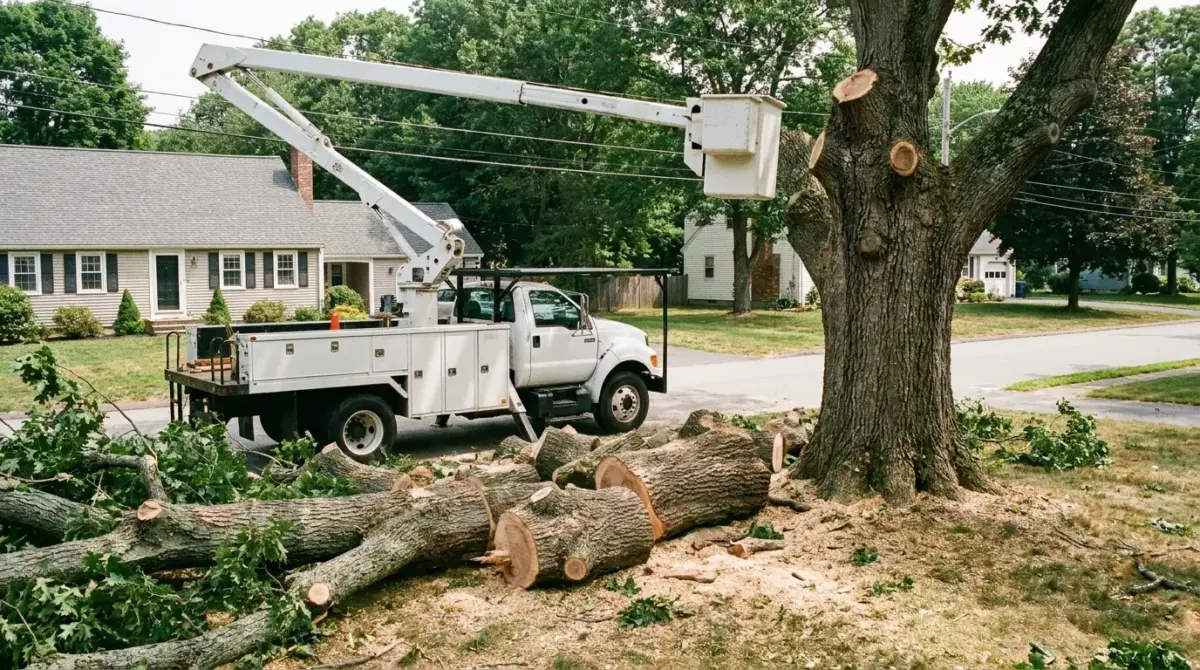
Tree removal cost is one of the most common tree-care questions Massachusetts homeowners ask. This guide walks you through what every property owner should know about tree removal cost — what to watch for, when to act, and how a Massachusetts arborist approaches tree removal cost on real properties across Norfolk, Middlesex, and Bristol counties.
You called for a tree removal quote and the number that came back made you blink. $2,800 for one oak? You priced it out at the other guy’s company and got $1,400. Same tree. What’s going on?
Tree removal pricing in Massachusetts can swing wildly even on identical-looking trees, because the size of the tree is only one of about ten factors that actually determine the cost. Here’s a breakdown of what really drives the price, so you can read a quote intelligently and spot the difference between a fair price and someone cutting corners.
The Ballpark Range
National averages don’t translate cleanly to Massachusetts because labor and insurance costs here run higher than in much of the country. Realistic 2026 ranges for residential tree removal in eastern MA:
- Small tree (under 30 feet): $400 to $900
- Medium tree (30 to 60 feet): $700 to $1,800
- Large tree (60 to 80 feet): $1,500 to $3,500
- Very large tree (80+ feet): $2,800 to $6,000+
Those are wide ranges on purpose. A 70-foot oak in a wide-open backyard with truck access is on the low end. The same 70-foot oak hanging over a swimming pool with a fence in the way is on the high end. Sometimes way past it.
The 10 Factors That Actually Set the Price
1. Tree Height
Obvious, but worth saying: taller trees cost more because they take more time and bigger equipment. The jump from 50 feet to 80 feet often doubles the price because at 80+ feet a bucket truck might not reach the top — you’re climbing or using a crane.
2. Trunk Diameter
A skinny pine and a thick oak can both be 60 feet tall but the oak might cost double. More wood means more chainsaw time, more cuts, more sections, and more weight to haul.
3. Species
Oak, hickory, and maple are dense hardwoods — slower to cut, harder on chains. Pine, poplar, and ash are softer. A 50-foot oak takes longer than a 50-foot pine, and the quote reflects it.
4. Access
The single biggest hidden cost driver. Can the truck and bucket get to the tree? Or does the crew need to carry every section through a narrow gate, around the house, and down a slope? Access difficulty can easily double a quote because everything takes 3-5x longer when hand-carried.
A backyard tree on a tight urban lot in Watertown will quote higher than the same tree on a wide-open suburban property in Sudbury, every time.
5. Proximity to Structures
A tree that can be “felled” — cut and dropped in one piece into a clear area — is the cheapest job there is. A tree that needs to be “sectioned” — climbed, cut piece by piece, each section roped down to protect what’s below — costs 2-3x more and takes a full day instead of a few hours.
Trees near houses, fences, sheds, decks, pools, driveways, and especially power lines all require sectioning. There’s no shortcut.
6. Power Lines
Trees touching or near energized power lines require coordination with the utility. Sometimes the utility comes out first to de-energize or protect the line. That adds time and cost. Tree services that aren’t qualified for line clearance work shouldn’t even quote those trees — and a good crew will tell you when they need the utility involved before they swing a saw.
7. Tree Condition
Counterintuitively, a dead or dying tree is often MORE expensive to remove than a healthy one. Why? A climber can’t trust the wood — branches that look solid might snap under their weight. Dead trees with rot at the base might fall in unpredictable directions. The crew has to be extra cautious, which means slower, which means more billable hours.
8. Stump Grinding (Add-On)
Most “tree removal” quotes don’t include stump grinding by default. Adding it usually runs $100 to $400 per stump depending on diameter. Some crews charge per inch of diameter — about $3-5 per inch is typical. If you want the stump gone, ask specifically.
9. Debris Hauling
Cheaper quotes sometimes leave the wood and brush on your property. That sounds fine until you realize you now own 800 pounds of oak rounds that need splitting, drying, and storing — or hauling to a dump that charges you to drop it off. Full debris removal typically adds $200 to $600. Make sure your quote spells out what happens to the wood.
10. Permits
In Massachusetts, public shade trees (anywhere in the right-of-way between the sidewalk and street) require a tree warden’s permit under MGL Chapter 87. Conservation areas and wetlands have additional restrictions. A good service handles the paperwork as part of the quote. A bad one skips it, leaving you on the hook for the fines.
Red Flags in a Quote
If you’re comparing quotes, watch out for these:
- Bid that’s 40%+ below the others. Almost always means: not insured, not licensed, debris stays on your property, or all three.
- No mention of insurance or licensing. A legitimate Massachusetts tree service is licensed and carries general liability plus workers’ comp. If they can’t show proof, walk away. One injury on your property without their insurance = your homeowner’s policy gets billed.
- Cash-only or “we can save you the tax.” Means no real business, no recourse if something goes wrong.
- Door-to-door solicitation after a storm. Storm chasers from out of state are notorious for taking deposits and disappearing.
- No on-site assessment. Real arborists need to see the tree, the access, and what’s around it before quoting accurately.
When Insurance Pays
Tree removal triggered by storm damage is sometimes covered by homeowner’s insurance, but with limits. Most policies cover removal of a tree that has actually fallen on a covered structure (house, garage, shed) — up to a cap of usually $500-$1,000 per tree. Preventive removal of a hazardous tree before it falls? Rarely covered. Removal of a tree that fell in your yard but didn’t hit anything? Sometimes covered, sometimes not.
Read your policy before assuming. And document everything with photos before the removal starts.
Bottom Line
A tree removal quote isn’t really about the tree. It’s about everything around the tree. Two arborists looking at the same oak can quote very different prices and both be honest — they’re seeing different challenges in the access, the proximity, the species, the condition. The lowest number isn’t always the best deal. The highest isn’t always price-gouging. Get 2-3 quotes, ask each what’s included and what isn’t, and pick the one that’s licensed, insured, and walked the property before quoting.
Trusted Local Network
Adjacent trades often come up during major tree work. For homeowners outside MA needing handyman support, general handyman services for tree-adjacent home repair handle that scope. And for restoration after tree-related property damage, structural restoration services cover the recovery side.
Your Massachusetts Tree Removal Specialists
If you need a transparent, fully itemized quote on a tree removal across Norfolk County, Middlesex County, and Bristol County — including Waltham, Lexington, Watertown, Milton, and 40+ surrounding towns, Norfolk Tree Service offers free on-site assessments before any work or commitment. Our fully licensed and insured crews handle tree removal with all required tree warden permits included. Contact us today for a no-obligation estimate.