 Skip to content
Choosing what to plant is the one tree decision a homeowner makes with a completely free hand, and it is the one that lasts longest. Soil, winter salt, wind exposure and how much room the crown will need when it is full grown all belong in the choice. This guide covers species that do well in New England yards, and a few that lead to regret.
The right tree planted in the right spot is one of the most valuable upgrades you can make to a Massachusetts property. It shades the house, raises home value, supports local wildlife, and outlives you. The wrong tree planted in the wrong spot is a 30-year regret that ends with a removal quote.
Here are the species that thrive in our climate and the ones you should think twice about — based on what actually performs in New England soils, weather, and pest pressure.
"*" indicates required fields
10 Trees That Thrive in Massachusetts
1. Sugar Maple (Acer saccharum)
The classic New England shade tree. Spectacular fall color. Lives 200+ years. Tolerates cold winters perfectly. Needs space — mature spread is 50+ feet. Best in deeper soils, struggles in compacted urban areas.
2. Red Oak (Quercus rubra)
Fast-growing for an oak (which is to say still slow — figure 1-2 feet per year). Massive at maturity, deep root system, no major pest threats currently. Supports hundreds of insect species that feed local birds. Don’t prune April-October because of oak wilt.
3. American Hornbeam (Carpinus caroliniana)
Underrated. Compact (25-35 feet tall), slow-growing, beautiful smooth gray bark with distinctive “muscle” appearance. Tolerates shade and tight planting locations. Great choice for smaller yards.
4. Eastern Redbud (Cercis canadensis)
Stunning spring flower display before leaves emerge. Compact (20-30 feet), good for front yards or as understory. Heart-shaped leaves. Native, supports pollinators, generally low-maintenance.
5. Kousa Dogwood (Cornus kousa)
Resistant to the dogwood anthracnose that’s wiped out a lot of native flowering dogwoods. Late spring flowers, fall color, edible (if odd-tasting) red fruit. Tops out around 25 feet.
6. Serviceberry (Amelanchier canadensis)
White spring flowers, edible berries that wildlife loves, golden-orange fall color. Multi-stemmed form makes it work as a small specimen tree or large shrub. Tops out around 25 feet.
7. River Birch (Betula nigra)
Distinctive peeling cinnamon-colored bark. Resistant to the bronze birch borer that’s killing white birches across New England. Tolerates wet soil that would kill other species. Fast growing.
8. Ginkgo (Ginkgo biloba)
Tough, pest-resistant, beautiful golden fall color, lives for centuries. CRITICAL: only plant male cultivars. Female ginkgos drop fruit that smells like rotten butter. Most nurseries sell male grafted specimens — confirm before buying.
9. Tulip Poplar (Liriodendron tulipifera)
Fast-growing native that hits 70+ feet at maturity. Tulip-shaped flowers in early summer, golden fall color. Best in deeper soils with adequate moisture. Not for small yards.
10. American Holly (Ilex opaca)
Evergreen for year-round interest, classic red berries on female trees. Lives long, deer-resistant, takes pruning well. Plant in groups to ensure pollination of female trees.
3 Trees to Avoid in Massachusetts
1. Norway Maple (Acer platanoides)
Invasive in Massachusetts. Spreads aggressively through seed, outcompetes native species, creates dense shade that prevents grass from growing underneath. Massachusetts has it on the “prohibited plant” list. Don’t plant them. Remove and replace if you have them.
The Massachusetts invasive plant resources list this and other species to avoid.
2. Bradford Pear (Pyrus calleryana)
Cheap and fast — and that’s the problem. The shape that makes them look uniform when young creates structural weaknesses that fail catastrophically in their second decade. Most Bradford pears split in half during a nor’easter sometime between years 15-25. And they’re now considered invasive in many states. Plant something else.
3. Silver Maple (Acer saccharinum)
Fast-growing but brittle wood, shallow aggressive roots that wreck sidewalks and septic lines, drops branches in storms, and has a relatively short lifespan for a shade tree. Pretty much every reason to plant a tree, silver maples don’t deliver.
Right Tree, Right Place
Beyond species, location matters as much as anything. Before planting:
- Look up — any power lines, eaves, or branches of other mature trees in the path of the new tree’s mature canopy?
- Look down — call Dig Safe (811) before any digging. Underground utilities will spoil a planting fast
- Consider mature size — measure the planned spot, find the species’ mature spread, and confirm you’ve got room
- Check sun exposure — sun-loving trees won’t thrive in deep shade, shade-loving species will scorch in full sun
- Match soil — wet spots need river birch or hornbeam, dry sandy soils need oak or ginkgo
When and How to Plant
Best planting windows in Massachusetts:
- Fall (mid-September to mid-October) — cooler temps reduce transplant stress, roots establish before winter dormancy
- Spring (mid-April to mid-May) — second-best option, but plant before summer heat arrives
Avoid summer planting (heat stress) and winter (frozen ground).
Planting depth is critical. The root flare (where the trunk widens at the base) must remain at or slightly above the existing soil grade. Too deep equals slow death. The Arbor Day Foundation planting guide has step-by-step illustrations.
First-Year Care
Young trees need attention to survive their first year:
- Water deeply once a week (more during heat waves), focus on the root ball area
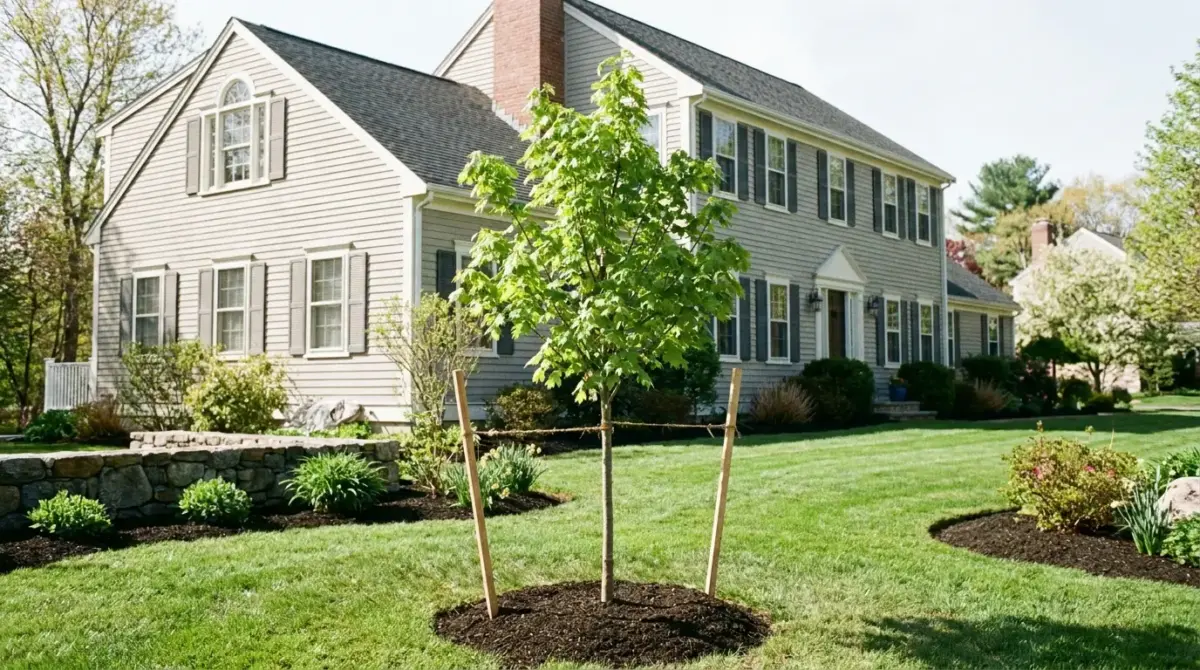
- Mulch in a proper donut shape (not against the trunk)
- Stake only if the tree can’t stand alone — remove stakes after one year
- Don’t fertilize the first year, the tree needs to establish roots
- Wrap the trunk for winter if rodents or deer are a concern
Bottom Line
The trees you plant this year will shade your kids’ kids if you choose well. Pick species suited to Massachusetts soils, weather, and pests. Avoid the invasives and the structurally weak species no matter how cheap they are at the box store. Plant at the right depth in the right season and the tree does the rest.
Trusted Local Network
Best-tree-to-plant decisions often intersect with broader landscape and outdoor plumbing planning. For homeowners outside MA planning irrigation around new tree plantings, plumbing services for outdoor water systems handle that side. And for general landscape and yard prep, general handyman services for landscape and outdoor work cover the surrounding scope.
Your Massachusetts Tree Planting Specialists
Need help choosing the right tree for your yard or want professional planting? Norfolk Tree Service serves Norfolk County, Middlesex County, and Bristol County — including Waltham, Lexington, Watertown, Milton, and 40+ surrounding towns. Our ISA-certified arborists handle tree and shrub planting with proper species selection, depth, and first-year care guidance. Contact us today.