 Skip to content
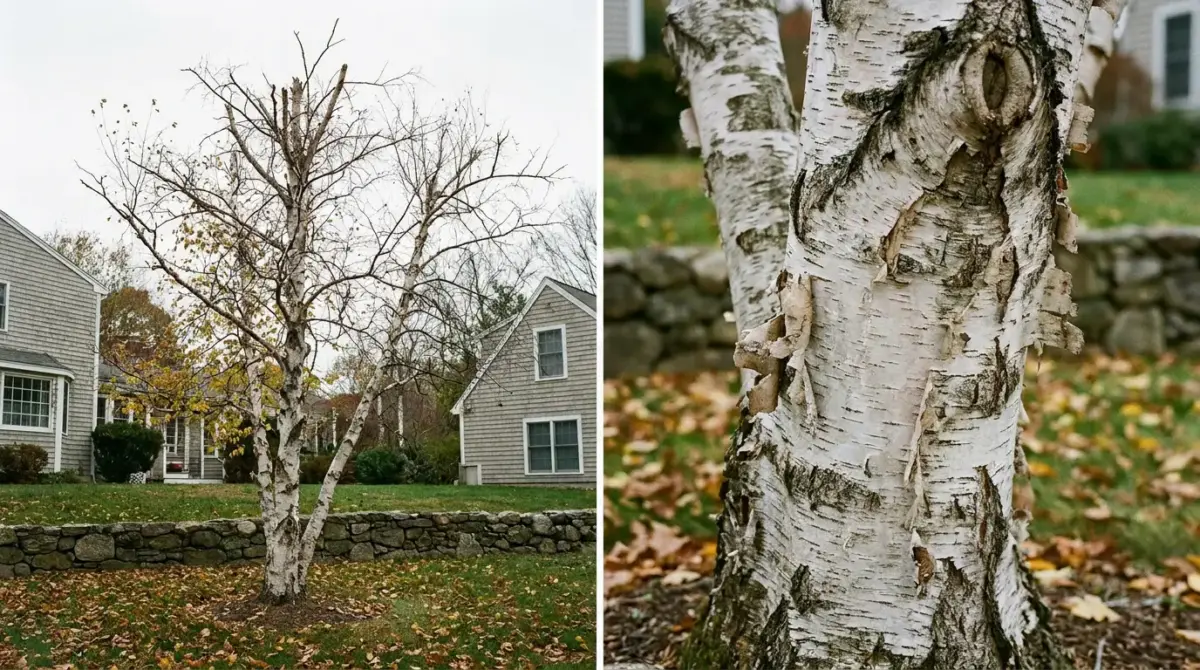
Birch tree is one of the most common tree-care questions Massachusetts homeowners ask. This guide walks you through what every property owner should know about birch tree — what to watch for, when to act, and how a Massachusetts arborist approaches birch tree on real properties across Norfolk, Middlesex, and Bristol counties.
The classic white-barked birch tree – the one in every New England postcard – is disappearing from Massachusetts yards. If you have an old birch or planted one in the last 15 years, you’ve probably watched it slowly decline. There’s a reason, and there’s something you can do about it.
The Two Killers
1. Bronze Birch Borer
Native beetle whose larvae bore S-shaped galleries through the cambium layer of stressed birches. Healthy vigorous trees can fight off attacks. Trees stressed by drought, soil compaction, or sun exposure get overwhelmed and die back from the top down.
The classic symptom: dieback that progresses from the upper canopy downward over 2-4 years. By the time you notice it, the tree is past saving.
2. Climate Stress
Native birches are northern-forest trees. They evolved for cool moist conditions with rich forest soils. The Massachusetts climate has been getting steadily warmer with more frequent drought summers. Add a typical suburban yard – compacted soil, full sun, mowed lawn instead of forest floor – and you have permanent low-grade stress that opens the door for bronze birch borer.
This is the underlying issue. The borer is the symptom, not the disease.
Which Birches Are Most Vulnerable
Most vulnerable: European white birch (Betula pendula). Common in older suburban plantings, almost always dies within 15-25 years in Massachusetts now.
Vulnerable: paper birch / canoe birch (Betula papyrifera). Our native white birch. Surviving in cool sites with good soil, dying in typical suburban yards.
Moderately vulnerable: gray birch (Betula populifolia). Tough but short-lived (20-30 years even at best).
Least vulnerable: river birch (Betula nigra). Native to wet bottomlands. Naturally resistant to bronze birch borer. Tolerates heat, urban soil, and Massachusetts climate change.
If You Have a Dying Birch
Treatment options exist but they’re expensive and ongoing:
- Systemic insecticide injections every 2-3 years
- Deep watering during all summer dry spells
- Mulch ring out to drip line
- Soil aeration in compacted areas
- Avoid any stressors – no construction near the root zone, no road salt, no soil grade changes
Once canopy dieback exceeds 30%, treatment is rarely cost-effective. Removal becomes the realistic option.
What to Plant Instead
If you’re replacing a lost birch and want similar aesthetics:
- River birch (Betula nigra) ‘Heritage’ – cinnamon peeling bark, similar elegant form, naturally resistant to the borer, tolerates Massachusetts heat
- European hornbeam (Carpinus betulus) – smooth gray bark with attractive muscle-like texture, formal upright form
- Yellowwood (Cladrastis kentukea) – smooth silvery-gray bark, white flowers in late spring
- Kousa dogwood (Cornus kousa) – mottled bark, late-spring flowers, fall color, disease-resistant
For pure landscape value, river birch is the closest match for the look you wanted from the original birch.
Bottom Line
White and paper birches no longer thrive reliably in Massachusetts suburban conditions. Climate change and bronze birch borer have combined to make them short-lived in most yards. River birch is the practical replacement – similar look, much better survival odds, and naturally resistant to the borer that’s killing the alternatives.
Trusted Local Network
Birch tree health issues often cascade into broader landscape and property concerns. For related needs, we recommend specialized tree-care services for declining trees.
Your Massachusetts Tree Planting Specialists
Have a dying birch and want to plant a more resilient replacement? Norfolk Tree Service serves Norfolk County, Middlesex County, and Bristol County including Waltham, Lexington, Watertown, Milton, and 40+ surrounding towns. We handle tree removal of the failing tree and tree and shrub planting for the replacement. Contact us today.