 Skip to content
Fallen leaves is one of the most common tree-care questions Massachusetts homeowners ask. This guide walks you through what every property owner should know about fallen leaves — what to watch for, when to act, and how a Massachusetts arborist approaches fallen leaves on real properties across Norfolk, Middlesex, and Bristol counties.
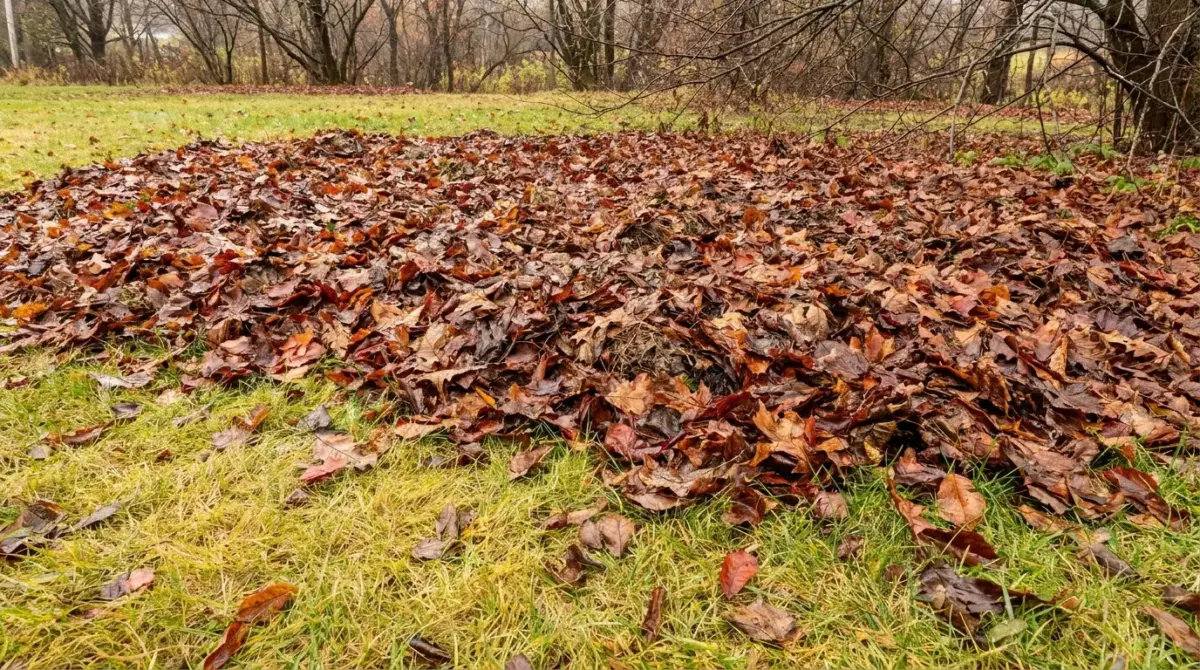
You bagged up half a yard of leaves last fall. The other half you left in place “to break down naturally.” Spring came, the grass came back, and… your leaves are still sitting there in a damp mat that’s now smothering the lawn.
Leaves don’t just decompose on their own in a typical Massachusetts yard. Here’s why, what’s happening underneath that mat, and how to actually let leaves work for your trees and grass.
Why Whole Leaves Don’t Break Down
Decomposition needs three things: oxygen, moisture, and surface area. A pile of whole leaves stacked on the lawn has plenty of moisture but very little surface area exposed and very little oxygen reaching the middle.
So the bottom layer compresses, gets matted, and sits there for years. The top dries and blows around but doesn’t break down. The grass underneath suffocates over a few months. By spring you have a layer of half-rotted leaves over dead patches of lawn.
What Actually Works for Lawns
Mulch-Mow Them
The best option for most properties. A mulching mower chops leaves into pieces small enough that they fall through the grass and break down within a few weeks. The shredded leaves return nitrogen and carbon to the soil – essentially free fertilizer.
Rule of thumb: if you can still see grass after mowing, you mowed correctly. If the lawn is covered in chopped leaves, mow again.
Rake to Beds, Don’t Bag
If you have heavy leaf cover and don’t want to mulch-mow, rake the leaves into your planting beds and under your trees – exactly where they would land naturally in a forest. This creates a natural mulch layer that:
- Insulates roots through winter
- Suppresses weeds in spring
- Breaks down over the year and feeds the soil
- Costs nothing and requires no hauling
Compost Them
If you have more leaves than you have bed space, dedicate a corner of the yard to a leaf compost pile. Chopped leaves break down in 6-12 months into “leaf mold” – one of the best soil amendments available. The UMass Extension composting guide walks through the process.
What Actually Works for Trees
Leaves left under a tree’s canopy (out to the drip line) replicate what happens in a natural forest. The leaves:
- Insulate roots from winter freeze-thaw cycles
- Decompose into compost that feeds the tree
- Suppress lawn grass that competes with tree roots
- Reduce weed growth and trim work around the base
The key: keep them at 2-4 inches deep, not 12. And keep them pulled back from the trunk.
When You Should Remove Leaves Completely
A few situations call for getting leaves out of the yard entirely:
- If the tree had a fungal disease (anthracnose, scab, etc.) – infected leaves can spread spores; bag and dispose
- If leaves are blocking storm drains or wetland buffers – rake and bag
- If leaves are piling against the house foundation – move them at least 3 feet from siding to prevent moisture issues
Town Pickup Programs
Many Massachusetts towns offer fall leaf pickup – usually requiring bagged or piled leaves at the curb. Check your town’s DPW schedule. Some towns now require paper bags (not plastic) because they compost the leaves. Save the plastic bags for trash.
Bottom Line
Leaves are an asset, not a problem, if you handle them right. Mulch-mow them into your lawn. Rake them into beds and around trees. Compost the rest. Bagging and hauling them away is the worst of all options – you’re paying for disposal of free fertilizer while leaving your soil hungry for what just left.
Trusted Local Network
Fall leaf cleanup often coincides with gutter, drain, and downspout maintenance. For related needs, we recommend specialized drain cleaning services.
Your Massachusetts Tree Care Specialists
If leaf cleanup or related tree care is more than you can handle this fall, Norfolk Tree Service serves Norfolk County, Middlesex County, and Bristol County including Waltham, Lexington, Watertown, Milton, and 40+ surrounding towns. We can recommend the right tree care for your property’s specific needs. Contact us today.