 Skip to content
Eastern hemlock is one of the few evergreens that holds deep shade all winter, and the adelgid is quietly taking it apart across the region. The insect is small enough to miss and slow enough that owners often notice only when a tree has gone thin and grey. This guide covers what to look for on the underside of the needles and what can still be done.
Eastern hemlocks were once one of the most common evergreens across Massachusetts forests and yards. In some parts of the state, they’re now down to a fraction of their original numbers — and the killer is a tiny insect smaller than a sesame seed.
Hemlock woolly adelgid (HWA) has been quietly destroying our hemlocks since the late 1980s. If you have hemlocks on your property, here’s what you need to know about spotting the infestation early and what treatment options actually work.
What HWA Looks Like
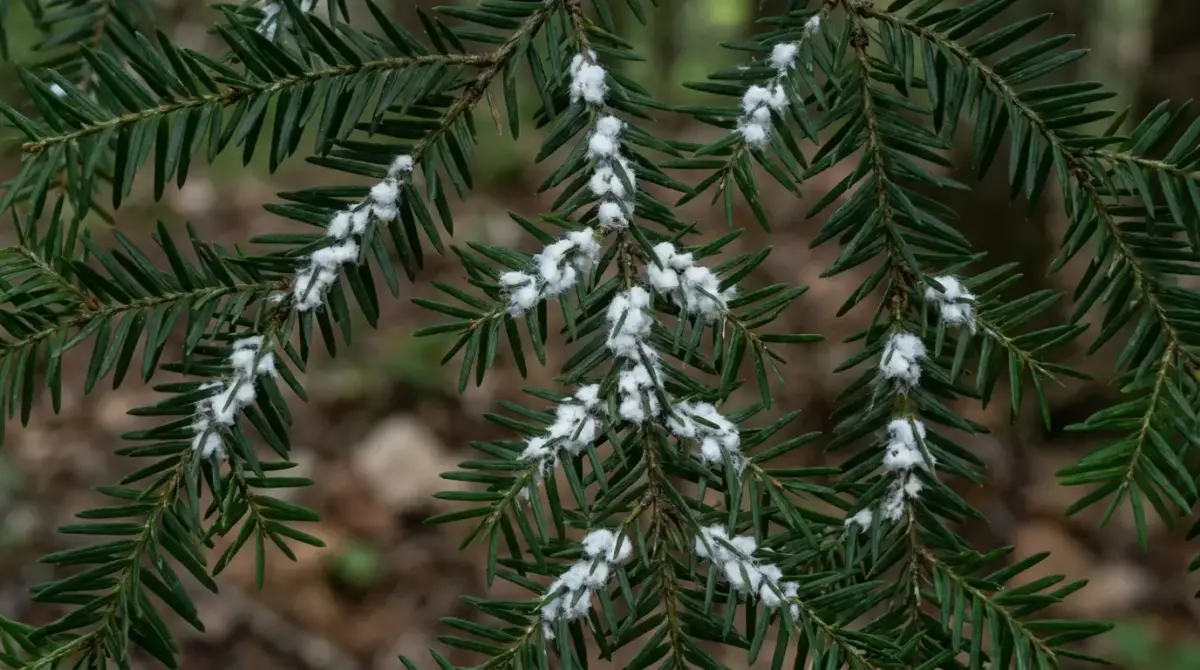
Hemlock woolly adelgid is named for its most visible sign — white, woolly, cottony egg sacs about the size of a pinhead clustered along the underside of hemlock needles, especially near the base where the needle attaches to the twig.
If you flip a hemlock branch and see what looks like miniature cotton balls or fluffy white dots all along the twigs, that’s HWA. The white masses are most visible from late fall through early spring, when the insects are actively feeding.
The US Forest Service HWA program has detailed identification photos for confirmation.
How HWA Kills Trees
The insects insert their feeding tubes into the base of hemlock needles and suck out stored carbohydrates. The tree loses energy faster than it can replace it. Symptoms:
- Needles turn from rich green to a dull grayish-green
- Needle drop accelerates — bare branches start appearing throughout the canopy
- New growth becomes stunted or stops entirely
- Branches die back from tip to trunk
- The tree dies completely, typically within 4-10 years of initial infestation
An infested hemlock doesn’t recover on its own. Without treatment, the trajectory is death.
When to Check Your Hemlocks
HWA inspection is easiest in winter and early spring when:
- The white woolly egg masses are at maximum visibility
- The contrast against bare landscape makes them easy to spot
- You have time before the spring egg-laying cycle starts
Inspect any hemlock on your property at least once a year. Pull a few low branches down and examine the undersides. Pay particular attention to trees that already look thin or stressed.
Treatment Options That Actually Work
Three proven treatment approaches in Massachusetts:
1. Systemic Insecticide (Imidacloprid or Dinotefuran)
Applied as a soil drench or injection, the tree absorbs the insecticide through its roots and distributes it through the vascular system. When HWA feeds, they ingest the chemical and die.
Imidacloprid: cheaper, slower-acting, lasts 4-7 years per application. Best applied in fall.
Dinotefuran: faster-acting, shorter duration (1-2 years). Best for rescuing trees in serious decline.
Both are restricted-use pesticides. Properly licensed arborists apply them. DIY application is possible with some products but mistakes happen with concentration, timing, or drift onto non-target species.
2. Horticultural Oil or Insecticidal Soap
Sprayed directly onto the foliage, these smother the insects. Cheap, organic-compatible, but require complete coverage of the entire tree to work — which is impractical for anything taller than about 30 feet.
Best for small ornamental hemlocks, hedges, or recently planted specimens. Multiple applications per year needed.
3. Biological Control
Several predatory beetle species (notably Laricobius nigrinus and Sasajiscymnus tsugae) have been released across Massachusetts forests as a long-term biological control. These work at the forest scale, not single-tree scale, and aren’t a quick fix for a homeowner with an infested specimen.
Treatment Timing Matters
Best windows for treatment in Massachusetts:
- Spring (April-May): Foliar sprays for hands-on coverage
- Fall (September-October): Soil drench applications. Soil is still warm enough for root uptake but the tree is preparing for winter
Avoid mid-summer treatment when trees are heat-stressed and uptake is slower.
When Removal Becomes the Answer
Treatment isn’t always worth it. Consider removal if:
- The tree has lost more than 30-40% of its canopy already
- Multiple years of treatment have failed to halt decline
- The tree is in poor position (near structures, blocking solar panels, etc.) regardless of HWA
- You can’t commit to ongoing treatment costs (treatments aren’t one-and-done)
A dead or dying hemlock becomes brittle quickly. Removal gets harder and more expensive the longer you wait.
Don’t Replant Hemlock — Yet
If you’ve lost a hemlock to HWA, replanting another hemlock in the same spot is a bet against the same insect that just killed the first one. Better evergreen alternatives for Massachusetts:
- White pine — fast growing, native, no major pest threats
- Norway spruce — long-lived, weeping form, deer-resistant
- American holly — denser, evergreen, attractive berries
- Atlantic white cedar — wet-tolerant native
Research on HWA-resistant hemlock varieties is ongoing through the Massachusetts DCR and forestry research institutions. Don’t replant hemlock until resistant cultivars are commercially available.
Bottom Line
Hemlock woolly adelgid is now present in every Massachusetts county. If you have hemlocks, they’re at risk. Annual inspection in winter is the cheapest investment you can make in keeping them alive. Treatment options exist and they work — but only if you act before the canopy is already 30%+ lost. After that, removal becomes the realistic option. Don’t wait until next spring to look.
Trusted Local Network
Pest issues like hemlock woolly adelgid often cascade into broader tree and property concerns. For related needs, we recommend specialized tree-care services for diseased and pest-affected trees.
Your Massachusetts Tree Care Specialists
If you suspect HWA on your hemlocks or need to schedule treatment, Norfolk Tree Service serves Norfolk County, Middlesex County, and Bristol County — including Waltham, Lexington, Watertown, Milton, and 40+ surrounding towns. Our ISA-certified arborists can confirm the diagnosis and recommend the right treatment or tree removal path. Contact us today for an inspection.