 Skip to content
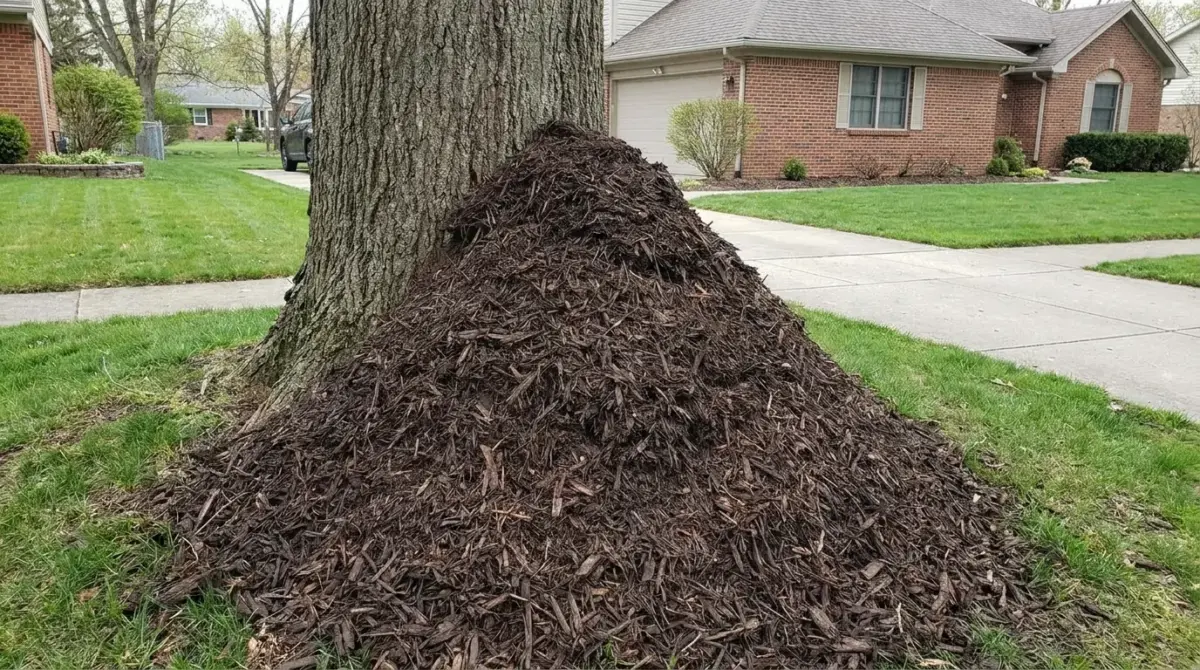
Mulch volcano is one of the most common tree-care questions Massachusetts homeowners ask. This guide walks you through what every property owner should know about mulch volcano — what to watch for, when to act, and how a Massachusetts arborist approaches mulch volcano on real properties across Norfolk, Middlesex, and Bristol counties.
Drive through any Massachusetts suburb in spring and you’ll see them everywhere – cone-shaped piles of mulch heaped against tree trunks like little brown volcanoes. They look tidy. They look professionally landscaped. They’re slowly killing the trees they’re supposed to protect.
Why Mulch Volcanoes Form
Most homeowners didn’t pile that mulch themselves. The landscaper did it. Many landscaping crews dump mulch each spring on top of last year’s leftover, and the only quick way to spread it neatly around a tree is to pile it up against the trunk. Each year the volcano gets taller until it’s a foot or more deep against the bark.
The crew thinks it looks finished. The trees pay the price.
What’s Actually Happening to the Tree
Bark Rot
Tree bark needs air. Pack moist mulch against it 24/7 and the bark stays wet. Fungi colonize the wet bark. Within a few years the cambium layer under the bark dies. The tree can’t move water and nutrients past the dead zone. Canopy thins. Tree dies.
Girdling Roots
Roots grow where conditions are best. Pile a foot of moist organic material against the trunk and the surface roots literally turn upward into the mulch instead of growing outward into soil. Those roots eventually wrap around the trunk and choke off the tree’s vascular system from the inside.
Rodent Damage
Voles and mice spend winter under the warm hidden chamber a volcano creates. They chew on the bark you’ve hidden from view. By spring you find a tree girdled all the way around at the base.
How to Fix an Existing Volcano
- Carefully pull mulch back from the trunk down to the original soil grade
- Find the root flare – the natural widening at the base of the trunk – and make sure it’s visible above the soil line
- Check for girdling roots wrapping the trunk; if present, professional root pruning may be needed
- Spread the existing mulch out into a flat donut shape, 2-4 inches deep, extending out to the drip line
- Keep the trunk-to-mulch gap from now on – usually 3-6 inches of bare soil around the trunk
The UMass Extension proper mulching guide has detailed before-and-after diagrams.
Tell Your Landscaper
If you hire a landscaping service, give them clear instructions in writing: flat donut shape, 2-4 inches max, root flare exposed. Most crews will comply once asked. Some won’t – those are the ones you replace.
Bottom Line
Mulch volcanoes are everywhere in Massachusetts neighborhoods. They look fine. They’re not. Every tree with one piled against its trunk is on a slow timer to decline. Spend 20 minutes per tree fixing it and you’ll add years of life and avoid an expensive removal down the road.
Trusted Local Network
Mulch volcanoes and other landscape mistakes often coincide with broader yard-care issues. For related needs, we recommend tree-care services for landscape and tree-health coordination.
Your Massachusetts Tree Care Specialists
If a tree on your property has been volcano-mulched for years and you’re worried about its condition, Norfolk Tree Service serves Norfolk County, Middlesex County, and Bristol County including Waltham, Lexington, Watertown, Milton, and 40+ surrounding towns. Our ISA-certified arborists can assess for girdling roots and recommend the right intervention or tree care approach. Contact us today.