 Skip to content
Some trees are not a removal decision. A split leader, a heavy lateral, a crack at an old attachment: these are structural problems, and structural problems sometimes have hardware answers. This guide explains what cabling and bracing actually do, which trees are worth supporting, and how to recognise the ones that are past it.
That huge maple in your front yard has a split trunk you’ve been worried about for years. Or two main leaders that look ready to peel apart in the next nor’easter. Or a heavy lateral branch that’s stretched out further than it should and is starting to crack at the attachment.
One arborist quotes removal. Another mentions “cabling and bracing.” It’s not a topic homeowners hear about often, but for the right tree it can add 20-40 years of life instead of swinging a chainsaw.
What Cabling and Bracing Actually Means
Two related techniques. Both are about reinforcing structural weaknesses so a tree can keep standing safely.
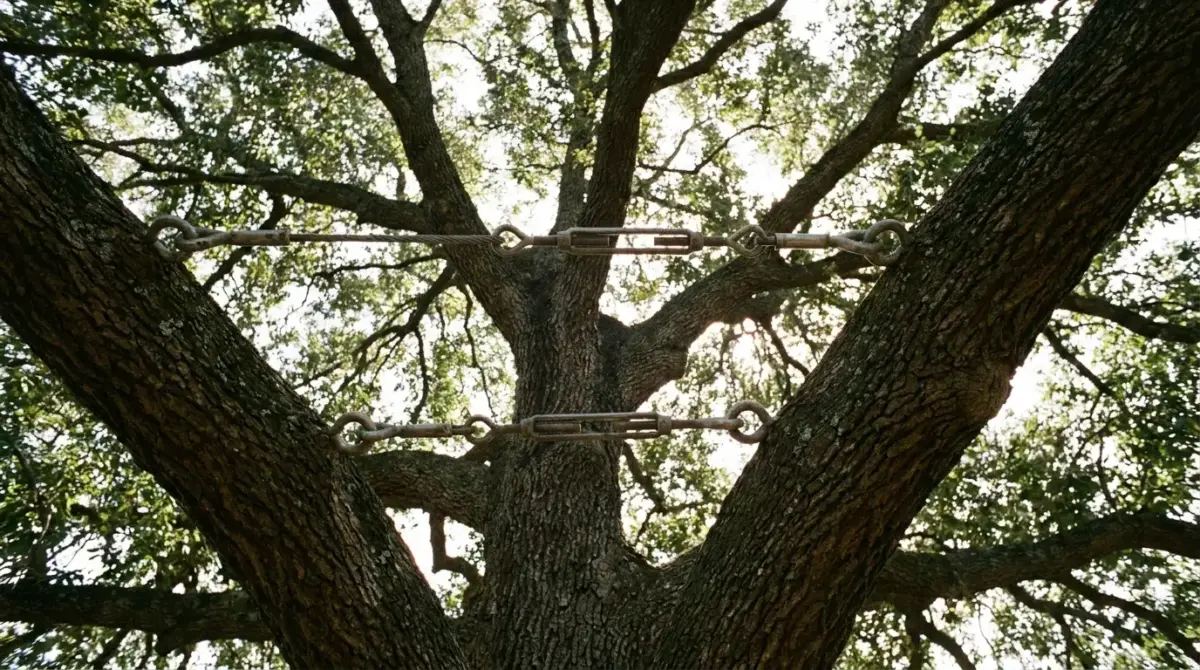
Cabling: high-strength steel cables installed between major branches or leaders in the upper canopy. The cables limit how far the limbs can move apart in wind. They don’t make the tree rigid — they catch the load before failure happens.
Bracing: threaded steel rods drilled through the trunk or branch union to physically hold two pieces together that would otherwise split apart. Usually combined with cabling above the rod for full protection.
The combination addresses both the immediate failure point and the long-term wind loading that caused the weakness.
When It’s the Right Answer
Cabling and bracing work best on:
- Co-dominant stems with included bark — two trunks of similar size growing from a tight V-shaped union, with bark trapped between them. The classic candidate
- Heavy lateral branches on otherwise healthy trees
- Mature specimen trees where the historical, aesthetic, or property value justifies the investment
- Trees that are structurally compromised but biologically healthy — solid wood, no major decay, no disease
- Cracked or split unions caught early — before the split runs all the way through
When It Won’t Save the Tree
Cabling is reinforcement, not resurrection. It doesn’t help trees with:
- Significant internal decay or hollow trunks
- Fungal infections like Armillaria root rot or Ganoderma
- Active emerald ash borer or other pest damage
- Major dead canopy (over 30% of the upper canopy)
- Root system failure (cracks in soil around the base, new lean)
An arborist who recommends cabling on a tree with these conditions either misread the situation or is selling you something. A reputable arborist tells you straight when removal is the safer call.
What It Costs
Typical Massachusetts 2026 pricing:
Industry Standards Matter
Cabling and bracing aren’t DIY work. They’re governed by ANSI A300 Part 3, the American National Standards Institute spec for tree support systems. The ISA best management practices reference these standards.
Key elements of a properly installed system:
- Cables installed at approximately 2/3 the height of the unsupported portion of the limb
- Hardware (lag eyes, threaded rods) sized to the load and species
- Static or dynamic cables chosen based on the failure risk
- Brace rods installed below cables, not as a substitute
- Inspection schedule built into the engagement — typically every 3-5 years
A handyman with a drill and some hardware-store cable is not what you want anywhere near a 60-foot tree.
Maintenance Over Time
An installed cable system isn’t fire-and-forget. Things to watch for:
- Cable wear — wind movement gradually fatigues steel. Replacement usually needed every 8-15 years depending on conditions
- Bark growth over the lag eyes — the tree slowly absorbs the hardware. Periodic adjustment may be needed
- Failure of one cable — can shift load to remaining cables in unpredictable ways. Replace as a system, not piecemeal
- Tree growth changing the geometry — the cable’s leverage point shifts as the tree matures
Schedule inspection every 3 years for high-value trees, every 5 for lower-stakes installations.
Pruning + Cabling: The Combo Approach
Cabling is often paired with reduction pruning. Removing 15-25% of the weight from the limbs being protected reduces the load the cables have to handle. It’s not a substitute for cabling on a real structural weakness, but it makes the cable system more effective and the failure scenario less catastrophic if the cable does fail.
Most quality cabling jobs include an initial reduction prune as part of the installation.
What to Ask Before Hiring
If an arborist recommends cabling, ask:
- What specific failure modes are you protecting against?
- Will you follow ANSI A300 Part 3 standards?
- What hardware do you use, and what’s the load rating?
- What’s the inspection schedule, and is it included in the quote?
- What’s the expected service life of the system?
- If the cable fails between inspections, what’s the failure mode?
Clear answers to those questions = a professional you can trust. Vague hand-waving = look elsewhere.
Bottom Line
Cabling and bracing is a real option for the right tree — one with structural weakness but underlying health, mature size, and value worth preserving. It’s not appropriate for diseased or dying trees, and it’s not DIY work. When done right by a certified arborist following ANSI standards, it can keep a heritage tree alive and safe for decades. Before agreeing to a removal, ask whether cabling is an option. The answer might surprise you.
Trusted Local Network
Cabling and bracing decisions often hinge on broader property and insurance considerations. Professional public insurance adjuster services handle the policyholder advocacy when tree-failure damage occurs. And for the restoration side after cabled trees do eventually need removal or fail, structural and water-damage restoration services cover the recovery work.
Your Massachusetts Tree Care Specialists
If you have a valuable mature tree with structural concerns, Norfolk Tree Service serves Norfolk County, Middlesex County, and Bristol County — including Waltham, Lexington, Watertown, Milton, and 40+ surrounding towns. Our ISA-certified arborists evaluate whether cabling, reduction pruning, or tree removal is the right path before any work begins. Contact us today for a structural assessment.