 Skip to content
An addition, a new driveway or a septic run can kill a mature tree three summers after the contractors have gone. The damage happens underground, to roots that reach far wider than the branches above them. This guide explains what construction actually does to a tree, and what protection has to be in place before the first machine arrives.
The contractor swears the tree will be fine. You’re keeping the big oak in the front yard while the new addition goes in around it. A year later the leaves come in thin, branches die, and 18 months after that the whole tree is dead — even though nobody ever cut it down.
Construction is one of the biggest invisible killers of mature trees in Massachusetts. The damage happens underground where you can’t see it, the symptoms take years to show, and by the time the tree is obviously dying it’s too late to save. Tree wells, proper barriers, and pre-construction planning prevent the problem.
What Actually Kills Trees During Construction
Soil Compaction
Heavy equipment driving over the root zone compresses soil, eliminating the air pockets that roots need to breathe. The damage is invisible from above but devastating below. A single pass of a backhoe across the drip line can compact soil enough to start killing surface roots.
Root Severance
Trenching for utilities, foundations, or drainage cuts through major roots. A tree can survive losing about 25% of its roots; losing 40% or more is usually fatal. Most trenches near established trees cut more than people realize because root systems extend out 2-3 times the canopy diameter.
Grade Changes
Adding even 6 inches of fill soil over the root zone suffocates roots — they need oxygen exchange with surface air. Lowering grade by removing soil exposes roots to drying and damage. Both are fatal over a few years.
Bark Damage
Equipment scrapes against the trunk, removing bark and creating entry wounds for fungi and insects. A continuous wound that goes more than halfway around the trunk is functionally a death sentence.
Chemical Contamination
Concrete washout, fuel spills, and herbicides used to control vegetation on the site can all kill trees. Concrete washout is particularly bad because it dramatically raises soil pH in the immediate area.
The Critical Root Zone
The most important concept in tree protection is the “critical root zone” (CRZ). It’s the area within which protection is essential to keep a tree alive.
A common rule of thumb: the CRZ extends out from the trunk a distance equal to 1.5 times the canopy radius — basically out beyond the drip line. For a tree with a 40-foot canopy spread, that’s a 30-foot radius protected zone around the trunk.
The ISA Best Management Practices for Tree Protection During Construction provides detailed guidance on CRZ calculation for different species and site conditions.
Tree Protection Plan Basics
Before any equipment moves onto the site, the tree protection plan should be in writing and posted at the site. It should include:
- Map showing all trees to be retained and their critical root zones
- Protection fencing locations and specifications
- No-go zones for vehicles, equipment, and material storage
- Designated access paths that avoid root zones
- Required protection measures for any unavoidable root zone work
- Penalty clauses in the contract for damage to protected trees
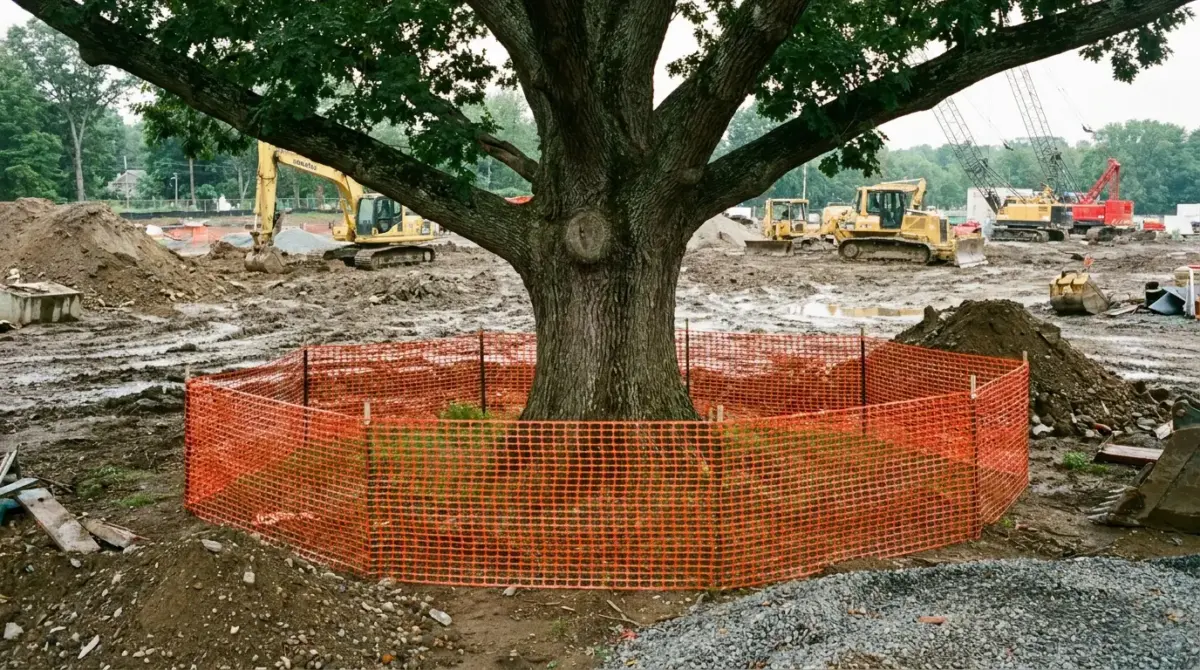
Protection fencing should be at least 4 feet tall, brightly visible, and impossible to drive through accidentally. Cheap silt fencing isn’t adequate — use rigid orange construction fence or chain link.
When Grade Has to Change Around a Tree
Sometimes you can’t avoid changing grade around a tree you want to keep — the new walkway has to be lower, the new patio has to be higher. Two engineering solutions:
Tree Wells (For Lower Grade)
If new grade is lower than original, build a retaining wall around the original soil grade at the drip line. The tree sits in a “well” of original elevation while new grade falls away around it. Done correctly, this preserves the root system entirely.
Aeration Systems (For Higher Grade)
If new grade has to come up, you can install a network of perforated pipe radiating out from the trunk and connecting to vent pipes that reach the new grade. This maintains air exchange to the original root zone. Complex, expensive, and only modestly successful — usually only worth it for high-value specimen trees.
What to Specify in Construction Contracts
If you’re working with a general contractor, include in writing:
- Specific trees protected with their CRZ defined
- Required protection fencing and when it must be installed (before mobilization)
- Designated equipment paths and material storage areas
- Concrete washout location (far from any tree)
- Penalty clauses for damage (typically the appraised value of the tree, which can be tens of thousands for a mature specimen)
- Requirement for arborist inspection before, during, and after construction
- Notification requirement if any unforeseen root zone work becomes necessary
Get an Arborist Involved Early
The biggest mistake homeowners make is bringing an arborist in after construction has started or, worse, after the tree starts showing problems. By then most decisions are already made and root damage is already done.
- Realistic assessment of which trees can survive the planned work
- Specific protection requirements for each tree being kept
- Identification of trees that should probably be removed proactively rather than damaged
- Written specifications for the contractor
- Post-construction care recommendations
The math favors the arborist visit.
Bottom Line
Trees and construction are a difficult combination. The damage that kills mature trees happens underground, takes years to show, and almost always traces back to decisions made before the project started. Spend a few hundred dollars on a pre-construction arborist consult, write tree protection into the contract, and install proper fencing before any equipment arrives. Or roll the dice and remove a dead tree in three years. Cheaper to plan it right.
Trusted Local Network
Tree protection during construction requires coordination across multiple trades. For related needs, we recommend renovation services for permitted residential projects.
Your Massachusetts Tree Care Specialists
Planning new construction with mature trees you want to keep? Norfolk Tree Service serves Norfolk County, Middlesex County, and Bristol County — including Waltham, Lexington, Watertown, Milton, and 40+ surrounding towns. Our ISA-certified arborists provide pre-construction assessments and ongoing protection guidance, plus lot and land clearing for trees that need to come down before the build. Contact us today.