 Skip to content
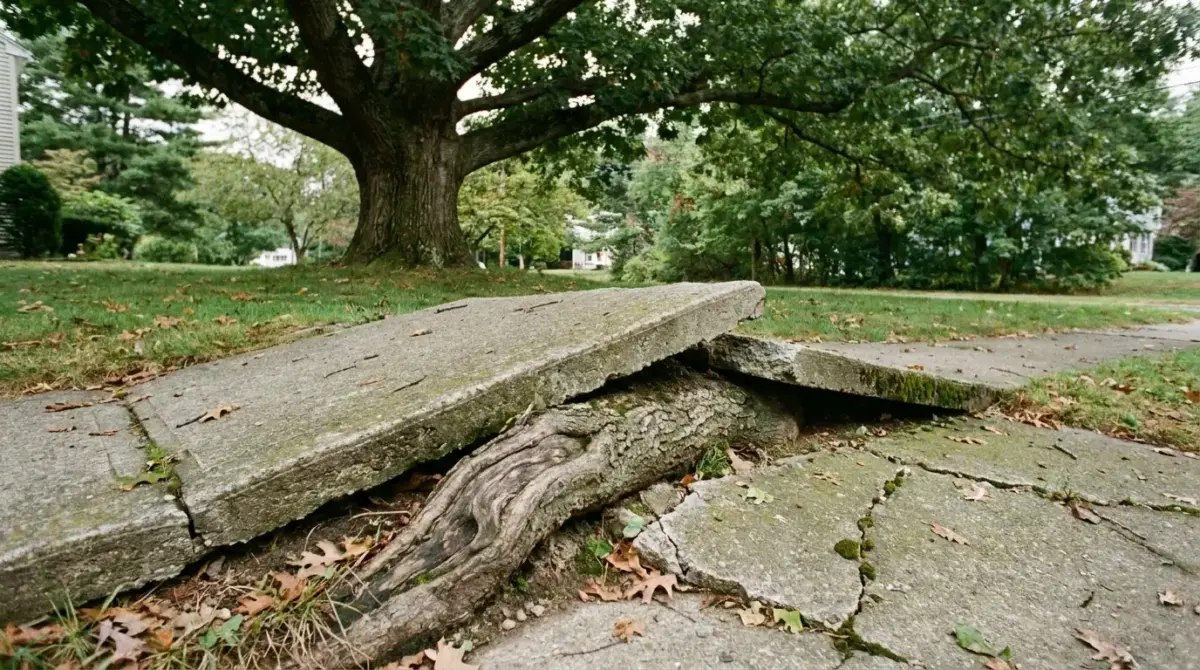
A lifted slab at the edge of the lawn is where tree biology meets the property line. Roots follow water and air near the surface, concrete sits on top of them, and something has to give. This guide explains why it happens, what can be done about it without killing the tree, and how responsibility is usually sorted out in Massachusetts.
That trip hazard on the sidewalk in front of your house didn’t appear overnight. Tree roots have been pushing on that concrete for years. Now somebody could fall on it, the town’s leaning on you to fix it, and you’re trying to figure out who actually owns this problem.
The answer depends on whose tree it is, where the sidewalk technically sits, and which Massachusetts town you live in. Here’s how it actually breaks down.
Why Roots Lift Concrete in the First Place
Tree roots don’t aim for sidewalks. They grow where conditions are best — moisture, oxygen, and loose soil. Sidewalks happen to create perfect conditions underneath: shade traps moisture, the slab cracks let oxygen in, and the soil under poured concrete is often compacted-but-not-impossibly-dense.
Once a root finds a crack, it grows along the underside of the slab. As the root thickens over years, it slowly lifts the concrete. By the time you see a 2-inch trip lip, the root underneath is the size of your forearm.
Who Owns the Sidewalk?
This is where most Massachusetts homeowners get confused. The strip of land between the street curb and the back edge of the sidewalk is usually town-owned right-of-way. The sidewalk itself sits on town property.
But — and this is the kicker — most Massachusetts towns place sidewalk maintenance responsibility on the adjacent property owner via local ordinance. So you don’t own it, but you’re on the hook for keeping it walkable. And in many towns, you’re also liable if someone falls.
Check your specific town’s ordinances. They’re typically under “public works” or “streets and sidewalks” sections.
Whose Tree Is It?
The tree that’s lifting the sidewalk falls into one of three categories:
1. Public Shade Tree
Trees in the right-of-way (between sidewalk and street, often called “tree belt” or “tree lawn”) are public shade trees under Massachusetts General Law Chapter 87. The town owns the tree. You can’t touch it without a tree warden’s permit.
If a public shade tree’s roots are damaging the sidewalk, the town typically handles tree-side issues — root pruning by their crews or removal if necessary. The sidewalk repair itself may still fall to the homeowner depending on local rules.
2. Your Tree
If the tree is on your private property (inside the property line, behind the right-of-way) but its roots are reaching out and lifting the public sidewalk, you’re typically responsible for both the tree management and the sidewalk repair. Worse, if someone trips on a root-lifted slab, your homeowner’s liability insurance is what pays out.
3. Your Neighbor’s Tree
Roots cross property lines without permission. If your neighbor’s oak is lifting the sidewalk in front of your house, you can legally cut the roots on YOUR side of the property line. But you can’t enter their property to prune branches or remove the tree.
Liability for the sidewalk damage is murky. Talk to a Massachusetts real estate attorney before assuming the neighbor will help pay.
The Three Real Options When Roots Are Lifting Concrete
Option 1: Root Pruning + Sidewalk Repair
An arborist cuts the offending root carefully, the sidewalk gets ground down, mudjacked, or replaced, and a root barrier gets installed to prevent future regrowth in that direction.
Pro: keeps the tree. Con: aggressive root pruning can destabilize the tree or cause decline. Best done by a certified arborist who understands what percentage of root mass can safely be cut.
Option 2: Grind Down the High Spots
If the trip hazard is mild (under 1.5 inches), a concrete saw can grind down the high edge to bring the slabs into a smoother transition. Cheapest fix, doesn’t touch the root, lasts a few years until the root grows more.
Some towns offer this as a free service from public works. Worth asking before hiring private.
Option 3: Replace the Sidewalk With Tree-Friendly Materials
Some towns are now allowing flexible pavers, rubber sidewalk tiles, or permeable concrete in areas where mature trees would otherwise have to come down. These materials accommodate root growth without cracking the surface.
Costs more upfront. Saves the tree. Saves the constant repair cycle. Check with your town to see if they permit alternative materials.
When Removal Becomes the Answer
Some situations leave no good alternative to removing the tree:
- The root system has cracked so much sidewalk that repairs are no longer practical
- Aggressive root pruning would destabilize the tree
- The tree is also pressing against the foundation, driveway, or utility lines
- The tree itself is in decline from other causes
If the tree is in the public right-of-way, removal requires a tree warden hearing under MGL Chapter 87 — public notice, 7-day comment period, and approval. You can’t just take it down because it’s annoying you.
Liability and Insurance
Trip-and-fall lawsuits over root-lifted sidewalks happen regularly in Massachusetts. The Insurance Information Institute homeowner liability overview covers what’s typically included in a standard policy.
To protect yourself:
- Walk your sidewalk twice a year. Note any lift over half an inch
- Get repairs done before lifts exceed 1 inch (which is when most municipalities consider it a hazard)
- If your homeowner’s policy includes umbrella liability, confirm coverage extends to sidewalk trip incidents
- Keep records of any complaints from neighbors or notices from the town — and your responses
Choosing Tree-Friendly Sidewalk Locations Going Forward
If you’re planting new trees or planning new sidewalks, you can avoid this entire problem with smart placement:
- Plant trees at least 6 feet away from any sidewalk or driveway
- Use root barrier panels installed at planting time to direct roots downward
- Choose species with less aggressive surface roots — sweetgum, ginkgo, ironwood — and avoid the worst offenders like silver maple, willow, and Norway maple near hardscape
- For new sidewalks near existing mature trees, consider rerouting the path slightly
Bottom Line
A sidewalk being lifted by tree roots isn’t a sudden problem and rarely a simple one. Know whose tree it is. Know your town’s rules. Get a certified arborist to evaluate before you make any decisions — cutting the wrong root can kill a tree you wanted to keep, and removing the wrong slab can land you on the wrong side of a liability claim. The right move is often a coordinated fix between the tree and the sidewalk, not just one or the other.
Trusted Local Network
Tree-related property issues often pair with adjacent home-maintenance trades. For homeowners outside MA dealing with general property maintenance, general home-services contractors handle that scope. And for plumbing issues that often intersect with tree roots near sewer lines, plumbing services for root-related sewer work in DFW cover the same diagnostic work in their region.
Your Massachusetts Tree Care Specialists
If tree roots are lifting your sidewalk or driveway, Norfolk Tree Service serves Norfolk County, Middlesex County, and Bristol County — including Waltham, Lexington, Watertown, Milton, and 40+ surrounding towns. Our certified arborists handle careful root pruning, tree removal when necessary, and full coordination with your local tree warden for public shade trees. Contact us today for a free assessment.