 Skip to content
Winter tree damage is one of the most common tree-care questions Massachusetts homeowners ask. This guide walks you through what every property owner should know about winter tree damage — what to watch for, when to act, and how a Massachusetts arborist approaches winter tree damage on real properties across Norfolk, Middlesex, and Bristol counties.
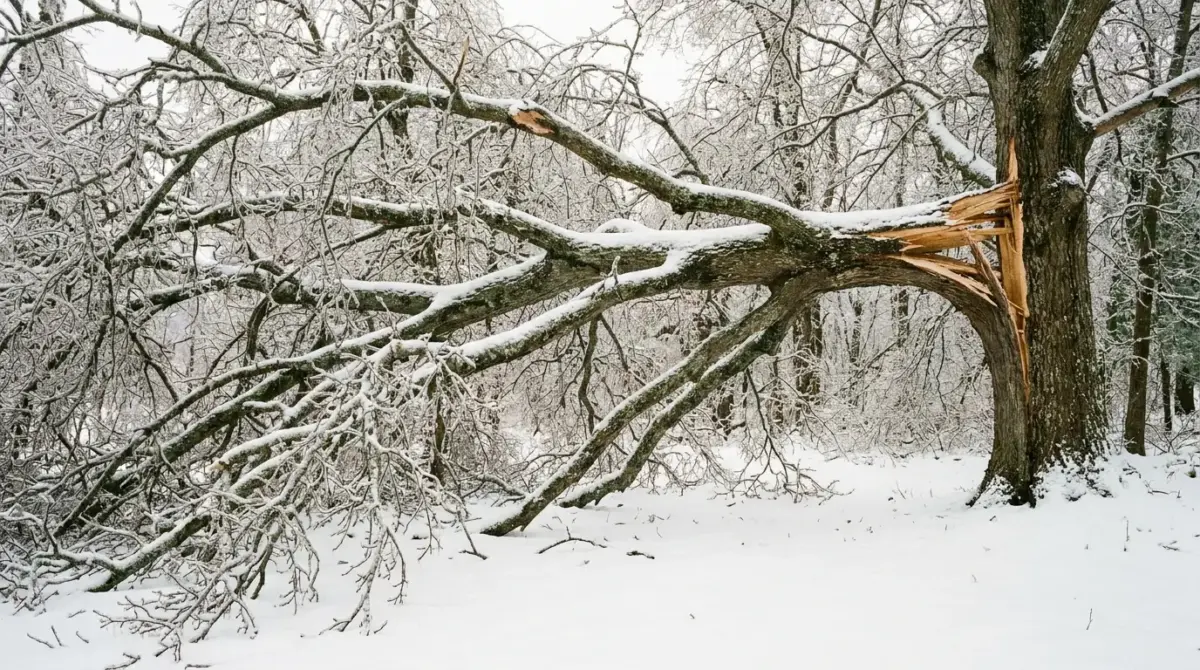
The first major snowstorm of the season just dumped a foot of heavy wet snow across Massachusetts. By morning your yard looks like a war zone – branches bent down to the ground, some snapped clean off, and the tall pine in the back looks like it’s leaning more than it used to.
Winter is harder on trees than most homeowners realize. Here’s what to look for after each storm and through the season.
Wet Snow Load Damage
The worst storms for trees are the early-winter wet snows. Branches still have leaves (in early December) and wet snow accumulates instead of blowing through. Limbs bend under the weight, sometimes snap, sometimes split at the trunk.
What to do during/after: NEVER try to knock snow off branches with a stick or broom. Frozen wood is brittle and you’ll cause more damage than the snow would. Let it melt or fall naturally.
Ice Storm Damage
Quarter-inch of ice on branches doubles the weight. Half-inch can take down power lines and major limbs. Massachusetts ice storms are catastrophic for trees because the weight is uniform across the entire canopy.
The National Weather Service winter safety guide covers ice storm preparation – most of which is also relevant to keeping your trees from making the situation worse.
Frost Cracks
When temperatures swing rapidly between cold nights and sunny days in winter, tree bark expands and contracts faster than the wood underneath. Result: vertical cracks down the trunk, sometimes several feet long.
Most frost cracks heal on their own over years. Major cracks (over an inch wide, going past the bark into the heartwood) need professional evaluation.
Salt Damage
Road salt and sidewalk de-icer kill trees over time. Salt accumulates in soil, gets taken up by roots, and prevents the tree from absorbing water properly. Common in Massachusetts trees within 30 feet of plowed roads.
Symptoms appear the following spring/summer: stunted growth, brown leaf margins, twig dieback. Fix: spring soil flushing with deep watering to leach salt out, and switching to less damaging products if you control the application.
Rodent Damage
Voles and mice eat tree bark when other food is scarce. Damage happens at the base of trunks, often hidden under snow. A continuous band of chewed bark around the trunk is a death sentence.
Prevention: hardware cloth or commercial tree guards around young trees before snow. Check trees under 5 years old every few weeks during winter.
Deer Damage
Deer rub their antlers on trunks in fall and winter and browse on lower branches. Both can damage young trees significantly. Repellents help; physical barriers (tree tubes or fencing) help more.
When to Call After a Storm
Immediately if:
- A tree fell on a structure
- A tree is leaning over a structure that wasn’t leaning before
- A major branch is hanging precariously near the house
- Power lines are involved (call utility first)
Within a week if:
- Branches snapped but the tree is otherwise stable
- Storm-bent branches haven’t sprung back
- You see new cracks in the trunk
Bottom Line
Winter in Massachusetts puts more stress on trees than the summer growing season does. Walk your trees after every major storm. Document damage with photos. Don’t try to “help” by knocking snow or ice off branches. Get professional assessment of any new lean, crack, or major branch loss.
Trusted Local Network
Winter storm tree damage almost always triggers cascading service needs across multiple trades. For related needs, we recommend specialized locksmith and door services.
Your Massachusetts Storm Cleanup Specialists
If a winter storm damaged your trees, Norfolk Tree Service serves Norfolk County, Middlesex County, and Bristol County including Waltham, Lexington, Watertown, Milton, and 40+ surrounding towns. Our 24/7 emergency tree services handle storm cleanup safely and document damage for insurance. Contact us today.